Lactoferrin powder was produced using three different methods: freeze-drying, spray-drying, and electrostatic spray-drying, with fresh liquid lactoferrin obtained from the industry as the raw material. The study evaluated the effects of these drying methods on the antioxidant capacity, antibacterial activity, degree of denaturation, and secondary structure characteristics of lactoferrin powder. Additionally, the physical and chemical properties of the lactoferrin powders, such as moisture content, particle size distribution, and iron saturation, were examined. The findings indicated that compared to lactoferrin solution, the electrostatic spray-dried (ESDLF) and spray-dried (SDLF) powders exhibited greater denaturation and conformational changes. The α-helix content increased, and the conformation became more stable, which might result in a significant loss of functional properties. In contrast, the denaturation and conformational changes in freeze-dried lactoferrin (FDLF) powder were minimal. Moreover, FDLF powder demonstrated remarkable antibacterial and anti-inflammatory capabilities compared to ESDLF powder and SDLF powders. Notably, at a sample concentration of 10%, the antibacterial efficacy of FDLF powder reached as high as 99%. This study has revealed that the freeze-drying process was the optimal method for minimizing the denaturation rate of lactoferrin and preserving the activity of lactoferrin powder.
Lactoferrin is a glycosylated protein with a molecular weight of 80kDa that is found mainly in mammalian milk 1. The lactoferrin content in bovine milk is 0.02%, while the lactoferrin content in human milk is 0.1% 2. Lactoferrin was first isolated from bovine milk in the 1830s. Studies have shown that lactoferrin possesses a wide range of physiological functions, including antibacterial, antiviral, anticancer, and iron-transporting activities, and it has broad applications in the medicinal and food industries 3, 4. Lactoferrin is often incorporated into infant formula as a nutritional supplement to enhance infant immunity. In addition, many therapeutic drugs, vaccines, and oral health products have been developed based on the medicinal properties of lactoferrin 5, 6. Currently, commercially available lactoferrin is primarily isolated from milk, with common separation methods including salting-out, ultrafiltration, dialysis and ion exchange chromatography. Lactoferrin solutions are very sensitive to factors such as temperature, pH, and microbial degradation in the environment. Therefore, it is usually converted into powder form to extend its shelf life and preserve its functional properties 5. At present, common drying methods for lactoferrin include freeze-drying, spray-drying and electrostatic spray-drying.
Freeze-drying (FD) is the most traditional drying method that minimizes lactoferrin denaturation due to its low processing temperatures, thereby preserving the protein's functional properties 7, 8. However, long drying time and high cost are the main disadvantages of this method 9. Spray-drying (SD) is a powder production method widely used in industry. This method produces lactoferrin powder with a uniform and fine particle size. In addition, the cost of spray-drying is low. However, the high temperatures and shear forces generated during atomization can induce structural changes in lactoferrin, which may compromise its physiological functions and nutritional value 10. Electrostatic spray-drying (ESD) is a novel technique wherein an electrostatic charge is applied at the nozzle to generate charged droplets from the feed solution. Due to the high charge density of solvent molecules and mutual repulsion, the solvent moves to the surface of the droplet while the active component remains in the center. Although similar to traditional spray-drying, ESD can form dry particles at lower temperatures, thereby better preserving the biological activity of heat-sensitive compounds 11. During drying, the secondary structure of lactoferrin can be altered to varying degrees by process parameters (e.g., temperature, concentration, feed flow rate, and conductivity), potentially impairing its functional properties.
Therefore, the aim of this research was to compare the effects of freeze-drying, spray-drying, and electrostatic spray-drying on the physical properties (e.g., color, moisture content, particle size), structure, and bioactivity (e.g., antibacterial activity) of lactoferrin powder. The findings of this study will provide a scientific basis for selecting an optimal drying method for lactoferrin to maximize the retention of its bioactivity, ensure safety, and fulfill its intended applications.
All reagents were GR grade and purchased from Shanghai Titan Technology Co., Ltd., including sodium chloride, sodium hydroxide and anhydrous ethanol. The lactoferrin kit was purchased from Beijing Zhongjianbaotai Biotechnology Co., Ltd. The lactoferrin solution was supplied by Inner Mongolia Mengniu Dairy (Group) Co., Ltd.
2.2. Preparation of Lactoferrin PowdersThe lactoferrin powder using the three different drying methods was produced by different manufacturers of drying equipment (Freeze dryer, Truking Technology Limited; Mini spray dryer B-290; Electrostatic spray dryer, Tianjin Dingweistree Technology Co., Ltd).
The lactoferrin solution was loaded onto a freeze-drying tray at a layer thickness of 10 mm. The freeze-drying conditions were as follows: the pre-freezing temperature was -7℃ to -40℃, and the interval was 1.6h; the sublimation temperature was 15℃ with an interval of 11.5h, and the second drying temperature was 55℃ with an interval of 3h.
The lactoferrin solution was heated to 45℃ prior to spray-drying as a pre-treatment. The inlet temperature was maintained at 160℃ and the outlet air temperature at 90℃. The feed flow rate during the spray-drying process was adjusted between 18% and 25% to maintain the set outlet temperature. The collected lactoferrin powder was used for further testing.
The atomizing nozzle utilized a pressure-type atomizer, configured with an atomization pressure of 0.3 MPa. The atomization process was conducted at 40°C. Nitrogen served as the protective gas. The inlet air temperature was regulated at 91.7°C, and the outlet air temperature was kept at 48.7°C. An electrostatic field voltage of 12 kV was applied, and the material was preheated to 50°C.
2.3. Determination of Moisture ContentThe moisture content (%) of lactoferrin powder was measured by a moisture meter (Mettler Toledo HB43 Halgen) and dried at 105℃ to a constant weight 12.
2.4. Measurement of Particle SizeThe particle size and overall distribution of lactoferrin powder were determined by MastersizerTM 2000 Ver.5.60 (Malvern Instruments Ltd.).
2.5. Measurement of Iron SaturationThe absorbance of 10 mg/mL lactoferrin solution reaching saturation is OD465=0.48 as a standard, according to which the iron saturation in the solution of unknown concentration can be estimated. The measured value at A280 after dilution of the solution should be between 1.00 and 1.50, and the solution must be passed through a 0.45μm cellulose acetate filter before determination.
2.6. Scanning Electron MicroscopyThe morphological characteristics of lactoferrin powder were observed by scanning electron microscope. The lactoferrin powder was fixed to the metal stub and coated by gold powder. All samples were photographed at an accelerating voltage of 5keV 13.
2.7. Differential Scanning CalorimetryThe denaturation degree of lactoferrin powder was determined by using DSC 14. The sample was weighed, sealed in an aluminum pan and placed in the instrument. The parameters were set as follows: heating rate 10℃/min, initial temperature 20℃, terminal temperature 100℃. After the temperature returned to the initial temperature, the measurement was initiated and the peak was integrated.
2.8. Comparative Analysis of Secondary StructureThe change of lactoferrin structure will lead to the difference of its function. Therefore, the secondary structure and change extent of lactoferrin with different drying methods were determined by using Fourier transform infrared spectroscopy to explore the relationship between the structure and function of lactoferrin. Fourier Transform Infrared (FTIR) spectroscopy was utilized to qualitatively examine the changes in the secondary structure of proteins after heat treatment, as described in the method section 15.
2.9. Antioxidant Properties of LactoferrinThe antioxidant activity of lactoferrin powders was characterized by 2,2-diphenyl-1- picrylhydrazyl radical (DPPH) scavenging assay 16.
2.10. Determination of Bacteriostatic ActivityThe antibacterial activity of lactoferrin against Staphylococcus aureus ATCC 6538 and Escherichia coli ATCC 8099 was evaluated using the plate count method. Briefly, a fresh slant culture of each test strain was incubated for 24 h, harvested, and washed with phosphate-buffered saline (PBS). The bacterial suspension was then diluted with PBS to a concentration of 5.0×10⁵ to 4.5×10⁶ CFU/mL for subsequent assays. For the assay, 5.0 mL of the lactoferrin sample was added to a sterile tube and equilibrated in a water bath at 20±1°C for 5 minutes. Then, 0.1 mL of the bacterial suspension was introduced, mixed immediately, and a timer was started. The contact time between the bacteria and the sample was strictly controlled. After the designated time, 1.0 mL of the mixture was inoculated in duplicate onto petri dishes, followed by the addition of culture medium. If necessary, the mixture was subjected to 10-fold serial dilution in PBS prior to plating. Appropriate dilutions were selected, and 1.0 mL of each was plated in duplicate for viable cell enumeration.In the positive control, PBS was used instead of the lactoferrin sample, yielding final colony counts between 1.0×10⁴ to 9.0×10⁴ CFU/mL. Negative controls containing only PBS and culture medium were also included. All plates were incubated at 36±1°C; E. coli was cultured for 48 h and S. aureus for 72 h before recording the results.
The experiment was performed in triplicate, and the antibacterial rate was calculated as follows:
 | (1) |
In the formula, X represents the antibacterial rate; A0 represents the amount of recovered bacteria in the positive control group; A1 is the amount of recovered bacteria in the experimental group.
The residual moisture content, mean particle size, and iron saturation of the lactoferrin powders are presented in Table 1. Moisture content is a critical parameter influencing both the physicochemical properties and shelf life of the powder. Among the three drying methods, the FDLF powder exhibited the lowest moisture content, which was nearly half that of the SDLF and ESDLF powders. This indicates that freeze-drying has superior drying efficiency, while spray-drying methods retained more water. Notably, the moisture content of both FDLF and ESDLF powders remained below 4.5%.
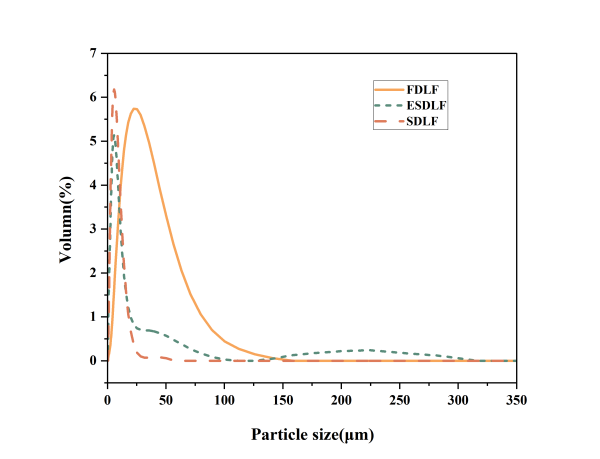
Particle size distribution and average particle size are the main parameters to characterize the particle size of lactoferrin powder. In order to explore the influence of different drying methods on the particle size of the powder, the particle size data of the powder under different drying methods were statistically analyzed by the particle size distribution detection method. The particle size distribution of lactoferrin powder was shown in Figure 1. The research results indicated that the average particle size of lactoferrin powder prepared via freeze-drying was 21.54 μm. Compared with the other two types of lactoferrin powders, the particle size of the powder obtained through freeze-drying was notably larger. Analysis of the particle size distribution curves revealed that the curves for spray-dried lactoferrin powder (SDLF) and electrostatic spray-dried lactoferrin powder (ESDLF) were virtually indistinguishable, demonstrating a highly consistent particle size distribution. However, it should be highlighted that the particle size distribution profile of SDLF features two prominent peaks, which suggested that the uniformity of the particle size in the powder produced by this method was relatively inadequate. In contrast, the particle size distribution of freeze-dried lactoferrin powder (FDLF) was relatively broader. The reason was that the freeze-dried lactoferrin powder was prepared by grinding. The particle size was predominantly determined by the grinding conditions, including the type of grinder, the mesh size of the sieve, and the grinding speed. Although the preparation process for freeze-dried lactoferrin powder was more complex than that of the other two drying methods, it offered the flexibility to tailor the particle size by adjusting the grinding conditions, thereby catering to diverse application requirements.
Iron saturation is an important indicator to measure the degree of iron ion binding in lactoferrin. Generally, the iron saturation of lactoferrin is 10-20%. Some studies have indicated that iron saturation may be related to the biological activity of lactoferrin. In this study, we conducted iron saturation tests on the above three kinds of lactoferrin powder, and the results showed that the iron saturation of the three kinds of lactoferrin was roughly the same, among which the iron saturation of FDLF and ESDLF was 11 and the iron saturation of SDLF was 12, although there were small differences, these differences were not significant.

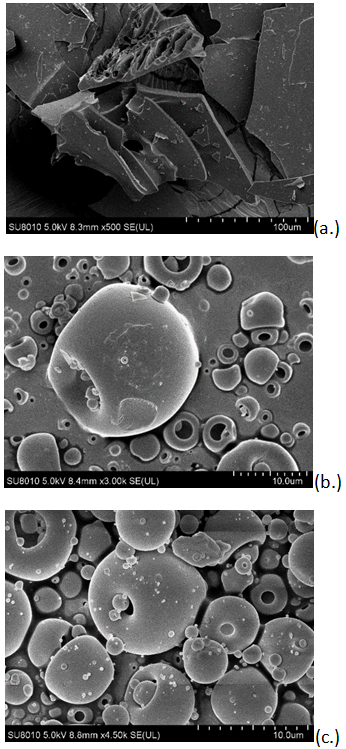
The SEM images of lactoferrin powder obtained by different drying methods were shown in Figure 2. The lactoferrin powders derived from different drying methods exhibited morphological appearances. The FDLF particles predominantly exhibited a flaky morphology with a relatively smooth surface. Moreover, its internal structure contained a large number of pores and showed a porous honeycomb structure. The lyophilization process, which involved water sublimation, led to the formation of a loose, porous structure in the lactoferrin powder. The overall shape of lactoferrin powders obtained through spray-drying and electrostatic spray-drying was spherical, while their interiors were mostly hollow and displayed a concave morphology.

The thermal denaturation of lactoferrin powder prepared by freeze-drying, spray-drying, and electrostatic spray-drying methods was investigated using differential scanning calorimetry (DSC) in Milli-Q water at a heating rate of 10℃/min. The degree of denaturation of lactoferrin solution was presented in Table 2 through DSC test data. The DSC peak temperature (Tmax) for the freeze-dried lactoferrin powder was measured at 74.36℃, aligning with the temperature range reported in the literature. Nevertheless, the DSC temperatures for electrostatic spray-drying and spray-drying tended to be relatively higher which were 81.93℃ and 85.98℃. It was worth noting that the temperature of DSC for electrostatic spray-drying and spray-drying were consistent with reports from other research groups for holo-LF 17. Studies revealed that an increase in the iron saturation of lactoferrin was associated with a higher denaturation temperature and a more dense structure 18, 19. Meanwhile, the biological function of lactoferrin tended to be gradually reduced or even lost 20. Therefore, the above results indicated that the structure of lactoferrin powders may become more compact and its conformation tended to be stable during spray-drying and electrostatic spray-drying. In addition, we observed that compared with the other two lactoferrin powders, freeze-dried lactoferrin powders had the highest calorimetric enthalpy change (△Hcal), reaching 250J/g. This further implied that freeze-dried lactoferrin required the absorption of more heat during the process of thermal denaturation.
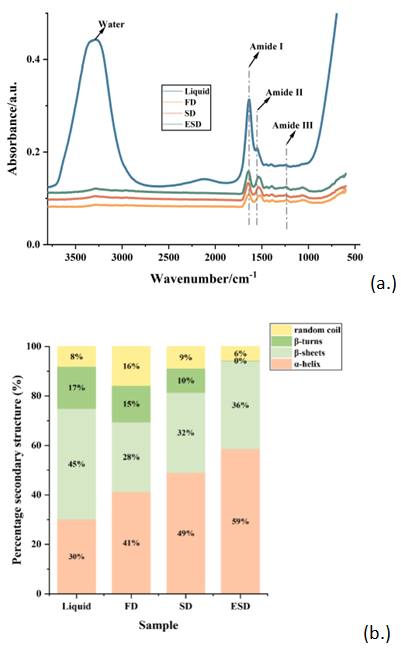
Lactoferrin liquid and lactoferrin powder with different drying methods were determined by Fourier infrared spectroscopy, and the secondary structure of lactoferrin was calculated by data fitting. The Fourier infrared spectra were presented in Figure 3. The difference between the curves in the figure indicated that the conformation of lactoferrin changes during drying. As depicted in the figure, the lactoferrin solution displayed a prominent absorption peak at 3294 cm-1, which was absent in the lactoferrin powder spectrum. This peak indicated the presence of a significant amount of water in the lactoferrin solution. The lactoferrin powder, obtained via drying, exhibited no strong absorption peak at this wavelength, suggesting that the drying process effectively removed a large amount of water from the lactoferrin solution. In addition, compared with spray-drying and electrostatic spray-drying, the freeze-dried lactoferrin powder exhibited the lowest absorption peak strength.
This illustrated that the water content of the freeze-dried lactoferrin powder was the lowest, which was consistent with the previously measured water content of the lactoferrin powders. Lactoferrin solutions also exhibit absorption peaks that characterize functional groups and chemical bonds, such as the peaks of Amide Ⅰ containing C-N stretching and -C=C- bonds at 1637.5 cm-1, AmideⅡ containing C-N stretching and N-H stretching at 1545 cm-1, Amide Ⅲ including C-N stretching and N-H bending at 1234 cm-1 21, 22. However, the Amide Ⅱ peak at 1545 cm-1 was obviously shifted to the right in the spectrum of lactoferrin powders by comparison with that of lactoferrin solution. Meanwhile, the characteristic peak of Amide Ⅱ in freeze-dried lactoferrin powder migrated farther which was caused by different drying methods.

The composition and content of lactoferrin secondary structure were transformed by fitting the Fourier infrared spectrum data. Table 3 illustrates the percentage of secondary structure in lactoferrin solution and lactoferrin powders. The powders were produced through freeze-drying, spray-drying and electrostatic spray-drying methods. The percentages of secondary structure indicated that the FDLF, SDLF and ESDLF tended to adopt more α-helix and less β-sheets and β-turns compared with lactoferrin liquid. It was worth noting that the freeze-dried lactoferrin powder exhibited a relatively lower β-sheets content. The existence of α-helix and β-turns was conducive to the proper folding of lactoferrin structure. Besides, the random coil content of FDLF was higher compared with SDLF and ESDLF. Research indicated that the functionality of lactoferrin was highly dependent on its β-strands content 23, 24. In this particular study, the lactoferrin liquid exhibited the highest β-strands content at 61.7%, followed by the freeze-dried lactoferrin powder, while the electrostatic spray-dried lactoferrin powder had the lowest content, amounting to just 35.8%.
Studies have shown that lactoferrin can inhibit the occurrence of Haber-Weiss reaction through chelation, so as to reduce the generation of hydroxyl free radicals, and has antioxidant and cell protective effects on oxidative stress caused by hydrogen peroxide reaction. The antioxidant capacity of lactoferrin prepared by various drying methods was compared by measuring their inhibitory effects on DPPH, with the results illustrated in the Figure 4. When the concentration was 5%, the clearance rate of DPPH-scavenging capacity of lactoferrin powder made by FD, SD and ESD were 48.35%, 18.41% and 37.98%, respectively.
Moreover, when the concentration of FDLF reached 1%, its DPPH-scavenging capacity achieved a clearance rate exceeding 10%. Interestingly, the DPPH clearance rate of spray-dried lactoferrin powder was significantly lower than that of lactoferrin powder prepared by the other two drying methods when the concentration was high. However, at low concentrations, the clearance rate was similar to that of the other two drying methods and was even slightly higher than that of electrostatic spray-dried lactoferrin powder. Among the three drying methods, the DPPH-radical scavenging ability of freeze-dried lactoferrin powder was significantly higher than that for SD and ESD lactoferrin powders.

These results indicated that the drying methods had a significant effect on the antioxidant capacity of lactoferrin powder. The change in antioxidant capacity may be attributed to the following reasons. Lactoferrin may undergo denaturation or conformational changes due to severe and / or prolonged heat treatment, mechanical shear force, and other factors, which in turn led to a decrease in its antioxidant capacity.
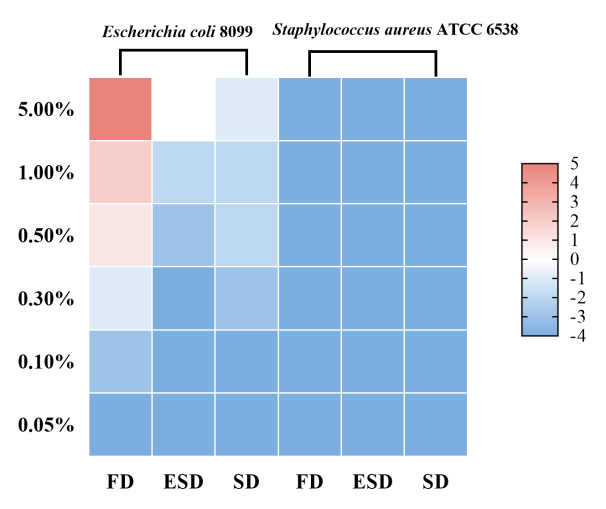
3.6. Antibacterial Activities of Lactoferrin PowdersTo verify the antimicrobial activity of lactoferrin against microorganisms, we examined two bacteria: Escherichia coli 8099 and Staphylococcus aureus ATCC 6538. According to the evaluation method of antibacterial and antibacterial effect WS/T 650-2019, the antibacterial efficacy of lactoferrin was assessed by determining the bacterial inhibition rate. An antibacterial effect was considered present if the antibacterial rate was ≥50%. Conversely, if the bacteriostatic rate was below 50%, no bacteriostatic effect was observed. Furthermore, a bacteriostatic rate of ≥90% indicated a strong bacteriostatic effect. The results of the tests were illustrated in Figure 5. Figure 5 showed a heat map evaluating the inhibitory capacity of three lactoferrin powders against Escherichia coli 8099, where pink represented inhibitory activity and blue represented no inhibitory activity. The depth of the color was determined by the difference in antibacterial ability. It is worth noting that as the concentration of lactoferrin powder increased, none of the three lactoferrin powders exhibited antibacterial activity against Staphylococcus aureus ATCC 6538. In contrast, the three lactoferrin powders demonstrated varying degrees of antibacterial activity against Escherichia coli 8099. In the bacterial inhibition experiments targeting Escherichia coli 8099, the inhibition rates achieved by lactoferrin powder (FDLF, SDLF, ESDLF) at various concentrations ranging from 0.05% to 5% were between 7.55% and 99%.
As the concentration of lactoferrin increased, the antimicrobial properties of FDLF showed the most significant improvement (as evidenced by the number of visible pink squares). Many studies have demonstrated that lactoferrin possesses the ability to inhibit Gram-negative bacteria through its interaction with Gram-negative lipopolysaccharide (LPS) 25, 26. According to Elass-Rochard et al 27, the N-terminal region of lactoferrin which included the lactoferrin peptide sequence binds to LPS present on the cell membrane of Escherichia coli. This interaction led to the detachment of LPS from the bacterial membrane of Escherichia coli, ultimately causing the disruption of the bacterial cell and thereby preventing its proliferation. Additional research indicated that the antibacterial efficacy of lactoferrin was influenced by its iron saturation level and concentration. Specifically, lactoferrin exhibited bactericidal activity primarily in its iron-free state, whereas the antibacterial potency of lactoferrin that is iron-saturated is diminished 28.
We observed that as the concentration of lactoferrin increased, the bacteriostatic rates of both SDLF and ESDLF gradually improved. However, neither of their bacteriostatic rates reached or exceeded 50%. Moreover, the bacteriostatic rate of ESDLF was relatively lower compared to that of SDLF. This observation aligned with the finding of other researchers, who have demonstrated that freeze-drying effectively preserves the activity of lactoferrin. In contrast, spray-drying and electrostatic spray-drying may lead to alterations in the structure of lactoferrin due to factors such as high temperatures or shear forces from the nozzle during the drying process. These structural changes can result in diminished activity or even complete inactivation of lactoferrin.

This study investigated the impact of various drying methods on the physicochemical properties of lactoferrin, including moisture content, particle size, antioxidant activity, and antibacterial ability. The results demonstrated that different drying methods can significantly alter these properties. Specifically, the freeze-drying method notably enhanced the bacteriostatic and antioxidant capabilities of lactoferrin. Given these findings, freeze-drying can be considered an effective approach for optimizing the utilization and storage of lactoferrin. Freeze-drying technology is particularly effective in preserving the bioactive components and functional properties of lactoferrin.
This work was supported by grants from the Department of Science and Technology of Inner Mongolia Autonomous Region through the Inner Mongolia Autonomous Region Science (Grant No.2025KYPT0065), the "Talents for Inner Mongolia" project Team of the Inner Mongolia Autonomous Region (Grant No.2025TEL29).
| [1] | Z.-S. Liu, P.-W. Chen. Featured Prebiotic Agent: The Roles and Mechanisms of Direct and Indirect Prebiotic Activities of Lactoferrin and Its Application in Disease Control. Nutrients 2023, 15 (12), 2759. | ||
| In article | View Article PubMed | ||
| [2] | S.G. Anema. Acidification of lactoferrin-casein micelle complexes in skim milk. Int. Dairy J. 2019, 99, 104550. | ||
| In article | View Article | ||
| [3] | E. Levy, V. Marcil, S. Tagharist Ép Baumel, et al. Lactoferrin, Osteopontin and Lactoferrin–Osteopontin Complex: A Critical Look on Their Role in Perinatal Period and Cardiometabolic Disorders. Nutrients 2023, 15 (6), 1394. | ||
| In article | View Article PubMed | ||
| [4] | P.P. Ward, E. Paz, O.M. Conneely. Lactoferrin: Multifunctional roles of lactoferrin: a critical overview. Cell. Mol. Life Sci. 2005, 62 (22), 2540–2548. | ||
| In article | View Article PubMed | ||
| [5] | B. Wang, Y.P. Timilsena, E. Blanch, B. Adhikari. Lactoferrin: Structure, function, denaturation and digestion. Crit. Rev. Food Sci. Nutr. 2019, 59 (4), 580–596. | ||
| In article | View Article PubMed | ||
| [6] | M. Tomita, H. Wakabayashi, K. Shin, et al. Twenty-five years of research on bovine lactoferrin applications. Biochimie 2009, 91 (1), 52–57. | ||
| In article | View Article PubMed | ||
| [7] | B. Liu, X. Zhou. Freeze-drying of Proteins. In Cryopreservation and Freeze-drying Protocols; Wolkers, W. F., Oldenhof, H., Eds.; Methods in Molecular Biology; Springer New York, New York, NY, 2015; Vol. 1257, pp 459–476. | ||
| In article | View Article PubMed | ||
| [8] | V. Prosapio, E. Lopez-Quiroga. Freeze-drying Technology in Foods. Foods 2020, 9 (7), 920. | ||
| In article | View Article PubMed | ||
| [9] | M. Tomita, H. Wakabayashi, K. Yamauchi, S. Teraguchi, H. Hayasawa. Bovine lactoferrin and lactoferricin derived from milk: production and applications. Biochem. Cell Biol. 2002, 80 (1), 109–112. | ||
| In article | View Article PubMed | ||
| [10] | B. Wang, Y.P. Timilsena, E. Blanch, B. Adhikari. Characteristics of bovine lactoferrin powders produced through spray and freeze drying processes. Int. J. Biol. Macromol. 2017, 95, 985–994. | ||
| In article | View Article PubMed | ||
| [11] | P. Jayaprakash, A. Maudhuit, C. Gaiani, S. Desobry. Encapsulation of bioactive compounds using competitive emerging techniques: Electrospraying, nano spray drying, and electrostatic spray drying. J. Food Eng. 2023, 339, 111260. | ||
| In article | View Article | ||
| [12] | B. Demircan, Y.S. Velioglu, A.M. Giuffrè. Comparison of different drying methods for bergamot peel: Chemical and physicochemical properties. J. Food Sci. 2024, 89 (3), 1498–1516. | ||
| In article | View Article PubMed | ||
| [13] | Q. Ma, R.K. Santhanam, Z. Xue, et al. Effect of different drying methods on the physicochemical properties and antioxidant activities of mulberry leaves polysaccharides. Int. J. Biol. Macromol. 2018, 119, 1137–1143. | ||
| In article | View Article PubMed | ||
| [14] | C. Conesa, L. Sánchez, C. Rota, et al. Isolation of lactoferrin from milk of different species: Calorimetric and antimicrobial studies. Comp. Biochem. Physiol. B Biochem. Mol. Biol. 2008, 150 (1), 131–139. | ||
| In article | View Article PubMed | ||
| [15] | S.J. Gaspard, A.V. Sunds, L.B. Larsen, et al. Influence of desialylation of caseinomacropeptide on the denaturation and aggregation of whey proteins. J. Dairy Sci. 2020, 103 (6), 4975–4990. | ||
| In article | View Article PubMed | ||
| [16] | S.C.T. Nicklisch, J.H. Waite. Optimized DPPH assay in a detergent-based buffer system for measuring antioxidant activity of proteins. MethodsX 2014, 1, 233–238. | ||
| In article | View Article PubMed | ||
| [17] | H. Bokkhim, N. Bansal, L. GrØndahl, B. Bhandari. Physico-chemical properties of different forms of bovine lactoferrin. Food Chem. 2013, 141 (3), 3007–3013. | ||
| In article | View Article PubMed | ||
| [18] | D.A. Goulding, J. O’Regan, L. Bovetto, N.M. O’Brien, J.A. O’Mahony. Influence of thermal processing on the physicochemical properties of bovine lactoferrin. Int. Dairy J. 2021, 119, 105001. | ||
| In article | View Article | ||
| [19] | C. Conesa, L. Sánchez, M.-D. Pérez, M. Calvo. A Calorimetric Study of Thermal Denaturation of Recombinant Human Lactoferrin from Rice. J. Agric. Food Chem. 2007, 55 (12), 4848–4853. | ||
| In article | View Article PubMed | ||
| [20] | A. Sreedhara, R. Flengsrud, T. Langsrud, et al. Structural characteristic, pH and thermal stabilities of apo and holo forms of caprine and bovine lactoferrins. BioMetals 2010, 23 (6), 1159–1170. | ||
| In article | View Article PubMed | ||
| [21] | J. Kong, S. Yu. Fourier Transform Infrared Spectroscopic Analysis of Protein Secondary Structures. Acta Biochim. Biophys. Sin. 2007, 39 (8), 549–559. | ||
| In article | View Article PubMed | ||
| [22] | Y.P. Timilsena, R. Adhikari, C.J. Barrow, B. Adhikari. Physicochemical and functional properties of protein isolate produced from Australian chia seeds. Food Chem. 2016, 212, 648–656. | ||
| In article | View Article PubMed | ||
| [23] | Š. Gruden, N.P. Ulrih. Diverse Mechanisms of Antimicrobial Activities of Lactoferrins, Lactoferricins, and Other Lactoferrin-Derived Peptides. | ||
| In article | |||
| [24] | P.M. Hwang, N. Zhou, X. Shan, C.H. Arrowsmith, H.J. Vogel. Three-Dimensional Solution Structure of Lactoferricin B, an Antimicrobial Peptide Derived from Bovine Lactoferrin. Biochemistry 1998, 37 (12), 4288–4298. | ||
| In article | View Article PubMed | ||
| [25] | B.J. Appelmelk, Y.Q. An, M. Geerts, et al. Lactoferrin is a lipid A-binding protein. Infect. Immun. 1994, 62 (6), 2628–2632. | ||
| In article | View Article PubMed | ||
| [26] | S. Farnaud, R.W. Evans. Lactoferrin—a multifunctional protein with antimicrobial properties. Mol. Immunol. 2003, 40 (7), 395–405. | ||
| In article | View Article PubMed | ||
| [27] | E. Elass-Rochard, A. Roseanu, D. Legrand, et al. Lactoferrin-lipopolysaccharide interaction: involvement of the 28-34 loop region of human lactoferrin in the high-affinity binding to Escherichia coli 055B5 lipopolysaccharide. Biochem. J. 1995, 312 (Pt 3), 839–845. | ||
| In article | View Article PubMed | ||
| [28] | A. Bernhardt, M. Wehrl, B. Paul, et al. Improved Sterilization of Sensitive Biomaterials with Supercritical Carbon Dioxide at Low Temperature. PLOS ONE 2015, 10 (6), e0129205. | ||
| In article | View Article PubMed | ||
Published with license by Science and Education Publishing, Copyright © 2026 Xuena Dong, Yu Liu, Shengbo Yu, Zhao Li, Chunyu Wu, Yun Chen, ZengLi Gao and Zhishen Mu
 This work is licensed under a Creative Commons Attribution 4.0 International License. To view a copy of this license, visit
http://creativecommons.org/licenses/by/4.0/
This work is licensed under a Creative Commons Attribution 4.0 International License. To view a copy of this license, visit
http://creativecommons.org/licenses/by/4.0/
| [1] | Z.-S. Liu, P.-W. Chen. Featured Prebiotic Agent: The Roles and Mechanisms of Direct and Indirect Prebiotic Activities of Lactoferrin and Its Application in Disease Control. Nutrients 2023, 15 (12), 2759. | ||
| In article | View Article PubMed | ||
| [2] | S.G. Anema. Acidification of lactoferrin-casein micelle complexes in skim milk. Int. Dairy J. 2019, 99, 104550. | ||
| In article | View Article | ||
| [3] | E. Levy, V. Marcil, S. Tagharist Ép Baumel, et al. Lactoferrin, Osteopontin and Lactoferrin–Osteopontin Complex: A Critical Look on Their Role in Perinatal Period and Cardiometabolic Disorders. Nutrients 2023, 15 (6), 1394. | ||
| In article | View Article PubMed | ||
| [4] | P.P. Ward, E. Paz, O.M. Conneely. Lactoferrin: Multifunctional roles of lactoferrin: a critical overview. Cell. Mol. Life Sci. 2005, 62 (22), 2540–2548. | ||
| In article | View Article PubMed | ||
| [5] | B. Wang, Y.P. Timilsena, E. Blanch, B. Adhikari. Lactoferrin: Structure, function, denaturation and digestion. Crit. Rev. Food Sci. Nutr. 2019, 59 (4), 580–596. | ||
| In article | View Article PubMed | ||
| [6] | M. Tomita, H. Wakabayashi, K. Shin, et al. Twenty-five years of research on bovine lactoferrin applications. Biochimie 2009, 91 (1), 52–57. | ||
| In article | View Article PubMed | ||
| [7] | B. Liu, X. Zhou. Freeze-drying of Proteins. In Cryopreservation and Freeze-drying Protocols; Wolkers, W. F., Oldenhof, H., Eds.; Methods in Molecular Biology; Springer New York, New York, NY, 2015; Vol. 1257, pp 459–476. | ||
| In article | View Article PubMed | ||
| [8] | V. Prosapio, E. Lopez-Quiroga. Freeze-drying Technology in Foods. Foods 2020, 9 (7), 920. | ||
| In article | View Article PubMed | ||
| [9] | M. Tomita, H. Wakabayashi, K. Yamauchi, S. Teraguchi, H. Hayasawa. Bovine lactoferrin and lactoferricin derived from milk: production and applications. Biochem. Cell Biol. 2002, 80 (1), 109–112. | ||
| In article | View Article PubMed | ||
| [10] | B. Wang, Y.P. Timilsena, E. Blanch, B. Adhikari. Characteristics of bovine lactoferrin powders produced through spray and freeze drying processes. Int. J. Biol. Macromol. 2017, 95, 985–994. | ||
| In article | View Article PubMed | ||
| [11] | P. Jayaprakash, A. Maudhuit, C. Gaiani, S. Desobry. Encapsulation of bioactive compounds using competitive emerging techniques: Electrospraying, nano spray drying, and electrostatic spray drying. J. Food Eng. 2023, 339, 111260. | ||
| In article | View Article | ||
| [12] | B. Demircan, Y.S. Velioglu, A.M. Giuffrè. Comparison of different drying methods for bergamot peel: Chemical and physicochemical properties. J. Food Sci. 2024, 89 (3), 1498–1516. | ||
| In article | View Article PubMed | ||
| [13] | Q. Ma, R.K. Santhanam, Z. Xue, et al. Effect of different drying methods on the physicochemical properties and antioxidant activities of mulberry leaves polysaccharides. Int. J. Biol. Macromol. 2018, 119, 1137–1143. | ||
| In article | View Article PubMed | ||
| [14] | C. Conesa, L. Sánchez, C. Rota, et al. Isolation of lactoferrin from milk of different species: Calorimetric and antimicrobial studies. Comp. Biochem. Physiol. B Biochem. Mol. Biol. 2008, 150 (1), 131–139. | ||
| In article | View Article PubMed | ||
| [15] | S.J. Gaspard, A.V. Sunds, L.B. Larsen, et al. Influence of desialylation of caseinomacropeptide on the denaturation and aggregation of whey proteins. J. Dairy Sci. 2020, 103 (6), 4975–4990. | ||
| In article | View Article PubMed | ||
| [16] | S.C.T. Nicklisch, J.H. Waite. Optimized DPPH assay in a detergent-based buffer system for measuring antioxidant activity of proteins. MethodsX 2014, 1, 233–238. | ||
| In article | View Article PubMed | ||
| [17] | H. Bokkhim, N. Bansal, L. GrØndahl, B. Bhandari. Physico-chemical properties of different forms of bovine lactoferrin. Food Chem. 2013, 141 (3), 3007–3013. | ||
| In article | View Article PubMed | ||
| [18] | D.A. Goulding, J. O’Regan, L. Bovetto, N.M. O’Brien, J.A. O’Mahony. Influence of thermal processing on the physicochemical properties of bovine lactoferrin. Int. Dairy J. 2021, 119, 105001. | ||
| In article | View Article | ||
| [19] | C. Conesa, L. Sánchez, M.-D. Pérez, M. Calvo. A Calorimetric Study of Thermal Denaturation of Recombinant Human Lactoferrin from Rice. J. Agric. Food Chem. 2007, 55 (12), 4848–4853. | ||
| In article | View Article PubMed | ||
| [20] | A. Sreedhara, R. Flengsrud, T. Langsrud, et al. Structural characteristic, pH and thermal stabilities of apo and holo forms of caprine and bovine lactoferrins. BioMetals 2010, 23 (6), 1159–1170. | ||
| In article | View Article PubMed | ||
| [21] | J. Kong, S. Yu. Fourier Transform Infrared Spectroscopic Analysis of Protein Secondary Structures. Acta Biochim. Biophys. Sin. 2007, 39 (8), 549–559. | ||
| In article | View Article PubMed | ||
| [22] | Y.P. Timilsena, R. Adhikari, C.J. Barrow, B. Adhikari. Physicochemical and functional properties of protein isolate produced from Australian chia seeds. Food Chem. 2016, 212, 648–656. | ||
| In article | View Article PubMed | ||
| [23] | Š. Gruden, N.P. Ulrih. Diverse Mechanisms of Antimicrobial Activities of Lactoferrins, Lactoferricins, and Other Lactoferrin-Derived Peptides. | ||
| In article | |||
| [24] | P.M. Hwang, N. Zhou, X. Shan, C.H. Arrowsmith, H.J. Vogel. Three-Dimensional Solution Structure of Lactoferricin B, an Antimicrobial Peptide Derived from Bovine Lactoferrin. Biochemistry 1998, 37 (12), 4288–4298. | ||
| In article | View Article PubMed | ||
| [25] | B.J. Appelmelk, Y.Q. An, M. Geerts, et al. Lactoferrin is a lipid A-binding protein. Infect. Immun. 1994, 62 (6), 2628–2632. | ||
| In article | View Article PubMed | ||
| [26] | S. Farnaud, R.W. Evans. Lactoferrin—a multifunctional protein with antimicrobial properties. Mol. Immunol. 2003, 40 (7), 395–405. | ||
| In article | View Article PubMed | ||
| [27] | E. Elass-Rochard, A. Roseanu, D. Legrand, et al. Lactoferrin-lipopolysaccharide interaction: involvement of the 28-34 loop region of human lactoferrin in the high-affinity binding to Escherichia coli 055B5 lipopolysaccharide. Biochem. J. 1995, 312 (Pt 3), 839–845. | ||
| In article | View Article PubMed | ||
| [28] | A. Bernhardt, M. Wehrl, B. Paul, et al. Improved Sterilization of Sensitive Biomaterials with Supercritical Carbon Dioxide at Low Temperature. PLOS ONE 2015, 10 (6), e0129205. | ||
| In article | View Article PubMed | ||