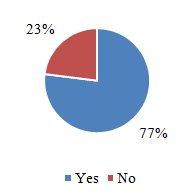
Teacher training programme following the pandemic is in dire need of reformation, especially with evolving technologies being used by students and teachers. This study explored how online learning and artificial intelligence (AI) have influenced teacher preparedness in this digital age and their teaching practices. The mixed-methods approach was employed, leveraging a convergent parallel research design to capture the simultaneous analysis of quantitative and qualitative data. A sample of sixty (n=60) educators participated in the study, who were selected using purposive sampling. The data was collected using questionnaires, interviews, and focus group discussions. The findings revealed that most educators had moderate proficiency in using technology but needed adequate training and emotional support. Approximately 77% of them agreed with the integration of AI in Jamaican classrooms. The study further emphasized that ongoing structured professional development is required for AI integration, along with infrastructural investments, and the implementation of policies for the digital transformation of the education sector.
The Jamaican education system has experienced a series of rapid transformations since the COVID-19 pandemic. This was first initiated by a government order on March 13, 2020, forcing schools to transition to online modality, a new phase for almost every educational institution 1. This means educators were now treading new waters, revealing the structural gaps in the education system, including challenges accessing devices and the internet. These problems varied from classroom to classroom and depended on geographic location – whether rural or urban. Additionally, teachers have expressed that they lacked the virtual pedagogy training, digital classroom management skills, and the infrastructure necessary to engage the students online. Robinson 2 echoed their accounts, emphasizing that students’ learning was hindered right across various levels of the system, early childhood, primary, high school, and even tertiary because online learning called for self-directed learning they were not prepared for and they received slow or insufficient feedback. These students also experienced reduced peer and teacher interactions as well as emotional support to thrive with this ‘new’ virtual environment. Moreover, students were also not turning up for classes due to similar challenges as teachers, such as poor connectivity and a lack of devices. This has hindered teachers’ efforts to facilitate structured virtual lessons, which they sometimes have to abandon to reach students through different means such as WhatsApp messages, voice notes, and PDF notes and worksheets 3, 4. These realities have highlighted inequalities across Jamaica’s education system, as well as its limited preparedness in effectively harnessing technological practices.
In response to the experiences of teachers, the Ministry of Education and Youth devised an initiative with relevant agencies equipped to promptly provide training for teachers to improve their digital skills. In September 2020, the Jamaica Teaching Council (JTC) provided thousands of teachers with training to navigate the online platforms, with a focus mostly on Zoom and Google Classroom 5. This was further strengthened by a collaboration with UNESCO, which allowed teachers to benefit from training sessions and, in turn, train other teachers, particularly at their schools. National College for Educational Leadership (NCEL), on the other hand, provided leadership training to about 2500 school administrators to help them provide effective guidance to their teachers through the sudden shift to digital learning 5, 6.
Even with these measures of support, the underlying issues of pedagogical competencies were still not fully addressed to ensure sustained digital and blended learning environments beyond the pandemic. Currently, teachers still need to be familiarized with the various digital tools, which require further training for digital pedagogy competencies as well as online instructional design to facilitate both instructional delivery and digital classroom management 7. Gudmundsdottir and Hathaway 8 pointed out that part of the training includes equipping teachers to redesign the learning pathways for multiple modalities, adjusting content from the traditional form to a virtual-ready format. Also, the educators need to adapt teaching methods most suited for online learning to motivate students and keep them engaged. Globally, educators have reported that all these changes have caused increased stress, burnout, and emotional strain, especially as they simultaneously dealt with their personal and household challenges 9.
Since post-COVID, classrooms have drastically changed with digital tools emerging, including artificial intelligence (AI), which has reshaped teaching practices and professional development. Worldwide, educators have adapted AI tools such as ChatGPT and Copilot to assist with their administrative duties, like lesson development, from content and lesson activities and differentiated instruction, to the creation of assessments with solutions 7 10 11. In Jamaica, however, the adoption of AI remains limited and uneven due to infrastructural constraints and limited exposure within teacher-education programmes. Samuels et al. 10 highlighted that Jamaican teachers express interest in AI-enhanced teaching, but require structured training, ethical guidance, and practical opportunities for integration into real classroom settings.
1.1. Statement of the ProblemThe COVID-19 pandemic acted as a stimulus, rapidly accelerating digital adoption in the Jamaican educational landscape. However, many Jamaican teachers continue to experience gaps in digital pedagogy, online assessment, and AI-enhanced instruction. Short-term training initiatives improved basic technical skills but did not fully prepare educators for sustained digital and AI-integrated teaching. The reaction to the COVID-19 pandemic was not sustained. Hence, teacher-training institutions face the challenge of modernizing curricula to reflect 21st-century digital tools with the active and overt emergence of AI.
1.2. Purpose of the StudyThe purpose of this study is to examine how online learning and artificial intelligence influence educator preparedness and pedagogical practice in Jamaica. The study examined how the classrooms have been transformed digitally and the impact on instructional design, and teachers’ perceptions of professional readiness since 2022. AI-based competencies may need center stage in making education relevant in this paradigm. Understanding how online learning and AI integration influence teacher preparedness is therefore essential to improving teacher-education programmes in Jamaica.
1.3. Significance of the StudyThe study is important for the Jamaican education system to become modernized, starting with teacher training programmes based on the growing global demand for digital tools and education coming out of the pandemic 12, 13. According to a UNESCO 13 report, to address the 21st century classroom needs, teaching practices must become more technology-driven but for students to become technologically savvy. Based on the report, there is a call for advanced development of teachers’ competencies, such as training teachers to become AI literate, to understand ethical technology, and be equipped with digital pedagogy to deliver effective instruction to digital-age learners. The OECD 14 further emphasized that lessons, when integrated with digital tools, need to be meaningful to improve student learning outcomes, as well as the need for teachers to become responsible with the technologies they use. In other words, teacher becoming competent in leveraging technology can facilitate students with a deeper understanding of subject matter and personalized learning opportunities. This will allow them to better handle online classes where they are not just replicating traditional teaching methods. These teachers can use adaptive platforms and simulations to drive interaction, collaboration, and critical thinking. However, teachers are encouraged to use technology with caution, by assessing each technology in terms of pedagogical appropriateness to facilitate an inclusive classroom and long-term student learning outcomes. As such educators need to align curriculum goals with the technological tools in an intentional manner. As such, addressing gaps related to digital access and teacher training is important, especially for developing economies such as Jamaica, to break down the barriers affecting teacher preparedness 15, 16. Therefore, this research will provide context-specific insights that draw on teachers’ experiences in virtual classrooms and their use of AI tools. This is essential to identifying professional development priorities and policies that may be needed, as well as guiding curriculum reformation in this digital era.
1.4. Research QuestionsThe study will be guided by the following research questions:
1. To what extent have online learning impacted teacher preparedness and their pedagogical practices since 2022?
2. In what ways has AI hindered or improved teaching practices in the digital age?
3. What are the views of teachers on their professional growth and preparedness based on their exposure to both traditional online training and the integration of AI tools in the classroom?
1.5. Definition of Key TermsOnline Learning involves engaging learners in an online space where they are provided with instructions, where the teacher uses digital platforms in real-time or otherwise.
Artificial Intelligence is defined as an automation ‘based on associations’ 17.
Teacher Preparedness is a measure of teachers having the relevant skills, knowledge, tools, teaching methods, and confidence to engage students effectively, such that learning outcomes are improved 18.
Digital Pedagogy is the method and practice of teaching that encompasses several other types of pedagogy by integrating them with digital technologies 8. In doing so, it seeks to facilitate the delivery of engaging lessons by leveraging students’ access to technological tools and promoting active learning, critical thinking, and improved learning outcomes.
Given the rapid usage of digital technologies in the post-COVID era, both online learning and artificial intelligence have emerged as characteristics of education and learning. The status of digital usage in Jamaica is expanding, with more students and businesses incorporating technology in their daily routines. For example, there is increased engagement online via social media platforms like TikTok and Instagram, whether for ecommerce activities or socialization. Interestingly, businesses were already seeking to integrate AI in their daily business operations, having realized that these tools have the capability of driving productivity and enhancing business efficiencies, even though their focus is more on the machine learning aspects 19. Contrastingly, discussions on the use of AI in the classroom only became more prominent during the pandemic, forcing educators to quickly adapt online learning and rigorously explore the integration of AI tools as part of the solution to gaps in online learning 7 10 20. Consequently, there are ongoing discussions globally for teacher training programmes to consider integrating digital platforms, such as Zoom and Google Classroom, along with AI tools, to address the accelerated shift caused by the pandemic.
Against this backdrop, this study examined two theoretical frameworks which rapidly became associated with the integration of digital technologies in the classroom: Technological, Pedagogical, and Content Knowledge (TPACK) and Substitution, Augmentation, Modification, Redefinition (SAMR). With the evolution of digital technologies, these frameworks are crucial to guide school administrators, and even educators themselves, on teaching competencies required to adapt to the technologies 21. This is closely tied to strengthening educators’ technological pedagogical practices and helping them to become prepared in the digital age. In essence, teachers need to strive to strike a balance among the technology they use, their teaching practice, and their content expertise to ensure meaningful teaching and learning experiences that lead to greater student learning outcomes 21, 22, 23. These two frameworks highlight the importance of preparing teachers not only to use technology, but to integrate it deeply and creatively into instructional practice. In this study, they are considered to accompany the analysis with the aim of incorporating existing empirical evidence, including from recent studies relevant to the Jamaican context, and identify gaps to inform future research.
2.1. Engendering Technology in TeachingEngendering technology in the classroom is both necessary and relevant for enhancing students’ competencies and enabling sustained pedagogical support. Martinez-Pons and Rosenfeld 24 did a study which revealed that students gain a lot when teachers are equipped with the technological competence developed through targeted, contextualized professional development. The assessment rubric for the teachers incorporated areas which focused on the use of technology in lessons and technology skills. In this study, teachers’ technological competencies were assessed and were found to have improved significantly based on the mean and standard deviation for the pre-test ( ,
, ) and post-test (
 ,
, ) from a performed t-test 24. Moreover, based on further analysis 24, it was uncovered that teachers’ competencies were directly linked to the frequency with which they used the internet (
 ) as well as their access to a device (
 ). However, 20% of the teachers were at a disadvantaged due to system gaps such as access to technological device. Nevertheless, as part of the professional development sessions, teachers were engaged in hands-on activities such as virtual field trips (VTFs) and other activities that allowed them to collaborate, proving helpful in improving their skills 24. This was further echoed by GCU 25 who stated that technology when integrated into classrooms have facilitated more student engagement through increased interaction and greater instructional benefits. Similarly, Spector 26 did a study observing K-12 classrooms and it was found that teachers who engaged students with technology and personalized attention saw students’ learning improve. Additionally, these teachers felt more confident in utilizing the digital tools. Therefore, the literature indicates that technology integration in classrooms is more than just transforming pedagogy but providing teachers with relevant training and competence, especially when coupled with peer collaborative activities and equitable access to technological device and tools.
This framework was first introduced by Mishra and Koehler 21, who divided the framework into several domains. These domains are Content Knowledge, Pedagogical Knowledge, Technological Knowledge, Research, Assessment, Curriculum, and Technological Pedagogical Knowledge. Technological Pedagogical Knowledge was developed to bridge the gap between Pedagogical Knowledge and Technological Knowledge. This, Mishra and Koehler 21 posited, is necessary because digital education is more than teachers having the ability to use technology tools. Rather, it is also strategically selecting those tools most suited for the lessons teachers design as they consider appropriate teaching strategies to provide students with meaningful learning opportunities. Therefore, educators need to become equipped with Technological Pedagogical Knowledge. Additionally, studies have revealed that teachers with higher TPACK levels and who draw on practically all domains strategically are more likely to create lessons where students feel confident, motivated, and engaged in the lesson process 27, 28. This is because these teachers have become more creative and innovative in identifying interactive learning tasks tailored based on students’ learning styles, having leveraged the digital tools effectively and facilitated formative feedback and collaboration which increases students’ outcomes 27, 28. For instance, an educator might design a lesson focusing on the equation of a line using the Desmos Graphing Calculator, engage students in a visual demonstration of what happens when the values [gradient, y-intercept, and x-intercept] are adjusted, and leverage the inquiry-based approach where each student has access to a device grouped as pairs or a maximum of three members. For this lesson, the educator differentiates instruction by allowing visual learners to identify what they notice based on the animation, while kinesthetic learners participate in the demonstration, and verbal learners are engaged in discussions. Schmidt et al. 27 added that it is not only educators that need to be a part of the process but also administrators of educational institutions to identify what adjustments may be necessary to facilitate the improvement of teachers’ competencies and students’ learning outcomes. They shared from a study that some administrators developed an assessment instrument which focused on TPACK framework for examining preservice teachers while on practicum. When the instrument was utilized, it revealed that some preservice teachers obtained high TPACK scores, implying that these teachers were better able to incorporate technology in their classrooms to improve content delivery and engage their students. Valtonen et al. 28, however, alluded that this framework needed to be broader to ensure teachers are equipped with twenty-first century skills, and added that competencies such as critical thinking and collaboration were a necessary part of teacher pedagogical knowledge. In adapting these competencies, teachers can provide students with content that facilitate deeper understanding while promoting their higher-order thinking skills through more engagement. In essence, technology should not be used in isolation but rather applied effectively for pedagogy integration so students’ outcome is not hindered in digital learning spaces.
2.3. The SAMR FrameworkThe second theoretical framework, SAMR, developed by Puentedura 23, offers a model of technology integration in four levels – substitution, augmentation, modification, and redefinition. The substitution level involves the replacement of the traditional tool with technology “without changing the learning task” 23. So, the pedagogy remains the same while only the medium shifts. For instance, teachers can now provide typed notes instead of handwritten photocopied ones. Importantly, at this level, students’ learning outcomes are not usually affected by the substitution since there is no pedagogical change happening. At the augmentation level, however, a slight change begins where the traditional tool or method, like “chalk and talk”, has been replaced by technology. At this stage, students become engaged in the learning process and can demonstrate their skills and knowledge to some extent due to moderate improvement in instructional quality. For example, the teacher might now use projector or smart television screens showing their content instead of writing on the broad, which takes away from teaching time, allowing more teacher-student interaction. Consequently, teachers can pay more attention to students learning needs and address them. Augmentation, however, does not involve a radical change in the pedagogy but rather a jumpstart at scaffolding focusing on students’ metacognitive awareness 23. The next level is where teachers make modification to their mode of pedagogical development and delivery, allowing teachers to collaborate with each other to plan lessons and prepare presentations. At some schools, teachers for a specific subject area at the same grade level would meet and collaborate on platforms such as Google Drive and SharePoint, where they input different materials related to tasks, differentiated instructions, and assessments to benefit from each other. Besides teachers, students can also meet with their peers for class projects and practice sessions. During this level, students use technology to interact with each other, engage with contents on various subjects and work on assignments together. Therefore, students can benefit from inquiry activities where they can investigate seeing their teachers more as facilitators who guide them along the way as they make meaning of the lessons, tasks or assignments. This requires an instructional design where students can complete authentic assessment for deeper cognitive processing. The final level is redefinition where students benefit from entirely new learning experiences which is only possible using digital tools 23. This involves transformation of the classroom altogether based on constructivist{1} and connectivist{2} pedagogies. This requires students to not only make inquiries but to become so involved that they can enhance their higher-order thinking skills and become creative [innovators], as well as collaborate well. During the redefinition stage, student learning becomes completely student-centered, which involves hands-on activities with real-world digital technologies that facilitate reflective learning. In the long-run, these students would be able to learn via multimodality and develop competencies across many disciplines which are needed for the 21st century. For example, students can be engaged in lessons using virtual realities and simulations, fostering collaboration and interaction through explorations. The SAMR model was endorsed by Romrell et al. 30, whose study focused on educators teaching students using a mobile learning (mLearning) approach. This approach involved students use of a mobile device requiring self-directed learning at anytime and anywhere. The study uncovered that teachers’ competencies improved when they adapted this approach and enabled them to better differentiate instructions, facilitating more engaging lessons and better grasps of concepts taught. Romrell et al. 30 concluded that this was an excellent scaffolding method in which technology can be meaningfully integrated, enhancing students’ engagement in the teaching and learning process.
2.4. Online Learning and Teacher Training (Pre- and Post-COVID)Online learning was not prominent before the pandemic, especially in Jamaica; its focus has always been on traditional face-to-face classes. However, this tradition became displaced since the COVID-19 pandemic, where schools were forced to resort to online teaching. During this time, governments implemented stay-at-home measures, which caused schools to be closed, and teacher training programmes had to adjust quickly to facilitate online learning 20, 32. Gross-La Borde et al. 32 shared a study conducted during the pandemic between March 2020 and June 2021, focusing on middle schools that resorted to Home-Based Learning (HBL) in Trinidad and Tobago. This involved the development of a special curriculum tailored for students to learn at home, and teachers were allowed to make visits to students’ homes using microphones and cameras to provide online learning. However, HBL was affected by distractions, dialogues between parents and teachers, unreliable internet connection across the country, and several students who were without devices 32. This case is quite similar to that of Jamaica, where internet connectivity was poor, and many students lacked the resources needed 33.
Globally, various educational institutions have adopted platforms for teaching and learning management systems, including Zoom, Google Meet, Google Classroom, Moodle, Blackboard, and Canvas. These platforms were considered mainly during the pandemic, and even after, due to their accessibility and flexibility to support instruction 34. Even with these available platforms, teachers and administrators interviewed from Jamaica, Region 5 (Manchester, Clarendon, and St. Elizabeth), all shared a similar sentiment, that the learning loss experienced was very great. One principal, St. Elizabeth George Lewis, stated that “We are in dire straits. We are in serious problems, and these problems are going to redound for years to come. Even when solutions are put in place, we are going to suffer from it without question” 33. Samuels et al. 20 (p. 8) pointed out that students were still ‘deprived of their academic responsibility’ due to the lack of structure at home and with devices. Agreeing, Williams 33 shared that even though Google Classroom was being used, students from the high school had to share the device at home [mostly a phone] with their siblings, most of whom were from single-parent households and could not afford to purchase a device for online learning. There were absentees who had neglected their education, which a St Elizabeth primary school teacher agreed with 33. However, this was not the only concern; coupled with this was the need to train teachers to adequately address these circumstances, along with parents to become knowledgeable about what is expected in these scenarios 32, 35, 36. Asim 37 shared that the main problem with the teacher training programmes is the focus on content delivery in the classroom using traditional methods, which are not suited for the 21st century classroom. Rather, teachers need to be prepared to facilitate pedagogical transformation where teachers not only effectively teach the curriculum but also employ innovative teaching methods and tools. Resoundingly, on a global scale, studies have revealed that the immediate transition from face-to-face classes caught both students and educators off-guard, with neither being prepared 38. Educators focused on content delivery, ensuring that the curriculum was covered. However, they were not equipped to provide students with the interactive online practice they needed because their training programmes did not prepare them. Most recently, teachers were once again expected to engage with students online, despite lack of preparedness, following the passage of Hurricane Melissa, a category 5 storm which extensively damaged the western parts of Jamaica 39. There were many factors to be considered that hindered online learning, including two of the most important elements – the lack of electricity and internet 39. Wright 39 cautioned Jamaica from jumping on every whim to adopt new technologies like AI, but rather spend time to critically assess them to know their benefits and risks, as is the case in the United States and the United Kingdom. This revealed that a gap exists between digital pedagogy competencies of educators and the continuation of online classes, reinforcing the need for technological pedagogical knowledge to be coupled with content knowledge, based on the TPACK perspective. This approach emphasizes that teachers need the training to be able to integrate technology with their pedagogy. Additionally, for pedagogical transformation to take place, especially concerning online learning, evolution must occur not just merely tipping the substitution or augmentation levels of the SMAR model but must be done throughout all levels of SMAR.
2.5. AI in Teacher Education: Tools, Potential, and PitfallsAI tools have increasingly been considered for education, especially in teacher education. Presently, teachers and students are using AI tools such as ChatGPT, Grammarly, and MagicSchool, which facilitate the generation of information for content development, studying, grammar checks, and lesson planning. Quite a few studies have since provided empirical evidence of this trend, especially in Jamaica. Samuels et al. 11 did a mixed methods study during the period of 2023 and 2024 with 60 trainee-teachers and 15 practicum supervisors and lecturers about the impact of AI on teacher training. These trainee-teachers were out on their teaching experiences, were 75% of them expressed that AI helped them greatly with lesson planning and they obtained personalized feedback 11. Additionally, 70% experienced improvement in classroom management because they could use the AI to develop tasks for their students. These tools were also used for mentorship and professional development by trainee and in-service teachers. These findings indicate that AI adoption has allowed these trainee-teachers to develop their confidence in managing their classrooms by developing differentiated learning tasks to address diverse learner needs and developing formative assessments. AI has helped to reduce the time in completing administrative duties and workload, and increased time spent on providing students with the responsive instruction needed. The study also revealed that trainee- and in-service teachers were concerned about being over-reliant on AI tools instead of their abilities, lacking literacy in using the tool effectively, and ethical concerns (such as obtaining generated feedback that has errors, data privacy, and algorithm bias) 11 40. These concerns reveal the need for assessment of the tools, as Wright 39 agreed, to balance both the risks and benefits before full adoption. As such, in 2024, the University of the West Indies (UWI), Mona campus, joined forces with eLearning (government agencies) to provide training for teachers to use AI tools for lesson development and classroom management 41. This was an initiative to specifically provide teachers with pedagogical support in the digital age, so that AI is not just an access tool. Additionally, AI tools need to be guided by theories such as TPACK and SAMR, where digital literacy becomes a part of technological knowledge for the development of AI instructional design that transforms pedagogy. Arek-Bawa & Reddy 42 shared that combining TPACK and SAMR allows for a deeper integration of AI tools in education, referred to as “Active Digital Pedagogies”. This allows students to engage in inquiry-based activities and collaboration.
2.6. Gaps in the Literature and Research NeedsEven with more research being published about online learning and AI tools, there are still several gaps. There is a need for longitudinal evidence because present studies like Samuels et al. 11, 20, especially in Jamaica, only provide snapshots of the effects AI tools have on teacher education. Also, there has been limited investigation into the ‘synergy between AI and online learning, particularly how classroom practices and teacher training programmes have been impacted. Finally, there is a need to adapt and integrate more robust conceptual frameworks, such as the combination of TPACK and SAMR, so AI-TPACK can emerge, which is necessary to develop the competencies of teachers leveraging AI tools. What cannot be overstated is that "technology can amplify great teaching, but great technology cannot replace poor teaching", as expressed by Organization for Economic Co-operation and Development 43 (p. 4). This fragmented understanding limits the development of holistic educational strategies.
This study used a mixed-methods approach in accordance with the convergent parallel research design, where data is collected simultaneously, followed by independent data analysis. This design was appropriate to examine the impact of online learning and AI on teacher preparedness, teaching practices, and professional development 44, 45. This involved assessing the nuances of educators’ perspectives about digital technologies by making comparisons, triangulating, and validating the findings, combining numerical evidence and personal narrative for a richer in-depth understanding of their experiences.
3.2. The ParticipantsA total of 60 educators participated in this study, of which 13% are male, and 87% are female, most of whom (60%) have been teaching for over 10 years. These educators teach secondary education in the following areas: Mathematics, Science, Languages, Business, History, Geography and/ or Social Studies, English Literature and Language, Industrial Arts, Physical Education, and Guidance Counselling. These educators taught in the Jamaican parishes: Kingston, St. Andrew, St. Ann, St. Catherine, St. Mary, and Manchester, ranging across the full spectrum of Jamaica’s education system. They were selected using the purposive sampling method since they had direct experiences engaging in online learning and digital technologies, including AI tools. From the list of these educators, 30 volunteered to participate in semi-structured interviews, while 15 engaged in focus group discussions, to obtain in-depth qualitative insights.
3.3. Data Collection and Data AnalysisThe researchers developed peer-reviewed instruments, which included online questionnaires, interviews, and focus groups, that were used to collect data during 2022 and 2023. The online instrument consisted of a mixture of closed-ended (multiple choice and Likert scale) and open-ended questions. This allowed the researchers to understand the types of technology available to facilitate online classes, teachers’ familiarity with AI tools and the types used, as well as their access to support and training. The questionnaire facilitated quantifying trends and insights into qualitative narratives, which were analyzed using inferential and descriptive statistics. This involved means, frequencies, cross-tabulations, Kruskal-Wallis tests, and Chi-square tests. The Kruskal-Wallis [non-parametric] test was used instead of the originally intended ANOVA [parametric] test due to violation of the normal distributed and homogeneity of variances assumptions, since the group values are constant. This test facilitated the comparison of group means of level of competencies (Weak, Average, Strong) based on each pedagogical practices among teachers as they use AI tools, which helped to triangulate the findings. For further insights, a posthoc test was done using Mann-Whitney U paired with Bonferroni correction with a significant level of 0.0167 The qualitative responses from the questionnaires, interviews and focus groups were analyzed using themes and codes in an organized manner so that they triangulate. These qualitative responses provided greater validity to the quantitative data and deeper interpretations for further context of the observed trends shown in the tables and figures. Microsoft Teams was used for focus group discussions to allow for transcriptions, which helped to make the thematic analysis easier. Also, statistical software such as Excel and SPSS were used to conduct the data analysis.
3.4. Ethical ConsiderationsThis study was conducted using ethical protocols including obtaining informed consent from the educators, making them fully aware of the project’s goals and objectives, the intended use of the data, voluntary participation, and the option to withdraw at any point during the study. Additionally, the participants remained anonymous throughout the study, and only the principal researcher had access to the raw data, which was password-protected, both digitally and physically.
The findings are organized and sequenced based on the three research questions.
4.1. Research Question 1To what extent have online learning impacted teacher preparedness and their pedagogical practices since 2022?
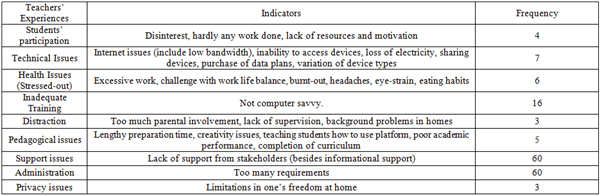
This research question allowed the researchers to present on trends related to online learning and its impact on teacher preparedness. It enables the use of descriptive statistics to provide insights into teachers’ experiences while teaching online classes during the pandemic, and to know the extent to which their instructional strategies have changed over time. Table 1 illustrates teachers’ experiences as they navigate online classes during and after the pandemic. All of the educators (60) equally shared that they had support and administrative issues. They stated in frustration that the administration outlined onerous requirements for online learning, as well as held ‘too many meetings’. Additionally, educators were overwhelmed and complained that the support they were mainly in need of from their stakeholders, besides the ongoing sharing of information, was very lacking. The teachers expressed they were in need of in-checks about their well-being, flexible schedules and hours and mentoring. Educators also expressed that navigating online platforms were a ‘learning by doing’ experience, where they had to learn how to use the virtual platforms such as Zoom and Google meet as they teach, also as they made notes to provide students with they learnt along the way how to use Learning Management Systems like Google classroom and Moodle. They were also required to redesign their lesson content for online delivery, create multimedia content, find creative ways for online classroom management, and provide students with technical and emotional support, simultaneously. This required an extensive amount of work, relative to pre-pandemic era with the traditional face-to-face classrooms. Seven (7) educators expressed that they mostly had technical issues navigating the online classes primarily due to internet challenges such as low bandwidth, quickly exhausted data plans, loss of electricity, having to share devices with their children and/ or spouses, as well as the variation of device types such as cellphones, tablets and laptops.
Educators frequently and relentlessly shared about technical issues for both themselves and their students, highlighting the heightened pressure they faced and endured. One educator expressed that:
“We were not able to hear each other at times, activities at home were interfering, no light therefore lessons ended. Students were not allowed to come in class. Students did not grasp concepts as I would like. Some students just didn't enjoy this medium. I am not computer savvy therefore responses from students were limited.”
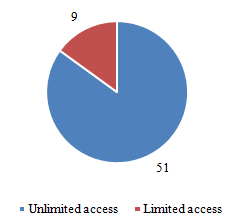
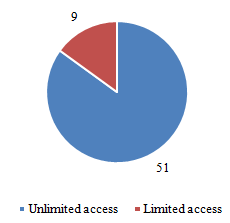
While most teachers indicated that they had internet most of the times, a few of them (9) expressed that at times they did not have internet access while working from home. Furthermore, it was revealed that 51 of them had unlimited access to devices to teach their classes compared to their students (Figure 1).
Teachers further expressed multiple times that students had internet issues. Eventually, the educators realized that students expressed thoughts related to the theme ‘internet issues’ revealed students’ dishonesty. They noticed that there were times some students were untruthful about not being able to connect due to their reluctance to participate in the online classes. One of the teachers also shared that:
“Students using technology issues as an excuse not to participate actively.”
Notwithstanding, quite a few educators have expressed that students are usually absent because of technical difficulties, whether device or internet connection problems. According to Minister Fayval Williams in an article written by Nadine Wilson-Harris 46 on May 5, 2021, “more than 120,000 students across Jamaica have been absent from classes in the last year as teaching became accessible primarily online due to the COVID-19 pandemic”. Minister Williams shared several factors that influenced the high level of truancy in Jamaica, such as asthmatic conditions, which quite a few students seemed to suffer from, and other ailments, rainfall disrupting internet connection, and no in-person classes being held 46. Due to the absenteeism, educators are concerned that students have been falling behind in their studies greatly. As one participant shared:
“Class attendance being low is a great challenge because when the students miss numerous classes, they fall behind and it hinders their understanding of concepts being taught while they are present. Most of my students do not work on their own so when they miss class, they do not catch up on what they have missed. Wi-fi problems seem to be the main cause of low class attendance.”
These challenges have led to health-related challenges as more work than usual was required during the pandemic. About 10% of the educators expressed they felt stressed out from excessive work required, felt burnt-out, struggled with headaches, eye-strains, eating habits, and work-life balance, since the Covid-19 pandemic and the requirement to teach online classes.
Repeatedly, teachers have shared that they are burnt out, the work has been excessive, and they have had to struggle with work-life balance. Participants shared “Burn out; too many meetings; too much access”, as well as others, in different words. Beatrice Gordon in an article to the editor, wrote addressing some of the stresses endured by teachers, such as physical, mental, and even spiritual burdens 47. Gordon 47 partly attributed this to the behaviors of both parents and students while teaching online, such as fights between adults and expletives by both parents and students. Also, household expenses have increased greatly, as a result of being home, whether utility bills, purchasing of devices, cell phone bills, and/ or purchasing of phone credit to contact students and parents. Gordon called on the government to do a needs assessment to address some of these concerns 47. Haynes-Brown et al. 48 shared, in an article titled ‘Coping personally and professionally as a teacher during COVID-19’, that the sudden change to teach online took a toll on teachers and was revealed in anxiety disorders due to “being locked down, being socially isolated, getting ill, and overwhelmed by the task of being an administrator, classroom manager, and the sole technical support personnel available for students and parents”. Moreover, educators often worry a great deal about their students in a typical face-to-face class, more so now that they are not seeing them 48. Resoundingly, some of the teachers elaborated that workload made them feel stressed out, using phrases such as “excessive workload”. For example, a teacher expressed that:
“Workload was my greatest issue. Seemingly, there is a lack of understanding when it comes to the rigors of online learning by college administration who have so many requirements. I found myself working beyond the call of duty and this has totally burnt me out!!!!!!!”
Another participant even expressed the state of conducting teaching:
“Not getting enough rest. Not eating properly. My eyes have gotten worse, feet are swollen every day. I am burnt out. Students attendance and participation has declined in the summer semester. It is very stressful. I don't like it.”
Another participant shared that he/she experienced “stress on the eyes because of long hours around the computer, teaching, writing plans, setting and marking assessments, making PowerPoint, and inputting grades”. While another spoke about pains, saying that besides feeling burnt out, he/she had “physical pains - in the shoulders, eyes, and head”.
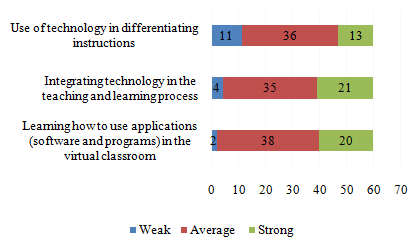
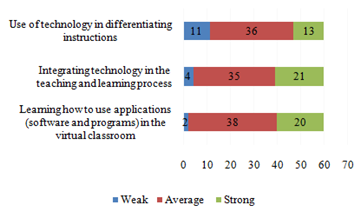
While teachers continued to bravely face the new challenges brought on by online learning, the analysis indicated that based on the training received across the island, most educators could sufficiently maneuver the online platforms and were able to adjust in order to use the pedagogy suited for online learning (Figure 2). The participants were asked to indicate on the survey their level of proficiency in the areas of learning how to use applications in the virtual classroom, being able to integrate technology in the teaching and learning process, as well as using technology to differentiate instruction. Figure 2 also indicates that 38 educators have adequate proficiency in using applications for online classes, while 20 shared that they had a strong proficiency. About 35 were adequately proficient in integrating technology into their teaching and 21 were confident they could. Most educators could proficiently use technology to differentiate instruction, with 36 being adequately proficient and 13 strongly proficient. Thus, with the training educators received, they were required to utilize it to effectively teach online classes and were confident in their training.
Of note, however, were the pedagogical issues educators noted they had since going online. These included lengthy preparation time, problems with creativity, teaching students how to use the platform, poor academic performance, and completion of the curriculum. With the pandemic, educators were required to adapt to teaching online and, as such, prepare the pedagogy most suited for the online space that supports the online learning management system (LMS) provided by the government. This was found to be a tedious task to set up the LMS to facilitate their lessons daily. As a participant stated:
“Adjusting my material to an online environment. Preparation for online teaching is a lot more time intensive. Issuing exams online also is a big problem. Time intensive and then using technology to check if students have issues as they have been proven to be dishonest about issues. Also the quality of students coming into tertiary institutions is not what it used to be and it is hard to get them to the level that is required from a distance.”
It is known that special preparation is required when teaching online classes in order to cater to the students’ learning needs 49. Consequently, several educators have spoken out about the lengthy time to do the special preparation that involves creating PowerPoints and activities needed for each lesson and making them available in a suitable manner on the LMS for students to access. A participant also expressed that he/she had to be “coming up with creative ways to constantly engage students” and researching to find creative ways, such as teaching strategies and online tools to engage students, has been very challenging. They have also shared that students also needed to be taught how to use the online platforms themselves to better engage them. This theme can be associated with the theme of stress, as it arises from the high volume of work required. The virtual classroom requires educators to not only prepare activities for daily lessons, but to also teach, be an administrator, classroom manager, and technical support to both parents and students, amongst other things 49.
The participants have also shared that students have been performing poorly on assessments due to high levels of absenteeism and technical issues. Twenty-seven percent (27%) of the participants shared that they did not receive any training in using technology in the online classroom, while 3% expressed the training received was inadequate, given that they were not computer savvy (Figure 3). One participant in the study shared that “I am not computer savvy, therefore responses from students were limited”. While the sample size was small, representing the minority of educators, it is concerning that training was inadequate or that teachers were not computer savvy bearing in mind that each educator normally teaches on average between 30-36 sessions weekly particularly at institutions below tertiary levels. Each session is about 30-45 minutes with about 30 students on average in each class, in a typical Jamaican classroom. Consequently, students would lose out on at least one subject area or some content in their different subject area.
Further, educators (3) are greatly concerned about continuous distraction that has been plaguing the students during online classes due to students’ problematic backgrounds, parental involvement, and the lack of supervision at home. A participant shared the following:
“The parents are not allowing the children to think for themselves. Children without devices or the internet. Parents having to go to work and no one to get children online. Children are distracted because of lack of supervision. Naked parents in the background. Children are not properly groomed for school.”
For educators, online learning had become more difficult as students’ learning environment was heavily impacted by their external environs, including family members in their space. The physical classroom was a more suitable control space due to being contained in a smaller space, where other students were the sole distraction, allowing the teacher to effectively supervise students. Other educators have shared that parental involvement has interfered with the online classroom space, to the extent that it appears parents are assuming the role of students. According to Gooding 50 in an article titled ‘10 ways parents disrupt children’s Google classroom during the pandemic’, parents of primary students wanted to participate in the classroom conversations, which they really should not be doing. Additionally, parents have shown inappropriate behaviour through their use of foul language and the grooming of themselves as well as other relatives 50. In other cases, students have dared to ask for teachers to allow other family members to attend classes on their behalf one day 50. Consequently, teachers have called for parental etiquette when having online classes. Some parents have even expressed that they do not want their children to turn on their cameras because of their background. Thus, with students not visible, proper engagement and observance of body language during lessons is hindered 2, leaving teachers to assume that the students understand. Other disruptions include students’ socio-economic background, with “interruptions from lewd music blaring on street sides … with children tucked beside them so as not to be left at home unsupervised” 2. Some of these students live in tenement yards and so, requesting that the music be lowered will be perceived as a disrespect and might pose violence 2. Consequently, students are behind in classes, making virtual learning increasingly inequitable. Some educators have even attempted to go to the homes of some of these students to drop off work, and even provided meals for them. Nevertheless, not all students have done the work, mainly due to the lack of supervision.
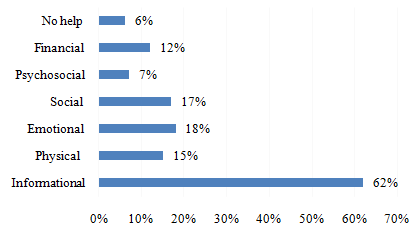
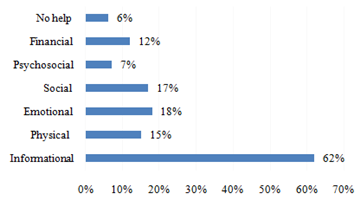
The participants in this study have shared the types of support they received during the rapid transition to online classes. The main type of support received was informational (including training) as shared by 62% participants, while 17% received social support, 18% emotional, 7% psychological, 15% physical, and 12% financial. Only 6% received no support (Figure 4). The educators expressed that the main type of support received is informational support. This involved quick training for some teachers to know how to maneuver the online teaching platforms and professional development sessions. This was evidently because of the urgency with which educators needed to become equipped to teach online and use online platforms. Even so, most teachers stated the training received was inadequate based on the actual work needed to be done. Thus, they tried to stay afloat to survive in the digital world, while being left to navigate their emotional and social issues on their own. Some teachers stated that they received social support in the form of encouragement and peer support through different channels including WhatsApp groups with family, friends, and colleagues. This helped them feel less isolated and benefit from real-time advice, reflecting the need for communities, to help teachers feel like they are not alone. Teachers also experienced emotional support, especially in times when they felt stress, anxiety, or overwhelmed. Though a small number teachers could benefit from empathetic communication, having persons listen to and relate to what they were going through and stay with them. Another structured form of emotional support teachers received was psychological, where they benefited from counselling and wellness check-ins, though only a minority experienced this. This is crucial for mental wellness, so they can deal with grief, fear, burnout, and family care. Additionally, some stated they got physical support such as laptops and tablets, helping to bridge the digital divide. In addition, it was indicated though that majority of the educators shouldered financial burdens alone to obtain tools to deliver public education. Some got financial support – even though not widely reported – to help with financial shortfall for class resources such as acquiring data packages, as well as subsides to offset additional expenses such as purchasing laptops. Finally, a small percent shared they got no assistance at any point in time, indicating the need for more equitable support.
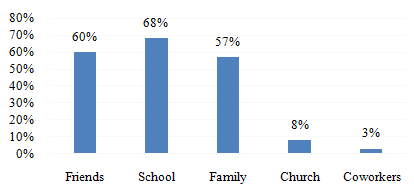
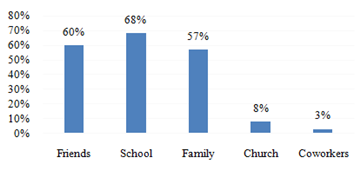
Findings in Figure 5 shed further light on the different agents that supported teachers. Sixty-eight percent (68%) of the participants shared they received support from the school they taught, 60% from friends, 57% from family, 8% church community, and 3% from coworkers. Most of the schools were active in providing support as expressed by majority of the educators. However, this came in the form of training, provision of devices and ongoing communication. The two other main categories of support were friends and family, indicating that personal relationships are vital for sustaining educators practically and emotionally. They benefited from technology tips, shared duties, and emotional balance, of which they greatly needed to make the transition more manageable.
Teachers have expressed that they had to rearrange their private space at home to facilitate online classes. Thus, they had to find suitable locations in their homes to prevent further disruptions to their families’ privacy. Also, as their own children had classes online, it was imperative to be situated in a more conducive location to conduct their own classes 48. A participant shared the following:
“Lack of privacy and limitation on space and entertainment activities for other family members in the household while classes are being held. For example the other family members cannot watch television or play music in the household while online sessions are being held”.
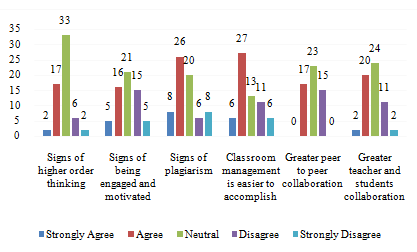
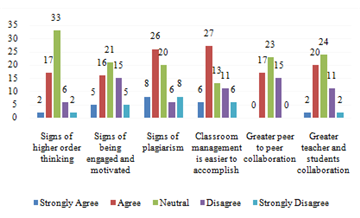
Notwithstanding the challenges switching to online teaching, educators’ perspective on technology use has shown mixed results. Based on Figure 6, 32% of the teachers agreed that students showed higher-order learning since they have used technology to teach online classes. This indicates that the use of digital tools has facilitated students with the development of their problem-solving, analysis, and deeper thinking skills. However, the majority either disagreed or were neutral. This sparked an overarching concern amongst a large number of teachers about students truly grasping content in their different subject areas and begs the question on whether methods of assessment in an online learning environment, coupled with students’ ability to attend classes had an impacted on what students actually retained.
What was particularly troubling to more than half of the participants (57%) was the prevalence of blatant plagiarism in student assignments. Teachers expressed concern that an increasing number of students were copying and pasting information from online sources as digital tools became more accessible. Educators viewed this trend as a significant red flag, highlighting a decline in students’ regard for academic integrity and personal development. This finding underscores the need for educators to rethink, plan, and review assessment practices in virtual classrooms if the goal is to foster critical thinkers who demonstrate competence and integrity and can contribute meaningfully to society.
Additionally, educators shared, based on further investigation, that students were struggling to complete their assignments due to lack of independent learning capability or insufficient guidance in evaluating information online to maintain academic honesty. When educators were asked about students’ willingness for greater collaboration, only 17 agreed while others seemed unsure. This implies that students may lack the enthusiasm for collaborative tools such as breakout rooms and Google docs, possibly due to limited training or ineffective introduction of these tools.
On a positive note, almost 40 percent (22) of the teachers have seen greater collaboration between students and themselves, indicating that online teaching can enhance teacher–student interactions when implemented thoughtfully to provide greater support. Furthermore, with regard to managing classroom space, the majority (55%) of the teachers stated that online classes were more manageable. This may be as a result of the ability to enable mute controls or based on established digital norms enforced by teachers. This suggests that teachers found online classrooms more manageable and structured, even though it lacked physical interactions, emphasizing that online classes can be effective, once they have the right tools and appropriate strategies.
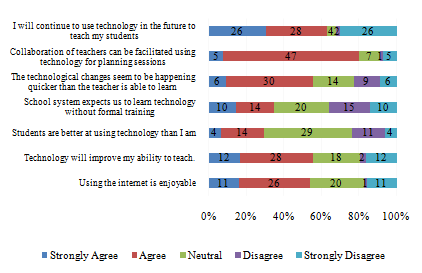
The study also analyzed teachers' shared beliefs about using technology in the future (Figure 7). Majority of the teachers (37) did not enjoy using technology as they did not seeing any benefits derived in the technology improving their ability to teach. This is possibly owing to the fact that some teachers lacked the experience to use the technology and felt a sense of inadequacy, impeding their ability to meaningfully engage in online. Other factors include their frustration with technical challenges, having difficulty customizing for subject needs, or even having poor user experience. Twenty-five (25) of the teachers, however, agreed that the school system expected them to learn technology without formal training, with almost the same amount (24) disagreeing. Ultimately, the responses highlight gaps in the school systems fulfilling its role to provide professional development and sufficient support for teachers during the transition to online teaching, and has led to them feeling overwhelmed, unprepared, and demotivated. Other teachers, however, expressed the opposite of this experience, implying that their experiences were dependent on the schools and possibly region. Nevertheless, the majority (54) agreed about using technology in the future to teach, as a result of the rushed and chaotic transition to virtual classes.
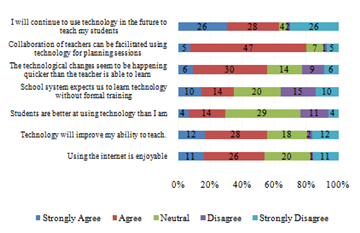
Also, it seemed that the majority agreed with using technology for lessons and teacher collaboration online, with 5 disagreeing, while 6 of them agree; and the others remained neutral. The teachers who expressed neutrality may have hesitated or felt uncertain about using technology for lesson planning and collaboration. This implies that the teachers needed adequate exposure to develop the conviction to use the technology for collaborative teaching and lesson design. Overall, it was indicated that the teachers desired support, structure, and meaningful engagement, and in no way were they against online teaching platforms, though new to them.
4.2. Results from Research Question 2In what ways has AI hindered or improved teaching practices in the digital age?
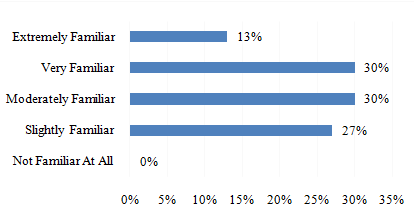
This research question examined the ways educators have found AI to be beneficial or lacking in guiding their classroom teaching practices in the digital age. The findings offer insights into educators’ level of familiarity with using AI tools, the purposes for which they use them, and the challenges experienced in adopting them. Figure 8 provides educators’ ratings of their level of familiarity with using AI tools. Thirty percent (30%) equally expressed moderate familiarity and being very familiar with using AI, while 13% felt ‘extremely familiar’. This implies that educators with moderate familiarity may know how to prompt AI tools to obtain information such as lesson ideas and activities, but would be unable to train or adapt AI-generated content to ensure accuracy and thus, may need support to use these tools confidently. On the other hand, the findings also suggest a frequent leveraging of AI tools for educational purposes, particularly among those that were ‘very familiar’ with AI tools. These educators are likely to be advocates for AI integration in education, having understood their capabilities and limitations. Additionally, 27% stated they were ‘slightly familiar’ with AI tools, indicating they had limited experience using them, impeding their ability to effectively exploit these tools for their classroom needs. Evidently, there is a need for equity across educators’ familiarity with AI tools, given the unequal expertise among educators.
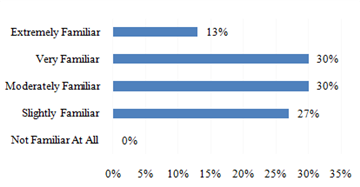
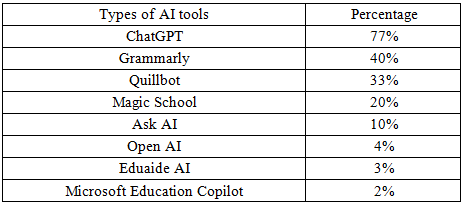
Table 2 and Figure 8 are closely tied together, because it is relevant to know which AI tools educators are familiar with. In Table 2, approximately 77% of the participants used ChatGPT, indicating greater familiarity with this tool, relative to others. Teachers mostly used ChatGPT because of its accessibility and versatility in providing content for instruction. Forty percent (40%) used Grammarly, 33% Quillbot, 20% MagicSchool, 10% Ask AI, 4% Open AI, 3% Eduaide AI, and 2% Microsoft Education Copilot. Educators expressed that they found these tools to be very convenient for use due to their user-friendly interface and low cost.
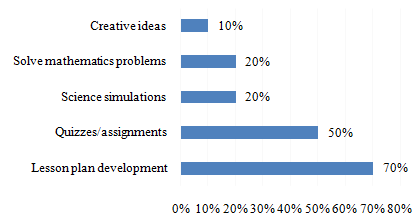
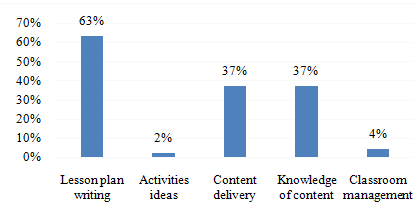
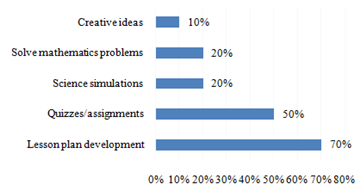
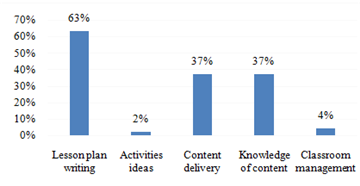
Overall, these tools are used for lesson plan development (70%), quizzes/assignments (50%), science simulations (20%), solving mathematics problems (20%), and obtaining creative ideas (10%) (Figure 9). This emphasized that teachers were acquainted with using AI tools for various subjects and classroom needs, especially in preparing content and providing instructional support. Furthermore, since using these tools, educators have derived benefits, according to Figure 10. These benefits include improved lesson plan writing (63%), improved activity ideas (2%), improved knowledge of content (37%), improved content delivery (37%), and improved classroom management (4%). This suggests that teachers are learning to use the AI tools to help shape their activities, especially for the future pedagogical practices.
In addition, Table 3 further highlights the positive effects of AI tools on teaching practices. Seventy-five percent (75%) of the educators experienced a positive impact while using them. This suggests that teachers have recognized the value of AI tools and are harnessing them as much as possible. They have used them to improve their efficiency, creativity, and instructional delivery and seen them as an active part of their teaching, and not just a mere futuristic concept. Also, it appears that educators have been changing their mindset of AI, where they are no longer skeptical but embracing its use as previously mentioned in Figure 9, especially since the number of hours for planning has reduced.
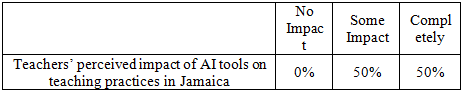
Additionally, 50% of the educators equally shared that they believed the Jamaican education system would experience ‘some impact’ or ‘complete’ change in using AI tools on teaching practices (Table 4). This implies that even though teachers are cautious about it being integrated in the classrooms, they are optimistic about the long-term impact. Their concerns, however, are mostly likely driven by a lack of training and inadequate resources.
Following, approximately 80% benefited from using AI tools to facilitate differentiated instruction (Table 5). This suggests that teachers have been finding ways to meet the diverse learners’ needs that otherwise would have been time-consuming, such as scaffolding, adapting tasks, or facilitating personalized instructions. So, for them, AI is not a replacement but an assisted tool or even a pedagogical partner to support learning by creating more engaging experiences for students.
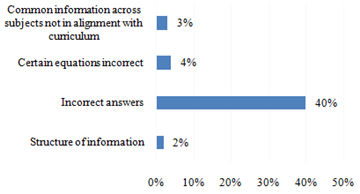
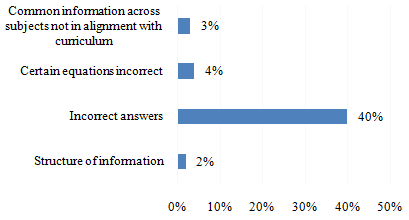
Notwithstanding the positive feedback, teachers have also observed erroneous feedback while using AI tools. Teachers (40%) gave an account of receiving incorrect answers on more than one occasion while using AI (Figure 11). This underscores the caution that, though these tools are good for academia and facilitate efficiency, they still require human oversight, where information is carefully vetted. In doing so, teachers can avoid engaging students with erroneous concepts, making the content delivery more reliable and accurate. Neglecting this responsible use of AI can add to students’ struggles with perceiving and grasping content, especially for subjects such as science, history, or mathematics and potentially result in students experiencing irrevocable damage. Four percent (4%) of the teachers who are mathematics teachers stated that the AI-generated feedback obtained had incorrect equations that could not be solved. Generally, in mathematics, equations must be framed with sufficient information that allows students to make sense of them for problem solving and performing calculations accordingly. Moreover, 3% of teachers found that some of the content generated using the AI tools was not aligned with the national standards curriculum (NSC) across commonly taught concepts, indicating that they are not yet ready for the Jamaican education system. In other words, the information needs to be more contextualized based on Jamaican culture, pedagogy, and curriculum standards. Finally, 2% of educators expressed concerns about the poor structure of the information obtained. This indicates that the information could not readily be understood or utilized due to reduced clarity, as they needed sufficient information to help them plan and deliver quality lessons. Also, this implies that relevant information is required to help teachers adequately explain the concepts to students so they can understand, especially those who struggle. Overall, even with the revolutionary power of AI in education, it is not flawless and reinforces the understanding that AI tools are supplemental to teachers and do not act as their replacements.
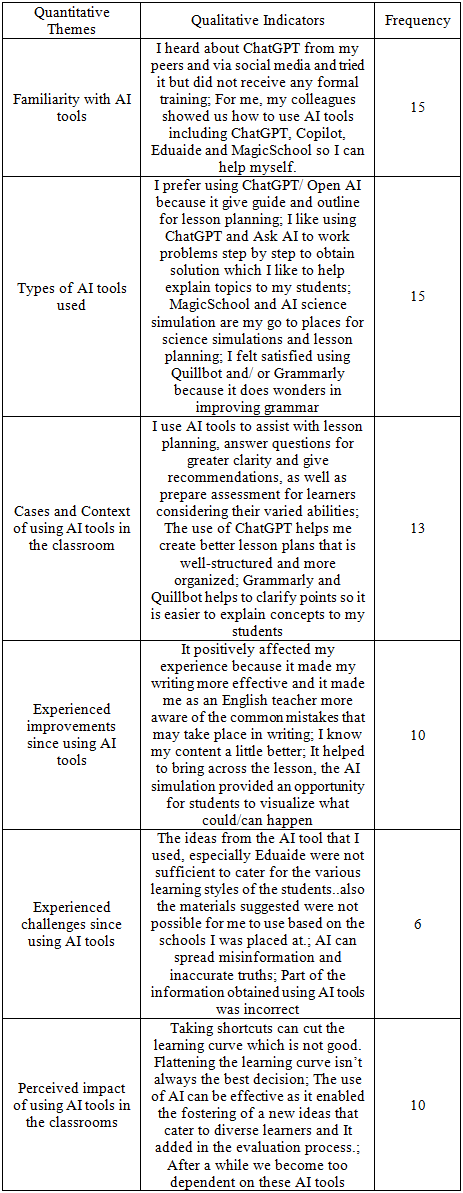
Table 6 provides the qualitative insights that supports the quantitative results for research question 2. It facilitates accounts narrated by the educators in using AI tools. Fifteen educators narrated that their level of familiarity with the AI tools, previously mentioned in Figure 8 and Table 2, is attributed to training and comfort levels. For instance, one teacher expressed that “I heard about ChatGPT from my peers and via social media and tried it but did not receive any formal training”, while others stated that their colleagues exposed them to using AI tools. The findings indicate that educators’ level of exposure of AI tool is inconsistent and many of them learnt how to use these tools informally, suggesting there was no formal professional development sessions. Additionally, 15 educators identified the following AI tools they preferred to use and its purpose: ChatGPT, Grammarly, Quillbot, Ask AI, Eduaide, AI science simulation, and MagicSchool, which coincide with those listed in Table 2. The main AI tools identified were. They expressed that these tool choice was because they are found to be easy to use and some like AI science simulation, and MagicSchool align with the subjects they taught as well as allowed them to cater to students’ specific needs. Furthermore, these tools helped them streamline their daily administrative duties including structuring lesson plans, diversify assessments which take into consideration students’ varying abilities. Educators further shared that in using these tools, they experienced improvements and/ or limitations in integrating them into their teaching practices. For instance, 10 teachers shared that their writing skills improved, they could better deliver lessons especially as they differentiate instructions, and students could better understand the concepts. However, they noted their dissatisfaction in using the tools expressing that in using some tools like Eduaide, they could not cater to students’ varying learning styles or not suited for the lesson; and they also obtained misinformation. This has caused teacher frustration, particularly due to lack of adaptability of these tools in considering local curriculum. When educators were asked about their perceived impact of AI tools in the classroom, one stated “Taking shortcuts can cut the learning curve which is not good. Flattening the learning curve isn’t always the best decision”, indicating that he or she believe that if educators rely on these tools their skills mastery and long-term competence will be undermined. For instance, even though educators can now obtain lesson plan outlines or a lot of assistance in preparing them, they needed to spend quality time to ensure they are well-designed and also focus more on strengthening their internal capabilities in order to be more productive. Otherwise, teachers might lose out on fortifying the depth of their pedagogical skills. Just like that educator, three other said the same thing differently where they expressed “After a while we become tool dependent on these AI tools”. The remaining teachers (6), however, stated that they find the AI tools to be effective because they can tailor lessons that to cater to diverse learners and improve their preparation of assessments. Overall, the findings suggest that there is a gap in the level of training (professional development) amongst educators using AI tools. Also, teachers’ effective use of AI tools vary based on the context of their intended output, and in using these tools there are ethical and factual concerns.
What are the views of teachers on their professional growth and preparedness based on their exposure to both traditional online training and the integration of AI tools in the classroom?
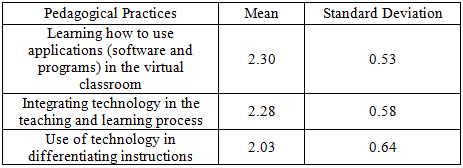
This research question seeks to provide insights into how teachers’ skills or competencies have evolved since encountering traditional online learning and using AI tools in the classroom. Table 7 illustrates the mean and standard deviation responses of pedagogical practices, and the results from a one-way test. The mean score for the pedagogical practice learning how to use applications is 2.3, revealing average proficiency level in using technology with a standard deviation of 0.53. On the other hand, for integrating technology in the classroom, the mean is 2.28 and the standard deviation is 0.58, indicating that these teachers have average proficiency, which is similar to those who use technology in differentiated instruction. This consistency of all the mean scores indicates that most educators felt a sense of confidence and experienced consistency in using technology tools, though their proficiency was not strong and was based on teachers’ level of professional development and their efforts to teach themselves to navigate the digital shift, which came with the pressure of the pandemic.
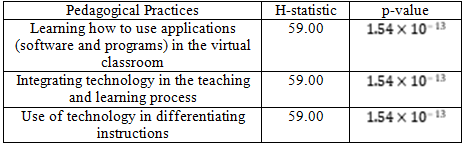
The conducted Kruskal-Wallis test also revealed an H-statistic of 59.0 and a p-value of  (< 0.05). Table 8 indicates that there is a statistical difference amongst the pedagogical practices. Overall, it is evident that the perceived strength of educators, given their use of technology in the classroom across the three pedagogical practices has a statistically significant difference (see Table 8). In other words, educators’ use of technology is reliant on their preparedness to use it in their classrooms.
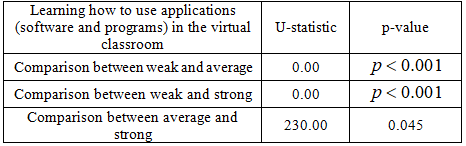
However, even though the practices are statistically difference, there are no specifications to indicate how they differs. Consequently, the posthoc test Mann-Whitney U paired with Bonferroni was performed since the data is categorical and not normally distributed (see Table 9, Table 10, Table 11). The results revealed that for the pedagogical practice learning how to use applications, the comparison between weak and average, and between weak and strong are statistically different (see Table 9). Furthermore, teachers who believed their knowledge to be weak, were more inclined to use software and programs in the virtual classroom meaningfully less than their colleagues. On the other hand, following the posthoc test, there is no significant difference between the groups of teachers who rated themselves average and strong.
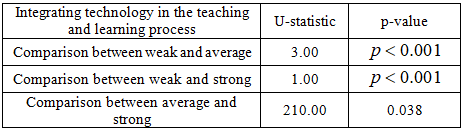
The findings also uncovered that for the pedagogical practice integrating technology in the teaching and learning process, the comparison between weak and average, and between weak and strong are statistically different (see Table 10). This suggests that teachers who rated themselves as weak are far less likely to effectively integrating technology in lessons, than their colleagues. Additionally, following the posthoc test, there is no significant difference between the groups of teachers who rated themselves average and strong, indicating that they are inclined to integrate technology meaningfully into the teaching and learning process.
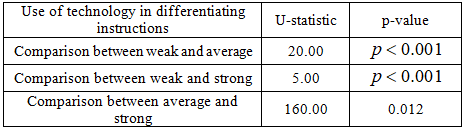
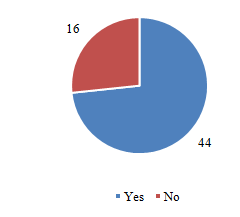
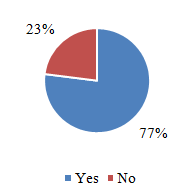
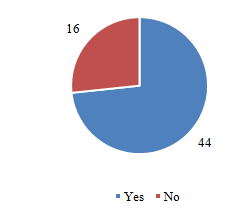
The results in Table 11 revealed that for the pedagogical practice use of technology in differentiating instructions, the three comparative groups (Weak vs Average, Weak vs Strong, Average vs Strong) are statistically different. This implies that teachers’ proficiency levels in using technology to differentiate instructions vary, calling for professional development sessions to improve all educators’ competencies. The fact, however, that educators are not adequately equipped to use technology reveals the need for professional development, especially with the inconsistencies that teachers have encountered while using AI (Figure 11). Nonetheless, 77% of the educators believed it is necessary to integrate AI in the Jamaican classroom (Figure 12), showing that educators are forward-thinking about the AI tools’ potential.
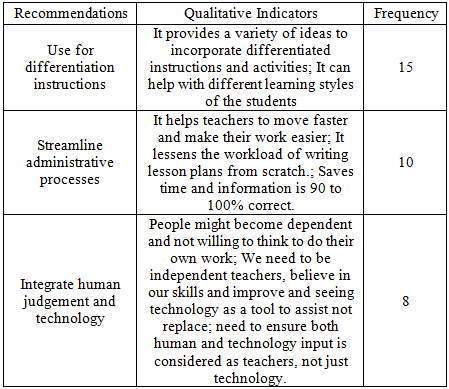
These educators went on to share recommendations to facilitate the integration of AI tools in Jamaican classrooms, which Table 12 records according to themes. Fifteen (15) educators recommended that AI tools to be used to facilitate differentiated instructions. They stated that they obtained a variety of ideas using AI tools which allowed them to plan lessons that incorporate differentiated instructions which has helped their students. However, 10 educators have recommended the use of AI tools to streamline administrative processes. They explained that these tools have helped to make their work easier and completed in faster saving them time and the information obtained is accurate at least 90% of the time. Nonetheless, 8 teachers were concerned about the use of AI and recommended an integration of human judgement and technology. These educators emphasised the need for them to remain the main decision-makers of whatever happens in their classroom rather than the tools they use. Additionally, the findings further suggest that teachers avoid being over-reliant on AI where their critical thinking skills do not become diminished or their judgement impaired. Teachers, also need to maintain their pedagogical identity to ensure they remain the content experts in the classroom, as well as facilitators and mentors for their students. In other words.
AI tools should be considered a valuable support for teachers, not their replacement, reinforcing that teachers need to continually grow professionally and asset their confidence.
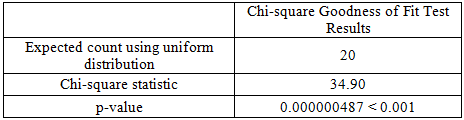
Table 13, however, shows that a Chi-square goodness-of-fit test leveraging the uniform distribution. It was uncovered that the Chi-square statistic is 34.90 with a p-value less than 0.01. This reveals that teachers’ familiarity with AI tools is statistically significant, though not uniform. This suggests that teachers need equitable training opportunities to facilitate the effective integration of AI tools in the Jamaican classrooms. In doing so, teachers can equitably access and use AI tools and make critical decisions on the best usage and practices to engage students.
Since the COVID-19 pandemic, traditional teaching practices are evolving rapidly with the transition to online classes and the integration of AI tools. Such changes expose the need for teachers to have digital competencies. The findings have revealed that a small number of educators rated themselves as having moderately strong proficiency in using educational applications and technology for classroom instruction (Figure 2), while the majority expressed average proficiency. The challenge, though, that teachers experience is ensuring their pedagogy remains effective while using digital tools. In addition, teachers’ confidence and mastery in bridging the gap between pedagogical practices and the use of AI tools are still developing. As such, the time is now for training programmes to become refined, focusing on digital pedagogy – considering TPACK and SAMR frameworks – which is more than just using multimedia tools, but rather expounding on online learning and AI tools. By reforming these programmes, pre-service and in-service teachers would become more literate and familiar with AI, enabling them to navigate the challenges with online learning and student engagement better 51. Therefore, ongoing reflective professional development to build educators’ digital competencies is imperative.
Besides professional development support, educators have expressed the need for and have indicated other forms of support systems they have benefited from. From schools, the primary form of support was informational support. However, teachers needed more emotional, physical, and psychological support, which they believed were more important than administrative information. In consideration of the pandemic, and the volume of work required, teachers were stressed and stretched beyond the norm and, arguably, unlike other professionals 52, 53. On a positive note, findings showed that several teachers received support from family and friends, and personal networks to help with the emotional toll and stress experienced. Further, Hildalgo-Andrade et al. 54 inferred that teachers needed safety nets which is more than what the schools had to offer, which is professional mental health support. This support was suitable to address teachers’ psychological strain. Overall, the findings revealed that teachers needed a more robust emotional support framework, especially during times like the pandemic. This can be done by developing frameworks that include peer mentorship, counselling, and well-being programmes to give teachers support, because learning cannot thrive when teachers are struggling to cope.
For AI integration in Jamaican classrooms, there are opportunities and cautions to consider. A significant number of educators expressed that they used AI tools, mainly such as ChatGPT, Grammarly, and Quillbot to facilitate lesson plan development, assignments, among others. These findings indicate that teachers are enthused to use these tools because it saves time and improves their efficiency for classroom preparations and administrative duties. Furthermore, educators experienced signs of improvement in their lesson planning, content delivery, and subject mastery. However, even with the benefits, the challenges are present, including erroneous feedback and reduced clarity in responses. This underscores the crucial role for educators to develop oversight while using AI tools after becoming digitally literate. MacIntyre et al. 55 and Morrison 56 pointed out that caution must be taken while using AI tools must be taken to avoid pedagogical shortcuts and possible misinformation by ensuring proper human oversight and digital literacy. Additionally, teachers have benefited from using AI tools for differentiated instruction, but could get more benefits through training and developing ethical and instructional judgement. To continue to derive the benefits, Robinson 2 emphasizes minimizing disparities in education and getting teachers ready for AI integration by providing equitable training to for all.
Despite the challenges and disparities in using AI tools, teachers are largely optimistic about integrating AI in Jamaican classrooms in the future and the positive impact it will have on teaching practices. Teachers believe AI tools will facilitate the transformation of the education system and not just their classrooms. However, Wright 39 cautions that a careful assessment of the risks and benefits of using AI is necessary, along with an appropriate structure in place, should teachers remain optimistic. Wright 39 further stated that Jamaica should not be quick to become a ‘passive adopter’ but rather a ‘thoughtful innovator’, bearing in mind that even the US and UK are still researching the benefits and risks. Importantly, through structured professional development obtaining ongoing digital training, teachers can become more prepared since both them and their students are leveraging AI tools in the classroom. Training is also necessary for teacher capacity building.
AI integration in education can be achieved when it is combined with curriculum, sustained professional development, and teacher training programmes following the frameworks TPACK and SAMR. However, for this to happen in Jamaica, Morrison 56 and OPM Communication 1 stated that investments are needed to develop the necessary infrastructure and implementing policies that ensure there is equitable access across education institutions.
4.5. ConclusionThe findings of this study have revealed that while educators are enthused about AI tools and believe it is a hopeful journey, there are challenges with integrating them in the Jamaican secondary schools. There is unevenness in teachers being adequately prepared, indicating the need for continuous professional development in an organized manner. Additionally, though teachers received some form of support during the pandemic, there were technological, systemic, and emotional support gaps. For long-term online learning, these gaps need urgent attention to improve the environment, particularly for content delivery. Findings also suggest that risks to using AI are present, including erroneous feedback and ambiguous responses. As such, adequate training to recognize and correct information prompted by these tools is vital to improve teachers and students confidence and familiarity in navigating online classrooms effectively.
The authors would like to thank the participants of this study and all the members of the Mathematics Department at Shortwood Teachers’ College for their continued support throughout each stage of this study. Special thanks to Monique Graham for editorial reviews and comments.
{1}. Constructivist Pedagogy, according to Professor Keith Taber 29, is where educators facilitate students with experiential learning opportunities as they shift between presentation and exposition in classroom delivery.
{2}.Connectivist pedagogy is a process where teachers provide students with information where these students can construct knowledge by interacting and collaborating with their peers 31.
| [1] | The Office of the Prime Minister (OPM) Communications. (2020, March 12). Schools Closed for 14 Days in Light of COVID-19. News from OPM. https://opm.gov.jm/schools-closed-for-14-days-in-light-covid-19/. | ||
| In article | |||
| [2] | Robinson, C. (2020, October 11). “We were not trained for this”–Inequity bedevils online classes as teachers battle assessment and matriculation concerns as low turnout marks first week. The Sunday Gleaner. | ||
| In article | |||
| [3] | Asmara, R. (2020). Teaching English in a virtual classroom using WhatsApp during COVID-19 pandemic. Language and Education Journal, 5(1), 16-27. | ||
| In article | View Article | ||
| [4] | Darmawan, M. R., Istiqomah, N., Mustofa, R. H., & Sofia, N. (2023). Effectiveness of online learning using WhatsApp in the midst of the COVID-19 pandemic. Classroom Action Research Journal (CARJO), 5(3), 27-36. | ||
| In article | View Article | ||
| [5] | Linton, L. (2020 September 14 ) Education Ministry Equipping Students, Teachers, Principals for Online Learning. https://jis.gov.jm/features/education-ministry-equipping-students-teachers-principals-for-online-learning/ | ||
| In article | |||
| [6] | Hunter, J. (2020, June 28). School administrators to benefit from virtual instructional leadership programme. Jamaica Information Service – The Voice of Jamaica. https://jis.gov.jm/features/school-administrators-to-benefit-from-virtual-instructional-leadership-programme/ | ||
| In article | |||
| [7] | Arce Vizcarra, F. G., Criado Davila, Y. V., Maldonado Cueva, P. D., Muñoz Ccuro, F. E., & San Miguel Velásquez, Y. V. (2025). Digital competencies in teachers and students during the pandemic: A systematic review. Proceedings of the 5th LACCEI International Multiconference on Entrepreneurship, Innovation and Regional Development (LEIRD 2025): "Entrepreneurship with Purpose: Social and Technological Innovation in the Age of AI". | ||
| In article | View Article | ||
| [8] | Gudmundsdottir, G.B. & Hathaway, D.M. (2020). "We Always Make It Work": Teachers' Agency in the Time of Crisis. Journal of Technology and Teacher Education, 28(2), 239-250. Waynesville, NC USA: Society for Information Technology & Teacher Education. https://www.learntechlib.org/primary/p/216242/. | ||
| In article | View Article | ||
| [9] | Kim, L. E., & Asbury, K. (2020, September 25). ‘Like a rug had been pulled from under you’: The impact of COVID-19 on teachers in England during the first six weeks of the UK lockdown. Br. J. Educ. Psychol. 2020, 90, 1062–1083. [CrossRef]. Retrieved August 14, 2021. | ||
| In article | View Article PubMed | ||
| [10] | Cunningham, D., Cunningham, S., Haye, K., Ellis, A., Facey, D., Hamilton, A., Jacobs, N., Miller, J., Morris, C., Morris, S., Ogeare, J., Samuels, S., & White, C. (2024, December 6). Beyond the horizon: An investigation to unravel the impact of AI on Jamaican students’ performance. American Journal of Educational Research, 12(12), 479–502. | ||
| In article | View Article | ||
| [11] | Samuels, S., Fisher-Howe, O., & Haye, K. (2025a). Teacher training in the digital age: The role of AI in professional development and mentorship. International Journal of Science and Research (IJSR), 14(4), 1027-1044. | ||
| In article | View Article | ||
| [12] | Bourne, P. A. (2025). The Education System in Jamaica: Performance, Equity, and Pathways for Reform. Global Journal of Emerging Trend in Education and Social Science. | ||
| In article | |||
| [13] | UNESCO (2023) Guidance For Generative AI In Education And Research https:// cdn.table.media/ assets/ wp-content/ uploads/2023/09/386693eng.pdf. | ||
| In article | |||
| [14] | OECD. (2021). Measuring Student Performance: PISA 2021 Framework. Paris: OECD Publishing, | ||
| In article | |||
| [15] | Willis, G. (2025). Digital Transformation in Jamaica's Education Sector. SIT Graduate Institute/SIT Study Abroad - SIT Digital Collections. https:// digitalcollections.sit.edu/ cgi/ viewcontent.cgi? article=4384&context=capstones. | ||
| In article | |||
| [16] | Granston, C. N. (2004). Technology and Teacher Training: The Systematic Design and Development of a Framework for Integrating Technology into Jamaica’s Teacher Training Programs. https://digitalcommons.usf.edu/cgi/viewcontent.cgi?article=2051&context=etd. | ||
| In article | |||
| [17] | U.S. Department of Education. (2023). Artificial intelligence and the future of teaching and learning https:// eric.ed.gov / ?id=ED631097. | ||
| In article | |||
| [18] | Trust, T., & Whalen, J. (2021, June 9). Emergency remote teaching with technology during the COVID-19 pandemic: Using the whole teacher lens to examine educator’s experiences and insights. Taylor & Francis. | ||
| In article | View Article | ||
| [19] | The Jamaica Gleaner. (2019, January 23). Technology in focus | Technology matters to Jamaica in 2019. Jamaica Gleaner. https://jamaica-gleaner.com/article/news/20190123/technology-focus-technology-matters-jamaica-2019#google_vignette | ||
| In article | |||
| [20] | Samuels, S., Haye, K., Cunningham, Jacobs, N., Stephens, T., Waldron, S., McKay, A., Clunie, A., Bartlett, M., Fisher-Howe, O., Williamson, C., Richards, T., McFarlane, M., Bryan, S., Gonzales, M., Cobourne, R., Francis, O., and Johnson-Clayton, K. (2025b). Transforming Classrooms: Exploring the Impact of Artificial Intelligence and Online Learning on High School Students' Academic Engagement and Performance. American Journal of Educational Research, vol. 13, no. 7: 338-353. | ||
| In article | |||
| [21] | Mishra, P., & Koehler, M. (2006). Technological pedagogical content knowledge: A framework for teacher knowledge. Teachers College Record. https://www.tcrecord.org | ||
| In article | View Article | ||
| [22] | Kurt, S. (2023 September 20). SAMR Model: Substitution, Augmentation, Modification, and Redefinition Educationaltechonoly.net. https://educationaltechnology.net/samr-model-substitution-augmentation-modification-and-redefinition/ | ||
| In article | |||
| [23] | Puentedura, R. (2013). SAMR: A model for meaningful technology integration. https://samrmodel.weebly.com/ | ||
| In article | |||
| [24] | Martinez-Pons, M., & Rosenfeld, B. (2004). Engendering Technology Use in the Classroom. Brooklyn College of the City University of New York. https:// files.eric.ed.gov/ fulltext/ED484989.pdf. | ||
| In article | |||
| [25] | GCE Editorial Team. (2025, May 13). Technology in the classroom: Benefits and the impact on education | GCU blog. Grand Canyon University: Private Christian University Phoenix AZ. https:// www.gcu.edu/ blog/ teaching- school-administration/ how-using-technology-teaching-affects-classrooms. | ||
| In article | |||
| [26] | Spector, C. (2024, February 14). How technology is reinventing K-12 education. Stanford Report. https:// news.stanford.edu/ stories/ 2024/02/technology-in-education. | ||
| In article | |||
| [27] | Schmidt, D. A. et al. (2009). Technological Pedagogical Content Knowledge (TPACK): The Development and Validation of an Assessment Instrument for Preservice Teachers. JRTE, 42(2), 123–149. | ||
| In article | View Article | ||
| [28] | Valtonen, T. et. al. (2017). TPACK updated to measure pre-service teachers’ twenty-first century skills. Australasian Journal of Educational Technology, 33(3). | ||
| In article | View Article | ||
| [29] | Taber, K. (2011). Constructivist pedagogy: What is constructivist pedagogy? https:// science-education- research.com/teaching-science/ constructivist-pedagogy/. | ||
| In article | |||
| [30] | Romrell, D., Kidder, L. C., & Wood, E. (2014). The SAMR model as a framework for evaluating mLearning. Online Learning, 18(2). | ||
| In article | View Article | ||
| [31] | Gafaro, B. C. (2020). MOOCs in the Language Classroom: Using MOOCs as Complementary Materials to Support Self-Regulated Language Learning. Chapter 9 - What is Connectivist Pedagogy? Recent Tools for Computer- and Mobile-Assisted Foreign Language Learning. | ||
| In article | View Article | ||
| [32] | Warner, S., Mohammed, J., & Gross-La Borde, M. (2023). From traditional to home-based learning: Challenges of elementary school teachers during COVID-19 in Trinidad and Tobago. International Journal of Innovation in Teaching and Learning (IJITL), 8(2), 1-19. | ||
| In article | View Article | ||
| [33] | Williams, K. (2021, May 5). Educators say students are struggling with online learning. Jamaica Observer. https:// www. jamaicaobserver.com/ 2021/ 05/05/educators-say-students-are-struggling-with-online-learning/. | ||
| In article | |||
| [34] | Raj, A. A. (2025). The effectiveness of online learning platforms: A review. Research Gate. https:// www. researchgate.net/ publication/391633089. | ||
| In article | |||
| [35] | Kuraekha, W., & Charoenroop, P. (2024). The reality of online learning in the post COVID-19 era: A case study of English language teaching in a private tutoring school. rEFLections, 31(3), 1320-1341. | ||
| In article | View Article | ||
| [36] | Roy, M. (2015). Teacher preparation and professional development: Competencies and skill sets for the online classroom. https://www.proquest.com.newdc.oum.edu.my/dissertations-theses/teacher-preparation-professional-development/ docview/ 1748654706/ se-2?accountid=48462. | ||
| In article | |||
| [37] | Asim, F. (2024). Examining the impact of teacher’s training programs on the role of teachers in the implementation and development of curriculum. Journal of Education and Educational Development, 11(2), 287-309. | ||
| In article | View Article | ||
| [38] | Hunter-Johnson, Y., Newton, N., Gardiner-Farquharson, B., Munnings, J., Bandelier, N., Butler, F., McDonald, T., Swann, N., & Edgecombe, R. (2021). Challenges and support for pre-service teachers’ virtual teaching and practicums: Implications for bahamian educational systems. International Journal of Bahamian Studies, 27, 147. | ||
| In article | View Article | ||
| [39] | Wright, D. (2025, October 26). Letter of the day | Remote learning is not a storm-ready solution for education continuity. Jamaica Gleaner. https://jamaica-gleaner.com/ article/ letters/ 0251025/ letter-day-remote-learning-not-storm-ready-solution-education-continuity. | ||
| In article | |||
| [40] | Madaio, M., et. al. (2021). Beyond “Fairness:” Structural (In)justice lenses on AI for education. Preprint. arXiv. https://arxiv.org/abs/2105.08847 (arXiv) | ||
| In article | |||
| [41] | The UWI Mona. (2024, March 1). AI workshop empowers Jamaican teachers to harness artificial intelligence in the classroom. UWI Mona News. https:// www.mona.uwi.edu/ news/ai-workshop-empowers-jamaican-teachers-harness-artificial-intelligence-classroom. | ||
| In article | |||
| [42] | Arek-Bawa, O., & Reddy, P. (2024). Active digital pedagogies: Conceptualising a framework for student-teacher preparation using TPACK and SAMR. Journal of Education. https:// www.scielo.org.za/scielo.php?pid=S2520-98682024000400002 & script=sci_arttext. | ||
| In article | |||
| [43] | OECD. (2015). Students, computers and learning. Making the connection. Paris, France: Organisation of Economic Co-operation and Development. | ||
| In article | View Article | ||
| [44] | Creswell, J. W. (2018). Research design: Qualitative, quantitative, and mixed methods approaches. 5th ed.. Sage Publications. ISBN-13 978-1506386706. | ||
| In article | |||
| [45] | Teddlie, C., & Tashakkori, A. (2009). Foundations of mixed methods research: Integrating quantitative and qualitative approaches in the social and behavioral sciences. Sage. ISBN-13 978-0761930129. | ||
| In article | |||
| [46] | Wilson-Harris, N. (2021, May 5). 120,000 students missing from classes over the last year. Jamaica Gleaner. https://jamaica-gleaner.com/article/news/20210505/120000-students-missing-classes-over-last-year#: ~: text=More% 20than% 20120% 2C000% 20students%20across,to%20the%20COVID%2D19%20pandemic. | ||
| In article | |||
| [47] | The Jamaica Gleaner. (2020, December 14). Letter of the day | Teachers are stressed, they need help. Jamaica Gleaner. https://jamaica-gleaner.com/article/letters/20201214/letter-day-teachers-are-stressed-they-need-help. | ||
| In article | |||
| [48] | Haynes-Brown, T., Cole, S., & Hordatt-Gentles, C. (2021, January 17). Coping personally and professionally as a teacher during COVID-19. Jamaica Gleaner. Retrieved August 12, 2021. https://jamaica-gleaner.com/article/art-leisure/20210117/coping-personally-and-professionally-teacher-during-covid-19. | ||
| In article | |||
| [49] | Rosalina, E., Nasrullah, N., & Elyani, E. P. (2020, December). Teacher’s Challenges towards Online Learning in Pandemic Era. Research Gate. https:// www.researchgate.net/ publication/ 348597977_Teacher's_Challenges_towards_Online_Learning_in_Pandemic_Era. | ||
| In article | View Article | ||
| [50] | Gooding, K. (2020, June 10). 10 ways parents disrupt children's Google classrooms during COVID-19 | Loop Jamaica. Loop News. https://jamaica.loopnews.com/content/10-ways-parents-disrupt-childrens-google-classrooms-during-covid-19-0. | ||
| In article | |||
| [51] | Best, J. (2020, March 12). 5 challenges of online teaching (and how to rise above them). 3P Learning. https:// www. 3plearning.com/ blog/ 5-common-pitfalls-distance-teaching-avoid/. | ||
| In article | |||
| [52] | Barnum, M. (2021, June 15). Teachers’ stress exceeded other workers’ this year: Survey. Chalkbeat. https:// www.chalkbeat.org/ 2021/6/15/22534048/teacher-stress-depression-pandemic-survey. | ||
| In article | |||
| [53] | Cardoza, K. (2021, April 6). How teachers’ and parents’ COVID stress is affecting kids. The Hechinger Report, PBS News Hour. https://www.pbs.org/newshour/education/how-teachers-and-parents-covid-stress-is-affecting-. | ||
| In article | |||
| [54] | Hidalgo-Andrade, P., Paz, C., & Hermosa-Bosano, C. (2021, July 2). Teachers’ Mental Health and Self-Reported Coping Strategies During the COVID-19 Pandemic in Ecuador: A Mixed-Methods Study. Dovepress. Retrieved August 14, 2021. | ||
| In article | View Article PubMed | ||
| [55] | Gregersen, T., Mercer, S., & MacIntyre, P. (2020, October 21). Understanding language teacher wellbeing: An ESM study of daily stressors and uplifts. | ||
| In article | View Article | ||
| [56] | Morrison, J. (2020, May 20). Distance learning in the covid-19 age. The Observer. https:// www.jamaicaobserver.com/ news/ distance-learning-in-the-covid-19-age_193860. | ||
| In article | |||
Published with license by Science and Education Publishing, Copyright © 2026 Shaneille Samuels, Kimberley Haye, Denneil Cunningham, Nicole Jacobs, Tanielle Stephens, Shalamara Waldron, Althia McKay, Odeisha Clunie, Matthew Bartlett, Orinthia Fisher-Howe, Corey Williamson, Toney-Ann Richards, Monique McFarlane, Saskia Bryan, Moesha Gonzales, Rohan Cobourne, Okhema Francis and Kereisha Johnson-Clayton
 This work is licensed under a Creative Commons Attribution 4.0 International License. To view a copy of this license, visit
http://creativecommons.org/licenses/by/4.0/
This work is licensed under a Creative Commons Attribution 4.0 International License. To view a copy of this license, visit
http://creativecommons.org/licenses/by/4.0/
| [1] | The Office of the Prime Minister (OPM) Communications. (2020, March 12). Schools Closed for 14 Days in Light of COVID-19. News from OPM. https://opm.gov.jm/schools-closed-for-14-days-in-light-covid-19/. | ||
| In article | |||
| [2] | Robinson, C. (2020, October 11). “We were not trained for this”–Inequity bedevils online classes as teachers battle assessment and matriculation concerns as low turnout marks first week. The Sunday Gleaner. | ||
| In article | |||
| [3] | Asmara, R. (2020). Teaching English in a virtual classroom using WhatsApp during COVID-19 pandemic. Language and Education Journal, 5(1), 16-27. | ||
| In article | View Article | ||
| [4] | Darmawan, M. R., Istiqomah, N., Mustofa, R. H., & Sofia, N. (2023). Effectiveness of online learning using WhatsApp in the midst of the COVID-19 pandemic. Classroom Action Research Journal (CARJO), 5(3), 27-36. | ||
| In article | View Article | ||
| [5] | Linton, L. (2020 September 14 ) Education Ministry Equipping Students, Teachers, Principals for Online Learning. https://jis.gov.jm/features/education-ministry-equipping-students-teachers-principals-for-online-learning/ | ||
| In article | |||
| [6] | Hunter, J. (2020, June 28). School administrators to benefit from virtual instructional leadership programme. Jamaica Information Service – The Voice of Jamaica. https://jis.gov.jm/features/school-administrators-to-benefit-from-virtual-instructional-leadership-programme/ | ||
| In article | |||
| [7] | Arce Vizcarra, F. G., Criado Davila, Y. V., Maldonado Cueva, P. D., Muñoz Ccuro, F. E., & San Miguel Velásquez, Y. V. (2025). Digital competencies in teachers and students during the pandemic: A systematic review. Proceedings of the 5th LACCEI International Multiconference on Entrepreneurship, Innovation and Regional Development (LEIRD 2025): "Entrepreneurship with Purpose: Social and Technological Innovation in the Age of AI". | ||
| In article | View Article | ||
| [8] | Gudmundsdottir, G.B. & Hathaway, D.M. (2020). "We Always Make It Work": Teachers' Agency in the Time of Crisis. Journal of Technology and Teacher Education, 28(2), 239-250. Waynesville, NC USA: Society for Information Technology & Teacher Education. https://www.learntechlib.org/primary/p/216242/. | ||
| In article | View Article | ||
| [9] | Kim, L. E., & Asbury, K. (2020, September 25). ‘Like a rug had been pulled from under you’: The impact of COVID-19 on teachers in England during the first six weeks of the UK lockdown. Br. J. Educ. Psychol. 2020, 90, 1062–1083. [CrossRef]. Retrieved August 14, 2021. | ||
| In article | View Article PubMed | ||
| [10] | Cunningham, D., Cunningham, S., Haye, K., Ellis, A., Facey, D., Hamilton, A., Jacobs, N., Miller, J., Morris, C., Morris, S., Ogeare, J., Samuels, S., & White, C. (2024, December 6). Beyond the horizon: An investigation to unravel the impact of AI on Jamaican students’ performance. American Journal of Educational Research, 12(12), 479–502. | ||
| In article | View Article | ||
| [11] | Samuels, S., Fisher-Howe, O., & Haye, K. (2025a). Teacher training in the digital age: The role of AI in professional development and mentorship. International Journal of Science and Research (IJSR), 14(4), 1027-1044. | ||
| In article | View Article | ||
| [12] | Bourne, P. A. (2025). The Education System in Jamaica: Performance, Equity, and Pathways for Reform. Global Journal of Emerging Trend in Education and Social Science. | ||
| In article | |||
| [13] | UNESCO (2023) Guidance For Generative AI In Education And Research https:// cdn.table.media/ assets/ wp-content/ uploads/2023/09/386693eng.pdf. | ||
| In article | |||
| [14] | OECD. (2021). Measuring Student Performance: PISA 2021 Framework. Paris: OECD Publishing, | ||
| In article | |||
| [15] | Willis, G. (2025). Digital Transformation in Jamaica's Education Sector. SIT Graduate Institute/SIT Study Abroad - SIT Digital Collections. https:// digitalcollections.sit.edu/ cgi/ viewcontent.cgi? article=4384&context=capstones. | ||
| In article | |||
| [16] | Granston, C. N. (2004). Technology and Teacher Training: The Systematic Design and Development of a Framework for Integrating Technology into Jamaica’s Teacher Training Programs. https://digitalcommons.usf.edu/cgi/viewcontent.cgi?article=2051&context=etd. | ||
| In article | |||
| [17] | U.S. Department of Education. (2023). Artificial intelligence and the future of teaching and learning https:// eric.ed.gov / ?id=ED631097. | ||
| In article | |||
| [18] | Trust, T., & Whalen, J. (2021, June 9). Emergency remote teaching with technology during the COVID-19 pandemic: Using the whole teacher lens to examine educator’s experiences and insights. Taylor & Francis. | ||
| In article | View Article | ||
| [19] | The Jamaica Gleaner. (2019, January 23). Technology in focus | Technology matters to Jamaica in 2019. Jamaica Gleaner. https://jamaica-gleaner.com/article/news/20190123/technology-focus-technology-matters-jamaica-2019#google_vignette | ||
| In article | |||
| [20] | Samuels, S., Haye, K., Cunningham, Jacobs, N., Stephens, T., Waldron, S., McKay, A., Clunie, A., Bartlett, M., Fisher-Howe, O., Williamson, C., Richards, T., McFarlane, M., Bryan, S., Gonzales, M., Cobourne, R., Francis, O., and Johnson-Clayton, K. (2025b). Transforming Classrooms: Exploring the Impact of Artificial Intelligence and Online Learning on High School Students' Academic Engagement and Performance. American Journal of Educational Research, vol. 13, no. 7: 338-353. | ||
| In article | |||
| [21] | Mishra, P., & Koehler, M. (2006). Technological pedagogical content knowledge: A framework for teacher knowledge. Teachers College Record. https://www.tcrecord.org | ||
| In article | View Article | ||
| [22] | Kurt, S. (2023 September 20). SAMR Model: Substitution, Augmentation, Modification, and Redefinition Educationaltechonoly.net. https://educationaltechnology.net/samr-model-substitution-augmentation-modification-and-redefinition/ | ||
| In article | |||
| [23] | Puentedura, R. (2013). SAMR: A model for meaningful technology integration. https://samrmodel.weebly.com/ | ||
| In article | |||
| [24] | Martinez-Pons, M., & Rosenfeld, B. (2004). Engendering Technology Use in the Classroom. Brooklyn College of the City University of New York. https:// files.eric.ed.gov/ fulltext/ED484989.pdf. | ||
| In article | |||
| [25] | GCE Editorial Team. (2025, May 13). Technology in the classroom: Benefits and the impact on education | GCU blog. Grand Canyon University: Private Christian University Phoenix AZ. https:// www.gcu.edu/ blog/ teaching- school-administration/ how-using-technology-teaching-affects-classrooms. | ||
| In article | |||
| [26] | Spector, C. (2024, February 14). How technology is reinventing K-12 education. Stanford Report. https:// news.stanford.edu/ stories/ 2024/02/technology-in-education. | ||
| In article | |||
| [27] | Schmidt, D. A. et al. (2009). Technological Pedagogical Content Knowledge (TPACK): The Development and Validation of an Assessment Instrument for Preservice Teachers. JRTE, 42(2), 123–149. | ||
| In article | View Article | ||
| [28] | Valtonen, T. et. al. (2017). TPACK updated to measure pre-service teachers’ twenty-first century skills. Australasian Journal of Educational Technology, 33(3). | ||
| In article | View Article | ||
| [29] | Taber, K. (2011). Constructivist pedagogy: What is constructivist pedagogy? https:// science-education- research.com/teaching-science/ constructivist-pedagogy/. | ||
| In article | |||
| [30] | Romrell, D., Kidder, L. C., & Wood, E. (2014). The SAMR model as a framework for evaluating mLearning. Online Learning, 18(2). | ||
| In article | View Article | ||
| [31] | Gafaro, B. C. (2020). MOOCs in the Language Classroom: Using MOOCs as Complementary Materials to Support Self-Regulated Language Learning. Chapter 9 - What is Connectivist Pedagogy? Recent Tools for Computer- and Mobile-Assisted Foreign Language Learning. | ||
| In article | View Article | ||
| [32] | Warner, S., Mohammed, J., & Gross-La Borde, M. (2023). From traditional to home-based learning: Challenges of elementary school teachers during COVID-19 in Trinidad and Tobago. International Journal of Innovation in Teaching and Learning (IJITL), 8(2), 1-19. | ||
| In article | View Article | ||
| [33] | Williams, K. (2021, May 5). Educators say students are struggling with online learning. Jamaica Observer. https:// www. jamaicaobserver.com/ 2021/ 05/05/educators-say-students-are-struggling-with-online-learning/. | ||
| In article | |||
| [34] | Raj, A. A. (2025). The effectiveness of online learning platforms: A review. Research Gate. https:// www. researchgate.net/ publication/391633089. | ||
| In article | |||
| [35] | Kuraekha, W., & Charoenroop, P. (2024). The reality of online learning in the post COVID-19 era: A case study of English language teaching in a private tutoring school. rEFLections, 31(3), 1320-1341. | ||
| In article | View Article | ||
| [36] | Roy, M. (2015). Teacher preparation and professional development: Competencies and skill sets for the online classroom. https://www.proquest.com.newdc.oum.edu.my/dissertations-theses/teacher-preparation-professional-development/ docview/ 1748654706/ se-2?accountid=48462. | ||
| In article | |||
| [37] | Asim, F. (2024). Examining the impact of teacher’s training programs on the role of teachers in the implementation and development of curriculum. Journal of Education and Educational Development, 11(2), 287-309. | ||
| In article | View Article | ||
| [38] | Hunter-Johnson, Y., Newton, N., Gardiner-Farquharson, B., Munnings, J., Bandelier, N., Butler, F., McDonald, T., Swann, N., & Edgecombe, R. (2021). Challenges and support for pre-service teachers’ virtual teaching and practicums: Implications for bahamian educational systems. International Journal of Bahamian Studies, 27, 147. | ||
| In article | View Article | ||
| [39] | Wright, D. (2025, October 26). Letter of the day | Remote learning is not a storm-ready solution for education continuity. Jamaica Gleaner. https://jamaica-gleaner.com/ article/ letters/ 0251025/ letter-day-remote-learning-not-storm-ready-solution-education-continuity. | ||
| In article | |||
| [40] | Madaio, M., et. al. (2021). Beyond “Fairness:” Structural (In)justice lenses on AI for education. Preprint. arXiv. https://arxiv.org/abs/2105.08847 (arXiv) | ||
| In article | |||
| [41] | The UWI Mona. (2024, March 1). AI workshop empowers Jamaican teachers to harness artificial intelligence in the classroom. UWI Mona News. https:// www.mona.uwi.edu/ news/ai-workshop-empowers-jamaican-teachers-harness-artificial-intelligence-classroom. | ||
| In article | |||
| [42] | Arek-Bawa, O., & Reddy, P. (2024). Active digital pedagogies: Conceptualising a framework for student-teacher preparation using TPACK and SAMR. Journal of Education. https:// www.scielo.org.za/scielo.php?pid=S2520-98682024000400002 & script=sci_arttext. | ||
| In article | |||
| [43] | OECD. (2015). Students, computers and learning. Making the connection. Paris, France: Organisation of Economic Co-operation and Development. | ||
| In article | View Article | ||
| [44] | Creswell, J. W. (2018). Research design: Qualitative, quantitative, and mixed methods approaches. 5th ed.. Sage Publications. ISBN-13 978-1506386706. | ||
| In article | |||
| [45] | Teddlie, C., & Tashakkori, A. (2009). Foundations of mixed methods research: Integrating quantitative and qualitative approaches in the social and behavioral sciences. Sage. ISBN-13 978-0761930129. | ||
| In article | |||
| [46] | Wilson-Harris, N. (2021, May 5). 120,000 students missing from classes over the last year. Jamaica Gleaner. https://jamaica-gleaner.com/article/news/20210505/120000-students-missing-classes-over-last-year#: ~: text=More% 20than% 20120% 2C000% 20students%20across,to%20the%20COVID%2D19%20pandemic. | ||
| In article | |||
| [47] | The Jamaica Gleaner. (2020, December 14). Letter of the day | Teachers are stressed, they need help. Jamaica Gleaner. https://jamaica-gleaner.com/article/letters/20201214/letter-day-teachers-are-stressed-they-need-help. | ||
| In article | |||
| [48] | Haynes-Brown, T., Cole, S., & Hordatt-Gentles, C. (2021, January 17). Coping personally and professionally as a teacher during COVID-19. Jamaica Gleaner. Retrieved August 12, 2021. https://jamaica-gleaner.com/article/art-leisure/20210117/coping-personally-and-professionally-teacher-during-covid-19. | ||
| In article | |||
| [49] | Rosalina, E., Nasrullah, N., & Elyani, E. P. (2020, December). Teacher’s Challenges towards Online Learning in Pandemic Era. Research Gate. https:// www.researchgate.net/ publication/ 348597977_Teacher's_Challenges_towards_Online_Learning_in_Pandemic_Era. | ||
| In article | View Article | ||
| [50] | Gooding, K. (2020, June 10). 10 ways parents disrupt children's Google classrooms during COVID-19 | Loop Jamaica. Loop News. https://jamaica.loopnews.com/content/10-ways-parents-disrupt-childrens-google-classrooms-during-covid-19-0. | ||
| In article | |||
| [51] | Best, J. (2020, March 12). 5 challenges of online teaching (and how to rise above them). 3P Learning. https:// www. 3plearning.com/ blog/ 5-common-pitfalls-distance-teaching-avoid/. | ||
| In article | |||
| [52] | Barnum, M. (2021, June 15). Teachers’ stress exceeded other workers’ this year: Survey. Chalkbeat. https:// www.chalkbeat.org/ 2021/6/15/22534048/teacher-stress-depression-pandemic-survey. | ||
| In article | |||
| [53] | Cardoza, K. (2021, April 6). How teachers’ and parents’ COVID stress is affecting kids. The Hechinger Report, PBS News Hour. https://www.pbs.org/newshour/education/how-teachers-and-parents-covid-stress-is-affecting-. | ||
| In article | |||
| [54] | Hidalgo-Andrade, P., Paz, C., & Hermosa-Bosano, C. (2021, July 2). Teachers’ Mental Health and Self-Reported Coping Strategies During the COVID-19 Pandemic in Ecuador: A Mixed-Methods Study. Dovepress. Retrieved August 14, 2021. | ||
| In article | View Article PubMed | ||
| [55] | Gregersen, T., Mercer, S., & MacIntyre, P. (2020, October 21). Understanding language teacher wellbeing: An ESM study of daily stressors and uplifts. | ||
| In article | View Article | ||
| [56] | Morrison, J. (2020, May 20). Distance learning in the covid-19 age. The Observer. https:// www.jamaicaobserver.com/ news/ distance-learning-in-the-covid-19-age_193860. | ||
| In article | |||