Road traffic injuries are a major but neglected public health challenge that requires concerted efforts for effective and sustainable prevention. Of all the systems with which people have to deal with every day, road traffic systems are the most complex and the most dangerous. Worldwide, an estimated 1.35 million people are killed in road crashes each year and as many as 50 million are injured. Projections indicate that these figures will continue to increase unless there is new commitment to prevention. The main objective of this study was to assess the knowledge and practice of road safety amongst pedestrians on Thika Super Highway, Nairobi County. This study used a cross-sectional descriptive design. The study population was pedestrians using Nairobi-Thika Super Highway. Convenience sampling method was used to select points along Thika Super Highway with high populations of pedestrians. The sample size was 350 pedestrians. Interviewer administered questionnaires and Key informant guide were used to gather information from pedestrians. Secondary data was obtained from Accident Records from both the traffic police and hospital departments to determine the situation of road accidents. Both descriptive and inferential statistics were used. Responses from structured questionnaire were coded and entered into the Statistical Package for Social Science- SPSS for analysis. The study found that sex and the level of education attained by respondents had significant correlations with the knowledge of road safety practices. It was found that 92.7% of the female respondents had learnt road safety practices while 95.3% of male respondents had learnt the same. The proportion of female respondents who had learnt road safety practices was higher than that of male respondents by about 3%. This difference although small warrants more research to assess knowledge differentials between males and females as well as exposure differences to road traffic injuries. The study recommends need to involve all road users in making policies and enhance collaborations in ensuring safety on Kenyan roads. Furthermore, more resources need to be pooled towards equipping health facilities along Thika Super Highway to improve on the handling capacity of accident victims.
Road traffic injuries represent a significant yet often overlooked public health challenge that demands a unified and persistent approach for effective and sustainable prevention. Globally, road traffic systems, despite being the most frequently engaged with, are fraught with complexity and danger 1. Annually, approximately 1.35 million lives are lost to road crashes, and up to 50 million people sustain injuries 1. The report from the World Health Organization highlights significant trends in road accidents since the initiation of the Decade of Action for Road Safety 2011–2020. The global population, number of vehicles, and road networks have all increased during this period, posing challenges to road safety. Despite these factors, there has been a 5% reduction in road traffic deaths from 2010 to 2021, with a peak in 2012 followed by a gradual decline. The road traffic fatality rate has also decreased by 16% since 2010, with a notable decline in fatalities in 2020 due to COVID-19-related restrictions. The global motor vehicle fleet has significantly expanded, particularly in regions like South-East Asia and the Americas, leading to a 41% reduction in annual fatality rates per 100,000 vehicles from 2010 to 2021 1.
In Kenya, the situation is particularly dire. The data analysis on road accidents in Kenya reveals concerning trends of increasing fatalities and injuries from January 2015 to January 2020 2. There has been a significant rise in both fatalities and injuries, with a 26.31% increase in fatalities and a 46.5% increase in injured persons during this period 2. Such statistics not only highlight a national crisis in road safety but also underscore the broader economic and workforce implications for healthcare systems that are already battling issues of underfunding and insufficient staffing. Despite the global consensus on the need for roads designed to segregate different types of users—such as motorists, cyclists, and pedestrians—many countries, including Kenya, fall short of implementing these recommendations.
The disparity in road safety is stark when comparing Kenya to other nations. For every 100,000 vehicles, about 510 are involved in fatal accidents in Kenya, significantly higher than in South Africa and the UK, which report 260 and 20 incidents respectively. Furthermore, pedestrians, who constitute 65% of the fatalities, with children making up 35% of that figure, are disproportionately affected. In 2023, the overall rate of Road Traffic Injuries (RTI) in Kenya was 27.8 per 100,000 people, which is 1.5 times the global rate 3. With this rate, the vehicle passengers and motorcyclists experienced the highest surge in injuries, the latter at an alarming annual increase of approximately 29%. These statistics not only reflect a substantial burden of Disability Adjusted Life Years (DALYs) but also call for urgent initiatives to mitigate and ultimately eliminate road traffic injuries.
The majority of road crashes can be attributed to a combination of human error, and road and vehicle factors 4. These include over-speeding, dangerous overtaking, influence of alcohol and drugs, driver negligence, poor driving standards, vehicle overload, inadequate vehicle maintenance, poorly maintained roads, challenging terrain, pedestrian negligence, and driver distractions such as cell phone use 4. Despite the clear and present danger posed by road carnage, which claims numerous lives and causes severe injuries both globally and in Kenya, the menace continues to escalate. An efficient road network is crucial for economic growth, and it is evident that the Kenyan government recognizes this, as evidenced by its efforts to rehabilitate roads to not only improve transit traffic flow but also to position the country as a regional transport and economic hub 5. However, the persistence of high accident rates on these roads points to the inadequacy of current strategies that focus solely on road expansion, maintenance, and traditional government policies on road safety.
Research into road traffic accidents has been limited, with few studies aimed at informing government strategies on the underlying causes, risk factors, and effective prevention measures. Prior research has typically concentrated on the traffic environment and vehicles, with little attention paid to risky behaviors and safety perceptions among pedestrians, despite their significant role in accident statistics. Therefore, this study aimed to delve deeper into the knowledge and practices related to road safety among pedestrians on the Nairobi-Thika Super Highway. By understanding the level of awareness and identifying risky practices among pedestrians, the study sought to offer robust recommendations that could not only help to prevent further loss of life and economic drain but also enhance the overall safety and efficiency of road transport in Kenya.
This study employed a cross-sectional descriptive study design to capture data at a specific point in time, which allows for the examination of both dependent variables (knowledge and practices of road safety) and independent variables (age, sex, marital status, occupation, education). Nairobi, the capital and largest city of Kenya, served as the study area. Known as the "Green City in the Sun," Nairobi is a bustling metropolis with an estimated urban population of about 4.4 million according to the 2019 Census. The Thika Super Highway, a major infrastructure project expanded into a six-lane highway, is a critical economic artery but has raised concerns regarding pedestrian safety. Despite the presence of footbridges, pedestrian accidents remain a significant risk due to inadequate crossing facilities across the expansive road.
The study population included all pedestrians utilizing the Nairobi-Thika Super Highway, estimated to be over 100,000. This population was diverse, spanning various ages and social classes, and is considered vulnerable due to their exposure in traffic environments. For practical reasons, the study focussed on pedestrians aged between 18 and 59 years, as they were more likely to provide reliable responses to questionnaires.
Data was collected using convenience sampling at various high pedestrian traffic points along the highway, including major centers like Muthaiga, Kasarani, and others. These areas were chosen due to their high concentration of pedestrians and their significance as industrial and commercial hubs. The sample size, calculated using Fisher's formula, is set at approximately 384 pedestrians to ensure statistical validity with a 95% confidence level and a 5% margin of error as shown below.
 |
Where,  desired sample size (population greater than 10,000)
 the standard normal deviation, a really set at 1.96
 the proportion in the target population estimated to half a particular characteristic i.e. 0.50 since proportion of pedestrians with knowledge of road safety is not known
 Degree of accuracy desired usually set at 0.05
p
 |
Therefore, 384 pedestrians were interviewed.
Eligibility criteria for participants included pedestrians aged 18 to 59 years encountered during the study period along the highway. Those known to be of unsound mind, below 18 years, or over 59 years were excluded from the study. Data collection was conducted through interviewer-administered questionnaires for both pedestrians and motorists. Additionally, key informant interviewed involved police officers, health professionals, and other stakeholders in the transport sector. Secondary data was sourced from traffic police and hospital records to assess the current situation of road accidents.
For data management and analysis, responses from structured questionnaires was coded and entered into the Statistical Package for Social Sciences (SPSS). Analysis included both descriptive and inferential statistics. Key informant interviews were transcribed verbatim, and an interpretive approach was used to analyse the qualitative data, identifying key categories and recurrent themes until saturation was reached.
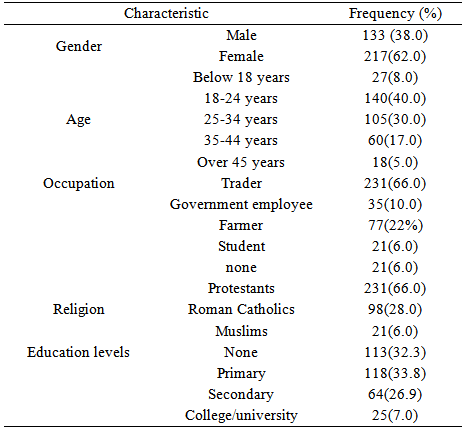
The study examined the socio-demographic characteristics of pedestrians using Thika Super Highway. The age distribution of respondents showed that 8% were below 18 years old, 40% were aged 18-24 years, 30% were aged 25-34 years, 17% were aged 35-44 years, and only 5% were over 45 years old (Table 1). In terms of gender, 62% of respondents were females, while 38% were males (Table 1). Regarding marital status, the majority of respondents were married (62.2%), with 18.9% classified as single, 15.4% as below 18 years old, and 3.5% as divorced or widowed (Table 1). Occupationally, traders constituted the largest group (66%), followed by farmers (22%), government employees (10%), students (6%), and 6% with no occupation. In terms of religious affiliation, Protestants comprised 66% of the respondents, Roman Catholics 28%, and Muslims 6% (Table 1). The education levels among respondents were generally low, with 32.3% having no formal education, 33.8% having primary education, 26.9% having secondary education, and 7% having tertiary education (Table 1).
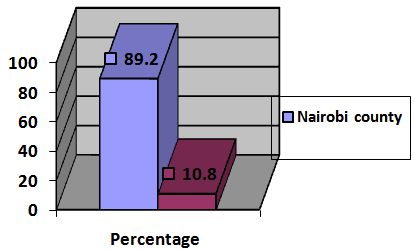
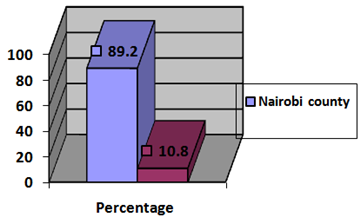
The majority of respondents (89.2%) were residents of Nairobi County (Figure 1).
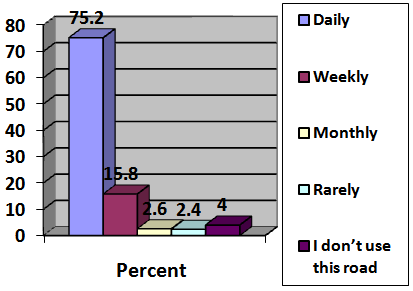
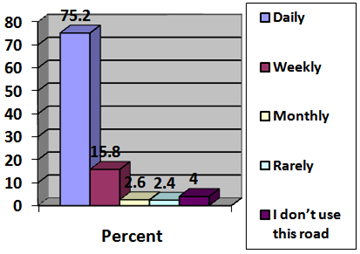
Most respondents (75.2%) reported using Thika Super Highway daily, with 15.8% using it weekly, and smaller percentages using it monthly or rarely (Figure 2).
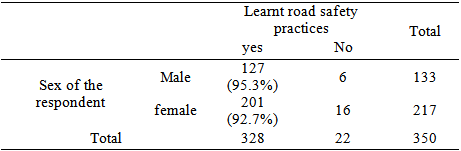
Of all the respondents who participated in the study, 93.3% reported having acquired road safety knowledge (Table 2). Among these respondents, 77.8% were male, while 22.2% were female (Table 2). The data indicated a higher proportion of male respondents who had learned road safety practices compared to their female counterparts.
The study revealed that road safety knowledge varied across different levels of education among the respondents (Table 3). Specifically, 89% of participants with no formal education had learned road safety practices. This percentage increased to 90.4% for those with a primary education, 92.7% for those with a secondary education, and reached 100% for respondents with a college/university education level (Table 3). These findings suggest a positive correlation between higher levels of education and the acquisition of road safety knowledge among the surveyed individuals.
The study found that a significant portion of pedestrians who had acquired road safety knowledge learned from different sources (Table 4). The majority (65.9%) obtained road safety information from their peers, while 7.5% received it through formal education or school. Furthermore, 11.8% learned from their parents, 3.9% from the media, and 10.7% from healthcare workers (Table 4).
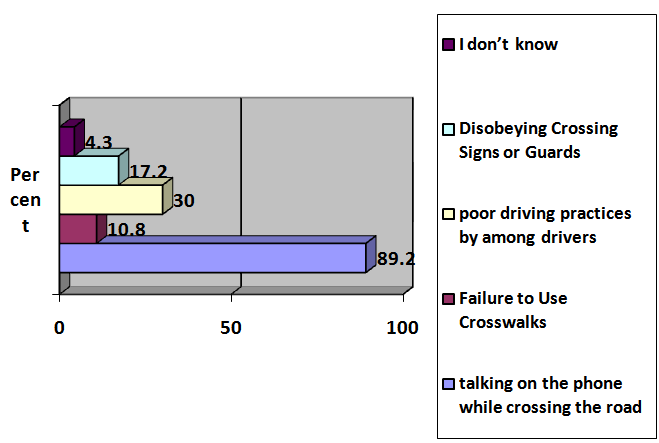
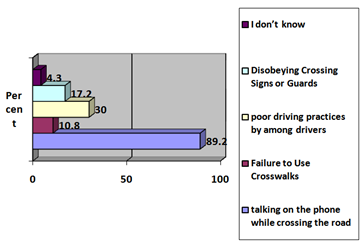
The study showed that 84.8% of all respondents acknowledged the presence of accident risks on Thika Super Highway (Figure 3). Among these respondents, 89.2% identified talking on the phone while crossing the road as the most dangerous behavior likely to lead to accidents. Additionally, 10.8% and 30% of pedestrians highlighted failure to use crosswalks and poor driving practices, respectively, as risky behaviors. Disobeying crossing signs or guards was mentioned by 17.2% of respondents, while 4.3% admitted to being unaware of the risks associated with road safety practices (Figure 3).
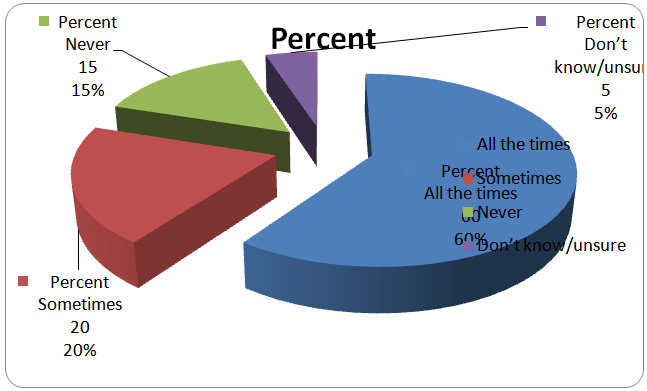
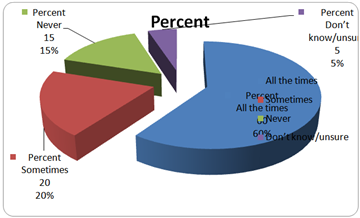
The data indicates that a majority (60%) of respondents consistently use the zebra crossing (Figure 4). Additionally, 20% reported using crosswalks only occasionally, while 15% admitted to never utilizing crosswalks. Lastly, 5% of respondents were uncertain about the frequency with which they used crosswalks (Figure 4).
Key informant interviews highlighted concerns about increasing road traffic accidents in Nairobi County, with a particular emphasis on Thika Super Highway. Informants expressed that the main causes of road traffic accidents were reckless driving, over speeding, and non-compliance with traffic rules by both pedestrians and drivers. They also mentioned that poorly maintained vehicles and lack of enforcement of road safety regulations contributed to the high accident rates. The informants identified several challenges in addressing road traffic accidents in Nairobi County. These included inadequate resources for road safety interventions, lack of coordination among stakeholders, corruption within the traffic police department, and limited public awareness campaigns on road safety. They also noted that the high population density and urbanization in Nairobi County exacerbated the road safety challenges.
The findings of this study revealed significant correlations between gender and the level of education attained by respondents with their knowledge of road safety practices. While over 92.7% of female respondents had learned road safety practices, 95.3% of male respondents had acquired the same knowledge, indicating a slight 3% difference favoring males. This small disparity suggested the need for further research to explore knowledge differentials and exposure variations to road traffic injuries between genders. The study emphasized that the level of education plays a crucial role in defining the knowledge of road safety practices, with 97% of respondents without formal education having learned about road safety 6.
Regarding road safety practices, the study found that 84.8% of respondents acknowledged the presence of road traffic accident risks, aligning with previous research on risk factors such as vehicle design, speed, road design, environment, and driver behavior 2. Despite a high level of knowledge among pedestrians on Thika Super Highway, Kenya continues to experience high injury and mortality rates, reflecting a broader concern about human risk factors on the roads 7.
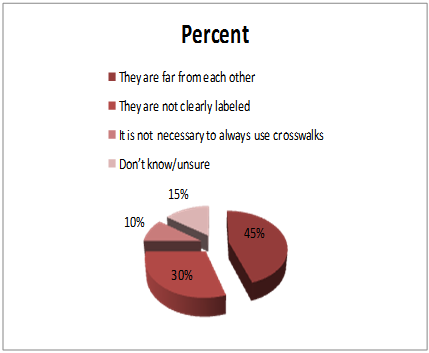
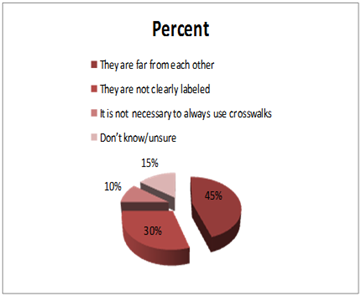
The study highlighted genuine reasons for pedestrians not using zebra crossings or crosswalks, such as distant placement and inadequate labeling of these facilities, underscoring the neglect of pedestrians in road construction and planning in Kenya. This neglect has contributed to pedestrians being the primary casualties in road accidents, which is in line with the findings of previous studies 8.
Similarly, the study identified considerable differences in the relative risk exposure of various classes of road users, with male pedestrians on Thika Super Highway potentially being more vulnerable to injury and fatality due to lower knowledge of road safety practices compared to female pedestrians. This disparity highlights the ongoing risks of road traffic injuries that can impact the country's economy 9.
Despite efforts to educate the population on road safety, challenges persist in applying this knowledge effectively, especially among illiterate road users. The study also raised concerns about poorly maintained vehicles and emphasized the need for enhanced enforcement of traffic regulations and public awareness programs to reduce road traffic accidents in Nairobi County and across Kenya.
The study's key informant respondents indicated that the problem of road traffic accidents in Nairobi County is exacerbated by poorly maintained and faulty vehicles, as well as behavioral issues among pedestrians and drivers. They suggested that greater efforts from traffic police and other stakeholders, including proper implementation of traffic laws and public awareness initiatives, could significantly reduce road traffic accidents not only in Nairobi County but also in other parts of Kenya.
In conclusion, this study finding suggested that pedestrians using Thika Super Highway exhibited a commendable level of knowledge regarding road safety practices. However, there is a pressing need for interventions to enhance the application of this knowledge in real-world scenarios. The neglect of pedestrians in the design and construction of roads, characterized by the absence of clear labeling and provision of walkways, poses a significant challenge to pedestrian safety. This disregard for pedestrian infrastructure underscores the importance of prioritizing pedestrian needs in road planning and development. Furthermore, this study highlighted a crucial relationship between the knowledge of road safety practices and their practical application. It was evident that the level of education among pedestrians played a significant role in determining their ability to effectively implement road safety measures. This dependency underscored the importance of education and awareness programs in equipping pedestrians with the necessary skills and understanding to navigate road environments safely. Addressing these key issues and implementing targeted interventions can work towards creating safer road environments for all pedestrians.
| [1] | World Health Organisation, (2023). Global status report on road safety 2023. https://www.who.int/teams/social-determinants-of-health/safety-and-mobility/global-status-report-on-road-safety-2023. | ||
| In article | |||
| [2] | Muguro, J. K., Sasaki, M., Matsushita, K., & Njeri, W. (2020). Trend analysis and fatality causes in Kenyan roads: A review of road traffic accident data between 2015 and 2020. Cogent Engineering, 7(1), 1797981. | ||
| In article | View Article | ||
| [3] | Mwenda, V., Yellman, M. A., Oyugi, E., Mwachaka, P., Gathecha, G., & Gura, Z. (2023). Piloting a hospital-based road traffic injury surveillance system in Nairobi County, Kenya, 2018–2019. Injury, 54(6), 1503-1509. | ||
| In article | View Article PubMed | ||
| [4] | Deme, D. (2019). Review on factors causes road traffic accident in Africa. Journal of Civil Engineering Research & Technology, 1(1), 1-8. | ||
| In article | View Article | ||
| [5] | Mose, N. (2022). Road transport infrastructure and economic growth in Kenya. | ||
| In article | |||
| [6] | Alonso, F., Gonzalez-Marin, A., Esteban, C., & Useche, S. A. (2020). Behavioral health at school: do three competences in road safety education impact the protective road behaviors of Spanish children?. International journal of environmental research and public health, 17(3), 935. | ||
| In article | View Article PubMed | ||
| [7] | Alhajyaseen, W. (2023). Human factors and road safety in the 2nd international traffic safety conference. International Journal of Injury Control and Safety Promotion, 30(1), 1-3. | ||
| In article | View Article PubMed | ||
| [8] | Ahmed, S. K., Mohammed, M. G., Abdulqadir, S. O., El‐Kader, R. G. A., El‐Shall, N. A., Chandran, D., ... & Dhama, K. (2023). Road traffic accidental injuries and deaths: A neglected global health issue. Health science reports, 6(5), e1240. | ||
| In article | View Article PubMed | ||
| [9] | Chen, S., Kuhn, M., Prettner, K., & Bloom, D. E. (2019). The global macroeconomic burden of road injuries: estimates and projections for 166 countries. The Lancet Planetary Health, 3(9), e390-e398. | ||
| In article | View Article | ||
Published with license by Science and Education Publishing, Copyright © 2025 George Njogu Karoki, Jackim M. Nyamari and Peter Kinyua Gachoki
 This work is licensed under a Creative Commons Attribution 4.0 International License. To view a copy of this license, visit
http://creativecommons.org/licenses/by/4.0/
This work is licensed under a Creative Commons Attribution 4.0 International License. To view a copy of this license, visit
http://creativecommons.org/licenses/by/4.0/
| [1] | World Health Organisation, (2023). Global status report on road safety 2023. https://www.who.int/teams/social-determinants-of-health/safety-and-mobility/global-status-report-on-road-safety-2023. | ||
| In article | |||
| [2] | Muguro, J. K., Sasaki, M., Matsushita, K., & Njeri, W. (2020). Trend analysis and fatality causes in Kenyan roads: A review of road traffic accident data between 2015 and 2020. Cogent Engineering, 7(1), 1797981. | ||
| In article | View Article | ||
| [3] | Mwenda, V., Yellman, M. A., Oyugi, E., Mwachaka, P., Gathecha, G., & Gura, Z. (2023). Piloting a hospital-based road traffic injury surveillance system in Nairobi County, Kenya, 2018–2019. Injury, 54(6), 1503-1509. | ||
| In article | View Article PubMed | ||
| [4] | Deme, D. (2019). Review on factors causes road traffic accident in Africa. Journal of Civil Engineering Research & Technology, 1(1), 1-8. | ||
| In article | View Article | ||
| [5] | Mose, N. (2022). Road transport infrastructure and economic growth in Kenya. | ||
| In article | |||
| [6] | Alonso, F., Gonzalez-Marin, A., Esteban, C., & Useche, S. A. (2020). Behavioral health at school: do three competences in road safety education impact the protective road behaviors of Spanish children?. International journal of environmental research and public health, 17(3), 935. | ||
| In article | View Article PubMed | ||
| [7] | Alhajyaseen, W. (2023). Human factors and road safety in the 2nd international traffic safety conference. International Journal of Injury Control and Safety Promotion, 30(1), 1-3. | ||
| In article | View Article PubMed | ||
| [8] | Ahmed, S. K., Mohammed, M. G., Abdulqadir, S. O., El‐Kader, R. G. A., El‐Shall, N. A., Chandran, D., ... & Dhama, K. (2023). Road traffic accidental injuries and deaths: A neglected global health issue. Health science reports, 6(5), e1240. | ||
| In article | View Article PubMed | ||
| [9] | Chen, S., Kuhn, M., Prettner, K., & Bloom, D. E. (2019). The global macroeconomic burden of road injuries: estimates and projections for 166 countries. The Lancet Planetary Health, 3(9), e390-e398. | ||
| In article | View Article | ||