Background/Objective: Repeated freezing and thawing results in the structural, compositional, and functional modifications in food materials. The present study was designed to optimize the effect of Freeze-thaw treatment (FTT) on free radical scavenging and linoleic acid reduction potentials of Nelumbo nucifera rhizome starch (NNRS). Methodology: A 4-factorial response-surface central composite design (CCD) based on three levels of each of the four input factors including freezing temperature (FT: -40, -20, and 0°C), freezing time (Ft: 24, 48, and 72 h), thawing time (Tt: 2, 4, and 6 h), and number of freeze-thaw cycles (FTC: 2, 4, and 6) was constructed. The NNRS was treated at different combinations of input variables as selected by CCD. The Freeze-thaw-treated N. nucifera rhizome starch (FTT-NNRS) was analyzed for antioxidant potential. Principle Findings: A statistically significant main effect (p=0.0017-0.0029) of FTT was observed on free radical scavenging and linoleic acid reducing potential (LARP) of NNRS. The 2, 2-diphenylpicrylhydrazyl (DPPH) radical scavenging potential was found to be a linear positive function of FT and Ft while hydroxyl radical scavenging potential showed a linear linear negative response towards FT and linear positive response towards FTC. The LARP also showed a linear positive response towards FT and Tt and quadratic positive response towards FT. Conclusion: FTT significantly affected the free radical scavenging potential and LARP of NNRS that may be attributed to the time-dependent variation in the structure of starch and exposure of some antioxidant residues after repeated freezing and thawing treatments.
Starch, a biopolymer, is synthesized and stored in plants and utilized by humans and other animals as a source of nutrition 1. Structurally, it consists of 20-25% linear amylose and 75% branched amylopectin chains 2. The amylose to amylopectin ratio determines the physical and functional characteristics of starch. The starch with high amylose to amylopectin ratio and more number of hydroxyl groups possesses good antioxidant potential that advocates its biomedical significance 3. Several physical and chemical modification techniques including thermal treatment, ultra-sonication, microwave irradiation, esterification, etherification, oxidation, hydroxylation, and cross-linking have been reported to enhance the structural and functional properties of starch for its nutritional, medicinal, and industrial applications 4, 5, 6, 7, 8, 9. These modifications have been reported to improve the functional quality of starch by changing its crystalline structure and chemical nature 6, 10. The modified starches with improved functional quality have got more importance in the industrial, biomedical, and pharmaceutical fields particularly as a carrier in targeted drug delivery 11, 12, 13.
Freeze-thaw treatment (FTT) is one of the physical non-thermal modification methods to change the physical and functional properties of starch 10, 14. The freezing of vegetables and other food materials at low temperature for their long time usage is a normal practice now a day. The freezing and thawing of food materials again and again may alter their nutritional and functional quality. FTT at various temperatures alters the physiochemical properties of starch molecules that may help improving the food quality and shelf-life for long term storage 15, 16. Studies on the FTT of various starches have reported significant modifications in the crystalline structure of starch that were correlated with a change in its swelling, absorption, gelatinization and retro-gradation abilities 8, 17.
Nelumbo nucifera rhizome is a good source of starch and utilized in various food and pharmaceutical formulations 8, 18, 19. It possesses antioxidant properties and is used in traditional medicines for the treatment of obesity, diabetes, and immune deficiencies 20. The native and microwave-treated N. nucifera rhizome starch (NNRS) has been studied for its physiochemical, functional and antioxidant properties 3. The researchers are also showing their interest in modification of NNRS to increase its nutritional and industrial significance. Recently, the modification of NNRS by acetylation, cross-linking, and oxidation have been reported that significantly changed its physiochemical characteristics such as swelling, solubility, and stability 6, 12. However, a limited data was found on the Freeze-thaw treatment on antioxidant potential of NNRS. The present study, was therefore, designed to optimize the effect of free-thaw treatment on the antioxidant potential of NNRS using response surface methodology (RSM). RSM is a statistical tool used to study the relationships between the input and response variables in multivariate optimization processes 21.
The fresh N. nucifera rhizomes were purchased from local market, removed the mud and washed with distilled water, cleaned and cut into fine slices after removing the nodes. The slices were blended in distilled water (solid: water 1: 20 w/v) for 20 min using a kitchen blender and passed the blend through a muslin cloth. The filtrate was diluted with distilled water (1:10 v/v) and allowed to stand until starch granules settled down. The supernatant was discarded and the suspension was filtered through a Whatman filter paper No. 41. The residue was dried in air and total starch yield was calculated using the formula reported earlier 22. The dried starch was stored in air-tight glass jar for further processing.
2.2. Experimental Design for Freeze-thaw OptimizationThe optimization of the effect of FTT on FRSP of NNRS was done by constructing a 4-factorial response-surface central composite design (CCD) using RSM. The constructed CCD consisted of three levels of each of the four input factors including freezing temperature (FT: -40, -20, and 0°C), freezing time (Ft: 24, 48, and 72 h), thawing time (Tt: 2, 4, and 6 h), and number of freeze-thaw cycles (FTC: 2, 4, and 6). The CCD consisted of overall 30 experimental runs including 16 factorial, 8 axial, and 6 center points. The selected combinations of actual levels of the selected input variables are shown in Table 1. The NNRS was subjected to FTT at different combinations of input variables as suggested by CCD. The native and Freeze-thaw-treated N. nucifera rhizome starch (FTT-NNRS) were then subjected to antioxidant analysis in terms of 2, 2-diphenyl picryl hydrayl radical scavenging potential (DPPH-RSP), hydroxyl radical scavenging potential (HRSP), and linoleic acid reducing potential (LARP). Butylated hydroxyl toluene (BHT) was used as standard antioxidant for comparison. The experimental data were statistically analyzed by response-surface quadratic models. The second-order quadratic polynomial regression equations were developed to study the relationship between the selected input variables and antioxidant potential of FTT-NNRS. The levels of the input variables to achieve the optimal response were calculated by numerical optimization at maximum desirability. In a subsequent experiment the antioxidant potential of NNRS treated at the optimum values of the selected input variables was also determined to test the reproducibility of the selected response-surface model.
2.3. Antioxidant AnalysisThe aqueous solution of the native and FTT-NNRS (10 mg/100 ml) was prepared by dissolving NNRS in distilled water followed by addition of few drops of dilute HCl. The solution was filtered through Whatman filter paper No. 1 to remove any undissolved particles and subjected to antioxidant analysis.
The antioxidant potential of the native and FTT-NNRS was determined in terms of DPPH-RSC, HRSP, and LARP using the previously described methods 23, 24, 25, 26. The DPPH-RSP and HRSP were calculated using the following equations 1 and 2 respectively.
 | (1) |
 | (2) |
 | (3) |
where,  is the absorbance of the control (reaction mixture without sample) and
  is the absorbance of the sample.
The experimental data obtained from antioxidant analysis was statistically analyzed by one-way analysis of variance (ANOVA). The relationship among the selected input variables and the antioxidant potential of NNRS was determined by employing the response-surface polynomial quadratic model. The following generalized response-surface quadratic polynomial regression equation was developed to calculate the predicted values of response variables.
 | (4) |
where,  is the predicted value of the response,

 and
and  are the coefficient estimates for main, linear, quadratic, and interaction effects of input factors.
The significance of the estimated coefficient of regression for each of the studied response was determined by calculating the lack of fit (F-ratio) and a probability (p) at 95% confidence level. The coefficient of determination (R2) and coefficient of variation (CV) were also calculated to check the adequacy and reliability of the response surface models 27. The construction of CCD, optimization and the statistical analysis of the experimental data were performed using the statistical software Design Expert 11 (Stat-Ease, Inc.).
The total yield of the starch extracted from N. nucifera rhizomes powder was found to be 15±3%. The experimental values of DPPH-RSP, HRSP, and LARP of the native and FTT-NNRS and BHT are presented in Table 1. The DPPH-RSP, HRSP, and LARP of the native NNRS were found to be 14.01±1.20, 12.70±2.60, and 19.34±0.45% respectively. The DPPH-RSP, HRSP and LARP of the FTT-NNRS ranged from 25.01 to 48.80, 10.60 to 23.10, and 13.13 to 42.85% with mean±standard deviation of 38.46±3.82, 16.40±2.46, and 25.99±8.25% respectively. The DPPH-RSP, HRSP, and LARP of BHT were found to be 58±2.90, 67.1±40, and 82.92±4.15% respectively. Statistical analysis of the experimental data showed a significant variation (p<0.05) in the antioxidant potential of the native and FTT-NNRS. Free-thaw treatment resulted in an increase in DPPH-RSP, HRSP, and LARP of the NNRS. However, the antioxidant potential of the native and FTT-NNRS remained comparatively lower than that of BHT.
3.1. Response Surface Analysis and Optimization of VariablesThe response-surface analysis of the experimental data yielded the following polynomial regression equations to explain the relationship between the antioxidant parameters and freeze-thaw variables.
 | (5) |
 | (6) |
 | (7) |
These equations included the coefficient estimates for the intercept, linear and quadratic effects, and interaction terms. The main, linear, interaction and quadratic effects of FT, Ft, Tt, and FTC on DPPH-RSP, HRSP, and LARP of NNRS as determined by analysis of variance (ANOVA) are presented in Table 2. The statistical results showed a significant positive main effect of the selected freeze-thaw variables on each of the studied parameters with relatively higher F-values (DPPH-RSP: 4.59, HRSP: 5.11, and LARP: 4.39) and lower p-values (DPPH-RSP: 0.0029, HRSP: 0.0017, and 0.0037). FT showed a significant linear negative effect on DPPH-RSP, HRSP, and LARP (F=8.83, 23.13, and 13.99 and p=0.0095, 0.0002, and 0.002 respectively) and quadratic positive effect on LARP (F=6.87 and p=0.0193). Ft and Tt showed the significant linear positive effects on DPPH-RSP (F=5.99 and p=0.0272) and LARP (F=4.57 and p=0.0495) respectively while FTC showed significant linear positive effect on HRSP (F=8.32 and p=0.0114). Ft and Tt also showed significant interaction effect on DPPH-RSP.
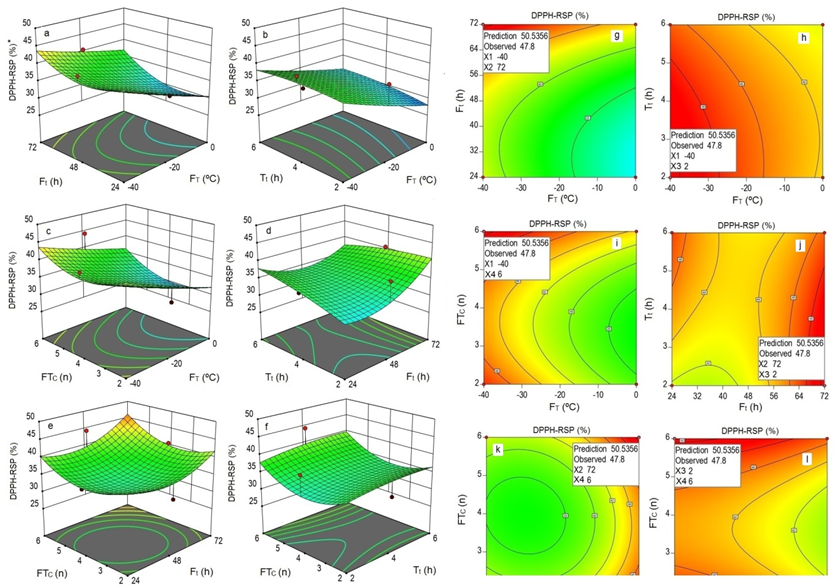
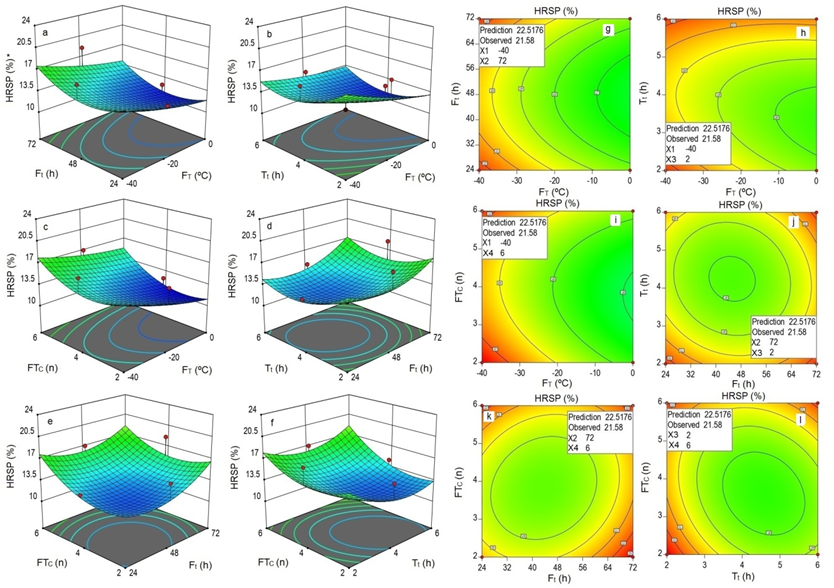
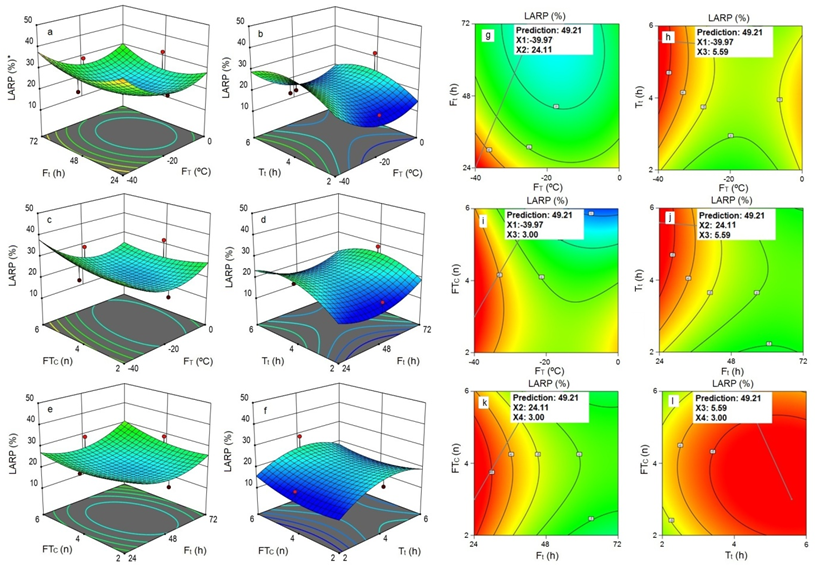
The graphical expressions of the linear, interaction and quadratic quadratic effects of the selected freeze-thaw variables on DPPH-RSP, HRSP, and LARP are presented in Figure 1a-f, Figure 2a-f, and Figure 3a-f respectively. The 3D surface plots clearly indicate the positive and negative variation in the antioxidant potential of FTT-NNRS under the influence of the selected freeze-thaw variables. The calculated values of regression coefficients (R2=0.8038-0. 0.8267) indicated that more than 80% of the variability in the studied antioxidant parameters could be explained by the suggested response-surface model. The observed values of CV (9.94-19.56%) and adequate precession (7.03-8.108%) showed a better precision and reliability of the experiments performed.


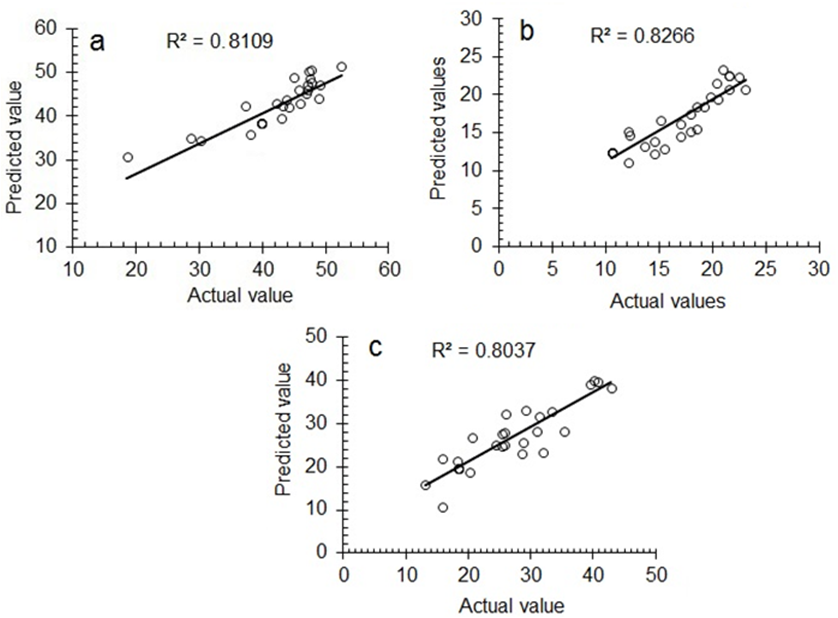
The applicability of the suggested response-surface model was tested by calculating the predicted values of the studied responses using the polynomial regression equations generated by the quadratic model. The linear regression plots of the predicted response values against the experimental values showed a relatively good correlation between the experimental and predicted values of the studied responses (Figure 4a-c). The relatively higher values of correlation coefficients (R2=8038-8267) indicated the applicability of suggested model to study the relationships between freeze-thaw conditions and antioxidant potential of NNRS.
The results of numerical optimization of the freeze-thaw variables to achieve the optimal DPPH-RSP, HRSP, and LARP with maximum desirability are presented in Figure 1g-l, Figure 2g-l, and Figure 3g-l respectively. The calculated optimum levels of freeze-thaw variables to achieve a maximal response of the studied parameters were: DPPH-RSP (Prediction 50.54%, FT: -40°C, Ft: 72 h, Tt: 2 h, and FTC: 6), HRSP (Prediction 22.5176 %, FT: -40°C, Ft: 72 h, Tt: 2 h, and FTC: 6), and LARP (Prediction 49.21%, FT: -39.97°C, Ft: 24.11 h, Tt: 5.59 h, and FTC: 3).
Freezing and thawing is common throughout the world in household preservations particularly for ready to eat food materials. This practice has been reported to significantly influence the physical and functional properties of food materials 10, 14. Starch, being an important component of most of the food materials, is also influenced by FTT that result in modification of starch structure and properties 8, 17. In continuity of the previous findings, the present study reports the effect of freeze-thaw treatment on antioxidant potential of NNRS.
The results clearly showed a significant positive main effect of FTT on the studied parameters of antioxidant potential of NNRS. The linear negative effect of FT on the studied parameters suggests that the antioxidant potential of NNRS is increased by freezing at very low temperature. The Ft and Tt showed linear positive effect on DPPH-RSP and LARP and positive interaction effect on DPPH-RSP that suggests that freezing at low temperature for 72-96 h followed by thawing for 2-5 h is helpful in increasing the antioxidant potential of NNRS.
The significance and adequacy of the suggested response-surface model was tested in terms of lack of fit (F-value), probability (p-value), correlation coefficient (R2), coefficient of variation (CV), and adequate precision (AP). Relatively higher F-values and lower p-values indicate significance of variation in response. A value of R2 closer to unity suggests the fitness of the data point on regression line in a response-surface model. Relatively lower values of CV and higher values of AP suggest the reliability and precision of the model 21, 28. The calculated values of lack of fit (4.59-5.11), probability (0.0017-0.0037), R2 (0.8038-0.8267), CV (9.94-19.56), and AP (7.03-8.108) suggested that the suggested response-surface model is applicable to explain the relationship between FTT and antioxidant potential of NNRS with good signs of fitness, reliability and precision.
The plots of experimental values of the studied responses against the predicted ones also showed good correlation suggesting the applicability of the suggested response-surface model to explain the effect of FTT variables on the antioxidant potential of NNRS. The results of numerical optimization of of FTT variables showed that optimum response of antioxidant potential can be achieved by freezing at low temperature (-40°C) for 72 h and thawing at room temperature for 2-5 h repeated for 3-6 times.
In conclusion, FTT showed a significant effect on the antioxidant potential of NNRS. The FTT at relatively, higher levels of FT, Tt, and FTC than the optimized ones may result in decrease in antioxidant potential of NNRS possibly due to time-dependent thermal degradation of the starch. The linear negative effect of FT suggests that freezing at -40°C up to 72 h with 3-6 FTC may help increasing the antioxidant potential of the starch. The observed variation in antioxidant potential of NNRS under the influence of FTT may be attributed to the time-dependent variation in the structure of starch and exposure of some antioxidant residues after repeated freezing and thawing treatments.
The authors are grateful to the Department of Biochemistry, Bahauddin Zakariya University, Multan, Pakistan for providing the facilities for conducting the research work.
The authors declare no conflict of interest regarding this study.
The study was not funded by any funding source.
All the data supporting this study has been provided in the manuscript.
| [1] | R.F. Tester, J. Karkalas, X. Qi, Starch — composition, fine structure and architecture, 39 (2004) 151-165. | ||
| In article | View Article | ||
| [2] | S. Adiloğlu, I, C. Yu, R. Chen, J.J. Li, J.J. Li, M. Drahansky, M. t Paridah, A. Moradbak, A.Z. Mohamed, H. abdulwahab taiwo Owolabi, FolaLi, M. Asniza, S.H.P. Abdul Khalid, T. Sharma, N. Dohare, M. Kumari, U.K. Singh, A.B. Khan, M.S. Borse, R. Patel, A. Paez, A. Howe, D. Goldschmidt, C. Corporation, J. Coates, F. Reading, We are IntechOpen , the world ’ s leading publisher of Open Access books Built by scientists , for scientists TOP 1 %, Intech. i (2012) 13. | ||
| In article | |||
| [3] | H. Nawaz, A. Akbar, H. Andaleeb, M. Shah, A. Amjad, A. Mehmood, R. Mannan, Microwave-Induced Modification in Physical and Functional Characteristics and Antioxidant Potential of Nelumbo nucifera Rhizome Starch, Journal of Polymers and the Environment. 28 (2020) 2965-2976. | ||
| In article | View Article | ||
| [4] | P. Deetae, S. Shobsngob, W. Varanyanond, P. Chinachoti, O. Naivikul, S. Varavinit, Preparation, pasting properties and freeze-thaw stability of dual modified crosslink-phosphorylated rice starch, Carbohydrate Polymers. 73 (2008) 351-358. | ||
| In article | View Article | ||
| [5] | T.J. Gutiérrez, N.J. Morales, M.S. Tapia, E. Pérez, L. Famá, Corn Starch 80:20 “Waxy”:Regular, “Native” and Phosphated, as Bio-Matrixes for Edible Films, Procedia Materials Science. 8 (2015) 304-310. | ||
| In article | View Article | ||
| [6] | S. Sukhija, S. Singh, C.S. Riar, Molecular characteristics of oxidized and cross-linked lotus (Nelumbo nucifera) rhizome starch, International Journal of Food Properties. 20 (2017) S1065-S1081. | ||
| In article | View Article | ||
| [7] | Z. Ma, J.I. Boye, Research advances on structural characterization of resistant starch and its structure-physiological function relationship: A review, Critical Reviews in Food Science and Nutrition. 58 (2018) 1059-1083. | ||
| In article | View Article PubMed | ||
| [8] | A.Q. Zhao, L. Yu, M. Yang, C.J. Wang, M.M. Wang, X. Bai, Effects of the combination of freeze-thawing and enzymatic hydrolysis on the microstructure and physicochemical properties of porous corn starch, Food Hydrocolloids. 83 (2018) 465-472. | ||
| In article | View Article | ||
| [9] | L. Dai, J. Zhang, F. Cheng, Effects of starches from different botanical sources and modification methods on physicochemical properties of starch-based edible films, International Journal of Biological Macromolecules. 132 (2019) 897-905. | ||
| In article | View Article PubMed | ||
| [10] | S. Srichuwong, N. Isono, H. Jiang, T. Mishima, M. Hisamatsu, Freeze-thaw stability of starches from different botanical sources: Correlation with structural features, Carbohydrate Polymers. 87 (2012) 1275-1279. | ||
| In article | View Article | ||
| [11] | T. Leslie, H. Xiao, M. Dong, Tailor-modified starch/cyclodextrin-based polymers for use in tertiary oil recovery, Journal of Petroleum Science and Engineering. 46 (2005) 225-232. | ||
| In article | View Article | ||
| [12] | S. Sun, G. Zhang, C. Ma, Preparation, physicochemical characterization and application of acetylated lotus rhizome starches, Carbohydrate Polymers. 135 (2016) 10-17. | ||
| In article | View Article PubMed | ||
| [13] | H. Nawaz, R. Wahed, M. Nawaz, D. Shahwar, Physical and Chemical Modifications in Starch Structure and Reactivity, in: 2020. | ||
| In article | View Article | ||
| [14] | A. V. Singh, L.K. Nath, A. Singh, Pharmaceutical, food and non-food applications of modified starches: A critical review, Electronic Journal of Environmental, Agricultural and Food Chemistry. 9 (2010) 1214-1221. | ||
| In article | |||
| [15] | S. Wang, X. Hu, Z. Wang, Q. Bao, B. Zhou, T. Li, S. Li, Preparation and characterization of highly lipophilic modified potato starch by ultrasound and freeze-thaw treatments, Ultrasonics Sonochemistry. 64 (2020) 105054. | ||
| In article | View Article PubMed | ||
| [16] | Y. Zheng, C. Zhang, Y. Tian, Y. Zhang, B. Zheng, H. Zeng, S. Zeng, Effects of freeze–thaw pretreatment on the structural properties and digestibility of lotus seed starch–glycerin monostearin complexes, Food Chemistry. 350 (2021) 129231. | ||
| In article | View Article PubMed | ||
| [17] | D. Liu, Z. Li, Z. Fan, X. Zhang, G. Zhong, Effect of soybean soluble polysaccharide on the pasting, gels, and rheological properties of kudzu and lotus starches, Food Hydrocolloids. 89 (2019) 443-452. | ||
| In article | View Article | ||
| [18] | Q.A. Showkat, J.A. Rather, A. Jabeen, B.N. Dar, H.A. Makroo, D. Majid, Bioactive components, physicochemical and starch characteristics of different parts of lotus (Nelumbo nucifera Gaertn.) plant: a review, International Journal of Food Science & Technology. 56 (2021) 2205-2214. | ||
| In article | View Article | ||
| [19] | Z. Wang, Y. Cheng, M. Zeng, Z. Wang, F. Qin, Y. Wang, J. Chen, Z. He, Lotus (Nelumbo nucifera Gaertn.) leaf: A narrative review of its Phytoconstituents, health benefits and food industry applications, Trends in Food Science & Technology. (2021). | ||
| In article | View Article | ||
| [20] | D.Y. Me, Q.W. Me, L.K. Be, J.J. Be, Antioxidant activities of various extracts of lotus ( Nelumbo nuficera Gaertn ) rhizome, 16 (2007) 158-163. | ||
| In article | |||
| [21] | D.C. Montgomery, Design and analysis of experiments, John wiley & sons, 2017. | ||
| In article | |||
| [22] | H. Nawaz, M.A. Shad, S. Saleem, M.U.A. Khan, U. Nishan, T. Rasheed, M. Bilal, H.M. Iqbal, Characteristics of starch isolated from microwave heat treated lotus (Nelumbo nucifera) seed flour, International Journal of Biological Macromolecules. (2018). | ||
| In article | View Article PubMed | ||
| [23] | T. Osawa, M. Namiki, A novel type of antioxidant isolated from leaf wax of Eucalyptus leaves, Agricultural and Biological Chemistry. 45 (1981) 735-739. | ||
| In article | View Article | ||
| [24] | N. Smirnoff, Q.J. Cumbes, Hydroxyl radical scavenging activity of compatible solutes, Phytochemistry. 28 (1989) 1057-1060. | ||
| In article | View Article | ||
| [25] | C. Sánchez-Moreno, J.A. Larrauri, F. Saura-Calixto, A procedure to measure the antiradical efficiency of polyphenols, Journal of the Science of Food and Agriculture. 76 (1998) 270-276. | ||
| In article | View Article | ||
| [26] | H. Saeed, H. Nawaz, M.A. Shad, D.E. Shahwar, H. Andaleeb, S. Muzaffar, R. Jabeen, T. Rehman, A. Waheed, Antioxidant Potential of Cell Wall Polysaccharides Extracted from Various Parts of Aerva javanica, (2019). | ||
| In article | View Article | ||
| [27] | R.V. Lenth, Response-surface methods in R, using rsm, Journal of Statistical Software. 32 (2009) 1-17. | ||
| In article | View Article | ||
| [28] | N.A.S. Amin, D.D. Anggoro, Optimization of direct conversion of methane to liquid fuels over Cu loaded W/ZSM-5 catalyst, Fuel. 83 (2004) 487-494. | ||
| In article | View Article | ||
Published with license by Science and Education Publishing, Copyright © 2021 Haq Nawaz, Raheela Jabeen, Rana Farhat Mehmood, Misbah Irshad, Muhammad Imran Irfan, Madiha Shahid and Mubashir Nawaz
 This work is licensed under a Creative Commons Attribution 4.0 International License. To view a copy of this license, visit
http://creativecommons.org/licenses/by/4.0/
This work is licensed under a Creative Commons Attribution 4.0 International License. To view a copy of this license, visit
http://creativecommons.org/licenses/by/4.0/
| [1] | R.F. Tester, J. Karkalas, X. Qi, Starch — composition, fine structure and architecture, 39 (2004) 151-165. | ||
| In article | View Article | ||
| [2] | S. Adiloğlu, I, C. Yu, R. Chen, J.J. Li, J.J. Li, M. Drahansky, M. t Paridah, A. Moradbak, A.Z. Mohamed, H. abdulwahab taiwo Owolabi, FolaLi, M. Asniza, S.H.P. Abdul Khalid, T. Sharma, N. Dohare, M. Kumari, U.K. Singh, A.B. Khan, M.S. Borse, R. Patel, A. Paez, A. Howe, D. Goldschmidt, C. Corporation, J. Coates, F. Reading, We are IntechOpen , the world ’ s leading publisher of Open Access books Built by scientists , for scientists TOP 1 %, Intech. i (2012) 13. | ||
| In article | |||
| [3] | H. Nawaz, A. Akbar, H. Andaleeb, M. Shah, A. Amjad, A. Mehmood, R. Mannan, Microwave-Induced Modification in Physical and Functional Characteristics and Antioxidant Potential of Nelumbo nucifera Rhizome Starch, Journal of Polymers and the Environment. 28 (2020) 2965-2976. | ||
| In article | View Article | ||
| [4] | P. Deetae, S. Shobsngob, W. Varanyanond, P. Chinachoti, O. Naivikul, S. Varavinit, Preparation, pasting properties and freeze-thaw stability of dual modified crosslink-phosphorylated rice starch, Carbohydrate Polymers. 73 (2008) 351-358. | ||
| In article | View Article | ||
| [5] | T.J. Gutiérrez, N.J. Morales, M.S. Tapia, E. Pérez, L. Famá, Corn Starch 80:20 “Waxy”:Regular, “Native” and Phosphated, as Bio-Matrixes for Edible Films, Procedia Materials Science. 8 (2015) 304-310. | ||
| In article | View Article | ||
| [6] | S. Sukhija, S. Singh, C.S. Riar, Molecular characteristics of oxidized and cross-linked lotus (Nelumbo nucifera) rhizome starch, International Journal of Food Properties. 20 (2017) S1065-S1081. | ||
| In article | View Article | ||
| [7] | Z. Ma, J.I. Boye, Research advances on structural characterization of resistant starch and its structure-physiological function relationship: A review, Critical Reviews in Food Science and Nutrition. 58 (2018) 1059-1083. | ||
| In article | View Article PubMed | ||
| [8] | A.Q. Zhao, L. Yu, M. Yang, C.J. Wang, M.M. Wang, X. Bai, Effects of the combination of freeze-thawing and enzymatic hydrolysis on the microstructure and physicochemical properties of porous corn starch, Food Hydrocolloids. 83 (2018) 465-472. | ||
| In article | View Article | ||
| [9] | L. Dai, J. Zhang, F. Cheng, Effects of starches from different botanical sources and modification methods on physicochemical properties of starch-based edible films, International Journal of Biological Macromolecules. 132 (2019) 897-905. | ||
| In article | View Article PubMed | ||
| [10] | S. Srichuwong, N. Isono, H. Jiang, T. Mishima, M. Hisamatsu, Freeze-thaw stability of starches from different botanical sources: Correlation with structural features, Carbohydrate Polymers. 87 (2012) 1275-1279. | ||
| In article | View Article | ||
| [11] | T. Leslie, H. Xiao, M. Dong, Tailor-modified starch/cyclodextrin-based polymers for use in tertiary oil recovery, Journal of Petroleum Science and Engineering. 46 (2005) 225-232. | ||
| In article | View Article | ||
| [12] | S. Sun, G. Zhang, C. Ma, Preparation, physicochemical characterization and application of acetylated lotus rhizome starches, Carbohydrate Polymers. 135 (2016) 10-17. | ||
| In article | View Article PubMed | ||
| [13] | H. Nawaz, R. Wahed, M. Nawaz, D. Shahwar, Physical and Chemical Modifications in Starch Structure and Reactivity, in: 2020. | ||
| In article | View Article | ||
| [14] | A. V. Singh, L.K. Nath, A. Singh, Pharmaceutical, food and non-food applications of modified starches: A critical review, Electronic Journal of Environmental, Agricultural and Food Chemistry. 9 (2010) 1214-1221. | ||
| In article | |||
| [15] | S. Wang, X. Hu, Z. Wang, Q. Bao, B. Zhou, T. Li, S. Li, Preparation and characterization of highly lipophilic modified potato starch by ultrasound and freeze-thaw treatments, Ultrasonics Sonochemistry. 64 (2020) 105054. | ||
| In article | View Article PubMed | ||
| [16] | Y. Zheng, C. Zhang, Y. Tian, Y. Zhang, B. Zheng, H. Zeng, S. Zeng, Effects of freeze–thaw pretreatment on the structural properties and digestibility of lotus seed starch–glycerin monostearin complexes, Food Chemistry. 350 (2021) 129231. | ||
| In article | View Article PubMed | ||
| [17] | D. Liu, Z. Li, Z. Fan, X. Zhang, G. Zhong, Effect of soybean soluble polysaccharide on the pasting, gels, and rheological properties of kudzu and lotus starches, Food Hydrocolloids. 89 (2019) 443-452. | ||
| In article | View Article | ||
| [18] | Q.A. Showkat, J.A. Rather, A. Jabeen, B.N. Dar, H.A. Makroo, D. Majid, Bioactive components, physicochemical and starch characteristics of different parts of lotus (Nelumbo nucifera Gaertn.) plant: a review, International Journal of Food Science & Technology. 56 (2021) 2205-2214. | ||
| In article | View Article | ||
| [19] | Z. Wang, Y. Cheng, M. Zeng, Z. Wang, F. Qin, Y. Wang, J. Chen, Z. He, Lotus (Nelumbo nucifera Gaertn.) leaf: A narrative review of its Phytoconstituents, health benefits and food industry applications, Trends in Food Science & Technology. (2021). | ||
| In article | View Article | ||
| [20] | D.Y. Me, Q.W. Me, L.K. Be, J.J. Be, Antioxidant activities of various extracts of lotus ( Nelumbo nuficera Gaertn ) rhizome, 16 (2007) 158-163. | ||
| In article | |||
| [21] | D.C. Montgomery, Design and analysis of experiments, John wiley & sons, 2017. | ||
| In article | |||
| [22] | H. Nawaz, M.A. Shad, S. Saleem, M.U.A. Khan, U. Nishan, T. Rasheed, M. Bilal, H.M. Iqbal, Characteristics of starch isolated from microwave heat treated lotus (Nelumbo nucifera) seed flour, International Journal of Biological Macromolecules. (2018). | ||
| In article | View Article PubMed | ||
| [23] | T. Osawa, M. Namiki, A novel type of antioxidant isolated from leaf wax of Eucalyptus leaves, Agricultural and Biological Chemistry. 45 (1981) 735-739. | ||
| In article | View Article | ||
| [24] | N. Smirnoff, Q.J. Cumbes, Hydroxyl radical scavenging activity of compatible solutes, Phytochemistry. 28 (1989) 1057-1060. | ||
| In article | View Article | ||
| [25] | C. Sánchez-Moreno, J.A. Larrauri, F. Saura-Calixto, A procedure to measure the antiradical efficiency of polyphenols, Journal of the Science of Food and Agriculture. 76 (1998) 270-276. | ||
| In article | View Article | ||
| [26] | H. Saeed, H. Nawaz, M.A. Shad, D.E. Shahwar, H. Andaleeb, S. Muzaffar, R. Jabeen, T. Rehman, A. Waheed, Antioxidant Potential of Cell Wall Polysaccharides Extracted from Various Parts of Aerva javanica, (2019). | ||
| In article | View Article | ||
| [27] | R.V. Lenth, Response-surface methods in R, using rsm, Journal of Statistical Software. 32 (2009) 1-17. | ||
| In article | View Article | ||
| [28] | N.A.S. Amin, D.D. Anggoro, Optimization of direct conversion of methane to liquid fuels over Cu loaded W/ZSM-5 catalyst, Fuel. 83 (2004) 487-494. | ||
| In article | View Article | ||