Resistant starches are commercially available as food ingredients for diabetic and obese patients; however, the effects of acetylated wheat starch on digestive enzymes and the glucose-insulin response both in vitro and in vivo require additional evidence. The goal of this study was to evaluate the effects of acetylated wheat starch (AWS) on blood glucose and insulin responses in high-fat diet (HFD)-induced obese and hyperglycemic mice. In vitro determination of α-amylase and amyloglucosidase resistance was performed according to AOAC 2002.02. Obese and hyperglycemic conditions were induced by HFD containing 52.1% fat. Postprandial blood glucose level, intraperitoneal glucose tolerance test (IPGTT), intraperitoneal insulin tolerance test (IPITT), homeostatic model assessment, and insulin resistance (HOMA-IR) were performed to evaluate the effects of AWS on glucose-insulin response after a single dose or repeated dose of AWS treatment and compared with normal wheat starch (NWS). The results showed that AWS contained a higher ratio of resistant starch (32.11 ± 0.99%) in comparison to NWS (7.36 ± 0.65%) (p < 0.05). The HFD induced significant metabolic alterations, including obesity and-, increased blood glucose (≥ 8.3 mmol/L), triglyceride (≥ 30% vs. control), and insulin levels. In the single-dose treatment protocol in obese, hyperglycemic mice, both postprandial blood glucose and its area under curve (AUC)0-120min values were significantly lower in the AWS-fed group than in the control (NWS-fed) group (p < 0.05). Long-term (8-week) treatment with AWS in obese, hyperglycemic mice significantly lowered body weight, blood glucose levels, and AUC values compared with those of the NWS group (p < 0.05). There was a significant decrease in the HOMA-IR index and AUC value during IPGTT and IPITT in the AWS-treated groups. This study demonstrated that AWS exerted more beneficial effects than NWS in obese and hyperglycemic mice, including weight loss, improved glucose-, and insulin tolerance, and reduced insulin resistance.
The prevalence of obesity and diabetes is increasing worldwide. Nutrition plays an important role in the treatment of diabetes and obesity 1. Good control of postprandial blood glucose in patients with diabetes will reduce glucose metabolism disorders and complications of large and small blood vessels caused by hyperglycemia 2.
Resistant starch (RS) is a fraction of starch that is not digested and absorbed in the upper gastrointestinal tract and, therefore, passes through the large intestine. Hence, RS is a good substrate for fermentation, which increases the concentration of short-chain fatty acids and reduces intestinal pH 4. There are four types of RS: physically unreachable starch (RS1), grain resistant and high amylose starch (RS2), retrograded starch (RS3), and chemically modified starch (RS4) 4.
Chemically modified starches are commercially available as food ingredients. Studies on the properties of chemically modified starch have provided significant findings for pharmaceutical and nutritional applications 5, 6. It has been shown that chemically modified starch can efficiently inhibit starch digestion in vitro. Chemical modification of starch reduces enzymatic digestibility, possibly due to bulky derivatives that interfere with the formation of enzyme-substrate complexes 7.
Compared to granulated, gelatinized, or high amylose starch, chemically modified starch contains a higher fiber content when analyzed by enzymic-gravimetric methods such as AOAC Method 991.43 5, 6. Many researchers have reported that chemically modified starch is less sensitive to amylase than unmodified starch in both in vitro and in vivo studies 8, 9.
Among chemically modified starches, acetylated wheat starch has been developed and studied mostly in term of its physicochemical properties 10, 11, 12, 13. However, research on its function is lacking, especially on digestive enzymes and the glucose-insulin response.
In our previous work, we successfully synthesized acetylated wheat starch by acetylation of native wheat starch with acetic anhydride. This starch was physicochemically characterized by 1H-NMR, SEM, X-ray, and DSC methods and tested for its solubility and swelling capacity. Starch has an acetyl content of 2.42% and a degree of substitution of 0.094 (authors’- communication). In this study, we further investigated the impact of this product on enzymatic resistance in vitro and blood glucose-insulin response in a mouse model of obesity and hyperglycemia under both acute and long-term experimental conditions. The results of our work potentially contribute novel information to the application of acetylated wheat starch as a nutritional approach for obese and diabetic patients.
Natural wheat starch (NWS) (Dai Phong Powder Joint Stock Company, Vietnam) and acetylated wheat starch (AWS) produced from NWS with an acetyl content of 2.42% and a degree of substitution of 0.094 were used for both in vitro and in vivo experiments.
Swiss albino mice, 8-weeks old were purchased from the Institute of Vaccines and Medical Biologicals, Nha Trang, Vietnam. Animal Use, and experimental protocols were approved by the Scientific Committee in Pharmacology and Clinical Pharmacy of the Faculty of Pharmacy, University of Medicine and Pharmacy at Ho Chi Minh City, Vietnam, and followed the Guidelines for Care and Use of Experimental Animals, 2011 of the National Academy of Sciences, USA. Mice were housed in a plastic cage with ad libitum access to food and water, maintained on a 12-hour light-dark cycle, at a temperature of 25-28°C.
2.2. MethodsIn vitro starch hydrolysis by digestive enzymes was performed according to the AOAC 2002.02 14. Briefly, 20 mg of the starch sample was incubated with a mixture of α-amylase and amyloglucosidase (AMG) (Dextrozyme® GA 270 AGU/g and Termamyl®SC 120 KNU-S/g) for 16 h at 37°C to hydrolyze the digestible starch into glucose. The hydrolysis reaction was terminated by adding an excess of saturated ammonium sulfate. Reaction mixture was then centrifuged (Spectrafuge™ 24D Digital Lab Microcentrifuge) at 0.8 G for 10 minutes. The supernatant was collected, and its volume was adjusted to 100 mL with distilled water. The precipitate was dissolved in ice-cold KOH 2M solution and incubated with AMG in sodium acetate buffer (8 ml, 1.2 M, pH 3.8) at 60°C for 30 min to hydrolyze the resistant starch fraction into glucose. The glucose content in the supernatant and AMG-treated precipitate was quantified by spectrophotometry at 510 nm (UV-VIS Model CARY 60 AGILENT) using a D-glucose assay kit (GOPOD Format; Megazyme, Ireland). The contents of the digestive and resistant starches were calculated using the following equations:
 | (1) |
 | (2) |
With:
DS: Content of digestive starch
RS: Content of resistant starch
a1, a2: glucose concentration (mmol/l) of samples
k: dilution coefficient, k = 5
M: molecular mass of glucose (M = 180 g/Mol)
m: mass of the sample
0.9: conversion factor for glucose mass to starch mass
Mice were divided into two groups: the control group fed with standard food containing protein-fat-carbohydrate (ratio of 23.2/12.0/64.8, respectively) with a metabolic calorie content of 3.6 kcal/g; and high-fat-diet (HFD) group fed with high fatty food containing protein-fat-carbohydrate (ratio of 12.6/52.1/35.3, respectively) with a metabolic calorie content of 4.9 kcal/g 15. Body weight and food intake were measured weekly until the body weight of the HFD group exceeded that of the control group by 30%. Blood samples were collected from the tail vein to measure the triglyceride, glucose, and insulin levels. Mice were determined as obese, and hyperglycemic when blood glucose was greater than or equal to 8.3 mmol/L and triglyceride concentration was greater than or equal to 30% of that of the control group at the same time point 16.
Blood samples (0.2 ml) were centrifuged at 0.8G, 4°C for 15 min to obtain plasma. Plasma glucose and triglyceride concentrations were measured using spectrophotometer at 510 nm (Cobas 6000 Analyzer, Roche Diagnostics). Plasma insulin concentration was determined using ELISA (Insulin Mouse ELISA Kit, Crystal Chem Inc., USA).
After overnight fasting, obese and hyperglycemic mice were randomly divided into three groups (N = 10, each) and orally fed a single dose (5 g/kg) of different starches: natural wheat starch (NWS group), natural wheat starch plus acetylated wheat starch (1:1 w/w) (NWS/AWS group), or acetylated wheat starch (AWS group). Blood samples were collected from the tip of the tail immediately before and at 30, 60, 90, and 120 min after feeding to measure glucose levels (Accu-Check Comfort, Roche Diagnostics, Japan). Blood glucose levels from 0 to 120 min were assessed by calculating the incremental area under the curve (AUC).
Obese and hyperglycemic mice were divided into four groups (N = 6, each), including the NWS-1 group fed with natural wheat starch at a dose of 5 g/kg once a day; AWS-1 group fed with acetylated wheat starch at a dose of 5 g/kg once a day; AWS-2 group fed with acetylated wheat starch at a dose of 5 g/kg twice a day and control group fed with standard food for 8 weeks. The body weight and blood glucose levels of all mice were assessed weekly. Intraperitoneal glucose tolerance test (IPGTT), intraperitoneal insulin tolerance test (IPITT), homeostatic model assessment, and insulin resistance (HOMA-IR) were performed on the last experimental day of week 8.
IPGTT and IPITT performance: Mice in all groups were fasted for 16 h and subsequently administered a dose of glucose load (2 g/kg, i.p.) in 0.1 ml distilled water to conduct IPGTT. The IPITT was conducted similarly to IPGTT, with human insulin (Insunorm 100 UI/ml, Aspen Pharma) injected at a dose of 0.75 UI/kg i.p. Blood samples were taken from the tip of the tail vein immediately before and at 15, 30, 60, and 120 min after glucose or insulin injection to measure plasma glucose (Accu-Check Comfort, Roche Diagnostics, Japan). The AUC of glucose was calculated using during IPGTT and IPITT. The trapezoidal rule was applied to calculate the incremental AUC, which was the sum of the blood glucose measurements for two consecutive time frames multiplied by the time interval and then divided by two. The total AUC was calculated as the sum of the incremental AUC 17.
Assessment of insulin resistance: Insulin resistance was calculated using the homeostatic model assessment and insulin resistance (HOMA-IR) index obtained by multiplying the glucose levels during fasting (mg/dL) with the insulin levels during fasting (ng/ml) and then dividing by 405 18. Plasma insulin levels were determined using ELISA (Ultra-sensitive rat insulin enzyme-linked immunosorbent Assay Kit, Crystal Chem Inc., USA). The assay was performed according to the manufacturer’s instructions. Standards were run in duplicate, and experimental samples were run in triplicate.
 | (3) |
The results are presented as mean ± SEM. Statistical analyse were performed using SPSS 20.0. Differences in body weight and biochemical indices were analyzed using ANOVA followed by Tukey post-hoc’ test. Differences were considered statistically significant at p < 0.05.
To determine the resistance to digestive enzymes, we first challenged both NWS and AWS under the same enzymatic hydrolysis conditions. As shown in Table 1, NWS was highly hydrolyzed by the enzymes (86.75 ± 0.76%), whereas AWS was less responsive (approximately 59.11** ± 1.01%), indicating the resistance of AWS to α-amylase and amyloglucosidase. Accordingly, the RS content of AWS was 4.36 times higher than that of NWS; thus, acetylation of wheat starch contributed to lowering glucose formation.
To evaluate the in vivo effect of AWS, we reproduced a model of HFD-induced obesity and hyperglycemia in mice 15. With an energy intake of 26.9 cal/day and a sustained period of 14-week feeding, the body weight of HFD-fed mice increased by 56.9%, accompanied by metabolic alterations, including increases in blood triglyceride and glucose by 77.8% and 32.07%, respectively. In addition, the insulin concentration significantly increased in comparison to that in the control group (Table 2). These results indicated that this model was reliable in mimicking metabolic disorders in obese and hyperglycemic subjects with predefined criteria and was therefore appropriate for in vivo evaluation of AWS effects.
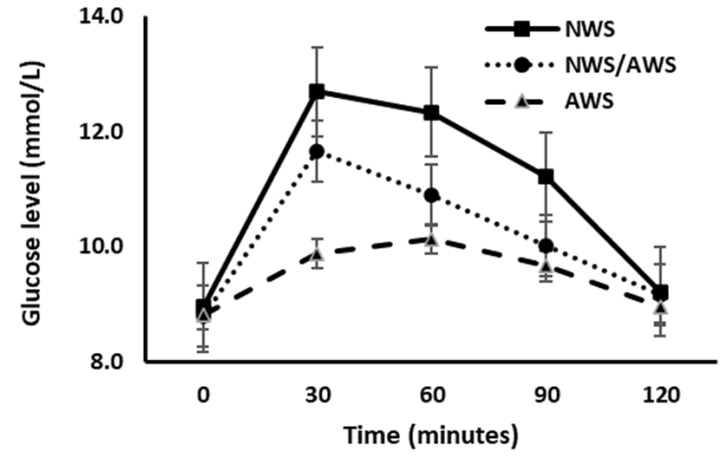
Mice that met the criteria for obesity and hyperglycemia in the HFD group were further divided into three groups and fed a single dose of different starches: NWS, AWS, or NWS plus AWS to evaluate the effects of AWS on postprandial blood glucose levels. Figure 1 and Table 3 present the postprandial blood glucose levels in the mice after starch feeding.
In the NWS group, the postprandial blood glucose concentration in obese, hyperglycemic mice increased rapidly and peaked after 30 min at a level of 12.69 mmol/l, increasing by 41.79% compared to the initial level (Figure 1). Furthermore, the AUC value representing blood glucose exposure after 120 min of treatment was 1,362 min*mmol/l.

In the AWS group, the postprandial blood glucose concentration increased steadily from 0 to 60 minutes, reaching a peak concentration of 10.14 mmol/l, corresponding to an initial 14.97% increase (Figure 1). The AUC of glucose exposure was significantly lower than that of the NWS-treated group (p < 0.05, Table 3). These results demonstrate that feeding with AWS lowered glucose formation and absorption, thereby lowering total blood glucose exposure.
Moreover, in the AWS plus NWS-fed mice, there was also a 32.54% increase in postprandial glucose concentration compared with the initial value, and the AUC value ranged between the NWS and AWS groups. This result indicate that the combination of NWS and AWS tended to lower blood glucose levels and total exposure than NWS, but not better than AWS alone.
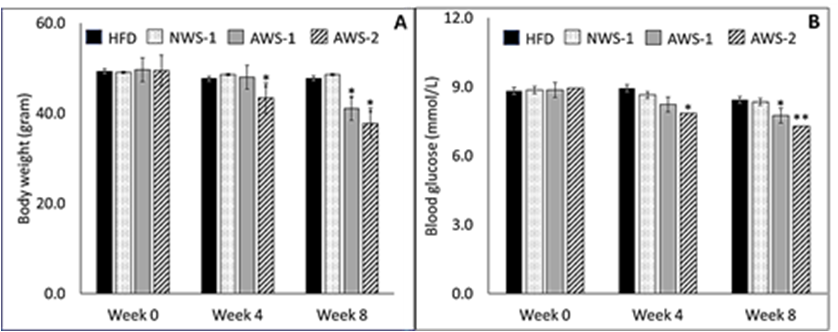
The long-term effects of AWS on body weight and glucose index were evaluated during an 8-week repeated-dose feeding. The basal values of body weight and glucose level did not differ from week 0 to week 8 in the HFD group treated with standard food (Figure 2A). After treatment with AWS-2 for 4 weeks, the body weight and blood glucose levels in these mice started to decrease; however, these were not observed in either NWS-1, or AWS-1 treated groups (Figure 2A). Compared to NWS-1 treatment, mice receiving AWS-2 showed significant body weight loss (p < 0.05). At week 8, both the AWS-1 and AWS-2 treated groups showed a significant reduction (p < 0.05) in these parameters compared to the NWS-1 group (Figure 2).
At the end of the feeding period (week 8), we conducted glucose tolerance- and insulin tolerance tests as well as measured insulin levels and insulin resistance to assess the impact of AWS on the blood glucose-insulin response.
Measurement of insulin concentration in HFD-, NWS-, and AWS-fed mice demonstrated a tendency of decrease in insulin levels (p > 0.05). However, the HOMA-IR index significantly declined in the AWS-1 and AWS-2 groups (p < 0.05) compared to that in the NWS group (Table 4).

In the glucose- and insulin tolerance tests, the AUC values of both the AWS-1 and AWS-2 groups were significantly lower than those of the NWS-1 group (Table 5). This result implied that there was an improvement in glucose tolerance after long-term AWS feeding. In addition, after challenge with a loading dose of insulin, glucose exposure in the AWS-2 treated group was significantly lower than that in the NWS-1 group, indicating an enhanced response to insulin in obese and hyperglycemic mice fed AWS.
Taken together, our results demonstrated that feeding AWS to obese and hyperglycemic mice reduced body weight and blood glucose levels, probably through the enhancement of insulin response and/or improvement of insulin resistance. Hence, AWS had more beneficial effects than NWS on obese and hyperglycemic mice in term of reducing body weight, improving glucose- and insulin tolerance, and reducing insulin resistance.
Chemically modified starch increases the ratio of resistant to digestive component 4, 5. The AWS used in this experiment was acetylated wheat starch with an acetyl content of 2.42% and a degree of substitution of 0.094, which resulted in an enhanced resistant content (4.36 times higher than that of its native counterpart, the NWS). Ačkar et al. used a mixture of succinic acid and acetic anhydride to acetylate wheat starch and obtained acetylated wheat starch with an acetyl content of 3.61%, which increased the resistant content to almost six times higher than that of native starch 13. Data from in vitro experiments have shown that increasing the acetyl content in modified starch results in a greater resistance capacity to digestive enzymes 19, however, it is unknown whether this leads to a lower blood glucose level when tested in an animal model. Furthermore, the acetyl content in modified starch should not exceed 2.5% when used in food formulation 20.
Using granular wheat starch for acetylated modification, Pham and Morita obtained an AWS with low digestive content 11. Acetylation of corn starch enhances the amount of resistant starch by more than 10% compared to that of prime starch 9, 19. Previous studies have provided similar evidence on the resistance capacity of chemically modified starches, for example, the cross-linked phosphorylation of commercial wheat starch 21, esterification by octenyl succinic anhydride of maize starch 22, and etherification by propylene oxide of sweet potato 23.
In this study, we used an obese and hyperglycemic mouse model induced by a high-fat diet, as previously described 15. Rats and mice show similar responses to dietary fat intake, and there is a close correlation between high-fat diet and obesity; hence, they are considered appropriate models for studying dietary obesity 16. In addition, this model may represent the mechanisms of obesity-induced insulin resistance via the release of hormones such as leptin and adiponectin, inhibition of phosphoinositide 3-kinase (PI3K) signaling in muscle, and upregulation of hepatic gluconeogenic enzyme phosphoenolpyruvate carboxykinase expression 24, 25. These events may contribute to insulin resistance and hence, increase blood glucose levels 25. With this model, the investigation of the impact of AWS on the blood glucose-insulin response would be appropriate and might provide reliable evidence for in vivo results.
The attenuating effect of AWS on postprandial blood glucose level, insulin concentration, and other indices compared with NWS in obese, hyperglycemic mice has implicated the beneficial outcomes of AWS in blood glucose control. The underlying mechanism of these effects may be attributable to increased hepatic fatty acid oxidation capacity and decreased glucose-dependent insulinotropic polypeptide (GIP) response 25 and/or reduced oxidative stress 26.
Consistent with previously published studies on different RS4-type resistant starches on prevention of obesity, and reduction of body weight and blood glucose levels 25, 26, 27, the AWS type also exerted similar effects. A recent study showed that a high-amylose wheat starch diet improved gastrointestinal health indicators and gut microbiota, reduced cecal pH, and increased short-chain fatty acids (SCFAs) in mice 28. Our unpublished data also showed that AWS increased SCFA production by fermentative anaerobic microorganisms in the large intestine more than natural wheat starch. Furthermore, SCFAs are known to induce glucagon-like peptide-1 (GLP-1), thus improving glucose homeostasis and insulin sensitivity 29. The reduction in body weight and postprandial blood glucose levels and the improvement in insulin resistance in mice fed AWS found in our study were most likely associated with intestinal incretin and microflora.
This study demonstrated that acetylated wheat starch (RS-type 4) has more beneficial effects than NWS in obese and hyperglycemic mice, including weight loss, postprandial glycemic regulation, improved glucose-, and insulin tolerance, and reduced insulin resistance. The bulking structure of acetylated wheat starch might interfere with the binding of digestive enzymes, thus preventing the production of glucose and improving the insulin response. This study provides further evidence for the application of acetylated wheat starch as an alternative energy source for hyperglycemia associated with obesity subjects.
The authors are thankful for the financial support provided by Hue University, Vietnam, for this research.
The authors declare that they have no competing interests relevant to the study.
| [1] | Arathuzik, G.G. and Goebel-Fabbri, A.E, “Nutrition therapy and the management of obesity and diabetes: an update”, Current Diabetes Reports, 11(2). 106-110. Apr 2011. | ||
| In article | View Article PubMed | ||
| [2] | Blüher, M, “Obesity: global epidemiology and pathogenesis”, Nature Review Endocrinology, 15(5). 288-298. May 2019. | ||
| In article | View Article PubMed | ||
| [3] | Englyst, K. N., Liu, S. and Englyst, H.N, “Nutritional characterization and measurement of dietary carbohydrates”, European journal of clinical nutrition, 61(Suppl 1). S19-39. Dec 2007. | ||
| In article | View Article PubMed | ||
| [4] | Raigond, P., Dutt, S. and Singh, B, Resistant Starch in Food, Springer, Switzerland, 2019, 815-846. | ||
| In article | View Article | ||
| [5] | Nawaz, H., Waheed, R., Nawaz, M. and Shahwar, D, Physical and Chemical Modifications in Starch Structure and Reactivity, IntechOpen, London, 2020. | ||
| In article | View Article | ||
| [6] | Wanikar, R. and Kotwal, S, Resistant Starch: A Promising Functional Food Ingredient, IntechOpen, London, 2021. | ||
| In article | View Article | ||
| [7] | Magallanes-Cruz, P.A., Flores-Silva, P.C. and Bello-Perez L.A, “Starch structure influences its digestibility: A review”, Journal of Food Science, 82(9). 2016-2023. Jul 2017. | ||
| In article | View Article PubMed | ||
| [8] | Björck, I.M., Gunnarsson, A. and Östergård, K, “A study of native and chemically modified potato starch. Part II: Digestibility in the rat intestinal tract”, Starch-starke, 41. 128-134. 1989. | ||
| In article | View Article | ||
| [9] | Chung, H.J., Shin, D.H. and Lim, S.T, “In vitro starch digestibility and estimated glycemic index of chemically modified corn starches”, Food Research International, 41(6). 579-585. Jul 2008. | ||
| In article | View Article | ||
| [10] | Takahashi, S., Maningat, C.C. and Seib, P.A, “Acetylated and hydroxypropylated wheat starch: Paste and gel properties compared with modified maize and tapioca starches”, Cereal Chemistry, 66(6). 499-506. 1989. | ||
| In article | |||
| [11] | Pham, V.H. and Morita, N, “Effects of granule sizes on physicochemical properties of cross-linked and acetylated wheat starches”, Starch-starke, 57(9). 413-420. Sep 2005. | ||
| In article | View Article | ||
| [12] | Gunaratne, A. and Corke, H, “Influence of prior acid treatment on acetylation of wheat, potato and maize starches”, Food Chemistry, 105(3). 917-925. Dec 2007. | ||
| In article | View Article | ||
| [13] | Ačkar, D., Subarić, D., Babić, J., Miličević, B. and Jozinović, A, “Modification of wheat starch with succinic acid/acetanhydride and azelaic acid/acetanhydride mixtures. II. Chemical and physical properties”, Journal of food science and technology, 51(8). 1463-1472. Aug 2014. | ||
| In article | View Article PubMed | ||
| [14] | McCleary, B.V. and Monaghan, D.A, “Measurement of Resistant Starch”, Journal of AOAC International, 85(3). 665-675. May 2002. | ||
| In article | View Article PubMed | ||
| [15] | Karasawa, H., Nagata-Goto, S., Takaishi, K. and Kumagae, Y, “A novel model of type 2 diabetes mellitus based on obesity induced by high-fat diet in BDF1 mice”, Metabolism, 58(3). 296-303. Mar 2009. | ||
| In article | View Article PubMed | ||
| [16] | Hariri, N. and Thibault, L, “High-fat diet-induced obesity in animal models”, Nutrition Research Review, 23(2). 270-299. Oct 2010. | ||
| In article | View Article PubMed | ||
| [17] | Allison, D.B., Paultre, F., Maggio, C., Mezzitis, N. and Pi-Sunyer, F.X, “The use of areas under curves in diabetes research”, Diabetes Care, 18(2). 245-250. Feb 1995. | ||
| In article | View Article PubMed | ||
| [18] | Antunes, L.C., Elkfury, J.L., Jornada, M.N., Foletto, K.C. and Bertoluci, M.C, “Validation of HOMA-IR in a model of insulin-resistance induced by a high-fat diet in Wistar rats”, Archives of Endocrinology and Metabolism, 60(2). 138-142. Apr 2016. | ||
| In article | View Article PubMed | ||
| [19] | Sahnoun, M., Ismail, N. and Kammoun R, “Enzymatically hydrolysed, acetylated and dually modified corn starch: physico-chemical, rheological and nutritional properties and effects on cake quality”, Journal of Food Science and Technology, 53(1). 481-490. Jan 2016. | ||
| In article | View Article PubMed | ||
| [20] | Code of Federal Regulations. Food additives permitted in food for human consumption. US Government Printing Office, Washington, DC, USA, Title 21, Chapter 1. Part 172: Section 172.892, Food Starch, 1994. | ||
| In article | |||
| [21] | Iacovou, M., Lim, J., Maningat, C.C., Bogatyrev, A., Ly, E., Dhital, S., Gidley, M.J., Shi, Y.C., Muir, J. and Seib, P.A, “ In vivo digestibility of cross-linked phosphorylated (RS4) wheat starch in ileostomy subjects”, Bioactive Carbohydrates and Dietary Fibre, 12. 25-36. Oct 2017. | ||
| In article | View Article | ||
| [22] | He, J., Liu, J. and Zhang, G, “Slowly digestible waxy maize starch prepared by octenyl succinic anhydride esterification and heat-moisture treatment: glycemic response and mechanism”, Biomacromolecules, 9(1). 175-184. Jan 2008. | ||
| In article | View Article PubMed | ||
| [23] | Ranaweera, S.A., Bamunuarachchi, K.K.D.S. and Gunaratne, A, “Effect of hydroxypropylation on functional properties of different cultivars of sweet potato starch in Sri Lanka”, International Journal of Food Science”, 2014. 1-8. 2014. | ||
| In article | View Article PubMed | ||
| [24] | Yang, Q., Graham, T.E., Mody, N., Preiner, F., Peroni O.D., Zabolotny, J.M., Kotani, K., Quadro, L. and Kahn, B.B, “Serum retinol-binding protein 4 contributes to insulin resistance in obesity and type 2 diabetes”, Nature 436. 356-362. Jul 2005. | ||
| In article | View Article PubMed | ||
| [25] | Shimotoyodome, A., Suzuki, J., Fukuoka, D., Tokimitsu, I. and Hase T, “RS4-type resistant starch prevents high-fat diet-induced obesity via increased hepatic fatty acid oxidation and decreased postprandial GIP in C57BL/6J mice”, American Journal of Physiology. Endocrinology and Metabolism, 298(3). E652-E662. Dec 2009. | ||
| In article | View Article PubMed | ||
| [26] | Si, X., Zhou, Z., Strappe, P. and Blanchard, C, “A comparison of RS4-type resistant starch to RS2-type resistant starch in suppressing oxidative stress in high-fat-diet-induced obese rats”, Food Function, 8(1). 232-240. Jan 2017. | ||
| In article | View Article PubMed | ||
| [27] | Lee, K.Y., Yoo, S.H. and Lee, H.G, “The effect of chemically-modified resistant starch, RS type-4, on body weight and blood lipid profiles of high fat diet-induced obese mice”, Starch/Starke, 64(1). 78-85. Jan 2012. | ||
| In article | View Article | ||
| [28] | Lim, S. M., Choo, J. M., Li, H., O'Rielly, R., Carragher, J., Rogers, G. B., Searle, I., Robertson, S. A., Page, A. J. and Muhlhausler, B, “A High Amylose Wheat Diet Improves Gastrointestinal Health Parameters and Gut Microbiota in Male and Female Mice”, Foods, 10(2). 220. Jan 2021. | ||
| In article | View Article PubMed | ||
| [29] | Mandaliya, D.K. and Seshadri, S, “Short Chain Fatty Acids, pancreatic dysfunction, and type 2 diabetes”, Pancreatology, 19(2). 280-284. Jan 2019. | ||
| In article | View Article PubMed | ||
Published with license by Science and Education Publishing, Copyright © 2022 Thi Thu Hien Chu, Hai Thuy Nguyen, Thi Hoa Phu, Huu Dung Tran and Manh Hung Tran
 This work is licensed under a Creative Commons Attribution 4.0 International License. To view a copy of this license, visit
http://creativecommons.org/licenses/by/4.0/
This work is licensed under a Creative Commons Attribution 4.0 International License. To view a copy of this license, visit
http://creativecommons.org/licenses/by/4.0/
| [1] | Arathuzik, G.G. and Goebel-Fabbri, A.E, “Nutrition therapy and the management of obesity and diabetes: an update”, Current Diabetes Reports, 11(2). 106-110. Apr 2011. | ||
| In article | View Article PubMed | ||
| [2] | Blüher, M, “Obesity: global epidemiology and pathogenesis”, Nature Review Endocrinology, 15(5). 288-298. May 2019. | ||
| In article | View Article PubMed | ||
| [3] | Englyst, K. N., Liu, S. and Englyst, H.N, “Nutritional characterization and measurement of dietary carbohydrates”, European journal of clinical nutrition, 61(Suppl 1). S19-39. Dec 2007. | ||
| In article | View Article PubMed | ||
| [4] | Raigond, P., Dutt, S. and Singh, B, Resistant Starch in Food, Springer, Switzerland, 2019, 815-846. | ||
| In article | View Article | ||
| [5] | Nawaz, H., Waheed, R., Nawaz, M. and Shahwar, D, Physical and Chemical Modifications in Starch Structure and Reactivity, IntechOpen, London, 2020. | ||
| In article | View Article | ||
| [6] | Wanikar, R. and Kotwal, S, Resistant Starch: A Promising Functional Food Ingredient, IntechOpen, London, 2021. | ||
| In article | View Article | ||
| [7] | Magallanes-Cruz, P.A., Flores-Silva, P.C. and Bello-Perez L.A, “Starch structure influences its digestibility: A review”, Journal of Food Science, 82(9). 2016-2023. Jul 2017. | ||
| In article | View Article PubMed | ||
| [8] | Björck, I.M., Gunnarsson, A. and Östergård, K, “A study of native and chemically modified potato starch. Part II: Digestibility in the rat intestinal tract”, Starch-starke, 41. 128-134. 1989. | ||
| In article | View Article | ||
| [9] | Chung, H.J., Shin, D.H. and Lim, S.T, “In vitro starch digestibility and estimated glycemic index of chemically modified corn starches”, Food Research International, 41(6). 579-585. Jul 2008. | ||
| In article | View Article | ||
| [10] | Takahashi, S., Maningat, C.C. and Seib, P.A, “Acetylated and hydroxypropylated wheat starch: Paste and gel properties compared with modified maize and tapioca starches”, Cereal Chemistry, 66(6). 499-506. 1989. | ||
| In article | |||
| [11] | Pham, V.H. and Morita, N, “Effects of granule sizes on physicochemical properties of cross-linked and acetylated wheat starches”, Starch-starke, 57(9). 413-420. Sep 2005. | ||
| In article | View Article | ||
| [12] | Gunaratne, A. and Corke, H, “Influence of prior acid treatment on acetylation of wheat, potato and maize starches”, Food Chemistry, 105(3). 917-925. Dec 2007. | ||
| In article | View Article | ||
| [13] | Ačkar, D., Subarić, D., Babić, J., Miličević, B. and Jozinović, A, “Modification of wheat starch with succinic acid/acetanhydride and azelaic acid/acetanhydride mixtures. II. Chemical and physical properties”, Journal of food science and technology, 51(8). 1463-1472. Aug 2014. | ||
| In article | View Article PubMed | ||
| [14] | McCleary, B.V. and Monaghan, D.A, “Measurement of Resistant Starch”, Journal of AOAC International, 85(3). 665-675. May 2002. | ||
| In article | View Article PubMed | ||
| [15] | Karasawa, H., Nagata-Goto, S., Takaishi, K. and Kumagae, Y, “A novel model of type 2 diabetes mellitus based on obesity induced by high-fat diet in BDF1 mice”, Metabolism, 58(3). 296-303. Mar 2009. | ||
| In article | View Article PubMed | ||
| [16] | Hariri, N. and Thibault, L, “High-fat diet-induced obesity in animal models”, Nutrition Research Review, 23(2). 270-299. Oct 2010. | ||
| In article | View Article PubMed | ||
| [17] | Allison, D.B., Paultre, F., Maggio, C., Mezzitis, N. and Pi-Sunyer, F.X, “The use of areas under curves in diabetes research”, Diabetes Care, 18(2). 245-250. Feb 1995. | ||
| In article | View Article PubMed | ||
| [18] | Antunes, L.C., Elkfury, J.L., Jornada, M.N., Foletto, K.C. and Bertoluci, M.C, “Validation of HOMA-IR in a model of insulin-resistance induced by a high-fat diet in Wistar rats”, Archives of Endocrinology and Metabolism, 60(2). 138-142. Apr 2016. | ||
| In article | View Article PubMed | ||
| [19] | Sahnoun, M., Ismail, N. and Kammoun R, “Enzymatically hydrolysed, acetylated and dually modified corn starch: physico-chemical, rheological and nutritional properties and effects on cake quality”, Journal of Food Science and Technology, 53(1). 481-490. Jan 2016. | ||
| In article | View Article PubMed | ||
| [20] | Code of Federal Regulations. Food additives permitted in food for human consumption. US Government Printing Office, Washington, DC, USA, Title 21, Chapter 1. Part 172: Section 172.892, Food Starch, 1994. | ||
| In article | |||
| [21] | Iacovou, M., Lim, J., Maningat, C.C., Bogatyrev, A., Ly, E., Dhital, S., Gidley, M.J., Shi, Y.C., Muir, J. and Seib, P.A, “ In vivo digestibility of cross-linked phosphorylated (RS4) wheat starch in ileostomy subjects”, Bioactive Carbohydrates and Dietary Fibre, 12. 25-36. Oct 2017. | ||
| In article | View Article | ||
| [22] | He, J., Liu, J. and Zhang, G, “Slowly digestible waxy maize starch prepared by octenyl succinic anhydride esterification and heat-moisture treatment: glycemic response and mechanism”, Biomacromolecules, 9(1). 175-184. Jan 2008. | ||
| In article | View Article PubMed | ||
| [23] | Ranaweera, S.A., Bamunuarachchi, K.K.D.S. and Gunaratne, A, “Effect of hydroxypropylation on functional properties of different cultivars of sweet potato starch in Sri Lanka”, International Journal of Food Science”, 2014. 1-8. 2014. | ||
| In article | View Article PubMed | ||
| [24] | Yang, Q., Graham, T.E., Mody, N., Preiner, F., Peroni O.D., Zabolotny, J.M., Kotani, K., Quadro, L. and Kahn, B.B, “Serum retinol-binding protein 4 contributes to insulin resistance in obesity and type 2 diabetes”, Nature 436. 356-362. Jul 2005. | ||
| In article | View Article PubMed | ||
| [25] | Shimotoyodome, A., Suzuki, J., Fukuoka, D., Tokimitsu, I. and Hase T, “RS4-type resistant starch prevents high-fat diet-induced obesity via increased hepatic fatty acid oxidation and decreased postprandial GIP in C57BL/6J mice”, American Journal of Physiology. Endocrinology and Metabolism, 298(3). E652-E662. Dec 2009. | ||
| In article | View Article PubMed | ||
| [26] | Si, X., Zhou, Z., Strappe, P. and Blanchard, C, “A comparison of RS4-type resistant starch to RS2-type resistant starch in suppressing oxidative stress in high-fat-diet-induced obese rats”, Food Function, 8(1). 232-240. Jan 2017. | ||
| In article | View Article PubMed | ||
| [27] | Lee, K.Y., Yoo, S.H. and Lee, H.G, “The effect of chemically-modified resistant starch, RS type-4, on body weight and blood lipid profiles of high fat diet-induced obese mice”, Starch/Starke, 64(1). 78-85. Jan 2012. | ||
| In article | View Article | ||
| [28] | Lim, S. M., Choo, J. M., Li, H., O'Rielly, R., Carragher, J., Rogers, G. B., Searle, I., Robertson, S. A., Page, A. J. and Muhlhausler, B, “A High Amylose Wheat Diet Improves Gastrointestinal Health Parameters and Gut Microbiota in Male and Female Mice”, Foods, 10(2). 220. Jan 2021. | ||
| In article | View Article PubMed | ||
| [29] | Mandaliya, D.K. and Seshadri, S, “Short Chain Fatty Acids, pancreatic dysfunction, and type 2 diabetes”, Pancreatology, 19(2). 280-284. Jan 2019. | ||
| In article | View Article PubMed | ||