Spices and culinary herbs are sources of bioactive compounds whose availability depends on preparation methods. This study aims to evaluate and compare the phytochemical, antioxidant, and enzyme-inhibitory properties of different aqueous extracts from seven culinary herbs of Burkina Faso. Extracts were prepared by maceration, infusion, and decoction for varying durations and extraction yields were determined. Total polyphenols were quantified using the Folin-Ciocalteu method, flavonoids using the aluminium chloride method, while salicylic acid and tannins were determined by spectrophotometric and colometric methods. Antioxidant activities were assessed by 2,2-diphenyl-1-picrylhydrazyl (DPPH) radical-scavenging capacity and ferric reducing power, while inhibitory activities against α-amylase, trypsin, and chymotrypsin were determined spectrophotometrically and expressed as half-maximal inhibitory concentration (IC50) values. Phytochemical screening revealed variable distributions of flavonoids, polyphenols, anthocyanins, saponins, alkaloids, and catechin tannins among the studied species. For five of the seven species, the highest extraction yields were obtained with 60-minute decoction: Apium graveolens (31.89%), A. porrum (26.27%), A. cepa (24.99%), M. piperita (20.76%), and O. basilicum (18.75%). Maceration favored the extraction of phenolic compounds and flavonoids in the majority, except for P. crispum and A. cepa and enhanced the ferric-reducing power and α-amylase inhibition across all species. Decoction showed variable effects depending on duration, increasing bioactive compounds but decreasing hydrolyzable tannins, DPPH radical-scavenging capacity, and α-amylase inhibition. Multivariate analysis reveals a dissociation between extraction yield, phytochemical richness, and anti-amylase activity, with A. cepa and M. piperita being more characterized by their bioactive compounds, while Petroselinum crispum, Anethum graveolens, and Ocimum basilicum exhibit the broadest enzyme-inhibiting potential. These results suggest differentiated uses for culinary herbs. In particular, Mentha piperita, rich in phenolic compounds and flavonoids, could be used in mild preparations such as macerations or infusions, while Anethum graveolens, characterized by a broader enzyme-inhibiting potential, appears to be a promising species for functional culinary applications.
Culinary spices and herbs play an important role in daily diets, particularly in the preparation of sauces, broths, and many traditional dishes 1. These plant species are commonly used for their richness in volatile organic compounds responsible for their distinctive aromatic and olfactory-gustatory profiles 2. Beyond this sensory appeal, these plants also constitute an important source of bioactive phytochemicals such as polyphenols, flavonoids, tannins, alkaloids, and other secondary metabolites 3, 4. These compounds are recognized for their antioxidant, antimicrobial, anti-inflammatory, and antitumor activities, as well as for their ability to modulate the activity of certain enzymes of physiological interest 5, 6. Among these enzymes, alpha-amylase plays a central role in starch hydrolysis; its partial inhibition can contribute to slowing glucose release and modulating the postprandial glycemic response 7. Trypsin and chymotrypsin, on the other hand, are serine proteases primarily involved in digestion, but they also play a role in numerous biological processes, including immune responses, tissue remodelling, coagulation, inflammation, and certain pathways associated with tumor progression, neurodegenerative diseases, and viral infections. Long considered antinutritional factors due to their ability to inhibit the digestion of dietary proteins, plant-derived protease inhibitors are now being studied for their potential bioactive properties, including anti-inflammatory, antiviral, anticancer, and immunomodulatory effects 8, 9. These natural products are generating increasing interest, and several studies have already highlighted the functional benefits of culinary spices and herbs. Epidemiological studies suggest that a diet rich in plant-based bioactive compounds is associated with a reduced risk of developing non-communicable diseases. Modelling studies suggest that increased consumption of herbs and spices could help reduce mortality from conditions such as stroke, cancer, and type 2 diabetes 10. However, the expression of organoleptic, nutritional, functional, and therapeutic potential depends largely on culinary preparation methods, which influence the release, stability, and bioavailability of bioactive compounds. In practice, spices and aromatic herbs are rarely consumed alone or raw; they are generally incorporated into food preparations where they undergo various aqueous and thermal treatments. These processes can modify the structure of the plant matrices and promote the release, stability, and availability of bioactive compounds, or, conversely, degrade them, depending on the intensity of the treatment. Several previous studies have investigated the phytochemical composition and antioxidant activity of various culinary herbs and spices 11, 12, 13, while others have focused on the inhibitory activity against digestive enzymes or the effect of different extraction solvents, with very limited consideration of actual cooking conditions 14, 15, 16, 17. Studies conducted by Aphrodite et al. 18 on several spices, including parsley, basil, and mint, demonstrated the influence of different cooking temperatures on total polyphenols, flavonoids, and antioxidant activity. Other studies have investigated the effects of temperature, drying, bleaching, or extraction conditions with different types of solvents on bioactive compositions, antioxidant activity, or alpha-amylase inhibition 19, 20, 21, 22. However, few studies have simultaneously evaluated, within the same plant matrices, the phytochemical profile, antioxidant activity, and enzyme-inhibitory activity. This fragmented approach limits our understanding of the relationships between preparation methods, the release of bioactive compounds, and the overall functional potential of edible herbs, as available results are often obtained from different species, with varying solvents, or under experimental conditions that are difficult to compare.
In this context, the objective of this study is to evaluate, using an integrated and comparative approach, the effects of aqueous extraction techniques representative of culinary practices on the phytochemical profiles and biological properties of seven culinary herbs.
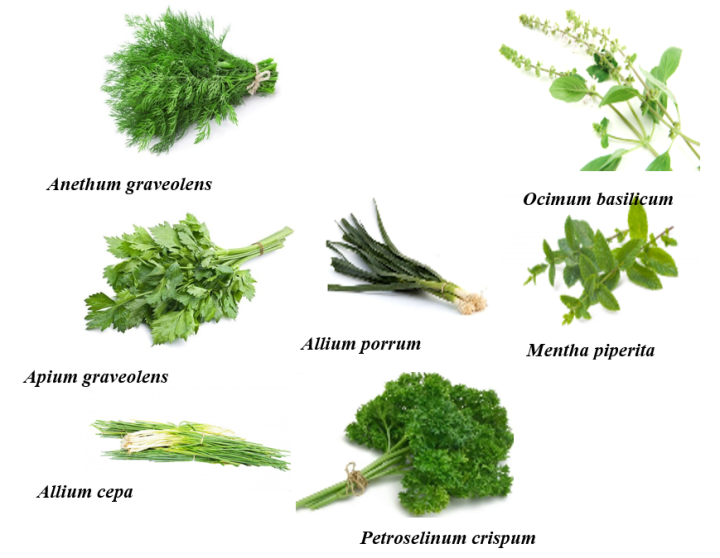
The biological material used in this study consists of the same plant samples previously studied and described in our earlier work 23. These are leaves of seven (7) species of culinary herbs. Ocimum basilicum, Anethum graveolens, Apium graveolens, Allium cepa, Allium porrum, Petroselinum crispum, and Mentha piperita (Figure 1). The conditions for collection, identification, and initial sample preparation were described in that publication. In the present study, these same samples underwent further aqueous extractions and additional analyses, focusing on phytochemical composition, antioxidant activity, and inhibitory activity against digestive enzymes. The tannin content values previously obtained for extracts prepared by maceration 23 were used solely for comparative purposes to assess the influence of the different aqueous extraction methods, including maceration, infusion, and decoction

Three techniques, each corresponding to distinct experimental conditions, were used to extract bioactive compounds.
Sample preparation: After shade-drying, the samples were finely ground using a MINI MOKA GR-0203 electric grinder 23. The resulting powders were then used to prepare aqueous extracts for the different analyses.
Aqueous maceration extraction: Extraction was performed as described by Zirihi et al. 24. This consisted of suspending 50 g of powder in 250 mL of distilled water. The mixture was left under continuous stirring for 24 h before being filtered.
Decoction extraction: This extraction was performed by boiling the sample for three different durations. For this, 50 g of powder were added to 250 mL of water, and the mixture was then brought to a boil for 15 min, 30 min, or 1 h. After heating, the preparations were left to infuse for 60, 45 and 15 min, respectively, to maintain a total contact time of 1h15 min for each treatment. 25.
Infusion Extraction: The infusion was performed by pouring 250 mL of boiling distilled water over 50 g of plant powder. The mixture was then left to stand for 1h15 to allow extraction of soluble compounds and cooling of the preparation, 26.
All the extracts obtained were filtered through Whatman No. 1 filter paper. The filtrate obtained was considered the crude extract, then dried in an oven at 50 °C for 3 days before being used in the various analyses. The extraction yield (R) is calculated using the formula below and expressed as a percentage of the initial dry mass used.
 | (1) |
Where m: mass of dried aqueous extract; M: mass of the test portion.
For the biological and phytochemical tests, 10 mg of each dry extract was dissolved in 10 mL of distilled water to prepare a 1 mg/mL stock solution.
2.3. Phytochemical ScreeningThe prepared extracts underwent phytochemical testing according to the methods described by Dohou et al. 27 and Békro et al. 28 to detect the presence or absence of certain families of secondary metabolites. To this end, characterization tests of the different groups of compounds were performed on the extracts obtained.
Tannin detection: 500 mg of extract was dissolved in 5 mL of a 25% methanol solution. To 1 mL of extract diluted in 2 mL of distilled water, 2 to 3 drops of 1% FeCl3 solution were added. The appearance of a greenish-black color indicates the presence of catechin tannins.
Saponin detection: Saponin detection was performed by adding 25 mL of water to 2 mL of each aqueous extract, then the mixture was vigorously shaken. After 20 minutes of standing, the presence of saponins was confirmed by the formation of a persistent foam.
Flavonoid detection: To 5 mL of each extract, 1 mL of concentrated HCl and 0.5 g of magnesium turnings are added. The presence of flavonoids is indicated by the development of a pink or red color after 3 minutes.
Phenolic compound detection: The ferric chloride (FeCl3) reaction was used to characterize phenolic compounds. One drop of a 2% alcoholic ferric chloride solution was added to 2 mL of the aqueous extract. The appearance of a bluish-black or green color, of varying intensity, indicates the presence of phenolic compounds.
Alkaloid detection: To 1 mL of each extract, 5 mL of 1% HCl are added. The mixture is heated in a water bath and then divided into two equal volumes. One volume (3 mL) is treated with Mayer's reagent, and the other (3 mL) with Wagner's reagent. The formation of a white or brown precipitate indicates the presence of alkaloids. Anthocyanin detection: The presence of anthocyanins was demonstrated by adding two milliliters (2mL) of aqueous extract to 2 mL of 2 N HCl. It is revealed by the appearance of a pink-red colour which turns to blue-violet after the addition of ammonia.
2.4. Secondary Metabolite AssaysThe total phenolic compound content was determined according to the method described by Hasperué et al. 29. In each test tube, 25 µL of the sample to be assayed (gallic acid or extract) and 125 µL of Folin-Ciocalteu reagent (FCR) solution (0.2 N) were added, depending on the solutions obtained after dilution. After 5 minutes of incubation at room temperature, 100 µL of a sodium carbonate solution (75 g/L) was added and the tube was left in the dark for 1 hour and 30 minutes. Optical densities were read at 760 nm using a UV-visible spectrophotometer (Epoch, Bio Tech Instruments Inc., Highland Park, USA). Total polyphenol levels were determined using the reference curve with gallic acid (0-100 mg/L) with equation 2.
 | (2) |
The results were expressed in milligrams of gallic acid equivalent (GAE) per 100 grams of dry extract (mg GAE/100g) according to the following equation:
 | (3) |
Where: C = total phenolic content in mg GAE/100 g of extract
c = sample concentration in μg/ml
D = dilution factor of the stock extract solution
Ci = concentration of the stock extract solution in mg/ml
Total flavonoid content was analyzed according to the Dowd method 30, adapted by Arvouet-Grand et al. 31. This method uses aluminium chloride to quantify flavonoids in the different extracts. Indeed, 75 µL of the 2% AlCl3 solution is added to 75 µL of each sample or of the standard (quercetin). After 15 minutes of incubation in the dark, the absorbance is read at 415 nm using a UV-visible spectrophotometer (Epoch, Bio Tech Instruments Inc., Highland Park, USA) against a blank consisting of 75 µL of extract and 75 µL of distilled water. The flavonoid concentrations are determined by reference to the calibration curve using quercetin as the standard (Equation 4).
 | (4) |
The results were expressed in milligrams of quercetin equivalent (QE) per 100 grams of dry extract (mg QE/100g) according to the following formula:
 | (5) |
Where: C = total flavonoid content in mg QE/100 g of extract
c = concentration of the sample read (µg/mL)
D = dilution factor of the stock extract solution
Ci = concentration of the stock extract solution (mg/mL)
The condensed tannin content of the extracts was determined using the vanillin-HCl method described by Julkunen-Tiitto 32, with slight modifications. Three milliliters of a 4% vanillin solution and 1.5 mL of HCl were added to 50 μL of samples and incubated for 15 min at room temperature. The absorbance was then read at 500 nm against a blank prepared under the same conditions, but with distilled water replacing the vanillin solution. The condensed tannin content of the extracts was extrapolated to a catechin calibration curve (Equation 6) and expressed in milligrams of catechin equivalents per 100 grams of extract (mg CE/100 g DW).
 | (6) |
The hydrolyzable tannin content was measured using the formula proposed by de Sousa Sabino et al. 33. Specifically, 1 mL of extract was added to 3.5 mL of a solution prepared from 0.01 M ferric chloride (FeCl₃) in 0.001 M hydrochloric acid (HCl). After 15 seconds, the absorbance of the mixture was read at 660 nm. The results were expressed as mg of tannic acid equivalents per 100 g of dry extract (mg/100 g) using the following formula:
 | (7) |
Where: A: absorbance; Mw: molecular weight of tannic acid (1701.19 g/mol); DF: dilution factor; ελ: 2169 M−1.cm−1; W: sample weight (g); V: extraction volume in L; l: optical path length = 1 cm
Salicylic acid extraction was performed according to the method described by Hoops 34, modified and adapted to our plant material. A 100 mg sample was homogenized in 5 mL of distilled water for 10 min and then centrifuged at 4500 rpm for 10 min. The collected supernatant constituted the crude salicylic acid extract. For this purpose, 100 μL of the extract was added to 150 μL of iron chloride (FeCl3 1%). After homogenization, absorbances were measured at 540 nm against a blank consisting of a mixture of 100 μL of the extract and 150 μL of distilled water. The values obtained were directly extrapolated to a salicylic acid standard (Equation 8).
 | (8) |
Concentrations are expressed in mg/100 g dry weight (DW).
2.5. Evaluation of Biological ActivitiesThe antioxidant capacity of each plant extract was determined using the method of Hinneburg et al. 35. This method is based on the extracts' ability to reduce ferric ions (Fe3+) to ferrous ions (Fe2+). Therefore, 500 µL of each extract solution were mixed with 1250 µL of phosphate buffer (0.2 M; pH 6.6) and 1250 µL of 1% aqueous potassium hexacyanoferrate [K3Fe(CN)6]. After 30 min of incubation at 50°C, 1250 µL of 10% trichloroacetic acid were added. The mixture was then centrifuged at 2000 rpm for 10 min. Next, 125 µL of the supernatant were mixed with 25 µL of distilled water and 25 µL of a freshly prepared aqueous solution of FeCl3 (0.1%). Absorbances were read at 700 nm against a blank prepared according to the same protocol as the samples, but in which the extract was replaced by distilled water. The values obtained were directly extrapolated to an ascorbic acid standard (Equation 9).
 | (9) |
The results were expressed in milligrams of ascorbic acid equivalent (AAE) per 100 grams of dry extract (mg AAE/100g) according to the following formula:
 | (10) |
Where: C = concentration of reducing compounds in mg AAE/100 g of extract
c = concentration of the sample read in µg/mL
D = dilution factor of the stock extract solution
ci = concentration of the stock extract solution in mg/mL
This method relies on the ability of the free radical DPPH° (2,2-Diphenyl-1-picrylhydrazyl) to accept a hydrogen atom or electron from a scavenging molecule (e.g., an antioxidant), leading to its reduction to DPPH-H. This reaction is accompanied by a color change from purple to yellow and a decrease in absorbance measured at 515 nm 36. Therefore, 100 µL of each extract were added to 200 µL of the DPPH solution (20 mg/L). After 15 min incubation in the dark at room temperature, absorbances were read at 515 nm. Distilled water was used as a blank. The percentage of DPPH radical neutralization was calculated using the following formula:
 | (11) |
Where: A: absorbance
A linearization of the % inhibition as a function of extract concentrations allowed the determination of the IC50 concentrations, i.e., those required to neutralize 50% of the DPPH radicals present in the reaction medium. The IC50 values were expressed in µg/mL. A lower IC50 value corresponds to higher antioxidant activity.
The inhibitory activity of trypsin (EC 3.4.21.4) of the extracts was determined according to the method described by Arefrad et al. 37. Thus, 100 µL of trypsin (from bovine pancreas, Sigma) at a concentration of 0.0125 mg mL⁻¹ were added to 100 µL of extract and incubated for 5 min, then 50 µL of N-α-Benzoyl-DL-Arginine p-Nitroanilide (BAPNA) at a concentration of 0.8 mg mL⁻¹ were added. The release of p-nitroanilide was monitored for 25 min at 410 nm against a blank using a spectrophotometer (Epoch, Bio Tech Instruments Inc., Highland Park, USA). The percentage of trypsin inhibition was calculated using the following formula:
 | (12) |
Where: A: absorbance
Linearization of the inhibitory activity as a function of extract concentrations allowed the determination of the 50% inhibitory concentrations (IC50), corresponding to the extract concentration required to inhibit 50% of the measured biological activity. The IC50 values were expressed in µg/mL.
The chymotrypsin inhibitory activity (EC 3.4.21.1) of culinary spice and herb extracts was determined using the procedure described by Arefrad et al. 37. Approximately 100 μL of extracts were added to 100 μL of chymotrypsin (from bovine pancreas, Sigma) at a concentration of 100 μg/mL. The mixture was incubated for 5 min, and then 50 μL of N-Glutaryl-L-Phenylalanine p-Nitroanilide (GPNA) substrate at a concentration of 3.2 mg mL was added to the mixture. The release of p-Nitroanilide was monitored for 25 min at 410 nm against a control using a spectrophotometer. The percentage of chymotrypsin inhibition was calculated using the following formula:
 | (13) |
Where: A: absorbance
Linearization of the inhibitory activity as a function of extract concentrations allowed for the determination of the 50% inhibitory concentrations (IC50). The IC50 values were expressed in µg/mL.
The activity of α-amylase was determined according to the method described by Cazzola et al 38. The principle of this method is based on the determination of reducing carbohydrates (maltodextrins) released during the hydrolysis of starch (1%) by α-amylase (0.3%) in the presence or absence of extract. The reaction mixture contained 312.5 µL of starch solution, 125 µL of enzyme solution, and 125 µL of extract. A control was made without plant extract, with the extract replaced by distilled water. The tubes were shaken and then incubated for 30 minutes at 40 °C. The reaction was stopped by adding 625 µL of 3,5-dinitrosalicylate (DNS), and the tubes were then placed in a boiling water bath for 8 minutes at 100 °C to halt the enzymatic reaction. Acarbose was used as a control for comparison. Absorbance was measured at 540 nm. The percentages of inhibition were determined as follows:
 | (14) |
Where: A: absorbance
Linearization of the inhibitory activity as a function of extract concentrations allowed the determination of the 50% inhibitory concentrations (IC50). The IC50 values were expressed in µg/mL.
2.6. Quality Assurance of Spectrometric AnalysesAppropriate quality assurance procedures and precautions are implemented to ensure the reliability of the results. Samples are handled carefully to avoid contamination. Laboratory glassware is cleaned meticulously according to the strictest standards, and the reagents used are of optimal analytical quality. Deionized double-distilled water is used throughout the study. Blank analyses of the reagents are performed to correct the spectrometer measurements.
2.7. Statistical AnalysisThe various analyses were performed in technical triplicate using the same experimental sample. The results are expressed as mean ± standard deviation. Microsoft Excel 2019 and GraphPad Prism, version 8.4.3, were used for descriptive data processing and graph creation. Differences between means were assessed using analysis of variance, followed by Tukey's multiple comparisons test at a significance level of 5% (p<0.05). XLSTAT 2019 and R-Studio (version 4.0.2, 2020) software were used for analyses of variance, correlations, and hierarchical clustering to examine potential relationships between parameters.
Extraction yields varied significantly from 13.52% ±0.1 to 31.89% ± 0.07 depending on the plant species and the extraction method used (Table 1). They also varied with the duration of the decoction. Among the seven plants studied, Apium graveolens stood out with the highest yields, regardless of the method used. In general, the best yields were obtained with prolonged decoction, particularly the 60-minute decoction. The lowest yield was recorded with the infusion of A. cepa. Conversely, Apium graveolens exhibited the highest yields for all the methods studied, with 26.26% ± 0.02% after maceration and 22.71% ± 0.09% after infusion. For the decoction, the maximum values were recorded after 30 and 60 minutes, reaching 29.68 ± 0.05% and 31.89 ± 0.07%, respectively. Equally high yields were recorded for Petroselinum crispum after maceration (23.85 ± 0.03%) and for Allium porrum after infusion (22.62 ± 0.07%) (Table 1).
Phytochemical screening was performed on macerated extracts from various culinary herbs. The results are presented in Table 2. Qualitative analysis of the macerated extracts revealed the presence of phenolic compounds, tannins, and anthocyanins in all the spices and culinary herbs studied. Saponins were also detected in the majority of extracts, except for those from M. piperita and A. porrum. Alkaloids, however, were absent from the extracts of M. piperita, A. porrum, and O. basilicum.
This section compares the bioactive compounds and biological activities of macerated extracts from the seven herbs studied. The results are presented in Table 3. The total polyphenol content varied significantly among the plants studied. The highest content was observed in the extracts of Mentha piperita, with 8877.88 ± 8.23 mg GAE/100 g. This value is considerably higher than those recorded for the other six herbs. Ocimum basilicum had the second highest content at 4888.47 ± 9.71 mg GAE/100 g, followed by Allium cepa, with a content of 3837.09 ± 3.78 mg GAE/100 g. Conversely, the lowest total polyphenol content was observed in Petroselinum crispum, at 1724.15 ± 8.67 mg GAE/100 g. Flavonoid levels also varied among the spices and culinary herbs studied. The highest content was observed in extracts of Mentha piperita, at 4760 ± 15.55 mg QE/100 g. This value is significantly higher than those recorded in the other six spices. The second highest content was observed in extracts of Apium graveolens, at 1863.43 ± 7.39 mg QE/100 g, followed by Ocimum basilicum, at 1844.44 ± 2.93 mg QE/100 g. Conversely, Petroselinum crispum exhibited the lowest flavonoid content at 1372.55 ± 3.66 mg QE/100 g. High salicylic acid levels were observed in the extracts of Allium cepa, Mentha piperita, and Ocimum basilicum, at 16.52 ± 0.37 mg/100 g, 15.68 ± 0.48 mg/100 g, and 15.17 ± 0.22 mg/100 g, respectively. Conversely, the lowest salicylic acid content was observed in Petroselinum crispum, at 4.81 ± 0.07 mg/100 g.
Analysis of variance (ANOVA) revealed significant differences in the biological activities of the extracts. Antioxidant activities were assessed to evaluate the capacity to scavenge 2,2-di(4-tert-octylphenyl)-1-picrylhydrazyl (DPPH) free radicals, as well as their ability to reduce ferric iron (III) to ferrous iron (II). The figure shows that all extracts exhibited high antioxidant capacities, with statistically significant variations. The highest Ferric Reducing Power (RP) was obtained in Petroselinum crispum, followed by Allium porrum with 5530.2 ± 205.90 mg AAE/100g DW and 5468.72 ± 73.7 mg AAE/100g DW, respectively.
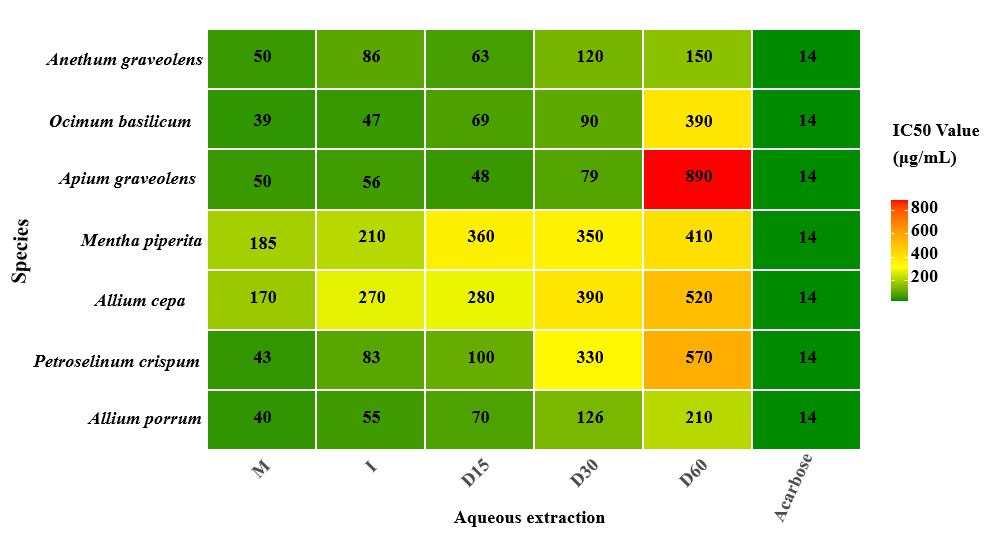
Values of a parameter with the same letters are not statistically different; those with different letters are statistically different at the 5% threshold (p≤0.05). Conversely, the lowest antioxidant activity was observed in Apium graveolens with 4626.26 ± 79.97 mg AAE/100g DW. Antiradical activity varied significantly depending on the type of culinary plant. Anethum graveolens exhibited the highest DPPH radical-scavenging capacity, with an IC50 of 138 ± 0.29 µg/mL. It was followed by extracts of Allium porrum and Ocimum basilicum with IC50 values of 150 ± 0.62 µg/mL and 152.6 ± 0.80 µg/mL, respectively. All seven extracts inhibited amylase, trypsin, and chymotrypsin, with different IC50 values. Regarding trypsin, the Apium graveolens extract showed the strongest inhibitory effect with an IC50 of 125.6 ± 1.3 µg/mL. In contrast, Allium porrum exhibited the weakest inhibitory activity, with an IC50 of 175.3 ± 0.6 µg/mL. Regarding the inhibition of the extracts against chymotrypsin, the IC50 values ranged from 77.1 ± 1.2 µg/mL for Anethum graveolens to 109.3 ± 0.5 µg/mL for Apium graveolens. The Anethum graveolens extract proved to be the most active, as indicated by its lowest IC50 value, while the Apium graveolens extract showed the least significant inhibitory activity. Regarding inhibitory activity against alpha-amylase, the extracts also exhibited markedly variable levels of efficacy. Among them, Ocimum basilicum was the most active, with the lowest IC50 of 39 ± 0.51 µg/mL. This value, however, remains higher than that of acarbose, the positive control, whose IC50 was 14 ± 0.02 µg/mL. Thus, although the Ocimum basilicum extract exhibits significant inhibitory activity against alpha-amylase, its efficacy remains lower than that of acarbose.
Values of a parameter with the same letters are not statistically different, those with different letters are statistically different at the 5% threshold (p ≤0.05).
Legends: RP: Ferric Reducing Power; DPPH: 2,2-Diphenyl-1-picrylhydrazyl Antiradical Activity.
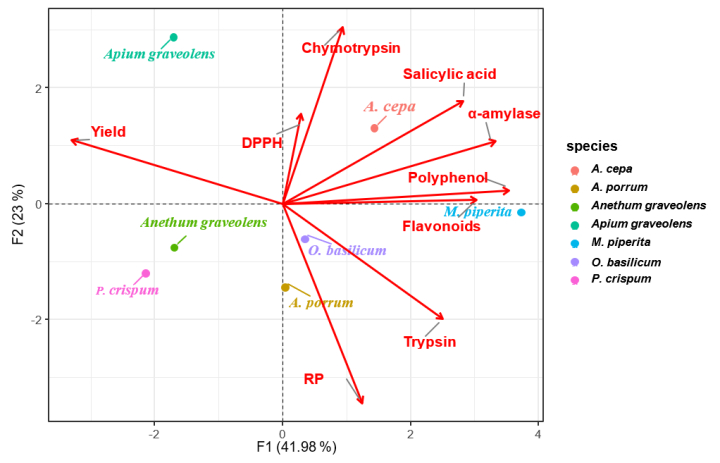
Principal component analysis (PCA) summarized 64.98% of the information in our dataset (Figure 2), with 41.98% along axis F1 and 23.00% along axis F2. This graph revealed a positive association between the levels of polyphenols, flavonoids, salicylic acid, and the IC50 values of the extracts with respect to alpha-amylase, all oriented towards the positive side of F1. Conversely, yield is projected onto the negative side of this axis, reflecting an opposition with these parameters. Axis F2 contrasts the IC50 values of the extracts against chymotrypsin and DPPH antioxidant activity, located in the upper part of the plane, with the IC50 values against trypsin and Ferric Reducing Power (RP), oriented towards the lower part. This organization suggests negative correlations between yield and polyphenol content on the one hand, and between Ferric Reducing Power (RP) and IC50 values against chymotrypsin on the other. The distribution of species in the plane highlights a distinct structure in phytochemical and biological profiles. One profile, represented by A. cepa and M. piperita, is characterized by an association with phenolic compounds, salicylic acid, and IC50 values against α-amylase, indicating weak inhibitory activity of the plants against this enzyme and a high polyphenol and salicylic acid content. A second profile, grouping P. crispum and Anethum graveolens, forms an opposing group, negatively associated with salicylic acid, phenolic compounds, and IC50 values against α-amylase, suggesting greater inhibitory activity against α-amylase. O. basilicum and A. porrum, forming group 3, occupy an intermediate profile, without a marked association. Finally, Apium graveolens presents a distinct profile, strongly associated with yield but negatively associated with phytochemical and antioxidant parameters, as well as with IC50 values against trypsin, reflecting more pronounced inhibitory activity against this enzyme and low levels of phytochemical compounds.

Legends: RP: Ferric Reducing Power; DPPH: 2,2-Diphenyl-1-picrylhydrazyl Antiradical Activity.
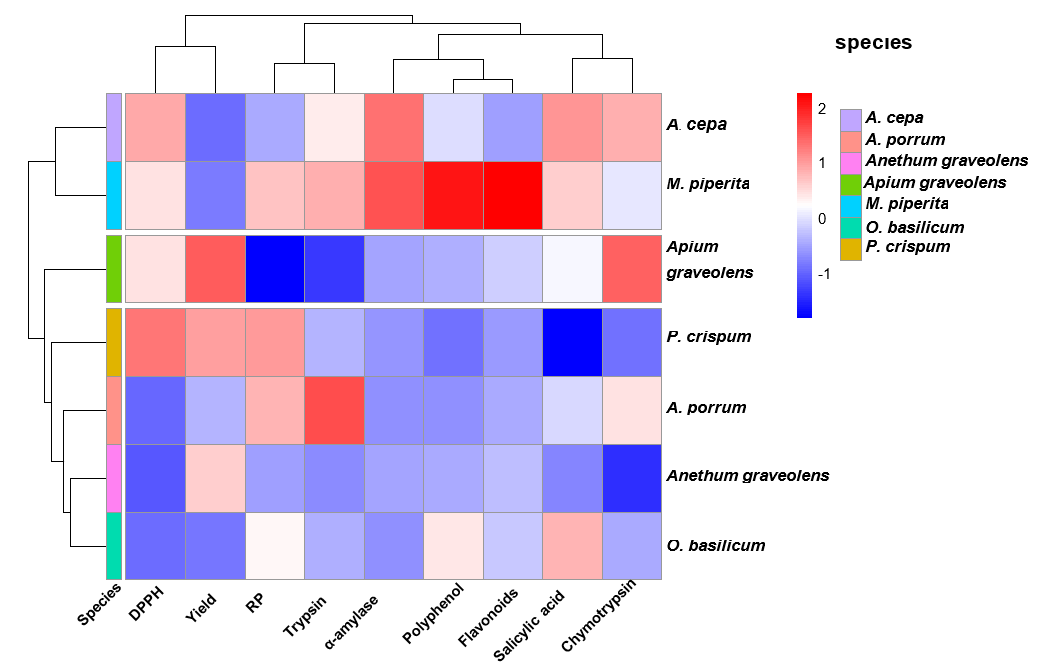
The hierarchical heat map highlights clear structuring of the extracts according to the species and parameters studied, with very good homogeneity of intra-species profiles (Figure 3). A. cepa and M. piperita are characterized by high levels for several phytochemical parameters. This trend is particularly pronounced in M. piperita, which has high polyphenol and flavonoid content, while A. cepa is characterized primarily by a high salicylic acid content. Conversely, Anethum graveolens, P. crispum, A. porrum, Apium graveolens, and O. basilicum share a profile more oriented towards the inhibition of digestive enzymes. Among these species, P. crispum, Anethum graveolens, and O. basilicum stand out with relatively low IC50 values for the three digestive enzymes, reflecting broader and stronger enzyme-inhibitory potential. The variable classification shows a correlation between polyphenols and flavonoids. Ferric Reducing Power (RP) appears close to the IC50 values for trypsin, while salicylic acid activity is close to the IC50 values for chymotrypsin. DPPH antioxidant activity and yield also form a distinct group.

Legends: RP: Ferric Reducing Power; DPPH: 2,2-Diphenyl-1-picrylhydrazyl Antiradical Activity
Table 4 presents the Pearson correlation coefficients between the different parameters studied. A strong positive correlation was observed between the total phenolic compound and flavonoid content (r = 0.92). Phenolic compound content also showed a positive correlation with the IC50 values of the extracts against alpha-amylase (r = 0.71). Similarly, a moderate positive correlation was observed between flavonoid content and the IC50 values against alpha-amylase (r = 0.62). Furthermore, moderate positive correlations were observed between the antioxidant activity measured by the Ferric Reducing Power (RP) Assay and the IC50 values of the extracts against trypsin (0.63), as well as between the salicylic acid content and the IC50 against chymotrypsin (Table 4).
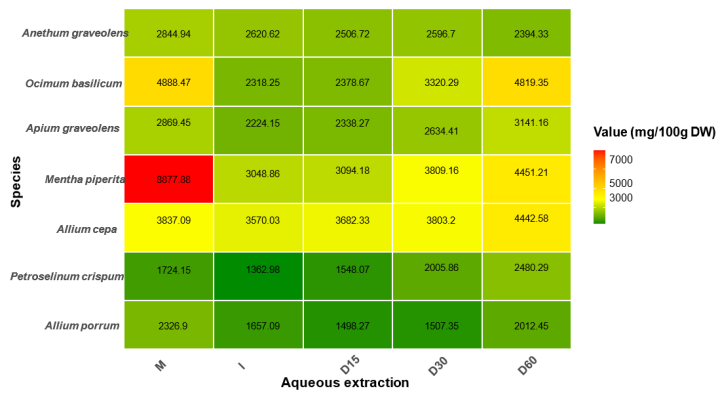
The various treatments applied, including maceration, infusion, and decoction of varying durations, had varying effects on the total polyphenol content of the spices and culinary herbs studied (Figure 4). Extracts obtained by maceration generally had higher polyphenol content than extracts obtained by infusion and decoction. The macerated extract of M. piperita was particularly noteworthy, with the highest polyphenol content, more than twice that obtained with the other extraction methods. For extracts obtained by heat treatment, the polyphenol content of Ocimum basilicum, Petroselinum crispum, Apium graveolens, Mentha piperita, and Allium cepa increased progressively with temperature and decoction time. Thus, the polyphenol content of Ocimum basilicum increased from 2378.67 ± 21.09 mg GAE/100g DW after infusion to 4819.35 ± 23.68 mg GAE/100g DW after 1 hour of decoction. Similarly, that of Petroselinum crispum increased from 1362.98 ± 2.96 mg GAE/100g DW to 2480.29 ± 19.17 mg GAE/100g DW. In contrast, Allium porrum showed relative stability in polyphenols during the first 30 minutes of heat treatment, followed by an increase in content after this period. Conversely, Anethum graveolens showed relative stability during the first 30 minutes, then a decrease in polyphenol content beyond 30 minutes.

Legends: M : Maceration, I : Infusion, D15 : Decoction for 15 minutes, D30: Decoction for 30 minutes, D60: Decoction for 60 minutes.
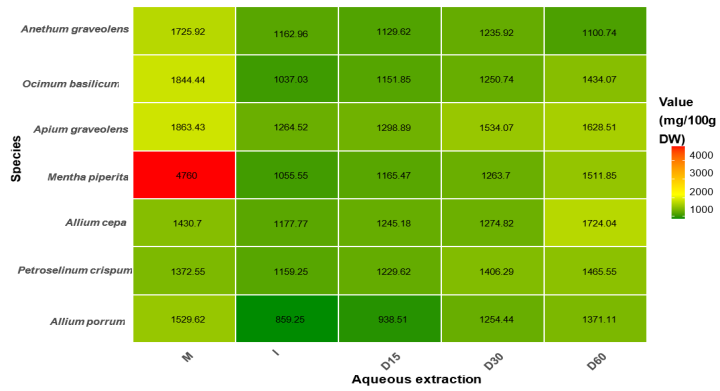
The different extraction treatments influenced the flavonoid content of the spices and culinary herbs studied to varying degrees (Figure 5). Overall, a slight increase in flavonoid content was observed during heat treatments, particularly as decoction time increased. In Ocimum basilicum, the content increased from 1037.03 ± 12.83 QE/100g in the infused extract to 1434.07 ± 4.2 QE/100g after 1 hour of decoction. Similarly, in Allium cepa, it increased from 1245.18 ± 7.8 to 1724.04 ± 4.22 mg QE/100g after 1 hour of decoction. Extracts obtained by maceration had the highest flavonoid content compared to infused and decocted extracts, regardless of the species. However, an exception was observed for Allium cepa, whose extract decocted for 1 hour had a higher content than the macerated extract. Infused extracts had the lowest content. For decocted extracts, flavonoid content increased with decoction time for all plants studied.

Legends: M : Maceration, I : Infusion, D15 : Decoction for 15 minutes, D30: Decoction for 30 minutes, D60: Decoction for 60 minutes
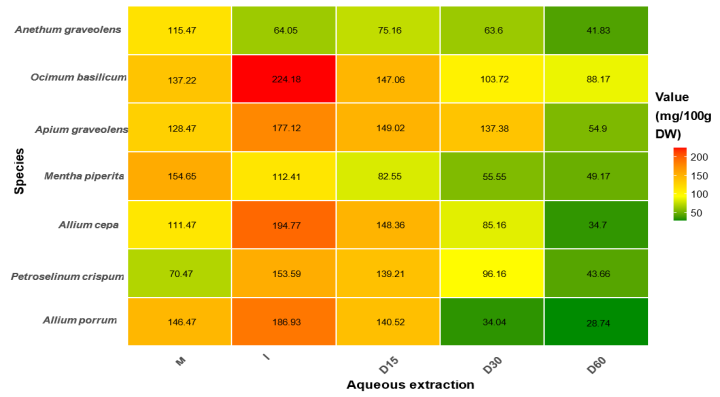
The evaluation of hydrolyzable tannins revealed significant variation in content across plant species and extraction treatment (Figure 6). For Allium cepa, Allium porrum, Mentha piperita, Ocimum basilicum, and Petroselinum crispum, the content decreased progressively with increasing heat treatment. Thus, in Allium cepa, the content decreased from 194.77 ± 1.03 mg GAE/100g DW in the infused extract to 34.7 ± 1.39 mg GAE/100g DW after 1 hour of decoction. A similar trend was observed in Allium porrum, where the content decreased from 186.93 ± 1.48 mg GAE/100g DW to 28.74 ± 1.26 mg GAE/100g DW. In contrast, Anethum graveolens stood out from the other species with lower hydrolyzable tannin content in infused extracts compared to extracts decocted for 15 minutes. In general, extracts decocted for 1 hour had the lowest hydrolyzable tannin content compared to macerated extracts, infused extracts, and those decocted for shorter periods. The lowest levels were obtained in Allium porrum and Allium cepa, with 28.74 ± 1.26 mg GAE/100g DW and 34.7 ± 1.39 mg GAE/100g DW, respectively

Legends: M : Maceration, I : Infusion, D15 : Decoction for 15 minutes, D30: Decoction for 30 minutes, D60: Decoction for 60 minutes.
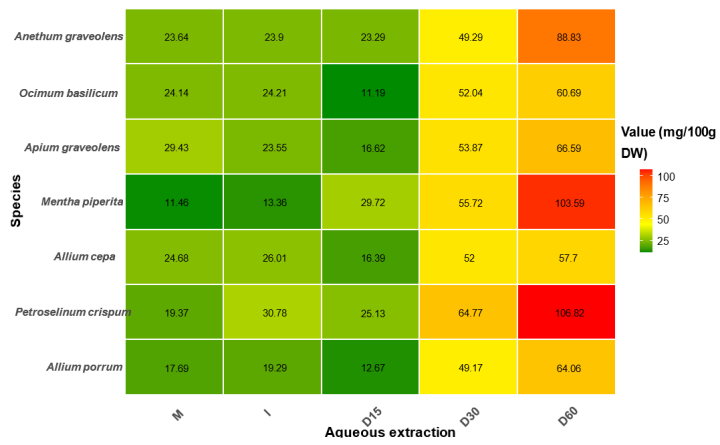
Quantitative analysis of condensed tannins in spices and culinary herbs revealed significant variability in content depending on the species and extraction methods (Figure 7). Generally, condensed tannin content increased progressively with longer decoction times, from 15 minutes to 1 hour, regardless of the species. The content in the infusion extracts was generally comparable to that of the macerated extracts, except for Apium graveolens and Petroselinum crispum, for which more pronounced differences were observed between these two extraction methods. The lowest levels of condensed tannins were particularly observed in extracts decocted for 15 min, notably in Ocimum basilicum and Allium porrum with respective values of 11.19 ± 0.28 mg/100 g DW and 12.67 ± 0.06 mg/100 g DW.

Legends: M: Maceration, I : Infusion, D15 : Decoction for 15 minutes, D30: Decoction for 30 minutes, D60: Decoction for 60 minutes
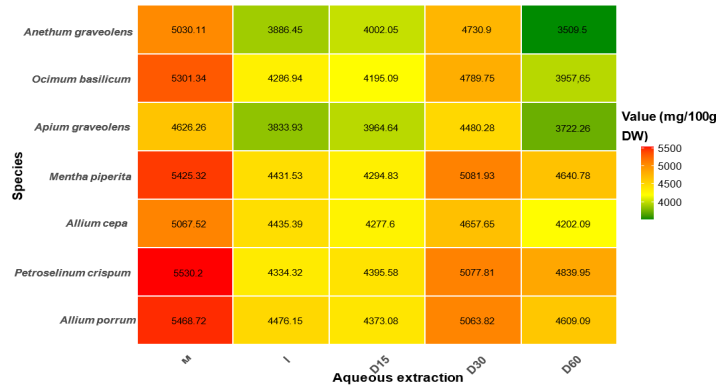
3.6. Effect of Aqueous Extraction Methods on Biological ActivitiesFor each culinary herb, five extracts were analyzed: one macerated extract, one infused extract, and three extracts obtained by decoction for 15, 30, and 60 minutes. The antioxidant capacity, assessed by the Ferric Reducing Power (RP) Assay, varied with the species studied and the extraction method used (Figure 8). Overall, the macerated extracts showed the highest Ferric Reducing Power values for all the plants studied. The infused extracts showed activities close to those of the extracts obtained by 15-minute decoction. Antioxidant activities also varied with decoction time. Of the three times studied, the 30-minute decoction showed the highest level of activity. The highest values were recorded for Mentha piperita, Petroselinum crispum, and Allium porrum, with 5081.93 ± 102.40 mg AAE/100g DW, 5077.81 ± 24.39 mg AAE/100g DM, and 5063.82 ± 71.89 mg AAE/100g DW, respectively. However, extracts decocted for 60 minutes exhibited the lowest FRAP values. For Mentha piperita, the activity decreased from 5081.93 ± 102.40 mg AAE/100g DW after 30 minutes of decoction to 4640.78 ± 173.21 mg AAE/100g DW after 60 minutes of decoction. A similar decrease was observed in Petroselinum crispum, with a drop from 5077.81 ± 24.39 mg AAE/100g DW to 4839.95 ± 183.37 mg AAE/100g DW. In Allium porrum, activity also decreased from 5063.82 ± 71.89 mg AAE/100g DW to 4609.09 ± 143.93 mg AAE/100g DW.

Legends: M: Maceration, I: Infusion, D15: Decoction for 15 minutes, D30: Decoction for 30 minutes, D60: Decoction for 60 minutes
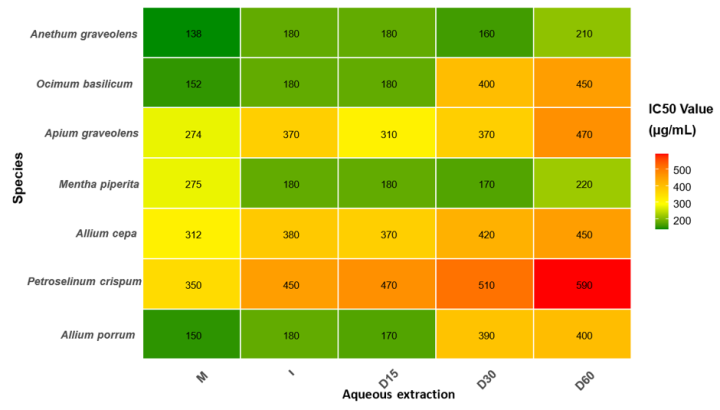
Antioxidant activity, assessed by the DPPH method, varied according to the type of extraction and the intensity of the heat treatment (Figure 9). Marked differences were observed, particularly in Ocimum basilicum and Allium porrum. For these two species, less severe treatments, such as maceration, infusion, or short-term decoction, showed the lowest IC50 values, reflecting a greater capacity to scavenge the DPPH radical. Conversely, prolonged heat treatments, such as decoctions at 30 and 60 minutes, resulted in higher IC50 values, indicating reduced antioxidant activity. The highest activities were obtained with macerated extracts of Anethum graveolens (138.33 ± 0.29 µg/mL), Allium porrum (150 ± 0.62 µg/mL), and Ocimum basilicum (152.6 ± 0.80 µg/mL). These low values indicate a higher free radical scavenging capacity in extracts not subjected to prolonged heating. Conversely, the highest IC50 values were observed in Petroselinum crispum extracts obtained by decoction for 60 min and 30 min, with 590 ± 20 µg/mL and 510 ± 10 µg/mL, respectively. For all plant species, macerated extracts exhibited the highest DPPH activity compared to infused and decocted extracts.

The potential to inhibit alpha-amylase activity, assessed using IC50 values, varied with plant species and extraction method (Figure 10). Macerated and infused extracts showed the lowest IC50 values across all seven spices, indicating more pronounced inhibition than observed with decocted extracts. The highest inhibitory effects were observed in the macerated extracts of Ocimum basilicum (39 ± 0.51 µg/mL) and Allium porrum (40 ± 0.27 µg/mL). Significant differences were observed in Apium graveolens, whose IC50 increased from 60 µg/ml in the macerated extract to 890 µg/ml in the extract decocted for 60 min. The variations in IC50 among the five extract types were less pronounced for Anethum graveolens and Mentha piperita.

Legends: M : Maceration, I : Infusion, D15 : Decoction for 15 minutes, D30: Decoction for 30 minutes, D60: Decoction for 60 minutes
Temperature and extraction time influence the yield and stability of bioactive compounds 39. The yields found depended on both the plant species and the method used. The highest yield was observed with Apium graveolens, which appears to be the species with the best retractability in maceration, decoction, and infusion. This observation suggests that this plant contains a significant proportion of water-soluble compounds. The variation in extraction yield observed between the extraction methods can be attributed to differences in temperature, contact time, and the diffusion capacity of the water-soluble compounds. The yields reported in this study are significantly higher than those of Mladenović et al. 40, who obtained 12.15% for macerated extracts of the same spice. The yield of the macerated extract of Ocimum basilicum (14.86 ± 0.04%) obtained in this study is comparable to that (15.24%) reported by Benabdallah et al. 41. The duration of heat treatment influenced the extraction yields of the spices and culinary herbs. The highest yields were observed with decocted extracts for most of the species analyzed, suggesting a favorable effect of heat on the extraction of soluble compounds. This trend is consistent with the observations reported by Lezoul et al 42. Previous work has also shown that high extraction temperatures can disrupt interactions between bioactive compounds and plant tissues, reduce solvent viscosity, improve mass transfer, and increase the solubility of these compounds 43. The presence of phenolic compounds, flavonoids, and tannins in all the studied species highlights the phytochemical richness of the analyzed culinary herbs. In contrast, the presence of saponins and alkaloids varied among the species, highlighting differences in phytochemical composition across the seven species. These results are consistent with previous studies reporting the presence of saponins, tannins, phenolic compounds, and alkaloids in aqueous extracts of Allium cepa 44, 45. Similar phytochemical groups have also been identified in extracts of Apium graveolens 46 and Ocimum basilicum 41. The levels of phenolic compounds, flavonoids, and salicylic acids varied among the species studied, revealing significant diversity in their phytochemical composition. Among the seven culinary herbs, M. piperita had the highest levels of polyphenols and flavonoids. This richness makes M. piperita particularly interesting as a culinary ingredient and could be utilized in food formulations. The polyphenol and flavonoid levels obtained for Anethum graveolens were higher than those reported by Jadhav and Pawar 47, who measured 1100.21 ± 0.02 mg GAE/100 g of extract and 4004 ± 4.73 mg QE/100 g, respectively. They also exceeded the values reported by Hadi et al. 48, which were 2335 ± 66 mg GAE/100g and 940 ± 51 mg QE/100g, respectively. However, these values remained lower than those found by Benabdallah et al. 41, which were 4120 ± 40 mg GAE/100g and 1296 ± 51 mg QE/100g, respectively. Furthermore, the phenolic compound levels measured in Allium cepa, Apium graveolens, and Petroselinum crispum were higher than those reported by Maser et al. 16, who obtained 404 ± 0.04, 728 ± 18, and 430 ± 17 mg GAE/100g, respectively. These results indicate that the species studied are relatively rich sources of phenolic compounds. The differences observed compared to values reported in the literature may reflect variations linked to cultivation conditions, as well as extraction and quantification methods 12. The relatively high levels observed across all species suggest that these culinary herbs hold potential as natural sources of bioactive compounds.
The variable levels of salicylic acid among the species studied may reflect differences in biosynthesis or physiological response to biotic and abiotic stresses 49. The levels found in the studied plants range from 0.280 to 60.4 mg/100 g, as reported for spices by Malakar et al. 50. The highest concentration observed in A. cepa suggests that this spice could be a significant source of salicylates among the studied species. However, its high consumption could thus increase dietary salicylate intake and promote intolerance reactions in individuals sensitive to aspirin or dietary salicylates 51.
The inhibition of trypsin and chymotrypsin by all seven aqueous extracts studied indicates that these herbs and spices contain compounds capable of modulating the activity of serine proteases. However, the significant differences in half-maximal inhibitory concentration (IC50) observed between species suggest that this inhibition is highly dependent on the plant matrix and its phytochemical profile. This observation is consistent with Ryl and Jasicka-Misiak 17, who reported that plant extracts rich in phenolic compounds could exhibit inhibitory activity against chymotrypsin. The lower IC50 observed against trypsin with Apium graveolens reflects a greater inhibitory efficacy of this extract against this enzyme, while the more pronounced activity of Anethum graveolens against chymotrypsin suggests a certain specificity of the active compounds depending on the targeted protease. This trend is consistent with the work of Gunbatan et al. 52 which also highlighted an inhibitory activity of serine proteases in plant extracts. This inhibition could be linked to the presence of bioactive compounds that form complexes with these enzymes, modify their conformation, or limit access to the active site. Trypsin and chymotrypsin represent promising targets for therapeutic intervention, as their enzymes are involved in several pathological processes, including inflammation, tumor progression, wound healing, and certain viral infections 53. From this perspective, Anethum graveolens and Apium graveolens could constitute interesting sources of bioactive compounds to explore. However, since these enzymes are involved in protein digestion, these extracts, which possess a potent inhibitory effect, must be used with caution. Alpha-amylase is widely used as a drug target to prevent postprandial hyperglycemia because it plays a role in the early stages of starch hydrolysis 54, 55. The inhibitory activity of alpha-amylase observed with extracts from the seven food plants highlights the presence of metabolites capable of interfering with this step of carbohydrate digestion. However, the variations in IC50 between species could be explained by differences in phytochemical profiles, particularly in phenolic compounds, flavonoids, tannins, or other metabolites likely to interact with α-amylase 7, 56, 57. The similarity of the IC50 values of macerated extracts of Ocimum basilicum and Petroselinum crispum to that of acarbose reinforces the functional interest of these extracts and highlights a promising inhibitory potential against α-amylase. This result is consistent with the work of Shanak et al. 14 and Bashkin et al. 57, who reported, respectively, a significant inhibition of enzymes involved in carbohydrate digestion by Ocimum basilicum and Petroselinum crispum.
This observation is consistent with the results reported by Corkovic et al. 58 and Kashtoh and Baek 7, who also observed differences in α-amylase inhibition among various plant extracts. These variations could be associated with the differences in phytochemical composition observed between the species. The strong correlation found between phenolic compounds and flavonoids can be explained by the fact that flavonoids constitute the most dominant phenolic group in the various extracts. This relationship was reported by El Rayess et al. 59, where these two parameters strongly contribute to the differentiation of plant species. Other studies have also shown a strong correlation between these two parameters 60. Apium graveolens presented a distinct profile. Its association with yield, but its opposition to phytochemical and antioxidant parameters, suggests that high yields could result from the extraction of other water-soluble constituents, such as sugars, minerals, proteins, or other non-phenolic metabolites. This trend is consistent with El Mannoubi 60, who reported higher levels of phenolic compounds and flavonoids in low-yield extracts. However, its association with greater trypsin inhibition suggests that other, unevaluated constituents of the extract may contribute to this activity. The intermediate profiles of O. basilicum and A. porrum reflect a less specialized position, characterized by a balance between phytochemical richness and enzyme inhibition. The observed correlations between ferric reducing power (RP) and the IC50 of trypsin, as well as between DPPH and the IC50 of chymotrypsin, suggest the existence of specific relationships between certain bioactive compounds and the inhibition of digestive proteases.
Hierarchical clustering distinguished between a group more closely associated with phytochemical parameters and another oriented towards the inhibition of digestive enzymes, indicating that the overall phytochemical content is insufficient to account for all observed biological activities. The profiles of M. piperita and A. cepa, more strongly marked by phytochemical parameters, suggest that these species are primarily valuable matrices for the supply of phenolic compounds. Conversely, the clustering of P. crispum, Anethum graveolens, O. basilicum, and Apium graveolens around low IC50 values for several digestive enzymes reflects a broader inhibitory potential, suggesting that these species contain compounds capable of interacting with various digestive enzymes, notably α-amylase, trypsin, and chymotrypsin. Several studies have reported similar cases of inhibition by culinary herbs. The significant influence of extraction methods on the phenolic and flavonoid content demonstrates that the phytochemical value of herbs and spices depends not only on the species but also on the preparation conditions. This observation is of particular interest from a culinary perspective, as these ingredients are generally consumed after being incorporated into sauces, broths, or cooked dishes, where they are exposed to water, heat, and varying cooking times. The differences observed between extracts can be explained by the ability of the processes to promote the solubilization of phenolic compounds and flavonoids, as well as by the sensitivity of certain molecules to heat treatments 61. The effect of heat treatments on these compounds remains complex. Phenolic compounds differ in the number and position of their hydroxyl groups, their degree of polymerization, and their association with plant matrix constituents, which can influence their extractability 62, oxidation, or degradation 63. Extracts obtained by maceration showed high levels of phenolic compounds and flavonoids, indicating that this process enables efficient extraction of these molecules, likely due to the 24-hour contact time with the plant matrix. This trend was particularly pronounced in the macerated extract of M. piperita, suggesting that this species could be better utilized in gentle preparations, such as warm infusions, macerations, or by adding it to dishes at the end of cooking, in order to better preserve its compounds. Furthermore, an increase in levels was observed with longer decoction times in Allium cepa, Ocimum basilicum and Petroselinum crispum, suggesting that increasing the contact time between these plant matrices and the solvent, combined with the effect of heat, promoted the release of matrix-bound compounds.
This increase may be linked to greater leaching of water-soluble compounds into the solvent during decoction. These results are consistent with the observations of Vagiri and Jensen 64, who showed that heat can improve the extractability of bioactive compounds by weakening cell structures to release bound compounds and facilitating their diffusion into the solvent. For species that showed a favorable response to decoction, this method of aqueous extraction, akin to certain culinary practices, could be of interest for harnessing their bioactive compounds and nutritional potential. However, the effects of temperature do not always follow a linear relationship with the intensity of the treatment. While increasing the intensity of the treatment can raise the apparent levels by disrupting cell walls and releasing bound compounds, more severe or prolonged heat treatments can also promote thermal degradation, oxidation, and hydrolysis of glycosylated forms, leading to a reduction in flavonoid and polyphenol levels 20, 63, 65, 66, 67. Thus, the results obtained after 24 hours of maceration and 1 hour of decoction indicate that the contact time between the plant matrix and the solvent is a determining factor in the extraction of these compounds. This observed effect cannot be attributed solely to temperature but could also result from gradual diffusion. Decoction altered the tannin profile of the extracts, with a decrease in hydrolyzable tannins and an increase in condensed tannins. These results suggest that prolonged decoction could reduce the content of hydrolyzable tannins, often associated with the astringency and sensory properties of cooked dishes. This observation is consistent with the work of Zayed et al. 68, who showed that hydrothermal processes can reduce tannin content through hydrolysis, degradation, or interaction with other constituents. Conversely, the increase in condensed tannin content in the decoctions is consistent with the work of Hoque et al. 68. However, their findings differ from those of Zayed et al. 68, who reported a decrease attributed to the formation of complexes with proteins and polysaccharides. Since these species are culinary plants, prolonged cooking could increase their condensed tannin content, contributing to dish astringency and the antinutritional effects associated with high levels. Maceration, which results in low condensed-tannin levels and high hydrolyzable tannin levels, could be a useful approach when the goal is to limit this antinutritional component.
Iron reducing power and DPPH scavenging activity were significantly affected by decoction time and the species studied. The best antioxidant activities observed in the macerated extracts of most plants suggest that the absence of heating favored the preservation of compounds involved in iron reducing power and DPPH radical scavenging. This trend corroborates the observations of Fernando et al. 21. Anethum graveolens and Mentha piperita retained relatively high antioxidant activity, regardless of the extraction method, indicating better stability of their antioxidant compounds. For both infused and decocted extracts, antioxidant activity generally increased up to 30 minutes of treatment, then decreased with prolonged exposure. This trend suggests that moderate heating can improve the extraction of antioxidant compounds, while longer treatment can lead to their degradation, oxidation, or transformation. Similar results were reported by Le et al. 22 during the drying of Ocimum basilicum at different temperatures. The low half-maximal inhibitory concentration (IC50) values obtained for Ocimum basilicum indicate a higher antiradical activity than those reported by Benabdallah et al. 41, who obtained an IC50 of 2122.81 ± 107.77 µg/mL. The results observed for Anethum graveolens are also comparable to those of Hadi et al. 47, who reported IC50 values of 117.08 ± 0.16 µg/mL for the aqueous extract and 558.75 ± 4.07 µg/mL for the decoction extract, confirming the antioxidant potential of this plant. Thus, Anethum graveolens, Ocimum basilicum, and A. porrum can be considered potential sources of natural antioxidants in culinary preparations, provided that appropriate preparation methods are used, such as maceration, gentle infusion, addition at the end of cooking, or moderate decoction.
Aqueous extraction methods strongly influenced the alpha-amylase-inhibiting activity of the herbs studied. Macerated and infused extracts exhibited higher alpha-amylase-inhibiting activity than decocted extracts, whose activity decreased with increasing heat treatment. The greater activity observed in macerated extracts suggests that the compounds involved are better preserved in the absence of heat, likely due to the heat sensitivity of certain bioactive metabolites. Infusion, characterized by brief exposure to heat, could also be beneficial. Conversely, boiling the extracts for 15 to 60 minutes could lead to the degradation, oxidation, or structural transformation of certain inhibitory compounds, thereby reducing their ability to interact with α-amylase. These observations indicate that the treatment effect depends on the temperature, the duration of exposure, and the overall intensity of the hydrothermal process. Le et al. 22, reported that the inhibitory activity of O. basilicum was maintained at 50 and 60°C, then decreased at 70 and 80 °C. Although these temperatures are lower than those used in our decoction treatments and therefore do not allow for a direct comparison, these results illustrate the possible influence of temperature on inhibitory activity. Similarly, Mulimani and Supriya reported a significant reduction in the inhibitory activity of α-amylase after cooking sorghum seeds 70.
This study highlights the influence of plant species, aqueous extraction method, and heat treatment duration on the phytochemical composition and biological activities of seven spices and culinary herbs commonly used in Burkina Faso. The results showed that these plants possess distinct profiles, both in terms of their phenolic compound, flavonoid, and salicylic acid content, and their antioxidant activities, including inhibition of alpha-amylase, trypsin, and chymotrypsin. Multivariate analysis allowed for the differentiation of a group composed of M. piperita and A. cepa, more strongly associated with phytochemical parameters, and another group, focused on the inhibition of digestive enzymes, comprising P. crispum, Anethum graveolens, O. basilicum, Apium graveolens, and A. porrum. Among the processes studied, maceration proved particularly effective for extracting phenolic compounds and flavonoids, as well as for obtaining higher antioxidant activity, as measured by the Ferric Reducing Power (RP) Assay, and a more pronounced inhibitory effect against alpha-amylase. The effects of decoction, on the other hand, varied depending on its duration and the parameters considered. It increased the condensed tannin content in several species. Conversely, more intense heat treatment led to a decrease in hydrolyzable tannins, the inhibitory effect on alpha-amylase, and antioxidant activity, as assessed by the DPPH test. These results highlight the importance of better considering culinary preparation methods in the nutritional and functional evaluation of culinary herbs, whose bioactive potential depends as much on their intrinsic composition as on the extraction conditions and heat treatments. Further studies on the identification of active compounds, confirmation of their effects in biological models and the type of inhibition of the different enzyme inhibitors would be necessary.
The authors declare that they have no conflicts of interest.
AAE, Ascorbic Acid Equivalent, BAPNA, N-α-Benzoyl-DL-Arginine p-Nitroanilide, CE,Catechin Equivalents, DNS, Dinitrosalicylate, DPPH, 2,2-Diphenyl-1-picrylhydrazyl, FCR, Folin-Ciocalteu Reagent, RP, Ferric Reducing Power, GAE Gallic Acid Equivalent, GPNA, N-Glutaryl-L-Phenylalanine p-Nitroanilide, IC50, half-maximal inhibitory concentration, PCA, Principal component analysis, QE, Quercetin Equivalent.
| [1] | Al-Habsi, N., Al-Khalili, M., Haque, S.A., Al Akhzami, N., Gonzalez-Gonzalez, C.R., Al Harthi, S., & Al Jufaili, S.M. (2025). Herbs and spices as functional food ingredients: A comprehensive review of their therapeutic properties, antioxidant and antimicrobial activities, and applications in food preservation. J. Funct. Foods, 129: 1-12. | ||
| In article | View Article | ||
| [2] | Mostafa, S., Wang, Y., Zeng, W., & Jin, B. (2022). Floral Scents and Fruit Aromas: Functions, Compositions, Biosynthesis, and Regulation. Front. Plant Sci., 13: 1-23. | ||
| In article | View Article PubMed | ||
| [3] | Shahidi, F., & Hossain, A. (2018). Bioactives in spices, and spice oleoresins: Phytochemicals and their beneficial effects in food preservation and health promotion. J. Food Bioact., 3: 8-75. | ||
| In article | View Article | ||
| [4] | Opara, E.I., & Chohan, M. (2014). Culinary Herbs and Spices: Their Bioactive Properties, the Contribution of Polyphenols and the Challenges in Deducing Their True Health Benefits. Int. J. Mol. Sci., 15(10): 19183-19202. | ||
| In article | View Article PubMed | ||
| [5] | Liu, Q., Meng, X., Li, Y., Zhao, C.N., Tang, G.Y., & Li, H.B. (2017). Antibacterial and Antifungal Activities of Spices. Int J Mol Sci., 18(6):1-62. | ||
| In article | View Article PubMed | ||
| [6] | Kunnumakkara, A.B., Sailo, B.L., Banik, K., Harsha, C., Prasad, S., Gupta, S.C., Bharti, A.C., & Aggarwal, B.B. (2018). Chronic diseases, inflammation, and spices: how are they linked? J Transl Med. 16(14): 1-25. | ||
| In article | View Article PubMed | ||
| [7] | Kashtoh, H., & Baek, K.H. (2023). New Insights into the Latest Advancement in α-Amylase Inhibitors of Plant Origin with Anti-Diabetic Effects. Plants, 12: 1-28. | ||
| In article | View Article PubMed | ||
| [8] | Kobayashi, H. (2013). Prevention of cancer and inflammation by soybean protease inhibitors. Front. Biosci., 966-973. | ||
| In article | View Article PubMed | ||
| [9] | Crocetti, L., Quinn, M.T., Cilibrizzi, A., & Giovannoni, M.P. (2022). Editorial: Serine protease inhibitors and their therapeutic applications. Front. Chem.,10:980152. | ||
| In article | View Article PubMed | ||
| [10] | Springmann, M., Charles, H., Godfray, J., Rayner, M., & Scarborough, P. (2016). Analysis and valuation of the health and climate change cobenefits of dietary change, Proc. Natl. Acad. Sci.,113 (15): 4146-4151. | ||
| In article | View Article PubMed | ||
| [11] | Wojdyło, A., Oszmiański, J., & Czemerys, R. (2007). Antioxidant activity and phenolic compounds in 32 selected herbs. Food Chem., 105: 940–949. | ||
| In article | View Article | ||
| [12] | El Hachlafi, N., Benkhaira, N., Al-Mijalli, S.A., Mrabti, H.N., Abdnim, R., Abdallah, E.M., Jeddi, M., Bnouham, M., Lee, L., Ardianto, C., Ming, L.C., Bouyahya, A., & Fikri-Benbrahim, K. (2023). Phytochemical analysis and evaluation of antimicrobial, antioxidant, and antidiabetic activities of essential oils from Moroccan medicinal plants: Mentha suaveolens, Lavandula stoechas, and Ammi visnaga. Biomed. Pharmacother, 164: 114937. | ||
| In article | View Article PubMed | ||
| [13] | Szarek, N., Jaworska, G., & Hanus, P. (2024). Profile of Phenolic Compounds and Antioxidant Activity of Celery (Apium graveolens) Juices Obtained from Pulp after α-Amylase Treatment from Aspergillus oryzae. Molecules, 29: 1438 | ||
| In article | View Article PubMed | ||
| [14] | Shanak, S., Bassalat, N., Albzoor, R., Kadan, S., & Zaid H. (2021). In Vitro and in Silico Evaluation for the Inhibitory Action of O. basilicum Methanol Extract on α -Glucosidase and α -Amylase. Evid. Based Complement. Alternat. Med. 2021: 1-9. | ||
| In article | View Article PubMed | ||
| [15] | İlhan Lale, E., Türkyılmaz, İ.B., & Yanardağ, R., (2023). In vitro trypsin inhibitory activities of some plant and fruit extracts and chemical compounds. Food and Health, 9: 282–292. | ||
| In article | View Article | ||
| [16] | Maser, W.H., Maiyah, N., Nagarajan, M., Kingwascharapong, P., Senphan, T., Ali, A.M.M., & Bavisetty, S.C.B., (2023). Effect of different extraction solvents on the yield and enzyme inhibition (α-amylase, α-glucosidase, and lipase) activity of some vegetables. Biodiversitas, 24(6):3320–3331. | ||
| In article | View Article | ||
| [17] | Rył, B., & Jasicka-Misiak, I. (2025). Phytochemical Analysis and Chymotrypsin Inhibitory Potential of Galium sp. and Solidago sp. via Effect-Directed HPTLC Bioassay. Molecules, 30: 2746. | ||
| In article | View Article PubMed | ||
| [18] | Aphrodite, C.T., Jean, S., Deloris Kuoh, Y., Esther Eyen, T., Mariama, M., & Edouard, N.A. (2021). Culinary Temperature Variably Affects the Antioxidant Content of Some Local Spices and Green Herbs. Turk. Tarim. Gida. Bilim. Teknol. Derg., 9:781–6. | ||
| In article | View Article | ||
| [19] | Turkmen, N., Sedat Velioglu, Y., Sari, F., & Polat, G. (2007). Molecules Effect of Extraction Conditions on Measured Total Polyphenol Contents and Antioxidant and Antibacterial Activities of Black Tea. Molecules, 12(3):484-96. | ||
| In article | View Article PubMed | ||
| [20] | Priecina, L., & Karklina, D. (2015). Composition of major organic acids in vegetables and spcices. CBU Proc. Int. Conf., 3:447–54. | ||
| In article | View Article | ||
| [21] | Fernando, I.T., Perera, K.I., Athauda, S.B.P., Sivakanesan, R., Kumar, N.S., & Jayasinghe, L. (2019). Heat stability of the in vitro inhibitory effect of spices on lipase, amylase, and glucosidase enzymes. Food Sci. Nutr., 7:425–32. | ||
| In article | View Article PubMed | ||
| [22] | Le, N.L., Le, T.T.H., & Ma, N.B. (2021). Effects of air temperature and blanching pre-treatment on phytochemical content, antioxidant activity and enzyme inhibition activities of thai basil leaves (Ocimum basilicum var. thyrsiflorum). Food Res., 5: 337–42. | ||
| In article | View Article | ||
| [23] | Kaboré, B., Diao, M., Ouédraogo, T.S., Sanou, M., Sama, H., Kaboré, K., Bazié, D., Guenné, S., Dibala, I.C., Gnanwa, M.J., Konaté, K., & Dicko, M.H. (2026) Nutritional potential, antinutritional factors, mineral bioavailability and pesticide content of seven herbal spices from Burkina Faso gastronomy. Front. Food Sci. Technol. 6:1831246. | ||
| In article | View Article | ||
| [24] | Zirihi, G.N., Kra Adou, M., & Guede-Guina, F. (2003). Evaluation of the antifungal activity of Microglossa pyrifolia (Lamarck) O. Kunze (Asteraceae) <<PYMI>> on the in vitro growth of Candida albicans. Rev. Med. Pharm., 17:9–11. | ||
| In article | |||
| [25] | Soudy, I.D., Delatour, P., & Grancher, D. (2010). Effects of traditional soaking on the nutritional profile of taro flour (Colocasia esculenta L. Schott) produced in Chad. Rev. Méd. Vét., 161 : 37–42. | ||
| In article | |||
| [26] | Biernacka, P., Felisiak, K., Adamska, I., Śnieg, M., & Podsiadło, C. (2023). Effect of Brewing Conditions on Antioxidant Properties of Ginkgo biloba Leaves Infusion. Antioxidants. 12(7): 1455. | ||
| In article | View Article PubMed | ||
| [27] | Dohou, N., Yamni, K., Tahrouch, S., Idrissi Hassani, L.M., Badoc, A., & Gmira, N. (2003). Screening phytochimique d’une endémique ibéro-marocaine, Thymelaea lythroides. Bull. Soc. Pharm. Bordeaux, 142: 61-78 | ||
| In article | |||
| [28] | Békro, Y.A., Békro, J.A., Boua, B.B., Tra Bi, F.H., & Éhilé, E.E. (2007). Étude ethnobotanique et screening phytochimique de Caesalpinia benthamiana (Baill.) Herend. et Zarucchi (Caesalpiniaceae). Sci. Nat., 4(2): 217-225. | ||
| In article | View Article | ||
| [29] | Hasperué, J.H., Rodoni, L.M., Guardianelli, L.M., Chaves, A.R., & Martínez, G.A. (2016). Use of LED light for Brussels sprouts postharvest conservation. Sci. Hortic., 213:281–6. | ||
| In article | View Article | ||
| [30] | Dowd, L. E. (1959). Spectrophotometric Determination of Quercetin. Anal. Chem., 31(7): 1184–1187. | ||
| In article | View Article | ||
| [31] | Arvouet-Grand, A., Vennat, B., Pourrat, A., & Legret, P. (1994). Standardization of propolis extract and identification of principal constituents. J. Pharm. Belg., 49:462-468. | ||
| In article | |||
| [32] | Julkunen-Tiitto, R. (1985). Phenolic constituents in the leaves of northern willows: methods for the analysis of certain phenolics. J. Agric. Food. Chem., 33:213–7. | ||
| In article | View Article | ||
| [33] | de Sousa Sabino, L., Leônia da Costa Gonzaga, M., de Siqueira Oliveira, L., Souza Gomes Duarte, A., de Silva, L.M., Sousa de Brito, E., Wilane de Figueiredo, R., Morais Ribeiro da Silva, L., & Machado de Sousa, P.H. (2020). Polysaccharides from acerola, cashew apple, pineapple, mango and passion fruit co-products: Structure, cytotoxicity and gastroprotective effects. Bioact. Carbohydr. Diet. Fibre, 24:100228. | ||
| In article | View Article | ||
| [34] | Hoops, S. C. (1974). Qualitative and colorimetric analysis of salicylic acid. J. Chem. Educ. 51 (12): 782. | ||
| In article | View Article | ||
| [35] | Hinneburg, I., Kempe, S., Rüttinger, H.H., & Neubert, R.H.H. (2006). Antioxidant and photoprotective properties of an extract from buckwheat herb (Fagopyrum esculentum MOENCH). Pharmazie, 61:237–40. | ||
| In article | |||
| [36] | Mishra, K., Ojha, H., & Chaudhury, N.K. (2012). Estimation of antiradical properties of antioxidants using DPPH assay: A critical review and results. Food. Chem., 130:1036–43. | ||
| In article | View Article | ||
| [37] | Arefrad, M., Jelodar, N.B., Nematzadeh, G., & Kazemitabar, S. (2013). Influence of genotype variation on trypsin and chymotrypsin inhibitors levels of seed storage proteins composition in soybean [Glycine max (L.) Merrill]. Intl. J. Agron. Plant. Prod., 4:2877–84. | ||
| In article | |||
| [38] | Cazzola, R., Camerotto, C., & Cestaro, B. (2011). Anti-oxidant, anti-glycant, and inhibitory activity against α-amylase and α-glucosidase of selected spices and culinary herbs. Int. J. Food Sci. Nutr., 62(2):175–184. | ||
| In article | View Article PubMed | ||
| [39] | Sun, S., Yu, Y., Jo, Y., Han, J.H., Xue, Y., Cho, M., Bae, S.J., Ryu, D., Park, W., Ha, K.T., & Zhuang, S. (2025). Impact of extraction techniques on phytochemical composition and bioactivity of natural product mixtures. Front. Pharmacol., 16:1615338. | ||
| In article | View Article PubMed | ||
| [40] | Mladenović, J., Vranjevac, I., Brković, D., Pavlović, N., Marjanović, M., Zdravković, J., & Đurić, N. (2024). Determination of the content of bioactive components in different extracts of celery leaves (Apium graveolens L.). Proceedings / 2nd International Symposium on Biotechnology, Faculty of Agronomy in Čačak, University of Kragujevac, (2024): 509-514. | ||
| In article | View Article | ||
| [41] | Benabdallah, H., Benchikh, F., & Amira, S. (2020). Ethnopharmacological Study and Evaluation of the Antioxidant Activity of Ocimum basilicum L. Extracts. JDDT., 10:132–7. | ||
| In article | View Article | ||
| [42] | Lezoul, N. E. H., Belkadi, M., Habibi, F., & Guillén, F. (2020). Extraction Processes with Several Solvents on Total Bioactive Compounds in Different Organs of Three Medicinal Plants. Molecules, 25(20): 4672. | ||
| In article | View Article PubMed | ||
| [43] | Vardanega, R., Carvalho, P.I.N., Albarelli, J.Q., Santos, D.T., & Meireles, M.A.A. (2017). Techno-economic evaluation of obtaining Brazilian ginseng extracts in potential production scenarios. Food. Bioprod. Process., 101:45–55. | ||
| In article | View Article | ||
| [44] | Enejiyon, S., Abdulrahman, A.H., Adedeji, A., Abdulsalam, R., & Oyedum, M. (2020). Antibacterial Activities of the Extracts of Allium sativum (Garlic) and Allium cepa (Onion) Against Selected Pathogenic Bacteria. Tanzan. J. Sci., 46:914–22. | ||
| In article | View Article | ||
| [45] | Momoh, J.O., Manuwa, A.A., Ayinde, F.A., & Bankole, Y.O. (2023). Nutritional, Phytochemicals, GC-MS and Antibacterial Activities of Aqueous Red Onion (Allium cepa) Extract against Staphylococcus aureus and Escherichia coli. Int. J. Trop. Dis. Health, 4:35–51. | ||
| In article | View Article | ||
| [46] | Auliannisa, R., Jenny, G., & Djohan, H. (2024). Phytochemical Identification and Antioxidant Activity Test of Acetone Extract of Celery Leaves (Apium graveolens L.) Using the DPPH (2,2-diphenyl-1-picrylhydrazyl) Method. Int. J. Med. Sci., 6:107–14. | ||
| In article | View Article | ||
| [47] | Jadhav, V.K., & Pawar, S.S. (2023). Qualitative and Quantitative Analysis of Anethum graveolens L. Leaves in Various Extracts. Adv. Zool. Bot., 11:392–8. | ||
| In article | View Article | ||
| [48] | Hadi, N., Drioiche, A., Bouchra, E.M., Baammi, S., Abdelaziz Shahat, A., Tagnaout, I., Radi, M., Remok, F., Bouzoubaa, A., & Zair, T. (2024). Phytochemical Analysis and Evaluation of Antioxidant and Antimicrobial Properties of Essential Oils and Seed Extracts of Anethum graveolens from Southern Morocco: In Vitro and In Silico Approach for a Natural Alternative to Synthetic Preservatives. Pharmaceuticals, 17(7):862. | ||
| In article | View Article PubMed | ||
| [49] | Sambyal, K., & Singh, R.V. (2021). Production of salicylic acid; a potent pharmaceutically active agent and its future prospects. Crit. Rev. Biotechnol., 41:394-405. | ||
| In article | View Article PubMed | ||
| [50] | Malakar, S., Gibson, P.R., Barrett, J.S., & Muir, J.G. (2017). Naturally occurring dietary salicylates: A closer look at common Australian foods. J. Food Compost. Anal., 57:31–9. | ||
| In article | View Article | ||
| [51] | Suliburska, J., & Cholik, R.S., 2024. Risks and benefits of salicylates in food: a narrative review, Nutr. Rev., 82(11): 1594–1604 | ||
| In article | View Article PubMed | ||
| [52] | Günbatan, T., Dilmaç, E., Gökbulut, A., Sucu, M., & Gürbüz, İ. (2025). Screening Study on Serine Protease Inhibitory Activity of 10 Plant Species. Chem. Biodivers., 22(5):e202402776. | ||
| In article | View Article PubMed | ||
| [53] | Famutimi, O.G., Adebiyi, V.G., Akinmolu, B.G., Dada, O.V., & Adewale, I.O. (2024). Trypsin, chymotrypsin and elastase in health and disease. Futur. J. Pharm. Sci., 10: 126. | ||
| In article | View Article | ||
| [54] | Borah, P.K., Sarkar, A., & Duary, R.K. (2019). Water-soluble vitamins for controlling starch digestion: Conformational scrambling and inhibition mechanism of human pancreatic α-amylase by ascorbic acid and folic acid. Food. Chem., 288:395–404. | ||
| In article | View Article PubMed | ||
| [55] | Ogunyemi, O.M., Gyebi, G.A., Saheed, A., Paul, J., Nwaneri-Chidozie, V., Olorundare, O., Adebayo, J., Koketsu, M., Aljarba, N., Alkahtani, S., Batiha, G.E.S., & Olaiya, C.O. (2022). Inhibition mechanism of alpha-amylase, a diabetes target, by a steroidal pregnane and pregnane glycosides derived from Gongronema latifolium Benth. Front. Mol. Biosci., 9:866719. | ||
| In article | View Article PubMed | ||
| [56] | Iftikhar, M., Zhang, H., Iftikhar, A., Raza, A., Begum, N., Tahamina, A., Syed, H., Khan, M., & Wang, J. (2020). Study on optimization of ultrasonic assisted extraction of phenolic compounds from rye bran. LWT,134:110243. | ||
| In article | View Article | ||
| [57] | Bashkin, A., Ghanim, M., Abu-Farich, B., Rayan, M., Miari, R., Srouji, S., Rayan, A., & Falah, M. (2021). Forty-one plant extracts screened for dual antidiabetic and antioxidant functions: Evaluating the types of correlation between α-amylase inhibition and free radical scavenging. Molecules, 26:317 | ||
| In article | View Article PubMed | ||
| [58] | Ćorković, I., Gašo-Sokač, D., Pichler, A., Šimunović, J., & Kopjar, M. (2022). Dietary Polyphenols as Natural Inhibitors of α-Amylase and α-Glucosidase. Life, 12:1692. | ||
| In article | View Article PubMed | ||
| [59] | Rayess, Y.E., Nehme, L., Ghanem, C., Beyrouthy, M.E., Sadaka, C., Azzi-Achkouty, S., Nehme, N., Gürer, E.S., & Sharifi-Rad. J. (2023). Phenolic content, antioxidant and antimicrobial activities evaluation and relationship of commercial spices in the lebanese market. BMC Chem., 17(1):157. | ||
| In article | View Article PubMed | ||
| [60] | El Mannoubi, I. (2023). Impact of different solvents on extraction yield, phenolic composition, in vitro antioxidant and antibacterial activities of deseeded Opuntia stricta fruit. J. Umm. Al-Qura. Univ. Appl. Sci., 9:176–84. | ||
| In article | View Article | ||
| [61] | Alide, T., Wangila, P., & Kiprop, A. (2020). Effect of cooking temperature and time on total phenolic content, total flavonoid content and total in vitro antioxidant activity of garlic. BMC Res. Notes, 13:564 | ||
| In article | View Article PubMed | ||
| [62] | Shahidi, F., & Yeo, J.D. (2016). Insoluble-bound phenolics in food. Molecules, 21(9): 1216. | ||
| In article | View Article PubMed | ||
| [63] | Xu, C.C., Wang, B., Pu, Y.Q., Tao, J.S., & Zhang, T. (2017). Advances in extraction and analysis of phenolic compounds from plant materials. Chin. J. Nat. Med., 15:721–31. | ||
| In article | View Article PubMed | ||
| [64] | Vagiri, M., & Jensen, M. (2017). Influence of juice processing factors on quality of black chokeberry pomace as a future resource for colour extraction. Food. Chem., 217:409–17. | ||
| In article | View Article PubMed | ||
| [65] | Lin, S., & Xiao, J. (2024). Impact of thermal processing on dietary flavonoids. Adv. Food Nutr. Res., 108:1–34. | ||
| In article | View Article | ||
| [66] | Nouioura, G., Tourabi, M., El Ghouizi, A., Kara, M., Assouguem, A., Saleh, A., Kamaly, O.A.l., El Ouadrhiri, F., Lyoussi, B., & Derwich, E.H. (2023). Optimization of a New Antioxidant Formulation Using a Simplex Lattice Mixture Design of Apium graveolens L., Coriandrum sativum L., and Petroselinum crispum M. Grown in Northern Morocco. Plants, 12(5):1175. | ||
| In article | View Article PubMed | ||
| [67] | Adefegha, S.A., Oboh, G., Oyeleye, S.I., & Osunmo, K. (2016). Alteration of starch hydrolyzing enzyme inhibitory properties, antioxidant activities, and phenolic profile of clove buds (Syzygium aromaticum L.) by cooking duration. Food Sci. Nutr., 4:250–60. | ||
| In article | View Article PubMed | ||
| [68] | Zayed, A., Abdelkareem, S., Talaat, N., Dayem, D.A., & Farag, M.A. (2025). Tannin in foods: Classification, Dietary Sources, and Processing Strategies to Minimize Anti-Nutrient Effects. Food. Bioproc. Tech., 18:9221–49. | ||
| In article | View Article | ||
| [69] | Hoque, M.B., Ayman, U., Sheikh, M.S., Hannan, M.A., Haque, P., Baria, B., Rahman, M.M., Jalil, M.A., & Das, D. (2025). An in-depth review on tannin sources, extraction methods, and industrial applications. Discover. Food, 5: 401. | ||
| In article | View Article | ||
| [70] | Mulimani, V.H., & Supriya, D. (1993). Effect of heat treatments on alpha-amylase inhibitor activity in sorghum (Sorghum bicolour L.). Plant Foods Hum. Nutr., 44:181–6. | ||
| In article | View Article PubMed | ||
Published with license by Science and Education Publishing, Copyright © 2026 Boureima KABORÉ, Mamounata DIAO, Abdou KABORÉ, Kabakdé KABORÉ, Poussian Raymond BARRY, Hemayoro SAMA, Abdoudramane SANOU, Samson GUENNÉ, Ibingou Crépin DIBALA, Kiessoun KONATÉ and Mamoudou Hama DICKO
 This work is licensed under a Creative Commons Attribution 4.0 International License. To view a copy of this license, visit
http://creativecommons.org/licenses/by/4.0/
This work is licensed under a Creative Commons Attribution 4.0 International License. To view a copy of this license, visit
http://creativecommons.org/licenses/by/4.0/
| [1] | Al-Habsi, N., Al-Khalili, M., Haque, S.A., Al Akhzami, N., Gonzalez-Gonzalez, C.R., Al Harthi, S., & Al Jufaili, S.M. (2025). Herbs and spices as functional food ingredients: A comprehensive review of their therapeutic properties, antioxidant and antimicrobial activities, and applications in food preservation. J. Funct. Foods, 129: 1-12. | ||
| In article | View Article | ||
| [2] | Mostafa, S., Wang, Y., Zeng, W., & Jin, B. (2022). Floral Scents and Fruit Aromas: Functions, Compositions, Biosynthesis, and Regulation. Front. Plant Sci., 13: 1-23. | ||
| In article | View Article PubMed | ||
| [3] | Shahidi, F., & Hossain, A. (2018). Bioactives in spices, and spice oleoresins: Phytochemicals and their beneficial effects in food preservation and health promotion. J. Food Bioact., 3: 8-75. | ||
| In article | View Article | ||
| [4] | Opara, E.I., & Chohan, M. (2014). Culinary Herbs and Spices: Their Bioactive Properties, the Contribution of Polyphenols and the Challenges in Deducing Their True Health Benefits. Int. J. Mol. Sci., 15(10): 19183-19202. | ||
| In article | View Article PubMed | ||
| [5] | Liu, Q., Meng, X., Li, Y., Zhao, C.N., Tang, G.Y., & Li, H.B. (2017). Antibacterial and Antifungal Activities of Spices. Int J Mol Sci., 18(6):1-62. | ||
| In article | View Article PubMed | ||
| [6] | Kunnumakkara, A.B., Sailo, B.L., Banik, K., Harsha, C., Prasad, S., Gupta, S.C., Bharti, A.C., & Aggarwal, B.B. (2018). Chronic diseases, inflammation, and spices: how are they linked? J Transl Med. 16(14): 1-25. | ||
| In article | View Article PubMed | ||
| [7] | Kashtoh, H., & Baek, K.H. (2023). New Insights into the Latest Advancement in α-Amylase Inhibitors of Plant Origin with Anti-Diabetic Effects. Plants, 12: 1-28. | ||
| In article | View Article PubMed | ||
| [8] | Kobayashi, H. (2013). Prevention of cancer and inflammation by soybean protease inhibitors. Front. Biosci., 966-973. | ||
| In article | View Article PubMed | ||
| [9] | Crocetti, L., Quinn, M.T., Cilibrizzi, A., & Giovannoni, M.P. (2022). Editorial: Serine protease inhibitors and their therapeutic applications. Front. Chem.,10:980152. | ||
| In article | View Article PubMed | ||
| [10] | Springmann, M., Charles, H., Godfray, J., Rayner, M., & Scarborough, P. (2016). Analysis and valuation of the health and climate change cobenefits of dietary change, Proc. Natl. Acad. Sci.,113 (15): 4146-4151. | ||
| In article | View Article PubMed | ||
| [11] | Wojdyło, A., Oszmiański, J., & Czemerys, R. (2007). Antioxidant activity and phenolic compounds in 32 selected herbs. Food Chem., 105: 940–949. | ||
| In article | View Article | ||
| [12] | El Hachlafi, N., Benkhaira, N., Al-Mijalli, S.A., Mrabti, H.N., Abdnim, R., Abdallah, E.M., Jeddi, M., Bnouham, M., Lee, L., Ardianto, C., Ming, L.C., Bouyahya, A., & Fikri-Benbrahim, K. (2023). Phytochemical analysis and evaluation of antimicrobial, antioxidant, and antidiabetic activities of essential oils from Moroccan medicinal plants: Mentha suaveolens, Lavandula stoechas, and Ammi visnaga. Biomed. Pharmacother, 164: 114937. | ||
| In article | View Article PubMed | ||
| [13] | Szarek, N., Jaworska, G., & Hanus, P. (2024). Profile of Phenolic Compounds and Antioxidant Activity of Celery (Apium graveolens) Juices Obtained from Pulp after α-Amylase Treatment from Aspergillus oryzae. Molecules, 29: 1438 | ||
| In article | View Article PubMed | ||
| [14] | Shanak, S., Bassalat, N., Albzoor, R., Kadan, S., & Zaid H. (2021). In Vitro and in Silico Evaluation for the Inhibitory Action of O. basilicum Methanol Extract on α -Glucosidase and α -Amylase. Evid. Based Complement. Alternat. Med. 2021: 1-9. | ||
| In article | View Article PubMed | ||
| [15] | İlhan Lale, E., Türkyılmaz, İ.B., & Yanardağ, R., (2023). In vitro trypsin inhibitory activities of some plant and fruit extracts and chemical compounds. Food and Health, 9: 282–292. | ||
| In article | View Article | ||
| [16] | Maser, W.H., Maiyah, N., Nagarajan, M., Kingwascharapong, P., Senphan, T., Ali, A.M.M., & Bavisetty, S.C.B., (2023). Effect of different extraction solvents on the yield and enzyme inhibition (α-amylase, α-glucosidase, and lipase) activity of some vegetables. Biodiversitas, 24(6):3320–3331. | ||
| In article | View Article | ||
| [17] | Rył, B., & Jasicka-Misiak, I. (2025). Phytochemical Analysis and Chymotrypsin Inhibitory Potential of Galium sp. and Solidago sp. via Effect-Directed HPTLC Bioassay. Molecules, 30: 2746. | ||
| In article | View Article PubMed | ||
| [18] | Aphrodite, C.T., Jean, S., Deloris Kuoh, Y., Esther Eyen, T., Mariama, M., & Edouard, N.A. (2021). Culinary Temperature Variably Affects the Antioxidant Content of Some Local Spices and Green Herbs. Turk. Tarim. Gida. Bilim. Teknol. Derg., 9:781–6. | ||
| In article | View Article | ||
| [19] | Turkmen, N., Sedat Velioglu, Y., Sari, F., & Polat, G. (2007). Molecules Effect of Extraction Conditions on Measured Total Polyphenol Contents and Antioxidant and Antibacterial Activities of Black Tea. Molecules, 12(3):484-96. | ||
| In article | View Article PubMed | ||
| [20] | Priecina, L., & Karklina, D. (2015). Composition of major organic acids in vegetables and spcices. CBU Proc. Int. Conf., 3:447–54. | ||
| In article | View Article | ||
| [21] | Fernando, I.T., Perera, K.I., Athauda, S.B.P., Sivakanesan, R., Kumar, N.S., & Jayasinghe, L. (2019). Heat stability of the in vitro inhibitory effect of spices on lipase, amylase, and glucosidase enzymes. Food Sci. Nutr., 7:425–32. | ||
| In article | View Article PubMed | ||
| [22] | Le, N.L., Le, T.T.H., & Ma, N.B. (2021). Effects of air temperature and blanching pre-treatment on phytochemical content, antioxidant activity and enzyme inhibition activities of thai basil leaves (Ocimum basilicum var. thyrsiflorum). Food Res., 5: 337–42. | ||
| In article | View Article | ||
| [23] | Kaboré, B., Diao, M., Ouédraogo, T.S., Sanou, M., Sama, H., Kaboré, K., Bazié, D., Guenné, S., Dibala, I.C., Gnanwa, M.J., Konaté, K., & Dicko, M.H. (2026) Nutritional potential, antinutritional factors, mineral bioavailability and pesticide content of seven herbal spices from Burkina Faso gastronomy. Front. Food Sci. Technol. 6:1831246. | ||
| In article | View Article | ||
| [24] | Zirihi, G.N., Kra Adou, M., & Guede-Guina, F. (2003). Evaluation of the antifungal activity of Microglossa pyrifolia (Lamarck) O. Kunze (Asteraceae) <<PYMI>> on the in vitro growth of Candida albicans. Rev. Med. Pharm., 17:9–11. | ||
| In article | |||
| [25] | Soudy, I.D., Delatour, P., & Grancher, D. (2010). Effects of traditional soaking on the nutritional profile of taro flour (Colocasia esculenta L. Schott) produced in Chad. Rev. Méd. Vét., 161 : 37–42. | ||
| In article | |||
| [26] | Biernacka, P., Felisiak, K., Adamska, I., Śnieg, M., & Podsiadło, C. (2023). Effect of Brewing Conditions on Antioxidant Properties of Ginkgo biloba Leaves Infusion. Antioxidants. 12(7): 1455. | ||
| In article | View Article PubMed | ||
| [27] | Dohou, N., Yamni, K., Tahrouch, S., Idrissi Hassani, L.M., Badoc, A., & Gmira, N. (2003). Screening phytochimique d’une endémique ibéro-marocaine, Thymelaea lythroides. Bull. Soc. Pharm. Bordeaux, 142: 61-78 | ||
| In article | |||
| [28] | Békro, Y.A., Békro, J.A., Boua, B.B., Tra Bi, F.H., & Éhilé, E.E. (2007). Étude ethnobotanique et screening phytochimique de Caesalpinia benthamiana (Baill.) Herend. et Zarucchi (Caesalpiniaceae). Sci. Nat., 4(2): 217-225. | ||
| In article | View Article | ||
| [29] | Hasperué, J.H., Rodoni, L.M., Guardianelli, L.M., Chaves, A.R., & Martínez, G.A. (2016). Use of LED light for Brussels sprouts postharvest conservation. Sci. Hortic., 213:281–6. | ||
| In article | View Article | ||
| [30] | Dowd, L. E. (1959). Spectrophotometric Determination of Quercetin. Anal. Chem., 31(7): 1184–1187. | ||
| In article | View Article | ||
| [31] | Arvouet-Grand, A., Vennat, B., Pourrat, A., & Legret, P. (1994). Standardization of propolis extract and identification of principal constituents. J. Pharm. Belg., 49:462-468. | ||
| In article | |||
| [32] | Julkunen-Tiitto, R. (1985). Phenolic constituents in the leaves of northern willows: methods for the analysis of certain phenolics. J. Agric. Food. Chem., 33:213–7. | ||
| In article | View Article | ||
| [33] | de Sousa Sabino, L., Leônia da Costa Gonzaga, M., de Siqueira Oliveira, L., Souza Gomes Duarte, A., de Silva, L.M., Sousa de Brito, E., Wilane de Figueiredo, R., Morais Ribeiro da Silva, L., & Machado de Sousa, P.H. (2020). Polysaccharides from acerola, cashew apple, pineapple, mango and passion fruit co-products: Structure, cytotoxicity and gastroprotective effects. Bioact. Carbohydr. Diet. Fibre, 24:100228. | ||
| In article | View Article | ||
| [34] | Hoops, S. C. (1974). Qualitative and colorimetric analysis of salicylic acid. J. Chem. Educ. 51 (12): 782. | ||
| In article | View Article | ||
| [35] | Hinneburg, I., Kempe, S., Rüttinger, H.H., & Neubert, R.H.H. (2006). Antioxidant and photoprotective properties of an extract from buckwheat herb (Fagopyrum esculentum MOENCH). Pharmazie, 61:237–40. | ||
| In article | |||
| [36] | Mishra, K., Ojha, H., & Chaudhury, N.K. (2012). Estimation of antiradical properties of antioxidants using DPPH assay: A critical review and results. Food. Chem., 130:1036–43. | ||
| In article | View Article | ||
| [37] | Arefrad, M., Jelodar, N.B., Nematzadeh, G., & Kazemitabar, S. (2013). Influence of genotype variation on trypsin and chymotrypsin inhibitors levels of seed storage proteins composition in soybean [Glycine max (L.) Merrill]. Intl. J. Agron. Plant. Prod., 4:2877–84. | ||
| In article | |||
| [38] | Cazzola, R., Camerotto, C., & Cestaro, B. (2011). Anti-oxidant, anti-glycant, and inhibitory activity against α-amylase and α-glucosidase of selected spices and culinary herbs. Int. J. Food Sci. Nutr., 62(2):175–184. | ||
| In article | View Article PubMed | ||
| [39] | Sun, S., Yu, Y., Jo, Y., Han, J.H., Xue, Y., Cho, M., Bae, S.J., Ryu, D., Park, W., Ha, K.T., & Zhuang, S. (2025). Impact of extraction techniques on phytochemical composition and bioactivity of natural product mixtures. Front. Pharmacol., 16:1615338. | ||
| In article | View Article PubMed | ||
| [40] | Mladenović, J., Vranjevac, I., Brković, D., Pavlović, N., Marjanović, M., Zdravković, J., & Đurić, N. (2024). Determination of the content of bioactive components in different extracts of celery leaves (Apium graveolens L.). Proceedings / 2nd International Symposium on Biotechnology, Faculty of Agronomy in Čačak, University of Kragujevac, (2024): 509-514. | ||
| In article | View Article | ||
| [41] | Benabdallah, H., Benchikh, F., & Amira, S. (2020). Ethnopharmacological Study and Evaluation of the Antioxidant Activity of Ocimum basilicum L. Extracts. JDDT., 10:132–7. | ||
| In article | View Article | ||
| [42] | Lezoul, N. E. H., Belkadi, M., Habibi, F., & Guillén, F. (2020). Extraction Processes with Several Solvents on Total Bioactive Compounds in Different Organs of Three Medicinal Plants. Molecules, 25(20): 4672. | ||
| In article | View Article PubMed | ||
| [43] | Vardanega, R., Carvalho, P.I.N., Albarelli, J.Q., Santos, D.T., & Meireles, M.A.A. (2017). Techno-economic evaluation of obtaining Brazilian ginseng extracts in potential production scenarios. Food. Bioprod. Process., 101:45–55. | ||
| In article | View Article | ||
| [44] | Enejiyon, S., Abdulrahman, A.H., Adedeji, A., Abdulsalam, R., & Oyedum, M. (2020). Antibacterial Activities of the Extracts of Allium sativum (Garlic) and Allium cepa (Onion) Against Selected Pathogenic Bacteria. Tanzan. J. Sci., 46:914–22. | ||
| In article | View Article | ||
| [45] | Momoh, J.O., Manuwa, A.A., Ayinde, F.A., & Bankole, Y.O. (2023). Nutritional, Phytochemicals, GC-MS and Antibacterial Activities of Aqueous Red Onion (Allium cepa) Extract against Staphylococcus aureus and Escherichia coli. Int. J. Trop. Dis. Health, 4:35–51. | ||
| In article | View Article | ||
| [46] | Auliannisa, R., Jenny, G., & Djohan, H. (2024). Phytochemical Identification and Antioxidant Activity Test of Acetone Extract of Celery Leaves (Apium graveolens L.) Using the DPPH (2,2-diphenyl-1-picrylhydrazyl) Method. Int. J. Med. Sci., 6:107–14. | ||
| In article | View Article | ||
| [47] | Jadhav, V.K., & Pawar, S.S. (2023). Qualitative and Quantitative Analysis of Anethum graveolens L. Leaves in Various Extracts. Adv. Zool. Bot., 11:392–8. | ||
| In article | View Article | ||
| [48] | Hadi, N., Drioiche, A., Bouchra, E.M., Baammi, S., Abdelaziz Shahat, A., Tagnaout, I., Radi, M., Remok, F., Bouzoubaa, A., & Zair, T. (2024). Phytochemical Analysis and Evaluation of Antioxidant and Antimicrobial Properties of Essential Oils and Seed Extracts of Anethum graveolens from Southern Morocco: In Vitro and In Silico Approach for a Natural Alternative to Synthetic Preservatives. Pharmaceuticals, 17(7):862. | ||
| In article | View Article PubMed | ||
| [49] | Sambyal, K., & Singh, R.V. (2021). Production of salicylic acid; a potent pharmaceutically active agent and its future prospects. Crit. Rev. Biotechnol., 41:394-405. | ||
| In article | View Article PubMed | ||
| [50] | Malakar, S., Gibson, P.R., Barrett, J.S., & Muir, J.G. (2017). Naturally occurring dietary salicylates: A closer look at common Australian foods. J. Food Compost. Anal., 57:31–9. | ||
| In article | View Article | ||
| [51] | Suliburska, J., & Cholik, R.S., 2024. Risks and benefits of salicylates in food: a narrative review, Nutr. Rev., 82(11): 1594–1604 | ||
| In article | View Article PubMed | ||
| [52] | Günbatan, T., Dilmaç, E., Gökbulut, A., Sucu, M., & Gürbüz, İ. (2025). Screening Study on Serine Protease Inhibitory Activity of 10 Plant Species. Chem. Biodivers., 22(5):e202402776. | ||
| In article | View Article PubMed | ||
| [53] | Famutimi, O.G., Adebiyi, V.G., Akinmolu, B.G., Dada, O.V., & Adewale, I.O. (2024). Trypsin, chymotrypsin and elastase in health and disease. Futur. J. Pharm. Sci., 10: 126. | ||
| In article | View Article | ||
| [54] | Borah, P.K., Sarkar, A., & Duary, R.K. (2019). Water-soluble vitamins for controlling starch digestion: Conformational scrambling and inhibition mechanism of human pancreatic α-amylase by ascorbic acid and folic acid. Food. Chem., 288:395–404. | ||
| In article | View Article PubMed | ||
| [55] | Ogunyemi, O.M., Gyebi, G.A., Saheed, A., Paul, J., Nwaneri-Chidozie, V., Olorundare, O., Adebayo, J., Koketsu, M., Aljarba, N., Alkahtani, S., Batiha, G.E.S., & Olaiya, C.O. (2022). Inhibition mechanism of alpha-amylase, a diabetes target, by a steroidal pregnane and pregnane glycosides derived from Gongronema latifolium Benth. Front. Mol. Biosci., 9:866719. | ||
| In article | View Article PubMed | ||
| [56] | Iftikhar, M., Zhang, H., Iftikhar, A., Raza, A., Begum, N., Tahamina, A., Syed, H., Khan, M., & Wang, J. (2020). Study on optimization of ultrasonic assisted extraction of phenolic compounds from rye bran. LWT,134:110243. | ||
| In article | View Article | ||
| [57] | Bashkin, A., Ghanim, M., Abu-Farich, B., Rayan, M., Miari, R., Srouji, S., Rayan, A., & Falah, M. (2021). Forty-one plant extracts screened for dual antidiabetic and antioxidant functions: Evaluating the types of correlation between α-amylase inhibition and free radical scavenging. Molecules, 26:317 | ||
| In article | View Article PubMed | ||
| [58] | Ćorković, I., Gašo-Sokač, D., Pichler, A., Šimunović, J., & Kopjar, M. (2022). Dietary Polyphenols as Natural Inhibitors of α-Amylase and α-Glucosidase. Life, 12:1692. | ||
| In article | View Article PubMed | ||
| [59] | Rayess, Y.E., Nehme, L., Ghanem, C., Beyrouthy, M.E., Sadaka, C., Azzi-Achkouty, S., Nehme, N., Gürer, E.S., & Sharifi-Rad. J. (2023). Phenolic content, antioxidant and antimicrobial activities evaluation and relationship of commercial spices in the lebanese market. BMC Chem., 17(1):157. | ||
| In article | View Article PubMed | ||
| [60] | El Mannoubi, I. (2023). Impact of different solvents on extraction yield, phenolic composition, in vitro antioxidant and antibacterial activities of deseeded Opuntia stricta fruit. J. Umm. Al-Qura. Univ. Appl. Sci., 9:176–84. | ||
| In article | View Article | ||
| [61] | Alide, T., Wangila, P., & Kiprop, A. (2020). Effect of cooking temperature and time on total phenolic content, total flavonoid content and total in vitro antioxidant activity of garlic. BMC Res. Notes, 13:564 | ||
| In article | View Article PubMed | ||
| [62] | Shahidi, F., & Yeo, J.D. (2016). Insoluble-bound phenolics in food. Molecules, 21(9): 1216. | ||
| In article | View Article PubMed | ||
| [63] | Xu, C.C., Wang, B., Pu, Y.Q., Tao, J.S., & Zhang, T. (2017). Advances in extraction and analysis of phenolic compounds from plant materials. Chin. J. Nat. Med., 15:721–31. | ||
| In article | View Article PubMed | ||
| [64] | Vagiri, M., & Jensen, M. (2017). Influence of juice processing factors on quality of black chokeberry pomace as a future resource for colour extraction. Food. Chem., 217:409–17. | ||
| In article | View Article PubMed | ||
| [65] | Lin, S., & Xiao, J. (2024). Impact of thermal processing on dietary flavonoids. Adv. Food Nutr. Res., 108:1–34. | ||
| In article | View Article | ||
| [66] | Nouioura, G., Tourabi, M., El Ghouizi, A., Kara, M., Assouguem, A., Saleh, A., Kamaly, O.A.l., El Ouadrhiri, F., Lyoussi, B., & Derwich, E.H. (2023). Optimization of a New Antioxidant Formulation Using a Simplex Lattice Mixture Design of Apium graveolens L., Coriandrum sativum L., and Petroselinum crispum M. Grown in Northern Morocco. Plants, 12(5):1175. | ||
| In article | View Article PubMed | ||
| [67] | Adefegha, S.A., Oboh, G., Oyeleye, S.I., & Osunmo, K. (2016). Alteration of starch hydrolyzing enzyme inhibitory properties, antioxidant activities, and phenolic profile of clove buds (Syzygium aromaticum L.) by cooking duration. Food Sci. Nutr., 4:250–60. | ||
| In article | View Article PubMed | ||
| [68] | Zayed, A., Abdelkareem, S., Talaat, N., Dayem, D.A., & Farag, M.A. (2025). Tannin in foods: Classification, Dietary Sources, and Processing Strategies to Minimize Anti-Nutrient Effects. Food. Bioproc. Tech., 18:9221–49. | ||
| In article | View Article | ||
| [69] | Hoque, M.B., Ayman, U., Sheikh, M.S., Hannan, M.A., Haque, P., Baria, B., Rahman, M.M., Jalil, M.A., & Das, D. (2025). An in-depth review on tannin sources, extraction methods, and industrial applications. Discover. Food, 5: 401. | ||
| In article | View Article | ||
| [70] | Mulimani, V.H., & Supriya, D. (1993). Effect of heat treatments on alpha-amylase inhibitor activity in sorghum (Sorghum bicolour L.). Plant Foods Hum. Nutr., 44:181–6. | ||
| In article | View Article PubMed | ||