There are limited general chemistry laboratory experiments that align with the atoms first approach lecture topics. An atomic structure lab experiment was developed to be implemented in the first weeks of the semester for students to learn how to use a balance, describe atomic structure and isotopes, plot data in MS Excel, and practice algebra skills early in the semester. The lab activity was completed at two different institutions during Fall 2023, Meredith College and North Carolina State University. The activity consists of three parts: 1) plot average atomic mass vs. atomic number and use linear regression line to identify an unknown, 2) weigh different isotope models and find the average atomic mass given the isotope compositions, and 3) weigh isotope models and calculate the percent isotope abundance for each model given the identity of the element. Pre- and post-lab quizzes were administered to assess the learning objectives and student feedback was collected for the activity through a post-lab survey.
Atomic structure and composition are key to understanding molecular structure, properties, and reactions in chemistry. Chemistry faculty have been interested in the “atoms-first” approach in general chemistry courses to first introduce the structure of the atom as a foundation for further learning versus starting with a macroscopic approach. Several textbooks have reorganized the chemical concepts in general chemistry to fit this model. 1, 2, 3, 4, 5 There have also been several studies that demonstrate improved student performance when the atoms-first approach was adopted. 6, 7, 8 One disadvantage of the atoms-first approach is the challenge to have a laboratory experiment align with the atomic structure lecture content. However, with creativity, an experiment can be designed to fit appropriately within the atoms first approach. 9
Most reported atomic structure activities are developed to be incorporated into upper-level laboratories or involve expensive instrumentation, such as a mass spectrometer. 10, 11 Recent experiments have also introduced atomic structure with the implementation of virtual reality. 12 Readily available online resources, such as PhET simulations, 13 have been used to teach atomic models with a major focus on electron transitions and appropriate calculations. 14 A foundational understanding of atomic composition is essential in a first-semester general chemistry course. Thus, an activity for atomic structure and isotope abundance was adapted 15 and further developed to use early in the laboratory curriculum. It introduces a series of basic skills and concepts that not only emphasize atomic structure concepts but set students up for success for the remainder of the semester and subsequent chemistry courses. The activity focuses on 1) atomic structure concepts, 2) algebra skills, 3) proper use of a laboratory balance, 4) data plotting skills. Giving students the opportunity to practice basic math skills early on in their chemistry education has been well studied and shown to be an important skill for success in chemistry. 16, 17, 18, 19 Additionally, introduction to plotting in MS Excel and then using the linear plot can strengthen student interpretation and manipulation of graphing. 20, 21, 22, 23 Herein, we describe the implementation of the activity at two different institutions, Meredith College and North Carolina State University (NC State).
In the atoms-first general chemistry curriculum used at both NC State and Meredith College, atomic structure and isotope abundance are covered in detail during the beginning of the first semester general chemistry course. These topics are also often discussed in high school honors and AP chemistry courses. A simple, inexpensive, hands-on activity with atomic models was developed to reinforce these concepts. Models were made using plastic containers filled with varying masses of beads to represent specific isotopes. There are three parts to the activity:
1. Generate a plot of atomic number as a function of mass using a series of known isotope models. Identify an unknown isotope by obtaining the mass of the isotope model and calculating atomic number using a linear regression trendline.
2. Calculate the average atomic mass and identify the unknown element given the relative abundance and measure the masses of the isotope models.
3. Calculate abundance of each isotope given the name of the element and measure the masses of the isotope models.
The learning objectives for the activity are:
1. Describe the structure of an atom and an isotope.
2. Calculate between isotope abundance, isotope mass, and average atomic mass.
3. Construct a linear regression line and use the data to calculate an unknown value.
4. Properly use a balance to weigh materials.
The activity can be done as an experiment or activity at the high school level, college level, or as a standalone outreach activity.
The activity was conducted as a laboratory experiment during a general chemistry laboratory course at two institutions, Meredith College and NC State, during Fall 2023. The experiment instructions from each institution are in the supporting information, as well as a lesson plan for instructors. Meredith College is a private, women’s liberal art college with an undergraduate enrollment of 1200-1400. North Carolina State University is a land-grant R1 research institution with approximately 27,000 undergraduate students enrolled over 11 colleges.
Participants at Meredith College were enrolled in CHE 141 General Chemistry I Laboratory and completed this lab during the third lab meeting of the semester. Students taking the course at Meredith College were a mix of chemistry majors, undeclared students, students requiring the course for another major, and students taking the course for a general education requirement. At NC State the activity was implemented as the first experiment of the semester in the CH 104 General Chemistry I Laboratory for Students in Chemical Sciences. All students participating in the study at NC State were chemistry majors. Students worked in pairs and a 2-3 hour block is required to complete the experiment. The experiment could be separated into individual parts to shorten the time.
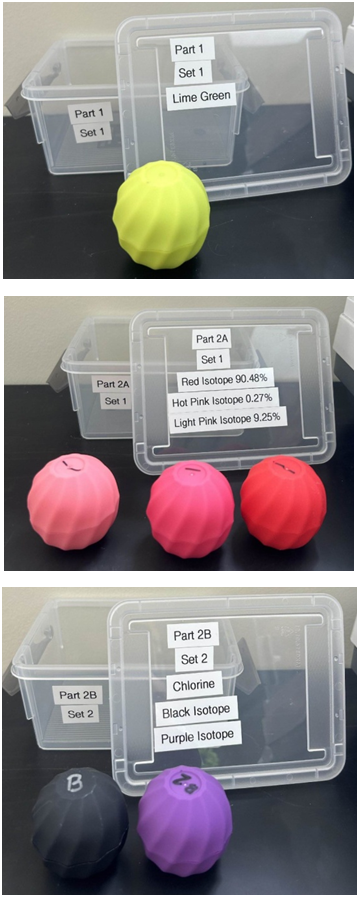
The models for the isotopes were made from plastic, screw top cases purchased from Amazon. A total of eight sets of isotopes were used. Different colored plastic containers were used to represent different isotopes of a specific element that has more than one naturally occurring isotope (Figure 1). The containers were filled with varying amounts and materials of metal shots, ribbon, and/or wire so the mass of each model corresponds to a specific isotope. For each isotope model, 1 g represents 1 g/mol.
In Part 1, MS Excel was used to create an XY scatter plot using the first ten elements of the periodic table with atomic mass on the y-axis and atomic number on the x-axis. Students weighed the atomic model of the unknown to find the atomic mass. Atoms with only one isotope listed in the NIST database for atomic weights and isotopic compositions with relative atomic masses, such as boron and fluorine, were chosen as the unknown for Part 1 of the activity. 24 The measured atomic mass of the isotope model was substituted into the linear regression equation to solve for the atomic number of the unknown element.
The goal of Part 2 was for students to calculate the average atomic mass and identify the unknown element given the percent isotope abundance. Students weighed each isotope model to find the atomic mass. The atomic mass and percent isotope abundance were substituted into the given equation to calculate average atomic mass.
In Part 3, students were given a series of known isotopes. Students weighed each isotope model to find the atomic masses. The students then used the average atomic mass of the element listed on the periodic table and measured atomic mass of each isotope to find the percent abundance of each isotope.
Pre-lab and post-lab quizzes (Supporting Information) were administered to evaluate whether students met the LOs. The pre-lab and post-lab quizzes had the same five multiple choice or dropdown selection questions to evaluate percent improvement. Questions 1-3 assessed LO 1, question 4 assessed LO 2 and question 5 assessed LO 3. A one-way ANOVA analysis was used to determine if there was a significant difference between the pre- and post-lab quiz average class percentages. Question 6 on the quiz was a free response question that gauged student understanding on why an element with a lower atomic number could be heavier than an element with a higher atomic number.
Pre- and post-lab quizzes at Meredith were administered through the learning management system, D2L Brightspace. The pre-lab quiz was administered during the lab before the experiment was performed, while the post-lab quiz was completed at the end of the lab experiment. A total of 63 students completed both the pre- and post-lab quizzes at Meredith. At NC State, pre- and post-lab quizzes were administered through the learning management system, Moodle. The pre-lab quiz was completed the night before the lab meeting while the post-lab quiz was due one week after the lab meeting. There were 53 NC State students who completed both the pre- and post-lab quizzes for the study.
In addition, a post-lab survey that evaluated student perceptions about the activity was conducted after the activity (Table S1). IRB approval for this study (protocol number 26226) was granted through North Carolina State University’s research and compliance office. The survey had nine questions, six Likert-scale questions and three short answer questions. At both institutions, the survey was sent via a Google Form to students after the experiment and was open for ten days. There were 51 Meredith students and 48 NC State students who responded to the survey for the study.
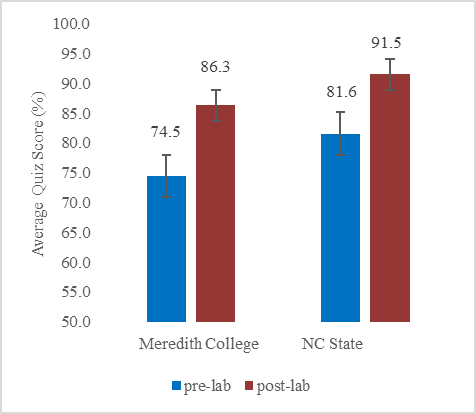
Pre- and post-lab quizzes were administered to assess the LOs for the activity. At Meredith College, the average for the pre-lab quiz was 74.5% +/- 2.9% (N=63) (Figure 2). The post-lab average score for students increased to 86.3% +/- 2.4%. Question 1 was omitted from the quiz results due to an error in the quiz setup on the learning management system. A p-value < 0.005 was obtained from the one-way ANOVA, which indicates a significant difference between the two quiz scores. The average post-lab quiz score for students at NC State also increased to 91.5% +/- 1.6% compared to the average pre-lab score of 81.6% +/- 3.0% (N=53). The quiz scores were significantly different, as indicated by p-value < 0.005 from the one-way ANOVA. Question 3 was omitted from the quiz scores at NC State due to an error in administration in the learning management system. The increase in student assessment scores suggest that students improved their knowledge on the structure of atoms and isotopes, using the equation for average atomic weight and percent isotope abundance, and isotope mass, and/or using a linear regression line to calculate an unknown value.

Table 1 shows the percentage of students that met each LO for each question on the pre- and post-lab quizzes at each institution. At both institutions, the percent of students that met the LO for each question increased from the pre-lab quiz to the post-lab quiz. Questions 1-3 on the quiz assessed whether students were able to describe the structure of an atom and an isotope. At NC State, question 1 was the most challenging for students with only 36% meeting the LO in the pre-lab quiz and 60% for the post-lab selecting both correct answers. It is important to note that if full credit was given for both partially and completely correct, the percentage of students was 91% and 98% for the pre- and post-quiz, respectively. Most students selected that isotopes have the same atomic number, but missed that isotopes have the same chemical properties. It would be helpful to add a specific question on the chemical properties of isotopes.
The percentage of students meeting the LO for Q2 increased by 10% and 6% from the pre-lab to post-lab for students at Meredith College and NC State, respectively. For question 3, 71% of Meredith students met the LO on the post-lab quiz. Calculating between isotope abundance, isotope mass, and average atomic mass was the LO measured in question 4. In the post-lab question 4 the percent of students that met the LO at Meredith and NC State were 83% and 96%, respectively. Question 5 aimed to assess students’ ability to use a linear regression line to calculate an unknown value. Both institutions showed an increase in the percentage of students that met the LO with 81% of Meredith students and 96% of NC State students that met the LO on the post-lab.

Question 6 on the quiz probed whether students understood why tellurium (Te) has a higher atomic mass than iodine (I) even though iodine has more protons than tellurium. The short answer question was marked as correct only if students referred to the difference in number of neutrons. At NC State, 78% of students answered correctly on both the pre- and post-lab quizzes, which showed no improvement. Meredith students showed significant improvement from the pre- and post-lab quiz scores with 62% and 82% correct, respectively.
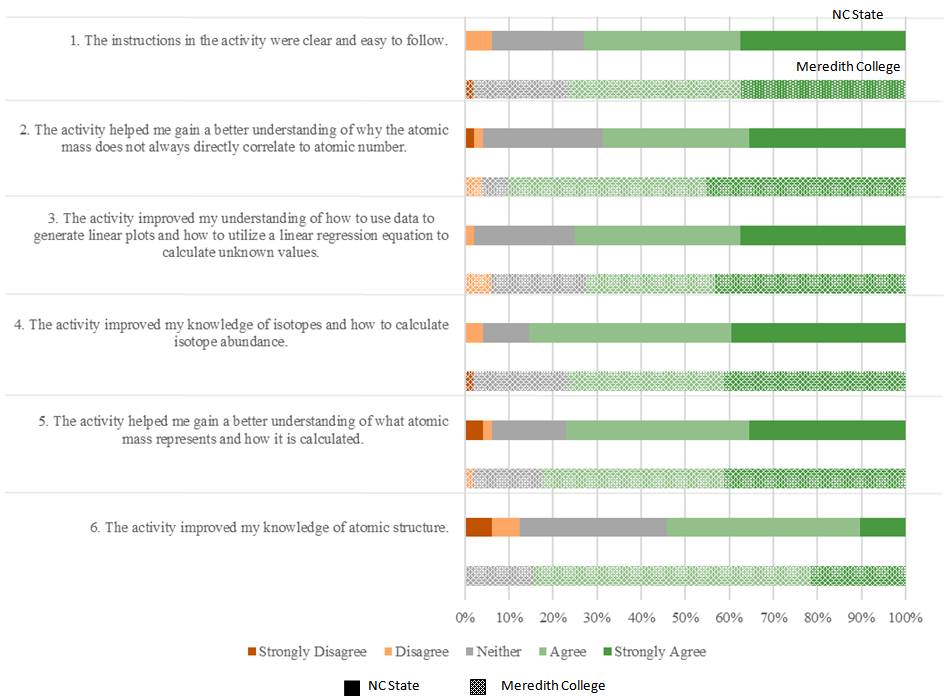
The student survey results for the Likert-scale questions are shown in Figure 3. Student feedback was overall positive for the experiment (Figure 3). Few students from either institution strongly disagreed or disagreed with any of the questions. At Meredith College, the average for each survey question was 4 or higher. NC State averages were also 4 or higher for all questions except question 6, with an average of 3.5. It is presumed that students have already been introduced to atomic structure before coming to the lab, either prior to college or through lectures. As a result, the students’ perception is that the lab activity did not enhance their understanding of this concept, even though the assessments suggest it did (Table 1).
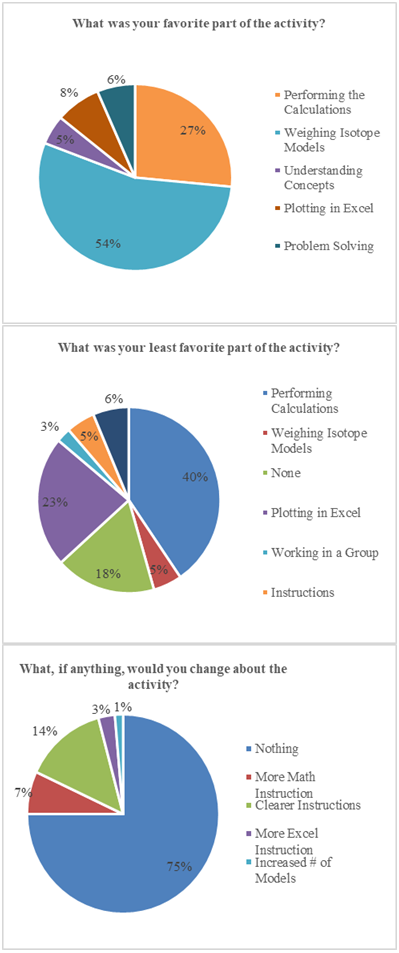
Students were also asked three free response questions: What was your favorite part of the activity? What was your least favorite part of the activity? and What, if anything, would you change about the activity?. The open-ended responses were evaluated by coding the different responses and reporting the total number of both Meredith and NC State students for each response (Figure 4). These data were aggregated due to very similar responses by students at the different institutions. Over half the students’ favorite part about the activity was the hands-on experience of using a balance and weighing the isotope models. Performing the calculations in the activity was the second favorite part of the lab. Other students commented that they enjoyed plotting in MS Excel, understanding the concepts of atomic structure and isotope abundance and problem solving. Although some students liked performing the calculations and plotting in excel, 40% and 23% of students reported that performing the calculations and plotting in excel were their least favorite parts, respectively. The one noticeable difference between institutions was that the majority of NC State students reported their least favorite part of the activity was plotting in MS Excel, while the majority of Meredith students disliked performing the calculations. Students did not give much feedback on what to change about the activity, as 75% of students responded that they would not change anything. Several students thought that some of the instructions in the activity could be worded more clearly, as well as more instruction on the math calculations and plotting in MS Excel.
Two of the faculty who taught these labs at Meredith College commented that the structure of the worksheet can improve the students’ experience. In Part 1, students were unclear about the purpose of generating the plot and students filled in the table without using the trend line first, and instead consulted the periodic table. NC State organized the experimental procedure differently and did not have a similar issue. While using the trend line, some students were using it incorrectly by substituting the atomic mass value for x instead of the y value, as stated in the instructions. It would be helpful to have more instruction in the pre-lab, or even a pre-lab video, for making and using a linear regression plot in MS Excel. It is also important to discuss the R2 value in the linear regression line of the first ten elements of the periodic table versus how it would not work extending it to the entire periodic table due to the ratio of protons and neutrons. From the results of question 6 for NC State students, the activity did not help increase student understanding on why an element with a lower atomic number could have a higher average atomic mass than an element with a higher atomic number. There are several suggestions that could be added to the activity to reinforce this concept. At the end of Part 1, have students generate a linear plot for both 3d and 5p elements and interpret the R2 value. In addition, add a question to compare the atomic mass of cobalt and nickel and have students discuss with their lab group the pattern discrepancy in atomic mass. These questions will help reinforce the concept that the neutron/proton ratio is not one as atomic number increases and that the atomic mass is derived from the combination of masses of neutrons and protons. In part 2A, having the table in number 4, and in part 2B, having the table in number 6, are important placements and allow students to fill in the table with less confusion. The tables previously were at the beginning of the questions and most students filled the table in before working through the steps. The final recommendation is to ensure that students can collaborate on parts 2A and 2B, especially if these examples were not covered in the lecture. If an instructor allows students to work on lab sections out of sequence, they should be aware that completing part 2A first may aid in solving part 2B.

The activity is a simple method that uses inexpensive materials to provide hands-on experience for students to be able to describe the structure of an atom and isotope, calculate between isotope abundance, isotope mass, and average atomic mass, construct and use a linear regression line, and properly use a balance to weigh materials. It can be administered as a laboratory experiment or activity in high school or a first-year general chemistry college course. Students met the LOs for the experiment and increased performance from the pre-lab to the post-lab quiz by an average of 11.8% at Meredith College and 9.9% at NC State. Students commented that they enjoyed the hands-on experience and learning how to use a balance. Positive feedback was received from students at both institutions with an average score of 4 or higher for all but one Likert-scale question. Lastly, the activity helps reinforce skills that students often struggle with such as plotting data and basic math skills.
We would like to thank Dr. Andrea Carter and Jessica Thorpe for feedback on the lab activity. We also thank the department of chemistry at North Carolina State University and the department of chemistry at Meredith College.
| [1] | Tro, N. J. Chemistry: Structure and Properties, 2nd ed.; Pearson: Hoboken, NJ, 2018. | ||
| In article | |||
| [2] | McMurry, J. E.; Fay, R. C. General Chemistry: Atoms First, 2nd ed.; Prentice Hall: Upper Saddle River, NJ, 2014. | ||
| In article | |||
| [3] | Flowers, P.; Neth, E. J.; Robinson, W. R.; Theopold, K.; Langley, R. Chemistry: Atoms First 2e, 2nd ed.; OpenStax: Houston, 2019. | ||
| In article | |||
| [4] | Burdge, J.; Overby, J. Chemistry: Atoms First, 5th ed.; McGraw Hill: New York, 2024. | ||
| In article | |||
| [5] | Zumdahl, S. S.; Zumdahl, S. A. Chemistry: An Atoms First Approach; Brooks Cole: Belmont, CA, 2011. | ||
| In article | |||
| [6] | Esterling, K. M.; Bartels, L. Atoms-First Curriculum: A Comparison of Student Success in General Chemistry. J. Chem. Educ. 2013, 90 (11), 1433–1436. | ||
| In article | View Article | ||
| [7] | Chitiyo, G.; Potter, D. W.; Rezsnyak, C. E. Impact of an Atoms-First Approach on Student Outcomes in a Two-Semester General Chemistry Course. J. Chem. Educ. 2018, 95 (10), 1711–1716. | ||
| In article | View Article | ||
| [8] | Schaller, C. P.; Graham, K. J.; Johnson, B. J.; Jakubowski, H. V.; McKenna, A. G.; McIntee, E. J.; Jones, T. N.; Fazal, M. A.; Peterson, A. A. Chemical Structure and Properties: A Modified Atoms-First, One-Semester Introductory Chemistry Course. J. Chem. Educ. 2015, 92 (2), 237–246. | ||
| In article | View Article | ||
| [9] | Lilly, C. P.; Ormond, A. B.; Carter, A. A.; Powell, W. J. Implementation of Recitations in General Chemistry I Laboratory Courses to Increase Student Performance. J. Chem. Educ. 2022, 99 (5), 1838–1846. | ||
| In article | View Article | ||
| [10] | Pfennig, B. W.; Schaefer, A. K. The Use of Gas Chromatography and Mass Spectrometry To Introduce General Chemistry Students to Percent Mass and Atomic Mass Calculations. J. Chem. Educ. 2011, 88 (7), 970–974. | ||
| In article | View Article | ||
| [11] | O’Malley, R. M. The Determination of the Natural Abundance of Isotopes of Chlorine: An Introductory Experiment in Mass Spectrometry. J. Chem. Educ. 1982, 59 (12), 1073–1076. | ||
| In article | View Article | ||
| [12] | Maksimenko, N.; Okolzina, A.; Vlasova, A.; Tracey, C.; Kurushkin, M. Introducing Atomic Structure to First-Year Undergraduate Chemistry Students with an Immersive Virtual Reality Experience. J. Chem. Educ. 2021, 98 (6), 2104–2108. | ||
| In article | View Article | ||
| [13] | PhET: Build an Atom. http://phet.colorado.edu (accessed May 2024). | ||
| In article | |||
| [14] | Clark, T. M.; Chamberlain, J. M. Use of a PhET Interactive Simulation in General Chemistry Laboratory: Models of the Hydrogen Atom. J. Chem. Educ. 2014, 91 (8), 1198–1202. | ||
| In article | View Article | ||
| [15] | Huff, R. B.; Evans, D. W. A Simple Laboratory Experiment Illustrating the Relative Nature of Atomic Weights. J. Chem. Educ. 1991, 68 (8), 675–676. | ||
| In article | View Article | ||
| [16] | Spencer, H. E. Mathematical SAT Test Scores and College Chemistry Grades. J. Chem. Educ. 1996, 73 (12), 1150–1153. | ||
| In article | View Article | ||
| [17] | Ranga, J. S. ConfChem Conference on Mathematics in Undergraduate Chemistry Instruction: Impact of Quick Review of Math Concepts. J. Chem. Educ. 2018, 95 (8), 1430–1431. | ||
| In article | View Article | ||
| [18] | Leopold, D. G.; Edgar, B. Degree of Mathematics Fluency and Success in Second-Semester Introductory Chemistry. J. Chem. Educ. 2008, 85 (5), 724–731. | ||
| In article | View Article | ||
| [19] | Andrews, M. H.; Andrews, L. First-Year Chemistry Grades and SAT Math Scores. J. Chem. Educ. 1979, 56 (4), 231–232. | ||
| In article | View Article | ||
| [20] | Magers, D. B.; Stan, P. L.; King, D. A. Graphing Activity for the First General Chemistry Lab Session to Introduce Data Processing. J. Chem. Educ. 2019, 96 (8), 1676–1679. | ||
| In article | View Article | ||
| [21] | Padgett, L. W.; MacGowan, C. E. Thermometry as a Teaching Tool for Graphing: A First-Day Introductory Chemistry Laboratory Experiment. J. Chem. Educ. 2013, 90 (7), 910–913. | ||
| In article | View Article | ||
| [22] | DeMeo, S.; Mills, P. Looking for Linearity: Integrating Graphing for First-Year Chemistry Students. Chem. Educ. 2001, 6 (1), 2–4. | ||
| In article | View Article | ||
| [23] | DeMeo, S. Mass Relationships in a Chemical Reaction: Incorporating Additional Graphing Exercises into the Introductory Chemistry Laboratory. J. Chem. Educ. 2005, 82 (8), 1219–1222. | ||
| In article | View Article | ||
| [24] | Coursey, J. S.; Schwab, D, J.; Tsai, J. J.; Dragoset, R. A. Atomic Weights and Isotopic Compositions with Relative Atomic Masses. https://www.nist.gov/ (accessed Oct 2019 and May 2023). | ||
| In article | |||
Published with license by Science and Education Publishing, Copyright © 2024 Cassandra P. Lilly, Ana Ison, Alexandra B. Ormond and Barbara Diamond
 This work is licensed under a Creative Commons Attribution 4.0 International License. To view a copy of this license, visit
https://creativecommons.org/licenses/by/4.0/
This work is licensed under a Creative Commons Attribution 4.0 International License. To view a copy of this license, visit
https://creativecommons.org/licenses/by/4.0/
| [1] | Tro, N. J. Chemistry: Structure and Properties, 2nd ed.; Pearson: Hoboken, NJ, 2018. | ||
| In article | |||
| [2] | McMurry, J. E.; Fay, R. C. General Chemistry: Atoms First, 2nd ed.; Prentice Hall: Upper Saddle River, NJ, 2014. | ||
| In article | |||
| [3] | Flowers, P.; Neth, E. J.; Robinson, W. R.; Theopold, K.; Langley, R. Chemistry: Atoms First 2e, 2nd ed.; OpenStax: Houston, 2019. | ||
| In article | |||
| [4] | Burdge, J.; Overby, J. Chemistry: Atoms First, 5th ed.; McGraw Hill: New York, 2024. | ||
| In article | |||
| [5] | Zumdahl, S. S.; Zumdahl, S. A. Chemistry: An Atoms First Approach; Brooks Cole: Belmont, CA, 2011. | ||
| In article | |||
| [6] | Esterling, K. M.; Bartels, L. Atoms-First Curriculum: A Comparison of Student Success in General Chemistry. J. Chem. Educ. 2013, 90 (11), 1433–1436. | ||
| In article | View Article | ||
| [7] | Chitiyo, G.; Potter, D. W.; Rezsnyak, C. E. Impact of an Atoms-First Approach on Student Outcomes in a Two-Semester General Chemistry Course. J. Chem. Educ. 2018, 95 (10), 1711–1716. | ||
| In article | View Article | ||
| [8] | Schaller, C. P.; Graham, K. J.; Johnson, B. J.; Jakubowski, H. V.; McKenna, A. G.; McIntee, E. J.; Jones, T. N.; Fazal, M. A.; Peterson, A. A. Chemical Structure and Properties: A Modified Atoms-First, One-Semester Introductory Chemistry Course. J. Chem. Educ. 2015, 92 (2), 237–246. | ||
| In article | View Article | ||
| [9] | Lilly, C. P.; Ormond, A. B.; Carter, A. A.; Powell, W. J. Implementation of Recitations in General Chemistry I Laboratory Courses to Increase Student Performance. J. Chem. Educ. 2022, 99 (5), 1838–1846. | ||
| In article | View Article | ||
| [10] | Pfennig, B. W.; Schaefer, A. K. The Use of Gas Chromatography and Mass Spectrometry To Introduce General Chemistry Students to Percent Mass and Atomic Mass Calculations. J. Chem. Educ. 2011, 88 (7), 970–974. | ||
| In article | View Article | ||
| [11] | O’Malley, R. M. The Determination of the Natural Abundance of Isotopes of Chlorine: An Introductory Experiment in Mass Spectrometry. J. Chem. Educ. 1982, 59 (12), 1073–1076. | ||
| In article | View Article | ||
| [12] | Maksimenko, N.; Okolzina, A.; Vlasova, A.; Tracey, C.; Kurushkin, M. Introducing Atomic Structure to First-Year Undergraduate Chemistry Students with an Immersive Virtual Reality Experience. J. Chem. Educ. 2021, 98 (6), 2104–2108. | ||
| In article | View Article | ||
| [13] | PhET: Build an Atom. http://phet.colorado.edu (accessed May 2024). | ||
| In article | |||
| [14] | Clark, T. M.; Chamberlain, J. M. Use of a PhET Interactive Simulation in General Chemistry Laboratory: Models of the Hydrogen Atom. J. Chem. Educ. 2014, 91 (8), 1198–1202. | ||
| In article | View Article | ||
| [15] | Huff, R. B.; Evans, D. W. A Simple Laboratory Experiment Illustrating the Relative Nature of Atomic Weights. J. Chem. Educ. 1991, 68 (8), 675–676. | ||
| In article | View Article | ||
| [16] | Spencer, H. E. Mathematical SAT Test Scores and College Chemistry Grades. J. Chem. Educ. 1996, 73 (12), 1150–1153. | ||
| In article | View Article | ||
| [17] | Ranga, J. S. ConfChem Conference on Mathematics in Undergraduate Chemistry Instruction: Impact of Quick Review of Math Concepts. J. Chem. Educ. 2018, 95 (8), 1430–1431. | ||
| In article | View Article | ||
| [18] | Leopold, D. G.; Edgar, B. Degree of Mathematics Fluency and Success in Second-Semester Introductory Chemistry. J. Chem. Educ. 2008, 85 (5), 724–731. | ||
| In article | View Article | ||
| [19] | Andrews, M. H.; Andrews, L. First-Year Chemistry Grades and SAT Math Scores. J. Chem. Educ. 1979, 56 (4), 231–232. | ||
| In article | View Article | ||
| [20] | Magers, D. B.; Stan, P. L.; King, D. A. Graphing Activity for the First General Chemistry Lab Session to Introduce Data Processing. J. Chem. Educ. 2019, 96 (8), 1676–1679. | ||
| In article | View Article | ||
| [21] | Padgett, L. W.; MacGowan, C. E. Thermometry as a Teaching Tool for Graphing: A First-Day Introductory Chemistry Laboratory Experiment. J. Chem. Educ. 2013, 90 (7), 910–913. | ||
| In article | View Article | ||
| [22] | DeMeo, S.; Mills, P. Looking for Linearity: Integrating Graphing for First-Year Chemistry Students. Chem. Educ. 2001, 6 (1), 2–4. | ||
| In article | View Article | ||
| [23] | DeMeo, S. Mass Relationships in a Chemical Reaction: Incorporating Additional Graphing Exercises into the Introductory Chemistry Laboratory. J. Chem. Educ. 2005, 82 (8), 1219–1222. | ||
| In article | View Article | ||
| [24] | Coursey, J. S.; Schwab, D, J.; Tsai, J. J.; Dragoset, R. A. Atomic Weights and Isotopic Compositions with Relative Atomic Masses. https://www.nist.gov/ (accessed Oct 2019 and May 2023). | ||
| In article | |||