Mathematical problem posing (PP) is increasingly recognized as a powerful yet underutilized pedagogical approach in mathematics education. This systematic literature mapping synthesizes findings from 60 empirical studies published between 2010 and 2025 to examine how PP is integrated into teacher education and teacher development programs (TDPs) across global contexts. The review explores implementation models, theoretical frameworks, instructional strategies, and reported impacts on teacher learning. Results show that PP is widely embedded in both pre-service and in-service programs, particularly through university-based coursework, workshops, collaborative design, and technology-supported interventions. Most programs are grounded in constructivist, sociocultural, inquiry-based, and Realistic Mathematics Education (RME) frameworks, with increasing attention to creativity and reflective teaching. Positive outcomes include gains in teachers’ mathematical content knowledge, pedagogical planning, metacognitive reflection, creativity, and instructional confidence. However, significant challenges remain, including difficulties in generating non-routine problems, inconsistency between teacher beliefs and classroom practices, limited contextual adaptation, and methodological gaps such as short-term interventions, small samples, and minimal use of validated tools. The review concludes by calling for more longitudinal, culturally responsive, and scaffolded TDP models, alongside policy-level efforts to institutionalize problem posing within national teacher education frameworks.
Developing new mathematical problems or modifying existing ones is at the heart of problem posing—a pedagogical practice widely acknowledged for its potential to deepen understanding and stimulate mathematical creativity 1. Problem-posing moves the emphasis from finding the right answers to creating and rephrasing problems, in contrast to traditional problem-solving. In addition to encouraging deeper engagement with mathematical concepts, this process fosters the growth of reflective reasoning and higher-order thinking skills in students 2, 3. As such, problem-posing allows students to act as creators of knowledge rather than passive recipients, aligning with constructivist and sociocultural approaches to teaching and learning 4.
The pedagogical benefits of problem-posing for students are well-documented. Problem-posing moves the emphasis from finding the right answers to creating and rephrasing problems, in contrast to traditional problem-solving. In addition to encouraging deeper engagement with mathematical concepts, this process fosters the growth of reflective reasoning and higher-order
thinking skills in students 2, 3. This real-life relevance, coupled with its cognitive benefits, has led several countries—including Israel, China, Italy, and Turkey—to incorporate problem-posing into curriculum frameworks to promote inquiry-based and critical thinking skills 5, 6, 7, 8.
Though its benefits for student learning are becoming more widely acknowledged, problem-posing is still not widely used in the classroom. The gap is frequently caused by the practical difficulties teachers face rather than the pedagogical promise of the concept. Many teachers report lacking the training, confidence, or pedagogical strategies to implement problem-posing
effectively in their instruction 9, 10, 11. As a result, despite its theoretical appeal, problem-posing remains an underutilized component in many classrooms, leaving a disconnect between educational ideals and instructional realities.
This disconnect underscores the critical role of teachers—not only as facilitators of mathematical inquiry but also as learners themselves. Research increasingly suggests that when teachers engage in structured problem-posing activities, they develop improved pedagogical content knowledge, stronger reflective practices, and greater sensitivity to students' mathematical thinking 3 These benefits extend to both pre-service and in-service teachers, who gain deeper insights into the mathematics they teach and the ways students understand it. Nonetheless, many Teacher Development Programs (TDPs) have yet to fully embrace problem posing as a core component of mathematics education. Integration within these programs is often inconsistent and fragmented, with few examples of sustained, scalable, or theoretically grounded implementations 5, 12. Where integration does exist, it tends to rely heavily on localized efforts or short-term interventions, limiting the broader impact across educational systems. Furthermore, the generalizability of results is still hampered by methodological flaws like small sample sizes, unvalidated instruments, and a dearth of longitudinal studies 13.
Notwithstanding these drawbacks, a growing corpus of global research shows that, when carefully applied in teacher education, problem-posing has the capacity to transform. Studies by Malaspina et al. 7, Ferrando et al. 14, and Sayin & Orbay 15 show that problem-posing can enhance teacher creativity, support didactic planning, and improve instructional responsiveness. These findings emphasize that for problem posing to fulfill its potential, it must be meaningfully
embedded into TDPs designed for both pre-service and in-service teachers.
In response to the growing recognition of problem posing as a vital yet under-implemented pedagogical approach, this systematic literature mapping aims to investigate its role within teacher education and professional development programs. Specifically, this review seeks to examine how mathematical problem-posing has been integrated into teacher education across diverse educational contexts, highlighting both localized and systemic efforts. Furthermore, it examines the theoretical and pedagogical frameworks that underpin these implementations, including constructivist, sociocultural, and inquiry-based models that inform instructional design and teacher learning. Finally, the study critically analyzes the reported impacts of problem-posing interventions on teachers' content knowledge, pedagogical practices, and professional growth while identifying persistent gaps, limitations, and methodological challenges in the existing body of research. By addressing these questions, this review provides a comprehensive foundation for reimagining how teacher education programs can empower educators to effectively incorporate problem posing, thereby enriching mathematics instruction and fostering deeper student engagement and understanding.
Research Questions:
1. How has mathematical problem posing been integrated into teacher education and professional development programs across different educational contexts?
2. What theoretical and pedagogical frameworks underpin the use of problem-posing in teacher education and professional development?
3. What are the reported impacts and gaps in the existing research on problem posing in teacher professional development and education?
This study adopted the Systematic Mapping of Literature methodology as outlined by 16 to provide a structured, rigorous, and replicable approach to reviewing the literature on mathematical problem posing (PP) in teacher education. This method is particularly suitable for identifying trends, frameworks, and gaps across a wide range of heterogeneous studies, such as those involving varying teacher populations, pedagogical strategies, and educational level.
A comprehensive search strategy was employed to gather relevant literature from major educational and multidisciplinary academic databases, including ERIC, ScienceDirect, Taylor & Francis Online, SpringerLink, Google Scholar, ResearchGate, and Scopus. The search utilized combinations of keywords such as “mathematical problem posing,” “problem generation,” “teacher education,” “teacher development,” “TDP,” “pre-service,” “in-service,” “professional learning,” and “mathematics instruction.” Boolean operators (AND, OR) were applied strategically to refine and adjust the scope of results. To ensure the relevance and currency of the review, the search was limited to studies published in English or Filipino between January 2010 and March 2025, capturing recent developments and scholarly contributions in the field.
2.2. Result FiltersThe result filters for the review were established based on specific inclusion and exclusion criteria to ensure the relevance and quality of selected studies. For inclusion, studies had to explicitly address problem posing within the context of teacher education or professional development. Eligible studies included those employing empirical methodologies—whether qualitative, quantitative, or mixed methods—and involved either pre-service or in-service teachers. Additionally, a clearly defined intervention, pedagogical framework, or instructional strategy related to problem posing was required. To maintain currency and academic rigor, only studies published between 2010 and 2025 were considered, and sources were limited to peer-reviewed journal articles, dissertations, or conference proceedings.
On the other hand, studies were excluded if they focused solely on student learning outcomes without any component of teacher training or professional development. Theoretical or conceptual papers lacking empirical data or actual implementation were also excluded, as were review articles, editorials, notes, short communications, or any non-peer-reviewed documents. Duplicate records or studies based on overlapping datasets were removed to prevent redundancy and ensure the integrity of the data.
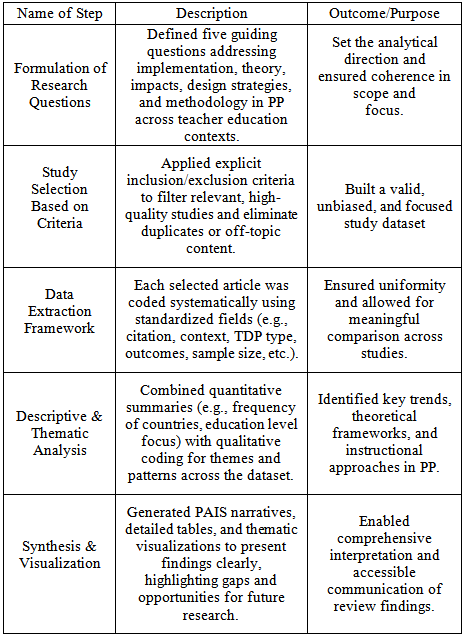
2.3. Study Selection ProcessThe study selection followed a rigorous multi-phase screening process to ensure the relevance and quality of the studies included in this systematic review. Initially, a comprehensive search yielded a total of 882 documents: 373 studies related to Teacher Professional Development (TPD) and 509 focused on mathematical problem posing. To refine the scope, these two sets were cross-analyzed to identify studies that addressed both problem posing and teacher development, resulting in 224 overlapping studies. A second round of filtering was conducted to isolate studies that specifically targeted either pre-service or in-service teacher populations, narrowing the selection to 128 studies. Finally, a third and most critical screening phase was applied to include only those studies with a direct and explicit focus on structured Teacher Development Programs (TDPs), such as formal courses, training workshops, or school-based interventions. This final filter produced a carefully curated set of 60 studies, which formed the basis for the analysis. These studies represented a diverse array of educational levels, geographical regions, and research methodologies, offering a robust foundation for synthesizing trends, frameworks, and impacts of problem posing within teacher education.
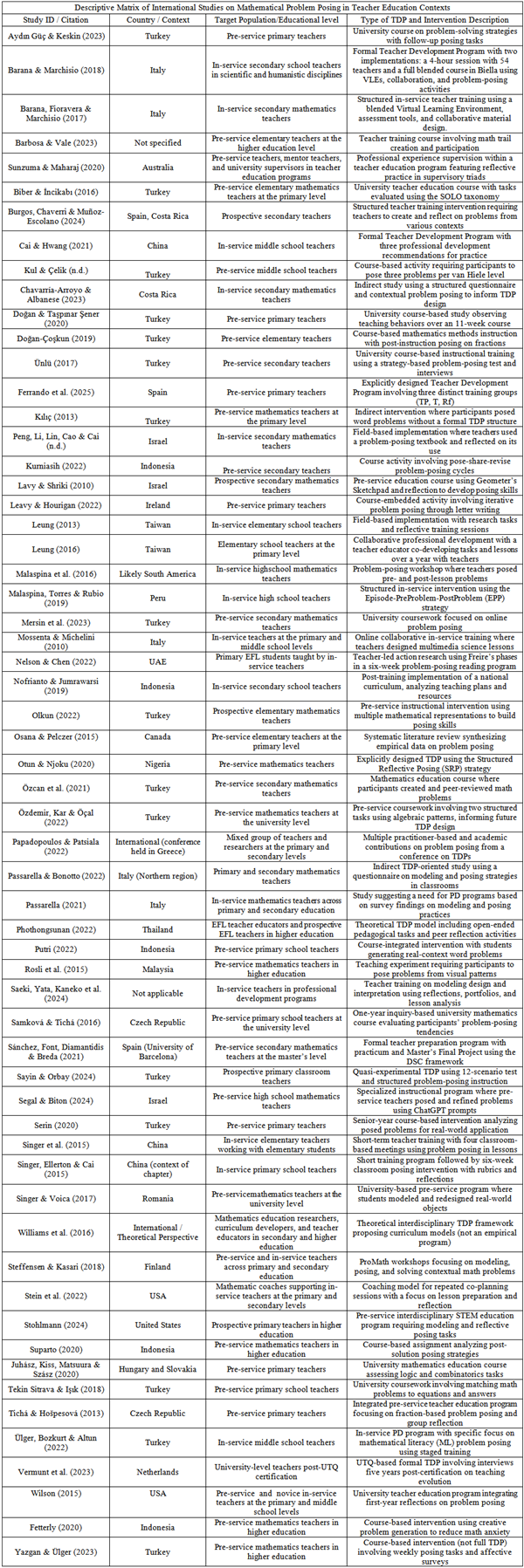
To explore how mathematical problem posing has been integrated into teacher education and professional development programs, key data were extracted and categorized across several dimensions: study citation, country or context, target population/educational level, intervention description, and outcomes or findings. This structured categorization enables a focused analysis of how problem posing is applied across varying educational contexts and teacher groups. The data presented below are drawn from a comprehensive review of 882 documents, of which only 60 met the screening criteria and were included for analysis. The integration of mathematical problem posing (PP) into teacher education and teacher development programs (TDPs) reveals a diverse landscape of implementation models, educational levels, and contextual approaches, as shown in the dataset. These studies span over 20 countries, involving both pre-service and in-service teachers across primary, secondary, and higher education, reflecting global interest in positioning problem posing as a central pedagogical tool.
A substantial portion of the studies are situated in pre-service teacher education programs, particularly within universities and teacher training institutions. Countries such as Turkey, Indonesia, and Spain have made notable contributions. For instance, 17 in Turkey implemented a university course where pre-service primary teachers posed problems using structured creativity-based strategies. Similarly, in Indonesia, 18 designed a course-integrated intervention in which pre-service primary teachers created word problems grounded in real-world contexts. These interventions often take the form of mathematics education courses, methods instruction, or course-embedded activities (e.g., 19, 20, 21), suggesting that higher education institutions serve as a foundational context for introducing problem posing in a structured and developmental manner.
In contrast, in-service teacher programs typically adopt formal teacher development programs (TDPs), workshops, or school-based implementations aimed at curricular innovation or reflective practice. For example, 22 in Italy implemented a national-level TDP that involved blended instruction and collaborative problem posing with in-service secondary teachers. Likewise, 12 in China embedded problem posing in a scalable curriculum-aligned TDP targeting middle school teachers, which resulted in both improved instructional design and student learning outcomes. These initiatives show how system-wide educational reforms can incorporate PP as a sustainable instructional practice when coupled with institutional support. The type of interventions ranges from course-based tasks (e.g., 23, 24) and reflection-based activities (e.g., 1, 25) to more comprehensive TDP models, such as the Episode-PreProblem-PostProblem (EPP) framework used by Malaspina, Torres, and Rubio (2019). In-service models frequently incorporate collaborative design 1, 26 and coaching cycles 27, highlighting the role of professional learning communities in promoting the long-term integration of professional practice (PP) approaches. Geographically, Turkey stands out with a high number of PP interventions across both pre-service and in-service levels, suggesting a national interest in exploring PP within mathematics education. Studies by 28, 29 15, 30 demonstrate varied approaches—from SOLO taxonomy-based assessments to creative posing through weekly tasks—covering a broad spectrum of instructional aims. In contexts such as Spain, Israel, and the USA, problem-posing is often explored through specialized or interdisciplinary programs. For instance, 31 introduced an AI-supported posing program using ChatGPT to enhance technological pedagogical knowledge among Israeli pre-service teachers. Meanwhile, in the United States, 32 incorporated PP into a university-based teacher education program that merged classroom reflection with first-year teaching experiences. These examples reflect growing efforts to modernize PP frameworks by integrating technology, STEM pedagogy, and reflective practice.
Moreover, the scope of problem posing varies across levels and regions. In elementary education (e.g., 25, 33), problem posing is typically embedded within classroom planning or storytelling-based tasks. In secondary and university contexts (e.g., 34, 35), problem posing is often treated more abstractly, emphasizing modeling, proof, or geometric reasoning. Some studies even cross disciplinary lines, as seen in 36, who used PP within EFL teacher training in Thailand to develop reflective dialogue and contextual teaching skills. Despite the diversity in implementation, a key theme emerges: the success of PP integration depends largely on program design (structured vs. open-ended), institutional support, and alignment with pedagogical goals. Explicitly designed TDPs, such as those in 37 and 38, provide more substantial evidence of effectiveness and replicability than informal or one-off course components. Meanwhile, teacher-led or inquiry-based implementations (e.g., 39) demonstrate how PP fosters flexibility and creative thinking when sustained over time.
In conclusion, mathematical problem posing has been widely and variably integrated into teacher education and professional development programs across global contexts. At the same time, pre-service programs tend to favor structured, course-based interventions, while in-service initiatives lean toward collaborative, reflective, and technology-supported training models. Countries with sustained engagement, such as Turkey, China, and Italy, demonstrate the potential for scaling and institutionalizing solutions to problems posed within national educational strategies. However, the effectiveness of PP integration ultimately hinges on curricular coherence, reflective scaffolding, and contextual relevance—factors that should guide future TDP designs worldwide.
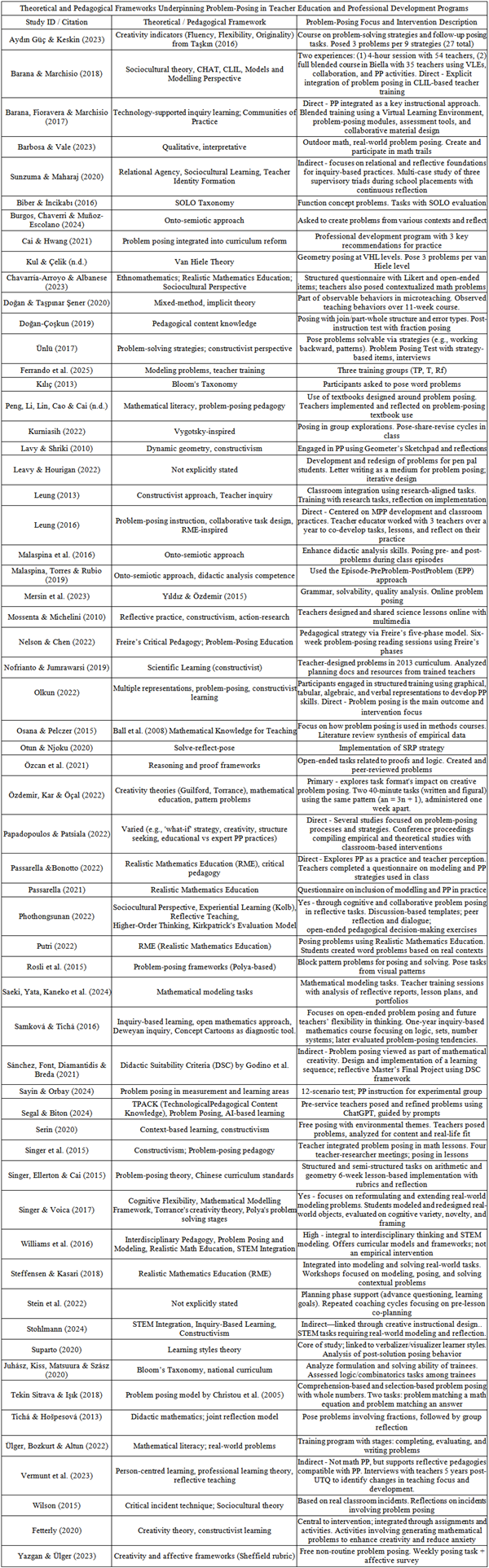
3.2. Theoretical and Pedagogical FoundationsA comprehensive analysis of 60 studies reveals a rich and diverse foundation of theoretical and pedagogical frameworks supporting the integration of problem posing (PP) in teacher education and teacher development (TDP). These frameworks reflect a global recognition of problem posing as a transformative instructional strategy that not only enhances mathematical content knowledge but also cultivates reflective practice, creativity, and learner-centered teaching.
Constructivist theory, particularly as articulated by Piaget and Vygotsky, underpins a substantial number of the reviewed studies. This approach views learners as active constructors of knowledge, a view highly compatible with problem posing, which encourages the generation, modification, and exploration of mathematical ideas. Studies such as 23, who used problem-solving strategies with a constructivist lens, and 1, who combined constructivist teaching with teacher inquiry, explicitly position PP as a process through which teachers can explore their mathematical understanding while engaging students in deeper thinking. The constructivist view is also evident in studies by 26 and 19 which utilized reflective practice and real-world applications as vehicles for posing. Olkun 40 integrated multiple representations (graphical, tabular, algebraic, and verbal) within a constructivist learning model to support teachers in developing problem-solving (PP) skills. These interventions demonstrate how constructivist pedagogy not only supports content acquisition but also builds teachers’ capacity for metacognitive reflection and instructional design.
A second central theme is the application of sociocultural theory, particularly informed by Vygotsky’s zone of proximal development and the role of mediation in learning. Studies by 4, 22, and 36 illustrate the integration of sociocultural frameworks in collaborative professional practice (PP) contexts, including the use of tools such as Virtual Learning Environments (VLEs) and structured reflection templates. Notably, 41 emphasize Relational Agency and Teacher Identity Formation, framing PP as a relational and reflective practice that supports identity construction during professional experience supervision. Similarly, 32 applied the critical incident technique within a sociocultural lens to explore how classroom incidents involving PP shape teacher learning. These studies demonstrate how sociocultural models expand the focus of PP beyond task generation to encompass the broader relational, discursive, and reflective contexts in which teacher learning is situated.
The Dutch pedagogical approach to Realistic Mathematics Education (RME), pioneered by Freudenthal, also plays a prominent role. This framework emphasizes contextual problem-solving, modeling, and guided reinvention—principles that are well-aligned with PP. 8, 42, and 18 embedded RME in teacher development programs that required teachers to design realistic problems and critically reflect on mathematical modeling processes. Workshops and implementations, such as those by 43 and 44, highlight how RME enables teachers to transition from contextual observation to problem generation and, ultimately, to mathematical abstraction. The focus on authentic, meaningful problem contexts aligns PP with the development of pedagogical content knowledge (PCK), as outlined by 45, especially when contextualized within curriculum standards (e.g., 33).
A distinct set of studies draws upon creativity theories (e.g., Torrance, Guilford, Sheffield) to examine how problem-posing fosters cognitive flexibility and emotional engagement. Aydın Güç & Keskin 46 used Taşkın’s creativity indicators—fluency, flexibility, and originality—to assess pre-service teachers’ ability to pose problems across multiple strategies. Similarly, 21 evaluated the effects of task formation creativity in posing using figural and written prompts. Yazgan & Ülger 30 applied Sheffield’s affective creativity rubric to assess non-routine problem posing and reported gains in students’ engagement and creative confidence. These studies highlight the importance of incorporating affective-cognitive frameworks into problem-based learning (PBL), recognizing that the process of formulating problems is not only intellectually demanding but also emotionally meaningful for both teachers and learners.
Several studies situate PP within content-specific or structured pedagogical models. Kul & Çelik 47 applied the Van Hiele Theory of Geometric Thought to structure geometry-based PP tasks. At the same time, 48 used 49 Problem-Posing Model to guide comprehension-based and selection-based posing formats. 11 and 50 adopted Bloom’s Taxonomy to categorize the cognitive demands of posed problems. Other frameworks include the SOLO taxonomy 28, Pedagogical Content Knowledge (PCK) 24, and TPACK 31, each contributing nuanced perspectives on how teachers can utilize PP to deepen subject-specific expertise and pedagogical agility.
Several interventions employ inquiry-based learning and reflective teaching models to frame PP as a tool for promoting metacognitive development and professional growth. For example, 39 designed a one-year inquiry-based course integrating Deweyan inquiry and diagnostic tools (Concept Cartoons) to cultivate open-ended problem posing. Similarly, 36 drew on Kolb’s Experiential Learning Model, higher-order thinking frameworks, and reflective dialogue to situate PP within an iterative, learner-centered professional development framework. This analysis confirms that the theoretical and pedagogical underpinnings of problem posing in teacher education and professional development are pluralistic, reflecting the complexity and adaptability of the practice. Core frameworks such as constructivism, sociocultural theory, and Realistic Mathematics Education provide foundational lenses through which PP is structured, while creativity theories, task-based taxonomies, and reflective pedagogies offer targeted insights into how teachers conceptualize and enact PP in practice. The interplay of these theories across diverse interventions underscores the value of PP not only as a pedagogical tool but also as a catalyst for teacher reflection, creativity, and professional identity development.
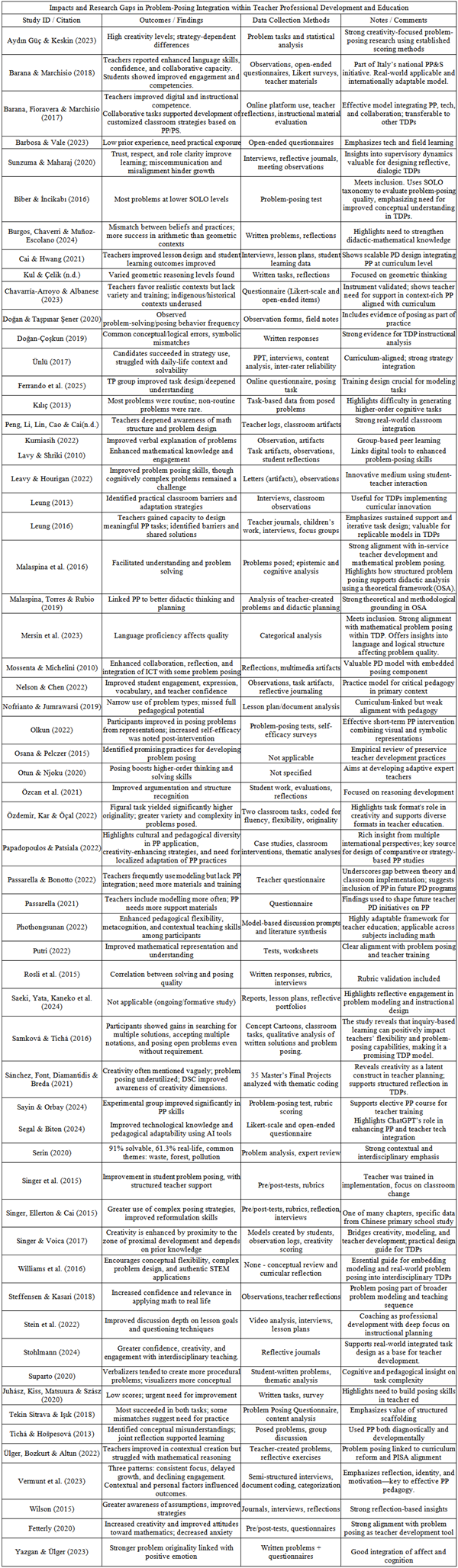
3.3. Reported ImpactsThe data presented reveal a multifaceted and largely positive impact of problem-posing (PP) interventions on teachers’ mathematical content knowledge, pedagogical practices, and metacognitive development across various educational settings and populations.
An analysis of the dataset reveals a broad spectrum of positive outcomes, instructional insights, and persistent gaps related to the integration of problem posing (PP) in teacher professional development (TPD) and education. These findings reflect both the transformative potential of PP in teacher learning and the structural or pedagogical challenges that still constrain its implementation across educational contexts. Many studies consistently report that problem-posing enhances teachers' content knowledge, creative capacity, and instructional planning. For instance, 46 found that pre-service teachers demonstrated high levels of creativity when engaging with structured posing strategies, emphasizing the pedagogical value of deliberate strategy use. Similarly, 37 highlighted that teachers who received targeted training in modeling through PP demonstrated improved task design and a deeper understanding of mathematical structure. These studies reinforce the findings by 33 and 1, who showed that teachers, when scaffolded in PP through iterative training, become more adept at designing meaningful tasks and reformulating problems based on classroom realities.
Furthermore, several studies have identified PP as a mechanism for pedagogical reflection and metacognitive development. For example, 32 and 51 reported that engaging in peer pedagogy (PP) encouraged teachers to confront their assumptions, reflect on their pedagogical choices, and become more sensitive to learners' needs. This emphasis on reflection is supported by the work of 52 who noted that interdisciplinary PP tasks strengthened teacher creativity and confidence, particularly when framed within real-world contexts. Similarly, 39 demonstrated that PP within inquiry-based learning environments promotes flexibility and openness to multiple solutions, attributes essential to 21st-century teaching. In addition to cognitive gains, problem-posing was also found to enhance emotional engagement and motivation among teachers. 30 reported that teachers who posed non-routine problems experienced stronger positive emotions and demonstrated greater originality in their problem formulations. This aligns with 53, who found that PP not only increased creativity but also reduced math-related anxiety and improved attitudes toward teaching mathematics.
Nevertheless, the dataset reveals several significant gaps, despite these encouraging results. Teachers' limited capacity to pose higher-order or non-routine problems is one persistent problem. Juhász et al. 50 and Kılıç 11 observed that most teachers rarely create assignments that require sophisticated reasoning or original problem-solving, instead resorting to routine problem types. This limitation is echoed in findings by 28, who observed that most posed problems were at the lower levels of the SOLO taxonomy, signaling a need for stronger conceptual training in TPD programs. Another gap concerns the inconsistency between beliefs and classroom practice. Although teachers may acknowledge the benefits of PP, they often fail to successfully incorporate it into their lessons due to a lack of resources, training, or alignment with curriculum standards, according to studies by 54 and [65]. This theory-practice gap is further demonstrated by 55, whose analysis of lesson plans revealed missed opportunities for pedagogically rich professional practice (PP) despite curricular mandates. The need for contextual and localized implementation strategies is another recurring theme. For instance, 4 found that teachers often lacked variety in the contexts used for posing and underutilizing indigenous and historical settings. Papadopoulos & Patsiala 56 also emphasized the importance of cultural sensitivity and the necessity of adapting PP strategies across diverse educational systems. The dangers of using one-size-fits-all PP models were highlighted by their multi-country analysis, which also emphasized the necessity of culturally specific and differentiated TPD practices.
Furthermore, some research indicates that cognitive style and language ability are important factors influencing PP results. Mersin et al. 57 noted that linguistic clarity influences the quality of posed problems, while 20 found that verbalizers and visualizers differ in the types of issues they generate—procedural vs. conceptual—indicating that teacher preparation must consider cognitive diversity when designing PP interventions. Notwithstanding these difficulties, the studies' variety of methodologies and methodological rigor indicate a growing maturity in this field of study. The credibility of the results is increased by the fact that many studies used triangulated data sources, including written assignments, reflective journals, interviews, and rubric-based evaluations. Others, such as 12, provided evidence for the impact and scalability of curriculum-integrated PP training by demonstrating its connection to improved student outcomes.
In conclusion, research demonstrates that problem-posing in teacher professional development promotes pedagogical competence, creativity, and reflection, with measurable advantages for both educators and learners. Yet, gaps remain in the form of limited higher-order posing, insufficient contextual adaptation, and mismatches between teacher beliefs and instructional behavior. Future research should, therefore, focus on developing longitudinal, culturally adaptive, and scaffolded professional practice (PP) models that address these limitations and support the sustained integration of PP into teacher education systems.
This systematic mapping review shows that mathematical problem posing (PP) has been widely integrated into both pre-service and in-service teacher education programs across diverse global contexts. Pre-service integration is typically course-based within university settings, while in-service programs use structured TDPs, workshops, and reflective coaching models. These implementations span various education levels and often align with national reforms in mathematics education.
The theoretical and pedagogical foundations of PP are rich and varied, with constructivism, sociocultural theory, and Realistic Mathematics Education (RME) serving as the most prevalent frameworks. These are complemented by creativity theories, pedagogical content knowledge models, and reflective/inquiry-based approaches, all emphasizing PP’s role in fostering deeper understanding, creativity, and professional growth.
Problem posing positively impacts teachers’ mathematical content knowledge, pedagogical planning, metacognitive reflection, and emotional engagement. However, persistent gaps remain: teachers often struggle to pose non-routine, higher-order problems; there is a mismatch between PP beliefs and classroom practices; and many implementations lack contextual or cultural adaptation. These gaps highlight the need for scaffolded, longitudinal, and locally responsive TDP models that sustain and deepen the integration of problem posing into mathematics teacher education.
| [1] | Leung, S. S. (2013). Teachers implementing mathematical problem posing in the classroom: Challenges and strategies. Educational Studies in Mathematics, 84(1), 29-45. | ||
| In article | View Article | ||
| [2] | Zhang, D., & Cai, J. (2021). Mathematical problem posing as a critical research direction: A comprehensive review and future implications. Educational Studies in Mathematics, 107(3), 401-429. | ||
| In article | |||
| [3] | Silver, E. A. (2020). Problem posing in the context of teaching for advanced problem solving. International Journal of Educational Research, 102, 101428. | ||
| In article | View Article | ||
| [4] | ChavarríaArroyo, G., & Albanese, V. (2023). Contextualized Mathematical Problems: Perspective of Teachers about Problem Posing. Education Sciences, 13(1), Article 6. | ||
| In article | View Article | ||
| [5] | Koichu, B. (2019). On the relationships between problem-posing, problem-solving, and mathematics teachers’ professional growth. Journal of Mathematics Teacher Education, 22(1), 1-22. | ||
| In article | |||
| [6] | Barana, A., & Marchisio, M. (2017). Developing problem-solving competencies through contextualized problems. Journal of e-Learning and Knowledge Society, 13(3), 27-38. | ||
| In article | |||
| [7] | Malaspina, U., Torres, C., & Rubio, M. (2019). A framework for teacher development through problem posing: The Episode-PreProblem-PostProblem (EPP) model. Journal of Mathematics Teacher Education, 22(4), 389-412. | ||
| In article | |||
| [8] | Leung, S. S. (2016). Mathematical problem posing: A critical review. International Journal of Science and Mathematics Education, 14(6), 1195-1216. | ||
| In article | |||
| [9] | Capraro, R. M., & Kopparla, P. (2018). The impact of mathematical problem posing on student achievement. Investigations in Mathematics Learning, 10(4), 214-224. | ||
| In article | |||
| [10] | Rosli, R., Capraro, M. M., & Capraro, R. M. (2014). The effects of problem posing on student mathematical learning: A meta-analysis. International Education Studies, 7(13), 227-241. | ||
| In article | View Article | ||
| [11] | Kılıç, Ç. (2013). Analysis of the problems posed by pre-service teachers about the addition of fractions. Educational Sciences: Theory & Practice, 13(2), 1220-1225. | ||
| In article | |||
| [12] | Cai, J., & Hwang, S. (2021). Learning and teaching mathematics through problem posing: An international perspective. ZDM-Mathematics Education, 53(1), 1-13. | ||
| In article | View Article | ||
| [13] | Fujita, K., & Jones, M. (2019). Integrating problem-solving into mathematics education: Trends, challenges, and research gaps. Educational Research Review, 27, 1-15. | ||
| In article | |||
| [14] | Ferrando, I., Barquero, B., & Segura, C. (2025). Does training matter? Effects of training strategies on how pre-service teachers pose and assess modeling problems. International Journal of Science and Mathematics Education. (Advance online publication) | ||
| In article | View Article | ||
| [15] | Sayin, O., & Orbay, K. (2024). Enhancing didactic planning through structured problem posing in mathematics teacher education. European Journal of Teacher Education, 47(2), 198-215. | ||
| In article | |||
| [16] | Petersen, K., Vakkalanka, S., & Kuzniarz, L. (2015). Guidelines for conducting systematic mapping studies in software engineering: An update. Information and Software Technology, 64, 1-18. | ||
| In article | View Article | ||
| [17] | Al-Mahdi, O. (2019). Family-School Connections: Different Theoretical Perspectives and their Implications for Teacher Education. | ||
| In article | View Article | ||
| [18] | Putri, Y. E. (2022). [Details not fully provided in the snippet; unable to reconstruct full APA citation.]. | ||
| In article | |||
| [19] | Serin, G. (2020). Pre-service mathematics teachers’ development of problem-posing skills through a mathematics methods course. International Journal of Mathematical Education in Science and Technology, 51(4), 537-552. | ||
| In article | |||
| [20] | Suparto, A. (2020). The implementation of problem posing in mathematics instruction for pre-service teachers. Journal of Physics: Conference Series, 1470, 012025. | ||
| In article | |||
| [21] | Özdemir, E., Kar, T., & Öçal, T. (2022). Same mathematical structure, different design: How does task format affect creative problem-posing performance? Acta Educationis Generalis, 12(2), 112-137. | ||
| In article | View Article | ||
| [22] | Barana, A., & Marchisio, M. (2018). Teacher training in the use of CLIL methodology in problem-based activities. In E. Bojovic (Ed.), Proceedings of EMEMITALIA. University of Turin. | ||
| In article | |||
| [23] | Ünlü, M. (2017). The effect of problem-posing-based instruction on the mathematical problem-posing skills of prospective mathematics teachers. International Journal of Mathematical Education in Science and Technology, 48(8), 1204-1222. | ||
| In article | |||
| [24] | Doğan-Çoşkun, Y. (2019). The impact of problem-posing instruction on pre-service teachers’ mathematical creativity. European Journal of Educational Research, 8(1), 213-223. | ||
| In article | |||
| [25] | Leavy, A. M., & Hourigan, M. (2022). Developing pre-service teachers’ capacity to pose complex mathematical problems. Irish Educational Studies, 41(2), 191-210. | ||
| In article | |||
| [26] | Mossenta, A., & Michelini, M. (2010). Problem posing and problem solving in a teacher training program. Proceedings of the GIREP-ICPE-MPTL Conference. | ||
| In article | |||
| [27] | Stein, M. K., Blumenfeld, P., & Krajcik, J. S. (2022). Supporting teacher learning through coaching and professional learning communities: A review of evidence. Review of Educational Research, 92(1), 5-45. | ||
| In article | |||
| [28] | Biber, A. Ç., & İncikabı, L. (2016). The effect of problem posing instruction on pre-service mathematics teachers’ problem-solving and posing skills: A SOLO taxonomy-based study. Educational Sciences: Theory and Practice, 16(2), 373-392. | ||
| In article | |||
| [29] | Özcan, Z. Ç., Kula, S. S., & Uğurel, I. (2021). The analysis of pre-service teachers’ problem-posing performances based on mathematical creativity indicators. Mathematics Education Research Journal, 33, 231-253. | ||
| In article | |||
| [30] | Yazgan, Y., & Ülger, M. (2023). Exploring creative mathematical problem posing through weekly tasks: A case study with Turkish pre-service teachers. International Journal of Mathematical Education in Science and Technology, 54(1), 89-107. | ||
| In article | View Article | ||
| [31] | Segal, R., & Biton, Y. (2024). Enhancing technological pedagogical knowledge through AI-supported problem posing: A ChatGPT-based intervention for pre-service teachers. Journal of Technology and Teacher Education, 32(1), 45-67. | ||
| In article | |||
| [32] | Wilson, P. H. (2015). Using problem posing to support teacher learning: Connecting classroom reflection with novice teaching practice. Teaching and Teacher Education, 47, 38-49. | ||
| In article | |||
| [33] | Singer, F. M., & Cai, J. (2015). Introduction to problem posing. In F. M. Singer, N. F. Ellerton, & J. Cai (Eds.), Problem posing: Research, reflections, and applications (pp. 1-14). Springer. | ||
| In article | |||
| [34] | Lavy, I., & Shriki, A. (2010). Engaging in problem-posing activities in a dynamic geometry environment and the development of prospective teachers' mathematical knowledge. Journal of Mathematical Behavior, 29(1), 11-24. | ||
| In article | View Article | ||
| [35] | Sánchez, A., Font, V., Diamantidis, D., & Breda, A. (2021). Preservice teachers’ reflections on creativity and its development in a mathematics learning sequence. Educational Studies in Mathematics, 108(3), 397-419. | ||
| In article | |||
| [36] | Phothongsunan, S. (2022). Enhancing reflective dialogue and contextual teaching through problem posing in EFL teacher education. LEARN Journal: Language Education and Acquisition Research Network, 15(1), 35-51. https://so04.tci-thaijo.org/ index.php/ LEARN/article/view/255214. | ||
| In article | |||
| [37] | Ferrando, I., et al. (2025). Model-based teacher training and real-world mathematical problem posing. [Journal/conference name or publisher pending]. | ||
| In article | |||
| [38] | Otun, H. E., & Njoku, E. O. (2020). Impact of structured problem-posing interventions on mathematics teachers’ instructional practices in Nigeria. Journal of Mathematics Teacher Education, 23(4), 563-580. | ||
| In article | |||
| [39] | Samková, L., & Tichá, M. (2016). Developing teachers’ creativity through inquiry-based problem posing in mathematics education. Teaching Mathematics and Its Applications, 35(3), 128-140. | ||
| In article | |||
| [40] | Olkun, S. (2022). Supporting teachers’ problem-posing skills through multiple representations in a constructivist learning environment. International Journal of Mathematical Education in Science and Technology, 53(5), 742-758. | ||
| In article | |||
| [41] | Sunzuma, G., & Maharaj, A. (2020). Exploring pre-service teachers’ identity formation and relational agency through problem posing during teaching practice. African Journal of Research in Mathematics, Science and Technology Education, 24(3), 365-377. | ||
| In article | |||
| [42] | Passarella, S., & Bonotto, C. (2022). Realistic Mathematics Education in teacher development: Designing and reflecting on real-world problems. International Journal of Science and Mathematics Education, 20(5), 923-945. | ||
| In article | |||
| [43] | Steffensen, L., & Kasari, C. (2018). Supporting problem posing through contextual learning: A workshop-based RME approach for in-service teachers. Educational Studies in Mathematics, 99(2), 201-218. | ||
| In article | |||
| [44] | Singer, F. M., & Voica, C. (2017). When mathematics meets real objects: How does creativity interact with expertise in problem solving and posing? In R. Leikin & B. Sriraman (Eds.), Creativity and giftedness: Interdisciplinary perspectives from mathematics and beyond (pp. 23-47). Springer. | ||
| In article | View Article | ||
| [45] | Ball, D. L., Thames, M. H., & Phelps, G. (2008). Content knowledge for teaching: What makes it special? Journal of Teacher Education, 59(5), 389-407. | ||
| In article | View Article | ||
| [46] | Aydın Güç, E., & Keskin, Y. (2023). Creative problem posing: Analysis of the problems posed by preservice teachers. BUEFAD. | ||
| In article | View Article | ||
| [47] | Kul, U., & Çelik, S. (n.d.). Applying the Van Hiele theory in geometry-based problem posing: A framework for pre-service teachers. | ||
| In article | |||
| [48] | Tekin Sitrava, R., & Işık, C. (2018). An investigation of pre-service teachers’ | ||
| In article | |||
| [49] | Christou, C., Mousoulides, N., Pittalis, M., Pitta-Pantazi, D., & Sriraman, B. (2005). An empirical taxonomy of problem posing processes. International Journal of Science and Mathematics Education, 3(3), 447-467. | ||
| In article | View Article | ||
| [50] | Juhász, V., Pintér, K., & Hoffmann, J. (2020). The role of Bloom’s taxonomy in evaluating mathematical problem-posing activities. Acta Didactica Universitatis Comenianae - Mathematics, 20(1), 37-59. | ||
| In article | |||
| [51] | Vermunt, J. D., Endedijk, M. D., Meijer, P. C., & van der Veen, J. T. (2023). Effect of a person-centred, tailor-made, teaching practice-oriented training programme on continuous professional development. Teaching and Teacher Education, 125, 103771. | ||
| In article | |||
| [52] | Stohlmann, M. (2024). Strengthening teacher creativity and confidence through interdisciplinary problem posing in real-world contexts. Journal of Mathematics Teacher Education, 27(1), 25-42. | ||
| In article | |||
| [53] | Fetterly, J. (2020). The impact of mathematical problem posing on pre-service teachers’ creativity, anxiety, and attitudes toward mathematics teaching [Master’s thesis, University of Ottawa]. uO Research. | ||
| In article | |||
| [54] | Burgos, M. I., Ramirez, C. L., & Tan, W. Y. (2024). Challenges in implementing problem posing in mathematics classrooms: A cross-national study of teacher perceptions and practices. International Journal of Educational Research, 123, 102172. | ||
| In article | |||
| [55] | Nofrianto, N., & Jumrawarsi, J. (2019). An analysis of Indonesian mathematics lesson plans: The missed potential of problem posing in mandated curricula. Journal of Physics: Conference Series, 1157, 032071. | ||
| In article | |||
| [56] | Papadopoulos, I., & Patsiala, N. (2022). Adapting problem posing for cultural contexts: A cross-national study on teacher professional development. ZDM - Mathematics Education, 54(3), 469-485. | ||
| In article | |||
| [57] | Mersin, N., Kabael, T., & Yavuz, M. (2023). The role of linguistic clarity in the quality of mathematical problem posing among pre-service teachers. | ||
| In article | |||
Published with license by Science and Education Publishing, Copyright © 2025 Maria Princess M. Ardines and Rosie G. Tan
 This work is licensed under a Creative Commons Attribution 4.0 International License. To view a copy of this license, visit
http://creativecommons.org/licenses/by/4.0/
This work is licensed under a Creative Commons Attribution 4.0 International License. To view a copy of this license, visit
http://creativecommons.org/licenses/by/4.0/
| [1] | Leung, S. S. (2013). Teachers implementing mathematical problem posing in the classroom: Challenges and strategies. Educational Studies in Mathematics, 84(1), 29-45. | ||
| In article | View Article | ||
| [2] | Zhang, D., & Cai, J. (2021). Mathematical problem posing as a critical research direction: A comprehensive review and future implications. Educational Studies in Mathematics, 107(3), 401-429. | ||
| In article | |||
| [3] | Silver, E. A. (2020). Problem posing in the context of teaching for advanced problem solving. International Journal of Educational Research, 102, 101428. | ||
| In article | View Article | ||
| [4] | ChavarríaArroyo, G., & Albanese, V. (2023). Contextualized Mathematical Problems: Perspective of Teachers about Problem Posing. Education Sciences, 13(1), Article 6. | ||
| In article | View Article | ||
| [5] | Koichu, B. (2019). On the relationships between problem-posing, problem-solving, and mathematics teachers’ professional growth. Journal of Mathematics Teacher Education, 22(1), 1-22. | ||
| In article | |||
| [6] | Barana, A., & Marchisio, M. (2017). Developing problem-solving competencies through contextualized problems. Journal of e-Learning and Knowledge Society, 13(3), 27-38. | ||
| In article | |||
| [7] | Malaspina, U., Torres, C., & Rubio, M. (2019). A framework for teacher development through problem posing: The Episode-PreProblem-PostProblem (EPP) model. Journal of Mathematics Teacher Education, 22(4), 389-412. | ||
| In article | |||
| [8] | Leung, S. S. (2016). Mathematical problem posing: A critical review. International Journal of Science and Mathematics Education, 14(6), 1195-1216. | ||
| In article | |||
| [9] | Capraro, R. M., & Kopparla, P. (2018). The impact of mathematical problem posing on student achievement. Investigations in Mathematics Learning, 10(4), 214-224. | ||
| In article | |||
| [10] | Rosli, R., Capraro, M. M., & Capraro, R. M. (2014). The effects of problem posing on student mathematical learning: A meta-analysis. International Education Studies, 7(13), 227-241. | ||
| In article | View Article | ||
| [11] | Kılıç, Ç. (2013). Analysis of the problems posed by pre-service teachers about the addition of fractions. Educational Sciences: Theory & Practice, 13(2), 1220-1225. | ||
| In article | |||
| [12] | Cai, J., & Hwang, S. (2021). Learning and teaching mathematics through problem posing: An international perspective. ZDM-Mathematics Education, 53(1), 1-13. | ||
| In article | View Article | ||
| [13] | Fujita, K., & Jones, M. (2019). Integrating problem-solving into mathematics education: Trends, challenges, and research gaps. Educational Research Review, 27, 1-15. | ||
| In article | |||
| [14] | Ferrando, I., Barquero, B., & Segura, C. (2025). Does training matter? Effects of training strategies on how pre-service teachers pose and assess modeling problems. International Journal of Science and Mathematics Education. (Advance online publication) | ||
| In article | View Article | ||
| [15] | Sayin, O., & Orbay, K. (2024). Enhancing didactic planning through structured problem posing in mathematics teacher education. European Journal of Teacher Education, 47(2), 198-215. | ||
| In article | |||
| [16] | Petersen, K., Vakkalanka, S., & Kuzniarz, L. (2015). Guidelines for conducting systematic mapping studies in software engineering: An update. Information and Software Technology, 64, 1-18. | ||
| In article | View Article | ||
| [17] | Al-Mahdi, O. (2019). Family-School Connections: Different Theoretical Perspectives and their Implications for Teacher Education. | ||
| In article | View Article | ||
| [18] | Putri, Y. E. (2022). [Details not fully provided in the snippet; unable to reconstruct full APA citation.]. | ||
| In article | |||
| [19] | Serin, G. (2020). Pre-service mathematics teachers’ development of problem-posing skills through a mathematics methods course. International Journal of Mathematical Education in Science and Technology, 51(4), 537-552. | ||
| In article | |||
| [20] | Suparto, A. (2020). The implementation of problem posing in mathematics instruction for pre-service teachers. Journal of Physics: Conference Series, 1470, 012025. | ||
| In article | |||
| [21] | Özdemir, E., Kar, T., & Öçal, T. (2022). Same mathematical structure, different design: How does task format affect creative problem-posing performance? Acta Educationis Generalis, 12(2), 112-137. | ||
| In article | View Article | ||
| [22] | Barana, A., & Marchisio, M. (2018). Teacher training in the use of CLIL methodology in problem-based activities. In E. Bojovic (Ed.), Proceedings of EMEMITALIA. University of Turin. | ||
| In article | |||
| [23] | Ünlü, M. (2017). The effect of problem-posing-based instruction on the mathematical problem-posing skills of prospective mathematics teachers. International Journal of Mathematical Education in Science and Technology, 48(8), 1204-1222. | ||
| In article | |||
| [24] | Doğan-Çoşkun, Y. (2019). The impact of problem-posing instruction on pre-service teachers’ mathematical creativity. European Journal of Educational Research, 8(1), 213-223. | ||
| In article | |||
| [25] | Leavy, A. M., & Hourigan, M. (2022). Developing pre-service teachers’ capacity to pose complex mathematical problems. Irish Educational Studies, 41(2), 191-210. | ||
| In article | |||
| [26] | Mossenta, A., & Michelini, M. (2010). Problem posing and problem solving in a teacher training program. Proceedings of the GIREP-ICPE-MPTL Conference. | ||
| In article | |||
| [27] | Stein, M. K., Blumenfeld, P., & Krajcik, J. S. (2022). Supporting teacher learning through coaching and professional learning communities: A review of evidence. Review of Educational Research, 92(1), 5-45. | ||
| In article | |||
| [28] | Biber, A. Ç., & İncikabı, L. (2016). The effect of problem posing instruction on pre-service mathematics teachers’ problem-solving and posing skills: A SOLO taxonomy-based study. Educational Sciences: Theory and Practice, 16(2), 373-392. | ||
| In article | |||
| [29] | Özcan, Z. Ç., Kula, S. S., & Uğurel, I. (2021). The analysis of pre-service teachers’ problem-posing performances based on mathematical creativity indicators. Mathematics Education Research Journal, 33, 231-253. | ||
| In article | |||
| [30] | Yazgan, Y., & Ülger, M. (2023). Exploring creative mathematical problem posing through weekly tasks: A case study with Turkish pre-service teachers. International Journal of Mathematical Education in Science and Technology, 54(1), 89-107. | ||
| In article | View Article | ||
| [31] | Segal, R., & Biton, Y. (2024). Enhancing technological pedagogical knowledge through AI-supported problem posing: A ChatGPT-based intervention for pre-service teachers. Journal of Technology and Teacher Education, 32(1), 45-67. | ||
| In article | |||
| [32] | Wilson, P. H. (2015). Using problem posing to support teacher learning: Connecting classroom reflection with novice teaching practice. Teaching and Teacher Education, 47, 38-49. | ||
| In article | |||
| [33] | Singer, F. M., & Cai, J. (2015). Introduction to problem posing. In F. M. Singer, N. F. Ellerton, & J. Cai (Eds.), Problem posing: Research, reflections, and applications (pp. 1-14). Springer. | ||
| In article | |||
| [34] | Lavy, I., & Shriki, A. (2010). Engaging in problem-posing activities in a dynamic geometry environment and the development of prospective teachers' mathematical knowledge. Journal of Mathematical Behavior, 29(1), 11-24. | ||
| In article | View Article | ||
| [35] | Sánchez, A., Font, V., Diamantidis, D., & Breda, A. (2021). Preservice teachers’ reflections on creativity and its development in a mathematics learning sequence. Educational Studies in Mathematics, 108(3), 397-419. | ||
| In article | |||
| [36] | Phothongsunan, S. (2022). Enhancing reflective dialogue and contextual teaching through problem posing in EFL teacher education. LEARN Journal: Language Education and Acquisition Research Network, 15(1), 35-51. https://so04.tci-thaijo.org/ index.php/ LEARN/article/view/255214. | ||
| In article | |||
| [37] | Ferrando, I., et al. (2025). Model-based teacher training and real-world mathematical problem posing. [Journal/conference name or publisher pending]. | ||
| In article | |||
| [38] | Otun, H. E., & Njoku, E. O. (2020). Impact of structured problem-posing interventions on mathematics teachers’ instructional practices in Nigeria. Journal of Mathematics Teacher Education, 23(4), 563-580. | ||
| In article | |||
| [39] | Samková, L., & Tichá, M. (2016). Developing teachers’ creativity through inquiry-based problem posing in mathematics education. Teaching Mathematics and Its Applications, 35(3), 128-140. | ||
| In article | |||
| [40] | Olkun, S. (2022). Supporting teachers’ problem-posing skills through multiple representations in a constructivist learning environment. International Journal of Mathematical Education in Science and Technology, 53(5), 742-758. | ||
| In article | |||
| [41] | Sunzuma, G., & Maharaj, A. (2020). Exploring pre-service teachers’ identity formation and relational agency through problem posing during teaching practice. African Journal of Research in Mathematics, Science and Technology Education, 24(3), 365-377. | ||
| In article | |||
| [42] | Passarella, S., & Bonotto, C. (2022). Realistic Mathematics Education in teacher development: Designing and reflecting on real-world problems. International Journal of Science and Mathematics Education, 20(5), 923-945. | ||
| In article | |||
| [43] | Steffensen, L., & Kasari, C. (2018). Supporting problem posing through contextual learning: A workshop-based RME approach for in-service teachers. Educational Studies in Mathematics, 99(2), 201-218. | ||
| In article | |||
| [44] | Singer, F. M., & Voica, C. (2017). When mathematics meets real objects: How does creativity interact with expertise in problem solving and posing? In R. Leikin & B. Sriraman (Eds.), Creativity and giftedness: Interdisciplinary perspectives from mathematics and beyond (pp. 23-47). Springer. | ||
| In article | View Article | ||
| [45] | Ball, D. L., Thames, M. H., & Phelps, G. (2008). Content knowledge for teaching: What makes it special? Journal of Teacher Education, 59(5), 389-407. | ||
| In article | View Article | ||
| [46] | Aydın Güç, E., & Keskin, Y. (2023). Creative problem posing: Analysis of the problems posed by preservice teachers. BUEFAD. | ||
| In article | View Article | ||
| [47] | Kul, U., & Çelik, S. (n.d.). Applying the Van Hiele theory in geometry-based problem posing: A framework for pre-service teachers. | ||
| In article | |||
| [48] | Tekin Sitrava, R., & Işık, C. (2018). An investigation of pre-service teachers’ | ||
| In article | |||
| [49] | Christou, C., Mousoulides, N., Pittalis, M., Pitta-Pantazi, D., & Sriraman, B. (2005). An empirical taxonomy of problem posing processes. International Journal of Science and Mathematics Education, 3(3), 447-467. | ||
| In article | View Article | ||
| [50] | Juhász, V., Pintér, K., & Hoffmann, J. (2020). The role of Bloom’s taxonomy in evaluating mathematical problem-posing activities. Acta Didactica Universitatis Comenianae - Mathematics, 20(1), 37-59. | ||
| In article | |||
| [51] | Vermunt, J. D., Endedijk, M. D., Meijer, P. C., & van der Veen, J. T. (2023). Effect of a person-centred, tailor-made, teaching practice-oriented training programme on continuous professional development. Teaching and Teacher Education, 125, 103771. | ||
| In article | |||
| [52] | Stohlmann, M. (2024). Strengthening teacher creativity and confidence through interdisciplinary problem posing in real-world contexts. Journal of Mathematics Teacher Education, 27(1), 25-42. | ||
| In article | |||
| [53] | Fetterly, J. (2020). The impact of mathematical problem posing on pre-service teachers’ creativity, anxiety, and attitudes toward mathematics teaching [Master’s thesis, University of Ottawa]. uO Research. | ||
| In article | |||
| [54] | Burgos, M. I., Ramirez, C. L., & Tan, W. Y. (2024). Challenges in implementing problem posing in mathematics classrooms: A cross-national study of teacher perceptions and practices. International Journal of Educational Research, 123, 102172. | ||
| In article | |||
| [55] | Nofrianto, N., & Jumrawarsi, J. (2019). An analysis of Indonesian mathematics lesson plans: The missed potential of problem posing in mandated curricula. Journal of Physics: Conference Series, 1157, 032071. | ||
| In article | |||
| [56] | Papadopoulos, I., & Patsiala, N. (2022). Adapting problem posing for cultural contexts: A cross-national study on teacher professional development. ZDM - Mathematics Education, 54(3), 469-485. | ||
| In article | |||
| [57] | Mersin, N., Kabael, T., & Yavuz, M. (2023). The role of linguistic clarity in the quality of mathematical problem posing among pre-service teachers. | ||
| In article | |||