Onions, grown and consumed in many countries around the world for their nutritional, therapeutic, and economic qualities, are prone to storage problems due to their high water content. Processing this fruit vegetable could be a solution to reduce post-harvest losses during periods of abundance. To this end, the influence of two drying methods (sun drying and shade drying) on the biochemical, microbiological, and organoleptic characteristics was studied. The onions were pretreated with boiling water and steam for 5 minutes, then dried for 7 days at an average temperature of 33°C in the sun and at room temperature (22 ± 2°C) in the shade. The results of biochemical analyses reveal that drying significantly reduces the water content of fresh yellow onions from 89.90% to 22.50%. There is also a variation in ash content (1.50 to 4.84%), titratable acidity (20.05 to 44.37 mEq/100g), total polyphenol content (81.97 to 340.37 mg EAG/g), flavonoid content (24.97 to 326 mg EQuer/g), and minerals Ca (4961±2 to 7399±0.5), Fe (147.1±1 to 476.9±0.6), Mg (734±1 to 294.6±0.6), Zn (29.6±0.6 to 46.6±1.40). The microbiological characteristics indicate the presence of mesophilic aerobic bacteria (5.55 × 10³ to 6.25 × 10⁴ CFU/g), total coliforms (4.35 × 10³ to 5.2 × 10³ CFU/g), fecal coliforms (4.65 × 10³ CFU/g), and an absence of yeasts and molds, E. coli, and ASR. The results of sensory analyses show that samples blanched with steam and dried in the shade were more appreciated by tasters for their color, taste, and smell. All these results constitute added value for the onion and will serve to reduce post-harvest losses.
Native to Central Asia 1, the onion (Allium cepa L) is a monocotyledonous plant belonging to the Alliaceae family. It is cultivated as a vegetable plant for its bulbs and leaves and is a basic ingredient in culinary preparations in all regions of the world 2. Onions occupy a very important place in global agriculture ; they are cultivated worldwide, particularly in warm regions. They offer good economic prospects, with the area under cultivation expanding daily and production spread over a long period of the year, with a harvest of around 67 million tons 3. Global production was estimated at around 100 million tons in 2019, with Africa and Côte d'Ivoire producing approximately 14 million tons and 8,602 tons, respectively 4. This production ranks Côte d'Ivoire among the small onion producers in Africa, especially in the sub-region. Onions are one of the most widely consumed vegetables worldwide and in Africa 2. In Côte d'Ivoire, consumption was estimated at over 200,000 tons in 2017 4. This high consumption stems from the dietary, nutritional, and therapeutic properties of onions 2. It is a universal spice, consumed in all regions of the world and one of the most widely sold raw vegetables 5. Onions contain minerals, mainly in amounts ranging from 0.21 g to 0.3 mg, 29 to 33 mg, 23 to 25 mg/100g, 10 to 24 mg/100g, and 0.129 mg/100g respectively in iron, phosphorus, calcium, magnesium, and manganese, etc. 5, 6 and also has a significant vitamin C content (7.4 mg/100g). It is a food of undeniable nutritional quality in many countries, particularly in the Sahel, where few crops offer such nutritional and economic benefits 5. The onion industry has become one of the pillars of West Africa's rural economy and is the subject of trade and commercial networks, sometimes competitive and sometimes complementary, between several countries in the subregion. Its growth is therefore a fine example of endogenous development that provides jobs and income 7. Despite its nutritional potential, significant post-harvest losses are recorded during periods of abundance due to the high perishability of onions 8. This forces actors in the onion sector in Côte d'Ivoire to import onions from Niger during the lean season 9. In response to this, several studies have been carried out on the characterization and processing of Galmi purple onions in order to reduce post-harvest losses during periods of abundance 10, 11, 12. This research has focused mainly on drying or dehydration, which is the most widely used technique in the world for preserving onions (leaves, bulbs) 13. However, few studies on the characterization and processing of yellow onions have been conducted in Côte d'Ivoire. This study complements those already carried out in order to reduce post-harvest losses of yellow onions during periods of abundance and to further enhance the growing production of yellow onions in Côte d'Ivoire. With this in mind, the study aims to evaluate the influence of two post-harvest preservation processes on the biochemical, microbiological, and organoleptic properties of yellow onions sold in the department of Korhogo. The objective of this work is to contribute to the reduction of post-harvest losses of fresh yellow onions in order to enhance the value of this vegetable.
The plant material consisted of fresh yellow onion bulbs sourced from three markets in the city of Korhogo, namely the Grand Market, the Sinistré Market, and the Haoussabougou Market. They were then transported to the Peleforo GON COULIBALY University Laboratory in Korhogo for various drying and analysis activities.
Yellow onions were purchased from three markets in the city of Korhogo. Batches of 5 kg of fresh onions were purchased and transported to the laboratory. Once at the laboratory, the fresh onion samples were then mixed to form a 15 kg batch of yellow onions (5 kg × 3). Sampling was carried out during the month of June 2024.
All solvant (n-hexane and methanol) were purchased from Merck. Reagents (metaphosphoric acid, Folin-Ciocalteu, DPPH) were purchased from Sigma-Aldrich. All chemicals used in this study were of analytical grade.
2.2. MethodsPre-treatment consisted of blanching the onions using two methods: immersion in boiling water for 5 minutes and steaming for 5 minutes. These methods were inspired by those of 10 with modifications. To this end, the yellow onion bulbs were sorted and peeled using a stainless steel knife. The peeled onions were washed with tap water, drained for 10 minutes, and then sliced into pieces less than 6 mm thick using knives. The onion slices obtained were divided into three portions. The first portion served as the control, and the second portion was blanched by steaming for 5 minutes. The third portion was pretreated by immersion in boiling water for 5 minutes. At the end of the process, the onion slices were drained using a stainless steel strainer for 15 minutes to remove surface water and weighed before drying. Finally, the dried onion slices were packaged in airtight bags for the various analyses.
Sun drying of onion slices cut into strips was carried out according to the method described by 14 with modifications. A mass of 1200 g to 1300 g of fresh blanched onion slices was spread out on racks and dried in the sun for 7 days, 8 hours per day at an average temperature of 33°C. The dried onion slices were then weighed and packaged in polyethylene bags for further analysis.
Shade drying of fresh onion slices cut into strips was carried out according to the method described by 15 with modifications. A mass of 1200 g to 1300 g of blanched fresh onion slices was spread out on a rack for 7 days in a ventilated room at room temperature (22 ± 2°C). The dried onion slices were then weighed and packaged in polyethylene bags for further analysis.
Proximate analysis was performed using official methods 16.
The moisture content was determined by the difference of weight before and after drying samples 5 g in an oven (Memmert, Germany) at 105°C until constant weight. pH was determined as follow: 5 g of dried powdered sample was homogenized with 50 mL of distilled water and then filtered through Whatman No. 4 filter paper. The pH value was recorded after the electrode of pH-meter (Hanna, Spain) was immersed into the filtered solution. The titratable acidity was determined by titrating 10 ml of the solution, previously prepared, with 0.1 N sodium hydroxide (NaOH) solution under magnetic stirring in the presence of two drops of phenolphthalein. Titration ended when the turning point was reached. Ash fraction was determined by the incineration of dry matter sample 5 g in a muffle furnace (Pyrolabo, France) at 550°C for 12 h. The percentage residue weight was expressed as ash content. Proteins were determined through the Kjeldhal method and the lipid content was determined by Soxhlet extraction using hexane as solvent. Carbohydrates content and calorific value were calculated and expressed on dry matter basis using the following formulas 17:
Total carbohydrates: 100 – (% Moisture+% Proteins+% Lipids+% Ash).
Calorific value: (% Proteins x 4) + (%Carbohydrates x 4) + (% Lipids x 9).
The minerals were identified and quantified using the method described by 18. 5 g of dried and crushed leaves are incinerated in a muffle furnace at 500°C for 12 hours, then 0.25 g of ash is taken and 10 mL of HCl/HNO3 (50%) is added, and the mixture is homogenized. The resulting mixture is then filtered through Whatman filter paper and the volume of the filtrate is made up to 100 mL with distilled water. Microanalysis for the qualitative and quantitative determination of minerals is performed by spectrometry (ICP-MS) using mineral standard solutions.
Phenolic compounds are extracted with methanol using the method of 19. 1 g of dried, crushed onion is homogenized in 10 mL of 70% (v/v) methanol. The resulting mixture is centrifuged at 1000 rpm for 10 min. The pellet is recovered in 10 mL of 70% (v/v) methanol and centrifuged again. The supernatants are collected in a 50 mL flask and made up to the mark with distilled water. The resulting solution is called methanolic extract. 1 mL of methanolic extract is introduced into a test tube and 1mL of Folin-ciocalteu reagent is added. The tube is left to stand for 3 min, then 1 mL of 20% (w/v) sodium carbonate solution is added. The contents of the tube are made up to 10 mL with distilled water and placed in the dark for 30 min. Optical density is read at 725 nm against a blank. A standard range established from a stock solution of gallic acid (1 mg/mL) under the same conditions as the assay is used to determine the amount of phenols in the sample.
The method for determining flavonoid content is that of 20. A volume of 0.5 mL of methanolic extract is introduced into a test tube. To the contents of the tube are successively added 0.5 mL distilled water, 0.5 mL aluminum chloride and 0.5 mL sodium nitrite. The tube is left to stand for 30 min in the dark, and the optical density (OD) is read at 415 nm against a blank. The flavonoid content of the samples was determined by means of a calibration line performed under the same conditions as the assay, using a quercetin stock solution at 0.1 mg/mL.
Sensory analysis of the samples was carried out on dried onion slices using a hedonic test with a panel of 10 tasters. The dried onion samples were assessed by the panelists on the basis of quality attributes such as color, taste, odor and overall acceptability using the same procedure using a 5-point hedonic scale, with a variation from very pleasant (5) to very unpleasant (1) 13. The sensory acceptability response variables were color, odor, taste and overall acceptability.
To prepare the stock solution, 10 g of each sample was placed in a sterile stomacher bag, into which was added 90 ml sterile peptone water (5 g peptone, 8.5 g NaCl and 1000 ml distilled water, pH 7.0). The mixture was homogenized in a stomacher for 2 min at normal speed. From this stock suspension, a series of successive decimal dilutions was made for agar inoculation. Thus, 1 ml of solution was withdrawn using a micropipette and introduced into a tube containing 9 ml of diluent (sterile peptone water) at room temperature. Then, 1 ml of this mixture was again taken from the latter solution and introduced into the next tube containing the same quantity of peptone water. Dilutions were made up to the highest desired dilution. From these dilutions, aerobic mesophilic germs, total and faecal coliforms, yeasts and moulds, Escherichia coli and sulfuto-reducing anaerobic germs were tested and enumerated. Aerobic mesophilic germ (AMG) was enumerated after incubation at 30°C for 72 h on Plate Count Agar (PCA, Oxoid, England) according to 21. Total and fecal coliforms were enumerated according to 22 after plating, on crystal violet and neutral red bile lactose agar (VRBL, liofilchem, njnItaly). Incubation was carried out at 37°C for 24 h for total coliforms and 44°C for fecal coliforms. 23 was used to enumerate yeasts and molds on Sabouraud chloramphenicol agar (liofilchem, Italy) after a 5-day incubation period at 25°C. Petri dishes containing fewer than 300 colonies were used to calculate the number of microorganisms present in the sample, expressed in 24 was used for Escherichia coli enumeration on RAPID E. coli 2 agar after incubation at 44°C in less than 24 h. Sulfuto reducing anaerobes (SRa) were counted in accordance with 25. Inoculation was carried out on tryptone sulfite neomycin (TSN) medium, and petri dishes were incubated at 37 to 46°C for 24 h.
For each germ to be enumerated, inoculation was carried out using the mass inoculation method. 1 mL of each dilution was introduced into a sterile petri dish into which 15 mL of inoculum was poured in an aseptic zone at a temperature of 47°C in a water bath. The petri dishes were then homogenized. The dishes were left to solidify on the bench in the sterility zone before incubation in the oven. Calculation was made using colonies from two successive dilutions, using the formula below: N= (Σc)/((n1+〖0,1.n〗n2)×d).
Statistical Analysis
All analyses were conducted in triplicate, and the results were analyzed using Excel. Analysis of Variance (ANOVA-1) and the Student-Newman-Keuls (SNK) test at the 5% significance level were employed to compare and distinguish means utilizing IBM SPSS Statistics version 20 software.
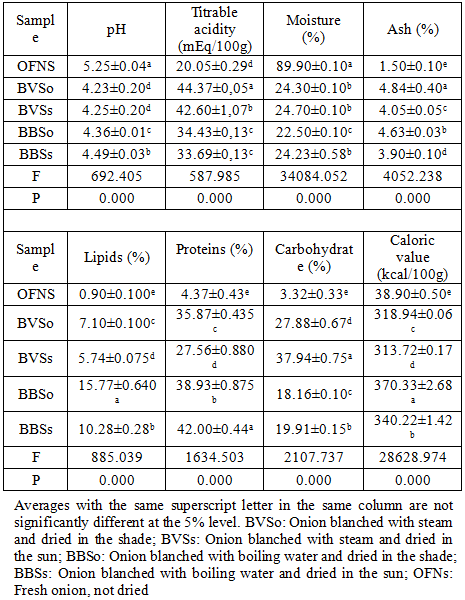
Statistical analysis of the data indicates a significant difference in the values obtained for all biochemical parameters in Table 1 evaluated between onion samples at a risk p ˂ 0.05. The water content of the dried onion samples varies from 22.50 to 24.70%. These contents are significantly lower than that found for the fresh onion sample (89.90%). The shade-dried (BBSo) and sun-dried onion samples (BBSs) had low water content (22.50% and 24.23%), respectively, compared to the sun-dried (BVSs) and shade-dried (BVSo) onion samples, which had high water content (16.68% and 16.99%), respectively. The pH ranged from 4.23 to 4.49 for the dried onion samples, while the pH of the fresh onion sample was 5.25. The highest pH values were obtained with the sun-dried (BBSs) and shade-dried (BBSo) samples, respectively. In terms of titratable acidity, a variation of 34.43 to 44.37 mEq/100g was observed for the dried samples, compared to 20.05 mEq/100g for the fresh onion sample. The shade-dried onion sample (BVSo) had the highest titratable acidity (44.37 mEq/100g). As for ash content, the value for the fresh onion sample was 1.50%, while those for the dried samples ranged from 3.90% to 4.84%. High ash contents were obtained with samples dried in the shade (4.84% and 4.63%), and low contents with those dried in the sun (3.90% and 4.05%). Regarding lipid content, the value for the fresh onion sample was 0.90%, compared to 5.74% to 15.77% for the dried samples. The samples of onions dried in the shade (BBSo) and in the sun (BBSs) had high values (15.77% and 10.28%) compared to those dried in the sun (BVSs) and in the shade (BVSo), which had low contents (5.74% and 7.10%). With regard to protein content, values ranged from 27.56% to 42.00% for the dried samples, whereas the fresh onion sample had a protein content of 4.37%. The highest protein content (42.00%) was observed in the sun-dried sample (BBSs). The carbohydrate content ranged from 19.91% to 37.94% and from 18.16% to 27.88% for sun-dried and shade-dried onion samples, respectively, compared to 3.32% for the fresh onion sample. The sun-dried sample (BVSs) had the highest carbohydrate content.
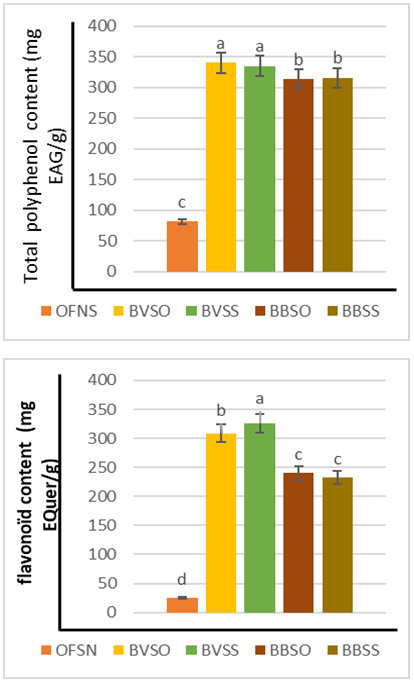
With regard to polyphenols and flavonoids, Figure 1 shows their respective compositions. For polyphenols, the contents of the dried samples ranged from 314.00±6.00 to 340.37±4.37 mg EAG/100g, compared to 81.97±2.275 mg EAG/100g for the fresh sample. The sample dried in the shade (BVSo) had the highest polyphenol content. Flavonoid content ranged from 232.50±0.000 to 326.00±8.000 mg EQuer/100g. These levels are significantly higher than those cost of 24.97±1.825mg EQuer/100g. The sample obtained from sun drying (BVSs) had the highest flavonoid content (326.00mg EQuer/100g).
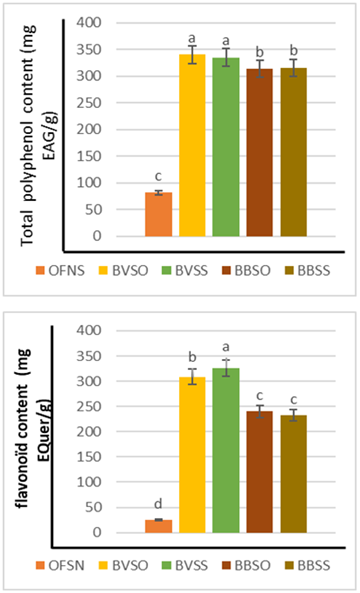
Different letters indicate a significant difference at a 5% risk level. BVSo: Onion blanched with steam and dried in the shade; BVSs: Onion blanched with steam and dried in the sun; BBSo: Onion blanched with boiling water and dried in the shade; BBSs: Onion blanched with boiling water and dried in the sun; OFNs: Fresh onion, not dried.
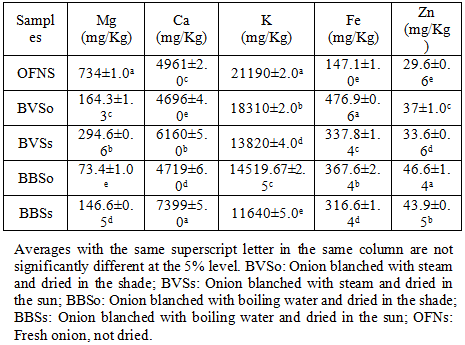
Table 2 shows the mineral content of the onion samples. These mineral contents varied significantly depending on the pretreatments undergone and the drying methods used. For example, magnesium (Mg) contents ranged from 73.4 mg/kg to 734 mg/kg. The highest value was obtained for the fresh onion sample (734.4±1.00) and the lowest (73.4±1.00) for the shade-dried onion sample (BBSo). As for calcium (Ca), the content ranged from 4696 mg/kg to 7399 mg/kg for the dried samples, compared to 4961 mg/kg for the fresh sample. The sample (BBSs) had the highest calcium content. The amount of potassium (K) in the dried onions ranged from 11,640 mg/kg for the sun-dried onion sample (BBSs) to 18,310 mg/kg for the shade-dried onion sample (BVSo), while that of the sample (OFNS) was 21,190 mg/kg. Regarding iron (Fe) content, the fresh onion sample (OFNS) had a content of 147.1 mg/kg, compared to 316.6 mg/kg to 476.9 mg/kg for the dried onion samples. As for zinc (Zn) content, values ranged from 33.6 mg/kg to 46.6 mg/kg for dried samples, while the fresh sample (OFNS) had a value of 29.6 mg/kg. For magnesium (Mg), values ranged from 17.9 mg/kg to 31 mg/kg. The sample (OFNS) showed the lowest value, while the sample (BBSo) showed the highest value.
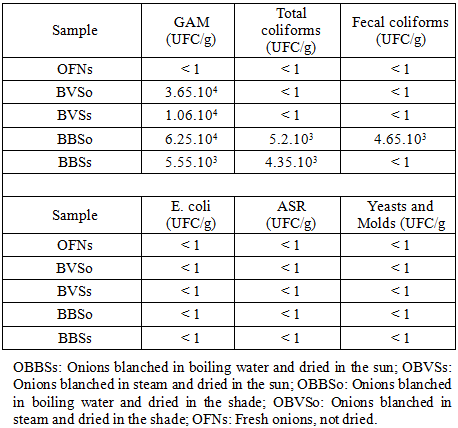
The results of the microbiological analysis of dried onions are shown in Table 3. The analysis revealed the presence of mesophilic aerobic bacteria in the dried onion samples, with a low microbial load ranging from 5.55 × 10³ CFU/g to 1.06 × 10⁴ CFU/g for the BBS and BVS samples, respectively, while the BVSo and BBSo samples had a high microbial load ranging from 3.65 × 10⁴ CFU/g to 10.4 × 10⁴ CFU/g. 104 CFU/g for the BBSs and BVSs samples, respectively, while the BVSo and BBSo samples had a high microbial load ranging from 3.65 × 10⁴ CFU/g to 6.25 × 10⁴ CFU/g, respectively. An absence of mesophilic aerobic bacteria were observed in the control sample (OFNs). With regard to total and fecal coliforms, analysis of the results revealed the presence of total coliforms with a microbial load of 5.2 × 10³ CFU/g and 4.35 × 10³ CFU/g for the BBSo and BBSs samples, respectively. As for fecal coliforms, only the BBSo sample showed a microbial load of 4.65 × 10³ CFU/g. An absence of these bacteria was noted in the other BVSo, BVSs, and control (OFNs) samples. Furthermore, no microbial load of aerobic sulfite-reducing bacteria (ASR) and E. coli was detected in any of the dried onion samples or the control sample (OFNs). As for yeasts and molds, microbiological analysis also showed no microbial load in all samples of dried onions BVSo, BVSs, BBSo, and BBSs, as well as the control sample (OFNs).
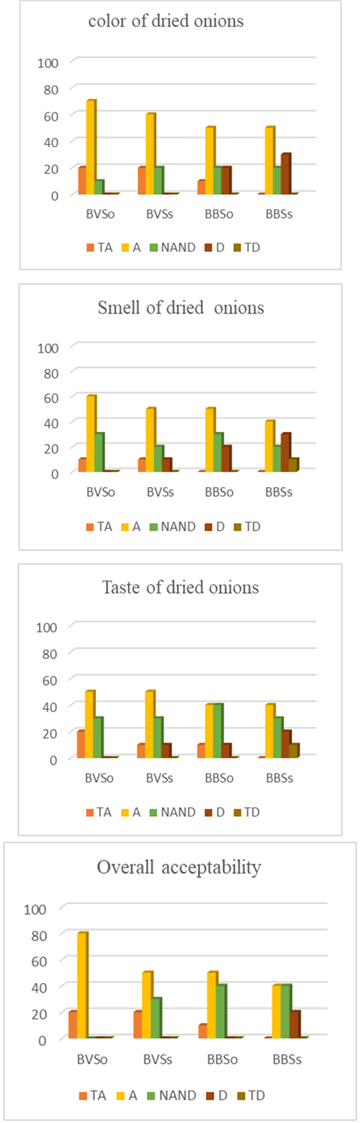
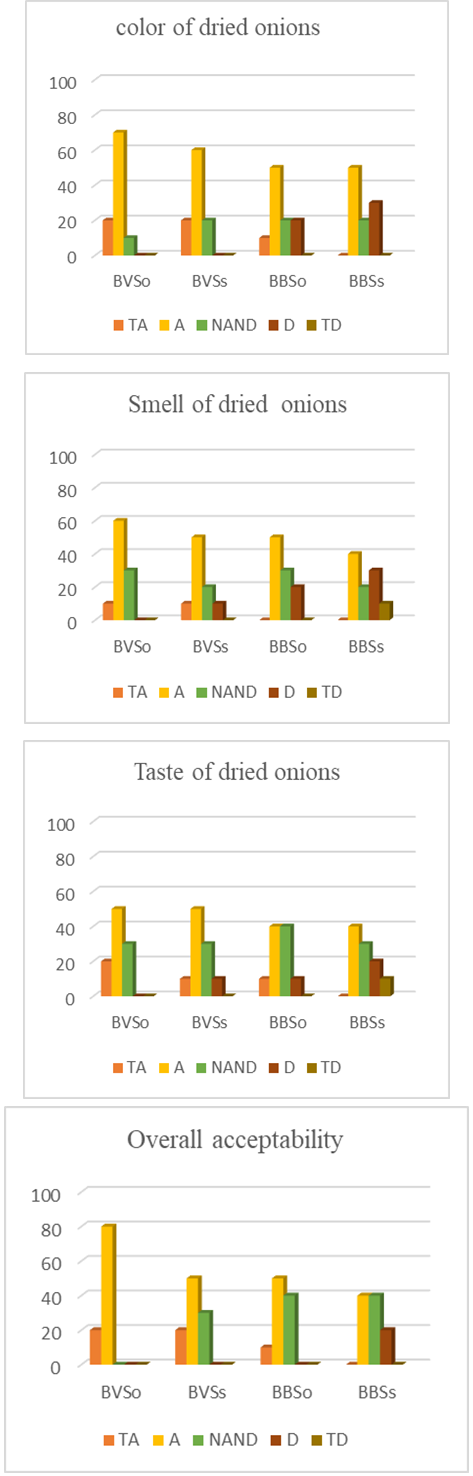
The assessment of color, taste, odor, and overall acceptability of the dried onion samples is shown in Figure 2. The color of the steam-blanched, shade-dried (BVSo) and steam-blanched, sun-dried (BVSs) onion samples was rated as pleasant by 70% and 60% of the panel, respectively, with 20% considering them very pleasant. The samples of onions blanched in boiling water, dried in the shade (BBSo) and dried in the sun (BBSs) were rated as pleasant by 50% of the tasters, while 20% considered them neither pleasant nor unpleasant, and only 10% rated the BBSo samples as very pleasant. As for the BBSo and BBSs samples, 20% and 30% of the panel found them unpleasant, respectively. Regarding the taste of the dried samples, 50% of the tasters described the taste of the BVSo and BVSs samples as pleasant, and 40% for the BBSo and BBSs samples. Twenty percent of tasters found the taste of the BVSo samples very pleasant and 10% found the BVSs and BBSo samples pleasant, while 30% of tasters found neither the BVSs nor the BBSs samples pleasant or unpleasant. Only 40% found the BBSo samples pleasant. 10% of the panel found the BVSs and BBSo samples unpleasant, followed by 20% for the BBSs samples, while only 10% found them very unpleasant. The smell of the BVSo and BVSs dried onions was pleasant according to 60% and 50% of the panelists, respectively, while 10% found it very pleasant. 50% and 40% found the BBSo and BBSs samples pleasant. The BVSo and BBSo samples were found to be neither pleasant nor unpleasant by 30% of panelists, compared to 20% for the BVSs and BBSs samples. As for the dried onions BVSs, BBSo, and BBSs, they were rated as unpleasant by 10%, 20%, and 30% of tasters, respectively, and only 10% found the dried BBSs samples very unpleasant. Regarding the overall acceptability of dried onions, 80% of tasters rated the BVSo dried onion samples as acceptable, 50% for the BVSs samples, and BBSo, and 40% for the BBSs samples. 20% rated the BVSo and BVSs samples as very acceptable, followed by 10% for the samples. In addition, 40% of the panel found the BBSo and BBSs samples neither acceptable nor unacceptable, and 30% found the BVSs samples neither acceptable nor unacceptable. However, 20% of the panelists rated the BBSs dried onion samples as unacceptable.
BVSo: Onion blanched with steam and dried in the shade; BVSs: Onion blanched with steam and dried in the sun; BBSo: Onion blanched with boiling water and dried in the shade; BBSs: Onion blanched with boiling water and dried in the sun; TD: Very unpleasant; D: Unpleasant; NAND: Neither pleasant nor unpleasant; A: Pleasant; TA: Very pleasant
The results showed that the pH varied from one drying process to another and that the effect of pre-treatment did not significantly influence the pH of the dried onions. The acidic pH values found in our study could have a positive impact on the preservation of dried onion samples. Our results are consistent with those of 13, who found a pH ranging from 4.01 to 5.10 for dried onion samples of the Galmi purple variety. As for titratable acidity, the results revealed an increase after drying the samples. Indeed, 26 indicated in their study that this increase was due to the conversion of sugar contained in the onion into organic acids. This increase in acidity observed during the various drying processes is beneficial because it limits the proliferation of microorganisms such as yeast and mold in dried onions. Regarding the water content of the dried onion samples, the results showed that the drying method has an influence on it. It decreases in all dried samples compared to fresh onions, which is thought to be due to water loss through evaporation during drying. This reduction in water content during sample drying is beneficial because drying improves food preservation by increasing dry matter 27. The results of this study corroborate those found by 28, who studied the effect of the drying process on the nutritional value and the chemical, physical, and sensory properties of onions. As for ash content, it increases in all dried samples compared to fresh onions. The ash content indicates the mineral content in a food. Therefore, its increase in onions during the various drying processes and, consequently, that of the mineral content could be due to the reduction in water, which leads to an increase in dry matter in the various onion samples studied. The increase in ash content during onion drying corroborates the reports by 29, 30. They claim that solar drying helps retain more minerals in fruits and vegetables. Regarding mineral content, the magnesium (Mg) content, which ranged from 73.4 to 734 mg/kg for onion samples, could be due to pretreatments and drying methods. As for calcium (Ca), the content for dried onion samples ranged from 4,696 to 7,399 mg/kg. These values obtained from dried onion samples could cover the recommended daily intake of Ca, which varies from 800 to 1200 mg per day 31. For potassium (K) content, the values for the dried onion samples (11,640 to 18,310 mg/kg) are lower than the value for the control sample (21,190 mg/kg). The type of drying and the type of pretreatment have a significant influence on potassium content. In addition, the iron (Fe) content showed very high values ranging from 147.1 (OFNS) to 476.9 mg/kg for the BVSo sample. The daily Fe requirement is estimated to be between 10 and 15 mg 13. Thus, dried onions have a sufficient content to meet consumers' dietary Fe requirements. The amount of zinc (Zn) in dried onions ranged from 33.6 to 46.6 mg/kg, while the control sample had a value of 29.6 mg/kg. The increase in zinc is due to the pre-treatment and drying methods.Ainsi, These values contribute to meeting daily zinc requirements, as the daily human requirement for Zn is approximately between 8 and 11 mg 32. Finally, the manganese (Mn) content, which ranged from 20.3 to 31 mg/kg for the dried onion samples and was 17.9 mg/kg for our sample (OFNS), is within the range given by 33, which was 7.95 to 31.35 mg/kg DM. As for lipid content, it varies depending on the drying method. High lipid content was observed in samples dried in the sun (BBSs) and in the shade (BBSo) (10.28% and 15.77%). Our results are similar to those found by 34, who also observed variations in lipid content in samples of Violet de Galmi onions dried in the sun and in the shade. The protein content varies depending on the drying method. It increases in all dried samples compared to fresh onions. High protein contents were found in the BBSs and BBSo samples (42% and 38.93%). Our results are higher than those found by 34 during the drying of Violet de Galmi onions (21% and 11.37%) for BBSs and BBSo, respectively. This observed difference could be explained by the varietal difference of the onions studied. Drying has a significant influence on total carbohydrate content. The moderately high carbohydrate content generally observed in all samples of sun-dried and shade-dried yellow onions could play an important role in human health. In addition to providing energy, carbohydrates are also necessary for many biochemical reactions that are not directly related to energy metabolism.
The microbiological characteristics determined on the dried onion samples reveal the presence of mesophilic aerobic bacteria with a microbial count of 5.55 × 10² CFU/g to 6.25 × 10³ CFU/g. These results comply with the quality standards for dried products 35, which are 5.105 CFU/g to 5.106 CFU/g. The high microbial loads of 3.65 × 10³ CFU/g for the sample (BVSo) and 6.25 × 10³ CFU/g for the sample (BBSo) are likely due to contamination during packaging, drying, or grinding. The samples comply with quality standards for dried products, and the microbiological profile of the food is acceptable and does not pose a risk to human health (Quebec Standard, 2009). With regard to total coliforms (4.35 x 10² to 5.2 x 10² CFU/g) and fecal coliforms (4.65 x 10² CFU/g), the loads are similar to those found in studies conducted by 36 with a variation of 1.31 × 10² to 5.39 × 10² CFU/g in dried samples of red, white, and cream onions. As for ASR and E. coli, the analyses reveal that all samples contain less than one germ per gram of dried onion (< 1 CFU/g). These results comply with 35, which are 103 to 104 CFU/g for ASR, and with the standards (102 to 103 CFU/g) set by 37 for E. coli. The absence of these microorganisms would be an indicator of good sanitary quality and the absence of fecal contamination in the samples. Furthermore, no yeast or mold was detected in any of the dried onion samples. These results comply with the standard (102 CFU/g) set by 37. These results confirm the product's high manufacturing quality. Analysis of the microbiological characteristics of the dried onion samples indicates that the microbiological profile of the four samples is satisfactory.
Regarding the organoleptic characteristics of dried onions. Analysis of the results revealed that 70% and 60% of tasters respectively found the color of the samples of steam-blanched onions dried in the shade (BVSo) and sun-dried onions (BVSs) to be pleasant. This positive assessment can be explained by the presence of anthocyanin in onionsIndeed, the presence of anthocyanin in onions gives them their attractive color, which is appreciated by consumers 38. These results are similar to those found by 34, who showed that 70% of tasters found the color of steam-blanched and sun-dried onion samples (OBVSs) pleasant, but lower than those by 13, who showed that 90% of tasters highly appreciated the color of the dried samplesIn terms of the taste of the dried samples, the analysis of the results indicates that 50% of tasters describe the smell of the samples of steam-blanched onions dried in the shade (BVSo) and sun-dried (BVSs) as pleasant. Our results are similar to those of 6, who studied improvements in onion drying technology and the formulation of seasoned condiments based on dried onions. Regarding odor, samples of steam-blanched onions dried in the shade (BVSo) and dried in the sun (BVSs) were perceived as pleasant by 60% and 50% of panelists, respectively. This observed difference could be explained according to 26. They indicated that aroma is conferred by volatile compounds and perceived by the odor receptor sites of the olfactory organ. Indeed, the pungency of onions during preparation, processing, and storage contributes significantly to the aroma of fresh and dried onions. The sample of onions blanched with steam and dried in the shade (BVSo) stands out from the other samples due to its color, taste, and smell. However, based on the sensory analysis of the dried onion from the four samples in the study, the tasters chose the BVSo sample as their favorite, followed by the BVSs, BBSo, and BBSs samples, respectively.
This study aimed to evaluate the influence of sun drying and shade drying on the biochemical, microbiological, and sensory parameters of yellow onions sold at the Korhogo market. Two types of bleaching were applied to onion slices before drying. The overall objective was to contribute to reducing post-harvest losses of fresh onions with a view to increasing their value. It appears that drying in the sun for 7 days at an average temperature of 33°C and drying in the shade (22 ± 2°C) better preserve the biochemical and sensory properties of dried onions. Drying significantly reduced the water content in fresh onions. In addition, it should be noted that blanching combined with drying has a significant effect on the biochemical and sensory properties of dried onion samples. Samples that have been blanched with steam and dried in the shade have better organoleptic quality than those blanched with boiling water. Microbiological analyses show that dried onion samples (BVSo and BVSs) have levels of mesophilic aerobic bacteria, total and fecal coliforms, yeasts, and molds that meet good hygiene practice standards. This is a factor in product quality. Dried onions can therefore be stored for a long time.
| [1] | Pitrat M. and Foury C. (2003). Histoires de légumes. Des Origines à l’orée du XXIe siècle. INRA: Paris, 111p. | ||
| In article | |||
| [2] | Mégroz N. and Andreas-Baumgartner A.S.A. (2000). L'oignon, bon au goût et à l'oeil. A la loupe, tabula no 2, 4 p. | ||
| In article | |||
| [3] | Bennacer M. and Bouderbala A. (2016). Etude du désherbage (chimique et manuel) en pépinière sur la culture d’oignon A. cépa (Deux hybrides F1 et une variété population). Mémoire de fin de formation pour l’obtention du diplôme de Master professionnel. Université Abdelhamid Ibn Badis-Mostaganem. 91p. | ||
| In article | |||
| [4] | FAOSTAT (2021). FAO Data Base. http://www.fao.org/faostat/fr (consulté le 14 Juillet 2023). | ||
| In article | |||
| [5] | Abdoulaye J. M. (2011). Evaluation de la valeur nutritive et des vertus thérapeutique de l'oignon : Cas du quartier Koirategui. Institut de Sante Publique - Nutrition humaine. | ||
| In article | |||
| [6] | Go I. (2014). Amélioration de la technologie de séchage de l'oignon et formulation de condiments assaisonnés à base d'oignon séché. Mémoire de fin de cycle pour l'obtention de la Licence Professionnelle en Génie Biologique. Université Polytechnique de Bobo-Dioulasso (U.P B), Burkina Faso. 70p. | ||
| In article | |||
| [7] | Cathala M., Woin N. and Essang T. (2003). L'oignon, une production en plein essor au Nord-Cameroun. Cahier Agriculture, 12 : 261-266. | ||
| In article | |||
| [8] | Onwude D.I., Hashim N., Janius R., Abdan K., Chen G. and Oladejo A.O. (2017). Non-thermal hybrid drying of fruits and vegetables: A review of current technologies Innov. Food Sci. Emerg. Technol., 43, pp. 223-238. | ||
| In article | View Article | ||
| [9] | FAO (1996). Etats des lieux sur les productions maraîchères et fruitières au Bénin. Appui à l’intensification et à la promotion des cultures maraîchères et fruitières. Document de travail. | ||
| In article | |||
| [10] | Compaoré C. S., Go I. and Sawadogo L. H. (2020). Impact du prétraitement au sel (NaCl) et du séchage sur les caractéristiques nutritionnelles et microbiologiques de l’oignon bulbe. International Journal of Biological Chemical Sciences vol.14, 3, pp 685-697. | ||
| In article | View Article | ||
| [11] | Djaeni M., Arifin U. F. and Sasongko S. B. (2017). Physical-Chemical Quality of Onion Analyzed Under Drying Temperature: Department of Chemical Engineering, Faculty of Engineering, Diponegoro University Jl. Prof. Soedarto, SH, Tembalang, Semarang, Indonesia 50275. | ||
| In article | |||
| [12] | Goudra P. G., Ramachandra C. T. and Udaykumar N. (2014). Dehydration of Onions with Different Drying Methods. Current Trends in Technology and Science. ISSN : 2279-0535. Volume : 3, Issue : 3, 210-216. | ||
| In article | |||
| [13] | Akoha P. (2021). Influence de deux techniques de séchage sur la qualité de deux variétés d’oignons séchés et conservés à l’échelle pilote au sud du Bénin. Mémoire de fin de formation pour l’obtention du diplôme de Master professionnel. Université d’Abomey-Calavi (UAC), Bénin. 73p. | ||
| In article | |||
| [14] | Mepba H. D., Eboh L. and Banigo D. E. B. (2007). Effects of processing treatments on the nutritive composition and consumer acceptance of some Nigerian edible leafy vegetables. African Journal of Food, Agriculture, Nutrition and Development on the World Wide Web: http://www.ajfand.net/ vol7no1.html. vol. 7, pp. 2-18. | ||
| In article | View Article | ||
| [15] | Vanderhulst P., Lanser H., Bergmeyer P. and Albers R. (1990). Solar energy: small scale applications in developing countries. International Food Journal, pp. 8-138. | ||
| In article | |||
| [16] | AOAC (1990). Official methods of analysis. Association of Official Analytical Chemists Ed., Washington DC, 684 p. | ||
| In article | |||
| [17] | FAO (2002). Elargir la base des ressources alimentaires grâce aux plantes indigènes. Rome (Italy). 295p. | ||
| In article | |||
| [18] | CEAEQ (2013). Détermination des métaux. Méthode par spectrométrie de masse à source ionisante au plasma d’argon. MA 200 – Met 1.2, Rev 4. Quebec, p. 24. | ||
| In article | |||
| [19] | Singleton V. L., Orthofer R. and Lamuela-Raventos R. M. (1999). Analysis of total phenols and other oxydant substrates and antioxydants by means of Folin-ciocalteu reagent. Methods Enzymology, 299: 152-178. | ||
| In article | View Article | ||
| [20] | Meda A., Lamien C. E., Romito M., Millogo J. and Nacoulma O. G. (2005). Determination of total phenolic, flavonoid and proline contents in Burkina Faso honeys as well as well as their radical scavenging activity. Food Chemistry, 91: 571-577. | ||
| In article | View Article | ||
| [21] | ISO 4833-1 (2013). Méthode horizontale de dénombrement des microorganismes capable de se développer et de former des colonies en milieu solide après incubation aérobie à 30°C. | ||
| In article | |||
| [22] | ISO 4832 (2006). Donne des directives générales pour le dénombrement des coliformes. Méthode de comptage des colonies après incubation à 30°C ou 37°C en milieu solide. | ||
| In article | |||
| [23] | ISO 21527-1 (2008). Méthode horizontale pour le dénombrement des Levures et Moisissures. | ||
| In article | |||
| [24] | ISO 16649-2 (2001). Méthode horizontale pour le dénombrement des Escherichia coli. | ||
| In article | |||
| [25] | NF V08-061 (2009). Microbiologie des aliments-Dénombrement en anaérobiose des bactéries sulfito-réductrices par comptage des colonies à 46°C. | ||
| In article | |||
| [26] | Seifu M., Tola Y. B., Mohammed A. and Astatkie T. (2018). Effect of variety and drying temperature on physicochemical quality, functional property, and sensory acceptability of dried onion powder. Food science nutrition. Vol 6, n°6, 9p. | ||
| In article | View Article PubMed | ||
| [27] | Fakeye I.O. (1999). Nigerian leafy vegetable. African Journal of science, 1: 55. | ||
| In article | |||
| [28] | Abdoulaye J. M. (2011). Evaluation de la valeur nutritive et des vertus thérapeutique de l'oignon: Cas du quartier Koirategui. Institut de Sante Publique - Nutrition humaine. | ||
| In article | |||
| [29] | Fuller R.J. (1991). A review of solar drying of fruit, vegetables and other food crops research report series. Journal of Agricutural Science, 74(3): 193-799. | ||
| In article | |||
| [30] | Ruel M.T. (2001). Can food-based strategies help reduce vitamin a and iron deficiencies. A review of recent evidence food policy. New York. American Food Journal, 26-28 pp. | ||
| In article | |||
| [31] | Armand A.B., Scher J., Aboubakar, Goudoum A., Ponka R., Montet D. and Mbofung C. M. (2018). Effect of three drying methods on the physicochemical composition of three varieties of onion (Allium cepa L). J Food Sci Président Nutr. ; 1(2) :17-24. | ||
| In article | View Article | ||
| [32] | CSS (2016). Conseil Supérieur de la Santé. Recommandations nutritionnelles pour la Belgique. Bruxelles CSS: 2016 Avis no 9285. | ||
| In article | |||
| [33] | Konaté M., Parkouda C., Tarpaga V., Guira F., Rouamba A. and Sawadogo-Lingani H. (2017). Evaluation des potentialités nutritives et l’aptitude à la conservation de onze variétés d’oignon (Allium cepa L.) bulbe introduite au Burkina Faso. Int. J. Biol. Chem. Sci., 11(5) : 2005-2015. | ||
| In article | View Article | ||
| [34] | Oulai D.P., Libra M.A., Kodjo N., Ouattara H.D., Cissé M. and Niamké L.S. (2025). Impact of blanching and two drying methods on the nutritional, organoleptic and microbiological properties of fresh onions of Galmi violet variety sold on the markets of korhogo (Côte d’Ivoire). Annual Research and Review in Biology, 40(1) : 50-61. | ||
| In article | View Article | ||
| [35] | Norme Quebec, CECMA, (2009). Lignes directrices et normes pour l'interprétation des résultats analytiques en microbiologie alimentaire. 59 p. | ||
| In article | |||
| [36] | Ameru M.B., Adeiza O.A., Rahman O.M., KURRAH I.A., Olaleye O.O. and Akande S. A. (2024). Effect of drying methods on the moisture content and microbiological properties of three varieties of dried onion slices (Allium cepa). Journal of Nutrition food science and Technology. 5 (1). Pp 1-8. | ||
| In article | |||
| [37] | Règlement CE n°2073/2005. Fixe les critères microbiologiques permettant de définir l’acceptabilité des denrées alimentaires ou d’un procédé. | ||
| In article | |||
| [38] | Fossen T., Anderson M., Vstedal D. O., Pedersen A. T. et Raknes A. (1996). Characteristic anthocyanin pattern from onions and other Allium spp. Journal of Food Science, vol. 61, n°4, pp 703-706. | ||
| In article | View Article | ||
Published with license by Science and Education Publishing, Copyright © 2025 OULAI Dehegnan Penan Patricia, TOURE Naka, LIBRA Michel Archange and NIAMKE Lamine Stébastien
 This work is licensed under a Creative Commons Attribution 4.0 International License. To view a copy of this license, visit
http://creativecommons.org/licenses/by/4.0/
This work is licensed under a Creative Commons Attribution 4.0 International License. To view a copy of this license, visit
http://creativecommons.org/licenses/by/4.0/
| [1] | Pitrat M. and Foury C. (2003). Histoires de légumes. Des Origines à l’orée du XXIe siècle. INRA: Paris, 111p. | ||
| In article | |||
| [2] | Mégroz N. and Andreas-Baumgartner A.S.A. (2000). L'oignon, bon au goût et à l'oeil. A la loupe, tabula no 2, 4 p. | ||
| In article | |||
| [3] | Bennacer M. and Bouderbala A. (2016). Etude du désherbage (chimique et manuel) en pépinière sur la culture d’oignon A. cépa (Deux hybrides F1 et une variété population). Mémoire de fin de formation pour l’obtention du diplôme de Master professionnel. Université Abdelhamid Ibn Badis-Mostaganem. 91p. | ||
| In article | |||
| [4] | FAOSTAT (2021). FAO Data Base. http://www.fao.org/faostat/fr (consulté le 14 Juillet 2023). | ||
| In article | |||
| [5] | Abdoulaye J. M. (2011). Evaluation de la valeur nutritive et des vertus thérapeutique de l'oignon : Cas du quartier Koirategui. Institut de Sante Publique - Nutrition humaine. | ||
| In article | |||
| [6] | Go I. (2014). Amélioration de la technologie de séchage de l'oignon et formulation de condiments assaisonnés à base d'oignon séché. Mémoire de fin de cycle pour l'obtention de la Licence Professionnelle en Génie Biologique. Université Polytechnique de Bobo-Dioulasso (U.P B), Burkina Faso. 70p. | ||
| In article | |||
| [7] | Cathala M., Woin N. and Essang T. (2003). L'oignon, une production en plein essor au Nord-Cameroun. Cahier Agriculture, 12 : 261-266. | ||
| In article | |||
| [8] | Onwude D.I., Hashim N., Janius R., Abdan K., Chen G. and Oladejo A.O. (2017). Non-thermal hybrid drying of fruits and vegetables: A review of current technologies Innov. Food Sci. Emerg. Technol., 43, pp. 223-238. | ||
| In article | View Article | ||
| [9] | FAO (1996). Etats des lieux sur les productions maraîchères et fruitières au Bénin. Appui à l’intensification et à la promotion des cultures maraîchères et fruitières. Document de travail. | ||
| In article | |||
| [10] | Compaoré C. S., Go I. and Sawadogo L. H. (2020). Impact du prétraitement au sel (NaCl) et du séchage sur les caractéristiques nutritionnelles et microbiologiques de l’oignon bulbe. International Journal of Biological Chemical Sciences vol.14, 3, pp 685-697. | ||
| In article | View Article | ||
| [11] | Djaeni M., Arifin U. F. and Sasongko S. B. (2017). Physical-Chemical Quality of Onion Analyzed Under Drying Temperature: Department of Chemical Engineering, Faculty of Engineering, Diponegoro University Jl. Prof. Soedarto, SH, Tembalang, Semarang, Indonesia 50275. | ||
| In article | |||
| [12] | Goudra P. G., Ramachandra C. T. and Udaykumar N. (2014). Dehydration of Onions with Different Drying Methods. Current Trends in Technology and Science. ISSN : 2279-0535. Volume : 3, Issue : 3, 210-216. | ||
| In article | |||
| [13] | Akoha P. (2021). Influence de deux techniques de séchage sur la qualité de deux variétés d’oignons séchés et conservés à l’échelle pilote au sud du Bénin. Mémoire de fin de formation pour l’obtention du diplôme de Master professionnel. Université d’Abomey-Calavi (UAC), Bénin. 73p. | ||
| In article | |||
| [14] | Mepba H. D., Eboh L. and Banigo D. E. B. (2007). Effects of processing treatments on the nutritive composition and consumer acceptance of some Nigerian edible leafy vegetables. African Journal of Food, Agriculture, Nutrition and Development on the World Wide Web: http://www.ajfand.net/ vol7no1.html. vol. 7, pp. 2-18. | ||
| In article | View Article | ||
| [15] | Vanderhulst P., Lanser H., Bergmeyer P. and Albers R. (1990). Solar energy: small scale applications in developing countries. International Food Journal, pp. 8-138. | ||
| In article | |||
| [16] | AOAC (1990). Official methods of analysis. Association of Official Analytical Chemists Ed., Washington DC, 684 p. | ||
| In article | |||
| [17] | FAO (2002). Elargir la base des ressources alimentaires grâce aux plantes indigènes. Rome (Italy). 295p. | ||
| In article | |||
| [18] | CEAEQ (2013). Détermination des métaux. Méthode par spectrométrie de masse à source ionisante au plasma d’argon. MA 200 – Met 1.2, Rev 4. Quebec, p. 24. | ||
| In article | |||
| [19] | Singleton V. L., Orthofer R. and Lamuela-Raventos R. M. (1999). Analysis of total phenols and other oxydant substrates and antioxydants by means of Folin-ciocalteu reagent. Methods Enzymology, 299: 152-178. | ||
| In article | View Article | ||
| [20] | Meda A., Lamien C. E., Romito M., Millogo J. and Nacoulma O. G. (2005). Determination of total phenolic, flavonoid and proline contents in Burkina Faso honeys as well as well as their radical scavenging activity. Food Chemistry, 91: 571-577. | ||
| In article | View Article | ||
| [21] | ISO 4833-1 (2013). Méthode horizontale de dénombrement des microorganismes capable de se développer et de former des colonies en milieu solide après incubation aérobie à 30°C. | ||
| In article | |||
| [22] | ISO 4832 (2006). Donne des directives générales pour le dénombrement des coliformes. Méthode de comptage des colonies après incubation à 30°C ou 37°C en milieu solide. | ||
| In article | |||
| [23] | ISO 21527-1 (2008). Méthode horizontale pour le dénombrement des Levures et Moisissures. | ||
| In article | |||
| [24] | ISO 16649-2 (2001). Méthode horizontale pour le dénombrement des Escherichia coli. | ||
| In article | |||
| [25] | NF V08-061 (2009). Microbiologie des aliments-Dénombrement en anaérobiose des bactéries sulfito-réductrices par comptage des colonies à 46°C. | ||
| In article | |||
| [26] | Seifu M., Tola Y. B., Mohammed A. and Astatkie T. (2018). Effect of variety and drying temperature on physicochemical quality, functional property, and sensory acceptability of dried onion powder. Food science nutrition. Vol 6, n°6, 9p. | ||
| In article | View Article PubMed | ||
| [27] | Fakeye I.O. (1999). Nigerian leafy vegetable. African Journal of science, 1: 55. | ||
| In article | |||
| [28] | Abdoulaye J. M. (2011). Evaluation de la valeur nutritive et des vertus thérapeutique de l'oignon: Cas du quartier Koirategui. Institut de Sante Publique - Nutrition humaine. | ||
| In article | |||
| [29] | Fuller R.J. (1991). A review of solar drying of fruit, vegetables and other food crops research report series. Journal of Agricutural Science, 74(3): 193-799. | ||
| In article | |||
| [30] | Ruel M.T. (2001). Can food-based strategies help reduce vitamin a and iron deficiencies. A review of recent evidence food policy. New York. American Food Journal, 26-28 pp. | ||
| In article | |||
| [31] | Armand A.B., Scher J., Aboubakar, Goudoum A., Ponka R., Montet D. and Mbofung C. M. (2018). Effect of three drying methods on the physicochemical composition of three varieties of onion (Allium cepa L). J Food Sci Président Nutr. ; 1(2) :17-24. | ||
| In article | View Article | ||
| [32] | CSS (2016). Conseil Supérieur de la Santé. Recommandations nutritionnelles pour la Belgique. Bruxelles CSS: 2016 Avis no 9285. | ||
| In article | |||
| [33] | Konaté M., Parkouda C., Tarpaga V., Guira F., Rouamba A. and Sawadogo-Lingani H. (2017). Evaluation des potentialités nutritives et l’aptitude à la conservation de onze variétés d’oignon (Allium cepa L.) bulbe introduite au Burkina Faso. Int. J. Biol. Chem. Sci., 11(5) : 2005-2015. | ||
| In article | View Article | ||
| [34] | Oulai D.P., Libra M.A., Kodjo N., Ouattara H.D., Cissé M. and Niamké L.S. (2025). Impact of blanching and two drying methods on the nutritional, organoleptic and microbiological properties of fresh onions of Galmi violet variety sold on the markets of korhogo (Côte d’Ivoire). Annual Research and Review in Biology, 40(1) : 50-61. | ||
| In article | View Article | ||
| [35] | Norme Quebec, CECMA, (2009). Lignes directrices et normes pour l'interprétation des résultats analytiques en microbiologie alimentaire. 59 p. | ||
| In article | |||
| [36] | Ameru M.B., Adeiza O.A., Rahman O.M., KURRAH I.A., Olaleye O.O. and Akande S. A. (2024). Effect of drying methods on the moisture content and microbiological properties of three varieties of dried onion slices (Allium cepa). Journal of Nutrition food science and Technology. 5 (1). Pp 1-8. | ||
| In article | |||
| [37] | Règlement CE n°2073/2005. Fixe les critères microbiologiques permettant de définir l’acceptabilité des denrées alimentaires ou d’un procédé. | ||
| In article | |||
| [38] | Fossen T., Anderson M., Vstedal D. O., Pedersen A. T. et Raknes A. (1996). Characteristic anthocyanin pattern from onions and other Allium spp. Journal of Food Science, vol. 61, n°4, pp 703-706. | ||
| In article | View Article | ||