Introduction: Food consumption apps are supportive digital tools designed to facilitate weight management and following healthier eating habits. There is a wide variety of food consumption apps available; however, there are limited literature that determine the main features of these apps in Saudi Arabia. Therefore, this study aimed to identify the scope of prominent food consumption mobile apps across two commercial apps stores (Apple iOS and Google Play) and determine the main features of apps systematically. Methods: This scoping review was conducted across the Apple iOS and Google Play stores in three steps: (1) electronic app search; (2) extract data; (3) analysis of apps’ characteristics and features. Results: A total of 99 apps were included, of which 41 (41%) were from the iOS store, and 58 (59%) were from the Google Play store. Approximately 52% of apps were rated “4.5 or less”, and 48% of apps were rated “4.6 and above”. Most apps offered more than one language, of which 81% provided 1 to 6 languages, and only 10.1% of apps offered 7 to 12 languages. We identified a total of 23 features, 29% of apps had 13 to 18 features, 27% of apps had 7 to 12 features, 23% of apps had 19+ features, and 18.2% of apps had 1 to 6 features. Conclusions: The findings of this review indicate that, while a wide range of food consumption apps are available, most apps offer limited features. Therefore, there is a need for introducing some unique features such as entering food by picture or barcode scanning, food composition tables, and tracking of micro-nutrients to attract more users. In addition, the number of features had a positive association with apps rating. Notably, high ratings may increase the app's visibility, therefore this should be considered by app developers to add desirable features in the future.
Obesity is a growing health problem. Since 1980, the global prevalence of overweight and obesity has doubled, a third of the world's population is overweight or obese 1. According to the World Health Organization (WHO), obesity is defined as an abnormal or excessive accumulation of fat that may cause harm to human health 2. Several diseases are associated with obesity, including type 2 diabetes mellitus, cardiovascular diseases, and cancer 3. The consumption of foods high in fat and sugar is a modifiable risk factor associated with the risk of developing diet-related non-communicable diseases 4. Self-monitoring for food intake is considered one of the methods that can aid in weight control as a cornerstone behavioral treatment for obesity and several non-communicable diseases. The approaches to food intake self-monitoring can be made using traditional paper-based methods or technology-based methods 5.
Technology-based methods to tracking daily food consumption are increasing in popularity considerably due to technological advances. These methods including use of food consumption mobile apps and other self-monitoring digital tools, which may result in facilitate weight loss and management 6, 7. Food consumption apps are used to track daily food consumption by recording all foods and beverages that are consumed during the day, then provide an overall estimation of energy, macro-, and micro-nutrient contents 8. Some specialists believe that the use of food consumption apps is more accurate than traditional methods (such as a diet record) for tracking the diet due to the immediate entry of dietary records after eating, and this would reduce the dependency on memory 9. In addition, there are numerous benefits of using food consumption apps, including lower costs, increased awareness of healthy eating, and easier food consumption tracking compared to other methods 10.
The usage of food consumption apps is popular locally and globally. In global studies, 51 apps were popular in Australia 11, 95 apps in Europe 12, and around 300 apps in the US 13. Looking at local studies, a study done by Alshathri et al. (2020), the results showed that a total of 60 apps were identified from the search in the Saudi app stores and they demonstrated that approximately 30% of participants had used weight management apps, and the most common reason for users to download these apps was to monitor food intake (37%) 14. This finding is consistent with another web-based questionnaire study was conducted by Aljuraiban GS. (2019) has shown that one of the most common reasons for users to download weight-management apps was to monitor food intake in both overweight or obese and normal-weight users (28%,42%) respectively 15.
The features of apps play a vital role in the patterns of their usage. Several studies have focused on identifying the common desirable features of food consumption apps. In 2015, a qualitative study was conducted by Alnasser AA et al. to learn more about the proposed features of an Arabic weight loss app by interviewing overweight and obese Saudi users. The Arabic language, motivational support and social networking, nutritional and physical activity tools, and user-friendly interface emerged as recommendations for an ideal weight loss App 16. Furthermore, the potential to be supervised by a specialist, nutritional value identification through barcodes, the availability of nutrition information on food items, periodic reports that include progress updates, and continuous reminders to follow a diet or physical activity plans were common desirable features of diet apps 14, 15.
Although there growing research on perspective of user in about desirable features of apps that monitor food consumption, and the reasons for users to download these apps. Notably, their perspective and desires may vary from other societies. There are no available scoping reviews focusing on exploring the features of available food consumption apps in Saudi apps stores –to the best of author’s knowledge-. This fact highlights the importance of conducting a scoping review to identify the scope of prominent food consumption apps and the most common features, which helps to match the desirable features with the available features and find the gaps as an essential step to develop national food consumption app that suitable for users in Saudi Arabia.
Therefore, this scoping review aimed to identify the scope of prominent food consumption mobile apps across two major commercial apps stores (Apple iOS and Google Play) and determine the primary purpose, key features, language options, subscription options, user rating, and the number of downloads to understand the local context.
This scoping review was conducted using the PRISMA-ScR (Preferred Reporting Items for Systematic Reviews and Meta-Analysis Extension for Scoping Reviews) guidelines 18. To identify the scope of prominent food consumption mobile apps across two commercial apps stores (Apple iOS and Google Play) in Saudi Arabia and determine the main features of apps systematically.
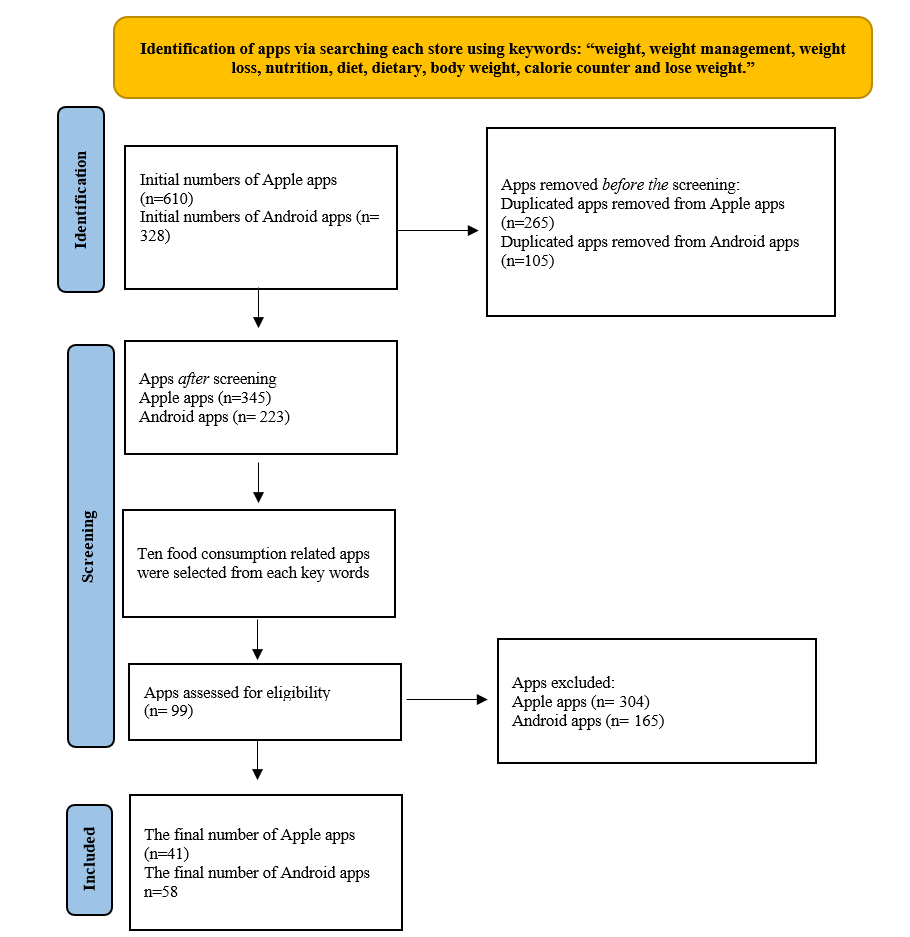
2.2. Apps Search StrategyAn electronic search was conducted between July 2021 and October 2021 to collect apps relevant to food consumption across two major commercial apps stores for the iPhone operating system (Apple iOS) and the Android (Google Play). First, each store was searched by two reviewers independently using the English search terms related to food consumption. Keywords included; “weight; weight management; weight loss; nutrition; diet; dietary; body weight; calorie counter; and lose weight.” No search filters were used to find a large number of apps within the designated time frame. Figure 1 displays the methodology used in this scoping review.
All food consumption mobile apps available on at least one of Saudi Arabia's apps stores for the iPhone (Apple iOS) or the Android (Google Play) with a primary purpose of tracking individual food consumption were included. All apps unavailable on the Google Play or Apple iOS stores in Saudi Arabia were excluded. In addition, apps that did not track food consumption, such as fitness or workout apps, were also excluded.
2.3. Apps SelectionThe apps selection process was performed in two phases, as shown in Figure 1.
Phase 1. Initial screening
In the first phase, two reviewers independently screened all the apps found during the search process. The initial number of mobile apps that met review inclusion criteria was: 610 apps for iPhone (Apple iOS) and 328 apps for Android (Google Play). Then an initial screening process was performed by removing the duplicated apps, 265 apps were duplicated for the iPhone (Apple iOS) and 105 for the Android (Google Play). The number of mobile apps after the initial screening was 345 apps from the iPhone (Apple iOS) and 223 apps from the Android (Google Play).
Phase 2. Final screening
In the second phase, the first ten displayed apps from each keyword search (after removing the duplicated apps) were selected. Some search terms had less than ten results; in that case, all apps were included. The number of final apps included were: 41 apps from the iPhone (Apple iOS) and 58 apps from the Android (Google Play) for a total of 99 apps in this review. It is worth noting that apps that appeared on both App stores were added twice (one for Google Play and one for Apple iOS) to account for various features supported by two different mobile operating systems.
2.4. Data ExtractionThe data extraction form was created using Microsoft Excel. The collected data included: app name, date of search, name of reviewers, apps store (operating system), keyword, age, developer, main purpose, number of downloads (only available for the Android), rating, premium subscription option, languages, and number of features (see Appendix 1) for the full extraction form.
2.5. Feature InventoryThe list of features inventory was created using deductive analysis by identify the features in most popular Apps. The three most common apps that appeared in the search multiple times in both Apple iOS and Google Play systems were selected. These apps are “MyFitnessPal,” “Lose It,” and “Calorie Counter,” which appeared when searching six to seven keywords.
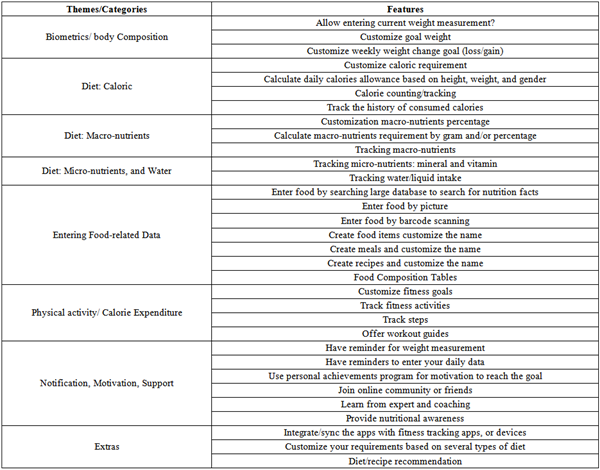
These Apps were reviewed independently using each operating system. All features in these three apps were listed from both operating system. A total of 32 features were listed, then categorized based on eight main categories (themes). This list was used as feature inventory to compare the number of available features in the sample of apps. (Table 1) shows the full themes and features.
Two reviewers examined a total of 99 apps independently by tried the apps by themselves to identify if the apps had any of the 32 features and 8 themes (Yes or No). If the app had at least one sub-category (features), it was considered to have the theme or category. The decision was made when both reviewers agreed, and all discrepancies were resolved through discussion with a third reviewer.
Data analysis was performed using SPSS Statistics version 16.0. The data were presented as frequencies and proportions using descriptive statistical analysis. In addition, cross tabulation analysis was performed using Chi-square test to explore the association between two categorical variables with statistical significance set at P<.05 and 95% CI.
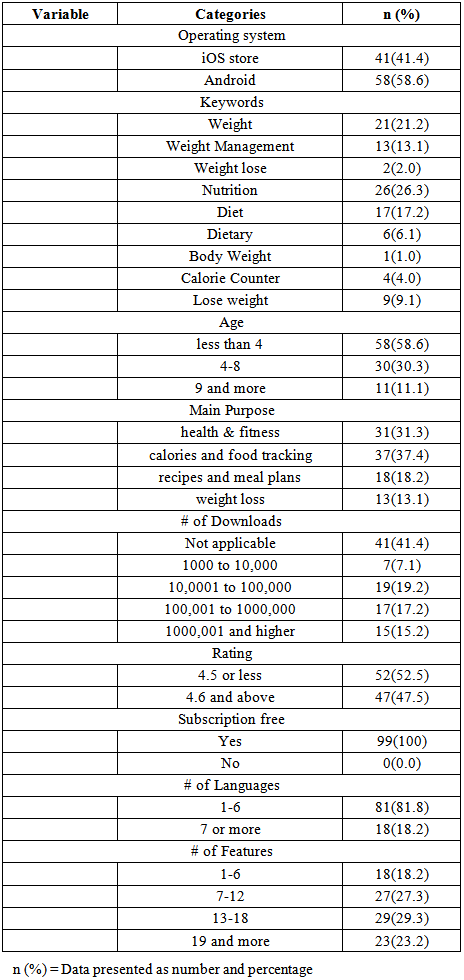
A total number of 99 apps were included in this review after a full search and screening between July and Oct 2021. 41 (41.4%) apps were from the iOS store, and 58 (58.6%) apps were from the Google Play store. However, only six apps appeared in both systems when searching, these are: MyFitnessPal, Lose it, Calorie Counter, Carb Manager, Cronometer - nutrition tracker, and Healthifyme.
We also grouped apps by their main purposes into four categories. We found that the highest proportion of apps was intended for calories, and food tracking, and health and fitness, 37.4%, and 31.3%, respectively.
Looking at users’ rating of apps, high ratings may increase the app's visibility and ranking. A little more than half of the apps (52.5%) were rated “4.5 or less”, and 47.5% of apps were rated “4.6 and above”. Most apps offered more than one language, of which 80.8% offered 1 to 6 language options, and 10.1% of apps offered 7 to 12 languages. In addition, all apps had an option for additional in apps purchases or a premium subscription fee.
Looking at the number of downloads; the iOS system does not provide this information. Therefore, we were only able to extract the information for the Android system. Only 19.2% of apps had 10, 0001 to 100,000 downloads, and 17.2% had 100,001 to 1000,000 downloads.
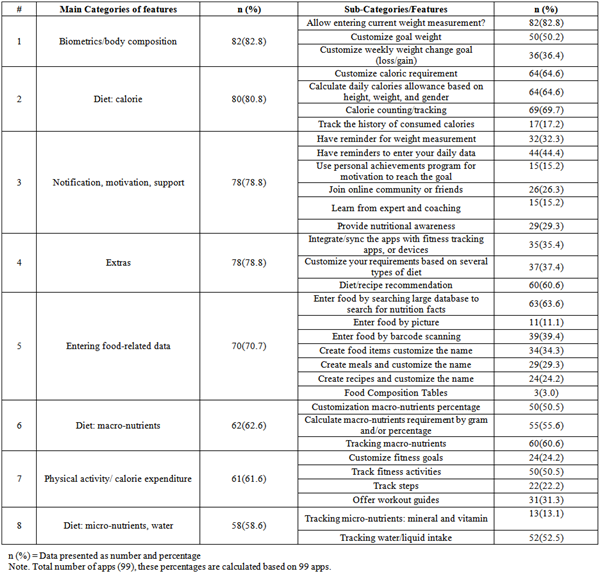
We identified common features available in food consumption apps and categorized them. A total of 32 features were listed under eight themes/categories (Table 1). Our results indicated that 29.3% of apps had 13 to 18 features, 27.3% of apps had 7 to 12 features, and 23.2% of apps had 19+ features. While 18.2% of apps had 1 to 6 features. The features of Apps were grouped into themes/categories features (Table 1). Results in Table 3 shows the percentages of apps in each category. Most apps had features under; biometrics/ body composition (82.8%) and diet: calorie (80.8%) categories. While the least common category is diet: micronutrients, and water (58.6%). Looking at the sub-categories/features. The five most common feature is allowing the entry of current weight measurement (82.8%), then calorie counting/tracking (69.7%), customized caloric requirement and calculation of daily calorie allowance (64.6%), then tracking macronutrients (60.6%). While, food composition tables (3%), entering food by a picture (11.1%), and tracking micronutrients: minerals, and vitamins (13.1%) were the least available features in the apps.
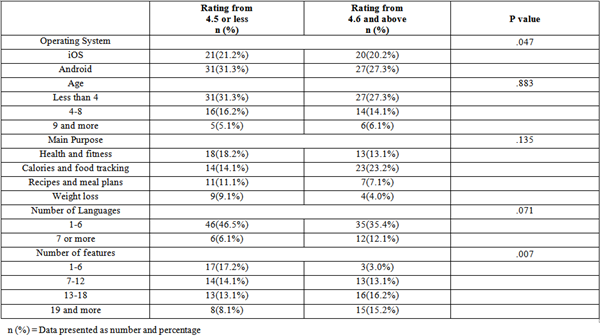
Table 4 shows correlation (cross-tabulation) results between users’ ratings and characteristics of food consumption apps. Chi-square test results show that there is a significant association between the apps’ rating and operating system (P=.047). Only 20.2% of iOS had a rating of 4.6 and above while Android had 27.3%. Interestingly, 31.3% of the Android apps had a rating of 4.5 or less, while only 21.2% of iOS apps had a rating of 4.5 or less. In addition, there is a significant association between the apps’ rating and the number of features available (P=.007). Apps with 13 to 18 features had a rating of 4.6 and above by 16.2%. While 14.1%. Apps that include 7 to 12 features had a rating of 4.5 or less. There is no significant difference between apps users’ ratings and the App’s main purpose, the age of the App, and the number of languages.
This scoping review was conducted to identify, evaluate, and examine individual food consumption apps in a systematic manner. This review is the first scooping review for food consumption mobile apps in Saudi Arabia, providing a comprehensive assessment of the market to identify the most common food consumption apps and their features. To the best of our knowledge, there are no scoping reviews in the literature assessing food consumption apps that were conducted in Saudi Arabia.
A total number of 99 apps were included in the review, 41 from the App store (iOS) and 58 from the Android (Google Play). Only six applications appeared in both systems when searching. These are; MyFitnessPal, Lose it, Calorie Counter, Carb Manager, Cronometer - nutrition tracker, and HealthifyMe. Some food consumption apps are used globally, such as MyFitnessPal and Lose it, but others are regional or local, such as: (أسلوب حياة ، حميتي). Previous studies with similar aims examined a range of 23 - 51 apps 11, 19, however, only one study had a larger sample than ours (393 apps) 13. In this review, searched apps stores were done using nine different keywords to identify relevant food consumption apps. The highest number of apps appeared when searching “weight” and “nutrition” key terms. Similarly, other studies found that searching “weight loss” and “weight” generated the largest number of results 13, 20.
Looking at the main purpose of the apps, we found that more than a third of apps targeted “calories and food tracking,” followed by “health and fitness”, then “recipes and meal plans,” and “weight loss.” However, in another study, they looked at the purpose from a targeted health behaviors perspective, and they found 48% of apps targeted diet and 72% of apps targeted physical activity 21. Looking at Villasana et al. study, they classified the apps’ purpose to diet and nutrition, health, education, and physical activity. It showed 52% of apps were related to “diet and nutrition”, 25% of apps related to “health”, 11% of apps related to “Education”, and 12% of mobile apps related to “Physical activity” 22. These differences might be due to the exclusion criteria used in this review, excluding any App that exclusively targeted physical activity, general health, or education. Thus, we had limited apps for these purposes.
Looking at the number of downloads; this review showed that more than a third of apps (Android only) were downloaded from 10,001 to 1000,000 times. While Villasana et al. found similar results, 29% of App downloads were 100,000 and 30% were downloaded 1000,000 22.
This review focused on the user’s rating as one of the main variables. During our search in App stores, we did not filter our search by rating. Thus, all apps that appeared in our search, regardless of their rating were included. Yet, most apps - regardless of their operating system - had a high rating, 47.5 % of apps in the sample were rated 4.5 or above out of 5, which is similar to Villasana et al. study results, 51% of apps had a rating above 4.5 22. It is notable that previous studies only included apps rated 4 or higher 19, 22.
The results indicated that most apps in the sample offered more than one language option, such as English, Arabic, French, German, Spanish, Portuguese, and Japanese. The most offered languages were English and Spanish. More than half (58.5%) of apps are available in English, and 13.1% of apps were available in both English and Arabic. No apps were available in Arabic only. The majority of apps (80.6%) offered 1 to 6 languages and, 10.2% of apps offered 7 to 12 languages. another study conducted in Saudi Arabia focused mainly on apps offering English and Arabic languages only. They found that out of 23 apps, 12 were only available in Arabic and 7 apps were available in English. Only 4 apps were available in both English and Arabic 14. Nonetheless, in our study, we only searched using English keywords, while Alshathri et al. used both English and Arabic keywords, which might explain the discrepancy.
Based on the findings of this review, there is a significant association between the application’s rating and operating system or number of Features. For example, it showed that 20 applications from IOS and 27 applications from Android had a rating of 4.6 and above. Another study, looking at the rating in the App store found that out of 23 apps, 15 apps had a rating of 4 or more, and 8 apps had a rating of less than 4 14. Yet, this review did not include the Android apps.
Looking at features; this review included 32 features, and the most common features available are; allowing the entry of current weight measurement; calorie counting/tracking; customized caloric requirement; and tracking macronutrients. While another study showed that only 14 features have been studied. Weight or energy intake progress charts and modifiable food databases were the most common features available, followed by barcode scanners and online social support or networking 23.
This review has a few limitations. One of the aims of this review that we could not fulfil is exploring the association between ranking and the number of downloads, iOS apps store did not provide this information. Therefore, we could not fulfil that objective. Additionally, like other studies, scoping reviews are at risk of bias from different sources like the bias of assessment, and selection bias. Even if bias is not formally assessed, that does not mean that bias does not exist. This study used English key words to search App stores, future research can explore Arabic keywords and Arabic Apps.
Despite the wide range of food consumption apps available, most apps offer limited features and the most common features are allowing users to enter current weight measurements and calorie counting/tracking. Therefore, there is a need for introducing some unique features such as entering food by picture or barcode scanning, food composition tables, learning from experts and coaches, and tracking of micro-nutrients to attract more users. In addition, we found that the number of features had an association with apps rating. Notably, high ratings may increase the app's visibility.so this should be considered by app developers to add desirable features in the future. This fact highlights the importance of matching the desirable features with the available features and find the gaps as an essential step to develop national food consumption app that suitable for users in Saudi Arabia. Future studies, could explore desirability of specific features by users in the region.
The authors would like to thank Dr. Majid M. AlKhalaf, and Mr. Omar A. Alhumaidan for supporting this review.
BMIBody mass index
WHOWorld Health Organization
AppsApplications
mHealthApps Mobile Health Apps
PRISMA-ScRReporting Items for Systematic Reviews and Meta-Analysis Extension for Scop-ing Reviews
IOSiPhone Operating System
NNCNational Nutrition Committee
SFDASaudi Food and Drug Authority
The views expressed in this paper are those of the author(s) and do not necessarily reflect those of the SFDA or its stakeholders. Guaranteeing the accuracy and the validity of the data is a sole responsibility of the research team. In addition, we would like to disclose that AI was not used in any portion of the manuscript writing.
This review received no external funding.
DA, MA, SA, and AA conceptualised the review. DA, and SA designed the data analysis plan. DA managed the data collection. MA and AA conducted the analysis. DA, MA, SA, and AA wrote the first draft and collated all the inputs. All authors read and approved the final manuscript.
The study protocol was reviewed and approved by the Biomedical Ethics Research Committee of King Abdullah International Medical Research Centre (Riyadh, Saudi Arabia) (Reference No. IRBC/1082/21). We confirm that all methods were carried out in accordance with relevant guidelines and regulations.
The authors have no competing of interest to declare.
| [1] | Chooi, Y. C., Ding, C., & Magkos, F. (2019). The epidemiology of obesity. Metabolism: Clinical and Experimental, 92, 6–10. | ||
| In article | View Article | ||
| [2] | World Health Organization. (2021). Obesity and overweight. Retrieved from https:// news-room/fact-sheets/ detail/obesity-and-overweight. | ||
| In article | |||
| [3] | Arroyo-Johnson, C., & Mincey, K. D. (2016). Obesity Epidemiology Worldwide. Gastroenterology Clinics of North America, 45(4), 571–579. | ||
| In article | View Article | ||
| [4] | Santos, J. A., Mckenzie, B., Trieu, K., Farnbach, S., Johnson, C., Schultz, J., Thow, A. M., Snowdon, W., Bell, C., & Webster, J. (2019). Contribution of fat, sugar and salt to diets in the Pacific Islands: a systematic review. Public Health Nutrition, 22(10), 1858–1871. | ||
| In article | View Article | ||
| [5] | Burke, L. E., Warziski, M., Starrett, T., Choo, J., Music, E., Sereika, S., Stark, S., & Sevick, M. A. (2005). Self-Monitoring Dietary Intake: Current and Future Practices. Journal of Renal Nutrition, 15(3), 281–290. | ||
| In article | View Article | ||
| [6] | Mateo, G. F., Granado-Font, E., Ferré-Grau, C., & Montaña-Carreras, X. (2015). Mobile Phone Apps to Promote Weight Loss and Increase Physical Activity: A Systematic Review and Meta-Analysis. Journal of Medical Internet Research, 17(11). | ||
| In article | View Article | ||
| [7] | Kozak, A. T., Buscemi, J., Hawkins, M. A. W., Wang, M. L., Breland, J. Y., Ross, K. M., & Kommu, A. (2017). Technology-based interventions for weight management: current randomized controlled trial evidence and future directions. Journal of Behavioral Medicine, 40(1), 99. | ||
| In article | View Article | ||
| [8] | Vasiloglou, M. F., Christodoulidis, S., Reber, E., Stathopoulou, T., Lu, Y., Stanga, Z., & Mougiakakou, S. (2020). What Healthcare Professionals Think of “Nutrition & Diet” Apps: An International Survey. Nutrients 2020, Vol. 12, Page 2214, 12(8), 2214. | ||
| In article | View Article | ||
| [9] | Jospe, M. R., Fairbairn, K. A., Green, P., & Perry, T. L. (2015). Diet App Use by Sports Dietitians: A Survey in Five Countries. JMIR Mhealth Uhealth 2015; 3(1): E7. | ||
| In article | View Article | ||
| [10] | Samoggia, A., & Riedel, B. (2020). Assessment of nutrition-focused mobile apps’ influence on consumers’ healthy food behaviour and nutrition knowledge. Food Research International, 128, 108766. | ||
| In article | View Article | ||
| [11] | Zaidan, S., & Roehrer, E. (2016). Popular Mobile Phone Apps for Diet and Weight Loss: A Content Analysis. JMIR MHealth and UHealth, 4(3). | ||
| In article | View Article | ||
| [12] | Martín, I. S. M., Fernández, M. G., & Yurrita, L. C. (2014). [Mobile applications for nutrition, dietetics and healthy habits; analysis and consequences of an increasing trend]. Nutricion Hospitalaria, 30(1), 15–24. | ||
| In article | |||
| [13] | Rivera, J., McPherson, A., Hamilton, J., Birken, C., Coons, M., Iyer, S., Agarwal, A., Lalloo, C., & Stinson, J. (2016). Mobile Apps for Weight Management: A Scoping Review. JMIR MHealth and UHealth, 4(3). | ||
| In article | View Article | ||
| [14] | Alshathri, D. M., Alhumaimeedy, A. S., Al-Hudhud, G., Alsaleh, A., Al-Musharaf, S., & Aljuraiban, G. S. (2020). Weight Management Apps in Saudi Arabia: Evaluation of Features and Quality. JMIR MHealth and UHealth, 8(10). | ||
| In article | View Article | ||
| [15] | Aljuraiban, G. S. (2019). Use of Weight-Management Mobile Phone Apps in Saudi Arabia: A Web-Based Survey. JMIR MHealth and UHealth, 7(2). | ||
| In article | View Article | ||
| [16] | Alnasser, A. A., Alkhalifa, A. S., Sathiaseelan, A., & Marais, D. (2015). What overweight women want from a weight loss app: a qualitative study on arabic women. JMIR MHealth and UHealth, 3(2). | ||
| In article | View Article | ||
| [17] | Amer, S. A., Bahumayim, A., Shah, J., Aleisa, N., Hani, B. M., & Omar, D. I. (2022). Prevalence and Determinants of Mobile Health Applications Usage: A National Descriptive Study. Frontiers in Public Health, 10. | ||
| In article | View Article | ||
| [18] | Tricco, A. C., Lillie, E., Zarin, W., O'Brien, K. K., Colquhoun, H., Levac, D., Moher, D., Peters, M., Horsley, T., Weeks, L., Hempel, S., Akl, E. A., Chang, C., McGowan, J., Stewart, L., Hartling, L., Aldcroft, A., Wilson, M. G., Garritty, C., Lewin, S., … Straus, S. E. (2018). PRISMA Extension for Scoping Reviews (PRISMA-ScR): Checklist and Explanation. Annals of internal medicine, 169(7), 467–473. | ||
| In article | View Article | ||
| [19] | Bardus, M., van Beurden, S. B., Smith, J. R., & Abraham, C. (2016). A review and content analysis of engagement, functionality, aesthetics, information quality, and change techniques in the most popular commercial apps for weight management. The international journal of behavioral nutrition and physical activity, 13, 35. | ||
| In article | View Article | ||
| [20] | Nikolaou CK, Lean ME. Mobile Apps for obesity and weight management: current market characteristics. International Journal of Obesity. 2017 Jan; 41(1): 200. | ||
| In article | View Article | ||
| [21] | Schoeppe, S., Alley, S., Rebar, A. L., Hayman, M., Bray, N. A., Van Lippevelde, W., Gnam, J. P., Bachert, P., Direito, A., & Vandelanotte, C. (2017). Apps to improve diet, physical activity and sedentary behaviour in children and adolescents: a review of quality, features and behaviour change techniques. The international journal of behavioral nutrition and physical activity, 14(1), 83. | ||
| In article | View Article | ||
| [22] | Villasana MV, Pires IM, Sá J, Garcia NM, Zdravevski E, Chorbev I, et al. Mobile applications for the promotion and support of Healthy Nutrition and physical activity habits: A systematic review, extraction of features and taxonomy proposal [Internet]. The Open Bioinformatics Journal. [cited 2021Dec22]. Available from: https:// openbioinformaticsjournal. com/ VOLUME/ 12/ PAGE/ 50/FULLTEXT/. | ||
| In article | View Article | ||
| [23] | Chen, J., Cade, J. E., & Allman-Farinelli, M. (2015). The Most Popular Smartphone Apps for Weight Loss: A Quality Assessment. JMIR mHealth and uHealth, 3(4), e104. | ||
| In article | View Article | ||
Published with license by Science and Education Publishing, Copyright © 2024 Duaa Alammari, Mayasem Alruhimi, Sarah Alkhunein and Aljawharah Alabdulkarim
 This work is licensed under a Creative Commons Attribution 4.0 International License. To view a copy of this license, visit
https://creativecommons.org/licenses/by/4.0/
This work is licensed under a Creative Commons Attribution 4.0 International License. To view a copy of this license, visit
https://creativecommons.org/licenses/by/4.0/
| [1] | Chooi, Y. C., Ding, C., & Magkos, F. (2019). The epidemiology of obesity. Metabolism: Clinical and Experimental, 92, 6–10. | ||
| In article | View Article | ||
| [2] | World Health Organization. (2021). Obesity and overweight. Retrieved from https:// news-room/fact-sheets/ detail/obesity-and-overweight. | ||
| In article | |||
| [3] | Arroyo-Johnson, C., & Mincey, K. D. (2016). Obesity Epidemiology Worldwide. Gastroenterology Clinics of North America, 45(4), 571–579. | ||
| In article | View Article | ||
| [4] | Santos, J. A., Mckenzie, B., Trieu, K., Farnbach, S., Johnson, C., Schultz, J., Thow, A. M., Snowdon, W., Bell, C., & Webster, J. (2019). Contribution of fat, sugar and salt to diets in the Pacific Islands: a systematic review. Public Health Nutrition, 22(10), 1858–1871. | ||
| In article | View Article | ||
| [5] | Burke, L. E., Warziski, M., Starrett, T., Choo, J., Music, E., Sereika, S., Stark, S., & Sevick, M. A. (2005). Self-Monitoring Dietary Intake: Current and Future Practices. Journal of Renal Nutrition, 15(3), 281–290. | ||
| In article | View Article | ||
| [6] | Mateo, G. F., Granado-Font, E., Ferré-Grau, C., & Montaña-Carreras, X. (2015). Mobile Phone Apps to Promote Weight Loss and Increase Physical Activity: A Systematic Review and Meta-Analysis. Journal of Medical Internet Research, 17(11). | ||
| In article | View Article | ||
| [7] | Kozak, A. T., Buscemi, J., Hawkins, M. A. W., Wang, M. L., Breland, J. Y., Ross, K. M., & Kommu, A. (2017). Technology-based interventions for weight management: current randomized controlled trial evidence and future directions. Journal of Behavioral Medicine, 40(1), 99. | ||
| In article | View Article | ||
| [8] | Vasiloglou, M. F., Christodoulidis, S., Reber, E., Stathopoulou, T., Lu, Y., Stanga, Z., & Mougiakakou, S. (2020). What Healthcare Professionals Think of “Nutrition & Diet” Apps: An International Survey. Nutrients 2020, Vol. 12, Page 2214, 12(8), 2214. | ||
| In article | View Article | ||
| [9] | Jospe, M. R., Fairbairn, K. A., Green, P., & Perry, T. L. (2015). Diet App Use by Sports Dietitians: A Survey in Five Countries. JMIR Mhealth Uhealth 2015; 3(1): E7. | ||
| In article | View Article | ||
| [10] | Samoggia, A., & Riedel, B. (2020). Assessment of nutrition-focused mobile apps’ influence on consumers’ healthy food behaviour and nutrition knowledge. Food Research International, 128, 108766. | ||
| In article | View Article | ||
| [11] | Zaidan, S., & Roehrer, E. (2016). Popular Mobile Phone Apps for Diet and Weight Loss: A Content Analysis. JMIR MHealth and UHealth, 4(3). | ||
| In article | View Article | ||
| [12] | Martín, I. S. M., Fernández, M. G., & Yurrita, L. C. (2014). [Mobile applications for nutrition, dietetics and healthy habits; analysis and consequences of an increasing trend]. Nutricion Hospitalaria, 30(1), 15–24. | ||
| In article | |||
| [13] | Rivera, J., McPherson, A., Hamilton, J., Birken, C., Coons, M., Iyer, S., Agarwal, A., Lalloo, C., & Stinson, J. (2016). Mobile Apps for Weight Management: A Scoping Review. JMIR MHealth and UHealth, 4(3). | ||
| In article | View Article | ||
| [14] | Alshathri, D. M., Alhumaimeedy, A. S., Al-Hudhud, G., Alsaleh, A., Al-Musharaf, S., & Aljuraiban, G. S. (2020). Weight Management Apps in Saudi Arabia: Evaluation of Features and Quality. JMIR MHealth and UHealth, 8(10). | ||
| In article | View Article | ||
| [15] | Aljuraiban, G. S. (2019). Use of Weight-Management Mobile Phone Apps in Saudi Arabia: A Web-Based Survey. JMIR MHealth and UHealth, 7(2). | ||
| In article | View Article | ||
| [16] | Alnasser, A. A., Alkhalifa, A. S., Sathiaseelan, A., & Marais, D. (2015). What overweight women want from a weight loss app: a qualitative study on arabic women. JMIR MHealth and UHealth, 3(2). | ||
| In article | View Article | ||
| [17] | Amer, S. A., Bahumayim, A., Shah, J., Aleisa, N., Hani, B. M., & Omar, D. I. (2022). Prevalence and Determinants of Mobile Health Applications Usage: A National Descriptive Study. Frontiers in Public Health, 10. | ||
| In article | View Article | ||
| [18] | Tricco, A. C., Lillie, E., Zarin, W., O'Brien, K. K., Colquhoun, H., Levac, D., Moher, D., Peters, M., Horsley, T., Weeks, L., Hempel, S., Akl, E. A., Chang, C., McGowan, J., Stewart, L., Hartling, L., Aldcroft, A., Wilson, M. G., Garritty, C., Lewin, S., … Straus, S. E. (2018). PRISMA Extension for Scoping Reviews (PRISMA-ScR): Checklist and Explanation. Annals of internal medicine, 169(7), 467–473. | ||
| In article | View Article | ||
| [19] | Bardus, M., van Beurden, S. B., Smith, J. R., & Abraham, C. (2016). A review and content analysis of engagement, functionality, aesthetics, information quality, and change techniques in the most popular commercial apps for weight management. The international journal of behavioral nutrition and physical activity, 13, 35. | ||
| In article | View Article | ||
| [20] | Nikolaou CK, Lean ME. Mobile Apps for obesity and weight management: current market characteristics. International Journal of Obesity. 2017 Jan; 41(1): 200. | ||
| In article | View Article | ||
| [21] | Schoeppe, S., Alley, S., Rebar, A. L., Hayman, M., Bray, N. A., Van Lippevelde, W., Gnam, J. P., Bachert, P., Direito, A., & Vandelanotte, C. (2017). Apps to improve diet, physical activity and sedentary behaviour in children and adolescents: a review of quality, features and behaviour change techniques. The international journal of behavioral nutrition and physical activity, 14(1), 83. | ||
| In article | View Article | ||
| [22] | Villasana MV, Pires IM, Sá J, Garcia NM, Zdravevski E, Chorbev I, et al. Mobile applications for the promotion and support of Healthy Nutrition and physical activity habits: A systematic review, extraction of features and taxonomy proposal [Internet]. The Open Bioinformatics Journal. [cited 2021Dec22]. Available from: https:// openbioinformaticsjournal. com/ VOLUME/ 12/ PAGE/ 50/FULLTEXT/. | ||
| In article | View Article | ||
| [23] | Chen, J., Cade, J. E., & Allman-Farinelli, M. (2015). The Most Popular Smartphone Apps for Weight Loss: A Quality Assessment. JMIR mHealth and uHealth, 3(4), e104. | ||
| In article | View Article | ||