Cream cheese with short shelf-life is a problem in the industry due to low-profit gain. In this study, the shelf-life of cream cheese (CC) produced at ultra-high temperature (UHT) (140°C) was investigated at 5, 15, and 25°C. The color of UHT-CC was not different from low-temperature (85°C) treated cream cheese (LT-CC) (p>0.05). The hardness and cohesiveness of UHT-CC were lower, but its elasticity and sensory properties were higher than LT-CC (p<0.05). The shelf-life of UHT-CC was calculated as 82 days at 25°C. UHT technology did not impair the overall quality of cream cheese while providing a longer shelf-life at 25°C.
Cream cheese has high moisture and nutrient content and an initial pH above 5.5, so it is susceptible to microbial spoilage and has a limited shelf life even under refrigeration temperature 1. As a result of lipid oxidation and the reproduction of microorganisms, the shelf life of cream cheese is usually around 7-10 days at refrigeration temperature.
The process temperature (85°C) applied in the production of cream cheese, ensuring the safety of the product, cannot completely eliminate thermoduric spoilage microorganisms and spores, so the shelf life of the product is accordingly short. At the same time, since the water activity values of cream cheese are higher than the other cheeses and are highly perishable, this product causes economic losses in storage conditions and transportation if the cold chain is not applied 2.
Ultra-high temperature (UHT) application is applied to many dairy products, extending the product's shelf life even at room temperature 3. By increasing the process temperature to 142°C with UHT, heat-resistant microorganisms in the product are also inactivated, thus delaying the spoilage of the product and producing safer products, even at product transfer points where the cold chain of the product is not followed 4. This application takes 1-2 seconds at 120-140°C and aims to kill all pathogens and microorganisms that cause deterioration except spore forms.
However, this processing method is not recommended for products with high consistency, as it may cause quality defects in the product 5. For example, applying the classical UHT system in viscous and heat-conducting products such as cream cheese is complex. For this process to be successful, a temperature of 140°C must be reached at every point of the product, which must be ensured. Since the caramelization reactions that will occur with the effect of the temperature start to take place in the product at this temperature, the heat treatment temperature window is relatively narrow.
Since the viscosity of milk is much lower than cream cheese's, successful results are obtained using plate heat exchanger systems. However, passing the cream cheese through narrow channels is impossible, especially since the tube flow exchanger application was considered a more suitable system. System parameters include temperature difference, heat transfer coefficient of the product, flow rate and conditions, capacity amount, pipe diameter, and length. Since some of these parameters are interdependent, there are great difficulties in practice because they depend on criteria such as diameter/length, which are the basis for machine dimensioning, and operating parameters such as capacity and maximum temperature 6. This study aims to create suitable process parameters and conditions for sterilization to extend the product's shelf life without causing a quality loss for UHT cream cheese production.
Materials
Butter, milk powder, melting salts, curd, and cheddar were purchased from Kromel Süt A.Ş (Sakarya, Turkey). The chemicals used in this study are sulfuric acid (H2SO4, Riedel-de Haën, Germany), chloroform (CHCl3) (Merck, Germany), acetic acid (Sigma Aldrich, Germany), potassium iodide (Sigma Aldrich, Germany), sodium thiosulfate (Sigma Aldrich, Germany).Plate Count Agar (PCA) (Merck, Germany), Violet Red Bile agar (VRB) (Merck, Germany), Potato Dextrose Agar (PDA) (Merck, Germany), Baird Parker Agar (Merck, Germany), Bismuth Sulfite Agar (BS) (Merck, Germany), PALCAM Agar (Merck, Germany), were used for microbiological analysis of cheese samples.
2.1. Production of UHT Cream CheeseIn batch heating, processes such as direct steam injection for heating and emulsification, cutting, mixing, and air removal were carried out. The cream cheese mixture (1000 L) (50% water, 25% butter, 25% cheese mixture (curd, cheddar, milk powder, melting salts mixture)) was cooked in the cooking tank until 85°C for LT-cream cheese or 90-95°C for UHT cream cheese using industrial scale traditional cream cheese and UHT cream cheese processing system (Supplementary Figure 1). LT cream cheese transferred to rapid cooling tank and packaged at 70°C. The UHT-cream cheese then transferred to the balance tank UHT inlet with a pump. The UHT system for cream cheese utilized steam under pressure to prevent evaporation and raise the temperature of the cream cheese to 142°C, which would otherwise start evaporating at 110°C under normal conditions. To prevent sticking caused by the temperature after heating, the surfaces of the pipes in contact with the product are coated with politetrafloroetilen polimerin (Teflon). To extend the shelf life in the UHT line, the cream cheese heated to 142°C was packaged after being cooled to 70-80°C in the rapid cooling tank. The cream cheese production by LT or UHT was replicated three times with using cheese mixtures produced at different batches.
2.2. Physical AnalysisL* (brightness), a* (-/+ green-redness), and b* (-/+ blue-yellowness) values of cream cheese samples were measured with a Minolta CR-400 (Minolta, Japan) color measuring device. Color measurements were performed under illumination C and 2' standard viewing angle conditions.
The texture profile of cream cheeses was analyzed using an HD Plus texture analyzer (UK). A 25 mm diameter aluminum cylinder probe (SMS P/25, 25 mm diameter) was used for the measurement. The force-time deformation curves for the measurement were obtained by applying a 25 kg load cell. The cheese samples to be measured were kept in the refrigerator and placed in the device after removal. The trigger force of the device was 5 g, and the pre-test, test, and post-test speeds were adjusted as 1 mm/sec, 5 mm/sec, and 5 mm/sec, respectively. The force-distance curves were recorded, and the force, the distance of the maximum force peak, and the mechanical parameters representing the curve (hardness, stickiness, elasticity, gumminess, and chewiness) were determined. The measurements were repeated twice for each sample, and the average values were recorded.
2.3. Chemical AnalyzesDry weights of the cheese samples were determined gravimetrically by drying the 3~5 g sample at 105±2°C until constant weight 7.
The fat ratios of the cheeses were made according to the Gerber method with special cheese butyrometer with 0-40 graduations. 3 g samples were taken from the cheeses, treated with 1.55-density sulfuric acid at 65-70 ºC, and centrifuged for 5 minutes, and the fat value was read and recorded from the butyrometer scale 8.
In accordance with the technique, 2-3 g samples were burned in the muffle furnace at 550°C and when it reached a constant value, the value was recorded, and the amount was calculated 9.
The pH values of the cheeses were determined with Hanna brand pH 211 model pH meters. The measurement was made by immersing the electrode of the pH meter in the cheese sample.
Protein ratios were calculated by multiplying the amount of nitrogen found by the Micro-Kjeldahl method of the samples subjected to wet burning by a factor of 6.38 and expressed as percent 10.
Peroxide number analysis was made according to the standard method in AOAC 11. 2 g (with an accuracy of 0.001 g) sample was weighed into a flask. After adding 10 ml of chloroform, the sample was dissolved by shaking the flask rapidly. 15 ml of acetic acid and 1 ml of KI (saturated pure potassium iodide solution) were added sequentially, and the flask was closed and waited in a dark place for 1 min. After it was shaken for 5-10 min, 75 ml of distilled water and 1 ml of 1% starch solution were added. The solution was titrated with sodium thiosulfate (0.01 N) until the color changed. The peroxide number was calculated using the following equation (1).
 Equation (1)
Where, V: Used sodium thiosulfate (ml), N: Normality of sodium thiosulfate (0.01 N), P: The sample weight. Since the peroxide number was expressed as meO2/kg oil, the result was divided by 8.
2.4. Accelerated Shelf-Life StudyThe shelf life of cream cheese was determined by accelerated shelf-life test. In the shelf- life test, total mesophilic bacteria, pH, and fat oxidation tests (peroxide number) were performed on the cream cheese samples stored at 5, 15, and 25 °C. The cheese stored at different temperatures was taken as a sample every 7 days and stored for 49 days. The storage period was terminated by considering the reference quality criteria limits for the cream cheese. These quality reference values are 106 CFU/g for total mesophilic bacteria, 2 meO2/kg for the oil oxidation test and 5.4 for pH. Shelf-life calculations of the product were made using the Arrhenius equation and the kinetic model 12.
2.5. Microbiological AnalysisTotal Mesophilic Aerobic Bacteria Count: The analysis was performed by inoculating the prepared dilutions on Plate Count Agar (PCA) medium with the pour plate method, followed by incubation at 37°C for 48 hours, and counting the colonies formed (CFU/g) 13.
Total Coliform Bacteria Count: Analysis was determined by plating on Violet Red Bile Agar (VRB) with the double layer pouring method and then counting the violet-red colonies formed after 24 hours of incubation at 37°C 13.
Yeast-Mold Counting: The prepared dilutions were plated on Potato Dextrose Agar (PDA), and after 4 days of incubation at 25°C, yeast and mold colonies were counted 13.
Coagulase-positive Staphylococci count: The number in cream cheese was determined using Baird Parker Agar (with egg yolk telluride added) 13. The suspicious colonies (circular, convex, moist, 2-3 mm in diameter, gray to dark black, primarily opaque or completely light in color, i.e. atypical without lecithinase-positive or lecithinase activity, with a buttery or gum-like consistency when touched with a loop) were chosen to test for catalase and coagulase test.
Presence of Listeria monocytogenes and Salmonella: After pre-enrichment in selective media such as Tetrathionate broth and Fraser Broth, the presence of L. monocytogenes and Salmonella was detected in 25 g cream cheeses using PALCAM and Bismuth Sulphite Agar, respectively 14.
2.6. Sensory AnalysisThe cheese samples were tested on 100 panelists from Food Engineering Department at Sakarya University by assigning a value on a 4-point scale, from 4 (extremely like) to 1 (extremely dislike) according to odor, taste, color, appearance and structural properties (Supplementary Table 1). The cheese samples (2 g) were served with salty crackers and water to wash their mouth within trials.
2.7. Statistical AnalysisThree replicates were used for statistical analysis using the SPSS program version 26.0 (IBM) company. The expression of the values such as mean standard deviation (SD) and evaluation of mean was studied using variance (ANOVA).
The chemical and physical properties of cream cheese produced by UHT technology and low-temperature technology are shown in Table 1. No significant differences were observed between the cheeses' chemical properties and pH values, except for the dry weight (p>0.05).
Color values of the cheese samples were given in the table as L*, a*, and b*. At these values, the L value is a value that indicates the brightness of the cheese; since the L* value in UHT cheeses was closer to 100, it could be considered to have brighter color than the control 15.
The UHT cheeses were treated with heat processes for a shorter time, which caused less caramelization than happened in the control samples. Likewise, a* and b* values show which color the cheese is close to between the red-green coordinates and the blue-yellow coordinates, respectively. If a* value is positive, it is evaluated on the red axis, and if it is negative, it is evaluated on the green axis. Similarly, if the b* value is positive, it is assumed to be close to yellow, and if it is negative, it is close to blue. These values were significantly the same in the LT and UHT cream cheeses (p>0.05).
3.1. Microbiological FeaturesThe microbiological quality of cream cheeses produced and packaged with UHT technology was also analyzed (Table 1). According to the Microbiological Criteria of the Turkish Food Codex 16, it has been determined that there are no pathogens such as Salmonella spp., E. coli O157:H7 and L. monocytogenes with zero tolerance in ready-to-eat products such as cream cheese. In addition, the number of S. aureus was well below the legal limit given for these products. Another microbiological character that determines the shelf life of the product is the total number of bacteria and yeast/molds. The total bacteria and yeast/mold count in the products produced with UHT were found below 1 log CFU/g. Thus, the new product produced was in accordance with the limits given by the microbiological criteria.
The most important use of UHT technology is to inactivate all microorganisms in vegetative form by applying high temperature for a short time 6. Even at room temperature, the products with this technology have a longer shelf life than those produced by applying other low temperatures. For example, in a similar study, the total microorganism load was below 1 log CFU/g but no pathogens were detected in the processed cheese produced with UHT technology 2. This work showed that even though cream cheese does not contain food preservatives like processed cheese UHT technology gave similar microbial inactivation.
3.2. Sensory Properties of Cream CheeseThe sensory properties of UHT cream cheese produced by applying high temperature were given more points by the panelists compared to the cheeses produced with low temperature (LT) (Table 1). For example, the panelists scored an average of 4.39 and 4.15 for the appearance and taste of UHT cheese, while the appearance of LT cheeses was given as 3.94 and 3.56, respectively. The panelists participating in the sensory analysis scored the texture properties of the cream cheeses, taking into account the spreadability on bread and mouth dispersion properties. The texture feature, which is an important feature of cream cheese, was also scored more by the panelists when UHT technology was applied (p<0.05). Again, the overall acceptability score of UHT cream cheese by the panelists was also significantly higher than LT cream cheeses.
Detection of the sensory properties of a food product that is newly designed or using a new technology gives important information about whether that product will be accepted in the market. In this project, a new product was produced using UHT technology applied at high temperature. The high temperature applied during the process carries the risk of causing a change in the structural properties and color of dairy products. However, the fact that the temperature applied in UHT products was high, but the application time was short has provided effects that made the product look and structurally pleasing to the panelists.
Textural Properties of Cheeses
While the hardness and cohesiveness of the cream cheeses produced using UHT technology were found to be lower than the LT cheeses (Table 1). However, there was no significant change in other textural properties such as elasticity and chewiness at the applied high temperature. Textural changing in the cream cheese is possibly due to the UHT process's effect on the protein structure in cream cheese. For example, cheese made from milk undergoing extreme heat treatment, such as UHT, shifts the protein's high isoelectric point to higher pH values for gelation and aggregation 17. The high temperature applied in cream cheeses may have caused the gel structure to deteriorate and the hardness and cohesiveness of the cheese to decrease. In addition, high temperature can affect the structure of the casein by changing its mineral balance with the increasing negative charge of the inorganic phosphate in the casein micelles 18. So, crosslinking in casein gel could be weakened by changing the charge ratio on the casein micelles. Cohesiveness is the power of the internal bonds forming the body of the product 1. The cohesiveness refers to the strength of internal bonds especially the protein-protein interactions. According to classic rubber elasticity theory, the quantity of cross-links in a particle gel determines its strength (a complex shear modulus) 19. Another possible difference in the UHT cream cheese could be that melting at ultra-high temperatures may break some of the cross-links between casein micelles, and the gel becomes softer when it cools down.
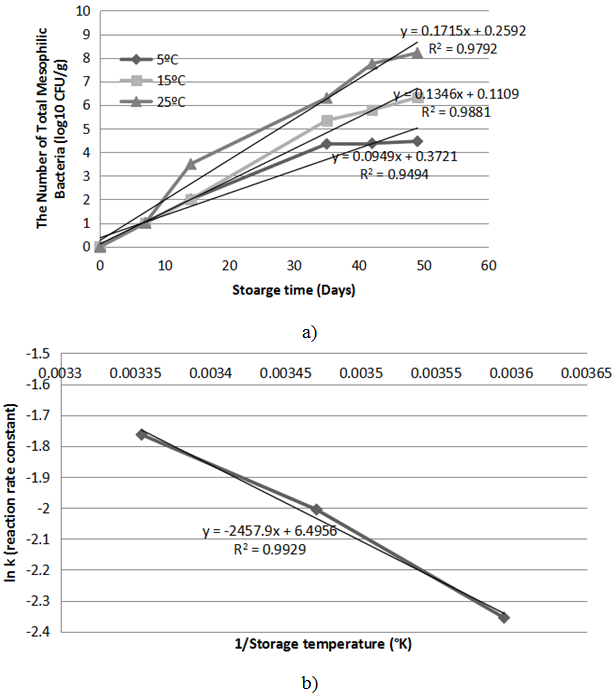
3.3. Shelf-Life StudyAccording to the microbiological analysis of cheeses stored at three different temperatures, the total number of mesophilic bacteria (TMB) at 25°C exceeded 6 logs CFU/g, which was determined as the reference for the onset of deterioration after 35 days. When the cheeses were stored at 15°C, this value reached 6.3 logs after 49 days (Table 2) (Figure 2). On the other hand, the TMB number was reported as 4.46 log at the end of the 49th day in cheeses stored at 5°C, which was determined as the lowest temperature.
In shelf life studies, zero, first, and second-degree kinetics are utilized. The decision on which one to use is made by plotting graphs against time using the raw data (zero-degree kinetics), the logarithm of the data (first-degree kinetics), or the reciprocal of the logarithmically transformed data (second-degree kinetics). The kinetic model with the highest regression coefficient (R2) is then selected from the obtained curves, and it is used in calculating the shelf life. In this study, zero-degree kinetics of the food was used to calculate the shelf life at different temperatures because the regression coefficient (R2) in zero-order kinetics was higher than the others 20.
In Figure 1, the slope values taken from the equation of the mesophilic bacteria growth curve form the growth's kinetic constant. The shelf life of cream cheese was calculated using equation (2) as 63, 44.5, and 34.9 days at 5°C, 15°C, and 25°C, respectively. It is thought that the shelf life of UHT cheeses is less than expected because the packaging could not be made aseptically as planned. At the same time, the Q10 value of the product referring a factor which the reaction rate escalates for every 10-degree elevation in temperature was calculated as 1.29 using the following equation (Equation 3, Table 2). This study showed that based on the TMB number and peroxide number of the samples, UHT technology increases the shelf-life of cream cheese by nine times at 5°C compared to the shelf-life of LT-CC.
 Equation (2)
 Equation(3)
In equation (2), where; A0: The initial number of bacteria at the first day, <1 log CFU/g), Ae: the number of bacteria at the beginning of deterioration, 6 log CFU /g) and k: kinetic constant of reaction (slope value of the graph). In equation (3), where, T1: low storage temperature, T2: high storage temperature.
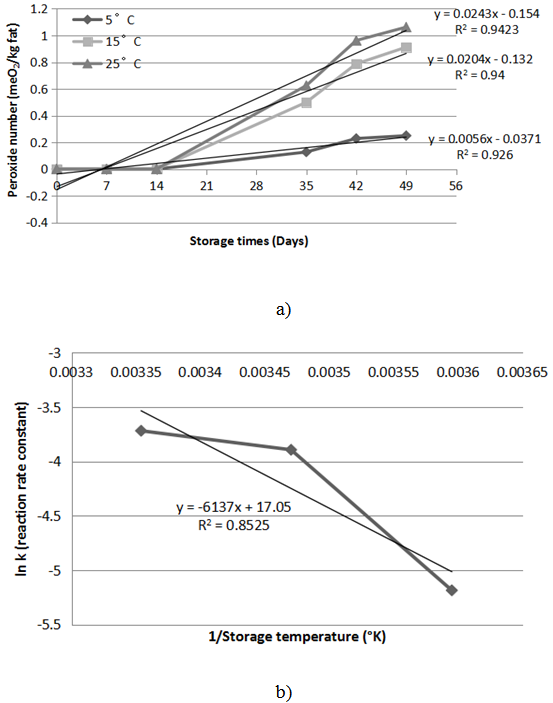
From every linear regression equation is obtained the value of quality decrease rate (slope, k). Then the ln k value is plotted with 1/T (K-1), and the intercept and slope value of the linear regression equation ln k = ln k0 - (E / R) (1 / T) was obtained.
The shelf life of cream cheese was also calculated by using the peroxide number formation rate constant, which is formed as a result of oxidation at 3 different temperatures in the cream cheese. In these calculations, the initial peroxide level in cheeses was accepted as 0 meqO2/kg fat and it was assumed that deterioration would occur when 2 meqO2/kg fat peroxide numbers was formed. According to these assumptions, the shelf life of the cheese was found to be 357 days at 5°C, 98 days at 15°C and 82 days at 25°C, by replacing the values in equation (3).


In addition, the activation energy was calculated using the graph curves showing the growth rate of mesophilic bacteria in the cream cheese and the rate of increase in peroxide number in cream cheese at 3 different storage temperatures (Figure 2, Table 3).
From every linear regression equation is obtained the value of quality decrease rate (slope, k). Then the ln k value is plotted with 1/T (K-1), and the intercept and slope value of the linear regression equation ln k = ln k0 - (E / R) (1 / T) was obtained.
Where: A0 = A value at the beginning of shelf life, Ae = A value at end of shelf life, k = kinetic constant of reaction (slope value of the graph).
Q10 (T2-T1)/10=Shelf-life (T1)/ Shelf-life (T2) pH variation of cream cheeses at different temperatures was also observed. Although the most important sign of deterioration in cheeses is the decrease in pH, the pH of these cream cheeses increased during 49 days of storage. The pH decreases with lactic acid formation by lactic acid bacteria. Since there are no live lactic acid bacteria in process cheeses such as cream cheese, the pH rises as a result of the conversion of amino acids into alkaline compounds such as amines, ammonium or indole by spoilage bacteria 21. Since the pH decrease in the calculations did not show a correlation with the increase in the storage temperature, it was not used in the shelf-life calculations of the cheese.
The shelf life of the cream cheese produced under low temperatures, with high moisture and nutrient content, varies between 2 and 3 weeks at refrigerator temperature. The profit share of such products, which have a short shelf life, is also low, preventing the manufacturer from exporting. The UHT system developed in this project aims to extend the shelf life by killing the microorganisms in the high-temperature cream cheese. The processed cream cheeses' shelf life was determined by determining the number of peroxides produced by fat oxidation and was calculated as 357 days at 5°C and 82 days at 25°C. However, while the applied high temperature did not cause a significant change in the chemical and color properties of cream cheeses compared to cheeses produced under normal temperature conditions, UHT cheeses, whose sensory properties were tested by the panelists, scored higher than other cheeses.
We would like to thank to Research Assistant Elif Sezer for the help during the study. The financial support of The Scientific and Technological Research Council of Turkey (TUBITAK), Ankara, TURKEY (Grant no: 118O999) is greatly appreciated.
Authors claim no conflict of interest.
Research data are not shared.
Ethics approval was received for this research.
A. Cagri-Mehmetoglu designed the experiments, wrote the manuscript; Özge Aslan wrote the manuscript, collected and analyzed the data; Tuğçe Ulutaşdemir collected and analyzed the data. Ilker Yildiz prepared the cheese samples. All of the authors completed and authorized the definitive manuscript.
| [1] | Pombo, A.F.W, Cream cheese: Historical, manufacturing, and physico-chemical aspects. International Dairy Journal. 117, 2021. 104948. | ||
| In article | View Article | ||
| [2] | Doruk İ. Farklı proses tekniklerinin eritme peyniri yapımında ürün kalitesi üzerine etkilerinin belirlenmesi [MSc Thesis]. Tekirdağ, Turkiye: Namık Kemal Üniversitesi, Tekirdağ; 2018. | ||
| In article | |||
| [3] | Chavan, R.S., Chavan, S.R., Khedka, C.D. and Jan, A.H, UHT milk processing and effect of plasmin activity on shelf life: A review. Comprehensive Reviews in Food Science and Food Safety, (10), 251-268, 2011. | ||
| In article | View Article | ||
| [4] | Rasane, P., Sharma, N., Fatma, S., Kaur, S., Jha, A., Kaur, D. and Singh, J, Ultra-high Temperature (UHT) Processing: Technological Significance and Updates. Current Nutritions Food and Science, (16), 1183-1195, 2020. | ||
| In article | View Article | ||
| [5] | Muir, D.D, UHT‐sterilized milk concentrate: A review of practical methods of production. International Journal of Dairy Technology, (37), 135-141, 1984. | ||
| In article | View Article | ||
| [6] | Jelen, P, Review of basic technical principles and current research in UHT processing of foods. Canadian Institute of Food Science and Technology Journal, 16, 159-166, 1983 | ||
| In article | View Article | ||
| [7] | IDF, Determination of the Total Solids Content of Cheese and, Bulletin 141. Brussels: International Dairy Federation, (IDF)1982. | ||
| In article | |||
| [8] | Kotterer, R. and Münch, S, Analysis methods for the milk science laboratory. Hildesheim, Germany: Verlag Thomas Mann. 1978. pp. 64–65. | ||
| In article | |||
| [9] | Kurt, A., Cakmakci, S. and Caglar, A, Analysis and examination methods for dairy products guidebook. Erzurum: Agricultural Faculty Publication, Ataturk University. 1993, pp. 18. | ||
| In article | |||
| [10] | IDF, Determination of the nitrogen (Kjeldahl method) and calculation of the crude protein content, IDF Standard 20B. Brussels: International Dairy Federation, (IDF) 1993. | ||
| In article | |||
| [11] | AOAC Official methods 925.10, 65.17, 974.24, 992.16. methods of analysis, association of official analytical chemists, 17th Edition, Gaithersburg, MD, USA: AOAC International, 2000. | ||
| In article | |||
| [12] | Doğan, İ. and Aydın, R, Gıdalarda hızlandırılmış raf ömrü testleri. Eskişehir Teknik Üniversitesi Bilim ve Teknoloji Dergisi-C Yaşam Bilimleri ve Biyoteknoloji 9, 109-124, 2020. | ||
| In article | View Article | ||
| [13] | Halkman, A.K, Gıda Mikrobiyolojisi Uygulamaları. Ankara: Başak Matbaacılık & Tanıtım Hizmetleri Ltd. Şti.2005. pp. 135‒237. | ||
| In article | |||
| [14] | Cabedo, L., Barrot, L.P.I. and Canelles, A.T.I, Prevalence of Listeria monocytogenes and Salmonella in ready-to-eat food in Catalonia, Spain. Journal of Food Protection, 71, 855-859, 2008. | ||
| In article | View Article PubMed | ||
| [15] | Rudan, M.A, Barbano, D.M., Gu, M.R., and Kindsted, S, Effect of the modification of fat particle size by homogenization on composition, proteolysis, functionality, and appearance of reduced fat Mozzarella cheese. Joutnal of Dairy Science, 81, 2065-2076, 1998. | ||
| In article | View Article | ||
| [16] | Turkish Food Codex Regulation–Microbiological Criteria Communiqué 2009/68. | ||
| In article | |||
| [17] | Lucey, J.A, Cultured dairy products: an overview of their gelation and texture properties. International Journal of Dairy Technology, 57, 77-84, 2004. | ||
| In article | View Article | ||
| [18] | Boiani, M., Fenelon, M., FitzGerald, R.J. and Kelly, P.M, Use of 31P NMR and FTIR to investigate key milk mineral equilibria and their interactions with micellar casein during heat treatment. International Dairy Journal, 81, 12-18, 2018. | ||
| In article | View Article | ||
| [19] | Zhong, Q. and Daubert, C.R, Kinetics of rennet casein gelation at different cooling rates. Journal Colloid Interface Science, 279, 88-94, 2004. | ||
| In article | View Article PubMed | ||
| [20] | Daughtry, B.J., Davey, K.R. and King, K.D, Temperature dependence of growth kinetics of food bacteria. Food Microbiology, 14, 21-30, 1997. | ||
| In article | View Article | ||
| [21] | Ledenbach, L.H. and Marshall, R.T, Microbiological Spoilage of Dairy Products. In: Sperber W and Doyle M (eds) Compendium of the Microbiological Spoilage of Foods and Beverages. Food Microbiology and Food Safety, Springer, New York: NY; 2009. | ||
| In article | View Article | ||
Published with license by Science and Education Publishing, Copyright © 2024 Özge Aslan, Tuğçe Ulutaşdemir, Ilker Yildiz and Arzu Çağrı-Mehmetoğlu
 This work is licensed under a Creative Commons Attribution 4.0 International License. To view a copy of this license, visit
https://creativecommons.org/licenses/by/4.0/
This work is licensed under a Creative Commons Attribution 4.0 International License. To view a copy of this license, visit
https://creativecommons.org/licenses/by/4.0/
| [1] | Pombo, A.F.W, Cream cheese: Historical, manufacturing, and physico-chemical aspects. International Dairy Journal. 117, 2021. 104948. | ||
| In article | View Article | ||
| [2] | Doruk İ. Farklı proses tekniklerinin eritme peyniri yapımında ürün kalitesi üzerine etkilerinin belirlenmesi [MSc Thesis]. Tekirdağ, Turkiye: Namık Kemal Üniversitesi, Tekirdağ; 2018. | ||
| In article | |||
| [3] | Chavan, R.S., Chavan, S.R., Khedka, C.D. and Jan, A.H, UHT milk processing and effect of plasmin activity on shelf life: A review. Comprehensive Reviews in Food Science and Food Safety, (10), 251-268, 2011. | ||
| In article | View Article | ||
| [4] | Rasane, P., Sharma, N., Fatma, S., Kaur, S., Jha, A., Kaur, D. and Singh, J, Ultra-high Temperature (UHT) Processing: Technological Significance and Updates. Current Nutritions Food and Science, (16), 1183-1195, 2020. | ||
| In article | View Article | ||
| [5] | Muir, D.D, UHT‐sterilized milk concentrate: A review of practical methods of production. International Journal of Dairy Technology, (37), 135-141, 1984. | ||
| In article | View Article | ||
| [6] | Jelen, P, Review of basic technical principles and current research in UHT processing of foods. Canadian Institute of Food Science and Technology Journal, 16, 159-166, 1983 | ||
| In article | View Article | ||
| [7] | IDF, Determination of the Total Solids Content of Cheese and, Bulletin 141. Brussels: International Dairy Federation, (IDF)1982. | ||
| In article | |||
| [8] | Kotterer, R. and Münch, S, Analysis methods for the milk science laboratory. Hildesheim, Germany: Verlag Thomas Mann. 1978. pp. 64–65. | ||
| In article | |||
| [9] | Kurt, A., Cakmakci, S. and Caglar, A, Analysis and examination methods for dairy products guidebook. Erzurum: Agricultural Faculty Publication, Ataturk University. 1993, pp. 18. | ||
| In article | |||
| [10] | IDF, Determination of the nitrogen (Kjeldahl method) and calculation of the crude protein content, IDF Standard 20B. Brussels: International Dairy Federation, (IDF) 1993. | ||
| In article | |||
| [11] | AOAC Official methods 925.10, 65.17, 974.24, 992.16. methods of analysis, association of official analytical chemists, 17th Edition, Gaithersburg, MD, USA: AOAC International, 2000. | ||
| In article | |||
| [12] | Doğan, İ. and Aydın, R, Gıdalarda hızlandırılmış raf ömrü testleri. Eskişehir Teknik Üniversitesi Bilim ve Teknoloji Dergisi-C Yaşam Bilimleri ve Biyoteknoloji 9, 109-124, 2020. | ||
| In article | View Article | ||
| [13] | Halkman, A.K, Gıda Mikrobiyolojisi Uygulamaları. Ankara: Başak Matbaacılık & Tanıtım Hizmetleri Ltd. Şti.2005. pp. 135‒237. | ||
| In article | |||
| [14] | Cabedo, L., Barrot, L.P.I. and Canelles, A.T.I, Prevalence of Listeria monocytogenes and Salmonella in ready-to-eat food in Catalonia, Spain. Journal of Food Protection, 71, 855-859, 2008. | ||
| In article | View Article PubMed | ||
| [15] | Rudan, M.A, Barbano, D.M., Gu, M.R., and Kindsted, S, Effect of the modification of fat particle size by homogenization on composition, proteolysis, functionality, and appearance of reduced fat Mozzarella cheese. Joutnal of Dairy Science, 81, 2065-2076, 1998. | ||
| In article | View Article | ||
| [16] | Turkish Food Codex Regulation–Microbiological Criteria Communiqué 2009/68. | ||
| In article | |||
| [17] | Lucey, J.A, Cultured dairy products: an overview of their gelation and texture properties. International Journal of Dairy Technology, 57, 77-84, 2004. | ||
| In article | View Article | ||
| [18] | Boiani, M., Fenelon, M., FitzGerald, R.J. and Kelly, P.M, Use of 31P NMR and FTIR to investigate key milk mineral equilibria and their interactions with micellar casein during heat treatment. International Dairy Journal, 81, 12-18, 2018. | ||
| In article | View Article | ||
| [19] | Zhong, Q. and Daubert, C.R, Kinetics of rennet casein gelation at different cooling rates. Journal Colloid Interface Science, 279, 88-94, 2004. | ||
| In article | View Article PubMed | ||
| [20] | Daughtry, B.J., Davey, K.R. and King, K.D, Temperature dependence of growth kinetics of food bacteria. Food Microbiology, 14, 21-30, 1997. | ||
| In article | View Article | ||
| [21] | Ledenbach, L.H. and Marshall, R.T, Microbiological Spoilage of Dairy Products. In: Sperber W and Doyle M (eds) Compendium of the Microbiological Spoilage of Foods and Beverages. Food Microbiology and Food Safety, Springer, New York: NY; 2009. | ||
| In article | View Article | ||