Marolo (Annona crassiflora Mart.) is one of Brazilian Savannah fruits of economic interest, because of its wide use, nutritional and functional components to be better exploited. The quality parameters and antioxidant activity of marolo fruit stored at different temperatures (0°C, 6°C, 12°C and 20 ± 1°C) were subjected to physical and chemical analyses (0, 7, 14, 21 and 28 days) at 2 exposition factors for the observation of a possible occurrence of chilling injury. The loss of fruit mass is directly proportional to its storage time. The respiratory activity increases at higher temperatures, and decreases along the storage time. Marolo can be classified as a fruit with high ethylene production. There was a significant increase in soluble solids (SS), followed by a sharp decline from the 7th day on. SS increased at higher at temperatures as well as in ripened fruit (compared to those analysed immediately after removal from cold). The content of sugar, pectin and the total antioxidant activity (AA) do not vary significantly due to storage time. Higher storage temperatures determine higher concentrations of sugars. The Pectin, acid ascorbic, total phenolics and AA observed suggest the nutritional and functional potential of this fruit. Recommended binomial time-temperature storage was 12°C for 21 days. There is no explicit indication of chilling in fruits stored under the conditions studied.
The Marolo or Araticum (Annona crassiflora Mart.), showing a peculiar identity, differentiates from the rest of the fruits because it belongs to the nourishment and the culture of the Brazilian Savanah populations. It is present in areas many times affected by monoculture, being endemic of the Brazilian Savanah, a biome with restricted distribution in areas quite affected by human activities 1. It has a vast culinary usage and natural consume, besides having nutritive and functional value that could be even more exploited.
Regarding its chemical composition, besides of showing significant levels of lipids, calories, fibres 2, high levels of phosphorus and magnesium 3 and prebiotic oligosaccharides 4, there are carotenoids 5, 6 phenolic compounds 7, high levels of linolenic acid 8. This demonstrates the food potential of this fruit 9 due to the compounds that contribute to its nutritive and functional value.
The cold storage, considered to be an efficient strategy to increase the fruits useful life, minimize the postharvest losses, by reducing the respiratory rate, delaying the maturation process and decreasing the incidence rate of illnesses 10. The fruits from tropical and subtropical origin are generally sensitive to physiological disturbs when exposed to temperatures colder than the range 7°C to 13°C 11. This phenomenon provokes qualitative and quantitative losses that can occur during the storage period or after its exposition to the environmental temperature in the commercialization process.
Anonnaceae fruits are very perishable and have a short postharvest conservation period 12. The cold storage needs to be used for the conservation of Marolo, however, the alterations that this type of conservation and postharvest management technologies of Anonacea family as a whole are still limited 13.
It is necessary to guarantee that these fruits reach the consumer in different commercialization places with their nutritional and quality characteristics preserved. Therefore, the fruits must be transported and stored in a way to minimize quantitative and qualitative losses in this process. This study was carried out with the aim of evaluating how marolo fruits behave during cold storage, evaluating different storage conditions, and verifying how the alterations to its composition can influence its stability and quality parameters in its commercialization.
Mature fruits were acquired at CEASA (Supply Centre, Uberlandia, Brazil), originally from Goiania, GO, Brazil, and transported to Federal University of Lavras (MG, Brazil). They were selected in relation to a uniform size (average 1.5 kg), to the colour of the rind (yellowish green and values of L* 43.5. a* 4.6 and b* 12.21), to a distance between the carpels of about 2 mm and to firmness (about 15 N). The fruits were washed, sanitized (sodium hypochlorite/200 mg.L-1/ pH 7.0/15 min), put on polyethylene trays with lids (14 cm of diameter) and stocked in cold chambers at a 0°C, 6°C, 12°C and 20°C ± 1°C (RU= 90± 5 %).
The first experiment was conducted in split-plot design with an additional treatment (4x5), 3 replications, 4 temperatures (0, 6. 12 and 20 ± 1°C) and 5 storage times (0,7. 14. 21. 28 days). The fruits were submitted to mass loss, respiratory rate and ethylene production. Fruits were weighted, placed in sealed glass desiccator with septum for collecting gas, and transported to the respective storage chamber. The mass loss was obtained by weighting the fruit along the storage period. The fruits were maintained, by approximately 1 hour, inside their respective chambers. Next, the respiratory rate and the ethylene production; were determined. The respiratory rate was quantified with a gas analyser O2/CO2 PBI Dansensor® (mL CO2.kg-1.h-1). For the ethylene determination, aliquots of gas were extracted from the glass recipients into vacuum tubes (10 mL). From these, samples of 1 µL were injected in a gas chromatographer (Varian Chrompack® CP-3800), equipped with a flame ionization detector. The conditions of the ionization detector are: column Porapak Q; injector temperature 250°C; detector temperature 280°C. The initial temperature of 90°C increased after 4 minutes and 30 seconds, at the rate of 100°C, each minute, up to 220°C. Nitrogen was used to clean and as arrest gas, with flux and pressure column of 20 mL min-1e 0.1 psi, respectively. The results were expressed in μL of ethylene. g-1. h-1.
The second experiment was conducted in triple factorial design, with an additional treatment (4x4x2+1), with 3 replications at the 0°C, 6°C, 12°C and 20°C ± 1°C. The day 0 (additional treatment); four storage times (7, 14, 21, 28 days) and two exposition factors. These factors were as follows: immediately after removing the fruits from the cold storage; and ripened at room temperature (20°C ± 1°C), after being removed from the cold storage, for the observation of possible occurrence of chilling injury.
In this experiment the fruits were submitted to following analyses: colour, soluble solids (SS), Tritatable acidity (TA), pH, firmness, pectin methylesterase activity (PME), total sugars, total and soluble pectin, ascorbic acid, total phenolics and antioxidant activity for the reduction of DPPH radical.
The evaluation of the colour was done in a Minolta® CR 400 colorimeter (CIE L*, a* e b*) performing 9 readings on different spots of the rind and pulp with 3 repetitions (1 fruit/repetition). The Hue angle and chromaticiticy were calculated according to McGuire 14.
The following contents were determined as follows: soluble solids (SS) by refratometry (°Brix); pH by potenciometry 15 and tritatable acidity using a NaOH 0,01N solution (% malic acid) 16.
The analysis of firmness was determined individually in the whole fruit including the rind, in the equatorial region, with the Penetrometer Magness-Taylor, with a 5/6 inches probe and the results were expressed in Newtons (N). The extraction of the enzyme pectin methylesterase (PME) was performed according to the technique of Buecher and Furmansky 17, with modifications 18. The determination of the PME activity followed the Hultin, Sun and Bulger techniques 19, with modifications 18. A unit of PME was defined as a quantity of enzyme able to catalyse the pectin demethylation corresponding to a consumption of 1 nmol of NaOH per gram of fresh pulp per minute. The total sugars were assessed by the Antrona method 20. The soluble and total pectin were extracted according to the McCready and McComb technique 21, having been determined by a spectrophotometer at 520 nm 22. The results were expressed in mg of galacturonic acid per 100 grams of pulp. The quantity of ascorbic acid was measured by the spectrophotometric method with 2.4-dinitrophenil-hydrazin 23, with the results expressed in mg.100g of pulp.
The analysis of the antioxidant activity based on the extinction of the absorption of the DPPH radical, 2.2-diphenil-1-picril hydrazil (DPPH 60 nm). Metanolic (50%) and acetanolic (70%) extracts were obtained. The methodology described by Brand Williams, Curvelier and Berset 24 was used and adapted by Rufino et. al. 25, with some adaptations in relation to the calculation. A spectrophotometer was utilized at 760 nm 26.
The data were analysed through ANOVA, followed by Tukey test and regression models at 5% nominal significance level. The statistical analysis were carried out in R version 4.1.3 27, through package ExpDes 28, and Sisvar 29.
The Marolo fruits kept at 20°C and 12°C were analysed only respectively until the 7th and the 21st days of storage, plus the necessary period for the ripening at room temperature.
The fruits kept at 20°C showed ripening within a maximum of 9 days (2 in 3 fruits), with only one fruit ripening in about 14 days. The fruits kept at 12°C, until the 14th and the 21st day of cold storage, ripened within a maximum of 7 days, at environmental temperature (20°C). The fruits stocked at 6°C tolerated 28 days (after 14 days of refrigeration they ripened in about 17 days) and, 21 days after the storage, they ripened after about 25 days. The refrigerated fruits within a maximum of 28 days ripened, average, after about 33 days. The fruits at 0°C resisted until 28 days and when exposed at environmental temperature, after 7 and 14 days of refrigeration, ripened in a maximum of 4 days, and after the refrigeration for 21 and 28 days, ripened in 7 days. Splits on the rind were observed starting from the peduncle in the majority of the treatments and this fact is normal in the natural process of this fruit ripening at environmental temperature.
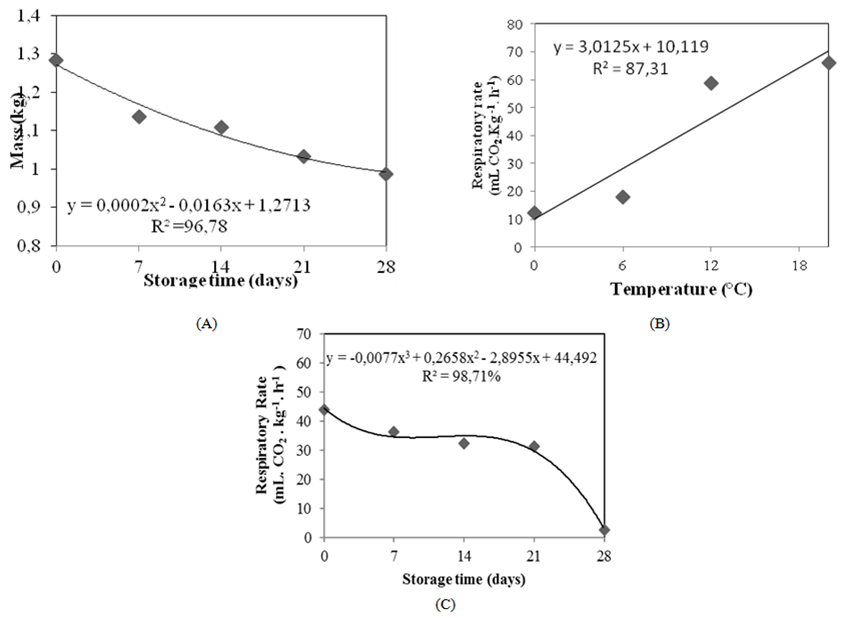
The mass loss changed along the storage time. It was observed an average loss of 300g after 28 days (23%) (Figure 1A). Losses between 3 and 6 % are enough to cause an important decrease in quality, but some fruits may be commercialized with 10% of moist loss 30. Nevertheless, Marolo, as a rustic fruit, maintained itself visually stable, despite the mass loss of 23%, although a sensory test has not been performed in order to confirm such statement.
The respiratory activity varied due to temperature and storage period (p < .05). At higher temperatures (12°C e 20°C), the CO2 production increased, and the opposite was observed at lower temperatures (0°C e 6°C) (Figure 1B). In general, products stored at high temperatures have their metabolism activated, with high respiratory activity, showing an increase of about 4.8 fold in marolo when comparing fruits stored at 0°C and 12°C (12.23 e 58.88 mL CO2.kg-1.h-1. respectively).
In Figure 1C, the decrease of the fruit respiration is observed along the period, being more intense from the 21st day of storage on. The respiratory activity of fruits reaches around 0 mL CO2.kg-1.h-1 on the 28th day, which suggests cellular death and end of their senescence. There may have been respiratory peaks in the intervals between observations, once there was an increase of respiration at higher temperatures, but these were not detected.

There was no difference between times (p = .991) and temperatures (p = .7040) in the determination of ethylene (31.45 µl ethylene.kg-1.h-1). According to Kader 31, marolo may be classified as a fruit with high ethylene production (rates range from 10 to 100 µl ethylene kg-1.h, at 20°C), such as apple, apricot, papaya and kiwi. As other anonaceae fruits, Marolo shows high rates of respiration and ethylene production, which play an important role in the postharvest management 13.
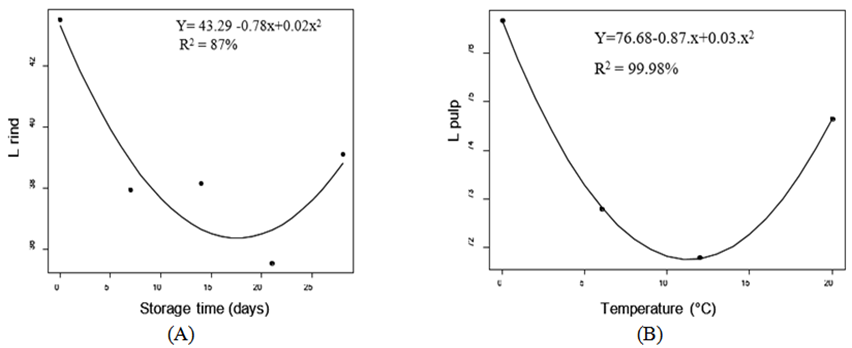
Analysing the data referring to the colour of the rind, it was observed difference (p = .016) just along the storage period for luminosity (L*), which was 5.87 units higher than the factorial mean (p = .001). The L* has shown decline through the storage period, demonstrating darkening of the rind, which is normal during ripening. According to Pareek et al. 12, Annonaceae are sensitive to chilling when submitted to low temperatures within the range between 8°C and 12°C depending on the cultivar and the ripening stage whose symptoms are hardening and darkening of the rind. However, since darkening occurs naturally in the rind of Marolo during ripening, this alteration cannot be taken into account as a probable manifestation of chilling in this fruit. Marolo consumers usually acquire it with dark rind, whose characteristic shows that it is fit for consumption, as long as the pulp contains desirable sensory characteristics such as yellow or orange colour, exotic aroma and sweet taste.

In the pulp, L* has significantly varied due to storage temperature (p = .009) and to exposition factor (p = 10-4), separately, without being influenced by the storage period, neither by any interaction between the tested factors. The mean of L* on time 0 (79.68) was 5.69 units higher than the factorial mean (Figure 2) (p = .046). The highest L* values were observed in the stored fruits at 0°C (76.69) followed by those at 20°C (74.66). The pulps, when analysed immediately after being withdrawn from the cold storage, showed lighter colour (highest L* value) than those analysed after ripening (77.87 and 70.13. respectively), however, not as light as in the beginning of the experiment. The L* values found agree with those obtained by Corrêa et al. 32 in marolo pulp (78.63±0.23). Internal browning is considered a symptom of chilling in many fruits. The observed L* data do not suggest chilling, even at the lowest temperatures.
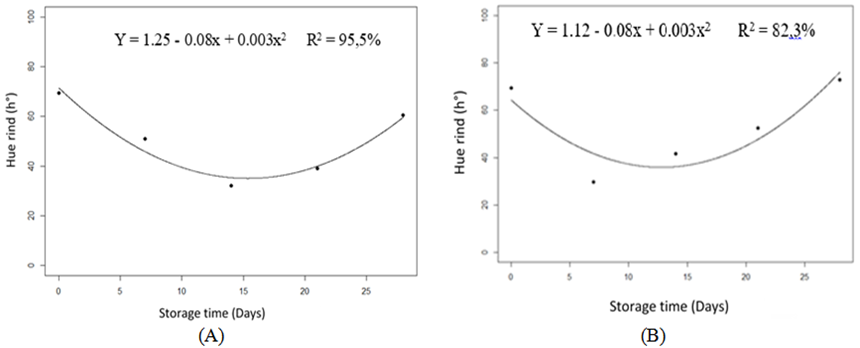
The mean hue angle (hº) of the fruits at time 0 (69.40) was 24.21 units higher than that of the factorial (45.19), which suggests the change in the colour of the rind of the fruits, with storage, from yellow-greenish to yellow-orange (p =10-3). It is noteworthy that the increase in the yellow colour of the marolo rind is accompanied by darkening, as verified by the changes in the L* value. Changes in h° of rind were also observed as a function of the interactions between exposure factor at room temperature after refrigeration and time (p = 10-4), as well as exposure factor at room temperature after refrigeration and temperature (p = .038). It can be seen that, with the exception of the 7th day, the values were lower for the fruits analysed immediately after chilling than those ripened after exposure to room temperature (Figure 3). Regarding the interaction between exposure factor and temperature, only the fruits stored at 20°C showed a significant difference in the hº angle of the skin. Fruits stored at 20°C for 7 days showed a yellowish-brown colour (50.08), compared to those analysed at the same temperature after ripening, which showed an orange-brown colour (30.54).
Changes in pulp h° were also observed as a function of interactions between exposure factor at room temperature after refrigeration and time (p = .029), as well as exposure factor at room temperature after refrigeration and temperature (p = .03). The time 0 mean was 87.89 and the factorial mean was 85.64. indicating a yellowish colour. Only at 28 days of storage there was a difference between the analyses right after removal from cold storage (93.98) and after ripening (85.25) (p = .015). Soon, the pulp of the ripened fruits tended to orange yellow.

Regarding the interaction between the exposure factor at room temperature after refrigeration and temperature, only the fruits analysed immediately after removal from cold storage exhibited a difference in pulp h° (p = .002). Fruits at 0°C and 20°C (90.2 and 89.55. respectively) were significantly different from those at 12°C (79.81), that is, they were more yellow-orange than the previous ones. The fruits stored at 6ºC did not differ from the others, with an average of 87.3. The data suggest that refrigerated storage did not prevent the development of normal fruit colour.
The chromaticity (C*) of the rind did not vary significantly (9.07±5.60), regardless of the variation factors analysed. The C* of the pulp varied as a function of the interaction between time and temperature (p = .01) and the factor of exposure to room temperature after refrigeration (p = 10-4). The mean of time 0 was 25.6±6.40. Only in the fruits kept at 0°C there was a difference (p = .03) between 21 and 28 days (24.78 and 32.92. respectively) and, at 7 and 14 days, there was no difference in relation to the others (31.62 and 29.34. respectively). The ripened fruits showed a more intense pulp colour (30.49) than those that were analysed immediately after cold storage (25.46). The intensity of the pulp colour was higher on the 28th day and in the ripened ones, suggesting chlorophyll degradation and a possible synthesis of pigments or phenolic compounds in the ripening of the fruit, even at low temperatures.
This seems to suggest that storage at low temperatures does not affect the colour development, since, when analysing the h° and C*, it is observed that there was no change in the colour that would mischaracterize the colour characteristic of the natural process of fruit ripening, at room temperature.
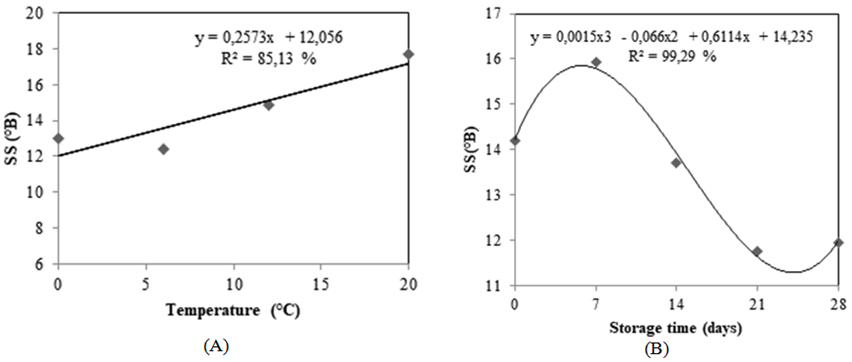
For annonaceae in general, the increase in the soluble solids (SS) content occurs with the increase in the storage period and the rate of this increase is greater at higher temperatures 12. This can be observed in the marolo fruits that showed a significant difference in relation to time, temperature and exposure factor to room temperature after refrigeration, alone for SS. In relation to time, there was a significant increase in SS until the 7th day, followed by a sudden drop from there, until the 21st day, remaining low until the 28th day (Figure 4). Studies show that, in annonaceae, in general, there are large increases in the SS content during ripening, mainly represented by soluble sugars 33. However, under prolonged storage conditions, these levels can be reduced to values lower than those observed at the time of harvest 34. It is observed that, at higher temperatures, the SS values were higher, suggesting the effect of refrigeration in the containment of sugar metabolism.
Regarding the exposure factor after cold storage, the average of the samples after ripening (14.66ºBrix) was higher than that recorded right after cold storage (12.66 ºBrix), showing the increase in SS content with ripening. The observed values are below the range of 17.6 to 24.3 ºBrix, found by Soares Júnior et al. 35, in minimally processed marolos harvested in the state of Tocantins and 20.26±1.99 ºBrix in fruits harvested in Minas Gerais 2 and 9.57 ºBrix in commercialized pulp marolo 36. The increase followed by a decrease, observed during marolo storage, suggests a positive, followed by a negative balance, respectively, in the sugar metabolism of the fruit.
Titratable acidity (TA) exhibited a significant interaction between time and temperature (p =.009) and between time and exposure factor, after removal from cold storage (p = .039). The AT at time 0 was 0.62±0.03%. There was a difference between temperatures only at 21 days of storage (p = .011), when the mean AT at 0°C was lower than at 6°C, with 12°C being equal to the others (.39%, .69% and .60%, respectively). Regarding the exposure factor to room temperature after refrigeration, at 21 and 28 days there was a significant difference between the fruits (p = .003 and p = .027. respectively), which were more acidic when ripened (0.68% and 0.71% malic acid, respectively) than when evaluated shortly after removal from the cold chamber (0.44% and 0.49% malic acid, respectively). The average of the fruits, at 20°C, was 0.47% and 0.51%, at 7 days and at the end of ripening (9 days), respectively. These values agree with those found by Damiani et al. 2 (0.5±0.1%) and next to Morais et al. 36 (.3 %).

The data suggest that fruits submitted to 6°C and 12°C, those ripened after exposure to room temperature, as well as those at the end of the storage time, are more acidic, with values slightly higher than the initial time, probably due to the synthesis of organic acids, as a function of ripening, and to the greater loss of water at the end of the storage period. The fruits at 0°C and those stored up to 21 and 28 days, analysed soon after being removed from the cold chamber, showed lower acidity, probably due to the effect of the cold, which reduces the metabolism and the conversion of organic acids, maintaining the acidity of the fruit. Mosca et al. 30 report that, in annonaceae, there seems to be a clear trend with respect to increasing TA in relation to maturation.
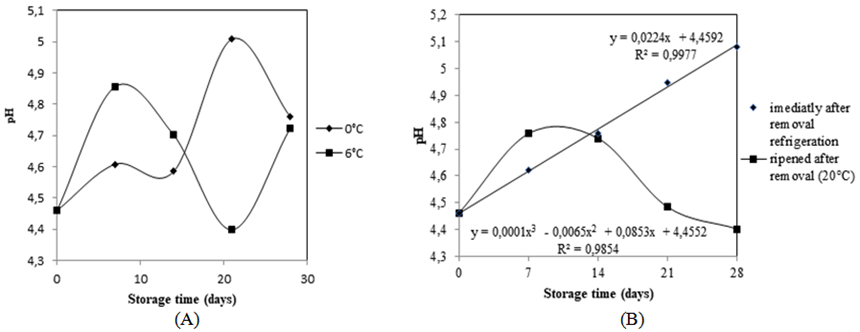
Analysing the pH variable, it was observed that the interaction between time and temperature and between time and exposure factor to room temperature after refrigeration was significant (p = .001 and p = .0001. respectively). The mean at time 0 was 4.46±0.02. Only at 21 days of storage there was a difference in pH between temperatures (p = .0006), with the highest average being presented at 0°C (5.00) and this differed by 6°C (4.39). The average pH of the fruits stored at 12°C (4.73) did not differ from the others, showing to be intermediate. These results are consistent with those observed for AT. Checking the time variable within each level of exposure factor to room temperature after refrigeration, an increase in pH in the fruits was observed during storage, soon after they were removed from refrigeration (p = .002), the opposite occurring in ripened fruits after exposure to room temperature (p = .01) (Figure 5). In the fruits analysed immediately after cold, the pH shows an increase over time, probably due to the intensification of the mobilization of organic acids, which coincides with the lower acidity in these same fruits.

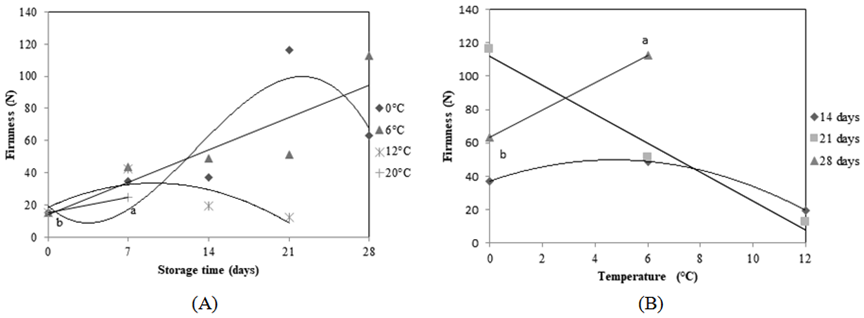
In relation to the pulp firmness, there was a significant interaction between the time, the temperature and the exposition factor after the refrigerated storage (p = 10-4). The firmness measured at the time 0 was 20.06 N, smaller than the average of all of the combinations of temperature, time and exposition factor (p = .0032). This difference in the firmness is, then, much better visualized when the time unfolding is analysed in the temperature and in the exposition factor toward the room temperature after the refrigeration. Thus, it can be verified that it is present in a significant way only in the moment immediately after the removal of the exposition at the temperatures of 0, 6 and 12°C (p = .05).
In the Figure 6A, the evolution of the fruits firmness is showed at different temperatures, when it is immediately evaluated after the removal of the temperature exposition. When stocked at 0°C, an increase of the deformation force was observed throughout the days, with a drop in about 21 days. During the storage at 6°C a linear behaviour was observed, being the firmness bigger throughout the days of the evaluation. At 12°C, the averages were quite smaller in relation to the others, showing a behaviour of diminution of the deformation force until the end of the storage. These results demonstrated that, at the temperatures of 0°C and 6°C, a hardening of the fruit happens and that can be associated to some disorders due to the cold temperatures, promoting a hardening of the pulp.
Analysing the temperature unfolding within each time level and within the factor of exposition to the environmental temperature, a significant difference was observed around the storage days 14. 21 and 28 for the fruits analysed immediately after the removal of the storage (p = .05). After 14 days of storage, the firmness showed averages slightly bigger at 6°C (48.84N) than at 0°C (36.9N). After 21 days, the biggest average was observed in the fruits at 0°C (115.4 N) and at 6°C (51.23 N), being softer than at 0°C. In both periods (14 and 21 days), the fruits at 12° C were even softer (respectively 19.44 and 12.21 N). After 28 days, there was a significant difference in the firmness averages between the temperatures of 0°C (63.35 N) and 6°C (112.46 N), being so the biggest (Figure 6B).

Table 1 shows the unfolding of the exposition factor within each time and each temperature for the firmness. There was a significant difference between the fruits at the moment immediately after the removal of the storage. The ripeness differ after this storage, in the majority of the analysed days (p = .05). There was no significant difference after 7 days of storage for the fruits at 20°C (p = .1652), after 14 days for fruits kept at 6°C and 12°C (respectively, p = .06 and p = .663), and after 21 days for those kept at 12°C (p = .6708). At 12°C, it was verified that there is a tendency of the firmness to get closer, denoting so the fact that this temperature promotes a bigger softening of the fruits, already at the 14th day of storage.
Major of the ripe fruits showed smaller averages after their removal from the cold storage and this thing directs us to a supposition of the effect of the cold as responsible of the hardening of the fruits. However, this is inverted for the firmness values equal to the fruits of the time 0 ones (in absolute terms) and this thing shows the effect of the firmness maintenance of the fruit until the end of the storage.
Therefore, a fruit softening can be observed independently from the temperature in which it was maintained under refrigeration. However, the difference between the fruits immediately after been retired from the cold and the ripe ones becomes more evident in those ones kept at the temperature of 0°C and 6°C and with the storage time elapsing mainly starting from the day 21 showing the influence of the cold in the fruit hardening, which is diluted with the fruits exposition at an environmental temperature that allows its hardening. Silva et al. 37 found firmness values of the Marolo pulp collected at 140 and 145 days after and before (2 and 0.75) and Damiani et al. 2, 0,29 N. These values are much smaller than the ones observed in this study. Probably, it occurs a hardening after the cold; however, the fruits matured at a temperature of 20°C present averages similar to those of the matured fruits, which were stocked at colder temperatures. Being so, this difference can be related to the differences among the cultivation regions, as to the stadium of the analysed fruits ripeness that can be influencing the firmness.
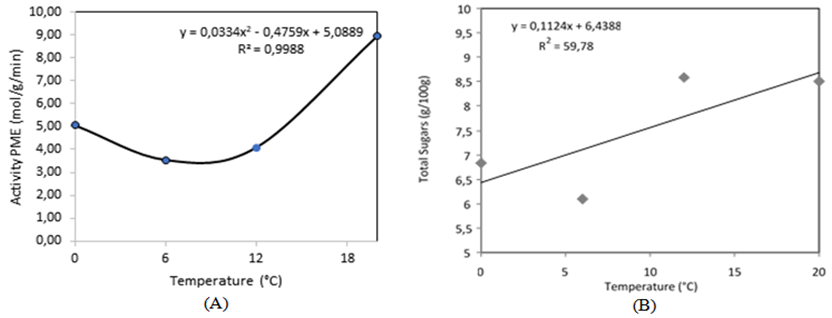
The activity of the enzyme pectin methylestherase (PME) varied in relation to the temperature (p = .032) and to the interaction between the storage time and the exposition factor after the refrigeration (p = .01) (Figure 7A). In the Table 2. The average values of the PME activity were shown and at the time 0 one was 3.73 Ŋmol.g.-1 min-1. It can be observed that the storage at 20°C promotes an elevation of its activity (8.95 Ŋmol.g.-1 min.-1) which stands out from other temperatures studied. The fruits kept at 0°C presented intermediate PME activity values and showed a slightly higher one than in the fruits at 6°C and at 12°C. It can be verified that this enzyme can have its activity altered because it can diminish, keep been constant or increase during the ripeness, depending on the species and on the extraction method for the analysis 38.
Only at the day 7 there was a difference between the averages of the PME activities of the analysed fruits immediately after the retirement of the cold and the ripened fruits, being the first ones (p =10) significantly bigger (respectively 11.97 and 4.0625 Ŋmol.g.-1 min.-1). Despite the interaction between the time, the temperature and the exposition factor (p = .733) wasn’t significant, it can be noted that the average of the ripened fruits at 0°C reached a PME value bigger than the higher temperatures (16.25 Ŋmol.g.-1 min.-1) at the day 7 being able to indicate a bigger production of this enzyme due to the cold.
However, these values decrease and reach the same level than the others, starting from the day 21 until the end of the storage. It is likely that there is a PME action in the beginning of the storage, however, it can be suggested that during the storage process there could be a more remarkable action by other enzymes also involved in the depolymerisation and in the solubilisation of the cellular wall compounds such as pectinases, hemicelulases and celulases. Being so, the PME can contribute directly or indirectly to the action of these other enzymes and thus creates an adequate ionic environment or possibly modifies the cellular wall porosity and allows the access of these ones to their potential substrates 39.
It was verified that there was not any significant difference between the levels of the total and soluble pectin within the analysed fruits (respectively, 1.055.83 and 364.90 mg.100g-1). The total Marolo pectins can contribute with the inclusion of soluble fibers in the diet proportioning the reduction of the gastrointestinal transit time and the intestinal absorption of the cholesterol. The Brazilian Cardiology Society recommend for treatment for dyslipidaemias that the fibers should be in the diet (for adults 25 g of total alimentary fibers are recommended, being 6 g per day of them soluble ones 40. Thus, 100 g of this fruit contribute with at least 6% of the percentage of the recommended soluble fiber and it is suggested that the Marolos softening should not be associated with the pectins metabolism.
The total sugars level in the fruits did not vary significantly during the storage time (p = .073). The average at the time 0 for the total sugars was 6.82 mg.100 g-1 of pulp. Damiani et al. 2 and Dragano et al. 5 matched higher values (respectively 12.38 and 14.77 g. 100g-1). There was a difference within the sugars levels at different temperatures (p = .030), being bigger at the higher temperatures (8.5 and 8.59 g. 100 g-1 at a temperature of 20°C and 12°C respectively) (Figure 7B). Silva et al. 37 demonstrated that the Marolo starch level increases about after 80 days after the blooming, having a peak around the day 120 (17.5 g of starch. 100g-1) and, starting from there, there is a sudden drop arriving at 145 days after the blooming with 2.5 g of starch.100g-1 of fruits in Marolos. There was also a concurring increase of the total soluble sugars level and the solid soluble ones starting from around 120 days after the blooming at the same point when a reduction of the starch level was observed. This fact suggests that within the refrigerated fruits at higher temperatures this process may be still happening. Thus, the conversion of the starch into sugars and organic acids happens, probably developing the sweetish flavour in a bigger intensity at the temperature of 12°C and 20°C comparing those ones at 6°C and 0°C.

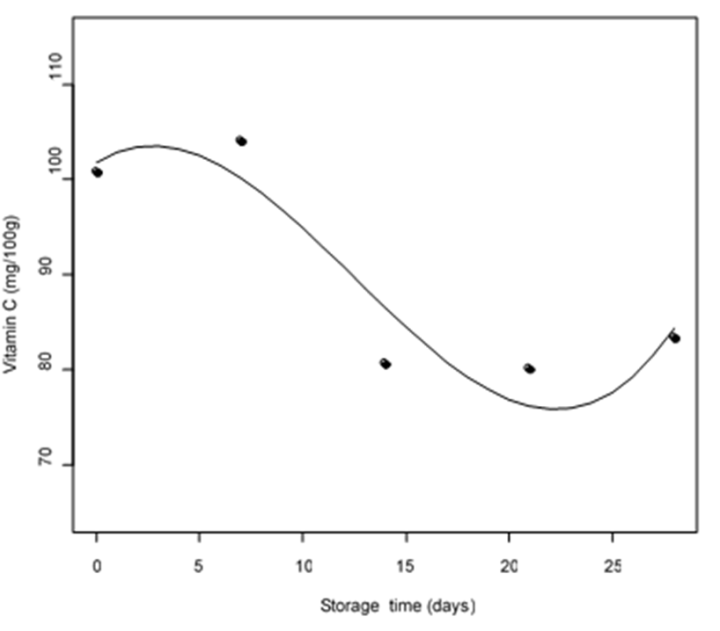
The Vitamin C level in the fruits at the time 0 was 100.8 mg. 100 g-1. Dragano et al. 5 matched lower levels in the Marolo frozen pulp (44.97 mg. 100g-1). In relation to the other fruits it showed a level similar to the raw pequi (91.89 mg. 100 g-1) 41 and lower than the guava (168.52 mg. 100 g-1) 42 and higher than orange (62.5 mg. 100 ml-1) 43. Regarding its levels during the ripeness, Vilas-Boas and Silva 44 matched the maximum value of 42 mg. 100 g-1 of Marolo fresh pulp in the pre-ripeness phase and it was observed a degradation in the ripeness (140 days) and the ripe fruits showed a value of approximately 37mg. 100 g-1. The vitamin C level varied significantly during the storage (p < .05) although the temperature did not influence it. It can be observed a fall in its levels from the 7th day to the 14th day with a tendency of stabilization starting from that moment (80mg. 100 g -1) (Figure 8).

Azzolini, Jacomino and Bron 45 while analysing red guavas during their storage verified that it initially an increase of the ascorbic acid level in all the ripeness phases happened with a posterior decrease. According to Mercado-Silva, Batista and Garcia-Velasco 46 the increase of the ascorbic acid level in guavas during the beginning of the ripeness is to be associated with the increase of the metabolic intermediary synthesis such as galactose, precursor of the ascorbic acid. The evolution of the ripeness and the storage favour the oxidation of acids that leads to a reduction of the ascorbic acid level and this can explain the fruits behaviour during the time. The fruits which have been just retired from the cold chamber showed Vitamin C levels higher (96.90 mg. 100g-1) than the ones ripened at an environmental temperature (80,71 mg.100 g-1) after the refrigerated storage (p < 0,05) and this is possibly due to the ascorbic acid oxidation during the ripeness and also to the stress. During the storage, the Vitamin C acts as an antioxidant initially having been produced in response to the oxidative reactions and it is suggested that its diminution might be associated with the ripeness and for a reason it can be considered as an indicator of loss of quality in the fruits. Its presence indicates that the other nutrients probably are still conserved. Therefore, the loss of a 20% of its content starting from 7 days after the storage independently from the temperature and the ripeness is considered a significant loss, however, already expected, due to its susceptibility.
However, even with this diminution, the results demonstrated that in approximately 100 g of pulp it is possible to supply an 88% of the recommended daily amount of Vitamin C for the adults or elderly people (90 mg) and to supply the total amount for the adult women (75 mg). There are evidences that the Vitamin C can play an important role in the reduction of cancer and that can have an association with the mortality reduction for cardiovascular illnesses 47.
There was a significant interaction between the time and the temperature in the level of the total phenolics. There was a decrease in the level of phenolic compounds and the average of the factorial was 875.38 mg GAE. 100 g-1 that is to say 121.09 units lower than the average of the time 0 (996.474 mg GAE. 100 g-1). In realizing the time, unfolding in each temperature level no significant difference was verified during the storage time for each one of the temperatures. However, in analysing the temperature unfolding in each time level it can be observed that only at the 28th day of storage there was a significant difference. The phenolic compounds level at 0°C was smaller than the one of the fruits at 6°C (respectively 700.14 and 1.038 mg.GAE.100 g-1). Probably in the storage at 0°C there an oxidation of the pre-existing compounds occurred. The alteration in the phenolic level only occur at the end of the storage (28th day), when there were only the fruits kept at 0°C and 6°C.
There was not a significant difference between the fruits ripened after having been retired from the refrigeration and the ones analysed immediately after the refrigeration (respectively 813.77 and 936.99 mg GAE.100 g-1). Different temperatures probably promoted the oxidation of the pre-existing compounds and at the same time the synthesis, keeping the balance in their quantity. The results of the level of phenolics observed in this work are coherent with the Souza et al. 48 ones, that consider the Marolo pulp as an excellent phenolic source, presenting values 739.37 mg GAE.100 g-1 of fresh mass, being higher than other fruits such as murici (334.37 mg GAE.100 g-1), soursop (281.00 GAE.100 g-1) and passion fruit (245.36 mg GAE.100 g-1). However, the results observed here are higher than the Morais et al 36 (221.61 mg GAE.100 g-1) in marolo pulp) and Damiani et al. 2 ones (respectively 211.11 mg GAE.100 g-1 and 260.5 mg GAE.100 g-1 of phenolic compounds in the ethanolic and aqueous extract).
Evaluating the fruits antioxidant activity during the storage by the sequestration percentage of the DPPH radical it can be verified that the bigger is the sequestration percentage, the bigger is its antioxidant capacity. There was not any difference between the treatments as far as the general average of the radical DPPH sequester was 51.12%. It can be observed that the fruit has a good potential of antioxidant activity and possibly is associated with high levels of phenolic compounds and Vitamin C.
Silva et al. 37 reported a considerable DPPH radical sequester percentage in Marolo fruits, being this associated with the high content of phenolic, that are related to the synthesis of ascorbic acid and beta-carotene during fruit development. Roesler 49 reports that the phenolic compounds show a better correlation with the DPPH than the Vitamin C, presenting a better activity.
The presence of these compounds with bioactive properties justifies the Marolo consumption contributing with the diet functionality. Actually, the interest for the study of phenolic compounds has increased a lot due mainly to the antioxidant ability of these substances to sequester free radicals, which are harmful for the human health 50. In addition, it still has carotenoids and vitamin C that together with the phenolic compounds has these antioxidant potential and pectins, which has action on dyslipidaemia and intestinal motility, making up the excellent functional and nutritional potential of this fruit.
The loss of fruit mass is directly proportional to its storage time. The respiratory activity of marolo is higher the higher the storage temperature and lower the longer the storage time. Marolo can be classified as a fruit with high ethylene production and the recommended time/temperature for storage was 12°C/21 days being small the variation in relation at 0 and 6°C. The level of sugars, pectins and total antioxidant activity do not vary significantly in relation to the storage time and higher storage temperatures determined high sugars concentrations. The pectins, Vitamin C and phenolics compounds concentrations as well as the antioxidant activity observed suggest the nutritional and functional potential of this fruit.
UFLA, UNIFAL-MG. and CNPq funding agency (304413/2016-0; 302699/2019-8); FAPEMIG (PPM-00458-15; PPM-00355-17) and CAPES (88881.068456/2014-01).
| [1] | REZENDE, M.L.; CANDIDO, P.A.; MALAFAIA, G.C. Sistemas agroalimentares localizados: uma abordagem para o marolo na região de Alfenas, Minas Gerais. Scientia Plena, Aracajú, v.8. n.8. p.1-7. 2012. | ||
| In article | |||
| [2] | DAMIANI, C.; VILAS BOAS, E.V.B.; ASQUIERI, E.R.; LAGE, M.E.; OLIVEIRA, R. A.; SILVA, F. A.; PINTO, D. M.; RODRIGUES, L.J.; Silva, E.P.; PAULA, N.R. Characterization of fruits from the savanna: Araça and Marolo. Ciência e Tecnologia de Alimentos, Campinas, 31(3): 723-729. jul.-set. 2011. | ||
| In article | View Article | ||
| [3] | SILVA, E. P. da et al. Characterization of chemical and mineral composition of marolo (Annona crassiflora Mart) during physiological development. Food Science and Technology (Campinas) [online]. 2017, v. 37, n. 1 [Accessed 25 March 2022], pp. 13-18. | ||
| In article | View Article | ||
| [4] | ARRUDA, H.S.; PEREIRA, G.A.; PASTORE, G.M. Oligosaccharide profile in Brazilian Cerrado fruit araticum (Annona crassiflora Mart.) .LWT - Food Science and Technology, v. 76, p. 278-283, 2017. | ||
| In article | View Article | ||
| [5] | DRAGANO, N. R. V.; VENANCIO, V. P.; PAULA, F. B. A.; DELLA LUCIA, F.; DRAGANO, N. R. V. et al. Influence of Marolo (Annona crassiflora Mart.) Pulp Intake on the Modulation of Mutagenic/Antimutagenic Processes and Its Action on Oxidative Stress In Vivo. Plant Foods for Human Nutrition, n.65. v. 4. 319-325. 2010. | ||
| In article | View Article PubMed | ||
| [6] | DUARTE, E. L.; CARLOS, L. A.; GONÇALVES, C. R.; DE ANDRADE, R. M.; DE OLIVEIRA, K. G. Influência da liofilização sobre os carotenoides de frutos do cerrado e comportamento higróscopico dos pós-liofilizados. Biológicas & Saúde, v. 7, n. 23, 23 mar. 2017. | ||
| In article | View Article | ||
| [7] | ARRUDA, H. S., PEREIRA, G. A. ; MORAIS, D R., EBERLIN, M. N., PASTORE, G. M. Determination of free, esterified, glycosylated and insoluble-bound phenolics composition in the edible part of araticum fruit (Annona crassiflora Mart.) and its by-products by HPLC-ESI-MS/MS. Food Chemistry, v. 245, p. 738-749, 2018. | ||
| In article | View Article PubMed | ||
| [8] | LOPES, R. M., SILVA, J. P, VIEIRA, R.F., SILVA, D.B., GOMES, I.S., AGOSTINI-COSTA, T.S. Composição de ácidos graxos em polpa de frutas nativas do cerrado. Revista Brasileira de Fruticultura, Jaboticabal - SP, v. 34. n. 2. p. 635-640, June 2012. | ||
| In article | View Article | ||
| [9] | CAVALCANTE T R M, NAVES R V, FRANCESCHINELLI E V, SILVA R P da. Polinização e formação de frutos em araticum. Bragantia [Internet]. 2009; 68(1): 13-21. | ||
| In article | View Article | ||
| [10] | CORTEZ, L. A. B. et al. Resfriamento de frutos e hortaliças. Brasília: EMBRAPA Hortaliças, 2002. 428 p. | ||
| In article | |||
| [11] | WANG, B. et al. Reduced chilling injury in mango fruit by 2.4-dichlorophenoxyacetic acid and the antioxidant response. Postharvest Biology and Technology, Amsterdam, v. 48. n. 2. p. 172-181. 2008. | ||
| In article | View Article | ||
| [12] | PAREEK, S., YAHIA, E. M, PAREEK, O.P. , KAUSHIK, R. A. Postharvest physiology and technology of Annona fruits. Food Research International v.44. n. 7. 1741-1751. 2011. | ||
| In article | View Article | ||
| [13] | HERNÁNDEZ FUENTES, L. M et. al.. Current Situation and Perspectives of Fruit Annonaceae in Mexico: Biological and Agronomic Importance and Bioactive Properties. Plants (Basel, Switzerland), 1(1), 7, 2021. | ||
| In article | View Article PubMed | ||
| [14] | McGUIRE, R. G. Reporting of objective colour measurements HortScience, Alexandria, v.27. n.12. p. 1254-1255. 1992. | ||
| In article | View Article | ||
| [15] | AOAC - ASSOCIATION OF OFFICIAL ANALYTICAL CHEMISTS. Official Method of Analysis. 21 ed. Washington, DC, USA, 2019. | ||
| In article | |||
| [16] | INSTITUTO ADOLFO LUTZ. Métodos físico-químicos para análise de alimentos. São Paulo: Instituto Adolfo Lutz, 2008. 1020 p. | ||
| In article | |||
| [17] | BUECHER, R. W.; FURMANSKI, R. J. Role of pectinasterase and polygalacturonase in the formation of woolliness um peaches. Journal of Food Science, Chicago, v. 43. n. 1. p. 264-266. Jan/Feb, 1978. | ||
| In article | View Article | ||
| [18] | VILAS-BOAS, E. V. B.; CHITARRA, A. B.; CHITARRA, M. I. F. Modificações pós-colheita de banana Prata gama irradiada. Pesquisa Agropecuária Brasileira, Brasília, v. 31. n. 9. p. 559-697. set. 1996. | ||
| In article | |||
| [19] | HULTIN, H. O.; SUN, B.; BULGER, J. Pectinmethylesterase of the banana: purification and properties. Journal of Food Science, Chicago, v. 31. n. 3. p. 320-327. May/June 1966. | ||
| In article | View Article | ||
| [20] | DISCHE, Z. General color reactions. In: Whistler, R. L.; Wolfram, M. L. (Ed.).Carbohydrate chemistry. New York: Academic, 1962. p. 477-512. | ||
| In article | |||
| [21] | MCCREADY, P. M.; MCCOMB, E. A. Extraction and determination of total pectic material. Analytical Chemistry, New York, v. 24. n. 12. p. 1586-1588. 1952. | ||
| In article | View Article | ||
| [22] | BLUMENKRANTZ, N.; ASBOE-HANSEN, G. New method of quantitative determination of uronic acids. Analytical Biochemistry, New York, v. 54. p. 484-489. 1973. | ||
| In article | View Article PubMed | ||
| [23] | STROHECKER, R. L.; HENNING, H. M. Análisis de vitaminas: métodos comprobados. Madri: Paz Montalvo, 1967. 428 p. | ||
| In article | |||
| [24] | BRAND-WILLIAMS, W.; CUVELIER, M. E.; BERSET, C. Use of a free radical method to evaluate antioxidant activity. Food Science and Technology, Trivandrum, v. 28. n. 1. p. 25-30, Jan. 1995. | ||
| In article | View Article | ||
| [25] | RUFINO, M. S. do M. et al. Metodologia científica: determinação da atividade antioxidante total em frutas pela captura do radical livre DPPH. Fortaleza: EMBRAPA, 2007. 4 p. | ||
| In article | |||
| [26] | WATERHOUSE, A. L. Polyphenolics: determination of total phenolics. In: WROLSTAD, R. E. (Ed.). Current protocols in food analytical chemistry. New York: J. Wiley, 2002. p. l1.1.1-l1.1.8. | ||
| In article | |||
| [27] | R CORE TEAM. R: A language and environment for statistical computing. R Foundation for Statistical Computing, Vienna, Austria. 2022. | ||
| In article | |||
| [28] | FERREIRA, E. B.; CAVALCANTI, P. P.; NOGUEIRA, D. A. ExpDes: an R package for ANOVA and experimental designs. Applied Mathematics, v.5. n.19. 2952. 2014. | ||
| In article | View Article | ||
| [29] | FERREIRA, D. F. Sisvar: a computer statistical analysis system. Ciência e Agrotecnologia (UFLA), v. 35. n.6. p. 1039-1042. 2011. | ||
| In article | View Article | ||
| [30] | MOSCA, J. L., CAVALCANTE, C.E.B.; DANTAS, T. M. Características botânicas das principais anonáceas e aspectos fisiológicos de maturação. Fortaleza: Embrapa Agroindústria Tropical (Document #106). 2006. 28 p. | ||
| In article | |||
| [31] | KADER, A.A. (editor). Postharvest technology of horticultural crops. Third edition. University of California, Agriculture and Natural Resources, Publication 3311. 535p, 2002. | ||
| In article | |||
| [32] | CORRÊA, S.C.; CLERICI, M.T.P.S.; GARCIA, J.S.; FERREIRA, E.B.; EBERLIN, M.N.; L. AZEVEDO. Evaluation of dehydrated marolo (Annona crassiflora) flour and carpels by freeze-drying and convective hot-air drying. Food Research International, v. 44. n. 7. 2385-2390, 2011. | ||
| In article | View Article | ||
| [33] | LIMA, M.A.C., MOSCA, J.L.; TRINDADE, D.C.G. Atraso no amadurecimento de atemóia cv. African Pride após tratamento pós-colheita com 1-metilciclopropeno. Ciência e Tecnologia de Alimentos, 30:599-604.2010. | ||
| In article | View Article | ||
| [34] | YAMASHITA, F.; MIGLIORANZA, L.H.S.; MIRANDA, L.A.; SOUZA, C.M.A. Effects of packaging and temperature on postharvest of atemoya. Revista Brasileira de Fruticultura, Jaboticabal, 24 (3)658-660, Dec 2002. | ||
| In article | View Article | ||
| [35] | SOARES JÚNIOR, M.S.; CALIARI, M.; VERA, R.; MELO, C.S. Filmes plásticos e ácido ascórbico na qualidade de araticum minimamente processado. Ciência Rural, v.37. n.6. p.1779-1785. Nov/Dec, 2007. | ||
| In article | View Article | ||
| [36] | MORAIS, E.C. et al. Compostos bioativos e características físico-químicas de polpa de araticum in natura e pasteurizada. Braz. J. Food Technol., Campinas, v. 20, 2017. | ||
| In article | View Article | ||
| [37] | SILVA, E.P DA, VILAS BOAS, E V DE B, XISTO, A L P R. Characterization and development of marolo (Annona crassiflora, Mart.). Food Sci Technol [Internet]. 2013Oct; 33(4): 666-75. | ||
| In article | View Article | ||
| [38] | LIMA, M.A.C.; ALVES, R.E.; FILGUEIRAS, H.A.C. Mudanças relacionadas ao amaciamento da graviola durante a maturação pós-colheita. Pesquisa Agropecuária Brasileira, Brasília, v. 41. n. 12. p. 1707-1713. dez. 2006. | ||
| In article | View Article | ||
| [39] | FONTES, R.V.et al. Atividade da pectinametilesterase e sua relação com a perda de firmeza da polpa de mamão cv. sunrise solo e tainung. Revista Brasileira de Fruticultura, Jaboticabal, v. 30, n. 1. p. 54-58. mar. 2008. | ||
| In article | View Article | ||
| [40] | FALUDI, André Arpad et al. Atualização da Diretriz Brasileira de Dislipidemias e Prevenção da Aterosclerose - 2017. Arquivos Brasileiros de Cardiologia [online]. 2017. v. 109. n. 2 Supl. 1 Access on: 21 March 2022. pp. 1-76. | ||
| In article | |||
| [41] | GONÇALVES, G. A. S. et al. Qualidade dos frutos do pequizeiro submetidos a diferentes tempos de cozimento. Ciência e Agrotecnologia, Lavras, v.35. n.2. p. 377-385. Mar/Apr, 2011. | ||
| In article | View Article | ||
| [42] | VILA, M.T.R. et al. Caracterização química e bioquímica de goiabas armazenadas sob refrigeração e atmosfera modificada. Ciência e Agrotecnologia, Lavras, v.31. n.5. p.1435-1442. Set/Oct, 2007. | ||
| In article | View Article | ||
| [43] | COUTO, M.; CANNIATTI-BRAZACA, S. G. Quantificação de vitamina C e capacidade antioxidante de variedades cítricas. Ciência e Tecnologia de Alimentos, Campinas, v. 30, n. 1. p. 15-19. maio 2010. Suplemento. | ||
| In article | View Article | ||
| [44] | VILAS-BOAS, E. V. B.; SILVA, E. P. Maturação controlada de marolo: um caso a ser estudado. In: Simpósio Sulmineiro do Marolo e Frutas do Cerrado, 1, 2009. Alfenas. Anais... Alfenas: UNIFAL, 2009. 1 CD-ROM. | ||
| In article | |||
| [45] | AZZOLINI, M.; JACOMINO, A. P.; BRON, I. U. Índices para avaliar qualidade pós-colheita de goiabas em diferentes estádios de maturação. Pesquisa Agropecuária Brasileira, Brasília, v.39. n.2. p.139-145. fev. 2004. | ||
| In article | View Article | ||
| [46] | MERCADO-SILVA, E.; BATISTA, P.B.; GARCIA-VELASCO, M.A. Fruit development, harvest index ripening changes of guavas produced in central Mexico. Postharvest Biology and Technology, Amsterdam, v.13. n. 2. p.143-150, Apr. 1998. | ||
| In article | View Article | ||
| [47] | COZZOLINO, S. M. F. Biodisponibilidade de nutrientes. 6ª. Edição. Barueri: Manole, 2021. 960p. | ||
| In article | |||
| [48] | SOUZA, V. R. de et al. Determination of bioactive compounds, antioxidant activity and chemical composition of Cerrado Brazilian fruits. Food Chemistry, London, v. 134. n. 1. p. 381-386. Sept. 2012. | ||
| In article | View Article | ||
| [49] | ROESLER, R. et al. Atividade antioxidante de frutas do cerrado. Ciência e Tecnologia de Alimentos, Campinas, v. 27. n. 1. p. 53-60, 2007. | ||
| In article | View Article | ||
| [50] | DORMAN, H. J. D. et al. Antioxidant properties and composition of aqueous extracts from Mentha species, Hybrids, Varieties, and Cultivars. Journal of Agricultural and Food Chemistry, Washington, v. 51. n. 16. p. 4563-4569. 2003. | ||
| In article | View Article PubMed | ||
Published with license by Science and Education Publishing, Copyright © 2023 Flavia Della Lucia, Heloísa Helena de Siqueira Elias, Edson Pablo da Silva, Andrea Luiza Ramos Pereira Xisto, André Feres Lopes Cardoso, Juliana Pinto de Lima, Eric Batista Ferreira and Eduardo Valério de Barros Vilas Boas
 This work is licensed under a Creative Commons Attribution 4.0 International License. To view a copy of this license, visit
http://creativecommons.org/licenses/by/4.0/
This work is licensed under a Creative Commons Attribution 4.0 International License. To view a copy of this license, visit
http://creativecommons.org/licenses/by/4.0/
| [1] | REZENDE, M.L.; CANDIDO, P.A.; MALAFAIA, G.C. Sistemas agroalimentares localizados: uma abordagem para o marolo na região de Alfenas, Minas Gerais. Scientia Plena, Aracajú, v.8. n.8. p.1-7. 2012. | ||
| In article | |||
| [2] | DAMIANI, C.; VILAS BOAS, E.V.B.; ASQUIERI, E.R.; LAGE, M.E.; OLIVEIRA, R. A.; SILVA, F. A.; PINTO, D. M.; RODRIGUES, L.J.; Silva, E.P.; PAULA, N.R. Characterization of fruits from the savanna: Araça and Marolo. Ciência e Tecnologia de Alimentos, Campinas, 31(3): 723-729. jul.-set. 2011. | ||
| In article | View Article | ||
| [3] | SILVA, E. P. da et al. Characterization of chemical and mineral composition of marolo (Annona crassiflora Mart) during physiological development. Food Science and Technology (Campinas) [online]. 2017, v. 37, n. 1 [Accessed 25 March 2022], pp. 13-18. | ||
| In article | View Article | ||
| [4] | ARRUDA, H.S.; PEREIRA, G.A.; PASTORE, G.M. Oligosaccharide profile in Brazilian Cerrado fruit araticum (Annona crassiflora Mart.) .LWT - Food Science and Technology, v. 76, p. 278-283, 2017. | ||
| In article | View Article | ||
| [5] | DRAGANO, N. R. V.; VENANCIO, V. P.; PAULA, F. B. A.; DELLA LUCIA, F.; DRAGANO, N. R. V. et al. Influence of Marolo (Annona crassiflora Mart.) Pulp Intake on the Modulation of Mutagenic/Antimutagenic Processes and Its Action on Oxidative Stress In Vivo. Plant Foods for Human Nutrition, n.65. v. 4. 319-325. 2010. | ||
| In article | View Article PubMed | ||
| [6] | DUARTE, E. L.; CARLOS, L. A.; GONÇALVES, C. R.; DE ANDRADE, R. M.; DE OLIVEIRA, K. G. Influência da liofilização sobre os carotenoides de frutos do cerrado e comportamento higróscopico dos pós-liofilizados. Biológicas & Saúde, v. 7, n. 23, 23 mar. 2017. | ||
| In article | View Article | ||
| [7] | ARRUDA, H. S., PEREIRA, G. A. ; MORAIS, D R., EBERLIN, M. N., PASTORE, G. M. Determination of free, esterified, glycosylated and insoluble-bound phenolics composition in the edible part of araticum fruit (Annona crassiflora Mart.) and its by-products by HPLC-ESI-MS/MS. Food Chemistry, v. 245, p. 738-749, 2018. | ||
| In article | View Article PubMed | ||
| [8] | LOPES, R. M., SILVA, J. P, VIEIRA, R.F., SILVA, D.B., GOMES, I.S., AGOSTINI-COSTA, T.S. Composição de ácidos graxos em polpa de frutas nativas do cerrado. Revista Brasileira de Fruticultura, Jaboticabal - SP, v. 34. n. 2. p. 635-640, June 2012. | ||
| In article | View Article | ||
| [9] | CAVALCANTE T R M, NAVES R V, FRANCESCHINELLI E V, SILVA R P da. Polinização e formação de frutos em araticum. Bragantia [Internet]. 2009; 68(1): 13-21. | ||
| In article | View Article | ||
| [10] | CORTEZ, L. A. B. et al. Resfriamento de frutos e hortaliças. Brasília: EMBRAPA Hortaliças, 2002. 428 p. | ||
| In article | |||
| [11] | WANG, B. et al. Reduced chilling injury in mango fruit by 2.4-dichlorophenoxyacetic acid and the antioxidant response. Postharvest Biology and Technology, Amsterdam, v. 48. n. 2. p. 172-181. 2008. | ||
| In article | View Article | ||
| [12] | PAREEK, S., YAHIA, E. M, PAREEK, O.P. , KAUSHIK, R. A. Postharvest physiology and technology of Annona fruits. Food Research International v.44. n. 7. 1741-1751. 2011. | ||
| In article | View Article | ||
| [13] | HERNÁNDEZ FUENTES, L. M et. al.. Current Situation and Perspectives of Fruit Annonaceae in Mexico: Biological and Agronomic Importance and Bioactive Properties. Plants (Basel, Switzerland), 1(1), 7, 2021. | ||
| In article | View Article PubMed | ||
| [14] | McGUIRE, R. G. Reporting of objective colour measurements HortScience, Alexandria, v.27. n.12. p. 1254-1255. 1992. | ||
| In article | View Article | ||
| [15] | AOAC - ASSOCIATION OF OFFICIAL ANALYTICAL CHEMISTS. Official Method of Analysis. 21 ed. Washington, DC, USA, 2019. | ||
| In article | |||
| [16] | INSTITUTO ADOLFO LUTZ. Métodos físico-químicos para análise de alimentos. São Paulo: Instituto Adolfo Lutz, 2008. 1020 p. | ||
| In article | |||
| [17] | BUECHER, R. W.; FURMANSKI, R. J. Role of pectinasterase and polygalacturonase in the formation of woolliness um peaches. Journal of Food Science, Chicago, v. 43. n. 1. p. 264-266. Jan/Feb, 1978. | ||
| In article | View Article | ||
| [18] | VILAS-BOAS, E. V. B.; CHITARRA, A. B.; CHITARRA, M. I. F. Modificações pós-colheita de banana Prata gama irradiada. Pesquisa Agropecuária Brasileira, Brasília, v. 31. n. 9. p. 559-697. set. 1996. | ||
| In article | |||
| [19] | HULTIN, H. O.; SUN, B.; BULGER, J. Pectinmethylesterase of the banana: purification and properties. Journal of Food Science, Chicago, v. 31. n. 3. p. 320-327. May/June 1966. | ||
| In article | View Article | ||
| [20] | DISCHE, Z. General color reactions. In: Whistler, R. L.; Wolfram, M. L. (Ed.).Carbohydrate chemistry. New York: Academic, 1962. p. 477-512. | ||
| In article | |||
| [21] | MCCREADY, P. M.; MCCOMB, E. A. Extraction and determination of total pectic material. Analytical Chemistry, New York, v. 24. n. 12. p. 1586-1588. 1952. | ||
| In article | View Article | ||
| [22] | BLUMENKRANTZ, N.; ASBOE-HANSEN, G. New method of quantitative determination of uronic acids. Analytical Biochemistry, New York, v. 54. p. 484-489. 1973. | ||
| In article | View Article PubMed | ||
| [23] | STROHECKER, R. L.; HENNING, H. M. Análisis de vitaminas: métodos comprobados. Madri: Paz Montalvo, 1967. 428 p. | ||
| In article | |||
| [24] | BRAND-WILLIAMS, W.; CUVELIER, M. E.; BERSET, C. Use of a free radical method to evaluate antioxidant activity. Food Science and Technology, Trivandrum, v. 28. n. 1. p. 25-30, Jan. 1995. | ||
| In article | View Article | ||
| [25] | RUFINO, M. S. do M. et al. Metodologia científica: determinação da atividade antioxidante total em frutas pela captura do radical livre DPPH. Fortaleza: EMBRAPA, 2007. 4 p. | ||
| In article | |||
| [26] | WATERHOUSE, A. L. Polyphenolics: determination of total phenolics. In: WROLSTAD, R. E. (Ed.). Current protocols in food analytical chemistry. New York: J. Wiley, 2002. p. l1.1.1-l1.1.8. | ||
| In article | |||
| [27] | R CORE TEAM. R: A language and environment for statistical computing. R Foundation for Statistical Computing, Vienna, Austria. 2022. | ||
| In article | |||
| [28] | FERREIRA, E. B.; CAVALCANTI, P. P.; NOGUEIRA, D. A. ExpDes: an R package for ANOVA and experimental designs. Applied Mathematics, v.5. n.19. 2952. 2014. | ||
| In article | View Article | ||
| [29] | FERREIRA, D. F. Sisvar: a computer statistical analysis system. Ciência e Agrotecnologia (UFLA), v. 35. n.6. p. 1039-1042. 2011. | ||
| In article | View Article | ||
| [30] | MOSCA, J. L., CAVALCANTE, C.E.B.; DANTAS, T. M. Características botânicas das principais anonáceas e aspectos fisiológicos de maturação. Fortaleza: Embrapa Agroindústria Tropical (Document #106). 2006. 28 p. | ||
| In article | |||
| [31] | KADER, A.A. (editor). Postharvest technology of horticultural crops. Third edition. University of California, Agriculture and Natural Resources, Publication 3311. 535p, 2002. | ||
| In article | |||
| [32] | CORRÊA, S.C.; CLERICI, M.T.P.S.; GARCIA, J.S.; FERREIRA, E.B.; EBERLIN, M.N.; L. AZEVEDO. Evaluation of dehydrated marolo (Annona crassiflora) flour and carpels by freeze-drying and convective hot-air drying. Food Research International, v. 44. n. 7. 2385-2390, 2011. | ||
| In article | View Article | ||
| [33] | LIMA, M.A.C., MOSCA, J.L.; TRINDADE, D.C.G. Atraso no amadurecimento de atemóia cv. African Pride após tratamento pós-colheita com 1-metilciclopropeno. Ciência e Tecnologia de Alimentos, 30:599-604.2010. | ||
| In article | View Article | ||
| [34] | YAMASHITA, F.; MIGLIORANZA, L.H.S.; MIRANDA, L.A.; SOUZA, C.M.A. Effects of packaging and temperature on postharvest of atemoya. Revista Brasileira de Fruticultura, Jaboticabal, 24 (3)658-660, Dec 2002. | ||
| In article | View Article | ||
| [35] | SOARES JÚNIOR, M.S.; CALIARI, M.; VERA, R.; MELO, C.S. Filmes plásticos e ácido ascórbico na qualidade de araticum minimamente processado. Ciência Rural, v.37. n.6. p.1779-1785. Nov/Dec, 2007. | ||
| In article | View Article | ||
| [36] | MORAIS, E.C. et al. Compostos bioativos e características físico-químicas de polpa de araticum in natura e pasteurizada. Braz. J. Food Technol., Campinas, v. 20, 2017. | ||
| In article | View Article | ||
| [37] | SILVA, E.P DA, VILAS BOAS, E V DE B, XISTO, A L P R. Characterization and development of marolo (Annona crassiflora, Mart.). Food Sci Technol [Internet]. 2013Oct; 33(4): 666-75. | ||
| In article | View Article | ||
| [38] | LIMA, M.A.C.; ALVES, R.E.; FILGUEIRAS, H.A.C. Mudanças relacionadas ao amaciamento da graviola durante a maturação pós-colheita. Pesquisa Agropecuária Brasileira, Brasília, v. 41. n. 12. p. 1707-1713. dez. 2006. | ||
| In article | View Article | ||
| [39] | FONTES, R.V.et al. Atividade da pectinametilesterase e sua relação com a perda de firmeza da polpa de mamão cv. sunrise solo e tainung. Revista Brasileira de Fruticultura, Jaboticabal, v. 30, n. 1. p. 54-58. mar. 2008. | ||
| In article | View Article | ||
| [40] | FALUDI, André Arpad et al. Atualização da Diretriz Brasileira de Dislipidemias e Prevenção da Aterosclerose - 2017. Arquivos Brasileiros de Cardiologia [online]. 2017. v. 109. n. 2 Supl. 1 Access on: 21 March 2022. pp. 1-76. | ||
| In article | |||
| [41] | GONÇALVES, G. A. S. et al. Qualidade dos frutos do pequizeiro submetidos a diferentes tempos de cozimento. Ciência e Agrotecnologia, Lavras, v.35. n.2. p. 377-385. Mar/Apr, 2011. | ||
| In article | View Article | ||
| [42] | VILA, M.T.R. et al. Caracterização química e bioquímica de goiabas armazenadas sob refrigeração e atmosfera modificada. Ciência e Agrotecnologia, Lavras, v.31. n.5. p.1435-1442. Set/Oct, 2007. | ||
| In article | View Article | ||
| [43] | COUTO, M.; CANNIATTI-BRAZACA, S. G. Quantificação de vitamina C e capacidade antioxidante de variedades cítricas. Ciência e Tecnologia de Alimentos, Campinas, v. 30, n. 1. p. 15-19. maio 2010. Suplemento. | ||
| In article | View Article | ||
| [44] | VILAS-BOAS, E. V. B.; SILVA, E. P. Maturação controlada de marolo: um caso a ser estudado. In: Simpósio Sulmineiro do Marolo e Frutas do Cerrado, 1, 2009. Alfenas. Anais... Alfenas: UNIFAL, 2009. 1 CD-ROM. | ||
| In article | |||
| [45] | AZZOLINI, M.; JACOMINO, A. P.; BRON, I. U. Índices para avaliar qualidade pós-colheita de goiabas em diferentes estádios de maturação. Pesquisa Agropecuária Brasileira, Brasília, v.39. n.2. p.139-145. fev. 2004. | ||
| In article | View Article | ||
| [46] | MERCADO-SILVA, E.; BATISTA, P.B.; GARCIA-VELASCO, M.A. Fruit development, harvest index ripening changes of guavas produced in central Mexico. Postharvest Biology and Technology, Amsterdam, v.13. n. 2. p.143-150, Apr. 1998. | ||
| In article | View Article | ||
| [47] | COZZOLINO, S. M. F. Biodisponibilidade de nutrientes. 6ª. Edição. Barueri: Manole, 2021. 960p. | ||
| In article | |||
| [48] | SOUZA, V. R. de et al. Determination of bioactive compounds, antioxidant activity and chemical composition of Cerrado Brazilian fruits. Food Chemistry, London, v. 134. n. 1. p. 381-386. Sept. 2012. | ||
| In article | View Article | ||
| [49] | ROESLER, R. et al. Atividade antioxidante de frutas do cerrado. Ciência e Tecnologia de Alimentos, Campinas, v. 27. n. 1. p. 53-60, 2007. | ||
| In article | View Article | ||
| [50] | DORMAN, H. J. D. et al. Antioxidant properties and composition of aqueous extracts from Mentha species, Hybrids, Varieties, and Cultivars. Journal of Agricultural and Food Chemistry, Washington, v. 51. n. 16. p. 4563-4569. 2003. | ||
| In article | View Article PubMed | ||