Mining, while generating economic and social benefits for local communities, causes major disruptions to landscape balances and particularly to agroforestry systems. This study, conducted at the Kalia mine site using a diachronic approach spanning three periods (pre-exploitation: 2000-2007, exploitation: 2007-2013, and post-exploitation: 2013-2020), aims to assess the effects of mining activity on agroforestry resources, land-use dynamics, and associated local perceptions. The methodology combined participatory surveys, field observations and analysis of multi-source satellite images. Ten agroforestry resources, grouped into four functional components, were identified in the study area. The results show that mining activities, including the construction of base-of-life infrastructure, the opening of tracks, and sounding operations, have resulted in marked degradation of vegetation and alteration of local ecosystem structures. For instance, the proportion of bare soils increased by 3-20% between the pre-exploitation period (2000-2007) and the post-exploitation period (2013-2020). In the same period, the proportion of fertile soils decreased from 18 to 10% between 2000 and 2020. Spatio-temporal analysis shows a significant regression of vegetation cover, inducing a loss of biodiversity and a weakening of ecosystem services. The area covered by bare soil increased by 24.99% (from 1001.2 to 5101.2 ha) between the pre-exploitation period and the exploitation period (2007-2013). After 2013, the area decreased to 2101.2 ha, referring to a reduction of 18.29%. Although some mitigation measures have been implemented by the mining company, their effectiveness remains limited in the short term. Given these findings, it is necessary to promote integrated territorial planning approaches, based on participatory impact assessment and sustainable co-management of natural resources, in order to reconcile mining development and agroecological resilience of territories.
The exploitation of mining resources in general and iron in particular is one of the safest ways to improve the socio-economic conditions of the population. These resources have been considered as an immense source of wealth for the regions or territories that hold them 1. However, their exploitation often impacts the environment and its components 2, 3. Studies by 4 and 5 indicate that between 2000 and 2019, 3264 km² of forests were destroyed by industrial mining, with indirect impacts in many countries, causing direct forest losses and indirect deforestation that disrupt local landscapes and agroforestry practices. The Organization for Economic Cooperation and Development (OECD) emphasizes that mining can have long-lasting impacts beyond the extraction period, and recommends a comprehensive standards-based approach integrating environmental, social and economic dimensions, with enhanced stakeholder participation 6.
Indeed, the environmental impact of mining extends beyond local ecosystems and has far-reaching consequences over long periods 3. Mining activities, although essential to economic growth, have a high potential to disrupt environmental balances 1, 3, 7. Mining operations and mineral processing produce nuisances that must be managed rationally and safely to preserve the environment 8.
The socio-economic context of iron ore mining in the Kalia regions of Guinea is not immune to this paradigm and reflects the complex interplay between industrial development and local livelihoods, with both positive and negative effects. The implementation of the Kalia Iron Ore Project, which began in 2007, would increase gross national income, have a positive effect on localities and a negative effect on the environment in general and agroforestry resources in particular.
Indeed, land pressure linked to demography is rapidly increasing the degradation of soil and vegetation cover, including trees, which have always been sources of food, nutrition and economic security. According to 9, agroforestry is gaining institutional recognition for its agroecological benefits. This important potential of agroforestry systems contributes greatly to the sustainable development of a locality.
Despite growing environmental concerns surrounding mining activities, there is a shortage of comprehensive studies that assess the environmental footprint of mining, particularly in developing countries like Guinea. It is therefore essential to assess the impact of mining operations and identify ways to reduce their negative effects on natural resources in general, and on agroforestry resources in particular, in Guinea and other countries of the West African subregion. It is in this context that this study, aiming to document the magnitude of the impacts of iron ore mining on agroforestry resources in Kalia and its regions between 2000 and 2020, was carried out. Specifically, the study aims to (i) characterize agroforestry resources in land-use units under the influence of mining, (ii) assess local perceptions of the impacts of iron mining activities in Kalia, and (iii) assess the spatial-temporal occupancy dynamics of land units before, during and after mining.
Description of the study area
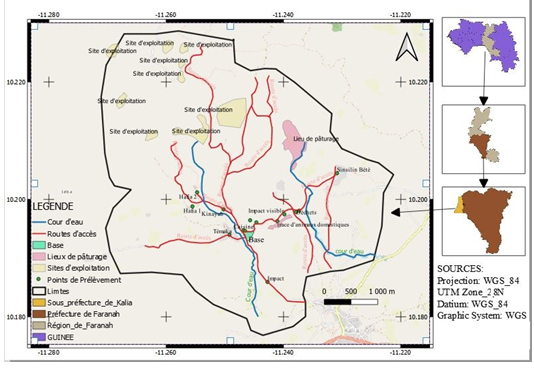
This study was carried out at the Kalia iron ore mining site, located at 0.1833° N and -11.2333° W, at an altitude of 582 meters. This site is part of the fifteen (15) districts of the sub-prefecture of Marella. It is bounded on the west by the prefecture of Faranah, 68 km from the prefectural capital, and on the east by the administrative center of Marella. It covers an area of 173 km² (Figure 1).
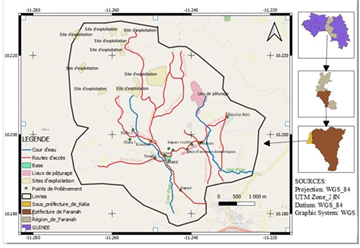
Climate data indicate an average annual temperature of 27.3°C and an average annual rainfall of 1,429.8 mm favoring agricultural and forestry activities (National Meteorological Agency of Guinea). The terrain is very rugged, alternating between mountains, plateaus, plains and shallows. The village is crossed by two (2) main rivers, namely Soumoudougou 1 and Soumoudougou 2, and has a significant floristic richness. These rivers are very favorable to the surrounding ecosystems.
Characterization of agroforestry resources in land-use units affected by mining
An agroforestry resource is any biological resource (plant, animal or microbial) derived from trees, shrubs, herbaceous plants, crops or ecological interactions of an agroforestry system, used by humans for food, health, energy, construction, or environmental preservation 10. In order to characterize agroforestry resources before, during and after mining in the region, direct observations coupled with semi-structured interviews were made over the three periods (2000-2007, 2007-2013 and 2013-2020) at the sites where these practices are actually implemented. A simple random sample was designed to select a total of 200 people to be surveyed. This sample includes 180 farmers (160 males and 20 females), and 20 from other economic sectors (mining company authorities, district authorities). The elements considered in the data collection were crops associated with trees, woody trees associated with agroforestry practices, wildlife, trees with agroecological services, dwellings, fertile soils and bare soils.
Frequency of occurrence (very common, common and rare) was used as a qualitative indicator of intensity of presence or use. Quantitatively, the proportions of each of the resources were determined from observation and survey data for each of the periods.
Evaluation of local perceptions on the impact of iron mining activities in Kalia
The evaluation of local perceptions on the impact of iron mining activities in Kalia was first made through the identification of extractive activities likely to influence the dynamics of agroforestry practices. For this, direct observations were carried out on the various sites of intervention of the company.
In a second step, an in-situ verification of the impacts of extractive activities on agroforestry systems was carried out through, on the one hand, a landscape reading, highlighting the induced changes in the environment, and on the other hand, semi-structured interviews with company officials and local communities. This phase focused on the systematic evaluation of the impacts of activities identified as having a significant impact on the resources.
The assessment of the potential impacts of the mining activities was carried out using an interrelations matrix that allows the sources of the impacts to be crossed with the local agroforestry resources. The impacts of iron ore mining were identified based on the affected components. Thus, the physical, biological and social environment were considered in relation to the impacts related to the mine's extractive activities. The methodology used to characterize the impact of mining activities is based on the identification of the origins of the impacts and on five (05) fundamental criteria: the nature of the impact (positive or negative), the magnitude (minor or major), the duration (temporary or permanent), the extent (local or global) and the intensity of the impact (low, medium or high).
Assessment of the spatial and temporal occupancy dynamics of land units before, during and after mining
The evaluation of the spatial-temporal dynamics of land use was based on the analysis of satellite images. For this purpose, the images of the Digital Elevation Model (DEM) with a resolution of 30 m were uploaded from the NASA USGS Earth Explorer site of the Shuttle Radar Topography Mission (STRM) for the three periods of interest (2000-2007, 2007-2013 and 2013-2020). The images were chosen based on their availability, quality (low or no clouds) and seasonal relevance (dry or late rainy season) to better distinguish between land-use units. The satellite images used were mainly as follows:
- Period 2000-2007: Landsat 7 ETM+ images with a spatial resolution of 30 meters. These images are freely available and provide good coverage for historical analysis.
- Period 2007-2013: Landsat 7 ETM+ images in addition to some scenes of Landsat 8 OLI (available from 2013). The spatial resolution is 30 meters, with a temporal resolution of 16 days.
- Period 2013-2020: Sentinel-2 MSI images obtained using the European Space Agency (ESA) satellites, with a spatial resolution of 10 meters for visible bands (RGB and NIR), and a temporal resolution of 5 days, which allows a better precision in the classification of land cover types.
These images were processed with the QGIS software and the Grass extension. A supervised classification was made using the Random Forest algorithm with the Semi-Automatic Classification Plugin. The contour lines have been extracted using the Contour Algorithm. The classifications were refined by superimposing the observations made during the control missions. This information was confirmed by the communities of Kalia district through a reading of the landscape and relief of the area. Information gathered in the field was complemented by satellite imagery on Google Maps and Bing Maps. This information from satellite imagery has made it possible to confirm and supplement the information collected in the field. This information also enabled land occupancy classes to be confirmed, their areas to be calculated, and the percentages to be estimated over the three periods.
Validation of the relevance of the classifications was done by comparing field data and results from the processing of satellite images through the establishment of confusion matrices for the periods of 2000-2007, 2007-2013 and 2013-2020. Two statistical indicators were used to evaluate the performance of classifications: overall accuracy, which expresses the total proportion of pixels correctly classified, and the Kappa coefficient, which measures the degree of agreement between the classified data and the reference data by correcting for the effects of chance. This provides a robust indicator of the reliability and consistency of the classifications obtained 11.
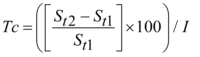
The rate of change (Tc) of a given occupancy unit was also determined between two periods. It expresses the proportion of each unit of natural vegetation that changes from one period to another. It is calculated from the following formula 12:
 | (1) |
With St1 and St2, the unit area at period t1 and t2, respectively, and I is the number of years between t1 and t2.
Dynamics of agroforestry resources before, during and after mining in Kalia
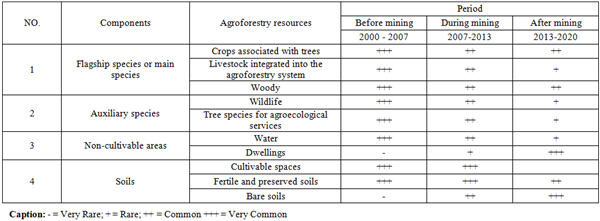
Various agroforestry resources were identified in Kalia, and these resources have experienced particular dynamics before, during and after iron ore mining in the region (Table 1).
It was noted that dwellings and bare soils were very rare before iron mining (2000-2007) but became frequent after mining (2013-2020). Conversely, the other components (wood, cultivable spaces and land containing living organisms) that were very common before iron mining (2000-2007) became only frequent after mining (2013-2020).
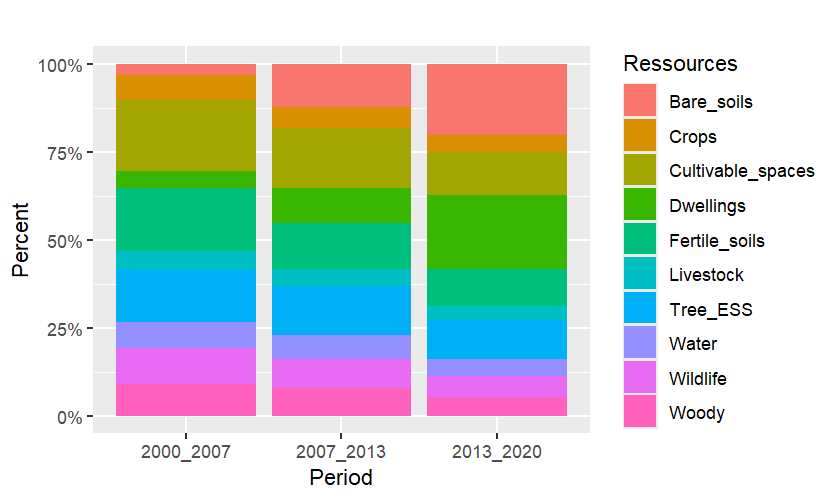
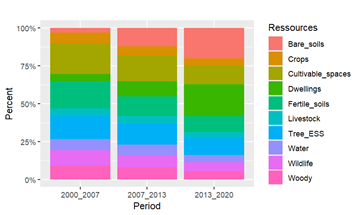
Quantitative analysis of land use by agroforestry resources in Kalia reveals a decrease in agroforestry resources in favor of bare soils and dwellings (Figure 2). Indeed, the proportion of bare soils increases by 3-20% between the pre-exploitation period (2000-2007) and the post-exploitation period (2013-2020), reflecting progressive land degradation or a reduction in vegetation cover. Conversely, the share of fertile soils shows a decreasing trend (from 18 to 10% between 2000 and 2020), suggesting increased pressure on or impoverishment of cultivable land.
Perceptions on the impact of iron mining activities identified at Kalia
During the investigations within the company, as well as the visit to the sites under exploration, we have identified four (4) activities which were: the life base establishment, the opening of access roads, the establishment of survey platforms and the survey.
- Impact of iron mining activities on agroforestry resources and housing in Kalia
Activities related to the installation of the living base have generated significant negative impacts on agroforestry resources, including tree species associated with crops, as well as integrated livestock and water resources. Although the impact is limited at the local level, its scale is major, and its duration is permanent. Conversely, for dwellings, the impact is positive and global with a strong intensity, a permanent character and a major scale.
The resources impacted by the opening of access roads are woody, soil and livestock. These resources were impacted through disruption of agro-pastoral practices, logging, soil compaction, reduced agricultural productivity and integrated livestock rearing, and accidental death of domestic animals. Overall, this impact is perceived as a negative, localised, temporary, strong and with a major status.
The establishment of the survey platforms has had a negative and strong impact on crops and soil. These impacts have manifested themselves through loss of fertility, degradation of cropping areas, soil disturbance and loss of biodiversity. These impacts were perceived as local, major, medium and temporary.
The survey hurt root systems, wildlife, groundwater and local populations. These include soil and water contamination, changes in tree root structure, disturbance of wildlife habitats and life cycles, interruption of agricultural activities during work, and hydrological alteration. This impact is globally perceived as major, permanent, local and medium.
-Socio-economic impacts of iron mining activities
The negative socio-economic repercussions referred to the fragility of the overall ecological system, affecting the livelihoods and living conditions of the inhabitants. However, to mitigate these negative impacts, the company has participated in the socio-economic development of village communities through:
- opening up several villages that are located between the exploration areas;
- the construction of basic infrastructures (schools, health posts);
- job creation (surveillance, housekeepers, cooks and recruitment of drivers and other tradesmen);
- the company has made one-time donations to the population of the area of implantation.
Land use dynamics before, during and after iron mining in Kalia
Statistics on the quality of the classification of satellite images used for the assessment of the occupation dynamics of Kalia district show satisfactory overall accuracy (87.3%, 89.1% and 91.6% for 2000-2007, 2007-2013 and 2013-2020, respectively). As for the Kappa coefficient, it also reveals a very good quality of classifications with values above 80% (83%, 86% and 89% for 2000-2007, 2007-2013 and 2013-2020, respectively).
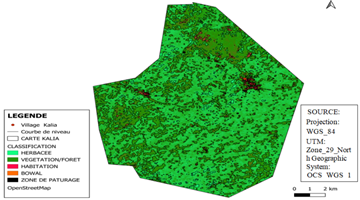
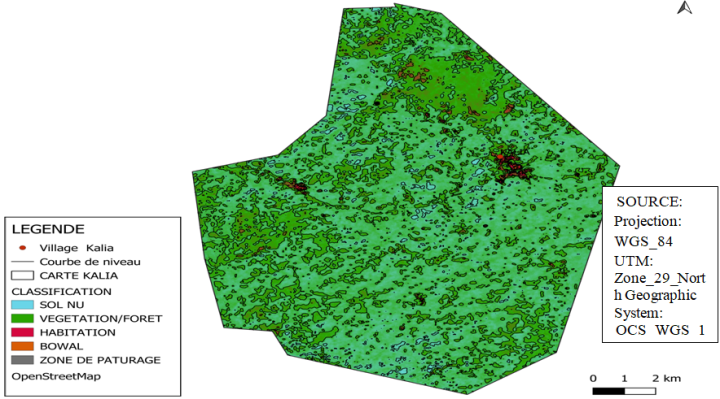
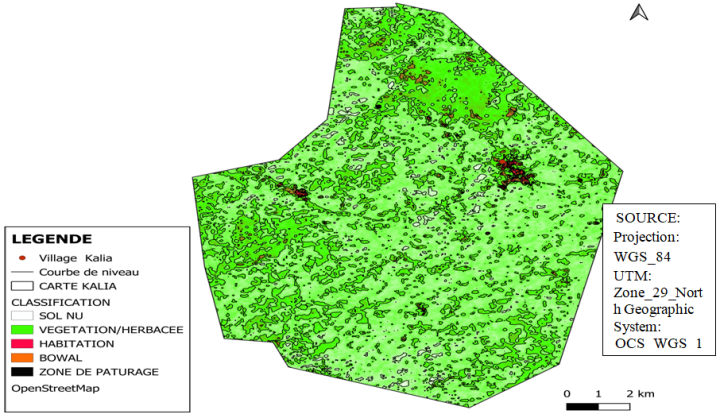
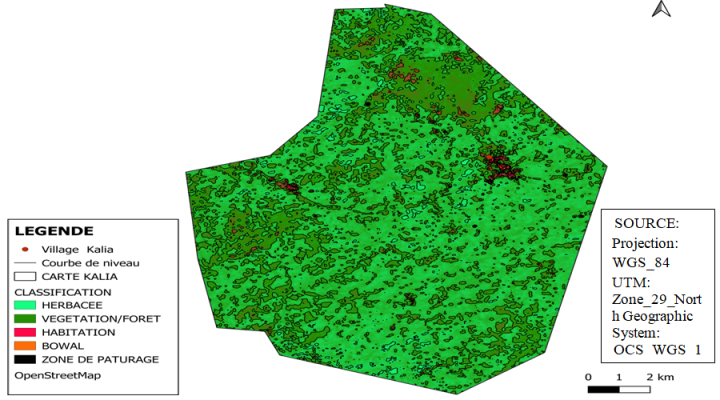
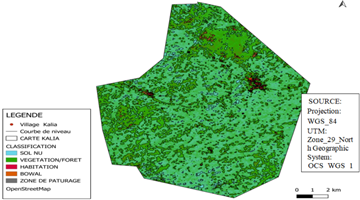
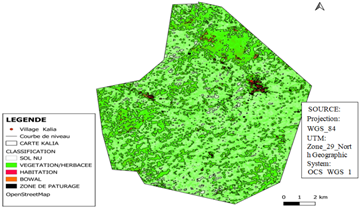
The analysis of areas and rates of change makes it possible to assess the impact of mining activity on landscape dynamics (Table 2). The area of bare soil increased from 1001.2 ha (2000-2007) to 5101.2 ha (2007-2013), corresponding to an increase of +24.99. After 2013, the area decreased to 2101.2 ha, resulting in a reduction of 18.29% (Table 2, Figure 3a, b and c).
For degraded vegetation or forest, a sharp decrease (–23.80%) was recorded between P1 (2000–2007) and P2 (2007–2013), from 8967.01 ha to 5062.06 ha. This regression coincides with the period of intensive exploitation and deforestation induced by mining activities (logging, roads, camps). However, the area increased considerably after 2013 to reach 9702.06 ha (+28.28%) (Table 2, Figure 3a, b and c).
Built-up areas increased slightly between P1 and P2 (+4.27%, from 2500.17 to 3200.11 ha). After 2013, a slight reduction (–3.65%) was observed (Table 2, Figure 3a, b and c).
For bowals, typical ferruginous formations, a slight expansion (+2.35%) was observed between P1 and P2, followed by a moderate decrease (–2.56%) between P2 and P3 (Table 2, Figure 3a, b and c).
Grazing areas were declining continuously from 2801.51 ha (P1) to 1521.01 ha (P2) and then to 901.03 ha (P3). This was a negative but not constant trend (–7.81% and then –3.78%) (Table 2, Figure 3a, b and c).
Impacts of iron mining on agroforestry resources in Kalia
Analysis of iron mining in Kalia reveals a progressive and significant decrease in the components of the traditional agroforestry system (trees associated with crops, cultivable spaces and land with living organisms). Conversely, there was a significant increase in residential areas, from 5% before mining (2000-2007) to 21% after mining (2013-2020) and a sharp increase in bare soils (from 3.09% to 20.1%) between the same periods. These findings reflect increasing anthropogenic pressure on natural resources. These results corroborate the work of 8 and 13, who claimed that the mining industry generates nuisances that have negative impacts on the environment. The same observation was made by 14, who confirmed the idea that mining activities, although essential, cause significant environmental disturbances. Iron mining also contributes significantly to the environmental footprint through greenhouse gas emissions and high energy consumption 15, 16, 17, 18, 19. These results indicate a gradual transformation of land, as well as an advanced process of ecological degradation and disruption of agroforestry landscapes. Iron mining activities in the Kalia area have led to significant disturbances in agroforestry resources. Similar findings were reported in studies by 20, through the identification of environmental damage related to mining in Fria Prefecture. This damage involves the destruction of vegetation cover, the loss of fauna, the pollution of rivers and the atmosphere through the use of chemicals.
Local perceptions on the impacts of iron mining activities in Kalia
Local perceptions of the impacts of iron mining activities in Kalia suggest a threat to the sustainability of agroforestry systems, a decrease in the supply of associated ecosystem services, and a reduction in the socio-ecological resilience of the territories. These results reflect an erosion of ecosystem services that undermines the resilience of local production systems, as well as the socio-environmental sustainability of agroforestry practices 21. It is for all these reasons that it is necessary to promote integrated resource management approaches, reconciling the needs for development and the conservation of ecological balances.
Impacts of iron mining on land occupations in Kalia
The values of the overall accuracy (greater than 85%) and the Kappa coefficient (greater than 83%) reveal a good correspondence between the classes assigned by the model and the observed reality (verified via the control points and the field data). The increasing dynamics (+24.99%) of bare soils between 2000-2007 (before mining) and 2007-2013 (during mining) reflect a sharp deterioration in vegetation cover linked to the opening of mining sites, soil stripping and the establishment of operating infrastructures. However, the slowdown in this regression after 2013 suggests natural plant recolonization or post-mining rehabilitation actions. Indeed, the work of 22 examining the impact of mining on soil properties and fertility degradation has focused on rehabilitation processes and progressive deforestation related to mining, agricultural expansion, urbanization and the expansion of bare soil areas, notably.
For degraded vegetation or forest, the sharp decrease (-23.80%) between P1 (2000–2007) and P2 (2007–2013) could be due to intensive mining and deforestation induced by mining activities (logging, roads, camps). On the other hand, the considerable increase in their area after 2013 suggests the implementation of secondary regeneration processes, probably due to the abandonment of certain areas of exploitation or ecological restoration measures. These results are supported by the work of 3 on the effects of gold mining on the biophysical components of the environment in Aouzegueur in the rural commune of Tabelot (Agadez, North Niger).
As for the dynamics of built-up areas, two phases of growth are observed. Initially, relatively strong growth (+4.27%) is noted and could be attributed to the expansion of mining infrastructure and habitat around mining sites. Secondly, a slight reduction (–3.65%) in this infrastructure is observed after 2013, reflecting the slowdown or stabilization of mining activity and perhaps a temporary demographic decline due to the end of the work.
The dynamics of typical ferruginous formations (bowals), consisting of a slight expansion (+2.35%) between P1 and P2, followed by a moderate decrease (–2.56%) between P2 and P3, could be due to changes in vegetation cover or to increased erosion processes during the exploitation phase, followed by subsequent stabilization.
The regressive trend (–7.81% and then –3.78%) in grazing areas reflects a significant reduction in pastoral areas, possibly due to land competition with mining and urban activities, and land degradation, making some areas unsuitable for grazing.
It appears that the iron mining in Kalia has caused a decrease in agroforestry resources (soil fertility, woody plants, and animal species) of the environment, to the detriment of bare soils and dwellings. Four main activities were identified as having led to this. These were: the establishment of the living base, the opening of access roads, the establishment of survey platforms and the survey itself. This regressive trend in agroforestry resources is reinforced by the dynamics of land use units before (2000-2007), during (2007-2013) and after (2013-2020) iron mining in the region.
The impact of iron mining activities on agroforestry resources was cumulative and was generally perceived negatively by local communities. However, to mitigate these negative impacts, the exploitation company has participated in the socio-economic development of local village communities through the opening up of villages located in exploration areas, the creation of diversified jobs, the construction of basic infrastructure (schools, health posts), and the granting of various donations to local populations.
Despite these efforts by the mining company, expectations were not met. It is therefore essential to promote an integrated territorial planning approach, based on participatory impact assessment and strategies for co-management of agroforestry resources to reconcile mining development and the sustainability of local agroecological practices.
The authors declare that they have no conflict of interest.
| [1] | Kéita, M. “Ecological Impact Analysis: Analysis of the ecological and socio-economic impact of industrial gold mining in Dinguiraye, Guinea”. Doctoral Thesis - Center for Environmental Studies and Research (CÉRE) of the University of Conakry, Guinea, 2023. | ||
| In article | |||
| [2] | Brahmi, M., Zouari, S. & Rossi, M. “The mining industry and its ecological effects. Socio-economic and environmental status in the Tunisian mining basin”, Cahiers de géographie, 17(1): 109-120, 2014. | ||
| In article | View Article | ||
| [3] | Tahirou, H. Y., Bachirou, H. Y., Kader, M. I. A., Bassara, H. S., Bouba, H., Amadou, A. T. & Zibo, G. “Impacts of gold mining on the biophysical components of the environment at Aouzegueur in the rural commune of Tabelot (Agadez, North Niger)”, International Journal of Innovation and Scientific Research, 75: 171-186, 2024. | ||
| In article | |||
| [4] | Sonter, L.J., Herrera, D., Barrett, D.J., Galford, G.L., Moran, C.J. & Soares-Filho, B.S, “Mining drives extensive deforestation in the Brazilian Amazon”, Nature Communications, 8, 1013, 2017. | ||
| In article | View Article PubMed | ||
| [5] | Giljum, S., Maus, V., Kuschnig, N., Luckeneder, S., Tost, M., Sonter, L.J. & Bebbington, A.J. “A pantropical assessment of deforestation caused by industrial mining”, PNAS, 119(38): e2118273119, 2022. | ||
| In article | View Article PubMed | ||
| [6] | Stefănescu, L., Robu, B.M. & Ozunu, A. “Integrated approach of environmental impact and risk assessment of Roșia Montană Mining Area, Romania”, Environmental Science and Pollution Research International, 20(11):7719–7727, 2013. | ||
| In article | View Article PubMed | ||
| [7] | Wilson, S. A., Wilson, C. O. & Moise, I. K. “Livelihood impacts of iron ore mining-induced land change in Sierra Leone: A time series analysis”, Applied Geography, 144:102713, 2022. | ||
| In article | View Article | ||
| [8] | Mbonimpa, M., Aubertin, M., Chapuis, R. P. & Bussière, B. “Practical pedotransfer functions for estimating the saturated hydraulic conductivity”. Geotechnical and Geological Engineering, 20: 235–259, 2002. | ||
| In article | View Article | ||
| [9] | FAO, Agroforestry. FAO: Rome, 2025 | ||
| In article | |||
| [10] | FAO, Advancing Agroforestry on the Policy Agenda: A guide for decision-makers, by G. Buttoud, in collaboration with O. Ajayi, G. Detlefsen, F. Place & E. Torquebiau. Agroforestry Working Paper No. 1. Food and Agriculture Organization of the United Nations. FAO, Rome, 2013, 37p. | ||
| In article | |||
| [11] | Congalton, R. G., “A review of assessing the accuracy of classifications of remotely sensed data”. Remote sensing of environment, 37(1): 35-46, 1991. | ||
| In article | View Article | ||
| [12] | Abba, B., “Dynamics of land use on the Dyabou plateau (Say Department, Niger)”, Territories, Societies and the Environment, 27, 2013. | ||
| In article | |||
| [13] | Bridge, G., “Contested terrain: Mining and the environment”, Annual Review of Environment and Resources, 29: 205–259, 2004. | ||
| In article | View Article | ||
| [14] | Doumbouya, A., Strategic Environmental and Social Study (ESES) of the reform of the mining sector in the Republic of Guinea. Internal report of the consultative workshop from 5 to 6 November 2015 in Conakry, Republic of Guinea. | ||
| In article | |||
| [15] | Haque, N. & Norgate, T., Life cycle assessment of iron ore mining and processing. In L. Lu (Ed.), Iron ore: Mineralogy, processing and environmental sustainability (pp. 615–630), 2015. | ||
| In article | View Article | ||
| [16] | Ferreira, H. & Leite, M.G.P., “A life cycle assessment (LCA) study of iron ore mining”, Journal of Cleaner Production, 108:1081–1091, 2015. | ||
| In article | View Article | ||
| [17] | Gan, Y. & Griffin, W.M “Analysis of life-cycle GHG emissions for iron ore mining and processing in China—Uncertainty and trends”, Resources Policy, 58: 90–96, 2018. | ||
| In article | View Article | ||
| [18] | Bao, W. & Lin, L., “Life-cycle environmental impact assessment of mineral industries”, Materials Science and Engineering, 351, 2018. | ||
| In article | View Article | ||
| [19] | Farjana, S.H., Huda, N. & Mahmud, M.A.P., “Life-cycle environmental impact assessment of mineral industries”, IOP Conference Series: Materials Science and Engineering, 351, 2018. | ||
| In article | View Article | ||
| [20] | Camara, A.Y., Keita, A., Li, H. & Keita, S.M., “Effect of mining by RUSAL Company on renewable natural resources in the Prefecture of Fria, Republic of Guinea”, Journal of Environment Pollution and Human Health, 6(1): 7–19, 2018. | ||
| In article | |||
| [21] | Souaré, S., “Bauxite Mining in the Boké Region (Western Guinea): Method used and impacts on physical environment”, European Journal of Sustainable Development Research, 3: 2542–4742, 2019. | ||
| In article | View Article | ||
| [22] | Kolie, B., Elshkaki, A. & Sunahara, G., “Environmental threat assessment framework for mining activities in Guinea: An integrated approach for sustainable development”, Environmental Management, 2: 356–375, 2024. | ||
| In article | View Article PubMed | ||
Published with license by Science and Education Publishing, Copyright © 2025 Aïssatou Lamarana Bah, Achille Hounkpèvi, Madjariou Barry, Charles Enogo Sovogui, Abdoulaye Barry and Mabetty Touré
 This work is licensed under a Creative Commons Attribution 4.0 International License. To view a copy of this license, visit
http://creativecommons.org/licenses/by/4.0/
This work is licensed under a Creative Commons Attribution 4.0 International License. To view a copy of this license, visit
http://creativecommons.org/licenses/by/4.0/
| [1] | Kéita, M. “Ecological Impact Analysis: Analysis of the ecological and socio-economic impact of industrial gold mining in Dinguiraye, Guinea”. Doctoral Thesis - Center for Environmental Studies and Research (CÉRE) of the University of Conakry, Guinea, 2023. | ||
| In article | |||
| [2] | Brahmi, M., Zouari, S. & Rossi, M. “The mining industry and its ecological effects. Socio-economic and environmental status in the Tunisian mining basin”, Cahiers de géographie, 17(1): 109-120, 2014. | ||
| In article | View Article | ||
| [3] | Tahirou, H. Y., Bachirou, H. Y., Kader, M. I. A., Bassara, H. S., Bouba, H., Amadou, A. T. & Zibo, G. “Impacts of gold mining on the biophysical components of the environment at Aouzegueur in the rural commune of Tabelot (Agadez, North Niger)”, International Journal of Innovation and Scientific Research, 75: 171-186, 2024. | ||
| In article | |||
| [4] | Sonter, L.J., Herrera, D., Barrett, D.J., Galford, G.L., Moran, C.J. & Soares-Filho, B.S, “Mining drives extensive deforestation in the Brazilian Amazon”, Nature Communications, 8, 1013, 2017. | ||
| In article | View Article PubMed | ||
| [5] | Giljum, S., Maus, V., Kuschnig, N., Luckeneder, S., Tost, M., Sonter, L.J. & Bebbington, A.J. “A pantropical assessment of deforestation caused by industrial mining”, PNAS, 119(38): e2118273119, 2022. | ||
| In article | View Article PubMed | ||
| [6] | Stefănescu, L., Robu, B.M. & Ozunu, A. “Integrated approach of environmental impact and risk assessment of Roșia Montană Mining Area, Romania”, Environmental Science and Pollution Research International, 20(11):7719–7727, 2013. | ||
| In article | View Article PubMed | ||
| [7] | Wilson, S. A., Wilson, C. O. & Moise, I. K. “Livelihood impacts of iron ore mining-induced land change in Sierra Leone: A time series analysis”, Applied Geography, 144:102713, 2022. | ||
| In article | View Article | ||
| [8] | Mbonimpa, M., Aubertin, M., Chapuis, R. P. & Bussière, B. “Practical pedotransfer functions for estimating the saturated hydraulic conductivity”. Geotechnical and Geological Engineering, 20: 235–259, 2002. | ||
| In article | View Article | ||
| [9] | FAO, Agroforestry. FAO: Rome, 2025 | ||
| In article | |||
| [10] | FAO, Advancing Agroforestry on the Policy Agenda: A guide for decision-makers, by G. Buttoud, in collaboration with O. Ajayi, G. Detlefsen, F. Place & E. Torquebiau. Agroforestry Working Paper No. 1. Food and Agriculture Organization of the United Nations. FAO, Rome, 2013, 37p. | ||
| In article | |||
| [11] | Congalton, R. G., “A review of assessing the accuracy of classifications of remotely sensed data”. Remote sensing of environment, 37(1): 35-46, 1991. | ||
| In article | View Article | ||
| [12] | Abba, B., “Dynamics of land use on the Dyabou plateau (Say Department, Niger)”, Territories, Societies and the Environment, 27, 2013. | ||
| In article | |||
| [13] | Bridge, G., “Contested terrain: Mining and the environment”, Annual Review of Environment and Resources, 29: 205–259, 2004. | ||
| In article | View Article | ||
| [14] | Doumbouya, A., Strategic Environmental and Social Study (ESES) of the reform of the mining sector in the Republic of Guinea. Internal report of the consultative workshop from 5 to 6 November 2015 in Conakry, Republic of Guinea. | ||
| In article | |||
| [15] | Haque, N. & Norgate, T., Life cycle assessment of iron ore mining and processing. In L. Lu (Ed.), Iron ore: Mineralogy, processing and environmental sustainability (pp. 615–630), 2015. | ||
| In article | View Article | ||
| [16] | Ferreira, H. & Leite, M.G.P., “A life cycle assessment (LCA) study of iron ore mining”, Journal of Cleaner Production, 108:1081–1091, 2015. | ||
| In article | View Article | ||
| [17] | Gan, Y. & Griffin, W.M “Analysis of life-cycle GHG emissions for iron ore mining and processing in China—Uncertainty and trends”, Resources Policy, 58: 90–96, 2018. | ||
| In article | View Article | ||
| [18] | Bao, W. & Lin, L., “Life-cycle environmental impact assessment of mineral industries”, Materials Science and Engineering, 351, 2018. | ||
| In article | View Article | ||
| [19] | Farjana, S.H., Huda, N. & Mahmud, M.A.P., “Life-cycle environmental impact assessment of mineral industries”, IOP Conference Series: Materials Science and Engineering, 351, 2018. | ||
| In article | View Article | ||
| [20] | Camara, A.Y., Keita, A., Li, H. & Keita, S.M., “Effect of mining by RUSAL Company on renewable natural resources in the Prefecture of Fria, Republic of Guinea”, Journal of Environment Pollution and Human Health, 6(1): 7–19, 2018. | ||
| In article | |||
| [21] | Souaré, S., “Bauxite Mining in the Boké Region (Western Guinea): Method used and impacts on physical environment”, European Journal of Sustainable Development Research, 3: 2542–4742, 2019. | ||
| In article | View Article | ||
| [22] | Kolie, B., Elshkaki, A. & Sunahara, G., “Environmental threat assessment framework for mining activities in Guinea: An integrated approach for sustainable development”, Environmental Management, 2: 356–375, 2024. | ||
| In article | View Article PubMed | ||