We present a comprehensive theoretical and numerical study of acceptor impurity states in polar semiconductors, combining a variational method with the Modified Generalized Exponential Cosine Screened Coulomb (MGECSC) potential. This potential accounts for long-range Coulomb screening, while central-cell corrections describe short-range lattice effects. Polaronic contributions are explicitly incorporated through the Huang–Rhys factor, enabling the analysis of phonon-assisted photoionization spectra. Calculations are performed for GaAs and CdTe, with parameters calibrated against experimental binding energies. Our results show that plasma screening reduces binding energies, weakens vibronic coupling, and modifies spectral line shapes in agreement with experimental observations. The model demonstrates predictive capability for photoionization cross sections, bridging plasma physics and semiconductor physics, and provides valuable insights for the design of doped optoelectronic devices under controlled screening conditions.
The continuous demand for high-performance optoelectronic devices, combining precision, efficiency and low energy consumption, has driven intense research into the control of impurities and defects in semiconductor materials. In low-dimensional semiconductor nanostructures, the presence of intentional or unintentional impurities plays a decisive role in determining electronic and optical properties. Among the various experimental probes, the photoionization process — an optical transition from the impurity ground state to conduction sub-bands — is a powerful tool for characterizing impurity states, as its cross section is highly sensitive to impurity type, location, and the host material's dielectric environment. Theoretical and experimental studies on photoionization cross sections have revealed strong dependencies on quantum confinement effects, impurity positioning, light polarization, and central-cell corrections, particularly in polar semiconductors such as GaAs and CdTe 1.
CdTe, for instance, is a polar semiconductor crystallizing in the zinc-blende structure, with a direct band gap whose magnitude depends on temperature. Its ability to be tailored to either n-type or p-type conductivity makes it highly relevant for devices such as solar cells, optical modulators, infrared detectors, and gamma/X-ray detectors. However, even in high-purity samples, residual impurities (e.g., As, Sb, Cu) or native defects can introduce electrically active levels in the band gap, affecting device performance. The accurate determination of binding energies and photoionization cross sections for these impurities is therefore critical, both for fundamental understanding and for optimizing device fabrication 2, 3.
From a theoretical standpoint, modelling impurity states in semiconductors requires a potential that captures the long-range Coulomb interaction and short-range corrections due to chemical shifts, lattice distortion, and carrier–phonon coupling. Traditional hydrogenic models often fail to reproduce experimental binding energies, especially for acceptors, where the complexity of the valence band (degeneracy, anisotropy) and strong central-cell effects must be accounted for 3, 4, 5, 6. Among the various potential models proposed in the literature, the Modified Generalized Exponential Cosine Screened Coulomb (MGECSC) potential stands out for its flexibility in describing both long-range and short-range screening effects. Initially developed to capture the strong screening in quantum plasmas, the MGECSC potential is expressed as 5, 6, 7, 8, 9:
 | (1) |
where  and
and  are dimensionless plasma parameters controlling the oscillatory and polynomial screening terms, and
  is the screening length. By appropriate choice of parameters, the MGECSC potential can also describe the plasma-free limit
  relevant for many solid-state systems.
In the present work, we extend the model potential approach by incorporating the MGECSC potential — supplemented with a differential central-cell correction proportional to  — into a variational formalism for calculating impurity binding energies. This approach is applied to both GaAs and CdTe doped with experimentally relevant impurities such as Mn, As, Sb, and Cu 1, 6. Our study has two main objectives: (i) to assess whether the MGECSC-based potential, when carefully calibrated, can reproduce experimental binding energies in polar semiconductors; and (ii) to analyze the impact of the potential parameters
  and the central-cell term on the accuracy of the model. By bridging methodologies from quantum plasma physics and semiconductor impurity modelling, this work provides a unified framework capable of describing both plasma-embedded atomic systems and solid-state environments 10. In the following, we first present the theoretical framework of the MGECSC potential and the variational formalism used to model acceptor impurities in polar semiconductors. We then introduce the numerical methodology adopted, including the variational procedures and simulations required for the evaluation of the parameters and spectra. Finally, the results are analyzed and discussed in light of the screening and polaronic effects, before concluding with the main findings and perspectives.
In semiconductor nanostructures, the photoionization of impurities is strongly influenced by the degree of electronic confinement. When the dimensionality is reduced, as in quantum dots, carriers are spatially restricted, which enhances their Coulomb interaction with the impurity. This enhanced confinement increases the impurity binding energy and consequently shifts the photoionization threshold towards higher photon energies compared to quantum wells or quantum wires 2, 4.
However, this simple confinement-induced enhancement does not tell the whole story. Real materials are also subject to additional interactions that significantly alter the binding energies and spectral features. In particular, electron–phonon coupling introduces polaronic shifts and phonon sidebands, while plasma screening modifies the long-range Coulomb attraction through collective oscillations 10. Furthermore, short-range chemical and lattice effects must be taken into account via central-cell corrections. The combined action of these mechanisms can either reinforce or counteract the pure confinement effect, leading to rich and non-trivial photoionization spectra 11, 12.
To correctly capture these competing contributions, one requires a theoretical framework that simultaneously includes confinement, electron–phonon coupling, plasma screening, and central-cell corrections. Within this framework, the photoionization cross section is derived under the dipole approximation from Fermi’s Golden Rule as 1:
 | (2) |
 is the constant of the fine structure,
  the optical refractive index,
  the dielectric constant.
  is the ratio between the effective field which is equal to the Lorentz field and the nominal (electric) field of the incident wave. It is customary to think of it as an adjustable parameter. This prefactor does not influence the spectral position of the maximum of the cross section; it only modifies its amplitude as a scaling factor. The true spectral structure lies in the dipole matrix elements and the energy difference between initial and final states.
Within the Born–Oppenheimer approximation, the total wavefunction of the system can be factorized into an electronic contribution and a lattice (phononic) contribution:
 | (3) |
Here,  denote the electronic wavefunctions, while
  represent the vibrational (lattice) states of the crystal. The first term encodes the purely electronic transition matrix element, which dictates the optical selection rules and the oscillator strength. The second term,
  accounts for the overlap between vibrational states and directly reflects the electron–phonon interaction.
Physically, this means that the absorption or emission of a photon in a solid cannot, in general, be described as a purely electronic process: the lattice participates through phonon sidebands. The redistribution of oscillator strength into these sidebands depends on the strength of electron–phonon coupling, which is characterized by the Huang–Rhys factor  12, 13. This dimensionless parameter quantifies the extent of lattice relaxation upon electronic excitation. At low temperatures, where only the vibrational ground state is initially populated, the probability of emitting
  longitudinal optical (LO) phonons follows a Poisson distribution:
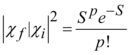 | (4) |
Thus, the electronic transition is modulated by a phonon “envelope”, producing a series of vibronic replicas in the absorption spectrum.
Formally, the vibrational overlap can be expressed using phonon creation and annihilation operators. Introducing the phonon displacement operator:
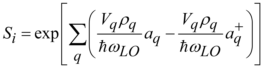 | (5) |
one writes
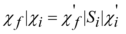 | (6) |
where  measures the strength of the carrier–LO phonon interaction,
  is the electron density coupled to phonon mode qqq, and
  is the LO phonon energy. The states
  correspond to the the factors proper of the Hamiltonian of free phonons.
After algebra involving the commutation relations of the operators  and
and  the overlap integral reduces to the Huang–Rhys expression above. This result shows clearly that electron–phonon coupling does not merely broaden or shift optical spectra, but generates a well-defined ladder of phonon-assisted transitions. These sidebands carry crucial information about the microscopic strength of coupling and about lattice relaxation dynamics around impurities in semiconductors 1.
This result shows that for weak coupling  the zero-phonon line dominates, while for stronger coupling spectral weight is transferred into phonon sidebands, reflecting polaronic dressing of the carrier.
 | (7) |
where  is the polaron coupling constant,
  and
and  are the high-frequency and static dielectric constants, respectively, and
  the LO phonon frequency. A larger
  implies stronger coupling, leading to a heavier effective mass and lower carrier mobility, and introduces a binding energy shift of order
  .
.
Beyond electron–phonon effects, collective plasma screening must be included. For this purpose, we adopt the Modified Generalized Exponential Cosine Screened Coulomb (MGECSC) potential, using an appropriate system of units. 5, 7, 9, 10:
 | (8) |
The exponential damping reflects the reduction of long-range Coulomb attraction due to free carriers, while the cosine term introduces oscillations reminiscent of Friedel oscillations arising from quantum diffraction effects. The parameter  entering the MGECSC potential represents the characteristic screening length of the medium. Its physical meaning depends on the regime of the electron gas 13, 14, 15.
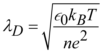
• In a classical, non-degenerate plasma, the screening is governed by the Debye length
 | (9) |
which increases with temperature and decreases with carrier density.
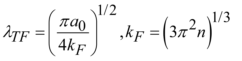
• In a quantum (degenerate) plasma, the screening arises from the collective response of a Fermi sea of electrons. The relevant length scale is the Thomas–Fermi screening length, obtained from the static limit of the Lindhard dielectric function:
 | (10) |
Where 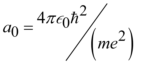 is the Bohr radius, and
  is the Fermi wavevector.
Unlike  is essentially independent of temperature at
  and scales weakly with density as
In the present work,  is therefore understood as a generalized screening length which reduces to
  in the high-temperature, non-degenerate limit and to
  in the low-temperature, degenerate regime relevant for polar semiconductors such as GaAs and CdTe 14.
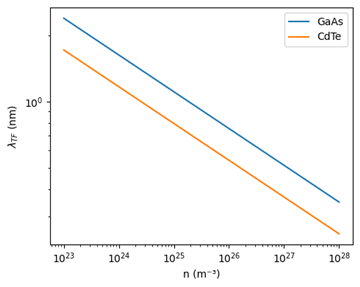
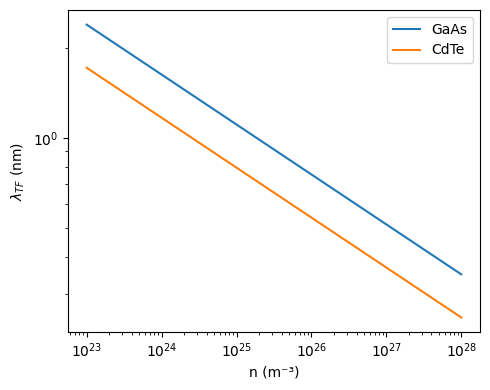
This Figure 1 shows the evolution of the Thomas-Fermi screening length,  , as a function of carrier density n for GaAs and CdTe. A characteristic decay of
 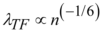 is observed, typical of screening in a degenerate electron gas. For a given density,
  is systematically larger in GaAs than in CdTe, due to its higher dielectric constant and lower effective mass. This difference reflects the increased screening efficiency in CdTe. The screening length
  serves as a central parameter for quantifying screening effects in subsequent calculations of binding energies and optical properties 15.
In Eq (8), the parameter  controls the strength of the cosine modulation. Physically, it represents quantum diffraction effects and Friedel-like oscillations in the electron density around the impurity. Larger
  values increase the oscillatory character of the potential, leading to non-monotonic variations of the binding energy with density.
The factor  refines the short-range behavior of the potential. It mimics local deviations from the pure Coulomb law due to exchange–correlation effects and the finite extension of the screening cloud. Adjusting
  allows one to better match experimental impurity binding energies, especially in polar semiconductors where central-cell effects are important. Importantly, in the plasma-free limit
 ,
,  , and
, and , the standard Coulomb potential is recovered.
By contrast,  sets the periodicity of the oscillatory term, linked to quantum diffraction and Friedel-like oscillations
 . Thus,
  controls the overall weakening of the interaction, while
  determines the wavelength of oscillatory modulations.
Together, these parameters enable the MGECSC potential to interpolate smoothly between the unscreened Coulomb limit and strongly screened quantum plasmas, while retaining flexibility to capture subtle short- and long-range effects in semiconductors.
However, this long-range potential alone is insufficient to reproduce experimental impurity binding energies, especially for acceptors, because it neglects the local chemical environment around the impurity. A central-cell correction must therefore be added, typically written as 1, 16:
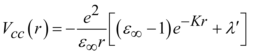 | (11) |
Where  is a characteristic inverse length describing the lattice response and
  is an adjustable parameter. This correction restores the missing short-range physics associated with local lattice relaxation and covalent bonding, and it plays a decisive role in aligning the theoretical binding energy with experimental values.
To evaluate the impurity ground-state energy, we employ a variational approach with a hydrogenic trial function:
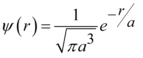 | (12) |
where  is a variational length scale related to the effective Bohr radius.
Within the effective mass approximation, the full Hamiltonian of the system reads 1:
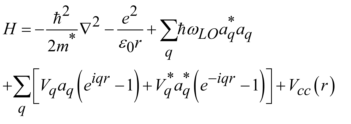 | (13) |
Here, the second term corresponds to the Coulomb attraction, the third term describes the contribution of longitudinal optical (LO) phonons, and the fourth term expresses the coupling between charge carriers and LO phonon modes. Using a canonical transformation, the Hamiltonian can be recast in the form:
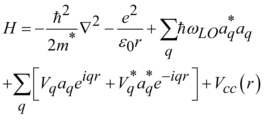 | (14) |
At this stage, the bare Coulomb potential  is replaced by its plasma-screened counterpart
 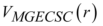 , leading to the modified Hamiltonian:
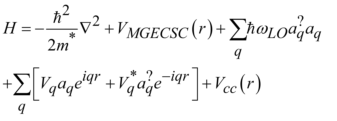 | (15) |
The long-range screening of the Coulomb interaction is fully described by the MGECSC potential  while the short-range local effects remain accounted for by the central-cell correction
 . This separation ensures that no double counting occurs: collective plasma effects act at long distances, whereas the CCC restores the physics of chemical bonding and lattice relaxation close to the impurity.
Within the adiabatic approximation, the ground-state trial wavefunction is refined to include the polaronic dressing of the impurity state by longitudinal optical phonons 1:
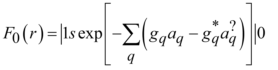 | (16) |
with
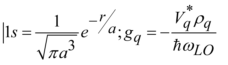 | (17) |
where  is the variational radius of the impurity,
  is the Fourier transform of the ground-state electron charge density, and
  is the phonon vacuum. This expression captures the polaronic cloud surrounding the impurity and thus improves the variational treatment of the coupled electron–phonon–plasma system.
The transformed Hamiltonian takes the form:
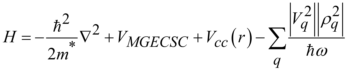 | (18) |
which, after symmetrization of the interaction term, can be written as:
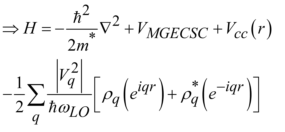 | (19) |
The last contribution represents the reorganization energy of the crystal lattice induced by the impurity. Its expectation value is proportional to the Huang–Rhys factor :
:
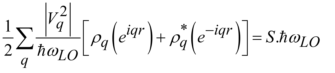 | (20) |
Physically, this term describes how the lattice polarizes around the impurity. A larger impurity radius aaa (weakly bound state) corresponds to weaker polarization (smaller ), whereas a smaller aaa (strongly bound state) enhances the polaronic correction.
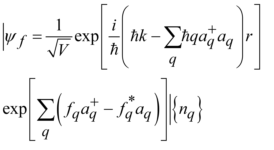
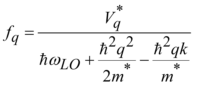
In the Lee–Low–Pines (LLP) approximation, the final state of the coupled system reads 1, 12:
 | (21) |
 | (22) |
where  counts the emitted phonons and
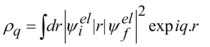
  is the momentum of the carrier. The source term for the lattice polarization is precisely the charge distribution of the impurity, expressed through the Fourier transform
 | (23) |
Collecting all contributions, the variational functional of the impurity binding energy is:
 | (24) |
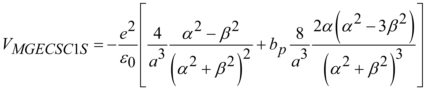
The first term is the kinetic confinement energy, increasing as the impurity radius shrinks.
 reflects the screened Coulomb attraction, where the exponential factor weakens binding as plasma density rises, while the oscillatory
  introduces Friedel-like oscillations in
  versus density.
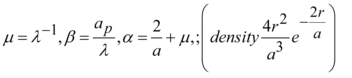
 | (25) |
with
 | (26) |
 | (27) |
 | (28) |
 | (28) |
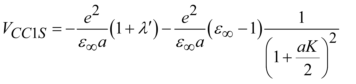
•  corrects the local environment, ensuring that short-range covalency and lattice relaxation are not double-counted 1.
 | (29) |
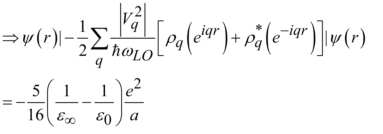
• The final term  is the polaronic stabilization energy, reduced as the impurity delocalizes.
 | (30) |
 | (31) |
Conversely, at finite carrier densities, plasma screening lowers  (shallower impurity), while polaronic effects partially compensate this loss of binding.
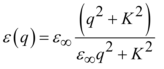
The central-cell correction can be further refined by allowing the dielectric response to be wave-vector dependent,
 | (32) |
which interpolates between  and
and 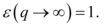 The Fourier transform of the Coulomb potential then leads to:
To capture lattice disruption induced by the impurity, an additional short-range term  is introduced, leading to the final CCC potential
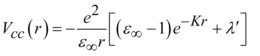 | (34) |
The adjustable parameter  is then fitted variationally to reproduce experimental binding energies in the absence of plasma. This calibration ensures that subsequent plasma-dependent predictions remain anchored to real data
The impurity binding energy is finally obtained by minimizing  with respect to the variational radius
  (and possibly
  in extreme plasma regimes). The resulting effective impurity radius
 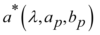 and corrected binding energy:
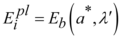 | (35) |
are then consistently reintroduced into the full spectroscopic formalism (photoionization thresholds, cross sections, phonon sidebands).
The determination of impurity binding energies and photoionization cross sections in the presence of plasma screening and electron–phonon coupling requires a careful numerical scheme. The strategy adopted here relies on a variational formulation within the effective-mass approximation, supplemented by the Modified Generalized Exponential Cosine Screened Coulomb (MGECSC) potential for long-range screening and a central-cell correction (CCC) to account for short-range lattice effects 18, 19;
To avoid inconsistencies, all calculations are performed in effective atomic units: lengths are expressed in the effective Bohr radius , and energies in the effective Rydberg
  . This normalization guarantees that the unscreened hydrogenic Coulomb potential yields the reference binding energy
  in the variational functional and
  and
and  are computed from the material parameters
  and
and 
For a hydrogenic  trial wave function with variational length
 , the expectation value of the total Hamiltonian reads
 | (36) |
The screened Coulomb potential yields closed-form integrals involving  and
and , leading to rational functions of
The central-cell correction is parameterized by  and
and  and introduces short-range lattice relaxation effects.
The polaron shift is incorporated through the Huang–Rhys factor , which scales inversely with the variational radius and depends explicitly on
 .
.
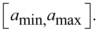
The variational energy  is minimized with respect to
  over a finite interval
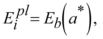
  This is achieved numerically using a bounded scalar minimization routine (Brent’s method). The optimal parameters are the effective radius
  the impurity binding energy
  and the polaron coupling factor
  .
.
Once  and
and  are determined, the photoionization cross section is evaluated from Fermi’s Golden Rule. The threshold condition defines the continuum density of states for photon absorption with emission of
  longitudinal optical phonons. The intensity of each phonon sideband is weighted by a Poisson factor
 . The overall cross section
  is then assembled as a weighted sum over phonon replicas, modulated by the dipole transition matrix element.
The central-cell parameter  is fixed by reproducing the experimental binding energy in the plasma-free limit
 . Thereafter, the model is predictive: varying the plasma parameters
  modifies both the binding energy and the spectral profile. As consistency checks, the scheme recovers the standard hydrogenic limit in the absence of screening, and exhibits the expected weakening of binding and reduction of vibronic coupling as the screening length decreases.
This implementation strategy provides a transparent and flexible numerical framework to analyze impurity states in plasma-exposed semiconductor nanostructures, and to compute both static (binding energies, effective radii) and dynamical (photoionization spectra) observables.
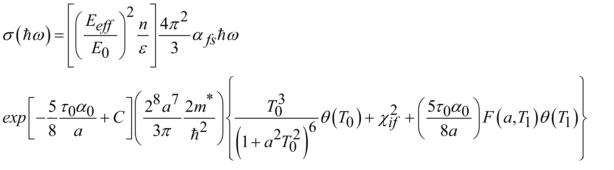
We recall that in these conditions, the integral over space cannot be done in a reasonable way 1. On the other hand, for low values of the wave vector  an approximation valid for slow charge carriers; doing a series development, we obtain the following expression of the photoionization cross section for the emission of a phonon 1:
 | (37) |
 is Heaviside's function,
  is the quantum radius of the polaron,
  is the charge-carrying phonon coupling constant, and
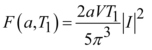
  is the volume of the crystal. In this expression, the term
  is added to take into account the overlap of vibrational wave functions on the spectra of the photoionization cross section.
 | (38) |
where  is the plasma- and polaron-corrected impurity energy. This expression shows that plasma screening lowers the binding energy, shifting the ionization threshold to lower photon energies, while electron–phonon coupling redistributes oscillator strength across phonon replicas. The oscillatory structure of the MGECSC potential can even introduce non-monotonic variations of binding energies with carrier density, reflecting quantum interference effects in screening.
In summary, this work, through the developed formalism, proposes a framework that coherently models the combined effects of confinement, polarons, plasma screening, and local corrections. The robustness of this formalism makes it applicable to the analysis of impurities in polar semiconductors such as GaAs, CdTe, and others (e.g., ZnSe and InP), while also building a bridge between semiconductor physics and quantum plasma physics, from which the MGECSC potential originated.
Before analyzing the full set of results, we first aimed to validate our theoretical model by comparing it with known data in the plasma-free limit , where the standard Coulomb potential is recovered. In this regime, our calculations successfully reproduce the findings of our previous work on the variation of the photoionization cross section depending on the choice of impurities in GaAs and CdTe 1. Moreover, the binding energies obtained for Li and Na impurities within the variational approach agree well with the experimental values reported for Mn in GaAs and As, Sb, and Cu, Li, Na in CdTe crystals, despite the diversity of experimental conditions (annealing atmospheres, impurity diffusion, ion implantation, electron irradiation) 18, 20, 21, 22, 23. This consistency confirms the reliability of the present formalism, while also emphasizing the ability of the Modified Generalized Exponential Cosine Screened Coulomb (MGECSC) potential to capture the essential electron–core interaction in both plasma-free and plasma-embedded environments:
The main physical parameters used in our theoretical calculations, together with typical estimates of the Thomas–Fermi screening length, are summarized in Table I 1, 13, 15:
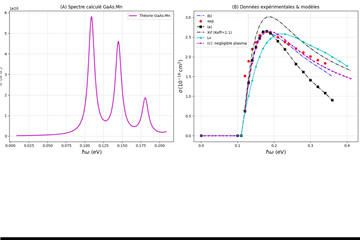
This initial verification confirms that the variational and polaronic corrections in our model correctly capture the physics, before extending the study to include screening and plasma effects. It also validates the numerical procedure used for evaluating the minimum energy and the corresponding optical spectra, as discussed in the following sections.
We now present the numerical results obtained from the variational framework outlined above, focusing on the impurity binding energies, polaronic coupling factors, and photoionization cross sections in GaAs and CdTe. Both materials exhibit strong polar character and therefore constitute relevant testbeds for the proposed MGECSC+CCC model 24, 25.
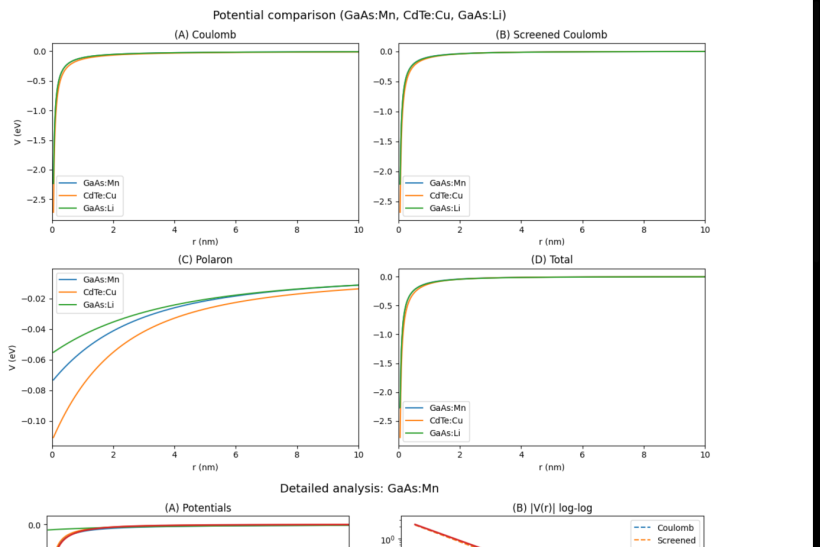
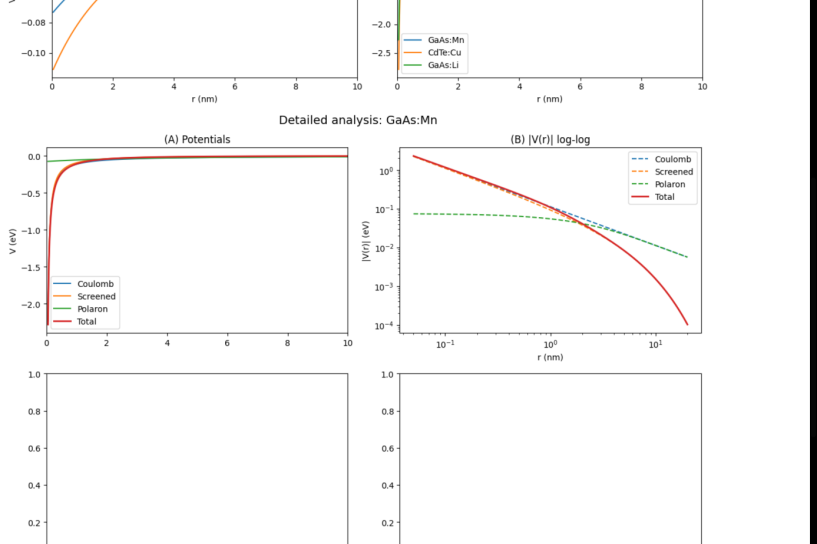
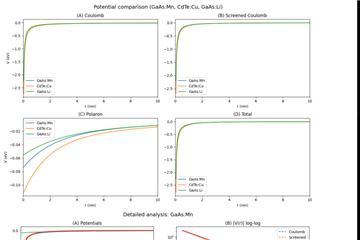
The comparative potential plots clearly illustrate how the attractive interaction between the electron and the impurity is modified depending on the material and screening effects.
• For all three systems (GaAs:Mn, CdTe:Cu, GaAs:Li), the unscreened potential diverges as  at short range and decays slowly at long range. This ideal form constitutes the pure Coulomb field limit, where no collective interactions of the medium are considered.
• The introduction of the Thomas-Fermi screening length  reduces the range of the potential. The smaller
  is, the more rapidly the attractive interaction is attenuated.
In doped GaAs (Mn or Li), where the free carrier density is significant, screening is strong, and the potential decays exponentially beyond a few angstroms.
™ In CdTe:Cu, where the carrier density is lower, the screening effect is less pronounced, and the potential retains a longer attractive tail.
• The electron-phonon coupling (modeled by the polaronic term) regularizes the Coulomb singularity at short range. It is observed that for , the polaronic potential smoothens the divergence and leads to a shallower effective interaction. This effect is particularly relevant in polar semiconductors (like GaAs and CdTe), where interaction with optical phonons is significant.
• The combination of the three contributions (Coulomb, screening, polaron) yields a realistic profile of the effective potential: attractive and regularized at short range, yet strongly reduced at long range by screening.
™ In GaAs:Mn, the total potential remains deeper than with Li, indicating a stronger impurity interaction.
™ In CdTe:Cu, the potential retains a longer range, which may favor electron localization.
These figures illustrate how the competition between Coulomb attraction, reduction by electronic screening, and polaronic renormalization determines the effective interaction between a bound electron and an impurity. They justify why binding energies and ionization thresholds differ from one material to another.
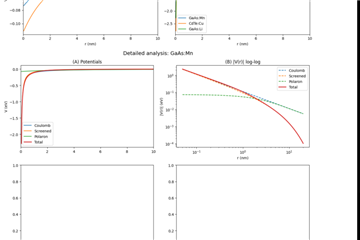
To deepen the interpretation, we isolated the case of Mn-doped GaAs:
• Figure (A), it is observed that the total potential (black) is more realistic than any of the separate terms. It is less singular at the origin (thanks to the polaronic correction) and decays more rapidly than pure Coulomb (due to screening). This allows visualization of the balance between atomic physics (Coulomb) and collective effects (screening, phonons).
• Figure (B), this representation highlights the difference in behavior at short distance:
™ Coulomb diverges strongly as 1/𝑟,
™ The polaron regularizes this divergence,
™ Screening acts mainly at medium and long range.
This contrast is essential for understanding how the electronic structure near the impurity is profoundly modified by environmental effects.
The GaAs:Mn case exemplarily illustrates the necessity of combining multiple mechanisms in the modeling: without the polaronic effect, the Coulomb singularity would be unrealistic; without screening, the potential range would be overestimated. The complete description (total potential) provides the necessary basis for interpreting experimental photoionization spectra.
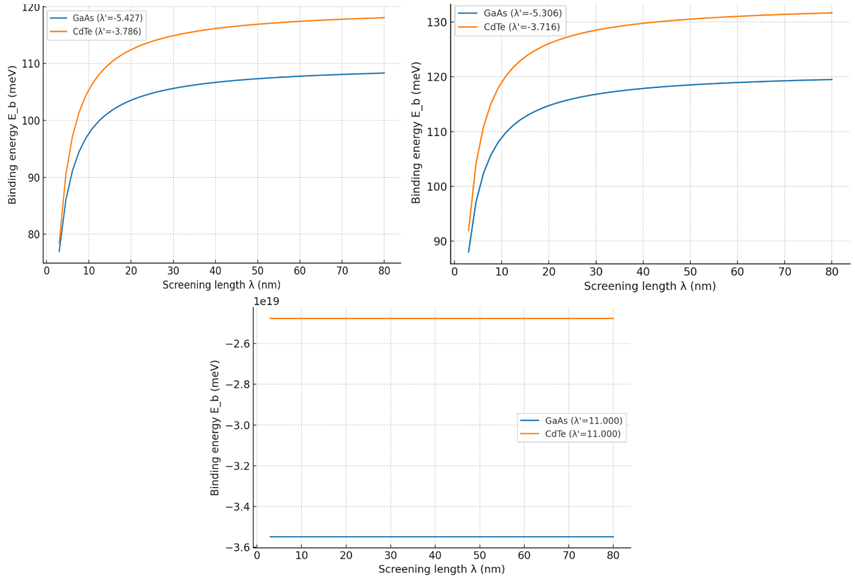
The three representations in Figure 6 illustrate the evolution of the binding energy as a function of the screening length  obtained within the variational model applied to the MGECSC (Modified Generalized Exponential–Cosine–Screened Coulomb) potential.
The first representation (Figure 6) shows the progressive decrease in binding energy as λ decreases, meaning as the screening effect of free carriers intensifies. As expected, in the limit  the binding energy tends toward a finite value corresponding to the unscreened exciton. This limit depends on the material and must be adjusted to match the known experimental binding energy.
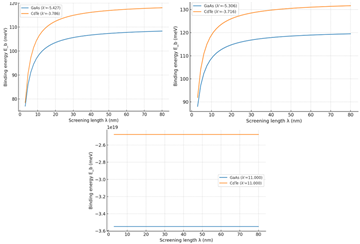

The two other graphs show the role of the correction parameter  introduced to account for central-cell effects (CCC). The optimal choice of
  is obtained by requiring that the theoretical curve exactly matches the experimental value
  in the unscreened limit. In the case of GaAs, a fit yields
  while for CdTe,
  is obtained. These values reflect short-range corrections specific to each material, related to differences in the dielectric function and band structure.
Overall, the results highlight two essential points:
1. The importance of screening effects: the higher the carrier density (and thus the smaller ), the more the exciton is weakened, up to complete dissociation. The necessity of including the CCC correction: without the adjustment via
 , the model underestimates or overestimates the asymptotic binding energy and fails to reproduce experimental values.
Thus, the MGECSC model calibrated with CCC provides a consistent description of the dependence of the excitonic binding energy on screening in the studied semiconductors.
In order to analyze in more detail the influence of the plasma screening on the impurity states, we have calculated the variationally optimized radius  together with the corresponding polaronic coupling parameter
 , as a function of the screening length
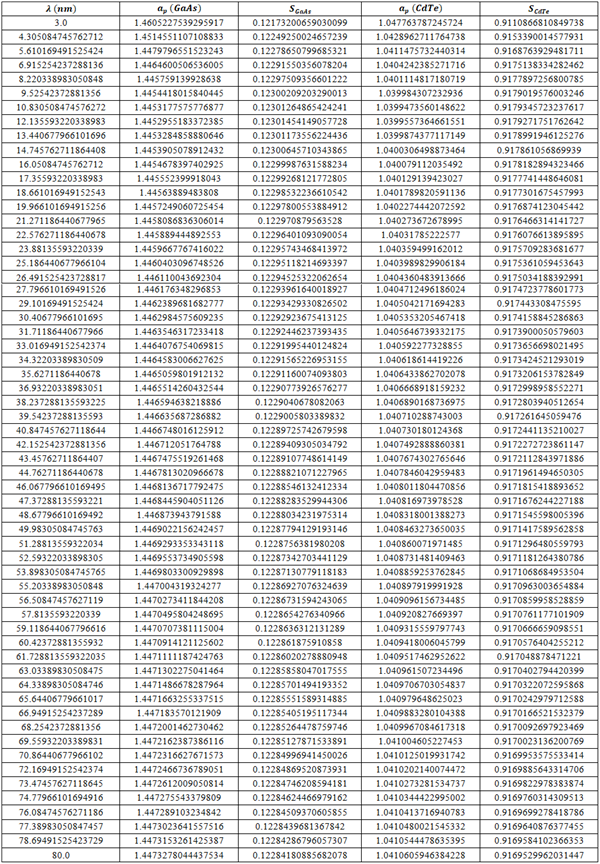
 . Table 2 summarizes the results obtained for GaAs:Mn and CdTe: Cu In the limit of small screening lengths (short-range screening), both
  and
and  vary significantly, reflecting the sensitivity of the bound state to the environment. In contrast, for larger values of
  (weak screening regime), the parameters converge rapidly to nearly constant values, consistent with the Coulombic limit discussed previously. This table therefore provides a clear quantitative benchmark of how the optimized impurity size and the polaronic coupling evolve across the crossover from strong to weak screening.
As can be seen from Table 2, the optimized radius  is systematically smaller for GaAs:Mn than for CdTe:Cu, which reflects the combined effect of a larger effective mass and a lower dielectric constant in GaAs. Consequently, the impurity state is more localized, and the polaronic coupling parameter
  takes higher values. In contrast, CdTe:Cu exhibits a more extended bound state with weaker coupling. These trends highlight the crucial role of host material parameters in determining both the localization of impurity states and the strength of electron–phonon interactions under different screening conditions. Importantly, such differences in localization directly influence the transition probabilities: a more localized state (as in GaAs:Mn) enhances the oscillator strength at low photon energies, whereas a more delocalized state (as in CdTe:Cu) shifts the photoionization threshold. This provides a consistent theoretical explanation for the experimental trends observed in the next section on the photoionization cross section.
In summary, .. controls localization,  tunes the spectral envelope, and
  dictates the screening regime. Their combined variation determines the shape and intensity distribution of the photoionization cross section spectra.
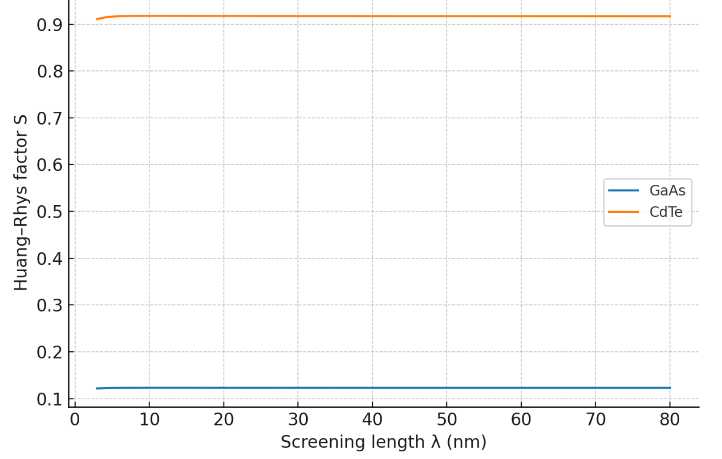
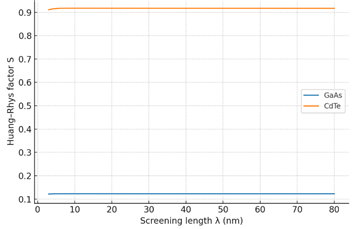
The Huang–Rhys factor was extracted from the polaronic relaxation energy via  Both materials show a slight decrease of
  with decreasing screening length
 , reflecting the reduction of electron–phonon coupling as the exciton radius expands under stronger screening.
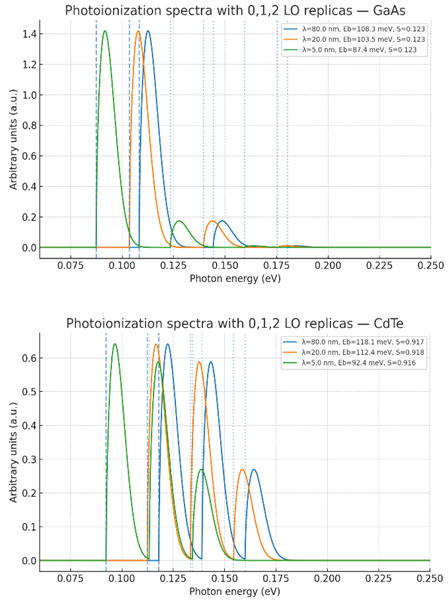
CdTe exhibits much larger values than GaAs (e.g., S≃0.92 vs. 0.12), due to its stronger dielectric contrast and lower LO phonon energy. Consequently, phonon sidebands are expected to be significantly more pronounced in CdTe, while in GaAs the optical response is dominated by the zero-phonon line. Screening further suppresses sidebands in both systems, with a stronger relative effect in CdTe.
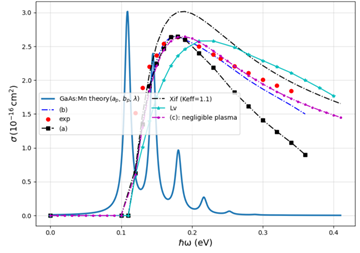
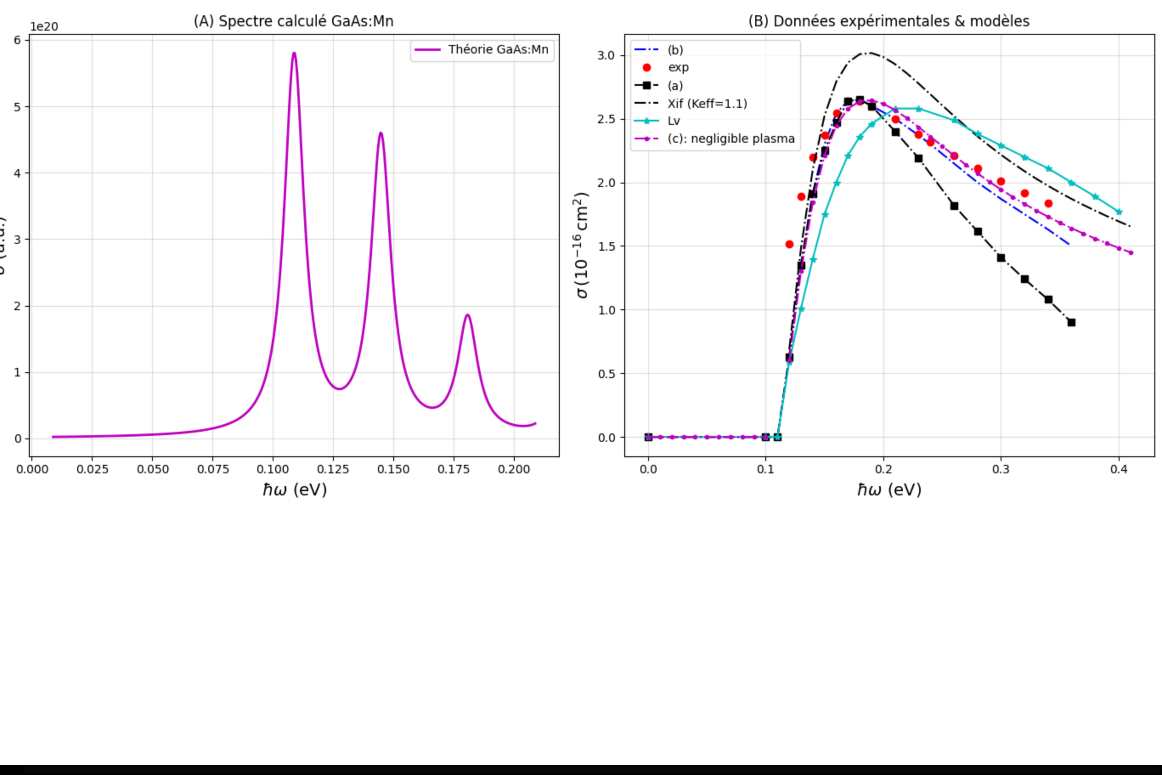
The theoretical spectrum of GaAs:Mn, developed within the variational–polaronic framework, is strongly dependent on the choice of the parameters . These parameters respectively control the effective localization length, the weight of the exponential polaronic component, and the characteristic screening length. Their combined effect determines both the absolute position and the relative intensity of the phonon replicas in the resulting absorption profiles.
First, the parameter  sets the spatial extension of the carrier’s bound state. A larger
  corresponds to a more delocalized wave function, which reduces the Coulomb binding strength and shifts the fundamental transition toward higher energies (weaker binding). Conversely, smaller values of
  lead to stronger localization, enhanced electron–phonon coupling, and a more pronounced redistribution of the oscillator strength toward phonon sidebands. This sensitivity is directly reflected in the following curves, where slight adjustments of
  allow one to correct the onset energy and recover the proper spacing relative to the zero-phonon line.
The role of  is more subtle but equally essential. As an inverse length scale,
  regulates the exponential decay of the polaronic potential. An increase in
  suppresses long-range contributions, thereby narrowing the spectral distribution and reducing the amplitude of higher-order phonon replicas. Conversely, smaller
  values broaden the spectrum and enhance the persistence of multiphonon contributions at larger energy shifts. If
  is too high, the resulting spectra are too narrow and underestimate the sidebands, while too low a
  exaggerates the vibronic envelope.
Finally, the screening length  introduces a carrier-density-dependent renormalization. Strong screening (small
 ) weakens the polaronic correction by enlarging the localization radius and decreasing the correlated lattice polarization energy. This leads to a reduction of the Huang–Rhys factor.., thereby suppressing the phonon replicas and strengthening the zero-phonon line. In the weak-screening regime (large
 ), the opposite occurs: phonon sidebands become more intense and the spectral profile broadens, consistent with the expected physics in GaAs:Mn, CdTe:Cu, or GaAs (CdTe) doped with Li or Na 25, 26.
Thus, the interplay of  and
and  provides a flexible yet physically consistent framework for bridging theory with possible experiments. These results highlight the central role of polaronic parameters in shaping the vibronic structure of these semiconductor materials and confirm that screening progressively modifies electron–phonon coupling in GaAs:Mn.
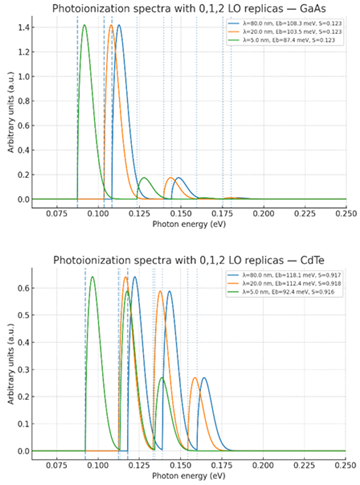
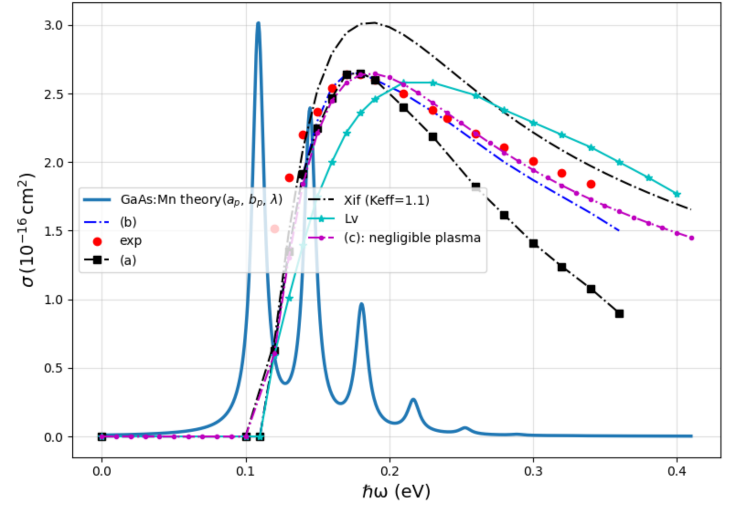
To model the photoionization cross-section spectra, the variational results for the binding energy )) and the optimal orbital radius
  were used to compute the Huang–Rhys factor
  , which quantifies the strength of the electron–phonon coupling. Each vibronic replica
  is associated with a photon energy threshold given by
  .
.
For a clear representation, the cross-section was modeled as a sum of contributions activated above each threshold. Each replica is weighted by the Poisson factor  , reflecting the statistical distribution of phonon emissions. The amplitude of each replica is proportional to the square root of the available energy, characteristic of continuum transitions, and is broadened by a Lorentzian lineshape to account for intrinsic transition broadening and instrumental effects when comparing with experiment. The absolute amplitude is given in arbitrary units (a.u.), although conversion to absolute units is possible; this choice was made to allow variation of the pre-exponential factor (including local field corrections
  and dipole matrix elements).
In the quasi-unscreened limit  the spectra exhibit a sharp zero-phonon line at the threshold
  , followed by distinct phonon replicas at
  and
and  . The relative intensity of these replicas is governed by
 , which is significantly larger in CdTe
  than in GaAs
 , explaining the more pronounced phonon sidebands observed in CdTe.
As  decreases (increasing carrier density), the main ionization threshold redshifts due to the reduction in
  . Concurrently, the relative intensity of the phonon replicas slightly decreases, consistent with the mild reduction in
  with stronger screening. For instance, in GaAs, the main peak shifts from
  to
to  meV
meV  and
and  meV
meV . A similar trend is observed in CdTe, though at higher absolute energies and with more prominent replicas.
Altogether, the present results demonstrate that the MGECSC+CCC variational–polaronic framework consistently bridges Coulombic, screened, and phonon-coupled regimes. This unified description provides a coherent interpretation of impurity-related PCS in polar semiconductors.
In this work, we have developed a unified theoretical framework for describing impurity states in polar semiconductors, combining the MGECSC screened potential, central-cell corrections, and electron–phonon coupling. The variational approach allows for an accurate determination of binding energies and photoionization cross sections, accounting for both long-range plasma screening and short-range lattice effects. Our theoretical and numerical calculations for GaAs and CdTe reproduce experimental trends, notably the reduction of binding energies and vibronic coupling with increasing screening. Beyond comparison with experiments, the method provides predictive insight into impurity behavior in other polar semiconductors. It therefore constitutes a flexible and powerful tool for exploring the interplay between Coulomb screening, polaron formation, and impurity localization.
Future perspectives include the study of anisotropic valence-band effects, many-body corrections, and temperature-dependent screening, paving the way for quantitative modeling of impurity-induced processes in advanced optoelectronic and spintronic devices. To validate these predictions, targeted experimental studies such as temperature-dependent photoluminescence and magneto-optical spectroscopy could directly probe the role of screening on impurity binding energies. In addition, high-resolution infrared absorption measurements would be valuable for testing the predicted anisotropic photoionization cross sections.
| [1] | Mamadou Coulibaly & Ibrahima Gueye Faye, “Variation of the Photoionization Cross Section Depending on the Choice of Impurities in the Case of GaAs and CdTe”, International Journal of Physics, 2022. | ||
| In article | View Article | ||
| [2] | A. Sali, H. Satori, M. Fliyou & H. Loumrhari, “The Photoionization Cross-Section of Impurities in Quantum Dots”, phys. stat. sol. (b) 2002. | ||
| In article | View Article | ||
| [3] | Mehmet Sahin, Firdes Tek & Ahmet Erdinç, “The photoionization cross section of a hydrogenic impurity in a multi-layered spherical quantum dot”, arXiv preprint, 2013. | ||
| In article | View Article | ||
| [4] | Grigor A. Mantashian & David B. Hayrapetyan, “Impurity effects on binding energy, diamagnetic susceptibility and photoionization cross-section of chalcopyrite AgInSe₂ Nanotadpole”, arXiv preprint, 2022. | ||
| In article | View Article PubMed | ||
| [5] | Amlan K. Roy, “Studies on some exponential-screened Coulomb potentials”, arXiv preprint, 2013. | ||
| In article | |||
| [6] | Ashok Chatterjee “Bound-state energies of the generalized exponential cosine-screened Coulomb potential” Phys. Rev. A 34, 2470 – Published 1 September, 1986 | ||
| In article | View Article PubMed | ||
| [7] | Young D. Kwon, “Theory of the screened Coulomb field generated by impurity ions in semiconductors”, Phys. Rev. B, 2006. | ||
| In article | View Article | ||
| [8] | Ed-Dahmouny et al., Impurity photo-ionization cross section and stark shift of ground and two low-lying excited electron-states in a core/shell ellipsoidal quantum dot”, 2023, Chemical Physics Letters, p. 140251. | ||
| In article | View Article | ||
| [9] | Mustafa Kemal Bahar. “The Energy Spectra of Electric Induced Mathieu Quantum Dot with Hydrogenic Impurity Implanted in Quantum Plasma”, Cumhuriyet Sci. J., 44(2) (2023) 370-376. | ||
| In article | View Article | ||
| [10] | M K Bahar, A Soylu. “Confinement control mechanism for two-electron Hulthen quantum dots in plasmas”, 2018, Journal of Physics B: Atomic, Molecular and Optical Physics, № 10, p. 105701. | ||
| In article | View Article | ||
| [11] | Amlan K. Roy. “Studies on some exponential-screened Coulomb potentials”, International Journal of Quantum Chemistry, 113, 1503-1510 (2013). | ||
| In article | View Article | ||
| [12] | Reda Arraoui, Ayoub Ed-Dahmouny, Abdelghani Fakkahi & A. Sali “Polaronic mass and non-parabolicity effects on the photoionization cross section of an impurity in a double quantum dot.” Superlattices and Microstructures, Septembre 2021. | ||
| In article | View Article | ||
| [13] | A. Sali, M. Fliyou & H. Satori “The effect of the electron–longitudinal optical phonon interaction on the photoionization in a quantum well.” J. Phys. Chem. Solids, Mai 1998. | ||
| In article | View Article | ||
| [14] | N. W. Ashcroft and N. D. Mermin, Solid State Physics, Holt, Rinehart and Winston, New York, 1976. | ||
| In article | |||
| [15] | C. Kittel, Introduction to Solid State Physics, 8th Edition, Wiley, New York, 2005. | ||
| In article | |||
| [16] | P. Yu and M. Cardona, Fundamentals of Semiconductors: Physics and Materials Properties, Springer, Berlin, 2010 | ||
| In article | View Article | ||
| [17] | J. C. Marini, B. Stébé & E. Kartheuser “Exciton–phonon interaction in CdSe and CuCl polar semiconductor nanospheres.” Physical Review B, Décembre 1994. | ||
| In article | View Article PubMed | ||
| [18] | I. A. Kokurin & N. S. Averkiev “Level structure of hole two-center complex and related luminescence in semiconductors.” Physical Review B, Mars 2023. | ||
| In article | View Article | ||
| [19] | Zhang Yong. “Electronic structures of impurities and point defects in semiconductors,” Chinese Physics B, 2018, 27(11): 117103 | ||
| In article | View Article | ||
| [20] | L. E. Oliveira and L. M. Falicov. “Central-cell and screening effects on the binding energies of neutral chalcogen impurities in silicon,” PHYSICAL REVIEW B, 15 JUNE 1986. | ||
| In article | View Article PubMed | ||
| [21] | Feliciano Giustino. “Electron-phonon interactions from first principles (arXiv, 2016).” arXiv: 1603.06965. | ||
| In article | |||
| [22] | E. Molva, J. L. Pautrat, K. Saminadayar, G. Milchberg & N. Magnea, “Acceptor states in CdTe and comparison with ZnTe. General trends,” Physical Review B (1984). | ||
| In article | View Article | ||
| [23] | Roman Grill and al. “Defect-induced optical transitions in CdTe and Cd₀.₉₆Zn₀.₀₄Te,” November 2002.17(12):1282. | ||
| In article | View Article | ||
| [24] | Li, Na, Ag, Cu, and Au impurities on Cd sites; N, P, As on Te sites, European Materials Research Society Series, 2010, Pages 5-97 | ||
| In article | |||
| [25] | A. Soylu. “Plasma screening effects on the energies of hydrogen atom”, PHYSICS OF PLASMAS 19, 072701 (2012) | ||
| In article | View Article | ||
| [26] | Stanton, Liam G.; Murillo, Michael S. (2016-04-08).“Ionic transport in high-energy-density matter ”. Physical Review E | ||
| In article | View Article PubMed | ||
| [27] | U. V. Desnica. Doping limits in II-VI compounds, CHALLENGES, PROBLEMS AND SOLUTIONS PII: S0960-8974(98)00011-4. | ||
| In article | |||
| [28] | Seán R. Kavanagh, Aron Walsh and David O. Scanlon “Rapid Recombination by Cadmium Vacancies in CdTe,” ACS Energy Letters (2021). | ||
| In article | View Article | ||
Published with license by Science and Education Publishing, Copyright © 2025 Mamadou COULIBALY, Ibrahima Gueye FAYE and Bassirou LO
 This work is licensed under a Creative Commons Attribution 4.0 International License. To view a copy of this license, visit
http://creativecommons.org/licenses/by/4.0/
This work is licensed under a Creative Commons Attribution 4.0 International License. To view a copy of this license, visit
http://creativecommons.org/licenses/by/4.0/
| [1] | Mamadou Coulibaly & Ibrahima Gueye Faye, “Variation of the Photoionization Cross Section Depending on the Choice of Impurities in the Case of GaAs and CdTe”, International Journal of Physics, 2022. | ||
| In article | View Article | ||
| [2] | A. Sali, H. Satori, M. Fliyou & H. Loumrhari, “The Photoionization Cross-Section of Impurities in Quantum Dots”, phys. stat. sol. (b) 2002. | ||
| In article | View Article | ||
| [3] | Mehmet Sahin, Firdes Tek & Ahmet Erdinç, “The photoionization cross section of a hydrogenic impurity in a multi-layered spherical quantum dot”, arXiv preprint, 2013. | ||
| In article | View Article | ||
| [4] | Grigor A. Mantashian & David B. Hayrapetyan, “Impurity effects on binding energy, diamagnetic susceptibility and photoionization cross-section of chalcopyrite AgInSe₂ Nanotadpole”, arXiv preprint, 2022. | ||
| In article | View Article PubMed | ||
| [5] | Amlan K. Roy, “Studies on some exponential-screened Coulomb potentials”, arXiv preprint, 2013. | ||
| In article | |||
| [6] | Ashok Chatterjee “Bound-state energies of the generalized exponential cosine-screened Coulomb potential” Phys. Rev. A 34, 2470 – Published 1 September, 1986 | ||
| In article | View Article PubMed | ||
| [7] | Young D. Kwon, “Theory of the screened Coulomb field generated by impurity ions in semiconductors”, Phys. Rev. B, 2006. | ||
| In article | View Article | ||
| [8] | Ed-Dahmouny et al., Impurity photo-ionization cross section and stark shift of ground and two low-lying excited electron-states in a core/shell ellipsoidal quantum dot”, 2023, Chemical Physics Letters, p. 140251. | ||
| In article | View Article | ||
| [9] | Mustafa Kemal Bahar. “The Energy Spectra of Electric Induced Mathieu Quantum Dot with Hydrogenic Impurity Implanted in Quantum Plasma”, Cumhuriyet Sci. J., 44(2) (2023) 370-376. | ||
| In article | View Article | ||
| [10] | M K Bahar, A Soylu. “Confinement control mechanism for two-electron Hulthen quantum dots in plasmas”, 2018, Journal of Physics B: Atomic, Molecular and Optical Physics, № 10, p. 105701. | ||
| In article | View Article | ||
| [11] | Amlan K. Roy. “Studies on some exponential-screened Coulomb potentials”, International Journal of Quantum Chemistry, 113, 1503-1510 (2013). | ||
| In article | View Article | ||
| [12] | Reda Arraoui, Ayoub Ed-Dahmouny, Abdelghani Fakkahi & A. Sali “Polaronic mass and non-parabolicity effects on the photoionization cross section of an impurity in a double quantum dot.” Superlattices and Microstructures, Septembre 2021. | ||
| In article | View Article | ||
| [13] | A. Sali, M. Fliyou & H. Satori “The effect of the electron–longitudinal optical phonon interaction on the photoionization in a quantum well.” J. Phys. Chem. Solids, Mai 1998. | ||
| In article | View Article | ||
| [14] | N. W. Ashcroft and N. D. Mermin, Solid State Physics, Holt, Rinehart and Winston, New York, 1976. | ||
| In article | |||
| [15] | C. Kittel, Introduction to Solid State Physics, 8th Edition, Wiley, New York, 2005. | ||
| In article | |||
| [16] | P. Yu and M. Cardona, Fundamentals of Semiconductors: Physics and Materials Properties, Springer, Berlin, 2010 | ||
| In article | View Article | ||
| [17] | J. C. Marini, B. Stébé & E. Kartheuser “Exciton–phonon interaction in CdSe and CuCl polar semiconductor nanospheres.” Physical Review B, Décembre 1994. | ||
| In article | View Article PubMed | ||
| [18] | I. A. Kokurin & N. S. Averkiev “Level structure of hole two-center complex and related luminescence in semiconductors.” Physical Review B, Mars 2023. | ||
| In article | View Article | ||
| [19] | Zhang Yong. “Electronic structures of impurities and point defects in semiconductors,” Chinese Physics B, 2018, 27(11): 117103 | ||
| In article | View Article | ||
| [20] | L. E. Oliveira and L. M. Falicov. “Central-cell and screening effects on the binding energies of neutral chalcogen impurities in silicon,” PHYSICAL REVIEW B, 15 JUNE 1986. | ||
| In article | View Article PubMed | ||
| [21] | Feliciano Giustino. “Electron-phonon interactions from first principles (arXiv, 2016).” arXiv: 1603.06965. | ||
| In article | |||
| [22] | E. Molva, J. L. Pautrat, K. Saminadayar, G. Milchberg & N. Magnea, “Acceptor states in CdTe and comparison with ZnTe. General trends,” Physical Review B (1984). | ||
| In article | View Article | ||
| [23] | Roman Grill and al. “Defect-induced optical transitions in CdTe and Cd₀.₉₆Zn₀.₀₄Te,” November 2002.17(12):1282. | ||
| In article | View Article | ||
| [24] | Li, Na, Ag, Cu, and Au impurities on Cd sites; N, P, As on Te sites, European Materials Research Society Series, 2010, Pages 5-97 | ||
| In article | |||
| [25] | A. Soylu. “Plasma screening effects on the energies of hydrogen atom”, PHYSICS OF PLASMAS 19, 072701 (2012) | ||
| In article | View Article | ||
| [26] | Stanton, Liam G.; Murillo, Michael S. (2016-04-08).“Ionic transport in high-energy-density matter ”. Physical Review E | ||
| In article | View Article PubMed | ||
| [27] | U. V. Desnica. Doping limits in II-VI compounds, CHALLENGES, PROBLEMS AND SOLUTIONS PII: S0960-8974(98)00011-4. | ||
| In article | |||
| [28] | Seán R. Kavanagh, Aron Walsh and David O. Scanlon “Rapid Recombination by Cadmium Vacancies in CdTe,” ACS Energy Letters (2021). | ||
| In article | View Article | ||