This paper presents a practical draft plan for Business Continuity (BC) and Disaster Recovery (DR) for a newly proposed government agency in the Republic of North Macedonia. The case study evaluates continuity options and provides managerial and technical recommendations aligned with the agency’s mandate to handle sensitive public-sector data. The framework integrates Risk assessment, Business Impact Analysis (BIA), and implementation guidance consistent with international best practices and local administrative requirements. Essential information systems, critical functions, and disruption scenarios are identified to ensure service continuity and data protection. Alternative data-center strategies-on-premises, cloud-based, hybrid, and commercial co-location-are compared, and operational procedures for recovery and resilience are defined. Key components include organizational roles, business processes, training and testing cycles, and IT infrastructure recommendations for primary and backup sites. Based on technical, economic, and national ICT conditions, the preferred approach is agency-owned equipment in professionally operated co-location facilities, with continuity operations managed internally. Findings indicate that instituting BC/DR early in the agency lifecycle enhances resilience, reduces downtime risk, and supports trustworthy public services. The work adapts established templates to the Macedonian context and offers actionable guidance for IT managers, infrastructure planners, and engineers engaged in public-sector digital transformation and resilience initiatives in Southeast Europe.
The establishment of a new public agency within the Government of the Republic of North Macedonia forms part of a wider administrative modernization initiative aimed at improving institutional processes and data management within one of the ministries. This initiative aligns with the National ICT Strategy for Digital Transformation 1, which seeks to eliminate fragmentation, rationalize information flows, and develop interoperable digital systems across the public sector. A major outcome of this modernization effort is the creation of a new Agency supported by a unified integrated database that will serve as the main platform for registration, monitoring, calculation, and payments of the citizens.The Agency’s design includes the definition of its organizational structure, operational model, and information and communication technology (ICT) architecture. A critical component of this effort is the establishment of a Business Continuity and Disaster Recovery (BC/DR) framework that ensures essential operations and data services can be maintained following a disruption. Given the sensitivity of the data to be processed, the absence of a structured BC/DR plan would expose the Agency to severe risks, including data loss, operational downtime, reputational damage, and legal consequences. Therefore, developing robust continuity and recovery strategies-covering on-premises, co-located, and cloud-based recovery options is vital to maintain public trust and guarantee uninterrupted service delivery.
The purpose of this study is to design a draft BC/DR plan for the newly proposed Agency by integrating international best practices (ISO 22301 2, ISO/IEC 27031 3, and NIST SP 800-34 4) with the local administrative and technical context. The plan addresses risk assessment, infrastructure design, recovery objectives, and training requirements, offering a structured framework for resilience and digital transformation in the Macedonian public sector.
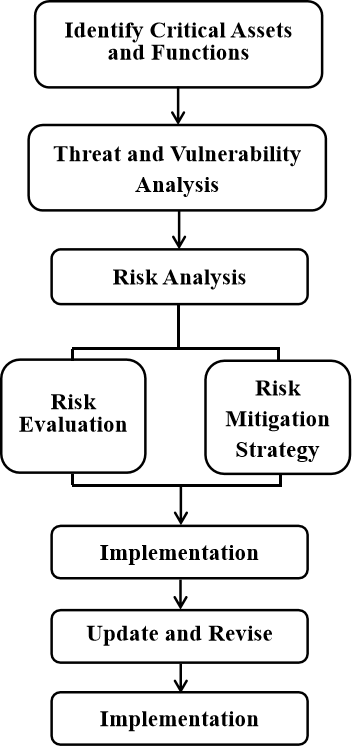
1.1. Methodological Approach for the Preparation of the BC/DR PlanAn incomplete or poorly developed BC/DR plan can be more harmful than having none at all; a document that has not been tested or validated may mislead staff during an emergency and waste critical time. Accordingly, preparation of the Agency’s BC/DR plan follows a structured methodology based on recognized international standards, adapted to the Agency’s specific operational environment.
This approach ensures that both strategic and technical dimensions of continuity management are addressed-from risk identification to testing and continuous improvement. Key success factors include:
• Identification of critical business functions;
• Comprehensive risk and business-impact assessments;
• Clear assignment of roles and responsibilities;
• Regular plan testing and simulation drills;
• Coordination of recovery tasks and communication;
• Definition of recovery metrics (RTO, RPO, MTD);
• Evaluation of resource interdependence;
• Continuous training and awareness; and
• Maintenance of version-controlled electronic plans.
These activities enable IT managers and decision-makers to evaluate resilience and compliance maturity against frameworks such as ISO 22301 2, ISO/IEC 27031 3, and NIST SP 800-34 4.
It is further recommended that the Agency manage its own disaster-recovery process rather than rely entirely on outsourced cloud services. Self-managed co-location model-placing Agency-owned equipment in a certified commercial data center ensures stronger control over sensitive data, faster decision making, and deeper institutional knowledge of system dependencies. Exclusive dependence on external providers could introduce operational uncertainty, as third-party personnel may lack sufficient understanding of internal processes. Moreover, the domestic ICT market has limited experience offering complete BC/DR-as-a-Service solutions, reinforcing the practicality of an internally managed model.
By applying this methodological framework, the Agency can develop a realistic, efficient, and maintainable BC/DR plan that supports operational continuity, compliance, and long-term resilience.
Business Continuity Planning Checklist
The list of steps for business-continuity planning was adapted from the public-domain Business Continuity Checklist 5 and enriched to meet the Agency’s specific operational and legal context. This structured approach will guide the Agency in developing a comprehensive continuity plan once fully operational.
Reference Format for the Agency Business Continuity Plan
For the Business Continuity (BC) Plan, the format developed by the Durham Civil Contingencies Unit (Durham County Council, UK) 6 was used as a foundational model. The template was modified to align with the Agency’s organizational and legal framework. This format offers a structured basis that can later be expanded into a detailed BC Plan once institutional parameters, such as location, staffing, communication protocols, ICT inventory, and infrastructure dependencies-are defined. By tailoring this format, the Agency ensures compliance with both international standards and national administrative requirements, establishing a practical roadmap for operational resilience.
Transition to Methodology
The reference models and methodological framework described above form the foundation for developing a practical and context-specific BC/DR plan for the newly proposed Agency. Building upon these frameworks, the following section presents the materials and methods used to collect data, analyze risk scenarios, and design the technical and operational components of the plan.
The development of the draft Business Continuity and Disaster Recovery (BC/DR) plan for the newly proposed Agency followed a structured, multi-phase methodology that integrates risk analysis, business-impact assessment, and ICT system evaluation. The framework combines international best practices-specifically ISO 22301 2, ISO/IEC 27031 3, and NIST SP 800-34 4-with national administrative and technical conditions in the Republic of North Macedonia.
2.1. Research ApproachThe study applies an applied case-study methodology to translate theoretical BC/DR principles into a context-specific framework suitable for a newly created public institution.Two primary data sources supported the analysis:
1. Primary data: technical documentation, feasibility studies, and specifications prepared by the ministry and project design team responsible for the Agency’s ICT system.
2. Secondary data: relevant ISO standards, national ICT strategies, and comparative analyses of European agencies performing similar functions.
The methodological design consisted of three phases:
1. Assessment and Analysis Phase - Identification of mission-critical services, interdependencies, and vulnerabilities. This phase included a Business Impact Analysis (BIA) to determine potential consequences of disruption, establish Recovery Time Objectives (RTOs) and Recovery Point Objectives (RPOs), and prioritize critical ICT systems.
2. Planning and Design Phase - Definition of BC/DR strategies, evaluation of data-center alternatives (on-premises, co-location, new-build, or cloud-based), and design of the primary and secondary ICT architectures.
3. Validation and Review Phase - Simulation of recovery procedures, documentation of workflows, and design of training and testing programs for periodic plan updates.
This phased approach ensures that the Agency’s BC/DR framework is evidence-based, auditable, and aligned with both ISO standards and local ICT realities.
2.2. Analytical Tools and Evaluation CriteriaA mixed-method evaluation was used to balance technical feasibility, economic sustainability, and organizational capability.
• A Risk Assessment Matrix quantified likelihood and impact of potential threats on operational continuity.
• Comparative analysis of data-center options applied criteria such as cost efficiency, scalability, physical and logical security, regulatory compliance, and human-resource capacity.
• Each scenario was rated for both technical feasibility and long-term sustainability, ensuring an optimal configuration that meets resilience, budgetary, and governance requirements.
These analyses guided subsequent design choices for infrastructure, recovery logistics, and staffing.
2.3. Application to the Agency ContextBecause the Agency will be newly established and lacks existing ICT infrastructure, four alternative configurations were considered:
1. Adaptation of existing government facilities - Repurposing available ministry space for initial operations.
2. Construction of a new dedicated data center - Purpose-built, high-availability facility meeting Tier standards.
3. Co-location of Agency-owned equipment within a certified commercial data center.
4. Adoption of cloud-based BC/DR services.
Each option was examined against international benchmarks and local capabilities. Following comparative technical and financial analysis, the recommended configuration is: a hybrid model, in which the Agency procures its own ICT equipment and co-locates it within a rented professional data-center facility for both the primary and backup sites.
This approach ensures:
• Full operational control and data sovereignty,
• Compliance with ISO-based BC/DR guidelines,
• Optimized cost and resource efficiency, and
• Flexibility for incremental expansion as systems mature.
2.4. Methodological OutcomeThe adopted methodology delivers a practical, standards-aligned BC/DR framework tailored to the Agency’s mission and ICT maturity. It supports risk mitigation, regulatory compliance, and a roadmap for resilience development that encompasses system recovery, data replication, and staff readiness.
This methodological foundation directly informed the technical and organizational design described in Section 3.4, where the plan is operationalized through infrastructure layout, recovery procedures, and defined responsibilities.
The Agency’s BC/DR framework adapts publicly available reference models, including the Business Continuity Checklist 5, the Durham Business Continuity Plan model 6, the Business Impact Analysis (BIA) Template 7, and the Disaster Recovery Plan Template 10. These resources were critically reviewed and customized to meet the Agency’s operational, infrastructural, and governance requirements without reproducing full source content.
The results of the analysis and design process provide a structured Business Continuity and Disaster Recovery (BC/DR) framework organized around three key pillars: Risk assessment outcomes, Business-continuity structure, and Disaster-recovery procedures. Together these pillars form a coherent system for maintaining resilience across organizational, technical, and operational layers.
3.1. Risk Assessment and Business Impact AnalysisThe assessment phase identified the principal operational risks likely to affect the Agency’s ICT environment, including power outages, network interruptions, cyber-security incidents, and physical damage to ICT infrastructure. The Business Impact Analysis (BIA) revealed that prolonged IT system downtime could critically affect citizen services, data integrity, and the institution’s public reputation.
A qualitative risk-assessment matrix was therefore developed to categorize and visualize the likelihood and impact of each risk scenario. This matrix supports decision-makers in prioritizing mitigation measures, allocating recovery resources, and defining recovery-time objectives consistent with ISO 22301 and NIST SP 800-34 guidance.
The results summarized in Table 1 provide a snapshot of the Agency’s principal operational risks and corresponding mitigation strategies. However, effective risk assessment alone does not guarantee continuity. The next step is to translate these analytical findings into an operational framework that defines how the Agency sustains essential functions during disruptions.
To ensure structured and coordinated action, the plan introduces procedures for maintaining operations under adverse conditions-supported by contact trees, recovery team roles, and escalation protocols, that collectively form the backbone of the Agency’s Business Continuity Framework, illustrated in Figure 1. This framework visually integrates organizational governance, communication flows, and technical response mechanisms into a unified model for continuity management.
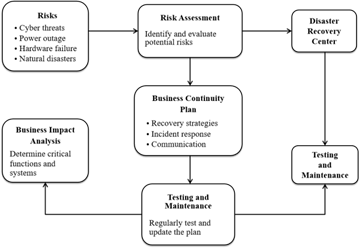
The Business Continuity Plan (BCP) defines the operational strategies, communication channels, and governance mechanisms required to maintain essential services during and after a disruption. It bridges the strategic intent of management with the technical response procedures executed by the IT and operations teams, ensuring coordinated action across human, organizational, and technological domains.
A strong BCP structure is founded on clearly defined roles, documented procedures, and periodic testing. This section consolidates those principles into a unified framework that ensures both resilience and accountability across all departments. Within this framework, the BCP specifies critical business functions, recovery priorities, and continuity strategies, while establishing the communication and escalation paths that guide the Agency’s crisis response.
To maintain operations under adverse conditions, the plan integrates contact hierarchies, recovery team responsibilities, and escalation protocols. These elements are organized into the Agency’s Business Continuity Framework (illustrated in Figure 1), which aligns organizational responsibilities with incident-response procedures to ensure a consistent flow of decision-making and information during emergencies.
A key component of the BCP is the Business Impact Analysis (BIA), which focuses on identifying and evaluating the consequences of disruptions to critical functions. The BIA quantifies both financial and non-financial impacts and defines recovery parameters, specifically the Recovery Time Objective (RTO) and Recovery Point Objective (RPO), through structured risk-impact analysis. Using the risk probabilities provided by the risk-assessment phase, the BIA determines how quickly processes must be restored and the extent of acceptable data loss.
Conducting a BIA prior to a crisis enables a smoother recovery process by clarifying priorities and resource requirements. In the Agency’s case, exact RPO and RTO values will be determined once detailed information becomes available regarding system architecture, inter-institutional connections, and equipment configuration.
During the realization of the BIA analysis, the format from the document “Business Impact Analysis (BIA) Template” retrieved from the National Institute of Standards and Technology 7 was used as the foundational model. This format was modified and enriched according to the operational context of the Agency, ensuring that it serves as a practical basis for developing a comprehensive, detailed BIA plan once the institution becomes operational.
An optimal continuity plan should address multiple interrelated factors, including the scope of disruption, cost and loss limitations, and critical recovery timelines that define the boundaries of BC and DR activities:
• MTD – Maximum Tolerable Downtime
• RPO – Recovery Point Objective, or the target point of data recovery
• RTO – Recovery Time Objective, as defined in the BIA template
• WRT – Work Recovery Time, representing the period following system recovery when teams verify that services and data integrity are fully restored before resuming normal operations
During preparation of the tender documentation for Business Continuity and Disaster Recovery planning, the Agency will formally define these parameters (RPO, RTO, WRT) based on finalized technical specifications and infrastructure design.
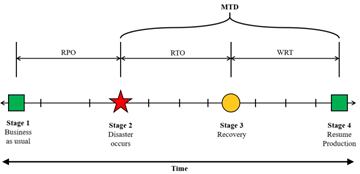
The diagram in Figure 2 illustrates the sequential recovery phases from normal operations through disruption, restoration, and full resumption of production. It visualizes how technical and organizational recovery objectives interact over time. Specifically, the Recovery Point Objective (RPO) defines the maximum tolerable data loss measured in time, while the Recovery Time Objective (RTO) specifies the target duration for restoring critical systems and services. The Work Recovery Time (WRT) represents the post-restoration phase during which teams verify data integrity and re-establish normal workflows. Finally, the Maximum Tolerable Downtime (MTD) denotes the total allowable outage period beyond which the Agency’s operations would experience unacceptable impact. These parameters, adapted from standard BC/DR frameworks 8, form the foundation for prioritizing recovery actions and sequencing technical responses.
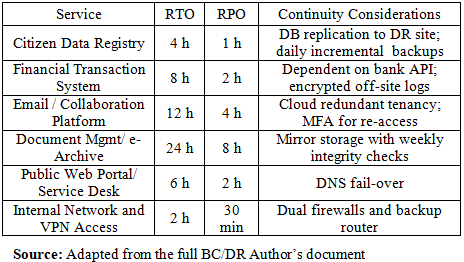
Based on these definitions, Recovery Time Objectives (RTOs) and Recovery Point Objectives (RPOs) were provisionally defined for each of the Agency’s critical services to ensure timely and structured restoration, as summarized in Table 2.
The Disaster Recovery Plan (DRP) defines the technical and procedural steps required to restore the Agency’s information and communication technology (ICT) systems following a disruptive incident. It proposes the establishment of a Disaster Recovery Center (DRC) in a geographically separate location, ensuring mirrored data, redundant connectivity, and continuous operational availability.
In alignment with modern disaster-recovery frameworks, the plan integrates automated monitoring, intelligent alerting, and context-aware response mechanisms that accelerate detection and coordination during crises 9. Incorporating these principles enhances the Agency’s ability to identify system disruptions early, prioritize recovery actions, and maintain real-time situational awareness across all critical services.
Reference Format for the Agency Disaster Recovery Plan (DRP)
The development of the draft DRP focuses primarily on technology and IT operations, ensuring the rapid restoration of business processes after a disruption. The plan aims to provide an effective, efficient, and economical response to catastrophic events that may interrupt critical functions. Typical examples include backup and restore procedures, defining how and when data recovery should occur, along with the acceptable reaction times for each system.
As previously discussed, disaster recovery represents the organization’s structured approach to restoring access and functionality to its ICT infrastructure after events such as natural disasters, cyber attacks, hardware failures, or other unforeseen incidents.
Several frameworks and templates exist for preparing a DR plan. For the Agency’s needs, the reference model selected was the publicly available document “Disaster Recovery Plan Template (Basic)” 10: This model was adapted and enriched to meet the specific operational and technical requirements of the Agency, ensuring compliance with both international best practices and local ICT governance standards.
We believe this adapted framework provides a robust foundation for developing a comprehensive and detailed Disaster Recovery Plan once the Agency becomes operational and all ICT assets, configurations, and dependencies are fully defined.
Evaluation of Infrastructure Alternatives
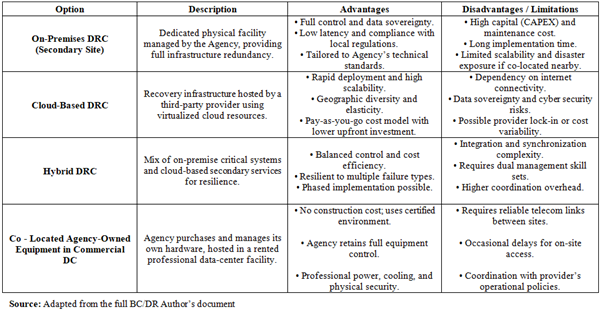
During the design of the Agency’s DRP, several infrastructure alternatives were evaluated to determine the most cost-effective and operationally resilient configuration for ensuring continuity of services. The analysis compared four models: on-premises recovery, cloud-based recovery, hybrid recovery, and co-location of Agency-owned equipment in a professional data center.
Each alternative was evaluated using predefined criteria, including degree of control, scalability, implementation cost, security, and recovery performance. The comparative results of this assessment are presented in Table 3, which summarizes the advantages and limitations of each approach.
Following the assessment of disaster-recovery options in Table 3, it is clear that technology alone cannot ensure continuity. A resilient recovery framework must also define the human and procedural elements that coordinate the response when disruptions occur. Once recovery environments are established, the next priority is to formalize the hierarchy responsible for activating and managing the Disaster Recovery Plan (DRP).
Defined roles ensure that incident detection, escalation, and restoration follow a unified chain of command. Without this structure, organizations face delayed actions and inconsistent communication. The Agency therefore should implement a command framework, aligning technical recovery teams with management oversight to maintain transparency and efficiency throughout the response process.
The Agency’s model recognizes three levels of control: (1) Strategic coordination by executive management; (2) Tactical oversight by continuity and IT leadership; (3) Operational execution by recovery teams. Each level has predefined responsibilities and activation triggers, supported by regular training and testing.
This structure strengthens accountability and compliance with ISO 22301 and NIST SP 800-34 2, 4. Cross-training among teams provides human redundancy that complements technical safeguards.
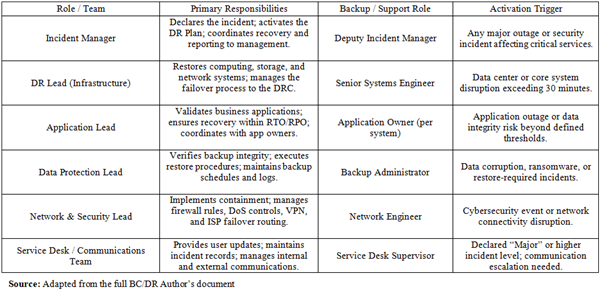
The following framework (Table 4), summarizes relationships, outlining the primary responsibilities, backup functions, and activation triggers that collectively, form the operational backbone of the Agency’s Disaster Recovery Plan. This framework represents the human foundation of the BC/DR system—ensuring that every recovery action is deliberate, traceable, and aligned with the Agency’s mission to protect critical public-sector data and sustain essential digital services.
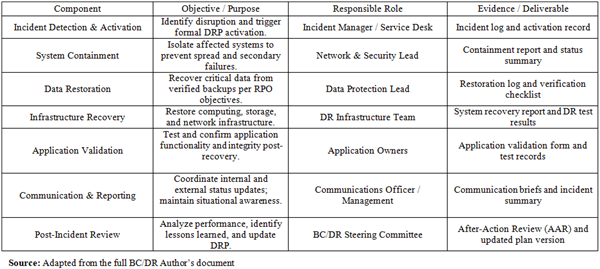
Following the allocation of responsibilities summarized in Table 4, it is essential to define the operational components that structure the implementation of the Disaster Recovery Plan (DRP). Each component represents a critical stage within the recovery life cycle, ensuring that all response actions are coordinated, traceable, and verifiable. Together, these elements establish the procedural foundation for executing, monitoring, and continuously improving the DRP during an incident. The key components, corresponding responsible roles, and expected deliverables are summarized in Table 5.
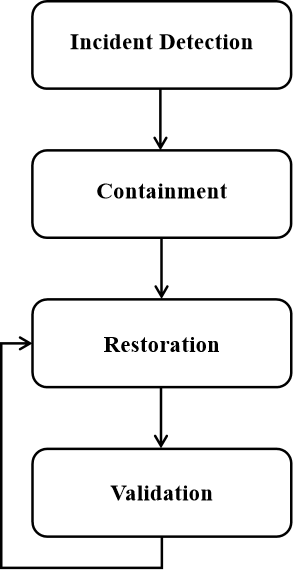
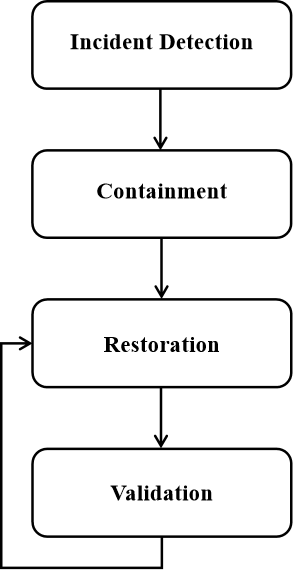
The defined roles operate within a structured disaster-recovery process those progresses through a series of sequential stages, from incident detection to full restoration and validation of services. This process ensures that each recovery phase is clearly delineated, accountable, and aligned with predefined objectives. Figure 3 and Figure 4 visualize these operational workflows and the technical interconnections within the Agency’s DRP framework. Specifically, Figure 3 illustrates the principal stages of the disaster-recovery cycle-spanning incident detection, containment, restoration, and post-recovery validation, showing the logical flow of activities and emphasizing the continuous feedback loops essential for performance improvement and organizational learning.
Flow Explanation:
1. Incident Detection: Early identification of an event that disrupts operations or compromises data integrity.
2. Containment: Isolation of affected systems to prevent escalation or secondary failures.
3. Restoration: Rebuilding of systems and services from verified backups or alternate environments.
4. Validation: Confirmation of full service integrity followed by documentation and reporting of lessons learned.
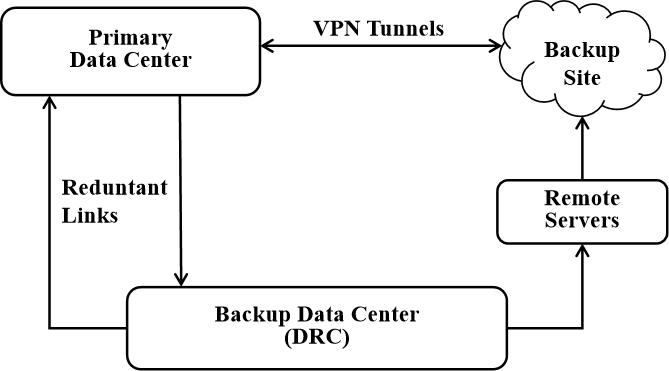
Following this sequence, the next Figure 4 illustrates how the Primary Data Center (PDC) connects with its Disaster Recovery Center (DRC) through redundant communication links and secure VPN tunnels. This configuration ensures that mission-critical information is continuously synchronized and can be efficiently restored, even in the event of a complete site outage.
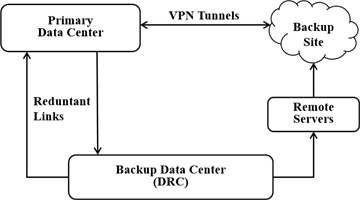
This figure illustrates the connectivity architecture between the Primary Data Center (PDC) and the Disaster Recovery Center (DRC). It shows how redundant communication channels and secure VPN tunnels maintain continuous synchronization of critical systems and databases.
3.4. Detailed Specification of the Agency Business Continuity (BC) and Disaster Recovery (DR) PlanEnsuring business continuity means maintaining the Agency’s ability to deliver essential services at an acceptable level after a disaster, cyber incident, or any significant interruption affecting people, facilities, or technology. Business Continuity (BC) coordinates human, technical, and procedural resources to sustain critical functions-often by relocating or restoring operations at an alternate site, when normal services are disrupted. Disaster Recovery (DR), in contrast, focuses on restoring the IT environment-infrastructure, data, and applications, after disruptive events such as natural hazards, cyber attacks, or systemic failures.
For a newly established institution handling sensitive public-sector data, a well-structured BC/DR capability is foundational to operational resilience. The framework minimizes downtime, protects information assets, maintains public trust, and supports rapid, orderly recovery. In line with international good practice (ISO 22301, ISO/IEC 27031, and NIST SP 800-34) 2, 3, 4, the Agency’s approach integrates governance, risk and impact assessment, recovery metrics (RTO/RPO), communications, and continuous improvement through training and testing.
BC and DR are interdependent: continuity strategies define acceptable downtime and service levels, while DR capabilities provide the technical means to meet those targets. Together, they ensure the Agency can adapt to short-term shocks and longer disruptions, sustain core functions, and mitigate financial and reputational impacts. The remainder of this section sets out (i) design principles and (ii) infrastructure options for a Backup Data Center / Disaster Recovery Center (DRC), followed by the current-state analysis and recommendations.
Modern continuity depends on a balanced mix of people, process, and technology. Because technology alone cannot assure continuity, the Agency must pair procedures and roles with suitable infrastructure for recovery. A Disaster Recovery Center (DRC) provides the controlled environment for data replication and system restoration, reducing downtime for mission-critical services.
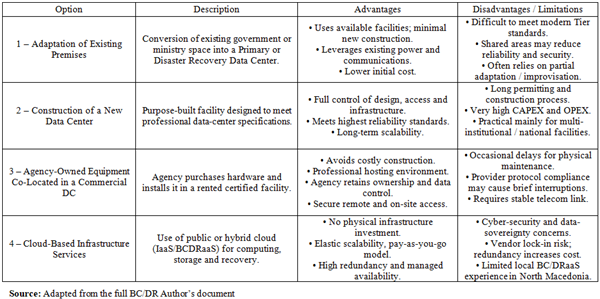
Four alternative configurations were assessed against cost, control, scalability, compliance, recovery performance, and local feasibility:
• Adaptation of Existing Premises (convert suitable government space into a PDC/DRC).
• Construction of a New Data Center (purpose-built to professional standards).
• Co-location of Agency-Owned Equipment in a certified commercial data center.
• Cloud-Based Infrastructure Services (public/hybrid cloud, including BCDR-as-a-Service).
A comparative summary of advantages and limitations appears in Table 6 – Comparative Analysis of Data-Center Options for Agency BC/DR Implementation (below). These options were evaluated with reference to recovery metrics (RTO/RPO), network resiliency (dual links, VPN, routing failover), data protection (backup/replication and integrity checks), and operational control-consistent with ISO 22301, ISO/IEC 27031, and NIST SP 800-34 guidelines 2, 3, 4.
Developing a robust strategy requires a Business Impact Analysis (BIA), risk assessment, clear roles, documented procedures, and cyclical testing/review. Supporting artifacts (contact trees, vendor registers, run books, and network/system diagrams) underpin execution quality.
Given the Agency’s Greenfield status (no existing primary or secondary data-center footprint), both a Primary Data Center (PDC) and a geographically separate DRC must be planned. Applying the criteria above and considering national ICT capacity, equipment pricing, staffing, and regulatory context, the following conclusions were reached:
• Recommended option: Co-location of Agency-Owned Equipment in a certified commercial data center for both PDC and DRC. This approach offers the best balance of control, security, compliance, and cost efficiency, while avoiding the long lead time and CAPEX of new construction and the data-sovereignty concerns and provider lock-in risks inherent to fully cloud-based models.
• Standards for the DRC:
○ Geographic separation (≥ 90 km from PDC) and, where feasible, a distinct seismic risk profile.
○ Dual independent telecom links to support continuous or near-real-time replication within defined RPO.
○ Dual power feeds with UPS and backup generation sized for critical loads.
○ Compute/storage sized to meet RTO/RPO targets for prioritized services.
○ Backup scheduling, integrity verification, and restoration testing aligned with SLAs.
The recommended configuration — the co-location of Agency-owned equipment in a certified commercial data center — preserves institutional control and ensures full data sovereignty. This model provides the Agency with direct ownership of its ICT assets while leveraging the physical security, power redundancy, and connectivity of a professionally managed facility. It minimizes the capital investment and long construction timelines associated with building a dedicated data center, while still providing the reliability and compliance required for public-sector operations.
Equally important, this approach strengthens internal technical capacity by keeping key BC/DR functions under the Agency’s management. Maintaining control over the recovery infrastructure enhances institutional knowledge of system interdependencies and accelerates decision-making during incidents. In contrast, complete outsourcing to cloud-based or third-party models can introduce dependencies that limit flexibility and delay critical recovery actions.
The co-location strategy also aligns with best-practice recommendations outlined in ISO 22301, ISO/IEC 27031, and NIST SP 800-34 2, 3, 4. These frameworks emphasize governance, risk awareness, and technical readiness as essential elements of continuity management. By retaining ownership of its infrastructure while hosting it in a professional environment, the Agency achieves a balanced combination of operational independence and technical resilience.
Overall, this recommendation establishes a sustainable path forward: one that safeguards data sovereignty, optimizes resources, and positions the Agency for future technological evolution. The following table (Table 6) summarizes the comparative assessment of the evaluated options, outlining their respective advantages, limitations, and suitability for the Agency’s Business Continuity and Disaster Recovery implementation.
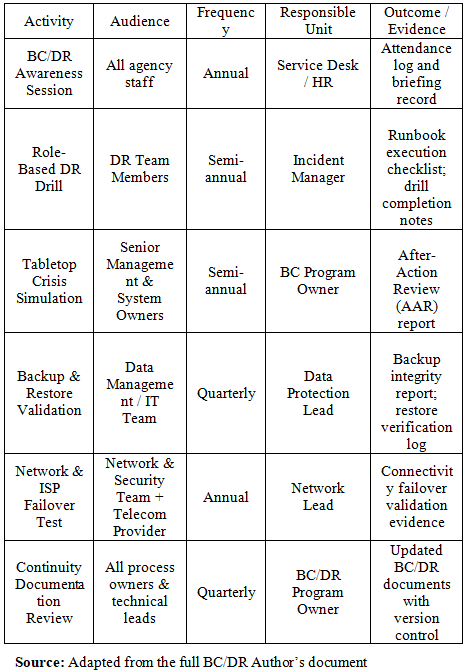
A structured training and awareness program ensures that all staff clearly understand their responsibilities during operational disruptions. Effective Business Continuity and Disaster Recovery (BC/DR) performance depends on continuous, role-specific training that strengthens coordination across teams, and maintains organizational readiness - summarized in Table 7.
This structured training and testing cycle ensures operational readiness, supports continual improvement, and reinforces institutional resilience across technical and administrative layers.
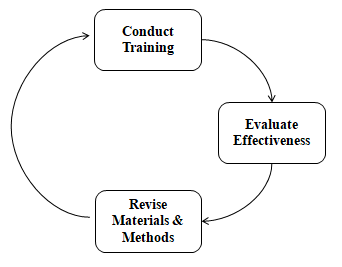
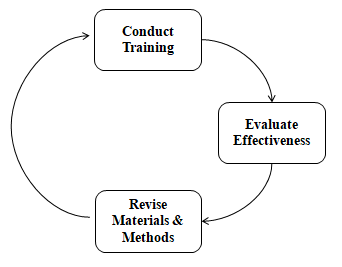
A clear governance and accountability structure ensures that BC/DR processes operate effectively during disruptions. Continuous competence development ensures that every employee understands their BC/DR responsibilities. The agency will organize structured training, live simulations, and quarterly plan reviews. Next Figure 5 illustrates the training review cycle for BC/DR plan.
This diagram depicts a closed loop of training (and testing) → evaluation → improvement. It emphasizes that preparedness is iterative rather than one-time.
The development of the draft Business Continuity and Disaster Recovery (BC/DR) plan underscores the critical role of institutional preparedness in achieving sustainable digital transformation within the public sector. The findings demonstrate that embedding continuity management at the earliest stages of an agency’s establishment significantly reduces operational risks, shortens recovery time, and strengthens long-term resilience.
A key insight from this case study is the importance of integrating technical recovery procedures with organizational governance and continuous staff training. Technology alone cannot guarantee resilience; effective BC/DR performance depends equally on well-defined roles, coordinated decision-making, and consistent institutional awareness.
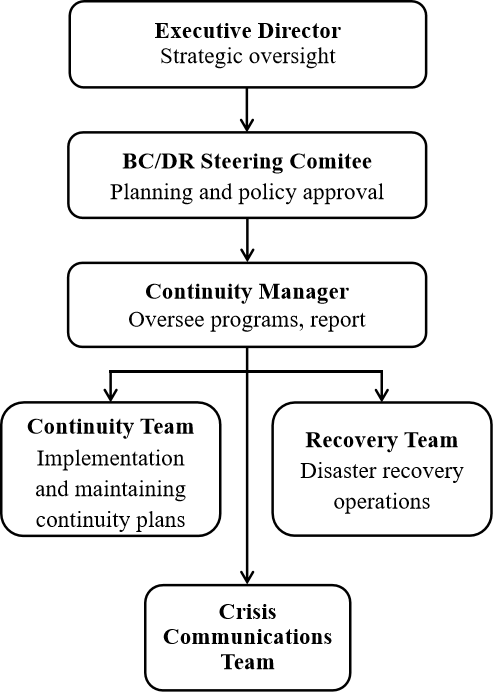
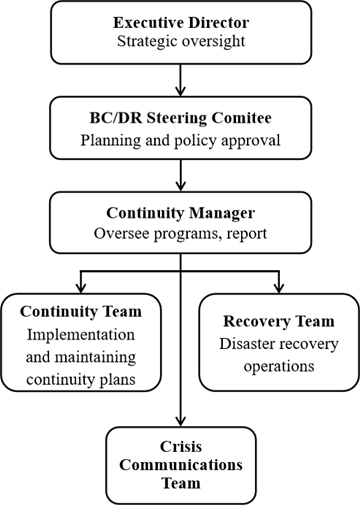
To ensure alignment between management oversight and technical execution, the Agency’s BC/DR framework incorporates a clear governance and accountability structure that supports coordination, communication, and performance evaluation during crisis situations. Next Figure 6 illustrates this governance hierarchy, outlining the relationships among management, continuity, and recovery teams. The structure promotes unified response, oversight, and transparent decision-making across all organizational layers, ensuring that responsibilities are clearly distributed and recovery activities are effectively monitored.
International frameworks such as ISO 22301 2 and NIST SP 800-34 4 emphasize similar governance integration, advocating for a holistic approach that combines business-impact analysis, resource management, and crisis communication. In practice, however, many public institutions fail to update or validate their BC/DR plans after initial implementation, leading to obsolescence and reduced preparedness. To prevent this, the proposed framework mandates annual reviews, periodic simulations, and after-action evaluations to maintain adaptability and continuous improvement.
In addition, the inclusion of cloud-based and hybrid recovery solutions provides scalability and cost efficiency suitable for budget-sensitive government agencies. This flexible model aligns with the broader goals of national digital-transformation strategies and encourages collaboration between institutions.
By applying lessons from international research and case studies-such as the methodologies described by Alexander & Wang (2024) 11-this study reinforces that proactive investment in continuity planning yields long-term benefits in operational stability, citizen trust, and public-sector resilience.
By applying lessons from global case studies, including methodologies described by Alexander & Wang (2024) 11, this paper shows that early investment in continuity planning yields long-term benefits for governance stability and data protection.
The proposed Business Continuity and Disaster Recovery (BC/DR) framework provides a structured foundation for ensuring resilience and operational stability within a government agency that needs to be established. It identifies critical functions, key risk scenarios, and recovery requirements while defining a governance model that supports coordinated implementation across organizational levels.
The structured methodology-drawing upon international standards such as ISO 22301 2 and NIST SP 800-34 4-ensures that essential operations can continue or be restored promptly following any major disruption. By integrating managerial oversight, technical recovery procedures, and continuous staff training, the framework enhances institutional preparedness and reinforces public trust in digital governance systems.
Key conclusions include:
• Developing BC/DR frameworks at the inception stage of an organization ensures long-term resilience and efficient crisis response.
• Applying structured methodologies supports the maintenance of essential services during both minor and large-scale disruptions.
• Taking into account the current situation in the country, the Recommended option is Co-location of Agency-Owned Equipment in a certified commercial data center for both PDC and DRC, but it should be also emphasized that Cloud-based and hybrid disaster-recovery models offer practical, scalable, and cost-effective options for public institutions with limited resources.
• Periodic testing, staff training, and document reviews are essential to maintaining plan relevance and ensuring adaptability over time.
• Strengthening coordination with national digital-governance bodies and cross-agency networks enhances interoperability and shared continuity capabilities.
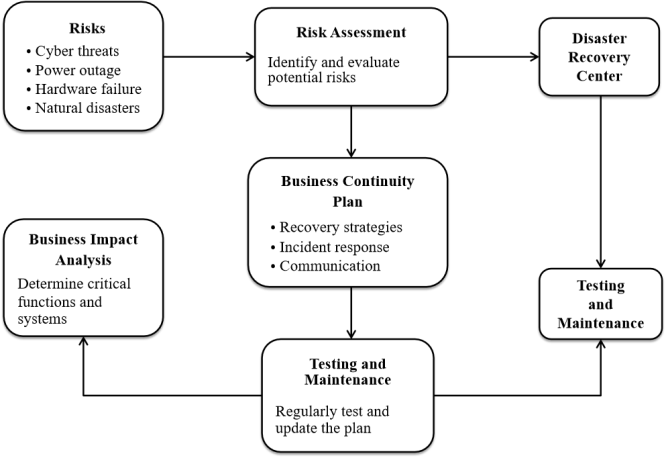
To illustrate how governance, operations, infrastructure, and training interconnect, Figure 7 presents the Agency’s comprehensive BC/DR eco system. The diagram integrates managerial oversight, technical recovery components, and continuous improvement into a single operational model. It shows how strategic coordination, procedural readiness, and infrastructure resilience sustain critical public services. Information flows, decision-making paths, and recovery linkages are mapped across organizational levels to ensure transparency, accountability, and timely escalation during disruptions.
By visualizing dependencies between teams, systems, and workflows, the figure clarifies roles, reduces ambiguity, and supports audits against ISO 22301 and NIST SP 800-34 principles. In short, Figure 7 provides a concise visual summary of the Agency’s BC/DR architecture—cohesive, adaptive, and designed for long-term resilience.
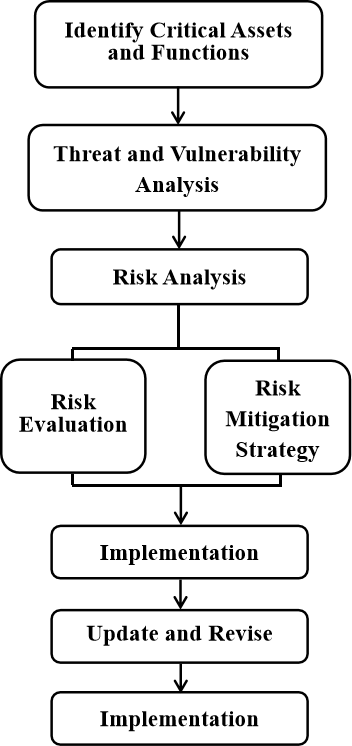
This figure presents an integrated view of the Agency’s Business Continuity and Disaster Recovery (BC/DR) ecosystem, combining governance, operational readiness, infrastructure safeguards, and continuous improvement mechanisms. The model illustrates how strategic oversight, organizational coordination, and technical resilience interact within a unified continuity framework.
The layered structure emphasizes that BC/DR effectiveness depends on ongoing feedback and adaptation, supported by periodic testing, simulation exercises, and regular plan updates. By embedding these components into everyday operations, the Agency ensures sustained readiness, compliance with international standards such as ISO 22301 2 and NIST SP 800-34 4, and long-term protection of mission-critical services.
Future enhancements to this framework may include the automation of recovery workflows, integration of cyber-resilience controls, and strengthened inter-agency collaboration to establish a coordinated national response capability.
The authors express their appreciation to colleagues and professionals in the field of information systems, ICT infrastructure, and business continuity whose research and shared experiences informed the development of this draft plan. The synthesis of best practices drawn from international frameworks such as ISO 22301 2 and NIST SP 800-34 4 has been instrumental in shaping the methodological approach of this work.
No specific financial support was received for this study, and all analyses and conclusions reflect the independent work and professional judgment of the authors.
The authors declare that they have no known financial, institutional, or personal conflicts of interest that could have influenced the research, analysis, or conclusions presented in this paper. All interpretations, evaluations, and recommendations were developed independently, based on publicly available information, professional experience, and the authors’ own analytical framework.
| [1] | Government of North Macedonia. National ICT Strategy for Digital Transformation, 2023-2027. https:// kind-bush-0f8b49503.2. azurestaticapps.net/ documents/ 34b557b4-13b8-45b4-a76c-c656eae345f0. | ||
| In article | |||
| [2] | ISO 22301: 2019. Security and Resilience – Business Continuity Management Systems – Requirements. ISO. https:// www.iso.org/ standard/75106.html. | ||
| In article | |||
| [3] | ISO/IEC 27031: 2025. Information Technology – Security Techniques – Guidelines for ICT Readiness for Business Continuity. https://www.iso.org/standard/44374.html. | ||
| In article | |||
| [4] | NIST SP 800-34 Rev. 1. Contingency Planning Guide for Federal Information Systems. National Institute of Standards and Technology, 2010. https:// csrc.nist.gov/ pubs/sp/ 800/ 34/r1/upd1/final. | ||
| In article | |||
| [5] | Business Continuity Plan Checklist. Alert Media. Available at: https://www.alertmedia.com/blog/business-continuity-plan-checklist/. | ||
| In article | |||
| [6] | Durham County Council. Small Business and Voluntary Organizations Business Continuity Plan Template. Available at: https://www.durham.gov.uk/media/888/Small-Business-and-Voluntary-Organisations-Business-Continuity-Plan/pdf/ Small Business And Voluntary Organization Business Continuity Template.pdf?m=635568457135400000. | ||
| In article | |||
| [7] | National Institute of Standards and Technology. Business Impact Analysis (BIA) Template. Available at: https:// csrc.nist.gov/ CSRC/ media/ Publications/sp/ 800-34/rev-1/final/ documents/ sp800-34-rev1_bia_template.docx. | ||
| In article | |||
| [8] | Marek, Z. (2013). Business Continuity / Disaster Recovery. Available at: http://defaultreasoning.com/2013/12/10/rpo-rto-wrt-mtdwth/. | ||
| In article | |||
| [9] | Hirsh, H., Coen, M.H., Mozer, M.C., Hasha, R., and Flanagan, J.L. (2002). “Room Service, AI-Style.” IEEE Intelligent Systems, 14 (2): 8–19. | ||
| In article | View Article | ||
| [10] | Disaster Recovery Plan Template (Basic). Available at: https://www.disasterrecoveryplantemplate.org/download/disaster-recovery-plan-template-basic/. | ||
| In article | |||
| [11] | Alexander, C.A., and Wang, L. (2024). “Recommending Solutions for Contingencies Including Business Impact Analysis, Continuity, and Disaster Recovery.” Information Security and Computer Fraud, 8 (1): 1–6, 2024. | ||
| In article | View Article | ||
Published with license by Science and Education Publishing, Copyright © 2025 Mile Mirchevski and Jana Mirchevska
 This work is licensed under a Creative Commons Attribution 4.0 International License. To view a copy of this license, visit
http://creativecommons.org/licenses/by/4.0/
This work is licensed under a Creative Commons Attribution 4.0 International License. To view a copy of this license, visit
http://creativecommons.org/licenses/by/4.0/
| [1] | Government of North Macedonia. National ICT Strategy for Digital Transformation, 2023-2027. https:// kind-bush-0f8b49503.2. azurestaticapps.net/ documents/ 34b557b4-13b8-45b4-a76c-c656eae345f0. | ||
| In article | |||
| [2] | ISO 22301: 2019. Security and Resilience – Business Continuity Management Systems – Requirements. ISO. https:// www.iso.org/ standard/75106.html. | ||
| In article | |||
| [3] | ISO/IEC 27031: 2025. Information Technology – Security Techniques – Guidelines for ICT Readiness for Business Continuity. https://www.iso.org/standard/44374.html. | ||
| In article | |||
| [4] | NIST SP 800-34 Rev. 1. Contingency Planning Guide for Federal Information Systems. National Institute of Standards and Technology, 2010. https:// csrc.nist.gov/ pubs/sp/ 800/ 34/r1/upd1/final. | ||
| In article | |||
| [5] | Business Continuity Plan Checklist. Alert Media. Available at: https://www.alertmedia.com/blog/business-continuity-plan-checklist/. | ||
| In article | |||
| [6] | Durham County Council. Small Business and Voluntary Organizations Business Continuity Plan Template. Available at: https://www.durham.gov.uk/media/888/Small-Business-and-Voluntary-Organisations-Business-Continuity-Plan/pdf/ Small Business And Voluntary Organization Business Continuity Template.pdf?m=635568457135400000. | ||
| In article | |||
| [7] | National Institute of Standards and Technology. Business Impact Analysis (BIA) Template. Available at: https:// csrc.nist.gov/ CSRC/ media/ Publications/sp/ 800-34/rev-1/final/ documents/ sp800-34-rev1_bia_template.docx. | ||
| In article | |||
| [8] | Marek, Z. (2013). Business Continuity / Disaster Recovery. Available at: http://defaultreasoning.com/2013/12/10/rpo-rto-wrt-mtdwth/. | ||
| In article | |||
| [9] | Hirsh, H., Coen, M.H., Mozer, M.C., Hasha, R., and Flanagan, J.L. (2002). “Room Service, AI-Style.” IEEE Intelligent Systems, 14 (2): 8–19. | ||
| In article | View Article | ||
| [10] | Disaster Recovery Plan Template (Basic). Available at: https://www.disasterrecoveryplantemplate.org/download/disaster-recovery-plan-template-basic/. | ||
| In article | |||
| [11] | Alexander, C.A., and Wang, L. (2024). “Recommending Solutions for Contingencies Including Business Impact Analysis, Continuity, and Disaster Recovery.” Information Security and Computer Fraud, 8 (1): 1–6, 2024. | ||
| In article | View Article | ||