This study investigates the role of psychological capital (PsyCap) as a mediator between gender identity expression and English academic achievement among secondary school students in India. Using a cross-sectional quantitative design, data were collected from 320 secondary school students (ages 13–17) from government-sponsored schools in West Bengal through stratified random sampling. Gender identity expression was assessed using the newly developed and validated Gender Identity Expression Questionnaire (GIEQ; 10 items, 4-point Likert scale), PsyCap was measured using a standardized assessment scale, and English achievement was evaluated through a curriculum-aligned test. Structural Equation Modeling (SEM) was employed to test the proposed mediation model. The GIEQ demonstrated excellent internal consistency (Cronbach's α = .946) and strong construct validity confirmed by EFA (single factor; eigenvalue = 6.733; variance explained = 67.33%; KMO = .966) and CFA (χ²(35) = 36.388, p = .404; CFI = .999; RMSEA = .011). SEM results revealed that gender identity expression significantly predicted PsyCap (β = .911, p < .001) and PsyCap significantly predicted English achievement (β = .905, p < .001). The direct effect of gender identity expression on English achievement was non-significant (β = −.004, p = .951), while the indirect effect through PsyCap was significant (standardized indirect effect = .824, p < .001), indicating full mediation. These findings underscore the importance of inclusive, strength-based educational environments that support the psychological well-being of all learners.
The academic and psychological experiences of school students are shaped by multiple identity dimensions, among which gender identity plays a subtle yet crucial role. In recent years, increasing attention has been given to students who do not strictly identify with binary gender norms. These individuals may exhibit gender-fluid or non-binary traits which, though not always explicitly expressed, can influence their self-perception, social interactions, and academic outcomes 1 2.
Simultaneously, psychological capital (PsyCap)—a positive psychological construct encompassing hope, efficacy, resilience, and optimism—has emerged as a significant predictor of academic motivation, well-being, and performance 3. Within the school context, students who possess strong psychological resources often demonstrate greater engagement and achievement, particularly in subjects like English, which require confidence, expressive ability, and sustained effort 4 5.
Despite growing global interest in gender-diverse student experiences and the documented role of PsyCap in education, Indian research in this domain remains limited. Most studies exploring gender identity and academic outcomes originate from Western contexts, leaving the unique sociocultural environment of Indian schools largely unexamined 6 7. Critically, no study to date has empirically tested whether PsyCap mediates the relationship between gender identity expression and academic achievement in English among Indian secondary school students. The present study aims to fill this gap by employing Structural Equation Modeling (SEM) to test a theoretically grounded mediation model.
1.1. Gender Identity and EducationGender identity—defined as an individual's deeply held, internal sense of their own gender, which may or may not correspond to the sex assigned at birth—significantly influences students' academic journeys, affecting their self-concept, engagement, and school performance 8. Traditional educational frameworks often operate on binary gender norms, overlooking the individual needs and strengths of non-binary or gender non-conforming students 9. When students' gender identities are unacknowledged or marginalized within institutional structures, their psychological well-being and academic motivation are adversely affected. Inclusive educational settings, by contrast, have been shown to foster better psychological adjustment and learning outcomes for gender-diverse students 10.
1.2. Non-Binary Inclinations in School SettingsNon-binary adolescents—those who do not exclusively identify as male or female but situate their gender identity outside or between these conventional categories—and gender-fluid adolescents—those whose gender identity shifts or fluctuates across a spectrum of expressions over time—often exhibit heightened emotional intelligence and empathy as a consequence of the complex social challenges they navigate 11. The lived experience of negotiating identity in environments structured around binary norms can foster advanced coping strategies and resilience 12, which may in turn manifest as adaptive academic behaviors such as greater persistence, creativity, and perspective-taking. These psychological traits position non-binary and gender-fluid students as unique contributors to diverse educational environments 13.
1.3. Psychological Capital and Academic LearningPsyCap, comprising hope, efficacy, resilience, and optimism, has been extensively linked with positive academic outcomes 3. Students with high PsyCap are more likely to persist in challenging academic tasks and demonstrate improved motivation and goal attainment 14. Recent studies have reaffirmed its role in promoting both academic performance and emotional well-being among school-aged children 15.
1.4. PsyCap and Gender IdentityResearch indicates a potential correlation between gender diversity and psychological flexibility. Non-binary students, by virtue of navigating complex social identities, may develop higher levels of emotional adaptability, contributing to enhanced PsyCap 16. However, empirical studies explicitly examining the link between gender identity expression and PsyCap in Indian adolescents remain sparse, marking a clear research gap 7.
1.5. English A.chievement and Psychological FactorsAcademic achievement in English, particularly among ESL learners, is strongly influenced by psychological constructs such as motivation, confidence, and resilience 17. Students with higher self-efficacy and optimism perform better in language acquisition tasks 18, and PsyCap has been identified as a contributing factor in developing sustained engagement with language learning 4.
1.6. Study ObjectivesBased on the foregoing review, the present study pursued the following objectives:
(1) To assess the level of gender identity expression among secondary school students.
(2) To measure the psychological capital and English academic achievement of the students.
(3) To examine whether gender identity expression predicts psychological capital.
(4) To examine whether psychological capital predicts English academic achievement.
(5) To test whether psychological capital mediates the relationship between gender identity expression and English academic achievement.
1.7. Research HypothesesH1: Gender identity expression significantly predicts psychological capital.
H2: Psychological capital significantly predicts English academic achievement.
H3: Psychological capital mediates the relationship between gender identity expression and English academic achievement.
This study employed a quantitative, cross-sectional research design, which was optimal for efficiently examining the concurrent relationships between variables within a large sample at a single point in time. Structural Equation Modeling (SEM) was used to test the proposed mediation model involving gender identity expression, psychological capital, and English academic achievement.
2.2. ParticipantsA total of 320 secondary school students (ages 13–17; M = 15.2 years, SD = 1.3) were recruited from government-sponsored secondary schools in West Bengal, India, using stratified random sampling. The sample comprised 168 male students (52.5%) and 152 female students (47.5%), drawn from Class IX and Class X across three school districts. Stratification was based on school district and grade level to ensure representative coverage. Only students with complete and valid responses were included in the final analysis (0% missing data).
2.3. InstrumentsThree instruments were administered:
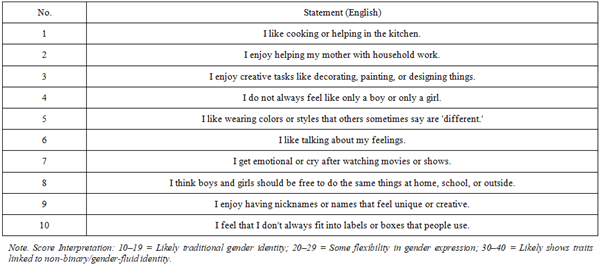
Gender Identity Expression Questionnaire (GIEQ): A 10-item self-report scale developed and validated for this study (see Appendix A for full instrument). Items were rated on a 4-point Likert scale (1 = Never True, 2 = Sometimes True, 3 = Often True, 4 = Always True), yielding total scores ranging from 10 to 40. Higher scores indicate stronger endorsement of non-binary or gender-flexible traits. The instrument was prepared in bilingual format (English and Bengali) to ensure accessibility for all participants.
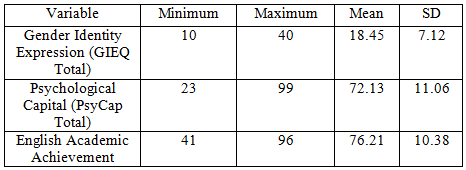
Psychological Capital Assessment Scale: Developed by Reena and Choudhary 19, this standardized tool measures four core dimensions of PsyCap—hope, efficacy, resilience, and optimism—yielding both subscale and composite scores. Total scores ranged from 23 to 99 in the present sample.
English Achievement Test: A curriculum-aligned test prepared in accordance with the West Bengal Board of Secondary Education syllabus, assessing students' academic performance in English. Scores ranged from 41 to 96 in the present sample.
2.4. Data Collection ProcedureData were collected during April 2025 through structured school visits conducted by trained research assistants. Prior to data collection, institutional approval was obtained from each participating school and from the Lovely Professional University Internal Ethics Committee (Approval No. LPU/ IEC/ EDU/ 2025-32). Written informed consent was secured from parents or guardians, and written assent was obtained from all student participants. All participants were assured of anonymity and confidentiality. Completion of the instruments took approximately 45–60 minutes per session.
2.5. Statistical AnalysisDescriptive statistics and reliability analysis were performed using IBM SPSS Statistics (Version 26). Exploratory Factor Analysis (EFA) was conducted using Principal Component Analysis (PCA) with Varimax rotation. Confirmatory Factor Analysis (CFA) and Structural Equation Modeling (SEM) were performed using IBM AMOS (Version 26). Model fit was evaluated using: Chi-square (χ²), CMIN/DF, CFI, TLI (rho2), RMSEA (with 90% CI and PCLOSE), GFI, and AGFI. Mediation was assessed through direct and indirect path coefficients within SEM. Standardized regression weights (β) are reported throughout. Acceptable fit thresholds were: CMIN/DF ≤ 3, CFI ≥ .95, TLI ≥ .95, RMSEA ≤ .08, GFI ≥ .90 20.
Descriptive statistics were computed for all three primary study variables. As shown in Table 1, students demonstrated moderately high mean scores in psychological capital and English achievement, with a diverse distribution of gender-related trait scores.
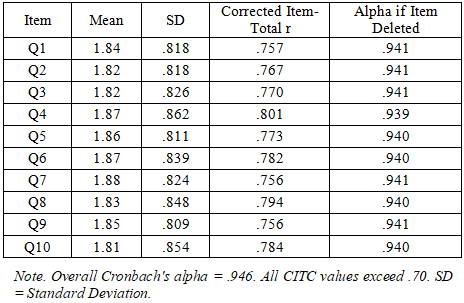
The internal consistency of the GIEQ was assessed using Cronbach's alpha coefficient. The scale demonstrated excellent reliability (α = .946, N items = 10). Item-level descriptive statistics and corrected item-total correlations (CITC) are presented in Table 2. All CITC values exceeded the recommended threshold of .70 21, and no item, if deleted, would substantially improve the overall alpha (minimum alpha if deleted = .939), confirming the contribution of each item to scale integrity.
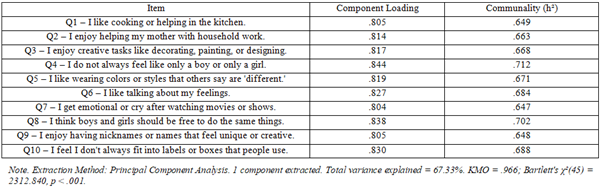
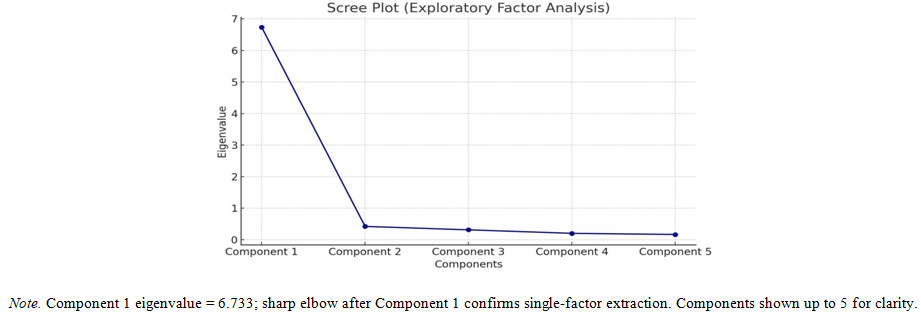
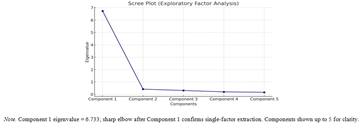
To examine the factor structure of the GIEQ, EFA using PCA with Varimax rotation was conducted on all 10 items. The Kaiser–Meyer–Olkin (KMO) measure of sampling adequacy was .966, and Bartlett's Test of Sphericity was significant (χ²(45) = 2312.840, p < .001), confirming the suitability of the data for factor analysis. A single component with an eigenvalue greater than 1 was extracted (eigenvalue = 6.733), accounting for 67.33% of the total variance. The scree plot (Figure 1) confirms the clear break after the first component. Factor loadings for all items exceeded .80 (range: .804–.844), as presented in Table 3.
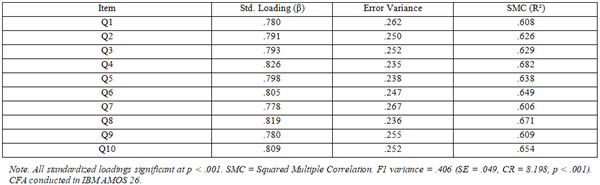
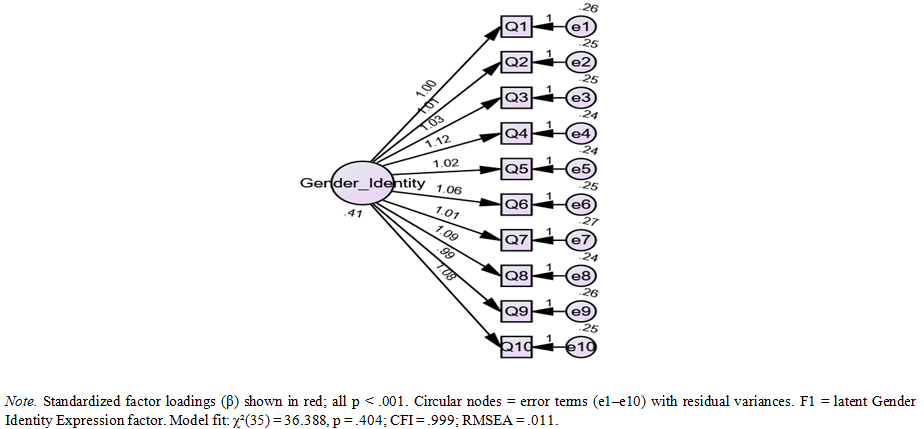
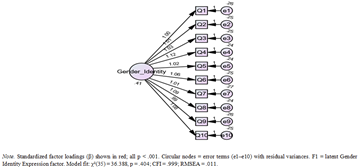
CFA was conducted in AMOS to validate the unidimensional factor structure of the GIEQ. The model specified a single latent construct (F1) indicated by Q1–Q10. All model fit indices met or exceeded recommended thresholds 20, confirming excellent model fit. The standardized factor loadings, error variances, and squared multiple correlations are presented in Table 4
CFA Model Fit: χ²(35) = 36.388, p = .404; CMIN/DF = 1.040; NFI = .984; CFI = .999; TLI = .999; RMSEA = .011 (90% CI: .000–.042); PCLOSE = .987; GFI = .979; AGFI = .967; RMR = .011.
All items demonstrated strong standardized factor loadings (range: .778–.826), well above the recommended minimum of .70. Modification indices indicated no substantively meaningful misspecification (largest MI = 7.21 for e1↔e5 covariance). The CFA path diagram is presented in Figure 2.
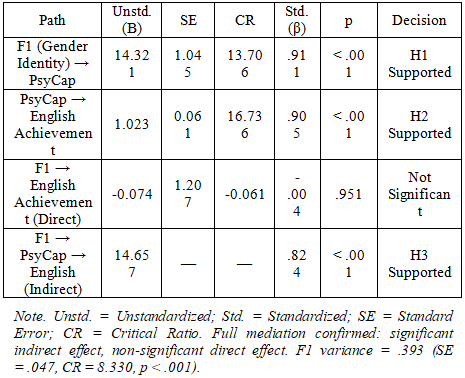
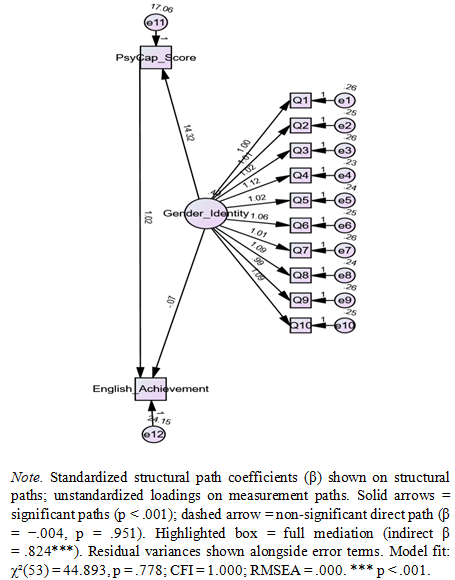
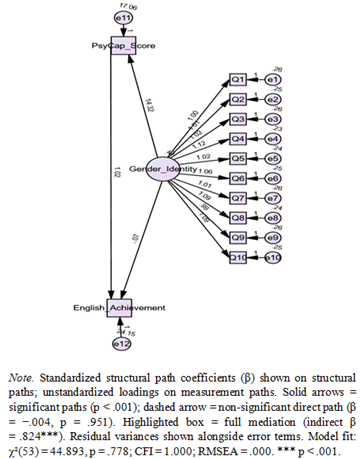
To test the hypothesized mediation model, SEM was conducted in AMOS with gender identity expression (latent variable F1, indicated by Q1–Q10) as the exogenous variable, PsyCap as the observed mediator, and English achievement as the observed outcome. The model showed excellent fit across all indices. The path coefficients for the mediation model are presented in Table 5.
SEM Model Fit: χ²(53) = 44.893, p = .778; CMIN/DF = 0.847; CFI = 1.000; TLI = 1.003; RMSEA = .000 (90% CI: .000–.025); PCLOSE = 1.000; GFI = .978; AGFI = .968.
Gender identity expression significantly predicted PsyCap (β = .911, p < .001), supporting H1. PsyCap significantly predicted English achievement (β = .905, p < .001), supporting H2. The direct path from gender identity expression to English achievement was non-significant (β = −.004, p = .951). The indirect path through PsyCap was significant (standardized indirect effect = .824, p < .001), confirming full mediation and supporting H3. The full SEM mediation path diagram is presented in Figure 3.
The present study explored how gender identity expression among Indian secondary school students predicts psychological capital and how PsyCap, in turn, influences English academic achievement. The finding of a significant positive relationship between gender identity expression and PsyCap (H1 supported; β = .911) suggests that students endorsing higher levels of non-binary or gender-flexible traits—such as emotional sensitivity, empathy, and social flexibility—also tend to possess greater hope, efficacy, resilience, and optimism. This finding aligns with prior research indicating that non-binary individuals often develop enhanced psychological coping mechanisms through the experience of navigating complex social identities Current Sexual Health Reports, 9(3), 116-120, 2017." class="coltj"> 11, American Journal of Preventive Medicine, 55(6), 787-794, 2018." class="coltj"> 16.
The significant positive impact of PsyCap on English achievement (H2 supported; β = .905) reaffirms the well-established role of internal psychological strengths in promoting academic success, particularly in subjects that demand sustained expression, creativity, and effort 3 4. Students with greater psychological capital appear more confident, goal-oriented, and optimistic in their approach to language learning, consistent with prior findings in the ESL and EFL literature 17 18.
The most notable contribution of this study is the demonstration of full mediation by PsyCap (H3 supported; indirect β = .824). The non-significant direct path and the highly significant indirect path collectively indicate that gender identity expression does not independently influence English achievement; rather, its effect is fully transmitted through the psychological resources that gender-flexible students tend to develop. This finding suggests that identity-related challenges may inadvertently serve as a catalyst for the development of resilience and self-efficacy, which ultimately facilitate academic performance 11 12.
The excellent psychometric properties of the newly developed GIEQ (α = .946; single-factor structure; KMO = .966; all CFA loadings ≥ .778; RMSEA = .011) represent a methodological contribution of the study. The instrument addresses a notable gap in the Indian educational assessment literature by providing a culturally adapted, psychometrically sound tool for measuring gender identity expression among adolescents.
These results have important implications for inclusive education. When students across the gender identity spectrum are affirmed and supported, they are more likely to cultivate the psychological resources that contribute to academic engagement and achievement. Schools and educators that create psychologically safe environments may therefore enable gender-diverse students to leverage their unique identity experiences as sources of academic strength 8 10. These findings add to a growing body of evidence calling for inclusive, strength-based approaches in Indian educational settings 6 21.
This study provides empirical evidence that psychological capital fully mediates the relationship between gender identity expression and English academic achievement among secondary school students in West Bengal, India. Students who display non-binary or gender-flexible traits appear to develop stronger psychological resources—hope, efficacy, resilience, and optimism—which in turn drive their academic performance in English.
Importantly, this study introduced and validated the Gender Identity Expression Questionnaire (GIEQ), a reliable and psychometrically sound 10-item instrument (Cronbach's α = .946; single-factor; 67.33% variance explained; all CFA standardized loadings ≥ .778; CFI = .999; RMSEA = .011) suitable for use with Indian adolescent populations.
5.2. RecommendationsBased on these findings, schools are encouraged to implement programs that actively develop students' PsyCap—through activities promoting goal-setting, optimism, self-efficacy, and resilience—while simultaneously fostering gender-inclusive environments. Teacher training programs should sensitize educators to the psychological and academic needs of gender-diverse students, and school counselling services should be equipped to offer targeted, empathetic support.
Future research should consider longitudinal designs to examine whether PsyCap development precedes or follows shifts in gender identity expression. The model should be tested across broader geographic and cultural contexts within India, extended to other academic subjects and school levels, and examined using bootstrap-based mediation testing to provide confidence intervals for indirect effects. Experimental studies examining the causal mechanisms underlying these associations would also strengthen the evidence base.
The authors sincerely thank the headmasters, teachers, and staff of the participating government-sponsored secondary schools in West Bengal for their cooperation during data collection. Special appreciation is extended to the parents of the student participants for their trust and informed consent, and to the students themselves for their willing participation.
The authors declare that they have no relevant financial or non-financial interests to disclose.
Funding: No funding was received for conducting this study.
Competing interests: The authors declare that they have no relevant financial or non-financial interests to disclose.
Ethics approval: This study was approved by the Lovely Professional University Internal Ethics Committee (Approval Memo No. LPU/IEC/EDU/2025-32, dated 31 July 2025). All procedures were conducted in accordance with the ethical standards of the 1964 Declaration of Helsinki and its later amendments.
Consent to participate: Written informed consent was obtained from all participating parents. Written assent was obtained from all student participants.
Consent to publish: Participants provided informed consent for the use of anonymised data in publication.
Data availability: The anonymised dataset is available from the corresponding author upon reasonable request, subject to ethical constraints protecting participant confidentiality.
Research Involving Human Participants: This study involved human participants and was conducted in accordance with approved ethical procedures.
Clinical Trial Number: Not applicable.
Declaration of Ethical Use of Artificial Intelligence
Artificial intelligence (AI)-assisted tools were used in a limited and responsible manner to support language editing, formatting refinement, and improvement of clarity during manuscript preparation. AI tools were not used for data collection, data analysis, statistical interpretation, generation of results, or formulation of the study's core scientific conclusions. All research design decisions, methodological procedures, interpretation of findings, and final content were independently reviewed, verified, and approved by the authors, who take full responsibility for the accuracy, integrity, and originality of this manuscript.
AGFI: Adjusted Goodness-of-Fit Index
AMOS: Analysis of Moment Structures
CFA: Confirmatory Factor Analysis
CFI: Comparative Fit Index
CITC: Corrected Item-Total Correlation
CMIN/DF: Chi-square to degrees-of-freedom ratio
CR: Critical Ratio
EFA: Exploratory Factor Analysis
ESL: English as a Second Language
GFI: Goodness-of-Fit Index
GIEQ: Gender Identity Expression Questionnaire
KMO: Kaiser–Meyer–Olkin
NFI: Normed Fit Index
PCA: Principal Component Analysis
PsyCap: Psychological Capital
RMSEA: Root Mean Square Error of Approximation
SEM: Structural Equation Modeling
SMC: Squared Multiple Correlation
TLI: Tucker–Lewis Index
Title: Understanding Self and Preferences
Instructions: Read each sentence carefully. Tick the option that shows how true it is for you. There are no right or wrong answers. Please answer honestly.
Response options: 4 = Always True, 3 = Often True, 2 = Sometimes True, 1 = Never True
| [1] | Smith, J.M., and Watson, C., "School climate and the experiences of gender-nonconforming students: Implications for inclusive education," International Journal of Educational Research, 96, 137-146, 2019. | ||
| In article | |||
| [2] | Ghosh, S., and Chatterjee, T., "Role of gender identity awareness in promoting adolescent mental health," Journal of Youth and Adolescence, 49(3), 44-52, 2020. | ||
| In article | |||
| [3] | Luthans, F., Youssef, C.M., and Avolio, B.J., Psychological Capital: Developing the Human Competitive Edge, Oxford University Press, New York, 2007. | ||
| In article | |||
| [4] | Choudhury, A., and Kumar, S., "Psychological capital and English language learning: A study on secondary school learners," Journal of Educational Research and Practice, 11(3), 15-20, 2021. | ||
| In article | |||
| [5] | Ali, S., and Das, P., "Role of psychological capital in language proficiency among high school learners," Asian Journal of Education and Social Studies, 23(4), 55-62, 2021. | ||
| In article | |||
| [6] | Bhattacharya, A., "Bridging gaps in gender equity and school practices in India," South Asian Review of Education, 9(2), 112-119, 2020. | ||
| In article | |||
| [7] | Banerjee, R., and Mukherjee, S., "Exploring psychological resilience among gender non-conforming adolescents in India," Indian Journal of Psychology and Education, 12(1), 45-52, 2022. | ||
| In article | |||
| [8] | Knutson, D., "Educating beyond the binary: A pedagogical imperative," Journal of Gender and Education, 32(6), 807-820, 2020. | ||
| In article | |||
| [9] | Dutta, M., "Gender stereotypes and schooling: A case for curriculum reform," Educational Studies Review, 15(4), 133-142, 2021. | ||
| In article | |||
| [10] | Jones, B.A., Bouman, W.P., and Arcelus, J., "Gender identity, academic engagement, and educational wellbeing: A review," Journal of LGBT Youth, 18(2), 97-116, 2021. | ||
| In article | |||
| [11] | Matsuno, E., and Budge, S.L., "Non-binary/genderqueer identities: A critical review of the literature," Current Sexual Health Reports, 9(3), 116-120, 2017. | ||
| In article | View Article | ||
| [12] | Singh, A.A., "Transgender youth of color and resilience: Negotiating oppression and finding support," Journal of Humanistic Counseling, 52(1), 2-14, 2013. | ||
| In article | |||
| [13] | Erickson-Schroth, L. (Ed.), Trans Bodies, Trans Selves: A Resource for the Transgender Community, Oxford University Press, New York, 2014. | ||
| In article | |||
| [14] | Sweetman, D., Luthans, F., Avey, J.B., and Luthans, B.C., "Relationship between positive psychological capital and creative performance," Canadian Journal of Administrative Sciences, 28(1), 4-13, 2011. | ||
| In article | View Article | ||
| [15] | Kim, Y., and Park, H., "The effects of psychological capital on learning flow and academic achievement in middle school students," Educational Psychology International, 9(1), 23-35, 2018. | ||
| In article | |||
| [16] | Gower, A.L., Rider, G.N., Brown, C., McMorris, B.J., Coleman, E., and Eisenberg, M.E., "Supporting transgender and gender diverse youth: Protection against emotional distress and substance use," American Journal of Preventive Medicine, 55(6), 787-794, 2018. | ||
| In article | View Article PubMed | ||
| [17] | Dornyei, Z., The Psychology of the Language Learner: Individual Differences in Second Language Acquisition, Routledge, London, 2005. | ||
| In article | |||
| [18] | Zhao, J., and Wang, Y., "Self-efficacy and optimism as predictors of academic success among ESL students," Journal of Language Teaching and Research, 11(5), 812-819, 2020. | ||
| In article | |||
| [19] | Reena, R., and Choudhary, M., Manual of Psychological Capital Assessment Scale, National Psychological Corporation, Agra, 2020. | ||
| In article | |||
| [20] | Hu, L.T., and Bentler, P.M., "Cutoff criteria for fit indexes in covariance structure analysis: Conventional criteria versus new alternatives," Structural Equation Modeling: A Multidisciplinary Journal, 6(1), 1-55, 1999. | ||
| In article | View Article | ||
| [21] | Nunnally, J.C., and Bernstein, I.H., Psychometric Theory (3rd ed.), McGraw-Hill, New York, 1994. | ||
| In article | |||
Published with license by Science and Education Publishing, Copyright © 2026 Palash Majumder, Nimisha Beri and Parimal Sarkar
 This work is licensed under a Creative Commons Attribution 4.0 International License. To view a copy of this license, visit
http://creativecommons.org/licenses/by/4.0/
This work is licensed under a Creative Commons Attribution 4.0 International License. To view a copy of this license, visit
http://creativecommons.org/licenses/by/4.0/
| [1] | Smith, J.M., and Watson, C., "School climate and the experiences of gender-nonconforming students: Implications for inclusive education," International Journal of Educational Research, 96, 137-146, 2019. | ||
| In article | |||
| [2] | Ghosh, S., and Chatterjee, T., "Role of gender identity awareness in promoting adolescent mental health," Journal of Youth and Adolescence, 49(3), 44-52, 2020. | ||
| In article | |||
| [3] | Luthans, F., Youssef, C.M., and Avolio, B.J., Psychological Capital: Developing the Human Competitive Edge, Oxford University Press, New York, 2007. | ||
| In article | |||
| [4] | Choudhury, A., and Kumar, S., "Psychological capital and English language learning: A study on secondary school learners," Journal of Educational Research and Practice, 11(3), 15-20, 2021. | ||
| In article | |||
| [5] | Ali, S., and Das, P., "Role of psychological capital in language proficiency among high school learners," Asian Journal of Education and Social Studies, 23(4), 55-62, 2021. | ||
| In article | |||
| [6] | Bhattacharya, A., "Bridging gaps in gender equity and school practices in India," South Asian Review of Education, 9(2), 112-119, 2020. | ||
| In article | |||
| [7] | Banerjee, R., and Mukherjee, S., "Exploring psychological resilience among gender non-conforming adolescents in India," Indian Journal of Psychology and Education, 12(1), 45-52, 2022. | ||
| In article | |||
| [8] | Knutson, D., "Educating beyond the binary: A pedagogical imperative," Journal of Gender and Education, 32(6), 807-820, 2020. | ||
| In article | |||
| [9] | Dutta, M., "Gender stereotypes and schooling: A case for curriculum reform," Educational Studies Review, 15(4), 133-142, 2021. | ||
| In article | |||
| [10] | Jones, B.A., Bouman, W.P., and Arcelus, J., "Gender identity, academic engagement, and educational wellbeing: A review," Journal of LGBT Youth, 18(2), 97-116, 2021. | ||
| In article | |||
| [11] | Matsuno, E., and Budge, S.L., "Non-binary/genderqueer identities: A critical review of the literature," Current Sexual Health Reports, 9(3), 116-120, 2017. | ||
| In article | View Article | ||
| [12] | Singh, A.A., "Transgender youth of color and resilience: Negotiating oppression and finding support," Journal of Humanistic Counseling, 52(1), 2-14, 2013. | ||
| In article | |||
| [13] | Erickson-Schroth, L. (Ed.), Trans Bodies, Trans Selves: A Resource for the Transgender Community, Oxford University Press, New York, 2014. | ||
| In article | |||
| [14] | Sweetman, D., Luthans, F., Avey, J.B., and Luthans, B.C., "Relationship between positive psychological capital and creative performance," Canadian Journal of Administrative Sciences, 28(1), 4-13, 2011. | ||
| In article | View Article | ||
| [15] | Kim, Y., and Park, H., "The effects of psychological capital on learning flow and academic achievement in middle school students," Educational Psychology International, 9(1), 23-35, 2018. | ||
| In article | |||
| [16] | Gower, A.L., Rider, G.N., Brown, C., McMorris, B.J., Coleman, E., and Eisenberg, M.E., "Supporting transgender and gender diverse youth: Protection against emotional distress and substance use," American Journal of Preventive Medicine, 55(6), 787-794, 2018. | ||
| In article | View Article PubMed | ||
| [17] | Dornyei, Z., The Psychology of the Language Learner: Individual Differences in Second Language Acquisition, Routledge, London, 2005. | ||
| In article | |||
| [18] | Zhao, J., and Wang, Y., "Self-efficacy and optimism as predictors of academic success among ESL students," Journal of Language Teaching and Research, 11(5), 812-819, 2020. | ||
| In article | |||
| [19] | Reena, R., and Choudhary, M., Manual of Psychological Capital Assessment Scale, National Psychological Corporation, Agra, 2020. | ||
| In article | |||
| [20] | Hu, L.T., and Bentler, P.M., "Cutoff criteria for fit indexes in covariance structure analysis: Conventional criteria versus new alternatives," Structural Equation Modeling: A Multidisciplinary Journal, 6(1), 1-55, 1999. | ||
| In article | View Article | ||
| [21] | Nunnally, J.C., and Bernstein, I.H., Psychometric Theory (3rd ed.), McGraw-Hill, New York, 1994. | ||
| In article | |||