This study looks at how male and female Social Studies instructors in the Kumasi Metropolitan Assembly feel about how acceptable present Senior High School Social Studies themes are for national development. The study used a quantitative design using a descriptive cross-sectional survey method based on Social Role Theory and Curriculum Appropriateness Theory. The researcher used proportionate stratified random sampling to get a sample of 245 teachers, 163 men and 82 women. Descriptive statistics and Chi-square tests were used to look at the data. The results showed that most teachers agreed that the curriculum helps the country grow. However, there were statistically significant variations between males and females in how they felt about certain issues, such as socialisation. It is interesting to note that The Youth and National Development and The World of Work and Entrepreneurship got excellent marks, but Science and Technology was seen as less relevant. These results show that we need to change the curriculum to make it more inclusive and get teachers involved to make the Social Studies program more responsive to the needs of students, more sensitive to gender issues, and more focused on development. The study gives important information for making decisions on education policy, creating new curricula, and training teachers in Ghana and places like it.
Background of the Study
Curriculum effectiveness is largely contingent upon the perspectives of the teachers who implement it. In Ghana, the ongoing socio-cultural transformation and the increasing call for inclusive education necessitate a critical appraisal of how gender influences curriculum interpretation and delivery. While Social Studies has long been positioned as a cornerstone for civic engagement and national consciousness, limited empirical research exists on how male and female teachers assess the relevance of its thematic components to national development. Given that teachers’ interpretations significantly affect pedagogical priorities and learner outcomes, understanding their gendered perspectives becomes imperative for effective curriculum development and implementation. This research responds to an urgent academic and policy need to ensure that educational reforms are grounded in contextually relevant, gender-sensitive evidence.
Social Studies is an important part of Ghana's Senior High School (SHS) curriculum. It is intended to help people feel like they belong to a community, develop a sense of national identity, get involved in civic life, and work towards long-term development. Social Studies is planned to give students the knowledge, skills, values, and attitudes they need to solve national problems like low civic engagement, corruption, inequality, and environmental degradation. This is because it is based on the need to create knowledgeable, responsible, and engaged citizens 1. The Social Studies curriculum includes topics like rights and responsibilities, governance, national integration and development, and using resources in a way that doesn't harm the environment. These topics were chosen on purpose to support national goals and encourage all-around national growth 2.
People still debate on how useful the curriculum is, especially when it comes to how effectively the current Social Studies curriculum meets the needs of the country's growth. Teachers have practical experience and understanding of the subject matter that affect how it is taught and understood because they are the ones who carry out the curriculum Eisner, 3, 4. Also, researchers are looking more closely at how gender affects how instructors see the curriculum, especially in places like Ghana where society and culture are always changing 5. Male and female teachers may have different views on how well the curriculum can make citizens who are developmentally focused.
In the Kumasi Metropolitan Assembly, which is a district in the Ashanti Region that is both urban and has a wide range of social and economic backgrounds, senior high school teachers educate young people to grasp the national development goals through Social Studies. There hasn't been any meaningful research done to find out if male and female teachers have different ideas about how appropriate the curriculum is. This study tries to fill this vacuum by looking at how teachers of different genders think about how relevant and useful the modern Social Studies topic is for national development in this metropolitan setting.
The Research Problem Statement
Even while Social Studies is important for helping Ghanaian teens become more aware of their civic and developmental responsibilities, there are still worries about how well the curriculum fits with national norms and priorities. There isn't a lot of research on this, but anecdotal evidence suggests that teachers may have different ideas about how important certain topics are, especially when it comes to gender. This is despite the subject's declared goals of promoting social justice, patriotism, and student growth 6.
So far, the research has not looked deeply enough at how gender impacts Ghanaian Social Studies teachers' views of the curriculum. This lack of attention is essential since experiences based on gender can affect how people feel about school, how teachers decide what to teach, and how they rate the material (Unterhalter, 2007). For example, when male and female teachers choose what makes a good or important sociocultural studies issue for the advancement of the nation, they may use distinct personal experiences and sociological facts.
The Kumasi Metropolitan Assembly cannot update or contextualise the Social Studies curriculum in ways that are gender-responsive and development-oriented because they don't have any statistics on what male and female teachers or instructors think about it. So, the purpose of this study is to find out if male and female Social Studies teachers or instructors have very different ideas about how acceptable Social Studies courses are. Without these insights, changes to policy can miss important points of view and not go forward with curriculum reform that is inclusive and works. While existing studies have established the broad relevance of Social Studies education in fostering national development 7, 8, limited scholarly attention has been given to gender-based differences in the perception and evaluation of the curriculum. Specifically, the influence of gender on how the Social Studies curriculum is assessed in relation to national development remains underexplored. This study seeks to address this critical gap in the literature by:
• Providing empirical evidence from both male and female teachers across multiple schools in an urban Ghanaian district.
• Using Social Role Theory and Curriculum Appropriateness Theory as complementary lenses to interpret perceptual disparities.
• Highlighting topic-specific perceptions and their implications for gender-sensitive curriculum reform.
The Purpose of the Research
The central purpose of this study is to compare the gendered perceptions of Social Studies teachers in the Kumasi Metropolitan Assembly regarding the appropriateness of the current Senior High School Social Studies curriculum in advancing national development goals. Specifically, the study seeks to uncover potential perceptual disparities between male and female teachers about curriculum content and assess how these perceptions align with or diverge from national educational priorities and development frameworks.
The Study's Objective
To find out the views of male and female teachers in the Kumasi Metropolitan Assembly about the existing Social Studies curriculum in senior high schools and whether it is appropriate for the national development.
Research Question
What are the opinions of Kumasi Metropolitan Assembly teachers, categorised by gender, regarding the appropriateness of Social Studies topics for senior high school learners in terms of the national development?
Hypothesis of the Study
H0: There is no discernible difference between the views of male and female teachers in the Kumasi Metropolitan Assembly about the appropriateness of senior high school Social Studies topics.
H1: There are notable differences between the views of male and female teachers in the Kumasi Metropolitan Assembly about the appropriateness of senior high school Social Studies topics.
Significance of the Study
There are many reasons why this study is important. First of all, it adds to the academic conversation on curriculum development and fairness in education by showing how gender affects what is suitable in a topic like Social Studies. The results will give teachers and curriculum designers real proof that curriculum revisions need to include perspectives that take gender into account.
Second, the article talks about the national call for improvements in education that are in line with Ghana's Education Strategic Plan (ESP) and the Sustainable Development Goals 9. The study will give helpful suggestions for making Social Studies more relevant. By looking at how male and female teachers think it may help the country grow.
Third, the study may have effects on how teachers are trained and how they might improve their skills in the classroom. It will be easier to change teacher education programs to fill in the gaps in how people see things and make sure that curriculum is delivered in a more uniform and inclusive way if we understand how people of different genders think. It will also help teachers think about how their own gender identities affect how they interact with the material.
Finally, the study adds to the body of localised educational research in Ghana by focused on Kumasi Metropolitan Assembly, an urban area with its own social and cultural factors that can affect how males and females see schooling. Because of this, its results could be used as a model for further study in the future, both in and outside of Sub-Saharan Africa.
Overview
To reach Ghana's educational and social-economic goals, it is important to include themes of national development in the Senior High School Social Studies curriculum. The goal of social studies is to provide students the knowledge, attitudes, and abilities they need to make a difference in society 7. Because teachers are the ones who put the curriculum into action, they have a unique outlook on how appropriate the things they teach are. However, there isn't much study right now on how gender affects teachers' views on these issues and how they relate to national development goals.
Education has always been seen as a way to help the country grow, and Social Studies is an important subject for getting people involved in their communities and being aware of social issues 10. Even if this is the intention, there are still issues over whether the themes taught in the current Senior High School Social Studies curriculum are right for Ghana and in line with the country's development aspirations. Because of this, it's important to look at how teachers feel about things based on their gender, especially in a place like the Kumasi Metropolitan Assembly where there are so many different cultures. This review looks closely at both theoretical and empirical evidence on how Social Studies topics might be used for national development, focussing on how teachers' views towards gender affect this.
Structure of Concepts and Theory
Theoretical Framework
The study is based on the ideas of social role and curriculum appropriateness. The Social Role Theory 11 says that men and women have distinct attitudes and points of view because of the social roles that are set by culture. Men and women teachers may see the things they teach in different ways because of their beliefs about their societal positions and their own experiences. So, Social Role Theory is a useful way to look at possible differences between men and women when looking at curriculum issues for national relevance.
The Curriculum Appropriateness Theory backs this up by saying that what students learn has to fit with their experiences, the goals of the country, and what society expects 12. This model looks at curriculum topics based on how well they fit with national goals including social justice, sustainable development, and democratic governance, as well as the learner's own environment.
Conceptual Framework
This study conceptualises the perceptions of Social Studies teachers using three interrelated dimensions:
i. Content Relevance: Whether the topics address current social and developmental issues in Ghana.
ii. Contextual Sensitivity: The extent to which the content accurately depict local problems and conditions.
iii. Gender Interpretation: The ways in which instructors' appraisal and engagement with the curriculum are influenced by their gender.
These elements interact with the broader goals of national development, including civic competency, economic empowerment, political participation, and environmental stewardship.
Examining Empirical Research
Social Studies and National Development
The importance of Social Studies to a nation's development is well known. Scholars agree that the subject fosters informed citizenship, national identity, and critical thinking 13 (Oware, 2016). For example, Osei and Boateng 8 found that Social Studies significantly improves students' understanding of Ghanaian government, resource management, and peacebuilding. However, they also identified a gap between the curriculum's content and Ghana's evolving needs, particularly in increasingly urbanised areas like Kumasi.
Similarly, Mensah and Asare 14 underlined the need for frequent curriculum reviews to ensure that the curriculum is relevant and responsive to national development goals. They pointed out that while some topics, such as environmental degradation and governance, are talked about, others, including entrepreneurship and digital literacy, are either barely mentioned or under-represented.
Perceptions of Teachers and Curriculum Adequacy
Teachers are essential in determining if a curriculum is appropriate since their views influence how classes are taught and how involved students are 15. Many Ghanaian teachers feel that some Social Studies courses are outdated or overly academic and have no practical application to today's issues, according to Ampadu and Ayiku 16. Additionally, their study revealed that teachers in rural and urban areas had distinct viewpoints, which would suggest that the relevance of the curriculum differs by region.
Additionally, Adu-Gyamfi (2017) asserts that teachers often face a mismatch between the curriculum's declared objectives and the real classroom situation, including inadequate teaching materials and evaluation methods that fail to consider national development issues.
Gender and Teacher Perception
A growing body of research suggests that teachers' gender may have an impact on how they engage with curriculum information. Eshun and Offei-Ansah 17 found that whereas female instructors tended to prioritise subjects related to social cohesion, gender equality, and family welfare, male instructors placed greater stress on civic responsibility, national identity, and governance. This supports the societal role theory, which links professional attitudes to gendered society expectations.
Furthermore, statistically significant differences in teachers' assessments of the importance of particular Social Studies themes by gender were discovered by Appiah-Kubi and Nyarko 10. Female instructors were more concerned about the under-representation of gender-sensitive issues, whilst male instructors were more satisfied with subjects related to government and economics. By demonstrating the potential for gender to influence curriculum appraisal, these findings provide credence to the current study's premise.
The Kumasi Metropolitan Context
The rich socio-economic environment of Kumasi as a metropolitan city facilitates the examination of teacher views. The Ghana Education Service (GES, 2023) provides a balanced sample for gender-based comparison analysis, showing significant gender parity among Social Studies teachers in Kumasi. In addition, the city faces issues with young unemployment, urban congestion, and the environment, all of which necessitate curriculum alignment for national development education to be successful.
Finding the Gaps and Synthesis
The literature reviewed indicates that Social Studies is essential to the advancement of national development and that teachers' opinions are vital in establishing the suitability of a curriculum. Although prior research has focused on curriculum relevance and teacher attitudes, few studies have specifically addressed gender-based disparities in teacher perspectives, particularly within the Kumasi Metropolitan Assembly. The current study aims to bridge this gap by testing the hypothesis that male and female instructors may hold significantly different views regarding the value of Social Studies courses for the nation's progress.
This literature review establishes the theoretical and empirical foundations for assessing the gendered views of Social Studies teachers in Kumasi. By situating the study within the frameworks of Social Role Theory and Curriculum Appropriateness Theory and establishing the issue in prior research, the study is well-positioned to make a substantial contribution to the discussion surrounding curriculum policy and gender-sensitive educational planning in Ghana.
Overview
The methodology of a research study is crucial to ensuring the reliability, validity, and credibility of its findings. This study explores at the gender-based perspectives of Social Studies teachers in the Kumasi Metropolitan Assembly (KMA) regarding the value of the current senior high school Social Studies curriculum in furthering the development of the country. The methodological design has been created to address the primary research question and hypothesis while adhering to recognised empirical standards and ethical research practices.
Research Paradigm
This study is grounded in the positivist research paradigm, which emphasises objectivity, measurement, and generalisability. Positivism promotes the use of empirical methods to evaluate hypotheses and ascertain relationships between variables 18. This study, which seeks to determine whether there is a significant statistical difference between the perspectives of male and female teachers, is well-suited for positivism since it promotes the use of quantitative data for hypothesis testing.
Theoretical Framework
The study is backed by the Social Role Theory 19, which maintains that societal roles that are assigned to people based on their gender have a significant impact on their behaviours, attitudes, and perceptions. The idea provides a lens through which to view how male and female teachers may hold differing views on the subjects that should be taught in the classroom due to their gendered roles and social experiences. Social role theory, therefore, offers a helpful framework for investigating gendered perspectives in educational settings 11.
Research Methods
This study's research methodology is quantitative. This approach enables the collection and analysis of numerical data that can subsequently be statistically verified to support or refute the study's hypothesis 20. Quantifying gender-based perceptual differences and drawing conclusions that relate to the broader population of KMA Social Studies instructors are both feasible with the quantitative design.
Research Design
The study used a descriptive cross-sectional survey design. This design enables the collection of data from a large number of respondents simultaneously for the purpose of characterising and comparing their perspectives 21. It is particularly useful for studies that focus on differences among sub-groups, such as gender, and supports statistical analysis to test the study hypothesis.
Population Under Study
The target group consisted of all Social Studies instructors in Ashanti Region Senior High Schools (SHS) (N = 629). However, to adhere to the research goal and premise, the sample population was restricted to the 629 Social Studies teachers employed in the fifty-two (52) Senior High Schools in the Kumasi Metropolitan Assembly during the 2023–2024 academic year. These instructors were selected as the most relevant group for this study due to their first-hand knowledge of the Social Studies curriculum and their ability to assess its applicability for addressing national development.
Methods for Sample and Sampling
Sampling, which is the process of selecting a subset (sample) from a larger population to estimate or forecast traits or phenomena within the larger group, is a crucial part of research methodology 22. A portion of the population that the researcher is interested in is therefore referred to as a sample. This process offers significant advantages in terms of time, money, and human resource efficiency. However, it also carries the risk of sample mistakes and limitations on generalisation 23.
According to Leedy and Ormrod 24, to provide a representative and satisfactory outcome, research studies should involve at least 30% of the accessible population. Sampling was done in this study to enable appropriate generalisation and derive trustworthy results. Selecting a sample size that is neither too large nor too small is necessary to ensure efficiency, representativeness, adaptability, and reliability in research 25 (Karma, 1990). Since it is often impractical to study the entire population, a carefully chosen sample becomes essential for making meaningful research conclusions 26.
To ensure equitable representation and minimize selection bias, the study employed proportionate stratified random sampling, dividing the 52 senior high schools into ten sub-metros. The gender distribution of Social Studies teachers within each sub-metro was carefully considered during the sampling process. It is very helpful to employ stratified random sampling when dealing with different populations. According to relevant characteristics, it comprises dividing the population into homogeneous strata or subgroups 22. Sampling is then done separately within each stratum. After stratification, the lottery method also referred to as unconstrained random sampling was used to select a sample from each stratum. This approach reduces selection bias and increases sample reliability and representativeness by ensuring that each unit in the stratum has an equal chance of being selected 23, 27.
The Sample for Teachers
There were fifty-two (52) senior high schools in the Kumasi Metropolitan Assembly, comprising both public and private institutions. To ensure equitable participation, these schools were separated into ten (10) sub-metros. The sample size for instructors was calculated using Yamane's (1967) formula for calculating sample size from a finite population (Bressoud, Carlson, Mesa, & Rasmussen, 2013).
 |
For the 2023–2024 academic year, 629 social studies teachers from 52 senior high schools were included, with a 5% margin of error:
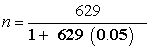 |
Consequently, the sample size consisted of 245 teachers. This sample was split among the ten sub-metros according to the number of Social Studies teachers in each to guarantee fair and unbiased representation. The proportionate stratified random sampling technique used in this investigation had the following formula: Sample Size for Stratum =
 |
Population Size
This method ensured that each sub-metro provided an appropriate number of instructors to the overall sample based on its fraction of the total teacher population. The gender composition of each sub-metro was also considered to increase the representativeness of the sample.
Moral Considerations
Ethical considerations are crucial to preserving the reliability, validity, and integrity of research involving human participants. The research of instructors' gendered attitudes regarding the appropriateness of modern Social Studies subject adhered strictly to all ethical guidelines. To obtain ethical approval, the researcher approached the Institutional Review Board (IRB) of the university with which the researcher is affiliated. The study adhered to internationally accepted ethical standards, such as beneficence, justice, and respect for human beings, as stated in the Belmont Report (National Commission for the Protection of Human Subjects in Biomedical and Behavioural Research, 1979).
Participants were informed of the purpose, limitations, and potential consequences of the study using a written consent form. Voluntary involvement was emphasised, and participants were assured that they could withdraw from the study at any moment without paying any costs. To guarantee secrecy and anonymity, responses were coded and data was safely preserved. There was no personally identifying information included in the results report. Furthermore, by refraining from using any form of coercion, dishonesty, or undue influence, the study complied with the ethical standards set forth by the American Educational Research.
Techniques for Analysing Data
The data analysis for this study employed both descriptive and inferential statistical approaches to give a comprehensive picture of the gendered perspectives of Kumasi Metropolitan Assembly teachers. The Statistical Package for the Social Sciences (SPSS), version 26.0, was used for all statistical computations. Descriptive statistics, such frequencies and simple percentages, were used to compile teachers' responses to questionnaire items in order to address the study topic. As a result, it was simpler to identify general trends and patterns in the viewpoints of both male and female participants. For example, once responses about the appropriateness of topics were separated into Likert-type responses (e.g., Highly Appropriate to Not Appropriate), the percentages of appropriateness by gender were shown.
Analytical Conclusion
To determine whether opinions of male and female teachers differed in a way that was statistically significant, the Chi-Square Test of Independence (χ²) was utilised. This test is relevant when analysing the relationships between two categorical variables, in this case, gender (male or female) and responses to categorical questionnaire items about the appropriateness of Social Studies themes 28.
Data Interpretation and Display
Tables showing the frequency distributions, percentages, and results of the chi-square test were presented. When appropriate, cross-tabulations were employed to illustrate the association between specific items and gender. Effect sizes (Cramér's V) were calculated to determine the strength of relationships, especially where there were noteworthy discoveries 29.
Conclusion of the Methodology Section
The chosen methodology ensured ethical and comprehensive data collection and analysis. Using descriptive and inferential statistical tools, the study successfully documented and compared the views of male and female teachers regarding the value of Senior High School Social Studies courses in furthering national development. These techniques support the study's objective and are required to test the hypotheses and offer a valid and reliable answer to the research issue.
Research Question:
What are the opinions of Kumasi Metropolitan Assembly teachers, categorised by gender, regarding the appropriateness of Social Studies topics for senior high school learners in terms of the nation's progress?
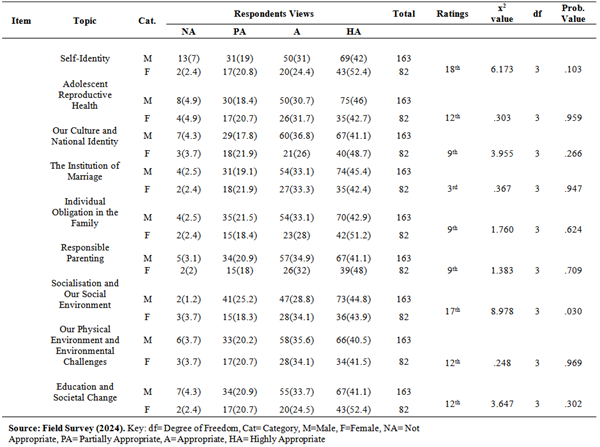
This section presents an analysis of male and female teachers’ perspectives on the appropriateness of selected Social Studies topics in the Senior High School curriculum for advancing national development. Data were obtained from a sample of 245 teachers (163 males and 82 females) within the Kumasi Metropolitan Assembly. The findings, summarized in Tables 1, 2, and 3, display frequencies, percentages, and results of Chi-square tests across key thematic areas of the Social Studies curriculum, namely environmental awareness, governance, and socio-economic development.
Overall, the analysis indicates that a substantial proportion of both male (74%) and female (75%) teachers perceive the current Social Studies curriculum as suitable for equipping students to meaningfully contribute to national development. Furthermore, the Chi-square test of independence revealed a statistically significant association between teachers’ gender and their perceptions of topic appropriateness, X² (3, N = 245) = 15.14, p = .002. This result suggests that gender significantly influences teachers' evaluations of curriculum relevance, with the probability of the observed relationship occurring by chance being less than 0.2%. As noted by Creswell 30, statistical significance at this level reflects a strong association warranting interpretive attention in curriculum review and educational policy decisions.
Analysis at the Topic Level by Item
The topic of "Self-Identity" was deemed appropriate or extremely appropriate by 73% of male teachers and 77% of female teachers, respectively. The total score of 74% indicates that the topic is seen favourably in terms of its importance to national consciousness and identity building. The chi-square test result (X2 = 6.173, p =.103) indicates that there is no statistically significant difference between the gendered responses, indicating that everyone agrees on the topic's importance 31. Similarly, the topic of 'Adolescent Reproductive Health' was positively assessed, receiving high ratings from 74% of female teachers and 77% of male teachers. The statistical analysis yielded a Chi-square value of 0.303 and a p-value of 0.959, indicating no significant difference between male and female teachers' assessments.
The theme, "Our Culture and National Identity," received positive feedback from 77% of teachers overall, with 78% of male teachers and 75% of female teachers stating that it was appropriate. The cultural consensus on the topic's significance in fostering social cohesion and patriotism is further supported by the chi-square test (X2 = 3.955, p =.266), which again shows no discernible gender-based difference in accordance with the educational goals outlined in the Ghana Education Service curriculum guidelines (GES, 2010).
With combined scores of 78% and 77%, respectively, the appropriateness ratings for "The Institution of Marriage" and "Individual Obligation in the Family" were likewise high. For instance, 79% of male teachers and 76% of female teachers supported marriage, and 79% of male teachers and 79% of female teachers supported family responsibilities. These endorsement levels were nearly equal for male and female instructors. Chi-square values of.367 (p =.947) and 1.760 (p =.624), respectively, support the conclusion that there is no discernible gender-based difference in views towards these issues.
"Responsible Parenting" was deemed appropriate by 77% of respondents, 76% of whom were men and 80% of whom were women. The non-significant Chi-square result (X2 = 1.383, p =.709) emphasises a shared understanding of the importance of parenting in national development, which is consistent with Bronfenbrenner's 32 ecological systems theory, which emphasises the role of the family in a child's socialisation.
Remarkably, there was a significant gender gap in the answers to the question "Socialisation and Our Social Environment," with 74% of male teachers and 78% of female teachers thinking it was appropriate. Despite the rating's homogeneity, the chi-square value (X2 = 8.978, p =.030) above the significance level, suggesting that opinions on this topic vary by gender. It is possible that female teachers might place greater importance on the socialisation process due to their nurturing duties both at home and in the classroom 9.
"Our Physical Environment and Environmental Challenges" received the same scores from male and female instructors (76%), and the Chi-square value of.248 (p =.969) showed no statistically significant gender-based difference. This outcome aligns with the increasing focus on environmental literacy as a key component of sustainable development worldwide 33.
The final topic, "Education and Societal Change," was deemed appropriate by 75% of men and 77% of women. The Chi-square test result (X2 = 3.647, p =.302) confirms that there is no significant gender-based variance. This shared viewpoint illustrates the broad acknowledgement of education's transformative potential, which is consistent with Social Studies' mission to develop critical thinkers capable of addressing societal concerns 34.
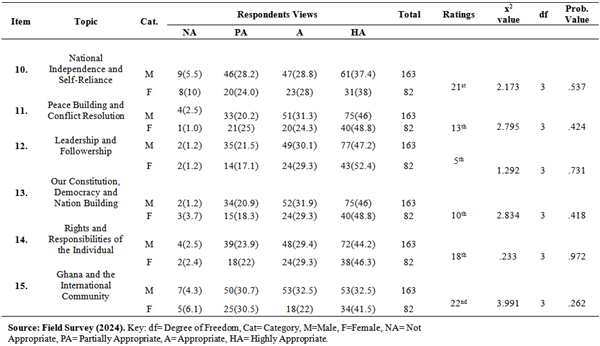
Table 2 displays the itemised frequency distributions, percentages, and chi-square test results for a few themes in the Senior High School Social Studies curriculum. The study found that both male and female teachers view "National Independence and Self-Reliance" is a topic that can help achieve the national development goals of the curriculum. Specifically, 66% of male teachers (n = 108) and 66% of female teachers (n = 54) rated this topic as either appropriate or highly appropriate. A chi-square (χ²) value of 2.173 and a matching p-value of .537 statistically support the uniformity of perception between genders, indicating no noticeable gender-based differences in perception, despite its relatively low ranking (21st). National self-reliance is a key concept in civic education and a prerequisite for sustainable development, claims Nudzor 35. This result is in line with his opinion.
The concept of "Peace Building and Conflict Resolution," was affirmed by 77% of male teachers (n = 126) and 73% of female teachers (n = 60). Seventy-six percent of respondents rated the issue as either acceptable or highly appropriate, making it the eighth most valued topic in the sample. Again, the chi-square analysis produced a score of 2.795 with a p-value of .424, indicating no statistically significant gender difference. This consensus is supported by the findings of Osler and Starkey 36, who highlight peace education as an essential instrument for promoting democratic citizenship and national solidarity.
Additionally, the topic "Leadership and Followership" was rated favourably by 82% of female instructors (n = 67) and 77% of male teachers (n = 126), making it one of the most highly recommended subjects. With a cumulative approval rating of 79%, this topic is placed highest in terms of perceived appropriateness. The chi-square value of 1.292 and the p-value of.731 preserve the statistical significance of gender differences in responses. This agreement backs up Arends' 37 assertion that the development of democracies and social transformation depend on encouraging responsible citizens and skilled leadership.
A closer examination shows that the topic "Our Constitution, Democracy and Nation Building," which scored 78% overall for appropriateness and came in at number ten in the hierarchy of preferred topics, was highly regarded by both male (78%, n = 127) and female (78%, n = 64) instructors. The gender groups do not significantly differ from one another, as shown by the chi-square result (χ² = 2.834, p =.418). The prevalent perspective highlights the significance of constitutional education as a civic requirement for cultivating students' sense of national identity and democratic awareness 38.
Notably, 76% of female teachers (n = 62) and 74% of male teachers (n = 120) gave the topic "Rights and Responsibilities of the Individual" positive ratings. A chi-square statistic of 0.233 and a p-value of .972, which demonstrate a significant alignment between responses from men and women, further corroborate the topic's constant endorsement trend despite its 18th-place ranking. According to Banks 39, who emphasises the need of civic knowledge in equipping students with the skills they need to be responsible citizens, instilling civic duties and ethical behaviour are still essential.
Finally, the topic "Ghana and the International Community" was rated as appropriate or highly appropriate by 64% of female teachers (n = 52) and 65% of male teachers (n = 106). Even though it was ranked 22nd out of all the concerns analysed, the overall approval rating of 64% is still noteworthy. The chi-square value of 3.991 and the p-value of.262 demonstrate that there is no significant gender-based difference in perception. This finding lends credence to the notion that international relations education fosters global awareness and helps national development through international cooperation, according to Torney-Purta et al. 40. Together, these findings suggest that male and female Social Studies teachers have largely comparable views on the value of teaching students about politics, government, and stability in order to inform them about the progress of the nation. The lack of significant gender-based differences across all areas investigated supports the assertion that Social Studies teachers, regardless of gender, prioritise civic, political, and global themes in the curriculum. According to Kerr 41, incorporating these subjects contributes to the development of informed, responsible, and involved individuals which is still the main objective of national development programmes.
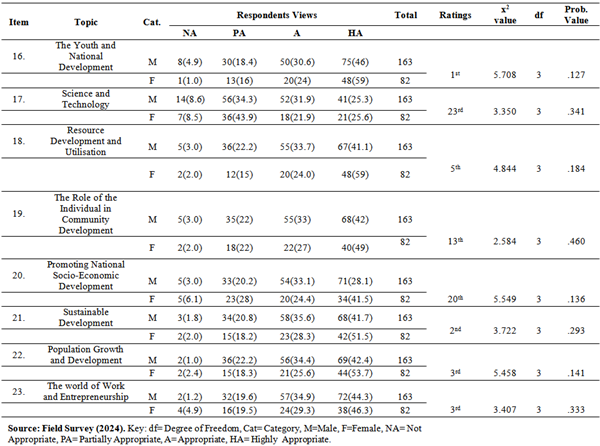
Table 3: displays the item-by-item analysis of Social Studies teachers' perceptions of the appropriateness of various Senior High School (SHS) curriculum subjects for fostering socio-economic growth in Ghana. The data includes the frequency and percentage distribution of responses by gender, as well as Chi-square (χ²) statistics to determine whether there was significant gender-based differences in perceptions.
The topic "The Youth and National Development" received the highest rating from both male and female respondents. Specifically, this issue received the highest rating of any item from 68 female instructors (83%) and 125 male instructors (77%) who rated it as either "Appropriate" or "Highly Appropriate." The topic's overall appropriateness score of 79% highlights its perceived relevance in giving students the knowledge and values needed for national development 42. The responses of male and female teachers did not differ statistically significantly, according to the chi-square analysis results (χ² = 5.708, df = 3, and p =.127). According to this study, teachers of both sexes share an understanding of the topic's potential to inspire youth engage in national development initiatives, which aligns with civic education goals 43.
However, "Science and Technology" was one of the least appropriate subjects, ranking twenty-third in terms of perceived relevance. Only 39 female teachers (48%) and 93 male teachers (57%) gave the issue a modest overall appropriateness rating of 52%. Despite the global emphasis on STEM education as a development driver, this relatively low rating may be the consequence of deficiencies in the pedagogical integration or content delivery in the Ghanaian SHS environment 9. The chi-square result of χ² = 3.350, p =.341 likewise revealed no significant gender-based differences in response, despite the fact that the results indicate that the teaching strategies employed to teach this subject need to be reconsidered.
"Resource Development and Utilisation," which was rated as appropriate or highly appropriate by 68 female instructors (83%) and 122 male instructors (75%), was another topic that scored well, with a 78% overall appropriateness rating. This topic, which ranked number five, was deemed highly relevant for providing students with practical experience in the sustainable use of natural and human resources for the nation's development 1. With χ² = 4.844, p =.184, the Chi-square analysis's findings revealed no discernible gender differences.
Furthermore, the topic of "The Role of the Individual in Community Development" received excellent support from both male and female professors, with a combined rating of 76% from 123 male instructors (75%) and 62 female instructors (76%). This demonstrates how encouraging civic engagement and responsible citizenship is highly valued in Social Studies education 44. p =.460 and χ² = 2.584, the chi-squared values, confirm that there is no appreciable gender difference in the replies.
The theme "Promoting National Socio-Economic Development" received mixed ratings, but overall, they were favourable. Respondents gave the topic a 73% overall appropriateness rating, with 54 female instructors (66%) and 71 male instructors (44%) supporting it. Even though the issue was ranked in twentieth place, the relatively high support shows that teachers still value its importance to students' comprehension of economic advancement and development policies. The gender difference was not statistically significant, according to the Chi-square results (χ² = 5.549, p =.136).
"Sustainable development," which ranked second overall, was strongly favoured by 126 male teachers (78%) and 65 female teachers (79%). The topic's relevance in fostering students' environmental consciousness and long-term development thinking is in line with current global education programmes, such as the United Nations Sustainable Development Goals 33. Furthermore, no appreciable gender differences in perceptions were found by the Chi-square test (χ² = 3.722, p =.293).
The same was true for "Population Growth and Development" and "The World of Work and Entrepreneurship," which received high ratings from both male and female respondents. Specifically, 129 male teachers (79%) and 62 female teachers (76%) supported "The World of Work and Entrepreneurship," while 125 male teachers (77%) and 65 female teachers (79%) supported "Population Growth and Development." Both topics had an overall appropriateness score of 78%, with chi-square values of χ² = 5.458 (p =.141) and χ² = 3.407 (p =.333), respectively. These findings also show that there is broad gender agreement on the significance of these topics for the national development agenda.
According to the study, teachers of both sexes believed that most of the curricular themes were excellent for equipping students with the abilities needed for the nation's progress. The consistency of expert ratings on curricular relevance is confirmed by the lack of statistically significant gender inequalities across all items, which is consistent with findings from comparable studies 45, 46. These results emphasise how important it is to maintain a balanced, culturally aware curriculum that addresses Ghana's socio-economic reality and encourages student participation in national development projects.
Discussions on the Appropriateness of the Topics (Content)
According to the study's findings, a significant majority of Social Studies teachers (74%) believed that the topics taught in the senior high school Social Studies curriculum helped students achieve the major objective of the subject, which is to equip them with the values, skills, and knowledge necessary to significantly contribute to their nation's development. This high ranking shows that, generally speaking, the curriculum content aligns with the learning objectives of promoting responsible citizenship and civic involvement among Ghanaian youth. This finding is consistent with the National Council for the Social Studies' 47 position that the primary goal of Social Studies is to produce informed, thoughtful, and involved citizens who can effectively participate in a democratic society and further the nation.
To equip students with the critical thinking skills necessary to address both personal and societal issues, Social Studies education by definition integrates national concerns, such as population dynamics, environmental sustainability, socio-cultural values, and governance 48. According to the topics' claimed effectiveness, the current curriculum appropriately represents these goals and can be a useful instrument for advancing civic education and the advancement of the country.
Despite widespread consensus on the topics' relevance, the survey discovered notable differences in how teachers evaluated the appropriateness of particular syllabus themes. These differences, especially when analysed by gender, demonstrate how teachers' perceptions of the curriculum may be shaped by their personal beliefs and professional backgrounds. For example, according to Gorski 49, instructors' pedagogical choices are often impacted by their own socio-cultural backgrounds, biases, and opinions, which in turn affect how the content is perceived and taught in the classroom. Consequently, these distinct perspectives could impact not only the emphasis on specific topics but also the scope and quality of education that students get.
These perception disparities may also have an impact on students' level of engagement and study skills. If teachers feel that a particular subject is less appropriate or relevant, they may not be as enthusiastic or put forth as much effort when teaching it, which could diminish students' motivation and interest. Gorski 49 asserts that students are more likely to be engaged and achieve better academically when curricular content is pertinent to their real-world experiences and perceived relevance.
One of the study's key conclusions is that "Science and Technology" is constantly ranked as the least appropriate topic by both male and female teachers. The intricacy of scientific concepts, which some Social Studies teachers may not feel adequately prepared to teach, a lack of training, and a lack of instructional materials are some of the possible causes of this. These findings are in line with earlier research by Osuafor and Ebele 50, who noted that a lack of textbooks and relevant teaching resources continues to be a barrier to the effective teaching of science-related content in the Social Studies curriculum.
Furthermore, it appears that gendered social roles and expectations shaped teachers' preferences for particular disciplines. According to 79% of male instructors, for instance, "World of Work and Entrepreneurship" was the most appropriate topic. This is consistent with cultural norms that place a higher value on men's financial independence and career progress. However, "The Youth and National Development" received the highest grade from 83% of female teachers, suggesting a greater emphasis on social cohesion, nurturing responsibilities, and community involvement. This finding supports Greenberg and Mollick's 51 assertion that men are more likely to pursue entrepreneurial endeavours due to their higher levels of self-confidence and that masculine traits such as confidence and risk tolerance significantly influence both professional interests and entrepreneurial goals.
The study also highlights the significance of the teaching syllabus as a pedagogical guide and a formal communication tool. According to Eberly, Newton, and Wiggers (2001), the syllabus serves as a basic framework that communicates to instructors and students the essential components of a subject. The content of the syllabus must be appropriate since it directly affects how successfully the subject can accomplish its developmental objectives. It is essential to ensure that the content is equitable, culturally appropriate, and representative of national interests to equip students to deal with the socio-economic problems of both their local communities and the greater community.
In conclusion, individual differences in how teachers evaluate specific subjects underscore the need for ongoing curriculum review, teacher professional development, and the provision of adequate teaching materials, despite the fact that the majority of teachers think the Social Studies curriculum is appropriate for furthering national development. These actions will help maximise each subject's potential to the development of the nation by guaranteeing that all subjects are taught and understood by both teachers and students.
Summary of Findings
Appropriateness of Social Studies Topics
This study critically examined Social Studies teachers' perceptions on the appropriateness of the topics taught in Ghana's Senior High School Social Studies curriculum, with a focus on how gender influences these beliefs. According to the results, the majority of respondents believed that the current curriculum content was generally acceptable and relevant for achieving Social Studies' primary objective, which is to prepare students in the nation's development. Teachers believed that the curriculum might provide students with the information, abilities, and attitudes necessary to build a nation.
However, significant gender-based disparities in opinions were observed. Male teachers found "The World of Work and Entrepreneurship" to be the most acceptable theme, while female teachers picked "The Youth and National Development." It's noteworthy that both male and female teachers thought "Science and Technology" was the least appropriate topic in terms of alignment with the main objectives of the curriculum. These discrepancies imply that the intersection of educational interests and gender influences curriculum assessment Crenshaw, 52 (Eargly, 1987)
The findings demonstrate the relevance of the societal Role Theory (Eagly, 1987), which holds that gender roles and societal expectations influence people's opinions, including their preferences for education. Despite offering a fundamental foundation, Tyler's 53 logical curriculum model which concentrated on goal-setting, material organisation, and outcome assessment falls short in addressing the complexity of teacher experiences and contextual circumstances. However, the more flexible and inclusive framework offered by Taba's 54 grassroots approach, which encourages teacher participation in curriculum development, is in line with the findings of this investigation. Similarly, Hunkin's 55 systems-thinking approach, which emphasises adaptability to societal changes, supports the necessity for dynamic curriculum that reflect the demands of contemporary society. Thus, the results of this study support the need for a curriculum that balances structure and flexibility to promote gender awareness, diversity, and the ability to adjust to shifting social norms. The collaborative combination of Taba's participatory design, Tyler's structural clarity, and Hunkin's adaptive lens may produce a more thorough and contextually relevant Social Studies programme.
According to the data collected and evaluated, the majority of Social Studies teachers, irrespective of gender, think that the current senior high school Social Studies curriculum is mostly appropriate for promoting national development. The differences in how teachers assess particular topics shows that their evaluations of curriculum content are impacted by gendered attitudes and possibly experienced situations.
Significantly, "Science and Technology" had consistently low ratings from both male and female respondents. This could be due to a perceived disconnect between the subject matter and Social Studies' educational goals, as well as a lack of appropriate teaching resources. Additionally, it was frequently stated that courses like "The Institution of Marriage," "The World of Work and Entrepreneurship," "The Youth and National Development," and "Sustainable Development" were more relevant and effective in reaching the subject's objective. Since teachers are the primary implementers, these choices emphasise the need for continuous curriculum evaluation that considers the context and includes their perspectives.
The study concludes by confirming that acknowledging diverse teacher perspectives, particularly those related to gender and classroom experience, can enhance the relevance and effectiveness of courses and give students a more impactful and equitable learning environment.
1. Curriculum review and reform: It is recommended that the Ministry of Education review the Social Studies curriculum in collaboration with the National Council for Curriculum and Assessment (NaCCA) to increase the relevance and applicability of each topic. In this reform, teachers should prioritise topics like "The Youth and National Development," "Sustainable Development," "The World of Work and Entrepreneurship," and "The Institution of Marriage" that they have found to be more effective in achieving national development goals.
2. Filling up the Content Gaps in Underperforming Topics: Special attention should be paid to subjects like "Science and Technology" and "National Independence and Self-Reliance," which were frequently rated as less acceptable. These topics should be modified to better fit the overarching objectives of Social Studies education to guarantee purpose clarity and real-world application in students' everyday lives.
3. Inclusive Teacher Involvement: Teachers' opinions should be systematically incorporated into curriculum development processes by curriculum designers and legislators. In line with Taba's 54 concept, encouraging active teacher participation ensures that curriculum development is influenced by a range of professional viewpoints and classroom realities.
4. Provision of Teaching Resources: To enhance the instruction of less popular courses, such as "Science and Technology," educational authorities should provide teachers with enough textbooks, instructional aids, and opportunities for continuous professional development. This will increase their self-assurance and make their lessons more effective.
Implications, Contributions to Knowledge and Subjects for Further Research
This study contributes significantly to educational research and practice in the following ways:
1. Policy Implications: The findings provide empirical support for gender-responsive curriculum development in Ghana and similar contexts. By highlighting perceptual differences in curriculum relevance, the study offers data-driven insights for policy actors seeking to enhance equity and inclusiveness in educational planning.
2. Curriculum Design: The research underscores the need to adapt Social Studies content to reflect contemporary social realities and gender dynamics. Topics perceived as less relevant, such as Science and Technology, may require pedagogical redesign or teacher re-orientation.
3. Teacher Education: By revealing gender-based differences in curriculum appraisal, the study recommends targeted training modules in teacher education programmes that sensitize educators to gender biases and encourage inclusive teaching approaches.
4. Theoretical Advancement: The integration of Social Role Theory and Curriculum Appropriateness Theory provides a nuanced framework for understanding the interplay between gender identity and curriculum perception. This theoretical combination advances scholarly dialogue on the sociology of education and curriculum theory.
5. Empirical Enrichment: The research enriches the empirical literature by offering a large-scale, gender-disaggregated analysis situated within a dynamic metropolitan educational context in sub-Saharan Africa an area that remains underrepresented in global educational research.
This study also offers a novel contribution by explicitly investigating gendered perceptions of Social Studies teachers in a metropolitan Ghanaian context, a research area that has been underexplored. Unlike previous works that broadly assess curriculum relevance, this paper zeroes in on gender as a social variable influencing curriculum appraisal. By using a large, stratified sample and combining descriptive and inferential statistics, the study generates robust insights into how male and female teachers differently evaluate curricular themes linked to governance, socio-economic development, environmental sustainability, and civic responsibilities. The findings offer a gender-disaggregated lens for rethinking national curriculum reforms, ensuring that educational strategies are both developmentally responsive and socially inclusive.
Opportunities for more research into the ways that intersectional characteristics like topic specialism, geographic location, school type (rural vs. urban), and teaching experience which may affect teachers' perceptions of the curriculum are created by this study. Future research could assess the long-term impacts of curriculum changes on teacher perception and instructional results using a longitudinal approach.
Additionally, studies that contrast teachers' and students' perspectives of the curriculum's appropriateness could provide a more complete picture of its effectiveness. It would also greatly benefit educational equity research to look at how curriculum design incorporates gender sensitivity and social inclusion.
By focussing on teacher-centered curriculum assessment and the impact of gender on educational attitudes, this study adds to the body of knowledge on curriculum theory and practice in sub-Saharan African contexts. It offers empirical support for combining classic curricular models with contemporary, context-responsive approaches to curriculum design and implementation.
| [1] | Aboagye, & Yawson. (2020). Teachers’ perceptions of curriculum relevance in Ghana. Frontiers in Education, 15, Article 15. Retrieved fromfrontiersin.org/ resposition.uji.es/scrip. org/ academia.edu. | ||
| In article | |||
| [2] | Ministry of Education (MoE). (2010). Teaching syllabus for Social Studies (SHS 1-3). Ghana Education Service. | ||
| In article | |||
| [3] | Eisner, E. W. (2002). The educational imagination: On the design and evaluation of school programmes (3rd ed.). Merrill Prentice Hall. | ||
| In article | |||
| [4] | Print, M. (1993). Curriculum development and design (2nd ed.). Allen & Unwin. | ||
| In article | |||
| [5] | Sadker, D. M., & Zittleman, K. R. (2015). Teachers, schools, and society: A brief introduction to education (4th ed.). McGraw-Hill. | ||
| In article | |||
| [6] | National Commission for Civic Education (NCCE). (2012). Annual report on civic education. NCCE. | ||
| In article | |||
| [7] | Anamuah-Mensah, J. (2002). Education in Ghana: A tool for national development. Ghana Education Review, 1(1), 11-25. | ||
| In article | |||
| [8] | Osei, M., & Boateng, R. (2018). Exploring Social Studies curriculum and its contribution to national development. Ghana Journal of Curriculum Studies, 5(2), 34-50. | ||
| In article | |||
| [9] | UNESCO. (2021). Reimagining our futures together: A new social contract for education. UNESCO. | ||
| In article | |||
| [10] | Appiah-Kubi, K., & Nyarko, P. (2022). Gender and teacher attitudes towards curriculum content in Ghana. African Journal of Educational Research, 10(1), 50-65. | ||
| In article | |||
| [11] | Eagly, A. H., & Wood, W. (2012). Social role theory. In P. A. M. Van Lange, A. W. Kruglanski, & E. T. Higgins (Eds.), Handbook of theories of social psychology (Vol. 2, pp. 458-476). SAGE. | ||
| In article | |||
| [12] | Kelly, A. V. (2009). The curriculum: Theory and practice (6th ed.). SAGE. | ||
| In article | |||
| [13] | Nwagwu, N. A. (2015). The role of Social Studies in fostering national integration in Nigeria. West African Journal of Education, 35(2), 20-33. | ||
| In article | |||
| [14] | Mensah, R., & Asare, K. B. (2020). Curriculum relevance and education for national development: A critical review. Journal of Curriculum and Teaching, 9(1), 17-26. | ||
| In article | |||
| [15] | Shulman, L. S. (1987). Knowledge and teaching: Foundations of the new reform. Harvard Educational Review, 57(1), 1-22. | ||
| In article | |||
| [16] | Ampadu, E., & Ayiku, M. (2019). Curriculum relevance and teacher perceptions in Ghanaian Senior High Schools. Journal of African Curriculum Studies, 7(3), 105-120. | ||
| In article | |||
| [17] | Eshun, I., & Offei-Ansah, C. (2021). Gendered preferences in Social Studies instruction: A Ghanaian perspective. Journal of African Studies and Development, 13(2), 22-34. | ||
| In article | |||
| [18] | Creswell, J. W., & Creswell, J. D. (2018). Research design: Qualitative, quantitative, and mixed methods approaches (5th ed.). SAGE. | ||
| In article | |||
| [19] | Eagly, A. H. (1987). Sex differences in social behaviour: A social-role interpretation. Erlbaum. | ||
| In article | |||
| [20] | Bryman, A. (2016). Social research methods (5th ed.). Oxford University Press. | ||
| In article | |||
| [21] | Fraenkel, J. R., Wallen, N. E., & Hyun, H. H. (2019). How to design and evaluate research in education (10th ed.). McGraw-Hill Education. | ||
| In article | |||
| [22] | Kumar, R. (2011). Research methodology: A step-by-step guide for beginners (3rd ed.). SAGE. | ||
| In article | |||
| [23] | Kumar, R. (2019). Research methodology (5th ed.). SAGE. | ||
| In article | |||
| [24] | Leedy, P. D., & Ormrod, J. E. (2005). Practical research: Planning and design (8th ed.). Pearson. | ||
| In article | |||
| [25] | Howard, G. S., Schmeck, R. R., & Bray, J. H. (1997). Methodological issues and strategies in clinical research (2nd ed.). American Psychological Association. | ||
| In article | |||
| [26] | Best, J. W., & Kahn, J. V. (1995). Research in education (7th ed.). Allyn & Bacon. | ||
| In article | |||
| [27] | Shadish, W. R., Cook, T. D., & Campbell, D. T. (2002). Experimental and quasi-experimental designs for generalized causal inference. Houghton Mifflin. | ||
| In article | |||
| [28] | McHugh, M. L. (2013). The Chi-square test of independence. Biochemia Medica, 23(2), 143-149. | ||
| In article | |||
| [29] | Field, A. (2018). Discovering statistics using IBM SPSS statistics (5th ed.). SAGE. | ||
| In article | |||
| [30] | Creswell, J. W. (2014). Research design: Qualitative, quantitative, and mixed methods approaches (4th ed.). SAGE. | ||
| In article | |||
| [31] | Gay, L. R., Mills, G. E., & Airasian, P. W. (2012). Educational research: Competencies for analysis and applications (10th ed.). Pearson. | ||
| In article | |||
| [32] | Bronfenbrenner, U. (1979). The ecology of human development: Experiments by nature and design. Harvard University Press. | ||
| In article | |||
| [33] | Curriculum Research and Development Division. (2010). Teaching syllabus for Social Studies (SHS 1-3). Ghana Education Service. | ||
| In article | |||
| [34] | United Nations. (2015). Transforming our world: The 2030 agenda for sustainable development. UN Publishing. | ||
| In article | |||
| [35] | Nudzor, H. (2013). National independence and self-reliance in post-colonial Ghana. Journal of African Political Studies, 7(3), 89-102. | ||
| In article | |||
| [36] | Osler, A., & Starkey, H. (2006). Education for democratic citizenship: A review of research, policy, and practice. Educational Review, 58(3), 267-285. | ||
| In article | |||
| [37] | Arends, R. I. (2012). Learning to teach (9th ed.). McGraw-Hill. | ||
| In article | |||
| [38] | Ajayi, K. (2017). Democracy, citizenship and constitutional education in Africa. Ibadan University Press. | ||
| In article | |||
| [39] | Banks, J. A. (2008). Diversity and citizenship education: Global perspectives. Jossey-Bass. | ||
| In article | |||
| [40] | Torney-Purta, J., Lehmann, R., Oswald, H., & Schulz, W. (2001). Citizenship and education in twenty-eight countries: Civic knowledge and engagement at age fourteen. IEA. | ||
| In article | |||
| [41] | Kerr, D. (1999). Citizenship education: An international comparison. International Review of Curriculum and Assessment Frameworks, 1(1), 1-23. | ||
| In article | |||
| [42] | Amoah, S., & Gyasi, R. M. (2020). Youth empowerment and national development: The role of education. Ghana Journal of Development Studies, 17(2), 45-60. | ||
| In article | |||
| [43] | Ajayi, M. T., & Adeyemi, T. O. (2021). Youth and civic participation in nation-building: A civic education perspective. International Journal of Civic Education, 15(1), 20-36. | ||
| In article | |||
| [44] | Mensah, J. K. (2018). Fostering civic competence through curriculum transformation. Journal of Social Education Research, 12(1), 33-45. | ||
| In article | |||
| [45] | Oppong, T. (2022). Social Studies education and national development in Ghana: A teacher's lens. Ghana Education Review, 3(2), 48-61. | ||
| In article | |||
| [46] | Teye, R. (2020). Evaluating the national relevance of Social Studies curriculum content in Ghana. Journal of Educational Development, 6(2), 25-39. | ||
| In article | |||
| [47] | National Council for the Social Studies (NCSS). (2019). College, career, and civic life (C3) framework for Social Studies state standards. NCSS. | ||
| In article | |||
| [48] | Kankam, G. (2016). Social Studies curriculum and nation building in Ghana. International Journal of Educational Research, 4(2), 87-99. | ||
| In article | |||
| [49] | Gorski, P. C. (2013). Reaching and teaching students in poverty: Strategies for erasing the opportunity gap. Teachers College Press. | ||
| In article | |||
| [50] | Osuafor, A. M., & Ebele, F. E. (2010). Resource constraints and teaching of science in African schools. Science Education International, 21(4), 246-260. | ||
| In article | |||
| [51] | Greenberg, J., & Mollick, E. (2017). Activist choice homophily and the crowdfunding of female founders. Administrative Science Quarterly, 62(2), 341-374. | ||
| In article | |||
| [52] | Crenshaw, K. (1991). Mapping the margins: Intersectionality, identity politics, and violence against women of colour. Stanford Law Review, 43(6), 1241-1299. | ||
| In article | |||
| [53] | Tyler, R. W. (1949). Basic principles of curriculum and instruction. University of Chicago Press. | ||
| In article | |||
| [54] | Taba, H. (1962). Curriculum development: Theory and practice. Harcourt Brace Jovanovich. | ||
| In article | |||
| [55] | Hunkin, E. (2019). Systems thinking in curriculum design. Australian Journal of Teacher Education, 44(1), 45-58. | ||
| In article | |||
Published with license by Science and Education Publishing, Copyright © 2025 David Adjei and David Naya Zuure
 This work is licensed under a Creative Commons Attribution 4.0 International License. To view a copy of this license, visit
http://creativecommons.org/licenses/by/4.0/
This work is licensed under a Creative Commons Attribution 4.0 International License. To view a copy of this license, visit
http://creativecommons.org/licenses/by/4.0/
| [1] | Aboagye, & Yawson. (2020). Teachers’ perceptions of curriculum relevance in Ghana. Frontiers in Education, 15, Article 15. Retrieved fromfrontiersin.org/ resposition.uji.es/scrip. org/ academia.edu. | ||
| In article | |||
| [2] | Ministry of Education (MoE). (2010). Teaching syllabus for Social Studies (SHS 1-3). Ghana Education Service. | ||
| In article | |||
| [3] | Eisner, E. W. (2002). The educational imagination: On the design and evaluation of school programmes (3rd ed.). Merrill Prentice Hall. | ||
| In article | |||
| [4] | Print, M. (1993). Curriculum development and design (2nd ed.). Allen & Unwin. | ||
| In article | |||
| [5] | Sadker, D. M., & Zittleman, K. R. (2015). Teachers, schools, and society: A brief introduction to education (4th ed.). McGraw-Hill. | ||
| In article | |||
| [6] | National Commission for Civic Education (NCCE). (2012). Annual report on civic education. NCCE. | ||
| In article | |||
| [7] | Anamuah-Mensah, J. (2002). Education in Ghana: A tool for national development. Ghana Education Review, 1(1), 11-25. | ||
| In article | |||
| [8] | Osei, M., & Boateng, R. (2018). Exploring Social Studies curriculum and its contribution to national development. Ghana Journal of Curriculum Studies, 5(2), 34-50. | ||
| In article | |||
| [9] | UNESCO. (2021). Reimagining our futures together: A new social contract for education. UNESCO. | ||
| In article | |||
| [10] | Appiah-Kubi, K., & Nyarko, P. (2022). Gender and teacher attitudes towards curriculum content in Ghana. African Journal of Educational Research, 10(1), 50-65. | ||
| In article | |||
| [11] | Eagly, A. H., & Wood, W. (2012). Social role theory. In P. A. M. Van Lange, A. W. Kruglanski, & E. T. Higgins (Eds.), Handbook of theories of social psychology (Vol. 2, pp. 458-476). SAGE. | ||
| In article | |||
| [12] | Kelly, A. V. (2009). The curriculum: Theory and practice (6th ed.). SAGE. | ||
| In article | |||
| [13] | Nwagwu, N. A. (2015). The role of Social Studies in fostering national integration in Nigeria. West African Journal of Education, 35(2), 20-33. | ||
| In article | |||
| [14] | Mensah, R., & Asare, K. B. (2020). Curriculum relevance and education for national development: A critical review. Journal of Curriculum and Teaching, 9(1), 17-26. | ||
| In article | |||
| [15] | Shulman, L. S. (1987). Knowledge and teaching: Foundations of the new reform. Harvard Educational Review, 57(1), 1-22. | ||
| In article | |||
| [16] | Ampadu, E., & Ayiku, M. (2019). Curriculum relevance and teacher perceptions in Ghanaian Senior High Schools. Journal of African Curriculum Studies, 7(3), 105-120. | ||
| In article | |||
| [17] | Eshun, I., & Offei-Ansah, C. (2021). Gendered preferences in Social Studies instruction: A Ghanaian perspective. Journal of African Studies and Development, 13(2), 22-34. | ||
| In article | |||
| [18] | Creswell, J. W., & Creswell, J. D. (2018). Research design: Qualitative, quantitative, and mixed methods approaches (5th ed.). SAGE. | ||
| In article | |||
| [19] | Eagly, A. H. (1987). Sex differences in social behaviour: A social-role interpretation. Erlbaum. | ||
| In article | |||
| [20] | Bryman, A. (2016). Social research methods (5th ed.). Oxford University Press. | ||
| In article | |||
| [21] | Fraenkel, J. R., Wallen, N. E., & Hyun, H. H. (2019). How to design and evaluate research in education (10th ed.). McGraw-Hill Education. | ||
| In article | |||
| [22] | Kumar, R. (2011). Research methodology: A step-by-step guide for beginners (3rd ed.). SAGE. | ||
| In article | |||
| [23] | Kumar, R. (2019). Research methodology (5th ed.). SAGE. | ||
| In article | |||
| [24] | Leedy, P. D., & Ormrod, J. E. (2005). Practical research: Planning and design (8th ed.). Pearson. | ||
| In article | |||
| [25] | Howard, G. S., Schmeck, R. R., & Bray, J. H. (1997). Methodological issues and strategies in clinical research (2nd ed.). American Psychological Association. | ||
| In article | |||
| [26] | Best, J. W., & Kahn, J. V. (1995). Research in education (7th ed.). Allyn & Bacon. | ||
| In article | |||
| [27] | Shadish, W. R., Cook, T. D., & Campbell, D. T. (2002). Experimental and quasi-experimental designs for generalized causal inference. Houghton Mifflin. | ||
| In article | |||
| [28] | McHugh, M. L. (2013). The Chi-square test of independence. Biochemia Medica, 23(2), 143-149. | ||
| In article | |||
| [29] | Field, A. (2018). Discovering statistics using IBM SPSS statistics (5th ed.). SAGE. | ||
| In article | |||
| [30] | Creswell, J. W. (2014). Research design: Qualitative, quantitative, and mixed methods approaches (4th ed.). SAGE. | ||
| In article | |||
| [31] | Gay, L. R., Mills, G. E., & Airasian, P. W. (2012). Educational research: Competencies for analysis and applications (10th ed.). Pearson. | ||
| In article | |||
| [32] | Bronfenbrenner, U. (1979). The ecology of human development: Experiments by nature and design. Harvard University Press. | ||
| In article | |||
| [33] | Curriculum Research and Development Division. (2010). Teaching syllabus for Social Studies (SHS 1-3). Ghana Education Service. | ||
| In article | |||
| [34] | United Nations. (2015). Transforming our world: The 2030 agenda for sustainable development. UN Publishing. | ||
| In article | |||
| [35] | Nudzor, H. (2013). National independence and self-reliance in post-colonial Ghana. Journal of African Political Studies, 7(3), 89-102. | ||
| In article | |||
| [36] | Osler, A., & Starkey, H. (2006). Education for democratic citizenship: A review of research, policy, and practice. Educational Review, 58(3), 267-285. | ||
| In article | |||
| [37] | Arends, R. I. (2012). Learning to teach (9th ed.). McGraw-Hill. | ||
| In article | |||
| [38] | Ajayi, K. (2017). Democracy, citizenship and constitutional education in Africa. Ibadan University Press. | ||
| In article | |||
| [39] | Banks, J. A. (2008). Diversity and citizenship education: Global perspectives. Jossey-Bass. | ||
| In article | |||
| [40] | Torney-Purta, J., Lehmann, R., Oswald, H., & Schulz, W. (2001). Citizenship and education in twenty-eight countries: Civic knowledge and engagement at age fourteen. IEA. | ||
| In article | |||
| [41] | Kerr, D. (1999). Citizenship education: An international comparison. International Review of Curriculum and Assessment Frameworks, 1(1), 1-23. | ||
| In article | |||
| [42] | Amoah, S., & Gyasi, R. M. (2020). Youth empowerment and national development: The role of education. Ghana Journal of Development Studies, 17(2), 45-60. | ||
| In article | |||
| [43] | Ajayi, M. T., & Adeyemi, T. O. (2021). Youth and civic participation in nation-building: A civic education perspective. International Journal of Civic Education, 15(1), 20-36. | ||
| In article | |||
| [44] | Mensah, J. K. (2018). Fostering civic competence through curriculum transformation. Journal of Social Education Research, 12(1), 33-45. | ||
| In article | |||
| [45] | Oppong, T. (2022). Social Studies education and national development in Ghana: A teacher's lens. Ghana Education Review, 3(2), 48-61. | ||
| In article | |||
| [46] | Teye, R. (2020). Evaluating the national relevance of Social Studies curriculum content in Ghana. Journal of Educational Development, 6(2), 25-39. | ||
| In article | |||
| [47] | National Council for the Social Studies (NCSS). (2019). College, career, and civic life (C3) framework for Social Studies state standards. NCSS. | ||
| In article | |||
| [48] | Kankam, G. (2016). Social Studies curriculum and nation building in Ghana. International Journal of Educational Research, 4(2), 87-99. | ||
| In article | |||
| [49] | Gorski, P. C. (2013). Reaching and teaching students in poverty: Strategies for erasing the opportunity gap. Teachers College Press. | ||
| In article | |||
| [50] | Osuafor, A. M., & Ebele, F. E. (2010). Resource constraints and teaching of science in African schools. Science Education International, 21(4), 246-260. | ||
| In article | |||
| [51] | Greenberg, J., & Mollick, E. (2017). Activist choice homophily and the crowdfunding of female founders. Administrative Science Quarterly, 62(2), 341-374. | ||
| In article | |||
| [52] | Crenshaw, K. (1991). Mapping the margins: Intersectionality, identity politics, and violence against women of colour. Stanford Law Review, 43(6), 1241-1299. | ||
| In article | |||
| [53] | Tyler, R. W. (1949). Basic principles of curriculum and instruction. University of Chicago Press. | ||
| In article | |||
| [54] | Taba, H. (1962). Curriculum development: Theory and practice. Harcourt Brace Jovanovich. | ||
| In article | |||
| [55] | Hunkin, E. (2019). Systems thinking in curriculum design. Australian Journal of Teacher Education, 44(1), 45-58. | ||
| In article | |||