To realize Vietnam’s recent goal of establishing English as a second language in schools, students' language learning motivation could play a vital role. In this study, descriptive, correlational, linear regression and ANOVA analyses were utilized to explore the perceptions of 521 first-year students on their attitudes and motivations toward learning English while they were in high school. The results indicated that students’ attitudes and motivations for learning English could be categorized into three main types: result-integrative motivation, instrumental motivation and intrinsic motivation. These types of motivation were correlated, and resultative-integrative motivation had the biggest impact on their suggestions to make English the second language in schools. Students residing in different regions of the country did not differ in their overall suggestions on making English the second language in schools. The study’s findings provide valuable insights and are expected to inform language educators, teachers and curriculum designers in their efforts to enhance the quality of English education in high schools across Vietnam.
For many years, high school students in Vietnam have studied English as a mandatory subject. This policy has enabled Vietnamese students to steadily improve their English proficiency, facilitating greater access to this global language for professional and career advancement. The Communist Party and the Government of Vietnam have consistently underscored the significance of providing high-quality education that aligns with practical societal and economic needs. The Politburo's Conclusion No. 91-KT/TW, dated August 12, 2024, reaffirms Resolution No. 29-NQ/TW, dated November 4, 2013, by the 11th Central Committee of the Communist Party which explicitly highlights the commitment to fundamentally and comprehensively reform education and training to meet the demands of industrialization, modernization, and integration into the socialist-oriented market economy and the global community. With regard to foreign language education, the resolution emphasizes the priority of "enhancing foreign language proficiency of students and graduates and gradually establishing English as a second language in schools and universities.
The quality of foreign language learning is shaped by a variety of factors, with learners' intrinsic motivation being a key determinant of success. Attitudes and motivation are deeply intertwined with the language learning process (Ellis, 1997; Gardner, 2001) 1, 2. Gardner emphasized that students who possess positive attitudes and strong motivation are significantly more likely to excel than those with negative attitudes and low levels of motivation. Crucially, both positive attitudes and motivation must coexist to facilitate successful language acquisition. For example, a student who maintains a positive outlook on language learning but lacks motivation is unlikely to achieve meaningful progress. Likewise, a motivated student who fails to take purposeful action will struggle to attain substantial outcomes (Dewaele et al., 2022) 3.
In Vietnam, despite many years of dedicated efforts to enhance English teaching and learning across various educational levels, the outcomes of English education remain questionable (Canh & Ngoc, 2017) 4. Teachers and students in different regions engage with the subject through diverse programs and teaching methods. Notably, English consistently ranks among the subjects with relatively low performance in Vietnam's national high school graduation exams. Analysis of the score distribution revealed an average score of 5.51 in 2022, representing a slight improvement compared to 2023’s mean score of 5.45 (Thanh Hung, 2022; Le Huyen, 2023) 5, 6.
Several factors have been identified as contributing to these results, including learners' intrinsic and extrinsic motivation, infrastructure quality, educational policies, and the broader learning environment (Meşe & Sevilen, 2021) 7. To enhance the effectiveness of foreign language education and achieve the goal of establishing English as a second language in schools, it is crucial to investigate students' attitudes and motivations toward learning English. Insights from such analyses could offer valuable policy recommendations for educational administrators and support meaningful reforms in Vietnam's foreign language education policies.
A wealth of research has investigated the concepts of "attitude" and "motivation," along with the role of intrinsic motivation in shaping foreign language learning outcomes. Scholars have utilized both quantitative and qualitative methodologies to analyze the extent to which these motivational factors influence students' academic performance (Gardner, 2001; Hoang & Bui, 2023; Meşe & Sevilen, 2021) 2, 7, 8.
2.1. Attitude and Motivation in Foreign Language LearningAttitude is regarded as one of the key factors contributing to success in foreign language learning (Spolsky, 1969) 9. Moreover, the extent to which students actively engage in the language learning process is largely influenced by their attitude. Attitudes toward language learning can be classified into two types: positive and negative. Numerous studies have highlighted the advantages of maintaining a positive attitude. Learners with a positive attitude toward foreign languages tend to have a significant edge over those with negative attitudes (Dewaele et al., 2022; Hoang & Bui, 2023) 3, 8.
There is a strong positive correlation between students’ attitudes and their achievement in learning English. For instance, Holmes and Wilson (2022) 10 argued that when individuals feel positively toward the target language, they are more motivated and thus more likely to succeed in achieving their language learning goals. Dewaele et al. (2022) 3 echoed these results in their structural equation study, which showed that attitudes toward foreign language study positively influenced learning outcomes. Likewise, in Li’s (2022) 11 study, it was found that when learners had positive attitudes toward their teachers, they enjoyed the lessons more.
Motivation is widely recognized as a critical factor in second language (L2) acquisition. It can be categorized into two types: intrinsic and extrinsic motivation. Intrinsic motivation, often associated with integrative orientation, refers to the desire to engage in an activity for its own sake, without external incentives or rewards (Bandura, 1977) 12. In contrast, extrinsic motivation, commonly linked with instrumental orientation, refers to the learner’s desire to achieve success to gain external rewards (Getie, 2020) 13. Much earlier, Dörnyei (2001) 14 posited that motivation was closely linked to student engagement in class activities, which could include both intrinsic and extrinsic motivation. In language learning, in a recent study on factors that influenced English language learners’ motivation in online learning, Meşe and Sevilen (2021) 7 pointed out a few external factors including teachers, classmates, schools and situational problems.
Previous studies have reported correlations between motivations and L2 competencies, outcomes and performance/communication (Darasawang & Reinders, 2021; Getie, 2020; Li, 2022; Nguyen & Habok, 2021) 11, 13, 15, 16. However, the level of correlation was not the same for all learning purposes. For example, in terms of learning a language for communication in Thailand’s L2 learning environment, where students have few chances to communicate outside the classroom, the correlation between students’ willingness to communicate, one aspect of motivation, and their language proficiency was weak. Similarly, in Vietnam's context, school students were not willing to communicate because their main aim of studying English was to pass the high-stakes high school completion examination (Hoang & Bui, 2023) 8. Nonetheless, in these two contexts, there is a strong correlation between student motivation and the teachers’ variables (teaching strategies, language competence, etc.). This result was echoed in Meşe and Sevilen’s (2021) 7 study in which teacher feedback and sufficient communication boosted student motivation in L2 learning. Likewise, there was a strong correlation between L2 learning motivation and learning outcomes as indicated in earlier studies (Ha et al., 2021; Nguyen & Habok, 2021) 16, 17;
As mentioned above, motivation can be categorized into intrinsic and extrinsic motivations. Research in the Malaysian context indicates that Malaysian students are generally more extrinsically than intrinsically motivated (Madziah & Isarji, 2009) 18. Similarly, a study by Ainol Madziah and Isarji (2009) 18 on foreign language learning at Universiti Kebangsaan Malaysia (UKM) and Universiti Teknologi Mara (UiTM) found that extrinsic motivation dominated among students. Most students at both universities studied foreign languages for future career opportunities, to gain broader knowledge, and to meet graduation requirements. However, the findings also revealed that UiTM students exhibited slightly higher levels of intrinsic motivation compared to UKM students. Their reasons included interest, enjoyment, exploring the literature of other cultures, and travel purposes. The results of Meşe and Sevilen’s (2021) 7 study indicated that online intrinsic and extrinsic motivations were lower than face-to-face ones.
The research by other studies corroborated most of the abovementioned findings (Nguyen & Habok, 2021; Bidin et al., 2009) 16, 18. For example, Bidin et al. (2009) 18 investigated the relationship between motivation, attitudes, and English language performance among UiTM students. An analysis of average scores for motivation and performance indicated that students leaned more toward extrinsic than intrinsic motivation for learning English. However, the weak correlation between extrinsic motivation, intrinsic motivation, and performance suggested that these types of motivation did not directly influence students’ English proficiency. In their study in Vietnam’s context, Nguyen and Habok (2021) 16 posited that students’ main motivators for learning were personal enjoyment, study, future career and examples from other people (family members, online figures). In addition, there were also statistically significant correlations among students learning different courses (through English).
In terms of English language learning motivation in Vietnamese schools, findings from a study by Ha et al. (2021) 17 revealed that teachers believed in teaching communication skills; however, in practice, they tend to focus more on preparing their students for tests, especially high-stakes ones (e.g., high school completion). Similarly, a study by Hoang and Bui (2023) 8 found that school students were reluctant to speak English outside the classroom despite their teacher's encouraging strategies. This was due to the students' expectations toward their teachers “… to help their students get good results in the national high school graduation examinations, which were written tests” (p.39). Like in the Malaysian context, Vietnamese school students tend to pay more attention to extrinsic motivation, especially the resultative one: passing an exam. However, the majority of participants (school students) in a study by Do and Nguyen (2021) 19 indicated (both in interviews and surveys) that their primary purpose of learning English was to get a good job.
Regarding suggestions on how to motivate L2 learners, it has been proposed in previous studies that organizations (schools, universities), teachers, and the students themselves could play a significant role. For example, Meşe and Sevilen (2021) 7 recommended that schools play an important role in the design and implementation of courses (online in the study) to maximize student motivation. They also posited in their study that teachers, especially their awareness, communication with students, and pedagogical strategies, are very important. In the same line or argument, it was argued in some studies that various stakeholders (e.g., educators and curriculum designers) could have both positive and negative impacts on student motivation, hence, great attention should be paid to them (Azar & Tanggaraju, 2020; Nguyen & Habok, 2021) 16, 20. As for the students themselves, it has been recommended in a few studies that they be given chances to communicate in the target language in general and even to visit foreign countries in particular. Some of the specific measures can include establishing English clubs and English-speaking days (Azar & Tanggaraju, 2020; Darasawang & Reinders, 2021; Getie, 2020; Linh & Cuong, 2024) 13, 15, 20, 21. However, in order to make English the second language, even in schools, a lot more is needed because in Vietnam’s context, English is not often spoken outside language classrooms, even in big cities like Hanoi and Ho Chi Minh (Tran & Tanemura, 2020) 22.
2.2. Status of English in VietnamCurrently, English is officially and formally taught in Vietnam from Grade three to Grade twelve and at higher levels. At the high school and undergraduate levels, the language is taught for both non-major (also called specialized) and major students. At the high school level, most provinces and cities also add English-intensive and bilingual curricula to a proportion of gifted or specialized classes (Tran & Tanemura, 2020) 22. The language is also used to teach some subjects, such as mathematics and sciences. Similarly, many universities offer English as a medium of instruction (EMI) courses as well as English majors in which students study the language to work as interpreters, teachers, etc. Outside the formal education system, English is also the most taught language throughout the country in domestic or international language centers (ref). English proficiency is also a requirement for job applications and graduate (master's and doctoral) studies.
The status of English in the country has received a great deal of attention from the country’s policies on education in general and foreign languages, mostly English, in particular (BCH TW, 2013) 23. For example, a National Foreign Language Project was approved with the aim of equipping Vietnamese youths with high English language competency (Chinh phu, 2017) 24. Likewise, English was made a compulsory subject in the country’s high school completion examination until 2024. In 2018, there was a heated discussion in the country on recognizing English as a second language (Trach, 2018) 25. More recently, in 2025, the country's Politburo issued Conclusion No. 91-KT/TW, which stipulated that "…gradually, English be the second language in schools" (BCH TW, 2024, p.6) 26.
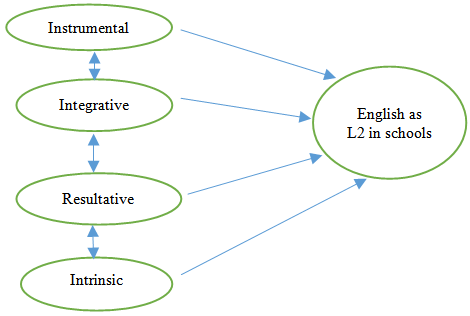
In line with this orientation, the relevant agencies and media in the country had another heated discussion on how to turn this policy direction into reality (Nhan, 2024) 27. There have been many suggestions, which could be categorized into three groups relating to the role of the educational system (e.g., resources investment), individual institutions (e.g., English curriculum) and teacher and students (e.g., teaching hours, motivation). In this study, we investigated the impacts of these three factors on the overall suggestions on how to make English the second language in schools. The study’s analytical framework is presented in Figure 1.
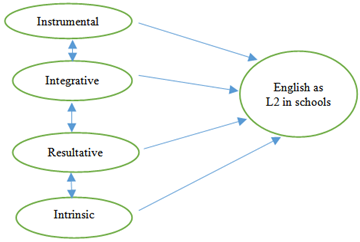
The above model is adapted from the socio-educational model of second language acquisition (Gardner, 2001) 2. In this model, Gardner distinguishes between four segments: the social environment, individual differences, the context of second language acquisition, and outcomes. In an adapted version of the socio-educational model (based on Gardner, 2001) 2, two variables are highlighted: Integrativeness and attitudes toward the learning situation, both of which are interrelated and influence motivation in second language acquisition. Motivation, along with language aptitude, directly impacts language achievement.
Integrativeness reflects a genuine interest in learning a second language to connect more closely with a different linguistic community. This often implies openness and respect toward other cultural groups and lifestyles. Attitudes toward the learning situation encompass one's perspective on any context in which the language is being learned. In a school setting, these attitudes might focus on the teacher, the course itself, classmates, and so on. Additionally, motivation refers to the driving force behind one's efforts in any learning environment.
In the socio-educational model, motivation in second language learning comprises three key components including effort, desire and employment. First, a motivated individual puts significant effort into learning the language. Secondly, a motivated learner actively wishes to achieve their goal. Thirdly, a motivated learner finds pleasure in the process of language learning. Effort, desire, and enjoyment distinguish highly motivated individuals from those with less motivation. The model also highlights three variables: integrativeness, attitudes toward the learning situation, and learning motivation, which together form integrative motivation. As conceptualized in the socio-educational model of second language acquisition, integrative motivation represents a complex combination of attitudes, goals, and drives. Thus, an integratively motivated individual is someone who is driven to learn a second language, desires or is willing to identify with another linguistic community, and tends to evaluate the learning situation positively.
In the model, integrativeness and attitudes toward the learning situation are viewed as supportive of motivation, but it is motivation itself that drives second language achievement. Thus, a learner may exhibit a high level of integrativeness or positive attitudes toward the learning situation; however, if these are not aligned with the motivation to learn the language, the learner is unlikely to achieve proficiency. Similarly, a learner who demonstrates a high level of motivation but lacks strong integrativeness or positive attitudes toward the learning situation may not consistently maintain a high level of motivation. The 27 questions that we used in this study (see below) reflected the essence of the socio-educational model of second language acquisition.
In the context of Vietnam, high school students represent a pivotal group in advancing the adoption of English as a second language in the country. Among various foreign languages, such as Chinese and French, English has been prioritized as the primary international language, reflecting Vietnam's ambition to align with global educational trends and narrow the gap with international standards.
This study seeks to explore three key research questions:
1.Do the student motivations in learning English correlate with student suggestions on making English a second language in schools?
2Are the student motivations significant predictors of the student suggestion?
3.What are the differences in student school locations on the student suggestion?
3.1. Research ParticipantsThe participants of this study were undergraduate students who enrolled in a Bachelor of Arts degree at a Vietnamese university. In order to enroll, they had to meet the University's requirements, which was the completion of a high school exit test in which English, or one foreign language such as Russian, Chinese, or Korean, was a compulsory test paper.
Of about 2100 students enrolled, 521 completed the online survey (a return rate of about 25 %). After cleaning the data, 487 responses were used for this study, accounting for 92% of the respondents. This number met the requirements of a multiple regression model with five independent variables (Hair et al., 2021) 28.
3.2. Procedure and Data AnalysisIn this study, an Attitude/Motivation Test Battery developed by Gardner et al. (2004) 29 was used to measure the participants' motivation, attitudes and interests in studying English during their schooling time. The original battery consisted of 100 items, but in this study, only 27 questions were selected under Gardner et al.’s (1985) 30 theory of second language learning inspiration that includes integrative and instrumental orientations. The two researchers of this study independently selected the item, and compared the two sets of questions. The similarity rate was nearly 85%.
In addition to the abovementioned 27 items on motivation, the questionnaire also included 4 questions on the participants' demographic features (gender, school location, scores of English paper test, and their English study duration up to the time of survey) and their perceptions (suggestions) on what needs to be done for English to be the second language in schools. This was because English was, and still is, considered a foreign language in most schools in Vietnam with the exception of some language major schools and universities.
Next, we translated the questions into Vietnamese and organized an opinion-gathering session to ensure the content validity of the questions. Ten students were invited to read the questions based on their English language learning experience during school time, sharing feedback on whether the questions were appropriate. Slight modifications regarding deletions, additions, and wording were made to assure suitability. In the next stage, the questionnaire was piloted on 35 first-year students. These students were excluded as study participants. The Cronbach's coefficient alpha values, calculated based on the pilot sample of this study, indicated that the developed instruments were reliable: 0.86 for the 27 motivation items and 0,71 for the 12 suggestions on how to make English the second language in schools. It is also worth mentioning that before the analysis, code reversing was also made for negative questions, e.g., It would bother me if I had to speak English on the telephone.
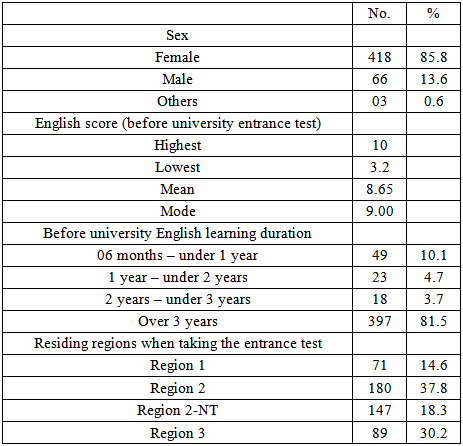
The data were analyzed using both frequency analysis and inferential statistics via the Statistical Package for The Social Sciences (SPSS), version 29. Descriptive analyses presented students' basic information and average scores of predictor variables and student suggestions. Correlation analysis was performed to understand the relationship between the three types of motivation and student suggestions. Multiple regression analyses investigated whether the three predictor variables significantly predicted the participants' suggestions. A one-way ANOVA investigated the effect of one background variable (school location) on the suggestions. This was because there were large discrepancies for the other three demographic items (gender, English paper test scores, and time of studying English). Please see Table 4 for details.
The data in the table shows that the vast majority of respondents are female, accounting for nearly 85% of the survey participants. This is also a common trend in specialized foreign language schools in Vietnam. The English exam scores of the respondents are also very high, with an average score of 8.65 and the most frequently achieved score being 9.0. However, some students scored as low as 3.2 in English. The majority of respondents (81.5%) had studied English for more than three years before entering university. Interestingly, more than 10% of the respondents had studied English for less than one year but still took the English exam when applying to a specialized language university. The highest proportion of survey participants (37.8%) live in district-level towns, provincial cities, and rural areas of centrally governed cities (KV2), followed by students living in urban districts of centrally governed cities (KV3). The proportion of students living in mountainous and economically disadvantaged rural areas (KV1) is the lowest at 14.6%.
4.2. Principal Component AnalysisIn order to investigate further the relative importance of each factor, a principal component analysis (PCA) using SPSS was conducted. The 27 items that expressed the participants’ three types of motivation (Integrative, intrinsic, and instrumental) were subjected to this analysis. After 5 rounds of interactions, ten items that either had low loadings (under 0.3) or lay in two components were removed from the analysis.
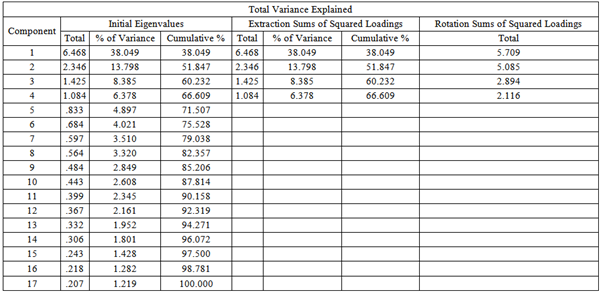
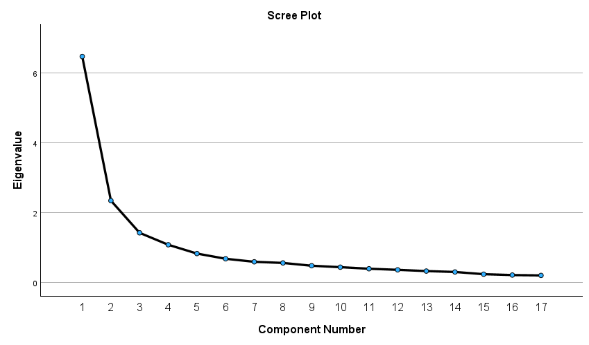
Prior to performing the PCA, the suitability of data for factor analysis was assessed. An inspection of the correlation matrix revealed the presence of many coefficients of 0.03 and above. The Kaiser-Meyer-Olkin (KMO) value was 0.71, exceeding the recommended value of 0.6 (Kaiser, 1974) 31 and Bartlett's Test of Sphericity indicated statistical significance, supporting the factorability of the correlation matrix. Principal components analysis revealed the presence of four components with eigenvalues exceeding 1, explaining 38.049, 13.798, 8.385, and 6.378 of variance respectively, as shown in Table 2.
Before accepting the factors, additional criteria were used such as Scree plot and parallel analysis. The Scree plot is a graph of eigenvalues. It is recommended to retain components lying to the left of the elbow which is a break from linearity. An inspection of the Scree plot (Figure 2) revealed a break after the fourth component.
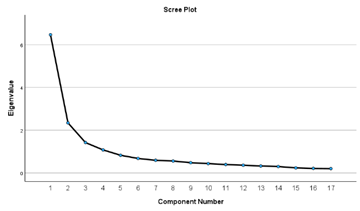
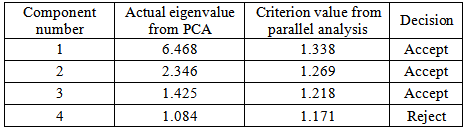
The findings from the Scree plot were further supported by the results of parallel analysis, which showed only four components with eigenvalues exceeding the corresponding criterion values for the randomly generated data matrix of the same size (27 variables × 487 respondents). Table 3 shows the results of the parallel analysis.
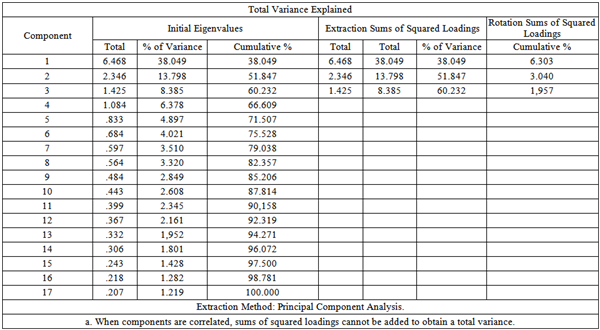
The Parallel Analysis showed that only three components with eigenvalues exceeding the corresponding criterion values for a randomly generated data matrix of the same size. The three-component solution explained a total of 48.2% of the variance, with Components 1, 2, 3 contributing 38.05%, 13.80%, and 8.39% of the variance respectively, as shown in Table 4.
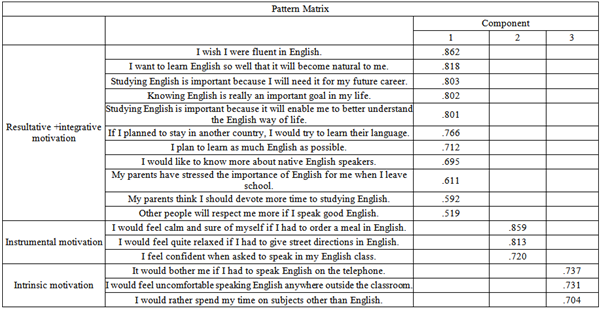
The rotated solution revealed the presence of a simple structure (Thurstone 1947), with three components showing a number of strong loadings and all variables loading substantially on only one component. The interpretation of the three components was consistent with previous research, with positive items loading strongly on one component and small or negative items loading strongly on the others. Table 5 presents the results of the principal component analysis.
The data contained in Table 5 reveal three components that expressed learners’ motivations in learning English. The first component (items) can be divided into two groups of motivation, i.e., resultative (items 4, 9, 12, 17, 18, 19, 20 and 25) and integrative items 5, 7 and 8). It seems that the participants (school students) paid a lot of attention to studying English in order to result in a better future life and jobs in general and mingling with foreigners in particular. The second component (items 1, 23, 24) is mainly related to the participant's instrumental motivation, i.e., being able to use English for specific tasks or duties. The third component (items 2, 3 and 15) can be considered intrinsic motivation, expressing their eagerness (or lack of it) in learning and using English.
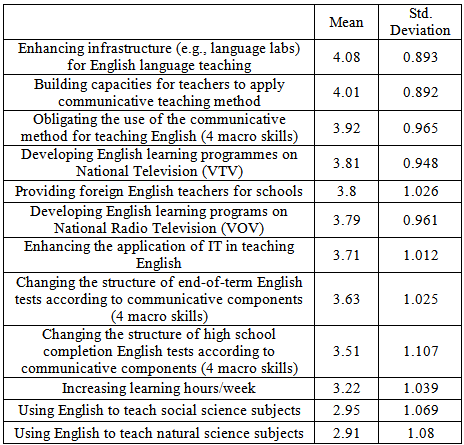
4.3. Correlation AnalysisIn this study, the participants were asked to express their opinions on 12 pre-determined suggestions on how to make English a second language in schools. These suggestions came from the latest discussion forum (ref) in Vietnam on the issue after the release of Decision number 91, dated 12 August 2024, by the country’s Politburo on its education development. The suggestions are divided into three categories: investment in infrastructure, human resources, and changes in teaching and using English as a medium of instruction at school levels. Table 5 presents the means and standard deviation for each suggestion.
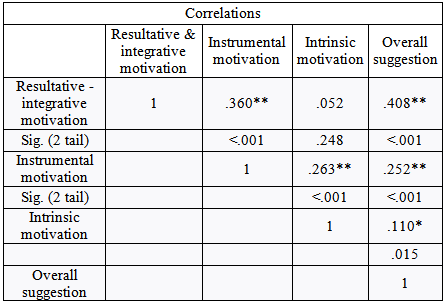
Data in Table 6 indicates that the participants strongly suggested investments in infrastructure and changing the teaching and testing methods towards four macro skills at schools with the mean scores of about 4.0/5.0. It is worth noting that current end-of-term tests and even the yearly high-stakes school completion exam do not include speaking and listening skills. Using English as a medium to teach social and natural science subjects also received relatively high mean scores (2.95 and 2.91, respectively). In order to explore the association between the participants' three types of motivation and their overall suggestions, we computed all 12 items into one called 'overall suggestions'. Table 7 presents the results of the correlation.
Note: p < 0.01; small r = 0.10 to 0.29; medium r = 0.30 to 0.49; large r = 0.50 to 1.0 (Cohen, 1988)
Table 2 shows the Pearson correlation coefficients between the variables. All three types of motivation are positively related to the students' overall suggestions on how to make English the second language in schools (p < 0.01). Data in Table 2 indicates that resultative-integrative motivation had the largest correlation (r = .408) with the overall suggestion, whereas intrinsic motivation recorded the smallest association (r = 0.11). Among the three types of motivation, resultative-integrative motivation and instrumental motivation had the strongest (r=0.36) followed by the correlation between instrumental motivation and intrinsic motivation (r=.263). Interestingly, there was no correlation between resultative-integrative motivation and intrinsic motivation (p=0.248).
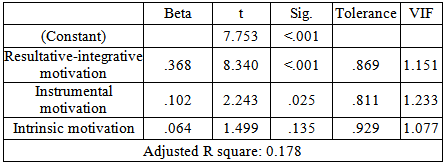
4.4. Regression AnalysisA multiple regression analysis was performed to see how much the independent variables can predict students' overall suggestions. The distribution of the data showed no extreme outliers for the data set. The tests also showed that the variables met the assumptions of normality, linearity, multicollinearity, and homoscedasticity (Pallant, 2011). After the entry of the four variables, the total variance explained by the model (adjusted R square) was 0.178.
Table 8 shows that only resultative-integrative motivation and instrumental motivation are significant predictors in explaining students’ overall suggestions on how to make English the second language in schools. Intrinsic motivation did not significantly contribute to the prediction of student suggestions. Comparing the contribution of the two independent variables, Table 8 shows that when the variance explained by all other variables in the model was controlled, resultative-integrative motivation made the strongest contribution to explaining the overall suggestion (ß = .368). The beta value for the instrumental motivation variable indicates relatively small contributions (ß = .102). The results of multiple regression analysis confirm those of correlation findings presented above. However, it is worth noting that the model (in this case, the three types of motivation) explains only 17.8% of the variance in the overall suggestion (adjusted R square = 0.178).
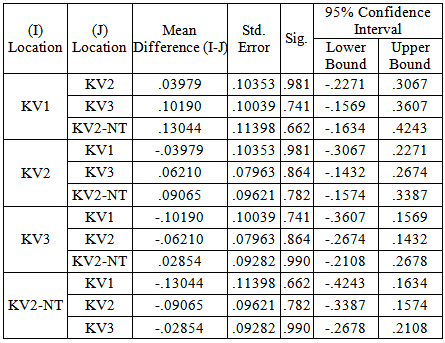
A one-way between-groups analysis of variance was conducted to explore the impact of the participants’ school locations on their overall suggestions. Levene’s test of equality was conducted to test the assumption of equal variance. The Sig. levels revealed that we did not violate the homogeneity of variance assumption. Participants were divided into four groups according to their school locations (KV1 - remote and mountainous areas, (ii) KV2 - towns and rural areas of provincial cities, (iii) KV3 - urban districts of centrally managed cities, and (iv) KV2-NT - the rest regions). There was no statistically significant difference in the overall suggestion scores for the four school locations: F (3, 483) = 0.64, p = 0.59. Table 9 presents the results of detailed analyses.
Our study investigated the perceptions of learner motivation in English language learning, especially in Vietnam's context of making English the second language in schools. More specifically, we explored the association between learner motivation and their suggestions on how to make English the second language at the high school level, the predictors of different types of motivation on their suggestions, and the impacts of learner-residing locations on their suggestions. The study results are now discussed in detail.
Regarding learning motivation, it was evident in the EFA analysis that school students had three types of motivations: result-integrative, instrumental, and intrinsic. The items for result–integrative accounted for the biggest number (11/17), which seems to reveal that school students placed a strong emphasis on learning English to communicate with native speakers of English and to prepare for future higher-level study. These results are partly in agreement with studies in the Malaysian context, where students are generally more extrinsically than intrinsically motivated (Bidin et al., 2009) 18. The high mean scores for all types of motivation in this study match those observed in an earlier study by Azar and Tanggaraju (2020) 20, also in the Malaysian context. Nonetheless, the above findings do not confirm Azar and Tanggaraju themselves, who found that instrumental motivation was higher than other types. The discrepancies could be explained by differences in the participants (university versus school students).
Compared with other studies in the Vietnamese context, the present findings seem to be consistent with studies in the Vietnamese context, which found that students learned English for personal enjoyment, communication with foreigners and future career path - results and integrative motivations (Do & Nguyen, 2021; Nguyen & Habok, 2021; Nguyen & Lo, 2022) 16, 19, 32. At the undergraduate level, university students' motivations even lean more towards the practicality of learning English rather than for other purposes (Ly, 2022) 11. In other words, students tend to study English not just for the sake of knowing the language but more for practical purposes. They wanted to learn English for practical purposes so as to be able to perform some specific tasks in English, e.g., ordering food and asking for directions. Similarly, there were some intrinsic desires, such as speaking English on the phone, outside the classroom.
On the contrary, a previous study by Ha et al. (2021) 17 indicated that, in schools, teachers tended to teach English for the main purpose of preparing their students for high-stake tests despite their beliefs in teaching communication skills for the students. Similarly, this study's findings are in contrast with the results of Ly’s (2022) 33 study, which indicated the majority of learners perceived that English education in Vietnamese schools is currently exam-oriented. A possible explanation for this might be that the participants of this study were mostly English majors whose long-term purpose of learning English was to get a job in English speaking environment, e.g., international organizations. They were the same students as in Do and Nguyen's (2021) 19 study, who were gifted in the English language.
This study has been able to demonstrate that the participants concurred with specific suggestions on how to make English the second language in schools. These suggestions were given high mean scores, ranging from 2.91 to 4.08/5.0, and they could be grouped into four categories (organization, teachers, curriculum, and enhanced role of English language). To some extent, these suggestions echoed what past studies have implied to promote learner motivation in L2 (Azar & Tanggaraju, 2020; Darasawang & Reinders, 2021; Meşe and Sevilen, 2021) 7, 15, 20. When the students are self-motivated to study (intrinsic), and when they get support from organizations and teachers (extrinsic), the outcomes of their study would be enhanced.
One of the interesting findings of the current study was the participants’ emphasis on how English could be taught in school - communicatively and in EMI courses. These findings accord with our earlier observations, which showed that teachers are trying to apply communicative language teaching approaches in the new curricula (i.e., the 2018 version) thanks to the availability of modern technologies such as language labs, multimedia projectors, Internet connection (Linh & Cuong, 2024; Thai & Nguyen, 2024) 21, 34. The trend to use English as a medium of instruction to teach some school subjects like mathematics, and science has also been integrated in the teacher training programs in the country (Chung et al., 2020; Giang, 2017) 35, 36. However, as there have been long "conflicts in policy and practice concerning assessment at the national level" (Ha et al., 2021, p.3471) 17, a lot more efforts are needed before real communicative language teaching can be widely implemented at school level in Vietnam.
The linear regression results of this study showed that resultative-integrative motivation had the strongest impact (beta = .408) on the participants’ overall suggestions on how to make English the second language in school. To some extent, this finding echoes past research (e.g., Do & Nguyen, 2021; Nguyen & Lo, 2022) 19, 37 in Vietnam’s context on the student’s main purposes of learning English (for communication with foreigners and future career paths). However, as the participants of those studies and the current ones were university students, the findings need to be interpreted with caution. The instrumental motivation (learning English to perform certain realistic tasks) also had impacts on the overall suggestion but at a more moderate level (beta = .252). This finding, to some extent, has not previously been similar to what Azar and Tanggaraju (2020) 20, described (instrumental motivation had the highest mean scores of all types). The difference can be explained in part by the difference in the status of English (as a foreign language in Vietnam and a second language in Malaysia).
Contrary to expectations, this study did not find a significant difference between the participants' school locations (mountainous, rural, urban) and their overall suggestions (on making English the second language in schools). It has been taken for granted that learners in the more disadvantaged areas did not enjoy the opportunities and conditions to learn English as in urban ones, as stated by Tran and Tanemura (2020) 22 who noted “the annual upsurge in the amount of English language learners" (p. 358). School students in disadvantageous areas also received bonuses in the high school completion exams (from 0.25 to 0.5). It is difficult to explain this result, but it might be related to the fact that participants of this study were very competent in the English subject (shown through high English test scores); hence, they did not see the regional difference as a key factor in making English the second language in school.
Our study investigated the role of motivations in L2 teaching and learning in Vietnam in general and their impacts on the recent orientation of the country's Politburo to make English the second language in schools. The study utilized descriptive, correlational, and regression analytical techniques to explore the perspectives of about 500 first-year university students on their motivations to learn English during school days, and suggestions to make English the second language. First of all, we found that result–integrative motivation had the strongest impact on the participants' overall suggestions, followed by instrumental and intrinsic motivations. The participants' suggestions can be categorized into four main groups, namely: physical and human resources investment; changes in teaching pedagogy for teachers, and in using English to teach other subjects. Students from different residing locations (mountainous, rural, urban) did not differ in their suggestions on recognizing English as the second language in schools.
This study contributes to the knowledge of English language teaching and learning in Vietnam's education system in general and at the school level in particular. Our study confirms previous findings and contributes to a growing body of research in understanding the role of intrinsic and extrinsic motivation in L2 acquisition. In addition, based on the findings of the current study, it is possible to offer some recommendations for language educators, curriculum designers, and future researchers. First, in the investment for schools to promote communicative language teaching and learning, using a fully equipped lab can be useful for students to enhance students’ most essential skills: speaking and listening (Hung & Ai, 2021; Mohammed, 2017) 19, 32. However, careful consideration should be made regarding investment in language labs because, with the fast development of technology, especially AI and GenAI applications, more cost-effective measures could be implemented. What seems to be more important is how to promote learner intrinsic motivation in L2 learning due to the lack of communication environment in English (Nguyen & Lo, 2022) 37.
Second, in order to make English the second language in schools, communication (in English) environment is crucial (Hung & Ai, 2021) 19. In other words, English should be made available outside the classrooms, hence, as suggested in this study, efforts should be made to produce English language learning programmes available on national and local television and radio stations. Like in the case of language lab mentioned above, careful consideration should also be made to make sure that the intended programmes meet the needs of specific learners, and delivered on suitable platforms as well. Again, technology enhanced language applications and well-informed learning styles of the students would provide valuable and most efficient means for course designs. In other words, there should be a smooth combination between L2 learning and using inside and outside classrooms.
Third, professional development with a focus on communication language teaching pedagogies should be further promoted for both in-service teachers and teacher students in teacher training institutions (Thai & Nguyen, 2024) 34. Their ability to deliver EMI courses in schools should also be carefully designed and implemented (Chung et al., 2020) 35. Currently, the country is preparing for the implementation of the Politburo's Conclusion No. 91-KT/TW on making English the second language in schools. The role of English (to be taught communicatively used as EMI as revealed in this study) should be widely and carefully surveyed and confirmed to ensure effective designs for future teaching and learning. Changing teachers’ “deep-rooted beliefs about traditional teaching, learning, and assessment" (Ha et al., 2021, p.3471) 17 is not easy, especially in remote and rural areas where stakeholders do not see the urgent need to use English for international communication and other purposes.
Our findings are subject to three limitations. First, the study surveyed students’ perceptions of English language learning motivations and suggestions on how to make English a second language in schools. To get a full picture of the issues, future studies should include data from school teachers, together with interviews from both groups as well. A combination of both quantitative and qualitative data will enhance the validity of the findings. Second, the study was conducted in an English major learning environment; hence, the findings may not transfer to other contexts where English is not considered a specialized subject. Third, the research did not include participants from all socio-economic regions of the whole country, for example, those from the central highland and southern provinces, where economic conditions are not the same as the northern provinces. Indeed, when this study was conducted, the country's Ministry of Education and Training had developed a plan to realize Politburo's Conclusion No. 91-KT/TW, including an order to request all the provincial education departments to conduct. In Vietnam's context, where top-down decision-making is sometimes applied, this survey would provide a comprehensive data set for a more valid plan for making English the second language in schools. Nonetheless, the planned survey should also include interviews with all stakeholders by independent researchers, and should also include data from universities, where the role of English is still far from being a second language.
Despite the limitations mentioned above, this study has been one of the first attempts to explore Vietnamese school student motivation types and their impact on the suggestions on how to make English the second language in schools. The study results also offer some implications for English language teachers, designers, and established role of English as a communicative language and means to teach other subjects at the school level.
| [1] | Ellis, R. (1997). Second language acquisition. Oxford University Press. | ||
| In article | |||
| [2] | Gardner, R.C. (2001). Integrative motivation and second language acquisition. In Z. Dornyei & R. Schmidt (Eds.). Motivation and second language acquisition (pp. 1-19). Honolulu: University of Hawaii. | ||
| In article | |||
| [3] | Dewaele, J.-M., Botes, E., & Greiff, S. (2023). Sources and effects of foreign language enjoyment, anxiety, and boredom: A structural equation modeling approach. Studies in Second Language Acquisition, 45(2), 461–479. | ||
| In article | View Article | ||
| [4] | Canh, L. V., & Ngoc, N. T. (2017). Đề án Ngoại ngữ quốc gia 2020 có thể học được gì từ kinh nghiệm châu Á? VNU Journal of Foreign Studies, 33(4), 10-23. | ||
| In article | View Article | ||
| [5] | Thanh Hung (2022). Phổ điểm môn tiếng Anh 2022 biến động mạnh. https://vietnamnet.vn/pho-diem-mon-tieng-anh-thi-tot-nghiep-thpt-2022-2042533.html | ||
| In article | |||
| [6] | Le Huyen (2023). Phổ điểm môn Tiếng Anh thi tốt nghiệp THPT 2023. https://vietnamnet.vn/pho-diem-mon-tieng-anh-thi-tot-nghiep-thpt-2023-2166590.html | ||
| In article | |||
| [7] | Meşe, E., & Sevilen, Ç. (2021). Factors influencing EFL students’ motivation in online learning: A qualitative case study. Journal of Educational Technology and Online Learning, 4(1), 11-22. | ||
| In article | |||
| [8] | Hoang, V. Q., & Bui, H. P. (2023). Encouraging EFL students’ willingness to communicate inside Vietnamese high school classrooms: Teachers’ strategies and students’ beliefs. Applied Research on English Language, 12(2), 25–50. | ||
| In article | |||
| [9] | Spolsky, B. (1969). Attitudinal aspects of second language learning. Language Learning, 19(3–4), 271–275. | ||
| In article | View Article | ||
| [10] | Holmes, J., & Wilson, N. (2022). An Introduction to Sociolinguistics (6th ed.). Routledge. | ||
| In article | View Article | ||
| [11] | Li, C. (2022). Foreign language learning boredom and enjoyment: The effects of learner variables and teacher variables. Language Teaching Research, 1–26. | ||
| In article | View Article | ||
| [12] | Bandura, A. (1997). Self-efficacy: Toward a unifying theory of behavioral change. Psychological Review, 84(2), 191–215. | ||
| In article | View Article PubMed | ||
| [13] | Getie, A. S. (2020). Factors affecting the attitudes of students towards learning English as a foreign language. Cogent Education, 7(1), 1–37. | ||
| In article | View Article | ||
| [14] | Dörnyei, Z., Schmidt, R., & Schmidt, R. W. (2001). Motivation and second language acquisition. National Foreign Language Resource Centre. | ||
| In article | |||
| [15] | Darasawang, P., & Reinders, H. (2021). Willingness to Communicate and Second Language Proficiency: A Correlational Study. Education Sciences, 11(9), 1–12. | ||
| In article | View Article | ||
| [16] | Nguyen, S. V., & Habók, A. (2021). Vietnamese non-English-major students’ motivation to learn English: From activity theory perspective. Heliyon, 7(4), 1–11. | ||
| In article | View Article PubMed | ||
| [17] | Ha, V. X., Tran, N. G., & Tran, N. H. (2021). Teachers’ beliefs and practices regarding assessment in English as a foreign language classrooms in Vietnam. The Qualitative Report, 26(11), 3457–3475. | ||
| In article | View Article | ||
| [18] | Bidin, S., Jusoff, K., Aziz, N. A., Salleh, M. M., & Tajudin, T. (2009). Motivation and Attitude in Learning English among UiTM Students in the Northern Region of Malaysia. English Language Teaching, 2(2), 16–20. | ||
| In article | View Article | ||
| [19] | Do, M. H., & Thi Thu Ai, N. (2021). Gifted high school students’ needs for English learning in Vietnam contexts. Arab World English Journal, 12(3), 351–365. | ||
| In article | View Article | ||
| [20] | Azar, A. S., & Tanggaraju, D. (2020). Motivation in second language acquisition among learners in Malaysia. Studies in English Language and Education, 7(2), 323–333. | ||
| In article | View Article | ||
| [21] | Hoàng T. D. L., & Nguyễn H. C. (2024). Khảo sát hoạt động xây dựng môi trường dạy học tiếng Anh theo hướng phát triển năng lực giao tiếp cho học sinh trung học cơ sở ở một huyện miền núi khu vực Tây Bắc Việt Nam. Tạp chí Giáo dục, 24(2), 39–43. | ||
| In article | |||
| [22] | Tran, P. M., & Tanemura, K. (2020). English in Vietnam. World Englishes, 39(3), 528–541. | ||
| In article | View Article | ||
| [23] | BCH TW (2013). Nghị quyết Hội nghị Trung ương 8 khóa XI về đổi mới căn bản, toàn diện giáo dục và đào tạo [Resolution of Central Party Committee Congress No 8 – Term XI on comprehensive reform of education and training]. | ||
| In article | |||
| [24] | Chính phủ (2017). Phê duyệt điều chỉnh, bổ sung Đề án dạy và học ngoại ngữ trong hệ thống giáo dục quốc dân giai đoạn 2017 – 2025. https:// vanban.chinhphu.vn/ default.aspx? pageid= 27160&docid=192343. | ||
| In article | |||
| [25] | Trach, N., X. (2018). Nên hay không việc công nhận tiếng Anh là ngôn ngữ thứ 2 của Việt Nam. https://dantri.com.vn/giao-duc/nen-hay-khong-viec-cong-nhan-tieng-anh-la-ngon-ngu-thu-2-cua-viet-nam-20181207155510152.htm | ||
| In article | |||
| [26] | BCH TW (2024). Kết luận số 91- KL/TW, ngày 12/8/2024 của Bộ Chính trị về tiếp tục thực hiện Nghị quyết số 29-NQ/TW, ngày 04/11/2013 của Ban Chấp hành Trung ương Đảng khoá XI https://tulieuvankien.dangcongsan.vn/he-thong-van-ban/van-ban-cua-dang/ket-luan-so-91-kltw-ngay-1282024-cua-bo-chinh-tri-ve-tiep-tuc-thuc-hien-nghi-quyet-so-29-nqtw-ngay-04112013-cua-ban-chap-10637 | ||
| In article | |||
| [27] | Nhan., T. (2024). Tiếng Anh là ngôn ngữ thứ hai trong trường học: Các nước thực hiện ra sao? https://tuoitre.vn/tieng-anh-la-ngon-ngu-thu-hai-trong-truong-hoc-cac-nuoc-thuc-hien-ra-sao-20240918095345014.htm | ||
| In article | |||
| [28] | Hair Jr., J. F., Hult, G. T. M., Ringle, C. M., Sarstedt, M., Danks, N. P., Ray, S. et al. (2021). Evaluation of Reflective Measurement Models. In Partial Least Squares Structural Equation Modeling (PLS-SEM) Using R. Classroom Companion: Business (pp. 75-90). Springer. | ||
| In article | View Article | ||
| [29] | Gardner, R. C. (2004). Attitude/motivation test battery: International AMTB research project. Canada: The University of Western Ontario. https:// www.academia.edu/ download/ 114271795/englishamtb.pdf. | ||
| In article | |||
| [30] | Gardner, R. C. (1985). Social psychology and second language learning: The role of attitudes and motivation. Edward Arnold. https://cir.nii.ac.jp/crid/1130000797160023680 | ||
| In article | |||
| [31] | Kaiser, H.F. (1974). An index of factorial simplicity. Psychometrika 39, 31–36. | ||
| In article | View Article | ||
| [32] | Mohammed, A. (2017). The role of language laboratory in English language learning settings. English Language Teaching, 10(2), 86–93. | ||
| In article | View Article | ||
| [33] | Ly, C. K. (2022). English as a global language: An exploration of EFL learners’ beliefs in Vietnam. International Journal of TESOL & Education, 3(1), 19–33. | ||
| In article | View Article | ||
| [34] | Thái T. C. T., & Nguyễn Q. T. (2024). Thực trạng bồi dưỡng giáo viên tiếng Anh trung học phổ thông theo tiếp cận năng lực. Tạp chí Giáo dục, 24(7), 37–42. | ||
| In article | |||
| [35] | Chung, P. K., Tuan, D. M., & Yen, P. T. H. (2020). Định hướng xây dựng chương trình đào tạo giáo viên dạy học môn toán và các môn khoa học tự nhiên bằng tiếng Anh ở Trường Đại học Giáo dục—Đại Học Quốc Gia Hà Nội. Tạp Chí Giáo Dục, 476(4), 15–19. | ||
| In article | |||
| [36] | Giang, H. T. (2017). Dạy học các môn toán, khoa học và tiếng Anh ở tiểu học theo chuẩn tiên tiến dựa trên phương pháp tích hợp chương trình Quốc gia Anh và chương trình Việt Nam tại Thành phố Hồ Chí Minh. Tạp chí Khoa học, 14(7), 191-198. | ||
| In article | View Article | ||
| [37] | Nguyen, T. B., & Lo, Y. H. G. (2022). Perceptions of Vietnamese EFL high school teachers and students towards English as a lingua franca. International Journal of TESOL & Education, 2(1), 327-348. | ||
| In article | View Article | ||
Published with license by Science and Education Publishing, Copyright © 2025 Pham Ngoc Thach and Nguyen Thi Thuy Hang
 This work is licensed under a Creative Commons Attribution 4.0 International License. To view a copy of this license, visit
http://creativecommons.org/licenses/by/4.0/
This work is licensed under a Creative Commons Attribution 4.0 International License. To view a copy of this license, visit
http://creativecommons.org/licenses/by/4.0/
| [1] | Ellis, R. (1997). Second language acquisition. Oxford University Press. | ||
| In article | |||
| [2] | Gardner, R.C. (2001). Integrative motivation and second language acquisition. In Z. Dornyei & R. Schmidt (Eds.). Motivation and second language acquisition (pp. 1-19). Honolulu: University of Hawaii. | ||
| In article | |||
| [3] | Dewaele, J.-M., Botes, E., & Greiff, S. (2023). Sources and effects of foreign language enjoyment, anxiety, and boredom: A structural equation modeling approach. Studies in Second Language Acquisition, 45(2), 461–479. | ||
| In article | View Article | ||
| [4] | Canh, L. V., & Ngoc, N. T. (2017). Đề án Ngoại ngữ quốc gia 2020 có thể học được gì từ kinh nghiệm châu Á? VNU Journal of Foreign Studies, 33(4), 10-23. | ||
| In article | View Article | ||
| [5] | Thanh Hung (2022). Phổ điểm môn tiếng Anh 2022 biến động mạnh. https://vietnamnet.vn/pho-diem-mon-tieng-anh-thi-tot-nghiep-thpt-2022-2042533.html | ||
| In article | |||
| [6] | Le Huyen (2023). Phổ điểm môn Tiếng Anh thi tốt nghiệp THPT 2023. https://vietnamnet.vn/pho-diem-mon-tieng-anh-thi-tot-nghiep-thpt-2023-2166590.html | ||
| In article | |||
| [7] | Meşe, E., & Sevilen, Ç. (2021). Factors influencing EFL students’ motivation in online learning: A qualitative case study. Journal of Educational Technology and Online Learning, 4(1), 11-22. | ||
| In article | |||
| [8] | Hoang, V. Q., & Bui, H. P. (2023). Encouraging EFL students’ willingness to communicate inside Vietnamese high school classrooms: Teachers’ strategies and students’ beliefs. Applied Research on English Language, 12(2), 25–50. | ||
| In article | |||
| [9] | Spolsky, B. (1969). Attitudinal aspects of second language learning. Language Learning, 19(3–4), 271–275. | ||
| In article | View Article | ||
| [10] | Holmes, J., & Wilson, N. (2022). An Introduction to Sociolinguistics (6th ed.). Routledge. | ||
| In article | View Article | ||
| [11] | Li, C. (2022). Foreign language learning boredom and enjoyment: The effects of learner variables and teacher variables. Language Teaching Research, 1–26. | ||
| In article | View Article | ||
| [12] | Bandura, A. (1997). Self-efficacy: Toward a unifying theory of behavioral change. Psychological Review, 84(2), 191–215. | ||
| In article | View Article PubMed | ||
| [13] | Getie, A. S. (2020). Factors affecting the attitudes of students towards learning English as a foreign language. Cogent Education, 7(1), 1–37. | ||
| In article | View Article | ||
| [14] | Dörnyei, Z., Schmidt, R., & Schmidt, R. W. (2001). Motivation and second language acquisition. National Foreign Language Resource Centre. | ||
| In article | |||
| [15] | Darasawang, P., & Reinders, H. (2021). Willingness to Communicate and Second Language Proficiency: A Correlational Study. Education Sciences, 11(9), 1–12. | ||
| In article | View Article | ||
| [16] | Nguyen, S. V., & Habók, A. (2021). Vietnamese non-English-major students’ motivation to learn English: From activity theory perspective. Heliyon, 7(4), 1–11. | ||
| In article | View Article PubMed | ||
| [17] | Ha, V. X., Tran, N. G., & Tran, N. H. (2021). Teachers’ beliefs and practices regarding assessment in English as a foreign language classrooms in Vietnam. The Qualitative Report, 26(11), 3457–3475. | ||
| In article | View Article | ||
| [18] | Bidin, S., Jusoff, K., Aziz, N. A., Salleh, M. M., & Tajudin, T. (2009). Motivation and Attitude in Learning English among UiTM Students in the Northern Region of Malaysia. English Language Teaching, 2(2), 16–20. | ||
| In article | View Article | ||
| [19] | Do, M. H., & Thi Thu Ai, N. (2021). Gifted high school students’ needs for English learning in Vietnam contexts. Arab World English Journal, 12(3), 351–365. | ||
| In article | View Article | ||
| [20] | Azar, A. S., & Tanggaraju, D. (2020). Motivation in second language acquisition among learners in Malaysia. Studies in English Language and Education, 7(2), 323–333. | ||
| In article | View Article | ||
| [21] | Hoàng T. D. L., & Nguyễn H. C. (2024). Khảo sát hoạt động xây dựng môi trường dạy học tiếng Anh theo hướng phát triển năng lực giao tiếp cho học sinh trung học cơ sở ở một huyện miền núi khu vực Tây Bắc Việt Nam. Tạp chí Giáo dục, 24(2), 39–43. | ||
| In article | |||
| [22] | Tran, P. M., & Tanemura, K. (2020). English in Vietnam. World Englishes, 39(3), 528–541. | ||
| In article | View Article | ||
| [23] | BCH TW (2013). Nghị quyết Hội nghị Trung ương 8 khóa XI về đổi mới căn bản, toàn diện giáo dục và đào tạo [Resolution of Central Party Committee Congress No 8 – Term XI on comprehensive reform of education and training]. | ||
| In article | |||
| [24] | Chính phủ (2017). Phê duyệt điều chỉnh, bổ sung Đề án dạy và học ngoại ngữ trong hệ thống giáo dục quốc dân giai đoạn 2017 – 2025. https:// vanban.chinhphu.vn/ default.aspx? pageid= 27160&docid=192343. | ||
| In article | |||
| [25] | Trach, N., X. (2018). Nên hay không việc công nhận tiếng Anh là ngôn ngữ thứ 2 của Việt Nam. https://dantri.com.vn/giao-duc/nen-hay-khong-viec-cong-nhan-tieng-anh-la-ngon-ngu-thu-2-cua-viet-nam-20181207155510152.htm | ||
| In article | |||
| [26] | BCH TW (2024). Kết luận số 91- KL/TW, ngày 12/8/2024 của Bộ Chính trị về tiếp tục thực hiện Nghị quyết số 29-NQ/TW, ngày 04/11/2013 của Ban Chấp hành Trung ương Đảng khoá XI https://tulieuvankien.dangcongsan.vn/he-thong-van-ban/van-ban-cua-dang/ket-luan-so-91-kltw-ngay-1282024-cua-bo-chinh-tri-ve-tiep-tuc-thuc-hien-nghi-quyet-so-29-nqtw-ngay-04112013-cua-ban-chap-10637 | ||
| In article | |||
| [27] | Nhan., T. (2024). Tiếng Anh là ngôn ngữ thứ hai trong trường học: Các nước thực hiện ra sao? https://tuoitre.vn/tieng-anh-la-ngon-ngu-thu-hai-trong-truong-hoc-cac-nuoc-thuc-hien-ra-sao-20240918095345014.htm | ||
| In article | |||
| [28] | Hair Jr., J. F., Hult, G. T. M., Ringle, C. M., Sarstedt, M., Danks, N. P., Ray, S. et al. (2021). Evaluation of Reflective Measurement Models. In Partial Least Squares Structural Equation Modeling (PLS-SEM) Using R. Classroom Companion: Business (pp. 75-90). Springer. | ||
| In article | View Article | ||
| [29] | Gardner, R. C. (2004). Attitude/motivation test battery: International AMTB research project. Canada: The University of Western Ontario. https:// www.academia.edu/ download/ 114271795/englishamtb.pdf. | ||
| In article | |||
| [30] | Gardner, R. C. (1985). Social psychology and second language learning: The role of attitudes and motivation. Edward Arnold. https://cir.nii.ac.jp/crid/1130000797160023680 | ||
| In article | |||
| [31] | Kaiser, H.F. (1974). An index of factorial simplicity. Psychometrika 39, 31–36. | ||
| In article | View Article | ||
| [32] | Mohammed, A. (2017). The role of language laboratory in English language learning settings. English Language Teaching, 10(2), 86–93. | ||
| In article | View Article | ||
| [33] | Ly, C. K. (2022). English as a global language: An exploration of EFL learners’ beliefs in Vietnam. International Journal of TESOL & Education, 3(1), 19–33. | ||
| In article | View Article | ||
| [34] | Thái T. C. T., & Nguyễn Q. T. (2024). Thực trạng bồi dưỡng giáo viên tiếng Anh trung học phổ thông theo tiếp cận năng lực. Tạp chí Giáo dục, 24(7), 37–42. | ||
| In article | |||
| [35] | Chung, P. K., Tuan, D. M., & Yen, P. T. H. (2020). Định hướng xây dựng chương trình đào tạo giáo viên dạy học môn toán và các môn khoa học tự nhiên bằng tiếng Anh ở Trường Đại học Giáo dục—Đại Học Quốc Gia Hà Nội. Tạp Chí Giáo Dục, 476(4), 15–19. | ||
| In article | |||
| [36] | Giang, H. T. (2017). Dạy học các môn toán, khoa học và tiếng Anh ở tiểu học theo chuẩn tiên tiến dựa trên phương pháp tích hợp chương trình Quốc gia Anh và chương trình Việt Nam tại Thành phố Hồ Chí Minh. Tạp chí Khoa học, 14(7), 191-198. | ||
| In article | View Article | ||
| [37] | Nguyen, T. B., & Lo, Y. H. G. (2022). Perceptions of Vietnamese EFL high school teachers and students towards English as a lingua franca. International Journal of TESOL & Education, 2(1), 327-348. | ||
| In article | View Article | ||