In the search for an adequate scenario for the construction of knowledge, it is necessary to consider the aspects that influence learning, such as the choice of the teaching technique used. The general objective of this work is to evaluate the cognitive and affective development achieved with the use of the Problem-Based Learning (PBL) technique, by students of the subject of Physical Chemistry in the issue of Carnot Cycle with the support of Artificial Intelligence. To this end, an exploratory study was carried out with students of Physical Chemistry of the second semester of the Chemistry career of the FES Cuautitlán UNAM. The data analysis was based on both the cognitive levels achieved and on the cognitive and affective assessments, in accordance with the Bloom-Barrows Taxonomy, obtained with the help of Artificial Intelligence using Chat GPT-4 and Google Gemini, allowing us to identify that, in general, the use of PBL can influence the level of cognitive and affective development achieved by students. in addition to stimulating teamwork, communication and meaningful learning.
The individual knows and builds his cognitive structure during his interaction with the world, through mental processes 1. In this way, knowledge is developed, through these mechanisms, used by the subject to translate the world, since it is a consequence of the information incorporated and assimilated by the subject during all stages of his or her life 2. In this sense, the subject, at each stage of development, presents possibilities for growth, allowing the teacher to stimulate his or her development 3. It is also necessary to consider some essential principles that affect learning, such as: the need for learning; autonomy and previous experience of the student; availability and guidance for learning; learning based on a real context; motivation for learning; etc. 4. Knowledge of these principles is essential to guide the teacher's practice, through strategies that facilitate learning. These strategies must contain activities that develop analytical thinking, learning, and the ability to work in a team, adding methods and techniques of group learning, development of communication, among others 5 since education must be a process of knowledge construction and not an ideology of transmission.
The challenge of teachers in their teaching practice is very important, due to the possible articulations between the teacher's didactic action and learning in the context of the classroom 6. However, techniques such as problem-based learning (PBL) can provide motivation and contribute to cognitive development 7. In addition, it helps in the development of problem-solving skills, critical analysis, autonomy in learning, and improved communication and cooperation among participants 8.
The additional use of an active teaching technique such as PBL may represent a promising strategy in the academic setting. In addition, to help in the preparation of the teacher's didactics. In this sense, this study sought to answer the following question: Does the use of PBL, as an additional tool to the traditional method, can influence the level of cognitive and affective development achieved by students of the subject of Physical Chemistry in the subject of Carnot Cycle?
With the general objective, to evaluate the ability of PBL, based on the Taxonomies of Bloom and Barrows 9, to influence the cognitive and affective levels achieved by students of the subject of Physical Chemistry in the topic of Carnot Cycle. This research sought to contribute to the teaching of the Carnot Cycle, through the evaluation of cognitive and affective development, provided by PBL, identifying whether its use collaborates with the process of knowledge construction.
Academic performance is affected by some variables, which can be related to the student, such as prior knowledge of the content, motivation and type of learning, or to the teacher, highlighting the teaching strategies and methods used 10. Each of these factors has an immediate and direct effect on performance, affecting the student's learning reasons and learning strategies, in different ways.
Learning can occur superficially or significantly. The superficial approach is characterized by the intention to complete a task, focusing on facts and not arguments, so that the learning process results in memorization and reproduction. This learning is the result of the student's lack of commitment to the topic worked on 11.
Learning occurs in a significant way when the student understands the proposed content and reflects based on new ideas and previous knowledge. This type of learning is aimed at integrating the new into personal experiences, knowledge, and interests 12 and is characterized by the student's personal commitment to his or her learning 13, where he or she seeks to understand and make sense of the content that was presented. The best academic performance for learning is associated with meaningful learning and the lowest with superficial learning 14.
The approach to learning can be decisive for the quality of teaching, influencing factors such as the development and satisfaction of the student with education. Thus, it is necessary to understand the influence of emotions on the teaching and learning process 15. Given this context, it is up to the teacher to stimulate learning, looking for more dynamic and creative methodological solutions that awaken interest in learning 16. It is understood that meaningful learning is more likely to be achieved when students are motivated 17.
For an individual to learn something, it is necessary to validate the experience, through his own criteria, that satisfies his requirements, so the individual can only know from his experiences and perceptions that he has. In this sense, when the student is motivated 18, he mobilizes his body for action, seeking its satisfaction, and this influence represents a personal investment that contributes to quality learning.
Based on the Taxonomies of Bloom and Barrows 9, the original taxonomies were developed, classified, and defined six main categories in the cognitive domain, described from a simple conception to a more complex one, representing a cumulative hierarchy 19. The development of these elements, in reference to the cognitive domain 20, brought together educational objectives in six categories: knowledge, understanding, application, analysis, synthesis and evaluation. While the affective domain analyzes how the individual becomes aware of the stimuli received and, from them, initiates affective behavior, within the context in which it occurs.
PBL is a teaching technique in which the learner is the central focus, which means that the subject is active in the learning process 21. It is based on the constructivist theory of learning, which considers that the student develops his or her own knowledge. PBL is characterized using a real problem experienced by society, so that the student can explore and develop critical thinking, skills in the search for solutions and acquire scientific and technological knowledge during the process. PBL is seen as an instrument of a certain problematic context, with the aim of motivating the student for learning, producing positive effects, such as helping in performance, improving knowledge and promoting better habits such as research 22.
Knowledge is not born with the subject, nor can it be transmitted, it is built through the interaction of the subject with the object of knowledge, through experience. The application of PBL allows the development of problem-solving skills, as well as providing the exchange of experiences 23. The use of PBL is effective in developing self-directed learning in students 24 by motivating and developing critical reasoning skills.
The PBL technique aims to develop students' ability to solve problems, building knowledge in a more meaningful way 25. For this purpose, in addition to an expository class, PBL was applied in the resolution of a problem, for the teaching of the Carnot Cycle. Thus, after the tasks were defined for each student, a problem on the Carnot Cycle was presented that was generated with the help of Artificial Intelligence (Chat GPT-4 and Google Gemini).
To teach Carnot Cycle, the PBL methodology was used, which is based on the presentation of problems 26, providing the student with experience and preparation to act in the face of unexpected challenges and situations. Its application allows the student to work as a team through collaborative work and develop critical and scientific thinking in the student.
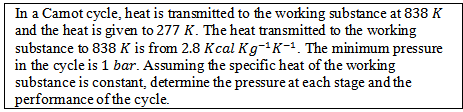
Based on the information obtained by Artificial Intelligence on the Carnot Cycle, a problem was selected to stimulate discussion and the search for solutions in the group. This problem was posed with various units of energy and pressure that must be homogenized in the MKS system for its solution and thus promote in the students an improvement in cognitive and affective development that reveals an increase in the levels of analysis, synthesis and creation, fundamental skills for critical thinking
The sample was made up of 40 students, 48% women and 52% men, with an average age of 20 years. During two classes of 120 minutes each, in the subject of Physical Chemistry of the second semester of the Chemistry career. In the first class, an initial questionnaire (pre-test) was applied to identify the students' previous knowledge of the topics related to the Carnot Cycle necessary for the resolution of the problem to be posed and related concepts about PBL. In the second class, the topic of the Carnot Cycle was presented through a PowerPoint presentation and then the problem to be solved using PBL was presented (Table 1). generated, with the help of Artificial Intelligence (Chat GPT-4 and Google Gemini).
The students were separated into groups and the role that each student was defined, within the options of secretary (rapporteur of the discussions), leader (motivator and mediator), spokesperson (voice of the group) and other members (researchers), following the stages of application of PBL 27 are: (1) present the situation of the problem, (2) identify the problem; (3) discuss the group's prior knowledge of the problem situation (the groups will propose hypotheses based on their previous knowledge of the topic); (4) summarize the discussion, (5) identify obscure points and form the set of topics and/or contents that need to be investigated, (6) study or search for information individually, which will be confronted, (7) all members bring the information collected and the group discusses and identifies what may be useful to solve the problem.
When the problem situation was identified, students began discussions about how to solve it. The groups then identified the dark spots, i.e. those elements that would need to be investigated to solve the problem. Each group presented a proposed solution discussed and analyzed by all, who defined what the group's proposed solution would be, presented by the spokesperson and discussed with the whole class.
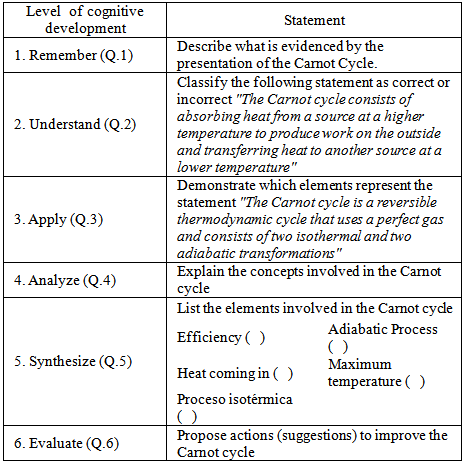
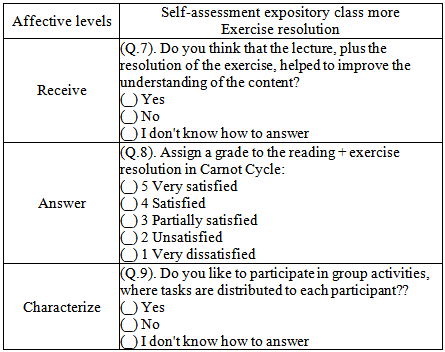
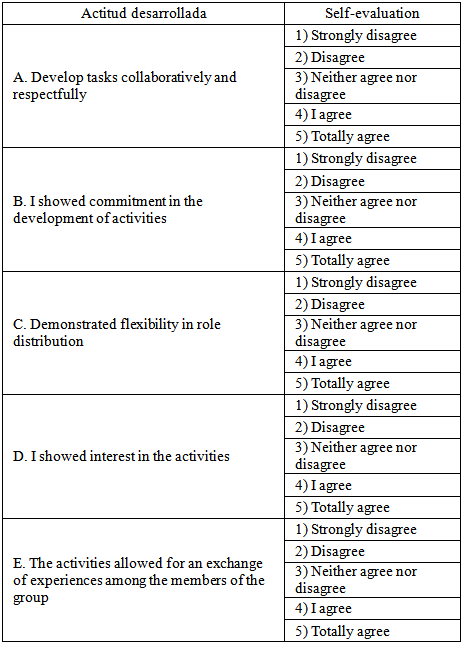
To carry out the cognitive and affective assessment of students based on the levels of the Bloom-Barrow Taxonomy 9, 28 two instruments were applied (Table 2 and Table 3) based on the prompts generated with the help of Artificial Intelligence that were modified and adapted to evaluate the cognitive and affective levels reached after the resolution of the problem. Also, a Self-Assessment prompt of developed attitudes, obtained by AI, was adapted and applied to the students during the resolution of the problem posed about the Carnot cycle solved through the PBL process (Table 4), using a Likert-type scale to find the attitudes developed during the application of the strategy.
To identify the level of cognitive development achieved by the students 9, it was considered that the student reached the desirable level in situations in which the answer was elaborated correctly and completely, regardless of the words used. When the student partially answered the questions, he or she was considered to have partially reached a certain level; and when he did not answer or answered incorrectly, it was considered that he did not reach the level analyzed.
To assess cognitive development (Table 2), initially through a pre-test, we sought to analyze the students' prior knowledge, at the most basic levels, before the lecture and the resolution of the exercise on the Carnot Cycle. This evaluation allowed the analysis of facts, terms, concepts about structure and processes on the Carnot Cycle based on the Bloom-Barrow Taxonomies, according to their levels in the post-test.
To verify the different cognitive levels, three questions were asked. (Q.1) Define the Carnot Cycle, it was used to check the "Remember" level or if the student had knowledge about the Carnot Cycle. (Q.2) To check the "Understand" level, they were asked to classify the statement as correct or incorrect. (Q.3) To inform which elements represent the Carnot Cycle? was used to confirm the "Apply" level (Table 2).
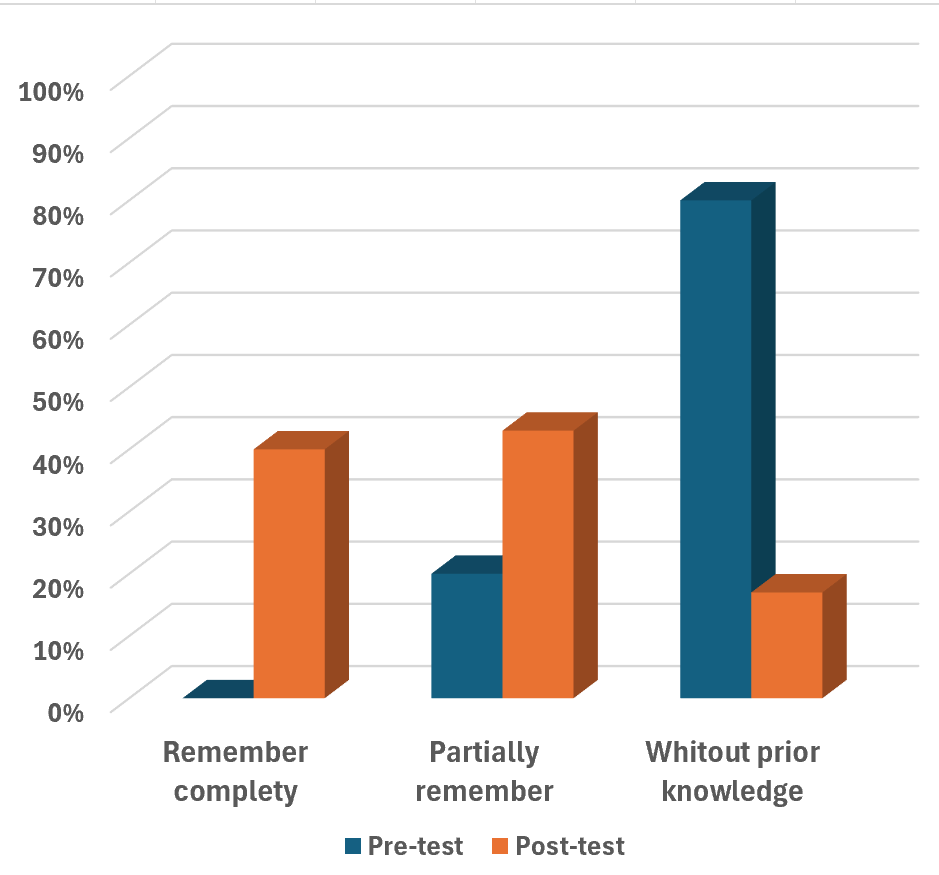
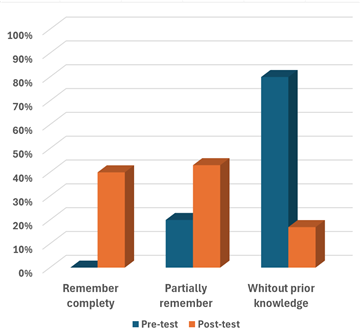
The results obtained in the pre-test for (Q.1) revealed that, of the 40 participants in this exploratory study, none reached the "Recall" level completely, 20% reached it partially and 80% had no previous knowledge of Carnot Cycle. This assessment showed that most students did not remember or had no prior knowledge of the concepts attributed to the Carnot Cycle, therefore, they should create new structures in their cognitive development to accommodate this new content.
Regarding the final evaluation (post-test), the results showed that 40% of the students managed to "Remember" what is evidenced through the Carnot Cycle. While 43% managed to achieve this result in part and 17% could not remember the concepts worked on. In contrast to this performance with that generated in the initial assessment, there was an evolution in the cognitive development of the students (Figure 1).
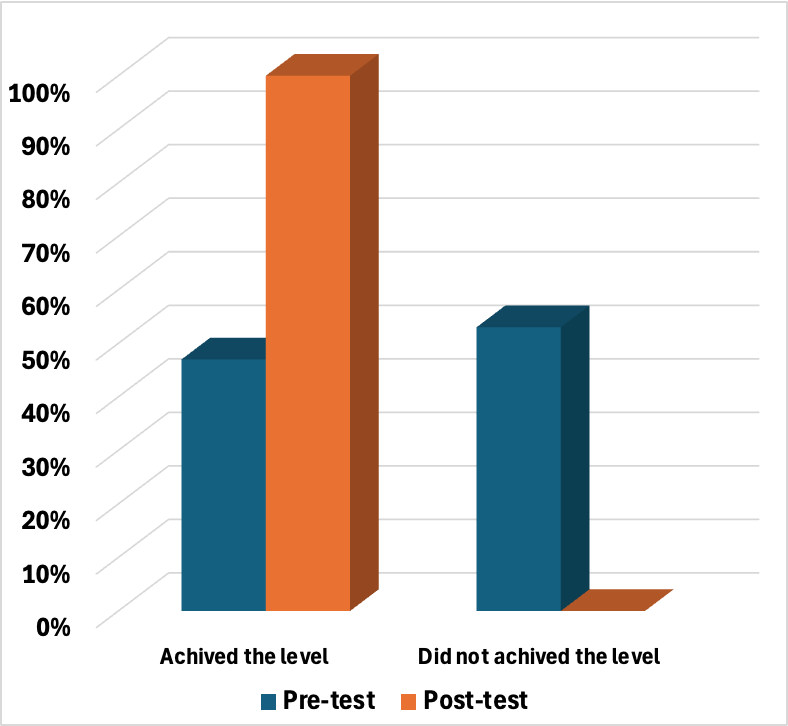
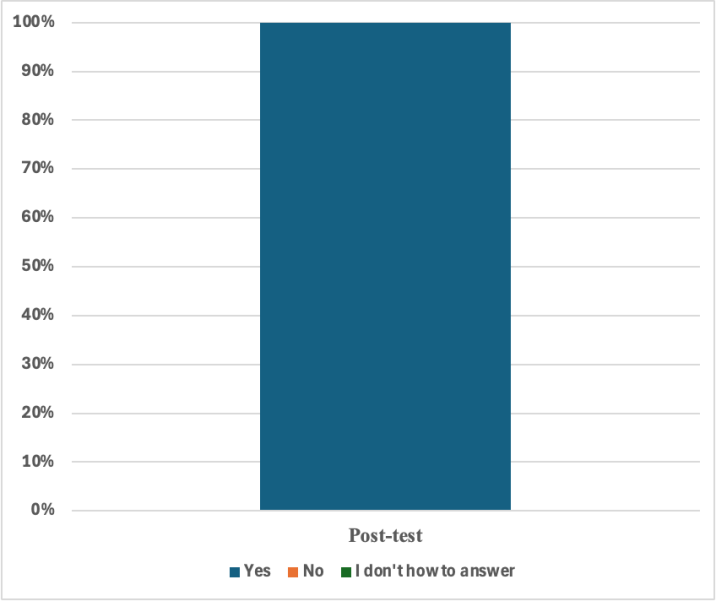
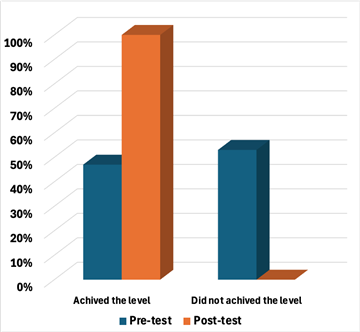
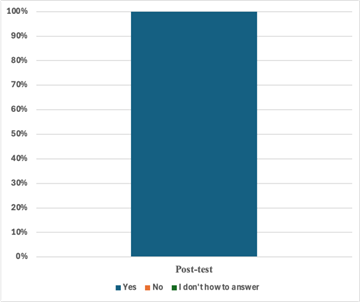
As for the "Understand" level (Q.2), in which students should read the question and classify it as correct or incorrect, therefore, if they understood the content they should conclude that the statement was correct. In the pre-test, it is observed that 47% of the students reached the "Understand" level and 53% could not solve the question correctly. In the post-test, 100% of the students answered the question correctly, which indicates that there was a process of accommodation or memorization at this level, for 53% of the students who in the pre-test were unable to understand the Carnot Cycle (Figure 2).
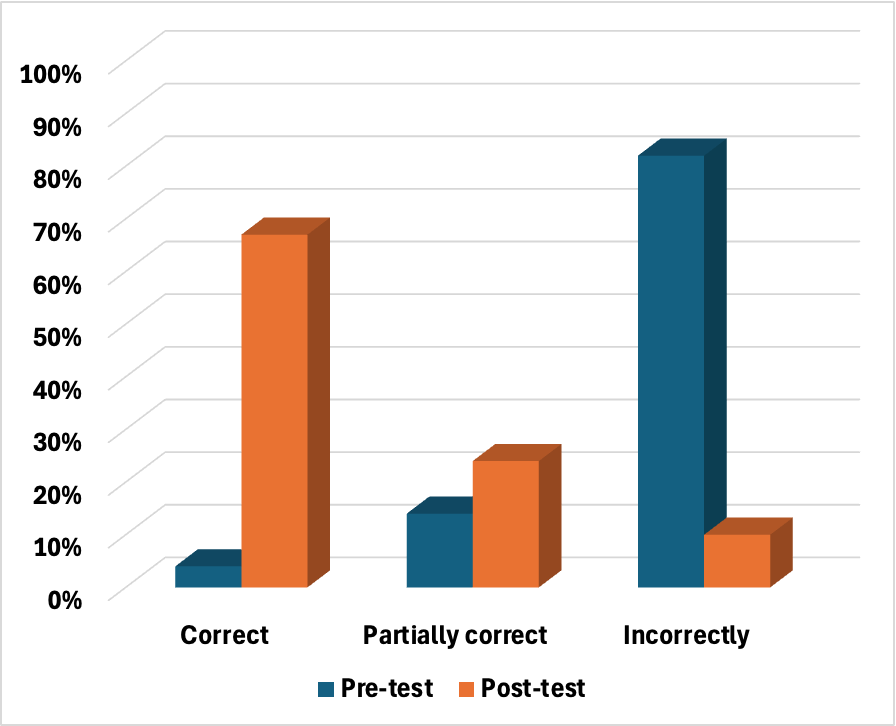
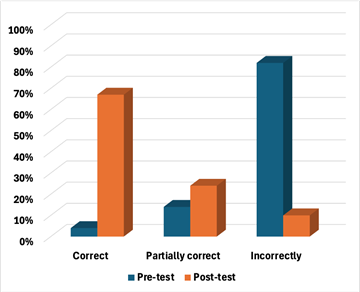
The third level examined in the pre-test was the ability to "Apply" the concepts on the structure and processes of the Carnot Cycle indicated in (P.3). In the results of the post-test of (P.3), it is observed that 67% of the students demonstrated which elements represent the Carnot Cycle, while 24% did so partially and 9% could not reach this level (Figure 3). Comparing this number with the result of the pretest, where it is observed that 4% of the students answered correctly, 14% partially answered the question correctly, and 82% answered incorrectly or did not answer at all, therefore, they did not reach the level of application. It is inferred that, after PBL, there was a better interpretation by the students, which previously reached 92% who did not reach this level. It is indicated that the use of PBL has influenced the way in which students examine theory and manage, through it, to direct an action, as indicated 19.
The more complex or higher-order levels were analyzed only in the post-test since they require a higher knowledge of the students, which is expected to be obtained after the application of the PBL strategy and resolution of the exercise on the Carnot Cycle.
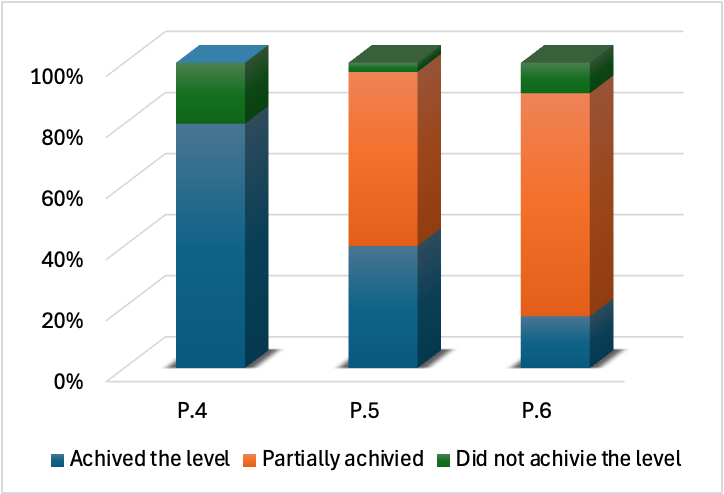
The "Analysis" level (Q.4), in turn, had not been reached by any student before, and with PBL it was reached by 17%. Analyzing the item partially, this result was achieved by 80% of the students and 20% did not reach the level. Thus, 80% of the students partially reached the "Analysis" level, while 20% could not discriminate (Q.4). (Figure 4).
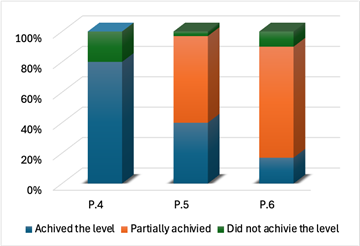
Regarding the ability to "Synthesize" (Q.5), this level was reached by 40% of the students in a total way and 57% partially, only 3% could not relate which elements are involved in the Carnot Cycle. (Figure 4). These results indicate the influence attributed to the use of PBL, indicating, as 22 pointed out, that PBL aids in performance (Figure 4).
Research on development, related to the students' ability to "Create" (Q.6) 28 - to propose solutions with knowledge of the facts to the problem posed - indicated that 17% of the students were able to maintain their response based on the concepts worked on in the Carnot Cycle analyzed, 73% managed to develop the proposal partially and 10% did not. Indicating that the strategy influenced students' ability to solve problems, expanding the development of levels to apply and synthesize (Figure 4).
These results indicated that the cognitive levels of higher order were fully achieved by the students in 80%, 40% and 17% for Q.4, Q.5 and Q.6 respectively, and partially by 57% and 73% for P.5 and P.6 respectively, with the teaching strategy used. As the higher-order cognitive level increases, the percentage of students who achieve the level completely decreases, and the percentage of students who achieve the level partially increases, it is demonstrated that the problem-solving technique complemented with the PBL strategy for teaching about the Carnot Cycle. It allowed students to build knowledge, because it helps in the development of students' intellectual autonomy.
Regarding the affective analysis, developed with the application of the resolution of the exercise, as well as with PBL, it was investigated according to the evaluation instrument (Table 3), based on Bloom's Taxonomy, how students receive the stimulus emitted by the teaching method, they feel satisfied with it, they manage to change their attitudes after the experience.
These questions have made it possible to identify the satisfaction of the students, as well as their motivations. It is possible to analyze the affective development versus the presentation plus the resolution of the Carnot Cycle problem. It is observed that 100% (Q.7) of the students believe that the teaching strategy used provides the understanding of the content (Figure 5).
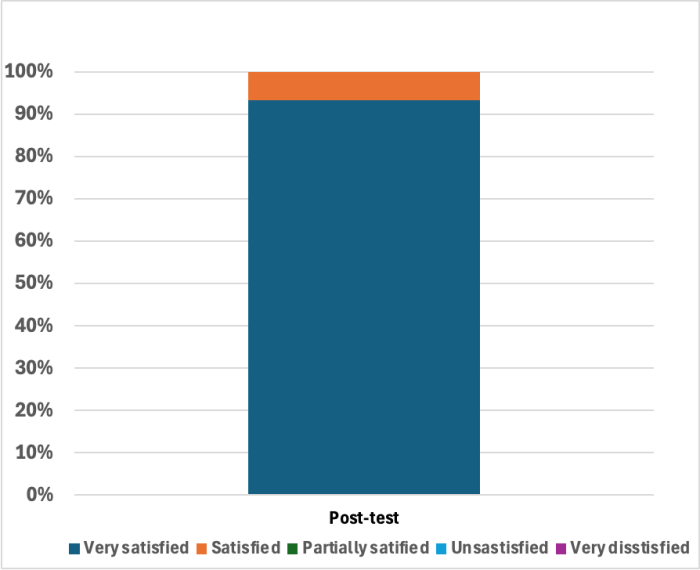
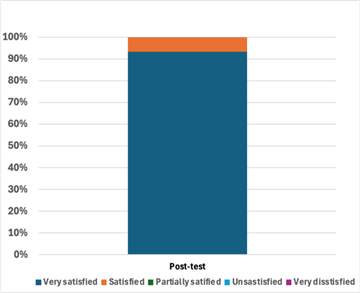
Assign a grade to the reading + exercise resolution in Carnot's Cycle (Q.8) was used to verify how students, when participating in a group activity that uses task separation, internalized values (Figure 6). Analyzing the affective domain of "response" developed with the application of PBL, it is observed in (Q.8) that 93.33% and 3.33% of the students are very satisfied or satisfied, respectively, with the strategy and believe that the use of the technique helped to improve the understanding of the content (Figure 6). It is important to note that none of the students presented partial or total dissatisfaction with the strategy. This indicates that one of the factors of the results was motivation during the construction of knowledge about the Carnot Cycle (Figure 6).
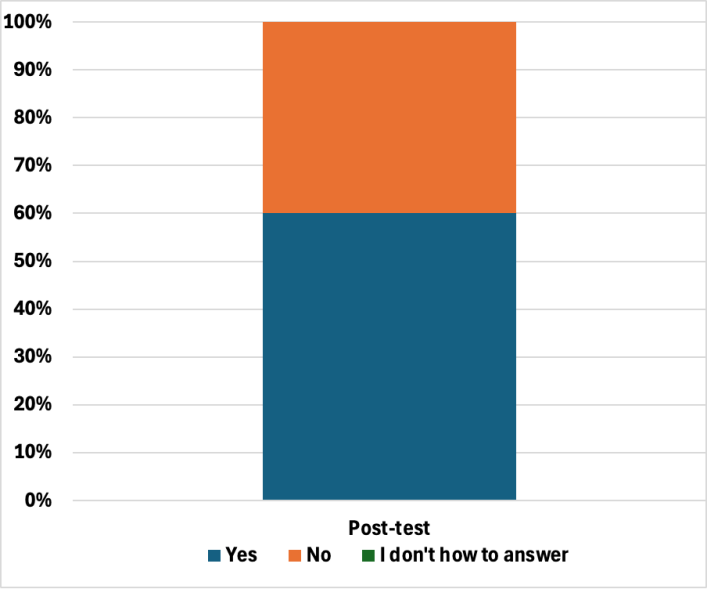
In the self-evaluation, carried out after the presentation and resolution of the exercise, when asked about the pleasure of participating in group activities (Q.9), in which there is separation of tasks, 60% said they liked it and 40% said they did not (Figure 7).
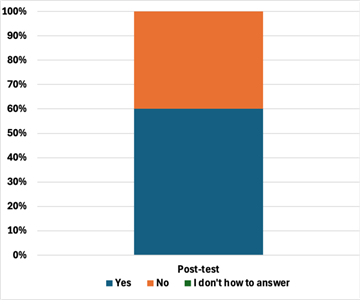
The results showed that, in general, most students were satisfied with the use of PBL, which allows us to identify which part of them changed their behavior after its application. This satisfaction, found in the evaluation of PBL, after its application, revealed that the students consider the technique motivating.
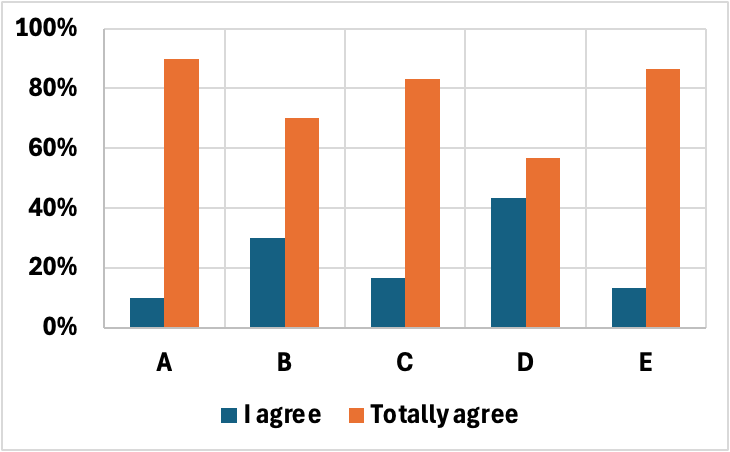
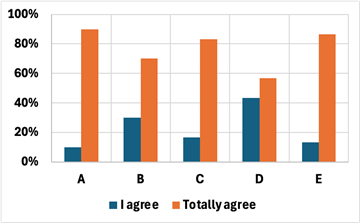
To conclude the evaluations, questions were applied about the attitudes developed related to the student himself (self-evaluation). The self-assessment, with the intention of analyzing in a general way the attitudes developed individually and in groups, students were asked to give a grade on the topics, based on a Likert scale Therefore, the issue related to the student's assessment and his or her own attitude were analyzed according to Table 4.
The results of the self-assessment of activities developed using PBL are presented in Figure 8. In item (A) they indicated that 90% of the students believe that they have developed the tasks collaboratively, respecting others, and 10% partially agree with this statement. In item (B), regarding the student's commitment to the proposed tasks, the evaluation indicated that 70% totally agree that there is commitment and 30% partially agree. Item (C) questioned the flexibility of the students in terms of the distribution of the tasks and functions performed during the experiment. This flexibility was indicated by 83.33% of the students who agreed to be flexible, while 16.67% agreed in part with this statement. Item (D), related to interest in participating in the activities, was confirmed by 56.66% of the students who said they showed interest in the activities, and 43.34% partially agreed with the statement. The analysis of the exchange of experiences provided by the activities. Item (E) was confirmed by 86.67%, who fully agreed that the techniques allowed the exchange of experiences and 13.33% partially agreed. It should be noted that the options totally in disagreement, in disagreement and neither in agreement nor in disagreement, presented any percentage.
From this evaluation, it can be highlighted that the participation of the students allowed them to develop group activities in a collaborative, committed, flexible, interesting way and, above all, facilitated the exchange of experiences. PBL helps in teamwork and problem-solving 29. The results found in this study, referring to the use of a teaching technique, as a complement to the traditional method, indicated that the use of PBL influenced almost all levels of cognitive development, considering the result achieved in its entirety. Adding to the above, its application provides satisfaction, and this effectiveness can provide knowledge construction and satisfaction, inducing the student's commitment to learning.
Some brief qualitative comments made by some students on the affective benefits of PBL in the teaching of the Carnot Cycle are:
- We can share ideas, knowledge, and get feedback from your partner, which improves the quality of work
- Peers provided motivation and support, reducing stress and improving creativity
- You can finish jobs faster and better because everyone focuses their qualities on a part of the work and having more people monitoring reduces errors
- We improve the understanding of what the Carnot Cycle is about, what its various stages are and their importance.
The resolution of the Carnot Cycle exercise was presented in a general way in the class after having performed the exercise with PBL. The groups formed solved the problem adequately, performing the mathematical operations, conversions of units, obtaining the values correctly of the thermodynamic processes of the Carnot Cycle.
The evaluation of the cognitive and affective performance achieved by the students at each moment of teaching of the Carnot cycle reveals that the use of PBL, as an additional strategy, was able to influence the levels of development achieved by the students, mainly at the most complex levels (analyzing, synthesizing and creating), as well as providing satisfaction. Along the same lines, motivation is a stimulus for meaningful learning.
This research seeks to contribute to the teaching of the Carnot Cycle, since, through this analysis, it can be concluded that it is beneficial to use a teaching technique that complements the traditional method, providing experience with the search for solutions and the development of critical thinking, as well as contributing to meaningful learning in addition to providing motivation. With these results, teachers can use the data as an analytical tool, adapted to the educational objectives they intend to achieve, creating new possibilities.
The data from this research allows us to infer that the use of PBL, which requires the direct and active participation of students with learning, helps the development of critical thinking, since it has influenced the most complex levels of cognitive development, according to the data found in the evaluations carried out based on the Bloom-Barrows Taxonomy. PBL allows the development of critical capacity, since, in this research, the use of the technique influenced the levels of learning, which contemplates this cognitive development.
As the construction of knowledge occurs through the subject's experience with the objects of study, it can be concluded that the use of active teaching techniques such as PBL, used in an additional way, help the cognitive and affective development of students, contributing to this construction. Finally, great satisfaction was generated in the students, expressing that this type of work should continue with other topics of Physical Chemistry. The successful implementation of PBL provides better learning outcomes for Physical Chemistry students in the Chemistry career.
As limitations, it is observed that this research was carried out in a single class and its results could not be compared with another that was not influenced by PBL, which would allow verifying the development provided in both cases. Another limiting factor was the size of the sample, which does not allow the generalization of the data found.
Sample size can affect the reliability of our conclusions, so we invite replication in various educational settings. It is recommended that in future projects experimental research with PBL be carried out in a group of students where it is applied and compared with another group where it was not applied, comparing the effect of cognitive and affective development in both cases. The students perceived the method as effective in this work, since it develops skills to elaborate and formulate questions, as well as teamwork and problem solving.
PIAPIME project 2.12.04.24 Problem-based learning for the cognitive and affective development of Chemistry students with the support of Artificial Intelligence in the subject of Physical Chemistry.
Informed consent was obtained from the students before the study.
There are no conflicts to declare.
The ethical rules in force in our institution were followed.
| [1] | Moreira, M. A. (2020). Aprendizaje significativo: la visión clásica, otras visiones e interés. Proyecciones, (14), 022-030. | ||
| In article | View Article | ||
| [2] | Sanghvi, P. (2020). Piaget’s theory of cognitive development: a review. Indian Journal of Mental Health, 7(2), 90-96. 5-Review-Article_Piagets-theory.pdf (indianmentalhealth.com). | ||
| In article | View Article | ||
| [3] | Piletti, N., & Rossato, S. M. (2024). Psicologia da aprendizagem: da teoria do condicionamento ao construtivismo. Editorial Contexto. Brasil. | ||
| In article | |||
| [4] | Knowles, M. S., Holton, E. F. I., & Swanson, R. A. (2015). The adult learner: The definitive classic in adult education and human. Florence: Taylor and Francis. | ||
| In article | |||
| [5] | Ma PhD, W. W., Tong, K. W., & Tso, A. W. B. (2020). Learning Environment and Design: Current and Future Impacts. Hong Kong. | ||
| In article | View Article | ||
| [6] | Giammatteo, L., & Obaya-Valdivia, A. (2021) Introducing Chemistry of Cleaning through Context-Based Learning in a High-School Chemistry Course) American Journal of Educational Research, 2021, Vol. 9, No. 6, 335-340 Available online at http://pubs.sciepub.com/education/9/6/2 Published by Science and Education Publishing. | ||
| In article | View Article | ||
| [7] | Wijnia, L., Noordzij, G., Arends, L. R., Rikers, R. M., & Loyens, S. M. (2024). The effects of problem-based, project-based, and case-based learning on students’ motivation: A meta-analysis. Educational Psychology Review, 36: 29, 1-38. | ||
| In article | View Article | ||
| [8] | Notari, M., Baumgartner, A., & Herzog, W. (2014). Social skills as predictors of communication, performance and quality of collaboration in project‐based learning. Journal of Computer Assisted Learning, 30(2), 132-147. | ||
| In article | View Article | ||
| [9] | Vargas-Rodríguez, Y.M., Obaya-Valdivia, A. (2021). Problem Based Learning: Barrow And Bloom Taxonomy (Experimental activity) International Journal of Education (IJE) vol 9, No 4, 19-29 December https://airccse.com/ije/abstract/9421ije02.html. | ||
| In article | View Article | ||
| [10] | Donche, V., & Van Petegem, P. (2016). Teacher educators' conceptions of learning to teach and related teaching strategies. Styles of Practice in Higher Education (75-90). Routledge. | ||
| In article | |||
| [11] | Fink, L. D. (2013). Creating significant learning experiences: An integrated approach to designing college courses. John Wiley & Sons. | ||
| In article | |||
| [12] | Billett, S. (2014). Integrating learning experiences across tertiary education and practice settings: A socio-personal account. Educational Research Review, 12, 1-13. https:// www.sciencedirect.com/ science/article/pii/S1747938X1400003. | ||
| In article | View Article | ||
| [13] | Felfe, J., Schyns, B., & Tymon, A. (2014). The impact of university students’ commitment on in-and extra-role performance. Journal of Applied Research in Higher Education, 6(1), 149-167. | ||
| In article | View Article | ||
| [14] | Biggs, J. B. (1987). Student Approaches to Learning and Studying. Research Monograph. Australian Council for Educational Research Ltd., Radford House, Frederick St., Hawthorn 3122, Australia. | ||
| In article | |||
| [15] | Tyng, C. M., Amin, H. U., Saad, M. N., & Malik, A. S. (2017). The influences of emotion on learning and memory. Frontiers in psychology, 8, 235933. | ||
| In article | View Article PubMed | ||
| [16] | Hanington, B., & Martin, B. (2019). Universal methods of design expanded and revised: 125 Ways to research complex problems, develop innovative ideas, and design effective solutions. Rockport Publishers. | ||
| In article | |||
| [17] | Vergara, D., Extremera, J., Rubio, M. P., & Dávila, L. P. (2019). Meaningful learning through virtual reality learning environments: A case study in materials engineering. Applied Sciences, 9(21), 4625. | ||
| In article | View Article | ||
| [18] | Dermol, V., & Čater, T. (2013). The influence of training and training transfer factors on organizational learning and performance. Personnel review, 42(3), 324-348. | ||
| In article | View Article | ||
| [19] | Krathwohl, D. R (2002). A revision of Bloom's taxonomy: An overview. Theory into practice, 41(4), 212-218. | ||
| In article | View Article | ||
| [20] | Barrows, H. S. (1986) A taxonomy of problem-based learning methods. Medical Education 20 (6), 481–486. | ||
| In article | View Article PubMed | ||
| [21] | Konopka, C. L., Adaime, M. B., & Mosele, P. H. (2015). Active teaching and learning methodologies: some considerations. Creative Education, 6(14), 1536-1545. | ||
| In article | View Article | ||
| [22] | Prince, M. (2004). Does active learning work? A review of the research. Journal of Engineering Education, 93(3), 223-231. | ||
| In article | View Article | ||
| [23] | Smith, K., Maynard, N., Berry, A., Stephenson, T., Spiteri, T., Corrigan, D., ... & Smith, T. (2022). Principles of problem-based learning (PBL) in STEM education: Using expert wisdom and research to frame educational practice. Education Sciences, 12(10), 728. | ||
| In article | View Article | ||
| [24] | Obaya Valdivia Adolfo, Delgadillo García Graciela. (2018) Estudio exploratorio de las actividades de estudio-aprendizaje en los alumnos de química industrial. Educación Química. 9 (4) 212-214. | ||
| In article | View Article | ||
| [25] | Chin, C., & Chia, L. G. (2004). Problem‐based learning: Using students' questions to drive knowledge construction. Science Education, 88(5), 707-727. | ||
| In article | View Article | ||
| [26] | Sastre De Genoveva (2018) El aprendizaje basado en problemas. Editorial GEDISA. España. | ||
| In article | |||
| [27] | Obaya-Valdivia, A., Montaño-Osorio, C. Rodríguez Vargas, Y.M. (2022) Exploratory Study to Determine the Effectiveness of Discussion Sessions as a Teaching Strategy on the Concepts of Spontaneity. Science Education International ¦ Volume 33 ¦ Issue 4, 1-5. | ||
| In article | View Article | ||
| [28] | Anderson, D. B., & Krathwohl, D. R. (2001). Taxonomy for learning, teaching, and assessing. Teaching Strategies for Outcomes-Based Education, 82- 85. Phi Delta Kappa International. | ||
| In article | |||
| [29] | Michaelsen, L. K., Knight, A. B., & Fink, L. D. (Eds.). (2023). Team-based learning: A transformative use of small groups in college teaching. Taylor & Francis. | ||
| In article | |||
Published with license by Science and Education Publishing, Copyright © 2024 Adolfo E. Obaya Valdivia, Carlos Montaño Osorio, Benjamín Velasco-Bejarano and Yolanda Marina Vargas-Rodríguez
 This work is licensed under a Creative Commons Attribution 4.0 International License. To view a copy of this license, visit
https://creativecommons.org/licenses/by/4.0/
This work is licensed under a Creative Commons Attribution 4.0 International License. To view a copy of this license, visit
https://creativecommons.org/licenses/by/4.0/
| [1] | Moreira, M. A. (2020). Aprendizaje significativo: la visión clásica, otras visiones e interés. Proyecciones, (14), 022-030. | ||
| In article | View Article | ||
| [2] | Sanghvi, P. (2020). Piaget’s theory of cognitive development: a review. Indian Journal of Mental Health, 7(2), 90-96. 5-Review-Article_Piagets-theory.pdf (indianmentalhealth.com). | ||
| In article | View Article | ||
| [3] | Piletti, N., & Rossato, S. M. (2024). Psicologia da aprendizagem: da teoria do condicionamento ao construtivismo. Editorial Contexto. Brasil. | ||
| In article | |||
| [4] | Knowles, M. S., Holton, E. F. I., & Swanson, R. A. (2015). The adult learner: The definitive classic in adult education and human. Florence: Taylor and Francis. | ||
| In article | |||
| [5] | Ma PhD, W. W., Tong, K. W., & Tso, A. W. B. (2020). Learning Environment and Design: Current and Future Impacts. Hong Kong. | ||
| In article | View Article | ||
| [6] | Giammatteo, L., & Obaya-Valdivia, A. (2021) Introducing Chemistry of Cleaning through Context-Based Learning in a High-School Chemistry Course) American Journal of Educational Research, 2021, Vol. 9, No. 6, 335-340 Available online at http://pubs.sciepub.com/education/9/6/2 Published by Science and Education Publishing. | ||
| In article | View Article | ||
| [7] | Wijnia, L., Noordzij, G., Arends, L. R., Rikers, R. M., & Loyens, S. M. (2024). The effects of problem-based, project-based, and case-based learning on students’ motivation: A meta-analysis. Educational Psychology Review, 36: 29, 1-38. | ||
| In article | View Article | ||
| [8] | Notari, M., Baumgartner, A., & Herzog, W. (2014). Social skills as predictors of communication, performance and quality of collaboration in project‐based learning. Journal of Computer Assisted Learning, 30(2), 132-147. | ||
| In article | View Article | ||
| [9] | Vargas-Rodríguez, Y.M., Obaya-Valdivia, A. (2021). Problem Based Learning: Barrow And Bloom Taxonomy (Experimental activity) International Journal of Education (IJE) vol 9, No 4, 19-29 December https://airccse.com/ije/abstract/9421ije02.html. | ||
| In article | View Article | ||
| [10] | Donche, V., & Van Petegem, P. (2016). Teacher educators' conceptions of learning to teach and related teaching strategies. Styles of Practice in Higher Education (75-90). Routledge. | ||
| In article | |||
| [11] | Fink, L. D. (2013). Creating significant learning experiences: An integrated approach to designing college courses. John Wiley & Sons. | ||
| In article | |||
| [12] | Billett, S. (2014). Integrating learning experiences across tertiary education and practice settings: A socio-personal account. Educational Research Review, 12, 1-13. https:// www.sciencedirect.com/ science/article/pii/S1747938X1400003. | ||
| In article | View Article | ||
| [13] | Felfe, J., Schyns, B., & Tymon, A. (2014). The impact of university students’ commitment on in-and extra-role performance. Journal of Applied Research in Higher Education, 6(1), 149-167. | ||
| In article | View Article | ||
| [14] | Biggs, J. B. (1987). Student Approaches to Learning and Studying. Research Monograph. Australian Council for Educational Research Ltd., Radford House, Frederick St., Hawthorn 3122, Australia. | ||
| In article | |||
| [15] | Tyng, C. M., Amin, H. U., Saad, M. N., & Malik, A. S. (2017). The influences of emotion on learning and memory. Frontiers in psychology, 8, 235933. | ||
| In article | View Article PubMed | ||
| [16] | Hanington, B., & Martin, B. (2019). Universal methods of design expanded and revised: 125 Ways to research complex problems, develop innovative ideas, and design effective solutions. Rockport Publishers. | ||
| In article | |||
| [17] | Vergara, D., Extremera, J., Rubio, M. P., & Dávila, L. P. (2019). Meaningful learning through virtual reality learning environments: A case study in materials engineering. Applied Sciences, 9(21), 4625. | ||
| In article | View Article | ||
| [18] | Dermol, V., & Čater, T. (2013). The influence of training and training transfer factors on organizational learning and performance. Personnel review, 42(3), 324-348. | ||
| In article | View Article | ||
| [19] | Krathwohl, D. R (2002). A revision of Bloom's taxonomy: An overview. Theory into practice, 41(4), 212-218. | ||
| In article | View Article | ||
| [20] | Barrows, H. S. (1986) A taxonomy of problem-based learning methods. Medical Education 20 (6), 481–486. | ||
| In article | View Article PubMed | ||
| [21] | Konopka, C. L., Adaime, M. B., & Mosele, P. H. (2015). Active teaching and learning methodologies: some considerations. Creative Education, 6(14), 1536-1545. | ||
| In article | View Article | ||
| [22] | Prince, M. (2004). Does active learning work? A review of the research. Journal of Engineering Education, 93(3), 223-231. | ||
| In article | View Article | ||
| [23] | Smith, K., Maynard, N., Berry, A., Stephenson, T., Spiteri, T., Corrigan, D., ... & Smith, T. (2022). Principles of problem-based learning (PBL) in STEM education: Using expert wisdom and research to frame educational practice. Education Sciences, 12(10), 728. | ||
| In article | View Article | ||
| [24] | Obaya Valdivia Adolfo, Delgadillo García Graciela. (2018) Estudio exploratorio de las actividades de estudio-aprendizaje en los alumnos de química industrial. Educación Química. 9 (4) 212-214. | ||
| In article | View Article | ||
| [25] | Chin, C., & Chia, L. G. (2004). Problem‐based learning: Using students' questions to drive knowledge construction. Science Education, 88(5), 707-727. | ||
| In article | View Article | ||
| [26] | Sastre De Genoveva (2018) El aprendizaje basado en problemas. Editorial GEDISA. España. | ||
| In article | |||
| [27] | Obaya-Valdivia, A., Montaño-Osorio, C. Rodríguez Vargas, Y.M. (2022) Exploratory Study to Determine the Effectiveness of Discussion Sessions as a Teaching Strategy on the Concepts of Spontaneity. Science Education International ¦ Volume 33 ¦ Issue 4, 1-5. | ||
| In article | View Article | ||
| [28] | Anderson, D. B., & Krathwohl, D. R. (2001). Taxonomy for learning, teaching, and assessing. Teaching Strategies for Outcomes-Based Education, 82- 85. Phi Delta Kappa International. | ||
| In article | |||
| [29] | Michaelsen, L. K., Knight, A. B., & Fink, L. D. (Eds.). (2023). Team-based learning: A transformative use of small groups in college teaching. Taylor & Francis. | ||
| In article | |||