Epidemiological studies reveal that almost half of African adults suffer from high blood pressure. According to WHO reports, this could be due to high salt consumption. Research indicates that excessive salt consumption leads to an imbalance in the intestinal microbiota by affecting Lactobacillus species, the balance of which is beneficial for stabilizing blood pressure. The aim of this study was to evaluate the effect of three seasoning broths with antihypertensive properties, formulated with Psathyrella tuberculata, an edible mushroom, and plant ingredients, on the growth of Lactobacillus Sp in vitro and their antihypertensive potential in vivo in hypertensive Wistar rats. The growth of Lactobacillus Sp was assessed by counting the number of CFU/mL every hour using a spectrophotometer and plotting the growth curves from the log CFU/mL values obtained. On the other hand, the antihypertensive potential was assessed by the invasive method using a CONTEC08A-VET electronic sphygmomanometer. The results of the comparison of the growth curves obtained revealed that the media prepared from the three formulations, in particular seasoning broth B50, contained more nutrients favourable to the growth of Lactobacillus Sp than the control medium, MRS broth. The results of the systolic blood pressure (SBP) and diastolic blood pressure (DBP) values, obtained after administration of the different aqueous treatment solutions, showed a reduction in SBP (39.03%) and DBP (35.75%) for broth B90, PAS (45.10%) and PAD (50.17%) for B70 broth, and PAS (48.78%) and PAD (53.17%) for B50 broth, compared with PAS (45.36%) and PAD (49.29%) obtained with the pharmaceutical drug furosemide 40 mg. The highest number of CFU/mL of Lactobacillus Sp and the reduction in PAS and PAD values obtained with seasoning broth B50 confirm that it has the highest antihypertensive potential of the other formulations.
Hypertension is defined as the permanent maintenance of high blood pressure, corresponding to a systolic blood pressure of 140 mm Hg or more with or without a diastolic blood pressure of 90 mm Hg or more 1. It is the world's leading chronic disease due to its frequency, severity and complications 2. Hypertension can lead to kidney failure, blindness, ruptured blood vessels and impaired cognitive function 3. Developing countries such as Côte d'Ivoire are not immune to the high prevalence rates of hypertension. In Côte d'Ivoire, a major screening campaign carried out at 55 sites in May 2017 estimated the prevalence of hypertension at 20.4% nationally 4. The main causes of this high prevalence in developing countries are physical inactivity, obesity and changes in diet 5. As far as diet is concerned, there is a growing trend towards inappropriate dietary practices and increasing consumption of processed products rich in salt, leading to high blood pressure, which is responsible for around 14% of strokes and 9% of myocardial infarctions 6. According to 7, high sodium intake (more than two grams per day) and inadequate potassium intake (less than three grams per day) are major risk factors for high blood pressure, stroke and heart disease. Similarly, the 8 has reported that the average salt intake of adults is 4 310 mg/day of sodium (equivalent to 10.78 g/day of salt), which is almost double the recommended intake of less than 2 000 mg/day of sodium (equivalent to less than 5 g/day of salt).
Several studies have shown that high salt consumption leads to imbalance in the gut microbiota through its actions on Lactobacillus species, the balance of which is beneficial for blood pressure stabilization 9, 10, 11. In addition, studies by 12, 13 14, 15, 16 and 17 have also shown that fiber-rich plant foods (dietary herbs, beverages rich in polyphenols and flavonoids, vegetables, nuts, wholegrain cereals and legumes, which are optimal dietary sources of magnesium) balance the intestinal microbiota, helping to lower blood pressure and reduce the risk of cardiovascular disease. Despite all the means of preventing and managing hypertension, it remains a growing public health problem worldwide and particularly in developing countries 5.
In this context, new dietary and therapeutic alternatives based on ingredients rich in antihypertensive bioactive molecules such as vegetable proteins, calcium, magnesium, potassium, polyphenols, flavonoids and dietary fiber need to be formulated in compliance with the recommended antihypertensive values of these nutrients. While the agri-food industries formulate broths that have still not had the desired effects on blood pressure balance, the alternative in this study is the formulation of seasoning broths based on the edible mushroom Psathyrella tuberculata and plant ingredients consisting of onion (Allium cepa), garlic (Allium sativa), parsley (Petroselinum crispum) and cassava (Manihot esculentus). The aim of this study was to assess the effect of these formulations on the growth of Lactobacillus in vitro and their antihypertensive potential in vivo in hypertensive Wistar rats.
The plant material consisted of three formulations of seasoning broths based on Psathyrella tuberculata, a species of edible mushroom, and vegetable ingredients (garlic cloves, onion bulbs, parsley leaves and cassava starch). The mushrooms and tuberous cassava roots were collected after cultivation at Hermankono in the Lôh Djiboua region of southern Côte d'Ivoire, while the vegetables were purchased at the Forum market in Adjamé, a commune in the Abidjan district of Côte d'Ivoire. The seasoning broths B90, B70 and B50 were formulated by incorporating 90%, 70% and 50% of the Psathyrella tuberculata mushroom.
For the animals' feed, their basic diet consisted of meal produced from maize, dehydrated fish purchased from the Forum d'Adjamé market (Abidjan, Côte d'Ivoire), and starch meal from manioc tubers used to formulate seasoning broths. In addition, sunflower oil (Aromate, Côte d'Ivoire), purchased from a supermarket in Abidjan, was added. The vitamin and mineral supplements from Vita flash, France, were purchased from a pharmacy.
2.2. Microbiological MaterialThe material used consisted of a strain of Lactobacillus Sp, MRS Broth (Pronadisa, Conda S.A., Spain), and media obtained from B90, B70 and B50 seasoning broths.
2.3. Animal MaterialThe animal material consisted of forty-two (42) adult male rats aged three (3) to four (4) months, albino, normotensive (systolic blood pressure ≤ 130 mmHg and diastolic blood pressure ≤ 100 mmHg), of the species Rattus norvegicus (Muridae) and Wistar, with a body mass of between 200 and 250 g. They came from the Vivarium of the Ecole Normale Supérieure (ENS) d'Abidjan, located within the Université Félix Houphouët Boigny (Cocody, Abidjan, Côte d'Ivoire).
2.4. Evaluation of the Growth of Lactobacillus Sp Strains by SpectrophotometerThe study of the impact of seasoning broths on the growth of Lactobacillus was evaluated using the method described by 18. Lactobacillus Sp growth was measured by counting the number of colony-forming units (CFU), with results expressed as log CFU/mL. The number of CFU/mL was determined every hour. The log CFU/mL values as a function of time were then used to plot growth curves. To ensure a reliable comparison, the cultures were grown under identical physico-chemical conditions.
Preserved Lactobacillus Sp strains were plated on to Man Rogosa and Sharp (MRS) agar. After 24 hours incubation at 37°C, one or 2 colonies were picked using a sterilised pasteur pipette and bubbled into 1 mL of MRS broth. The optical density was then read at 625 nm to obtain a cell count of 0.5 McFarlane, corresponding to 1,108 CFU/mL. This suspension was used as inoculum for the control and the formulated seasoning broths (B90, B70 and B50).
A quantity of 5 g of powder of each seasoning broth (B90, B70 and B50) was taken and then diluted in 45 mL of MRS broth, then stirred for 30 min to obtain a homogeneous mixture. The different suspensions obtained were centrifuged at 4000 rpm for 20 min. After centrifugation, 40 mL of each supernatant was collected in sterile airtight dishes. A volume of 1 mL of the prepared Lactobacillus Sp inoculum was added to each supernatant, homogenised and incubated at 37°C.
The suspensions obtained were used to assess the growth of Lactobacillus Sp:
- M1: Medium based on MRS broth and B90 seasoning broth;
- M2: Medium based on MRS broth and B70 seasoning broth;
- M3: Medium based on SRM broth and B50 seasoning broth.
The control study was carried out by transferring 1 mL of inoculum (either 1,108 CFU/mL) into 40 mL (equivalent to the quantity of supernatant collected during the study on formulated seasoning broths) of MRS broth and then incubated at 37°C in an oven. Counts were taken every hour to plot the control growth curve.
Bacterial concentration by spectrophotometry was determined according to the method used by 19. Growth was monitored by measuring the optical density at 625 nm of each tube prepared for 24 hours at a regular time interval of one hour. For the preparation of the blank, 500 µL of the prepared MRS broth was used, whereas for the preparation of the different seasoning broth suspensions (B90, B70 and B50), 500 µL of supernatant from each broth was taken using a micropipette. Each quantity used was transferred to sterilised test tubes, which were then placed in an oven at 37°C. The optical density (OD) was read after every 1 hour, taking care to homogenise before sampling the suspension. Three optical density (OD) readings were taken for each interval.
2.5. In Vivo Study of the Antihypertensive Activity of Formulated Seasoning BrothsThe rats were acclimatized for 7 days to the tail cuff of the sphygmomanometer and fed a basal diet prepared according to the modified method of 20 for adaptation prior to the confirmation phase of their normotensive state.
During this acclimatisation phase, the rats were distributed randomly in experimental cages at a temperature of around +20°C, with alternating light and dark periods of 12/12h.
The basic diet provided consisted of maize meal, cassava starch, fish meal, sunflower oil and a vitamin and mineral premix, with water added for homogenization (Table 1). All the components were transferred to a saucepan and cooked on a hot plate until they set. After cooling, the food was stored in a refrigerator at +4°C. Each morning, between 11 a.m. and 12 p.m., the fresh food was weighed out at a rate of 30 g per rat and placed in their feed trough. The rats had free access to drinking water in bottles.
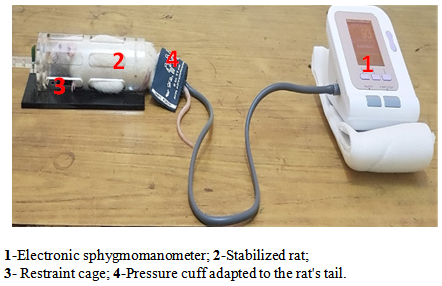
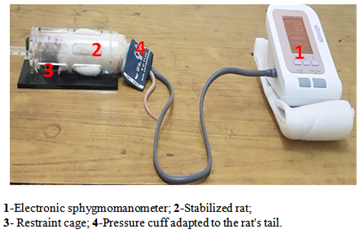
The blood pressure of Wistar rats was recorded by the indirect method, using the recording device, the electronic sphygmomanometer « CONTEC08A-VET, China » (Figure 1, 1). To collect each recording, the tail of the stabilized rat (Figure 1, 2) in the restraint cage (Figure 1, 3) was inserted and wrapped tightly around the pressure cuff (Figure 1, 4). After setting up the device, the automatic parameter measurement operation was carried out in a single touch using the multi-step oscillometric deflation measurement method with good repeatability. The blood pressure signal detected emits pressure vibrations which are displayed on the tensiometer screen together with the corresponding pressure (diastolic, systolic and mean) and respiratory rate values.
The effect of formulated seasoning broths in vivo on the reduction of blood pressure was evaluated with forty-two (42) rats judged to be normotensive by the measurements taken of diastolic and systolic pressures, in three (3) stages:
- From day 1 of the experiment to day 7, the normotensive state of the rats was confirmed;
- From day 8 of experimentation to day 35, arterial hypertension was induced in normotensive rats by administration of salt (8 ‰ NaCl);
- From day 36 of experimentation to day 56, the antihypertensive effect of seasoning food broths was evaluated on rats. Indeed, the forty-two (42) rats were divided into six (6) batches, with seven (7) rats per batch in experimental cages. This allocation required the weight of the rats to be measured on the last day of acclimatization. The rats were marked with an indelible marker for identification purposes.
The rats were divided into two groups: Group T, consisting of 7 control rats, and the experimental groups, consisting of 35 rats in group E1 to E5. The diastolic and systolic blood pressures of all the rats were determined once a day, between 7:00 am and 4:00 pm.
The determination of blood pressure for monitoring the normotensive state was carried out over a period of seven (7) days with a one-day interval.
After seven (7) days of confirmation of the normotensive state of each rat, arterial hypertension was induced only in the 35 normotensive rats of group E1 to E5 constituting the experimental groups, by administration of the basal diet, to be given as 8 ‰ of NaCl (8 g of NaCl mixed with 1000 g of the basal diet), overdosed with salt (NaCl) in that they also received, ad libitum, a solution of 8 ‰ NaCl (8 g of NaCl dissolved in 1 liter of tap water) used in 50-centilitre baby bottles as drinking water (corresponding to 4 g of salt dissolved in the 50 cl of tap water) according to the modified method of 21.
Diastolic and systolic blood pressures were determined once a day, between 7:00 a.m. and 4:00 p.m., with a one-day interval between each measurement.
By monitoring the hypertensive state of the experimental rats, the induction of arterial hypertension was stopped after twenty-eight (28) days. After four (4) weeks of experimentation, all 36 rats treated with sodium chloride (NaCl) had almost severe arterial hypertension justified by a systolic blood pressure greater than or equal to 170 mmHg and a diastolic blood pressure greater than or equal to 140 mmHg (measured by a non-invasive method).
The aqueous solutions for the formulated seasoning broths, were prepared according to the method described by 22. Fifty (50) grams of each formulated seasoning broth was boiled for 15 min in one (1) liter of distilled water. After cooling, the completely homogenous mixture was stored in hermetically sealed sterile jars sold in pharmacies for force-feeding.
The 50 g/L concentration used, was the lowest common therapeutic concentration of the seasoning broths formulated, having had antihypertensive activity on subjects made hypertensive by a salt overdosed diet (8 ‰ of NaCl) in a preliminary study. This preliminary study was conducted with four (4) concentrations (30 g/L; 50 g/L; 70 g/L and 90 g/L) of each seasoning broth (B90, B70 and B50) and a group of forty-eight (48) wistar rats.
The usual antihypertensive agent used, furosemide 40 mg, was dissolved in distilled water according to the manufacturer's recommendations (100 mg furosemide per 500 ml distilled water).
After arterial hypertension developed in the experimental rats that became hypertensive, the basal diet with an excess of salt (NaCl) was stopped. This diet was replaced by the same basic diet administered to the control group (Group T). The effect of aqueous solutions of seasoning broths formulated at a concentration of 50 g/L on the reduction of blood pressure was evaluated by administering the optimal dose (1 ml/100 g body weight) to each batch by gavage until blood pressure stabilized. The dose corresponding to the body weight of each animal was administered according to 22, once a day between 9 am and 10 am for a duration of twenty-one (21) days of treatment with one (1) day intervals.
The different batches for the experiments were distributed as follows:
- Group T (Distilled water): Normotensive control rats treated with distilled water, these animals received only the basal diet and normal ad-libithum tap water. This batch received distilled water by gavage (four times a week) at a rate of 1mL/100g body weight.
- Group E1 (distilled water): Hypertensive control rats treated with distilled water, these animals received only the basal diet and normal ad-libithum tap water. This batch was force-fed (four times a week) with distilled water at a rate of 1mL/100g body weight.
- Group E2 (SAqF40 mg): Hypertensive rats treated with furosemide 40 mg aqueous solution, these animals received the basal diet and normal ad-libithum tap water. This batch received furosemide aqueous solution by gavage (four times a week) at a rate of 1mL/100g body weight.
- Group E3 (SAqB90): Hypertensive rats treated with the aqueous solution of seasoning broth B90, these animals received the basal diet and ad-libithum normal tap water. These rats received the aqueous solution of B90 seasoning broth by gavage (four times a week) at a rate of 1mL/100g body weight.
- Group E4 (SAqB70): Hypertensive rats treated with the aqueous solution of seasoning broth B70, these animals received the basic diet and normal ad-libithum tap water. These rats received the aqueous solution of B70 seasoning broth by gavage (four times a week) at a rate of 1mL/100g body weight.
- Group E5 (SAqB50): Hypertensive rats treated with the aqueous solution of seasoning broth B50, these animals received the basic diet and normal ad-libithum tap water. These rats received the aqueous solution of B50 seasoning broth by gavage (four times a week) at a rate of 1mL/100g body weight.
2.6. Analysis of ResultsGraph Pad Prism 4 software (Microsoft, San Diego California, USA) was used for the statistical analysis of the results. The values were expressed as the mean, followed by the standard error of the mean (m ± esm). The significance of the differences observed was assessed using analysis of variance (ANOVA) followed by Tukey's multiple comparison test (at the 5% threshold).
In this test, when:
P > 0.05 the observed difference is non-significant (ns),
P < 0.05 the observed difference is insignificant (*),
P < 0.01 the observed difference is significant (**),
P < 0.001 the observed difference is highly significant (***),
P < 0.0001 the observed difference is highly significant (****).
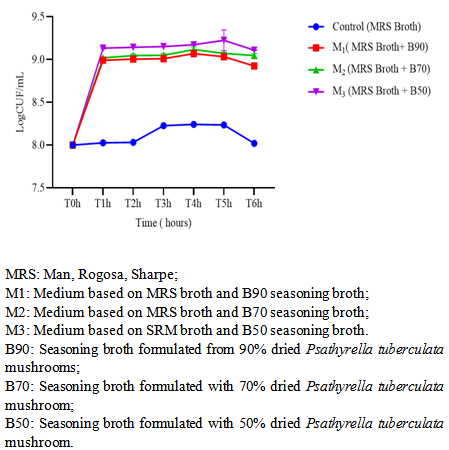
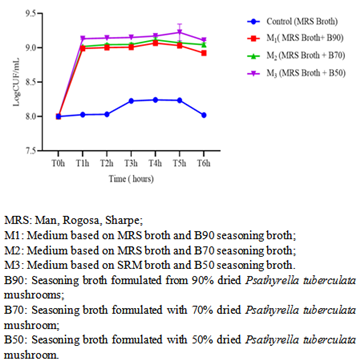
The growth curves of the Lactobacillus strain cultivated in vitro in the three (3) experimental media (M1, M2 and M3) plotted in the same frame as that of the control medium (MRS broth), make it possible to identify three (3) phases for the experimental media (M1, M2 and M3) and four (4) phases for the control medium (MRS broth) (Figure 2).
Statistical analysis of changes in the number of Lactobacillus strains expressed in log CFU/mL showed a highly significant difference (P < 0.0001) between the experimental media (M1, M2 and M3) and between the experimental media and the control medium (MRS broth).
In the control medium, the Lactobacillus strain undergoes a latent phase lasting 2 hours. After this adaptation phase, the cells enter an exponential growth phase between the second hour (T2h) and the third hour (T3h) of incubation. The estimated load increased from 8.03 ± 0.01 to 8.22 ± 0.01 log CFU/mL. Between T3h and T5h, there was no further cell division. The strain is in a stationary phase. Finally, a phase of decline is visible from the 5th hour (T5h) to the 6th hour (T6h), the growth rate becomes negative. The bacterial load fell from 8.22±0.01 to 8.02±0.01 log CFU/mL.
However, there was no apparent adaptation phase on the experimental media. After one hour's incubation, the strain grew exponentially on all three media. The bacterial load increased sharply. It increased from 8±0 to 8.99±0.003 log CFU/mL, from 8±0 to 9.01±0.004 log CFU/mL and from 8±0 to 9.13±0.008 log CFU/mL for experimental media M1, M2 and M3 respectively. A stationary phase was then observed until T5h. This was followed by a phase of decline in the three experimental media
The change in systolic (SBP) and diastolic (DBP) blood pressure after induction of arterial hypertension by a sodium diet (8 ‰ NaCl) was assessed by considering the reference values, that obtained before induction (Day 7 of experimentation) of arterial hypertension in normotensive rats.
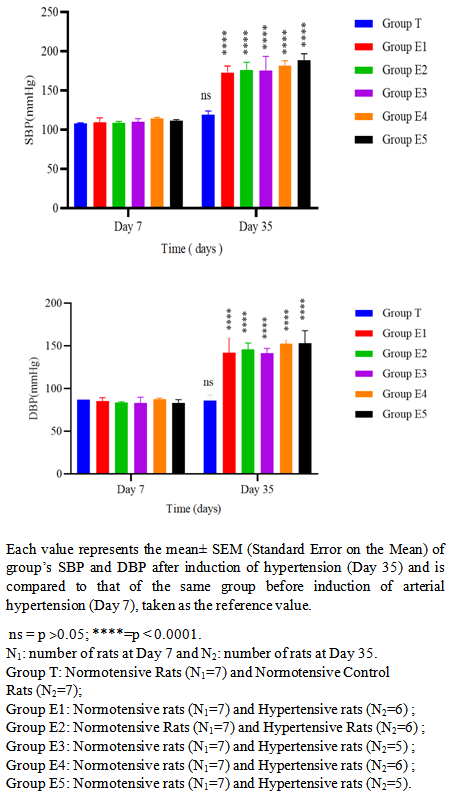
The systolic and diastolic blood pressure of normotensive rats in Group T (Day 7) were 108±1 mmHg and 87±0 mmHg respectively. There was little change in blood pressure after induction of hypertension in these animals fed only the basal diet. The values determined at Day 35 were 119.5 ± 4.58 and 86 ± 6.27 mmHg respectively, during systole and diastole. These variations correspond to a 10.64% increase in SBP and a 1.14% reduction in DBP (Figure 3).
In contrast, the salt-supplemented basal diet administered to the rats ( Groups E1 to E5) resulted in a highly significant (p<0.001) increase in systolic and diastolic blood pressure compared with baseline (Figure 3).
After induction of hypertension (Day 35), blood pressure varied from 109.66 ± 5.68 to 173.05 ± 8.31 mmHg during systole and from 85.33 ± 4.16 to 141.94 ± 17.80 mmHg during diastole in rats from Group E1. Blood pressure increased by 57.80% during systole and 66.34% during diastole.
The same applies to rats in Group E2 . Blood pressure varied from 108.66 ± 2.08 to 176.33 ± 9.82 mmHg, an increase of 59.54% during systole. During diastole, it increased by 74.64% (83.66 ± 1.15 to 176.33 ± 9.82 mmHg).
In addition, blood pressure varied from 110 ± 4.35 mmHg to 175.5 ± 18.15 mmHg during systole and from 83.33 ± 6.80 mmHg to 141.33 ± 5.79 mmHg during diastole in rats from Group E3. As a result, blood pressure increased by 62.27% during systole and 69.60% during diastole.
Subsequently, blood pressure in rats in Group E4 varied from 114.33±1.52 to 181.94 ± 6.36 mmHg, i.e. an increase of 59.13 % during systole. During diastole, it increased by 74.55% (87.33±1.52 to 152.44 ± 5.69 mmHg).
Finally, systolic and diastolic arterial pressures increased by 68.89% (112 ± 1 to 189.16 ± 7.84 mmHg) and 83.79% (83.33 ± 3.78 to 153.16 ± 14.78 mmHg) respectively in rats from Group E5.

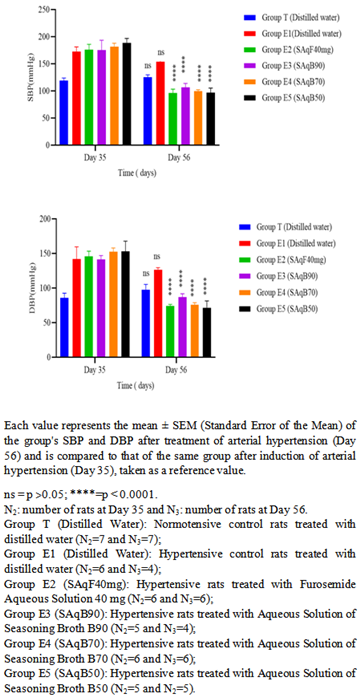
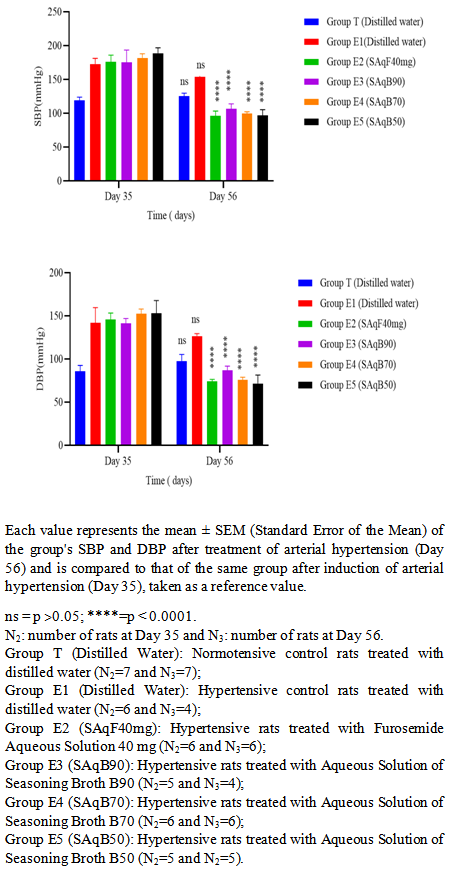
Administration of distilled water did not result in significant changes in systolic and diastolic blood pressure in control rats (Group T and Group E1).However, the blood pressure of hypertensive rats determined during systole and diastole fell sharply and significantly (p<0.0001) after administration of aqueous solutions of formulated seasoning broths and furosemide (Figure 4).
The hypertension treatment phase, from day 36 to day 56, was marked by the discontinuation of the salt-supplemented basal diet. In hypertensive rats treated with furosemide (Group 3 (SAqF40 mg)), SBP fell by 45.36% (76.33 ± 9.82 to 96.33 ± 7.11 mmHg). DBP fell from 146.11 ± 7.34 mmHg on day 35 to 74.16 ± 2.46 mmHg on day 56, a reduction of 49.29%.
Compared with furosemide, certain aqueous solutions of formulated seasoning broths result in a significant reduction in blood pressure.
In hypertensive rats treated with B70 broth (Group E4 (SAqB70)), systolic blood pressure fell from 181.94 ± 6.36 mmHg on day 35 to 99.88 ± 2.40 mmHg on day 56, a reduction of 45.10%. Diastolic blood pressure fell by 50.17% (152.44 ± 5.69 to 75.94 ± 3.19 mmHg). B70 seasoning broth thus resulted in a percentage reduction in treated rats close to that of furosemide.
Systolic and diastolic blood pressures were reduced by 48.78% (189.16 ± 7.84 to 96.88 ± 8.56 mmHg) and 53.17% (153.16 ± 14.78 to 71.72 ± 9.89 mmHg) respectively in hypertensive rats treated with B50 seasoning broth (Group E5 (SAqB50)). B50 seasoning broth produced a greater reduction in blood pressure (48.78% for SAP and 53.17% for DBP). These induced reductions were greater than those recorded with furosemide.
Hypertensive rats treated with B90 seasoning broth (Group E3 (SAqB90)) showed the lowest reduction in blood pressure. Systolic blood pressure fell by 39.03% (175.5±18.15 to 107±7 mmHg). Diastolic blood pressure fell from 141.33±5.79 to 86.83±5.13 mmHg. This represents a decrease of 35.75%. The smallest decreases were recorded in those rats treated with B90 seasoning broth.
The study of the activity of seasoning broths (B90, B70 and B50) formulated, on the growth of Lactobacillus, in vitro, was necessary, before the evaluation in vivo of the antihypertensive activity of these food formulations, because several experiments have shown the therapeutic effect of Lactobacillus in the treatment of cardiovascular diseases 23, 24. Clinical and animal experiments have shown preventive and therapeutic effects of Lactobacillus strains on hypercholesterolemia, hyperlipidemia, hyperglycemia, atherosclerosis, obesity and high blood pressure 25.
This evaluation consisted in comparing the growth of Lactobacillus Sp in experimental media M1, M2 and M3 containing MRS broth, associated respectively with seasoning broths B90, B70 and B50, to that of the control medium MRS broth. The results showed that experimental media M1, M2 and M3 did not present a lag phase, unlike the control medium. This could indicate that the conditions in these experimental media favored a faster adaptation of Lactobacillus Sp. Indeed, the absence of a lag phase during bacterial growth could be explained by the richness of the medium in directly assimilable nutrients, thus the studies of 26 showed that the addition of certain nutrients or additives more favorable to the growth of Lactobacillus could reduce the lag phase.
Furthermore, the exponential phases in experimental media M1, M2 and M3 showed a significant increase in the number of Lactobacillus Sp. This could be due to factors such as pH and nutrient composition of the formulated seasoning broths. Indeed, the study by 27 showed that a pH between 5.5 and 6.5 favors the optimal growth of bacteria, while lower or higher pHs can limit it. These results are consistent with those obtained in our previous work, which showed that the pH of formulated seasoning broths ranged from 5.96 ± 0.01 to 6.39 ± 0.01 28. These slightly acidic pHs are therefore favorable to the growth of Lactobacillus which develop better in acidic media. In addition, proteins, vitamins, minerals, dietary fibers, and fermentable carbohydrates such as reducing sugars, present in large quantities in the various formulated seasoning broths, could be the nutrients responsible for the exponential growth of these Lactobacillus Sp in experimental media M1, M2 and M3. This hypothesis is confirmed by several studies 29, 30 that have demonstrated that these bioactive nutrients promote the viability of Lactobacillus and the exponential growth of these bacteria.
As for the stationary phase, observed in experimental media M1, M2 and M3, it is also higher than that of the control medium, which could indicate a better capacity of these experimental media to support the growth of Lactobacillus. Indeed, the results of 31 show that a stationary phase longer than the other phases is linked to an increased availability of nutrients or a lesser inhibition of metabolic products.
On the other hand, the decline observed from the fifth hour of incubation in all culture media indicates that these culture media have become depleted of nutrients or that the metabolic waste of the bacteria has begun to accumulate in these culture media at the same time. This deduction is consistent with the work of 26. These phases of decline observed in the experimental media, with a higher number of Lactobacillus than in the control medium, show once again that the formulated seasoning broths could contribute to the balance of the intestinal microbiota. Indeed, the work of 24 showed that Lactobacillus exerts a strong antimicrobial activity against pathogenic bacteria, strengthening the intestinal barrier and restoring the balance of the intestinal microbiota.
In addition, the quality and proportions of the ingredients composing these formulations could justify the high number of Lactobacillus during this phase of decline. Furthermore, some specific prebiotics such as the oligosaccharides of dietary fibers contained in onion and garlic, could be the substrates most responsible for this growth of Lactobacillus in these media. The work of 32 showed that the oligosaccharides contained in onion and garlic, are prebiotics favorable to the growth of probiotic bacteria such as Lactobacillus. These results therefore explain the reason why the number of Lactobacillus obtained in the M3 medium, showed the highest values in all three phases. This M3 medium contained the B50 seasoning broth which was formulated with ingredients with higher proportions of onion and garlic.
To evaluate the in vivo antihypertensive properties of these seasoning broths formulated in Wistar rats, the effect of oral administration of aqueous solutions of seasoning broths (B90, B70, B50), furosemide 40 mg and distilled water on systolic blood pressure (SBP) and diastolic blood pressure (DBP) in salt (NaCl)-induced hypertensive rats was examined.
Before induction of arterial hypertension, the systolic and diastolic blood pressures of normotensive rats were lower than those obtained by 33. Administration of the salt-supplemented basal diet to the different group (Group E1 to Group E5) from day 8 to day 35, resulted in an increase in SBP and DBP in these rats. This increase is in agreement with the work of 34 who showed that excessive sodium consumption with 1g of sodium corresponding to 2.5 g of salt, is directly linked to an increase in sodium and water retention, leading to an increase in blood volume and peripheral vascular resistance.
Furthermore, the treatment phase of arterial hypertension marked by the return to the basal diet without salt supplementation revealed a reduction in SBP and DBP for all animals that received the basal diet supplemented with salt, with more marked decreases in the groups treated with the aqueous solutions SAqB90, SAqB70, SAqB50 and SAqF40mg. Indeed, a recent meta-analysis by 35 showed that a modest reduction in salt intake for 4 weeks or more leads to significant reductions in blood pressure, both in hypertensive and normotensive individuals, regardless of sex and ethnic group. These results are also in agreement with those of 36 who showed that dietary interventions, including reduction in salt intake, can lead to significant reductions in blood pressure in diabetic and hypertensive individuals.
Besides, the bioactive effect of SAqB90, SAqB70 and SAqB50 aqueous solutions on the reduction of SBP and DBP could be explained by the presence of polyphenols and flavonoids in the formulated seasoning broths acting via several mechanisms, such as inhibition of angiotensin converting enzyme (ACE), reduction of oxidative stress and improvement of endothelial function. Indeed, the work of 37 showed that specific classes of phenolic compounds or their metabolites, are reported to improve endothelial dysfunction through their antioxidant action, but also act directly on nitric oxide (NO) metabolism or reduce vasoconstriction by acting on the activity of ACE and angiotensin II receptors. As for the bioactive effect of furosemide 40 mg on the reduction of SBP and DBP, the results could be explained by its main action which is to increase the excretion of sodium and water by the kidneys, thus reducing blood volume and blood pressure. This justification is in agreement with the work of 38 who explain in detail the mechanism by which furosemide acts on the loop of Henle to exert its diuretic and antihypertensive effects. Based on the percentages of reduction of SBP and DBP of each of the aqueous solutions, the aqueous solution SAqB50 with its higher percentages of reduction of SBP and DBP would have more active components acting on the reduction of blood pressure. Therefore, the seasoning broth B50 could be recommended in the preparation of dishes for hypertensive people.
Lactobacillus, if present in a balanced amount in the intestinal microbiota, helps stabilize blood pressure. On the other hand, excessive salt consumption would inhibit the growth of Lactobacillus, thus causing high blood pressure. This study has shown in depth that B90, B70 and B50 seasoning broths promote the growth of Lactobacillus more than the MRS broth control medium. In addition, it showed that Lactobacillus grew faster in the B50 seasoning broth. Furthermore, after induction of arterial hypertension by salt (NaCl) in normotensive rats, oral administration of formulated B90, B70 and B50 seasoning broth solutions, together with furosemide and distilled water, showed that formulated B90, B70 and B50 seasoning broths contributed more to the reduction of systolic blood pressure (SBP) and diastolic blood pressure (DBP) values. In particular, B50 seasoning broth was able to bring these indicators back to levels similar to those of the normotensive control group. These beneficial effects suggest eubiosis-restoring properties, as well as potential antihypertensive and cardioprotective properties of these formulated seasoning broths.
Animals were treated in accordance with Directive 2010/63/EU on the protection of animals used for scientific purposes. All necessary efforts were made to minimize animal suffering and reduce the number of animals used.
The authors declare that there is no conflict of interest.
| [1] | Loret E, Prise en charge nutritionnelle du patient hypertendu. Thèse de Doctorat ès Sciences (Option: Pharmacie), Université joseph Fourier de Grenoble, France, 2013, 174p. | ||
| In article | |||
| [2] | Blacher J., Halimi J M., Hanon O., Mourad J J., Pathak A., Schnebert B., Girerd X, Prise en charge de l’hypertension artérielle de l’adulte. Recommandations 2013 de la Société Française d’Hypertension Artérielle. Sang Thrombose Vaisseaux, 25(5): 297-305. 2013. | ||
| In article | View Article | ||
| [3] | Yaovi N W S, Facteurs associés (FA) à la survenue / complications de l’hypertension artérielle (HTA) chez les jeunes adultes au Togo. Thèse de doctorat d’Etat ès Sciences (Option: Psychologie, Psychopathologie et Psychologie Clinique), Université de Picardie Jules Verne, France, 2022, 294p. | ||
| In article | |||
| [4] | Kramoh K E., Ekoua D., Abina A., Koffi K F., Koffi D B., Boka B., Aké-Traboulsi E., N’Cho-Mottoh M.-P., Tanoh M., Kouakou N Y N., Konin C., Anzouan-Kacou J.-B., N’Guetta R., Coulibaly I., Xia X., Beaney T., Poulter N R., Assi S R, May Measurement Month 2017: an analysis of blood pressure screening results in Côte d’Ivoire-Sub-Saharan Africa. European Heart Journal Supplements,21: 4749. 2019. | ||
| In article | View Article PubMed | ||
| [5] | Doulougou B, Hypertension artérielle dans la population adulte du Burkina Faso: prévalence, détection, traitement et contrôle. Thèse de Doctorat ès sciences (Option: Médecine Sociale et Préventive, ), Université de Montréal, France, 2014, 262p. | ||
| In article | |||
| [6] | Ha S K, Dietary salt intake and hypertension. Electrolyte Blood Press, 12(1): 7–18. 2014. | ||
| In article | View Article PubMed | ||
| [7] | OMS, Lignes directrices de l’OMS sur l’activité physique et la sédentarité: en un coup d’œil [WHO guidelines on physical activity and sedentary behaviour: at a glance].Genève,2020, 24p. | ||
| In article | |||
| [8] | OMS, ; .2023. | ||
| In article | |||
| [9] | Liu T H., Chiou J., Tsai TY, Effects of Lactobacillus plantarum TWK10-Fermented Soymilk on Deoxycorticosterone Acetate-Salt-Induced Hypertension and Associated Dementia in Rats. Nutrients, 8 (5): 260. 2016. | ||
| In article | View Article PubMed | ||
| [10] | Wilck N., Matus M G., Kearney S M., Olesen S W., Forslund K., Bartolomaeus H., Haase S., Mähler A., Balogh A., Markó L., Vvedenskaya O., Kleiner F H., Tsvetkov D., Klug L., Costea P I., Sunagawa S., Maier L., Rakova N., Schatz V., Neubert P., Frätzer C., Krannich A., Gollasch M., Grohme D A., Côrte-Real B F., Gerlach R G., Basic M., Typas A., Wu C., Titze J M., Jantsch J., Boschmann M., Dechend R., Kleinewietfeld M., Kempa S., Bork P., Linker R A., Alm E J., Müller D N, Salt-responsive gut commensal modulates TH17 axis and disease. 551(7682): 585-589. 2017. | ||
| In article | View Article PubMed | ||
| [11] | Zhao X., Zhong X., Liu X., Wang X., Gao X, Therapeutic and Improving Function of Lactobacilli in the Prevention and Treatment of Cardiovascular-Related Diseases: A Novel Perspective from Gut Microbiota. Frontiers in Nutrition, 8: 693412. 2021. | ||
| In article | View Article PubMed | ||
| [12] | He J., Wofford M R., Reynolds K., Chen J., Chen C S., Myers L., Minor D L., Elmer P J., Jones D W., Whelton P K, Effect of dietary protein supplementation on blood pressure: a randomized, controlled trial. Circulation, 124 (5): 589-95. 2011. | ||
| In article | View Article PubMed | ||
| [13] | Mi-Hyun K., So Y Bu., Mi-Kyeong C, Daily calcium intake and its relation to blood pressure, blood lipids, and oxidative stress biomarkers in hypertensive and normotensive subjects. Nutrition Research and Practice, 6(5): 421-428. 2012. | ||
| In article | View Article PubMed | ||
| [14] | Hügel H M., Jackson N., May B., Anthony L., Zhang A I., Xue C C, Polyphenol protection and treatment of hypertension. Elsevier, ): 220-231. 2016. | ||
| In article | View Article PubMed | ||
| [15] | Dominguez L., Veronese N., Barbagallo M, Magnesium and Hypertension in Old Age. Nutrients, 13 (1):139. 2020. | ||
| In article | View Article PubMed | ||
| [16] | Micek A., Godos J., Del Rio D., Galvano F., Grosso G, Dietary Flavonoids and Cardiovascular Disease: A Comprehensive Dose-Response Meta-Analysis. Molecular, Nutrition & Food Research. 65(6): e2001019. 2021. | ||
| In article | View Article PubMed | ||
| [17] | Xu C., Marques F Z, How Dietary Fibre, acting via the Gut Microbiome, Lowers Blood Pressure. Current Hypertension Reports, 24(11):509-521. 2022. | ||
| In article | View Article PubMed | ||
| [18] | Hanoune S, Optimisation de la croissance de souches de bactéries lactiques d’intérêts biotechnologiques et probiotiques sur milieux à base de lactosérum et de lupin. Thèse de doctorat ès Sciences, Université Badji Mokhtar – Annaba, Algérie, 2017, 162p. | ||
| In article | |||
| [19] | Hadj S O., Bechouni O E k, Activité prébiotique des hydrolysats des polysaccharides extraits de quelques plantes spontanées à caractère médicinal récoltées dans le Sahara Algérien (région de Ghardaïa). Mémoire de Master (Option: Biologie, Microbiologie Appliquée), Université Kasdi Merbah Ouargla, Algerie, 2024, 64p. | ||
| In article | |||
| [20] | Garcin H., Higueret P., Amoikon K C E, Effect of large dose of retinol or retinoid acid on thyroid hormones in the rats. Annals of Nutrition and Metabolism, 28:92-100.1984. | ||
| In article | View Article PubMed | ||
| [21] | Rapp J P, Dahl salt-susceptible and salt-resistant rats. A review. Hypertension, 4(6): 753- 763.1982. | ||
| In article | View Article PubMed | ||
| [22] | Camara F, Valorisation du soumbara, un condiment local issu de la fermentation des graines de néré (Parkia biglobosa) ou de soja (Glycin max), vendu en Côte d’Ivoire: aspects socio-économiques, microbiologiques, nutritionnels et thérapeutiques. Thèse de Doctorat ès sciences (Spécialité: Sciences et Technologies des Aliments), Université Nangui Abrogoua, Abidjan, 2016, 147 p. | ||
| In article | |||
| [23] | Ejtahed H S., Mohtadi-Nia J., Homayouni-Rad A., Niafar M., Asghari-Jafarabadi M., Mofid V., Akbarian-Moghari A, Effect of probiotic yogurt containing Lactobacillus acidophilus and Bifidobacterium lactis on lipid profile in individuals with type 2 diabetes mellitus. Journal of Dairy Science, 94 (7):3288-94. 2011. | ||
| In article | View Article PubMed | ||
| [24] | Zhao X., Zhong X., Liu X., Wang X., Gao X, Therapeutic and Improving Function of Lactobacilli in the Prevention and Treatment of Cardiovascular-Related Diseases: A Novel Perspective from Gut Microbiota. Frontiers in Nutrition, 8:693412. 2021. | ||
| In article | View Article PubMed | ||
| [25] | Yan Y T., Pan D D, Screening and hypocholesterolemic effect of Lactobacillus fermentum. Food Science and Biotechnology, 31:224–8. 2010. | ||
| In article | |||
| [26] | Gänzle M G, Lactic metabolism revisited: metabolism of lactic acid bacteria in food fermentations and food spoilage. Current Opinion in Food Science, 2: 106-113. 2015. | ||
| In article | View Article | ||
| [27] | Sionek B., Szydłowska A., Trząskowska M., Kołożyn-Krajewska, D, The Impact of Physicochemical Conditions on Lactic Acid Bacteria Survival in Food Products. Fermentation,10 (6):298. 2024. | ||
| In article | View Article | ||
| [28] | Farman O A., Kouamé N D., Koné-Boko T N A., Dadié T., Anin A. L, Evaluation of the Microbiological Quality and the Expiration Date of Seasoning Food Broths Based on the Edible Mushroom Psathyrella tuberculata and Local Ingredients in Côte d'Ivoire. EAS Journal of Nutrition and Food Sciences, 6(3): 77-85. 2024. | ||
| In article | View Article | ||
| [29] | Pallin A., Agback P., Jonsson H., Roos S, Evaluation of growth, metabolism and production of potentially bioactive components during fermentation of barley with Lactobacillus reuteri, Food Microbiology, 57: 159-171.2016. | ||
| In article | View Article PubMed | ||
| [30] | Terpou A., Papadaki A., Lappa I K., Kachrimanidou V., Bosnea L A., Kopsahelis N, Probiotics in Food Systems: Significance and Emerging Strategies Towards Improved Viability and Delivery of Enhanced Beneficial Value. Nutrients, 11(7): 1591. 2019. | ||
| In article | View Article PubMed | ||
| [31] | Kwoji L D., M., M A., Aiyegoro O A, Formulation of Chemically Defined Media and Growth Evaluation of Ligilactobacillus salivarius ZJ614 and Limosilactobacillus reuteri ZJ625, Frontiers in Microbiology, 13:865493. 2022. | ||
| In article | View Article PubMed | ||
| [32] | Di Renzo L., Gualtieri P., Romano L., Marrone G., Noce A., Pujia A., Perrone M A., Aiello V., Colica C., De Lorenzo A, Role of personalised nutrition in chronic-degenerative diseases. Nutrients, 11(8): 1707. 2019. | ||
| In article | View Article PubMed | ||
| [33] | Coulibaly S O., Ouattara A., Ouattara K., Coulibaly A, Effets antihypertensifs des extraits aqueux et éthanolique des graines fermentées de Parkia Biglobosa (Mimosaceae) chez les rats. European Scientific Journal, 13 (36): 1857–7881. 2017. | ||
| In article | View Article | ||
| [34] | He F J., Tan M., Ma Y., MacGregor G A, Salt reduction to prevent hypertension and cardiovascular disease. Journal of the American College of Cardiology, 75(6): 632–647. 2020. | ||
| In article | View Article PubMed | ||
| [35] | He F J., Li J., Macgregor G A, Effect of longer-term modest salt reduction on blood pressure: Cochrane systematic review and meta-analysis of randomised trials. British Medical Journal, 346: f1325. 2013. | ||
| In article | View Article PubMed | ||
| [36] | Tseng E., Appel L J., Yeh H.-C., Pilla S J., Miller E R., Juraschek S P., Maruthur N M, Effects of the Dietary Approaches to Stop Hypertension Diet and Sodium Reduction on Blood Pressure in Persons with Diabetes. Hypertension. 2020. | ||
| In article | View Article PubMed | ||
| [37] | Clark J L., Zahradka P., Taylor C G, Efficacy of flavonoids in the management of high blood pressure. Nutrition Reviews, 73 (12): 799–822. 2015. | ||
| In article | View Article PubMed | ||
| [38] | Schnell J L, Furosemide and its effects on bone development in humans & equine models: implications for human and animal use. Masters of Professional Studies in Agriculture and Life Sciences. Faculty of the Graduate School of Cornell University, 2019, 68p. | ||
| In article | |||
Published with license by Science and Education Publishing, Copyright © 2025 Farman Ouattara Ahmed, N’zebo Désiré Kouamé, Kouassi Roselin Cyrille Goly, Anin-Atchibri Anin Louise and Dadié Adjéhi
 This work is licensed under a Creative Commons Attribution 4.0 International License. To view a copy of this license, visit
http://creativecommons.org/licenses/by/4.0/
This work is licensed under a Creative Commons Attribution 4.0 International License. To view a copy of this license, visit
http://creativecommons.org/licenses/by/4.0/
| [1] | Loret E, Prise en charge nutritionnelle du patient hypertendu. Thèse de Doctorat ès Sciences (Option: Pharmacie), Université joseph Fourier de Grenoble, France, 2013, 174p. | ||
| In article | |||
| [2] | Blacher J., Halimi J M., Hanon O., Mourad J J., Pathak A., Schnebert B., Girerd X, Prise en charge de l’hypertension artérielle de l’adulte. Recommandations 2013 de la Société Française d’Hypertension Artérielle. Sang Thrombose Vaisseaux, 25(5): 297-305. 2013. | ||
| In article | View Article | ||
| [3] | Yaovi N W S, Facteurs associés (FA) à la survenue / complications de l’hypertension artérielle (HTA) chez les jeunes adultes au Togo. Thèse de doctorat d’Etat ès Sciences (Option: Psychologie, Psychopathologie et Psychologie Clinique), Université de Picardie Jules Verne, France, 2022, 294p. | ||
| In article | |||
| [4] | Kramoh K E., Ekoua D., Abina A., Koffi K F., Koffi D B., Boka B., Aké-Traboulsi E., N’Cho-Mottoh M.-P., Tanoh M., Kouakou N Y N., Konin C., Anzouan-Kacou J.-B., N’Guetta R., Coulibaly I., Xia X., Beaney T., Poulter N R., Assi S R, May Measurement Month 2017: an analysis of blood pressure screening results in Côte d’Ivoire-Sub-Saharan Africa. European Heart Journal Supplements,21: 4749. 2019. | ||
| In article | View Article PubMed | ||
| [5] | Doulougou B, Hypertension artérielle dans la population adulte du Burkina Faso: prévalence, détection, traitement et contrôle. Thèse de Doctorat ès sciences (Option: Médecine Sociale et Préventive, ), Université de Montréal, France, 2014, 262p. | ||
| In article | |||
| [6] | Ha S K, Dietary salt intake and hypertension. Electrolyte Blood Press, 12(1): 7–18. 2014. | ||
| In article | View Article PubMed | ||
| [7] | OMS, Lignes directrices de l’OMS sur l’activité physique et la sédentarité: en un coup d’œil [WHO guidelines on physical activity and sedentary behaviour: at a glance].Genève,2020, 24p. | ||
| In article | |||
| [8] | OMS, ; .2023. | ||
| In article | |||
| [9] | Liu T H., Chiou J., Tsai TY, Effects of Lactobacillus plantarum TWK10-Fermented Soymilk on Deoxycorticosterone Acetate-Salt-Induced Hypertension and Associated Dementia in Rats. Nutrients, 8 (5): 260. 2016. | ||
| In article | View Article PubMed | ||
| [10] | Wilck N., Matus M G., Kearney S M., Olesen S W., Forslund K., Bartolomaeus H., Haase S., Mähler A., Balogh A., Markó L., Vvedenskaya O., Kleiner F H., Tsvetkov D., Klug L., Costea P I., Sunagawa S., Maier L., Rakova N., Schatz V., Neubert P., Frätzer C., Krannich A., Gollasch M., Grohme D A., Côrte-Real B F., Gerlach R G., Basic M., Typas A., Wu C., Titze J M., Jantsch J., Boschmann M., Dechend R., Kleinewietfeld M., Kempa S., Bork P., Linker R A., Alm E J., Müller D N, Salt-responsive gut commensal modulates TH17 axis and disease. 551(7682): 585-589. 2017. | ||
| In article | View Article PubMed | ||
| [11] | Zhao X., Zhong X., Liu X., Wang X., Gao X, Therapeutic and Improving Function of Lactobacilli in the Prevention and Treatment of Cardiovascular-Related Diseases: A Novel Perspective from Gut Microbiota. Frontiers in Nutrition, 8: 693412. 2021. | ||
| In article | View Article PubMed | ||
| [12] | He J., Wofford M R., Reynolds K., Chen J., Chen C S., Myers L., Minor D L., Elmer P J., Jones D W., Whelton P K, Effect of dietary protein supplementation on blood pressure: a randomized, controlled trial. Circulation, 124 (5): 589-95. 2011. | ||
| In article | View Article PubMed | ||
| [13] | Mi-Hyun K., So Y Bu., Mi-Kyeong C, Daily calcium intake and its relation to blood pressure, blood lipids, and oxidative stress biomarkers in hypertensive and normotensive subjects. Nutrition Research and Practice, 6(5): 421-428. 2012. | ||
| In article | View Article PubMed | ||
| [14] | Hügel H M., Jackson N., May B., Anthony L., Zhang A I., Xue C C, Polyphenol protection and treatment of hypertension. Elsevier, ): 220-231. 2016. | ||
| In article | View Article PubMed | ||
| [15] | Dominguez L., Veronese N., Barbagallo M, Magnesium and Hypertension in Old Age. Nutrients, 13 (1):139. 2020. | ||
| In article | View Article PubMed | ||
| [16] | Micek A., Godos J., Del Rio D., Galvano F., Grosso G, Dietary Flavonoids and Cardiovascular Disease: A Comprehensive Dose-Response Meta-Analysis. Molecular, Nutrition & Food Research. 65(6): e2001019. 2021. | ||
| In article | View Article PubMed | ||
| [17] | Xu C., Marques F Z, How Dietary Fibre, acting via the Gut Microbiome, Lowers Blood Pressure. Current Hypertension Reports, 24(11):509-521. 2022. | ||
| In article | View Article PubMed | ||
| [18] | Hanoune S, Optimisation de la croissance de souches de bactéries lactiques d’intérêts biotechnologiques et probiotiques sur milieux à base de lactosérum et de lupin. Thèse de doctorat ès Sciences, Université Badji Mokhtar – Annaba, Algérie, 2017, 162p. | ||
| In article | |||
| [19] | Hadj S O., Bechouni O E k, Activité prébiotique des hydrolysats des polysaccharides extraits de quelques plantes spontanées à caractère médicinal récoltées dans le Sahara Algérien (région de Ghardaïa). Mémoire de Master (Option: Biologie, Microbiologie Appliquée), Université Kasdi Merbah Ouargla, Algerie, 2024, 64p. | ||
| In article | |||
| [20] | Garcin H., Higueret P., Amoikon K C E, Effect of large dose of retinol or retinoid acid on thyroid hormones in the rats. Annals of Nutrition and Metabolism, 28:92-100.1984. | ||
| In article | View Article PubMed | ||
| [21] | Rapp J P, Dahl salt-susceptible and salt-resistant rats. A review. Hypertension, 4(6): 753- 763.1982. | ||
| In article | View Article PubMed | ||
| [22] | Camara F, Valorisation du soumbara, un condiment local issu de la fermentation des graines de néré (Parkia biglobosa) ou de soja (Glycin max), vendu en Côte d’Ivoire: aspects socio-économiques, microbiologiques, nutritionnels et thérapeutiques. Thèse de Doctorat ès sciences (Spécialité: Sciences et Technologies des Aliments), Université Nangui Abrogoua, Abidjan, 2016, 147 p. | ||
| In article | |||
| [23] | Ejtahed H S., Mohtadi-Nia J., Homayouni-Rad A., Niafar M., Asghari-Jafarabadi M., Mofid V., Akbarian-Moghari A, Effect of probiotic yogurt containing Lactobacillus acidophilus and Bifidobacterium lactis on lipid profile in individuals with type 2 diabetes mellitus. Journal of Dairy Science, 94 (7):3288-94. 2011. | ||
| In article | View Article PubMed | ||
| [24] | Zhao X., Zhong X., Liu X., Wang X., Gao X, Therapeutic and Improving Function of Lactobacilli in the Prevention and Treatment of Cardiovascular-Related Diseases: A Novel Perspective from Gut Microbiota. Frontiers in Nutrition, 8:693412. 2021. | ||
| In article | View Article PubMed | ||
| [25] | Yan Y T., Pan D D, Screening and hypocholesterolemic effect of Lactobacillus fermentum. Food Science and Biotechnology, 31:224–8. 2010. | ||
| In article | |||
| [26] | Gänzle M G, Lactic metabolism revisited: metabolism of lactic acid bacteria in food fermentations and food spoilage. Current Opinion in Food Science, 2: 106-113. 2015. | ||
| In article | View Article | ||
| [27] | Sionek B., Szydłowska A., Trząskowska M., Kołożyn-Krajewska, D, The Impact of Physicochemical Conditions on Lactic Acid Bacteria Survival in Food Products. Fermentation,10 (6):298. 2024. | ||
| In article | View Article | ||
| [28] | Farman O A., Kouamé N D., Koné-Boko T N A., Dadié T., Anin A. L, Evaluation of the Microbiological Quality and the Expiration Date of Seasoning Food Broths Based on the Edible Mushroom Psathyrella tuberculata and Local Ingredients in Côte d'Ivoire. EAS Journal of Nutrition and Food Sciences, 6(3): 77-85. 2024. | ||
| In article | View Article | ||
| [29] | Pallin A., Agback P., Jonsson H., Roos S, Evaluation of growth, metabolism and production of potentially bioactive components during fermentation of barley with Lactobacillus reuteri, Food Microbiology, 57: 159-171.2016. | ||
| In article | View Article PubMed | ||
| [30] | Terpou A., Papadaki A., Lappa I K., Kachrimanidou V., Bosnea L A., Kopsahelis N, Probiotics in Food Systems: Significance and Emerging Strategies Towards Improved Viability and Delivery of Enhanced Beneficial Value. Nutrients, 11(7): 1591. 2019. | ||
| In article | View Article PubMed | ||
| [31] | Kwoji L D., M., M A., Aiyegoro O A, Formulation of Chemically Defined Media and Growth Evaluation of Ligilactobacillus salivarius ZJ614 and Limosilactobacillus reuteri ZJ625, Frontiers in Microbiology, 13:865493. 2022. | ||
| In article | View Article PubMed | ||
| [32] | Di Renzo L., Gualtieri P., Romano L., Marrone G., Noce A., Pujia A., Perrone M A., Aiello V., Colica C., De Lorenzo A, Role of personalised nutrition in chronic-degenerative diseases. Nutrients, 11(8): 1707. 2019. | ||
| In article | View Article PubMed | ||
| [33] | Coulibaly S O., Ouattara A., Ouattara K., Coulibaly A, Effets antihypertensifs des extraits aqueux et éthanolique des graines fermentées de Parkia Biglobosa (Mimosaceae) chez les rats. European Scientific Journal, 13 (36): 1857–7881. 2017. | ||
| In article | View Article | ||
| [34] | He F J., Tan M., Ma Y., MacGregor G A, Salt reduction to prevent hypertension and cardiovascular disease. Journal of the American College of Cardiology, 75(6): 632–647. 2020. | ||
| In article | View Article PubMed | ||
| [35] | He F J., Li J., Macgregor G A, Effect of longer-term modest salt reduction on blood pressure: Cochrane systematic review and meta-analysis of randomised trials. British Medical Journal, 346: f1325. 2013. | ||
| In article | View Article PubMed | ||
| [36] | Tseng E., Appel L J., Yeh H.-C., Pilla S J., Miller E R., Juraschek S P., Maruthur N M, Effects of the Dietary Approaches to Stop Hypertension Diet and Sodium Reduction on Blood Pressure in Persons with Diabetes. Hypertension. 2020. | ||
| In article | View Article PubMed | ||
| [37] | Clark J L., Zahradka P., Taylor C G, Efficacy of flavonoids in the management of high blood pressure. Nutrition Reviews, 73 (12): 799–822. 2015. | ||
| In article | View Article PubMed | ||
| [38] | Schnell J L, Furosemide and its effects on bone development in humans & equine models: implications for human and animal use. Masters of Professional Studies in Agriculture and Life Sciences. Faculty of the Graduate School of Cornell University, 2019, 68p. | ||
| In article | |||