Teacher self-efficacy is a key predictor of instructional quality, student engagement, and academic achievement. Inclusive mathematics classrooms require both mathematics and special education teachers to pair high self-efficacy with competencies in mathematics, differentiation, collaboration, and inclusive instructional practices. This literature review aims to investigate the self-efficacy scales currently used to measure the aforementioned competencies in inclusive mathematics classrooms. By conducting a systematic search of published studies from 2000 to 2025 using databases such as Web of Science, Scopus, and ERIC, and employing citation tracking according to predefined inclusion/exclusion criteria, the following analysis examined the characteristics, dimensions, and psychometric properties of seven instruments. Based on the results, all seven instruments have a satisfactory level of reliability and provide evidence of either construct or convergent validity; however, none of them cover the full set of competences required by both mathematics and special education teachers in inclusive classrooms. The most common self-efficacy dimensions include instruction, classroom management, collaboration, differentiation, behavior management, and pedagogical content knowledge of mathematics. Nevertheless, there is a gap in research on the relationships between self-efficacy and other education-related variables and a lack of specific validation of the instruments mentioned for inclusive mathematics classrooms. Therefore, current scales partially meet the requirements of measuring teacher self-efficacy in inclusive mathematics classes. This review recommends developing and validating a new self‑efficacy scale for inclusive mathematics classrooms, particularly in contexts where policies and curricula emphasize inclusive math education.
Teacher self-efficacy, which is based on Albert Bandura’s Social Cognitive Theory (SCT), refers to teachers’ beliefs in their capability to organize and execute the actions required to achieve desired instructional outcomes 1, 2. According to SCT, efficacy beliefs influence teachers’ motivation, persistence, instructional decisions, and coping with challenges. Teachers with high self-efficacy tend to utilize innovative pedagogical strategies, individualize instruction to meet student needs, and persist through instructional difficulties 1. Such beliefs are especially important in inclusive classrooms, where teachers are expected to meet students’ diverse learning needs while ensuring that all students participate meaningfully and are academically engaged 3.
In addition to social cognitive theory, the concept of teacher self-efficacy in inclusive mathematics classrooms can be viewed through the lens of inclusive mathematics education, co-teaching theory, and pedagogical content knowledge (PCK). Inclusive mathematics education focuses on equitable participation, access to rigorous mathematical thinking, and instructional responsiveness to learner diversity 4, 5. From this perspective, effective mathematics instruction is not only about delivering content but also about adapting representations, tasks, and problem-solving opportunities to the needs of students with different abilities and learning profiles. Consequently, teachers’ self-efficacy in inclusive mathematics settings extends beyond general instructional confidence to include confidence in differentiating mathematical concepts, facilitating conceptual understanding, and supporting students with special needs in engaging with complex mathematical ideas 6.
The co-teaching theory further broadens the framework by highlighting the collaborative nature of inclusive instruction. In many inclusive math classrooms, math teachers and special education teachers collaborate to plan lessons, adapt instruction, manage classroom behavior, and assess student learning 7. Effective co-teaching requires shared responsibility for instruction, communication, decision-making, and mutual professional trust. In this context, teacher self-efficacy is not only an individual construct but can also include beliefs about collaborative competence and the ability to work effectively in interdisciplinary teaching partnerships 8. Therefore, the intersection of the pedagogical knowledge of mathematics teachers and the understanding of accommodations and individualized support of special education teachers is the heart of successful inclusive mathematics instruction.
The framework may also be strengthened by the concept of pedagogical content knowledge (PCK), which emphasizes the combination of subject matter knowledge and pedagogy 9. In mathematics education, PCK is knowledge of how to represent, explain, and adapt mathematical concepts to help students to understand them 10. In inclusive settings, this knowledge becomes more complicated because teachers need to predict misconceptions, use multiple representations, scaffold abstract concepts, and differentiate instruction to meet students’ cognitive and learning needs. Therefore, self-efficacy in inclusive mathematics classrooms could mean a teacher’s confidence in their use of pedagogical strategies that are mathematics-specific, in addition to addressing learner diversity and inclusion.
In summary, these theoretical perspectives suggest that self-efficacy for inclusive mathematics instruction is complex and context specific. To effectively support diverse learners, mathematics and special education teachers need to combine instructional expertise with collaborative practices, inclusive strategies, and mathematics-specific pedagogical knowledge 11. Without sufficient confidence in these interrelated domains, inclusive practices can be inconsistent, and students’ opportunities to engage meaningfully in mathematics learning can be limited.
Several well-established instruments have contributed to the study of teacher self-efficacy, such as The Teachers’ Sense of Efficacy Scale (TSES), the Mathematics Teaching Efficacy Beliefs Instrument (MTEBI), and Self-efficacy Measures for Inclusive Education 2, 3, 12. However, these instruments were mainly developed for general educational contexts. Current measures differ in their degree of focus on instructional practices, mathematics pedagogy, or inclusion, but few directly attend to the joint demands of inclusive mathematics instruction. More specifically, little attention has been given to co-teaching efficacy, collaborative instructional adaptation, mathematics-specific differentiation, and inclusive pedagogical content knowledge dimensions.
Importantly, such a finding does not imply that current instruments are not adequate, but rather that there are still opportunities to contextualize and refine measures of self-efficacy for inclusive mathematics contexts further. Assessment of self-efficacy should be context-specific to where teaching occurs, as it has been argued by researchers that efficacy beliefs are task and context-specific 7, 13. Therefore, it is important to investigate to what degree existing self-efficacy questionnaires reflect the instructional, collaborative, and pedagogical demands related to inclusive mathematics education. Such analysis can inform future efforts to adapt or develop instruments that are better able to assess teacher self-efficacy in co-taught inclusive mathematics classrooms.
The critical review was conducted using a systematic search strategy based on the Preferred Reporting Items for Systematic Reviews and Meta-Analyses (PRISMA) guidelines to increase transparency, rigor, and reproducibility of the review process 14. The review was also based on well-established evidence-based review frameworks in education and social science research, as described by Petticrew and Roberts 15 and Okoli 16. The PRISMA framework was followed for the systematic and reproducible identification, screening, eligibility, and inclusion of studies. The purpose of the review was to critically identify, screen, analyze, and synthesize survey questionnaires used to measure the self-efficacy of mathematics teachers and special education (SpEd) teachers teaching in inclusive mathematics classrooms. The review focused specifically on instruments that demonstrated psychometric evidence and were applied within inclusive or special mathematics education contexts.
A comprehensive literature search was conducted using three major academic databases: Web of Science, Scopus, and ERIC. To maximize retrieval of relevant studies, combinations of keywords and Boolean operators were used, including self-efficacy, teacher efficacy, mathematics, inclusive education, special education, questionnaire, instrument, survey, measure, and scale. Example search strings included ("teacher self-efficacy” AND “mathematics” AND “inclusive education”) and (“teacher efficacy” AND “special education” AND “survey instrument”). Citation searching of reference lists from key articles was also performed to identify additional relevant studies not captured in the initial database searches.
To ensure alignment with the objectives of the review, explicit inclusion and exclusion criteria were established before screening. Studies were included if they: (a) were published between 2000 and 2025; (b) reported the development, adaptation, validation, or utilization of quantitative questionnaires measuring teacher self-efficacy; (c) focused on mathematics teachers, special education teachers, or co-teachers within inclusive or special/inclusive mathematics education settings; (d) provided psychometric information such as reliability, validity, and preferably factor structure; (e) examined teacher self-efficacy or related constructs such as mathematics teaching self-efficacy or inclusive teaching self-efficacy; (f) were peer-reviewed journal articles; and (g) were written in English. Studies were excluded if they (a) lacked psychometric evidence; (b) measured constructs unrelated to self-efficacy, such as attitudes or content knowledge alone; (c) focused solely on students, parents, or administrators; or (d) did not involve mathematics or inclusive/special education contexts.
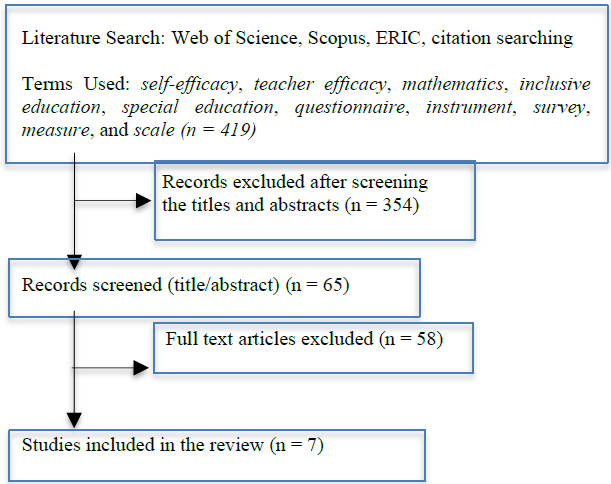
The selection of studies followed the four PRISMA stages—identification, screening, eligibility, and inclusion—as reflected in the documented search process. During identification, records were retrieved from Web of Science (82), Scopus (214), ERIC (119), and citation searching (4). All references were exported into a reference management system, where duplicates were removed. In the screening phase, titles and abstracts were evaluated against the predetermined inclusion and exclusion criteria. This step resulted in the exclusion of 63 records from Web of Science, 187 from Scopus, 104 from ERIC, and none from citation searching. During the eligibility stage, full texts of potentially relevant studies were assessed for methodological rigor, contextual relevance, and alignment with the review focus. Fulltext exclusions included 17 articles from Web of Science, 24 from Scopus, and 13 from ERIC, while all four citationsearch records proceeded to fulltext assessment. Finally, in the inclusion phase, only studies meeting all criteria were retained. The final sample consisted of seven studies that reported the development, adaptation, validation, or implementation of selfefficacy survey instruments specifically related to inclusive mathematics instruction among mathematics and/or special education teachers.
To improve the reliability and rigor of the review process, reviewer roles were clearly defined. The primary reviewer conducted the searches of the database, managed the references, performed the initial screening of the titles and abstracts, and extracted data from eligible studies. A second reviewer independently checked the included studies for eligibility at the full-text screening stage and checked the extracted data for accuracy and consistency. Disagreements about study eligibility or coding decisions were discussed, and articles were re-reviewed until consensus was obtained. The collaborative process helped reduce reviewer bias and increase the credibility of the findings.
Protocols for data extraction were developed to ensure consistency in the collection of information from each included study. Descriptive, methodological, and psychometric information was recorded in a structured data extraction matrix. The descriptive information contained the name of the instrument, author(s), year of publication, country/region, educational level, and characteristics of the participants. Instrument-related information, such as the number of items, dimensions/subscales, response formats, and intended purpose of the questionnaire, was included. The psychometric data consisted of internal consistency (e.g., Cronbach’s alpha), exploratory factor analysis (EFA), confirmatory factor analysis (CFA), and evidence of content, construct, and criterion validity. The extraction process was based on the principles of instrument evaluation as defined by DeVellis 17 and Nunnally and Bernstein 18.
The coding and synthesis steps consisted of organizing the extracted information into thematic categories that allowed comparison among studies. Instruments were coded according to major dimensions of teacher self-efficacy represented in the questionnaires, such as instructional strategies, differentiation, collaboration, classroom management, inclusive practices, and mathematics teaching competence. Studies were also classified by target population, educational context, and level of psychometric rigor. Due to the limited number of studies and the diversity of the identified instruments, a narrative synthesis approach was used. The synthesis sought to identify patterns, strengths, limitations, and gaps in the existing self-efficacy questionnaires used in inclusive mathematics classrooms.
The study selection process is presented in Figure 1. Initial database searches and citation tracking identified a total of 419 records, including Web of Science (n = 82), Scopus (n = 214), ERIC (n = 119), and citation searching (n = 4). During the title and abstract screening stage, studies that did not specifically address teacher self-efficacy, inclusive mathematics instruction, or mathematics and special education teachers were excluded. This resulted in the exclusion of 63 records from Web of Science, 187 from Scopus, 104 from ERIC, and none from citation searching. The remaining studies then underwent full-text screening for eligibility. At this stage, articles were excluded because they did not provide psychometric evidence, did not focus on inclusive mathematics contexts, or did not measure teacher self-efficacy. Consequently, 17 studies from Web of Science, 24 from Scopus, and 13 from ERIC were excluded at the full-text review stage. After the screening and eligibility process, seven studies were included in the final review.
After eligibility assessment, seven studies fulfilled all inclusion criteria and were included in the final review. The relatively small number of studies included is indicative of the limited availability of validated and context-specific self-efficacy survey questionnaires specifically designed for mathematics and special education teachers teaching in inclusive mathematics classrooms. This finding indicates the need for further development, validation, and refinement of measurement instruments in this niche area of research.
Table 1 presents the descriptive features of the teacher self-efficacy survey instruments reviewed. These tools were developed and applied across a variety of educational structures and cultural contexts, reflecting the expanding global attention to teachers’ self‑efficacy in mathematics education, inclusive teaching, and special education 2, 3, 6, 19, 20, 21, 22. The wide range of contexts in which these instruments were used demonstrates the broad utility of self-efficacy as a construct and the importance of assessing it in diverse instructional settings and teacher functions.
The studies reviewed were mostly in the context of primary and secondary schools and with various respondent groups. These were practicing mathematics teachers 20, preservice mathematics teachers 21, special education teachers 22, and mixed samples of general and special educators who taught collaboratively in inclusive classrooms 3, 23. This distribution illustrates the widespread use of self-efficacy measures by teachers and the need for measuring the specific instructional challenges that are relevant to inclusive and discipline-specific teaching.
Sample sizes were widely varied across studies, ranging from relatively small validation cohorts to large, nationally or cross-nationally representative teacher samples. Such variability is probably due to different methodological purposes, as some studies are designed to develop and improve instruments, while other studies attempt to validate existing scales in larger and more diverse populations.
Each of the instruments used in the 7 studies reviewed had a different conceptual focus. Some scales were designed to measure general teacher self‑efficacy 2, 15, whereas others specifically assessed mathematics teaching self‑efficacy 20. Additional instruments targeted self‑efficacy related to special education and inclusive teaching 3, 22, and 23. Notably, the number of instruments addressing mathematics self‑efficacy in the context of inclusive education was limited, and no existing scale had been developed to measure self‑efficacy for both mathematics and special education teachers working together in inclusive mathematics classrooms 19. This gap indicates a significant conceptual and practical need for instruments that reflect the collaborative and interdisciplinary nature of inclusive mathematics instruction.
3.2. Instrument ContentThe instruments analyzed showed great differences in the number of items included and in the dimensional structure of the scales. Some instruments included general items on self-efficacy beliefs about classroom management, student motivation, and instructional methods (e.g., 2), while other instruments included mathematics-specific items such as explaining mathematics concepts, using multiple representations, and dealing with students’ misconceptions (e.g., 20). The inclusive education-focused instruments generally contained dimensions concerning adaptation of instruction to learners with special needs, collaboration with other professionals, and class management 3 and 23.
Yet very few measures combined all the following within one construct: (a) mathematics-specific knowledge of teaching mathematics, (b) differentiation and accommodation for students’ diversity, (c) socio-emotional aspects of classroom management, and (d) cooperation between mathematics and special educators in the inclusive setting. This implies that previous measures only partly addressed the issue of the complex multi-dimensional construct of teachers' self-efficacy in the inclusive mathematics environment when teachers have to attend to various demands at once 19 and 24.
3.3. Dimensions of Self-Efficacy in the Reviewed Survey QuestionnairesThe instruments used to measure teacher self-efficacy were developed in different educational contexts. Two of the seven instruments measured self-efficacy in general education settings 2 and 21; one was related to mathematics teaching 20; and three were aimed at measuring teachers’ self-efficacy in inclusive and/or special education 3, 22, and 23. Only one instrument was directly connected to inclusive mathematics classrooms and included both mathematics and special education teachers 19. Regarding the dimensionality of the instruments, one was unidimensional 20 and six were multidimensional 2, 3, 19, 21, 22, and 23. Overall, the dominance of multidimensional instruments suggests that teacher self-efficacy in inclusive mathematics education is generally viewed as a multifaceted construct requiring the integration of multiple teaching competencies.
The reviewed instruments often assessed several dimensions. These dimensions included instructional strategies, classroom management, collaboration, differentiation, and behavior support, which are measures of instructional efficacy, inclusive instructional practices, collaborative problem-solving, and self-efficacy in addressing learners’ special needs. In the mathematics-related measure, dimensions that were specific to mathematics were included as well, such as mathematics pedagogical content knowledge and mathematics teaching outcome expectancy 20. Inclusive education instruments often explored teacher self-efficacy in adapting instructional methods to diverse learners, teaching children with disabilities, and fostering a positive classroom climate 5, 6, and 16.
All identified dimensions are listed in the measurement review in Table 2. As seen from Table 2, the choice of dimensions is driven by the contexts represented in the reviewed instruments, the literature on teacher self-efficacy, and approaches to developing self-efficacy scales. However, no single measure reviewed addresses all the competencies needed by mathematics and special education teachers in an inclusive mathematics classroom.
3.4. Psychometric Validity of Self‑Efficacy SurveysTable 2 summarizes the psychometric properties of the reviewed teacher self-efficacy instruments and provides evidence of the reliability and validity of the seven measures. Overall, the instruments demonstrated strong internal consistency, with most reliability coefficients exceeding the recommended threshold of α = .70, indicating stable measurement across items 18. Construct validity was supported through exploratory and confirmatory factor analyses that confirmed the dimensional structures proposed by the scales’ developers. Furthermore, content validity was typically determined through expert judgment, theoretical basis, or pilot testing procedures. However, evidence for convergent and discriminant validity was less consistently reported, suggesting that some instruments may not have undergone a comprehensive psychometric evaluation.
A common limitation of the studies reviewed, however, is the lack of psychometric validation in the context of inclusive mathematics classrooms. The tools that were designed to identify the skills of general educators, preservice teachers, and special education teachers may not adequately identify the specialized skills needed when mathematics teachers and special educators co-teach in inclusive settings. Klassen et al. 24 emphasize that self‑efficacy measures have to be validated in the specific contexts in which they are supposed to be used in order to be reliable and predictive. Thus, the validity of existing instruments is not clear for inclusive mathematics environments. Hence, there is a need for a context-specific, empirically validated self-efficacy scale for the collaborative demands of inclusive mathematics instruction.
3.5. Relationships of Self‑Efficacy to Other VariablesAs summarized in Table 2, some of the studies reviewed examined the relationships between teacher self-efficacy and other educational variables, providing evidence for the predictive power of these instruments. In all studies reporting such an analysis, higher levels of teacher self‑efficacy were associated with positive outcomes in terms of instruction and attitudes. For instance, Tschannen-Moran and Hoy 2 discovered that teachers with a greater sense of self-efficacy are more likely to demonstrate greater quality of instruction and more resilience in addressing classroom issues. Swars et al. 20 found that mathematics teaching self-efficacy is positively related to mathematics instructional confidence and pedagogical decision-making. In inclusive education contexts, Sharma et al. 3 and Savolainen et al. 23 found that higher self-efficacy predicted more positive attitudes towards inclusion and greater willingness to implement inclusive practices. Similarly, McLeskey et al. 22 found that higher self‑efficacy of mathematics and special education co‑teachers was associated with higher quality co‑teaching and more effective inclusive mathematics instruction.
However, we have to note that none of the reviewed studies considered these relations in inclusive mathematics classrooms where mathematics teachers and special educators work together. This gap limits the generalizability of existing findings to the specialized context of inclusive math instruction. As Klassen et al. 24 argue, measures of self-efficacy need to be validated within the specific contexts in which they are to be used to demonstrate reliable and predictive utility. The studies reviewed provide valuable information about the correlates of teacher self-efficacy; however, the lack of context-specific validation raises concerns about the generalizability of these findings to inclusive mathematics settings.
The systematic literature search conducted across Web of Science, Scopus, ERIC, and citation tracking revealed a notable gap in the literature. No prior review has specifically synthesized self-efficacy questionnaires designed for mathematics and special education teachers working within inclusive mathematics instruction. Consequently, the present review contributes to a relatively underexplored area by critically examining assessment approaches used to measure teacher self-efficacy in inclusive mathematics settings. Although teacher self-efficacy has been examined extensively in the settings of general education, mathematics education, and inclusive education independently 1, 2, 3, the conjunction of these areas, particularly in collaborative and inclusive mathematics classrooms, has not been investigated much.
Collectively, the evaluated instruments support the contention of Petticrew and Roberts 15 and Okoli 16 that teacher self-efficacy is a multidimensional construct. However, the instruments varied considerably in their conceptual focus and scope. General self-efficacy measures, such as the Teachers’ Sense of Efficacy Scale (TSES), are intended to be used across contexts and focus primarily on general instructional practices, classroom management, and student engagement, but are less sensitive to the specific needs of inclusive mathematics instruction. In contrast, mathematics-specific tools, such as the Mathematics Teaching Efficacy Beliefs Instrument (MTEBI), were more directly related to mathematics pedagogy and outcome expectancy with relatively less emphasis on inclusion and collaborative practices. Similarly, inclusive education scales like the Teacher Efficacy for Inclusive Practices (TEIP) focused on inclusive instruction, behavior management, and collaboration but did not explicitly address mathematics-specific pedagogical challenges. These differences suggest that existing instruments vary in how they incorporate mathematics pedagogy and inclusive instructional practices.
The review also indicates that some dimensions relevant to inclusive mathematics instruction were comparatively under-represented across the instruments examined. Although several questionnaires focused on instructional strategies, classroom management, collaboration, and differentiation, few instruments directly addressed topics such as co-teaching self-efficacy, collaborative instructional planning between mathematics and special education teachers, adaptation of mathematical concepts for diverse learners, and mathematics-specific behavioral supports 19. Given the increasing emphasis on collaborative inclusive practices in mathematics education, these areas may be worthy of further investigation in future instrument development and validation studies.
The psychometric quality of the instruments was generally acceptable, particularly with respect to internal consistency, reliability and convergent validity. However, the degree of psychometric evidence was not consistent across studies. Some instruments had better evidence for discriminant validity and construct validation than others, and relatively few studies examined the applicability of the measures in collaborative or co-taught instructional contexts. Moreover, several instruments were validated with general classroom teachers rather than interdisciplinary teaching teams. While these findings do not necessarily indicate weaknesses in the instruments themselves, they do suggest that further validation research may be useful when using existing measures in inclusive mathematics contexts that involve collaboration between mathematics and special education teachers.
Another key distinction across the instruments reviewed relates to the outcomes associated with teacher self-efficacy. Several studies found that teachers’ self-efficacy was related to better quality of instruction, positive attitudes toward inclusion, and better classroom management. However, the majority of research on these relationships has focused on the individual teacher. Despite the importance of co-teaching partnerships, little attention has been paid to the potential interaction of the self-efficacy beliefs of mathematics teachers and special education teachers. This is an important direction for further research because collaborative efficacy may affect instructional coordination, differentiation practices, and the overall effectiveness of inclusive mathematics instruction.
Overall, the results suggest that current self-efficacy instruments provide important foundations for understanding teacher beliefs in mathematics and inclusive education domains. At the same time, the review points to opportunities for further refinement and contextualization of these measures for inclusive mathematics instruction. Future research could consider developing or adapting instruments that more explicitly incorporate mathematics pedagogy, inclusive instructional practices, collaborative teaching processes, and differentiation strategies in co-taught classroom environments.
Many questionnaires designed to measure teacher self-efficacy are currently available, including instruments developed for mathematics teachers, general educators, special educators, and teachers working within inclusive mathematics classrooms. A teacher’s sense of efficacy is a key factor influencing the quality of instruction and student achievement 1, 2. This critical review aimed to help researchers and decision-makers choose the best self-efficacy questionnaire for mathematics and special education teachers working in inclusive environments. Several critical considerations emerged to guide instrument selection and future development through a critical analysis of the descriptive and psychometric characteristics of the seven instruments.
First, any selected instrument must be tightly aligned to the specific instructional context in which it will be used 24. Such an examination of the dimensions of teacher self-efficacy most relevant to inclusive mathematics instruction is needed. Mathematics-specific instruments such as the Mathematics Teaching Efficacy Beliefs Instrument (MTEBI) 20 may not adequately address collaborative and inclusive teaching practices. Inclusive education measures such as the Teacher Efficacy for Inclusive Practices (TEIP) 3 may not adequately reflect the specific demands of mathematics instruction. This mismatch highlights the need for a more integrated framework that encompasses both content-specific and inclusion-oriented teaching competencies.
Second, researchers should critically reflect on the need to adapt existing instruments when applying them to new populations or contexts. Differences in the roles of mathematics teachers, special education teachers, and co-teaching teams may influence self-efficacy perceptions 25. Thus, adaptations may be necessary to reflect key features of inclusive mathematics classrooms, such as co-teaching practices, differentiation of complex mathematical concepts, assessment accommodations, and instructional support for students with diverse learning needs. Furthermore, when these instruments are used in different educational systems, they should be checked for their cross-cultural validity to ensure conceptual and linguistic equivalence.
Third, the selection or adaptation of any instrument must be based on sound psychometric evidence. Valid and reliable measures are necessary for accurate interpretations of teacher self-efficacy as well as meaningful research and policy decisions. Establishing validity through expert review, pilot testing, exploratory and confirmatory factor analyses, and reliability testing is critical to ensure that the instrument accurately reflects the intended constructs within inclusive mathematics settings 17, 18.
Beyond instrument selection, the results of this review have important practical implications. This study emphasizes the importance of teacher education programs, specifically developing preservice and in-service teachers’ self-efficacy in mathematics instruction and inclusive pedagogical practices, especially in co-teaching settings. The importance of improving teacher self-efficacy is further elevated by the close linkage between teacher self-efficacy and instructional effectiveness and perseverance in difficult teaching environments 1. Thus, teacher preparation programs should include training that builds confidence in differentiating instruction, working with special education colleagues, and adapting mathematical content for diverse learners.
From a policy perspective, frameworks for inclusive education need to acknowledge the twin demands of content mastery and inclusion, with professional development standards and evaluation systems that support both. This is consistent with research that highlights the context-dependent nature of teacher efficacy and its development via institutional support structures 2. The findings suggest the need to build teacher capacity in using adaptive and responsive teaching strategies in mathematics education in order to promote equitable participation and learning outcomes for all students.
Finally, this review points to the need for the development of a new context-specific self-efficacy instrument adapted to inclusive mathematics education. Future instrument development should include multidimensional constructs such as mathematics instructional efficacy, differentiation/adaptation of content, collaboration/co-teaching efficacy, classroom management in inclusive settings, and disability-responsive instructional practices. The development process should be subjected to rigorous validation procedures such as expert panel validation, cognitive interviews, pilot studies, exploratory and confirmatory factor analyses, and reliability assessments such as internal consistency and test-retest reliability 18. Contextual factors, such as varying models of inclusion, co-teaching structures, cultural differences, and policy environments, should also be incorporated to ensure the instrument’s relevance and applicability across diverse educational settings.
Overall, the integration of these considerations will strengthen both the measurement of teacher self-efficacy and its application in research, policy, teacher education, and classroom practice within inclusive mathematics education.
| [1] | A. Bandura, Self-efficacy: The exercise of control, W. H. Freeman, New York, 1997. | ||
| In article | |||
| [2] | M. Tschannen-Moran and A. W. Hoy, “Teacher efficacy: Capturing an elusive construct,” Teaching and Teacher Education, 17(7), 783–805, Oct. 2001. | ||
| In article | View Article | ||
| [3] | U. Sharma, T. Loreman and C. Forlin, “Measuring teacher efficacy to implement inclusive practices,” Journal of Research in Special Educational Needs, 12(1), 12–21, Mar. 2012. | ||
| In article | View Article | ||
| [4] | H. Roos, “Inclusive mathematics education: State-of-the-art research from Brazil and Germany,” ZDM Mathematics Education, 51(4), 573–589, Jun. 2019. | ||
| In article | |||
| [5] | R. Lambert and P. Tan, “Conceptualizations of access in mathematics for students with disabilities,” Mathematical Thinking and Learning, 19(4), 247–260, Oct. 2017. | ||
| In article | |||
| [6] | S. R. Powell, M. K. Driver and T. E. Julian, “Students with mathematics difficulty: Instructional considerations for inclusive classrooms,” Intervention in School and Clinic, 56(2), 85–92, Nov. 2020. | ||
| In article | View Article | ||
| [7] | M. Friend, L. Cook, D. Hurley-Chamberlain and C. Shamberger, “Co-teaching: An illustration of the complexity of collaboration in special education,” Journal of Educational and Psychological Consultation, 20(1), 9–27, Jan. 2010. | ||
| In article | View Article | ||
| [8] | M. C. Pugach and L. P. Blanton, “Enacting diversity in dual certification programs,” Journal of Teacher Education, 63(4), 254–267, Sep. 2012. | ||
| In article | View Article | ||
| [9] | L. S. Shulman, “Those who understand: Knowledge growth in teaching,” Educational Researcher, 15(2), 4–14, Feb. 1986. | ||
| In article | View Article | ||
| [10] | D. L. Ball, M. H. Thames and G. Phelps, “Content knowledge for teaching: What makes it special?” Journal of Teacher Education, 59(5), 389–407, Nov. 2008. | ||
| In article | View Article | ||
| [11] | J. McLeskey, M. S. Rosenberg and D. L. Westling, Inclusion: Effective practices for all students, Pearson, Boston, 2017. | ||
| In article | |||
| [12] | L. G. Enochs, P. L. Smith and D. Huinker, “Establishing factorial validity of the Mathematics Teaching Efficacy Beliefs Instrument,” School Science and Mathematics, 100(4), 194–202, Apr. 2000. | ||
| In article | View Article | ||
| [13] | A. Bandura, “Guide for constructing self-efficacy scales,” in Self-efficacy beliefs of adolescents, F. Pajares and T. Urdan, Eds., Information Age Publishing, Greenwich, 2006, 307–337. | ||
| In article | |||
| [14] | M. J. Page, J. E. McKenzie, P. M. Bossuyt, I. Boutron, T. C. Hoffmann, C. D. Mulrow, L. Shamseer, J. M. Tetzlaff, E. A. Akl, S. E. Brennan, R. Chou, J. Glanville, J. M. Grimshaw, A. Hróbjartsson, M. M. Lalu, T. Li, E. W. Loder, E. Mayo-Wilson, S. McDonald and D. Moher, “The PRISMA 2020 statement: An updated guideline for reporting systematic reviews,” BMJ, 372, n71, Mar. 2021. | ||
| In article | View Article PubMed | ||
| [15] | M. Petticrew and H. Roberts, Systematic Reviews in the Social Sciences: A Practical Guide, Blackwell Publishing, Oxford, 2006. | ||
| In article | View Article PubMed | ||
| [16] | C. Okoli, “A Guide to Conducting a Standalone Systematic Literature Review,” Communications of the Association for Information Systems, 37(43), 879–910, Nov. 2015. | ||
| In article | View Article | ||
| [17] | R. F. DeVellis, Scale development: Theory and applications, 4th ed., Sage, Thousand Oaks, 2017. | ||
| In article | |||
| [18] | J. C. Nunnally and I. H. Bernstein, Psychometric theory, 3rd ed., McGraw-Hill, New York, 1994. | ||
| In article | |||
| [19] | J. McLeskey, M.-D. Barringer, B. Billingsley, M. Brownell, D. Jackson, M. Kennedy, T. Lewis, L. Maheady, J. Rodriguez, M. C. Scheeler, J. Winn and D. Ziegler, High-leverage practices for inclusive classrooms, Routledge, New York, 2020. | ||
| In article | |||
| [20] | S. L. Swars, C. J. Daane and J. Giesen, “Mathematics anxiety and mathematics teacher efficacy: What is the relationship?” School Science and Mathematics, 107(3), 84–92, Mar. 2007. | ||
| In article | |||
| [21] | C. M. Rubie-Davies, A. Flint and L. McDonald, “Teacher beliefs, teacher characteristics, and school contextual factors: What predicts teacher self-efficacy?” Journal of Educational Research, 105(4), 255–264, Jul. 2012. | ||
| In article | |||
| [22] | H. Savolainen, P. Engelbrecht, M. Nel and O.-P. Malinen, “Understanding teachers’ attitudes and self-efficacy in inclusive education: Implications for pre-service and in-service teacher education,” European Journal of Special Needs Education, 27(1), 51–68, Feb. 2012. | ||
| In article | View Article | ||
| [23] | O.-P. Malinen, H. Savolainen and J. Xu, “Beijing in-service teachers’ self-efficacy and attitudes towards inclusive education,” Teaching and Teacher Education, 36, 64–70, Nov. 2013. | ||
| In article | |||
| [24] | R. M. Klassen, V. M. Tze, S. M. Betts and K. A. Gordon, “Teacher efficacy research 1998–2009: Signs of progress or unfulfilled promise?” Educational Psychology Review, 23(1), 21–43, Mar. 2011. | ||
| In article | View Article | ||
| [25] | M. Zee and H. M. Koomen, “Teacher self-efficacy and its effects on classroom processes, student academic adjustment, and teacher wellbeing: A synthesis of 40 years of research,” Review of Educational Research, 86(4), 981–1015, Dec. 2016. | ||
| In article | View Article | ||
Published with license by Science and Education Publishing, Copyright © 2026 Arlyn B. Elorde, Heidemae R. Tabor and Laila S. Lomibao
 This work is licensed under a Creative Commons Attribution 4.0 International License. To view a copy of this license, visit
http://creativecommons.org/licenses/by/4.0/
This work is licensed under a Creative Commons Attribution 4.0 International License. To view a copy of this license, visit
http://creativecommons.org/licenses/by/4.0/
| [1] | A. Bandura, Self-efficacy: The exercise of control, W. H. Freeman, New York, 1997. | ||
| In article | |||
| [2] | M. Tschannen-Moran and A. W. Hoy, “Teacher efficacy: Capturing an elusive construct,” Teaching and Teacher Education, 17(7), 783–805, Oct. 2001. | ||
| In article | View Article | ||
| [3] | U. Sharma, T. Loreman and C. Forlin, “Measuring teacher efficacy to implement inclusive practices,” Journal of Research in Special Educational Needs, 12(1), 12–21, Mar. 2012. | ||
| In article | View Article | ||
| [4] | H. Roos, “Inclusive mathematics education: State-of-the-art research from Brazil and Germany,” ZDM Mathematics Education, 51(4), 573–589, Jun. 2019. | ||
| In article | |||
| [5] | R. Lambert and P. Tan, “Conceptualizations of access in mathematics for students with disabilities,” Mathematical Thinking and Learning, 19(4), 247–260, Oct. 2017. | ||
| In article | |||
| [6] | S. R. Powell, M. K. Driver and T. E. Julian, “Students with mathematics difficulty: Instructional considerations for inclusive classrooms,” Intervention in School and Clinic, 56(2), 85–92, Nov. 2020. | ||
| In article | View Article | ||
| [7] | M. Friend, L. Cook, D. Hurley-Chamberlain and C. Shamberger, “Co-teaching: An illustration of the complexity of collaboration in special education,” Journal of Educational and Psychological Consultation, 20(1), 9–27, Jan. 2010. | ||
| In article | View Article | ||
| [8] | M. C. Pugach and L. P. Blanton, “Enacting diversity in dual certification programs,” Journal of Teacher Education, 63(4), 254–267, Sep. 2012. | ||
| In article | View Article | ||
| [9] | L. S. Shulman, “Those who understand: Knowledge growth in teaching,” Educational Researcher, 15(2), 4–14, Feb. 1986. | ||
| In article | View Article | ||
| [10] | D. L. Ball, M. H. Thames and G. Phelps, “Content knowledge for teaching: What makes it special?” Journal of Teacher Education, 59(5), 389–407, Nov. 2008. | ||
| In article | View Article | ||
| [11] | J. McLeskey, M. S. Rosenberg and D. L. Westling, Inclusion: Effective practices for all students, Pearson, Boston, 2017. | ||
| In article | |||
| [12] | L. G. Enochs, P. L. Smith and D. Huinker, “Establishing factorial validity of the Mathematics Teaching Efficacy Beliefs Instrument,” School Science and Mathematics, 100(4), 194–202, Apr. 2000. | ||
| In article | View Article | ||
| [13] | A. Bandura, “Guide for constructing self-efficacy scales,” in Self-efficacy beliefs of adolescents, F. Pajares and T. Urdan, Eds., Information Age Publishing, Greenwich, 2006, 307–337. | ||
| In article | |||
| [14] | M. J. Page, J. E. McKenzie, P. M. Bossuyt, I. Boutron, T. C. Hoffmann, C. D. Mulrow, L. Shamseer, J. M. Tetzlaff, E. A. Akl, S. E. Brennan, R. Chou, J. Glanville, J. M. Grimshaw, A. Hróbjartsson, M. M. Lalu, T. Li, E. W. Loder, E. Mayo-Wilson, S. McDonald and D. Moher, “The PRISMA 2020 statement: An updated guideline for reporting systematic reviews,” BMJ, 372, n71, Mar. 2021. | ||
| In article | View Article PubMed | ||
| [15] | M. Petticrew and H. Roberts, Systematic Reviews in the Social Sciences: A Practical Guide, Blackwell Publishing, Oxford, 2006. | ||
| In article | View Article PubMed | ||
| [16] | C. Okoli, “A Guide to Conducting a Standalone Systematic Literature Review,” Communications of the Association for Information Systems, 37(43), 879–910, Nov. 2015. | ||
| In article | View Article | ||
| [17] | R. F. DeVellis, Scale development: Theory and applications, 4th ed., Sage, Thousand Oaks, 2017. | ||
| In article | |||
| [18] | J. C. Nunnally and I. H. Bernstein, Psychometric theory, 3rd ed., McGraw-Hill, New York, 1994. | ||
| In article | |||
| [19] | J. McLeskey, M.-D. Barringer, B. Billingsley, M. Brownell, D. Jackson, M. Kennedy, T. Lewis, L. Maheady, J. Rodriguez, M. C. Scheeler, J. Winn and D. Ziegler, High-leverage practices for inclusive classrooms, Routledge, New York, 2020. | ||
| In article | |||
| [20] | S. L. Swars, C. J. Daane and J. Giesen, “Mathematics anxiety and mathematics teacher efficacy: What is the relationship?” School Science and Mathematics, 107(3), 84–92, Mar. 2007. | ||
| In article | |||
| [21] | C. M. Rubie-Davies, A. Flint and L. McDonald, “Teacher beliefs, teacher characteristics, and school contextual factors: What predicts teacher self-efficacy?” Journal of Educational Research, 105(4), 255–264, Jul. 2012. | ||
| In article | |||
| [22] | H. Savolainen, P. Engelbrecht, M. Nel and O.-P. Malinen, “Understanding teachers’ attitudes and self-efficacy in inclusive education: Implications for pre-service and in-service teacher education,” European Journal of Special Needs Education, 27(1), 51–68, Feb. 2012. | ||
| In article | View Article | ||
| [23] | O.-P. Malinen, H. Savolainen and J. Xu, “Beijing in-service teachers’ self-efficacy and attitudes towards inclusive education,” Teaching and Teacher Education, 36, 64–70, Nov. 2013. | ||
| In article | |||
| [24] | R. M. Klassen, V. M. Tze, S. M. Betts and K. A. Gordon, “Teacher efficacy research 1998–2009: Signs of progress or unfulfilled promise?” Educational Psychology Review, 23(1), 21–43, Mar. 2011. | ||
| In article | View Article | ||
| [25] | M. Zee and H. M. Koomen, “Teacher self-efficacy and its effects on classroom processes, student academic adjustment, and teacher wellbeing: A synthesis of 40 years of research,” Review of Educational Research, 86(4), 981–1015, Dec. 2016. | ||
| In article | View Article | ||