Quality and customer satisfaction have long been recognized as playing a crucial role for success and survival in today’s competitive market. As part of the monitoring and evaluation of products and services, this research was undertaken to assess the quality of products and service delivery at a mining canteen and to establish whether the catering service company employees were being trained and further to identify the challenges faced by the employees. The sample consisted of 150 customers, out of which 101 responded. Triangulation method was utilized to find information from the different units within the catering service company. The managers, waitresses, cashiers, supervisors form part of the sample. A closed-ended questionnaire was given to users and visitors who patronize the canteen. Semi-Structured interviews were conducted to the canteen staff. The results from the survey indicated that respondents were not satisfied with the variety of meals and the quality of drinks offered to them. As depicted in the findings, quality service delivery is a major issue, and it is not consistent. In terms of hygienic condition at the canteen, participants were of the view that the canteen was the best. Regarding training of most of the employees from the catering services company did not receive enough training compared to what they should. Shortage of skillful personnel in the kitchen especially chefs and cooks, shortage of kitchen equipment to perform tasks, shortage of ingredients in the kitchen which often compromises quality and long working hours where mentioned as some of challenges that hinders the provision of quality service. This study significantly contributes to providing a deeper insight into factors that influences dining choice of a mining community.
Customer satisfaction, quality and retention are global issues that affect all organizations, be it large or small, profit or non-profit, global, or local. The importance of customer satisfaction and service quality has been shown to be related to helping improve the overall performance of organizations. Many companies are interested in studying, evaluating, and implementing marketing strategies that aim at improving customer retention and maximizing share of customers in view of the beneficial effects on the financial performance for the firm. There has been a strong advocacy for the adoption of customer retention as one of the key performance indicators 1. According to 1, 2, offering high quality service has a positive impact on the overall customer retention, subsequently enabling the company to lead in brand loyalty and high income. Reference 3 assert that meeting the customer expectations will not only provide customer satisfaction, but will also foster customer loyalty, reducing customer loss rate or increasing retention. It is apparent that customers seek loyalty to ensure the provision of stable quality services in a specific period of time.
There are many researchers who have defined service quality in different ways. For instance, 4, define service quality as ‘any intangible act of performance that one party offers to another that does not result in the ownership of anything’. Service quality is defined as “the totality of features the consumer’s overall impression of the relative inferiority / superiority of the organization and its services’ 5. According to 6, service quality is the difference between the service that the customer expects to receive and the service that the customer gets. Meanwhile 7, defines service quality as “a word of service providers is something that must be done well”. These definitions implies that service quality is an important strategy for success and survival in today’s competitive economic environment.
Quality and customer satisfaction have long been recognized as playing a crucial role for success and survival in today’s competitive market. Not surprisingly, considerable research has been conducted on these two concepts. Notably, the quality and satisfaction concepts have been linked to customer behavioral intentions like purchase and loyalty intention, willingness to spread positive word of mouth, referral, and complaint intention by many researchers 8, 9, 10. Customers are lifeblood of any organization, and without them, a firm has no revenues, no profits, and therefore no market value 11.
In food service establishments, providing quality of service is as important as in other service sectors, a quality dimension that cannot be underestimated. Although staff canteen is considered crucial in offering healthy and well-balanced meals in modern guidelines (Pronk, 2009), workplace dinning is associated with poor quality and bad food choices 13. In addition, the safety of consumed meals is not fully guaranteed 14. Insufficient food safety knowledge by food handlers poses a serious threat to the food safety in food service establishment 15. Therefore, implementing a training program for all the employees is crucial.
Overall consumer satisfaction may be an important factor in the overall dining experience. In addition, restaurants that can offer high quality of service to their clients will acquire a more prominent increase beneficiaries over their opponents to retain customers, and to attain growth and be sustainable 16. Food and beverage quality service (in terms of taste, freshness, providing timely and variety meals), physical environment (including providing an ambience service, aesthetic, hygiene, and cleanliness) 17, 18, 19, 20 and service (in terms of professional skills, offering quality assistance) 16 customers have a significant effect on customer satisfaction.
The interest in studying satisfaction and service quality as the antecedents of customer behavioral intentions in this paper has been stimulated, firstly, by the recognition that customer satisfaction does not, on its own, produce customer lifetime value. Secondly, satisfaction and quality are closely linked to market share and customer retention. However, In Botswana, there is no previous research that has been conducted in this area of studies and there is intensively growing demand among customers. This study will significantly contributes to providing a deeper insight into factors that influences dining choice of a mining community. The findings of this study are of practical importance to the food service industry and the management of the food service establishment as the knowledge will assist them to make the right decisions regarding the management of the canteen operations and the positioning of the food service establishment to their customers.
Against this background, this study was undertaken to assess the quality of products and service delivery at a mining canteen and to establish whether the catering service company employees were being trained and further to identify the challenges faced by the employees.
This article is organized as follows: methodology section which includes the study design, study design, study area and population, data collection and methods and data analysis. The results are presented and discussed in the results and discussion section. Finally, conclusions in the “Conclusion” section.
The study adopted the mixed method that is qualitative and quantitative as a research design. Quantitative research design is a means of testing objectives theories by examining the relationship among variables. These variables can be measured, typically on instruments, so that numbered data can be analyzed using statistical procedures 21. Quantitative research design is often used in exploratory and descriptive research; therefore, it fits the nature of the study 22.
Qualitative research design provides an adequate explanation for certain phenomena and satisfying answers to the question that such phenomena may raise. It provides the researcher with an in-depth analysis of the situation and a meaningful interpretation of the role of those involved in that situation 23.
2.2. Study Area and PopulationIn this research the target population of study comprised of all employees working for the mine and visitors, men and women who patronize the canteen and employees at the canteen. Convenience sampling technique was used to select participants for the study. It is a type of non-probability sampling used to select research participants who are easily assessable to the researcher 24. In addition, non-probability sampling is a sampling technique where the probability of selecting each case from the total population is not known 22. For this reason, convenience sampling was chosen because there was no sample frame. Attempts to get the phone numbers and emails of the customers from the management of the canteen remained futile. Therefore, the researcher stood in front of the canteen during lunch hour to access a large number of customers. Any customer who was willing and ready to answer the questionnaire instantly was approached for the completion of the questionnaire. Although the sampling method used required a larger sample size, out of the 150 questionnaires distributed, only 101 were returned, that is 67% response rate.
2.3. Data Collection and MethodsData was collected from the employees who visited the canteen from the month of January 2020. Respondents used staff canteens at lunch time but at different times of serving. Lunch is between 1245-2pm. Respondents were informed that their participation was on voluntary basis and all information provided will be kept private and confidential. A letter of informed consent was drawn up and given to each participant and respondent.
Questionnaire consisted of questions on the product, services delivery, cleanliness of the facility, atmosphere in the canteen, satisfaction factor and technology. Questionnaires were distributed only to those utilizing the canteen and agreed to participate in the study. The researchers then explained the nature and requirement of the survey before the respondent filled up the questionnaire. A 5 Likert Scale where 5= very satisfied, 4= satisfied, 3=neutral, 2=unsatisfied, and 1= very unsatisfied was used for evaluation.
Face to face interviews were conducted with the staff of the catering company to allow participants to discuss their opinions, views, and experiences fully in detail. The following set of questions for the interview were prepared:
1. Before joining this company, did you receive any formal training. If YES, what training did you receive?
2. Have you received on the job training since joining this company? If YES, what training did you receive? If NO, why?
3. Has training improved job performance?
4. What challenges do you experienced at work?
2.4. Data AnalysisData entry and analysis involving mainly frequencies, percentages, means and standard deviations were done using Statistical Package for Social Sciences (SPSS) version 22. Frequencies of the different categories of background characteristics were presented to show the percent distribution of respondents.
Data collected from the interviews were analysed using thematic content analysis 25 based on the study objectives. The voice recordings were transcribed verbatim to ensure validity of the data.
Table 1 indicates the demographical variables of the respondents. It was indicated from the study that, 93(92.1%) were males and 8(7.9%) were females. It was also indicated from the study that, 76(76.8%) of the respondents were within ages ranging from 25-34 years whiles 12 respondents were within ages ranging from 35-44 years. Few respondents (8.1%) had their ages from 45 years and above. majority of the respondents 55(57.3%) had acquired tertiary certificates whiles 39(40.6%) had completed secondary education (that is both JC and SSS). The findings also revealed that, 29(29.9%) of the respondents were from management levels whiles 14(14.4%) were professional employees at the mine. Most of the employees responded to the questionnaires were skilled manual workers (45.4%) whiles 10.3% were manual workers (Table 1). The results depicts that the age group 25-34 was predominant in this study and therefore, the food service manager should develop a plan that appeals to various sections of the customers tailor made to the different age groups 26, 27. This means that the management will not waste time in tracking down the customers since the age group which buys their products is recognized 26.
Out of the 101 respondents, 82(81.2%) said they eat at the canteen daily whilst 10 respondents (9.9%) said the visit the canteen weekly. These findings depict that majority of the employees visit and eat at the canteen each day.
Table 2 shows that, majority of the respondents stated that meals are served at appropriate time (66%) and also at appropriate temperature (65.7%). 28 have shown that food waiting time is considered an important dimension that consumer look at. The findings of this study are similar to those observed in another study 29.
Food and beverage quality has been considered an essential component affecting the quality of service 30, 31, 32 and variety and choices, hygiene, and cleanliness 30. However, in this study, respondents were not satisfied with the variety of meals and also the quality of drinks offered to them. Only 37.0% agreed to the variety of meals offered and 29.6% of the respondents agreed that, there’s a wide range of choice of menu items offered to them. This finding is consistent with the previous finding of 13, 27, 29. Literature show that quality and satisfaction concepts have been linked to customer behavioral intentions like purchase and loyalty intention, willingness to spread positive word of mouth, referral, and complaint intention 8, 9, 10.
Table 3 shows that, 42 (42.4%) of the respondents agreed that meals offered to them do make them feel at home. It was indicated from the survey that, 44% of the respondents agreed that staff provide good quality service whiles 39(39.4%) said staff have the knowledge to answer customers questions. Table 3 depicts that, 40(40.4%) of the respondents agreed that staff are experienced and are well trained. Findings from the study show that, quality service delivery is a major issue. This depict that, service delivery is not consistent (that is; it is on and off). The findings of this study are similar with the findings of 29, 34, 35.

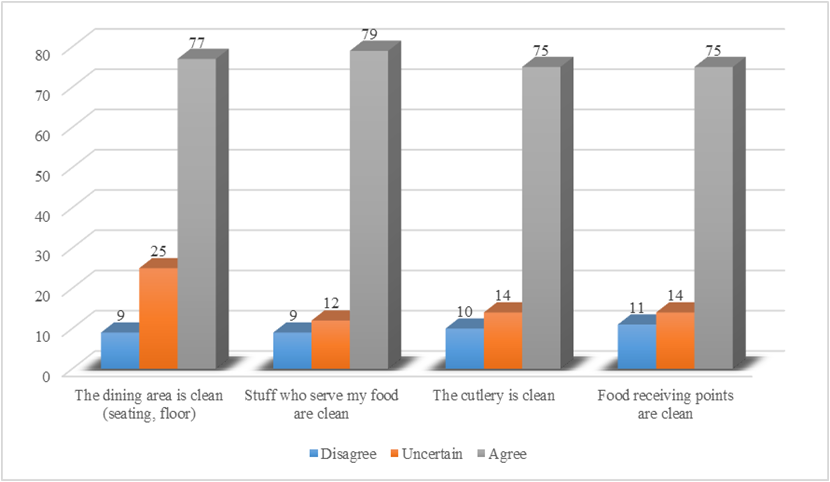
Figure 1 shows that, participants were of the view that, hygienic condition (in terms of; seating, floor, cutlery, and the serving point) at the canteen was the best. Moreover, it was indicated from the study that, majority of the participants agreed that the climatic condition (atmosphere) at the canteen was also conducive. Majority of the respondents agreed that there is effective layout at the canteen. It was indicated from the findings that, majority of respondents said the dining room, lighting, sitting arrangement and space were very effective (Table 4). However, its worth noting that few respondents (25%) complained that the canteen is always noisy (Table 4). According to 18, aesthetic and hygiene have a significant effect on customer satisfaction. In addition to providing an ambience service, restaurants that can offer quality assistance to their clients will acquire a more prominent beneficiaries over their opponents to retain customers, and to attain growth and be sustainable 16.
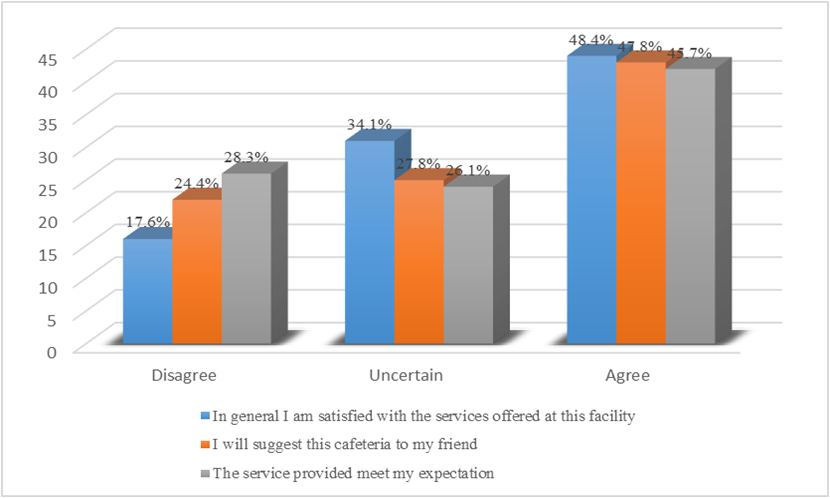
Figure 2 indicates that, customer service satisfaction was questionable. None of the agree scores was above 50% as depicted from the study. This means, services provided at the canteen and the camp site were not consistence.

The study revealed that, 54(63%) of the respondents were of the view that technological service at the canteen was good whiles 15(18%) also disagreed about the technological service provided at the canteen.
The rationale for the interview question “Before joining this company, did you receive any formal training?” was to determine if employees in the catering establishments previous training experience before joining the company. Out of the 21 participants, only 9.5% did not receive any training. This is an indication that most of the employees received training of some sort prior to joining this company. Of the 9.5% who did not receive training mentioned that they were either excluded from training or did not know that there was training going on. When asked about the type of training they received, 50% of the employees received training in Customer Service, followed by employees who received training in Food Preparation Skills (21%) and Food Safety, Hygiene and Handling (21%). According to 15, the lack of insufficient food safety knowledge by food handlers poses a serious threat to the food safety in food service establishment.
Regarding whether they have received on-the-job training, it was indicated from the study that, 66.7% of the employees mentioned that they have received training since they joined the company whilst 33.3% of employees stated that they had no training. The lack of food hygiene training programs could lead to inadequate food safety knowledge 33. The implementation of training programs is essential to prevent food safety failures which are usually caused by lack of food safety knowledge and practices of food handlers 34. Employee compliance and management supervision are key elements to ensure the success of training.
When asked about whether training has improved their job performance, the interviewees revealed that the Customer Service training has improved their skills in dealing with an angry or difficult customers thus increased the levels of service quality or professionalism the organization presents to the public. In addition, one respondent mentioned that training has helped to improve good working relationships with colleagues and supervisors. Therefore, good working relationships amongst employees makes work even more enjoyable. Few respondents mentioned that the training in Chemical safety and the kitchen has helped them learn about the health hazards, safe handling, use and storage of chemicals. This finding show that education and training of employees has been found to be significant to address customers’ needs and expectations, thus ensure customer satisfaction 38. In addition, in order for companies to keep and improve the quality of service, and to ensure customer satisfaction, companies should put a huge effort in recruiting, training, motivating their employees so that their customers can experience services that can exceed their expectation 39. 37 suggests that short term refresher training is a key future of an effective training program to improve food safety practices.
When employees were asked about challenges, they face at work, most employees complained about shortage of skillful personnel in the kitchen especially chefs and cooks which was a hindrance in preparing quality food. Shortage of kitchen equipment to perform tasks and depreciated kitchen equipment were considered affecting work performance. In addition, improper maintenance of the kitchen equipment was considered a problem. According to the respondents, regular checkups and maintenance of the equipment can complement the chef and enable him or her to experiment, take risks and prepare the best meals. Employees complained about the kitchen and the eating area which were old. One of the respondents mentioned that “it is unhygienic to prepare and service food in an outdated kitchen”. Respondents complained about shortage of ingredients in the kitchen which often compromises quality. Lack of catering uniform was a safety concern. According to one of the respondents “customers often complain about poor personal hygiene (improper working clothes, unclean hands and long and polished nails, uncovered hair, no gloves), which they say was a safety concern”. Other challenges mentioned during the interviews were job descriptions which are not well defined, lack of overtime allowance, favoritism, and lack of professionalism in the workplace, long working hours, and communication breakdown between the supervisors, managers and even the customers.
The present study investigates how service quality influence on customer satisfaction and how customers see quality. The findings show that, respondents were not satisfied with the variety of meals, the quality of drinks offered to them. Customer service satisfaction was questionable. However, customers were excited about the atmosphere, dinning and sitting arrangement, hygienic and lightning conditions. This study identifies training of employees as an important dimension in food service. Most of the employees from the catering services company did not receive enough training compared to what they should. Offering support to staff with appropriate training programs that covers all the basics cannot be over emphasized. Understanding the challenges faced by employees in a food service business should be taken into consideration by the management in an effort to improve their quality of services, food quality, food hygiene and safety, and customer satisfaction, thereby increased customer loyalty and sustained brand name. This study has some limitations in terms of the sample size which was too small to generalize to the whole population. However, the findings of this study are of practical importance to the food service industry and the management of the food service establishment because of the identified problems. Further research can conduct further in-depth study on how to improve the running of the food service establishment.
The results of the survey are recommended to observe if catering company needs to improve its strategies In order to achieve quality service delivery and good customer service satisfaction, the following are recommended: (1) variety of foods and drinks should be served especially in the camp site e.g. Juices and other fruit mixes , however standard menu should be provided and followed at the canteen, (2) there should be a supply of consistent and reliable food products and these will help improve quality service, (3) implement training and development programs, and training should be continuous and sufficient to service the needs of the staff members (4) provide training required by employees to meet the basic competencies for the job. This is usually the supervisor's responsibility. Training should be based on food preparation skills, food hygiene and safety, Personal Hygiene. Training on recipe standardization is important as a standardized recipe produces a consistent quality and yield every time when the exact procedures, equipment, and ingredients are used, (5) The catering company management should liaise with the mining management on issues concerning proper maintenance at the canteen, (6) employees’ job description should be well defined in order to avoid miscommunication among workers (working hours, overtime allowance, salaries etc.).
| [1] | Valenzuela-Fernandez1, L., Nicolas, C., Gil-Lafuente, J., and Merigo, J.M., “Fuzzy indicators for customer retention”, International Journal of Engineering Business Management 8. 1-8. September 2016. | ||
| In article | View Article | ||
| [2] | Nsiah, R. and Mensah, A.A., “The Effect of Service Quality on Customer Retention in the Banking Industry in Ghana: A Case Study of Asokore Rural Bank Limited”. September 2014. | ||
| In article | View Article | ||
| [3] | Lau, M., Cheung, R., Lam, A., and Chu, Y., “Measuring service quality in the banking industry: A hong kong based study”, Contemporary Management Research, 9(3), 263-283. September 2013. | ||
| In article | View Article | ||
| [4] | Kotler, P., and Keller, K. L. Marketing management. Pearson Prentice Hall, Upper Saddle River, New Jersey, 2009. | ||
| In article | |||
| [5] | Kotler P., Armstrong G., Saunders J., and Wong V., Principle of Marketing, 3rd edition, Pretence Hall, Europe, 2002. | ||
| In article | |||
| [6] | Ford, R.C., Sturman, M.C., and Heaton, C.P. Managing Quality Service in Hospitality: How Organizations Achieve Excellence in the Guest Experience. Delmar Cengage Learning: Clifton Park, NY, USA, 2012. | ||
| In article | |||
| [7] | Supranto, J. Pengukuran Tingkat Kepuasan Pelanggan: Untuk Menaikkan Pangsa Pasar. Jakarta: Penerbit Rineka Cipta. 2016. | ||
| In article | |||
| [8] | Olsen, S.O., “Comparative Evaluation and the Relationship Between Quality, Satisfaction, and Repurchase Loyalty”, Journal of the Academy of Marketing Science, 30 (3), 240-249. Jul.2002. | ||
| In article | View Article | ||
| [9] | Kang, S. S., Nobuyuki, O. and Herbert, D., “Service Quality and its Effects on Customer Satisfaction and Customer Behavioral Intention: Hotel and Ryokan Guests in Japan”. Asia Pacific Journal of Tourism Research, 9 (2), 189-203. February 2004. | ||
| In article | View Article | ||
| [10] | Söderlund, M., and Öhman, N., “Assessing behavior before it becomes behavior: An examination of the role of intentions as a link between satisfaction and repatronizing behavior”, International Journal of Service Industry Management, 16(2), 169-185, April 2005. | ||
| In article | View Article | ||
| [11] | Gronroos, C. “Service Management and Marketing, A Customer Relationship Management Approach, John Wiley and Sons, Ltd., Hoboken, 2000. | ||
| In article | |||
| [12] | Pronk, N.P., “Physical Activity promotion in business and industry: evidence, context, and recommendations for a national plan, Journal of physical activity and Health, 2(6), 220-235, November, 2009. | ||
| In article | View Article PubMed | ||
| [13] | Kjøllesdal, M.R., Holmboe-Ottesen, G., and Wandel, M., “Frequent use of staff canteens is associated with unhealthy dietary habits and obesity in a Norwegian adult population,” Public Health Nutrition, 14(1), 133-141. January 2011. | ||
| In article | View Article PubMed | ||
| [14] | Donkoh, S.A., Quainoo, A.K., Cudjoe, E., and Kaba, N.C., “Customer Satisfaction and Perceptions about Food Services on the University for Development Studies Campus, Ghana”, African Journal of Food Science, 6, 216-223, April 2012. | ||
| In article | View Article | ||
| [15] | Ifeadike, C.O., Ironkwe, O.C., Adogu, P.O., Nnebue CC. “Assessment of the food hygiene practices of food handlers in the Federal Capital Territory of Nigeria”, Tropical Journal of Medical Research, 17(1): 10. January 2014. | ||
| In article | View Article | ||
| [16] | Oswald M., “Measuring restaurant service quality in East London, South Africa: A comparison of restaurant customer expectations and perceptions”, African Journal of Hospitality, Tourism and Leisure, 7(2), 1-12. February 2018. | ||
| In article | |||
| [17] | Tam, R., Yassa, B., Parker, H., O'Connor, H., and Allman-Farinelli, M., “University students' on-campus food purchasing behaviors, preferences, and opinions on food”, Nutrition, 37: 7-13, May 2017. | ||
| In article | View Article PubMed | ||
| [18] | Nunkoo, R., Teeroovengadum, V., Thomas, P., and Leonard, L., “Integrating service quality as a second-order factor in a customer satisfaction and loyalty model”, International Journal of Contemporary Hospitality Management, 29(12): 2978-3005. March 2017. | ||
| In article | View Article | ||
| [19] | Saglik, E., Gulluce, A.C., Kaya, U., Ozhan, Ç.K., “Service Quality and Customer Satisfaction Relationship: A Research in Erzurum Ataturk University Refectory”. American International Journal of Contemporary Research, 4, 100-117. January 2014. | ||
| In article | |||
| [20] | Ryu, K.; Lee, H.J.; Kim, W.G. The Influence of the quality of the physical environment, food, and service on restaurant image, customer perceived value, customer satisfaction, and behavioral intentions. Int. Journal of Contemporary Hospitality Management. 24, 200-223, September 2012. | ||
| In article | View Article | ||
| [21] | Creswell, J. W., “Research design: Choosing among five approaches, (3rd ed), Sage, Thousand Oaks, CA, 2013. | ||
| In article | |||
| [22] | Saunders, M., Lewis, P., and Thornhill, A., “Research methods for business students (5th ed), Pearson Education Limited, England, 2009. | ||
| In article | |||
| [23] | Brennen, B.S., “Qualitative Research Methods for Media Studies”, Routledge, (2nd ed)., New York, Jun 2017, 254. | ||
| In article | View Article | ||
| [24] | Bryman, A and Bell B., “Business Research Methods”, (3rd ed), Oxford University Press, New York. | ||
| In article | |||
| [25] | Creswell, J. W. (2009). Research design: Qualitative, quantitative, and mixed methods approaches, (3rd ed), Sage, Thousand Oaks, CA. | ||
| In article | |||
| [26] | Abezie, H.W., “Assessing a restaurant service quality using the DINESERV model A quantitative study on Pizza Hut”. Department of Business Administration Master's Program in Marketing Master's Thesis in Business Administration I, 15 Credits, Autumn 2019. | ||
| In article | |||
| [27] | Serhan, M. and Serhan., C., “The Impact of Food Service Attributes on Customer Satisfaction in a Rural University Campus Environment Mireille”, International Journal of Food Science, no page numbers, December 2019. | ||
| In article | View Article PubMed | ||
| [28] | TINOCO, M. A. C; RIBEIRO, J. L. D. Estudo qualitativo dos principais atributos que determinam a percepção de qualidade e de preço dos consumidores de restaurantes a la carte. Gest. Prod. São Carlos, 15(1), 73-87, April 2008. | ||
| In article | View Article | ||
| [29] | Moreira Junior, F.J., Ansuj, A.P., de Oliveira, J.R., and Weise, A.D., “assessment of customer satisfaction of restaurant in Santa Maria”, Brazilian Journal of Management / Revista de Administração da UFSM, 12 (3), 434-450, September 2019. | ||
| In article | View Article | ||
| [30] | Tam, R., Yassa, B., Parker, H., O'Connor, H., and Allman-Farinelli, M., “University students' on-campus food purchasing behaviors, preferences, and opinions on food”, Nutrition, 37: 7-13. | ||
| In article | View Article PubMed | ||
| [31] | REZHA Arlanda, R., and Suroso, R., “The Influence of Food & Beverage Quality, Service Quality, Place, and Perceived Price to Customer Satisfaction and Repurchase Intention”, Journal of Research in Management, 1(1), 28-37, March 2018. | ||
| In article | View Article | ||
| [32] | Bujisic, M., Hutchinson, J., and Parsa, H. G., “The Effects of Restaurant Quality Attributes on Customer Behavioral Intentions”. International Journal of Contemporary Hospitality Management, 26(8), 1270-1291. November 2014. | ||
| In article | View Article | ||
| [33] | Ng, Y.N., “A study of customer satisfaction, return intention, and word of mouth endorsement in University dining facilities”, Oklahoma State University in partial fulfillment of the requirements for the Degree of Master of science, July 2005. (Online): https://shareok.org/bitstream/handle/11244/9694/NG_okstate_0664M_1503.pdf?sequence=1. | ||
| In article | |||
| [34] | Izogo, E. E., and Ogba, I. E. “Service Quality, Customer Satisfaction and Loyalty in Automobile Repair Services Sector”, International Journal of Quality & Reliability Management, 32(3), 250-269. February 2015. | ||
| In article | View Article | ||
| [35] | Dedeoğlu, B. B., and Demirer, H., “Differences in Service Quality Perceptions of Stakeholders in the Hotel Industry” International Journal of Contemporary Hospitality Management, 27(1), 130-146, February 2015. | ||
| In article | View Article | ||
| [36] | Choi J, Norwood H, Seo S, Siral SS, Neal J. “Evaluation of food safety related behaviours of retail and food service employees while handling fresh and fresh-cut leafy greens”, Food Control, 67,199-208, February 2016. | ||
| In article | View Article | ||
| [37] | Adesokan, H.K. “Food Safety Training Is Associated with Improved Knowledge and Behaviours among Foodservice Establishments’ Workers”, International Journal of Food Science, 2015, 1-8, January 2015. | ||
| In article | View Article PubMed | ||
| [38] | Gagić, S, Tešanović, D. and Jovičić, A., “The Vital Components of Restaurant Quality that Affect Guest Satisfaction”. Turizam, 17(4):166-176, January 2013. | ||
| In article | View Article | ||
| [39] | Lovelock, C. and Wright, L, “Principles of Service Marketing and Management”, (2nd ed), Prentice Hall, New Jersey, 2002. | ||
| In article | |||
Published with license by Science and Education Publishing, Copyright © 2021 Sarah Tshepho Pona Matenge
 This work is licensed under a Creative Commons Attribution 4.0 International License. To view a copy of this license, visit
http://creativecommons.org/licenses/by/4.0/
This work is licensed under a Creative Commons Attribution 4.0 International License. To view a copy of this license, visit
http://creativecommons.org/licenses/by/4.0/
| [1] | Valenzuela-Fernandez1, L., Nicolas, C., Gil-Lafuente, J., and Merigo, J.M., “Fuzzy indicators for customer retention”, International Journal of Engineering Business Management 8. 1-8. September 2016. | ||
| In article | View Article | ||
| [2] | Nsiah, R. and Mensah, A.A., “The Effect of Service Quality on Customer Retention in the Banking Industry in Ghana: A Case Study of Asokore Rural Bank Limited”. September 2014. | ||
| In article | View Article | ||
| [3] | Lau, M., Cheung, R., Lam, A., and Chu, Y., “Measuring service quality in the banking industry: A hong kong based study”, Contemporary Management Research, 9(3), 263-283. September 2013. | ||
| In article | View Article | ||
| [4] | Kotler, P., and Keller, K. L. Marketing management. Pearson Prentice Hall, Upper Saddle River, New Jersey, 2009. | ||
| In article | |||
| [5] | Kotler P., Armstrong G., Saunders J., and Wong V., Principle of Marketing, 3rd edition, Pretence Hall, Europe, 2002. | ||
| In article | |||
| [6] | Ford, R.C., Sturman, M.C., and Heaton, C.P. Managing Quality Service in Hospitality: How Organizations Achieve Excellence in the Guest Experience. Delmar Cengage Learning: Clifton Park, NY, USA, 2012. | ||
| In article | |||
| [7] | Supranto, J. Pengukuran Tingkat Kepuasan Pelanggan: Untuk Menaikkan Pangsa Pasar. Jakarta: Penerbit Rineka Cipta. 2016. | ||
| In article | |||
| [8] | Olsen, S.O., “Comparative Evaluation and the Relationship Between Quality, Satisfaction, and Repurchase Loyalty”, Journal of the Academy of Marketing Science, 30 (3), 240-249. Jul.2002. | ||
| In article | View Article | ||
| [9] | Kang, S. S., Nobuyuki, O. and Herbert, D., “Service Quality and its Effects on Customer Satisfaction and Customer Behavioral Intention: Hotel and Ryokan Guests in Japan”. Asia Pacific Journal of Tourism Research, 9 (2), 189-203. February 2004. | ||
| In article | View Article | ||
| [10] | Söderlund, M., and Öhman, N., “Assessing behavior before it becomes behavior: An examination of the role of intentions as a link between satisfaction and repatronizing behavior”, International Journal of Service Industry Management, 16(2), 169-185, April 2005. | ||
| In article | View Article | ||
| [11] | Gronroos, C. “Service Management and Marketing, A Customer Relationship Management Approach, John Wiley and Sons, Ltd., Hoboken, 2000. | ||
| In article | |||
| [12] | Pronk, N.P., “Physical Activity promotion in business and industry: evidence, context, and recommendations for a national plan, Journal of physical activity and Health, 2(6), 220-235, November, 2009. | ||
| In article | View Article PubMed | ||
| [13] | Kjøllesdal, M.R., Holmboe-Ottesen, G., and Wandel, M., “Frequent use of staff canteens is associated with unhealthy dietary habits and obesity in a Norwegian adult population,” Public Health Nutrition, 14(1), 133-141. January 2011. | ||
| In article | View Article PubMed | ||
| [14] | Donkoh, S.A., Quainoo, A.K., Cudjoe, E., and Kaba, N.C., “Customer Satisfaction and Perceptions about Food Services on the University for Development Studies Campus, Ghana”, African Journal of Food Science, 6, 216-223, April 2012. | ||
| In article | View Article | ||
| [15] | Ifeadike, C.O., Ironkwe, O.C., Adogu, P.O., Nnebue CC. “Assessment of the food hygiene practices of food handlers in the Federal Capital Territory of Nigeria”, Tropical Journal of Medical Research, 17(1): 10. January 2014. | ||
| In article | View Article | ||
| [16] | Oswald M., “Measuring restaurant service quality in East London, South Africa: A comparison of restaurant customer expectations and perceptions”, African Journal of Hospitality, Tourism and Leisure, 7(2), 1-12. February 2018. | ||
| In article | |||
| [17] | Tam, R., Yassa, B., Parker, H., O'Connor, H., and Allman-Farinelli, M., “University students' on-campus food purchasing behaviors, preferences, and opinions on food”, Nutrition, 37: 7-13, May 2017. | ||
| In article | View Article PubMed | ||
| [18] | Nunkoo, R., Teeroovengadum, V., Thomas, P., and Leonard, L., “Integrating service quality as a second-order factor in a customer satisfaction and loyalty model”, International Journal of Contemporary Hospitality Management, 29(12): 2978-3005. March 2017. | ||
| In article | View Article | ||
| [19] | Saglik, E., Gulluce, A.C., Kaya, U., Ozhan, Ç.K., “Service Quality and Customer Satisfaction Relationship: A Research in Erzurum Ataturk University Refectory”. American International Journal of Contemporary Research, 4, 100-117. January 2014. | ||
| In article | |||
| [20] | Ryu, K.; Lee, H.J.; Kim, W.G. The Influence of the quality of the physical environment, food, and service on restaurant image, customer perceived value, customer satisfaction, and behavioral intentions. Int. Journal of Contemporary Hospitality Management. 24, 200-223, September 2012. | ||
| In article | View Article | ||
| [21] | Creswell, J. W., “Research design: Choosing among five approaches, (3rd ed), Sage, Thousand Oaks, CA, 2013. | ||
| In article | |||
| [22] | Saunders, M., Lewis, P., and Thornhill, A., “Research methods for business students (5th ed), Pearson Education Limited, England, 2009. | ||
| In article | |||
| [23] | Brennen, B.S., “Qualitative Research Methods for Media Studies”, Routledge, (2nd ed)., New York, Jun 2017, 254. | ||
| In article | View Article | ||
| [24] | Bryman, A and Bell B., “Business Research Methods”, (3rd ed), Oxford University Press, New York. | ||
| In article | |||
| [25] | Creswell, J. W. (2009). Research design: Qualitative, quantitative, and mixed methods approaches, (3rd ed), Sage, Thousand Oaks, CA. | ||
| In article | |||
| [26] | Abezie, H.W., “Assessing a restaurant service quality using the DINESERV model A quantitative study on Pizza Hut”. Department of Business Administration Master's Program in Marketing Master's Thesis in Business Administration I, 15 Credits, Autumn 2019. | ||
| In article | |||
| [27] | Serhan, M. and Serhan., C., “The Impact of Food Service Attributes on Customer Satisfaction in a Rural University Campus Environment Mireille”, International Journal of Food Science, no page numbers, December 2019. | ||
| In article | View Article PubMed | ||
| [28] | TINOCO, M. A. C; RIBEIRO, J. L. D. Estudo qualitativo dos principais atributos que determinam a percepção de qualidade e de preço dos consumidores de restaurantes a la carte. Gest. Prod. São Carlos, 15(1), 73-87, April 2008. | ||
| In article | View Article | ||
| [29] | Moreira Junior, F.J., Ansuj, A.P., de Oliveira, J.R., and Weise, A.D., “assessment of customer satisfaction of restaurant in Santa Maria”, Brazilian Journal of Management / Revista de Administração da UFSM, 12 (3), 434-450, September 2019. | ||
| In article | View Article | ||
| [30] | Tam, R., Yassa, B., Parker, H., O'Connor, H., and Allman-Farinelli, M., “University students' on-campus food purchasing behaviors, preferences, and opinions on food”, Nutrition, 37: 7-13. | ||
| In article | View Article PubMed | ||
| [31] | REZHA Arlanda, R., and Suroso, R., “The Influence of Food & Beverage Quality, Service Quality, Place, and Perceived Price to Customer Satisfaction and Repurchase Intention”, Journal of Research in Management, 1(1), 28-37, March 2018. | ||
| In article | View Article | ||
| [32] | Bujisic, M., Hutchinson, J., and Parsa, H. G., “The Effects of Restaurant Quality Attributes on Customer Behavioral Intentions”. International Journal of Contemporary Hospitality Management, 26(8), 1270-1291. November 2014. | ||
| In article | View Article | ||
| [33] | Ng, Y.N., “A study of customer satisfaction, return intention, and word of mouth endorsement in University dining facilities”, Oklahoma State University in partial fulfillment of the requirements for the Degree of Master of science, July 2005. (Online): https://shareok.org/bitstream/handle/11244/9694/NG_okstate_0664M_1503.pdf?sequence=1. | ||
| In article | |||
| [34] | Izogo, E. E., and Ogba, I. E. “Service Quality, Customer Satisfaction and Loyalty in Automobile Repair Services Sector”, International Journal of Quality & Reliability Management, 32(3), 250-269. February 2015. | ||
| In article | View Article | ||
| [35] | Dedeoğlu, B. B., and Demirer, H., “Differences in Service Quality Perceptions of Stakeholders in the Hotel Industry” International Journal of Contemporary Hospitality Management, 27(1), 130-146, February 2015. | ||
| In article | View Article | ||
| [36] | Choi J, Norwood H, Seo S, Siral SS, Neal J. “Evaluation of food safety related behaviours of retail and food service employees while handling fresh and fresh-cut leafy greens”, Food Control, 67,199-208, February 2016. | ||
| In article | View Article | ||
| [37] | Adesokan, H.K. “Food Safety Training Is Associated with Improved Knowledge and Behaviours among Foodservice Establishments’ Workers”, International Journal of Food Science, 2015, 1-8, January 2015. | ||
| In article | View Article PubMed | ||
| [38] | Gagić, S, Tešanović, D. and Jovičić, A., “The Vital Components of Restaurant Quality that Affect Guest Satisfaction”. Turizam, 17(4):166-176, January 2013. | ||
| In article | View Article | ||
| [39] | Lovelock, C. and Wright, L, “Principles of Service Marketing and Management”, (2nd ed), Prentice Hall, New Jersey, 2002. | ||
| In article | |||