The present study retrospectively evaluated data from a product-monitoring test of a multi-ingredient dietary supplement containing egg white hydrolysate (EWH) as a principal bioactive component, together with maca extract, zinc, and other functional ingredients. The test involved healthy adult men aged 20–60 years and used a randomized, double-blind, placebo-controlled crossover procedure. Participants received the investigational product and placebo during separate two-week periods, with a one-week washout between periods. Sexual well-being and physical fatigue were assessed using self-reported visual analog scale (VAS) questionnaires after one and two weeks of each monitoring period. Nineteen participants entered the randomized monitoring sequences, and complete data from 16 participants were available for the principal analysis. Compared with placebo, use of the investigational product was associated with significantly higher scores for multiple endpoints of sexual well-being, including morning erection quality, erection hardness, erection maintenance, sexual desire, and sexual satisfaction. Favorable differences were also observed in fatigue-related measures. No serious adverse events were recorded during the monitoring periods. Overall, retrospective analysis of this product-monitoring dataset identified consistent treatment-associated patterns in self-reported sexual well-being, supporting further prospective evaluation of this EWH-containing multi-ingredient formulation.
Male sexual well-being is an important dimension of psychosocial functioning, overall health, and quality of life.Sexual health is inherently multifaceted, comprising sexual desire, erectile function, sexual satisfaction, and overall sexual confidence, all of which are influenced by complex interactions among vascular, neurological, hormonal, metabolic, and psychological factors. As modern lifestyle-associated fatigue and stress continue to increase, there is growing interest in safe and accessible strategies to support male sexual well-being and vitality.
Dietary supplementation has long been used to support a wide range of health concerns, such as hypertension, metabolic disorders, and skin-related conditions, and is increasingly being explored as an approach to promoting sexual health and well-being.A variety of dietary ingredients and functional food components have been investigated for their potential to support endothelial function, vascular responsiveness, oxidative balance, hormonal regulation, and physical recovery 1, 2, 3, 4, 5, 6, which are physiologically relevant to male sexual function. In particular, food-derived bioactive peptides have garnered increasing interest beyond their nutritional value owing to their documented capacity to exert antioxidant, anti-inflammatory, angiotensin-converting enzyme (ACE)-inhibitory, vasodilatory, and endothelial-protective effects 7, 8, 9, 10, 11, 12, 13. Egg white is a rich source of high-quality proteins and bioactive compounds with potential physiological benefits 14, 15, 16. Enzymatic hydrolysis of egg white proteins yields low-molecular-weight peptides characterized by enhanced bioavailability and biological activity.Egg white-derived peptides have been reported to exhibit a range of biological activities, including antioxidant, antihypertensive, anti-inflammatory, glucoregulatory, and endothelial function-modulating effects 17, 18, 19, 20, 21. Notably, accumulating evidence suggests that egg white-derived peptidesmay improve vascular dysfunction, reduce oxidative stress, and modulate endothelial nitric oxide (NO)-mediated responses, indicating its potential relevance for circulatory and endothelial health 22, 23, 24. Given the central role of endothelial function and vascular responsiveness in erectile physiology, these findings raise the possibility that supplementation of egg white-derived peptidesmay beneficially influence male sexual well-being.
Despite growing evidence for the potential benefits of egg white-derived peptides, maca, zinc, and other functional ingredients, the effects of multi-ingredient formulations containing these components on male sexual well-being and physical fatigue remain insufficiently characterized. In particular, few studies have examined these outcomes concurrently in healthy men. Therefore, the present study aimed to retrospectively evaluate treatment-associated differences in self-reported sexual well-being and fatigue during use of a multi-ingredient dietary supplement compared with placebo.
The investigational product used in this study was a multi-ingredient dietary supplement commercially marketed as MR.Z®, consisting of a blend of bioactive peptides, botanical extracts, and minerals encapsulated in hard capsules. The detailed composition of the investigational product is presented in Table 1.The investigational product was formulated to provide, as the primary active ingredients, 350.0 mg of egg white hydrolysate (EWH; provided by Pharma Foods International Co., Ltd., Kyoto, Japan), 350.0 mg of maca extract powder (MACAXS-HC; provided by TOWA Corporation, Kyoto, Japan), and 70.0 mg of zinc-enriched yeast containing 5% zinc(provided by MIWA SEIYAKU Co., Ltd., Tokyo, Japan) per daily dose, administered as six capsules in divided doses. In addition, each daily dose contained 10.0 mg each of several supportive botanical extracts and functional ingredients, including Eleutherococcus senticosus powder, Ptychopetalum olacoides extract powder, horse placenta powder, Cistanche tubulosa extract powder, Withania somnifera extract powder, Piper longum extract powder, and the amino acid L-citrulline. Starch (160.0 mg per daily dose) was included as an excipient.The placebo consisted of capsules containing 100% starch. Both the investigational product and placebo were supplied by Itoh Kanpo Pharmaceutical Co., Ltd. (Osaka, Japan) and were stored at room temperature, protected from light, heat, and humidity.To maintain blinding, the investigational product and placebo capsules were matched in appearance, size, shape, color, odor, and taste.
2.2. Egg White HydrolysateThe egg white hydrolysate (EWH; commercially available as Runpep®) used in this study is a peptide-rich hydrolysate with an average molecular weight of approximately 1,500 Da. EWH was produced by enzymatic hydrolysis of dried egg white using a combination of three proteases: Papain 300® (BIOCON, Nagoya, Japan), Protease S "Amano" G®, and Protease N "Amano"® (Amano Enzyme Inc., Nagoya, Japan). The hydrolysis process was subsequently followed by treatment with a peptidase (Peptidase R®; Amano Enzyme Inc.) to further generate low-molecular-weight peptides. The peptide content of the final EWH preparation was 76.5%, as determined by the Kjeldahl nitrogen analysis method.
2.3. Ethical ConsiderationsParticipants received detailed oral and written explanations of the monitoring procedures. Personal data were handled in strict compliance with applicable laws, regulations, and institutional policies regarding data protection.
2.4. ParticipantsA total of 20 menaged 20–60 years entered the product-monitoring program. Eligible participants were generally healthy adults with no history of significant chronic disease or any severe or uncontrolled medical condition, as determined by the investigators at screening. Individuals receiving medical treatment or medications that could potentially affect the study outcomes were excluded. All participants were willing and able to comply with the study requirements and procedures.
2.5. Study Design and ProceduresThe present study represents a retrospective exploratory analysis of data generated during a product-monitoring test of the investigational product, a final multi-ingredient dietary supplement formulation, conducted at Pharma Foods International Co., Ltd., Kyoto, Japan, in 2011.
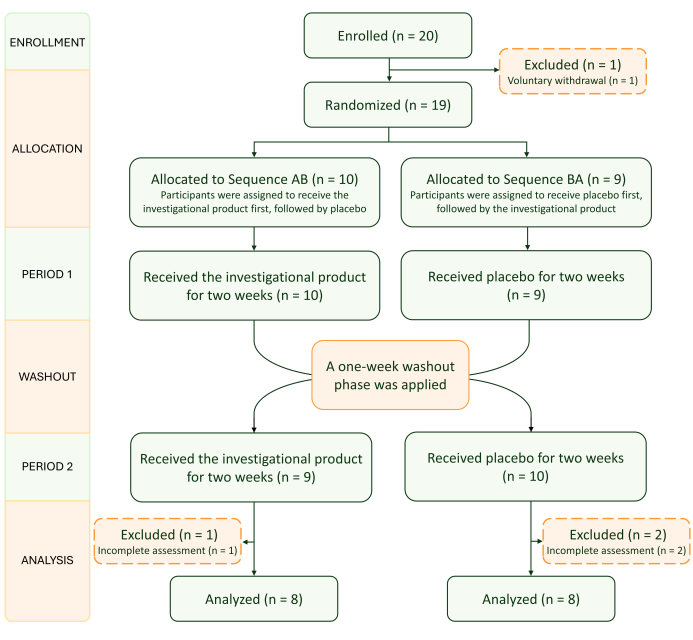
The monitoring test used a randomized, double-blind, placebo-controlled crossover design. Eligible participants were randomized to one of two intervention sequences: Sequence AB (investigational product followed by placebo) or Sequence BA (placebo followed by the investigational product). Each intervention period lasted two weeks, during which participants received six capsules per day in divided doses. The two intervention periods were separated by a one-week washout period. Adherence to the assigned product-use procedures was monitored throughout each period.
Self-reported outcomes were assessed using study-specific Visual Analog Scale (VAS) questionnaires administered during each intervention period. Participants were instructed to indicate their current perceived status on a scale ranging from 0 to 100 using item-specific anchors, with higher scores consistently representing a more favorable status. No specific retrospective recall period was defined because the questionnaire assessed the participant’s current condition at the time of assessment. The questionnaire included items related to physical fatigue and sexual well-being, and the complete questionnaire, including the exact wording and response anchors for each item, is provided in Supplementary Appendix A. Adverse events reported by participants during the monitoring periods were also documented.
2.6. Statistical AnalysisThe principal analysis was conducted using participants with complete outcome assessments required for the repeated-measures crossover analysis. Participants with incomplete assessments were excluded from this analysis. An intention-to-treat analysis including all randomized participants was not feasible because the incomplete assessments did not provide sufficient outcome data for the corresponding treatment contrasts, and missing outcomes were not imputed.
Self-reported outcomes were analyzed using linear mixed-effects models for repeated measures. For each outcome, fixed effects included treatment (investigational product vs. placebo), intervention period (first vs. second), assessment time (Week 1 vs. Week 2), treatment sequence (Sequence AB vs. Sequence BA), age, and the treatment-by-time interaction. Participant was included as a random intercept to account for the correlation of repeated observations within individuals. Model parameters were estimated using restricted maximum likelihood (REML), and denominator degrees of freedom were calculated using the Satterthwaite approximation. The random-intercept model assumes a common within-participant correlation across repeated observations. Model assumptions were evaluated by inspection of residual and quantile-quantile plots. Least-squares means (LS means) and 95% confidence intervals were calculated for each treatment at each assessment time point, and treatment contrasts were obtained using the emmeans package. To account for multiple comparisons across outcomes and assessment time points, p-values were additionally adjusted using the Benjamini–Hochberg false discovery rate (FDR) procedure, with adjustment performed separately within the physical fatigue and sexual well-being outcome families. Both nominal and FDR-adjusted p-values were reported. Possible carryover was not modeled as an additional fixed effect because of the limited sample size and consequent risk of overparameterization. Instead, a sensitivity analysis restricted to observations from the first intervention period was performed to assess whether the overall pattern of treatment differences was dependent on the crossover component of the design. No a priori sample-size or power calculation was performed because the present analysis used an existing product-monitoring dataset. All analyses were conducted in R (version 4.4.3).
A total of 20 participants entered the program. One participant withdrew voluntarily before sequence allocation, leaving 19 participants who were randomized to one of two product-use sequences: Sequence AB (investigational product followed by placebo; n = 10) or Sequence BA (placebo followed by the investigational product; n = 9). Three participants had incomplete assessments and were therefore not included in the principal analysis, resulting in a complete-case analysis population of 16 participants, with eight participants from each sequence (Figure 1). Among participants assigned to Sequence AB and Sequence BA, the mean ages were 40.70 ± 11.14 and 41.22 ± 11.13 years, respectively. Among the 16 participants included in the principal analysis, the corresponding mean ages were 36.25 ± 6.67 and 41.25 ± 11.90 years, respectively. No statistically significant difference in age was observed between the two sequences.

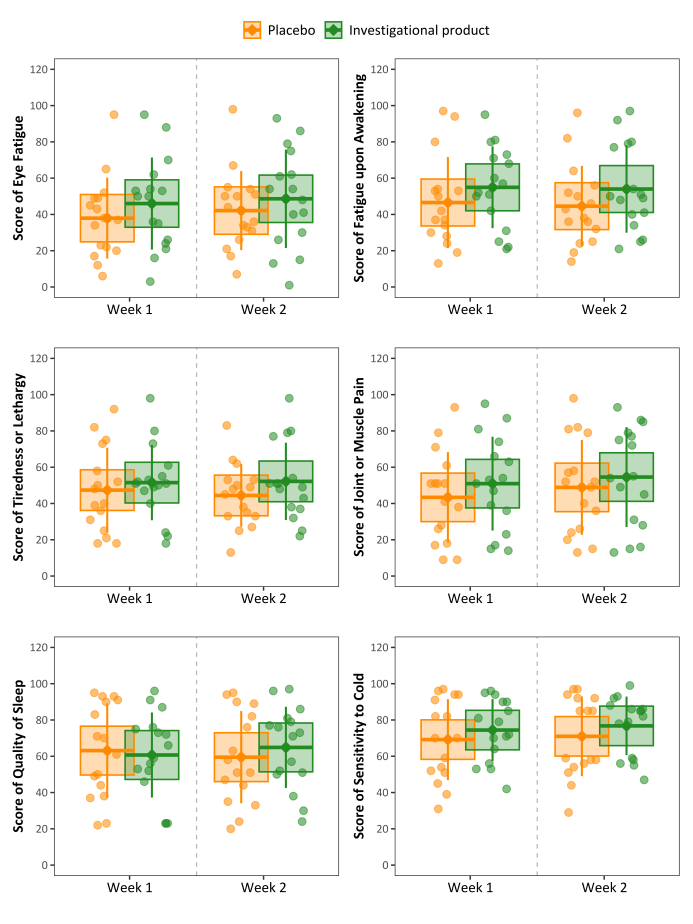
The effects of the investigational product on self-reported physical fatigue-related outcomes are illustrated in Figure 2, with complete numerical results provided in Table 2. LS mean scores were generally higher during use of the investigational product than during placebo exposure across most assessed outcomes and time points. Nominally significant treatment-associated differences were observed for eye fatigue at Week 1 (ΔLS mean = 8.06, p = 0.011) and Week 2 (ΔLS mean = 6.50, p= 0.039), fatigue upon awakening at Week 1 (ΔLS mean = 8.38, p = 0.046) and Week 2 (ΔLS mean = 9.44, p = 0.026), and joint or muscle pain at Week 1 (ΔLS mean = 7.56, p = 0.018). Numerical differences were also observed for joint or muscle pain at Week 2 (ΔLS mean = 5.69, p = 0.070) and tiredness or lethargy at Week 2 (ΔLS mean = 7.75, p = 0.095). However, none of these comparisons remained statistically significant after Benjamini–Hochberg false discovery rate adjustment. Sleep quality and sensitivity to cold also showed numerically higher LS mean scores during investigational product use at Week 2 (ΔLS mean = 5.38, p = 0.249 and ΔLS mean = 5.75, p = 0.103, respectively), although the between-treatment differences were not statistically significant. At Week 1, sleep quality showed no meaningful between-treatment difference (ΔLS mean = −2.44, p = 0.599), whereas sensitivity to cold was numerically higher during investigational product use (ΔLS mean = 5.25, p = 0.136).
As a sensitivity analysis addressing possible carryover effects, the analysis was repeated using data from the first intervention period only. The direction of the treatment differences was generally consistent with that observed in the full crossover analysis, with higher LS mean scores during use of the investigational product for all six fatigue-related outcomes at both assessment time points. Estimated between-treatment differences ranged from 0.75 to 15.50 points. The largest differences were observed for fatigue upon awakening at Week 1 (ΔLS mean = 15.00) and Week 2 (ΔLS mean = 15.50), tiredness or lethargy at Week 2 (ΔLS mean = 14.75), and eye fatigue at Week 1 (ΔLS mean = 12.50) and Week 2 (ΔLS mean = 13.50). None of the first-period-only comparisons reached nominal statistical significance or remained significant after FDR adjustment.
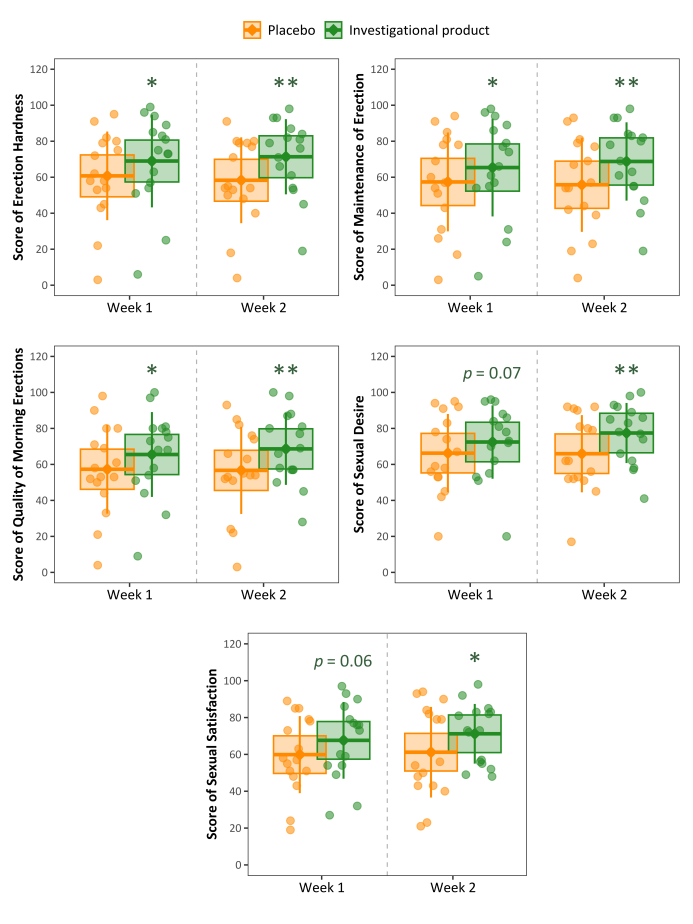
The effects of the investigational product on self-reported sexual well-being are illustrated in Figure 3, with complete numerical results provided in Table 3. Overall, intake of the investigational product was associated with higher LS mean scores across all five assessed outcomes compared with placebo, with treatment-associated differences generally becoming more pronounced at Week 2. At Week 1, significantly higher scores were observed for erection hardness during sexual intercourse or masturbation (ΔLS mean = 8.25, p = 0.021, FDR-adjusted p = 0.029), erection maintenance (ΔLS mean = 8.00, p = 0.020, FDR-adjusted p = 0.029), and morning erection quality (ΔLS mean = 8.19, p = 0.024, FDR-adjusted p = 0.029). Sexual desire (ΔLS mean = 6.19, p = 0.070) and sexual satisfaction (ΔLS mean = 7.75, p = 0.056) showed numerically higher scores but did not reach statistical significance at Week 1. At Week 2, significantly higher scores were observed for all five outcomes, including erection hardness (ΔLS mean = 13.06, p< 0.001, FDR-adjusted p = 0.002), erection maintenance (ΔLS mean = 12.94, p< 0.001, FDR-adjusted p = 0.002), morning erection quality (ΔLS mean = 11.94, p = 0.0014, FDR-adjusted p = 0.003), sexual desire (ΔLS mean = 11.50, p = 0.0012, FDR-adjusted p = 0.003), and sexual satisfaction (ΔLS mean = 10.00, p = 0.015, FDR-adjusted p = 0.029). Thus, the treatment-associated differences observed for all five sexual well-being outcomes at Week 2 remained statistically significant after adjustment for multiple comparisons.
As a sensitivity analysis addressing possible carryover effects, the analysis was repeated using data from the first intervention period only. The direction of the treatment differences was consistent with that observed in the full crossover analysis, with higher LS mean scores for the investigational product across all five sexual well-being outcomes at both assessment time points. Estimated between-treatment differences ranged from 11.25 to 28.62 points. Erection maintenance showed nominally significant differences at Week 1 (ΔLS mean = 26.62, p = 0.040) and Week 2 (ΔLS mean = 28.62, p = 0.029), although no first-period-only comparison remained statistically significant after FDR adjustment. The wider confidence intervals observed in this analysis were consistent with the reduced sample information available when only the first intervention period was considered.
3.4. Safety OutcomesNo serious adverse events were reported via the self-administered questionnaire throughout the study.During the placebo period, two participants reported mild gastrointestinal symptoms. Specifically, one experienced stomach discomfort during Week 1 that resolved by Week 2, while another reported mild stomach pain during Week 1 only.During the investigational productperiod, one participant reported transient, mild nausea immediately following intake during Week 2, which resolved spontaneously. All reported adverse events were mild and self-limiting, and no participants discontinued due to adverse events.


The present study retrospectively evaluated data from a randomized, double-blind, placebo-controlled crossover product-monitoring test of a multi-ingredient dietary supplement consisting of egg white-derived peptides, botanical extracts, and minerals in healthy adult men. Overall, the results showed treatment-associated differences in several self-reported measures of physical fatigue and sexual well-being, although the strength and consistency of these differences varied between the two outcome domains. For fatigue-related outcomes, LS mean scores were generally higher during use of the investigational product than during placebo exposure. Nominally significant differences were observed for fatigue upon awakening, eye fatigue, and joint or muscle pain at one or more assessment time points; however, none of the fatigue-related comparisons remained statistically significant after adjustment for multiple comparisons. These findings therefore suggest a possible favorable pattern in subjective physical condition, but the evidence for individual fatigue-related outcomes was limited in this exploratory dataset.
In contrast, the treatment-associated differences were more consistent for sexual well-being. Higher LS mean scores were observed during use of the investigational product across all five assessed outcomes, including morning erection quality, erection hardness, erection maintenance, sexual desire, and sexual satisfaction. At Week 1, significant differences that remained after FDR adjustment were observed for morning erection quality, erection hardness, and erection maintenance, whereas sexual desire and sexual satisfaction showed numerical but nonsignificant differences. By Week 2, significant treatment-associated differences were observed across all five sexual well-being outcomes and remained significant after adjustment for multiple comparisons. The generally larger between-treatment differences observed at Week 2 suggest that the treatment-associated pattern became more pronounced with continued product use.
The temporal pattern of the findings is also noteworthy. For several sexual well-being outcomes, treatment-associated differences were already detectable after one week and became more pronounced after two weeks. A broadly similar numerical pattern was observed for several fatigue-related measures, although these differences did not withstand correction for multiple testing. Accordingly, the present findings do not establish distinct acute or cumulative physiological effects, but they indicate that the observed differences, particularly those related to sexual well-being, tended to strengthen over the two-week product-use period.
Physical condition and sexual well-being may also be interrelated. Fatigue, sleep quality, and general vitality can influence subjective sexual well-being, while sexual satisfaction may in turn contribute to psychological well-being. The concurrent numerical changes observed across these domains therefore raise the possibility that some of the reported differences reflect interacting aspects of overall physical and psychological condition. However, the original product-monitoring test was not designed to distinguish direct physiological effects on sexual function from indirect effects mediated through fatigue, sleep, mood, or other factors. This relationship warrants more targeted investigation in prospective studies.
Male sexual responses are regulated by coordinated interactions between the central and peripheral nervous systems, with autonomic neural pathways playing a critical role in the initiation and maintenance of erection. Central to these processes is NO, a gaseous signaling molecule and neuromodulator synthesized from L-arginine by NO synthases 25. Erectile function is known to be highly dependent on endothelial health and NO-mediated vasodilation 26, 27, 28. NO released from endothelial cells and nitrergic nerves promotes relaxation of cavernosal smooth muscle, thereby increasing penile blood flow and facilitating erection 29, 30, 31. NO also acts as animportant neuromodulator within the central nervous system, where it orchestrates with dopamine, oxytocin, and other neurochemical mediators in the hypothalamus and paraventricular nucleus to regulate both the consummatory and appetitive sexual behavior, including erection, copulation, sexual motivation, arousal, and reward 25.Consistent with the mechanistic findings, nutritional interventions targeting endothelial NO-related pathways, such as L-arginine supplementation, have demonstrated benefits for erectile function, underscoring the relevance of vascular and endothelial NO-mediated signaling to male sexual health 32, 33, 34.In this regard, we previously demonstrated that EWH significantly increased NO production in an endothelial nitric oxide synthase-expressing cell line 35, 36. Importantly, these findings are supported by independent studies showing that EWH enhances NO-mediated endothelial function while attenuating oxidative stress and inflammatory signaling pathways 22, 23. EWH has also been reported to modulate the renin–angiotensin system and mitigate endothelial dysfunction, suggesting broader benefits for vascular homeostasis 24. Collectively, these findings provide a plausible mechanistic rationale by which EWH may support erection quality and maintenance. Furthermore, the favorable pattern observed for cold sensitivity and several fatigue-related outcomes raises the possibility that broader physiological processes, such as peripheral circulation and systemic regulation, may be involved. These observations are also consistent with the possibility that EWH contributes, at least in part, through effects on vascular function, peripheral blood flow, and/or autonomic regulation 37, 38, 39.
The investigational product also contained Lepidium meyenii (maca) extract as a primary bioactive component. The observed improvements in self-perceived sexual health align closely with previous preclinical and clinical evidence suggesting that macapositively influences sexual function and libido.Specifically, maca has been shown to enhance sexual performance parameters in male rats 40 and increase ejaculation frequency in mice through the upregulation of NO and cyclic guanosine monophosphate (cGMP) signaling pathways 41. At the clinical level, heightened sexual desire has been noted in healthy male athletes following 14 days of maca supplementation 42, alongside dose-dependent improvements in libido among patients with selective serotonin reuptake inhibitor (SSRI)-induced sexual dysfunction 43. Furthermore, maca supplementation has been shown to significantly improve International Index of Erectile Function (IIEF) scores in men experiencing late-onset hypogonadism symptoms 44. However, recent systematic reviews and meta-analyses caution that the broader clinical evidence remains inconclusive due to a limited number of randomized controlled trials, small sample sizes, and significant heterogeneity regarding extract preparation, dosage, and outcome measures 45, 46.
In addition to EWH and maca extract, the formulation investigated in the present study contained zinc, which may also have contributed to the observed outcomes. Zinc is an essential trace element involved in male reproductive physiology and has been implicated in the regulation of erectile function. It has been reported that zinc supplementation improves sexual performance and erectile responsesthrough enhancement of NO production and cGMPsignaling, maintenance of testosterone production, and attenuation of oxidative stress and inflammation within penile tissue 47, 48. Furthermore, increased intracellular free zinc has been observed in penile tissue during erection, supporting a physiological role for zinc in erectile processes 49. Consistent with these mechanistic findings, population-based analyses have reported an inverse association between dietary zinc intake and the prevalence of erectile dysfunction 50.
Given the multi-ingredient nature of the investigational product, the contribution of individual components to the observed outcomes cannot be isolated. Nevertheless, the improvements in sexual well-being and physical vitality observed in the present study are consistent with the possibility that these bioactive ingredients exert complementary and augmented effects through multipleand potentially overlappingmechanisms involving NO signaling, oxidative balance, vascular function, endocrine regulation, and neurophysiological pathways. Further studies employing factorial or component-controlled designs are warranted to clarify the contribution of individual ingredients and to evaluate potential interactions among them.
The investigational product was generally well tolerated during the product-monitoring periods. No serious adverse events were reported, and all documented adverse events were mild and transient and resolved without medical intervention. Reported events were infrequent and consisted primarily of mild gastrointestinal symptoms, including stomach discomfort, stomach pain, and transient nausea. Similar symptoms occurred during both the investigational product and placebo periods, with no apparent pattern suggesting increased gastrointestinal intolerance during use of the investigational product. No participant discontinued product use because of an adverse event. These observations are broadly consistent with previous evidence regarding thetolerability of the principal componentsof the formulation. For example, in randomized human studies, egg white hydrolysate was administered at 5 g/day for up to two weeks without treatment-related adverse events 51, while maca has also been reported to be safe during a 12-week randomized, placebo-controlled study 44. The present formulation provided 3.5 mg/day of elemental zinc, substantially below the adult Tolerable Upper Intake Level (UL) of 40 mg/day; adverse effects of zinc supplementation are primarily associated with prolonged intake at substantially higher doses 52. Taken together, the available monitoring data indicate that the investigational product was well tolerated over the short duration of exposure, although the limited sample size and monitoring period preclude broader conclusions regarding safety.
Several limitations should be considered when interpreting the present findings. First, the outcomes were based on self-reported VAS assessments and may therefore have been influenced by day-to-day variation in physical condition, psychological state, participant expectations, and reporting variability. Although the randomized, double-blind, placebo-controlled crossover design helped reduce some of these sources of bias, the questionnaires were study-specific and were not validated instruments for assessing fatigue or sexual function. Future studies should incorporate validated patient-reported measures together with objective or semi-objective physiological assessments where appropriate. Second, the product-use periods were relatively short, and the persistence of the observed treatment-associated differences during longer-term use or after discontinuation remains unknown. Third, the present study was a retrospective exploratory analysis of an existing product-monitoring dataset with a small analysis population, limiting statistical precision and the ability to investigate heterogeneity of response. The individual data nevertheless suggest appreciable inter-individual variability. Larger prospective studies could therefore examine whether baseline fatigue, sleep quality, age, lifestyle factors, vascular risk profile, or baseline sexual function are associated with differences in response to supplementation.
In conclusion, this retrospective exploratory analysis of product-monitoring data identified treatment-associated differences in several self-reported measures of sexual well-being and physical condition during use of a multi-component dietary formulation containing primarily EWH, maca extract, and zinc. The findings were more consistent for sexual well-being, whereas the fatigue-related results were less robust after adjustment for multiple comparisons. Overall, the observed patterns suggest that this formulation may have potential effects on perceived sexual well-being and aspects of daily physical condition, but the findings should be interpreted cautiously given the small sample size, short product-use periods, and reliance on study-specific self-reported outcomes. Further prospective studies using validated outcome measures and larger study populations are warranted to confirm these observations.
The authors confirm their contribution to the paper as follows: Conceptualization: KW, MS; Writing – original draft: XL; Data curation: XL, AT, WI; Formal analysis: XL; Investigation; KW, MS; Methodology: KW, MS; Visualization: XL; Writing – review & editing: KS, XL; Project administration: SS, YK.
The authors gratefully acknowledge Itoh Kanpo Pharmaceutical Co., Ltd. and Kongo Yakuhin Co., Ltd. for providing the investigational product used in this study.
This research received no external funding.
XL, KW, MS, AT, WI, SS, KS, and YK are employees of Pharma Foods International Co., Ltd., which manufactures and supplies the egg white hydrolysate, a component of the investigational product evaluated in this study.
The authors confirm that the data supporting the findings of this study are available within the article.
| [1] | Zamani, M., Rezaiian, F., Saadati, S., Naseri, K., Ashtary-Larky, D., Yousefi, M., Golalipour, E., Clark, C.C.T., Rastgoo, S. and Asbaghi, O., “The effects of folic acid supplementation on endothelial function in adults: a systematic review and dose-response meta-analysis of randomized controlled trials,” Nutrition Journal, 22, 12, 2023. | ||
| In article | View Article PubMed | ||
| [2] | Yilmaz, M.I., Demir, Z., Demir, M.F., Yilmaz, N.E., Abuzgaia, A.M., Elzagallaai, A., Piskin, D., Tuncer, S., Yilmaz, M.T., Kaya, F.M., Demir, Y., Sahin, A.E., Öztürk, M. and Demir, H., “Dietary supplementation improves markers of inflammation, oxidative stress, and endothelial function in a healthy adults,” Medical Research Archives, 13 (8), 2025. | ||
| In article | View Article | ||
| [3] | Valerio, V., Myasoedova, V.A., Massaiu, I., Ravani, A., Frigerio, B., Rusconi, V., Bertolini, F., Pompilio, G. and Poggio, P., “Oral nutraceutical intervention to improve endothelial function: evidence from in vitro and pilot clinical studies,” Biomedicine & Pharmacotherapy, 191, 118552, 2025. | ||
| In article | View Article PubMed | ||
| [4] | Higashi, Y., “Beneficial effects of supplementation on endothelial function: what mechanisms?”, Journal of Atherosclerosis and Thrombosis, 29 (9), 1268-1270, 2022. | ||
| In article | View Article PubMed | ||
| [5] | Srivatsav, A., Balasubramanian, A., Pathak, U.I., Rivera-Mirabal, J., Thirumavalavan, N., Hotaling, J.M., Lipshultz, L.I. and Pastuszak, A.W., “Efficacy and safety of common ingredients in aphrodisiacs used for erectile dysfunction: a review,” Sexual Medicine Reviews, 8 (3), 431-442, 2020. | ||
| In article | View Article PubMed | ||
| [6] | Maurya, N.K., “Libido boosting functional foods,” in Recent Advances in Male Reproductive System, Wu, W., Ed., IntechOpen, 2022. | ||
| In article | |||
| [7] | Thaha, A., Wang, B.S., Chang, Y.W., Hsia, S.M., Huang, T.C., Shiau, C.Y., Hwang, D.F. and Chen, T.Y., “Food-derived bioactive peptides with antioxidative capacity, xanthine oxidase and tyrosinase inhibitory activity,” Processes, 9 (5), 747, 2021. | ||
| In article | View Article | ||
| [8] | Chen, H., Sun, J., Fang, H., Lin, Y., Wu, H., Lin, D., Yang, Z., Zhou, Q., Zhao, B., Zhou, T., Wu, J., Li, S. and Liu, X., “Food-derived bioactive peptides: health benefits, structure-activity relationships, and translational prospects,” Journal of Zhejiang University Science B, 26 (11), 1037-1058, 2025. | ||
| In article | View Article PubMed | ||
| [9] | Chen, C., Xia, P., Gan, Y., Zheng, X., Yang, P., Shi, A., Liu, X., Zhang, J., Yu, P. and Zhang, D., “Food-derived bioactive peptides as emerging therapeutic agents: unlocking novel strategies for colorectal cancer treatment,” Pharmacological Research, 217, 107819, 2025. | ||
| In article | View Article PubMed | ||
| [10] | Chakrabarti, S., Jahandideh, F. and Wu, J., “Food-derived bioactive peptides on inflammation and oxidative stress,” BioMed Research International, 2014, 608979, 2014. | ||
| In article | View Article PubMed | ||
| [11] | Bhoria, S. and Dhewa, T., “Functional integration of ACE inhibitory peptides into food matrices: stability, bioavailability, consumer acceptance, regulatory and commercialization barriers,” Journal of Food Composition and Analysis, 147, 108029, 2025. | ||
| In article | View Article | ||
| [12] | Grootaert, C., Matthijs, B., Voorspoels, S., Possemiers, S., Smagghe, G. and Van Camp, J., “Egg-derived bioactive peptides with ACE-inhibitory properties: a literature update,” Food & Function, 8, 3847-3855, 2017. | ||
| In article | |||
| [13] | He, Z., Liu, G., Qiao, Z., Cao, Y. and Song, M., “Novel angiotensin-I converting enzyme inhibitory peptides isolated from rice wine lees: purification, characterization, and structure-activity relationship,” Frontiers in Nutrition, 8, 746113, 2021. | ||
| In article | View Article PubMed | ||
| [14] | Andersen, C.J., “Bioactive egg components and inflammation,” Nutrients, 7 (9), 7889-7913, 2015. | ||
| In article | View Article PubMed | ||
| [15] | Lyu, S., Li, T., Yang, Q., Liu, J., Zhang, T. and Yu, T., “Potential application of egg white peptides for antioxidant properties: perspectives from batch stability and network pharmacology,” Foods, 13 (19), 3148, 2024. | ||
| In article | |||
| [16] | Zhang, X., Chelliappan, B., Rajeswari, S. and Antonysamy, M., “Recent advances in applications of bioactive egg compounds in nonfood sectors,” Frontiers in Bioengineering and Biotechnology, 9, 738993, 2021. | ||
| In article | View Article PubMed | ||
| [17] | Wanthong, A., Boonmark, C., Vaisopha, N., Roytrakul, S., Tankrathok, A., Taemaitree, L., Daduang, S., Boonlue, S., Khunkitti, W., Klaynongsruang, S. and Jangpromma, N., “Egg white hydrolysate peptides act as antimicrobial and anti-inflammatory agents for acne,” Heliyon, 10 (11), e32468, 2024. | ||
| In article | View Article PubMed | ||
| [18] | Cho, D.Y., Jo, K., Cho, S.Y., Kim, J.M., Lim, K., Suh, H.J. and Oh, S., “Antioxidant effect and functional properties of hydrolysates derived from egg-white protein,” Korean Journal for Food Science of Animal Resources, 34 (3), 362-371, 2014. | ||
| In article | |||
| [19] | Yubolphan, R., Phongsiri, K., Mongkhammee, N., Pidech, J., Roytrakul, S., Suwattanasophon, C., Choowongkomon, K., Daduang, S., Khunkitti, W. and Jangpromma, N., “Anti-inflammatory effects of hen egg white hydrolysate and its specific peptides IS8, PA11, and PK8 on LPS-induced macrophage inflammation,” Food Science & Nutrition, 13 (8), e70713, 2025. | ||
| In article | View Article PubMed | ||
| [20] | Mojibi, Y., de Campos Zani, S.C., Richard, C. and Chan, C.B., “A review of the efficacy of egg-derived bioactive peptides and hydrolysates on glycemic regulation,” Medical Research Archives, 13 (10), 2025. | ||
| In article | View Article | ||
| [21] | Rungchang, S., Sringarm, C., Numthuam, S., Tosuk, N., Thongsuk, T., Phinyo, M., Winuprasith, T. and Jiamyangyuen, S., “Hydrolysis kinetics amino acid profiling and antioxidant properties of enzymatic hydrolysates from desalted egg white,” Scientific Reports, 15 (1), 44270, 2025. | ||
| In article | View Article PubMed | ||
| [22] | Piagette, J.T., Pinheiro Júnior, J.E.G., Kanaan, S.H.H., Herrera, C.T., Bastilhos, L.O., Peçanha, F.M., Vassallo, D.V., Miguel-Castro, M. and Wiggers, G.A., “Pretreatment with egg white hydrolysate protects resistance arteries from damage induced after treatment with accidental cadmium exposure values,” Journal of Functional Foods, 104, 105529, 2023. | ||
| In article | View Article | ||
| [23] | Escobar, A.G., Rizzetti, D.A., Piagette, J.T., Peçanha, F.M., Vassallo, D.V., Miguel, M. and Wiggers, G.A., “Antioxidant properties of egg white hydrolysate prevent mercury-induced vascular damage in resistance arteries,” Frontiers in Physiology, 11, 595767, 2020. | ||
| In article | View Article PubMed | ||
| [24] | Ashkar, F., Fan, H., Wang, Z., Fernando, I.P.S. and Wu, J., “Ovotransferrin-depleted egg white hydrolysate reduces blood pressure in spontaneously hypertensive rats,” Food Materials Research, 4, e035, 2024. | ||
| In article | View Article | ||
| [25] | Melis, M.R. and Argiolas, A., “Erectile function and sexual behavior: a review of the role of nitric oxide in the central nervous system,” Biomolecules, 11 (12), 1866, 2021. | ||
| In article | View Article PubMed | ||
| [26] | Kaltsas, A., Zikopoulos, A., Dimitriadis, F., Sheshi, D., Politis, M., Moustakli, E., Symeonidis, E.N., Chrisofos, M., Sofikitis, N. and Zachariou, A., “Oxidative stress and erectile dysfunction: pathophysiology, impacts, and potential treatments,” Current Issues in Molecular Biology, 46 (8), 8807-8834, 2024. | ||
| In article | View Article PubMed | ||
| [27] | Bivalacqua, T.J., Usta, M.F., Champion, H.C., Kadowitz, P.J. and Hellstrom, W.J.G., “Endothelial dysfunction in erectile dysfunction: role of the endothelium in erectile physiology and disease,” Journal of Andrology, 24 (6 Suppl), S17-S37, 2003. | ||
| In article | View Article | ||
| [28] | Maas, R., Schwedhelm, E., Albsmeier, J. and Böger, R.H., “The pathophysiology of erectile dysfunction related to endothelial dysfunction and mediators of vascular function,” Vascular Medicine, 7 (3), 213-225, 2002. | ||
| In article | View Article PubMed | ||
| [29] | Burnett, A.L., “The role of nitric oxide in erectile dysfunction: implications for medical therapy,” Journal of Clinical Hypertension (Greenwich), 8 (12 Suppl 4), 53-62, 2006. | ||
| In article | View Article PubMed | ||
| [30] | Toda, N., Ayajiki, K. and Okamura, T., “Nitric oxide and penile erectile function,” Pharmacology & Therapeutics, 106 (2), 233-266, 2005. | ||
| In article | View Article PubMed | ||
| [31] | Davies, K.P., “Development and therapeutic applications of nitric oxide releasing materials to treat erectile dysfunction,” Future Science OA, 1 (1), FSO53, 2015. | ||
| In article | |||
| [32] | Klotz, T., Mathers, M.J., Braun, M., Bloch, W. and Engelmann, U., “Effectiveness of oral L-arginine in first-line treatment of erectile dysfunction in a controlled crossover study,” Urologia Internationalis, 63 (4), 220-223, 1999. | ||
| In article | |||
| [33] | Wu, G., Meininger, C.J., McNeal, C.J., Bazer, F.W. and Rhoads, J.M., “Role of L-arginine in nitric oxide synthesis and health in humans,” in Advances in Experimental Medicine and Biology, Wu, G., Ed., Springer, 2021, 167-187. | ||
| In article | View Article PubMed | ||
| [34] | Tian, Y., Zhou, Q., Li, W., Liu, M., Li, Q. and Chen, Q., “Efficacy of L-arginine and Pycnogenol® in the treatment of male erectile dysfunction: a systematic review and meta-analysis,” Frontiers in Endocrinology, 14, 1211720, 2023. | ||
| In article | View Article PubMed | ||
| [35] | Pharma Foods International Co., Ltd., “NO production promoting composition and chilling improving agent containing the same,” Japanese Patent JP6026148B2, 2016. | ||
| In article | |||
| [36] | Pharma Foods International Co., Ltd., “NO production promoting composition and male function improving agent containing the same,” Japanese Patent JP5383549B2, 2014. | ||
| In article | |||
| [37] | Kono, K., Abe, S., Yamamoto, M., Kayashima, R., Kaneko, K., Sakuma, M., Toyoda, S., Nakajima, T. and Inoue, T., “Vascular endothelial dysfunction and autonomic nervous hyperactivity among premenopausal women with cold-sensitivity constitution (Hiesho),” Tohoku Journal of Experimental Medicine, 253 (1), 51-60, 2021. | ||
| In article | |||
| [38] | Arendt Nielsen, T., Lundbye-Christensen, S., Krasimirova Dimitrova, Y., Riahi, S., Brock, B., Drewes, A.M. and Brock, C., “Adynamic response to cold pain reflects dysautonomia in type 1 diabetes and polyneuropathy,” Scientific Reports, 13, 11318, 2023. | ||
| In article | View Article PubMed | ||
| [39] | Eglin, C.M., Wright, J., Maley, M.J., Hollis, S., Massey, H., Montgomery, H. and Tipton, M.J., “The peripheral vascular responses in non-freezing cold injury and matched controls,” Experimental Physiology, 108, 420-437, 2023. | ||
| In article | View Article PubMed | ||
| [40] | Cicero, A.F.G., Piacente, S., Plaza, A., Sala, E., Arletti, R. and Pizza, C., “Hexanic Maca extract improves rat sexual performance more effectively than methanolic and chloroformic Maca extracts,” Andrologia, 34 (3), 177-179, 2002. | ||
| In article | View Article PubMed | ||
| [41] | Zhang, Y., Zhou, F. and Ge, F., “Effects of combined extracts of Lepidium meyenii and Allium tuberosum Rottl. on erectile dysfunction,” BMC Complementary and Alternative Medicine, 19, 135, 2019. | ||
| In article | View Article PubMed | ||
| [42] | Stone, M., Ibarra, A., Roller, M., Zangara, A. and Stevenson, E., “A pilot investigation into the effect of maca supplementation on physical activity and sexual desire in sportsmen,” Journal of Ethnopharmacology, 126 (3), 574-576, 2009. | ||
| In article | View Article PubMed | ||
| [43] | Dording, C.M., Fisher, L., Papakostas, G., Farabaugh, A., Sonawalla, S., Fava, M. and Mischoulon, D., “A double-blind, randomized, pilot dose-finding study of maca root (L. meyenii) for the management of SSRI-induced sexual dysfunction,” CNS Neuroscience & Therapeutics, 14 (3), 182-191, 2008. | ||
| In article | View Article PubMed | ||
| [44] | Shin, D., Jeon, S.H., Piao, J., Park, H.J., Tian, W.J., Moon, D.G., Ahn, S.T., Jeon, K.H., Zhu, G.Q., Park, I., Park, H.J., Bae, W.J., Cho, H.J., Hong, S.H. and Kim, S.W., “Efficacy and safety of Maca (Lepidium meyenii) in patients with symptoms of late-onset hypogonadism: a randomized, double-blind, placebo-controlled clinical trial,” World Journal of Men's Health, 41 (3), 692-700, 2023. | ||
| In article | |||
| [45] | Lee, H.W., Lee, M.S. and Kil, K.J., “Maca (L. meyenii) for erectile dysfunction: a systematic review and meta-analysis,” Journal of Men's Health, 19 (1), 1-6, 2023. | ||
| In article | |||
| [46] | Bower-Cargill, C., Yarandi, N. and Petroczi, A., “A systematic review of the versatile effects of the Peruvian Maca Root (Lepidium meyenii) on sexual dysfunction, menopausal symptoms and related conditions,” Phytomedicine Plus, 2 (4), 100326, 2022. | ||
| In article | View Article | ||
| [47] | Besong, E.E., Akhigbe, T.M., Ashonibare, P.J., Oladipo, A.A., Obimma, J.N., Hamed, M.A., Adeyemi, D.H. and Akhigbe, R.E., “Zinc improves sexual performance and erectile function by preventing penile oxidative injury and upregulating circulating testosterone in lead-exposed rats,” Redox Report, 28 (1), 2225675, 2023. | ||
| In article | |||
| [48] | Akhigbe, R.E., Hamed, M.A., Odetayo, A.F., Akhigbe, T.M. and Oyedokun, P.A., “Zinc improves sexual and erectile function in HAART-treated rats via the upregulation of erectogenic enzymes and maintenance of redox balance,” The Aging Male, 26 (1), 2205517, 2023. | ||
| In article | View Article PubMed | ||
| [49] | Kang, B.S., Suh, S.W., Yang, D.Y., Choi, B.Y. and Lee, W.K., “Expression and Distribution of Free Zinc in Penile Erectile Tissue,” World Journal of Men's Health, 41 (1), 155-163, 2023. | ||
| In article | View Article PubMed | ||
| [50] | Liu, R.J., Li, S.Y., Xu, Z.P., Yu, J.J., Mao, W.P., Sun, C., Xu, B. and Chen, M., “Dietary metal intake and the prevalence of erectile dysfunction in US men: Results from National Health and Nutrition Examination Survey 2001–2004,” Frontiers in Nutrition, 9, 974443, 2022. | ||
| In article | View Article PubMed | ||
| [51] | Oe, M., Sakamoto, H., Nishiyama, H., Sasahara, R., Masuda, Y., Adachi, M. and Nishiyama, T., “Egg white hydrolyzate reduces mental fatigue: randomized, double-blind, controlled study,” BMC Research Notes, 13, 443, 2020. | ||
| In article | View Article PubMed | ||
| [52] | Saper, R.B. and Rash, R., “Zinc: an essential micronutrient,” American Family Physician, 79 (9), 768-772, 2009. | ||
| In article | |||
Published with license by Science and Education Publishing, Copyright © 2026 Xuan Li, Kazuya Watabe, Maya Sakashita, Aoi Tamura, Wako Ikeda, Saki Shirako, Kenji Sato and Young-il Kim
 This work is licensed under a Creative Commons Attribution 4.0 International License. To view a copy of this license, visit
http://creativecommons.org/licenses/by/4.0/
This work is licensed under a Creative Commons Attribution 4.0 International License. To view a copy of this license, visit
http://creativecommons.org/licenses/by/4.0/
| [1] | Zamani, M., Rezaiian, F., Saadati, S., Naseri, K., Ashtary-Larky, D., Yousefi, M., Golalipour, E., Clark, C.C.T., Rastgoo, S. and Asbaghi, O., “The effects of folic acid supplementation on endothelial function in adults: a systematic review and dose-response meta-analysis of randomized controlled trials,” Nutrition Journal, 22, 12, 2023. | ||
| In article | View Article PubMed | ||
| [2] | Yilmaz, M.I., Demir, Z., Demir, M.F., Yilmaz, N.E., Abuzgaia, A.M., Elzagallaai, A., Piskin, D., Tuncer, S., Yilmaz, M.T., Kaya, F.M., Demir, Y., Sahin, A.E., Öztürk, M. and Demir, H., “Dietary supplementation improves markers of inflammation, oxidative stress, and endothelial function in a healthy adults,” Medical Research Archives, 13 (8), 2025. | ||
| In article | View Article | ||
| [3] | Valerio, V., Myasoedova, V.A., Massaiu, I., Ravani, A., Frigerio, B., Rusconi, V., Bertolini, F., Pompilio, G. and Poggio, P., “Oral nutraceutical intervention to improve endothelial function: evidence from in vitro and pilot clinical studies,” Biomedicine & Pharmacotherapy, 191, 118552, 2025. | ||
| In article | View Article PubMed | ||
| [4] | Higashi, Y., “Beneficial effects of supplementation on endothelial function: what mechanisms?”, Journal of Atherosclerosis and Thrombosis, 29 (9), 1268-1270, 2022. | ||
| In article | View Article PubMed | ||
| [5] | Srivatsav, A., Balasubramanian, A., Pathak, U.I., Rivera-Mirabal, J., Thirumavalavan, N., Hotaling, J.M., Lipshultz, L.I. and Pastuszak, A.W., “Efficacy and safety of common ingredients in aphrodisiacs used for erectile dysfunction: a review,” Sexual Medicine Reviews, 8 (3), 431-442, 2020. | ||
| In article | View Article PubMed | ||
| [6] | Maurya, N.K., “Libido boosting functional foods,” in Recent Advances in Male Reproductive System, Wu, W., Ed., IntechOpen, 2022. | ||
| In article | |||
| [7] | Thaha, A., Wang, B.S., Chang, Y.W., Hsia, S.M., Huang, T.C., Shiau, C.Y., Hwang, D.F. and Chen, T.Y., “Food-derived bioactive peptides with antioxidative capacity, xanthine oxidase and tyrosinase inhibitory activity,” Processes, 9 (5), 747, 2021. | ||
| In article | View Article | ||
| [8] | Chen, H., Sun, J., Fang, H., Lin, Y., Wu, H., Lin, D., Yang, Z., Zhou, Q., Zhao, B., Zhou, T., Wu, J., Li, S. and Liu, X., “Food-derived bioactive peptides: health benefits, structure-activity relationships, and translational prospects,” Journal of Zhejiang University Science B, 26 (11), 1037-1058, 2025. | ||
| In article | View Article PubMed | ||
| [9] | Chen, C., Xia, P., Gan, Y., Zheng, X., Yang, P., Shi, A., Liu, X., Zhang, J., Yu, P. and Zhang, D., “Food-derived bioactive peptides as emerging therapeutic agents: unlocking novel strategies for colorectal cancer treatment,” Pharmacological Research, 217, 107819, 2025. | ||
| In article | View Article PubMed | ||
| [10] | Chakrabarti, S., Jahandideh, F. and Wu, J., “Food-derived bioactive peptides on inflammation and oxidative stress,” BioMed Research International, 2014, 608979, 2014. | ||
| In article | View Article PubMed | ||
| [11] | Bhoria, S. and Dhewa, T., “Functional integration of ACE inhibitory peptides into food matrices: stability, bioavailability, consumer acceptance, regulatory and commercialization barriers,” Journal of Food Composition and Analysis, 147, 108029, 2025. | ||
| In article | View Article | ||
| [12] | Grootaert, C., Matthijs, B., Voorspoels, S., Possemiers, S., Smagghe, G. and Van Camp, J., “Egg-derived bioactive peptides with ACE-inhibitory properties: a literature update,” Food & Function, 8, 3847-3855, 2017. | ||
| In article | |||
| [13] | He, Z., Liu, G., Qiao, Z., Cao, Y. and Song, M., “Novel angiotensin-I converting enzyme inhibitory peptides isolated from rice wine lees: purification, characterization, and structure-activity relationship,” Frontiers in Nutrition, 8, 746113, 2021. | ||
| In article | View Article PubMed | ||
| [14] | Andersen, C.J., “Bioactive egg components and inflammation,” Nutrients, 7 (9), 7889-7913, 2015. | ||
| In article | View Article PubMed | ||
| [15] | Lyu, S., Li, T., Yang, Q., Liu, J., Zhang, T. and Yu, T., “Potential application of egg white peptides for antioxidant properties: perspectives from batch stability and network pharmacology,” Foods, 13 (19), 3148, 2024. | ||
| In article | |||
| [16] | Zhang, X., Chelliappan, B., Rajeswari, S. and Antonysamy, M., “Recent advances in applications of bioactive egg compounds in nonfood sectors,” Frontiers in Bioengineering and Biotechnology, 9, 738993, 2021. | ||
| In article | View Article PubMed | ||
| [17] | Wanthong, A., Boonmark, C., Vaisopha, N., Roytrakul, S., Tankrathok, A., Taemaitree, L., Daduang, S., Boonlue, S., Khunkitti, W., Klaynongsruang, S. and Jangpromma, N., “Egg white hydrolysate peptides act as antimicrobial and anti-inflammatory agents for acne,” Heliyon, 10 (11), e32468, 2024. | ||
| In article | View Article PubMed | ||
| [18] | Cho, D.Y., Jo, K., Cho, S.Y., Kim, J.M., Lim, K., Suh, H.J. and Oh, S., “Antioxidant effect and functional properties of hydrolysates derived from egg-white protein,” Korean Journal for Food Science of Animal Resources, 34 (3), 362-371, 2014. | ||
| In article | |||
| [19] | Yubolphan, R., Phongsiri, K., Mongkhammee, N., Pidech, J., Roytrakul, S., Suwattanasophon, C., Choowongkomon, K., Daduang, S., Khunkitti, W. and Jangpromma, N., “Anti-inflammatory effects of hen egg white hydrolysate and its specific peptides IS8, PA11, and PK8 on LPS-induced macrophage inflammation,” Food Science & Nutrition, 13 (8), e70713, 2025. | ||
| In article | View Article PubMed | ||
| [20] | Mojibi, Y., de Campos Zani, S.C., Richard, C. and Chan, C.B., “A review of the efficacy of egg-derived bioactive peptides and hydrolysates on glycemic regulation,” Medical Research Archives, 13 (10), 2025. | ||
| In article | View Article | ||
| [21] | Rungchang, S., Sringarm, C., Numthuam, S., Tosuk, N., Thongsuk, T., Phinyo, M., Winuprasith, T. and Jiamyangyuen, S., “Hydrolysis kinetics amino acid profiling and antioxidant properties of enzymatic hydrolysates from desalted egg white,” Scientific Reports, 15 (1), 44270, 2025. | ||
| In article | View Article PubMed | ||
| [22] | Piagette, J.T., Pinheiro Júnior, J.E.G., Kanaan, S.H.H., Herrera, C.T., Bastilhos, L.O., Peçanha, F.M., Vassallo, D.V., Miguel-Castro, M. and Wiggers, G.A., “Pretreatment with egg white hydrolysate protects resistance arteries from damage induced after treatment with accidental cadmium exposure values,” Journal of Functional Foods, 104, 105529, 2023. | ||
| In article | View Article | ||
| [23] | Escobar, A.G., Rizzetti, D.A., Piagette, J.T., Peçanha, F.M., Vassallo, D.V., Miguel, M. and Wiggers, G.A., “Antioxidant properties of egg white hydrolysate prevent mercury-induced vascular damage in resistance arteries,” Frontiers in Physiology, 11, 595767, 2020. | ||
| In article | View Article PubMed | ||
| [24] | Ashkar, F., Fan, H., Wang, Z., Fernando, I.P.S. and Wu, J., “Ovotransferrin-depleted egg white hydrolysate reduces blood pressure in spontaneously hypertensive rats,” Food Materials Research, 4, e035, 2024. | ||
| In article | View Article | ||
| [25] | Melis, M.R. and Argiolas, A., “Erectile function and sexual behavior: a review of the role of nitric oxide in the central nervous system,” Biomolecules, 11 (12), 1866, 2021. | ||
| In article | View Article PubMed | ||
| [26] | Kaltsas, A., Zikopoulos, A., Dimitriadis, F., Sheshi, D., Politis, M., Moustakli, E., Symeonidis, E.N., Chrisofos, M., Sofikitis, N. and Zachariou, A., “Oxidative stress and erectile dysfunction: pathophysiology, impacts, and potential treatments,” Current Issues in Molecular Biology, 46 (8), 8807-8834, 2024. | ||
| In article | View Article PubMed | ||
| [27] | Bivalacqua, T.J., Usta, M.F., Champion, H.C., Kadowitz, P.J. and Hellstrom, W.J.G., “Endothelial dysfunction in erectile dysfunction: role of the endothelium in erectile physiology and disease,” Journal of Andrology, 24 (6 Suppl), S17-S37, 2003. | ||
| In article | View Article | ||
| [28] | Maas, R., Schwedhelm, E., Albsmeier, J. and Böger, R.H., “The pathophysiology of erectile dysfunction related to endothelial dysfunction and mediators of vascular function,” Vascular Medicine, 7 (3), 213-225, 2002. | ||
| In article | View Article PubMed | ||
| [29] | Burnett, A.L., “The role of nitric oxide in erectile dysfunction: implications for medical therapy,” Journal of Clinical Hypertension (Greenwich), 8 (12 Suppl 4), 53-62, 2006. | ||
| In article | View Article PubMed | ||
| [30] | Toda, N., Ayajiki, K. and Okamura, T., “Nitric oxide and penile erectile function,” Pharmacology & Therapeutics, 106 (2), 233-266, 2005. | ||
| In article | View Article PubMed | ||
| [31] | Davies, K.P., “Development and therapeutic applications of nitric oxide releasing materials to treat erectile dysfunction,” Future Science OA, 1 (1), FSO53, 2015. | ||
| In article | |||
| [32] | Klotz, T., Mathers, M.J., Braun, M., Bloch, W. and Engelmann, U., “Effectiveness of oral L-arginine in first-line treatment of erectile dysfunction in a controlled crossover study,” Urologia Internationalis, 63 (4), 220-223, 1999. | ||
| In article | |||
| [33] | Wu, G., Meininger, C.J., McNeal, C.J., Bazer, F.W. and Rhoads, J.M., “Role of L-arginine in nitric oxide synthesis and health in humans,” in Advances in Experimental Medicine and Biology, Wu, G., Ed., Springer, 2021, 167-187. | ||
| In article | View Article PubMed | ||
| [34] | Tian, Y., Zhou, Q., Li, W., Liu, M., Li, Q. and Chen, Q., “Efficacy of L-arginine and Pycnogenol® in the treatment of male erectile dysfunction: a systematic review and meta-analysis,” Frontiers in Endocrinology, 14, 1211720, 2023. | ||
| In article | View Article PubMed | ||
| [35] | Pharma Foods International Co., Ltd., “NO production promoting composition and chilling improving agent containing the same,” Japanese Patent JP6026148B2, 2016. | ||
| In article | |||
| [36] | Pharma Foods International Co., Ltd., “NO production promoting composition and male function improving agent containing the same,” Japanese Patent JP5383549B2, 2014. | ||
| In article | |||
| [37] | Kono, K., Abe, S., Yamamoto, M., Kayashima, R., Kaneko, K., Sakuma, M., Toyoda, S., Nakajima, T. and Inoue, T., “Vascular endothelial dysfunction and autonomic nervous hyperactivity among premenopausal women with cold-sensitivity constitution (Hiesho),” Tohoku Journal of Experimental Medicine, 253 (1), 51-60, 2021. | ||
| In article | |||
| [38] | Arendt Nielsen, T., Lundbye-Christensen, S., Krasimirova Dimitrova, Y., Riahi, S., Brock, B., Drewes, A.M. and Brock, C., “Adynamic response to cold pain reflects dysautonomia in type 1 diabetes and polyneuropathy,” Scientific Reports, 13, 11318, 2023. | ||
| In article | View Article PubMed | ||
| [39] | Eglin, C.M., Wright, J., Maley, M.J., Hollis, S., Massey, H., Montgomery, H. and Tipton, M.J., “The peripheral vascular responses in non-freezing cold injury and matched controls,” Experimental Physiology, 108, 420-437, 2023. | ||
| In article | View Article PubMed | ||
| [40] | Cicero, A.F.G., Piacente, S., Plaza, A., Sala, E., Arletti, R. and Pizza, C., “Hexanic Maca extract improves rat sexual performance more effectively than methanolic and chloroformic Maca extracts,” Andrologia, 34 (3), 177-179, 2002. | ||
| In article | View Article PubMed | ||
| [41] | Zhang, Y., Zhou, F. and Ge, F., “Effects of combined extracts of Lepidium meyenii and Allium tuberosum Rottl. on erectile dysfunction,” BMC Complementary and Alternative Medicine, 19, 135, 2019. | ||
| In article | View Article PubMed | ||
| [42] | Stone, M., Ibarra, A., Roller, M., Zangara, A. and Stevenson, E., “A pilot investigation into the effect of maca supplementation on physical activity and sexual desire in sportsmen,” Journal of Ethnopharmacology, 126 (3), 574-576, 2009. | ||
| In article | View Article PubMed | ||
| [43] | Dording, C.M., Fisher, L., Papakostas, G., Farabaugh, A., Sonawalla, S., Fava, M. and Mischoulon, D., “A double-blind, randomized, pilot dose-finding study of maca root (L. meyenii) for the management of SSRI-induced sexual dysfunction,” CNS Neuroscience & Therapeutics, 14 (3), 182-191, 2008. | ||
| In article | View Article PubMed | ||
| [44] | Shin, D., Jeon, S.H., Piao, J., Park, H.J., Tian, W.J., Moon, D.G., Ahn, S.T., Jeon, K.H., Zhu, G.Q., Park, I., Park, H.J., Bae, W.J., Cho, H.J., Hong, S.H. and Kim, S.W., “Efficacy and safety of Maca (Lepidium meyenii) in patients with symptoms of late-onset hypogonadism: a randomized, double-blind, placebo-controlled clinical trial,” World Journal of Men's Health, 41 (3), 692-700, 2023. | ||
| In article | |||
| [45] | Lee, H.W., Lee, M.S. and Kil, K.J., “Maca (L. meyenii) for erectile dysfunction: a systematic review and meta-analysis,” Journal of Men's Health, 19 (1), 1-6, 2023. | ||
| In article | |||
| [46] | Bower-Cargill, C., Yarandi, N. and Petroczi, A., “A systematic review of the versatile effects of the Peruvian Maca Root (Lepidium meyenii) on sexual dysfunction, menopausal symptoms and related conditions,” Phytomedicine Plus, 2 (4), 100326, 2022. | ||
| In article | View Article | ||
| [47] | Besong, E.E., Akhigbe, T.M., Ashonibare, P.J., Oladipo, A.A., Obimma, J.N., Hamed, M.A., Adeyemi, D.H. and Akhigbe, R.E., “Zinc improves sexual performance and erectile function by preventing penile oxidative injury and upregulating circulating testosterone in lead-exposed rats,” Redox Report, 28 (1), 2225675, 2023. | ||
| In article | |||
| [48] | Akhigbe, R.E., Hamed, M.A., Odetayo, A.F., Akhigbe, T.M. and Oyedokun, P.A., “Zinc improves sexual and erectile function in HAART-treated rats via the upregulation of erectogenic enzymes and maintenance of redox balance,” The Aging Male, 26 (1), 2205517, 2023. | ||
| In article | View Article PubMed | ||
| [49] | Kang, B.S., Suh, S.W., Yang, D.Y., Choi, B.Y. and Lee, W.K., “Expression and Distribution of Free Zinc in Penile Erectile Tissue,” World Journal of Men's Health, 41 (1), 155-163, 2023. | ||
| In article | View Article PubMed | ||
| [50] | Liu, R.J., Li, S.Y., Xu, Z.P., Yu, J.J., Mao, W.P., Sun, C., Xu, B. and Chen, M., “Dietary metal intake and the prevalence of erectile dysfunction in US men: Results from National Health and Nutrition Examination Survey 2001–2004,” Frontiers in Nutrition, 9, 974443, 2022. | ||
| In article | View Article PubMed | ||
| [51] | Oe, M., Sakamoto, H., Nishiyama, H., Sasahara, R., Masuda, Y., Adachi, M. and Nishiyama, T., “Egg white hydrolyzate reduces mental fatigue: randomized, double-blind, controlled study,” BMC Research Notes, 13, 443, 2020. | ||
| In article | View Article PubMed | ||
| [52] | Saper, R.B. and Rash, R., “Zinc: an essential micronutrient,” American Family Physician, 79 (9), 768-772, 2009. | ||
| In article | |||