Mushrooms are valued natural resources with unique nutritional profiles and bioactive components, gaining increasing attention in food and pharmaceutical research for their diverse health-promoting effects. This study systematically summarizes the latest research progress on mushroom bioactive components, their health benefits, and application prospects. A systematic review was conducted using databases including CNKI, PubMed, Web of Science, Scopus, and Google Scholar. Mushrooms are rich in polysaccharides, phenols, terpenoids, and other bioactive substances, exerting anti-tumor, anti-inflammatory, antioxidant, and immunomodulatory effects. They also show potential in regulating blood glucose/lipids and alleviating cardiovascular and neurodegenerative diseases, supporting their application in prebiotics, anti-aging formulations, and wound healing materials. Mushrooms hold significant potential for health product development. Future research should prioritize efficient extraction of active components, in-depth mechanistic analysis, and industrial technology innovation to facilitate translation from basic research to practical applications in functional foods and biomedicine.
Mushrooms, macroscopic fungi of the phyla Basidiomycota and Ascomycota, are globally recognized as dual food and medicinal resources with remarkable nutritional and medicinal value. Structurally, they consist of an intricate hyphal network that forms fruiting bodies (caps and stipes), lack chlorophyll, and rely on saprophytic growth on lignin- and cellulose-rich decaying organic matter to acquire nutrients via microbial degradation (Figure 1) 1. In this competitive ecological niche, mushrooms have evolved to synthesize diverse secondary metabolites as a defense against pathogens 2; these metabolites, together with endogenous bioactive compounds, underpin their environmental resilience and biological activity.
Historically, mushrooms have played a pivotal role in human nutrition and therapeutics. Chitin, a key fungal cell wall component, acts as a valuable dietary fiber with additional health benefits, and mushrooms represent an abundant natural source of dietary antioxidants that mitigate oxidative stress and associated cellular damage. Modern research has validated their efficacy in preventing and managing multiple disorders, including cancer, immune dysfunction, inflammation, diabetes, and cardiovascular diseases. Notably, only 10% of the approximately 140,000 global mushroom species have been taxonomically identified and scientifically investigated 3, with merely 700–800 species confirmed to possess medicinal properties (e.g., anti-cancer and immunomodulatory effects) 4, reflecting immense untapped biodiversity and a clear need for further research in this field.

Common edible species, including Agaricus bisporus, Lentinula edodes, Pleurotus ostreatus, Volvariella volvacea, Pleurotus eryngii, and Flammulinavelutipes, are widely consumed worldwide, while certain toxic genera (e.g., Inocybe) pose significant health hazards 5. Since the 18th century, advances in cultivation technology have driven a thirtyfold increase in the global production of cultivated edible mushrooms 6, making them one of the most widely cultivated and consumed edible fungi due to their rich nutrition, favorable palatability, and inherent health-promoting properties. Beyond culinary applications, mushrooms are increasingly valorized as functional foods, nutritional supplements, and pharmaceutical raw materials.
Driven by sustained investment in nutritional and pharmacological research, as well as product innovation, the global mushroom industry holds substantial growth potential with far-reaching implications for public health. This review comprehensively summarizes the major bioactive components of mushrooms, their diverse health benefits, and current and future application prospects. It aims to further unlock the developmental potential of mushroom resources and provide a theoretical basis for their high-value utilization in the food, nutrition, and pharmaceutical sectors.
Mushrooms, recognized for their appealing texture, flavor, and medicinal properties, have long served as an important component of human diets and healthcare. Mushrooms are attractive in terms of nutrient content as a great source of carbohydrates, proteins, lipids, vitamins, and minerals, with 32-61.4 g/100 g carbohydrates, 13.8-38.5 g/100 g protein, and 0.4-5.9 g/100 g fat. Moreover, a 100-gram serving of most mushroom species can provide approximately 15-30% of the daily recommended intake of essential vitamins and trace elements 7. Beyond these nutritional components, further phytochemical analysis of diverse mushroom species has revealed a variety of active chemical components containing in mushrooms, including phenolic acids, flavonoids, tannins, pyrogallols, triterpenoids, and diterpenoids. The investigation of these mushroom-derived nutrients and chemical components provides a scientific basis for the development of natural product-based strategies for prevention and control of human diseases, and underscore the efficacy and feasibility of incorporating edible fungi into dietary management programs.
2.1. NutrientsCarbohydrates, composed of carbon, hydrogen, and oxygen, are the most abundant organic compounds in nature with broad-spectrum chemical structures and biological functions. Carbohydrates account for approximately 50%-65% of mushroom composition on a dry weight basis 8. Functionally, carbohydrates in mushrooms can be divided into two categories: (1) Digestible carbohydrates can be absorbed and utilized by human body, including monosaccharides, disaccharides, and polysaccharides; (2) Indigestible carbohydrates cannot be digested by enzymes but contribute to gastrointestinal health, such as dietary fiber. The most common monosaccharides identified in mushrooms include glucose, fructose, galactose, mannose, xylose, rhamnose, ribose, and arabinose. Among all carbohydrate forms, polysaccharides are the main active ingredients responsible for the health benefits of edible and medicinal mushrooms.
In recent decades, mushroom-derived polysaccharides, isolated from the fruiting bodies, mycelia, or fermentation broths, have attracted increasing attention due to their diverse biological activities and unique chemical structures. These bioactive polysaccharides can be classified into homopolysaccharides (e.g., dextran) and heteropolysaccharides that contain two or more different types of monosaccharides 9. The biological activity of these mushroom-derived polysaccharides is affected by their distinct structural characteristics, including molecular weight, monosaccharide composition, water solubility, branching pattern, polymer charge, and glycosidic bond type 10. Table 1 provided a summary of representative carbohydrates isolated from several important mushroom species.
Besides polysaccharides, proteins and peptides are also important nutrients present in mushrooms, contributing to their nutritional and therapeutic value. Mushroom-derived proteins are highly digestible and exhibit abundant biological activities, including fungal immunomodulatory proteins (FIPs), ribosomal inactivating proteins (RIPs), lectins (glycoproteins), antimicrobial proteins, and enzymatically active proteins. Among these, FIPs are a novel class of bioactive proteins capable of regulating cytokine response. So far, more than 38 FIPs have been identified with anti-allergic, anti-inflammatory, anticancer, and other biological activities 18. RIPs are enzymes capable of inactivating ribosomes by specifically removing one or more adenosine residues from rRNA 19. Another mushroom-isolated proteins, lectins, existing in the caps, stems, and hyphae of mushrooms, are defense proteins blocking attacks by insects or fungi 20. They are non-immune-derived carbohydrate-binding proteins (glycoprotein) that specifically binds cell surface carbohydrates to induce cell agglutination 21. The binding specificity of lectins with surface glycan fragments determining their biological function and therapeutic applications.
Proteins in mushrooms are essential for metabolism regulation, intercellular communication, transport, and structural maintenance. When incorporated into the human diet, mushroom proteins are nutrient-rich alternatives to conventional protein sources. Numerous studies have shown that mushroom-derived proteins contain a complete amino acid profile, often exceeding nutritional value of proteins found in milk, meat, and eggs 22. Hence, mushrooms are increasingly recognized as a sustainable and functional source of dietary protein with added health-promoting properties.
Lipids represent a critical form of energy storage in mushrooms. Their content in mushrooms is relatively low, usually ranging from 0.1% to 16.3% of dry weight, allowing mushrooms to be a low-fat healthy food 23. Approximately 52–87% of the lipids in mushrooms are unsaturated fatty acids, primarily including oleic acid and linoleic acid. Linoleic acid is an essential fatty acid necessary for health and is known for its anti-cancer effect, which cannot be synthesized endogenously due to the absence of enzyme omega-3 desaturase in humans 24. Studies have found that L. edodes contained high levels of linoleic acid, further supporting its classification as functional foods for cancer prevention. Besides unsaturated fatty acids, mushrooms also contain moderate amounts of saturated fatty acids, such as palmitic acid and stearic acid 25.
Mushrooms represent an excellent source of vitamins and minerals with high nutritional value. The vitamin profile of mushrooms includes riboflavin, thiamine, tocopherols, ascorbic acid, niacin, folic acid, vitamin D2, and provitamin D2. Mushrooms have also been reported to contain fairly high levels of the provitaminergosterol, and are considered the only non-animal natural source of vitamin D 26. The high content of vitamin B12 in certain mushroom species is comparable to that in beef, fish, and liver, thus allowing mushrooms to be an alternative source of this crucial nutrient for vegetarians 27.
Besides vitamins, mushrooms also contain high levels of potassium, phosphorus, and magnesium, moderate amounts of calcium, and low amounts of sodium, zinc, iron, and copper 28. Notably, mushrooms are free of cholesterol, helpful for preventing atherosclerotic cardiovascular disease. Compared to many other vegetables, their low sodium and high potassium content makes them particularly suitable for individuals managing hypertension 29. Moreover, mushrooms are also a dietary source of selenium, a trace element important for human nutrition and health 30. Overall, the abundant vitamins and minerals in mushrooms enhance their profile as both a nutritious food and a functional ingredient with potential health benefits.
2.2. Chemical ComponentsPhenolic compounds are a diverse group of secondary metabolites widely distributed in mushrooms, including phenolic acids, flavonoids, tannins, and pyrogallols. Among them, phenolic acids and flavonoids are the most abundant and well-studied subclasses. Phenolic acids commonly identified in mushrooms include caffeic acid, p-coumaric acid, gallic acid, cinnamic acid, protocatechuic acid, and ferulic acid 31, among which chlorogenic acid, gallic acid, and protocatechuic acid are strongly related to the antioxidant capacity of phenolic acids 32. These phenolic acids are prevalent in the widely consumed mushroom species, including A. bisporus, L. edodes, and P. ostreatus 33. In addition to phenolic acids,flavonoids are another major group of naturally occurring phenolic compounds found in mushrooms, which exist in nature in the form of glycosides or aglycones. Edible mushrooms contain a variety of flavonoids, including catechins, myricetin, emodin, mulcetin, hesperetin, naringenin, formomemerin, biocatechins, resveratrol, quercetin, catrogallol, rutin, and kaempferol. Table 2 provided a summary of the major polyphenols identified in mushrooms.
Higher basidiomycetes, particularly mushroomis an extremely important source of bioactive terpenoids, a class of unsaturated hydrocarbon compounds with wide-ranging health benefits. Terpenoids can be typically classified into monoterpenoids, sesquiterpenoids, diterpenoids, triterpenoids, and polyterpenoids. Until now, diverse structurally distinct terpenoids, including triterpenoids,diterpenoids, triterpene,lanostane-type triterpene, 4, 5-secolanostanes triterpenes, and 24-methylene lanostane, have been isolated from mushrooms 41. Among all these mushroom-derived terpenoids, triterpenoids are the most reported class, which are primarily isolated from various mushroom species, including Inonotus obliquus, Fomitopsisbetulina, Astraeus asiaticus, andGymnopilusorientispectabilis 42 43. Triterpenoids are compounds possessing a carbon skeleton formed from 6 isoprene units, often serving as precursors to steroids and exhibiting notable health benefits.
Two unprecedented triterpenes, compounds 1 and 2, possessing a unique 6/6/6/5/6 scaffold, were isolated from the fruiting bodies of the mushroom Ganoderma australe 44. Three novel meroterpenoids, compounds3-5, were isolated from the basidiomycete Clitocybe clavipes, among which clavipine A (compound 3) exhibited significant antiproliferative activity against HepG2 and A549 cell lines 45. Moreover, five previously undescribed guanacastane diterpenoids, compounds 6-10, were obtained from cultures of Psathyrellacandolleana, with compounds 6-8 exhibiting notable antibacterial activity 46. The chemical structures of compounds 1-10 were presented in Figure 2.

Among the sterols identified in mushrooms, the predominant components include lanosterol, ergosterol, and ergosterol peroxide, with ergosterol being the most abundant and characteristic sterol of mushroom cell membranes. High levels of ergosterol were found in mushroom species such as A. bisporus, L. edodes, P. ostreatus and Grifola frondose 47. Ergosterol is of particularly value as a dietary precursor of vitamin D₂ and as a natural antioxidant. In fungi, it plays a fundamental role by stabilizing cell membrane fluidity, supporting protein function, regulating intracellular transport, and thereby maintaining the integrity of fungal cell membrane structure 48.
Beyond its physiological role in fungi, ergosterol has attracted much attention for its pharmacological activities, including anti-cancer, anti-inflammatory, and antioxidant activities. Notably, its anti-inflammatory potency has been reported to exceed that of the nonsteroidal anti-inflammatory drug indomethacin 49. Ergosterol exists in mushrooms in both free and esterified forms, and upon ultraviolet light exposure undergoes a photolytic reaction to yield ergocalciferol precursors (vitamin D₂) 50. This process highlights mushrooms as a rare non-animal dietary source of vitamin D₂, significantly enhancing their nutritional value for vegetarians and vegans. It is also worth noting that the amount of ergosterol in mushrooms is dynamic, decreasing with mushroom maturation, and at the same growth stage, being higher in the cap than that of the stalk 51.
Alkaloids are a broad class of basic, nitrogen-containing natural products, and numerous types with different structures and biological properties have been found in mushrooms. These include β-carboline alkaloids, pyrroloquinoline alkaloids, pyrroles, indoles, and miscellaneous alkaloids 52. Among them, psilocybin, a phosphorylated indole alkaloid that naturally occurs in “magic” mushrooms (genus Psilocybe), is one of the most studied indole metabolites in mushrooms. Psilocybin is considered a naturally occurring hallucinogen, and in recent years, psilocybin has been found to have significant effects in the treatment of a variety of mental disorders, especially in the treatment of depression 53, and has become a promising mental health treatment.
Table 3 lists the new compounds isolated from mushrooms over the past five years, along with their corresponding pharmacological activities.
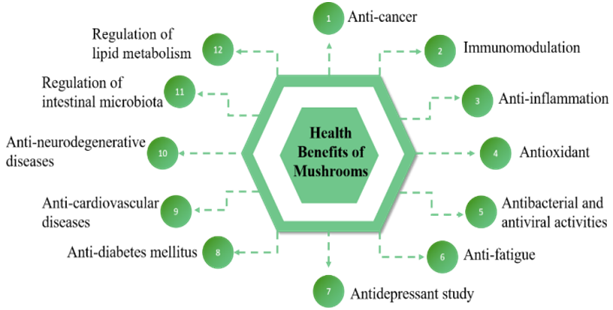
Mushrooms have abundant biological activities, and their health benefits have attracted extensive attention. Comprehensive research has focused on the active ingredients present in mushrooms, revealing their potential in anti-cancer, immunomodulatory, antioxidant, anti-inflammatory, antibacterial, anti-fatigue, anti-allergic, and anti-depressant. Comprehensive investigation of their beneficial properties deepens our understanding of mushroom bioactivity and supports their application as a scientific basis for the development of new drugs and functional health supplements. Figure 3 summarized the health benefits of mushrooms and their bioactive constituents.
3.1. Anti-cancerMushrooms have demonstrated excellent anti-cancer property against diverse types of cancer. They can inhibit cancer growth and improve the quality of life in cancer patients during and after conventional therapies. A review of clinical investigations indicated that patients taking medicinal mushrooms experienced improvements in mood, physical state, sleep quality, and reduced side effects of conventional chemotherapy 68. Moreover, the combination of mushroom-derived extracts with conventional chemotherapeutic agents or other natural bioactive compounds exhibited synergistic effects, enhancing therapeutic efficacy while reducing treatment-related adverse effects. The accumulating evidence supports the potential of mushrooms and their isolates against various types of cancer, providing preliminary evidence for the potential application of mushrooms in cancer prevention and therapy.
Clinical studies and practical experience have shown that polysaccharide K (PSK), a bioactive polysaccharide derived from Coriolus versicolor, could improve the immune system in lung cancer patients, reduce tumor-related symptoms, and prolong survival period 69. Besidespolysaccharides, peptides extracted from L. edodes exhibited a certain toxic effect against a variety of human lung cancer cells with low IC50 values. Moreover, BEAP, a protein isolated and purified from Boletus, exhibited anti-lung cancer activity via triggering apoptosis, cell cycle arrest, and inhibition on the proliferation of A549 cells in vitro 70. Pleuroferrin, a novel protein isolated from Pleurotus ferulae, has also demonstrated anin vitro anti-cancer effect against non-small cell lung cancer, highlighting the therapeutic potential of mushroom-derived proteins in lung cancer prevention and therapy 71.
Many mushroom species have demonstrated promising anti-breast cancer activity. A novel medicinal mushroom mixture composed of Agaricus blazei, Grifola frondosa, and L. edodes and a medicinal mushroom mixture rich in β-glucan exhibited excellent antitumor properties in mice transplanted with triple negative breast cancer cells 4T1 72 73. Clinical studies further reported that β-glucan improved the quality of life of breast cancer patients undergoing chemotherapy. A specific β-glucan, linear (1→6)-β-D-glucan (B16), isolated from A. bisporus andplasma-treated mushroom extracts demonstrated dual anti-cancer effect in breast cancer cells. B16 combined with doxorubicin exhibited a synergistic effect that reduced the viability of breast cancer cells MDA-MB-231 by 31% compared to doxorubicin alone 74. Moreover, A. bisporus exhibited therapeutic potential for 7, 12-dimethylbenzo[a]anthracene (DMBA)-induced breast cancer 75.
A cytotoxic study revealed that the ethyl acetate extracts from P. ostreatus and Pseudobasidiumussuriensis exhibited an inhibition on cell proliferation of prostate cancer cells PC-3, with inhibition rates of 99.45%-92.82% at concentrations of 520-530 μg/mL 76. In clinical trials, oral administration of A. bisporus powder reduced circulating levels of prostate-specific antigen in patients with biochemically recurrent prostate cancer 77. At the molecular level, a polysaccharide extracted from L. edodes could effectively inhibit the growth of prostate cancer by targeting thetumor microenvironment. It regulated the function of prostate cancer-associated fibroblasts (CAFs) by activating the TLR4-NF-κB pathway and thereby interfering CAF-mediated immunosuppression 78. Another study found a synergistic interaction of lovastatin and extract of Antrodia camphorate enhanced cytotoxicity against PC-3 cells, indicating the potential for combination therapies using mushroom-derived extracts and conventional therapeutic drugs 79.
The most common and aggressive brain cancer in adults is glioblastoma (GBM), in which mushroom-derived extracts exhibit great anticancer activity. In vitro studies using human glioblastoma cell linesU87MG and LN-18 demonstrated that mushroom extracts inhibited cell proliferation, induced apoptosis, arrested the cell cycle at the sub-G1 or G2/M phase, and inhibited metalloproteinase activity. In a survey of mushrooms, L. edodes and Tricholoma matsutake showedthe strongest anti-glioma potential 80. Lentinan (LNT), a potent molecule from L. edodes, has been identified as a highly effective agent against GBM. Cell studies using U87MG revealed a strong anti-GBM effect of LNT by reducing cell viability and promoting apoptotic cell death. Moreover, LNT exhibited excellent biocompatibility and stability, making it a promising candidate for the treatment of GBM 81.
Besides, mushroom-derived extracts have shown promising potential in the therapy of various digestive system malignancies. The β-glucan fraction isolated from L. edodes exhibited anti-cancer activity against colon cancer cells 82. PSK therapy has demonstrated the ability to enhance anti-cancer immunity in gastric cancer 83. Another study revealed inhibitory activity of Auricularia auricula-judae in gastric cancer cells, particularly in patients with stage IIb gastric cancer 84. As to oral health, a crude extract of A.blazei induced apoptosis of oral cancer cells CAL-27 85. Moreover, medicinal mushrooms G. frondosa, L. edodes, and F.velutipes have shown significant anti-cancer activity against cervical cancer 86. In hepatocellular carcinoma, Letinouspolysaccharide-1, a homogeneous water-soluble flake polysaccharide extracted and purified from Boletus, exhibited notable anticancer efficacy in vitro 87. Additionally, polysaccharides isolated from F.velutipes were found to elevate the activity of immune cells and enhance immune-mediated attack on kidney cancer in vivo 88. Recent studies have also indicated therapeutic potential of mushrooms against skin cancer, esophageal cancer, blood cancer, and multiple myeloma 89 90. Overall, these collective findings reveal the anti-cancer potential of mushrooms, indicating their potential as natural adjuncts or leads for anticancer agent development.
3.2. ImmunomodulationRecent studies have shown that mushroom-derived extracts exhibited extensive effects on immune function. Polysaccharides extracted from mushrooms, including β-D-glucan, polysaccharide-peptides, and polysaccharide-proteins, are considered host defense enhancers or biological response modulators. For instance, the alkali-soluble β-glucan extracted from P.eryngii has been shown to improve spleen lymphocyte proliferation, enhance NK cell activity, and increase the phagocytic capacity of abdominal phagocytes, thus promoting host immune responses in preclinical models 91. Moreover, consuming a diet supplemented with β-glucan could improve immunity in cancer patients and reduce symptoms related to upper respiratory tract infections, seasonal allergies, osteoarthritis, and obesity-related comorbidities 92. Current research has supported a dual role of β-glucan functioning as an immune initiator during pathogen challenge and as a modulator that restores immune response post-infection 93. Additionally, studies indicated potent and complex immunomodulatory potential of P.eryngii and Hericium erinaceusdue to their rich diversity of polysaccharides and proteoglycans 94 95.
Besides polysaccharides, other mushroom-derived compounds, including terpenes and terpenoids, lectins, and FIPs, also exhibited strong immunomodulatory activity. For instance, the secondary metabolite lectins purified from P. ostreatus notably enhanced immunogenicity through modulation of cellular and humoral immunity 96. Moreover, L. edodes could inhibit the proliferation of cancer cells and enhance the immune system 97. Interestingly, in an ethanolic extract of Rubinoboletusballouii, endemic to the forests of Yunnan, researchers identified two novel immunosuppressive compounds 1-ribofuranosyl-s-triazin-2(1H)-one and pistillarin, which might serve as new molecular scaffolds for immunomodulatory agent development 98. These studies unfolded mushrooms to be a valuable source of immunomodulatory agents, offering natural, safe, and accessible approach to improving health.
3.3. Anti-inflammationInflammation is a physiological response of the body triggered by tissue injury, infection, or irritation, which serves to scavenge harmful substances, repair damaged tissue, and restore tissue function. However, extensive or prolonged inflammation can lead to the progression of many diseases. Mushroom extracts have been shown to exhibit significant anti-inflammatory effect, with evidence indicating that their bioactive components could significantly reduce inflammatory mediators. Polysaccharides from edible mushroomswere shown to increasepancreatic β cell mass and alleviate β cell disorder through anti-inflammatory activity 9. Bioactive compounds extracted from Dictyophoraindusiata were found to exhibit anti-inflammatory activity via inhibition of pro-inflammatory cytokines 99. Similarly, polysaccharide-rich extract from Antrodiacinnamomea exhibited anti-inflammatory activity by inhibiting IL-6 secretion in lipopolysaccharide (LPS)-stimulated RAW264.7 macrophages 100. Furthermore, Pleurotus citrinopileatus, commonly known as golden mushroom, exhibited anti-inflammatory property and showed potential againstinflammatory diseases 12.
3.4. AntioxidantAntioxidants are beneficial in eliminatingreactive oxygen species (ROS), thereby protecting biological systems from oxidative injury. Mushrooms represent a rich source of natural antioxidants, offering both nutritional and therapeutic benefits by reducing oxidative stress. The antioxidant activity of mushroom-derived compounds has been extensively studied, and their effects included inhibiting lipid peroxidation, reducing human low-density lipoprotein and malondialdehyde, and scavenging free radicals 9. Polysaccharides extracted from mushrooms are particularly notable for their extensiveantioxidant activity. For instance, isogalactan isolated and purified from mushrooms had potential to be an antioxidant, as evidenced by its strong reducing power and free radical scavenging ability 17. Specific proteoglycans isolated from P. ostreatus and L. edodescomposited polysaccharide (LECP) were also found to exhibit excellent antioxidant capacity 101 102. Moreover, LNT has been reported to protect bovine mammary epithelial cells (BMEC) from LPS-induced injury by reducing ROS production 103.
Besides polysaccharides, mushrooms contain numerous compounds withantioxidant properties, including antioxidant enzymes, reductive coenzymes, phenols, and amino acid derivatives. Phenolic biomolecules, widely distributed in edible mushrooms, exhibited excellent antioxidant activity as they were natural substrates for oxidases 104 105. Ergothioneine, a sulfur-containing amino acid derivative almost exclusively in mushrooms, has been identified as a dietary antioxidant with cytoprotective capacity. Similarly, ergosterol exhibited antioxidant property by inhibiting lipid peroxidation and reducing intracellular ROS levels 51. Collectively, mushrooms represented a potent source of key antioxidants that could reduce oxidative stress, improve human health, and enhance quality of life, and hold great promise for applications in functional foods,nutraceuticals, and preventive medicine.
3.5. Antibacterial and Antiviral ActivitiesThe morbidity and mortality of infectious diseases caused by bacteria and viruses are rising globally, accompanied by rising antimicrobial resistance. Novel and excellent solutions, especially bioactive ingredients derived from natural sources, have attracted increasing attention. In this context, mushrooms have garnered considerable interest due to their abundant content of bioactive ingredients with broad-spectrum antimicrobial capacity against diverse bacteria and fungi 106. L. edodes exhibited strong antimicrobial efficacy against both Gram-positive and Gram-negative bacteria, particularly, its ethyl acetate extract exhibited the highest antibacterial efficacy 107. Another study has shown that the extract of Tricholosporumgoniospermum also exhibited strong antibacterial activity against a range of pathogens 108. Furthermore, medicinal mushroom extracts are known for their activity against drug-resistant bacteria, including Methicillin-susceptible Staphylococcus aureus (MSSA) and Methicillin-resistant Staphylococcus aureus (MRSA).
In addition to antibacterial efficacy, mushrooms also exhibit antiviral potential. A study demonstrated protective capacity of polysaccharides CLNT (crude lentinan) on the intestinal microbiota and immune barrier of Oncorhynchus mykissinfected with infectious hematopoietic necrosis virus (IHNV). CLNT exerted its antiviral effect by enhancing the intestinal immune barrier and regulating the intestinal microbiota and short-chain fatty acids (SCFAs) metabolism in O. mykiss 109. Likewise, dietary supplementation with A. bisporus enhanced the innate immune response to bacterial and viral infections by elevating NK cell activity, promoting dendritic cell maturation, and decreasing pro-inflammatory cytokine production 110. Moreover, flavonoids derived from mushrooms have shown strong antiviral activity against diverse viruses, including influenza A and B, encephalitis virus, dengue virus type-2,HCV, HBV,HIV-1,enterovirus A71,and poliovirus 111.
3.6. Anti-fatigueMushrooms have significant anti-fatigue potential owing to their rich profile of nutrients and bioactive compounds, such as polysaccharides, proteins, vitamins, minerals, and dietary fiber 112. The combined action of these bioactive components contained in edible and medicinal mushrooms might help support physiological homeostasis, maintain metabolic function, and reduce fatigue. Mushroom-derived polysaccharides have been shown to relieve fatigue by improving muscle function, enhancing antioxidant activity, regulating blood glucose level, and modulating immune and hormonal response. Additionally, adenosine, a purine nucleoside present in mushrooms, has shown an inhibitory effect on platelet aggregation, thereby promoting blood circulation and reducing fatigue 113. Moreover, polysaccharide-protein complexes, polysaccharide-peptide conjugates, triterpenoids, phenols, and flavonoids isolated from mushrooms also exhibited anti-fatigue properties by scavenging free radicals, modulating inflammation, and enhancing energy metabolism 114.
3.7. Antidepressant StudyMushrooms are valuable daily dietary sources with potentially multidirectional antidepressant activity 115. The most well-known constituent is psilocybin, a naturally occurring hallucinogen isolated fromPsilocybe species that holds great promise for treating depression and other mental health conditions 116. A related compound, norbaeocystin, has demonstrated overlapping therapeutic potential with psilocybin but lacks hallucinogenic property,making it a promising alternative for clinical use with fewer psychotropic side effects 117. Additionally, a medicinal mushroomH.erinaceus has been shown antidepressant potential by enhancing the BDNF-TrkB-CREB signaling pathway, promoting neurogenesis, and reducing neuroinflammation 118. Coumaric acid (p-CA), a phenolic acid present in mushrooms, exhibited therapeutic potential for patients with depression. In a corticosterone (CORT)-induced mouse model, p-CA significantly attenuated CORT-induced depressive-like behavior and memory deficits by regulating of a variety of targets and signaling pathways 119.
3.8. Anti-diabetes MellitusMushrooms are considered an ideal food for the prevention and management of hyperglycemia, primarily due to their high protein and dietary fiber content, coupled with low fat content 120. In addition to their nutritional profile, mushrooms have attracted attention as a promising source of natural medicines with anti-diabetic property. Mushroom polysaccharides, particularly β-glucans, have been shown to exhibit strong hypoglycemic effect by decreasing triglycerides, improving insulin resistance, and reducing cholesterol and blood glucose levels, making them viable candidates for the development of functional foods or adjunct therapies for diabetes 121 122. Moreover, terpenoids and vitamin D present in mushrooms also played vital roles in controlling diabetes via modulating glucose metabolism and insulin sensitivity 123. Many mushroom species have demonstrated particularly promise in decreasing blood glucose level and relieving diabetes symptoms. For instance, polysaccharides extracted from both the fruiting bodies and mycelium of the cultivated edible fungus P.eryngii demonstrated significant hypoglycemic activity 124. Similarly, C.comatus mycelium polysaccharides (CMP) could improve insulin resistance and enhance energy metabolism in a mouse model of diabetic nephropathy 125.
3.9. Anti-cardiovascular Diseases (CVDs)Mushrooms possess a high linoleic acid/linolenic acid ratio, which contributes to improved heart function and reduced risks of arterial thrombosis and hypertension 126. This lipid profile, combined with the presence of bioactive constituents including ergosterol, polyphenols, terpenes, polysaccharides, and proteins, rendered mushroom a valuable functional food for CVDs prevention. Ergosterol, a sterol present in mushroom membranes, along with ergosterol peroxides, has demonstrated cholesterol-reducing property, thereby contributing to CVDs prevention 50. Another bioactive compound, ergothioneine (EGT) could accumulate rapidly in the heart tissue after external ingestion, and higher circulating level of EGT reduced CVDs-related mortality and reduced the risk of cardiovascular disease 127. Crude aqueous extract of Pleurotus griseus abundant in EGT has been shown to protect human aortic endothelial cells from hydrogen peroxide-induced oxidative stress 128. Moreover, King bolete mushroom protein hydrolysate (KBMPH) notably inhibited angiotensin Ⅰ-converting enzyme activity, and novel peptides further extracted from KBMPH were considered as natural alternatives to synthetic antihypertensive drugs, with potential applications in nutraceuticals and functional foods 129.
3.10. Anti-neurodegenerative Diseases (NDs)Alzheimer's disease (AD) and Parkinson's disease (PD) are the most typical and prevalent NDs, and their common characteristics are central nervous system dysfunction and a wide range of clinical manifestations 130. Nowadays, NDs have become a major challenge in the field of public health. Fortunately, recent studies have highlighted the neuroprotective property of mushrooms and their active ingredients as promising intervention agents for combating neurodegeneration. Studies have shown that mushrooms could delay neurodegeneration, where mushroom extracts could reduce β-amyloid-induced neurotoxicity by clearing abnormal protein deposits, inhibiting acetylcholinesterase activity, and modulating neuroinflammation 131.
Existing evidence demonstrates that mushroom-derived metabolites can combat pathological processes of AD.A key feature in AD pathogenesis is the vicious cycle between oxidative stress and Aβ/tau proteinopathies. In this context,A. bisporusshowed potential for AD intervention by reducing oxidative stress markers in brain tissue 132. Likewise, β-glucanisolated fromL. edodescould regulate the gut-brain axis, prevent high-fat diet-induced cognitive impairment, and mitigate Aβ peptide toxicity, thus delaying the progression from mild cognitive impairment to AD 133. In another study, the neutral polysaccharide BEP2 isolated from the fruiting body ofBoletusspecies significantly improved learning and memory function in APP/PS1 transgenic mice, achieving triple effects of Aβ plaque clearance, neuro-inflammation inhibition, and neuronal protection 134. H.erinaceusdeserved particular attention for its neuroprotective capacity, which was shown to effectively alleviate hippocampal oxidative stress and inflammation, ameliorate neuronal degeneration, and improve behavioral abnormalities in AD animal models 135. Preclinical and clinical studies further confirmed thatH.erinaceusextract could significantly improve cognitive dysfunction and delay disease progression of AD, accompanied by its memory-enhancing effects offering new nutritional and therapeutic possibilities for AD patients 136.
PD, another prevalent neurodegenerative disorder, is characterized by the progressive loss of dopaminergic neurons in the substantia nigra of the midbrain 131. In recent years, studies have highlighted the neuroprotective potential of mushrooms, particularly H.erinaceus, bioactive components and the mycelium of which have demonstrated significant neuroprotective property. In an MPTP (1-Methyl-4-phenyl-1,2,3,6-tetrahydropyridine)-induced PD mouse model, a mushroom isolate erinacine A could effectively reduce neurotoxicity, enhance the anti-apoptotic ability of neurons, and inhibit neuronal cell death through dual modulating the PAK1 / AKT / LIMK2/MEK and Cofilin survival pathway, and simultaneously inhibiting the cell death pathway 137. BesidesH. erinaceus, medicinal fungi G. frondosa has shown promise, where its extract significantly ameliorated dopaminergic neuron degeneration by modulating the oxidative stress pathway in a melanogaster PD model 138. These findings supported the potential of mushrooms as a natural, multi-modal strategy for protection of neuronal health.
3.11. Regulation of Intestinal MicrobiotaNumerous mushroom polysaccharides have been demonstrated to modulate microbiota composition and exhibit anti-inflammatory activity, thus contributing to intestinal homeostasis. For instance, soluble dietary fiber fromL. edodescould inhibit pathogenic bacterial proliferation and meanwhilepromote colonizationof beneficial bacteria. This microbiota remodeling was directly linked to the regulation of SCFAs metabolism, which was critical for gut health and immune modulation 139. Likewise, polysaccharides from P.eryngiicould improve the intestinal microenvironment through facilitating interactions among SCFAs production, the intestinal mucosal barrier, and intestinal epithelial cells 140. In a dextran sodium sulfate-induced ulcerative colitis model, A. bisporuspolysaccharides (ABP) and their purified components exhibited dose-dependent therapeutic effects by increasing probiotic abundance and inhibiting pathogenic bacterial populations 141. Notably,Boletuspolysaccharide (BAP) was particularly known for its intestinal mucosal protective effect via intestinal mucosal repair, tight junction reinforcement, and pro-inflammatory factors inhibition 142. Moreover, polysaccharide fromF.velutipescould elevate cecal SCFAs levels and regulate theFirmicutes/Bacteroidetes ratio,demonstrating significant protective efficacy in various intestinal injury models 143.
3.12. Regulation of Lipid MetabolismAs natural functional foods, mushrooms and their bioactive components have demonstrated potential in metabolic regulation. Mushrooms appear to regulate lipid metabolism throughmultiple mechanisms, including inhibition of intestinal cholesterol absorption, suppression of hepatic cholesterol synthesis, and regulation of the peroxisome proliferator-activated receptor signaling pathway. Of particular note is the bioactive polysaccharides from P.eryngii, whichhas shown to significantly improve glucose tolerance and regulate lipid metabolism in high-fat diet mice 144. Moreover, these polysaccharides fromP.eryngiiwere reported to achieve dual metabolic regulation benefits by inhibiting abnormal adipose tissue hyperplasia and simultaneously increasing cecal SCFAs levels 124. Additionally, supplementation with β-glucan/ergosterol complexes in both mice and equine models has been shown to significantly reduce serum cholesterol 145. It was reported that β-glucan and ergosterolexerted anti-hypercholesterolemic effect by effectively inhibiting adipogenesis-related genes and enhancing production of SCFAs 146.
3.13. Other Health BenefitsThe biological activity of mushroom-derived secondary metabolites has demonstrated important potential in multiple nutritional and medical fields.These metaboliteshave shown significant protective effect against liver dysfunction. Extracts fromL. edodes, rich in vitamin D, notably attenuated liver damage in immune-mediated mouse hepatitis 147. Likewise, P.eryngii significantly mitigated disease severity in a high-fat diet-induced nonalcoholic fatty liver disease 144. In a CCl4-induced liver injury model, LNT has demonstrated protective effect against hepatocyte degeneration, necrosis, and inflammatory infiltration 148. Moreover, water-soluble polysaccharides fromC.comatusdelayed liver fibrosis progression 149. A novel antioxidant polysaccharide G-1 isolated fromPleurotus abalonushas also been identified as a promising functional food ingredient for liver health due to its remarkable antioxidant and hepatoprotective efficacy 150.
Beyond hepatoprotective property, mushroomactive ingredients have shown beneficial effect on the skeletal system, including enhancement of osteogenesis, promotion of alkaline phosphatase activity, stimulation of bone mineralization, and inhibition of osteoclast production 151. In terms of renal protection, phosphorylated polysaccharides from P.eryngii significantly ameliorated kidney injury in chronic renal failure mice 152. Studies have also revealed the intervention promise of mushrooms in modulating allergic diseases. Ethanol extracts from mushrooms could inhibit type IV allergic reaction 153. Moreover, FIPs from enoki (F. velutipes) mushrooms could effectively alleviate chronic inflammation of the airways in asthma models 154. Besides, mushroom species such as Agaricus subrufescens, P. ostreatus, and G. frondosa have attracted attention in anti-aging and longevity research due to their diverse bioactive components 155.
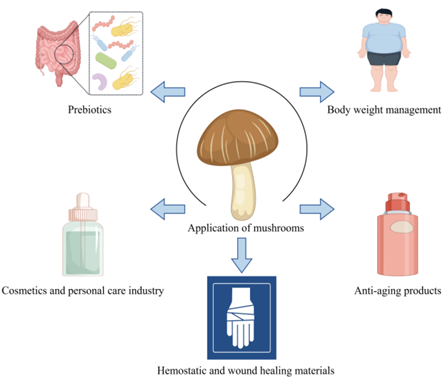
Nowadays, mushrooms demonstrate promising application in the pharmaceutical, functional foods, and nutraceuticalindustries. Figure 4 summarizes thebroad application of mushrooms in food, nutraceutical, and healthcare sectors.

Mushrooms and their derivatives can be developed as natural prebiotics due to their efficacy on regulation of intestinal microbiota. Within the domain of functional foods development, mushrooms are considered a high-quality source of prebiotic constituents, particularly due to their rich content of indigestible polysaccharides. These active constituents include chitin, hemicellulose, and complex carbohydrates such as α- and β-glucan, which have demonstrated prebiotic properties. Notably, polysaccharide fractions with prebiotic effects have been successfully extracted from L. edodes, P. ostreatus and A. bisporus. For example, in L. edodes, the chitin-dextran complex, unique to its cell wall, could maintain a high degree of stability and metabolic activity in the gastric acid environment and thereby effectively promoting the production of SCFAs, allowing it to be an ideal candidate for prebiotics 156. Furthermore, ABP and BAP have emerged as novel prebiotic candidates, with potential to achieve disease prevention and gut health maintenance through improving the abundance of beneficial microbes and optimizing the composition of the microbiota 142 157. These findings opened novel approaches for the development of mushroom-based functional foods targeting intestinal microbiota modulation.
4.2. Body Weight ManagementBesides prebiotics, mushrooms have promising application in body weight management due to their modulatory effect on metabolic disorders. From a nutritional perspective, mushrooms, characterized by high dietary fiber, low energy density, and substantial protein quality, have demonstrated to be an ideal food substitute to prolong the duration of satiety for individuals seeking to regulate energy intake. Clinical data has shown that long-term intake of mushrooms significantly improved metabolic indicators, such as body mass index, fasting blood glucose, and serum triglycerides, highlighting their beneficial role in body weight regulation of overweight individuals 158. The existing research evidence supported the unique value of mushrooms as a dietary intervention in preventing high-fat diets-induced obesity and dyslipidemia.
4.3. Anti-aging ProductsMushrooms, as a unique natural resource of bioactive compounds, offer considerable potential for the development of novel anti-aging products. Mushrooms are rich in antioxidants, which help combat aging-related symptoms by eliminating free radicals, thus reducing oxidative damage to cells and tissues. Besides, the fruiting bodies of medicinal mushrooms are rich in other anti-aging compounds that can promote cellular repair and regeneration by activating specific signaling pathways involved in tissue renewal, thereby delaying the aging process. These bioactive compounds included polysaccharides, polyphenols, terpenes, vitamins, and selenium 159. Therefore, the combined effect of the bioactive compounds in mushrooms could effectively delay the onset and progression of aging, highlighting mushrooms as promising candidates for anti-aging nutraceutical and pharmaceutical applications.
4.4. Cosmetics and Personal Care IndustryMushrooms are also gaining increasing attention in the cosmetics and personal care industry. They offer multifunctional skin benefits, including protection against environmental stressors, delay of the aging process, and enhancement of overall skin health and appearance. Mushroom extracts have been incorporated into a growing number of cosmeceutical formulations, many of which claim benefits such as reduction of fine lines and wrinkles, improvement in skin texture, photoprotection, and amelioration of pigmentation disorders. The fruiting bodies of medicinal mushrooms rich in diverse bioactive components have demonstrated antioxidant, skin-lightening, moisturizing, and anti-wrinkle effects 160. Notably, the water-soluble polysaccharide extracted from Auricularia auricula (AAP) has been used in the formulation of anti-aging creams and lotions, where it functioned by inhibiting enzymes associated with skin aging, promoting skin elasticity, and stimulating collagen synthesis 161. Furthermore, it was reported that mushroom extracts inhibited ultraviolet B irradiation-induced senescence in HaCaTcell, highlighting their potential for the development of photoprotective skincare products.
4.5. Hemostatic and Wound Healing MaterialMushrooms exhibit significant potential for development as hemostatic and wound healing material owing to the critical functions of their bioactive components, which act acrossmultiple dimensions of wound repair process. For instance, chitin exhibited both antimicrobial and wound healing properties. Additionally, LNT could accelerate wound healing by enhancing neovascularization, reducing inflammatory responses, and promoting infiltration of M2 macrophages, which was crucial for tissue remodeling and repair 162. Notably, carbonized cellulose aerogel derived fromA. bisporushas emerged as a novel hemostatic material for treating uncontrollable bleeding, owing to its excellent hemoglobin-binding capacity and platelet-activation property 163. Taken together, these mushroom-derived ingredients—rich in antimicrobial, anti-inflammatory, and immunomodulatory agents—represent a promising candidate for clinical wound healing application.
Although mushrooms have been widely used as important food and medicine for a long history, their full potential remains underexplored and underutilized in modern application. For instance, the antidepressant property of mushrooms has garnered great concern, yet the underlying mechanisms and their potential for development into edible or medicinal interventions for antidepressant property require further investigation. Future research should focus on comprehensive investigation of wild mushroom resources, aiming to identify novel edible and medicinal mushroom species with unique bioactive constituents. These insights will facilitate the formulation of mushroom-based functional food products and nutraceuticals to meet growing consumer demand for natural and healthy foods.
Mushrooms are widely recognized as high-quality food with substantial health-promoting properties. Existing literature indicated their significant role in enhancing nutritional status and supporting disease prevention due to a variety of nutrients and chemical components present in mushrooms. These bioactive constituents contributed to diverse health benefits, including immunomodulation, anticancer, anti-inflammation, antioxidant, antibacterial and antiviral, anti-fatigue, antidepressant, anti-diabetes mellitus, and anti-cardiovascular disease, allowing mushrooms to be promising candidates for development as functional foods and therapeutic agents. This article has reviewed the major active ingredients of mushrooms and their health benefits in disease prevention or treatment. Furthermore, the current application of mushrooms as natural prebiotics, body weight management, anti-aging drugs, cosmetics, and hemostatic and wound healing materialhas been summarized. Looking forward, mushrooms offer significant promise not only as functional foods but also as a rich source of lead compounds for drug discovery.
This work was supported by the National Natural Science Foundation of China (Grant No. 82304358). The authors acknowledge the use of ChatGPT (OpenAI) solely for English language editing and improvement of manuscript readability. All scientific content, interpretations, and conclusions were developed and verified by the authors.
| [1] | Rathore, H., Prasad, S., Kapri, M., Tiwari, A. and Sharma, S., "Medicinal importance of mushroom mycelium: Mechanisms and applications," Journal of Functional Foods, 56. 182-193. Mar. 2019. | ||
| In article | View Article | ||
| [2] | Sun, X., Shi, Y., Shi, D., Tu, Y. and Liu, L., "Biological activities of secondary metabolites from the edible-medicinal macrofungi," Journal of Fungi, 10 (2). 144. Feb. 2024. | ||
| In article | View Article PubMed | ||
| [3] | Sinha, S.K., Upadhyay, T.K. and Sharma, S.K., "Nutritional-medicinal profile and quality categorization of fresh white button mushroom," Biointerface Research in Applied Chemistry, 11 (2). 8669-8685. Feb. 2021. | ||
| In article | View Article | ||
| [4] | Park, H.-J., "Current uses of mushrooms in cancer treatment and their anticancer mechanisms," International Journal of Molecular Sciences, 23 (18). 10502. Sep. 2022. | ||
| In article | View Article PubMed | ||
| [5] | Patocka, J., Wu, R., Nepovimova, E., Valis, M., Wu, W. and Kuca, K., "Chemistry and toxicology of major bioactive substances in inocybe mushrooms," International Journal of Molecular Sciences, 22 (4). 2218. Feb. 2021. | ||
| In article | View Article PubMed | ||
| [6] | Bhagarathi, L.K., Subramanian, G. and DaSilva, P.N.B., "A review of mushroom cultivation and production, benefits and therapeutic potentials," World Journal of Biology Pharmacy and Health Sciences, 15 (2). 01-056. Aug. 2023. | ||
| In article | View Article | ||
| [7] | Dimopoulou, M., Kolonas, A., Mourtakos, S., Androutsos, O. and Gortzi, O., "Nutritional composition and biological properties of sixteen edible mushroom species," Applied Sciences, 12 (16). 8074. Aug. 2022. | ||
| In article | View Article | ||
| [8] | Boro, S., Kambhampati, V., Das, S. and Saikia, D., "Edible mushrooms as meat analogues: A comprehensive review of nutritional, therapeutic, and market potential," Food Research International, 214. 116632. Aug. 2025. | ||
| In article | View Article PubMed | ||
| [9] | Arunachalam, K., Sreeja, P.S. and Yang, X., "The antioxidant properties of mushroom polysaccharides can potentially mitigate oxidative stress, beta-cell dysfunction and insulin resistance," Frontiers in Pharmacology, 13. 874474. May. 2022. | ||
| In article | View Article PubMed | ||
| [10] | Wang, Y., Jia, J., Ren, X., Li, B. and Zhang, Q., "Extraction, preliminary characterization and in vitro antioxidant activity of polysaccharides from Oudemansiella radicata mushroom," International Journal of Biological Macromolecules, 120. 1760-1769. Oct. 2018. | ||
| In article | View Article PubMed | ||
| [11] | Yang, S., Yan, J., Yang, L., Meng, Y., Wang, N., He, C., Fan, Y. and Zhou, Y., "Alkali-soluble polysaccharides from mushroom fruiting bodies improve insulin resistance," International Journal of Biological Macromolecules, 126. 466-474. Apr. 2019. | ||
| In article | View Article PubMed | ||
| [12] | Mizuno, M. and Minato, K.-i., "Anti-inflammatory and immunomodulatory properties of polysaccharides in mushrooms," Current Opinion in Biotechnology, 86. 103076. Feb. 2024. | ||
| In article | View Article PubMed | ||
| [13] | Petraglia, T., Latronico, T., Fanigliulo, A., Crescenzi, A., Liuzzi, G.M. and Rossano, R., "Antioxidant activity of polysaccharides from the edible mushroom Pleurotus eryngii," Molecules, 28 (5). 2176. Feb. 2023. | ||
| In article | View Article PubMed | ||
| [14] | Sharma, A., Sharma, A. and Tripathi, A., "Biological activities of Pleurotus spp. polysaccharides: A review," Journal of Food Biochemistry, 45 (6). e13748. Jun. 2021. | ||
| In article | View Article | ||
| [15] | Tan, Y., Zeng, N.-K. and Xu, B., "Chemical profiles and health-promoting effects of porcini mushroom (Boletus edulis): A narrative review," Food Chemistry, 390. 133199. May. 2022. | ||
| In article | View Article PubMed | ||
| [16] | Zavadinack, M., Bellan, D.d.L., Bonaldi, M.P.F., Milhorini, S.d.S., Cordeiro, L.M.C., Simas, F.F. and Iacomini, M., "Polysaccharide fractions extracted from lactarius quieticolor mushroom exhibit immune stimulatory activities on macrophages," Food Research International, 197. 115205. Oct. 2024. | ||
| In article | View Article PubMed | ||
| [17] | Qu, Y., Yan, J., Zhang, X., Song, C., Zhang, M., Mayo, K.H., Sun, L., Cheng, H. and Zhou, Y., "Structure and antioxidant activity of six mushroom-derived heterogalactans," International Journal of Biological Macromolecules, 209. 1439-1449. Apr. 2022. | ||
| In article | View Article PubMed | ||
| [18] | Chugh, R.M., Mittal, P., Mp, N., Arora, T., Bhattacharya, T., Chopra, H., Cavalu, S. and Gautam, R.K., "Fungal mushrooms: A natural compound with therapeutic applications," Frontiers in Pharmacology, 13. 925387. Jul. 2022. | ||
| In article | View Article PubMed | ||
| [19] | Yadav, D. and Negi, P.S., "Bioactive components of mushrooms: Processing effects and health benefits," Food Research International, 148. 110599. Jul. 2021. | ||
| In article | View Article PubMed | ||
| [20] | He, M., Condict, L., Richardson, S.J., Brennan, C.S. and Kasapis, S., "Molecular characterization of interactions between lectin - a protein from common edible mushroom (Agaricus bisporus) - and dietary carbohydrates," Food Hydrocolloids, 146. 109253. Sep. 2024. | ||
| In article | View Article | ||
| [21] | El-Maradny, Y.A., El-Fakharany, E.M., Abu-Serie, M.M., Hashish, M.H. and Selim, H.S., "Lectins purified from medicinal and edible mushrooms: Insights into their antiviral activity against pathogenic viruses," International Journal of Biological Macromolecules, 179. 239-258. Mar. 2021. | ||
| In article | View Article PubMed | ||
| [22] | González, A., Cruz, M., Losoya, C., Nobre, C., Loredo, A., Rodríguez, R., Contreras, J. and Belmares, R., "Edible mushrooms as a novel protein source for functional foods," Food & Function, 11 (9). 7400-7414. Sep. 2020. | ||
| In article | View Article PubMed | ||
| [23] | Sande, D., Oliveira, G.P.d., Moura, M.A.F.e., Martins, B.d.A., Lima, M.T.N.S. and Takahashi, J.A., "Edible mushrooms as a ubiquitous source of essential fatty acids," Food Research International, 125. 108524. Jun. 2019. | ||
| In article | View Article PubMed | ||
| [24] | Silva Figueiredo, P., Carla Inada, A., Marcelino, G., Maiara Lopes Cardozo, C., De Cássia Freitas, K., De Cássia Avellaneda Guimarães, R., Pereira de Castro, A., Aragão do Nascimento, V. and Aiko Hiane, P., "Fatty acids consumption: The role metabolic aspects involved in obesity and its associated disorders," Nutrients, 9 (10). 1158. Oct. 2017. | ||
| In article | View Article PubMed | ||
| [25] | Tagkouli, D., Kaliora, A., Bekiaris, G., Koutrotsios, G., Christea, M., Zervakis, G.I. and Kalogeropoulos, N., "Free amino acids in three pleurotus species cultivated on agricultural and agro-Industrial by-products," Molecules, 25 (17). 4015. Sep. 2020. | ||
| In article | View Article PubMed | ||
| [26] | Cardwell, G., Bornman, J.F., James, A.P. and Black, L.J., "A review of mushrooms as a potential source of dietary Vitamin D," Nutrients, 10 (10). 1498. Oct. 2018. | ||
| In article | View Article PubMed | ||
| [27] | Zhou, Y.X., He, A.E. and Xu, B.J., "Natural resources, quantification, microbial bioconversion, and bioactivities of vitamin B for vegetarian diet," Food Chemistry, 463. 140849. Jan. 2025. | ||
| In article | View Article PubMed | ||
| [28] | Podkowa, A., Kryczyk-Poprawa, A., Opoka, W. and Muszyńska, B., "Culinary–medicinal mushrooms: A review of organic compounds and bioelements with antioxidant activity," European Food Research and Technology, 247 (3). 513-533. Nov. 2020. | ||
| In article | View Article | ||
| [29] | Krittanawong, C., Isath, A., Hahn, J., Wang, Z., Fogg, S.E., Bandyopadhyay, D., Jneid, H., Virani, S.S. and Tang, W.H.W., "Mushroom consumption and cardiovascular health: A systematic review," American Journal of Medicine, 134 (5). 637-642. May. 2021. | ||
| In article | View Article PubMed | ||
| [30] | Xu, M.M., Zhu, S., Li, Y.R., Xu, S., Shi, G.Y. and Ding, Z.Y., "Effect of selenium on mushroom growth and metabolism: A review," Trends in Food Science & Technology, 118. 328-340. Dec. 2021. | ||
| In article | View Article | ||
| [31] | Fogarasi, M., Nemes, S.A., Farcas, A., Socaciu, C., Semeniuc, C.A., Socaciu, M.I. and Socaci, S., "Bioactive secondary metabolites in mushrooms: A focus on polyphenols, their health benefits and applications," Food Bioscience, 62. 105166. Dec. 2024. | ||
| In article | View Article | ||
| [32] | Sezgin, S., Dalar, A. and Uzun, Y., "Determination of antioxidant activities and chemical composition of sequential fractions of five edible mushrooms from Turkey," Journal of Food Science and Technology-Mysore, 57 (5). 1866-1876. May. 2020. | ||
| In article | View Article PubMed | ||
| [33] | Calleja-Gómez, M., Roig, P., Rimac Brnčić, S., Barba, F.J. and Castagnini, J.M., "Scanning electron microscopy and triple TOF-LC-MS-MS analysis of polyphenols from PEF-treated edible mushrooms (L. edodes, A. brunnescens, and P. ostreatus)," Antioxidants, 12 (12). 2080. Dec. 2023. | ||
| In article | View Article PubMed | ||
| [34] | Ma, S., Zhang, H. and Xu, J., "Characterization, antioxidant and anti-inflammation capacities of fermented Flammulina velutipes polyphenols," Molecules, 26 (20). 6205. Oct. 2021. | ||
| In article | View Article PubMed | ||
| [35] | Bertéli, M.B.D., Oliveira Filho, O.B.Q., Freitas, J.D.S., Bortolucci, W.C., Silva, G.R., Gazim, Z.C., Lívero, F.A.R., Lovato, E.C.W., Valle, J.S., Linde, G.A., Barros, L., Reis, F.S., Ferreira, I.C.F.R., Paccola-Meirelles, L.D. and Colauto, N.B., "Lentinus crinitus basidiocarp stipe and pileus: Chemical composition, cytotoxicity and antioxidant activity," European Food Research and Technology, 247 (6). 1355-1366. Mar. 2021. | ||
| In article | View Article | ||
| [36] | Stojković, D.S., Kovačević-Grujičić, N., Reis, F.S., Davidović, S., Barros, L., Popović, J., Petrović, I., Pavić, A., Glamočlija, J., Ćirić, A., Stevanović, M., Ferreira, I.C.F.R. and Soković, M., "Chemical composition of the mushroom Meripilus giganteus karst. and bioactive properties of its methanolic extract," LWT - Food Science and Technology, 79. 454-462. Jan. 2017. | ||
| In article | View Article | ||
| [37] | Liaotrakoon, W. and Liaotrakoon, V., "Amino acid profile, phytochemical composition and antimicrobial activities of edible tropical bolete mushroom (Phlebopus colossus (R. Heim) Singer)," Journal of Food Measurement and Characterization, 16 (3). 1967-1973. Oct. 2022. | ||
| In article | View Article | ||
| [38] | Mocan, A., Fernandes, Â., Barros, L., Crişan, G., Smiljković, M., Soković, M. and Ferreira, I.C.F.R., "Chemical composition and bioactive properties of the wild mushroom polyporus squamosus (Huds.) Fr: A study with samples from Romania," Food & Function, 9 (1). 160-170. Nov. 2018. | ||
| In article | View Article PubMed | ||
| [39] | Somanjana, K. and Krishnendu, A., "Investigation on a novel mushroom, russula pseudocyanoxantha: Chemical composition and antioxidant potency," Research Journal of Biotechnology, 17 (6). 158-164. Jun. 2022. | ||
| In article | View Article | ||
| [40] | Taofiq, O., Calhelha, R.C., Heleno, S., Barros, L., Martins, A., Santos-Buelga, C., Queiroz, M.J.R.P. and Ferreira, I.C.F.R., "The contribution of phenolic acids to the anti-inflammatory activity of mushrooms: Screening in phenolic extracts, individual parent molecules and synthesized glucuronated and methylated derivatives," Food Research International, 76. 821-827. Aug. 2015. | ||
| In article | View Article PubMed | ||
| [41] | Lee, J.-S., Maarisit, W., Abdjul, D.B., Yamazaki, H., Takahashi, O., Kirikoshi, R., Kanno, S.-i. and Namikoshi, M., "Structures and biological activities of triterpenes and sesquiterpenes obtained from Russula lepida," Phytochemistry, 127. 63-68. Apr. 2016. | ||
| In article | View Article PubMed | ||
| [42] | Wang, J., Beghelli, D., Amici, A., Sut, S., Dall’Acqua, S., Lupidi, G., Dal Ben, D., Bistoni, O., Tomassoni, D., Belletti, B., Musa, S., Mahajna, J., Pucciarelli, S. and Marchini, C., "Chaga mushroom triterpenoids inhibit dihydrofolate reductase and act synergistically with conventional therapies in breast cancer," Biomolecules, 14 (11). 1454. Nov. 2024. | ||
| In article | View Article PubMed | ||
| [43] | Sofrenic, I., Andelkovic, B., Todorovic, N., Stanojkovic, T., Vujisic, L., Novakovic, M., Milosavljevic, S. and Tesevic, V., "Cytotoxic triterpenoids and triterpene sugar esters from the medicinal mushroom Fomitopsis betulina," Phytochemistry, 181. 112580. Jan. 2021. | ||
| In article | View Article PubMed | ||
| [44] | Zhou, L., Chen, H.P., Li, X.Y. and Liu, J.K., "Ganoaustralins A and B, unusual aromatic triterpenes from the mushroom Ganoderma australe," Pharmaceuticals, 15 (12). 1520. Dec. 2022. | ||
| In article | View Article PubMed | ||
| [45] | Sun, Z.C., Zhu, N.L., Zhou, M., Huo, X.W., Wu, H.F., Tian, Y., Yang, J.S., Ma, G.X., Yang, Y.L. and Xu, X.D., "Clavipines A-C, antiproliferative meroterpenoids with a fused azepine skeleton from the basidiomycete Clitocybe clavipes," Organic Chemistry Frontiers, 6 (22). 3759-3765. Nov. 2019. | ||
| In article | View Article | ||
| [46] | Wu, H., Yang, H.-X., Li, Z.-H., Feng, T. and Liu, J.-K., "Psathyrellins A–E, Antibacterial Guanacastane Diterpenoids from Mushroom Psathyrella candolleana," Natural Products and Bioprospecting, 11 (4). 447-452. Jul. 2021. | ||
| In article | View Article PubMed | ||
| [47] | El-Ramady, H., Abdalla, N., Badgar, K., Llanaj, X., Töros, G., Hajdú, P., Eid, Y. and Prokisch, J., "Edible mushrooms for sustainable and healthy human food: Nutritional and medicinal attributes," Sustainability, 14 (9). 4941. May. 2022. | ||
| In article | View Article | ||
| [48] | Papoutsis, K., Grasso, S., Menon, A., Brunton, N.P., Lyng, J.G., Jacquier, J.C. and Bhuyan, D.J., "Recovery of ergosterol and vitamin D2 from mushroom waste - Potential valorization by food and pharmaceutical industries," Trends in Food Science & Technology, 99. 351-366. May. 2020. | ||
| In article | View Article | ||
| [49] | Choy, H.L., Gaylord, E.A. and Doering, T.L., "Ergosterol distribution controls surface structure formation and fungal pathogenicity," Mbio, 16 (2). 17. Feb. 2025. | ||
| In article | View Article PubMed | ||
| [50] | Nowak, R., Nowacka-Jechalke, N., Pietrzak, W. and Gawlik-Dziki, U., "A new look at edible and medicinal mushrooms as a source of ergosterol and ergosterol peroxide-UHPLC-MS/MS analysis," Food Chemistry, 369. 130927. Feb. 2022. | ||
| In article | View Article PubMed | ||
| [51] | Rangsinth, P., Sharika, R., Pattarachotanant, N., Duangjan, C., Wongwan, C., Sillapachaiyaporn, C., Nilkhet, S., Wongsirojkul, N., Prasansuklab, A., Tencomnao, T., Leung, G.P.-H. and Chuchawankul, S., "Potential beneficial effects and pharmacological properties of ergosterol, a common bioactive compound in edible mushrooms," Foods, 12 (13). 2529. Jun. 2023. | ||
| In article | View Article PubMed | ||
| [52] | Zorrilla, J.G. and Evidente, A., "Structures and biological activities of alkaloids produced by mushrooms, a fungal subgroup," Biomolecules, 12 (8). 1025. Aug. 2022. | ||
| In article | View Article PubMed | ||
| [53] | Kessing, R., "Psilocybin for severe treatment-resistant depression," Fortschritte Der Neurologie Psychiatrie, 93 (07/08). 262-263. Jul. 2025. | ||
| In article | View Article | ||
| [54] | Felegyi, K., Garádi, Z., Rácz, B., Tóth, G., Papp, V., Boldizsár, I., Dancsó, A., Spengler, G., Béni, S. and Ványolós, A., "Polyporenic Acids from the Mushroom Possess Chemosensitizing and Efflux Pump Inhibitory Activities on Colo 320 Adenocarcinoma Cells," Journal of Fungi, 9 (9). Sep. 2023. | ||
| In article | View Article PubMed | ||
| [55] | Lee, B.S., Ryoo, R., Park, J.S., Choi, S.U., Jeong, S.Y., Ko, Y.J., Kim, J.K., Kim, J.C. and Kim, K.H., "Meyeroguilline E, a New Isoindolinone Alkaloid from the Poisonous Mushroom, and Identification of Compounds with Multidrug Resistance (MDR) Reversal Activities," Acs Omega, 7 (43). 39456-39462. Nov. 2022. | ||
| In article | View Article PubMed | ||
| [56] | Cabutaje, E.M., Ueno, K., dela Cruz, T.E.E. and Ishihara, A., "Suppression of anthracnose disease by orsellinaldehyde isolated from the mushroom Coprinus comatus," Journal of Applied Microbiology, 135 (6). Jun. 2024. | ||
| In article | View Article PubMed | ||
| [57] | Cabutaje, E.M., Seki, K., Kodama, M., Arie, T., Ueno, K., dela Cruz, T.E.E. and Ishihara, A., "Coprinolide, a novel antifungal tricyclic polyketide with a rare furanone-fused chromene skeleton isolated from the mushroom Coprinus comatus," Journal of Pesticide Science, 49 (4). 243-254. Nov. 2024. | ||
| In article | View Article PubMed | ||
| [58] | Lv, J.H., Yang, X.M., Xiong, M.M., Yao, L., Wang, L.A., Li, Z. and Zhang, J.X., "Clypeasterol, a novel aromatic ergosterol skeleton from the mushroom," Natural Product Research. Jun. 2024. | ||
| In article | |||
| [59] | Wei, J., Li, J.Y., Feng, X.L., Zhang, Y.L., Hu, X.S., Hui, H.P., Xue, X.D. and Qi, J.Z., "Unprecedented Neoverrucosane and Cyathane Diterpenoids with Anti-Neuroinflammatory Activity from Cultures of the Culinary-Medicinal Mushroom," Molecules, 28 (17). Sep. 2023. | ||
| In article | View Article PubMed | ||
| [60] | Huong, L.M., Nghi, D.H., Luyen, N.D., Quynh, D.T., Huong, P.T.T., Tai, B.H. and Kiem, P.V., "Hericium VN, an undescribed compound isolated from and its cytotoxic activity on human brain astrocytoma," Journal of Asian Natural Products Research, 26 (7). 850-857. Jul. 2024. | ||
| In article | View Article PubMed | ||
| [61] | Wang, Y.T., Tan, H.Y., Zhao, X., Yang, Y., Xu, R., Zhu, S.M., Ma, H., Luo, F.Y., Dong, C.H. and Li, C.W., "Sesquiterpenoid derivatives isolated from a liquid culture of Hypholoma capnoides 819," Phytochemistry, 219. Mar. 2024. | ||
| In article | View Article PubMed | ||
| [62] | Oliveira, M.D.A., Andrade, T.D.A.D., Joaquim, S.J.r., Lima, N.M., Machado, H.G., Tabudravu, J.N., Pinto, F.D.L., Fukui-Silva, L., Amaro, M.C., de Moraes, J., Silva, D.H.S., Citó, A.M.D.L. and Feitosa, C.M., "Anthelmintic Potential of Conjugated Long-Chain Fatty Acids Isolated from the Bioluminescent Mushroom," Journal of Natural Products, 88 (2). 255-261. Jan. 2025. | ||
| In article | View Article PubMed | ||
| [63] | Lee, S., Kim, T.W., Lee, Y.H., Kang, D.M., Ryoo, R., Ko, Y.J., Ahn, M.J. and Kim, K.H., "Two New Fatty Acid Derivatives, Omphalotols A and B and Anti-Fatty Acid Derivatives from Poisonous Mushroom," Pharmaceuticals, 15 (2). Feb. 2022. | ||
| In article | View Article PubMed | ||
| [64] | Cabutaje, E.M., Ueno, K., Osaki-Oka, K., Kido, K., dela Cruz, T.E.E. and Ishihara, A., "Identification of two phthalide derivatives and an oxindole compound isolated from the edible mushroom and their inhibitory activities against plant pathogenic microorganisms," Journal of Pesticide Science, 48 (4). 156-167. Nov. 2023. | ||
| In article | View Article PubMed | ||
| [65] | De Padua, J.C., Kikuchi, T., Sakakibara, F., De Leon, A.M., Bungihan, M.E., Ueno, K., dela Cruz, T.E.E. and Ishihara, A., "Novel compound, pleuropyronine, and other polyketides isolated from the edible mushroom suppress bacterial biofilm formation," Bioscience Biotechnology and Biochemistry, 89 (1). 11-21. Nov. 2024. | ||
| In article | View Article PubMed | ||
| [66] | Yao, L., Lv, J.H., Pan, M.C., Xing, L., Wang, L.P., Li, C.T., Liu, S.Y. and Li, Y., "Two new compounds from edible mushroom," Natural Product Research, 37 (9). 1491-1497. May. 2023. | ||
| In article | View Article PubMed | ||
| [67] | Shi, C., Peng, Y.L., He, J., Li, Z.H., Liu, J.K. and Feng, T., "Structures, Chemical Conversions, and Cytotoxicity of Tricholopardins C and D, Two Triterpenoids from the Wild Mushroom," Natural Products and Bioprospecting, 11 (2). 235-241. Apr. 2021. | ||
| In article | View Article PubMed | ||
| [68] | Jeitler, M., Michalsen, A., Frings, D., Hübner, M., Fischer, M., Koppold-Liebscher, D.A., Murthy, V. and Kessler, C.S., "Significance of medicinal mushrooms in integrative oncology: A narrative review," Frontiers in Pharmacology, 11. 580656. Nov. 2020. | ||
| In article | View Article PubMed | ||
| [69] | Habtemariam, S., "Trametes versicolor (Synn. Coriolus versicolor) polysaccharides in cancer therapy: Targets and efficacy," Biomedicines, 8 (5). 135. May. 2020. | ||
| In article | View Article PubMed | ||
| [70] | Zhang, Y., Liu, F. and Ng, T.B., "Interrelationship among paraptosis, apoptosis and autophagy in lung cancer A549 cells induced by BEAP, an antitumor protein isolated from the edible porcini mushroom Boletus edulis," International Journal of Biological Macromolecules, 188. 313-322. Jul. 2021. | ||
| In article | View Article PubMed | ||
| [71] | Liu, M.-H., Liu, F., Ng, T.B. and Liu, Z.-K., "Purification and characterization of pleuroferin, a novel protein with in vitro anti-non-small cell lung cancer activity from the mushroom Pleurotus ferulae lanzi," Process Biochemistry, 122. 16-25. Sep. 2022. | ||
| In article | View Article | ||
| [72] | Roda, E., De Luca, F., Di Iorio, C., Ratto, D., Siciliani, S., Ferrari, B., Cobelli, F., Borsci, G., Priori, E.C., Chinosi, S., Ronchi, A., Franco, R., Di Francia, R., Berretta, M., Locatelli, C.A., Gregori, A., Savino, E., Bottone, M.G. and Rossi, P., "Novel medicinal mushroom blend as a promising supplement in integrative oncology: A multi-tiered study using 4T1 triple-negative mouse breast cancer model," International Journal of Molecular Sciences, 21 (10). 3479. May. 2020. | ||
| In article | View Article PubMed | ||
| [73] | De Luca, F., Roda, E., Ratto, D., Desiderio, A., Venuti, M.T., Ramieri, M., Bottone, M.G., Savino, E. and Rossi, P., "Fighting secondary triple-negative breast cancer in cerebellum: A powerful aid from a medicinal mushrooms blend," Biomedicine & Pharmacotherapy, 159. 114262. Jan. 2023. | ||
| In article | View Article PubMed | ||
| [74] | Rutckeviski, R., Corso, C.R., Román-Ochoa, Y., Cipriani, T.R., Centa, A. and Smiderle, F.R., "Agaricus bisporus β-(1 → 6)-d-glucan induces M1 phenotype on macrophages and increases sensitivity to doxorubicin of triple negative breast cancer cells," Carbohydrate Polymers, 278. Sep. 2022. | ||
| In article | View Article PubMed | ||
| [75] | Latif, A., Issa Khan, M., Rakha, A. and Ali Khan, J., "Evaluating the therapeutic potential of white button mushroom (Agaricus bisporus) against DMBA‐induced breast cancer in Sprague Dawley rats," Journal of Food Biochemistry, 45 (12). e13979. Oct. 2021. | ||
| In article | View Article PubMed | ||
| [76] | Acay, H. and Baran, M., "Fatty acid compositions of total lipid, phospholipid and triacylglycerol fractions of the wild edible mushroom pleurotus ostreatus and russula delica with cytotoxic activities on prostate carcinoma cell lines," Medicine Science, 8 (3). 736-740. Jul. 2019. | ||
| In article | View Article | ||
| [77] | Wang, X., Ha, D., Mori, H. and Chen, S., "White button mushroom (Agaricus bisporus) disrupts androgen receptor signaling in human prostate cancer cells and patient-derived xenograft," The Journal of Nutritional Biochemistry, 89. 108580. Dec. 2021. | ||
| In article | View Article PubMed | ||
| [78] | Xu, Y., Ma, J., Zheng, Q., Wang, Y., Hu, M., Ma, F., Qin, Z., Lei, N. and Tao, N., "MPSSS impairs the immunosuppressive function of cancer-associated fibroblasts via the TLR4-NF-κB pathway," Bioscience Reports, 39 (5). BSR20182171. Apr. 2019. | ||
| In article | View Article PubMed | ||
| [79] | Yao, C.-J., Chang, C.-L., Hu, M.-H., Liao, C.-H., Lai, G.-M., Chiou, T.-J., Ho, H.-L., Kuo, H.-C., Yang, Y.-Y., Whang-Peng, J. and Chuang, S.-E., "Drastic synergy of lovastatin and antrodia camphorata extract combination against PC3 androgen-refractory prostate cancer cells, accompanied by AXL and stemness molecules inhibition," Nutrients, 15 (21). 4493. Oct. 2023. | ||
| In article | View Article PubMed | ||
| [80] | Nowakowski, P., Markiewicz-Żukowska, R., Gromkowska-Kępka, K., Naliwajko, S.K., Moskwa, J., Bielecka, J., Grabia, M., Borawska, M. and Socha, K., "Mushrooms as potential therapeutic agents in the treatment of cancer: Evaluation of anti-glioma effects of Coprinus comatus, Cantharellus cibarius, Lycoperdon perlatum and Lactarius deliciosus extracts," Biomedicine & Pharmacotherapy, 133. 111090. Dec. 2021. | ||
| In article | View Article PubMed | ||
| [81] | Trivedi, S. and Belgamwar, V., "Fabrication and optimization of chitosan-g-m-PEG-NH2 copolymer for advanced glioblastoma therapy using surface engineered lentinan loaded nanovesicles for nasal delivery," International Journal of Biological Macromolecules, 273. 133125. Jun. 2024. | ||
| In article | View Article PubMed | ||
| [82] | Liu, N., Zou, S., Xie, C., Meng, Y. and Xu, X., "Effect of the β-glucan from Lentinus edodes on colitis-associated colorectal cancer and gut microbiota," Carbohydrate Polymers, 316. 121069. May. 2023. | ||
| In article | View Article PubMed | ||
| [83] | Park, G.S., Shin, J., Hong, S., Gopal, J. and Oh, J.W., "Anticarcinogenic potential of the mushroom polysaccharide lentinan on gastric and colon cancer cells: Antiproliferative, antitumorigenic, Mu-2-related death-inducing gene, MUDENG ramifications," Journal of Industrial and Engineering Chemistry, 135. 122-130. Jul. 2024. | ||
| In article | View Article | ||
| [84] | Dan, A., Swain, R., Belonce, S. and Jacobs, R.J., "Therapeutic effects of medicinal mushrooms on gastric, breast, and colorectal cancer: A scoping review," Cureus. 37574. Apr. 2023. | ||
| In article | View Article | ||
| [85] | Chen, H., Li, L.Y., Lu, Y.P., Shen, Y.J., Zhang, M., Ge, L.H., Wang, M., Yang, J., Tian, Z.C. and Tang, X.F., "Azoxystrobin reduces oral carcinogenesis by suppressing mitochondrial complex III activity and inducing apoptosis," Cancer Management and Research, 12. 11573-11583. Nov. 2020. | ||
| In article | View Article PubMed | ||
| [86] | Elhusseiny, S.M., El-Mahdy, T.S., Awad, M.F., Elleboudy, N.S., Farag, M.M.S., Aboshanab, K.M. and Yassien, M.A., "Antiviral, cytotoxic, and antioxidant activities of three edible agaricomycetes mushrooms: Pleurotus columbinus, Pleurotus sajor-caju, and Agaricus bisporus," Journal of Fungi, 7 (8). 645. Aug. 2021. | ||
| In article | View Article PubMed | ||
| [87] | Li, Y., You, L., Dong, F., Yao, W. and Chen, J., "Structural characterization, antiproliferative and immunoregulatory activities of a polysaccharide from Boletus Leccinum rugosiceps," International Journal of Biological Macromolecules, 157. 106-118. Apr. 2020. | ||
| In article | View Article PubMed | ||
| [88] | Gilardoni, G., Negri, F., Finzi, P.V., Hussain, F.H.S. and Vidari, G., "New tricholidic acid triterpenoids from the mushroom Tricholoma ustaloides collected in an italian beech wood," Molecules, 28 (9). 3864. May. 2023. | ||
| In article | View Article PubMed | ||
| [89] | Cheung, M.K., Yue, G.G.L., Chiu, P.W.Y. and Lau, C.B.S., "A review of the effects of natural compounds, medicinal plants, and mushrooms on the gut microbiota in colitis and cancer," Frontiers in Pharmacology, 11. 744. May. 2020. | ||
| In article | View Article PubMed | ||
| [90] | Panda, S.K., Sahoo, G., Swain, S.S. and Luyten, W., "Anticancer activities of mushrooms: A neglected source for drug discovery," Pharmaceuticals, 15 (2). 176. Jan. 2022. | ||
| In article | View Article PubMed | ||
| [91] | Minato, K.-i., Laan, L.C., van Die, I. and Mizuno, M., "Pleurotus citrinopileatus polysaccharide stimulates anti-inflammatory properties during monocyte-to-macrophage differentiation," International Journal of Biological Macromolecules, 122. 705-712. Oct. 2019. | ||
| In article | View Article PubMed | ||
| [92] | Vlassopoulou, M., Yannakoulia, M., Pletsa, V., Zervakis, G.I. and Kyriacou, A., "Effects of fungal beta-glucans on health – a systematic review of randomized controlled trials," Food & Function, 12 (8). 3366-3380. Feb. 2021. | ||
| In article | View Article PubMed | ||
| [93] | Ellefsen, C.F., Lindstad, L., Klau, L.J., Aachmann, F.L., Hiorth, M. and Samuelsen, A.B.C., "Investigation of the structural and immunomodulatory properties of alkali-soluble β-glucans from Pleurotus eryngii fruiting bodies," Carbohydrate Polymers, 322. 121367. Sep. 2023. | ||
| In article | View Article PubMed | ||
| [94] | Wang, X., Qu, Y., Wang, Y., Wang, X., Xu, J., Zhao, H., Zheng, D., Sun, L., Tai, G., Zhou, Y. and Cheng, H., "β-1,6-Glucan from Pleurotus eryngii modulates the immunity and gut microbiota," Frontiers in Immunology, 13. 859923. May. 2022. | ||
| In article | View Article PubMed | ||
| [95] | Murphy, E.J., Rezoagli, E., Pogue, R., Simonassi-Paiva, B., Abidin, I.I.Z., Fehrenbach, G.W., O'Neil, E., Major, I., Laffey, J.G. and Rowan, N., "Immunomodulatory activity of β-glucan polysaccharides isolated from different species of mushroom – A potential treatment for inflammatory lung conditions," Science of The Total Environment, 809. 152177. Dec. 2022. | ||
| In article | View Article PubMed | ||
| [96] | Perduca, M., Destefanis, L., Bovi, M., Galliano, M., Munari, F., Assfalg, M., Ferrari, F., Monaco, H.L. and Capaldi, S., "Structure and properties of the oyster mushroom (Pleurotus ostreatus) lectin," Glycobiology, 30 (8). 550-562. Aug. 2020. | ||
| In article | View Article PubMed | ||
| [97] | Blagodatski, A., Yatsunskaya, M., Mikhailova, V., Tiasto, V., Kagansky, A. and Katanaev, V.L., "Medicinal mushrooms as an attractive new source of natural compounds for future cancer therapy," Oncotarget. 29259-29274. Jun. 2018. | ||
| In article | View Article PubMed | ||
| [98] | Yue, G.G.-L., Lau, C.B.-S. and Leung, P.-C., "Medicinal plants and mushrooms with immunomodulatory and anticancer properties—A review on Hong Kong’s experience," Molecules, 26 (8). 2173. Apr. 2021. | ||
| In article | View Article PubMed | ||
| [99] | Zhang, Y., Xun, H., Gao, Q., Qi, F., Sun, J. and Tang, F., "Chemical constituents of the mushroom Dictyophora indusiata and their anti-inflammatory activities," Molecules, 28 (6). 2760. Mar. 2023. | ||
| In article | View Article PubMed | ||
| [100] | Zhang, Y., Ma, A.J., Xi, H., Chen, N., Wang, R., Yang, C.H., Chen, J.B., Lv, P., Zheng, F.P. and Kang, W.Y., "Antrodia cinnamomea ameliorates neointimal formation by inhibiting inflammatory cell infiltration through downregulation of adhesion molecule expression in vitro and in vivo," Food Science and Human Wellness, 10 (4). 421-430. Jul. 2021. | ||
| In article | View Article | ||
| [101] | Stastny, J., Marsik, P., Tauchen, J., Bozik, M., Mascellani, A., Havlik, J., Landa, P., Jablonsky, I., Treml, J., Herczogova, P., Bleha, R., Synytsya, A. and Kloucek, P., "Antioxidant and anti-Inflammatory activity of five medicinal mushrooms of the genus pleurotus," Antioxidants, 11 (8). 1569. Aug. 2022. | ||
| In article | View Article PubMed | ||
| [102] | Muñoz-Castiblanco, T., Mejía-Giraldo, J.C. and Puertas-Mejía, M.Á., "Lentinula edodes, a novel source of polysaccharides with antioxidant power," Antioxidants, 11 (9). 1770. Sep. 2022. | ||
| In article | View Article PubMed | ||
| [103] | Meng, M., Huo, R., Wang, Y., Ma, N., Shi, X., Shen, X. and Chang, G., "Lentinan inhibits oxidative stress and alleviates LPS-induced inflammation and apoptosis of BMECs by activating the Nrf2 signaling pathway," International Journal of Biological Macromolecules, 222. 2375-2391. Oct. 2022. | ||
| In article | View Article PubMed | ||
| [104] | Ayar-Sümer, E.N., Verheust, Y., Özçelik, B. and Raes, K., "Impact of lactic acid bacteria fermentation based on biotransformation of phenolic compounds and antioxidant capacity of mushrooms," Foods, 13 (11). 1616. May. 2024. | ||
| In article | View Article PubMed | ||
| [105] | Krüzselyi, D., Móricz, Á.M. and Vetter, J., "Comparison of different morphological mushroom parts based on the antioxidant activity," Lwt, 127. 109436. Apr. 2020. | ||
| In article | View Article | ||
| [106] | Bertéli, M.B.D., Barros, L., Reis, F.S., Ferreira, I.C.F.R., Glamočlija, J., Soković, M., Valle, J.S.d., Linde, G.A., Ruiz, S.P. and Colauto, N.B., "Antimicrobial activity, chemical composition and cytotoxicity of Lentinus crinitus basidiocarp," Food & Function, 12 (15). 6780-6792. May. 2021. | ||
| In article | View Article PubMed | ||
| [107] | Angelini, P., Venanzoni, R., Angeles Flores, G., Tirillini, B., Orlando, G., Recinella, L., Chiavaroli, A., Brunetti, L., Leone, S., Di Simone, S.C., Ciferri, M.C., Zengin, G., Ak, G., Menghini, L. and Ferrante, C., "Evaluation of antioxidant, antimicrobial and tyrosinase inhibitory activities of extracts from Tricholosporum goniospermum, an edible wild mushroom," Antibiotics, 9 (8). 513. Aug. 2020. | ||
| In article | View Article PubMed | ||
| [108] | Chun, S., Gopal, J. and Muthu, M., "Antioxidant activity of mushroom extracts/polysaccharides—Their antiviral properties and plausible antiCOVID-19 properties," Antioxidants, 10 (12). 1899. Nov. 2021. | ||
| In article | View Article PubMed | ||
| [109] | Ren, G., Xu, L., Zhao, J., Shao, Y., Chen, X., Lu, T. and Zhang, Q., "Supplementation of dietary crude lentinan improves the intestinal microbiota and immune barrier in rainbow trout (Oncorhynchus mykiss) infected by infectious hematopoietic necrosis virus," Frontiers in Immunology, 13. 920065. Jun. 2022. | ||
| In article | View Article PubMed | ||
| [110] | Wang, X., Ha, D., Yoshitake, R. and Chen, S., "White button mushroom interrupts tissue AR-mediated TMPRSS2 expression and attenuates pro-inflammatory cytokines in C57BL/6 mice," npj Science of Food, 5 (1). 20. Aug. 2021. | ||
| In article | View Article PubMed | ||
| [111] | Badshah, S.L., Faisal, S., Muhammad, A., Poulson, B.G., Emwas, A.H. and Jaremko, M., "Antiviral activities of flavonoids," Biomedicine & Pharmacotherapy, 140. 111596. Jan. 2021. | ||
| In article | View Article PubMed | ||
| [112] | Zhang, Y., Wang, D., Chen, Y., Liu, T., Zhang, S., Fan, H., Liu, H. and Li, Y., "Healthy function and high valued utilization of edible fungi," Food Science and Human Wellness, 10 (4). 408-420. May. 2021. | ||
| In article | View Article | ||
| [113] | Geng, P., Siu, K.-C., Wang, Z. and Wu, J.-Y., "Antifatigue functions and mechanisms of edible and medicinal mushrooms," BioMed Research International, 2017. 1-16. May. 2017. | ||
| In article | View Article PubMed | ||
| [114] | Zheng, P.Y., Dai, W.Z., Lin, X.H., Lin, S.L., Zhang, Y. and Hu, J.M., "Blending polysaccharides from three edible mushrooms represents a promising approach for augmenting their anti-oxidant and anti-fatigue activities," International Journal of Biological Macromolecules, 298. 140020. Apr. 2025. | ||
| In article | View Article PubMed | ||
| [115] | Lazur, J., Hnatyk, K., Kała, K., Sułkowska-Ziaja, K. and Muszyńska, B., "Discovering the potential mechanisms of medicinal mushrooms antidepressant activity: A review," Antioxidants, 12 (3). 623. Mar. 2023. | ||
| In article | View Article PubMed | ||
| [116] | Hudspeth, J., Rogge, K., Dörner, S., Müll, M., Hoffmeister, D., Rupp, B. and Werten, S., "Methyl transfer in psilocybin biosynthesis," Nature Communications, 15 (1). 2709. Mar. 2024. | ||
| In article | View Article PubMed | ||
| [117] | Rakoczy, R.J., Runge, G.N., Sen, A.K., Sandoval, O., Wells, H.G., Nguyen, Q., Roberts, B.R., Sciortino, J.H., Gibbons, W.J., Friedberg, L.M., Jones, J.A. and McMurray, M.S., "Pharmacological and behavioural effects of tryptamines present in psilocybin‐containing mushrooms," British Journal of Pharmacology, 181 (19). 3627-3641. May. 2024. | ||
| In article | View Article PubMed | ||
| [118] | Chong, P.S., Poon, C.H., Roy, J., Tsui, K.C., Lew, S.Y., Phang, M.W.L., Tan, R.J.Y., Cheng, P.G., Fung, M.-L., Wong, K.H. and Lim, L.W., "Neurogenesis-dependent antidepressant-like activity of Hericium erinaceus in an animal model of depression," Chinese Medicine, 16 (1). 132. Dec. 2021. | ||
| In article | View Article PubMed | ||
| [119] | Yu, X.-D., Zhang, D., Xiao, C.-L., Zhou, Y., Li, X., Wang, L., He, Z., Reilly, J., Xiao, Z.-Y. and Shu, X., "P-Coumaric acid reverses depression-like behavior and memory deficit via inhibiting AGE-RAGE-Mediated neuroinflammation," Cells, 11 (10). 1594. May. 2022. | ||
| In article | View Article PubMed | ||
| [120] | Khursheed, R., Singh, S.K., Wadhwa, S., Gulati, M. and Awasthi, A., "Therapeutic potential of mushrooms in diabetes mellitus: Role of polysaccharides," International Journal of Biological Macromolecules, 164. 1194-1205. Jul. 2020. | ||
| In article | View Article PubMed | ||
| [121] | Hamza, A., Mylarapu, A., Krishna, K.V. and Kumar, D.S., "An insight into the nutritional and medicinal value of edible mushrooms: A natural treasury for human health," Journal of Biotechnology, 381. 86-99. Feb. 2024. | ||
| In article | View Article PubMed | ||
| [122] | See Toh, C.J.Y., Bi, X., Lee, H.W., Yeo, M.T.Y. and Henry, C.J., "Is mushroom polysaccharide extract a better fat replacer than dried mushroom powder for food applications?," Frontiers in Nutrition, 10. 1111955. Feb. 2023. | ||
| In article | View Article PubMed | ||
| [123] | Tiwari, A., Singh, G., Singh, U., Sapra, L., Rana, V., Sharma, V., Srivastava, R.K. and Sharma, S., "Edible mushrooms: The potential game changer in alleviating vitamin D deficiency and improving human health," International Journal of Food Science and Technology, 57 (3). 1367-1377. Mar. 2022. | ||
| In article | View Article | ||
| [124] | Zhang, B.R., Li, Y.Y., Zhang, F.M., Linhardt, R.J., Zeng, G.Y. and Zhang, A.Q., "Extraction, structure and bioactivities of the polysaccharides from Pleurotus eryngii: A review," International Journal of Biological Macromolecules, 150. 1342-1347. May. 2020. | ||
| In article | View Article PubMed | ||
| [125] | Gao, Z., Kong, D., Cai, W., Zhang, J. and Jia, L., "Characterization and anti-diabetic nephropathic ability of mycelium polysaccharides from coprinus comatus," Carbohydrate Polymers, 251. 117081. Sep. 2021. | ||
| In article | View Article PubMed | ||
| [126] | Rauf, A., Joshi, P.B., Ahmad, Z., Hemeg, H.A., Olatunde, A., Naz, S., Hafeez, N. and Simal‐Gandara, J., "Edible mushrooms as potential functional foods in amelioration of hypertension," Phytotherapy Research, 37 (6). 2644-2660. Apr. 2023. | ||
| In article | View Article PubMed | ||
| [127] | Fu, T.-T. and Shen, L., "Ergothioneine as a natural antioxidant against oxidative stress-related diseases," Frontiers in Pharmacology, 13. 850813. Mar. 2022. | ||
| In article | View Article PubMed | ||
| [128] | Lam-Sidun, D., Peters, K.M. and Borradaile, N.M., "Mushroom-derived medicine? preclinical studies suggest potential benefits of ergothioneine for cardiometabolic health," International Journal of Molecular Sciences, 22 (6). 3246. Mar. 2021. | ||
| In article | View Article PubMed | ||
| [129] | Kaprasob, R., Khongdetch, J., Laohakunjit, N., Selamassakul, O. and Kaisangsri, N., "Isolation and characterization, antioxidant, and antihypertensive activity of novel bioactive peptides derived from hydrolysis of King Boletus mushroom," Lwt, 160. 113287. Feb. 2022. | ||
| In article | View Article | ||
| [130] | Rai, S.N., Mishra, D., Singh, P., Vamanu, E. and Singh, M.P., "Therapeutic applications of mushrooms and their biomolecules along with a glimpse of in silico approach in neurodegenerative diseases," Biomedicine & Pharmacotherapy, 137. 111377. Feb. 2021. | ||
| In article | View Article PubMed | ||
| [131] | Abitbol, A., Mallard, B., Tiralongo, E. and Tiralongo, J., "Mushroom natural products in neurodegenerative disease drug discovery," Cells, 11 (23). 3938. Dec. 2022. | ||
| In article | View Article PubMed | ||
| [132] | García-Sanmartín, J., Bobadilla, M., Mirpuri, E., Grifoll, V., Pérez-Clavijo, M. and Martínez, A., "Agaricus mushroom-enriched diets modulate the microbiota-gut-brain axis and reduce brain oxidative stress in mice," Antioxidants, 11 (4). 695. Mar. 2022. | ||
| In article | View Article PubMed | ||
| [133] | Pan, W., Jiang, P., Zhao, J., Shi, H., Zhang, P., Yang, X., Biazik, J., Hu, M., Hua, H., Ge, X., Huang, X.-F. and Yu, Y., "β-Glucan from Lentinula edodes prevents cognitive impairments in high-fat diet-induced obese mice: Involvement of colon-brain axis," Journal of Translational Medicine, 19 (1). 54. Feb. 2021. | ||
| In article | View Article PubMed | ||
| [134] | Zhu, Y., Li, L., Jin, X., Li, Z., Wang, C., Teng, L., Li, Y., Zhang, Y. and Wang, D., "Structure characterisation of polysaccharides purified from Boletus aereus Bull. and its improvement on AD-like behaviours via reliving neuroinflammation in APP/PS1 mice," International Journal of Biological Macromolecules, 258. 128819. Dec. 2024. | ||
| In article | View Article PubMed | ||
| [135] | Cordaro, M., Salinaro, A.T., Siracusa, R., D’Amico, R., Impellizzeri, D., Scuto, M., Ontario, M.L., Cuzzocrea, S., Di Paola, R., Fusco, R. and Calabrese, V., "Key mechanisms and potential implications of Hericium erinaceus in NLRP3 inflammasome activation by reactive oxygen species during alzheimer’s disease," Antioxidants, 10 (11). 1664. Oct. 2021. | ||
| In article | View Article PubMed | ||
| [136] | Yanshree, Yu, W.S., Fung, M.L., Lee, C.W., Lim, L.W. and Wong, K.H., "The monkey head mushroom and memory enhancement in alzheimer’s disease," Cells, 11 (15). 2284. Jul. 2022. | ||
| In article | View Article PubMed | ||
| [137] | Lee, K.-F., Tung, S.-Y., Teng, C.-C., Shen, C.-H., Hsieh, M.C., Huang, C.-Y., Lee, K.-C., Lee, L.-Y., Chen, W.-P., Chen, C.-C., Huang, W.-S. and Kuo, H.-C., "Post-treatment with Erinacine A, a derived diterpenoid of H. erinaceus, attenuates neurotoxicity in MPTP model of parkinson’s disease," Antioxidants, 9 (2). 137. Feb. 2020. | ||
| In article | View Article PubMed | ||
| [138] | Tripodi, F., Falletta, E., Leri, M., Angeloni, C., Beghelli, D., Giusti, L., Milanesi, R., Sampaio-Marques, B., Ludovico, P., Goppa, L., Rossi, P., Savino, E., Bucciantini, M. and Coccetti, P., "Anti-aging and neuroprotective properties of Grifola frondosa and Hericium erinaceus extracts," Nutrients, 14 (20). 4368. Oct. 2022. | ||
| In article | View Article PubMed | ||
| [139] | Yin, C., Noratto, G.D., Fan, X., Chen, Z., Yao, F., Shi, D. and Gao, H., "The impact of mushroom polysaccharides on gut microbiota and its beneficial effects to host: A review," Carbohydrate Polymers, 250. 116942. Aug. 2020. | ||
| In article | View Article PubMed | ||
| [140] | Ma, G., Ma, S., Du, H., Li, X., Tao, Q., Hu, Q. and Xiao, H., "Interactions between intestinal microbial fermentation products of Pleurotus eryngii polysaccharide with gut mucus," Food & Function, 15 (3). 1476-1488. Dec. 2024. | ||
| In article | View Article PubMed | ||
| [141] | Liu, W., Wang, L., Yuan, Q., Hao, W., Wang, Y., Wu, D., Chen, X. and Wang, S., "Agaricus bisporus polysaccharides ameliorate ulcerative colitis in mice by modulating gut microbiota and its metabolism," Food & Function, 15 (3). 1191-1207. Oct. 2024. | ||
| In article | View Article PubMed | ||
| [142] | Luo, Q., Li, X., Li, H., Kong, K., Li, C., Fang, Z., Hu, B., Wang, C., Chen, S., Wu, W., Li, X., Liu, Y. and Zeng, Z., "Effect of in vitro simulated digestion and fecal fermentation on Boletus auripes polysaccharide characteristics and intestinal flora," International Journal of Biological Macromolecules, 249. 126461. Aug. 2023. | ||
| In article | View Article PubMed | ||
| [143] | Hao, R., Zhou, X., Zhao, X., Lv, X., Zhu, X., Gao, N., Jiang, Y., Wu, M., Sun-Waterhouse, D. and Li, D., "Flammulina velutipes polysaccharide counteracts cadmium-induced gut injury in mice via modulating gut inflammation, gut microbiota and intestinal barrier," Science of The Total Environment, 877. 162910. Mar. 2023. | ||
| In article | View Article PubMed | ||
| [144] | Du, H., Han, Y., Ma, G., Tan, C., Hu, Q. and Xiao, H., "Dietary intake of whole king oyster mushroom (Pleurotus eryngii) attenuated obesity via ameliorating lipid metabolism and alleviating gut microbiota dysbiosis," Food Research International, 184. 114228. Mar. 2024. | ||
| In article | View Article PubMed | ||
| [145] | Ahmad, I., Arif, M., Xu, M., Zhang, J., Ding, Y. and Lyu, F., "Therapeutic values and nutraceutical properties of shiitake mushroom (Lentinula edodes): A review," Trends in Food Science & Technology, 134. 123-135. Mar. 2023. | ||
| In article | View Article | ||
| [146] | Von Dentz, M., Vogt, É.L. and Kucharski, L.C., "Mushrooms and their compounds in the modulation of lipid metabolism: A comprehensive review of recent findings," Food Bioscience, 57. 103540. Dec. 2024. | ||
| In article | View Article | ||
| [147] | Drori, A., Shabat, Y., Ben Ya'acov, A., Danay, O., Levanon, D., Zolotarov, L. and Ilan, Y., "Extracts from Lentinula edodes (Shiitake) edible mushrooms enriched with Vitamin D exert an anti-inflammatory hepatoprotective effect," Journal of Medicinal Food, 19 (4). 383-389. Jan. 2016. | ||
| In article | View Article PubMed | ||
| [148] | Wang, C.-Y., "A review on the potential reuse of functional polysaccharides extracted from the by-products of mushroom processing," Food and Bioprocess Technology, 13 (2). 217-228. Jan. 2020. | ||
| In article | View Article | ||
| [149] | Zhao, H., Li, D., Li, M., Liu, L., Deng, B., Jia, L. and Yang, F., "Coprinus comatus polysaccharides ameliorated carbon tetrachloride-induced liver fibrosis through modulating inflammation and apoptosis," Food & Function, 13 (21). 11125-11141. Sep. 2022. | ||
| In article | View Article PubMed | ||
| [150] | Muhaxi, M., Liu, F. and Ng, T.B., "Structural characterization and in vitro hepatoprotective activity of a novel antioxidant polysaccharide from fruiting bodies of the mushroom Pleurotus ferulae," International Journal of Biological Macromolecules, 243. 125124. Jun. 2023. | ||
| In article | View Article PubMed | ||
| [151] | Kerezoudi, E.N., Mitsou, E.K., Gioti, K., Terzi, E., Avgousti, I., Panagiotou, A., Koutrotsios, G., Zervakis, G.I., Mountzouris, K.C., Tenta, R. and Kyriacou, A., "Fermentation of Pleurotus ostreatus and Ganoderma iucidum mushrooms and their extracts by the gut microbiota of healthy and osteopenic women: Potential prebiotic effect and impact of mushroom fermentation products on human osteoblasts," Food & Function, 12 (4). 1529-1546. Feb. 2021. | ||
| In article | View Article PubMed | ||
| [152] | Li, H., Feng, Y., Sun, W., Kong, Y. and Jia, L., "Antioxidation, anti-inflammation and anti-fibrosis effect of phosphorylated polysaccharides from pleurotus djamor mycelia on adenine-induced chronic renal failure mice," International Journal of Biological Macromolecules, 170. 652-663. Jan. 2021. | ||
| In article | View Article PubMed | ||
| [153] | Hetland, G., Tangen, J.-M., Mahmood, F., Mirlashari, M.R., Nissen-Meyer, L.S.H., Nentwich, I., Therkelsen, S.P., Tjønnfjord, G.E. and Johnson, E., "Antitumor, anti-inflammatory and antiallergic effects of Agaricus blazei mushroom extract and the related medicinal basidiomycetes mushrooms, Hericium erinaceus and Grifola frondosa: A review of preclinical and clinical studies," Nutrients, 12 (5). 1339. May. 2020. | ||
| In article | View Article PubMed | ||
| [154] | Chu, P.-Y., Sun, H.-L., Ko, J.-L., Ku, M.-S., Lin, L.-J., Lee, Y.-T., Liao, P.-F., Pan, H.-H., Lu, H.-L. and Lue, K.-H., "Oral fungal immunomodulatory protein- Flammulina velutipes has influence on pulmonary inflammatory process and potential treatment for allergic airway disease: A mouse model," Journal of Microbiology, Immunology and Infection, 50 (3). 297-306. Jul. 2017. | ||
| In article | View Article PubMed | ||
| [155] | Shevchuk, Y., Kuypers, K. and Janssens, G.E., "Fungi as a source of bioactive molecules for the development of longevity medicines," Ageing Research Reviews, 87. 101929. Apr. 2023. | ||
| In article | View Article PubMed | ||
| [156] | Majumdar, S. and Negi, P.S., "Extraction of chitin-glucan complex from shiitake (Lentinula edodes) fruiting bodies using natural deep eutectic solvents and its prebiotic potential," International Journal of Biological Macromolecules, 273. 133046. Jun. 2024. | ||
| In article | View Article PubMed | ||
| [157] | Fu, C., Ye, K., Ma, S., Du, H., Chen, S., Liu, D., Ma, G. and Xiao, H., "Simulated gastrointestinal digestion and gut microbiota fermentation of polysaccharides from Agaricus bisporus," Food Chemistry, 418. 135849. Mar. 2023. | ||
| In article | View Article PubMed | ||
| [158] | Rizzo, G., Goggi, S., Giampieri, F. and Baroni, L., "A review of mushrooms in human nutrition and health," Trends in Food Science & Technology, 117. 60-73. Jan. 2021. | ||
| In article | View Article | ||
| [159] | Luo, J., Ganesan, K. and Xu, B., "Unlocking the power: New insights into the anti-aging properties of mushrooms," Journal of Fungi, 10 (3). 215. Mar. 2024. | ||
| In article | View Article PubMed | ||
| [160] | Angelini, P., Venanzoni, R., Angeles Flores, G., Tirillini, B., Orlando, G., Recinella, L., Chiavaroli, A., Brunetti, L., Leone, S., Di Simone, S.C., Ciferri, M.C., Zengin, G., Ak, G., Menghini, L. and Ferrante, C., "Evaluation of Antioxidant, Antimicrobial and Tyrosinase Inhibitory Activities of Extracts from Tricholosporum goniospermum, an Edible Wild Mushroom," Antibiotics (Basel), 9 (8). Aug. 2020. | ||
| In article | View Article PubMed | ||
| [161] | Chen, N., Zhang, H., Zong, X., Li, S., Wang, J., Wang, Y. and Jin, M., "Polysaccharides from Auricularia auricula: Preparation, structural features and biological activities," Carbohydr Polym, 247. 116750. Nov. 2020. | ||
| In article | View Article PubMed | ||
| [162] | Jia, Z., Chen, L., Gu, D., Li, X., Wen, T. and Li, W., "Lentinan-loaded GelMA hydrogel accelerates diabetic wound healing through enhanced angiogenesis and immune microenvironment modulation," International Journal of Biological Macromolecules, 264. 130716. Mar. 2024. | ||
| In article | View Article PubMed | ||
| [163] | Yang, G., Huang, Z., McCarthy, A., Huang, Y., Pan, J., Chen, S. and Wan, W., "Super‐elastic carbonized mushroom aerogel for management of uncontrolled hemorrhage," Advanced Science, 10 (16). 2207347. Jun. 2023. | ||
| In article | View Article PubMed | ||
Published with license by Science and Education Publishing, Copyright © 2026 Xuejing Zhang, Ningning Lian, Yue Li, Han Yu, Huiyun Tian, Mengmeng Liu and Xiaowei Huo
 This work is licensed under a Creative Commons Attribution 4.0 International License. To view a copy of this license, visit
http://creativecommons.org/licenses/by/4.0/
This work is licensed under a Creative Commons Attribution 4.0 International License. To view a copy of this license, visit
http://creativecommons.org/licenses/by/4.0/
| [1] | Rathore, H., Prasad, S., Kapri, M., Tiwari, A. and Sharma, S., "Medicinal importance of mushroom mycelium: Mechanisms and applications," Journal of Functional Foods, 56. 182-193. Mar. 2019. | ||
| In article | View Article | ||
| [2] | Sun, X., Shi, Y., Shi, D., Tu, Y. and Liu, L., "Biological activities of secondary metabolites from the edible-medicinal macrofungi," Journal of Fungi, 10 (2). 144. Feb. 2024. | ||
| In article | View Article PubMed | ||
| [3] | Sinha, S.K., Upadhyay, T.K. and Sharma, S.K., "Nutritional-medicinal profile and quality categorization of fresh white button mushroom," Biointerface Research in Applied Chemistry, 11 (2). 8669-8685. Feb. 2021. | ||
| In article | View Article | ||
| [4] | Park, H.-J., "Current uses of mushrooms in cancer treatment and their anticancer mechanisms," International Journal of Molecular Sciences, 23 (18). 10502. Sep. 2022. | ||
| In article | View Article PubMed | ||
| [5] | Patocka, J., Wu, R., Nepovimova, E., Valis, M., Wu, W. and Kuca, K., "Chemistry and toxicology of major bioactive substances in inocybe mushrooms," International Journal of Molecular Sciences, 22 (4). 2218. Feb. 2021. | ||
| In article | View Article PubMed | ||
| [6] | Bhagarathi, L.K., Subramanian, G. and DaSilva, P.N.B., "A review of mushroom cultivation and production, benefits and therapeutic potentials," World Journal of Biology Pharmacy and Health Sciences, 15 (2). 01-056. Aug. 2023. | ||
| In article | View Article | ||
| [7] | Dimopoulou, M., Kolonas, A., Mourtakos, S., Androutsos, O. and Gortzi, O., "Nutritional composition and biological properties of sixteen edible mushroom species," Applied Sciences, 12 (16). 8074. Aug. 2022. | ||
| In article | View Article | ||
| [8] | Boro, S., Kambhampati, V., Das, S. and Saikia, D., "Edible mushrooms as meat analogues: A comprehensive review of nutritional, therapeutic, and market potential," Food Research International, 214. 116632. Aug. 2025. | ||
| In article | View Article PubMed | ||
| [9] | Arunachalam, K., Sreeja, P.S. and Yang, X., "The antioxidant properties of mushroom polysaccharides can potentially mitigate oxidative stress, beta-cell dysfunction and insulin resistance," Frontiers in Pharmacology, 13. 874474. May. 2022. | ||
| In article | View Article PubMed | ||
| [10] | Wang, Y., Jia, J., Ren, X., Li, B. and Zhang, Q., "Extraction, preliminary characterization and in vitro antioxidant activity of polysaccharides from Oudemansiella radicata mushroom," International Journal of Biological Macromolecules, 120. 1760-1769. Oct. 2018. | ||
| In article | View Article PubMed | ||
| [11] | Yang, S., Yan, J., Yang, L., Meng, Y., Wang, N., He, C., Fan, Y. and Zhou, Y., "Alkali-soluble polysaccharides from mushroom fruiting bodies improve insulin resistance," International Journal of Biological Macromolecules, 126. 466-474. Apr. 2019. | ||
| In article | View Article PubMed | ||
| [12] | Mizuno, M. and Minato, K.-i., "Anti-inflammatory and immunomodulatory properties of polysaccharides in mushrooms," Current Opinion in Biotechnology, 86. 103076. Feb. 2024. | ||
| In article | View Article PubMed | ||
| [13] | Petraglia, T., Latronico, T., Fanigliulo, A., Crescenzi, A., Liuzzi, G.M. and Rossano, R., "Antioxidant activity of polysaccharides from the edible mushroom Pleurotus eryngii," Molecules, 28 (5). 2176. Feb. 2023. | ||
| In article | View Article PubMed | ||
| [14] | Sharma, A., Sharma, A. and Tripathi, A., "Biological activities of Pleurotus spp. polysaccharides: A review," Journal of Food Biochemistry, 45 (6). e13748. Jun. 2021. | ||
| In article | View Article | ||
| [15] | Tan, Y., Zeng, N.-K. and Xu, B., "Chemical profiles and health-promoting effects of porcini mushroom (Boletus edulis): A narrative review," Food Chemistry, 390. 133199. May. 2022. | ||
| In article | View Article PubMed | ||
| [16] | Zavadinack, M., Bellan, D.d.L., Bonaldi, M.P.F., Milhorini, S.d.S., Cordeiro, L.M.C., Simas, F.F. and Iacomini, M., "Polysaccharide fractions extracted from lactarius quieticolor mushroom exhibit immune stimulatory activities on macrophages," Food Research International, 197. 115205. Oct. 2024. | ||
| In article | View Article PubMed | ||
| [17] | Qu, Y., Yan, J., Zhang, X., Song, C., Zhang, M., Mayo, K.H., Sun, L., Cheng, H. and Zhou, Y., "Structure and antioxidant activity of six mushroom-derived heterogalactans," International Journal of Biological Macromolecules, 209. 1439-1449. Apr. 2022. | ||
| In article | View Article PubMed | ||
| [18] | Chugh, R.M., Mittal, P., Mp, N., Arora, T., Bhattacharya, T., Chopra, H., Cavalu, S. and Gautam, R.K., "Fungal mushrooms: A natural compound with therapeutic applications," Frontiers in Pharmacology, 13. 925387. Jul. 2022. | ||
| In article | View Article PubMed | ||
| [19] | Yadav, D. and Negi, P.S., "Bioactive components of mushrooms: Processing effects and health benefits," Food Research International, 148. 110599. Jul. 2021. | ||
| In article | View Article PubMed | ||
| [20] | He, M., Condict, L., Richardson, S.J., Brennan, C.S. and Kasapis, S., "Molecular characterization of interactions between lectin - a protein from common edible mushroom (Agaricus bisporus) - and dietary carbohydrates," Food Hydrocolloids, 146. 109253. Sep. 2024. | ||
| In article | View Article | ||
| [21] | El-Maradny, Y.A., El-Fakharany, E.M., Abu-Serie, M.M., Hashish, M.H. and Selim, H.S., "Lectins purified from medicinal and edible mushrooms: Insights into their antiviral activity against pathogenic viruses," International Journal of Biological Macromolecules, 179. 239-258. Mar. 2021. | ||
| In article | View Article PubMed | ||
| [22] | González, A., Cruz, M., Losoya, C., Nobre, C., Loredo, A., Rodríguez, R., Contreras, J. and Belmares, R., "Edible mushrooms as a novel protein source for functional foods," Food & Function, 11 (9). 7400-7414. Sep. 2020. | ||
| In article | View Article PubMed | ||
| [23] | Sande, D., Oliveira, G.P.d., Moura, M.A.F.e., Martins, B.d.A., Lima, M.T.N.S. and Takahashi, J.A., "Edible mushrooms as a ubiquitous source of essential fatty acids," Food Research International, 125. 108524. Jun. 2019. | ||
| In article | View Article PubMed | ||
| [24] | Silva Figueiredo, P., Carla Inada, A., Marcelino, G., Maiara Lopes Cardozo, C., De Cássia Freitas, K., De Cássia Avellaneda Guimarães, R., Pereira de Castro, A., Aragão do Nascimento, V. and Aiko Hiane, P., "Fatty acids consumption: The role metabolic aspects involved in obesity and its associated disorders," Nutrients, 9 (10). 1158. Oct. 2017. | ||
| In article | View Article PubMed | ||
| [25] | Tagkouli, D., Kaliora, A., Bekiaris, G., Koutrotsios, G., Christea, M., Zervakis, G.I. and Kalogeropoulos, N., "Free amino acids in three pleurotus species cultivated on agricultural and agro-Industrial by-products," Molecules, 25 (17). 4015. Sep. 2020. | ||
| In article | View Article PubMed | ||
| [26] | Cardwell, G., Bornman, J.F., James, A.P. and Black, L.J., "A review of mushrooms as a potential source of dietary Vitamin D," Nutrients, 10 (10). 1498. Oct. 2018. | ||
| In article | View Article PubMed | ||
| [27] | Zhou, Y.X., He, A.E. and Xu, B.J., "Natural resources, quantification, microbial bioconversion, and bioactivities of vitamin B for vegetarian diet," Food Chemistry, 463. 140849. Jan. 2025. | ||
| In article | View Article PubMed | ||
| [28] | Podkowa, A., Kryczyk-Poprawa, A., Opoka, W. and Muszyńska, B., "Culinary–medicinal mushrooms: A review of organic compounds and bioelements with antioxidant activity," European Food Research and Technology, 247 (3). 513-533. Nov. 2020. | ||
| In article | View Article | ||
| [29] | Krittanawong, C., Isath, A., Hahn, J., Wang, Z., Fogg, S.E., Bandyopadhyay, D., Jneid, H., Virani, S.S. and Tang, W.H.W., "Mushroom consumption and cardiovascular health: A systematic review," American Journal of Medicine, 134 (5). 637-642. May. 2021. | ||
| In article | View Article PubMed | ||
| [30] | Xu, M.M., Zhu, S., Li, Y.R., Xu, S., Shi, G.Y. and Ding, Z.Y., "Effect of selenium on mushroom growth and metabolism: A review," Trends in Food Science & Technology, 118. 328-340. Dec. 2021. | ||
| In article | View Article | ||
| [31] | Fogarasi, M., Nemes, S.A., Farcas, A., Socaciu, C., Semeniuc, C.A., Socaciu, M.I. and Socaci, S., "Bioactive secondary metabolites in mushrooms: A focus on polyphenols, their health benefits and applications," Food Bioscience, 62. 105166. Dec. 2024. | ||
| In article | View Article | ||
| [32] | Sezgin, S., Dalar, A. and Uzun, Y., "Determination of antioxidant activities and chemical composition of sequential fractions of five edible mushrooms from Turkey," Journal of Food Science and Technology-Mysore, 57 (5). 1866-1876. May. 2020. | ||
| In article | View Article PubMed | ||
| [33] | Calleja-Gómez, M., Roig, P., Rimac Brnčić, S., Barba, F.J. and Castagnini, J.M., "Scanning electron microscopy and triple TOF-LC-MS-MS analysis of polyphenols from PEF-treated edible mushrooms (L. edodes, A. brunnescens, and P. ostreatus)," Antioxidants, 12 (12). 2080. Dec. 2023. | ||
| In article | View Article PubMed | ||
| [34] | Ma, S., Zhang, H. and Xu, J., "Characterization, antioxidant and anti-inflammation capacities of fermented Flammulina velutipes polyphenols," Molecules, 26 (20). 6205. Oct. 2021. | ||
| In article | View Article PubMed | ||
| [35] | Bertéli, M.B.D., Oliveira Filho, O.B.Q., Freitas, J.D.S., Bortolucci, W.C., Silva, G.R., Gazim, Z.C., Lívero, F.A.R., Lovato, E.C.W., Valle, J.S., Linde, G.A., Barros, L., Reis, F.S., Ferreira, I.C.F.R., Paccola-Meirelles, L.D. and Colauto, N.B., "Lentinus crinitus basidiocarp stipe and pileus: Chemical composition, cytotoxicity and antioxidant activity," European Food Research and Technology, 247 (6). 1355-1366. Mar. 2021. | ||
| In article | View Article | ||
| [36] | Stojković, D.S., Kovačević-Grujičić, N., Reis, F.S., Davidović, S., Barros, L., Popović, J., Petrović, I., Pavić, A., Glamočlija, J., Ćirić, A., Stevanović, M., Ferreira, I.C.F.R. and Soković, M., "Chemical composition of the mushroom Meripilus giganteus karst. and bioactive properties of its methanolic extract," LWT - Food Science and Technology, 79. 454-462. Jan. 2017. | ||
| In article | View Article | ||
| [37] | Liaotrakoon, W. and Liaotrakoon, V., "Amino acid profile, phytochemical composition and antimicrobial activities of edible tropical bolete mushroom (Phlebopus colossus (R. Heim) Singer)," Journal of Food Measurement and Characterization, 16 (3). 1967-1973. Oct. 2022. | ||
| In article | View Article | ||
| [38] | Mocan, A., Fernandes, Â., Barros, L., Crişan, G., Smiljković, M., Soković, M. and Ferreira, I.C.F.R., "Chemical composition and bioactive properties of the wild mushroom polyporus squamosus (Huds.) Fr: A study with samples from Romania," Food & Function, 9 (1). 160-170. Nov. 2018. | ||
| In article | View Article PubMed | ||
| [39] | Somanjana, K. and Krishnendu, A., "Investigation on a novel mushroom, russula pseudocyanoxantha: Chemical composition and antioxidant potency," Research Journal of Biotechnology, 17 (6). 158-164. Jun. 2022. | ||
| In article | View Article | ||
| [40] | Taofiq, O., Calhelha, R.C., Heleno, S., Barros, L., Martins, A., Santos-Buelga, C., Queiroz, M.J.R.P. and Ferreira, I.C.F.R., "The contribution of phenolic acids to the anti-inflammatory activity of mushrooms: Screening in phenolic extracts, individual parent molecules and synthesized glucuronated and methylated derivatives," Food Research International, 76. 821-827. Aug. 2015. | ||
| In article | View Article PubMed | ||
| [41] | Lee, J.-S., Maarisit, W., Abdjul, D.B., Yamazaki, H., Takahashi, O., Kirikoshi, R., Kanno, S.-i. and Namikoshi, M., "Structures and biological activities of triterpenes and sesquiterpenes obtained from Russula lepida," Phytochemistry, 127. 63-68. Apr. 2016. | ||
| In article | View Article PubMed | ||
| [42] | Wang, J., Beghelli, D., Amici, A., Sut, S., Dall’Acqua, S., Lupidi, G., Dal Ben, D., Bistoni, O., Tomassoni, D., Belletti, B., Musa, S., Mahajna, J., Pucciarelli, S. and Marchini, C., "Chaga mushroom triterpenoids inhibit dihydrofolate reductase and act synergistically with conventional therapies in breast cancer," Biomolecules, 14 (11). 1454. Nov. 2024. | ||
| In article | View Article PubMed | ||
| [43] | Sofrenic, I., Andelkovic, B., Todorovic, N., Stanojkovic, T., Vujisic, L., Novakovic, M., Milosavljevic, S. and Tesevic, V., "Cytotoxic triterpenoids and triterpene sugar esters from the medicinal mushroom Fomitopsis betulina," Phytochemistry, 181. 112580. Jan. 2021. | ||
| In article | View Article PubMed | ||
| [44] | Zhou, L., Chen, H.P., Li, X.Y. and Liu, J.K., "Ganoaustralins A and B, unusual aromatic triterpenes from the mushroom Ganoderma australe," Pharmaceuticals, 15 (12). 1520. Dec. 2022. | ||
| In article | View Article PubMed | ||
| [45] | Sun, Z.C., Zhu, N.L., Zhou, M., Huo, X.W., Wu, H.F., Tian, Y., Yang, J.S., Ma, G.X., Yang, Y.L. and Xu, X.D., "Clavipines A-C, antiproliferative meroterpenoids with a fused azepine skeleton from the basidiomycete Clitocybe clavipes," Organic Chemistry Frontiers, 6 (22). 3759-3765. Nov. 2019. | ||
| In article | View Article | ||
| [46] | Wu, H., Yang, H.-X., Li, Z.-H., Feng, T. and Liu, J.-K., "Psathyrellins A–E, Antibacterial Guanacastane Diterpenoids from Mushroom Psathyrella candolleana," Natural Products and Bioprospecting, 11 (4). 447-452. Jul. 2021. | ||
| In article | View Article PubMed | ||
| [47] | El-Ramady, H., Abdalla, N., Badgar, K., Llanaj, X., Töros, G., Hajdú, P., Eid, Y. and Prokisch, J., "Edible mushrooms for sustainable and healthy human food: Nutritional and medicinal attributes," Sustainability, 14 (9). 4941. May. 2022. | ||
| In article | View Article | ||
| [48] | Papoutsis, K., Grasso, S., Menon, A., Brunton, N.P., Lyng, J.G., Jacquier, J.C. and Bhuyan, D.J., "Recovery of ergosterol and vitamin D2 from mushroom waste - Potential valorization by food and pharmaceutical industries," Trends in Food Science & Technology, 99. 351-366. May. 2020. | ||
| In article | View Article | ||
| [49] | Choy, H.L., Gaylord, E.A. and Doering, T.L., "Ergosterol distribution controls surface structure formation and fungal pathogenicity," Mbio, 16 (2). 17. Feb. 2025. | ||
| In article | View Article PubMed | ||
| [50] | Nowak, R., Nowacka-Jechalke, N., Pietrzak, W. and Gawlik-Dziki, U., "A new look at edible and medicinal mushrooms as a source of ergosterol and ergosterol peroxide-UHPLC-MS/MS analysis," Food Chemistry, 369. 130927. Feb. 2022. | ||
| In article | View Article PubMed | ||
| [51] | Rangsinth, P., Sharika, R., Pattarachotanant, N., Duangjan, C., Wongwan, C., Sillapachaiyaporn, C., Nilkhet, S., Wongsirojkul, N., Prasansuklab, A., Tencomnao, T., Leung, G.P.-H. and Chuchawankul, S., "Potential beneficial effects and pharmacological properties of ergosterol, a common bioactive compound in edible mushrooms," Foods, 12 (13). 2529. Jun. 2023. | ||
| In article | View Article PubMed | ||
| [52] | Zorrilla, J.G. and Evidente, A., "Structures and biological activities of alkaloids produced by mushrooms, a fungal subgroup," Biomolecules, 12 (8). 1025. Aug. 2022. | ||
| In article | View Article PubMed | ||
| [53] | Kessing, R., "Psilocybin for severe treatment-resistant depression," Fortschritte Der Neurologie Psychiatrie, 93 (07/08). 262-263. Jul. 2025. | ||
| In article | View Article | ||
| [54] | Felegyi, K., Garádi, Z., Rácz, B., Tóth, G., Papp, V., Boldizsár, I., Dancsó, A., Spengler, G., Béni, S. and Ványolós, A., "Polyporenic Acids from the Mushroom Possess Chemosensitizing and Efflux Pump Inhibitory Activities on Colo 320 Adenocarcinoma Cells," Journal of Fungi, 9 (9). Sep. 2023. | ||
| In article | View Article PubMed | ||
| [55] | Lee, B.S., Ryoo, R., Park, J.S., Choi, S.U., Jeong, S.Y., Ko, Y.J., Kim, J.K., Kim, J.C. and Kim, K.H., "Meyeroguilline E, a New Isoindolinone Alkaloid from the Poisonous Mushroom, and Identification of Compounds with Multidrug Resistance (MDR) Reversal Activities," Acs Omega, 7 (43). 39456-39462. Nov. 2022. | ||
| In article | View Article PubMed | ||
| [56] | Cabutaje, E.M., Ueno, K., dela Cruz, T.E.E. and Ishihara, A., "Suppression of anthracnose disease by orsellinaldehyde isolated from the mushroom Coprinus comatus," Journal of Applied Microbiology, 135 (6). Jun. 2024. | ||
| In article | View Article PubMed | ||
| [57] | Cabutaje, E.M., Seki, K., Kodama, M., Arie, T., Ueno, K., dela Cruz, T.E.E. and Ishihara, A., "Coprinolide, a novel antifungal tricyclic polyketide with a rare furanone-fused chromene skeleton isolated from the mushroom Coprinus comatus," Journal of Pesticide Science, 49 (4). 243-254. Nov. 2024. | ||
| In article | View Article PubMed | ||
| [58] | Lv, J.H., Yang, X.M., Xiong, M.M., Yao, L., Wang, L.A., Li, Z. and Zhang, J.X., "Clypeasterol, a novel aromatic ergosterol skeleton from the mushroom," Natural Product Research. Jun. 2024. | ||
| In article | |||
| [59] | Wei, J., Li, J.Y., Feng, X.L., Zhang, Y.L., Hu, X.S., Hui, H.P., Xue, X.D. and Qi, J.Z., "Unprecedented Neoverrucosane and Cyathane Diterpenoids with Anti-Neuroinflammatory Activity from Cultures of the Culinary-Medicinal Mushroom," Molecules, 28 (17). Sep. 2023. | ||
| In article | View Article PubMed | ||
| [60] | Huong, L.M., Nghi, D.H., Luyen, N.D., Quynh, D.T., Huong, P.T.T., Tai, B.H. and Kiem, P.V., "Hericium VN, an undescribed compound isolated from and its cytotoxic activity on human brain astrocytoma," Journal of Asian Natural Products Research, 26 (7). 850-857. Jul. 2024. | ||
| In article | View Article PubMed | ||
| [61] | Wang, Y.T., Tan, H.Y., Zhao, X., Yang, Y., Xu, R., Zhu, S.M., Ma, H., Luo, F.Y., Dong, C.H. and Li, C.W., "Sesquiterpenoid derivatives isolated from a liquid culture of Hypholoma capnoides 819," Phytochemistry, 219. Mar. 2024. | ||
| In article | View Article PubMed | ||
| [62] | Oliveira, M.D.A., Andrade, T.D.A.D., Joaquim, S.J.r., Lima, N.M., Machado, H.G., Tabudravu, J.N., Pinto, F.D.L., Fukui-Silva, L., Amaro, M.C., de Moraes, J., Silva, D.H.S., Citó, A.M.D.L. and Feitosa, C.M., "Anthelmintic Potential of Conjugated Long-Chain Fatty Acids Isolated from the Bioluminescent Mushroom," Journal of Natural Products, 88 (2). 255-261. Jan. 2025. | ||
| In article | View Article PubMed | ||
| [63] | Lee, S., Kim, T.W., Lee, Y.H., Kang, D.M., Ryoo, R., Ko, Y.J., Ahn, M.J. and Kim, K.H., "Two New Fatty Acid Derivatives, Omphalotols A and B and Anti-Fatty Acid Derivatives from Poisonous Mushroom," Pharmaceuticals, 15 (2). Feb. 2022. | ||
| In article | View Article PubMed | ||
| [64] | Cabutaje, E.M., Ueno, K., Osaki-Oka, K., Kido, K., dela Cruz, T.E.E. and Ishihara, A., "Identification of two phthalide derivatives and an oxindole compound isolated from the edible mushroom and their inhibitory activities against plant pathogenic microorganisms," Journal of Pesticide Science, 48 (4). 156-167. Nov. 2023. | ||
| In article | View Article PubMed | ||
| [65] | De Padua, J.C., Kikuchi, T., Sakakibara, F., De Leon, A.M., Bungihan, M.E., Ueno, K., dela Cruz, T.E.E. and Ishihara, A., "Novel compound, pleuropyronine, and other polyketides isolated from the edible mushroom suppress bacterial biofilm formation," Bioscience Biotechnology and Biochemistry, 89 (1). 11-21. Nov. 2024. | ||
| In article | View Article PubMed | ||
| [66] | Yao, L., Lv, J.H., Pan, M.C., Xing, L., Wang, L.P., Li, C.T., Liu, S.Y. and Li, Y., "Two new compounds from edible mushroom," Natural Product Research, 37 (9). 1491-1497. May. 2023. | ||
| In article | View Article PubMed | ||
| [67] | Shi, C., Peng, Y.L., He, J., Li, Z.H., Liu, J.K. and Feng, T., "Structures, Chemical Conversions, and Cytotoxicity of Tricholopardins C and D, Two Triterpenoids from the Wild Mushroom," Natural Products and Bioprospecting, 11 (2). 235-241. Apr. 2021. | ||
| In article | View Article PubMed | ||
| [68] | Jeitler, M., Michalsen, A., Frings, D., Hübner, M., Fischer, M., Koppold-Liebscher, D.A., Murthy, V. and Kessler, C.S., "Significance of medicinal mushrooms in integrative oncology: A narrative review," Frontiers in Pharmacology, 11. 580656. Nov. 2020. | ||
| In article | View Article PubMed | ||
| [69] | Habtemariam, S., "Trametes versicolor (Synn. Coriolus versicolor) polysaccharides in cancer therapy: Targets and efficacy," Biomedicines, 8 (5). 135. May. 2020. | ||
| In article | View Article PubMed | ||
| [70] | Zhang, Y., Liu, F. and Ng, T.B., "Interrelationship among paraptosis, apoptosis and autophagy in lung cancer A549 cells induced by BEAP, an antitumor protein isolated from the edible porcini mushroom Boletus edulis," International Journal of Biological Macromolecules, 188. 313-322. Jul. 2021. | ||
| In article | View Article PubMed | ||
| [71] | Liu, M.-H., Liu, F., Ng, T.B. and Liu, Z.-K., "Purification and characterization of pleuroferin, a novel protein with in vitro anti-non-small cell lung cancer activity from the mushroom Pleurotus ferulae lanzi," Process Biochemistry, 122. 16-25. Sep. 2022. | ||
| In article | View Article | ||
| [72] | Roda, E., De Luca, F., Di Iorio, C., Ratto, D., Siciliani, S., Ferrari, B., Cobelli, F., Borsci, G., Priori, E.C., Chinosi, S., Ronchi, A., Franco, R., Di Francia, R., Berretta, M., Locatelli, C.A., Gregori, A., Savino, E., Bottone, M.G. and Rossi, P., "Novel medicinal mushroom blend as a promising supplement in integrative oncology: A multi-tiered study using 4T1 triple-negative mouse breast cancer model," International Journal of Molecular Sciences, 21 (10). 3479. May. 2020. | ||
| In article | View Article PubMed | ||
| [73] | De Luca, F., Roda, E., Ratto, D., Desiderio, A., Venuti, M.T., Ramieri, M., Bottone, M.G., Savino, E. and Rossi, P., "Fighting secondary triple-negative breast cancer in cerebellum: A powerful aid from a medicinal mushrooms blend," Biomedicine & Pharmacotherapy, 159. 114262. Jan. 2023. | ||
| In article | View Article PubMed | ||
| [74] | Rutckeviski, R., Corso, C.R., Román-Ochoa, Y., Cipriani, T.R., Centa, A. and Smiderle, F.R., "Agaricus bisporus β-(1 → 6)-d-glucan induces M1 phenotype on macrophages and increases sensitivity to doxorubicin of triple negative breast cancer cells," Carbohydrate Polymers, 278. Sep. 2022. | ||
| In article | View Article PubMed | ||
| [75] | Latif, A., Issa Khan, M., Rakha, A. and Ali Khan, J., "Evaluating the therapeutic potential of white button mushroom (Agaricus bisporus) against DMBA‐induced breast cancer in Sprague Dawley rats," Journal of Food Biochemistry, 45 (12). e13979. Oct. 2021. | ||
| In article | View Article PubMed | ||
| [76] | Acay, H. and Baran, M., "Fatty acid compositions of total lipid, phospholipid and triacylglycerol fractions of the wild edible mushroom pleurotus ostreatus and russula delica with cytotoxic activities on prostate carcinoma cell lines," Medicine Science, 8 (3). 736-740. Jul. 2019. | ||
| In article | View Article | ||
| [77] | Wang, X., Ha, D., Mori, H. and Chen, S., "White button mushroom (Agaricus bisporus) disrupts androgen receptor signaling in human prostate cancer cells and patient-derived xenograft," The Journal of Nutritional Biochemistry, 89. 108580. Dec. 2021. | ||
| In article | View Article PubMed | ||
| [78] | Xu, Y., Ma, J., Zheng, Q., Wang, Y., Hu, M., Ma, F., Qin, Z., Lei, N. and Tao, N., "MPSSS impairs the immunosuppressive function of cancer-associated fibroblasts via the TLR4-NF-κB pathway," Bioscience Reports, 39 (5). BSR20182171. Apr. 2019. | ||
| In article | View Article PubMed | ||
| [79] | Yao, C.-J., Chang, C.-L., Hu, M.-H., Liao, C.-H., Lai, G.-M., Chiou, T.-J., Ho, H.-L., Kuo, H.-C., Yang, Y.-Y., Whang-Peng, J. and Chuang, S.-E., "Drastic synergy of lovastatin and antrodia camphorata extract combination against PC3 androgen-refractory prostate cancer cells, accompanied by AXL and stemness molecules inhibition," Nutrients, 15 (21). 4493. Oct. 2023. | ||
| In article | View Article PubMed | ||
| [80] | Nowakowski, P., Markiewicz-Żukowska, R., Gromkowska-Kępka, K., Naliwajko, S.K., Moskwa, J., Bielecka, J., Grabia, M., Borawska, M. and Socha, K., "Mushrooms as potential therapeutic agents in the treatment of cancer: Evaluation of anti-glioma effects of Coprinus comatus, Cantharellus cibarius, Lycoperdon perlatum and Lactarius deliciosus extracts," Biomedicine & Pharmacotherapy, 133. 111090. Dec. 2021. | ||
| In article | View Article PubMed | ||
| [81] | Trivedi, S. and Belgamwar, V., "Fabrication and optimization of chitosan-g-m-PEG-NH2 copolymer for advanced glioblastoma therapy using surface engineered lentinan loaded nanovesicles for nasal delivery," International Journal of Biological Macromolecules, 273. 133125. Jun. 2024. | ||
| In article | View Article PubMed | ||
| [82] | Liu, N., Zou, S., Xie, C., Meng, Y. and Xu, X., "Effect of the β-glucan from Lentinus edodes on colitis-associated colorectal cancer and gut microbiota," Carbohydrate Polymers, 316. 121069. May. 2023. | ||
| In article | View Article PubMed | ||
| [83] | Park, G.S., Shin, J., Hong, S., Gopal, J. and Oh, J.W., "Anticarcinogenic potential of the mushroom polysaccharide lentinan on gastric and colon cancer cells: Antiproliferative, antitumorigenic, Mu-2-related death-inducing gene, MUDENG ramifications," Journal of Industrial and Engineering Chemistry, 135. 122-130. Jul. 2024. | ||
| In article | View Article | ||
| [84] | Dan, A., Swain, R., Belonce, S. and Jacobs, R.J., "Therapeutic effects of medicinal mushrooms on gastric, breast, and colorectal cancer: A scoping review," Cureus. 37574. Apr. 2023. | ||
| In article | View Article | ||
| [85] | Chen, H., Li, L.Y., Lu, Y.P., Shen, Y.J., Zhang, M., Ge, L.H., Wang, M., Yang, J., Tian, Z.C. and Tang, X.F., "Azoxystrobin reduces oral carcinogenesis by suppressing mitochondrial complex III activity and inducing apoptosis," Cancer Management and Research, 12. 11573-11583. Nov. 2020. | ||
| In article | View Article PubMed | ||
| [86] | Elhusseiny, S.M., El-Mahdy, T.S., Awad, M.F., Elleboudy, N.S., Farag, M.M.S., Aboshanab, K.M. and Yassien, M.A., "Antiviral, cytotoxic, and antioxidant activities of three edible agaricomycetes mushrooms: Pleurotus columbinus, Pleurotus sajor-caju, and Agaricus bisporus," Journal of Fungi, 7 (8). 645. Aug. 2021. | ||
| In article | View Article PubMed | ||
| [87] | Li, Y., You, L., Dong, F., Yao, W. and Chen, J., "Structural characterization, antiproliferative and immunoregulatory activities of a polysaccharide from Boletus Leccinum rugosiceps," International Journal of Biological Macromolecules, 157. 106-118. Apr. 2020. | ||
| In article | View Article PubMed | ||
| [88] | Gilardoni, G., Negri, F., Finzi, P.V., Hussain, F.H.S. and Vidari, G., "New tricholidic acid triterpenoids from the mushroom Tricholoma ustaloides collected in an italian beech wood," Molecules, 28 (9). 3864. May. 2023. | ||
| In article | View Article PubMed | ||
| [89] | Cheung, M.K., Yue, G.G.L., Chiu, P.W.Y. and Lau, C.B.S., "A review of the effects of natural compounds, medicinal plants, and mushrooms on the gut microbiota in colitis and cancer," Frontiers in Pharmacology, 11. 744. May. 2020. | ||
| In article | View Article PubMed | ||
| [90] | Panda, S.K., Sahoo, G., Swain, S.S. and Luyten, W., "Anticancer activities of mushrooms: A neglected source for drug discovery," Pharmaceuticals, 15 (2). 176. Jan. 2022. | ||
| In article | View Article PubMed | ||
| [91] | Minato, K.-i., Laan, L.C., van Die, I. and Mizuno, M., "Pleurotus citrinopileatus polysaccharide stimulates anti-inflammatory properties during monocyte-to-macrophage differentiation," International Journal of Biological Macromolecules, 122. 705-712. Oct. 2019. | ||
| In article | View Article PubMed | ||
| [92] | Vlassopoulou, M., Yannakoulia, M., Pletsa, V., Zervakis, G.I. and Kyriacou, A., "Effects of fungal beta-glucans on health – a systematic review of randomized controlled trials," Food & Function, 12 (8). 3366-3380. Feb. 2021. | ||
| In article | View Article PubMed | ||
| [93] | Ellefsen, C.F., Lindstad, L., Klau, L.J., Aachmann, F.L., Hiorth, M. and Samuelsen, A.B.C., "Investigation of the structural and immunomodulatory properties of alkali-soluble β-glucans from Pleurotus eryngii fruiting bodies," Carbohydrate Polymers, 322. 121367. Sep. 2023. | ||
| In article | View Article PubMed | ||
| [94] | Wang, X., Qu, Y., Wang, Y., Wang, X., Xu, J., Zhao, H., Zheng, D., Sun, L., Tai, G., Zhou, Y. and Cheng, H., "β-1,6-Glucan from Pleurotus eryngii modulates the immunity and gut microbiota," Frontiers in Immunology, 13. 859923. May. 2022. | ||
| In article | View Article PubMed | ||
| [95] | Murphy, E.J., Rezoagli, E., Pogue, R., Simonassi-Paiva, B., Abidin, I.I.Z., Fehrenbach, G.W., O'Neil, E., Major, I., Laffey, J.G. and Rowan, N., "Immunomodulatory activity of β-glucan polysaccharides isolated from different species of mushroom – A potential treatment for inflammatory lung conditions," Science of The Total Environment, 809. 152177. Dec. 2022. | ||
| In article | View Article PubMed | ||
| [96] | Perduca, M., Destefanis, L., Bovi, M., Galliano, M., Munari, F., Assfalg, M., Ferrari, F., Monaco, H.L. and Capaldi, S., "Structure and properties of the oyster mushroom (Pleurotus ostreatus) lectin," Glycobiology, 30 (8). 550-562. Aug. 2020. | ||
| In article | View Article PubMed | ||
| [97] | Blagodatski, A., Yatsunskaya, M., Mikhailova, V., Tiasto, V., Kagansky, A. and Katanaev, V.L., "Medicinal mushrooms as an attractive new source of natural compounds for future cancer therapy," Oncotarget. 29259-29274. Jun. 2018. | ||
| In article | View Article PubMed | ||
| [98] | Yue, G.G.-L., Lau, C.B.-S. and Leung, P.-C., "Medicinal plants and mushrooms with immunomodulatory and anticancer properties—A review on Hong Kong’s experience," Molecules, 26 (8). 2173. Apr. 2021. | ||
| In article | View Article PubMed | ||
| [99] | Zhang, Y., Xun, H., Gao, Q., Qi, F., Sun, J. and Tang, F., "Chemical constituents of the mushroom Dictyophora indusiata and their anti-inflammatory activities," Molecules, 28 (6). 2760. Mar. 2023. | ||
| In article | View Article PubMed | ||
| [100] | Zhang, Y., Ma, A.J., Xi, H., Chen, N., Wang, R., Yang, C.H., Chen, J.B., Lv, P., Zheng, F.P. and Kang, W.Y., "Antrodia cinnamomea ameliorates neointimal formation by inhibiting inflammatory cell infiltration through downregulation of adhesion molecule expression in vitro and in vivo," Food Science and Human Wellness, 10 (4). 421-430. Jul. 2021. | ||
| In article | View Article | ||
| [101] | Stastny, J., Marsik, P., Tauchen, J., Bozik, M., Mascellani, A., Havlik, J., Landa, P., Jablonsky, I., Treml, J., Herczogova, P., Bleha, R., Synytsya, A. and Kloucek, P., "Antioxidant and anti-Inflammatory activity of five medicinal mushrooms of the genus pleurotus," Antioxidants, 11 (8). 1569. Aug. 2022. | ||
| In article | View Article PubMed | ||
| [102] | Muñoz-Castiblanco, T., Mejía-Giraldo, J.C. and Puertas-Mejía, M.Á., "Lentinula edodes, a novel source of polysaccharides with antioxidant power," Antioxidants, 11 (9). 1770. Sep. 2022. | ||
| In article | View Article PubMed | ||
| [103] | Meng, M., Huo, R., Wang, Y., Ma, N., Shi, X., Shen, X. and Chang, G., "Lentinan inhibits oxidative stress and alleviates LPS-induced inflammation and apoptosis of BMECs by activating the Nrf2 signaling pathway," International Journal of Biological Macromolecules, 222. 2375-2391. Oct. 2022. | ||
| In article | View Article PubMed | ||
| [104] | Ayar-Sümer, E.N., Verheust, Y., Özçelik, B. and Raes, K., "Impact of lactic acid bacteria fermentation based on biotransformation of phenolic compounds and antioxidant capacity of mushrooms," Foods, 13 (11). 1616. May. 2024. | ||
| In article | View Article PubMed | ||
| [105] | Krüzselyi, D., Móricz, Á.M. and Vetter, J., "Comparison of different morphological mushroom parts based on the antioxidant activity," Lwt, 127. 109436. Apr. 2020. | ||
| In article | View Article | ||
| [106] | Bertéli, M.B.D., Barros, L., Reis, F.S., Ferreira, I.C.F.R., Glamočlija, J., Soković, M., Valle, J.S.d., Linde, G.A., Ruiz, S.P. and Colauto, N.B., "Antimicrobial activity, chemical composition and cytotoxicity of Lentinus crinitus basidiocarp," Food & Function, 12 (15). 6780-6792. May. 2021. | ||
| In article | View Article PubMed | ||
| [107] | Angelini, P., Venanzoni, R., Angeles Flores, G., Tirillini, B., Orlando, G., Recinella, L., Chiavaroli, A., Brunetti, L., Leone, S., Di Simone, S.C., Ciferri, M.C., Zengin, G., Ak, G., Menghini, L. and Ferrante, C., "Evaluation of antioxidant, antimicrobial and tyrosinase inhibitory activities of extracts from Tricholosporum goniospermum, an edible wild mushroom," Antibiotics, 9 (8). 513. Aug. 2020. | ||
| In article | View Article PubMed | ||
| [108] | Chun, S., Gopal, J. and Muthu, M., "Antioxidant activity of mushroom extracts/polysaccharides—Their antiviral properties and plausible antiCOVID-19 properties," Antioxidants, 10 (12). 1899. Nov. 2021. | ||
| In article | View Article PubMed | ||
| [109] | Ren, G., Xu, L., Zhao, J., Shao, Y., Chen, X., Lu, T. and Zhang, Q., "Supplementation of dietary crude lentinan improves the intestinal microbiota and immune barrier in rainbow trout (Oncorhynchus mykiss) infected by infectious hematopoietic necrosis virus," Frontiers in Immunology, 13. 920065. Jun. 2022. | ||
| In article | View Article PubMed | ||
| [110] | Wang, X., Ha, D., Yoshitake, R. and Chen, S., "White button mushroom interrupts tissue AR-mediated TMPRSS2 expression and attenuates pro-inflammatory cytokines in C57BL/6 mice," npj Science of Food, 5 (1). 20. Aug. 2021. | ||
| In article | View Article PubMed | ||
| [111] | Badshah, S.L., Faisal, S., Muhammad, A., Poulson, B.G., Emwas, A.H. and Jaremko, M., "Antiviral activities of flavonoids," Biomedicine & Pharmacotherapy, 140. 111596. Jan. 2021. | ||
| In article | View Article PubMed | ||
| [112] | Zhang, Y., Wang, D., Chen, Y., Liu, T., Zhang, S., Fan, H., Liu, H. and Li, Y., "Healthy function and high valued utilization of edible fungi," Food Science and Human Wellness, 10 (4). 408-420. May. 2021. | ||
| In article | View Article | ||
| [113] | Geng, P., Siu, K.-C., Wang, Z. and Wu, J.-Y., "Antifatigue functions and mechanisms of edible and medicinal mushrooms," BioMed Research International, 2017. 1-16. May. 2017. | ||
| In article | View Article PubMed | ||
| [114] | Zheng, P.Y., Dai, W.Z., Lin, X.H., Lin, S.L., Zhang, Y. and Hu, J.M., "Blending polysaccharides from three edible mushrooms represents a promising approach for augmenting their anti-oxidant and anti-fatigue activities," International Journal of Biological Macromolecules, 298. 140020. Apr. 2025. | ||
| In article | View Article PubMed | ||
| [115] | Lazur, J., Hnatyk, K., Kała, K., Sułkowska-Ziaja, K. and Muszyńska, B., "Discovering the potential mechanisms of medicinal mushrooms antidepressant activity: A review," Antioxidants, 12 (3). 623. Mar. 2023. | ||
| In article | View Article PubMed | ||
| [116] | Hudspeth, J., Rogge, K., Dörner, S., Müll, M., Hoffmeister, D., Rupp, B. and Werten, S., "Methyl transfer in psilocybin biosynthesis," Nature Communications, 15 (1). 2709. Mar. 2024. | ||
| In article | View Article PubMed | ||
| [117] | Rakoczy, R.J., Runge, G.N., Sen, A.K., Sandoval, O., Wells, H.G., Nguyen, Q., Roberts, B.R., Sciortino, J.H., Gibbons, W.J., Friedberg, L.M., Jones, J.A. and McMurray, M.S., "Pharmacological and behavioural effects of tryptamines present in psilocybin‐containing mushrooms," British Journal of Pharmacology, 181 (19). 3627-3641. May. 2024. | ||
| In article | View Article PubMed | ||
| [118] | Chong, P.S., Poon, C.H., Roy, J., Tsui, K.C., Lew, S.Y., Phang, M.W.L., Tan, R.J.Y., Cheng, P.G., Fung, M.-L., Wong, K.H. and Lim, L.W., "Neurogenesis-dependent antidepressant-like activity of Hericium erinaceus in an animal model of depression," Chinese Medicine, 16 (1). 132. Dec. 2021. | ||
| In article | View Article PubMed | ||
| [119] | Yu, X.-D., Zhang, D., Xiao, C.-L., Zhou, Y., Li, X., Wang, L., He, Z., Reilly, J., Xiao, Z.-Y. and Shu, X., "P-Coumaric acid reverses depression-like behavior and memory deficit via inhibiting AGE-RAGE-Mediated neuroinflammation," Cells, 11 (10). 1594. May. 2022. | ||
| In article | View Article PubMed | ||
| [120] | Khursheed, R., Singh, S.K., Wadhwa, S., Gulati, M. and Awasthi, A., "Therapeutic potential of mushrooms in diabetes mellitus: Role of polysaccharides," International Journal of Biological Macromolecules, 164. 1194-1205. Jul. 2020. | ||
| In article | View Article PubMed | ||
| [121] | Hamza, A., Mylarapu, A., Krishna, K.V. and Kumar, D.S., "An insight into the nutritional and medicinal value of edible mushrooms: A natural treasury for human health," Journal of Biotechnology, 381. 86-99. Feb. 2024. | ||
| In article | View Article PubMed | ||
| [122] | See Toh, C.J.Y., Bi, X., Lee, H.W., Yeo, M.T.Y. and Henry, C.J., "Is mushroom polysaccharide extract a better fat replacer than dried mushroom powder for food applications?," Frontiers in Nutrition, 10. 1111955. Feb. 2023. | ||
| In article | View Article PubMed | ||
| [123] | Tiwari, A., Singh, G., Singh, U., Sapra, L., Rana, V., Sharma, V., Srivastava, R.K. and Sharma, S., "Edible mushrooms: The potential game changer in alleviating vitamin D deficiency and improving human health," International Journal of Food Science and Technology, 57 (3). 1367-1377. Mar. 2022. | ||
| In article | View Article | ||
| [124] | Zhang, B.R., Li, Y.Y., Zhang, F.M., Linhardt, R.J., Zeng, G.Y. and Zhang, A.Q., "Extraction, structure and bioactivities of the polysaccharides from Pleurotus eryngii: A review," International Journal of Biological Macromolecules, 150. 1342-1347. May. 2020. | ||
| In article | View Article PubMed | ||
| [125] | Gao, Z., Kong, D., Cai, W., Zhang, J. and Jia, L., "Characterization and anti-diabetic nephropathic ability of mycelium polysaccharides from coprinus comatus," Carbohydrate Polymers, 251. 117081. Sep. 2021. | ||
| In article | View Article PubMed | ||
| [126] | Rauf, A., Joshi, P.B., Ahmad, Z., Hemeg, H.A., Olatunde, A., Naz, S., Hafeez, N. and Simal‐Gandara, J., "Edible mushrooms as potential functional foods in amelioration of hypertension," Phytotherapy Research, 37 (6). 2644-2660. Apr. 2023. | ||
| In article | View Article PubMed | ||
| [127] | Fu, T.-T. and Shen, L., "Ergothioneine as a natural antioxidant against oxidative stress-related diseases," Frontiers in Pharmacology, 13. 850813. Mar. 2022. | ||
| In article | View Article PubMed | ||
| [128] | Lam-Sidun, D., Peters, K.M. and Borradaile, N.M., "Mushroom-derived medicine? preclinical studies suggest potential benefits of ergothioneine for cardiometabolic health," International Journal of Molecular Sciences, 22 (6). 3246. Mar. 2021. | ||
| In article | View Article PubMed | ||
| [129] | Kaprasob, R., Khongdetch, J., Laohakunjit, N., Selamassakul, O. and Kaisangsri, N., "Isolation and characterization, antioxidant, and antihypertensive activity of novel bioactive peptides derived from hydrolysis of King Boletus mushroom," Lwt, 160. 113287. Feb. 2022. | ||
| In article | View Article | ||
| [130] | Rai, S.N., Mishra, D., Singh, P., Vamanu, E. and Singh, M.P., "Therapeutic applications of mushrooms and their biomolecules along with a glimpse of in silico approach in neurodegenerative diseases," Biomedicine & Pharmacotherapy, 137. 111377. Feb. 2021. | ||
| In article | View Article PubMed | ||
| [131] | Abitbol, A., Mallard, B., Tiralongo, E. and Tiralongo, J., "Mushroom natural products in neurodegenerative disease drug discovery," Cells, 11 (23). 3938. Dec. 2022. | ||
| In article | View Article PubMed | ||
| [132] | García-Sanmartín, J., Bobadilla, M., Mirpuri, E., Grifoll, V., Pérez-Clavijo, M. and Martínez, A., "Agaricus mushroom-enriched diets modulate the microbiota-gut-brain axis and reduce brain oxidative stress in mice," Antioxidants, 11 (4). 695. Mar. 2022. | ||
| In article | View Article PubMed | ||
| [133] | Pan, W., Jiang, P., Zhao, J., Shi, H., Zhang, P., Yang, X., Biazik, J., Hu, M., Hua, H., Ge, X., Huang, X.-F. and Yu, Y., "β-Glucan from Lentinula edodes prevents cognitive impairments in high-fat diet-induced obese mice: Involvement of colon-brain axis," Journal of Translational Medicine, 19 (1). 54. Feb. 2021. | ||
| In article | View Article PubMed | ||
| [134] | Zhu, Y., Li, L., Jin, X., Li, Z., Wang, C., Teng, L., Li, Y., Zhang, Y. and Wang, D., "Structure characterisation of polysaccharides purified from Boletus aereus Bull. and its improvement on AD-like behaviours via reliving neuroinflammation in APP/PS1 mice," International Journal of Biological Macromolecules, 258. 128819. Dec. 2024. | ||
| In article | View Article PubMed | ||
| [135] | Cordaro, M., Salinaro, A.T., Siracusa, R., D’Amico, R., Impellizzeri, D., Scuto, M., Ontario, M.L., Cuzzocrea, S., Di Paola, R., Fusco, R. and Calabrese, V., "Key mechanisms and potential implications of Hericium erinaceus in NLRP3 inflammasome activation by reactive oxygen species during alzheimer’s disease," Antioxidants, 10 (11). 1664. Oct. 2021. | ||
| In article | View Article PubMed | ||
| [136] | Yanshree, Yu, W.S., Fung, M.L., Lee, C.W., Lim, L.W. and Wong, K.H., "The monkey head mushroom and memory enhancement in alzheimer’s disease," Cells, 11 (15). 2284. Jul. 2022. | ||
| In article | View Article PubMed | ||
| [137] | Lee, K.-F., Tung, S.-Y., Teng, C.-C., Shen, C.-H., Hsieh, M.C., Huang, C.-Y., Lee, K.-C., Lee, L.-Y., Chen, W.-P., Chen, C.-C., Huang, W.-S. and Kuo, H.-C., "Post-treatment with Erinacine A, a derived diterpenoid of H. erinaceus, attenuates neurotoxicity in MPTP model of parkinson’s disease," Antioxidants, 9 (2). 137. Feb. 2020. | ||
| In article | View Article PubMed | ||
| [138] | Tripodi, F., Falletta, E., Leri, M., Angeloni, C., Beghelli, D., Giusti, L., Milanesi, R., Sampaio-Marques, B., Ludovico, P., Goppa, L., Rossi, P., Savino, E., Bucciantini, M. and Coccetti, P., "Anti-aging and neuroprotective properties of Grifola frondosa and Hericium erinaceus extracts," Nutrients, 14 (20). 4368. Oct. 2022. | ||
| In article | View Article PubMed | ||
| [139] | Yin, C., Noratto, G.D., Fan, X., Chen, Z., Yao, F., Shi, D. and Gao, H., "The impact of mushroom polysaccharides on gut microbiota and its beneficial effects to host: A review," Carbohydrate Polymers, 250. 116942. Aug. 2020. | ||
| In article | View Article PubMed | ||
| [140] | Ma, G., Ma, S., Du, H., Li, X., Tao, Q., Hu, Q. and Xiao, H., "Interactions between intestinal microbial fermentation products of Pleurotus eryngii polysaccharide with gut mucus," Food & Function, 15 (3). 1476-1488. Dec. 2024. | ||
| In article | View Article PubMed | ||
| [141] | Liu, W., Wang, L., Yuan, Q., Hao, W., Wang, Y., Wu, D., Chen, X. and Wang, S., "Agaricus bisporus polysaccharides ameliorate ulcerative colitis in mice by modulating gut microbiota and its metabolism," Food & Function, 15 (3). 1191-1207. Oct. 2024. | ||
| In article | View Article PubMed | ||
| [142] | Luo, Q., Li, X., Li, H., Kong, K., Li, C., Fang, Z., Hu, B., Wang, C., Chen, S., Wu, W., Li, X., Liu, Y. and Zeng, Z., "Effect of in vitro simulated digestion and fecal fermentation on Boletus auripes polysaccharide characteristics and intestinal flora," International Journal of Biological Macromolecules, 249. 126461. Aug. 2023. | ||
| In article | View Article PubMed | ||
| [143] | Hao, R., Zhou, X., Zhao, X., Lv, X., Zhu, X., Gao, N., Jiang, Y., Wu, M., Sun-Waterhouse, D. and Li, D., "Flammulina velutipes polysaccharide counteracts cadmium-induced gut injury in mice via modulating gut inflammation, gut microbiota and intestinal barrier," Science of The Total Environment, 877. 162910. Mar. 2023. | ||
| In article | View Article PubMed | ||
| [144] | Du, H., Han, Y., Ma, G., Tan, C., Hu, Q. and Xiao, H., "Dietary intake of whole king oyster mushroom (Pleurotus eryngii) attenuated obesity via ameliorating lipid metabolism and alleviating gut microbiota dysbiosis," Food Research International, 184. 114228. Mar. 2024. | ||
| In article | View Article PubMed | ||
| [145] | Ahmad, I., Arif, M., Xu, M., Zhang, J., Ding, Y. and Lyu, F., "Therapeutic values and nutraceutical properties of shiitake mushroom (Lentinula edodes): A review," Trends in Food Science & Technology, 134. 123-135. Mar. 2023. | ||
| In article | View Article | ||
| [146] | Von Dentz, M., Vogt, É.L. and Kucharski, L.C., "Mushrooms and their compounds in the modulation of lipid metabolism: A comprehensive review of recent findings," Food Bioscience, 57. 103540. Dec. 2024. | ||
| In article | View Article | ||
| [147] | Drori, A., Shabat, Y., Ben Ya'acov, A., Danay, O., Levanon, D., Zolotarov, L. and Ilan, Y., "Extracts from Lentinula edodes (Shiitake) edible mushrooms enriched with Vitamin D exert an anti-inflammatory hepatoprotective effect," Journal of Medicinal Food, 19 (4). 383-389. Jan. 2016. | ||
| In article | View Article PubMed | ||
| [148] | Wang, C.-Y., "A review on the potential reuse of functional polysaccharides extracted from the by-products of mushroom processing," Food and Bioprocess Technology, 13 (2). 217-228. Jan. 2020. | ||
| In article | View Article | ||
| [149] | Zhao, H., Li, D., Li, M., Liu, L., Deng, B., Jia, L. and Yang, F., "Coprinus comatus polysaccharides ameliorated carbon tetrachloride-induced liver fibrosis through modulating inflammation and apoptosis," Food & Function, 13 (21). 11125-11141. Sep. 2022. | ||
| In article | View Article PubMed | ||
| [150] | Muhaxi, M., Liu, F. and Ng, T.B., "Structural characterization and in vitro hepatoprotective activity of a novel antioxidant polysaccharide from fruiting bodies of the mushroom Pleurotus ferulae," International Journal of Biological Macromolecules, 243. 125124. Jun. 2023. | ||
| In article | View Article PubMed | ||
| [151] | Kerezoudi, E.N., Mitsou, E.K., Gioti, K., Terzi, E., Avgousti, I., Panagiotou, A., Koutrotsios, G., Zervakis, G.I., Mountzouris, K.C., Tenta, R. and Kyriacou, A., "Fermentation of Pleurotus ostreatus and Ganoderma iucidum mushrooms and their extracts by the gut microbiota of healthy and osteopenic women: Potential prebiotic effect and impact of mushroom fermentation products on human osteoblasts," Food & Function, 12 (4). 1529-1546. Feb. 2021. | ||
| In article | View Article PubMed | ||
| [152] | Li, H., Feng, Y., Sun, W., Kong, Y. and Jia, L., "Antioxidation, anti-inflammation and anti-fibrosis effect of phosphorylated polysaccharides from pleurotus djamor mycelia on adenine-induced chronic renal failure mice," International Journal of Biological Macromolecules, 170. 652-663. Jan. 2021. | ||
| In article | View Article PubMed | ||
| [153] | Hetland, G., Tangen, J.-M., Mahmood, F., Mirlashari, M.R., Nissen-Meyer, L.S.H., Nentwich, I., Therkelsen, S.P., Tjønnfjord, G.E. and Johnson, E., "Antitumor, anti-inflammatory and antiallergic effects of Agaricus blazei mushroom extract and the related medicinal basidiomycetes mushrooms, Hericium erinaceus and Grifola frondosa: A review of preclinical and clinical studies," Nutrients, 12 (5). 1339. May. 2020. | ||
| In article | View Article PubMed | ||
| [154] | Chu, P.-Y., Sun, H.-L., Ko, J.-L., Ku, M.-S., Lin, L.-J., Lee, Y.-T., Liao, P.-F., Pan, H.-H., Lu, H.-L. and Lue, K.-H., "Oral fungal immunomodulatory protein- Flammulina velutipes has influence on pulmonary inflammatory process and potential treatment for allergic airway disease: A mouse model," Journal of Microbiology, Immunology and Infection, 50 (3). 297-306. Jul. 2017. | ||
| In article | View Article PubMed | ||
| [155] | Shevchuk, Y., Kuypers, K. and Janssens, G.E., "Fungi as a source of bioactive molecules for the development of longevity medicines," Ageing Research Reviews, 87. 101929. Apr. 2023. | ||
| In article | View Article PubMed | ||
| [156] | Majumdar, S. and Negi, P.S., "Extraction of chitin-glucan complex from shiitake (Lentinula edodes) fruiting bodies using natural deep eutectic solvents and its prebiotic potential," International Journal of Biological Macromolecules, 273. 133046. Jun. 2024. | ||
| In article | View Article PubMed | ||
| [157] | Fu, C., Ye, K., Ma, S., Du, H., Chen, S., Liu, D., Ma, G. and Xiao, H., "Simulated gastrointestinal digestion and gut microbiota fermentation of polysaccharides from Agaricus bisporus," Food Chemistry, 418. 135849. Mar. 2023. | ||
| In article | View Article PubMed | ||
| [158] | Rizzo, G., Goggi, S., Giampieri, F. and Baroni, L., "A review of mushrooms in human nutrition and health," Trends in Food Science & Technology, 117. 60-73. Jan. 2021. | ||
| In article | View Article | ||
| [159] | Luo, J., Ganesan, K. and Xu, B., "Unlocking the power: New insights into the anti-aging properties of mushrooms," Journal of Fungi, 10 (3). 215. Mar. 2024. | ||
| In article | View Article PubMed | ||
| [160] | Angelini, P., Venanzoni, R., Angeles Flores, G., Tirillini, B., Orlando, G., Recinella, L., Chiavaroli, A., Brunetti, L., Leone, S., Di Simone, S.C., Ciferri, M.C., Zengin, G., Ak, G., Menghini, L. and Ferrante, C., "Evaluation of Antioxidant, Antimicrobial and Tyrosinase Inhibitory Activities of Extracts from Tricholosporum goniospermum, an Edible Wild Mushroom," Antibiotics (Basel), 9 (8). Aug. 2020. | ||
| In article | View Article PubMed | ||
| [161] | Chen, N., Zhang, H., Zong, X., Li, S., Wang, J., Wang, Y. and Jin, M., "Polysaccharides from Auricularia auricula: Preparation, structural features and biological activities," Carbohydr Polym, 247. 116750. Nov. 2020. | ||
| In article | View Article PubMed | ||
| [162] | Jia, Z., Chen, L., Gu, D., Li, X., Wen, T. and Li, W., "Lentinan-loaded GelMA hydrogel accelerates diabetic wound healing through enhanced angiogenesis and immune microenvironment modulation," International Journal of Biological Macromolecules, 264. 130716. Mar. 2024. | ||
| In article | View Article PubMed | ||
| [163] | Yang, G., Huang, Z., McCarthy, A., Huang, Y., Pan, J., Chen, S. and Wan, W., "Super‐elastic carbonized mushroom aerogel for management of uncontrolled hemorrhage," Advanced Science, 10 (16). 2207347. Jun. 2023. | ||
| In article | View Article PubMed | ||