Exploring the multifaceted realm of science education, this study investigates the nuanced dimensions of teaching science through the perspectives of educators. By scrutinizing critical perspectives, theoretical foundations, practical teaching methods, technology integration, assessment and feedback, and hands-on practices, the research aims to uncover the intricate dynamics shaping effective science instruction. The findings reveal significant direct effects among selected constructs, particularly with Conceptual Perspectives (CP) influencing Theoretical Perspectives (TP) and TP impacting Assessment and Feedback (AF). These notable effects underscore the necessity for targeted policies and interventions to enhance science teaching, especially in response to global assessments like PISA, highlighting a critical imperative for improved science education performance in the Philippines. As the study advocates for strategic efforts to elevate science education, its implications extend beyond the local context. The insights contribute not only to the local discourse but also resonate globally, aligning with international benchmarks such as PISA. This imperative for improved science education underscores the study's significance, guiding educational stakeholders toward effective strategies to enhance the quality of science instruction in the Philippines and beyond. Furthermore, the study emphasizes the pivotal role of targeted interventions and policies in addressing the identified constructs, advancing science education on both local and global scales.
In the dynamic realm of science education, elucidating the intricate dynamics of effective teaching is imperative for cultivating meaningful learning experiences. Despite a plethora of studies delving into individual dimensions of science teaching, there exists a notable gap in the literature regarding a comprehensive model that systematically examines the interrelationships among critical perspectives, theoretical foundations, practical teaching, technology integration, assessment and feedback, and hands-on practices within science education 1. This research seeks to address this gap by undertaking a meticulous examination of these dimensions, framed by the constructivist theory and scrutinized through the discerning lenses of experienced science educators.
In the existing body of literature on science education, an apparent void emerges when it comes to comprehensive models that elucidate the intricate interplay among critical perspectives, theoretical foundations, practical teaching, technology integration, assessment and feedback, and hands-on practices within the context of science teaching 2, 3, 4, 5. While numerous studies have independently examined these dimensions, there is a discernible lack of research that systematically models the relationships among them. The absence of such comprehensive modeling impedes our ability to grasp the synergistic effects and interdependencies that characterize effective science instruction 6, 7, 8, 9, 10. This research endeavors to fill this critical gap by not only acknowledging the importance of each dimension but also by providing a holistic and empirically substantiated structural equation model that captures the complex web of interactions among these facets. The endeavor is rooted in the understanding that an integrated model holds the potential to revolutionize pedagogical approaches in science education, offering educators and researchers a nuanced framework to enhance instructional practices and ultimately elevate the quality of science learning experiences for students 11, 12, 13, 14, 15.
Grounded in the constructivist philosophy, which posits learning as an active process of knowledge construction, the identified dimensions align with constructivist principles in science education. Critical perspectives foster an environment conducive to questioning and critical analysis, theoretical foundations provide the cognitive framework for knowledge construction, practical teaching methods promote active student engagement, technology integration enhances interactive learning experiences, assessments become formative tools for ongoing understanding, and hands-on practices exemplify the application of theoretical concepts in authentic contexts 1, 16, 17, 18, 19. To rigorously explore the intricate relationships among these dimensions, this research employs a Structural Equation Modeling (SEM) approach. SEM offers a robust analytical framework, allowing for the systematic modeling of direct and indirect relationships between critical perspectives, theoretical foundations, practical teaching, technology integration, assessment and feedback, and hands-on practices. By leveraging SEM methodology, this research seeks to not only unveil the underlying structures and dynamics influencing effective science instruction within the constructivist paradigm but also quantitatively assess the strength and significance of these relationships.
The crux is: this study contributes to the scientific literature by presenting a validated structural equation model that transcends theoretical conjecture, providing empirical insights into the complexities of science education. Rooted in both constructivist principles and the methodological rigor of SEM, the research aims to unravel the intricate tapestry of effective science instruction. By doing so, it strives to advance our understanding of the nuanced interplay among critical perspectives, theoretical foundations, practical teaching, technology integration, assessment and feedback, and hands-on practices, ultimately informing the cultivation of interactive, participatory, and student-centered learning environments in science education 20, 21, 22, 23.
This descriptive research entails a comprehensive exploration aimed at enhancing science education across all levels. The investigation spans Critical Perspectives, Theoretical Foundations, Practical Teaching, Technology Integration, Assessment, and Hands-on Practices. A meticulously crafted questionnaire serves as the primary data collection tool, targeting science teachers in elementary, secondary, and tertiary education 1. The instrument's reliability (.977), indicated by a robust alpha coefficient, ensures the credibility of the gathered information.
The study's respondents comprise science teachers in elementary, secondary, and tertiary levels, specifically those holding positions as Master Teachers, Head Teachers, Special Science Teachers, and Teacher-educators in the college. This selection criteria, including individuals actively engaged in science education leadership roles, enhances the study's depth and ensures a saturated exploration of the thesis. The profile of the respondents is shown in Table 1.
The data collected underwent analysis using both descriptive and inferential statistical methods. Additionally, a Structural Equations Model was employed to elucidate the intricate relationships among variables, particularly examining how they impact the application of various facets of science education. This analysis is conducted with a specific focus on aligning the research parameters with the constructivist principles in science education. The utilization of these advanced statistical techniques adds a layer of depth to the study, providing nuanced insights into the multifaceted dimensions of science education.
1. Dimensions of Science Teaching
Presented in Table 2 are the mean of the six dimensions of science teaching as framed in this study. It shows that all dimensions are rated with strongly agree which is interpreted as evident and widely practiced by the teacher-respondents in the locale of the study. The uniform "Strongly Agree" ratings across all science teaching dimensions—critical perspectives, theoretical foundations, practical teaching, technology integration, assessment and feedback, and hands-on practices—among teacher-respondents in the locale of this study indicate a highly positive state of science teaching. This consistent endorsement suggests widespread recognition and adoption of practices associated with effective science instruction.
The "Strongly Agree" rating implies active incorporation of critical perspectives, fostering an environment encouraging students to question and critically analyze scientific information. The evident embrace of theoretical foundations establishes a robust cognitive framework for knowledge construction. The prevalent adoption of practical teaching methods, including hands-on practices, underscores an emphasis on active student engagement and real-world application of theoretical concepts. Furthermore, the agreement on technology integration reflects shared recognition of its importance in enhancing interactive learning experiences. Affirmation of positive assessment and feedback practices signals a collective commitment to continuous evaluation and improvement of student understanding 1, 8, 9, 10, 11.
This collective affirmation across all dimensions signifies a comprehensive approach to science teaching in the locale of this study. The findings suggest heightened awareness among educators on the importance of each dimension and proactive implementation in instructional practices. This consensus among teacher-respondents provides a strong foundation for subsequent structural equation modeling analysis, indicating an environment suitable for exploring interrelationships among these dimensions and their collective impact on effective science instruction 24, 25, 26, 27, 28. This research presents an opportunity to delve deeper into the connections and dynamics among these dimensions in a context where they are widely practiced, contributing to the broader discourse on science education.
2. Structural Equation Modeling on the Dimensions of Science Teaching
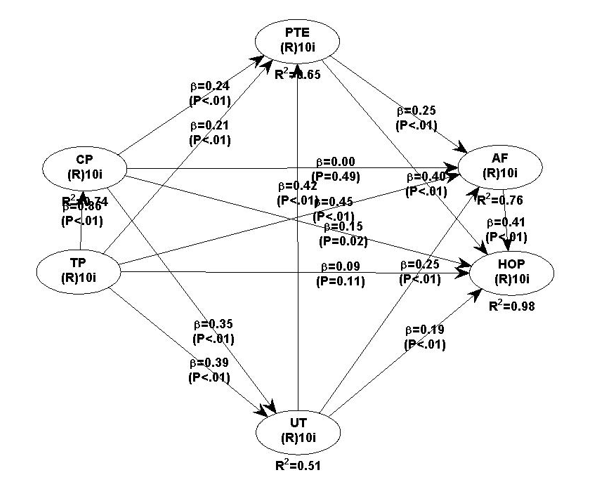
Presented in Table 3 are the estimates and outcomes of the proposed relationships in the model as shown in Figure 1. The parameter estimates based on the beta coefficient and p-value from the result of SEM analysis reveals that 13 out of the 15 hypotheses had direct affect in between select constructs of the dimensions of science teaching in the locale of the study.

In terms of the inter-relationship of the seven constructs, two have significant large effects as found based on the SEM analysis. Conceptual Perspectives (CP) posted a large (f2=.739) direct effect on Theoretical Perspectives (TP) (p-value=<.001) while TP posted the same, f2=.369, on Assessment and Feedback (AF) (p-value=<.001). On the other hand, CP posted moderate direct effect along PTE, UT, and HOP, f2 values of .178, .238, and .198, and p-values of <.001, <.001, .019, respectively; TP posted similar moderate direct effect on PTE and UT, f2 values of .155 and .269, and p-values of .001 and <.001, respectively; PTE posted similar moderate direct effect on AF and HOP, f2 values of .193 and .329, and p-values of <.001, respectively; UT posted moderate direct effect on PTE and AF, f2 values of .319 and .193, and p-values of <.001; AF posted moderate direct effect on HOP with f2 value of .341 and p-value of <.001; UT posted small direct effect on HOP with f2 value of .147 and p-value of .003. The SEM analysis revealed significant direct effects among the six dimensions of science teaching. These findings post significant implications for educators and academic planners, suggesting the need to develop policies and other interventions to bolster the status of science teaching across all level especially that the Philippines lagged behind in the recent world ranking in science like the PISA.
3. Model Fit and Quality Indices of the developed model.
Model fit and quality indices are crucial in Structural Equation Modeling (SEM) analysis for several reasons. These tests assess how well the proposed model aligns with the observed data, validate the model's theoretical relationships, detect misspecifications, compare alternative models, and provide evidence for generalizability 29, 30. Evaluating these indices ensures the validity and reliability of SEM analyses and aids in decision-making regarding model suitability 30, 31.
Average path coefficient (APC)=0.311, P<0.001
Average R-squared (ARS)=0.727, P<0.001
Average adjusted R-squared (AARS)=0.723, P<0.001
Average block VIF (AVIF)=3.726, acceptable if <= 5, ideally <= 3.3
Average full collinearity VIF (AFVIF)=4.187, acceptable if <= 5, ideally <= 3.3
Tenenhaus GoF (GoF)=0.616, small >= 0.1, medium >= 0.25, large >= 0.36
Simpson's paradox ratio (SPR)=1.000, acceptable if >= 0.7, ideally = 1
R-squared contribution ratio (RSCR)=1.000, acceptable if >= 0.9, ideally = 1
Statistical suppression ratio (SSR)=1.000, acceptable if >= 0.7
Nonlinear bivariate causality direction ratio (NLBCDR)=1.000, acceptable if >= 0.7
4. Proposed Plan to Bolster Science Education in the Elementary, Secondary, and Tertiary
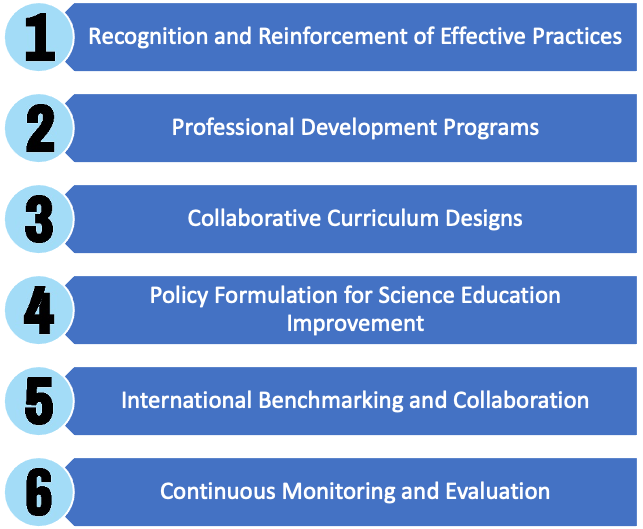
The proposition of six key strategies for enhancing science education demands a critical examination of each element. Firstly, the call for the "Recognition and Reinforcement of Effective Practices" is commendable but necessitates moving beyond symbolic gestures. While events like an Open House and Awards Day are important, a sustained culture of excellence requires tangible, continuous recognition through avenues such as professional development opportunities or mentorship initiatives. The "Professional Development Program" is a strategic move, but its effectiveness hinges on the ongoing evaluation of content relevance and practical applicability. Ensuring a balance between theoretical knowledge and practical skills is crucial, necessitating continuous feedback from participants.
Collaborative curriculum designs advocating for the integration of Conceptual Perspectives (CP) and Theoretical Perspectives (TP) through interdisciplinary approaches offer promise. However, a critical analysis is essential to ensure the feasibility and adaptability of such approaches. Consideration of available resources, faculty expertise, and the local educational context is paramount to avoid implementation challenges. The "Policy Formulation for Science Education Improvement" is a significant step, but policies must be dynamic and responsive. Constant evaluation and adjustment, guided by ongoing feedback, local studies, and international benchmarks, are necessary to address both immediate needs and future trends in science education.
Engaging in "International Benchmarking and Collaboration" presents opportunities, but a nuanced approach is crucial. Critical analysis is needed to contextualize successful practices from other countries, considering the unique challenges and strengths of the local education system. Lastly, the establishment of mechanisms for "Continuous Monitoring and Evaluation" is foundational, yet its effectiveness hinges on robust feedback systems, regular data analysis, and a commitment to act upon findings. The evaluation process should be iterative, allowing for adjustments based on changing needs and circumstances. In essence, each strategy's success lies in its continuous refinement based on ongoing assessment, feedback, and a comprehensive understanding of the local and global landscape of science education.
The consistently high "Strongly Agree" ratings across all dimensions of science teaching among teacher-respondents in the locale of the study indicate a positive state of science instruction, reflecting widespread recognition and adoption of effective pedagogical practices. This consensus establishes a solid foundation for subsequent structural equation modeling analysis, allowing for the exploration and quantification of interrelationships among critical perspectives, theoretical foundations, practical teaching methods, technology integration, assessment and feedback, and hands-on practices, contributing valuable insights to the broader discourse on science education.
The 13 out of the 15 hypotheses indicate significant direct effects among select constructs of science teaching dimensions in the locale of the study. Particularly noteworthy are the identified substantial effects: Conceptual Perspectives (CP) directly influencing Theoretical Perspectives (TP), and TP similarly impacting Assessment and Feedback (AF). These findings underscore the imperative for targeted policies and interventions aimed at improving the state of science teaching, especially in light of global rankings such as the recent PISA results, revealing a need for enhanced performance in science education in the Philippines.
| [1] | Anoling, KM., Abella, CRG., Cagatao, PPS., & Bautista, RG. (2024). Critical perspectives, theoretical foundations, practical teaching, technology integration, assessment and feedback, and hands-on practices in science education. American Journal of Educational Research, 12(1), 20-27. | ||
| In article | View Article | ||
| [2] | Shah, Rajendra Kumar, “Effective Constructivist Teaching Learning in the Classroom.” Shanlax International Journal of Education, vol. 7, no. 4, 2019, pp. 1–13. | ||
| In article | View Article | ||
| [3] | Mensah, E. (2015). Exploring Constructivist Perspectives in the College Classroom. SAGE Open, 5(3). | ||
| In article | View Article | ||
| [4] | Chin, C. (2004). Students' questions: fostering a culture of inquisitiveness in science classrooms. The School science review, 86, 107-112. | ||
| In article | |||
| [5] | Pedrosa-de-Jesus, Helena & Moreira, Aurora & Lopes, Betina & Watts, D. (2014). So much more than just a list: Exploring the nature of critical questioning in undergraduate sciences. Research in Science & Technological Education. 32. 10.1080/ 02635143.2014.902811. | ||
| In article | View Article | ||
| [6] | Forawi, S. (2016). Standard-based science education and critical thinking. Thinking Skills and Creativity, 20, 52-62. | ||
| In article | View Article | ||
| [7] | Kolstø, S.D., Bungum, B., Arnesen, E.K., Isnes, A., Kristensen, T., Mathiassen, K., Mestad, I., Quale, A., Tonning, A.S., & Ulvik, M. (2006). Science students' critical examination of scientific information related to socioscientific issues. Science Education, 90, 632-655. | ||
| In article | View Article | ||
| [8] | Guerrero, JS., & Bautista, RG. (2023). Inquiry-based teaching in secondary science. International Journal of Social Science & Humanities, 8(2), 146-154. | ||
| In article | |||
| [9] | Bagay, MC., Ursua, RRR., Abellera, MAA., Baldovino, RJG., Concepcion, RAP ., Galapon, VS., & Bautista, RG. (2023). Problem-based learning in teaching science. Journal of Innovations in Teaching and Learning, 3(1), 7-14. | ||
| In article | |||
| [10] | Vallerio, ZV., Tobias, JCZ., Tillay, JN., Dumangeng, AP., Pumihic, VT., & Bautista, RG. (2023). Science teaching and learning conceptions towards teachers’ sense of efficacy. American Journal of Educational Research, 11(2), 79-83. | ||
| In article | View Article | ||
| [11] | Libao, NJP., Sagun, JJB., Tamangan, EA., Pattalitan, APP., Dupa, MED., & Bautista, RG. (2016). Science learning motivations as correlate of students’ academic performances. Journal of Technology and Science Education, 6(3), 209-218. | ||
| In article | View Article | ||
| [12] | Legaspi, JME., Perhilliana, CO., Camayang, JG., Garingan, EG., Velasco, MKGT., Ursua, JC., & Bautista, RG. (2020). Scientific Learning Motivations as Predictors of Pre-service Elementary Grade Teachers’ Authentic Assessment Practices in Science. American Journal of Educational Research, 8(3), 150-154. | ||
| In article | |||
| [13] | Discipulo, LG., & Bautista, RG. (2022). Students’ cognitive and metacognitive learning strategies towards hands-on science. International Journal of Evaluation and Research in Education, 11(2), 658-664. | ||
| In article | View Article | ||
| [14] | Ligado, FNG., Guray, ND., & Bautista, RG. (2022). Pedagogical beliefs, techniques, and practices towards hands-on science. American Journal of Educational Research, 10(10), 584-591. | ||
| In article | View Article | ||
| [15] | Ke, L., Sadler, T. D., Zangori, L., & Friedrichsen, P. J. (2021). Developing and using multiple models to promote scientific literacy in the context of socio-scientific issues. Science & Education, 30(3), 589-607. | ||
| In article | View Article PubMed | ||
| [16] | Tytler, R., Prain, V., Hubber, P., & Waldrip, B. (Eds.). (2013). Constructing representations to learn in science. Springer Science & Business Media. | ||
| In article | View Article | ||
| [17] | Campbell, T., Oh, P. S., Maughn, M., Kiriazis, N., & Zuwallack, R. (2015). A review of modeling pedagogies: Pedagogical functions, discursive acts, and technology in modeling instruction. Eurasia Journal of Mathematics, Science and Technology Education, 11(1), 159-176. | ||
| In article | View Article | ||
| [18] | Haskel‐Ittah, M. (2023). Explanatory black boxes and mechanistic reasoning. Journal of research in science teaching, 60(4), 915-933. | ||
| In article | View Article | ||
| [19] | Hodson, D. (2013). Nature of science in the science curriculum: Origin, development, implications and shifting emphases. In International handbook of research in history, philosophy and science teaching (pp. 911-970). Dordrecht: Springer Netherlands. | ||
| In article | View Article | ||
| [20] | Upmeier zu Belzen, A., Engelschalt, P., & Krüger, D. (2021). Modeling as scientific reasoning—The role of abductive reasoning for Modeling competence. Education Sciences, 11(9), 495. | ||
| In article | View Article | ||
| [21] | Simarro, C., & Couso, D. (2021). Engineering practices as a framework for STEM education: a proposal based on epistemic nuances. International Journal of STEM Education, 8(1), 53. | ||
| In article | View Article | ||
| [22] | Adúriz-Bravo, A. (2013). A ‘semantic’view of scientific models for science education. Science & Education, 22, 1593-1611. | ||
| In article | View Article | ||
| [23] | Manz, E. (2012). Understanding the codevelopment of modeling practice and ecological knowledge. Science Education, 96(6), 1071-1105. | ||
| In article | View Article | ||
| [24] | Zhai, X., He, P., & Krajcik, J. (2022). Applying machine learning to automatically assess scientific models. Journal of Research in Science Teaching, 59(10), 1765-1794. | ||
| In article | View Article | ||
| [25] | Eidin, E., Bielik, T., Touitou, I., Bowers, J., McIntyre, C., Damelin, D., & Krajcik, J. (2024). Thinking in terms of change over time: opportunities and challenges of using system dynamics models. Journal of Science Education and Technology, 33(1), 1-28. | ||
| In article | View Article | ||
| [26] | Lee, O., & Grapin, S. E. (2022). The role of phenomena and problems in science and STEM education: Traditional, contemporary, and future approaches. Journal of research in science teaching, 59(7), 1301-1309. | ||
| In article | View Article | ||
| [27] | Bahtiar, B., Ibrahim, I., & Maimun, M. (2022). Analysis of Students' Scientific Literacy Skill in terms of Gender Using Science Teaching Materials Discovery Model Assisted by PhET Simulation. Jurnal Pendidikan IPA Indonesia, 11(3), 371-386. | ||
| In article | View Article | ||
| [28] | Georgiou, Y., & Kyza, E. A. (2023). Fostering chemistry students’ scientific literacy for responsible citizenship through socio-scientific inquiry-based learning (SSIBL). Sustainability, 15(8), 6442. | ||
| In article | View Article | ||
| [29] | Hair, J. F., Black, W. C., Babin, B. J., & Anderson, R. E. (2019). Multivariate Data Analysis. | ||
| In article | |||
| [30] | Kline, R. B. (2016). Principles and Practice of Structural Equation Modeling. | ||
| In article | |||
| [31] | Byrne, B. M. (2016). Structural Equation Modeling with AMOS. | ||
| In article | View Article | ||
Published with license by Science and Education Publishing, Copyright © 2024 Charmaine Ruth G. Abella, Krisel M. Anoling, Peter Paul S. Cagatao and Romiro G. Bautista
 This work is licensed under a Creative Commons Attribution 4.0 International License. To view a copy of this license, visit
http://creativecommons.org/licenses/by/4.0/
This work is licensed under a Creative Commons Attribution 4.0 International License. To view a copy of this license, visit
http://creativecommons.org/licenses/by/4.0/
| [1] | Anoling, KM., Abella, CRG., Cagatao, PPS., & Bautista, RG. (2024). Critical perspectives, theoretical foundations, practical teaching, technology integration, assessment and feedback, and hands-on practices in science education. American Journal of Educational Research, 12(1), 20-27. | ||
| In article | View Article | ||
| [2] | Shah, Rajendra Kumar, “Effective Constructivist Teaching Learning in the Classroom.” Shanlax International Journal of Education, vol. 7, no. 4, 2019, pp. 1–13. | ||
| In article | View Article | ||
| [3] | Mensah, E. (2015). Exploring Constructivist Perspectives in the College Classroom. SAGE Open, 5(3). | ||
| In article | View Article | ||
| [4] | Chin, C. (2004). Students' questions: fostering a culture of inquisitiveness in science classrooms. The School science review, 86, 107-112. | ||
| In article | |||
| [5] | Pedrosa-de-Jesus, Helena & Moreira, Aurora & Lopes, Betina & Watts, D. (2014). So much more than just a list: Exploring the nature of critical questioning in undergraduate sciences. Research in Science & Technological Education. 32. 10.1080/ 02635143.2014.902811. | ||
| In article | View Article | ||
| [6] | Forawi, S. (2016). Standard-based science education and critical thinking. Thinking Skills and Creativity, 20, 52-62. | ||
| In article | View Article | ||
| [7] | Kolstø, S.D., Bungum, B., Arnesen, E.K., Isnes, A., Kristensen, T., Mathiassen, K., Mestad, I., Quale, A., Tonning, A.S., & Ulvik, M. (2006). Science students' critical examination of scientific information related to socioscientific issues. Science Education, 90, 632-655. | ||
| In article | View Article | ||
| [8] | Guerrero, JS., & Bautista, RG. (2023). Inquiry-based teaching in secondary science. International Journal of Social Science & Humanities, 8(2), 146-154. | ||
| In article | |||
| [9] | Bagay, MC., Ursua, RRR., Abellera, MAA., Baldovino, RJG., Concepcion, RAP ., Galapon, VS., & Bautista, RG. (2023). Problem-based learning in teaching science. Journal of Innovations in Teaching and Learning, 3(1), 7-14. | ||
| In article | |||
| [10] | Vallerio, ZV., Tobias, JCZ., Tillay, JN., Dumangeng, AP., Pumihic, VT., & Bautista, RG. (2023). Science teaching and learning conceptions towards teachers’ sense of efficacy. American Journal of Educational Research, 11(2), 79-83. | ||
| In article | View Article | ||
| [11] | Libao, NJP., Sagun, JJB., Tamangan, EA., Pattalitan, APP., Dupa, MED., & Bautista, RG. (2016). Science learning motivations as correlate of students’ academic performances. Journal of Technology and Science Education, 6(3), 209-218. | ||
| In article | View Article | ||
| [12] | Legaspi, JME., Perhilliana, CO., Camayang, JG., Garingan, EG., Velasco, MKGT., Ursua, JC., & Bautista, RG. (2020). Scientific Learning Motivations as Predictors of Pre-service Elementary Grade Teachers’ Authentic Assessment Practices in Science. American Journal of Educational Research, 8(3), 150-154. | ||
| In article | |||
| [13] | Discipulo, LG., & Bautista, RG. (2022). Students’ cognitive and metacognitive learning strategies towards hands-on science. International Journal of Evaluation and Research in Education, 11(2), 658-664. | ||
| In article | View Article | ||
| [14] | Ligado, FNG., Guray, ND., & Bautista, RG. (2022). Pedagogical beliefs, techniques, and practices towards hands-on science. American Journal of Educational Research, 10(10), 584-591. | ||
| In article | View Article | ||
| [15] | Ke, L., Sadler, T. D., Zangori, L., & Friedrichsen, P. J. (2021). Developing and using multiple models to promote scientific literacy in the context of socio-scientific issues. Science & Education, 30(3), 589-607. | ||
| In article | View Article PubMed | ||
| [16] | Tytler, R., Prain, V., Hubber, P., & Waldrip, B. (Eds.). (2013). Constructing representations to learn in science. Springer Science & Business Media. | ||
| In article | View Article | ||
| [17] | Campbell, T., Oh, P. S., Maughn, M., Kiriazis, N., & Zuwallack, R. (2015). A review of modeling pedagogies: Pedagogical functions, discursive acts, and technology in modeling instruction. Eurasia Journal of Mathematics, Science and Technology Education, 11(1), 159-176. | ||
| In article | View Article | ||
| [18] | Haskel‐Ittah, M. (2023). Explanatory black boxes and mechanistic reasoning. Journal of research in science teaching, 60(4), 915-933. | ||
| In article | View Article | ||
| [19] | Hodson, D. (2013). Nature of science in the science curriculum: Origin, development, implications and shifting emphases. In International handbook of research in history, philosophy and science teaching (pp. 911-970). Dordrecht: Springer Netherlands. | ||
| In article | View Article | ||
| [20] | Upmeier zu Belzen, A., Engelschalt, P., & Krüger, D. (2021). Modeling as scientific reasoning—The role of abductive reasoning for Modeling competence. Education Sciences, 11(9), 495. | ||
| In article | View Article | ||
| [21] | Simarro, C., & Couso, D. (2021). Engineering practices as a framework for STEM education: a proposal based on epistemic nuances. International Journal of STEM Education, 8(1), 53. | ||
| In article | View Article | ||
| [22] | Adúriz-Bravo, A. (2013). A ‘semantic’view of scientific models for science education. Science & Education, 22, 1593-1611. | ||
| In article | View Article | ||
| [23] | Manz, E. (2012). Understanding the codevelopment of modeling practice and ecological knowledge. Science Education, 96(6), 1071-1105. | ||
| In article | View Article | ||
| [24] | Zhai, X., He, P., & Krajcik, J. (2022). Applying machine learning to automatically assess scientific models. Journal of Research in Science Teaching, 59(10), 1765-1794. | ||
| In article | View Article | ||
| [25] | Eidin, E., Bielik, T., Touitou, I., Bowers, J., McIntyre, C., Damelin, D., & Krajcik, J. (2024). Thinking in terms of change over time: opportunities and challenges of using system dynamics models. Journal of Science Education and Technology, 33(1), 1-28. | ||
| In article | View Article | ||
| [26] | Lee, O., & Grapin, S. E. (2022). The role of phenomena and problems in science and STEM education: Traditional, contemporary, and future approaches. Journal of research in science teaching, 59(7), 1301-1309. | ||
| In article | View Article | ||
| [27] | Bahtiar, B., Ibrahim, I., & Maimun, M. (2022). Analysis of Students' Scientific Literacy Skill in terms of Gender Using Science Teaching Materials Discovery Model Assisted by PhET Simulation. Jurnal Pendidikan IPA Indonesia, 11(3), 371-386. | ||
| In article | View Article | ||
| [28] | Georgiou, Y., & Kyza, E. A. (2023). Fostering chemistry students’ scientific literacy for responsible citizenship through socio-scientific inquiry-based learning (SSIBL). Sustainability, 15(8), 6442. | ||
| In article | View Article | ||
| [29] | Hair, J. F., Black, W. C., Babin, B. J., & Anderson, R. E. (2019). Multivariate Data Analysis. | ||
| In article | |||
| [30] | Kline, R. B. (2016). Principles and Practice of Structural Equation Modeling. | ||
| In article | |||
| [31] | Byrne, B. M. (2016). Structural Equation Modeling with AMOS. | ||
| In article | View Article | ||