This quantitative study examines the perspectives of undergraduate and postgraduate students at Mogadishu University in Somalia toward the Erasmus+ program with Turkish universities Viz. Sivas Cumhuriyet University, Kütahya Dumlupınar University and Gaziantep University. The study uses a questionnaire and descriptive statistics and The Kruskal-Wallis and Mann-Whitney U and Wilcoxon W analyses. The result proposes that the program provides positive advantages in intercultural communication and dialogue and improves students' ability to communicate effectively with people from different cultures, improving the positive impact of Erasmus on intercultural communication abilities. However, students perceive challenges, such as familiarizing themselves with a new cultural and academic environment and balancing academic work with social and cultural activities. The study also found that the Erasmus+ program provides high academic advantages, such as enhancing academic skills, knowledge acquisition, access to resources, critical thinking, and research skills. Overall, the study emphasizes the importance of study abroad programs like Erasmus+ in promoting intercultural communication and dialogue and enhancing academic skills, while institutions should provide adequate support to students to ensure they can fully benefit from the program.
In today's globalized world, intercultural communication and understanding are increasingly important. The Erasmus Program is a popular student exchange program that has been implemented between universities in different countries to promote intercultural communication and understanding. The program aims to allow students and staff to study, teach, and work in different cultural and linguistic environments, thereby developing their intercultural competencies and promoting a sense of European identity (European Commission, 2021).
The Erasmus program (European Region Action Scheme for the Mobility of University Students) was launched in 1987 as a consequence of a pilot student exchange between 1981 and 1986. At the beginning, the program included 11 European Union (EU) countries and had expanded to 34 countries (including both EU Member States and Non-EU countries) by 2020. Initially, the Erasmus program concerned only student and staff exchange, and since 1987 it has embraced such aspects as vocational training, school education, adult education, youth, and sport. In 2014 the Erasmus+ program was initiated, combining into one single program all of the initiatives in the field of education, training, youth, and sport (Kafarski and Kazak 2022) 1.
In 2014, when the program was rebranded as Erasmus+, with a €14.7 billion budget to provide a broader range of opportunities for millions of Europeans to study, train, and gain work experience abroad up until the year 2020(Version 2023) 2.
Mogadishu University has Signed Erasmus mobility with three Turkish Universities in 2019, 2022 and 2023. These universities include: Sivas Cumhuriyet University, Kütahya Dumlupınar University and Gaziantep University.
The aim of the university is to promote internationalization, academic and research collaboration through involvement and partnership with higher education and research institutions and to help students to become internationally competent and well-prepared for job requirements.
This learning mobility is also involved in supporting teachers and students their cultural experiences. Therefore, there is a need to conduct a study to explore students’ perceptions of the impact of the Erasmus Program on promoting intercultural communication and dialogue between Mogadishu University and a Turkish Universities{1}.
1.1. Related WorkThe Erasmus program has been a significant initiative of the European Union in the field of education, promoting student mobility and cooperation among universities in Europe since its inception in 1987. While the program has its advantages, such as the development of cross-cultural competence and enhancement of professional skills, there are also challenges and limitations associated with the program, as highlighted by various studies illustrated below:
Engel (2010) 3 suggested that the Erasmus program has significantly contributed to making study abroad an experience (Engel 2010) 3. Mitchell (2012) 4 examined the intercultural aspect of studying abroad and presented compelling evidence that the Erasmus experience leads to attitudinal changes about Europe among participants. The study also highlighted significant differences between Erasmus students and those who do not study abroad (Mitchell 2012) 4.
According to a study conducted by Böttcher and colleagues in 2016, female students were found to be overrepresented in the ERASMUS program in nearly all of the countries studied, when compared to the overall population of tertiary students. This trend was observed across various subject areas. Additionally, the study revealed a gender imbalance in the distribution of hosting institutions, which was primarily driven by subject and consistent with the gender ratios in different subject areas. (Böttcher et al. 2016) 5.
According to Beerkens and colleagues' (2016) 6 research, the most robust predictors for non-participation in study abroad programs are home-ties and lack of interest. However, data on student-level barriers and motivations provides limited information to explain why students from certain countries are more active participants in such programs (Beerkens et al. 2016) 6.
Schnepf and Colagrossi (2020) 7 investigated the factors that predict Erasmus mobility and found that student characteristics, such as ability and social status, are important but only explain a portion of unequal uptake. The study also revealed that social segregation of universities and fields of study contribute to the unequal pattern of mobility. Specifically, disadvantaged students enrolled in certain fields of study and universities are less likely to participate in student mobility programs, even after accounting for their individual characteristics. Therefore, to promote more inclusive student mobility, grant funding and incentives should be targeted towards universities and fields of study with a high proportion of disadvantaged students (Schnepf and Colagrossi 2020) 7.
Lesjak and colleagues (2020) 8 found that the level of study and gender have a significant impact on the travel behavior of students, making them useful attributes to consider when targeting Erasmus+ travelers. Based on their perception of destination attributes, male students tend to seek cities with attractive nightlife, while female students prefer easily accessible cities that are safe and offer attractive cultural sites. (Lesjak, Juvan, and Podovšovnik 2020) 8.
In Pavlina's (2021) 9 research, the most notable advantages of participating in the ERASMUS program were found to be the development of cross-cultural competence, as well as the enhancement of professional skills and personal growth. Students who worked with international participants in their home university as part of the program had a highly positive experience (Pavlina 2021) 9.
According to Koris and colleagues' (2021) 10 study, Erasmus students faced significant challenges while studying online (such as during COVIP-19 Pandemic) with limited social interaction. They lacked cultural knowledge of the destination country and missed out on the valuable insights that come from face-to-face teaching and social interactions. However, the study also revealed that students were satisfied with their academic achievements (Koris, Mato-Díaz, and Hernández-Nanclares 2021) 10.
Marinescu and colleagues (2022) 11 found that when choosing a university for mobility purposes, the initial desire to study abroad is a more significant factor than the financial expense, which may have been expected. The study also revealed that students consider the improvement of their academic performance to be just as important as the social aspect of experiencing other cultures when embarking on mobility programs (Marinescu et al. 2022) 11.
Cuzzocrea and Krzaklewska (2023) 12 suggested that, based on their examination of students who have participated in multiple mobility experiences through the Erasmus+ program, it is worth considering how their underlying motivations evolve with each subsequent mobility experience (Cuzzocrea and Krzaklewska 2023) 12.
In conclusion, the Erasmus program has provided a unique opportunity for students to gain valuable cross-cultural competence, enhance their professional skills, and experience personal growth. However, there are also challenges associated with the program, such as limited social interaction in online learning environments and unequal uptake among disadvantaged students. To make the program more inclusive, grant funding and incentives should be targeted towards universities and fields of study with a high proportion of disadvantaged students. It is also worth considering how students' motivations evolve with each subsequent mobility experience.
Gender and level of study are significant factors that influence the travel behavior of students in the Erasmus program. Female students are overrepresented in the program, while male students tend to seek cities with attractive nightlife. However, a detailed analysis reveals that these patterns are predominantly driven by subject and geographical location.
Despite the challenges and limitations of the program, the Erasmus experience leads to attitudinal changes among participants and promotes international cooperation and understanding among universities. However, it is worth noting that data on student-level barriers and motivations provide limited information to explain why students from certain countries are more active participants in such programs. Therefore, further research is needed to address this gap, especially for students from underrepresented regions such as Somalia.
1.2. Research Problem Statement:The Erasmus Mobility Program is a significant initiative of the European Union, promoting student mobility and cooperation among universities in Europe. However, there is a lack of research exploring the perspectives of students from underrepresented regions, such as Somalia, on the Erasmus Mobility Program. This study aims to address this gap by exploring the perspectives of students from Mogadishu University on the Erasmus Mobility Program between Mogadishu University and Turkish universities.
1.3. Significance of the Study:The Erasmus Mobility Program aims to promote international cooperation and understanding among universities in Europe. However, there is a lack of research exploring the perspectives of students from underrepresented regions, such as Somalia, on the Erasmus Mobility Program. This study is significant as it will provide insights into the perspectives of Somali students on the Erasmus Mobility Program, which can be used to inform program development and implementation. The study will also contribute to the literature on the Erasmus Mobility Program, particularly from the perspective of students from underrepresented regions.
1.4. Research Objectives:The primary aim of the study is to investigate the perceptions of undergraduate students at Mogadishu University towards the Erasmus+ Program with Turkish Universities. The specific objectives of the study are listed as follows:
1. To identify the intercultural communication and dialogue advantages of the Erasmus+ Program between Mogadishu University and Turkish Universities for undergraduate students.
2. To explore the challenges that undergraduate students face in the Erasmus+ Program between Mogadishu University and Turkish Universities.
3. To evaluate the academic advantages of the Erasmus+ Program between Mogadishu University and Turkish Universities for undergraduate students at Mogadishu University.
1.5. Research Questions:The study is focused on the following central question: What are the perceptions of undergraduate students at Mogadishu University regarding the Erasmus+ Program with Turkish Universities? The study also includes the following sub-questions:
1. How do undergraduate students perceive the advantages of intercultural communication and dialogue during the Erasmus+ Program between Mogadishu University and Turkish Universities?
2. What are the perceptions of undergraduate students towards the challenges that may arise during the Erasmus+ Program between Mogadishu University and Turkish Universities?
3. How do undergraduate students perceive the academic advantages of participating in the Erasmus+ Program between Mogadishu University and Turkish Universities?
1.6. Hypotheses:1. Ha1: Based on gender, age, academic level, faculties, and academic year, there exists a statistically significant difference at the level (a = 0.05) among the responses of respondents regarding the advantages of intercultural communication and dialogue during the Erasmus+ Program between Mogadishu University and Turkish Universities.
2. Ha2: Based on gender, age, academic level, faculties, and academic year, there exists a statistically significant difference at the level (a = 0.05) among the responses of respondents regarding the challenges that may arise during the Erasmus+ Program between Mogadishu University and Turkish Universities.
3. Ha3: Based on gender, age, academic level, faculties, and academic year, there exists a statistically significant difference at the level (a = 0.05) among the responses of respondents regarding the academic advantages during the Erasmus+ Program between Mogadishu University and Turkish Universities.
This study aims to explore the perspectives of undergraduate and postgraduate students at Mogadishu University towards the Erasmus+ program between Mogadishu University and Turkish Universities. The study was designed using a quantitative approach to collect and analyze data. The target population for this study is undergraduate and postgraduate students at Mogadishu University from nine faculties. A random sampling technique was used to select the sample for this study. The sample size for the study is 436 undergraduate and postgraduate students, selected from the nine faculties of Mogadishu University. A questionnaire was employed as the primary data collection tool for this study with five point of the Likert Scale. The collected data was analyzed using descriptive statistics; percentages and weighted means and The Kruskal-Wallis and Mann-Whitney U and Wilcoxon W analyses. Descriptive statistics were used to summarize the data and provide an overview of the responses to each question. The Kruskal-Wallis and Mann-Whitney U and Wilcoxon W analyses were employed to determine any significant differences in the perceptions of undergraduate and postgraduate students regarding the Erasmus+ program with Turkish Universities. The reliability of consistence of date was examined in SPSS,and result showed acceptable value on Cronbach's Alpha (.869). In this study, ethical considerations were taken into account. All participants were informed about the purpose of the study and their voluntary participation. The confidentiality and anonymity of the participants were also ensured. This study has some limitations. The sample size is limited to Mogadishu University, which may not be representative of the broader population. Additionally, the use of a questionnaire as the primary data collection tool may limit the depth of information obtained from the participants.
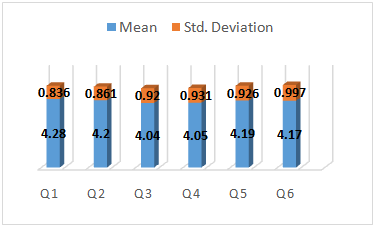
Table 1, Table 2 and Figure 1 present the results of a survey that collected the responses of students on the advantages of the Erasmus+ program in intercultural communication and dialogue. The survey had six questions, and students rated their level of agreement or disagreement on a scale ranging from 1 to 5. The results indicate that students perceive very high advantages in developing intercultural communication skills and gaining a better understanding of other cultures, with means of 4.28 and 4.20, respectively, and standard deviations of 0.836 and 0.86. Additionally, the Erasmus+ program is perceived to provide high advantages in interacting with people from different cultures, improving language skills, developing a more open-minded attitude toward other cultures, and developing empathy toward people from different cultures, with means ranging from 4.04 to 4.19, and standard deviations ranging from 0.920 to 0.997.

Overall, the grand mean of all six questions was 4.155, indicating that the Erasmus+ program between Mogadishu University and Turkish Universities is perceived to provide high advantages in intercultural communication and dialogue.
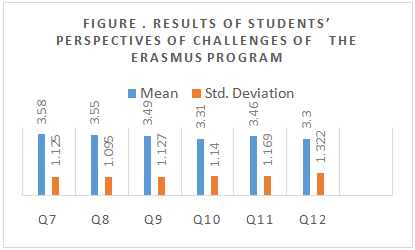
The findings presented in Table 3, and Figure 2 suggest that students perceive very high challenges in several areas of the program, such as adapting to a new cultural environment, communicating with people who speak a different language, balancing academic work with social and cultural activities, and adapting to a new academic system. These challenges were reflected in mean scores of 4.58, 4.55, 4.49, and 4.46, respectively, with standard deviations ranging from 1.095 to 1.169.

On the other hand, dealing with homesickness during the Erasmus program, making new friends, and socializing with people from different cultural backgrounds were perceived as having average or moderate challenges, with mean scores of 3.31 and 3.30, and standard deviations of 1.140 and 1.322, respectively. The overall or grand mean of the six items 3.45 mentioned above indicates that students are likely to face high challenges during the Erasmus+ program. Overall, the results suggest that the Erasmus+ program presents significant challenges for students in various aspects, particularly in adapting to new cultural and academic environments. However, challenges related to socialization and homesickness were perceived as less significant. These findings can inform the development of strategies to support students in overcoming the challenges of the Erasmus+ program and enhancing their overall experience.

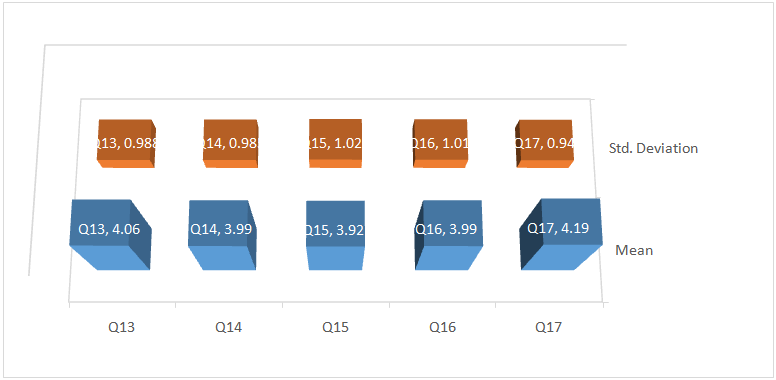
The study examined students' perspectives on the academic advantages of the Erasmus program, focusing on five questions related to the development of academic skills, knowledge acquisition, access to resources, critical thinking, and research skills.
The results, presented in Table 4 and Figure 3 indicate that students perceive high academic advantages of the Erasmus program across all five questions. Specifically, the means for all items ranged from 3.92 to 4.19, indicating a high academic advantage.
Moreover, the grand mean of all questions was 4.03, indicating that the Erasmus program provides high academic advantages for students. Overall, the findings suggest that the Erasmus program is perceived by students as having a positive impact on their academic skills, knowledge acquisition, access to resources, critical thinking, and research skills, and can contribute to enhancing their overall academic experience.
3.1. Testing HypothesesIn this section, the outcomes of the hypotheses proposed by researchers on three aspects of the study, namely Intercultural Communication and Dialogue Advantages, Challenges, and Academic Advantages, are presented. The responses of respondents were analyzed based on their gender, age, academic level, faculties, and academic years. The Kruskal-Wallis test was employed to determine whether the alternative hypotheses were accepted or rejected based on the variances. Furthermore, the Mann-Whitney U and Wilcoxon W analyses were utilized to re-examine any variances that were identified.
Table 5 presents the results of the Kruskal-Wallis test conducted to evaluate the differences in responses among participants. The results indicate that, with the exception of the academic year variable, the alternative hypotheses were not supported for the factors of Intercultural Communication and Academic Advantages, as their p-values were greater than 0.05. Thus, the null hypothesis was maintained. However, the hypotheses related to Intercultural Communication and Academic Advantages, based on the academic year variable, were supported, as their p-values were less than 0.05.
3.2. Results of Mann-Whitney U and Wilcoxon W for Determining VariancesAfter obtaining a statistically significant result in the Academic Year variable, Mann-Whitney U and Wilcoxon W tests were used to identify the source of the differences.
Table 6 displays the results of Mann-Whitney U and Wilcoxon W tests used to identify differences in variance between Year One and Year Two. The p-values for the factors of Intercultural Communication, Dialogue Advantages, and Academic Advantages are all below 0.05, Viz; 0.048 and 0.002, respectively. As a result, we can conclude that the alternative hypothesis is supported.
The findings of the Mann-Whitney U and Wilcoxon W tests are presented in Table 7. The analysis revealed a p-value of 0.05 for the factor of Academic Advantages, thereby supporting the alternative hypothesis. Conversely, for the factors of Intercultural Communication, Dialogue Advantages, and Challenges, the p-values are 0.838, 0.207, and greater than 0.05, respectively, indicating that the null hypothesis could not be rejected.
Table 8. illustrates the variance in the academic factor between Year One and Year Four, where the p-value was found to be 0.001, which is less than 0.05. Therefore, the alternative hypothesis was accepted. However, for the factors of Intercultural Communication, and Dialogue Advantages, and Challenges, the p-values were found to be 0.124, 0.487, respectively, which are greater than 0.05, indicating the acceptance of the null hypothesis.
The outcomes of the analysis of variances in the factors of Intercultural Communication and Dialogue Advantages between Year Two and Year Three are presented in Table 9. The results demonstrated that the p-value was 0.016, which is below the significance level of 0.05, indicating that the alternative hypothesis is supported. However, for the factors of Challenges and Academic Advantages, the p-values are 0.207 and 0.210, respectively, greater than 0.05. These results suggest that the null hypothesis could not be rejected for these factors.
The findings presented in Table 10, which compared Year Two and Year Four, and Table 11, which compared Year Three and Year Four, indicate that all p-values were greater than 0.05. These results suggest that the null hypothesis was accepted for all factors, indicating that there was no statistically significant difference observed between the factors being compared in each table.
The findings of this study indicate that the Erasmus+ program provides high advantages in intercultural communication and dialogue. Students perceived that the program improves their ability to communicate effectively with people from different cultures, and provides them with a better understanding of other cultures. This result is consistent with the findings of Baranova, Kobicheva, and Tokareva (2020) 13, who found that students' knowledge, abilities, and attitudes were substantially greater after participating in the Erasmus program, which was largely beneficial for learning a foreign language and improving cross-cultural communication skills. This demonstrates Erasmus's positive impact on intercultural communication abilities (Baranova, Kobicheva, and Tokareva 2020) 13.
4.2. Challenges of the Erasmus+ Program:The study identified several challenges will be faced by students participating in the Erasmus+ program. One of the most significant challenges is adapting to a new cultural and academic environment. Students perceived that they will have to adjust to different norms, values, and academic systems, which can be stressful and challenging, and communicating with people who speak a different language is also a significant challenge for students, as it can impede their ability to fully participate in academic and social activities. This findings are consistent with the findings of the study of Keles(2013) 14 who opined that the language barrier is one of the main barriers to intercultural communication. Problems of vocabulary equivalence, idiomatic equivalence, experiential equivalence, and conceptual equivalence can cause communication problems (Keles 2013) 14. Balancing academic work with social and cultural activities was also a challenge for students, as they will have to manage their time effectively to meet academic requirements while also participating in social and cultural activities.
4.3. Academic Advantages:The study found that the Erasmus+ program provides high academic advantages to students. Students perceived that the program contributed to the development of their academic skills, knowledge acquisition, and access to resources, critical thinking, and research skills. Exposure to different academic systems and resources can broaden students' perspectives and enhance their ability to think critically and conduct research. Additionally, studying in a different country can provide students with access to unique resources and opportunities that they may not have had in their home country. This results are consistent with the findings of the study of Granato et al. (2021) 15, who opined that Erasmus mobility improves graduation results for undergraduate students in scientific and technical fields, and the program has a positive impact on performance at graduation appears to be stronger for students who visit foreign universities of relatively lower quality compared with their home university and for those who stay abroad for more than six months (Granato et al. 2021) 15.
Overall, the findings of this study highlight the importance of study abroad programs such as the Erasmus+ program in promoting intercultural communication and dialogue, enhancing academic skills, and providing a valuable learning experience for undergraduate students. The challenges identified in this study underscore the need for institutions to provide adequate support to students during their study abroad programs to ensure that they can fully benefit from them.
Based on the results of this study, it can be concluded that the Erasmus+ program provides significant advantages in intercultural communication and dialogue, as well as academic development. However, there are also several challenges that students may face when participating in the program, such as adapting to a new cultural and academic environment, managing time effectively, and communicating with people who speak a different language.
Based on the findings of this study, here are some recommendations for universities and students:
6.1. For universities:1. Offer supplementary resources and support, such as language classes and programs aimed at promoting cultural diversity awareness, to assist students in adapting to unfamiliar academic and cultural environments.
2. Provide additional resources and support to aid students in adapting to novel academic settings.
3. Advocate the value of the Erasmus+ program as a means for students to boost their intercultural communication skills, expand their academic horizons, and improve their overall personal and academic development.
4. Cultivate a supportive atmosphere for students who participate in the Erasmus+ program, including access to peer networks and academic advisors.
6.2. For students:1. Prepare in advance for the challenges of adapting to a new cultural and academic environment, such as by learning the local language and customs.
2. Manage time effectively to balance academic work with social and cultural activities.
3. Seek support from academic advisors and peer networks to help navigate the challenges of the program.
a) Take advantage of the opportunities provided by the Erasmus+ program to broaden their academic perspective, develop intercultural communication skills, and enhance overall academic and personal growth.
{1} Relations Office at Mogadishu University: https://mu.edu.so/
| [1] | Kafarski, Krzysztof, and Jan K. Kazak. 2022. “Erasmus Staff Mobility in the Building of a European Network: The Case of a Central European University.” Sustainability (Switzerland) 14(9). | ||
| In article | |||
| [2] | Version, Accepted. 2023. “Repositório ISCTE-IUL Part 3 Institutionalized Mobility inside and Outside Erasmus.” (351). | ||
| In article | |||
| [3] | Engel, Constanze. 2010. “The Impact of Erasmus Mobility on the Professional Career: Empirical Results of International Studies on Temporary Student and Teaching Staff Mobility.” Belgeo (4):351–63. | ||
| In article | |||
| [4] | Mitchell, Kristine. 2012. “Student Mobility and European Identity: Erasmus Study as a Civic Experience?” Journal of Contemporary European Research 8(4):490–518. | ||
| In article | |||
| [5] | Böttcher, Lucas, Nuno A. M. Araújo, Jan Nagler, José F. F. Mendes, Dirk Helbing, and Hans J. Herrmann. 2016. “Gender Gap in the ERASMUS Mobility Program.” PLoS ONE 11(2):1–8. | ||
| In article | |||
| [6] | Beerkens, Maarja, Manuel Souto-Otero, Hans de Wit, and Jeroen Huisman. 2016. “Similar Students and Different Countries? An Analysis of the Barriers and Drivers for Erasmus Participation in Seven Countries.” Journal of Studies in International Education 20(2):184–204. | ||
| In article | |||
| [7] | Schnepf, Sylke V., and Marco Colagrossi. 2020. “Is Unequal Uptake of Erasmus Mobility Really Only Due to Students’ Choices? The Role of Selection into Universities and Fields of Study.” Journal of European Social Policy 30(4):436–51. | ||
| In article | |||
| [8] | Lesjak, Miha, Emil Juvan, and Eva Podovšovnik. 2020. “Erasmus+ Mobility: Empirical Insights into Erasmus+ Tourists Behaviour.” Academica Turistica 13(1):35–50. | ||
| In article | |||
| [9] | Pavlina, Svetlana Yu. 2021. “Cross-Border Education: Students Exchange Programme Participants’ Perspective on ERASMUS.” Vysshee Obrazovanie v Rossii 30(4):146–56. | ||
| In article | |||
| [10] | Koris, Rita, Francisco Javier Mato-Díaz, and Núria Hernández-Nanclares. 2021. “From Real to Virtual Mobility: Erasmus Students’ Transition to Online Learning amid the COVID-19 Crisis.” European Educational Research Journal 20(4):463–78. | ||
| In article | |||
| [11] | Marinescu, Nicolae, Anca Madar, Nicoleta Andreea Neacsu, and Camelia Schiopu. 2022. “An Empirical Research on the Behavioral Perceptions of University Students on Their ERASMUS Mobilities Abroad.” International Journal of Environmental Research and Public Health 19(9). | ||
| In article | |||
| [12] | Cuzzocrea, Valentina, and Ewa Krzaklewska. 2023. “Erasmus Students’ Motivations in Motion: Understanding Super-Mobility in Higher Education.” Higher Education 85(3):571–85. | ||
| In article | |||
| [13] | Baranova, Tatiana, Aleksandra Kobicheva, and Elena Tokareva. 2020. “The Impact of Erasmus Program on Intercultural Communication Skills of Students.” E3S Web of Conferences 164. | ||
| In article | |||
| [14] | Keles, Yener. 2013. “What Intercultural Communication Barriers Do Exchange Students of Erasmus Program Have During Their Stay in Turkey, Mugla?” Procedia - Social and Behavioral Sciences 70:1513–24. | ||
| In article | |||
| [15] | Granato, Silvia, Enkelejda Havari, Gianluca Mazzarella, and Sylke V. Schnepf. 2021. “Study Abroad Programmes and Students’ Academic Performance: Evidence from Erasmus Applications.” SSRN Electronic Journal (14651). | ||
| In article | |||
Published with license by Science and Education Publishing, Copyright © 2023 Said Abubakar Sheikh Ahmed
 This work is licensed under a Creative Commons Attribution 4.0 International License. To view a copy of this license, visit
http://creativecommons.org/licenses/by/4.0/
This work is licensed under a Creative Commons Attribution 4.0 International License. To view a copy of this license, visit
http://creativecommons.org/licenses/by/4.0/
| [1] | Kafarski, Krzysztof, and Jan K. Kazak. 2022. “Erasmus Staff Mobility in the Building of a European Network: The Case of a Central European University.” Sustainability (Switzerland) 14(9). | ||
| In article | |||
| [2] | Version, Accepted. 2023. “Repositório ISCTE-IUL Part 3 Institutionalized Mobility inside and Outside Erasmus.” (351). | ||
| In article | |||
| [3] | Engel, Constanze. 2010. “The Impact of Erasmus Mobility on the Professional Career: Empirical Results of International Studies on Temporary Student and Teaching Staff Mobility.” Belgeo (4):351–63. | ||
| In article | |||
| [4] | Mitchell, Kristine. 2012. “Student Mobility and European Identity: Erasmus Study as a Civic Experience?” Journal of Contemporary European Research 8(4):490–518. | ||
| In article | |||
| [5] | Böttcher, Lucas, Nuno A. M. Araújo, Jan Nagler, José F. F. Mendes, Dirk Helbing, and Hans J. Herrmann. 2016. “Gender Gap in the ERASMUS Mobility Program.” PLoS ONE 11(2):1–8. | ||
| In article | |||
| [6] | Beerkens, Maarja, Manuel Souto-Otero, Hans de Wit, and Jeroen Huisman. 2016. “Similar Students and Different Countries? An Analysis of the Barriers and Drivers for Erasmus Participation in Seven Countries.” Journal of Studies in International Education 20(2):184–204. | ||
| In article | |||
| [7] | Schnepf, Sylke V., and Marco Colagrossi. 2020. “Is Unequal Uptake of Erasmus Mobility Really Only Due to Students’ Choices? The Role of Selection into Universities and Fields of Study.” Journal of European Social Policy 30(4):436–51. | ||
| In article | |||
| [8] | Lesjak, Miha, Emil Juvan, and Eva Podovšovnik. 2020. “Erasmus+ Mobility: Empirical Insights into Erasmus+ Tourists Behaviour.” Academica Turistica 13(1):35–50. | ||
| In article | |||
| [9] | Pavlina, Svetlana Yu. 2021. “Cross-Border Education: Students Exchange Programme Participants’ Perspective on ERASMUS.” Vysshee Obrazovanie v Rossii 30(4):146–56. | ||
| In article | |||
| [10] | Koris, Rita, Francisco Javier Mato-Díaz, and Núria Hernández-Nanclares. 2021. “From Real to Virtual Mobility: Erasmus Students’ Transition to Online Learning amid the COVID-19 Crisis.” European Educational Research Journal 20(4):463–78. | ||
| In article | |||
| [11] | Marinescu, Nicolae, Anca Madar, Nicoleta Andreea Neacsu, and Camelia Schiopu. 2022. “An Empirical Research on the Behavioral Perceptions of University Students on Their ERASMUS Mobilities Abroad.” International Journal of Environmental Research and Public Health 19(9). | ||
| In article | |||
| [12] | Cuzzocrea, Valentina, and Ewa Krzaklewska. 2023. “Erasmus Students’ Motivations in Motion: Understanding Super-Mobility in Higher Education.” Higher Education 85(3):571–85. | ||
| In article | |||
| [13] | Baranova, Tatiana, Aleksandra Kobicheva, and Elena Tokareva. 2020. “The Impact of Erasmus Program on Intercultural Communication Skills of Students.” E3S Web of Conferences 164. | ||
| In article | |||
| [14] | Keles, Yener. 2013. “What Intercultural Communication Barriers Do Exchange Students of Erasmus Program Have During Their Stay in Turkey, Mugla?” Procedia - Social and Behavioral Sciences 70:1513–24. | ||
| In article | |||
| [15] | Granato, Silvia, Enkelejda Havari, Gianluca Mazzarella, and Sylke V. Schnepf. 2021. “Study Abroad Programmes and Students’ Academic Performance: Evidence from Erasmus Applications.” SSRN Electronic Journal (14651). | ||
| In article | |||