The dynamics of the digital economy constitute the central thesis of every education policy within the context of the trending the fourth industrial revolution. This implies that the focus of every education and training policy should be geared towards the development of skills for the digital economy. Despite being cognizant of the above premise, it has been observed that the Ministry of Secondary Education lacks a strong technology policy and practice for teaching-learning geared towards the development of skills for digital economy. This study is set to evaluate the extent to which educational technology policy and practice develop digital economy skills on high school learners in government secondary schools in Cameroon. The methodology constitutes a mixed approach, with the purposeful sampling used for the selection of policy makers and planners at the Ministry of Secondary Education. The stratified random sampling was used to obtain information from high school managers, high school teachers, high school graduates pursuing studies at the University of Yaounde I. The data were analyzed with content analysis. The results revealed existing but poorly designed technology policies and plans for secondary schools in Cameroon. Policy implementation presented an unprecedented gap at all levels. As a result, recommendations have been made to policy makers and planners/education managers of ICT in education to bridge the said gap.
Rapid digitalization is affecting all aspects of life – including the way we interact, work, shop and receive services – as well as how value is created and exchanged. It is estimated that the world economy benefited about $175 billion in 2018 from productivity benefits to businesses from the use of IoT (Internet of Things); this is equivalent to 0.2 per cent of global GDP. Over half of these benefits were enjoyed by manufacturing and information-related businesses. Productivity benefits from business use of IoT are expected to rise to $3.7 trillion by 2025, representing 0.34 per cent of global GDP. The United States and China are leading the world in IoT productivity gains, accounting for over 50 per cent of global benefits 1.
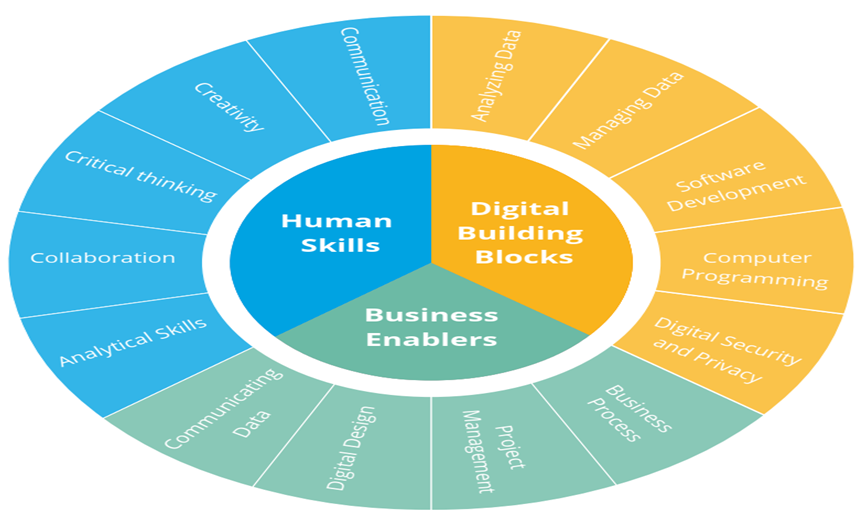
Moreover, the advent of this digital age is creating vast new opportunities for graduates leaving school. For instance, a recent survey by Burning Glass/ Business Higher Education Forum to find out skill trends in today’s job markets revealed that digitally intensive jobs are the most prevalent out of more than 150 million job postings in the United States of America. This study identified 14 skills which are considered foundational in this novel economy and classified them under 3 core skill regions as seen on the table and figure below:

UNESCO (2017) corroborates the above as it posits that the skills for the digital economy can also be grouped in three, namely:
i. Basic functional digital skills: accessing and engaging with digital technologies.
ii. Generic digital skills: using digital technologies in meaningful and beneficial ways.
iii. Higher level skills: using digital technologies in empowering and transformative ways
This signifies that today’s economy has been swallowed by the fourth industrial revolution, or what is known as “technology boom”. Despite this awareness of the skills, importance to this new economy, classical Government High schools in Cameroon are yet to live up to these changing times. Assuming that policy design is a point of departure for every successful venture, this has therefore in recent times served as a call for global and local education policy makers to accord more importance to technology policy for education designs and the mode of practice. In this light, core aspects that have been subjected to serious questioning include:
- To what extent has the policy design addressed a solid technology relevance policy design for the development of skills for the digital economy?
- To what extent has the policy design addressed transformation for the development of skills for the digital economy?
- To what extent has the policy design addressed technology inclusiveness/equity for schools towards the development of skills for the digital economy?
It is based on the above premises that this study proceeds to evaluate the state of technology policy for schools in the Ministry of Secondary Education, by putting a finger on the relevance of policy design towards developing skills for digital economy, the transformative elements, the holistic nature of policy, and technology inclusiveness/equity. Key technology policies that can be mentioned here are seen below.
a. External policy environment
i. The Muscat Agreement
The Muscat Agreement is an offshoot of the Global Education Monitoring pertaining to EFA (Education For All), a global education initiative that germinated in Jomtien in 1990, and received grounded confirmation in Dakar, Senegal in 2000. Held in Muscat, OMAM, in 2014 by world education stakeholders, this meeting acknowledged that EFA and the Millennium Development Goals (MDGs) have been the most important commitment to education in recent decades and have driven education to significant progress. Yet, it was still realized that hundreds of millions of learners were still lagging behind in terms of basic education, and education of the girl child most particularly in middle and less developed countries. As a matter of fact, an estimated 250 million children were unable to read, write or count well even after spending at least four years in school. Moreover, key issues that remained staked are persistent inequalities in access, the state of access, non-completion of formal schooling, weak skills levels, and relevance to the job market needs.
What was most attracting in this meeting was that every stakeholder acknowledged the need of a new type of education that equipped learners with the skill set to respond to an uncertain future. In this light, the stakeholders reiterated as follows:
We acknowledge that future education priorities must reflect the significant socio-economic transformations that have occurred since the adoption of the EFA and the MDGs and the changing requirements in the type and level of knowledge, skills and competencies for knowledge-based economies. Therefore, we recognize that there is a strong need for a strong and forward-looking education agenda that completes unfinished business while going beyond the current goals in terms of depth and scope as well as to provide people with the understanding competencies and values they require to address the many challenges that our societies and economies are facing.
UNESCO (2014:2)
The above trend by world leaders saw the need to fill the gaps of the past years as noticed in the GEM (Global Education Monitoring) report. This implies that stakeholders were called upon to lay down education mechanisms that meet the exigencies of changing times. In this light, since Cameroon participated and endorsed this commitment, the local education policy design ought to pay particular attention to these gaps. The extent to which this has been applicable in Cameroon’s education system will be determined based on this study’s results.
ii. The Incheon Declaration and Framework for Action
In May 2015, global education stakeholders converge on Incheon, Korea to finalize the grounds of how to implement a new post-2015 Education agenda. This new vision is fully captured by the proposed SDG 4 'Ensure inclusive and equitable quality education and promote lifelong learning opportunities for all' and its corresponding targets. According to UNESCO (2015) This new vision for education is transformative and universal. It also attends to the ‘unfinished business’ of the EFA agenda and the education-related MDGs, and addresses global and national education challenges. According to 2, the appropriation of ICT by key education stakeholder is central to the achievement of the SDG4 targets of inclusive and equitable quality learning, and lifelong learning as well. This author estimates that according more importance to technology in today’s education is critical to developing the type and nature of skills needed by today’s job market. This is corroborated by Njebakal & Teneng 3 as they posit that ICT constitutes an inevitable component in the drive for reducing skill mismatch among graduates.
It suffices to note that the 2030 education agenda recognizes education as key to achieving full employment and poverty eradication. To this, 4 resolved that education constitutes the basis for every societal transformation. These authors concluded that education policy makers, planners and managers should endeavor to rise up to the problem set by the fourth industrial revolution. It is based on these premises that this policy instrument is considered relevant in this study as it guides global and local education policies on the required ingredients and methodology. The most important question that remains to be answered is if Cameroon has been able to align her education policy to these commitments. However, field results will determine the degree with which the latter have been effective and efficient.
iii. From the 2015 Agenda of sustainable Development to the Qingdao Declaration (2015) and Qingdao statement (2017)
The 2015 agenda for sustainable development is a historic international meeting that resulted in 17 SDGs and 169 targets to be achieved by 2030. It refocused the former visions to hit a trio of targets: people, planet and prosperity. This agenda reaffirmed the crucial role technology plays in achieving SDG 4 with key pillars as access, equity, quality, inclusion and lifelong learning, and other goals. Also, it should be noted that five of the sustainable Development Goals: enhancing gender equality (Goal 5), infrastructure (Goal 9), reducing inequalities among and across countries (Goal 10), enhancing peace, justice and strong institutions (Goal 16) and ensuring partnership for the goals (Goal 17), have universally been carved out as ICT related targets.
It suffices to note that two international meetings with direct focus on the integration of ICT in global classroom were held in 2015 and 2017 respectively by UNESCO.
First there was the Qingdao declaration-2015. Given the remarkable role of ICT in today’s society and considering the imperativeness of digital skills for everyone, UNESCO convened an international conference on ICT and post-2015 Education from 23 to 25 May 2015 in Qingdao, the People’s Republic of China. This conference had as main aim to reflect on how to unleash the full potentials of ICT for education and achieving the sustainable development goals. Among various outcomes, this conference recognized that the ability to leverage ICT for learning is no longer a specialized skill, it is foundational to succeed in today’s society. It also focuses on access and inclusion by all to digital resources and skills, open educational resources and open solutions, developing well-informed long-term policies and strategies to unleash the potentials of ICT to achieve greater quality in education and transform learning, 5.
- Second, there was the Qingdao statement-2017.
The main aim of this conference was to lay down strategic priorities and mechanisms for the achievement of the Qingdao declaration of 2015. The Qingdao statement was captured under five headings as follows:
- Priority for equitable access to and use of ICT;
- Policies to unlock ICT for quality and relevance learning;
- Integrated ICT solutions across areas of SDG4 and the SDGs;
- Fostering the evolution of locally sustained ICT solutions for education;
- Coordination mechanisms to strengthen regional and international cooperation.
However, it is important to note that the Qingdao Declaration and Statement constitute the core of international policy documents that directly relates to this study. However, the most relevant question posed by this study is to what extent have these significant policies on ICT in education been institutionalized by educational institutions in Cameroon? This forms the basis for an argument on the need for a strategic ICT policy for secondary Education in Cameroon.
iv. The African Union’s Agenda 2063
This is a well-developed plan for the transformation of Africa, developed by African Union (AU) in 2013 during its golden jubilee. Captioned as the “Africa we want”, it constitutes the continent’s blueprint to become a global powerhouse in the next 50 years. In its goal number 02, it stresses the need for the use of science, innovation and technology to develop well-skilled citizens. This plan is expected to be achieved through the African Education system.
v. The African Union’s Digital Transformation Agenda (2020-2030)
On 18 May 2020, the African Union adopted a comprehensive strategy paper on the digital transformation of Africa from 2020 to 2030. The aim of the ten-year plan is to build a single digital market in Africa until 2030. The plan comprises 16 goals, including harmonized legislation, agreements between the AU member states on cyber security and data privacy, interoperability between the African states, extension of the African domain name space, enhancement digital education for everybody (e-Skills Development Program) and promotion of the Pan-African trade. By 2030, African citizens shall have become enlightened and responsible e-citizens. What is important to note here is that this policy instrument focuses on developing the African digital economy to world maxim. Through e-skill development, education and training institutions are well informed and prepared to develop the skills required by Africans to integrate into this world class digital economy. The extent to which Cameroon as a member state aligns its teaching-learning to the said policy dynamics will be examined.
vi. The Transforming Education Summit
At the Transforming Education Summit held in September 2022 in New York, the international community reaffirmed digital education as a public good, and agreed to treat digital technology and virtual environments as core to the educational enterprise. The latter demand the same rigor, care, and attention that are paid to the physical infrastructure of learning. Schools and their resources have long been treated as public goods. And rightly so. They benefit everyone and, as such, demand public support, oversight, and governance. The same needs to be done for the digital spaces and infrastructures of learning.
As member state, Cameroon took 13 commitments for the transformation of the education system. Amongst them, the government engaged to “ensure teachers’ pre- and in-service training on digital pedagogy, the mastery and use of ICTs in education and distance education management”.
b. National Policy Environment.
Before delving into the relevant education related technology policy /reforms within the Ministry of Secondary Education, it is important to present a brief summary of the evolution of ICT policy environment as seen below.
i. History on the Evolution of ICT in Secondary Education in Cameroon
The project for introducing ICTs in schools was given an impetus by a presidential statement in 2001. This statement made it clear that imported computers and their accessories were to be duty-free for schools. Moreover, the World Bank in its ICT task force policy have raised the concept of cyber education in the global school system to promote the development of computer technology, to improve the accessibility of learners to information technology, and to encourage digital inclusion in developing countries. As we moved on, consolidating the presidential statement and the World Bank initiative, the Ministry of National Education (MINEDUC) authorized the Inspectorate General of Pedagogy in charge of teaching computer sciences at all levels, to design and develop a project on cyber education in Cameroon. The project was implemented in April 2001.
In 2004, key strategies on using ICTs in education were highlighted in the first official draft of the Cameroon National Information and Communication Infrastructure (NICI) policy and plan prepared by the government with support from the United Nations Development Program (UNDP) and the United Nations Economic Commission for Africa (UNECA). In this document, the Cameroonian government recognizes ICTs as a national priority along with education, health, forestry, and governance. As indicated in the NICI plan document, the government resolved to achieve the following:
- Modernizing the educational system through the introduction of ICTs in schools;
- Introducing ICT application training modules into national universities;
- Preparing a sectoral ICT policy for the educational sector;
- Training teachers in the use of ICTs;
- Equipping all schools with ICT facilities;
- Multiplying pedagogic resource centers for teachers and students;
- Establishing distance training facilities;
- Providing support for the production of ICT teaching materials (didactical).
In June 2005 the Prime Minister signed a decree creating and organizing the national sub-committee for the integration of ICTs in education.
In 2002, a ministerial decision defining the condition for the creation of Multimedia Resource Centers (MRCs) in government secondary schools was published. Then in 2003 a decree introducing ICTs in education was published by the Ministry of National Education (presently MINESEC, the Ministry of Secondary Education). The decree stipulated that ICTs would become a core-course as from September 2003.
The Ministry of Secondary Education was reorganized to include a new unit called the National Pedagogy Support Unit (CAAP). CAAP is equipped with a distance training unit called Unité de Formation à Distance (UFAD) and is expected to ensure the training and capacity-building for teachers, which includes distance learning. Also important to note is that factors influencing the implementation process include budget availability, weak linkages between stakeholders and project management, and coordination. There is no specific board or organ in charge of the co-ordination of the global cyber education project. Stakeholders seem to be evolving independently, thus resulting in some ignoring what others are doing.
ii. Educational Technology-Related Policies/Reforms within the Ministry of Secondary Education.
Prior to 2007, the main education governing framework was Law No. 98/004 of 4 April 1998 to lay down guidelines on Education in Cameroon. At the time of drafting this framework, ICT in education was not a major issue. What was pressing was to lay down a framework for the smooth functioning of primary and secondary education and training in the country. Key issues where the general infrastructure guidelines, curriculum, human resources and finances. This was mostly geared toward increasing the number of Cameroonians in literacy and/or secondary education. Very little reflections were directed to shape policy towards developing skills for the information societies or digital economy as it is the case of today 6.
However, at the wake of 2007, the Cameroon government developed significant interest in ICT and its role in development. This alone precipitated the build-up of a National ICT policy for the development of the nation by the end of 2007. Despite the existence of several initiatives before this period, there was the absence of a particular framework to guide the infusion of ICT in different sectors of the country’s development apparatus, including education and training. Key commitments in this policy were to accelerate Cameroon’s entry into the information society by encouraging an increase in ICT in every state sector (National ICT Policy, 2007). It suffices to note that Chapter 2 (3) of this document highlights the need to develop the necessary human resources for information society. This chapter stresses that ICT skills shall be developed either in pre-service, in-service, both in formal and non-formal education settings (National ICT Policy, 2007). In this light, the policy mentioned the training of specialists in technical and engineering fields by Higher Education institutions. Also, chapter 2(5) highlights the mainstreaming of ICT in education and research sector. This mean that in real terms, schools at all levels ought to develop the necessary ICT skills for the 21st century job market. However, it is rather unfortunate that this has never been put into practice. It also follows that this policy made mention of no clear strategic plan to guide the development and use of ICT in the learning environment 4. In this light, 7 explains that the National ICT policy for 2007 made no particular emphasis on the development of ICT in the education sector.
The 2035 agenda for development in Cameroon also contained some ingredients of ICT in education which, despite its narrow nature was seen as a driver to involve the country into the knowledge-based society. This policy instrument underscored the development of ICT skills required by other sectors for the development of the nation. As a matter of fact, education and training institutions were tasked with the production of skilled tech man power for the transformation of the country into an emerging nation by 2035. Despite this key commitment, 8 argued that policy governance or implementation in Cameroon is stymied as best practices are yet to be felt. This author further states that the main problem of policy in Cameroon is lack or slow implementation and evaluation. In this light, 6, adds that the scattered nature of ICT in education policy in different policy documents is a major default, hindering best practices. These authors are practically worried about the holistic nature of ICT policy for education, which is a key element with policies that transforms. In this light, 7 stated that the 2035 vision was another policy milestone for various development sectors in the country, but also failed to make any precise statement for the development of digital skills in the education sector.
Another important policy with regards to this study is the Education and Training Sector Strategy for 2013-2020 (Ministry of Economy, Planning and Regional Development, 2013). This strategic document had as raison d’etre to match the cross-education sector to the exigencies of the 21st century. Specifically relevant to this study is specific objective No 1: improve the quality of learning in primary and secondary education, (ESSD, 2013: 70). Under this objective, the curriculum reform strategy calls for the generalization of ICT in the whole school curriculum at all education levels (ESSD, 2013: 70). In the same light, strategy N0 4 of this framework focuses on the generalization of ICT in the education/training system. It declares as follows:
The modernization of the education and training system at all levels will be done by integrating and owning ICTs through provision of sufficient digital infrastructure and solid training of all stakeholders. This will involve:
- Building the capacities of teachers and supervisory staff in the use of computer hardware and digital pedagogic resources;
- Promoting new opportunities and training tools (E-learning, distance education, didactic software, etc.);
- Improving the learning environment in schools (multimedia centers, providing schools with computers, etc.)
- Setting up an operational system for preventive and curative maintenance of computers.
(ESSD, 2013: 73)
Other ICT-pedagogic integrations aspects like connectivity, and energy supply, were also mentioned in this framework. However, recent studies demonstrated that the Covid-19 pandemic revealed an ill-prepared education system to cope with the new norm as learning switched online. As a matter of fact, Béché, 2 carried out a study to determine the readiness of the Cameroonian education system to respond to covid-19 outbreak, which caused learning to go on-line. Findings revealed that Cameroon education system was significantly below the threshold in the use ICTs to enhance continued learning in such situations.
In addition to the above, specific objective No.2 insists on the adaptation of training to the socio-economic environment. As a matter of fact, 9, emphasizes that every recent education policy should be designed, not only for developing the socio-emotional personalities of citizens, but to equip them with up-to-date skills required by the 21st century job market. However, it should be noted that any action here was to be based on a study to be carried on-the-job-market skills to graduate unemployment gap. It therefore suffices to note that this situation is not getting better as both high school and university graduates have in recent years inflated unemployment figures around the country (National Institute of Statistics, 2021).
In addition to the above, the Cameroon government being aware of the changing trend of the digital economy, drafted and published a framework to guide every sector of the country to get entangled this new trend. The main issues at the center of the Cameroon’s plan for the Digital Economy constituted the following:
- Digital infrastructure: the availability of affordable and quality Internet, which is instrumental to bringing more people and businesses online;
- Digital platforms: the presence and use of digital platforms that can support greater digital exchange, transactions, and access to public services online;
- Digital financial services: the ability to pay, save, borrow, and invest through digital means, which is key to increasing financial inclusion and the e-commerce market;
- Digital entrepreneurship: the presence of an ecosystem that supports entrepreneurs, start-ups, and bigger companies to generate new products and services that leverage new technologies and business models, which is critical to widen and deepen digital economic transformation;
- Digital skills: the development of a tech-savvy workforce, with both basic and advanced digital skills to support increased technology adoption and innovation and enable investments in high value-added services.
Despite this commendable initiative by the state of Cameroon, a world bank diagnosis for 2019 pointed out that Cameroon is still lagging in ICT infrastructure, still at the start-up stage for FinTech (Financial Technology). Also, the country lags behind others on two key pillars holding the digital economy: digital platforms and digital skills. As a matter of fact, schools lack interconnected platforms for communication and related administrative functioning. Even the state of e-learning platforms is practically feeble. In this light, 6 posits that the use of WhatsApp platforms for learning, and National television media during the peak of the covid-19 was a clear demonstration of digital platform gaps in Cameroon’s educative system.
On the other hand, limited market relevance of skills development programs as observed in the school curriculum translates into youth being poorly prepared for the labor market and post-secondary studies. We must also note that the low level of digital skills by school managers and teachers is a significant setback that manifests in outcome by graduates. In all, this policy framework holds critical formulations to push the development of digital skills, but faces same setbacks like those above, that is poor implementation and no detailed technology plan for school. It is based on the weaknesses observed in the above-mentioned policy frameworks that the state of Cameroon adopted the National Development Strategy for 2030 10.
The NDS30 is a strategic document that comes at the heels of multiple challenges faced by the Cameroon economy. These key stakes include revitalizing the economy, improving climate security, strengthening the socio-professional sector, and improving livelihoods. It was adopted within the context of the knowledge-based economy, or information societies. This strategy is an era of dramatic change in every sector, caused by the technology revolution. Consequently, there is a need for various sectors, with education inclusive goals?? to adjust to the new dawn. This document expresses the need to improve on the Human Capital Development Initiative (HCDI) through quality education and training at all educational levels. However, a focus on the digitalization of the education remains feeble in terms of a detailed action plan for the education sector. It suffices to mention that this new development policy is less than two years old, and should not be subjected to any harsh criticism since the time lapse is ten years.
Eight hundred and sixty-five (865) respondents made up of high school administrators (principals, vice-principals), policy makers and planners at the Ministry of Secondary Education, high school teachers, and high school graduates (were traced at classical faculties, enrolled at the Bachelors cycle), were selected for questionnaire through the stratified-random sampling method. It should be noted that these graduates are those who indicated that their reason for continuing into the faculty is because they could not find jobs with their high school certificate. Of these 865 respondents, five (05) are officials involved in policy making and planning. They were purposefully selected from the Ministry of Secondary Education. Also, of these 865, secondary school principals were randomly selected from 20 secondary/high schools around the semi-urban area of the Mfoundi Division. Semi-structured interviews were used to obtain qualitative information. Relational content analysis was used for analyzing the data.
This section of the paper presents the findings of the study, interpretation and/or discussions as seen below.
The findings from question 1 depict that 415 of the 865 respondents strongly disagree with the holistic nature of digital policy within the Ministry of Secondary Education, hence, simply signifying that there is absence of a holistic digital policy to push through the development of digital economy skills as expected. In addition to these statistics, information from interviews with policy and planning officials at the ministry corroborate that technology policies and reforms that connect to education and training are scattered in national development policy documents all around. One of these respondents declared as follows:
The fact that ICTs in education guidelines are dotted here and there makes it difficult for translation and result-based implementation. The formulations may be very beautiful, but frustrating for planners and managers to make out something impactful when picking from divided sources.
(Field interview, March, 2022)
The above assertion is telling of the fact that the holistic nature of ICT in education policy remains a major problem. According to 11, nations are required to lay down harmonized national strategies that will leverage ICT for relevant skills development. According to 4, the formulations of ICT for education policies at the macro level have been highly techno-centric. It is therefore necessary to contend that unlike in other African countries like Rwanda, Kenya, and South Africa, Cameroon portrays a lack of focus and weak response to the technology revolution. This implies that the dose of technology for education is yet to be considered as a top priority in education and training policies 12. To this, 2 remarked that the poor response x-rayed by the Cameroon education system during the covid-19 is a clear indication that it is ill-prepared in terms of technology for continuous learning.
Question 2 on its part depicts that there is insufficient presence of a digital learning plan designed by the ministry to guide the use of technology in the classroom. This is justified by the high number of respondents who strongly disagreed at 317, making 36.6%, and 196 making 22.7% who disagree. What we must acknowledge is that the ministry has designed content material for technology at all levels. It therefore follows that schools only implement what has been given by the central services. It is worth noting that 13 and other education partners have called on schools to build specific technology plans to meet their environmental needs. But field interviews revealed a reluctance towards this claim. As a matter of fact, schools still consider ICT with a pinch of salt 14, 15. Some school administrators even went as far to comment that ICT is not a more important discipline that others.
Also, question 3 demonstrates the fact that policy goals are feebly relevant to the development of digital economy skills. This is evident as 308, making 36.6% of the respondents strongly disagreed, unlike 147 making 17.0 % who disagreed. These statistics constitutes the larger portion of the 865 who were questioned for this study. The relevance of policy goals to field realities has been a bone of contention for research with the Cameroon educative system. In this light, as 3 asserted, technology ingredients are weakly present in the curriculum policy that tackles the 21st century job market. Also, 4 corroborates this view as they posited that the skill mismatch question as observed among high school graduates is explained by curriculum policy relevance. It is worth noting that the digital economy is composed of well-defined skills, of which every current education and training policy is required to have embedded 16. Unfortunately, it is not the case with the current education policy within the Ministry of Secondary Education.
In addition to the above, question 4 reveals a significantly weak implementation of the existing technology policy. This is evident as 237, making 28.6% of the respondents strongly disagreed, unlike 172 making 19.9 % who disagreed. No matter how a policy is well formulated, what will make it a point of reference is its implementation to achieve what is was intended to, and the available resources. In this light, onlookers have often contended that the real illness blocking development in Cameroon is policy implementation. In that vein, 8 explained that Cameroon has often formulated very beautiful policies, but would always fall short in implementation. This gap was quickly identified during field studies when questioning principals on the state of implementation of ICT for education policy 17. In response, most of these principals noted that the resources are limited, for example, there is a weak presence of multimedia centers, connectivity, energy, and digital competency by teachers 18, 19.
Question 5 on its part shows that elements of access, equity and inclusion are insufficiently present in digital learning policy in secondary education in Cameroon. This is evident as 135, constituting 15.6% of the respondents strongly disagreed, as well as 247 making 28.6 % disagreed. Despite the fact that a considerable number of these respondents, 221 making 25.5% stayed neutral, the statistics still confirms that access, equity and inclusion are not effective in digital policy. This signifies that quality and lifelong learning is yet to be considered effective 6. The questions of inclusiveness, access, and lifelong learning as advocated by the United Nations (2015) and its partners have been recurrent till now. In this regard, Sustainable Development Goal four (SDG4) has been a guiding pillar for nations to follow in defining education and training policies, so as not to miss out in these aspects 5.
Given that the world is in the state of continuous multiple crisis: Covid-19, climate crisis and related consequences, and civil unrest with internally displaced learners. It therefore follows that the use of technology can enhance continuous learning through distance learning as indicated in the Qingdao declaration of 2015, and the Qingdao statement of 2017, 5. However, the school planners and managers when interviewed maintained that they are aware of what SDG4 recommends, but are not equipped in terms of infrastructure, equipment and updated skills to get everything on the expected track.
Looking at question 6, it indicates that policy does not sufficiently execute the clause on partnership between teaching-learning and the business world. This can be explained by the bulk of respondents, 324, (37.5%) who strongly disagreed, and 177 (20.5 %) said they disagreed respectively. It should be noted that a key point in the SDGs is partnership, which is SDG 17. In this perspective, only major partners like the World Bank, the United Nations, the European Union, and the Commonwealth of Nations mostly intervene at the level of policy formulation 20. However, a more engaging partnership of policy at all levels will better shape education and training to respond to the development of skills for the digital market.
Question seven (07) on its part demonstrate that education policy failed to make significant provisions for open education resources such as digital libraries, open access journals for teachers and learners and expand access to textbooks and other forms of learning content. In this regard, 704, making 81.4% of the respondents strongly disagreed, and 40 making 4.6 % disagreed, as well. According to 21 the importance of creating digital libraries is critical to enhance 21st century learning. This is occurring at a time where the Cameroon education system is yet to boast of a digital library. What is existent is traditional book shelves in some schools, with outdated books filled in 22. It suffices to note that this area of technology in education is still quite weak in secondary education in Cameroon.
Question eight (08) indicates that digital policy feebly ensured sustainability mechanisms as 246, (ie 28.4%) of the respondents strongly disagreed, unlike 192 making 22.2 % who disagreed as well. A considerable number agreed that some elements of sustainability were however present in policy formulations, although not being implemented. This study noted that elements of sustainability in policy like a strategic plan, specificity, measurable, accuracy, realistic, and time-bound (SMART) are lagging in education policy 23. Also, 5 calls for accountability and responsibility in policy implementation. This also includes sustainable financing of ICT infrastructures/equipment and policy 2. This is confirmed by interviews as respondents demonstrated lapses in accountability and responsibility. The simple truth is that stakeholders are duly aware of the above, but lack the resources to make things happen as expected, 24, 25, 26.
Based on the above results, the following recommendations were made to the various stakeholders involved:
- There is need for the harmonization of a technology policy for education at this ministry;
- The policy needs to updated to meet the needs of the digital economy;
- The Ministry of Secondary Education should ensure schools have a plan for the infusion of ICT in the teaching-learning process;
- School managers are called upon to be effective and efficient in the implementation of education policy related to the development of skills for the digital economy;
- The ministry should constantly follow up to ensure that aspects of inclusion and lifelong learning are well considered in the process;
- The financing and /or provision of resources that enable the effective development of skills for the digital economy should be a priority in the ministry’s expenditure. Among other key resources we have modern multimedia centers (well equipped), high bandwidth internet, sustainable energy;
- The ministry and schools should develop and multiply strategies for partnering with key stakeholders in the planning and implementation of technology policy for education;
- Continuous professional development in ICT pedagogic skills for teachers should be enforced;
- School managers should also be trained in e-governance;
- Sustainable management should ensure and enhance accountability and responsibility;
- The ministry should endeavor to align and engage with international ICT standards for education policy, in formulation, strategy and implementation respectively.
In a nutshell, this study aimed at finding out the extent to which ICT for education policy addresses the development of skills for digital economy among high school students. Key issues examined were the relevance of policy design towards developing digital economy skills, the transformative elements, the holistic nature of policy, and technology inclusiveness/equity. An evaluation of these elements in the existing education reforms in the Ministry of Secondary Education proved to be very weak, reason for high school graduates in Cameroon prefer to enroll for bachelor degree programs instead of going to the labor market. This is simply explained by the fact that they lack the required skills for this job market. Njebakal & Teneng 3 corroborates this premises as they underscored that only graduates who have been equipped with technology-oriented skills can either pick up gainful jobs or create jobs for themselves. It therefore suffices to note that we are at the epoch of digital disruption in every sector including the job market 27, 28. Thus, education and training are required to follow this trend by adjusting the skills development strategies. It is for this reason that the existing state of education policy in the Ministry of Secondary Education requires revitalization to respond to the status-quo. This study recommends, from a general view point that there is need for an ICT agenda for the transformation of teaching-learning transactions this ministry. Good to know is that the ministry created a distance learning center in 2021 to step up her engagement in the digitalization of education. How distant learning is practiced in this center will constitute grounds for my future research. It is important to note that very little can be said about this center for now.
| [1] | GSMA. 2019b. “Overcoming the Know Your Customer hurdle: Innovative solutions for the mobile money sector.” | ||
| In article | |||
| [2] | Béché, E. (2020). Cameroonian Responses to COVID-19 in the Education Sector: Exposing an Inadequate Education System. International Review of Education, 1-21. | ||
| In article | View Article PubMed | ||
| [3] | Njebakal, S. E., & Teneng, P. (2017). Technological inputs in Higher Education and graduate destinations in Cameroon. The case of the University of Yaounde I. International Journal of New Technology and Research, 3(3): 25-29. | ||
| In article | |||
| [4] | Sylvanus W. NGU, and P. Teneng. (2020). “Unlocking Graduates’ Employability: The Case of Technical High School Graduates of the Diamaré Division, Far North Region, Cameroon.” American Journal of Educational Research, vol. 8, no. 9 (2020): 705-717. | ||
| In article | View Article | ||
| [5] | UNESCO (2015). SDG4-Education 2030, Incheon Declaration (ID) and Framework for Action. For the Implementation of Sustainable Development Goal 4, Ensure Inclusive and Equitable Quality Education and Promote Lifelong Learning Opportunities for All, ED-2016/WS/28. | ||
| In article | |||
| [6] | Pius W. Akumbu, Patience P. Teneng, S. Ngu. Technological development and distance learning during disease outbreak in Cameroon: The COVID 19 experience. Justine Germo Nzweundji.; Pius W. Akumbu. Responding to disease outbreak in Cameroon: Lessons from COVID-19, 55, Rüdiger Köppe Verlag, pp.97-107, 2020. | ||
| In article | |||
| [7] | Josué, T. T. (2007). ICT in Education in Cameroon. Cameroon country report produced by Survey of ICT and Education in Africa, available at: www.infodev.org/infodev-files/resource/InfodevDocuments_390. pdf. | ||
| In article | |||
| [8] | Nkamta E. (2017). Skills acquisition in Cameroon: How well does the secondary school curriculum equip school leavers for employment? International Journal of Humanities and Social Sciences.p-ISSN: 1694-2620.e-ISSN: 1694-2639. Vol. 9, No. 5, 2017, pp. 7-24, ©IJHSS. | ||
| In article | |||
| [9] | Patience P. Teneng,(2020). Transformational Leadership and Wealth Creation in Educational Organizations: The Case of Higher Education in Cameroon. The Global Journal of Transformative Education. Vol.2, No.1. | ||
| In article | View Article | ||
| [10] | Ministry of Economy, Planning, and Regional Development, 2020. National Development Strategy 2020-2030: For structural transformation and inclusive development. | ||
| In article | |||
| [11] | UNESCO (2017). Education for Sustainable Development Goals: Learning Objectives. UNESCO, 7 Place de Fontenoy 75357, Paris 07 SP, France. | ||
| In article | View Article | ||
| [12] | Mbangwana Atezah, M. (2008). Introduction of ICT in Schools and Classrooms in Cameroon. ICT and Changing Mindsets in Education. Ottawa, CRDI, 124-135. | ||
| In article | |||
| [13] | UNESCO (2018). The Fourteenth International Conference on eLearning for Knowledge-based Society, 18 March 2018, Thailand, 6.1-6.8. | ||
| In article | |||
| [14] | Tchameni Ngamo, S. (2007). Stratégies organisationnelles d’intégration des TCI dans l’enseignement secondaire au Cameroun: Étude d’écoles pionnières. PhD Dissertation, University of Montreal. | ||
| In article | |||
| [15] | Ndongfack, M. (2015). Mastery of Active and Shared Learning Processes for Techno-Pedagogy (MASLEPT): A Model for Teacher Professional Development on Technology Integration. Creative Education, 6: 32-45. | ||
| In article | View Article | ||
| [16] | Karsenti, T., Collin, S., & Harper-Merrett, T. (2011). Pedagogical integration of ICT: Successes and challenges from 100+ African Schools Ottawa, ON: IDRC. Retrieved from https://depot.erudit.org/id/003775dd?mode=full&locale=fr, on March 03, 2021. | ||
| In article | |||
| [17] | Tchombe, T. M. S. (2009). Perceptions of learning: Principles and practices in ICT integrated classroom. | ||
| In article | |||
| [18] | Fonkoua, P. (2006). Approche conceptuelle de la «ticelogie» ou science d’intégration des TIC dans la formation des formateurs. In Fonkoua, P. (ed.), Intégration des TIC dans le processus enseignement-apprentissage au Cameroun, 223-234. Yaounde: Éditions terroirs, collections ROCARE. | ||
| In article | |||
| [19] | Fonkoua, P. (2009). Les TIC pour les enseignants d’aujourd’hui et de demain. In T. Karsenti (ed.). Intégration pédagogique des TIC en Afrique: Stratégies d’action et pistes de réflexion, 151-181. Ottawa: CRDI. | ||
| In article | |||
| [20] | Dhawan, S. (2020). Online learning: A panacea in the time of COVID-19 Crisis. Journal of Educational Technology Systems, 49(1): 5-22. | ||
| In article | View Article PubMed | ||
| [21] | Béché, E. & Fonkoua, P. (2016). Introduction: Utility, Usability and Acceptability of Open and Distance Learning in the Cameroonian University Context. In Fonkoua, P. & Béché, E. (eds.), Les formations ouvertes et à distance au Cameroun: Entre discours et réalités d’innovation, 11-32. Paris: L’Harmattan. | ||
| In article | |||
| [22] | Béché, E. (2017). Conceptualizing the Implementation of Distance Learning System at the Higher Teacher's Training College of Maroua (Cameroon) International Journal of Humanities Social Sciences and Education, 4(5): 51-62. | ||
| In article | View Article | ||
| [23] | Traoré, D. (2008). Quel avenir pour l’usage pédagogique des TIC en Afrique subsaharienne ? Cas de cinq pays membres du ROCARE. In Touré, K., Tchombe, T. M. S. & Karsenti, T. (eds.), ICT and changing mindsets in education. Bamenda: Langaa, 168-178. | ||
| In article | |||
| [24] | Djeumeni-Tchamabe, M. (2007). Les écoles normales et les établissements scolaires face aux TICE: Le cas du Cameroun. http://www.adjectif.net/spip/spip.php?article29. Retrieved on August 21, 2020. | ||
| In article | |||
| [25] | Tchamabe, M. D. (2010). Les pratiques pédagogiques des enseignants avec les TIC au Cameroun entre politiques publiques et dispositifs techno-pédagogiques; compétences des enseignants et compétences des apprenants; pratiques publiques et pratiques privées, Doctoral dissertation, Université René Descartes-Paris V. | ||
| In article | |||
| [26] | Nsolly, N. B., & Charlotte, N. M. (2016). Integration of ICTs into the curriculum of Cameroon primary and secondary schools: A review of current status, barriers and proposed strategies for effective Integration. International Journal of Education and Development using ICT, 12(1): 89-106. | ||
| In article | |||
| [27] | Bibeau, R. (2005). Les TIC à l’école: Proposition de taxonomie et analyse des obstacles à leur intégration. Revue de l’EPI. Retrieved from https://edutice.archives-ouvertes.fr/edutice-00277818/file/a0511a.htm. On March 05, 2021. | ||
| In article | |||
| [28] | Anderson, J. (2010). ICT Transforming Education: A Regional Guide. UNESCO, Bangkok. | ||
| In article | |||
Published with license by Science and Education Publishing, Copyright © 2023 Yvan Rony Engozo’o, Innocent Fozing and Roselyn Mutia
 This work is licensed under a Creative Commons Attribution 4.0 International License. To view a copy of this license, visit
http://creativecommons.org/licenses/by/4.0/
This work is licensed under a Creative Commons Attribution 4.0 International License. To view a copy of this license, visit
http://creativecommons.org/licenses/by/4.0/
| [1] | GSMA. 2019b. “Overcoming the Know Your Customer hurdle: Innovative solutions for the mobile money sector.” | ||
| In article | |||
| [2] | Béché, E. (2020). Cameroonian Responses to COVID-19 in the Education Sector: Exposing an Inadequate Education System. International Review of Education, 1-21. | ||
| In article | View Article PubMed | ||
| [3] | Njebakal, S. E., & Teneng, P. (2017). Technological inputs in Higher Education and graduate destinations in Cameroon. The case of the University of Yaounde I. International Journal of New Technology and Research, 3(3): 25-29. | ||
| In article | |||
| [4] | Sylvanus W. NGU, and P. Teneng. (2020). “Unlocking Graduates’ Employability: The Case of Technical High School Graduates of the Diamaré Division, Far North Region, Cameroon.” American Journal of Educational Research, vol. 8, no. 9 (2020): 705-717. | ||
| In article | View Article | ||
| [5] | UNESCO (2015). SDG4-Education 2030, Incheon Declaration (ID) and Framework for Action. For the Implementation of Sustainable Development Goal 4, Ensure Inclusive and Equitable Quality Education and Promote Lifelong Learning Opportunities for All, ED-2016/WS/28. | ||
| In article | |||
| [6] | Pius W. Akumbu, Patience P. Teneng, S. Ngu. Technological development and distance learning during disease outbreak in Cameroon: The COVID 19 experience. Justine Germo Nzweundji.; Pius W. Akumbu. Responding to disease outbreak in Cameroon: Lessons from COVID-19, 55, Rüdiger Köppe Verlag, pp.97-107, 2020. | ||
| In article | |||
| [7] | Josué, T. T. (2007). ICT in Education in Cameroon. Cameroon country report produced by Survey of ICT and Education in Africa, available at: www.infodev.org/infodev-files/resource/InfodevDocuments_390. pdf. | ||
| In article | |||
| [8] | Nkamta E. (2017). Skills acquisition in Cameroon: How well does the secondary school curriculum equip school leavers for employment? International Journal of Humanities and Social Sciences.p-ISSN: 1694-2620.e-ISSN: 1694-2639. Vol. 9, No. 5, 2017, pp. 7-24, ©IJHSS. | ||
| In article | |||
| [9] | Patience P. Teneng,(2020). Transformational Leadership and Wealth Creation in Educational Organizations: The Case of Higher Education in Cameroon. The Global Journal of Transformative Education. Vol.2, No.1. | ||
| In article | View Article | ||
| [10] | Ministry of Economy, Planning, and Regional Development, 2020. National Development Strategy 2020-2030: For structural transformation and inclusive development. | ||
| In article | |||
| [11] | UNESCO (2017). Education for Sustainable Development Goals: Learning Objectives. UNESCO, 7 Place de Fontenoy 75357, Paris 07 SP, France. | ||
| In article | View Article | ||
| [12] | Mbangwana Atezah, M. (2008). Introduction of ICT in Schools and Classrooms in Cameroon. ICT and Changing Mindsets in Education. Ottawa, CRDI, 124-135. | ||
| In article | |||
| [13] | UNESCO (2018). The Fourteenth International Conference on eLearning for Knowledge-based Society, 18 March 2018, Thailand, 6.1-6.8. | ||
| In article | |||
| [14] | Tchameni Ngamo, S. (2007). Stratégies organisationnelles d’intégration des TCI dans l’enseignement secondaire au Cameroun: Étude d’écoles pionnières. PhD Dissertation, University of Montreal. | ||
| In article | |||
| [15] | Ndongfack, M. (2015). Mastery of Active and Shared Learning Processes for Techno-Pedagogy (MASLEPT): A Model for Teacher Professional Development on Technology Integration. Creative Education, 6: 32-45. | ||
| In article | View Article | ||
| [16] | Karsenti, T., Collin, S., & Harper-Merrett, T. (2011). Pedagogical integration of ICT: Successes and challenges from 100+ African Schools Ottawa, ON: IDRC. Retrieved from https://depot.erudit.org/id/003775dd?mode=full&locale=fr, on March 03, 2021. | ||
| In article | |||
| [17] | Tchombe, T. M. S. (2009). Perceptions of learning: Principles and practices in ICT integrated classroom. | ||
| In article | |||
| [18] | Fonkoua, P. (2006). Approche conceptuelle de la «ticelogie» ou science d’intégration des TIC dans la formation des formateurs. In Fonkoua, P. (ed.), Intégration des TIC dans le processus enseignement-apprentissage au Cameroun, 223-234. Yaounde: Éditions terroirs, collections ROCARE. | ||
| In article | |||
| [19] | Fonkoua, P. (2009). Les TIC pour les enseignants d’aujourd’hui et de demain. In T. Karsenti (ed.). Intégration pédagogique des TIC en Afrique: Stratégies d’action et pistes de réflexion, 151-181. Ottawa: CRDI. | ||
| In article | |||
| [20] | Dhawan, S. (2020). Online learning: A panacea in the time of COVID-19 Crisis. Journal of Educational Technology Systems, 49(1): 5-22. | ||
| In article | View Article PubMed | ||
| [21] | Béché, E. & Fonkoua, P. (2016). Introduction: Utility, Usability and Acceptability of Open and Distance Learning in the Cameroonian University Context. In Fonkoua, P. & Béché, E. (eds.), Les formations ouvertes et à distance au Cameroun: Entre discours et réalités d’innovation, 11-32. Paris: L’Harmattan. | ||
| In article | |||
| [22] | Béché, E. (2017). Conceptualizing the Implementation of Distance Learning System at the Higher Teacher's Training College of Maroua (Cameroon) International Journal of Humanities Social Sciences and Education, 4(5): 51-62. | ||
| In article | View Article | ||
| [23] | Traoré, D. (2008). Quel avenir pour l’usage pédagogique des TIC en Afrique subsaharienne ? Cas de cinq pays membres du ROCARE. In Touré, K., Tchombe, T. M. S. & Karsenti, T. (eds.), ICT and changing mindsets in education. Bamenda: Langaa, 168-178. | ||
| In article | |||
| [24] | Djeumeni-Tchamabe, M. (2007). Les écoles normales et les établissements scolaires face aux TICE: Le cas du Cameroun. http://www.adjectif.net/spip/spip.php?article29. Retrieved on August 21, 2020. | ||
| In article | |||
| [25] | Tchamabe, M. D. (2010). Les pratiques pédagogiques des enseignants avec les TIC au Cameroun entre politiques publiques et dispositifs techno-pédagogiques; compétences des enseignants et compétences des apprenants; pratiques publiques et pratiques privées, Doctoral dissertation, Université René Descartes-Paris V. | ||
| In article | |||
| [26] | Nsolly, N. B., & Charlotte, N. M. (2016). Integration of ICTs into the curriculum of Cameroon primary and secondary schools: A review of current status, barriers and proposed strategies for effective Integration. International Journal of Education and Development using ICT, 12(1): 89-106. | ||
| In article | |||
| [27] | Bibeau, R. (2005). Les TIC à l’école: Proposition de taxonomie et analyse des obstacles à leur intégration. Revue de l’EPI. Retrieved from https://edutice.archives-ouvertes.fr/edutice-00277818/file/a0511a.htm. On March 05, 2021. | ||
| In article | |||
| [28] | Anderson, J. (2010). ICT Transforming Education: A Regional Guide. UNESCO, Bangkok. | ||
| In article | |||