The teaching of Chemistry has long been stigmatized as something difficult for teachers to do and at the same time complicated for students to understand. Some reasons may be the abstract nature of certain topics, among which is the identification of functional groups in compounds of biological interest such as the active principles of medicines. This article presents the structuring and implementation of a didactic strategy focused on the teaching-learning process of the subject of Chemistry for the theme Formulation of Medicines for which it was supported using ICT (Information and Communication Technologies). Subject taught in the curriculum of the College of Sciences and Humanities belonging to the National Autonomous University of Mexico at the high school level. The development of the strategy is based on an instructional design type ADDIE (Analysis, Design, Development, Implementation., Evaluation) which allows to have the opportunity for a continuous improvement of the strategy, using LKT (Learning and Knowledge Technologies) tools with a playful approach. The subject of the formulation of medicines is novel for students due to the social and environmental impact it can have on everyday life, in addition, the use of analogies allows a transfer of the knowledge taught to something more common and close to students. The results obtained reflected the influence that the use of LKT with a playful approach can have on student learning on the topic of drug formulation measured through the calculation of Hake's learning gain. We can take as an indication that the improvement of learning is real by using playful activities in the teaching of topics such as the identification of functional groups in medicines.
The new generations live with the presence of digital technologies, to the point that this could even be modifying their cognitive skills. Indeed, these are young people who have not known the world without the Internet, and for whom digital technologies mediate much of their experiences. In the subject Formulation of medicines taught in the subject of Chemistry at the baccalaureate level that is mandatory commonly goes unnoticed by students because it is taught in a traditional way without managing to transcend that knowledge to a real application.
Chemistry is related to many fields of human knowledge; at the upper secondary level at the College of Sciences and Humanities (CCH) UNAM in México. Chemistry is a compulsory subject and constitutes the first contact for high school students with the discipline and with the Area of Experimental Sciences; in them science and its methods are conceived as dynamic and integrated processes with a historical and social character, conceptions shared by all the subjects of the Area, which allow you to acquire the initial bases of a scientific training that is integrated into a basic culture as a result of the acquisition of the learning promoted by all the disciplines that will affect the upper secondary education, since there are vertical relationships between the subjects of the Area of Experimental Sciences, as well as horizontal relationships with the different disciplines of other areas of the Curriculum.
The poor conception that students have towards the chemistry taught at the upper secondary level suggests a problem that immediately becomes a challenge for teachers in charge of training them is to improve scientific literacy and increase interest in science from the promotion of scientific vocations. We believe that the origin of this problem lies in different scenarios. On the one hand, the way in which scientific and technological knowledge is being taught, closely linked to a predominant teaching model in the compulsory education stage, dependent on methodological exhibition strategies and little focused on the promotion of the research activity of students. The ADDIE model is an acronym that represents different moments of a course 1. The ADDIE model derives its name from the five stages of the process:
1. Analysis
2. Design
3. Development
4. Implementation
5. Evaluation
The ADDIE model is an interactive model non-linear because the formative assessment that is executed in each phase allows the instructional designer to make and execute changes 2.
In the subject Formulation of medicines taught in the subject of Chemistry that is mandatory commonly goes unnoticed by students because it is taught in a traditional way without managing to transcend that knowledge to a real application. It is proposed to suggest strategies to reformulate training practices and improve the social value of the scientist through the application of ICT in teaching 3, 4.
The objective of this paper was to develop and apply a didactic strategy with the use of ICT on the formulation of medicines to motivate students to learn chemistry, which will encourage learning inside and outside the classroom.
The methodology used was based on the instructional design based on the ADDIE model, where first an analysis of the educational level and the institution was carried out to establish a planning, then the design of the objectives and learning situations, the design of the didactic strategy and the identification, selection and organization of contents, as well as the elaboration of the evaluation instruments, the next stage was the selection and organization of the materials, the adaptation of these materials to comply with the content established in the curriculum, then the implementation was carried out using ICT tools 5 with the use of platforms such as Kahoot, Quizizz, Canva, Zoom, Socrative, Mentimeter, Facebook and Classroom.
The evaluation of the students was carried out throughout the teaching-learning process with the afore mentioned digital instruments. We worked with two groups of students, one was explained the topic in a traditional way that was called control and another group in which the use of ICT was implemented 6.
3.1. ImplementationThe implementation was carried out first in a pilot group in two groups in the semester period 2021-2 at the CCH Azcapotzalco UNAM located in Mexico City. 68% women and 32% men in a so-called playful group, 66% women and 44% men in a group called control. A sample of application of the didactic sequence with a total of 16 students in the group with a playful approach and 12 students in the control group with an age range between 15-17 years old.
Subsequently, it was carried out in two groups both in a schedule of 9-11 hours, during the semester 2022-1, the experimental group composed of 10 women and 8 men, (56% women 44% men) and the control group composed of 14 women and 1 man (99% women and 1% men) aged between 15 and 17 years data obtained through direct question in class, all studying the subject of Chemistry, in the CCH Naucalpan located in the State of Mexico, both taught by the same teacher to avoid discrepancies in teaching style. In both groups the topic was developed in two classes of 2 hours each.
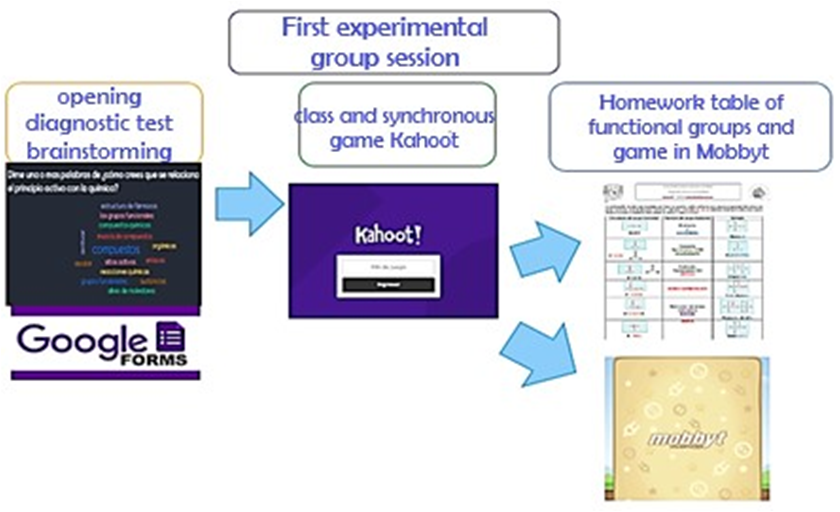
During the implementation in the group with a playful approach, it began with a brainstorming to have a conception of the previous ideas of the students as well as a diagnostic questionnaire (Annex 1) through a Google form with the same purpose of seeing the initial knowledge and thus generating evidence of the beginning of the students. The explanation of the topic was developed in Power Point and for the closing of the class a game in Kahoot was implemented in synchronous mode. In addition to the game, activities were left at home such as completing a table with functional groups and a game on the Mobbyt platform (Figure 1).


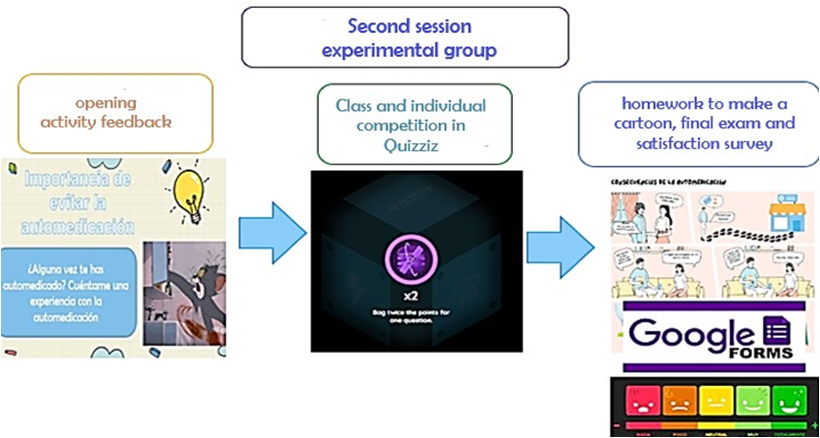
During the second session the explanation of the topic was given and for the closing a synchronous game was made on the Quizizz platform and the final questionnaire was carried out to have evidence of the knowledge acquired and it was left home to make a comic in order to be able to give them a creative space and at the same time that they could reaffirm and deepen those topics (Figure 2).
While in a second implementation in the group without a playful approach began with brainstorming, the explanation in Power Point and for the closing they were asked to elaborate an infographic and the arrangement of a home first aid kit. In the second session began with the feedback of the activities, in the development the explanation of the topic was given and for the closing they were asked to accommodate a relationship of columns with the concepts seen in class.
It is worth mentioning that the answers to all the activities were collected on digital platforms or as handwritten images, but the synchronous activities such as explanations were always online, using Zoom, so in this research the groups were divided as: groups with a playful approach and groups without a playful approach with the use of CT and ICT.
In both groups, the concepts related to the topic of drug formulation were reviewed without neglecting some but giving more emphasis to learning to identify functional groups in the active ingredients.
3.2. MaterialsFigure 2 shows the platforms used in the application of the strategy proposed in the experimental group, with different objectives, explanatory, demonstrative, reinforcement among others 7.
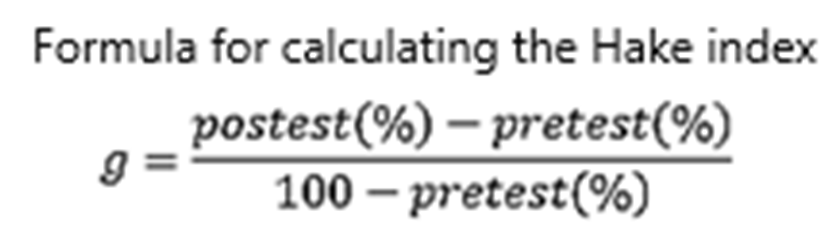
To evaluate the learning acquired by the students, the results obtained through the use of Hake's equation 8 were analyzed in which g is the relationship between the results of the percentage of correct answers before (pretest) and after (posttest) of the strategy; If the result of g is less than 0.3 the learning gain is low while if it is greater than 0.7 the learning gain is high, these percentages are shown in table number 1 and visually we can see them in graphs 1 (experimental group) and 2 (control group), in most of the items it is shown that the % of assertiveness increased after the application of the strategy.
The formula to perform the calculation of the Hake index is Figure 3.

A pretest was performed before the application of the strategy and a post test to see its effectiveness, the results of the percentage of assertiveness and the calculation of the Hake index are presented in Table 1, where g less than 0.3 is low learning gain while if it is greater than 0.7 the learning gain is high.
The Hake index was calculated with the use of the percentages of assertiveness between the initial and final test of both groups, the results are presented in Table 2.
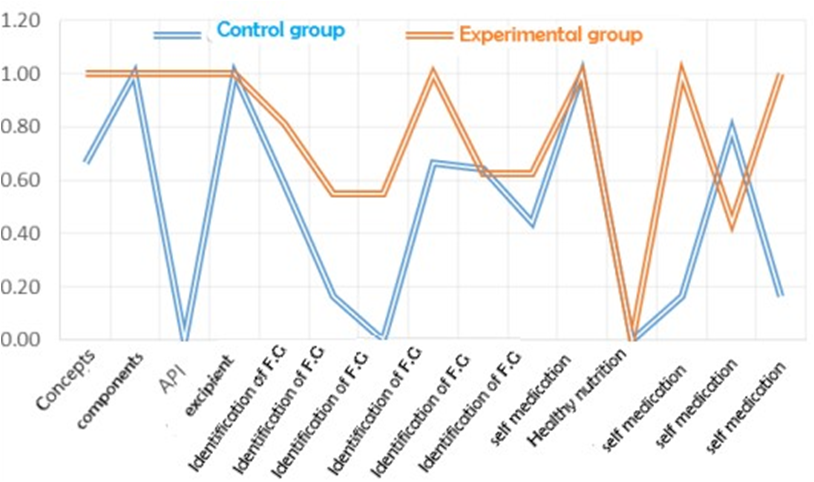
When analyzing the rate of learning gain in both groups, it can be observed that it is higher in the experimental group (Figure 4), where we can observe in which items the experimental group surpassed the control group, in those that are those corresponding to the identification of functional groups of the active ingredients.
Figure 3 shows the Hake Factor calculated for the two groups of students, the control and the experimental, shows that the didactic strategy proposed for the teaching-learning of the formulation of drugs, showed a positive impact on most of the items, and the average Hake factor of the control group was 0.52 and the average of the experimental group was 0.77.
Additionally, an analysis of the variance was carried out using as treatments the implementations of both didactic strategies (traditional and with the use of ICT) to see if there was really a significant difference in the learning gain index between both groups, the results of the ANOVA calculation performed are shown in Table 3.
Based on the plan, it was established as a null hypothesis that there are no significant differences between both groups with different strategies with respect to learning gain, while the alternative hypothesis will be that there is a significant difference with respect to the learning gain with the different strategies applied. As can be seen in the F of tables (4.1132) is less than the calculated F (6.5469) so the null hypothesis H 0 is rejected, thus establishing that if there is a significant difference between the learning gain obtained by the students between one and another strategy 9.
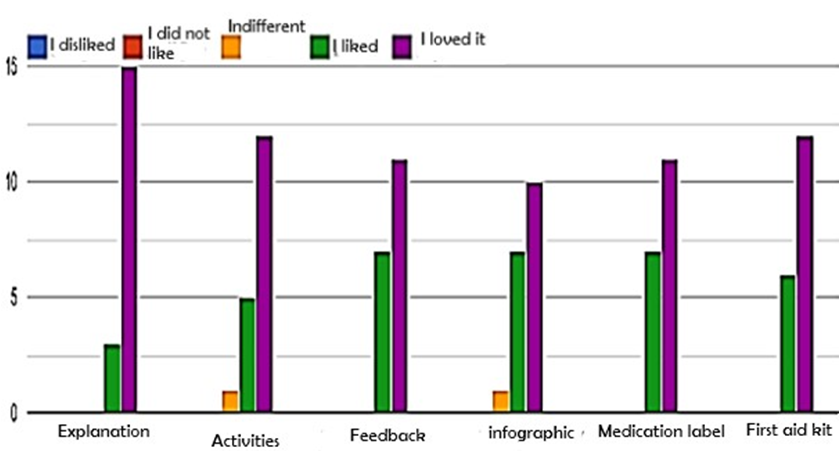
A satisfaction survey (Annex 2A and 2B) was applied to the students to know how their experience was for each strategy and in this way to generate perspectives of what could help improve this exploratory study. The results obtained from the surveys applied with Likert scale are presented in Figure 5 that shows the degree of satisfaction of the activities carried out in the control group.


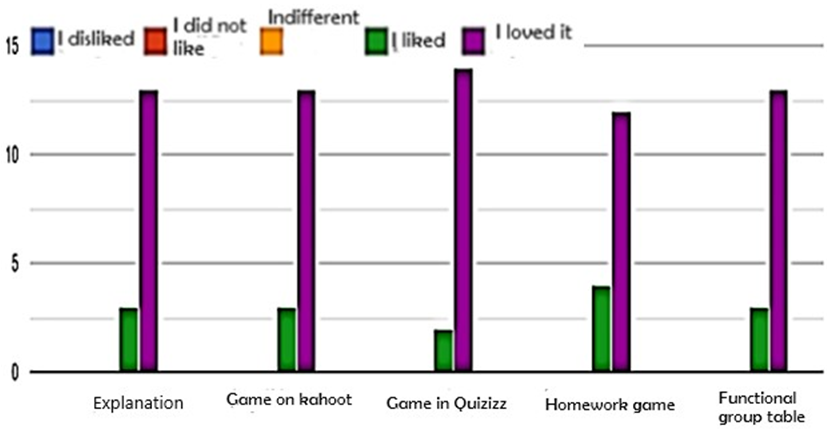
In the experimental group, data were obtained, with respect to the activities carried out in the different platforms with the use of ICT, by the application of the Likert scale in Figure 6.

The results indicate that the difference in terms of learning gain between both groups is significant with a statistical reference such as the analysis of variance for both treatments in very similar populations.
This paper presents the development and implementation of a didactic sequence focused on the teaching-learning process of the subject of drug formulation with the use of ICT, taught at the upper secondary level. The development of the strategy is based on an instructional design of the ADDIE type. The topic of medicine formulation is novel to students because of the social and environmental impact it can have on everyday life. We can point out that the gain of learning with the proposed strategy is greater than that obtained in the traditional method. The digital platforms used favored the learning process in addition to giving greater dynamism to the class allowing us to have variety in the type of activities. The selection of ICT tools will depend on the educational needs of the students, as well as the context they present, the type of institution and in this case the educational level where they were implemented 10.
Remember that the new generations are also called digital natives who tend to quickly absorb multimedia information from images and videos equal to or better than if it were text, so the use of ICT in these new generations is accepted in most cases, mostly if they are easy to access and use. The results obtained reflected the influence that the use of LKT with a playful approach can have on student learning on the topic of drug formulation measured through the calculation of Hake's learning gain.
The statistical analysis carried out between the groups under study showed that the learning gain in the experimental group presents a significant difference, so it can be seen that there is real learning through the use of recreational activities in the teaching of topics such as the identification of functional groups in drugs."
This study received no specific financial support.
The authors declare that they have no competing interests.
| [1] | Jaramillo, A.A., Obaya-Valdivia, A.E., Vargas-Rodríguez, Y.M. (2019) ADDIE, Instructional Design Based on Flipped Classroom for Teaching and Learning “From minerals to metals: Chemical Processes, usage and relevance” in a High School Chemistry course. International Journal of Current Research. 11 (05) 3993-3998. | ||
| In article | |||
| [2] | Saza Garzón, I. D., Mora Marín, D. P., Agudelo Franco, M. (2019). El diseño instruccional ADDIE en la Facultad de Ingeniería UNIMINUTO. Hamut’ay. Lima-Perú, 6(3): 126-137. | ||
| In article | View Article | ||
| [3] | Chirino, V. and Molina, A. (2010). Critical factors in a definition of mobile learning model, Cruz Cunha, M.M., and Moreira G. (editors) Handbook of Research on Mobility and Computing, Evolving Technologies and Ubiquitous Impacts. Portugal. IGI Global. | ||
| In article | |||
| [4] | Barriga, F. D. (2021). Principios de diseño instruccional de entornos de aprendizaje apoyados con TIC: un marco de referencia sociocultural y situado. Tecnología y Comunicación Educativa, 41 4-16. | ||
| In article | |||
| [5] | Rodríguez, Y.B., Obaya-Valdivia, A.E., Vargas-Rodríguez, Y.M. (2021). ICT: Didactic Strategy using Online Simulators for the Teaching Learning of the Law of Conservation of Matter and its Relationship to Chemical Reactions in Higher Middle Education International Journal of Educational Technology and Learning 10 (2) 56-67 | ||
| In article | View Article | ||
| [6] | Castro, S., Guzmán, B., Casado D. (2007). Las TIC en los procesos de enseñanza y aprendizaje. Laurus. Revista de Educación. 23 213-234. | ||
| In article | |||
| [7] | Edelmira, R.M., Duarte, J.E., Fernández, M.F. (2018) Validación de un material didáctico computarizado para la enseñanza de Oscilaciones y Ondas a partir del estilo de aprendizaje de los estudiantes, Revista Espacios. 39. (49) 38-40. | ||
| In article | |||
| [8] | Salazar, R.E., Obaya-Valdivia, A.E., Vargas-Rodríguez, Y.M. (2019) Evaluating a didactic strategy to promote atomic models learning in High School students through Hake’s method. International Journal of Education and Research. 7 (5) 293-312. | ||
| In article | |||
| [9] | Dagnino, J. (2014). Análisis de Varianza. Revista Chilena de Anestesia 43 306-310. | ||
| In article | View Article | ||
| [10] | Guardia, L. (2000). El Diseño formativo: Un enfoque del diseño pedagógico de los materiales didácticos en soporte digital. J. M. Duart y A. Sangrà Aprender en la virtualidad. Barcelona: GEDISA. | ||
| In article | |||
Published with license by Science and Education Publishing, Copyright © 2023 Heidi Cleofas Garduño, Miriam Aide Castillo Rodríguez and Obaya-Valdivia Adolfo Eduardo
 This work is licensed under a Creative Commons Attribution 4.0 International License. To view a copy of this license, visit
http://creativecommons.org/licenses/by/4.0/
This work is licensed under a Creative Commons Attribution 4.0 International License. To view a copy of this license, visit
http://creativecommons.org/licenses/by/4.0/
| [1] | Jaramillo, A.A., Obaya-Valdivia, A.E., Vargas-Rodríguez, Y.M. (2019) ADDIE, Instructional Design Based on Flipped Classroom for Teaching and Learning “From minerals to metals: Chemical Processes, usage and relevance” in a High School Chemistry course. International Journal of Current Research. 11 (05) 3993-3998. | ||
| In article | |||
| [2] | Saza Garzón, I. D., Mora Marín, D. P., Agudelo Franco, M. (2019). El diseño instruccional ADDIE en la Facultad de Ingeniería UNIMINUTO. Hamut’ay. Lima-Perú, 6(3): 126-137. | ||
| In article | View Article | ||
| [3] | Chirino, V. and Molina, A. (2010). Critical factors in a definition of mobile learning model, Cruz Cunha, M.M., and Moreira G. (editors) Handbook of Research on Mobility and Computing, Evolving Technologies and Ubiquitous Impacts. Portugal. IGI Global. | ||
| In article | |||
| [4] | Barriga, F. D. (2021). Principios de diseño instruccional de entornos de aprendizaje apoyados con TIC: un marco de referencia sociocultural y situado. Tecnología y Comunicación Educativa, 41 4-16. | ||
| In article | |||
| [5] | Rodríguez, Y.B., Obaya-Valdivia, A.E., Vargas-Rodríguez, Y.M. (2021). ICT: Didactic Strategy using Online Simulators for the Teaching Learning of the Law of Conservation of Matter and its Relationship to Chemical Reactions in Higher Middle Education International Journal of Educational Technology and Learning 10 (2) 56-67 | ||
| In article | View Article | ||
| [6] | Castro, S., Guzmán, B., Casado D. (2007). Las TIC en los procesos de enseñanza y aprendizaje. Laurus. Revista de Educación. 23 213-234. | ||
| In article | |||
| [7] | Edelmira, R.M., Duarte, J.E., Fernández, M.F. (2018) Validación de un material didáctico computarizado para la enseñanza de Oscilaciones y Ondas a partir del estilo de aprendizaje de los estudiantes, Revista Espacios. 39. (49) 38-40. | ||
| In article | |||
| [8] | Salazar, R.E., Obaya-Valdivia, A.E., Vargas-Rodríguez, Y.M. (2019) Evaluating a didactic strategy to promote atomic models learning in High School students through Hake’s method. International Journal of Education and Research. 7 (5) 293-312. | ||
| In article | |||
| [9] | Dagnino, J. (2014). Análisis de Varianza. Revista Chilena de Anestesia 43 306-310. | ||
| In article | View Article | ||
| [10] | Guardia, L. (2000). El Diseño formativo: Un enfoque del diseño pedagógico de los materiales didácticos en soporte digital. J. M. Duart y A. Sangrà Aprender en la virtualidad. Barcelona: GEDISA. | ||
| In article | |||