The presidential declaration in 2001 on the integration of Information and Communication Technology (ICT) in primary and secondary schools in cameroon constitute a major milestone for it is used in the teaching-learning process. This immediately provoked others, such as the World Bank’s cyber education initiative in 2001, and the development of a National ICT policy for the country in 2007 Tchinda (2007). Despite these efforts, it effective presence in the teaching-learning of English Language in particular is lagging. This situation worsened on the advent of the Corona Virus which halted schooling all over the world and later imposed digital education as the new order. This paper investigates the extent to which the digital environment has been prepared to render the teaching-learning of English Language effective in times of crisis like COVID-19. The digital environment is understood in this study as the possession of hardware gadgets, knowledge of, and usability of education software, skills for usage, availability of a steady and high speed internet. The study used the survey research design. 150 English language teachers were randomly selected from public secondary schools in Yaounde. A four modality likert scaled questionnaire was used for data collection, and the Pearson’s correlation was used to verify measure the degree of relation between the digital environment and English didactics. The results revealed that the digital environment was ill-prepared to ensure effective learning in times of crisis like covid-19. Recommendations have been made to authorities and teachers to prepare the digital environment with the appropriate ingredients.
The 21st century classroom is faced with two key challenges: firstly, to equip learners with the right skills for a knowledge economy, characterized by a changing work environment. The second is to enhance effective learning in emergency situations given that the world is in perpetual crisis, with Covid-19 the most recent. The latter constitute the object of study in this paper. As a matter of fact, more than ever before has learning been interrupted globally in the face of a crisis as observed with the Corona Health Pandemic that erupted from the Wuhan province of China, starting 2019, and later swallowed the globe in no time. This constituted an unprecedented shock for education systems the world over as it led to the closure of schools at all levels in 190 countries and across the six continents of the globe, 1 In this light, UNESCO estimates as of April 2020 counted about 1.6 billion children and youths who were out of school, whereas approximately 91% of those enrolled in formal education programs were affected.
In Cameroon, the Government Response Strategy under the pilot ship of the Prime Minister-Head of Government instructed the closure of schools from March 18, 2020. This saw the closure of 31,851 schools with over 7 million children and youths of school age affected. Moreover, approximately 4,200 community learning centers also shut their doors across the national territory, all in an attempt to contain the spread of the COVID-19 (UNICEF, 2019). Despite this frightful circumstance that still persists till date, education is destined to continue, and with expected quality standards. This is for the simple reason that undermining the crucial role of education for the world’s upkeep in the 21st century may lead to a sharp downturn in knowledge and leave us in a sinking swam.
As a result, the teaching-learning process has dramatically shifted to online as observed in countries like Japan, the United Kingdom, and many more. Dhawan 2, even recounted that the e-learning industry is projected to be worth 128million Euros by 2021 globally as the deadly corona virus has eliminated physical learning procedures. This author added that online learning has been adopted as a panacea for ensuring effective learning in front of a health pandemic of this nature. This mean that the digital environment is offering millions of students the opportunity to learn effectively as they stay at home or with limited access to school. It therefore suffices to mention that a shift to television learning as lessons were being delivered to learners of examination classes of both primary and secondary schools is saluted, though with shortcomings.
In this light relevant significant questions to pose include: what became of intermediate classes given that this measure was to avoid a blank school year for end of course learners? Were all the actors of the education community prepared in terms of possession of digital tools for this task? Do actors of the education community have knowledge on, and can use education applications for online learning? Does the current level of technology appropriation in Cameroon, which is worrying low as indicated by 3, 4, 5, 6, 7, 8, 9, 24, 25, warrants a successful shift into the currently imposed digital age, and by the current Covid-19 context? To what extent does the state of the internet in Cameroon enhances online learning dynamics? Searching for responses to these questions constitute the fulcrum of this study. It investigates the extent to which the digital environment influences effective learning of English language in general in times of crisis like covid-19 in Cameroon.
It suffices to mention that English language, according to Section1 (3) of the 1996 Constitution of the Republic of Cameroon, is one of the official languages of cameroon (The constitution of the republic of Cameroon, 1996) 10. Meaning that the important role it plays in the country’s communication cannot be overemphasized. This has been concretized through law N0 0098/ on the Orientation of Education in Cameroon. All these legal and policy efforts have made English an obligatory discipline from basic education, through high school in Cameroon. This, therefore brings us to the stakes surrounding English language skills in these schools, otherwise known as English didactics. Unlike other disciplines that have gone online as a result of Covid-19, English language is not an exception. Given the crucial role demonstrated by varied authors in the use of educational technologies in enhancing effective learning in emergency situations, how can this be adapting in the teaching of English language in secondary schools in Cameroon? This study has the following specific research objectives:
- To investigate the extent to which the possession of ICT hardware by immediate actors of the education community influences effective teaching-learning of English language in the age of covid-19 in public secondary schools in cameroon.
- To find out the degree with which platform thinking and usage enhances by immediate actors of the education community influences effective teaching-learning of English language in the age of covid-19 in public secondary schools in cameroon.
- To examine the effectiveness of the internet in terms of speed and consistency favors effective learning of English language in public secondary schools in Cameroon.
- To verify skills in possession of actors, for the effective manipulation of the digital environment so as to facilitate effective teaching-learning of English language in the age of covid-19 in public secondary schools in cameroon.
Technology constitutes an inevitable path in today’s society, that is rapidly evolving and advancing on various levels 11. Despite global advancement in the span and availability of technology, schools still face difficulties to maintain a technology culture. It is more evident in developing countries where drawbacks on challenges in access to ICT equipment, ICT skills and internet still constitute a major obstacle, whereas developed countries have evolved significantly in the integration of ICT in the Educational milieu. In this light, UNESCO 12 in a working paper examining mobile learning in Northern America underscored the fact that the prevalence of technology in schools and the increase availability of digital content and resources resulted in more learning effectiveness and performance per se. This is to say that, online learning is an emerging field which requires fast recognition and integration by educators and learners.
In the forgoing, the ambiance in Africa does not speak well as compared to Western countries. As a matter of fact, educational institutions, schools, colleges and universities in African countries currently still insist or practice exclusively traditional methods of learning that is, face-to-face lectures in classrooms. This is happening at a time when blended learning has been introduced and emphasized as a major step towards the integration of technology in education. This wave of resistant by the African society is still a call for concern however. But this description is not a one size fit all in the sense that a considerable number of African nations (Tunisia, Egypt, South Africa, Nigeria, Ghana, Kenya, Ivory Coast, Cameroon) just to name these few have made considerable efforts to introduce online learning in the educational system, amid facing challenges of access to soft and hardware equipment, relevant technology skills and ICT culture as a whole.
The integration of EdTech began only in 2001 in the primary and secondary education in Cameroon and has been evolving at a slow and unsatisfactory pace. This is evident in the concentration of EdTech in urban and partly in semi-urban areas. In this direction, very few schools are in possession of a computer not to talk of a computer laboratory. This discourse can be pursued when we question the possession or availability of ICT gadgets by actors of the educational community, frankly speaking, a report by the Ministry of Economic and planning reveals that less than 30% of the rural population own mobile phones and or computer amid over 80% in urban centers (Ministry of Economy and planning 2019). This report expatiates in the fact that monetary poverty continues to be a major obstacle in the Cameroon context, whereas teachers, parents and students must be in possession of good performant ICT gadgets for us to attain a wide range of EdTech integration.
To add to the above, today’s generation is a technology DNA inscribed. UNESCO 12 support this statement as she underscores that this is a generation born of technology, meaning that we are inseparable from technology; therefore, it constitutes our todays cultural trend: how we live, think, work and act. In this light, Dhawan (ibid) contends that “online teaching is no more an option, it is a necessity” this author explains in her article title: online learning: a panacea in the time of COVID-19 crisis that in the Indian context, the pandemic has made institutions to go from offline mode to online mode of pedagogy. To this end, the crisis would make educational institutions which were reluctant to change to accept modern technology. This shift has already been observed in countries like China and even in Cameroon where online education in the universities have increased exponentially during the break.
An important point to underscore in this study is on the degree of ICT skills possess by educators. Given the maxim that we are a DNA technology generation, it is therefore sufficing to contend that, teachers would hardly survive in their role as facilitators without sharpening their skills in the use of ICT in the learning process. In this line, UNICEF and Save the Child in numerous reports in recent years observed that the learning environment has changed dramatically to embrace the fourth industrial revolution which has given more importance to technological innovations. the standard for teachers to cope in the midst of such novelty requires a corresponding shift as well. It therefore follows that this study examines the digital environment in four core dimensions as seen below:
2.1. The Dilemma of Possession of ICT Hardware ToolsIn the 21st century knowledge-based economy, a sufficiently possession of up-to date ICT hardware tools by stakeholders of the education community is a milestone for successful integration, and facilitating effective learning. This concerns in particular learners, teachers, and parents who are the principal are directly involved in students’ learning. In Cameroon, it is estimated that EdTech hardware amidst Mobile android phones, laptop or desktop computers, radio and televisions are insufficiently available for teachers and learners. In this light, Beche 15 asserts that the appropriation of EdTech begins with having the appropriate hardware. These include computers, mobile android phones, video projectors, printers, televisions, radios, and the list is long. A recent study by Nkamji (2019) reveals that the only and approximately 25% of the immediate actors of the teaching-learning process are in possession of up to date hardware for learning in Cameroon. This author precise that most teachers use this hardware for typing examination questions, and entering of marks. The findings of a study carried out by same author in primary and secondary schools in Yaounde indicates that only 23% of teachers have ever projected their lessons. The responses by most of these teachers simply justify the fact that either they lack personal computers or multimedia centers are absent in their schools. More seriously is the fact that the cyber project initiative to provide these centers in secondary schools in Cameroon has almost ended up in urban areas. The fact that most teachers lack this hardware made it difficult to work with learners in times of crisis like the covid-19.
However, new trends have evolved in the possession of EdTech hardware by actors. This is based on the observation that about 80% of secondary school learners in urban centers own an android mobile phone. Despite restrictions by the school regulations for being in possession of a phone by students on campus, it has been observed that learners are ready to do anything to penetrate the school with their phones. This brings us to another question of not only having these hardware, but on what it is being used for. It is even recounted that today’s learners are termed “youths of the android generation”, a term explaining that there is no way to separate these learners from their android phone, Mbagwa, 2019. It therefore follows that shifting learning material into these android phones will oblige them make meaningful use of them, than surfing the social media on irrelevant topics.
2.2. The Degree of Usability of Hard and SoftwareThe problem of digitalization in Cameroon secondary schools today is not merely limited to the availability of ICT tools, but extends to their level of usage by actors in the teaching-learning process. To this effect, Mbagwa (ibid) posits that the culture of using learning platforms such as google scholar, or Mass Open Online Courses (MOOCS), and Learning Management Systems (LMS) is yet to make its way into the teaching-learning process. In the midst of the covid-19, only end of course classes had the opportunity to interact through online learning platforms. It follows that very few teachers who are familiar with these platforms could use them, and yet mostly in higher education institutions, Beche 13. In this light, Karsenti (2009) 4 classifies teachers in several categories based on their degree of usage of ICT in teaching-learning process. In this light, teachers who actually use these tools both in preparing and teaching their lessons fall within the first category. Karsenti call them the pioneers. The second category known as the sceptics are those easily get discouraged by integration challenges. Two sub categories appear here, which are: the unsecured (they use ICT to prepare lessons, but do not use them in class), and the fearful who consider a computer as a mysterious box, which is very difficult to understand. The last category, known as the hesitant are teachers who do not even believe that ICT tools can facilitate the teaching-process.
According to Mbagwana 24 it would be a fierce battle as we embark on the introduction of ICT in the learning process. This view is shared by Ndongfack 8 as he captures the lukewarm attitude portrayed by primary school teachers in using computers to prepare their lessons. Ngoungouo 14 recounts that most teachers still prefer to prepare their lessons manually, and to deliver them physically. This questions the state of English language teaching in the face of crisis like the covid-19. It is in the same tone that Fonkoua 4 explains that the familiarization of teachers with these tools is crucial for satisfactory level of usability in teaching.
2.3. The Question of an Accessible, Affordable, Steady and High Speed InternetCameroon’s digital landscape was boosted in 2016 by adoption of the National ICT Strategic Plan 2020. This saw an improvement in the telecommunication infrastructure including an extension of an optical fiber of 12000 Km, connecting 209 of the country’s 360 subdivisions. The internet is under the regulation of so many bodies under the ministry of Communication such as the Telecommunication Regulatory Agency(ATG), and the National Telecommunication Agency(ANTIC). Added to this that four telecommunication companies exist in the country which are: Mobile Telephone Network (MTN), Orange Cameroon, Nextel, and Vittel the internet in the country is not steady, and speedy.
2.4. The State of the Learning EnvironmentFor many centuries now, education; whether formal, informal and non-formal constitutes the main lever for developing all human’s faculties for full integration in the society. So to say, formal schooling which has been the most recommended has through world leadership, policies and reforms done the bulk of the work, that is in ensuring basic and higher education for all. The resolutions of the Education for all conferences of Jomtien in 1990, Dakar in 2000, the Millennium development declarations, and the 2030 agenda are a few to mention. In Cameroon, the 1995 educational forum set the pace of Cameroon’s educational fabric, which was later confirmed in the 1996 constitution, and concretized by the 1998 education orientation law. Despite these ground breaking developments, the state of learning globally, and Cameroon in particular is still in crisis as statistics by a UNESCO Report 12, indicates that a quarter of a billion children, adolescents and youths are not in school. This report emphasizes that fact that education is an opportunity with potential to transform lives. Yet, an estimated 258million of children, adolescents, and youths or 17% of the world’s population are not in school. The situation is quite uneven in sub-Saharan Africa as the number of learners out of school surpasses that of Central and Southern Asia and is growing.
The state of learning in Cameroon has increased but quite lagging. A report by the Ministry of the Economy, and Planning 26 that as of 2015, preschool gross rate was 37,5% for children aged 4-5, primary school completion rate by sex was 72.8% for girls, and 79,7% for boys, the literacy rate of young women aged 15-24 was 68%, while that of male youths aged 15-24 was 83%. In the same light, a substantial supply of qualified teachers has been encouraging but still low. Similarly, a world bank report for 2018 indicates that the state of learning in Cameroon is significantly compounded by poor infrastructure, weak governance, less funding, corruption and little efforts to balance gender education, rural education, and the underprivileged. The education system of the country has suffered significantly from the Boko Haram insurgency in the Far North Region since 2014, while education in the English speaking regions of the North and South west regions have been disrupted since 2016 by the socio-political struggle. Amid these crisis challenging context for education, learning requires to continue as expected. The reason why technology has been spotted in recent years as instrumental in improving learning, and enhancing effective learning times of crisis.
To proceed, a lot of issues are attached to online learning but we cannot ignore the gravity of it in times of COVID-19 pandemic that has put a major part of the world on quarantine and therefore turned many cities into phantom cities with important damage seen in schools, universities and colleges 1. Amid this global breakdown, human activities including education ought to continue. It is against this backdrop that online teaching and learning rapidly received unprecedented attention as 2 terms it as ‘a panacea for the crisis’. Within the context of a health pandemic the world has never witnessed, and that its nature and mode of transmission was evident in simple human interaction or contact. Therefore, a lockdown or a cut off between contact was the first preventive measure prescribed by world leading health authorities, thus the only way out at this moment as described by Dhawan (ibid) was to embrace online learning no matter the inconveniences attached to it.
Cameroon is ranked among the first five African countries to have witnessed increased numbers of COVID-19 infected, amid an insignificant number of deaths. On this score, the incumbent Cameroon prime minister Joseph Dion Ngute prescribed response majors among which total school short down was part. Trapped in the dragnet of weak online learning dispositions, only the public and educational administration adopted the use of online mechanism such as video conferences, WhatsApp and emails to reactivate institutional activities even though at a low pace. Given that end of course examinations were fast approaching, the various ministries of education (Minesec and Minedub) resolved to television teaching only for examination classes. Constraint related to this are evident and enormous. The adaptation of the teachers, the question of outreach to all learners even in rural areas who are neither in possession of a television set nor electricity, the follow up of parents on their children, just to name these few.
The expression “English Language teaching” from the layman’s view is often understood as the whole process of preparing and delivering lessons in English language. It is a process that intends to inculcate on learners the English language skills of reading, writing, speaking and listening and the sub-skills of grammar and vocabulary. These skills are today divided into two main groups: Essential knowledge (grammar and vocabulary) and category of action (reading, writing, listening and speaking). The acquisition of all these skills is what makes learners proficient in the language. Therefore, to consider learners proficient in English Language, they should be able to speak, read, write and understand the language. If this is not attained, then proficiency in the lxanguage is not reached and you can be considered as illiterate or to have barely acquired an elementary knowledge in the language.
In Cameroon, the state of English language has evolved on the grim of cross views between policy makers, scholars, and language teachers per se. On a first note, despite legal and policy dispositions for this language to constitute one of the official mediums of communication in Cameroon, its valorization in the education system has been on a slow pace. As a matter of fact, after 60 years of sovereignty, the question of outreach and quality still hover around English language. According to Chiatoh and Akumbu 27 policy makers have really ignored the ingredients required to achieve quality in English language writing and speaking in Cameroon. These authors underscored that the consequences are surfacing after 50 years, with intensified concerns about falling standards. In this light, a world bank development report for 2018 on Cameroon revealed that English language is serious only in the two English speaking regions of the country, and sporadically present in the French Speaking Regions, (world bank, 2018). However, this is totally replica at all levels of the education systems. This can be justified by the lukewarm attitude by French learners who consider the minority spoken English as a “no issue” to for them. Frankly speaking, upon my interaction with some high school French learners they often make statements like “L’Anglais c’est Dieu qui donne”, “C’est le Cameroun qui est bilingue et pas les Cameroonians”. This gives the impression that they have blocked their minds to the learning of English and this can be interpreted as a lack of ‘push’ or interest in the language.
This has sparked some significant transformation in the learning environment from quantity to higher quality through the use of EdTech. As a matter of fact, in the field of education, the introduction of e-learning has brought about a paradigm shift in the teaching and learning process. Nowadays, our students are harnessing new technologies and thus they learn in a new digital manner. They create knowledge rather than memorize and repeat content. (Ngwa et al 2013, cited 15) Within this new digital environment, todays classrooms must provide our students with lessons where the outside world of emerging technologies is bridged to the classroom and act as guide. Learners should feel that they can have an online identity in networking spaces in order to increase opportunities for learning, to foster collaboration, motivation and knowledge sharing. EdTech help students to do research since learning is student-centered. This simply means pedagogically through independent, self-paced learning; (learner autonomy), students interact with modern technologies to review, construct, analyze and make suggestions in their learning processes. This premises are significantly tied to the status of English language globally, and in cameroon in particular as described below.
In this light, Sala and Ubanako, ( 16: 71) quoting Crystal, 17 affirm that English language is used in all the six continents of the globe and has a semi-official status in over 70 countries. English language is the world’s most successful language with over 1500 million speakers. There is the belief that if its growth continues at this rate, the less powerful tongue will be lost one day. Today, English is an international language; it is the language of science and technology. 85% of computer information is thought in English, 75% of written communication is in English language. English is therefore the working language of multinational companies, government and non-governmental organizations, politics, cinema, sports etc. Many people around the world are increasingly learning the language more than any other language since it gives them more opportunities in the world. Sala and Ubanako, (ibid) quoting Modiano, (1999: 13) who commented about the future of English as he states that:
At this point in history it seems to be the case that sociolinguists are convinced that English will continue to be the common language for cross cultural communication. It is envisioned as the language for the global language, the lingua franca.
English language today cannot be the property of a specific country, culture, race, religious group. It cannot also be restricted geographically. The desire to learn and speak English is therefore very important. The socio-cultural explanation looks at the way people all over the world in many works of life, have come to depend on English for their wellbeing. The language has penetrated deep into the international domains of political life, business, safety and communication. The convenience of having a lingua franca available to serve the global common relations and needs has come to be appreciated by millions. Several domains have come to be totally dependent on it, the computer software industry being a prime example. A language’s future seems assured when so many organizations come to have a vested interest in it.
The importance of English is further highlighted by Crystal, ( 17: 106) as he writes the history of the spread of English as far back as the 17th century. He explained that English has moved from Europe and spread to Africa and the South Pacific as a result of the 19th century colonial development and took a significant step when it was adopted as the semi-official language of many newly independent states in the 20th century. The spread of English has been seen at three concentric circles in which the language has been acquired or used. There is the inner circle, the outer or extended circle and the expanded circle. It is to this effect that Crystal, (ibid) says his decision to write the grammar of this language is because there is high demand for it by foreigners who are interested in important works written in English.
Mpoche and Chandramonan, ( 18: 69) make mention of Kachru’s (1990) concentric circles showing how English is important not only in Cameroon but in the world at large. They had this to say:
The Cameroonian context of English language learning falls within Kachru’s (1990) Outer circle as well as Inner circle... Kachru (1990) captures the global trend of English and resultant innovations around the world in terms of its new roles in range of functions and depth of societal penetration. This he does by classifying English into three concentric circles: Inner (native speakers), outer (mostly users of English and second language) and expanding (mostly users of English as a foreign language.
Tanda and Mumambang, (2006) corroborate the significance of English language when they observed that English has gained an international status in recent years such that it becomes difficult to operate in today’s ever-globalising world with style without good knowledge of it. They say it has also become the international language of trade and commerce within the global village. Tanda and Mumambang, (ibid), quoting Chrystal, (1997), refers to the common code necessary for effective communication in English as World Standard English (WSE).
McArthur, ( 19: 15) also highlights the significance of English. To him, English has become a super-meta language, that is a world-wide vehicle for the discussion and languages in general and a default language, that is, it is now the medium mostly used in the world’s system of communication where one does not see the need for the other. There is therefore the need for this language to be improved through its teaching tools as to enable it stand the test of time. The use of educational technologies in the teaching and learning of English will greatly influence both the written and spoken forms of English positively, and will permit easy communication.
This therefore calls for the use of material that reflects the environment in which we live today to teach and learn English. This is to say, old pedagogic methods and the use of text books are not sufficient in the teaching and learning of English language, because they have not sufficiently met the needs of teaching and learning of English. Hence, such a goal can be better achieved through real digitalization in the teaching and learning of English.
English has spread from Britain to many parts of the world and it is used either as a native language, a second language or a foreign language depending on the political and historical background of the countries concerned.
Crystal, (1997) distinguishes between three types of English using societies. English is used as a mother tongue and it is acquired from childhood in the home by Britain, the United States of America, Canada, New Zealand and Australia. Within the native varieties, some differences could be noticed in spelling and pronunciation as is the case with British and American English.
A native language is simply described as the mother tongue or first language. Bloomfield, (1993) as cited by Lee, 20 defines a native language as “the first language a human being learns to speak” i.e. a person is a native speaker of any first language he learns to speak after his birth. The definition of native language according to Bloomfield is limited because it does not take into consideration the birth place or country of origin of the speaker since it is acquired but not learned.
A second language can be any language learned after the native language or the mother tongue. This type of language is often learned in a formal situation with the help of an instructor. English is used as a second language in a country when it acts as the medium of instruction and official activities. In this context, knowledge of English is imperative to conveniently operate and survive in that country.
Sala and Ubanako, (ibid) quoted Crystal, ( 17: 3) who gives certain criteria used to consider English as a second language. He says:
A language can be made an official language of a country to be used as a medium of communication in such domains as government, the law court, the media, the educational system…such a language is often described as a “second language” because it is seen as a complement to a person’s mother tongue or “first language” …. Secondly, a language can be made a priority in a country’s foreign language teaching even though this language has no official status.
Countries using ESL are former British colonies such as Nigeria, Ghana, Kenya, Tanzania, Cameroon, Uganda, India, Pakistan, Philippines, Bangladesh and Singapore. From Crystal’s point of view, countries like India or Kenya where the language has an officially recognized place in the linguistic repertoire can be rightly classified as second language communities. Part of the respondents in this study who are teachers and students, use English as a second language.
In connection to the above, English is often considered as a Foreign Language (EFL) as well. Here, English is mainly a school subject and does not affect the social or national life of the country. English is needed for communication with other users of English, for the reading of books in English, for the watching of films in English etc. It is also used for science and technology, commerce, travels, over the media and in broadcast. Communities using EFL include: Japan, France, Germany and Cameroon. this is to say that the respondents of this study who are teachers and students however use English as a foreign language.
The use of educational technologies in the teaching of English language has been clearly explained by a handful of theoretical models among which we have the following:
a. Computer-Assisted Language Teaching (CALT)
Considerable advancements in educational technologies and language instruction provides a greater convenience, but also in a certain extent, changes the role of teachers as they become facilitators of knowledge. In tough times like the COVID-19 era, new teaching models should be based on the modern digital dispensation. CALT began to change the traditional image of teachers, as chalk, a pen, a blackboard, a book is being replaced with modern technological gadgets, and this has led people to rethink the role of teachers. In the computer age, learners can have multi-channel access to knowledge, teachers are no longer the only source of knowledge, and the teacher is a facilitator and a guide. The teacher’s focus has shifted from the traditional handwriting on the blackboard and moves to the big screen (Over Head Projector). Teachers guide the learners in the learning process to overcome various unfavorable factors. The guidance given to learning are: how to use the computer to the various resources, how to find useful resources, how to effectively operate computers and above all, how to learn English language through modern technological gadgets.
With the development of information technology, CALT is gradually changing the role of teachers. Teachers are no longer at the center of teaching, the master of the classroom and knowledge no longer comes directly from the teachers. Computer-aided language teaching in some areas reduce the teaching staff, but the computer is only an auxiliary teaching tool since the presence of the teacher cannot be totally excluded. The teacher’s presence is needed to guide students on how to go about with the learning process and maintain order in class.
Although CALT is good, it can only be effectively implemented if the language teachers are trained with ICT skills. If teachers lack or are not interested in training and improving their ICT skills, then using ICT to teach will not be a reality despite the fact that it is important, facilitates and makes the teaching/learning process easier and stress free. Teachers are therefore called upon to improve on their ICT skills and upgrade their teaching to the standard of the global society.
b. Computer Assisted Language Learning (CALL)
Scott, David and Beadle, Shane (2014) define Computer Assisted Language Learning (CALL) as “any process in which the learner uses a computer to improve foreign language competence.” The technology includes not only computers but also smart phones, tablets, and MP3 players. CALL therefore includes: Authentic foreign language material, such as video clips, flash-animations, web-quests, pod-casts, web-casts, and news etc. Online environments where learners can communicate with foreign language speakers, through email, text-based computer-mediated communication (synchronous and asynchronous), social media, or voice/video conferencing; Language-learning tools (online apps or software), such as for phonetics, pronunciation, vocabulary, grammar and clause analysis, which may include a text-to-speech function or speech recognition, and often includes interactive and guided exercises; Online proprietary virtual learning environments, which offer teacher-student and peer to peer communication; and also Game-based learning.
Moreover, CALL promotes student-centered learning, allowing for self-paced learning styles, and increased risk-taking. It can provide learners with autonomy and the choice of when, where, and how to study. E-mail and other computer writing tasks encourage self-monitoring because of the ability to proofread before producing a final draft. This means that the effective use of CALL depends on teachers’ ability to understand and integrate the use of the applications in their curricula. Many teachers lack the competence to use them in the classroom and the knowledge about CALL teaching aids. The expansion of CALL on a large scale also depends on the availability of schools and homes with access to software and systems although this is not considered to be a barrier in some countries.
The use of CALL also depends on the ways in which teachers adopt and integrate it into their teaching. Factors that influence teachers’ use of CALL include personal knowledge and attitudes, teacher training and professional development, and perceptions of its effectiveness. Instructors must possess online knowledge and skills as well as the ability to choose how, when, and to whom to apply CALL.
Developing online teaching skills (DOTS) was a project aimed at assisting language teachers in using up-to-date technology in their teaching. A training kit was developed, which includes bite-sized activities for ten online pedagogic tools. By completing the activities, teachers can learn to use these tools and integrate them into their language classes. They can also watch video clips of experts explaining their use of the tools and discuss their experiences and needs. This means that teachers should be trained in CALL pedagogical design and effective adoption and integration of CALL into teaching. For many language teachers, there is low awareness of CALL and limited ability to use CALL even with the availability of the technology.
There are other pedagogical decisions to make such as how to balance CALL with other more traditional methods in the classroom. Scott, David and Beadle, Shane 21 citing Pérez Torres (2002) who suggests that the use of CALL should be one hour a week in four hours a week courses and on a fortnightly basis for three hours a week courses. This may be important when online access means that students become distracted by irrelevant material. CALL can be part of an approach to blend learning of languages which encompasses guided learning and non-formal and informal learning.
To sum it up, far from being a tool mimicking a textbook or teacher, CALL has the power to transform language learning through the application of innovative research and practices. Although the potential of the Internet for educational use has not been fully explored yet and the average school still makes little use of computers, it is obvious that we have entered a new information age in which the links between technology and language teaching has been established. Nowadays, the internet is gaining immense popularity in language teaching and more and more educators and learners are embracing it. The reasons for using CALL include: experiential learning, motivation, enhance student achievement, authentic materials for study, greater interaction, individualization, independence from a single source of information, and global understanding. This form of computer-based instruction corresponded to cognitive theories which recognized that learning was a creative process of discovery, expression, and development.
c. Didactics transposition model.
The problem of didactics transposition has been a long history as teachers have continuously questioned how subject matter can be organized for easy delivery, adapted and assimilation by learners. This concept was made prominent by Yves Chevallard in the 80s, when he published the book on la transposition: didactique du savant au savoir enseigne. Though published in the domain of mathematics, the results were later extended to other domains of knowledge. It therefore follows that 3 interrelated elements emanates from this theory, which are:
- Savior-savant: the knowledge produced by researchers.
- Savior a enseigne: the knowledge being treated by teachers to be taught.
- Savoir enseigne: the knowledge actually taught.
This can be represented in a schematic way as follows:

Applying this schema in this study simply convokes the use of digital technologies in the online research by teachers to access books and articles online that can be used to prepare their lessons. These tools can also be used in typing and presenting of lessons. However, recent authors have criticized this theory for not caving out clearly the role of technology in this process of knowledge transformation.
It is a quantitative study, hence was conducted through the survey research design. The researcher deems it necessary to use this design as it permitted the handling of a good number of respondents. Also, core to the problem of digitalization in the teaching-learning process in Cameroon are still issues related to the availability of digital tools, skills possession, steady and speedy internet, and motivation to usage in teaching. These variables are however quantifiable, hence justifying the choice of this methodology. In this light, 150 English language teachers were randomly selected from public secondary schools in Yaounde. A four modality Likert scaled questionnaire was then used for data collection, and the Pearson’s correlation was used to verify the degree of relationship between the digital environment and English didactics. This choice of the area of study is based on the fact that the researcher operates in this zone, and therefore is versed with the dynamics of the teaching-learning environment.
8.1. Descriptive Statistics
8.2. Inferential Statistics
Pearson Correlations between the possession of technology gadgets, usability of education software, digital skills for eLearning, availability of a steady and high speed internet, and English language teaching.
 |
The Pearson correlation table above shows important statistics such as the correlation coefficient (r) as follows:
- Possession of Technology gadgets: r = 0,947, which is high, and moves towards 1 as per the correlation law. This indicates a strong correlation between Possession of Technology gadgets and English didactics. This is equally based on the fact that the level of significance is 0.000, largely less than 0.05, (alpha) which is the standard error margin: r = 0,947, P= 0,000 ≤ 0,05. This signify that the Possession of Technology gadgets is statistically linked to the problem of English language teaching in these secondary schools.
- Usability of education software: r = 0,938, which is high, and therefore indicates a strong correlation between Usability of education software and English didactics. This is equally based on the fact that the level of significance is 0.000, largely less than 0.05, (alpha) which is the standard error margin: r = 0,938, P= 0,000 ≤ 0,05. This mean that low rate at which teachers use this software in the teaching of English language requires to be improved upon.
- Digital skills for eLearning: r = 0,897, which is high, and therefore indicates a strong correlation between Digital skills for eLearning and English didactics. This is equally based on the fact that the level of significance is 0.000, largely less than 0.05, (alpha) which is the standard error margin: r = 0,897, P= 0,000 ≤ 0,05. This indicates insufficiency in the possession of digital skills for eLearning by these teachers is a call for concern.
- Availability of a steady high speedy internet: r = 0,906, which is high, and therefore indicates a strong correlation between Availability of high and steady internet and English didactics. This is equally based on the fact that the level of significance is 0.000, largely less than 0.05, (alpha) which is the standard error margin: r = 0,928, P= 0,000 ≤ 0,05. This signify that the lack of a steady and speedy internet is hinders the flow of English language teaching in these schools.
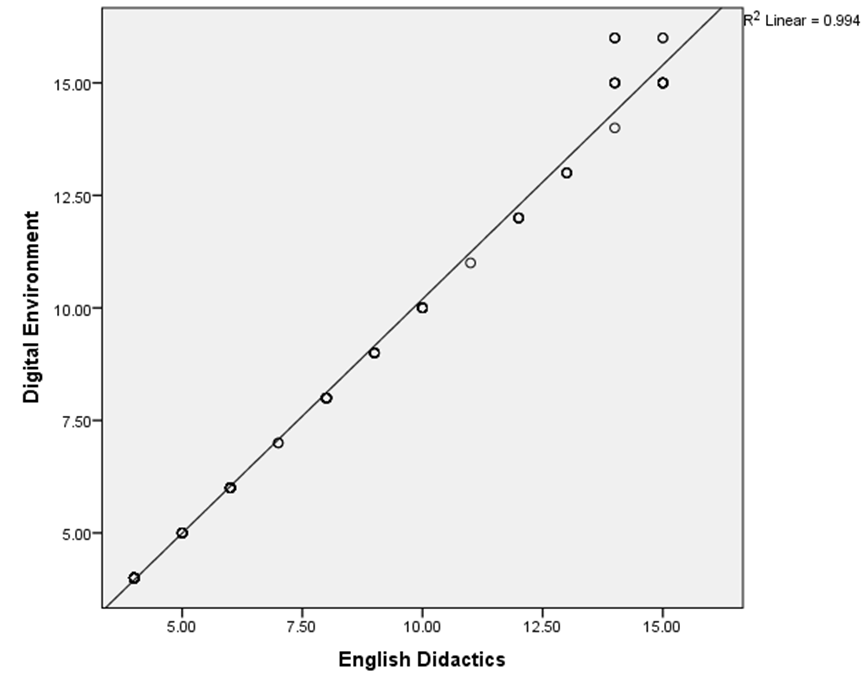
Observing from the above results, all four items have been confirmed at extremely high correlations coefficients, hence confirming the hypothesis that there is a high correlation between the digital environment and the English didactics. This is demonstrated in the figure below.

The scattered plot graph demonstrates a significant concentration points around the straight line. This indicates that English didactic will be of high quality if the digital environment is sufficiently established and managed. This is backed by the high determination coefficient, which is 0.994.
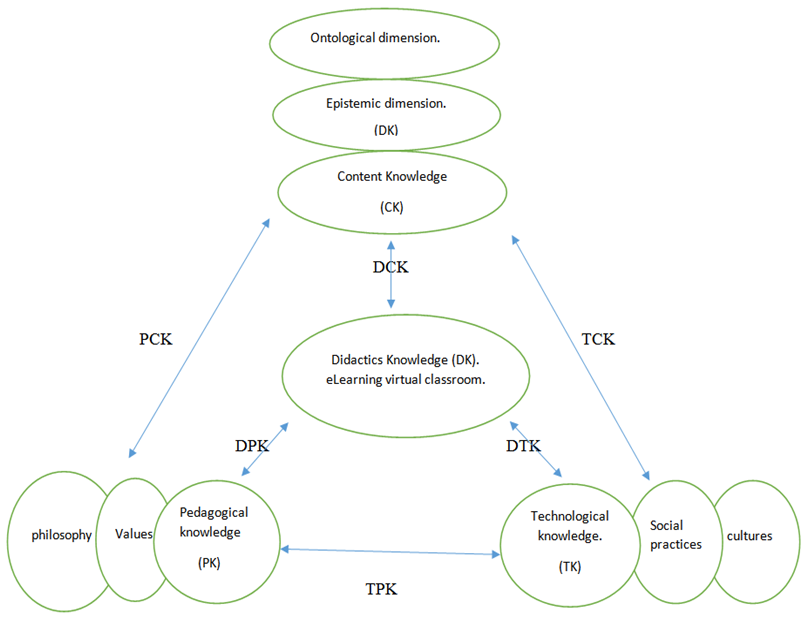
Based on the results as seen above, it is extremely necessary to propose a suitable model that can improve on this situation. In this light, Amador, F. et al, 23 produced a didactic transposition framework for a virtual classroom or for eLearning. These author termed this model, a didactic tetrahedron as seen below:

The following analysis can be made from the above figure:
- There is an interaction between the pedagogical knowledge (PK) and technological knowledge (TK) to enhance didactics knowledge(DK). This signify that English language pedagogy (teaching methods and approaches) is technology oriented. So to say that blended learning approaches can come into play in the teaching of English language in these secondary schools. Also, Key to note is that the social context is significantly considered in this process, as values, philosophy, culture and social practices guides the choice of knowledge, methods, and tools to be used.
- A second observation is the interaction between technological knowledge (TK)and Content Knowledge (CK). This imply that English language content material is being prepared and delivered with the use of technology.
- A third observation explains the link between pedagogical knowledge(PK) and content knowledge (CK). This indicates that English language teaching methods are commensurate to content. This also explains the fact that English language content is being conceived and delivered with strict respect of the social context of learners.
- The fourth observation is based on triangle PCK (pedagogical content knowledge), TCK (Technological content knowledge), and TPK (Technological pedagogical knowledge). This triangle demonstrates that didactics can be successful in a virtual space if technology is sufficiently used at all levels of the teaching-learning process. This is clearly illustrated in triangle DCK (Didactics content knowledge), DPK (Didactics pedagogical knowledge), and DTK (Didactics Technological Knowledge).
This study sought out to investigate the digital environment and English didactics in secondary schools in Cameroon. Our results from field inquiries has revealed that the digital environment is unevenly ready to make learning effective in times of crisis like that of the COVID-19. Key lapses to note in such a digital environment are: insufficient presence of relevant educational technology gadgets for the teaching of English language, teachers lack of knowledge on the usability of software for the teaching of English language, lack of digital skills from a general perspective, and the absent of a steady and high speed internet to enhance the whole process of didactics transposition. Despite this, we have to note here that the importance of English language in the growth and development of the Cameroon society cannot be overemphasized. It is for this reason that strategies must be conceived to cope with present day exigencies in the teaching-learning of English language. In this light, the online education model or blended learning is fast becoming the order of the day. We therefore need to adapt to this new wave.
- Based on the problem of lack of educational technology gadgets, this study recommends that policy makers, government and partners in the financing of education should take as a priority or as a matter of urgency. Both teachers and learners should be equipped with updated education technology tools.
- To talk of the issues of digital skills, it has been a long term problem in Africa. However, the advent of the covid-19 has imposed the use of these skills in the teaching-learning process since online education is fast becoming the new norm. we therefore recommend that members of the education community should invest more in digital skills acquisition 28. This can be done through training workshops, continues education, sponsorship, and individual learning, 25
- It is also worth noting that the digital culture is not vibrant in our environment. This is explained by the fact that most teachers, particularly of the old generation are still finding it difficult to embrace this new wave of doing things. However, it is time to understand that new society in which we live in is largely technology guided. Hence, teachers are called to cultivate the digital culture.
- The telecommunication environment is instrumental for the smooth functioning of online learning. In this light, a key issue is to put in place a steady and high speed internet for research and online interactions between teachers and learners. An aspect which is significantly lagging in our environment. It is in the competence of the government to ensure the existence of steady and speedy internet.
| [1] | WHO (2020). Coronavirus disease (COVID19) Situation Dashboard. https://www.who.int/home. Retrieved on August 20, 2020. | ||
| In article | |||
| [2] | Dhawan, S. (2020). Online Learning: A Panacea in the Time of COVID-19 Crisis. Journal of Educational Technology Systems, 49(1), 5-22. | ||
| In article | |||
| [3] | Béché, E. & Fonkoua, P. (2016). Introduction: Utility, usability and acceptability of open and distance learning in Cameroonian university context. In P. Fonkoua et E. Béché (dir.). Les formations ouvertes et à distance au Cameroun: Entre discours et réalités d’innovation (p. 11-32). Paris: Le Harmattan. | ||
| In article | |||
| [4] | Fonkoua, P. (2009). Les TIC pour les enseignants d’aujourd’hui et de demain. In T. Karsenti (dir.). Intégration pédagogique des TIC en Afrique: Stratégies d’action et pistes de réflexion (p.151-181). Ottawa : CRDI. | ||
| In article | |||
| [5] | https://en.unesco.org/covid19/educationresponse/solutions. Retrieved on August 22, 2020. Iranian English Teachers' Perspective. American Journal of Scientific Research | ||
| In article | |||
| [6] | Djeumeni-Tchamabe, M. (2007). Les écoles normales et les établissement scolaires face aux TICE: le cas du Cameroun. http://www.adjectif.net/spip/spip.php?article29. Retrieved on August 21, 2020. | ||
| In article | |||
| [7] | Djeumeni-Tchamabe, M. (2010). Pratiques pédagogiques des enseignants avec les TIC au Cameroun entre politiques publiques et dispositifs techno-pédagogiques, compétences des enseignants et compétences des apprenants, pratiques publiques et pratiques privées (Doctoral dissertation, Paris 5). Euro Journals Publishing, Inc. ISSN 2301-2005 Issue 76 September, 2012, | ||
| In article | |||
| [8] | Ndongfack, M. N. (2015). Mastery of active and shared learning processes for techno-pedagogy (MASLEPT): A model for teacher professional development on technology integration. Creative Education, 6(01), 32. | ||
| In article | |||
| [9] | Béché, E. (2013b). TIC et innovations dans les pratiques enseignantes au Cameroun. Frantice.net, 6, 5-21. | ||
| In article | |||
| [10] | Béché, E. (2019). Conceptualizing the Implementation of Distance Learning System at the Higher Teacher’s Training College of Maroua (Cameroon). | ||
| In article | |||
| [11] | Constitution of the Republic of Cameroon, 1996. | ||
| In article | |||
| [12] | Newbill, P., & Baum, L. (2013). Design Creativity! Learning & Leading with Technology, 40(4), 16-19. | ||
| In article | |||
| [13] | UNESCO (2020). An unprecedented Crisis. | ||
| In article | |||
| [14] | https://en.unesco.org/courier/2020-3/education-unprecedented-crisis. Retrieved on 03/03/2021. | ||
| In article | |||
| [15] | Béché, E. (2020). Cameroonian responses to COVID-19 in the education sector: Exposing an inadequate education system. International Review of Education, 1-21. | ||
| In article | |||
| [16] | Ngoungouo, A. (2017). The use of ICTs in the Cameroonian school system: A case study of some primary and secondary schools in Yaoundé. International Journal of Education and Development using ICT, 13(1). | ||
| In article | |||
| [17] | Rad, N. F. (2012). Evaluation of ICT Usage in English Language Instruction. | ||
| In article | |||
| [18] | Sala, B. M. and N.V. Ubanako. (2008). Basic English Grammar and Lexicology. | ||
| In article | |||
| [19] | Crystal, D. (2003). English as a Global Language. Cambridge: Cambridge University. | ||
| In article | |||
| [20] | Mpoche, K. and Chandramonan, B. (2012). Cameroon Journal of Studies in the Commonwealth (CJSC) vol 1 No. 1 January 2012. | ||
| In article | |||
| [21] | McArthur, T. (2003). English as an Asian language. English Today, 19(2), 19-22. | ||
| In article | |||
| [22] | Lee, O. (2005). Science education with English language learners: Synthesis and research agenda. Review of educational research, 75(4), 491-530. Retrieved on July, 12, 2021 from https://www.researchgate.net. | ||
| In article | |||
| [23] | Scott, D., & Beadle, S. (2014). Improving the effectiveness of language learning: CLIL and computer assisted language learning. ICF GHK. | ||
| In article | |||
| [24] | Mbangwana, M. A. (2008). Introduction of ICT in Schools and Classrooms in Cameroon. ICT and changing mindsets in education. Bamenda, Cameroon: Langaa. | ||
| In article | |||
| [25] | Njebakal, S. E., & Teneng, P. P. (2017). Technological Inputs in Higher Education and Graduate Destinations in Cameroon. The Case of the University of Yaoundé I. International Journal of New Technology and Research, 3(3). pp. 31-42. | ||
| In article | |||
| [26] | The Ministry of Economy and planning (2018). | ||
| In article | |||
| [27] | Chiatoh, B. A., & Akumbu, P. W. (2014). Enhancing English language studies in Cameroon: The mother tongue perspective. California Linguistic Notes, 39(1), 23-47. | ||
| In article | |||
| [28] | NAE, N. (2020). “ONLINE LEARNING DURING THE PANDEMIC: WHERE DOES JAPAN STAND? https://www.researchgate.net. Retrieved on August 20, 2020. | ||
| In article | |||
Published with license by Science and Education Publishing, Copyright © 2022 Mbeh Adolph Tanyi
 This work is licensed under a Creative Commons Attribution 4.0 International License. To view a copy of this license, visit
http://creativecommons.org/licenses/by/4.0/
This work is licensed under a Creative Commons Attribution 4.0 International License. To view a copy of this license, visit
http://creativecommons.org/licenses/by/4.0/
| [1] | WHO (2020). Coronavirus disease (COVID19) Situation Dashboard. https://www.who.int/home. Retrieved on August 20, 2020. | ||
| In article | |||
| [2] | Dhawan, S. (2020). Online Learning: A Panacea in the Time of COVID-19 Crisis. Journal of Educational Technology Systems, 49(1), 5-22. | ||
| In article | |||
| [3] | Béché, E. & Fonkoua, P. (2016). Introduction: Utility, usability and acceptability of open and distance learning in Cameroonian university context. In P. Fonkoua et E. Béché (dir.). Les formations ouvertes et à distance au Cameroun: Entre discours et réalités d’innovation (p. 11-32). Paris: Le Harmattan. | ||
| In article | |||
| [4] | Fonkoua, P. (2009). Les TIC pour les enseignants d’aujourd’hui et de demain. In T. Karsenti (dir.). Intégration pédagogique des TIC en Afrique: Stratégies d’action et pistes de réflexion (p.151-181). Ottawa : CRDI. | ||
| In article | |||
| [5] | https://en.unesco.org/covid19/educationresponse/solutions. Retrieved on August 22, 2020. Iranian English Teachers' Perspective. American Journal of Scientific Research | ||
| In article | |||
| [6] | Djeumeni-Tchamabe, M. (2007). Les écoles normales et les établissement scolaires face aux TICE: le cas du Cameroun. http://www.adjectif.net/spip/spip.php?article29. Retrieved on August 21, 2020. | ||
| In article | |||
| [7] | Djeumeni-Tchamabe, M. (2010). Pratiques pédagogiques des enseignants avec les TIC au Cameroun entre politiques publiques et dispositifs techno-pédagogiques, compétences des enseignants et compétences des apprenants, pratiques publiques et pratiques privées (Doctoral dissertation, Paris 5). Euro Journals Publishing, Inc. ISSN 2301-2005 Issue 76 September, 2012, | ||
| In article | |||
| [8] | Ndongfack, M. N. (2015). Mastery of active and shared learning processes for techno-pedagogy (MASLEPT): A model for teacher professional development on technology integration. Creative Education, 6(01), 32. | ||
| In article | |||
| [9] | Béché, E. (2013b). TIC et innovations dans les pratiques enseignantes au Cameroun. Frantice.net, 6, 5-21. | ||
| In article | |||
| [10] | Béché, E. (2019). Conceptualizing the Implementation of Distance Learning System at the Higher Teacher’s Training College of Maroua (Cameroon). | ||
| In article | |||
| [11] | Constitution of the Republic of Cameroon, 1996. | ||
| In article | |||
| [12] | Newbill, P., & Baum, L. (2013). Design Creativity! Learning & Leading with Technology, 40(4), 16-19. | ||
| In article | |||
| [13] | UNESCO (2020). An unprecedented Crisis. | ||
| In article | |||
| [14] | https://en.unesco.org/courier/2020-3/education-unprecedented-crisis. Retrieved on 03/03/2021. | ||
| In article | |||
| [15] | Béché, E. (2020). Cameroonian responses to COVID-19 in the education sector: Exposing an inadequate education system. International Review of Education, 1-21. | ||
| In article | |||
| [16] | Ngoungouo, A. (2017). The use of ICTs in the Cameroonian school system: A case study of some primary and secondary schools in Yaoundé. International Journal of Education and Development using ICT, 13(1). | ||
| In article | |||
| [17] | Rad, N. F. (2012). Evaluation of ICT Usage in English Language Instruction. | ||
| In article | |||
| [18] | Sala, B. M. and N.V. Ubanako. (2008). Basic English Grammar and Lexicology. | ||
| In article | |||
| [19] | Crystal, D. (2003). English as a Global Language. Cambridge: Cambridge University. | ||
| In article | |||
| [20] | Mpoche, K. and Chandramonan, B. (2012). Cameroon Journal of Studies in the Commonwealth (CJSC) vol 1 No. 1 January 2012. | ||
| In article | |||
| [21] | McArthur, T. (2003). English as an Asian language. English Today, 19(2), 19-22. | ||
| In article | |||
| [22] | Lee, O. (2005). Science education with English language learners: Synthesis and research agenda. Review of educational research, 75(4), 491-530. Retrieved on July, 12, 2021 from https://www.researchgate.net. | ||
| In article | |||
| [23] | Scott, D., & Beadle, S. (2014). Improving the effectiveness of language learning: CLIL and computer assisted language learning. ICF GHK. | ||
| In article | |||
| [24] | Mbangwana, M. A. (2008). Introduction of ICT in Schools and Classrooms in Cameroon. ICT and changing mindsets in education. Bamenda, Cameroon: Langaa. | ||
| In article | |||
| [25] | Njebakal, S. E., & Teneng, P. P. (2017). Technological Inputs in Higher Education and Graduate Destinations in Cameroon. The Case of the University of Yaoundé I. International Journal of New Technology and Research, 3(3). pp. 31-42. | ||
| In article | |||
| [26] | The Ministry of Economy and planning (2018). | ||
| In article | |||
| [27] | Chiatoh, B. A., & Akumbu, P. W. (2014). Enhancing English language studies in Cameroon: The mother tongue perspective. California Linguistic Notes, 39(1), 23-47. | ||
| In article | |||
| [28] | NAE, N. (2020). “ONLINE LEARNING DURING THE PANDEMIC: WHERE DOES JAPAN STAND? https://www.researchgate.net. Retrieved on August 20, 2020. | ||
| In article | |||