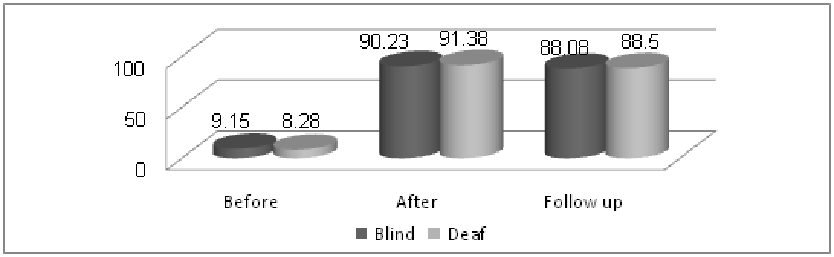
Background: Both deaf and blindness are devastating physical conditions with deep emotional and economic implications. The aim of this study was to evaluate the effectiveness of educational sessions on reproductive health among blind and deaf students at Zagazig city. Subjects and methods; A quasi-experimental design was used. Purposive sample of Sixty three students Deaf and Blind from El-Amal School for Deaf and Hard for Hearing, and El-Nour School for Blind respectively at Zagazig City. Two tools were used; I. A questionnaire consisting of two parts: Part A; Socio-demographic characteristics of the student. Part B; Student's knowledge about reproductive health. II. An observational checklist to assess the student's practice to breast self-examination. Results showed that the total score value of knowledge among blind and deaf student’s improved from 9.15% and 8.28% respectively in preprogram, to 90.23% and 91.38% respectively immediately post program, and decreased slightly to 88.08%, and 88.5% respectively at follow up 3 months’ post program. Conclusion: The educational session's significantly brought out improvements in the knowledge and practice of Blind and Deaf students regarding reproductive health. So, it is recommended that a health education about reproductive health to be provided to all students in the special schools, and continuing training programs to be provide to all students to update their knowledge and practices.
Adolescence is a critical period in girls’ lives as this is a transition from childhood to the responsibilities of adulthood 1. The World Health Organization 2 estimates that more than one billion people in the world are between 14-24 years old 2. More than 90% of them live in developing countries. Investment in the health of this age group has played a major role in the development of human communities due to the dual role of women in community health and well-being of future generations as one of the main paths to the achievement of Millennium Development Goals and youth goals 3.
Reproductive health (RH) is defined as a state of physical, mental, and social well-being in all matters relating to the reproductive system, at all stages of life, good reproductive health implies that people are able to have a satisfying and safe sex life 4. Reproductive health issues are important aspects of this developmental process. All studies and review of literature reported that adolescent Egyptians lack basic information on RH topics and often receive information from sources that may be misleading or inaccurate. Comprehensive sexuality education helps empower young people to protect their health and well-being as they grow and take on family responsibilities 5. Adolescent students are faced with challenges related to the management of menstrual hygiene in public places. The United Nations International Children's Emergency Fund estimates that 1 in 10 school age African girls do not attend school during menstruation. Similarly, the World Bank statistics indicated that students have been absent from school 4 days every 4 weeks because of menstruation 6.
The community health nurse can advocate for both deaf and blind students by improving their needs, by designing health education intervention to protect them from hazards such as smoking, substance abuse and dangers of spread of sexually transmitted diseases, and promote their healthy life style or even participating in teaching classes focusing on the targeted areas of nutrition, reproductive health, physical activity, stress management, family planning, and injury prevention 1.
1.1. Significant of the StudyBoth deaf and blindness cause major changes in lifestyle and habits, which may result in problems in physical, psychological and social adjustments, it has a serious effect on the adolescent students, family and community 7. In Egypt, about 6-7 per 1000 child are hearing impaired 8. Additionally, the WHO estimated that 9 out of 10 who are visually impaired live in the developing country. Approximately 90% of the world deaf and visually impaired people live in the developing countries. The sexual and reproductive health needs of young persons are often unattended to and they have poor access to sexual reproductive health information and services
1.2. Aim of the StudyThe present study aimed to evaluate the effectiveness of educational sessions on reproductive health among blind and deaf students at Zagazig city. That can be accomplished through the following objectives:
1. Assess both blind and deaf students regarding reproductive health knowledge and practice prior and after the educational sessions.
2. Plan, implement, and evaluate the effectiveness of a health educational session for blind and deaf students at Zagazig City.
1.4. HypothesisKnowledge and practice regarding reproductive health among blind and deaf students will be improved after health education sessions.
A quasi-experimental research design with pre–post assessments was used to conduct the current study.
2.2. Study SettingsThis study was conducted in two special education school students
• El-Amal School for Deaf and Hard for Hearing
• El-Nour School for Blind.
2.3. SamplingSample criteria: All students attending the study settings were eligible to be included in the study sample if they were fulfilling the following criteria.
Inclusion Criteria:
1. Age ranges between 14 to 22 years
2. Girl students only.
3. Having no health problems rather than hearing and visual impairment.
4. IQ more than 70; (records of the students in school).
5. Agree to participate in the study.
Sample size:
A sample of 63 student's with hearing and visual impairment attending the study settings during the study period
Sampling technique: A purposive sampling technique was used to recruit students according to their eligibility criteria until the sample size were fulfilling.
2.4. Tools of Data CollectionTwo tools were developed by the researcher based on current related literature to collect the necessary data for achieving the study objectives.
Tool I: An interview questionnaire; It consisted of two parts;
• Part (I): For collecting data pertaining to socio-demographic characteristics of the student such as; age, birth order rank, place of residence, and family characteristics as; parent's level of education, job, family income, etc.
• Part II: These involved questions about student's knowledge about reproductive health developed by the researcher and guided by Mohamed et al. 9. The questionnaire covered the parts of reproductive health as; definition, goal, factors that affect the RH, target groups of RH, elements of childhood stage, RH components, elements of adolescence stage, elements of pre-marriage stage, the post-reproductive age (10 Questions), anatomy of female reproductive system (2 Questions), puberty (2 Questions), ovulation (5 Questions), menstrual cycle and self-care during menstruation (7 Questions), pregnancy and delivery (6 Questions), knowledge about puerperal and breast self-examination (5 Questions). As well, questions assessing student's knowledge regarding sexual health which included questions about female genital mutilation (5 Questions), marriage and consanguinity (3 Questions), premarital counseling (7 Questions), family planning methods and sexual transmitted disease (10 Questions).
Scoring system for knowledge part: A complete correct answer was scored 2, an incomplete correct answer was scored1 and an incorrect answers or don’t know was scored zero. For each area of knowledge, the scores of items were summed up and divided by the number of items; the total score of knowledge was 96 points. Evaluation of student’s knowledge 75% or more was considered good, level of knowledge, 50-<75% considered fair, and less than 50% considered poor.
Tool II
An observational checklist developed by the researcher and guided by Vaidya et al. 10 was intended to assess practice regarding breast self-examination which included ten items, such as; examining breasts at end of the menstrual period, stand in front of the mirror and look for the presence of any changes to breast, lift the arms above the head, use the three middle fingers to feel the breasts, starting from the outer side of the breast, pressure with fingertips in circular motions, move the breast in a circular way slowly, go around the nipple to cover all parts of the breast, attention to the area between the breast and armpit, and finally feeling any lumps or any changes.
Scoring: Each step observed ''done'' was scored one and the '' not done'' zero. The scores of the ten steps were summed up. The practice was considered satisfactory (≥ 60%), and unsatisfactory (<60%)
2.5. Content Validity and ReliabilityThe validity of data collection tools prepared by the researcher, were also assessed during this phase by five experts from community health nursing and obstetric and gynecological department, faculty of nursing, Zagazig University and staff members in El-Amal School for Deaf and Hard of Hearing, El-Nour School for Blind, Zagazig City. These experts assessed the tools for clarity, relevance, applicability, comprehension, and understanding. This constituted the face and content validation of the tools. All recommended modifications on the tools were done. Reliability of the proposed tools was done by Cronbach's Alpha test; it was 0.945 for tool (I) and 0.950 for tool (II).
2.6. Pilot StudyBefore performing the main study, a pilot study was carried out on 10% of the study sample (6 students). Its purpose was to test the questions for any ambiguity, practicability, applicability, and feasibility of the tool and then the necessary modifications were done. It also helped the researcher to determine the time needed for filling in the forms. Those who shared in the pilot study were excluded from the main study sample.
2.7. Field WorkThe execution of the study was carried out through four phases: assessment, planning, implementation, and evaluation. This lasted for 5 months for first data collection from beginning of October, 2018 to the end of May, 2019.
• Assessment phase:
This phase involved the pre-intervention data collection for baseline assessment. The researchers first introduced herself and explained the purpose of the research briefly to the head master and the staff working to gain their cooperation. Every student was met individually for participation was obtained. The researchers read and explained each item of the study questionnaire to the students, the headmaster of the school for deaf students nominated an experienced teacher in sign language according to the researchers' request. She accompanied the researcher as a translator throughout the study phases to facilitate and ensure complete and accurate transmission of any message to the students, and recorded her response to each item. The time consumed for answering the study questionnaire ranged from 40 -50 minutes. Filling in the socio-demographic data took 5-10 minutes, student's knowledge about RH questionnaire took 15 -20 minutes, and the observational checklist for breast self-examination practices took 5-10 minutes. This technique was repeated for each student chosen. Immediately after the interview, the researcher checked the completeness of the forms. The data were preliminarily analyzed to provide the basis for designing the intervention program.
• Planning phase:
Based on the results obtained from the assessment phase, the researcher designed the students' based intervention program and session's contents according to the identified students' needs. The sessions were developed based on these needs and in view of the related literature. Detected needs, requirements and deficiencies were translated into objectives of the intervention sessions. The sessions consist of three main components. The first component was for giving a theoretical background of definition, goal, factors that affect the reproductive health, reproductive health components, target groups of reproductive health, elements of childhood stage, elements of adolescence stage, elements of pre-marriage stage, and the post-reproductive age components. The second component focused on a theoretical knowledge and practical sessions about personal hygiene regarding self-care during menstruation, types of female genital mutilation, and sexual transmitted diseases. The third component included practical of breast-self-examination.
• Implementation phase:
The intervention was implemented in the form of sessions. The program was carried out in the library of the school. To ensure exposure of all students to the same learning experience, all of them received the same content using same training methods. The training methods divided into: deaf students included: demonstration, re-demonstration, individual discussion, role play, and reinforcement. The sessions were aided by using pictures, posters, and video through laptop. While Blind students used individual discussion, played a role in the representation of the body himself, and Milligan. To ensure that the participants understand the content, each session was started by a summary about what was given through the previous session, followed by the objectives of the new one. Motivation and reinforcement techniques were used as praising and giving them appreciation certificates for what they acted and showed with excellence of practice to enhance interest and learning.
The intervention was implemented in 12 theoretical sessions and 4 practical sessions. Each session lasted about 30 to 45 minutes. The objectives of the sessions were as follows:
• Session 1: An introduction session to explain the aim of the sessions, and pre-test. Lecture was used as a teaching method.
Objectives: To introduce the intervention, to explain its purpose and obtain pre-assessment test result.
• Sessions (2 & 3): Focused on imparting knowledge of the definition, goal, factors that affect the reproductive health, components, target groups, elements of childhood stage, elements of adolescence stage, elements of pre-marriage stage, and the post-reproductive age components. Group discussions and handouts were used as teaching methods.
• Session (4 & 5): The main objective was to help students gain knowledge about anatomy of the external and internal reproductive organs of the female. Group discussions and lecture were used as teaching methods. Manequin used for practical sessions to provide accurate places of genitalia. Demonstration and re-demonstration were used as teaching methods.
• Session (6): The main objective was to provide knowledge about normal age of puberty, signs of puberty in females, function of the ovaries, and time of ovulation, Group discussions was used as teaching method.
• Sessions (7 & 8): The main objective was to help students identify the characteristics of the menstrual cycle abnormal, and practical sessions about personal hygiene regarding self-care during menstruation, as well, signs and symptoms of pregnancy, care and avoidance during pregnancy, and serious signs that require going to the doctor during pregnancy. Group discussion, and demonstration, re-demonstration were used as teaching methods.
• Session (9): The main objective was to acquire the students learn the stages of delivery, serious signs that require going to a doctor immediately in the postpartum period. Group discussions were used as a teaching method.
• Session (10): The main objective was to help students know definition and types of circumcision, and the risk of female genital mutilation, in addition, the proper age for marriage, dangers of early marriage, the importance of pre-marital counseling, and dangers of consanguinity. Group discussions and lecture were used as a teaching method.
• Session (11): The main objective was to help students gain knowledge about definition, benefits, and types of family planning methods. Group discussions and lecture were used as a teaching method.
• Session (12): The main objectives were to help students know definition, types, dangerous, symptoms of sexually transmitted disease infection. Group discussions and lecture were used as teaching methods.
• Session (13 &14): The main objective was to help students apply the correct technique of breast-self-examination practice consists of ten steps. Role play, and demonstration, and re-demonstration were used as teaching methods (2 practical sessions).
• Sessions (15 & 16): These sessions involved global summarization and revision of the aim of the sessions and for follow-up of health education training that should be performed at least annually.
• Evaluation phase:
Evaluation of the health educational intervention was done immediately after its implantation, and a follow-up evaluation after three months through applying the same tools of the pretest.
2.8. Administrative and Ethical ConsiderationsAn official permission was obtained using the proper channel of communication. As well, an oral consent was obtained from each student who agrees to participate in the study. They were informed that participation is voluntary and that they have the right to withdraw from the study at any time without giving any reason.
2.9. Statistical AnalysisThe collected data were organized, tabulated and statistically analyzed using Statistical Package for Social Studies (SPSS) version 19 created by IBM, Illinois, Chicago, USA. For numerical values the range mean and standard deviations were calculated. For categorical variables the number and percentage were calculated. Comparison of categorical observations before, after and at follow up periods was done using Friedman’s Chi square test. Comparison of mean values before, after and at follow up periods was done using repeated measurement analysis of variance. When analysis of variance was found significant least significant test was used to compare between each two means. When studying variables affecting total score of knowledge and practice, Mann-Whitney Z test was used for variables presented in two subcategories, and Chi square of Kruskal-Wallis test for variables presented in more than two subcategories. The level of significance was adopted at p<0.05.
Table 1: Indicates that, the mean age of the studied students were 18.16+1.89 years. In addition, 71.4% of studied sample reside rural areas, and more than half of the students were first in birth rank (52.4%). Considering, fathers' education of the students 49.2% were illiterate compared to 34.9% of mothers. Concerning students' mean and standard deviation of age at menarche, it was 13.63+0.97. Moreover, slightly more than half of the families' students' income (50.8%) was sufficient and not saving.
Table 2: Shows that most of students (98.4%) were circumcised. In addition, more than half of them (55.6%) were circumcised at age eleven and for highest percent of students (69.9%), the national for circumcision was religious misconceptions.
Table 3: Demonstrates highly statistically significant differences regarding reproductive health, anatomy of genitalia, menstruation, ovulation, pregnancy, Peurperium, breast self-examination, circumcision, premarital counseling, family planning, and sexually transmitted diseases throughout intervention phases (P<0.001).
Table 4: points that none of them gave correct answer preprogram while in post program and follow up (3 months later) they represented an equal percentage (95.2%), regarding signs of puberty.
Table 5: Reveals that, statistically significant relationships were found between immediately after intervention and at follow-up regarding only total knowledge of reproductive health and their fathers' education at level (P=0.034).
Table 6: Points that, none of the student (Blind and Deaf) before intervention performed practice of breast self-examination. While after program implementation the percentage ranged between (100%) and 73.0%, at follow up ranged between (88.9%) and (63.5%).
Table 7: Displays that the total knowledge score of the studied students were scored as good knowledge level by (0% in preprogram implementation and improved to (90.5% & 88.9%) in post and follow up program implementation. Meanwhile, (100%) had poor knowledge at preprogram that reduced to (1.6%). in post and follow up program implementation.
Table 8: Clarifies that (100%) had unsatisfactory practice of BSE at preprogram implementation that reduced to (4.8% &11.1) in post and follow up program implementation respectively.


Figure 1: Illustrates that the total score value of total knowledge among studied blind and deaf students improvement from 9.15% and 8.28% respectively in preprogram, to 90.23% and 91.38% respectively immediately post program, and decreased slightly to 80.08%, and 88.5% respectively at follow up 3 months’ post program.
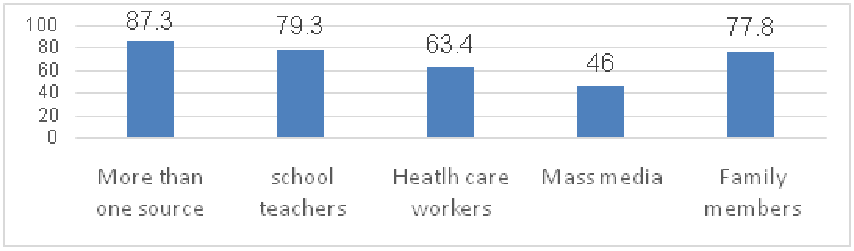
Figure 2: Illustrates that the blind and deaf students had 87.3% of their knowledge from more than one source.
In Egypt, adolescents receive very limited education about reproductive health through the formal school system particularly special schools. Thus, the adolescent reproductive health situation is equally poor. Adolescents constitute an important population group in community because their physical and emotional health is vital to the future of society, and they are unable to help themselves without guidance, and direction. Additionally, adolescence is a time of storm and stress. This indicates the importance of the selection of this age group in the present study 11.
In the current study, slightly more than half of the students were first in birth order rank, although the first born may be more privileged, but with no opportunity to have the chance of exchanging information with older siblings. This finding is in disagreement with Wafik et al. 12 who conducted study to evaluate the effectiveness of health program for adolescents girl’s with hearing-impairments to improve knowledge & attitude regarding reproductive health in Zagazig city. They found that half of the students were second or third in birth order rank, which is expected at this age being not too young or too old. In line with finding, Borges et al. 13, in a study in Portugal, showed that adolescents' perceptions and attitudes towards puberty and reproductive health were significantly influenced by the experience of older siblings. This study finding might be due to the low educational level, adding to that the majority of the studied sample reside rural areas.
According to the present study findings, students had relatively high percentages of illiterate fathers representing nearly half and mothers reaching almost one-third, with fewer percentages having university education. This might have had its reflection on adolescents' knowledge, since parents' education is an important factor in transferring related sound information to their children. Such environment may lead to variety of misconceptions, incomplete knowledge, and blindfold faith in cultural taboos, myths and social customs. As mentioned by Herman et al. 14 “there is silence on sex both at home and school.” Hence, parents need to be able to communicate effectively with their adolescent children regarding these sensitive issues 15.
Moreover, the highest percentage accounting for almost two fifth most of the students' fathers of the present study students were manual workers and the majority of their mothers were housewives, this is in addition to the rural areas where the majority of them reside. Additionally, although the majority of the students reported having sufficient income almost two fifth of these considered it insufficient. In fact, such low socio-economic environment predicts psychological disorders and risky behaviors 16 in adolescents. Regarding to source of daily care, most of the students with disabilities (deaf & blind) were living with their fathers and mothers. This finding is in agreement by Gultie et al. 17in Ethiopia who reported that 66.5% of girls were living with their fathers and mothers. This might be due to the nature of disability.
In the present study, regarding students' sources of information the results revealed that majority of the knowledge gained was from more than one source, while for the minority it was from mass media. This result was in accordance with Ali and Abd-El Aal. 18 in Cairo, as more than three quarters of the students' knowledge gained was from more than one source. Similarly, Wafik et al. 12 in Zagazig City demonstrated that for the majority more than one source as; friends, followed by sisters, and teachers were the preferred sources of information about puberty changes and reproductive health. This needs to be taken cautiously as friends are a frequent source of wrong information and misconceptions at this age. In congruence with this current study finding, Rajni et al. 19found that friends were the most important source of information as reported by 83% of the adolescent girls in India. This might be due to the efficiency of sign language used for the students with hearing impairment among them and all blinded students dependent on the sense of hearing in the present study staying at school.
In the present study, the majority of the students' with disabilities (blind & deaf had their menarche in the normal range reported in the literature, with mean of 13,63+0.97 years. This result is agreement with Abd El-Hameed et al. 20 who found that the mean age at menarche was 13.2 years among Egyptian girls. On the same line, the mean age at menarche was found to be 13.1 years in Assiut City in 2013 by Marzouk et al. 21. More recently, Mohamed et al. 9 mentioned that the majority of the girls in their study had their menarche with a median 13 years. The finding is in line with the result of the study done in Ethiopia by Gultie et al. 17 which reported a similar percentage of age at menarche among adolescents.
The prevalence of female genital mutilation (FGM) or circumcision among the present study (deaf & blind) students reached almost all of them except one student blind. Although this rate is seemingly very high, on the contrary, Mohamed et al. 9found that circumcision among girls, in Ibrahimiah District reached about three-fifth of them. On the same line, the rates reached 89.2% in Upper Egypt 22. In this respect, the researcher views that globally, the prevalence of, and support for, female genital mutilation/cutting s declining. One of the main objectives of the current study was the assessment of students' knowledge about reproductive health. The results point to generally low levels of score knowledge particularly concerning the areas of pregnancy, premarital counsel, family planning, menstruation, breast self-examination and sexually transmitted diseases. The lack of knowledge about all components of reproductive health might be understandable, given that these issues are not yet of great concern to adolescents. However, the deficient knowledge about menstruation is intriguing given that all girls had already their menses. This indicates that the family as well as the health care providers including school health team does not pay much attention to this important issue in adolescents' life.
The present study result was in agreement with He 32, in China, who reported high percentages of adolescents had no information about reproductive health issues. On the same line, Kotecha 24, in India who found that minority of the girls mentioned that they had heard about contraception. The findings are in accordance with scattered previous studies which demonstrated low levels of knowledge among adolescent girls regarding component of reproductive health issues in developing countries such as; in urban Nepal, Shrestha et al. 25, in Indian, Kotecha et al. 24, Adinew et al. 26, Ibrahimiah District Sharkia Governorate Mohamed et al. 9 and in Jharkhand, Banerjee et al. 27.
In the present study after the implementation of the program main objectives were highly achieved, the results point to generally high levels of score knowledge particularly concerning the areas of pregnancy, premarital counseling, family planning, menstruation, and sexually transmitted diseases. These results as in agreement with Kotecha 24,in India who that found more than half of the adolescent student knew correctly about various modes of transmission of HIV/AIDS, a large proportion of them have mentioned changes in puberty such as increase in height, change in voice, and breast development. These results are in accordance with Madeni et al. 28 in Tanzania who reported that the reproductive health program improved the students' knowledge and behavior about sexuality. Additionally, these findings are congruent with Ali and Abd-El Aal. 18 in Cairo, who detected statistically significant improvements among blind students between pre-test and post-test results regarding reproductive health. Similarly, Osman et al. 29 in Assiut Governorate found that all their student sample (deaf & blind) (100%) had poor knowledge regarding to reproductive health in pretest while their knowledge improved in posttest to 58.8%.
The current study findings are in agreement with many previous studies, which reported better levels of knowledge among adolescent girls regarding reproductive health in developing countries such as in Lee et al. 30, who mentioned 80%; Tiwari et al. 32, who detected 60.7%, Adinma 32, whose rate was 48.4%, Udgiri et al. 33 who reported 57%,. Wafik et al. 12, who found 100%. Similarly, significant improvement was mentioned in other studies as that conducted by in Nigeria by Abiodun et al. 34 and in Ethiopia by Gultie et al. 17. This may be due to that students (Deaf & Blind) gave great attention to educational program knowledge regarding RH and were very interested in all the topics of RH that increased their self-esteem.
At follow up after the program, 3 months students' knowledge decreased slightly, due to the type of disability or due to forgetness. This result was in accordance with Ali and Abd-El Aal. 18 in Cairo, who found that despite appreciable decreases in knowledge long term, knowledge retention was modest but stable. This stresses that the program should be repeated after a certain interval to upgrade their knowledge and maintain their achievement. From this point of view, follow-up education is most essential to continuously upgrade the knowledge; this could be in the form of equipping them with booklet, and workshops and boosting their knowledge regularly
In the present study all the deaf and blindness (100%) has poor practice regarding to breast self- examination. This goes in accordance with a finding reported by Saeed et al. 35 in Kuwait a high proportion of them were not aware of the correct steps of the procedure. This finding is agreement with Somdatta and Baridalyne 36. This might be due to this is the first study work in El-Amal school for deaf and El-Nour School for Blind about practice of breast self-examination. Health education programs in the present study initiated to improve student’s practice of breast self- examination. In fact, regular BSE has been as a part of the breast health promotion.
In light of results of the current study, it can be concluded that the study revealed that the intervention was effective and increased the level of deaf and blind students' knowledge and practice of breast self-examination of reproductive health.
It is recommended that health education and training program about reproductive health to be provided to all students in the special schools. A booklet to maintain knowledge and practices of the most important need for reproductive health to be available in all schools, and continuing training program should be provided to all students to update their knowledge and practices.
| [1] | Wong's, L., Hockenberry, M., & Wilson, D. (2012). Nursing Care of Children and Adolescent (8th ed.) Boston: Mosby Co. 1097-1099. | ||
| In article | |||
| [2] | World Health Organization. (2008). Reproductive health. Retrieved (May 29, 2016) from: http://www.google. com.eg/#q=Raising+Awareness+of). | ||
| In article | |||
| [3] | Parvizi, S., Ahmadi, F., & Asadi, H. (2011). The social context of adolescent health: A Quality study. School of Nursing and Midwifery, Tehran University of Medical Sciences, 24, (69), 7-18. | ||
| In article | |||
| [4] | Stidham, H.K., Moreau, C., & Trussell, J. (2014). Determinants of and disparities in reproductive health service use among adolescent and young adult women in the United States, American Journal Of Public Health, 102,(2), 359-367. | ||
| In article | View Article PubMed | ||
| [5] | Wahba, M., & Fahimi, F. (2012). The Need for Reproductive Health Education in Schools in Egypt, Retrieved (August 14, 2016) from www.prb.org. | ||
| In article | |||
| [6] | United Nations, Educational, Scientific & Cultural Organization (UNESCO) (2014): Puberty education and menstrual hygiene management. Retrieved (July 30, 2016) from http://unesdoc.unesco.org/images/0022/002267/226792e.pdf-puberty. | ||
| In article | |||
| [7] | McConachie, H., & Moore V. (2011). Early Expression Language of severely visually impaired children, Developmental Medicine and Child Neurology 7th ed. Pp 230-240. | ||
| In article | View Article PubMed | ||
| [8] | Mehl, A., & Thompson, V. (2010). Newborn Hearing Screening. The Great Omission. Journal of Pediatrics, (1) 101-126. | ||
| In article | View Article PubMed | ||
| [9] | Mohamed, H.E., Wafik, W., & Elden, H.S. (2014). Knowledge and Attitude Regarding Pubertal Physical and Psychological Changes among Adolescent Girls in brahimiah District Sharkia Governorate. Faculty of Nursing Zagazig University. | ||
| In article | |||
| [10] | Vaidya, J.S., Joseph, D.J., Tobias, J.S., Bulsara. M., Wenz, F., Saunders, C., Alvarado, M., Flyger, H.L., Massarut, S., Eiermann, W., Keshtgar, & Baum, M. (2010). Targeted intraoperative radiotherapy versus whole breast radiotherapy for breast cancer: an international, prospective, randomized, non-inferiority phase 3 trial. Lancet. 376(10):91-102. Retrieved (January 1, 2015) from https://www.ncbi.nlm.nih.gov/pubmed/2. | ||
| In article | View Article | ||
| [11] | Maxwell, J., Belser, JW., & David D. (2007). A health handbook for women with disabilities. Berkley, CA, Hesperian Foundation. | ||
| In article | |||
| [12] | Wafik, W., Mahmoud, S.F., & Abd-elrahman, S. (2015). Effectiveness of Reproductive Health Program for Adolescent’s Girls With hearing-impairments at Sharkia Governorate. The first international scientific specific education conference 2015, Sharjah. UAE. | ||
| In article | |||
| [13] | Borges, A.L., LatorreMdo R., & Schor N. (2007). [Factors associated with sexual debut among adolescents enrolled in a family health unit in East Side São Paulo, Brazil].Cad SaudePublica, 23, (7), 1583-94. | ||
| In article | View Article PubMed | ||
| [14] | Herman, L., Ovuga, E., Mshilla, M., Ojara, S., Kimbugwe, G., Adrawa AP., & Mahuro N. (2014). Knowledge, Perceptions and Acceptability to Strengthening Adolescents' Sexual and Reproductive Health Education amongst Secondary Schools in Gulu District. World AcadSciEng Technol; 7, (7), 1787-1802. | ||
| In article | |||
| [15] | Shiferaw, K., Getahun, F., & Asres, G. (2014). Assessment of adolescents' communication on sexual and reproductive health matters with parents and associated factors among secondary and preparatory schools' students in Debremarkos town, North West Ethiopia.Report Health, 11,(1), 2. | ||
| In article | View Article PubMed | ||
| [16] | Torikka, A., Kaltiala-Heino, R., Rimpelä, A., Marttunen, M., Luukkaala, T., & Rimpelä, M. (2014). Self-reported depression is increasing among socio-economically disadvantaged adolescents - repeated cross-sectional surveys from Finland from 2000 to 2011.BMC Public Health, 14, 408. | ||
| In article | View Article PubMed | ||
| [17] | Gultie, T., Hailu, D., & Workineh, Y. (2014). Age of menarche and knowledge about menstrual hygiene management among adolescent school girls in Amhara province, Ethiopia: implication to health care workers & school teachers. PLoS One, 30;9,(9):e108644. | ||
| In article | View Article PubMed | ||
| [18] | Ali, R.A., & Abd-El Aal, E.M. (2015). Effect of Health Educational Program for Female Blinded Adolescent Regarding Reproductive Health. American Journal of Nursing Science; 4(1), 1-8. Retrieved (January 21, 2015). | ||
| In article | |||
| [19] | Rajni, D., Anil, K., & Manpreet, K. (2009). Knowledge and practices Related to Menstruation among Tribal (Gujjar) Adolescent Girls. Ethno-Med, 3,(1), 43-4. | ||
| In article | View Article | ||
| [20] | Abd El-Hameed, N.A., Mohamed, M.S., Ahmed, N.H., & Ahmed E.R. (2011). Assessment of Dysmenorrhea and Menstrual Hygiene Practices among Adolescent Girls in Some Nursing Schools at EL-Minia Governorate, Egypt. Journal of American Science; 7,(9). | ||
| In article | |||
| [21] | Marzouk, S.A., El- dien, H.A., Thabet, R.A.E., & El Zaher, A.A. M. (2013). Impact of educational Program about menarche on improving student's self- concept at Assiut Governorate. Life Sci J; 10,(1), 860-868. | ||
| In article | |||
| [22] | Rasheed, S.M., Abd-Ellah, A.H., & Yousef F.M. (2011). Female genital mutilation in Upper Egypt in the new millennium.Int J GynaecolObstet, 114 (1), 47-50. | ||
| In article | View Article PubMed | ||
| [23] | He, H., Ostbye, T., & Daltveit, A.K. (2009). Reproductive and family planning history, knowledge, and needs: A community survey of low-income women in Beijing, China. BMC Women's Health, 10; 9: 23. | ||
| In article | View Article PubMed | ||
| [24] | Kotecha, P.V., Patel, S., Baxi, R.K., Mazumdar, V.S., Misra, S., Modi, E., & Diwanji, M. (2009). Reproductive health awareness among rural school going adolescents of Vadodara district. Indian J Sex TransmDis, 30,(2), 94-99. | ||
| In article | View Article PubMed | ||
| [25] | Shrestha, R.M., Otsuka, K., Poudel, K.C., Yasuoka, J., Lamichhane, M., & Jimba, M. (2013): Better learning in schools to improve attitudes toward abstinence and intentions for safer sex among adolescents in urban Nepal. BMC Public Health, 20; 13: 244. | ||
| In article | View Article PubMed | ||
| [26] | Adinew, Y.M., Worku, A.G., & Mengesha, Z.B. (2013). Knowledge of reproductive and sexual rights among University students in Ethiopia: institution-based cross-sectional. BMC Int Health Hum Rights. | ||
| In article | View Article PubMed | ||
| [27] | Banerjee, S.K., Andersen, K.L., Warvadekar, J., Aich, P., Rawat, A., & Upadhyay, B. (2015). How prepared are young, rural women in India to address their sexual and reproductive health needs? a cross-sectional assessment of youth in Jharkhand. Report Health; 12: 97. | ||
| In article | View Article PubMed | ||
| [28] | Madeni, F., Horiuchi, S., & Iida, M. (2011). Evaluation of a reproductive health awareness program for adolescence in urban Tanzania--A quasi-experimental pre-test post-test research. Report Health. 2016 Jun 27; 8: 21. | ||
| In article | View Article PubMed | ||
| [29] | Osman, S.R., Zakherah, M.S., & Bayomi, S.S. (2015). Impact of Health Education Program on Knowledge of Blind and Deaf Adolescent Girls about Reproductive Health in Assiut Governorate, Egypt. the 7th international scientific nursing conference faculty of nursing Helwan university in collaboration with Kennesaw university. | ||
| In article | |||
| [30] | Lee, L.K., Chen, P.C., Lee, K.K., & Kaur, J. (2006). Menstruation among adolescent girls in Malaysia: a cross-sectional school survey. Singapore Med J.; 47,(10), 869-74. | ||
| In article | |||
| [31] | Tiwari, H., Oza, U.N., & Tiwari, R. (2006). Knowledge, attitudes and beliefs about menarche of adolescent girls in Anand district, Gujarat. East Mediterr Health J.; 12,(3-4), 428-433. | ||
| In article | |||
| [32] | Adinma, E.J. (2009). Perceptions and Practices on Menstruation amongst Nigerian Secondary School Girls. African Journal of Reproductive Health; 12,(1): 74. | ||
| In article | |||
| [33] | Udgiri, R., Angadi, M.M., Patil, S., & Sorganvi, V. (2010). Knowledge and practices regarding menstruation among adolescent girls in an urban slum, Bijapur. J Indian Med Assoc, 108, (8), 514-6. | ||
| In article | |||
| [34] | Abiodun, O., Sotunsa, J., Ani, F., & Jaiyesimi, E. (2014). Knowledge of HIV/AIDS and predictors of uptake of HIV counseling and testing among undergraduate students of a privately owned university in Nigeria. BMC Res Notes, 12; 7: 639. | ||
| In article | View Article PubMed | ||
| [35] | Saeed, R.S., Bakir, Y.Y., & Ali, L.M. (2014). Are women in Kuwait aware of breast cancer and its diagnostic procedures? Asian Pac J Cancer Prev; 15,(15), 6307-13. | ||
| In article | View Article PubMed | ||
| [36] | Somdatta, P., & Baridalyne, N. (2009). Awareness of breast cancer in women of an urban resettlement colony. Indian J Cancer. 45, (4), 149-53. | ||
| In article | View Article PubMed | ||
Published with license by Science and Education Publishing, Copyright © 2020 Samia Farouk Mahmoud and Mervat Elshahat Ibrahim
 This work is licensed under a Creative Commons Attribution 4.0 International License. To view a copy of this license, visit
http://creativecommons.org/licenses/by/4.0/
This work is licensed under a Creative Commons Attribution 4.0 International License. To view a copy of this license, visit
http://creativecommons.org/licenses/by/4.0/
| [1] | Wong's, L., Hockenberry, M., & Wilson, D. (2012). Nursing Care of Children and Adolescent (8th ed.) Boston: Mosby Co. 1097-1099. | ||
| In article | |||
| [2] | World Health Organization. (2008). Reproductive health. Retrieved (May 29, 2016) from: http://www.google. com.eg/#q=Raising+Awareness+of). | ||
| In article | |||
| [3] | Parvizi, S., Ahmadi, F., & Asadi, H. (2011). The social context of adolescent health: A Quality study. School of Nursing and Midwifery, Tehran University of Medical Sciences, 24, (69), 7-18. | ||
| In article | |||
| [4] | Stidham, H.K., Moreau, C., & Trussell, J. (2014). Determinants of and disparities in reproductive health service use among adolescent and young adult women in the United States, American Journal Of Public Health, 102,(2), 359-367. | ||
| In article | View Article PubMed | ||
| [5] | Wahba, M., & Fahimi, F. (2012). The Need for Reproductive Health Education in Schools in Egypt, Retrieved (August 14, 2016) from www.prb.org. | ||
| In article | |||
| [6] | United Nations, Educational, Scientific & Cultural Organization (UNESCO) (2014): Puberty education and menstrual hygiene management. Retrieved (July 30, 2016) from http://unesdoc.unesco.org/images/0022/002267/226792e.pdf-puberty. | ||
| In article | |||
| [7] | McConachie, H., & Moore V. (2011). Early Expression Language of severely visually impaired children, Developmental Medicine and Child Neurology 7th ed. Pp 230-240. | ||
| In article | View Article PubMed | ||
| [8] | Mehl, A., & Thompson, V. (2010). Newborn Hearing Screening. The Great Omission. Journal of Pediatrics, (1) 101-126. | ||
| In article | View Article PubMed | ||
| [9] | Mohamed, H.E., Wafik, W., & Elden, H.S. (2014). Knowledge and Attitude Regarding Pubertal Physical and Psychological Changes among Adolescent Girls in brahimiah District Sharkia Governorate. Faculty of Nursing Zagazig University. | ||
| In article | |||
| [10] | Vaidya, J.S., Joseph, D.J., Tobias, J.S., Bulsara. M., Wenz, F., Saunders, C., Alvarado, M., Flyger, H.L., Massarut, S., Eiermann, W., Keshtgar, & Baum, M. (2010). Targeted intraoperative radiotherapy versus whole breast radiotherapy for breast cancer: an international, prospective, randomized, non-inferiority phase 3 trial. Lancet. 376(10):91-102. Retrieved (January 1, 2015) from https://www.ncbi.nlm.nih.gov/pubmed/2. | ||
| In article | View Article | ||
| [11] | Maxwell, J., Belser, JW., & David D. (2007). A health handbook for women with disabilities. Berkley, CA, Hesperian Foundation. | ||
| In article | |||
| [12] | Wafik, W., Mahmoud, S.F., & Abd-elrahman, S. (2015). Effectiveness of Reproductive Health Program for Adolescent’s Girls With hearing-impairments at Sharkia Governorate. The first international scientific specific education conference 2015, Sharjah. UAE. | ||
| In article | |||
| [13] | Borges, A.L., LatorreMdo R., & Schor N. (2007). [Factors associated with sexual debut among adolescents enrolled in a family health unit in East Side São Paulo, Brazil].Cad SaudePublica, 23, (7), 1583-94. | ||
| In article | View Article PubMed | ||
| [14] | Herman, L., Ovuga, E., Mshilla, M., Ojara, S., Kimbugwe, G., Adrawa AP., & Mahuro N. (2014). Knowledge, Perceptions and Acceptability to Strengthening Adolescents' Sexual and Reproductive Health Education amongst Secondary Schools in Gulu District. World AcadSciEng Technol; 7, (7), 1787-1802. | ||
| In article | |||
| [15] | Shiferaw, K., Getahun, F., & Asres, G. (2014). Assessment of adolescents' communication on sexual and reproductive health matters with parents and associated factors among secondary and preparatory schools' students in Debremarkos town, North West Ethiopia.Report Health, 11,(1), 2. | ||
| In article | View Article PubMed | ||
| [16] | Torikka, A., Kaltiala-Heino, R., Rimpelä, A., Marttunen, M., Luukkaala, T., & Rimpelä, M. (2014). Self-reported depression is increasing among socio-economically disadvantaged adolescents - repeated cross-sectional surveys from Finland from 2000 to 2011.BMC Public Health, 14, 408. | ||
| In article | View Article PubMed | ||
| [17] | Gultie, T., Hailu, D., & Workineh, Y. (2014). Age of menarche and knowledge about menstrual hygiene management among adolescent school girls in Amhara province, Ethiopia: implication to health care workers & school teachers. PLoS One, 30;9,(9):e108644. | ||
| In article | View Article PubMed | ||
| [18] | Ali, R.A., & Abd-El Aal, E.M. (2015). Effect of Health Educational Program for Female Blinded Adolescent Regarding Reproductive Health. American Journal of Nursing Science; 4(1), 1-8. Retrieved (January 21, 2015). | ||
| In article | |||
| [19] | Rajni, D., Anil, K., & Manpreet, K. (2009). Knowledge and practices Related to Menstruation among Tribal (Gujjar) Adolescent Girls. Ethno-Med, 3,(1), 43-4. | ||
| In article | View Article | ||
| [20] | Abd El-Hameed, N.A., Mohamed, M.S., Ahmed, N.H., & Ahmed E.R. (2011). Assessment of Dysmenorrhea and Menstrual Hygiene Practices among Adolescent Girls in Some Nursing Schools at EL-Minia Governorate, Egypt. Journal of American Science; 7,(9). | ||
| In article | |||
| [21] | Marzouk, S.A., El- dien, H.A., Thabet, R.A.E., & El Zaher, A.A. M. (2013). Impact of educational Program about menarche on improving student's self- concept at Assiut Governorate. Life Sci J; 10,(1), 860-868. | ||
| In article | |||
| [22] | Rasheed, S.M., Abd-Ellah, A.H., & Yousef F.M. (2011). Female genital mutilation in Upper Egypt in the new millennium.Int J GynaecolObstet, 114 (1), 47-50. | ||
| In article | View Article PubMed | ||
| [23] | He, H., Ostbye, T., & Daltveit, A.K. (2009). Reproductive and family planning history, knowledge, and needs: A community survey of low-income women in Beijing, China. BMC Women's Health, 10; 9: 23. | ||
| In article | View Article PubMed | ||
| [24] | Kotecha, P.V., Patel, S., Baxi, R.K., Mazumdar, V.S., Misra, S., Modi, E., & Diwanji, M. (2009). Reproductive health awareness among rural school going adolescents of Vadodara district. Indian J Sex TransmDis, 30,(2), 94-99. | ||
| In article | View Article PubMed | ||
| [25] | Shrestha, R.M., Otsuka, K., Poudel, K.C., Yasuoka, J., Lamichhane, M., & Jimba, M. (2013): Better learning in schools to improve attitudes toward abstinence and intentions for safer sex among adolescents in urban Nepal. BMC Public Health, 20; 13: 244. | ||
| In article | View Article PubMed | ||
| [26] | Adinew, Y.M., Worku, A.G., & Mengesha, Z.B. (2013). Knowledge of reproductive and sexual rights among University students in Ethiopia: institution-based cross-sectional. BMC Int Health Hum Rights. | ||
| In article | View Article PubMed | ||
| [27] | Banerjee, S.K., Andersen, K.L., Warvadekar, J., Aich, P., Rawat, A., & Upadhyay, B. (2015). How prepared are young, rural women in India to address their sexual and reproductive health needs? a cross-sectional assessment of youth in Jharkhand. Report Health; 12: 97. | ||
| In article | View Article PubMed | ||
| [28] | Madeni, F., Horiuchi, S., & Iida, M. (2011). Evaluation of a reproductive health awareness program for adolescence in urban Tanzania--A quasi-experimental pre-test post-test research. Report Health. 2016 Jun 27; 8: 21. | ||
| In article | View Article PubMed | ||
| [29] | Osman, S.R., Zakherah, M.S., & Bayomi, S.S. (2015). Impact of Health Education Program on Knowledge of Blind and Deaf Adolescent Girls about Reproductive Health in Assiut Governorate, Egypt. the 7th international scientific nursing conference faculty of nursing Helwan university in collaboration with Kennesaw university. | ||
| In article | |||
| [30] | Lee, L.K., Chen, P.C., Lee, K.K., & Kaur, J. (2006). Menstruation among adolescent girls in Malaysia: a cross-sectional school survey. Singapore Med J.; 47,(10), 869-74. | ||
| In article | |||
| [31] | Tiwari, H., Oza, U.N., & Tiwari, R. (2006). Knowledge, attitudes and beliefs about menarche of adolescent girls in Anand district, Gujarat. East Mediterr Health J.; 12,(3-4), 428-433. | ||
| In article | |||
| [32] | Adinma, E.J. (2009). Perceptions and Practices on Menstruation amongst Nigerian Secondary School Girls. African Journal of Reproductive Health; 12,(1): 74. | ||
| In article | |||
| [33] | Udgiri, R., Angadi, M.M., Patil, S., & Sorganvi, V. (2010). Knowledge and practices regarding menstruation among adolescent girls in an urban slum, Bijapur. J Indian Med Assoc, 108, (8), 514-6. | ||
| In article | |||
| [34] | Abiodun, O., Sotunsa, J., Ani, F., & Jaiyesimi, E. (2014). Knowledge of HIV/AIDS and predictors of uptake of HIV counseling and testing among undergraduate students of a privately owned university in Nigeria. BMC Res Notes, 12; 7: 639. | ||
| In article | View Article PubMed | ||
| [35] | Saeed, R.S., Bakir, Y.Y., & Ali, L.M. (2014). Are women in Kuwait aware of breast cancer and its diagnostic procedures? Asian Pac J Cancer Prev; 15,(15), 6307-13. | ||
| In article | View Article PubMed | ||
| [36] | Somdatta, P., & Baridalyne, N. (2009). Awareness of breast cancer in women of an urban resettlement colony. Indian J Cancer. 45, (4), 149-53. | ||
| In article | View Article PubMed | ||


)
)
)
)
)
)