In recent time, the market of lower gluten content or gluten free bread has expanded because of its being congenial to celiac patient. The purpose of this investigation was to extensively study the proximate composition and sieving analysis of raw, sun and mechanical dried corn flour, furthermore, the quality parameters of bread were also evaluated. After sun and mechanical drying of corn samples, grinding was carried out. Proximate analysis showed that mechanical dried corn flour contains higher amount of protein, fat, ash and carbohydrate content than fresh and sun dried samples. Then, flour made of corn dried at 50°C gave highest co-efficient of determination (r2=0.857). After that, bread was prepared from sun and mechanical dried (50°C) corn flour substituted with wheat flour. Observations showed that the specific volume of sun dried corn flour breads was higher than that of mechanical dried corn flour breads and this property of the breads was progressively decreased with increasing level of corn flour in bread formulation. Additionally, mechanical dried corn flour breads got the higher scores for hardness test than the sun dried samples. Sensory evaluation of bread samples containing sun and mechanical dried corn flour and control bread was conducted. It was found that bread containing 5 % flour from corn dried mechanically at 50°C gave the best bread and obtained score was (89±4.00) and was closely followed by sun dried corn flour at similar substitution level.
In many countries corn (Zea mays L.) plays a major role in nourishment. Regarding the cultivation areas and total production, maize together with rice and wheat is the most cultivated cereal in the world. With bright market potential, the cultivable area for corn increased dramatically during the last few years. But, since these systems grew in significance only during the 2000s, concerns over their sustainability have emerged only recently.
Maize flour contains high level of many important vitamins and minerals, including potassium, phosphorus, zinc, calcium, iron, thiamine, niacin, vitamin B6, and folate and it can be used as substitution along with wheat flour 1. Kent 2 reported the proximate composition of whole maize flour in the study of the maize variety-dent which has protein content of about 9.4%, fat 4.1%, ash1.4%, crude fibre 2.0% and carbohydrate 72.1%. The composition of maize grain varies with variety, soil and environment. The proximate composition (%) of dehulled degermed maize flour was crude protein (7.46 ± 0.27), crude fat (1.42 ± 0.34), ash (0.2 ± 0.03), crude fibre (0.51 ± 0.01), carbohydrate 79.46 and the whole maize flour as crude protein (8.20 ± 0.07), crude fat (6.02 ± 0.63), ash (1.51 ± 0.16), crude fibre (1.84 ± 0.05) and carbohydrate 74.14 3.
Although baked cereal products made from wheat flour are consumed worldwide, some individuals present intolerance to wheat, and to other cereal grains such as oats, rye, and barley. This intolerance, called celiac disease, seriously impairs intestinal absorption and can lead to a severe malnutrition. In this regard, non-wheat cereal products such as corn can be used for celiac patients. Celiac disease is an unremitting disorder resulting from an immune reaction to certain cereal proteins. Most toxic elements for celiac are wheat proteins: α-, β- and γ-gliadin, high molecular weight glutenins, along with secalin from rye, hordein from barley and avenin from oat 4. Gluten plays a vital role in development of bread by giving cohesiveness. It helps to retain the CO2 produced during fermentation and this gas expansion causes wheat breads to increase volume and attain acceptable crumb texture 5. Although maize is a gluten-free cereal, it is suitable to produce foods addressed to celiac patients 6.
In recent years, most of the developed countries in the world, a large volume of breads are being prepared from the mixture of corn flour and wheat flour. Addition of rice or corn flour to wheat flour resulted in a suitable flour for biscuit manufacture, giving improved dough processing properties and crumbliness of finished biscuits 7. Bread and cake made from corn flour are the main food items in Mexico, Chili, Ecquador and Guatemala. Corn flour is also used as a replacement for wheat flour to make cornbread and other baked products 8. In addition, by substituting part of the wheat flour with maize flour in any product the costs can be reduced 9.
Regarding the importance and points mentioned above, the objectives of present study were as follows: (i) To determine the proximate composition of fresh, sun and mechanical dried corn flour and (ii) To evaluate the physical, textural and organoleptic properties of breads made from sun and mechanical dried corn flour.
Total carbohydrate content of foods has, for many years, been calculated by difference, rather than analyzed directly. Carbohydrate content of the samples was determined by subtracting the measured protein, fat, ash and moisture from 100.
2.2. Bulk PropertiesBulk density was determined by the method of Murphy et al. 11. The sample was filled into a 10 ml graduated cylinder up to the 10 ml mark. Then weight was taken.
2.3. Drying of CornForced convection hot air type cabinet dryer was used for drying corn. Fresh corns of known moisture content were placed in trays and drying commenced in the drier at 40°C, 50°C and 60°C with a constant air velocity and air dry bulb temperature. The velocity of air was measured (0.6 m/sec.) by anemometer. Weight loss was used as a measure of extent of drying and samples were dried until it came to the equilibrium condition.
Corn was evenly spread on tray of known loading density and kept outside when the sun was shining. After every hour, the corn was collected and weighed, and again spread on the tray for drying as long as bright sunlight was available.
2.4. Sieving AnalysisThe raw, sun and mechanical dried corn was ground with a grinder, were put on the top sieve, and shaken for few minutes. Then the mass of the sample left on each sieve was measured.
2.5. Formulation of BreadAfter grinding the corn flour was used as substitution with wheat flour for making bread. A variety of other non wheat flours such as rice flour 12, yam flour 13, maize flour 1 and sorghum flour 14 have been tested as substitutes for wheat flour in bread formulations and reported that a level of 20% is the upper limit for substitution without there being a change in consumer acceptance of the bread 15.
The gluten content required for bread is 12-14 %. From calculated value, corn flour can be used with wheat flour upto 9% as substitution. Corn dried at 50°C gives better particle size and can be conveniently used for milling and baking industry 16. The breads were prepared as the following way from 5% and 8% sun and mechanical (50°C) dried corn flour with wheat flour. All the ingredients were weighed and then mixed in a mixer machine for about 10 min. to make control bread and breads from corn flour. The prepared doughes were set aside for 2 hrs while fermentation proceeded. After 2 hrs doughes were “Knocked back”. Again “Knock back” the dough and rested for about 1 hr. Then the dough was divided into loaf size portion and these were roughly shaped. The dough pieces were rested at about 27°C for 10-15 min. (1st proof) and moulded into final shape. The doughes were rested again in the baking pan for the final proof of 60 min at 37°C. Then it was baked in the oven at a temperature of 230°C for 40 min. The loaves were allowed to cool for a minimum of 2 hrs. at 24°C before evaluation.
2.7. Evaluation of Bread by Objective AnalysisVarious parameters were sub-divided into external parameters (colour and texture of crust) and internal parameters (colour, texture and structure of crumb, presence of air cell, air cell size). The bread volume was determined by seed displacement method 17, the weight and specific volume of backed bread were also measured.
2.8. Evaluation of HardnessHardness of the bread samples was performed with an instrumental penetration test using a Texturometer (GY-4, Yueqing Handpi Instruments Co., Ltd., China) equipped with high precision sensor. The pretest, test and post-test speed were 1.0 mm/s. The depth of the bread was 12 mm. Texture was expressed as the maximum force as the test cell penetrated to a depth of 10 mm into the sample 18. For the analysis the slices were cut in 1 cm thickness. The mean of three determinations was calculated for each bread sample.
2.9. Sensory Evaluation of BreadsThe sensory evaluation of five types of breads like control bread and breads from 5% and 8% sun and mechanical dried corn flour (50°C) were evaluated for external and internal parameters by 30 tasters. The external and internal parameters were collected from the bread score report as used by the American Institute of Baking. The external, internal and total parameters were numbered within 30, 70 and 100 respectively. One slice from each bread was presented and the samples were randomly coded.
2.10. Statistical AnalysisThe results were evaluated by one way ANOVA using SPSS program (IBM Corporation, Inc, 2013, version 22). Duncan’s Multiple Range Test (DMRT) was used to differentiate the mean values significantly.
After grinding, the proximate compositions of corn flour and wheat flour were analyzed and those were shown on Table 2.
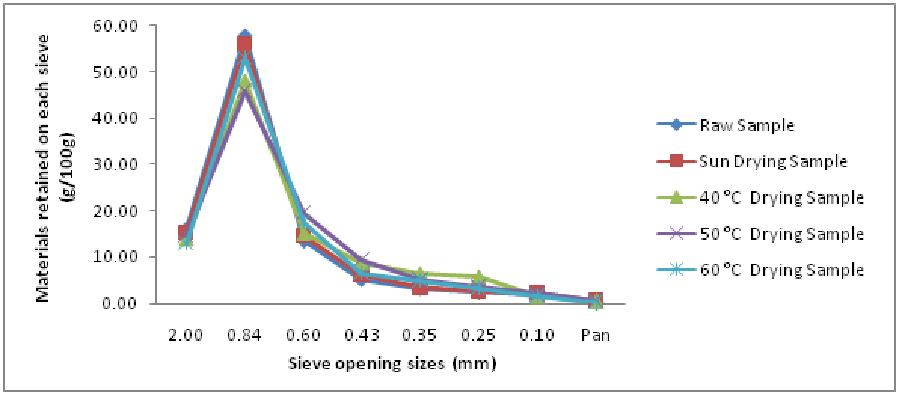
3.2. Sieving Analysis of Corn FlourParticle size distribution is one of the most important properties of granulated materials, and it is the most important criteria in the usage of flour 21. From Figure 1, it is clear that the amount of particles on same opening size sieves were different for raw corn, sun and mechanical dried corn. This difference occurred due to different moisture content such as 30.07 %, 11.37 % and 10.87 % on wet weight basis for raw, sun and mechanical dried corn flour respectively. Mechanical dried (50°C) sample gave more fine particles than others. Much coarse particles were obtained from raw and 60°C dried sample. At 60°C corn surface became very tough so it was very difficult to grind the sample. Sieving analysis of ground grain or complete diets are an important quality control procedure used in both commercial and on farm feed mills 22.
The highest bulk density was found 687 kg/ m³ and the lowest was 651 kg/m³ of sun dried and 60°C mechanical dried corn respectively. The bulk density indicates that more of the products could be prepared using a small amount of water. These values are similar to the values of Lee and Chung 23 was 638.5-742.2 kg/m³ and lower than the value of ANSI 24 was 721 kg/m³. The value of co-efficient of determination was found to be higher for all the samples, which represents a good fit of the curves. Table 3 showed that the highest value of coefficient of determination, r2 (0.857) was observed for 50°C mechanical dried sample that indicates the existence of a good relationship between dependent and independent variables. The ground material is usually designated by fineness modulus number. The particles retained on sieves were measured and the modulus of fineness of raw, sun and 40°C, 50°C and 60°C mechanical dried corn were calculated and found as 2.95, 3.17, 3.25, 3.54 and 3.78. Silver 25 recommended fineness modulus of 3.6 for shelled corn. Accordingly the fineness of modulus at 50°C mechanical dried corn was the most acceptable value.

The external parameters of breads were expressed as colour and texture of crust and internal parameters were colour, texture and structure of crumb, presence of air cell, air cell size. The physical properties of breads such as weight, specific volumes were also measured (Table 4).
The volume was affected by many factors both from the ingredients and from processing. The volume of breads was presented in Table 4. The volume of control bread was higher (507±1.00) than corn flour breads. But, this is not significantly different from bread with 5% mechanical (50°C) dried corn flour which gave the value of (504.00±2.00). These two types of breads are significantly different (P<0.05) from the others. It was also observed that breads with increasing level of corn flour showed progressively decreasing level of bread volume. Mechanical dried corn flour breads gave higher volume than sun dried corn flour breads. The volume is the most important individual quality parameter used for evaluation of bread, because it is a quantitative measurement and correlates well with dough handling properties, crumb texture and freshness technological versatility 26.
The weight of bread with 5% mechanical (50°C) dried corn flour was significantly (P˂0.05) higher (242.70±1.30) than other breads except bread with 8% mechanical (50°C) dried corn flour which was (240.90±1.90). It was observed that the weight of all the breads were significantly (P˂0.05) higher than the control bread. The weight of corn flour breads were decreasing with the increasing level of corn flour. It was also found that the weight of mechanical dried corn flour breads were higher than sun dried corn flours. The variation in bread weight might be due to the fact that corn flour contained higher amount of solid matters compared to wheat flour.
Table 4 showed that the specific volume of control bread was (2.18±0.02) which is significantly (P˂0.05) different from the others. The specific volume of sun dried corn flour breads was higher than mechanical dried corn flour breads. It was found that the specific volume of the breads was progressively decreased with increasing level of corn flour in bread formulation. This may be due to the baking quality of corn flour i.e. baking quality of corn flour is lower than wheat flour.
The general appearance of the breads was shown in the Table 5. All the breads gave better appearance.
The crust characteristics of the breads were presented in Table 5. The crust colour of sun and mechanical dried bread were similar (i.e. brown) except the control bread which had light brown. Crust colour is a result of the development of caramelozation during baking. The texture of crust applies to the condition of the crust and would vary somewhat with different types of bread. The crust texture of the control bread was crispy and 8 % sun and mechanical dried corn flour breads were soft silky. The overall crust characteristics of 5 % sun and mechanical dried corn flour breads were seemed to be better than that of others. Because, the crust of 5 % sun and mechanical dried corn flour breads were thin and easily broken.
Colour evaluation was made with interior slices. Table 5 showed that the crumb colour of control bread was whitish. The breads with 5 % sun and mechanical dried corn flour breads was brown colour and 8 % sun and mechanical dried corn flour breads was slightly brown. In general the control breads had better crumb colour. But, crumb colour of corn flour breads was also attractive. From Table 5, the control bread and bread with 5 % sun and mechanical dried corn flour breads gave soft silky texture. Bread with 8 % sun and mechanical dried corn flour breads gave soft texture. From acute observation it was seen that the overall crumb texture of bread containing 5% corn flour was the best. The crumb structure of control bread and bread containing 5 % sun and mechanical dried corn flour were fine even whereas bread with 8% sun and mechanical dried corn flour were even. The overall crumb structure of 5 % sun and mechanical dried corn flour breads were seemed to be better than the others. The characteristics of the air cell which was observed were presented in Table 5. A few air cells present in control bread which were larger in size. The air cells in breads containing 5 % sun and mechanical dried corn flour breads were also few but they were slightly larger in size. Very few air cells were observed in 8 % sun and mechanical dried corn flour breads and they were small in size. The air cell size and uniformity was relatively standard with the differences probably resulting from inexperienced dough handling rather than the effect of the supplements.
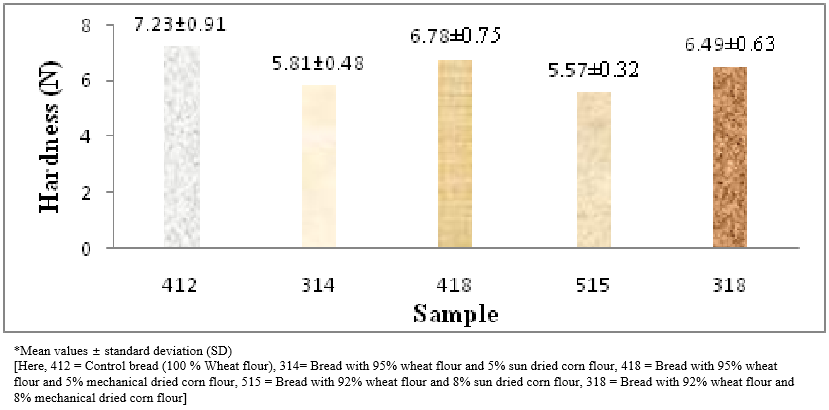
3.5. Effect of Bread Flour on Hardness of BreadThe product inner structure was evaluated by texture analysis. All the four corn flour bread samples along with the control sample were assessed to characterize the crumb in terms of texture (Figure 2). The bread produced with the commercial flour showed high values of hardness (7.23±0.91). Then, the mechanical dried (50°C) corn flour breads got the second (6.78±0.75) and third (6.49±0.63) position. The sun dried corn flour breads secured the lowest position due to the difference in drying conditions. Moreover, 8% sun and mechanical dried corn flour breads showed lower hardness than the 5 % samples as a result of increased percentage of corn flour.

Bread samples containing sun and mechanical dried corn flour and control bread were subjected to sensory evaluation. For evaluation of breads, the external and internal parameters were collected from the bread score report as used by the American Institute of Baking. These parameters were used to assess the acceptability of breads containing 5% and 8% sun and mechanical dried corn flour. The mean score for external, internal parameters and total score of the samples were given in Table 6.
Statistical analysis on the response of taste panel of external parameters of corn flour breads showed that all the samples were not significantly (P < 0.05) different. Control bread and 5 % sun and mechanical dried corn flour breads are significantly (P < 0.05) different from 8 % sun and mechanical dried corn flour breads. 5 % mechanical dried corn flour bread was got the highest score (26±2.00) as seen from Table 6. Sample 515 got the lowest score (20±1.00) and was equally acceptable as sample 318 securing (21±1.50). For internal parameters 5 % sun and mechanical dried corn flour breads were significantly (P < 0.05) different from control bread and 8 % sun and mechanical dried corn flour breads. Again, the highest score (63±2.00) was obtained by 418 and was successively followed by sample 314, 412 and 318 with score (61±1.50), (58±1.00) and (55±1.00) respectively, while the lowest score (53±0.50) was given by sample 515.
Total score obtained by 5 % sun and mechanical dried corn flour breads were significantly (P < 0.05) different from control bread and 8 % sun and mechanical dried corn flour breads Table 6. It was seen that samples maintained similar position as acceptability and sample 418 secured the highest score (89±4.00). This was successively followed by sample 314 with score (86±2.5). Thus it was seen that at 5 % substitution level mechanically dried (50°C) flour with 3.54 fineness modulus gave the highest score and was closely followed by sun dried corn flour at similar substitution level. Control bread however obtained 3rd position and significantly (P < 0.05) different from other breads. With 8 % substitution level mechanical dried corn flour bread that secured 4th position with a score (76±2.50) and 8% sun dried corn flour bread got the lowest score (73±0.50). With the increasing presentence of corn flour from 5 % to 8 %, the acceptability was decreasing. Further experiments can be done for the preparation of corn flour breads to study the effect of other ingredients on corn flour breads.
Although bread and similar baked products made from wheat flour are consumed worldwide, some individuals are intolerant to gluten of wheat. Gluten is the protein complex, which gives dough the viscid property, none in oats, barley, maize and rice. Thinking about this point, maize flour was mixed with the wheat flour to minimize the effect of gluten content. After grinding and sieving analysis 50°C mechanical dried corn was used for bread preparation because of its acceptable value of fineness modulus and co-efficient of determination than others along with sun dried and control sample. Control and mechanical dried sample showed higher hardness than the sun dried samples. The overall crust and crumb characteristics of 5 % mechanical dried (50°C) corn flour breads seemed to be better than that of others. From sensory analysis, 418 got the highest score for external and internal parameters and which was 5 % mechanical dried (50°C) corn flour bread. For total score, the samples maintained similar position as acceptability and sample 418 secured the highest score (89±4.00). Thus it is seen that at 5 % substitution level mechanically dried (50°C) flour gave the highest score and closely followed by sun dried corn flour at similar substitution level. The acceptability was decreasing, with the increasing proportion of corn flour from 5 % to 8 %.
The authors convey gratefulness to NST authority as the research was provided with immense support by a research fellowship from NST (National Science and Technology), Ministry of Science and Technology, Government of the People's Republic of Bangladesh.
AOAC: Association of Official Analytical Chemists
ANOVA: Analysis of variance
FAO: Food and Agriculture Organization (United Nations)
g: Gram
ml: Milliliters
%: Percentage
°C: Degree Celsius
SPSS: Statistical Package for Social Science
| [1] | A. Paucean and S. Man; Influence of defatted maize germ flour addition in wheat: maize bread formulations. Journal of Agro-alimentary Processes and Technologies, 19(3), 298-304 (2013). | ||
| In article | |||
| [2] | N. L. Kent; “Technology of cereals: An Introduction of Students of Food Science and Agriculture”. 3rd Edition. Pergamon Press, Oxford, 1990. | ||
| In article | |||
| [3] | P. Houssou and G. S. Ayernor; Appropriate processing and food functional properties of maize flour. African Journal of Food Science and Technology (AJST), 3(12), 126-131 (2002). | ||
| In article | View Article | ||
| [4] | J. Skerritt, J. Devery and A. Hill; Gluten Intolerance: Chemistry, celiac toxicity, and detection of prolamins in food. Cereal Foods World, 35, 638-639 (1990). | ||
| In article | |||
| [5] | N. S. Deor, A. Deswal and H. N. Mishra; Alternative approaches towards gluten-free dough development: recent trends. Food Engineering Reviews, 6, 89-104 (2014). | ||
| In article | View Article | ||
| [6] | E. D. L. Hera, M. Talegón, P. Caballero and M. Gómez; Influence of maize flour particle size on gluten-free bread making. Journal of Science of Food and Agriculture, 93, 924-932 (2013). | ||
| In article | View Article PubMed | ||
| [7] | G. Bottcher, W. Freund and J. Senneka; Raw materials for biscuit products. Optimization of wheat flour. Siisswaren, Germany, 39(4), 23-29 (1995). | ||
| In article | |||
| [8] | E. G. Onuk, I. M. Ogara, H. Yahaya and N. Nannim; Economic evaluation of maize production. Production Agriculture and Technology, 6 (1), 1-11 (2010). | ||
| In article | |||
| [9] | A. O. Elkhalifa and A. H. El-Tinay; Effect of cysteine on bakery products from wheat-sorghum blends. Food Chemistry, 77, 133-137 (2002). | ||
| In article | View Article | ||
| [10] | AOAC; Official Methods of Analysis of the Association of official Analytical Chemist. 17th Ed. Washington D.C (2005). | ||
| In article | |||
| [11] | M. G. Murphy, D. I. Skonberg and M. E. Camire; Chemical composition and physical properties of extruded snacks containing crab processing products. Journal Food Science Agric, 83, 1163-1167 (2003). | ||
| In article | View Article | ||
| [12] | S. Rai, A. Kaur, B. Singh and K. S. Minhas; Quality characteristics of bread produced from wheat, rice and maize flours. Journal of Food Science and Technology, 49, 786-791 (2012). | ||
| In article | View Article PubMed | ||
| [13] | C. L. Hsu, S. L. Hurang, W. Chen, Y. M. Weng and C. Y. Tseng; Qualities and antioxidant properties of bread as affected by the incorporation of yam flour in the formulation. International journal of food science and technology, 39(2), 231-238 (2004). | ||
| In article | View Article | ||
| [14] | M. M. Keregero and K. Mtebe; Acceptability of wheat-sorghum composite flour products: An assessment. Plant Foods for Human Nutrition, 46(4), 305-308 (1994). | ||
| In article | View Article PubMed | ||
| [15] | M. Eduardo, U. Svanberg and L. Ahrne; Consumers acceptance of composite cassava-maize-wheat breads using baking improvers. African journal of food science, 8(7), 390-401 (2014). | ||
| In article | View Article | ||
| [16] | J. Roy, M. A. Alim and M. N. Islam; Drying kinetics and determination of water sorption isotherms of corn. Journal of Bangladesh Agricultural University, 15(2), 309-317 (2017). | ||
| In article | View Article | ||
| [17] | D. B. Ott; Applied Food Science Manual. Michigan State University. Pergramon press, USA, (1987). | ||
| In article | |||
| [18] | M.O. Mohamed and H.A. Morris; Textural and microstructural properties of rennet-induced milk coagulum as affected by the addition of soy protein isolate. Journal of Texture Studies, 18(2), 137-155 (1987). | ||
| In article | View Article | ||
| [19] | W. W. Leung, R. R. Butrum and F. H. Chang; Food Composition Table for use in East Asia, FAO Food Policy & Nutrition Div., Rome (1972). | ||
| In article | |||
| [20] | L. L. Navickis; Corn flour addition to wheat flour doughs, Effect on rheological properties. Cereal Chem, 64(4), 307-310 (1987). | ||
| In article | |||
| [21] | D. Sahai, O. Buendia and D. S. Jackson; Analytical techniques for corn flour: Particle size and functionality relationships in masa flour sample. Cereal chemistry, 78(1), 14-18 (2001). | ||
| In article | View Article | ||
| [22] | K. D. Rausch, R. L. Belyea, M. R. Ellersieck, V. Singh, D. B. Johnston, and M. E. Tumbleson; Particle size distributions of Ground Corn and DDGS from dry grind processing. American Society of Agricultural Engineers, 48(1), 273-277 (2004). | ||
| In article | View Article | ||
| [23] | C. H. Lee and D. S. Chung; Grain Physical and Thermal Properties Related to Drying and Aeration. Department of Biological and Agricultural Engg, Kansas State University, Manhattan, Kansas, USA (2001). | ||
| In article | |||
| [24] | ANSI; American National Standards Institute. Journal of Food Engineering, 84 (1998). | ||
| In article | |||
| [25] | E. A. Silver. A proposed method for determining uniformity of ground feeds. Agric. Engineering, 19(6), 250 (1938). | ||
| In article | |||
| [26] | Y. Pomeranz; What? How much? What function in bread making? Cereal Food World, 25, 656-662 (1980). | ||
| In article | |||
Published with license by Science and Education Publishing, Copyright © 2020 Joysree Roy and Md. Nazrul Islam
 This work is licensed under a Creative Commons Attribution 4.0 International License. To view a copy of this license, visit
http://creativecommons.org/licenses/by/4.0/
This work is licensed under a Creative Commons Attribution 4.0 International License. To view a copy of this license, visit
http://creativecommons.org/licenses/by/4.0/
| [1] | A. Paucean and S. Man; Influence of defatted maize germ flour addition in wheat: maize bread formulations. Journal of Agro-alimentary Processes and Technologies, 19(3), 298-304 (2013). | ||
| In article | |||
| [2] | N. L. Kent; “Technology of cereals: An Introduction of Students of Food Science and Agriculture”. 3rd Edition. Pergamon Press, Oxford, 1990. | ||
| In article | |||
| [3] | P. Houssou and G. S. Ayernor; Appropriate processing and food functional properties of maize flour. African Journal of Food Science and Technology (AJST), 3(12), 126-131 (2002). | ||
| In article | View Article | ||
| [4] | J. Skerritt, J. Devery and A. Hill; Gluten Intolerance: Chemistry, celiac toxicity, and detection of prolamins in food. Cereal Foods World, 35, 638-639 (1990). | ||
| In article | |||
| [5] | N. S. Deor, A. Deswal and H. N. Mishra; Alternative approaches towards gluten-free dough development: recent trends. Food Engineering Reviews, 6, 89-104 (2014). | ||
| In article | View Article | ||
| [6] | E. D. L. Hera, M. Talegón, P. Caballero and M. Gómez; Influence of maize flour particle size on gluten-free bread making. Journal of Science of Food and Agriculture, 93, 924-932 (2013). | ||
| In article | View Article PubMed | ||
| [7] | G. Bottcher, W. Freund and J. Senneka; Raw materials for biscuit products. Optimization of wheat flour. Siisswaren, Germany, 39(4), 23-29 (1995). | ||
| In article | |||
| [8] | E. G. Onuk, I. M. Ogara, H. Yahaya and N. Nannim; Economic evaluation of maize production. Production Agriculture and Technology, 6 (1), 1-11 (2010). | ||
| In article | |||
| [9] | A. O. Elkhalifa and A. H. El-Tinay; Effect of cysteine on bakery products from wheat-sorghum blends. Food Chemistry, 77, 133-137 (2002). | ||
| In article | View Article | ||
| [10] | AOAC; Official Methods of Analysis of the Association of official Analytical Chemist. 17th Ed. Washington D.C (2005). | ||
| In article | |||
| [11] | M. G. Murphy, D. I. Skonberg and M. E. Camire; Chemical composition and physical properties of extruded snacks containing crab processing products. Journal Food Science Agric, 83, 1163-1167 (2003). | ||
| In article | View Article | ||
| [12] | S. Rai, A. Kaur, B. Singh and K. S. Minhas; Quality characteristics of bread produced from wheat, rice and maize flours. Journal of Food Science and Technology, 49, 786-791 (2012). | ||
| In article | View Article PubMed | ||
| [13] | C. L. Hsu, S. L. Hurang, W. Chen, Y. M. Weng and C. Y. Tseng; Qualities and antioxidant properties of bread as affected by the incorporation of yam flour in the formulation. International journal of food science and technology, 39(2), 231-238 (2004). | ||
| In article | View Article | ||
| [14] | M. M. Keregero and K. Mtebe; Acceptability of wheat-sorghum composite flour products: An assessment. Plant Foods for Human Nutrition, 46(4), 305-308 (1994). | ||
| In article | View Article PubMed | ||
| [15] | M. Eduardo, U. Svanberg and L. Ahrne; Consumers acceptance of composite cassava-maize-wheat breads using baking improvers. African journal of food science, 8(7), 390-401 (2014). | ||
| In article | View Article | ||
| [16] | J. Roy, M. A. Alim and M. N. Islam; Drying kinetics and determination of water sorption isotherms of corn. Journal of Bangladesh Agricultural University, 15(2), 309-317 (2017). | ||
| In article | View Article | ||
| [17] | D. B. Ott; Applied Food Science Manual. Michigan State University. Pergramon press, USA, (1987). | ||
| In article | |||
| [18] | M.O. Mohamed and H.A. Morris; Textural and microstructural properties of rennet-induced milk coagulum as affected by the addition of soy protein isolate. Journal of Texture Studies, 18(2), 137-155 (1987). | ||
| In article | View Article | ||
| [19] | W. W. Leung, R. R. Butrum and F. H. Chang; Food Composition Table for use in East Asia, FAO Food Policy & Nutrition Div., Rome (1972). | ||
| In article | |||
| [20] | L. L. Navickis; Corn flour addition to wheat flour doughs, Effect on rheological properties. Cereal Chem, 64(4), 307-310 (1987). | ||
| In article | |||
| [21] | D. Sahai, O. Buendia and D. S. Jackson; Analytical techniques for corn flour: Particle size and functionality relationships in masa flour sample. Cereal chemistry, 78(1), 14-18 (2001). | ||
| In article | View Article | ||
| [22] | K. D. Rausch, R. L. Belyea, M. R. Ellersieck, V. Singh, D. B. Johnston, and M. E. Tumbleson; Particle size distributions of Ground Corn and DDGS from dry grind processing. American Society of Agricultural Engineers, 48(1), 273-277 (2004). | ||
| In article | View Article | ||
| [23] | C. H. Lee and D. S. Chung; Grain Physical and Thermal Properties Related to Drying and Aeration. Department of Biological and Agricultural Engg, Kansas State University, Manhattan, Kansas, USA (2001). | ||
| In article | |||
| [24] | ANSI; American National Standards Institute. Journal of Food Engineering, 84 (1998). | ||
| In article | |||
| [25] | E. A. Silver. A proposed method for determining uniformity of ground feeds. Agric. Engineering, 19(6), 250 (1938). | ||
| In article | |||
| [26] | Y. Pomeranz; What? How much? What function in bread making? Cereal Food World, 25, 656-662 (1980). | ||
| In article | |||