The production of dried mango slices represents a significant financial opportunity for many cooperatives in northern Côte d’Ivoire. However, the challenge lies in preserving the slices after production, which remains a limiting factor for the sustainable development of this sector. The objective of this study was to improve the shelf life of dried mango slices (Mangifera indica L. var. Kent). To achieve this, a number of treatments were applied. UV-C Exposure: The slices were exposed to ultraviolet-C (UV-C) radiation. Packaging: After UV-C treatment, the slices were packaged either in kraft paper or polyethylene. Subsequently, these treated slices underwent an accelerated aging test over three months within a controlled environment maintained at 40°C ± 2°C and a relative humidity of 75% ± 5%. Regular analyses were conducted at specific intervals (T0: initial time; T3: 3rd month of storage; T6: 6th month of storage; and T9: 9th month of storage). The study found that the microbiological load for the group treated with UV-C and packaged in kraft paper (LMS-UVC-K) showed no significant microbiological load, while the group treated with UV-C and packaged in polyethylene (LMS-UVC-P) experienced a 9% increase (TAMF). Additionally, LMS-UVC-P had a moisture content of 47.98%, whereas LMS-UVC-K had 12.77%. Remarkably, the water activity (Aw) values did not exceed the threshold (Aw = 0.6) for LMS-UVC-K. In sensory evaluations, LMS-UVC-K received the highest sensory ratings during the 9-month storage period, with an average score of 6 ± 0.00. In contrast, LMS-UVC-P scored an average of 4 ± 0.00. Overall, the combination of kraft paper and UV-C treatment allowed for a minimum shelf life of 9 months for dried mango slices, while the combination of polyethylene and UV-C treatment provided 3 months of preservation. This approach could effectively preserve dried mango slices produced.
Dried mango slices hold a cherished place in Ivorian culinary tradition, and their production involves small-scale cooperatives as key players. Beyond local consumption, these slices have gained popularity in Europe, serving as a strategic weapon against substantial post-harvest losses (which can reach 40% of total production) 1 and providing a vital income stream for those involved in the sector. Undoubtedly, this activity contributes significantly to enhancing the value of this tropical fruit 2. These slices are derived from fresh mangoes and undergo several essential steps, including washing, peeling, trimming, slicing, drying, and finally, packaging in polyethylene 3.
From a nutritional perspective, dried mango slices can serve as a rich source of essential nutrients, including vitamins (such as A and C), minerals (such as calcium, potassium, sodium, and iron), and bioactive compounds 4, 5. Incorporating dried mango slices into dietary habits may contribute to reducing the risk of cardiovascular disease and certain cancers, while simultaneously enhancing overall quality of life 6. For numerous consumers, these dried slices serve as a convenient and nutritious snacking option-an appealing alternative to heavily processed appetizer products. However, due to the observed variation in moisture content and water activity during post-production storage, dried mango slices may become vulnerable to both microbiological contamination and oxidation. This susceptibility primarily arises from the use of polyethylene-type packaging. As a result, the overall marketability of dried mango slices could be compromised, particularly in terms of taste, aroma, texture, and nutritional value. Furthermore, this packaging-related vulnerability might lead to a reduction in the slices’ shelf life, notably affecting the minimum durability date. Such consequences could have significant economic and health implications. However, it is essential to carefully consider effective preservation measures to ensure the sanitary and marketable quality of dried mango slices. These corrective actions should be readily available and accessible for easy adoption and popularization.
Indeed, ultraviolet (UV-C) irradiation could serve as an effective treatment method for dried mango slices. By applying UV-C, we can prevent microbiological contamination of foodstuffs-either by destroying or inactivating microorganisms and limiting their ability to multiply.
Similarly, kraft paper plays a crucial role as a packaging material for food preservation. Not only is it highly affordable, but it is also biodegradable. Its impermeability to both water and air makes it an excellent choice for safeguarding food products, protecting them from contamination and oxidation 7.
This study aims to evaluate the impact of UVC irradiation and/or kraft packaging on the minimum durability date (MDD) of dried mango slices produced in northern Côte d’Ivoire.
In this study, three batches of dried mangoes, each consisting of three 100 g packets of dried Kent variety mangoes, were examined over a 45-day storage period in a climate chamber (40°C and 75% relative humidity). The first batch comprised dried mango slices treated with ultraviolet C (UV-C) rays (at 254 nm) for one minute, then packaged in polyethylene (LMS-UVC-P). The second batch consisted of dried mango slices treated with UV-C (254 nm) for one minute, then packaged in Kraft paper (LMS-UVC-K). Freshly processed mangoes were collected from cooperatives located in northern Côte d’Ivoire. All samples were taken from the two packaging batches obtained. Four analysis points were established: immediately after packaging, after 14 days or 3 months, after 28 days or 6 months, and after 42 days or 9 months (T0, T3, T6, and T9). The accelerated aging conditions in the CTS climate chamber were 40°C ± 2°C and 75% ± 5% relative humidity, in accordance 8, 9, over a period of 6 weeks, corresponding to 9 months of storage. Analyses were conducted every 2 weeks (equivalent to 3 months of storage).
2.2. Moisture and Water Activity AnalysisThe moisture content was determined in accordance 10 standard. Five grams of the sample were weighed and placed in a ventilated oven at 105°C for 48 hours. The dried sample was then removed, cooled in a desiccator, weighed, and returned to the oven for one hour before being reweighed. This process was repeated until a constant weight was obtained. To determine the water activity (aw), an Awmeter (Aqualab, France) was used.
2.3. Microbiological AnalysisThe culture media used to carry out the work were prepared according to the manufacturer’s recommendations mentioned on the different boxes. This involved aseptically removing 25 g of the sample primarily at (T0, T3, T6, and T9), placing it in a sterile Stomacher plastic bag, and adding 225 mL of buffered peptone water (BPW). This mixture was then ground for 1 to 3 minutes, then left to stand for 30 minutes to allow for revivification. The dilution stock solution (10^-1) was thus formed in accordance with the standard 11. From the stock solution, dilutions were made in test tubes to facilitate enumeration. To prepare the 10^-1 dilution, 1 mL of the stock suspension was taken sterile and mixed with 9 mL of buffered peptone water (BPW) in a sterile test tube. Next, 1 mL of the 10^-1 dilution was taken and homogenized in 9 mL of buffered peptone water to obtain the 10^-2 dilution. Using the same technique, dilutions from 10^-3 to 10^-6 were made. Decimal dilutions were prepared in accordance with the standard 11. These were carried out using horizontal methods 12. The following germ groups were enumerated: total aerobic mesophilic flora (TAMF); yeasts and molds; E. coli and salmonella.
2.4. Vitamins AnalysisAscorbic acid was extracted using a metaphosphoric acid/acetic acid solution and assayed with 2,6-dichlorophenol indophenol calibrated with standard vitamin C of known concentration 13. As for vitamin A, it was determined according to the protocol described by 14.
2.5. Minerals AnalysisThe minerals calcium (Ca), potassium (K), magnesium (Mg) and sodium (Na) were determined according to the protocol of 10.
2.6. Sensorial TraitsFor sensory analysis, dried mango slice samples were evaluated at each analysis period (T0, T3, T6, and T9). The samples were assessed by 60 panelists according to the National Committee for Ethics in Life and Health Sciences (Ref: 00047_24/MSHPCMU/CNESVS-Km). A hedonic scoring test following 15 standard was used to evaluate the acceptability level of dried mango (Mangifera indica L. var Kent) slice samples. Thus, sixty (60) untrained assessors aged over 18 were selected to form part of the panel. The panelists were asked to rate the overall appreciation level of the sensory attributes of color, taste, smell, texture, and overall acceptability on a 7-point unipolar linear scale according to the scale prescribed by 16. Color, taste, texture, and overall acceptability were rated from 1 (extremely disliked) to 7 (extremely liked).
2.7. Statistical AnalysisThe analysis of variance (ANOVA) of data from the evaluation of biochemical, microbiological, and sensory parameters was conducted using the statistical software XLSTAT 11.19. Whenever a significant difference was revealed, the ANOVA test was supplemented by Tukey’s post-ANOVA test to identify the variable(s) with significant differences. Data generated by the XLSTAT statistical software were evaluated by significance analysis (P ≤ 0.05).
The evolution of the microbiological characteristics of dried mango slices during accelerated aging at 40°C and 75% RH is presented in Table 1. Regarding the dried mango slices treated with UV-C and then packaged in polyethylene (LMS-UV-C-P), a significant increase (P < 0.05) of 4.8% and 9% was noted respectively for total aerobic mesophilic germs (TAMF) and molds over the 9 months of storage, corresponding to 6 weeks of steaming in the climate chamber. As for molds, no significant difference was observed during this period. Furthermore, the dried mango slices treated with UV-C and then packaged in Kraft paper (LMS-UV-C-K) showed no significant microbial load during the 9 months of storage, equivalent to 6 weeks of steaming in the climate chamber.
Scores on the same line with different superscript letters are statistically different at P ˂ 0.05 according to Tuckey's test. T0: time before climatic enclosure; T3: 2 weeks in climatic enclosure; T6: 4 weeks in climatic enclosure and T9: 6 weeks in climatic enclosure. FAMT: total aerobic mesophilic flora. LMS-UVC-P: dried mango slice treated with UV-C (240 nm) then packaged in polyethylene packaging; LMS-UVC-K: dried mango slice treated with UV-C (240 nm) then packaged in Kraft packaging; LMS-K: dried mango slice packaged without UV-C (240 nm) treatment in Kraft packaging.
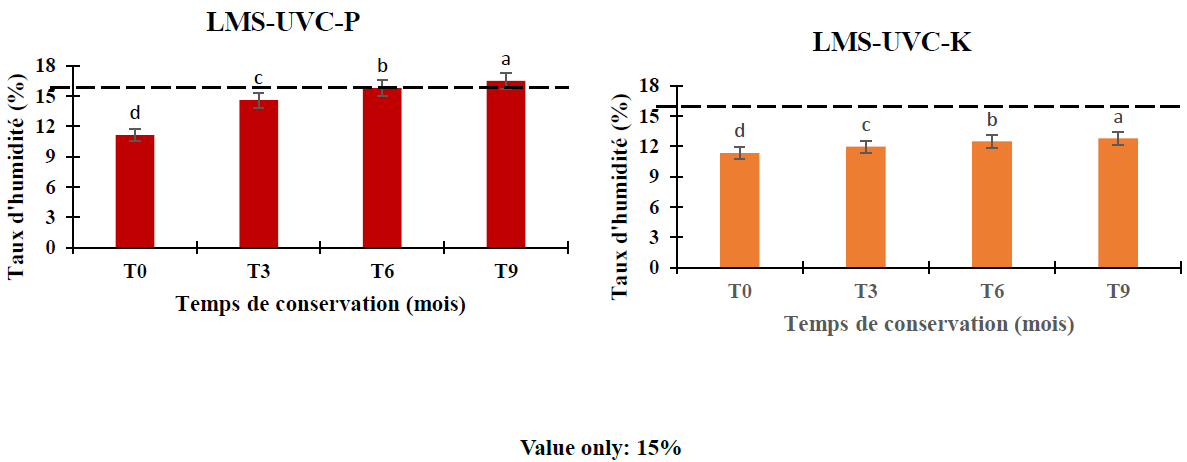
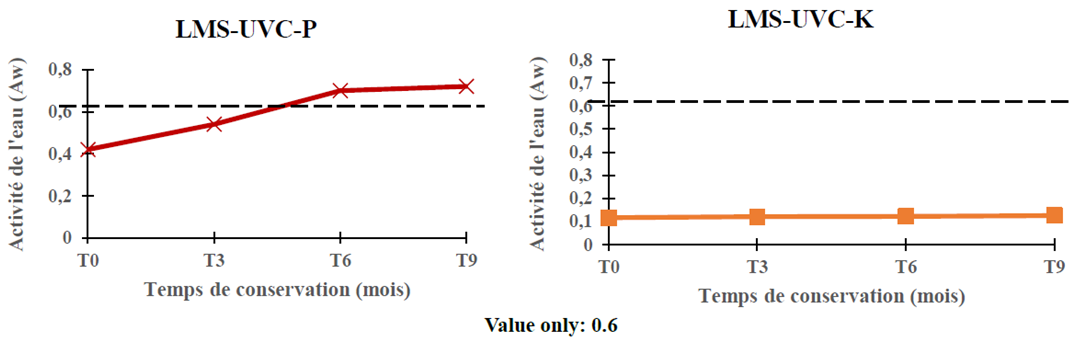
Figure 1 illustrates the evolution of water activity (Aw) and moisture content of dried mango slice samples during accelerated aging (40°C and 75% RH). The moisture content increased from 11.15 ± 1.00 g/100 g sample (T0) to 16.50 ± 0.12 g/100 g sample (T9), representing a 47.98% increase for dried mango slices treated with UV-C and then packaged in polyethylene (LMS-UV-C-P). For dried mango slices treated with UV-C and packaged in Kraft paper (LMS-UV-C-K), the moisture content increased from 11.35 ± 1.08 g/100 g sample (T0) to 12.8 ± 0.12 g/100 g sample (T9), representing a 12.77% increase. Regarding water activity (Aw) values (Figure 2), no increase above the threshold value (Aw = 0.6) was observed for dried mango slices treated with UV-C and then packaged in Kraft paper (LMS-UV-C-K).
With the exception of dried mango slices treated with UV-C and then packaged in Kraft paper (LMS-UV-C-K), dried mango slices treated with UV-C and then packaged in polyethylene (LMS-UV-C-P) showed water activity above the threshold value (Aw = 0.6) after the 3rd month of storage.


The vitamin contents of dried mango samples during accelerated aging (40°C and 75% RH) are presented in Table 2. With the exception of vitamin D, the results obtained from statistical processing revealed no significant differences (P < 0.05) in the vitamin composition of the different samples. Nevertheless, the vitamin A content remained high, with an average level of 1.26% over the 9 months of storage. Similarly, the vitamin C content remained high over the 9-month shelf-life, with an average level of 31.39%. Regarding the vitamin D content, a significant increase (P < 0.05) was observed in the slices of dried mangoes treated with UV-C and then packed in polyethylene-type packaging (LMS-UV-C-P) and those of dried mangoes treated with UV-C and then packed in Kraft-type packaging (LMS-UV-C-K). These values ranged respectively from 1.60 ± 0.05 µg/100 g to 1.45 ± 0.09 µg/100 g and from 1.63 ± 0.15 µg/100 g to 1.40 ± 0.01 µg/100 g over the 9 months of storage.
Scores on the same line with different superscript letters are statistically different at P ˂ 0.05 according to Tuckey's test. T0: time before entering climatic chamber; T3: 2 weeks in climatic chamber; T6: 4 weeks in climatic chamber and T9: 6 weeks in climatic chamber; LMS-UV-C-P: dried mango slice treated with UV-C (240 nm) then packed in polyethylene-type packaging; LMS-UV-C-K : dried mango slice treated with UV-C (240 nm) then packaged in Kraft-type packaging; LMS-K: dried mango slice packaged without UV-C treatment (240 nm) in Kraft packaging.
The mineral composition of dried mango slices during accelerated aging (40°C and 75% RH) is presented in Table 3. The minerals analyzed included calcium, potassium, magnesium, sodium, and iron. Among the macro-elements, potassium (K) was the most predominant mineral in each sample, with contents ranging from 861.52 ± 0.06 µg/100 g to 865.85 ± 0.25 µg/100 g for dried mango slices treated with UV-C and then packed in polyethylene-type packaging (LMS-UV-C-P) during the 9-month storage period. For dried mango slices treated with UV-C and then packed in Kraft packaging (LMS-UV-C-K), these levels ranged from 862.55 ± 0.01 µg/100 g to 864.75 ± 0.08 µg/100 g over the 9-month shelf-life. Depending on the storage period (T0, T3, T6, and T9), the levels of Ca, Mg, and Na increased significantly (P < 0.05), peaking in the 6th month of storage (T6) for each sample.
Scores on the same line with different superscript letters are statistically different at P ˂ 0.05 according to Tuckey's test. T0: time before entering climatic chamber; T3: 2 weeks in climatic chamber; T6: 4 weeks in climatic chamber and T9: 6 weeks in climatic chamber; LMS-UV-C-P: dried mango slice treated with UV-C (240 nm) then packed in polyethylene-type packaging; LMS-UV-C-K : dried mango slice treated with UV-C (240 nm) then packaged in Kraft-type packaging; LMS-K: dried mango slice packaged without UV-C treatment (240 nm) in Kraft packaging.
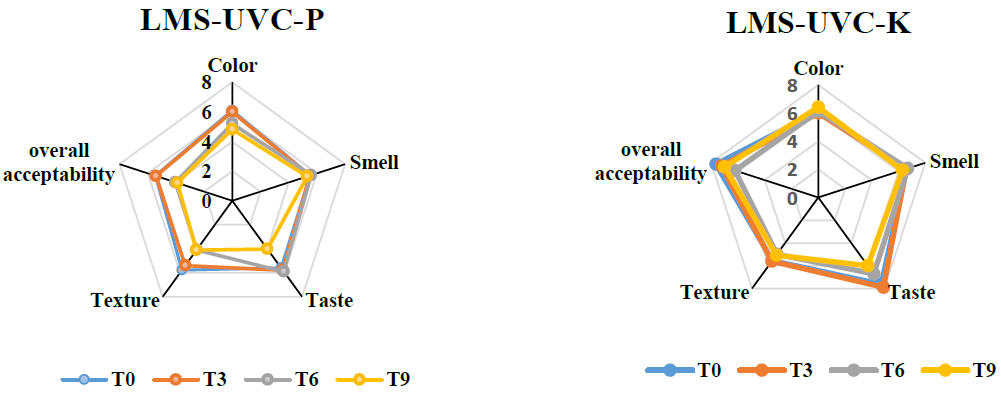
Figure 3 illustrates the degree of appreciation of the sensory parameters of dried mango slices during accelerated aging (40°C and 75% RH). A significant depreciation (P < 0.05) in the overall acceptability and texture of dried mango slices treated with UV-C and then packaged in polyethylene (LMS-UV-C-P) was recorded from the 6th month of storage, with an average score of 3 ± 0.00. Conversely, descriptors such as color and taste showed a significant decline (P < 0.05) from the 9th month of storage, with an average score of 4 ± 0.00. As for dried mango slices treated with UV-C and then packaged in Kraft paper (LMS-UV-C-K), they were appreciated throughout the 9 months of storage, with an average score of 6 ± 0.00.

The aim of this study was to assess the effectiveness of the combined use of UV-C and packaging on the minimum durability date (MDD) of dried mango slices (Mangifera indica L. var Kent). This study shows that the use of Kraft paper, UV-C lamps, and the combined use of these actions have had different impacts on the shelf life of packaged dried mango slices. These differences are reflected in the variations in stability indicators (moisture content (H%), water activity (Aw), and microbial count (N)) that determine the minimum durability date (MDD) of dried mangoes. As a reminder, a dried mango slice is considered stable if and only if H% < 15%, Aw < 0.6, and N ≤ 10^4 CFU/g TAMF according to the standard 20 relating to the marketability of dried mango slices. Thus, for an expected result estimated at 9 months of shelf life, the investigations showed that all stability indicators had values above the threshold values recommended by the standard for the use of UV-C lamps. These observations indicate that the single use of the UV-C lamp is not recommended for the 9-month conservation of dried slices. Indeed, although the positive effect of UV-C on microbial growth is proven (reduction rate estimated at 72.27% at 6 months (T6)), their action did not limit the proliferation of mesophilic aerobic germs in dried mango slices after 3 months (T3 = 1.98 x 10^4). This proliferation of mesophilic aerobic flora would be linked to the increase in water activity (Aw rises from 0.54 (T3) to 0.7 (T6)) due to the permeability of the polyethylene packaging used to package the dried mangoes produced. Based on these analyses, the minimum durability date (MDD) of dried mango slices treated with UV-C and then packaged in polyethylene-type packaging (LMS-UV-C-P) could be estimated at 3 months (Best before 3 months). Similar indications were observed when evaluating the quality of yêkè-yêkè (corn couscous) and gambari-lifin (refined corn flour) during storage 17. This evaluation revealed that the variation in water activity (from 0.40 at the start to 0.67 after 9 months) favored the proliferation of total aerobic mesophilic flora germs (4.0 x 10^4 to 4.4 x 10^6 CFU/g). The lower quality of dried mango slices could be linked to the cooling time adopted during packaging. However, rapid cooling of mango slices after drying (rapidly lowering the temperature) could limit bacterial growth. Indeed, the faster food is cooled, the less time it will remain in the danger zone and the less risk there will be of bacterial growth 18. Regarding the combined use of Kraft paper and UV-C lamps in the preservation plan for dried mango slices, analyses indicated that in addition to the absence of total aerobic mesophilic flora germs, an estimated humidity of 12.8 and a water activity (Aw) equal to 0.13 were observed after 9 months of storage. Concerning the quality standard for dried mangoes, these results suggest that the combined use of Kraft packaging and UV-C could be recommended for the preservation of dried mango slices. The observed compliance with the standard’s requirements would depend primarily on controlling the development of mesophilic aerobic flora during the cooling of dried mango slices under the action of UV-C radiation. Indeed, UV-C radiation destroys the DNA of yeasts and bacteria, leading to their death or annihilating all their reproductive functions, eventually resulting in the death of the microorganisms. Based on this assertion, 19 recommend the use of UV-C radiation to sterilize musts and wines without altering their physicochemical characteristics, in order to limit the risk of microbial development. Furthermore, given these qualities (microbicidal action), 20, 21 suggest the use of UV-C radiation for decontamination/disinfection purposes post-harvest. Based on these various analyses, the minimum durability date (MDD) of dried mango slices treated with UV-C and then packaged in Kraft-type packaging (LMS-UV-C-K) could be estimated at 9 months (Best before 9 months). However, dried mango slices treated with UV-C and then packaged in Kraft packaging (LMS-UV-C-K) showed significant mean scores (P < 0.05). These scores, obtained from descriptors such as color, odor, taste, and texture throughout the 6 weeks of climatic aging, ranged from (7.65 ± 0.66) to (7.00 ± 1.71) for overall acceptability. Thus, dried mango slices packaged without UV-C treatment in Kraft-type packaging (LMS-UV-C-K) were appreciated throughout the 9 months (6 weeks of aging) of storage.
At the conclusion of this study, actions were undertaken to improve the preservation plan for dried mangoes in order to extend their shelf life (MDD). Three actions were implemented to enhance the shelf life of dried mango slices. The combined use of the aforementioned actions limited microbial proliferation during the 9 months of preservation. From a sensory perspective, the corrective actions favored an overall appreciation of dried mango slices treated with UV-C and then packaged in polyethylene-type packaging (LMS-UV-C-P) for up to 3 months, and dried mango slices packaged without UV-C treatment in Kraft-type packaging (LMS-UV-C-K) for up to 9 months. In light of the results, the combined use of UV-C and Kraft paper could be recommended in the implementation of the preservation plan for dried mango slices produced in Côte d’Ivoire.
The authors would like to thank the anonymous reviewers who contributed significantly to improving the scientific quality of this article by devoting their valuable time to its critical evaluation.
The authors declare that there is no conflict of interest in this article.
All authors listed have significantly contributed to the development and the writing of this article.
This research did not receive any specific grant from funding agencies in the public, commercial, or not-for-profit sectors.
| [1] | Inter-mangue, 2022. Atelier diagnostic de l’association interprofessionnelle de la filière mangue (inter mangue) booster la filière mangue en 2020 par la création d’emplois et la réduction de la pauvreté. https://news.abidjan.net/articles/706008/vers-la-reduction-de-20%-des-pertes-postrecoltes-de-la-mangue. [Consulté le 20/02/2022]. | ||
| In article | |||
| [2] | M Arnoldus; F Van der Pol, C Ravry, 2011. Affaire juteuse : quel est l’avenir des produits dérivés de la mangue au Burkina Faso et au Mal, 144 p. | ||
| In article | |||
| [3] | KE Fokouo, KN Kouassi, M Adou, YD N’dri, K Tano, NG Amani, 2023. S.W.O.T. diagnosis of the production system of dried mango slices produced in the North of the Côte d’Ivoire. African Journal of Food Science, 17(3), 59-66. | ||
| In article | |||
| [4] | P Labaky, 2021. Étude de nouveaux marqueurs de qualité de la mangue fraîche et d’un procédé innovant de texturation (IVDV) pour l’optimisation de la qualité des purées et des mangues séchées. Université Montpellier; Université Saint-Joseph (Beyrouth), 218 p. | ||
| In article | |||
| [5] | KE Fokouo, KN Kouassi, M Adou, YD N’dri, K Tano, NG Amani, 2022. Influence of Storage Time on the Physicochemical, Microbiological and Sensory Characteristics of Dried Mango Slices (Mangifera indica L. Var Kent) Produced in Côte d'Ivoire. International Journal of Current Microbiology and Applied Sciences, 11(10), 158-167. | ||
| In article | View Article | ||
| [6] | C Vasco, J Ruales, A Kamal-Eldin, 2008. Total penolic compounds and antioxidant capacities of major fruits from Ecuador. Food Chemistry, 111(4): 816-823. | ||
| In article | View Article | ||
| [7] | Research Institute, 2016. «Assessment of physical and mechanical properties of paper bags used to transport retail products », ITENE. www.paperrecovery.org | ||
| In article | |||
| [8] | ICH, 2009. Stability testing of active pharmaceutical ingredients and finished pharmaceutical products. World Health Organization WHO Technical Report Series, No 953. | ||
| In article | |||
| [9] | FD X 15-140, 2013. Mesure de l'humidité de l'air. Enceintes climatiques et thermostatiques. Caractérisation et vérification, 43 p. | ||
| In article | |||
| [10] | AOAC, 2000. Official methods of analysis, 17th edn. Association of Official Analytical Chemists, Washington DC, 687 p. | ||
| In article | |||
| [11] | NF EN ISO 6887-1, 2017. Microbiologie de la chaîne alimentaire-Préparation des échantillons, de la suspension mère et des dilutions décimales en vue de l'examen microbiologique-Partie 1 : Règles générales pour la préparation de la suspension mère et des dilutions décimales, 28 p. | ||
| In article | |||
| [12] | AFNOR NF V08-051, 1999. Microbiologie des aliments-Dénombrement des microorganismes par comptage des colonies obtenues à 30 degrés Celsius-Méthode de routine, 8 p. | ||
| In article | |||
| [13] | G Pongracz, H Weiser, D Matzinger, 1971. Tocopherols- Antioxydant. Fat. Science Technology, 97: 90-104. | ||
| In article | View Article | ||
| [14] | R Sami, Y Li, B Qi, S Wang, Q Zhang, F Han, L Jiang, 2014. HPLC Analysis of Water-Soluble Vitamins (B2, B3, B6, B12, and C) and Fat-Soluble Vitamins (E, K, D, A, andβ-Carotene) of Okra (Abelmoschus esculentus). Journal of Chemistry, 1-6. | ||
| In article | View Article | ||
| [15] | AFNOR NF EN ISO 11136, 2017. Analyse sensorielle-Méthodologie-Lignes directrices générales pour la réalisation d'épreuves hédoniques effectuées avec des consommateurs dans un espace contrôlé, 55 P. | ||
| In article | |||
| [16] | B Dereje, S Abera, 2020. Effect of some pretreatments before drying on microbial load and sensory acceptability of dried mango slices during storage periods and Agriculture. Cogent Food & Agriculture, 6(1), 1-17. | ||
| In article | View Article | ||
| [17] | PA Houssou, NR Adjovi, R Metohoue, V Dansou, H Djivoh, A Hotegni, GA Mensah, 2016. Évaluation de la qualité de yêkè-yêkè (couscous de maïs) et de gambari-lifin (farine raffinée de maïs) au cours du stockage. Revue Ivoirienne des Sciences et Technologie, 27: 136-150. | ||
| In article | |||
| [18] | Guide des manipulateurs d’aliments de l’Ontario, 2018. La salubrité des aliments. ED 3, 166 p. | ||
| In article | |||
| [19] | F Davaux, S Nicolas, C Oubart, 2018. Les UV-C : une alternative à la stabilisation microbiologique des mouts et des vins, 4 p. | ||
| In article | |||
| [20] | J Mercier, M Baka, B Reddy, R Corcuff, J Arul, 2001. Shortwave Ultraviolet Irradiation for Control of Decay Caused by Botrytis cinerea in Bell Pepper: Induced Resistance and Germicidal Effects. Journal of the American Society for Horticultural Science, 126: 128-133. | ||
| In article | View Article | ||
| [21] | A Siddiqui, S Dawar, MJ Zaki, N Hamid, 2011. Role of ultra violet (UV-C) radiation in the control of root infecting fungi on groundnut and mung bean. Pakistan Journal of Botany, 43: 2221-2224. | ||
| In article | |||
| [22] | LA Adepoju, ZD Osunde, 2017. Effect of pretreatments and drying methods on some qualities of dried mango (Mangifera indica) fruit. Agricultural Engineering International: CIGR Journal, 19(1): 187-194. | ||
| In article | |||
Published with license by Science and Education Publishing, Copyright © 2026 Kouamé Elie FOKOUO, N’zué Kouadio Christian OKA, Hanzi Karen KOUAME and Kouakou Nestor KOUASSI
 This work is licensed under a Creative Commons Attribution 4.0 International License. To view a copy of this license, visit
http://creativecommons.org/licenses/by/4.0/
| [1] | Inter-mangue, 2022. Atelier diagnostic de l’association interprofessionnelle de la filière mangue (inter mangue) booster la filière mangue en 2020 par la création d’emplois et la réduction de la pauvreté. https://news.abidjan.net/articles/706008/vers-la-reduction-de-20%-des-pertes-postrecoltes-de-la-mangue. [Consulté le 20/02/2022]. | ||
| In article | |||
| [2] | M Arnoldus; F Van der Pol, C Ravry, 2011. Affaire juteuse : quel est l’avenir des produits dérivés de la mangue au Burkina Faso et au Mal, 144 p. | ||
| In article | |||
| [3] | KE Fokouo, KN Kouassi, M Adou, YD N’dri, K Tano, NG Amani, 2023. S.W.O.T. diagnosis of the production system of dried mango slices produced in the North of the Côte d’Ivoire. African Journal of Food Science, 17(3), 59-66. | ||
| In article | |||
| [4] | P Labaky, 2021. Étude de nouveaux marqueurs de qualité de la mangue fraîche et d’un procédé innovant de texturation (IVDV) pour l’optimisation de la qualité des purées et des mangues séchées. Université Montpellier; Université Saint-Joseph (Beyrouth), 218 p. | ||
| In article | |||
| [5] | KE Fokouo, KN Kouassi, M Adou, YD N’dri, K Tano, NG Amani, 2022. Influence of Storage Time on the Physicochemical, Microbiological and Sensory Characteristics of Dried Mango Slices (Mangifera indica L. Var Kent) Produced in Côte d'Ivoire. International Journal of Current Microbiology and Applied Sciences, 11(10), 158-167. | ||
| In article | View Article | ||
| [6] | C Vasco, J Ruales, A Kamal-Eldin, 2008. Total penolic compounds and antioxidant capacities of major fruits from Ecuador. Food Chemistry, 111(4): 816-823. | ||
| In article | View Article | ||
| [7] | Research Institute, 2016. «Assessment of physical and mechanical properties of paper bags used to transport retail products », ITENE. www.paperrecovery.org | ||
| In article | |||
| [8] | ICH, 2009. Stability testing of active pharmaceutical ingredients and finished pharmaceutical products. World Health Organization WHO Technical Report Series, No 953. | ||
| In article | |||
| [9] | FD X 15-140, 2013. Mesure de l'humidité de l'air. Enceintes climatiques et thermostatiques. Caractérisation et vérification, 43 p. | ||
| In article | |||
| [10] | AOAC, 2000. Official methods of analysis, 17th edn. Association of Official Analytical Chemists, Washington DC, 687 p. | ||
| In article | |||
| [11] | NF EN ISO 6887-1, 2017. Microbiologie de la chaîne alimentaire-Préparation des échantillons, de la suspension mère et des dilutions décimales en vue de l'examen microbiologique-Partie 1 : Règles générales pour la préparation de la suspension mère et des dilutions décimales, 28 p. | ||
| In article | |||
| [12] | AFNOR NF V08-051, 1999. Microbiologie des aliments-Dénombrement des microorganismes par comptage des colonies obtenues à 30 degrés Celsius-Méthode de routine, 8 p. | ||
| In article | |||
| [13] | G Pongracz, H Weiser, D Matzinger, 1971. Tocopherols- Antioxydant. Fat. Science Technology, 97: 90-104. | ||
| In article | View Article | ||
| [14] | R Sami, Y Li, B Qi, S Wang, Q Zhang, F Han, L Jiang, 2014. HPLC Analysis of Water-Soluble Vitamins (B2, B3, B6, B12, and C) and Fat-Soluble Vitamins (E, K, D, A, andβ-Carotene) of Okra (Abelmoschus esculentus). Journal of Chemistry, 1-6. | ||
| In article | View Article | ||
| [15] | AFNOR NF EN ISO 11136, 2017. Analyse sensorielle-Méthodologie-Lignes directrices générales pour la réalisation d'épreuves hédoniques effectuées avec des consommateurs dans un espace contrôlé, 55 P. | ||
| In article | |||
| [16] | B Dereje, S Abera, 2020. Effect of some pretreatments before drying on microbial load and sensory acceptability of dried mango slices during storage periods and Agriculture. Cogent Food & Agriculture, 6(1), 1-17. | ||
| In article | View Article | ||
| [17] | PA Houssou, NR Adjovi, R Metohoue, V Dansou, H Djivoh, A Hotegni, GA Mensah, 2016. Évaluation de la qualité de yêkè-yêkè (couscous de maïs) et de gambari-lifin (farine raffinée de maïs) au cours du stockage. Revue Ivoirienne des Sciences et Technologie, 27: 136-150. | ||
| In article | |||
| [18] | Guide des manipulateurs d’aliments de l’Ontario, 2018. La salubrité des aliments. ED 3, 166 p. | ||
| In article | |||
| [19] | F Davaux, S Nicolas, C Oubart, 2018. Les UV-C : une alternative à la stabilisation microbiologique des mouts et des vins, 4 p. | ||
| In article | |||
| [20] | J Mercier, M Baka, B Reddy, R Corcuff, J Arul, 2001. Shortwave Ultraviolet Irradiation for Control of Decay Caused by Botrytis cinerea in Bell Pepper: Induced Resistance and Germicidal Effects. Journal of the American Society for Horticultural Science, 126: 128-133. | ||
| In article | View Article | ||
| [21] | A Siddiqui, S Dawar, MJ Zaki, N Hamid, 2011. Role of ultra violet (UV-C) radiation in the control of root infecting fungi on groundnut and mung bean. Pakistan Journal of Botany, 43: 2221-2224. | ||
| In article | |||
| [22] | LA Adepoju, ZD Osunde, 2017. Effect of pretreatments and drying methods on some qualities of dried mango (Mangifera indica) fruit. Agricultural Engineering International: CIGR Journal, 19(1): 187-194. | ||
| In article | |||