Originally associated with the sociocultural groups of Central Benin, Tchakpalo, a traditional beninese beer, has gradually spread throughout the country. This study aimed to establish the socio-professional profile of vendors and to document the new production practices of Tchakpalo. Hence semi-structured survey combined with direct observations of Tchakpalo vendors were carried out in the five municipalities of Southern Benin. The study indicates that this trade is strongly dominated by women (97.52%), aged 35 to 54 (87.60%), mostly educated (64.46%) and married (75.21%). They have at least five years of experience (78.51%). However, some have been working in this field for over 15 years (30.58%) and some practise this activity exclusively (42.97%). Nevertheless, Tchakpalo trade allows them to contribute significantly to their families’ financial needs (100%). A large diversity of production practices has been registered through the study area. Thus, maize is the most used raw material in Tchakpalo production. Five technological variants of Tchakpalo production have been identified (DFM: Double-Fermented Maize; MFM: Mono-Fermented Maize; NFM: No-Fermented Maize; MFMS: Mono-Fermented Maize-Sorghum; NFMS: No-Fermented Maize-Sorghum). Each variant presented the same unit operations while the number, sequence, operating conditions, additives, and production equipment differ from a variant to another. The Mono-Fermented Maize (MFM) variant is the most commonly used by producers (37.70%). The results of this study provide a solid scientific database for projects to promote this beer, which is emblematic of Benin's food heritage.
The first inhabitants of the Earth primarily fed themselves with food obtained principally through hunting and gathering 1. Later, the need to cultivate certain crops arose. Cereal grains were among the first crops to be grown and harvested. Ancient civilizations prospered in part due to their ability to produce, store and distribute these cereal grains: maize in the America before the arrival of Europeans, rice in the great Asian civilizations, and barley in Ethiopia and Northeast Africa. Millennia later, cereals remain staple products in Africa and constitute an important source of energy and micronutrients 2. They are processed into various food products, both traditional and modern. The types of processing depend on the cereals cultivated and local dietary habits.
In Sub-Saharan African countries, several traditional beers are produced from locally grown cereals, particularly maize (Zea mays L.), millet (Pennisetum typhoideum) and sorghum (Sorghum bicolor (L.) Moench), and they constitute the main alcoholic beverage for savanna populations, meanwhile palm wine is the drink of forest-dwelling populations 3. These beverages contribute significantly to the diet of the populations in these countries and possess remarkable socio-economic importance. These beverages play a crucial role in ceremonies and public events and provides important income for women, who mainly produce them 2.
In Benin, Tchakpalo is a local and low-alcohol made by malting, brewing, and spontaneously fermentating a wort made from water and germinated maize or sorghum grits, or both 4. Originally associated with the Idaatcha and Nago sociocultural groups, located in the municipalities of Glazoué and Dassa-Zoumè in Central Benin 5, this beer has gradually spread throughout the country, particularly in major cities, where it has become very popular 6.
During it migration, the original production process of Tchakpalo has undergone regional adaptations. These adaptations affect multiple aspects of the production, including the unit operations and their associated parameters, but also the raw materials, ingredients, and the production and sales equipment. However, the variations in Tchakpalo production methods in Southern Benin, are poorly documented and not widely recognised.
A valorization of this traditional beer, which is highly appreciated by the Beninese population, requires standardization of the production process based on the most appreciated sensory attributes. To accomplish this goal, it is essential to gather accurate information about the actors of the value chain and the processing conditions, and the distribution methods involved in the sector. This study aimed to contribute the food security of the population by documenting the processing conditions and distribution methods during Tchakpalo production and sale in Benin.
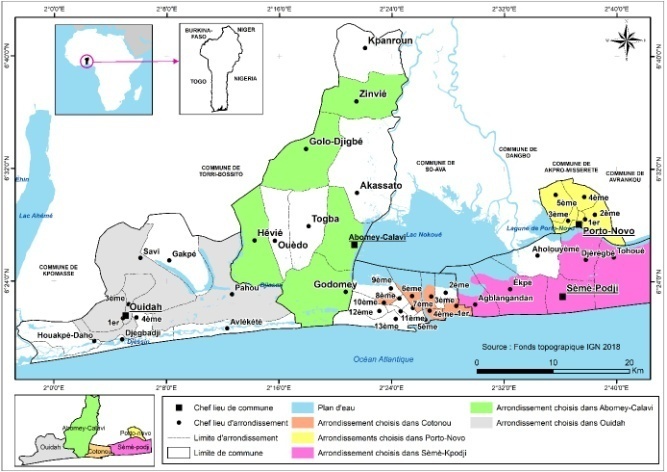
This study was carried out in the five (05) urban municipalities in Southern Benin within the Grand Nokoué area 7: Cotonou (the economic capital), Porto-Novo (the administrative capital), and Abomey-Calavi, Sèmè-Podji and Ouidah (three residential municipalities) (Figure 1). The selection is justified by the limited documentation on the Tchakpalo production in these municipalities, particularly in Ouidah, Sèmè-Podji and Porto-Novo. The few studies on Tchakpalo are focused on Central Benin.
2.2. Selection of Survey ParticipantsFor the selection of survey participants, mixed method, combining purposive sampling with the snowball sampling was implemented following Hongbete et al. 8. Specifically, in each municipality, five (05) districts were randomly selected. Within each district, Tchakpalo vendors were chosen either randomly or based on recommendation, depending on their accessibility and availability and consent to participate in the study. In total, two hundred seventy-nine (279) vendors of Tchakpalo were interviewed during the survey period.
2.3. Collection of Socio-professional Data of Tchakpalo VendorsThe socio-professional profile of Tchakpalo vendors in the Grand Nokoué area was documented in French and/or the local language (Fon, Goun, Yoruba, Nago, Mahi, etc.), using a semi-structured questionnaire, from January to May 2024. The questionnaire, administered at the Tchakpalo sales site (Tchakpalodrôme), was structured around two main axes:
• Socio-demographic characteristics of the vendors including name, gender, age, occupation, level of education and/or literacy, ethnicity and marital status.
• Eco-professional characteristics of vendors including the nature of the producer, the type of trade (exclusive or not, primary or secondary), years of experience, method use for sale, financial income and membership in a professional association or organization.
2.4. Tchakpalo Production MonitoringBased on their availability and the possibility of accessing their production units, sixty-one (61) Tchakpalo vendors were selected for production monitoring (09 in Ouidah, 16 in Abomey-Calavi, 07 in Cotonou, 08 in Sèmè-Podji and 21 in Porto-Novo). Production of Tchakpalo was followed at their respective processing units, in order to establish the flow chart used by each Tchakpalo processors. Particular attention was given to the raw materials (type, selection, variety, availability, additives, etc.), the production equipment (type, nature, manufacturing material, use, maintenance, etc.), and the production method (unit operations, operating conditions, packaging, etc.).
2.5. Statistical Analysis of Collected DataThe survey data collected were computed using GraphPad Prism Version 10.5, and descriptive statistics (mean and proportion) were performed to generate various graphs with the same software. Multiple comparison tests were conducted to analyse the differences in proportions among the various modalities of categorical variables (age, gender, etc.) using the prop.test function in R software version 4.4.2. ArcGIS Version 10.8 was used for the geographical representation of the study area.
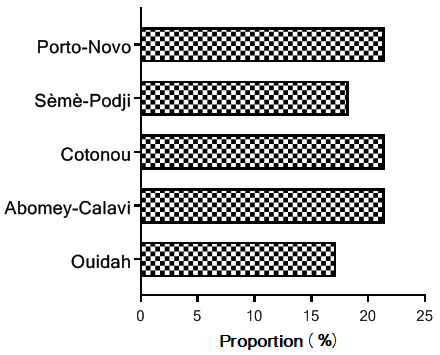
The Figure 2 shows the distribution of Tchakpalo vendor’s accross the studied municipalities. In total, two hundred and seventy-nine (279) vendors inequally distributed across the study area (48 in Ouidah, 60 in Abomey-Calavi, 60 in Cotonou, 51 in Sèmè-Podji and 60 in Porto-Novo) were involved in the first phase of this study. Tchakpalo vendors were found in all districts of the investigated municipalities showing the importance of the activity. This large distribution of vendors can be explained by the fact that the traditional beer Tchakpalo is well-known and consumed by many people. Over the past decade, it has become very popular, particularly in the major cities of Benin 6 (Konfo et al., 2015).
The municipalities of Ouidah and Sèmè-Podji recorded less Tchakpalo vendors than the other municipalities. This result can be explained by differences in the demographic profiles of these municipalities. Indeed, the communes of Ouidah and Sèmè-Podji have a low population density (482 and 897 inhabitants/km², respectively) compared to the communes of Abomey-Calavi (1,218 inhabitants/km²), Porto-Novo (5,286 inhabitants/km²), and Cotonou (8,595 inhabitants/km²), according to the INSAE 9 database. It is important to mention that Abomey-Calavi (residential city), Cotonou (economic capital), and Porto-Novo (administrative capital) are among the most cosmopolitan urban centers in Benin. In these municipalities, a cultural diversity can be observed, which is reflected, among other things, in a wide variety of culinary offerings. Therefore, the popularity of the traditional beer Tchakpalo in these areas comes as no surprise. This result also suggests that Tchakpalo consumers may be more represented in the municipalities of Abomey-Calavi, Porto-Novo, and Cotonou than in those of Ouidah and Sèmè-Podji.


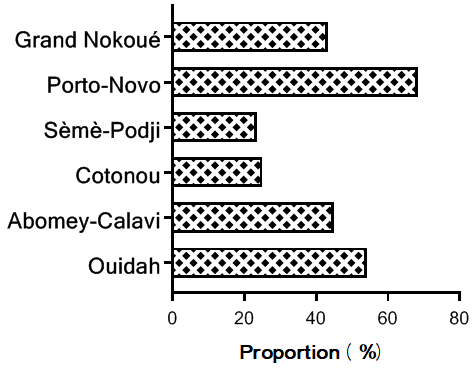
All Tchakpalo vendors surveyed do not actually sell Tchakpalo. Indeed, this traditional beer is typically produced from maize, millet, sorghum, or a mixture of these grains. The production process must include three major stages: malting, brewing and fermentation. Unfortunately, only 43.37% of vendors offer the consumers a beverage produced according to the above criteria and with the main attributes of Tchakpalo (Figure 3). More specifically, there are more processors/vendors of genuine Tchakpalo in the municipalities of Ouidah and Porto-Novo. Conversely, the proportion of vendors of genuine Tchakpalo is at least half as low in the municipalities of Cotonou and Sèmè-Podji. Other processors/vendors of Tchakpalo are selling to the consumers adulterated Tchakpalo (fake Tchakpalo), which consists of a fermented or unfermented drink that, from an organoleptic and technological point of view, doesn’t present the original attributes of Tchakpalo. The raw materials used for these fake Tchakpalo drinks are mainly pineapple (Ananas comosus) peel and Guissi (fermented, soaked maize starch supernatant). These ingredients are cooked to produce a drink to which carbonised sugar syrup is added to obtain the brownish color like the one of genuine Tchakpalo. Other chemical products are added to approximate the organoleptic characteristics of the original Tchakpalo. This practice, technically classified as food fraud, exposes consumers to significant health risks (biological, chemical, and physical). In fact, food fraud is defined as the act of altering, misrepresenting or substituting one product for another, thereby compromising consumer safety and economic ethics 10. Primarily motivated by economic gain, food fraud poses serious risks to consumer health due to the introduction of unauthorized substances or allergens and mislabelling of toxic chemicals into food products 11. The situation is even worse in developing countries such as Benin, where regulatory applications and food control are weak.
3.3. Socio-demographic Profile of Tchakpalo VendorsThe Table 1 provides information on the socio-demographic characteristics of Tchakpalo vendors in Grand Nokoué. Here only vendors of genuine Tchakpalo (121 individuals) were d considered. A high significant difference (p < 0.001) was recorded between the modalities of each socio-demographic parameter. This Table 1 shows that the Tchakpalo sale is an activity carried out almost exclusively by women (97.52%) in Grand Nokoué. In fact, the few male Tchakpalo vendors encountered do not own the stalls themselves. They co-sell Tchakpalo with their wives when the latter are engaged in secondary commercial activities, family activities or other activities. These men, all of whom are labourers, have their workshops right next to the Tchakpalo sales site. It would therefore not be wrong to say that the sale of Tchakpalo is an activity carried out exclusively by women in Southern Benin. This feminization of Tchakpalo sales was also observed by Egounlety et al. 5 in the municipality Dassa-Zoumé in Central Benin.
Our results are consistent with those reported by Kagambega et al., 12 which noticed that In Burkina Faso, for example, the production and sale of traditional drink Zoom-koom is carried out exclusively by women. In Cameroon, the traditional fermented cereal drink (Kounou) is produced exclusively by women 13. Other studies have also reported the predominance of women in the preparation and sale of street food (Noumavo et al., 14 in Benin; Adeosun et al., 15 in Nigeria; Nkosi and Tabil, 16 in South Africa; Ma et al., 17 in China and Samapundo et al., 18 in Haiti). This predominance of women observed in this study can be explained by the fact that in Africa, most activities involving cooking or food is devolved to women 19. In addition, they are generally cheerful and more welcoming to customers. According to Konaté et al. 20, the predominance of women in the traditional processing of agricultural products results from their dual status as housewives and agricultural workers, often responsible for food preparation.
However, in other parts of the world, with very patriarchal cultures, like Brazil, there's a strong male presence in the street food sector. In fact, research carried out in Brazil by Isoni Auad et al. 21 and Cortese et al. 22, report that 80% (federal district) and 58% (city of Florianopolis) of street food vendors were men, respectively. In Haiti 18 and Kenya 23, it was reported that street food vendors were predominantly men.
Several factors can influence the gender profile in street food vending. These include: the type of food, the geographical area, cultural considerations, location (city centre or outlying neighbourhoods), etc. Ethnic specialization is sometimes noted. For example, in West Africa, grilling meat is a male specialty while roasted fresh corn is categorised as female activity. The Fulani, Moors and Hausa are the main groups involved in grilling meat as most of time, people belonging to those ethnic group practices animal rearing. Other culinary specialties (curdled milk, ice cream, etc.) can be made by either men or women.
Except for Porto-Novo city, where Tchakpalo vendors registered were very old {[45-55[, 51.22%}, it can be noted that, the majority of Tchakpalo vendors of Grand Nokoué belong to the 35-44 age group (55.37 %) or the 45-54 age group (32.23 %). This result is close to the rate 97.5 % (26-65 years old) obtained by Egounlety et al. 5 in Central Benin on female vendors of Tchakpalo and slightly lower than the 69.4% (aged 35 to 54) obtained by Mahopo et al. 24 in South Africa on female street food vendors. Tégblé et al. 25 also observed a predominance of female vendors aged 35 to 45 in street food vending in Southern Benin. However, in a study conducted in Cameroon by Bayoï and Danla 26 on Bili-Bili and Cochette, two traditional beers produced from sorghum and rice respectively, the vendors were much younger (aged 20 to 40). Several factors influence the age of street food vendors (type of food, geographical area, culture, level of development, etc.). However, the 35-45 age group is predominant. This can be explained by the fact that this age corresponds to family settlement for many people and the need of financial resources to support their families is more highlighted in that period. Much more productive, with a strong desire to fulfil themselves, they are open to all types of income-generating activities that do not require large financial resources, such as street food selling.
The marital status of Tchakpalo vendors vary slightly from one city to another. The major marital types found include single, married, divorced, and widowed women. However, the majority of Tchakpalo vendors are married (75.21%) or divorced (12.40%). Although none of the vendors had received university degree, the majority had attended Primary or secondary school (64.46%), contrary to the results obtained by Egounlety et al. 5 (2019) in Central Benin, where the majority of female Tchakpalo vendors were illiterate (55%). This difference in the level of education of Tchakpalo vendors between Southern and Central Benin can be explained by the difference in the level of school infrastructure. In fact, in the southern municipalities, almost all villages and city neighbourhoods have at least one primary school and junior and senior high schools 27, which is not always the case in the central municipalities. Furthermore, the cities of Abomey-Calavi, Cotonou, and Porto-Novo are among the four cities with special status in the country, characterized by a level of development and urbanization significantly higher than in other cities. The level of education of street food vendors could increase in the coming years, thanks to the efforts of the Beninese government.
Indeed, free access to preschool and primary education, decreed in 2006 by the Beninese government, is now implemented throughout the country. Furthermore, the introduction of free school meals in preschool and primary schools, especially in rural areas, has significantly improved school enrolment rates for girls and boys 28. When street food vendors are educated, their knowledge of food safety is relatively good and consumers are better protected. In a study conducted by Thanh 29 in Vietnam, a very positive correlation was recorded between street svendors' knowledge of food safety and their level of education and training. Although this remains debatable, education remains an important tool for development, especially in developing countries.
The ethnic groups most represented among Tchakpalo vendors in Grand Nokoué are the Fon (28.10%) and the Goun (39.67%). The strong representation of these two groups is entirely normal. Indeed, the Fon-Goun and related ethnic groups constitute the majority socio-cultural groups in the municipalities involved in this study. They account for 56.7 % of population of Cotonou, 66 % of population of Porto-Novo and 69.8 % of Ouidah population 30. Although Tchakpalo it originated from central Benin, where it is mainly produced by the people from Nago ethnic group, traditional Tchakpalo beer has been adopted by ethnic groups in other towns and villages to which it has migrated.
3.4. Sales Practices and Economic Importance of the Tchakpalo TradeThe sales practices and economic importance of the Tchakpalo trade are presented in Table 2. A highly significant difference (p < 0.001) was observed between the modalities of almost all the parameters evaluated. This table shows that Tchakpalo production in Grand Nokoué is carried out by the women vendors themselves (100 %). For some, the Tchakpalo selling is their only professional activity (42.97 %), as is the case in the municipality of Dassa-Zoumè (Central Benin), where this traditional beer is widely consumed 5 (Egounlety et al., 2019). In Grand Nokoué, however, some vendors combine it with other commercial activities (57.02 %). For the majority of those in the latter group (66 %), the Tchakpalo selling remains their main commercial activity. The secondary activities they engage in, are periodic, with greater importance during periods of low sales of Tchakpalo (rainy seasons, harmattan, major holidays, etc.).
In terms of professional experience, the profile of Tchakpalo vendors varies from one city to another. It should be noted that more than half of the Tchakpalo vendors (57.85 %) have less than ten (10) years of professional experience. Approximately twenty-six percent (26 %) of vendors have between ten (10) and nineteen (19) years of experience in this activity, while nearly sixteen percent (16%) have been working in this field for more than twenty (20) years. This overall view hides certain subtleties. In fact, in the city of Porto-Novo, nearly half of the vendors (48.78%) have more than fifteen years of experience in Tchakpalo production and sales. This observation can be explained by the socio-demographic profile of Tchakpalo vendors. It is in this city that we find the oldest vendors (58.54% ≥15 years).
Considering the age profile and the number of years of experience, it can be noted that processors/vendors involved in this activity are generally young girls or young women who have made it their career. They find themselves in this trade mainly either through family inheritance, lack of employment opportunities, or for its average financial income.
Regardless of the municipalities, stationary sales are the most common method used by Tchakpalo vendors. More than three-quarters of these vendors use stationary sales (77.69%). Stationary sales refer to a form of marketing in which the vendor operates from a fixed, stable, and easily identifiable location. In this sale mode, the consumer moves to the place of sale. The opposite of this sale form is itinerant or street selling, in which the vendor moves to offer her products to consumers. In this study, none of the Tchakpalo vendors exclusively adopt street vending. However, some vendors adopt a mixed sales method (22.31%) that combines stationary and itinerant sales to reach a larger number of consumers.
Very few vendors receive production orders from individuals in the municipalities of Ouidah and Sèmè-Podji. However, in the municipalities of Abomey-Calavi, Cotonou, and Porto-Novo, nearly half of the Tchakpalo vendors receive production orders for special events (weddings, dowries, birthdays, popular celebrations, etc.).
All the vendors report that selling Tchakpalo is a financially rewarding activity. The activity could generate significant profits, which enable processors/vendors to contribute significantly to their families’ financial needs and to save money. Most of them did not wish to comment on the profits made daily. However, some vendors claim to make up to 9 $ US per day, especially during periods of high heat.
Unfortunately, none of Tchakpalo vendors (0 %) belong to a professional association, group or organization. Membership in such structures offers enormous advantages. They organize training for members on various aspects of their profession (economic, technical, marketing, etc.). Negassa et al. 31 showed that 95.4% of street food vendors have never had the opportunity to attend training related to food safety and hygiene.
3.5. Different Technological Variants of Tchakpalo Production in Grand NokouéThe two (02) main raw materials used in Tchakpalo production in Grand Nokoué are maize and sorghum. They are used in single production (maize or sorghum alone) or in co-production (maize and sorghum mixture). Each producer adopts one type of raw material and uses another only in the case of a special order. Table 3 shows the distribution of producers according to the type of raw material used daily. It is easy to see that maize in single-crop production is used by nearly three-quarters of producers, followed by a mixture of maize and sorghum. None of the producers use sorghum alone. This is because sorghum is more expensive than maize, which remains the main cereal in southern Benin. Even in central Benin, where Tchakpalo originated from, producers claim that combining raw materials for Tchakpalo production is very economical 5.
The raw material is purchased from wholesalers or retailers, at the market or in residential areas. According to Tchakpalo producers, the main quality criterion used in selecting raw materials is color (white or white-yellow for maize and red for sorghum). Secondarily, the grains must be whole, dry, free of mold, and contain no foreign matter or insect pests.

Five (05) different technological diagrams have been identified to produce Tchakpalo in Grand Nokoué. These include the three (03) crucial and decisive stages in brewing, namely malting, brewing and fermentation.
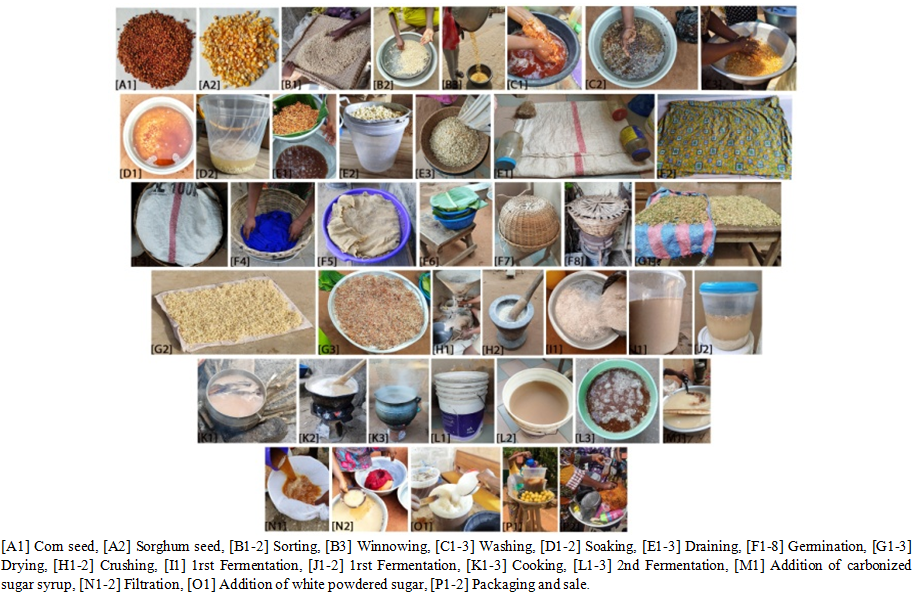
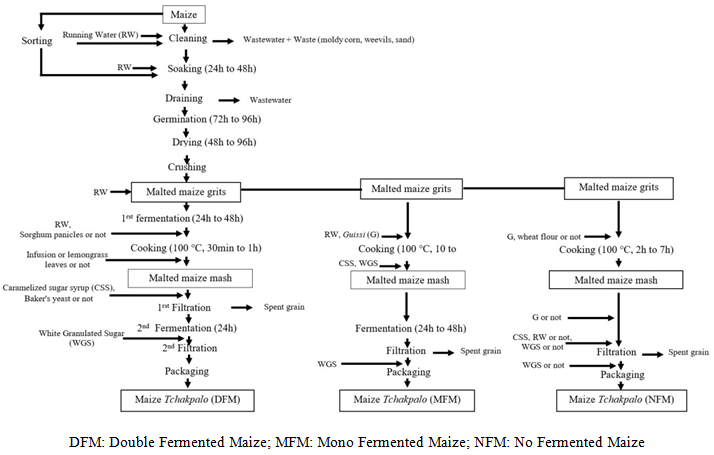
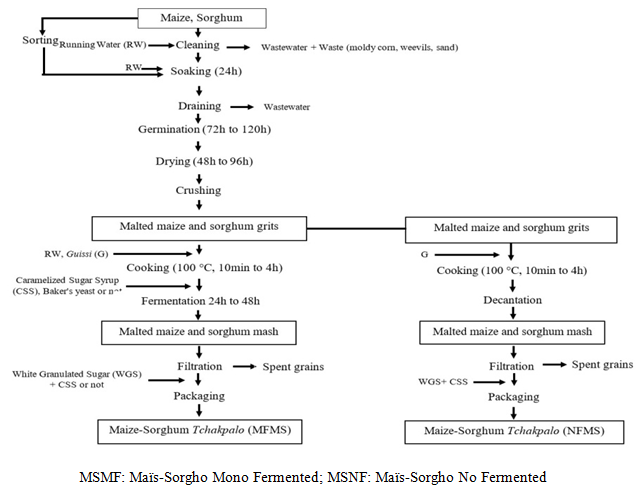
The various stages of malting process are almost identical among producers. This process begins with cleaning (sorting, winnowing and washing) of the maize or sorghum several times to remove as much rotten grains and foreign materials as possible (moldy or broken maize grains, weevils, sand, stones, etc.) (Figure 4). The clean grains are then soaked in water, often in a closed container, at room temperature for 1 to 2 days. To produce maize-sorghum Tchakpalo, the maize and sorghum grains are soaked together. Soaking is widely recognized as the most critical step in malting because, good soaking will result in good germination 32. Indeed, rehydration of the grains starts cellular metabolism, which leads to the lifting of grain dormancy and their entry into germination 33.
Enzymes such as amylases (α and β), proteases, peptidases and glucanases, which are essential for the germination phase, are synthesized and released during soaking. The soaked cereal grains are then drained, spread out in a basket lined with banana leaves or on a synthetic cloth on the ground, and covered for 3 to 4 days to ensure proper germination. During germination, the grains are sprinkled with water every 24 hours or twice a day (morning and evening) to allow the grains to germinate properly and to limit the risk of fungal contamination. The germinated seeds produce seedlings of relatively uniform size. These seeds are sun dried for an average of 3 days. This step has two advantages: it dries the seeds and stops germination 32.
The brewing process in Tchakpalo production essentially consists of grinding the malted grains and cooking the resulting grits. The malted maize or sorghum grains are crushed using a mill or a mortar and pestle. This step releases the important elements as starch polymers and enzymatic equipment, and increases the surface area in contact with water, thus optimizing sugar extraction 32. The grits obtained after crushing are mixed with tap water and homogenized. This mixture may or may not undergo spontaneous fermentation for 24 to 48 hours at room temperature. This is followed by cooking at 100 °C on a wood or charcoal fire to obtain malted maize or sorghum wort (a sweet solution composed principally of fermentable sugars). The wort obtained in this way, after various additions (carbonized sugar syrup, Guissi, sorghum panicle, lemongrass leaves, etc.) depending on the type of diagram, is filtered and the grains residues are removed. The grains residues obtained are often reused for another preparation. Producers add tap water and/or Guissi, then leave the mixture to seattle or ferment, as appropriates, folklore by the other seps described above.
All producers (100%) add caramelized sugar syrup to the mash to obtain or enhance the characteristic brownish color of Tchakpalo. In addition to caramelized sugar syrup, some producers (21.49%) add sorghum panicles to give maize Tchakpalo its brownish color. In the study conducted by Egounlety et al. 5, 50% of producers reported that they add sorghum panicles and/or sorghum leaf sheaths to change the whitish color of maize Tchakpalo to a brown color that is highly appreciated by consumers. According to some producers (8.26%), sorghum panicles also have antibacterial properties. Some producers add fermented maize starch supernatant (Guissi) to acidify the medium, making it more conducive to good fermentation. Lemongrass leaves or their infusions are sometimes added during or after cooking for flavouring of the drink.
The filtrate obtained undergoes spontaneous fermentation for 24 hours at room temperature. During this fermentation phase, sugars are converted into alcohol and organoleptic compounds are produced. Although this fermentation is spontaneous, it modifies the content of essential components in the must, such as carbohydrates, proteins, and minerals, reduces anti-nutritional factors, and induces the production of various aromas 34. To speed up fermentation, some producers add baker's yeast (Saccharomyces cerevisiae). It should be noted that all producers (100%) use plastic containers for fermentation. This could be explained by the fact that plastic accumulates heat better, thus creating ideal conditions for the development and proliferation of fermenting microorganisms. In the fermentation processes of traditional fermented beverages, the fermenting microorganisms come mainly from the microflora naturally present in the substrates, additives, utensils, and equipment used 35.
The product of this fermentation, known in brewing technology as bruite beer, green beer, or young beer, is filtered and sweetened by adding powdered white sugar or left unsweetened before being packaged for sale. Depending on the technology used, this produces Tchakpalo made from maize, sorghum, or a mixture of maize and sorghum. Tchakpalo is generally packaged in calabashes, plastic basins, or 0.5 L, 1.5 L, or 25 L cans. Some consumers add lemon juice to Tchakpalo before drinking it. Figure 5 and Figure 6 shows the production diagrams for maize Tchakpalo and maize-sorghum Tchakpalo, respectively. Basicallly, there are three (03) technological variants for the production of maize Tchakpalo and two (02) technological variants for the production of maize-sorghum Tchakpalo.
The five (05) different Tchakpalo production processes identified in this study contain all practically the same unit operations (sorting, washing, soaking, draining, germination, drying, crushing, cooking, filtration, fermentation and packaging). However, the number, chronology, operating conditions (duration, temperature, etc.), additives and production equipment vary significantly from one process to another. Also, the number of processors varies significantly (p < 0.001) from one process to another. This result confirms the observations of some authors who have worked on traditional african beers. Indeed, Coulibaly et al. 36 stated that traditional beer production processes in Africa are long, complex and vary depending on the country or region, but are nevertheless based on the same principles. These processes involve three main operations: malting, brewing and fermentation 37, 38. Thus, based on the two raw materials (maize and sorghum) and the number of major technological operations (malting, brewing and fermentation), Table 4 presents a comparative summary of these variants.
The Table 4 shows that the type of raw material and the number of fermentation stages are the most significant criteria differentiating the various Tchakpalo production processes in Grand Nokoué. Three (03) variants contain at least one distinct stage of spontaneous fermentation (DFM, MFM and MFMS). In the other two (02) variants, there is no distinct stage of spontaneous fermentation; this has been replaced by the usage of fermented maize starch supernatant (Guissi), which acidifies the medium, giving Tchakpalo the tangy taste normally obtained after fermentation. Guissi is also considered a starter, as it contains fermenting microorganisms. As a reminder, Guissi is purchased from Akassa producers. It is a traditional fermented paste made from maize starch and consumed in several West African countries, especially Benin 12.
The Table 5 illustrates the distribution of Tchakpalo producers according to the type of diagram used. This table shows that the MFM and NFM processes are the most widely used by producers in all the municipalities involved in this study. They are used by 37.70 % and 26.23 % of producers in Grand Nokoué, respectively.
Konfo et al. 6 observed that 95 % of women producers of maize Tchakpalo in urban areas (Cotonou, Abomey-Calavi and Lokossa) used a production process without a distinct fermentation stage. According to producers using the NFM process, Guissi not only reduces the production time of Tchakpalo, making it less labor-intensive and more economical, but also gives Tchakpalo a distinctive taste and aroma that is highly appreciated by consumers.
In fact, the duration of spontaneous fermentation of a product can be shortened by using another previously fermented product containing specific microorganisms such as yeasts and lactic acid bacteria: this is known as back-slopping inoculation 39. Back-slopping is a traditional fermentation technique that involves reusing a portion of a previous culture to sow a new production, thus preserving and adapting the microbial flora over successive cycles 40. This fermentation technique has been widely used for centuries because it is easy to apply and produces high yields, even though it poses significant health risks 41.

This study focuses on the technological diversity and socio-professional profile of Tchakpalo vendors in Grand Nokoué and reveals that the sector is strongly dominated by women aged 35 to 54, educated and married, belong to the Fon and Goun ethnic groups, and have at least five years of experience. None of them belong to an association, group, or professional organization. Nevertheless, this informal trade allows them to contribute significantly to their families' financial needs. The high degree of heterogeneity in production practices, reflecting the local adaptation of the original process, is an obstacle to the standardization and promotion of this beer, which is emblematic of Benin's food heritage. However, the characterization of the actors and technological variants (DFM, MFM, NFM, MFMS, and NFMS) provides an essential scientific basis for research and development projects aimed at producing safe, consistent quality Tchakpalo that can be promoted on a larger scale. Achieving these objectives requires characterization of microbiological, physicochemical, and nutritional properties of the different variants identified, and, far better, identifying the sensory attributes related to the most appreciated Tchakpalo by consumers and it related physicochemical qualities attributes.
Styles for table title, table head, and table text are provided. Tables should be set in one column wherever possible and be placed near their first mention in the body. Tables and figures do not need to be placed on separate pages at the back of the manuscript.
The authors thank the Tchakpalo producers involved in this study.
d’Avila DOGNON: Methodology, Formal analysis, Investigation, Resources, Data curation, Writing - original draft, Project administration, Funding acquisition.
Agossou D. P. NOUMAVO: Methodology, Validation, Formal analysis, Resources, Data curation, Writing - review & editing, Project administration, Funding acquisition.
Sènan VODOUHE: Methodology, Formal analysis, Resources, Writing - original draft, Funding acquisition.
Lucile ADJOVI: Methodology, Formal analysis, Investigation, Writing - original draft, Funding acquisition.
Joseph BRAVO: Methodology, Formal analysis, Investigation.
Yanik Y. AKIN: Methodology, Data curation, Software.
Nicodème W. Chabi: Writing - review & editing, Supervision.
Adolphe ADJANOHOUN: Supervision.
Farid BABA-MOUSSA: Supervision.
This study was funded by the authors.
The authors declare no conflicts of interest regarding the publication of this paper.
| [1] | Magimel, J., "Histoire de l’alimentation, de la préhistoire à nos jours", Paysans & Société, 392(2), 54–56, 2022. | ||
| In article | View Article | ||
| [2] | Konzou, T.S., Agbodan, K.A., Tchani, G.W., Agbodan, K.M.L., and Boyode, P., "Valorisation de la bière locale à base de sorgho par l’utilisation d’une méthode chimique simple de contrôle de la qualité (la densimétrie)", International Journal of Innovation and Applied Studies, 29(3), 628–637, 2020. | ||
| In article | |||
| [3] | Belliard, F., "La préparation de bière de sorgho chez les Jóòhé (Burkina Faso): étude ethnolinguistique d'une technique", Journal des Africanistes, 71(2), 49–76, 2001. https:// www.persee.fr/ doc/jafr_0399-0346_2001_num_71_2_1269. | ||
| In article | View Article | ||
| [4] | Dossou, J., Ballogou, Y., Daïnou, O., Akissoé, N., and de Souza, C., "Amélioration du procédé traditionnel de maltage du sorgho (Sorghum bicolor) pour la production du Tchakpalo au Bénin", Bulletin de la Recherche Agronomique du Bénin, 76, 30–40, 2014. | ||
| In article | |||
| [5] | Egounlety, A.M., Viera-Dalode, G., Houssou, P., and Dossou, J., "Procédé de production, caractéristiques microbiologiques, physicochimiques et sensorielles du chakpalo, bière traditionnelle de maïs en Afrique de l’Ouest", Annales de l’Université de Parakou – Série Sciences Naturelles et Agronomie, 9(2), 61–78, 2019. | ||
| In article | View Article | ||
| [6] | Konfo, C.T.R., Chabi, N.W., Dahouenon-Ahoussi, E., Cakpo-Chichi, M., Soumanou, M.M., and Sohounhloue, D.C.K., "Improvement of African traditional sorghum beers quality and potential applications of plants extracts for their stabilization: A review", Journal of Microbiology, Biotechnology and Food Sciences, 2015. | ||
| In article | |||
| [7] | Magimel, J., "Histoire de l’alimentation, de la préhistoire à nos jours", Paysans & Société, 392(2), 54–56, 2022. | ||
| In article | View Article | ||
| [8] | Konzou, T.S., Agbodan, K.A., Tchani, G.W., Agbodan, K.M.L., and Boyode, P., "Valorisation de la bière locale à base de sorgho par l’utilisation d’une méthode chimique simple de contrôle de la qualité (la densimétrie)", International Journal of Innovation and Applied Studies, 29(3), 628–637, 2020. | ||
| In article | |||
| [9] | Konzou, T.S., Agbodan, K.A., Tchani, G.W., Agbodan, K.M.L., and Boyode, P.; Belliard, F., "La préparation de bière de sorgho chez les Jóòhé (Burkina Faso): étude ethnolinguistique d'une technique", Journal des Africanistes, 71(2), 49–76, 2001. . | ||
| In article | View Article | ||
| [10] | Dossou, J., Ballogou, Y., Daïnou, O., Akissoé, N., and de Souza, C., "Amélioration du procédé traditionnel de maltage du sorgho (Sorghum bicolor) pour la production du Tchakpalo au Bénin", Bulletin de la Recherche Agronomique du Bénin, 76, 30–40, 2014. | ||
| In article | |||
| [11] | Egounlety, A.M., Viera-Dalode, G., Houssou, P., and Dossou, J., "Procédé de production, caractéristiques microbiologiques, physicochimiques et sensorielles du chakpalo, bière traditionnelle de maïs en Afrique de l’Ouest", Annales de l’Université de Parakou – Série Sciences Naturelles et Agronomie, 9(2), 61–78, 2019. | ||
| In article | View Article | ||
| [12] | Konfo, C.T.R., Chabi, N.W., Dahouenon-Ahoussi, E., Cakpo-Chichi, M., Soumanou, M.M., and Sohounhloue, D.C.K., "Improvement of African traditional sorghum beers quality and potential applications of plants extracts for their stabilization: A review", Journal of Microbiology, Biotechnology and Food Sciences, 5(2), 190–196, 2015. | ||
| In article | View Article | ||
| [13] | SIRAT, Procédures de gestion de la main d’œuvre, Société des Infrastructures Routières et de l’Aménagement du Territoire, Ministère du Cadre de Vie et des Transports, chargé du Développement Durable, République du Bénin, 2025, 60 p. | ||
| In article | |||
| [14] | Hongbete, F., Tidjani, A.-K., and Kindossi, J.M., "Traditional production technology, consumption and quality attributes of toubani: A ready-to-eat legume food from West Africa", African Journal of Biotechnology, 16(19), 1123–1130, 2017. | ||
| In article | View Article | ||
| [15] | INSAE, Effectifs de la population des villages et quartiers de ville du Bénin, INSAE, Cotonou, 2016, 83 p. | ||
| In article | |||
| [16] | Abid, H.M.R., Aslam, S., Alwan, N., and Khalid, N., "Current readiness on food fraud risk mitigation in developing countries: A review", Agriculture & Food Security, 14(9), 1–24, 2025. | ||
| In article | View Article | ||
| [17] | Everstine, K., Hellberg, R.S., and Sklare, S.A., "Introduction to food fraud", in Food Fraud, Academic Press, Elsevier, Amsterdam, 1–7, 2021. | ||
| In article | View Article | ||
| [18] | Kagambega, B., Technologie des bouillies de céréales fermentées et caractérisation de probiotiques, Thèse de Doctorat, Université Joseph Ki-Zerbo, Ouagadougou, Burkina Faso, 2019, 252 p. | ||
| In article | |||
| [19] | Maïworé, J., Ngoune, L.T., Koumba, M.K., Metayer, I., Montet, D., and Durand, N., "Determination of bacterial population and the presence of pesticide residues from some Cameroonian smoked and dried fish", Scientific African, 13, e00886, 2021. | ||
| In article | View Article | ||
| [20] | Noumavo, A.D.P., Ohin, M.A.B., Fadipe, I.G., Hadji, B., Ahouangansi, S., Akin, Y.Y., Baba-Moussa, L., and Baba-Moussa, F., "Knowledge, hygienic practices, and toxi-infectious risks associated with ready-to-eat Gbeli vended in streets of Abomey-Calavi, Benin", BioMed Research International, 2022, 8399831, 2022. | ||
| In article | View Article PubMed | ||
| [21] | Adeosun, K.P., Greene, M., and Oosterveer, P., "Informal ready-to-eat food vending: A social practice perspective on urban food provisioning in Nigeria", Food Security, 14(3), 763–780, 2022. | ||
| In article | View Article PubMed | ||
| [22] | Nkosi, N.V., and Tabit, F.T., "The food safety knowledge of street food vendors and the sanitary conditions of their street food vending environment in the Zululand District, South Africa", Heliyon, 7(7), e07640, 2021. | ||
| In article | View Article PubMed | ||
| [23] | Ma, L., Chen, H., Yan, H., Wu, L., and Zhang, W., "Food safety knowledge, attitudes, and behavior of street food vendors and consumers in Handan, China", BMC Public Health, 19(1), 1128, 2019. | ||
| In article | View Article PubMed | ||
| [24] | Samapundo, S., Climat, R., Xhaferi, R., and Devlieghere, F., "Food safety knowledge, attitudes and practices of street food vendors and consumers in Port-au-Prince, Haiti", Food Control, 50, 457–466, 2015. | ||
| In article | View Article | ||
| [25] | Aka, S., Dje, K.M., Fokou, G., Doumbia, M., Ahoussi, J.M.S., and Bonfoh, B., "Production et consommation du Tchapalo à Abidjan: typologie des brasseuses et des consommateurs", European Scientific Journal, 13(1), 148–163, 2017. | ||
| In article | View Article | ||
| [26] | Konaté, A., N’Zebo, J.M.N., Don, O.R., and Ahi, A.P., "Knowledge and uses of “Datou”, a fermented condiment made from Hibiscus sabdariffa seeds in northern Côte d’Ivoire", Journal of Animal & Plant Sciences, 61(1), 11153–11167, 2024. | ||
| In article | |||
| [27] | Isoni, A.L., Cortez, G.V., Stedefeldt, E., Yoshio, N.E., Costa, S.N.A., and Zandonadi, R.P., "Food safety knowledge, attitudes, and practices of Brazilian food truck food handlers", Nutrients, 11, 1784, 2019. | ||
| In article | View Article PubMed | ||
| [28] | Cortese, R.D.M., Veiros, M.B., Feldman, C., and Cavalli, S.B., "Food safety and hygiene practices of vendors during the chain of street food production in Florianopolis, Brazil", Food Control, 62, 178–186, 2016. | ||
| In article | View Article | ||
| [29] | Muinde, O.K., and Kuria, E., "Hygienic and sanitary practices of vendors of street foods in Nairobi, Kenya", African Journal of Food, Agriculture, Nutrition and Development, 5(8), 1–14, 2005. | ||
| In article | View Article | ||
| [30] | Mahopo, T.C., Nesamvuni, C.N., Nesamvuni, A.E., de Bruyn, M., van Niekerk, J., and Ambikapathi, R., "Operational characteristics of women street food vendors in rural South Africa", Frontiers in Public Health, 10, 849059, 2022. | ||
| In article | View Article PubMed | ||
| [31] | Tégblé, E., Pratiques de vaisselle, qualité bactériologique et profil pathogénique des souches d’E. coli isolées des eaux de rinçage, Mémoire de Master, Université d’Abomey-Calavi, Bénin, 2022, 81 p. | ||
| In article | |||
| [32] | Bayoï, J.R., Danla, B.M., and Adadi, P., "Production and biochemical, phytochemical, sensory, and microbiological characterization of “Bili-Bili” and “Cochette,” two traditional beers produced from sorghum (Sorghum bicolor) and rice (Oryza sativa)", Journal of Food Quality, 2023, Article ID 6625891, 26 pages, 2023. | ||
| In article | View Article | ||
| [33] | INStaD, Annuaire statistique 2022, Institut National de la Statistique et de la Démographie, Ministère de l’Économie et des Finances, République du Bénin, 2023, 308 p. | ||
| In article | |||
| [34] | Alladatin, J., Borori, A., Gnanguenon, A., and Fonton, A., "Évaluation d’impact des cantines scolaires sur les performances et la rétention scolaire au primaire: cas du Bénin", Revista Multidisciplinar, 4(1), 171–196, 2022. | ||
| In article | View Article | ||
| [35] | Thanh, T.N.C., Food safety behavior, attitudes and practices of street food vendors and consumers in Vietnam, Master’s Dissertation, Ghent University, Ghent, Belgium, 2015, 61 p. | ||
| In article | |||
| [36] | INSAE, Enquête Démographique et de Santé du Bénin (EDSB-IV) 2011–2012, Ministère du Développement, Cotonou, 2013, 573 p. | ||
| In article | |||
| [37] | Negassa, B., Anbese, A.T., Worku, G., Areba, A.S., Seboka, B.T., Debela, B.G., Kanno, G.G., and Soboksa, N.E., "Food hygiene practices and associated factors among street food vendors in southern Ethiopia", Environmental Health Insights, 17, 1786302231168531, 2023. | ||
| In article | View Article PubMed | ||
| [38] | Ajas, J.S., Processus de production de la bière: impact de la variation des paramètres de brassage sur les propriétés organoleptiques, Thèse de Doctorat, Université de Montpellier, France, 2018, 108 p. | ||
| In article | |||
| [39] | Samake, O., Traore, K., Bengaly, A., Yens, A., Traore, B., and Cisse, F., "Effets de différentes modalités de trempage de semences sur le rendement du maïs au Mali", International Journal of Biological and Chemical Sciences, 16(6), 2549–2559, 2023. | ||
| In article | View Article | ||
| [40] | Chelule, P.K., Mbongwa, H.P., Carries, S., and Gqaleni, N., "Lactic acid fermentation improves the quality of amahewu, a traditional South African maize-based porridge", Food Chemistry, 122(3), 656–661, 2010. | ||
| In article | View Article | ||
| [41] | Mulaw, G., Gebregziabher, T., and Tesfay, T., "A review on the microbiology of Ethiopian traditional fermented beverage products", Frontiers in Nutrition, 12, 1519547, 2025. | ||
| In article | View Article PubMed | ||
Published with license by Science and Education Publishing, Copyright © 2026 d’Avila DOGNON, Agossou Damien Pacôme NOUMAVO, Sènan VODOUHE, Lucile ADJOVI, Joseph BRAVO, Yanik Yaï AKIN, Nicodème Worou Chabi, Adolphe ADJANOHOUN and Farid BABA-MOUSSA
 This work is licensed under a Creative Commons Attribution 4.0 International License. To view a copy of this license, visit
http://creativecommons.org/licenses/by/4.0/
This work is licensed under a Creative Commons Attribution 4.0 International License. To view a copy of this license, visit
http://creativecommons.org/licenses/by/4.0/
| [1] | Magimel, J., "Histoire de l’alimentation, de la préhistoire à nos jours", Paysans & Société, 392(2), 54–56, 2022. | ||
| In article | View Article | ||
| [2] | Konzou, T.S., Agbodan, K.A., Tchani, G.W., Agbodan, K.M.L., and Boyode, P., "Valorisation de la bière locale à base de sorgho par l’utilisation d’une méthode chimique simple de contrôle de la qualité (la densimétrie)", International Journal of Innovation and Applied Studies, 29(3), 628–637, 2020. | ||
| In article | |||
| [3] | Belliard, F., "La préparation de bière de sorgho chez les Jóòhé (Burkina Faso): étude ethnolinguistique d'une technique", Journal des Africanistes, 71(2), 49–76, 2001. https:// www.persee.fr/ doc/jafr_0399-0346_2001_num_71_2_1269. | ||
| In article | View Article | ||
| [4] | Dossou, J., Ballogou, Y., Daïnou, O., Akissoé, N., and de Souza, C., "Amélioration du procédé traditionnel de maltage du sorgho (Sorghum bicolor) pour la production du Tchakpalo au Bénin", Bulletin de la Recherche Agronomique du Bénin, 76, 30–40, 2014. | ||
| In article | |||
| [5] | Egounlety, A.M., Viera-Dalode, G., Houssou, P., and Dossou, J., "Procédé de production, caractéristiques microbiologiques, physicochimiques et sensorielles du chakpalo, bière traditionnelle de maïs en Afrique de l’Ouest", Annales de l’Université de Parakou – Série Sciences Naturelles et Agronomie, 9(2), 61–78, 2019. | ||
| In article | View Article | ||
| [6] | Konfo, C.T.R., Chabi, N.W., Dahouenon-Ahoussi, E., Cakpo-Chichi, M., Soumanou, M.M., and Sohounhloue, D.C.K., "Improvement of African traditional sorghum beers quality and potential applications of plants extracts for their stabilization: A review", Journal of Microbiology, Biotechnology and Food Sciences, 2015. | ||
| In article | |||
| [7] | Magimel, J., "Histoire de l’alimentation, de la préhistoire à nos jours", Paysans & Société, 392(2), 54–56, 2022. | ||
| In article | View Article | ||
| [8] | Konzou, T.S., Agbodan, K.A., Tchani, G.W., Agbodan, K.M.L., and Boyode, P., "Valorisation de la bière locale à base de sorgho par l’utilisation d’une méthode chimique simple de contrôle de la qualité (la densimétrie)", International Journal of Innovation and Applied Studies, 29(3), 628–637, 2020. | ||
| In article | |||
| [9] | Konzou, T.S., Agbodan, K.A., Tchani, G.W., Agbodan, K.M.L., and Boyode, P.; Belliard, F., "La préparation de bière de sorgho chez les Jóòhé (Burkina Faso): étude ethnolinguistique d'une technique", Journal des Africanistes, 71(2), 49–76, 2001. . | ||
| In article | View Article | ||
| [10] | Dossou, J., Ballogou, Y., Daïnou, O., Akissoé, N., and de Souza, C., "Amélioration du procédé traditionnel de maltage du sorgho (Sorghum bicolor) pour la production du Tchakpalo au Bénin", Bulletin de la Recherche Agronomique du Bénin, 76, 30–40, 2014. | ||
| In article | |||
| [11] | Egounlety, A.M., Viera-Dalode, G., Houssou, P., and Dossou, J., "Procédé de production, caractéristiques microbiologiques, physicochimiques et sensorielles du chakpalo, bière traditionnelle de maïs en Afrique de l’Ouest", Annales de l’Université de Parakou – Série Sciences Naturelles et Agronomie, 9(2), 61–78, 2019. | ||
| In article | View Article | ||
| [12] | Konfo, C.T.R., Chabi, N.W., Dahouenon-Ahoussi, E., Cakpo-Chichi, M., Soumanou, M.M., and Sohounhloue, D.C.K., "Improvement of African traditional sorghum beers quality and potential applications of plants extracts for their stabilization: A review", Journal of Microbiology, Biotechnology and Food Sciences, 5(2), 190–196, 2015. | ||
| In article | View Article | ||
| [13] | SIRAT, Procédures de gestion de la main d’œuvre, Société des Infrastructures Routières et de l’Aménagement du Territoire, Ministère du Cadre de Vie et des Transports, chargé du Développement Durable, République du Bénin, 2025, 60 p. | ||
| In article | |||
| [14] | Hongbete, F., Tidjani, A.-K., and Kindossi, J.M., "Traditional production technology, consumption and quality attributes of toubani: A ready-to-eat legume food from West Africa", African Journal of Biotechnology, 16(19), 1123–1130, 2017. | ||
| In article | View Article | ||
| [15] | INSAE, Effectifs de la population des villages et quartiers de ville du Bénin, INSAE, Cotonou, 2016, 83 p. | ||
| In article | |||
| [16] | Abid, H.M.R., Aslam, S., Alwan, N., and Khalid, N., "Current readiness on food fraud risk mitigation in developing countries: A review", Agriculture & Food Security, 14(9), 1–24, 2025. | ||
| In article | View Article | ||
| [17] | Everstine, K., Hellberg, R.S., and Sklare, S.A., "Introduction to food fraud", in Food Fraud, Academic Press, Elsevier, Amsterdam, 1–7, 2021. | ||
| In article | View Article | ||
| [18] | Kagambega, B., Technologie des bouillies de céréales fermentées et caractérisation de probiotiques, Thèse de Doctorat, Université Joseph Ki-Zerbo, Ouagadougou, Burkina Faso, 2019, 252 p. | ||
| In article | |||
| [19] | Maïworé, J., Ngoune, L.T., Koumba, M.K., Metayer, I., Montet, D., and Durand, N., "Determination of bacterial population and the presence of pesticide residues from some Cameroonian smoked and dried fish", Scientific African, 13, e00886, 2021. | ||
| In article | View Article | ||
| [20] | Noumavo, A.D.P., Ohin, M.A.B., Fadipe, I.G., Hadji, B., Ahouangansi, S., Akin, Y.Y., Baba-Moussa, L., and Baba-Moussa, F., "Knowledge, hygienic practices, and toxi-infectious risks associated with ready-to-eat Gbeli vended in streets of Abomey-Calavi, Benin", BioMed Research International, 2022, 8399831, 2022. | ||
| In article | View Article PubMed | ||
| [21] | Adeosun, K.P., Greene, M., and Oosterveer, P., "Informal ready-to-eat food vending: A social practice perspective on urban food provisioning in Nigeria", Food Security, 14(3), 763–780, 2022. | ||
| In article | View Article PubMed | ||
| [22] | Nkosi, N.V., and Tabit, F.T., "The food safety knowledge of street food vendors and the sanitary conditions of their street food vending environment in the Zululand District, South Africa", Heliyon, 7(7), e07640, 2021. | ||
| In article | View Article PubMed | ||
| [23] | Ma, L., Chen, H., Yan, H., Wu, L., and Zhang, W., "Food safety knowledge, attitudes, and behavior of street food vendors and consumers in Handan, China", BMC Public Health, 19(1), 1128, 2019. | ||
| In article | View Article PubMed | ||
| [24] | Samapundo, S., Climat, R., Xhaferi, R., and Devlieghere, F., "Food safety knowledge, attitudes and practices of street food vendors and consumers in Port-au-Prince, Haiti", Food Control, 50, 457–466, 2015. | ||
| In article | View Article | ||
| [25] | Aka, S., Dje, K.M., Fokou, G., Doumbia, M., Ahoussi, J.M.S., and Bonfoh, B., "Production et consommation du Tchapalo à Abidjan: typologie des brasseuses et des consommateurs", European Scientific Journal, 13(1), 148–163, 2017. | ||
| In article | View Article | ||
| [26] | Konaté, A., N’Zebo, J.M.N., Don, O.R., and Ahi, A.P., "Knowledge and uses of “Datou”, a fermented condiment made from Hibiscus sabdariffa seeds in northern Côte d’Ivoire", Journal of Animal & Plant Sciences, 61(1), 11153–11167, 2024. | ||
| In article | |||
| [27] | Isoni, A.L., Cortez, G.V., Stedefeldt, E., Yoshio, N.E., Costa, S.N.A., and Zandonadi, R.P., "Food safety knowledge, attitudes, and practices of Brazilian food truck food handlers", Nutrients, 11, 1784, 2019. | ||
| In article | View Article PubMed | ||
| [28] | Cortese, R.D.M., Veiros, M.B., Feldman, C., and Cavalli, S.B., "Food safety and hygiene practices of vendors during the chain of street food production in Florianopolis, Brazil", Food Control, 62, 178–186, 2016. | ||
| In article | View Article | ||
| [29] | Muinde, O.K., and Kuria, E., "Hygienic and sanitary practices of vendors of street foods in Nairobi, Kenya", African Journal of Food, Agriculture, Nutrition and Development, 5(8), 1–14, 2005. | ||
| In article | View Article | ||
| [30] | Mahopo, T.C., Nesamvuni, C.N., Nesamvuni, A.E., de Bruyn, M., van Niekerk, J., and Ambikapathi, R., "Operational characteristics of women street food vendors in rural South Africa", Frontiers in Public Health, 10, 849059, 2022. | ||
| In article | View Article PubMed | ||
| [31] | Tégblé, E., Pratiques de vaisselle, qualité bactériologique et profil pathogénique des souches d’E. coli isolées des eaux de rinçage, Mémoire de Master, Université d’Abomey-Calavi, Bénin, 2022, 81 p. | ||
| In article | |||
| [32] | Bayoï, J.R., Danla, B.M., and Adadi, P., "Production and biochemical, phytochemical, sensory, and microbiological characterization of “Bili-Bili” and “Cochette,” two traditional beers produced from sorghum (Sorghum bicolor) and rice (Oryza sativa)", Journal of Food Quality, 2023, Article ID 6625891, 26 pages, 2023. | ||
| In article | View Article | ||
| [33] | INStaD, Annuaire statistique 2022, Institut National de la Statistique et de la Démographie, Ministère de l’Économie et des Finances, République du Bénin, 2023, 308 p. | ||
| In article | |||
| [34] | Alladatin, J., Borori, A., Gnanguenon, A., and Fonton, A., "Évaluation d’impact des cantines scolaires sur les performances et la rétention scolaire au primaire: cas du Bénin", Revista Multidisciplinar, 4(1), 171–196, 2022. | ||
| In article | View Article | ||
| [35] | Thanh, T.N.C., Food safety behavior, attitudes and practices of street food vendors and consumers in Vietnam, Master’s Dissertation, Ghent University, Ghent, Belgium, 2015, 61 p. | ||
| In article | |||
| [36] | INSAE, Enquête Démographique et de Santé du Bénin (EDSB-IV) 2011–2012, Ministère du Développement, Cotonou, 2013, 573 p. | ||
| In article | |||
| [37] | Negassa, B., Anbese, A.T., Worku, G., Areba, A.S., Seboka, B.T., Debela, B.G., Kanno, G.G., and Soboksa, N.E., "Food hygiene practices and associated factors among street food vendors in southern Ethiopia", Environmental Health Insights, 17, 1786302231168531, 2023. | ||
| In article | View Article PubMed | ||
| [38] | Ajas, J.S., Processus de production de la bière: impact de la variation des paramètres de brassage sur les propriétés organoleptiques, Thèse de Doctorat, Université de Montpellier, France, 2018, 108 p. | ||
| In article | |||
| [39] | Samake, O., Traore, K., Bengaly, A., Yens, A., Traore, B., and Cisse, F., "Effets de différentes modalités de trempage de semences sur le rendement du maïs au Mali", International Journal of Biological and Chemical Sciences, 16(6), 2549–2559, 2023. | ||
| In article | View Article | ||
| [40] | Chelule, P.K., Mbongwa, H.P., Carries, S., and Gqaleni, N., "Lactic acid fermentation improves the quality of amahewu, a traditional South African maize-based porridge", Food Chemistry, 122(3), 656–661, 2010. | ||
| In article | View Article | ||
| [41] | Mulaw, G., Gebregziabher, T., and Tesfay, T., "A review on the microbiology of Ethiopian traditional fermented beverage products", Frontiers in Nutrition, 12, 1519547, 2025. | ||
| In article | View Article PubMed | ||