The objective of this study was to compare the loaf quality and shelf life of sourdough and yeast-leavened. Sourdough bread is widely consumed in regions such as northern Europe and U.S while sourdough bread relatively unknown in Japan. Sourdough bread was made using novel lactic acid bacteria (LAB): Lacticaseibacillus paracasei NFRI 7415, isolated from traditional Japanese fermented fish, and Laciplantibacillus plantarum, an LAB which, together with L. paracasei, was recently shown to inhibit growth of Escherichia coli. A bread to which LAB were not added was made as a control. Although there were no significant differences in the weight, specific volume and water content among the three samples, the total sugar content of sourdough breads was lower than that of the control: co-fermentation of LAB and yeast appeared to increase sugar consumption. As expected, sourdough bread contained a higher content of organic acid, especially lactic acid. The sample loaves were cut into 1-cm slices and placed in a polypropylene bag, sealed, and stored at 28°C for 6 days. The general bacteria count of the control reached 1010 cfu/g in 6 days, while the sourdough bread was in the range of 105–106 cfu/g. The mold exposure tests showed mixed results, with the sourdough breads showing relatively suppressed growth of incidentally introduced mold, but not inoculated mold. These results indicate that the lactic acid produced by L. paracasei and L. plantarum was effective at inhibiting expansion of toxic bacteria but had no effect on mold to shelf.
Lactic acid bacteria (LAB) have been used for millennia in a wide range of fermented foods, including dairy products such as yogurt and cheese, pickles, sake, and wine. Fermented foods have nutritional functions and health benefits, and many microorganisms such as LAB are involved in them 1, 2. In addition to lactic acid, LAB produce small amounts of acetic acid, formic acid, succinic acid, citric acid, and the like. These organic acids act on harmful bacteria and improve the shelf life of food 3.
Sourdough bread is widely consumed in regions such as northern Europe and U.S. It is characterized by its unique flavor and sourness. Sourdough is rich in organic acids produced by LAB, and both LAB and yeast are concentrated in the sourdough 3, 4. The organic acids produced by LAB help to improve the preservability of bread by preventing the growth of Bacillus spp. 3, 5. Lactobacillus brevis, L. plantarum and L. fermentum have been discovered in several sourdoughs. Saccharomyces exiguous, Candida milleri and Candida humilis have been identified from spontaneously fermented sourdough 6, 7.
Lacticaseibacillus paracasei NFRI 7415 is a LAB isolated from a traditional Japanese fermented fish called funa-sushi. The pH sharply decreases with the growth of the cells 8, 9, such that a large amount of organic acid (such as lactic acid) could be expected to be produced in the fermentation process by the addition of strain NFRI 7415 to dough. Previous studies have shown that co-culture of L. paracasei and Lactiplantibacillus plantarum with Escherichia coli inhibits the growth of E. coli 10, 11. Therefore, in this study, we made sour bread using L. paracasei and L. plantarum, respectively, and carried out preservation tests and mold-proof examination. Bread to which no LAB was added was prepared as a control, and the pH and the number of bacteria in the sourdough bread during storage were compared.
L. paracasei NFRI 7415 was isolated from funa-sushi 8 and L. plantarum NBRC 15891 was purchased from National Institute of Technology and Evaluation. The LAB was inoculated onto MRS (Difco Laboratories, Detroit, MI) agar medium and incubated at 37°C for 48 h. After incubation, the LAB colonies were transferred into a 15-mL tube containing MRS medium and incubated at 37°C for 24 h. Then, 1 mL of pre-culture solution was transferred in 1,000 mL of MRS medium and anaerobically incubated at 37°C for 48 hr.
To culture commercial baker’s yeast (S. cerevisiae), we used YM agar medium (1% glucose, 0.5% peptone, 0.3% yeast extract, 0.3% malt extract, pH 6.8). The yeast colonies were transferred into a 100-mL Erlenmeyer flask containing YM medium and incubated at 30°C for 24 h with 150-rpm shaking. Then, 1 mL of pre-culture solution was transferred into a 500-mL Erlenmeyer flask containing YM medium and incubated at 30°C for 48 h with 150-rpm shaking.
Both cultures were centrifuged at 3,000 rpm for 10 min, and the precipitate was recovered. The collected precipitates were each suspended in sterilized water. Then the cultures were centrifuged at 3,000 rpm for 10 min, supernatants were removed, and the LAB and yeast were collected 12.
2.2. Preparation of Sourdough Starter and Measurement of pH and Number of BacteriaThe sourdough starter was composed of a mixture of 50 g of semi-high gluten flour, 50 g of water and 1.0 g of LAB, and was fermented at 28°C for 24 h. After initial preparation of the sourdough starter, 1.0-g portions (n=3) were sampled at 0, 2, 4, 6, 8, 10 and 24 h. Each sample was placed with 9.0 mL of sterilized water in a 15-mL Falcon tube and stirred for 1 min with a mixer before measuring the pH using a HORIBA F-52 pH meter (Horibaba Seisakusho, Kyoto). After each pH measurement, the suspension was diluted and cultured on MRS agar medium at 37°C for 48 hours to estimate the number of colony-forming units at each phased.
2.3. Preparation of the Sourdough BreadWe prepared two types of sourdough bread using different LAB: L. paracasei and L. plantarum. A 75-g portion of sourdough starter was mixed with 175 g of semi-high-gluten flour, 40 g of whole wheat flour, 150 g of water, 6.0 g of compressed yeast, and 4.5 g of salt. The breads were then baked in a Siroca home oven (SHB-112, Oku Sale Co., Japan) until done. After cooling for 30 minutes, the height and weight of the breads were measured, and their moisture content was measured by the atmospheric pressure-drying method. In addition, the volumes of the loaves were measured using the rapeseed displacement method and the specific volumes were calculated as volume divided by mass.
2.4. Determination of Sugar Contents and Organic Acids in the Sourdough BreadThe sugar contents of the sourdough bread and control were detected by a phenol-sulfuric acid method 13.
For the organic acid analysis, a 1-g sample was extracted with 10 mL of 70% ethanol at 50°C for 30 min and centrifuged at 3,000 rpm for 10 min. The residue was further extracted two more times, and all of the extracts were combined and evaporated by rotary vacuum evaporation. The concentrates were diluted to 3 mmol/L of perchloric acid solution and filtered through a 0.45-μm syringe filter (Millipore, Milford, MA). The organic acid in the three sourdoughs was quantified by high-performance liquid chromatography (HPLC) (UV L-7405, Hitachi). The samples were applied to a GL-C610H-S column (300 mm x 7.8 mm; flow rate, 0.5 ml/min; oven temperature, 60°C; injection volume, 20 μl; Hitachi Chemical, Tokyo), and UV absorbance was measured at 440 nm. Citric acid, tartaric acid, malic acid, succinic acid, lactic acid, acetic acid, propionic acid, isobutyric acid and n-butyric acid were used as standard solutions. The concentration of organic acids in the sourdough was calculated by the absolute calibration curve method.
2.5. Preservation Test and Mold-Proof Examination of the Sourdough BreadWe weighed out 1.0-g samples of the baked sourdough bread and control, sealed them in individual polypropylene bags, and stored them in an incubator at 28°C for 6 days. The general bacterial count and pH were measured every 2 days during the storage period. In a separate experiment, the sourdough and control breads were cut into 1-cm-thick slices, and each slice was sealed in a polypropylene bag and stored at 28°C for 6 days. The condition of the sourdough bread surface was observed every two days.
In the mold-proof examination, two types of fungi that were naturally grown on an agar medium for general bacteria were collected and identified by DNA analysis. Mold 1 (Aspergillus niger) and mold 2 (Aspergillus sydowii) were collected and suspended in sterilized water. These cultures were used after being diluted so that the OD was 0.1 when measured at 600 nm with a spectrophotometer (U-5100, HITACHI, Tokyo). Each of the breads were cut into three 1-cm-thick slices that were inoculated with mold, then sealed individually in a polypropylene bag and stored at 28°C until mold was visually confirmed. Observations were made every two days.
2.6. Statistical AnalysisValues are expressed as means±SDs. Repeated-measures analysis of variance (ANOVA) was used to evaluate the three samples. Differences in mean values between samples were tested by Tukey’s multiple-range test. Student’s t-test was used for the pH and number of LAB colony-forming units (cfus) of sourdough. P-values less than 0.05 were considered statistically significant.
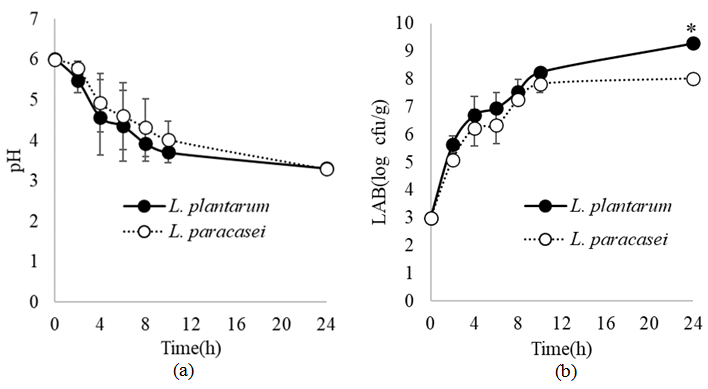
Figure 1 shows the changes in pH and the number of LAB cfus in sourdough starter fermented with L. paracasei and L. plantarum. The pH of the two kinds of sourdough dropped sharply and reached about pH 3.5–3.0 after 24 h (Figure1(a)). There was no difference in the lactic acid bacteria counts between the two sourdoughs at the start of fermentation, but after 24 h, L. paracasei reached 108 cfu/g while L. plantarum reached 109 cfu/g (p<0.01) (Figure 1(b)).
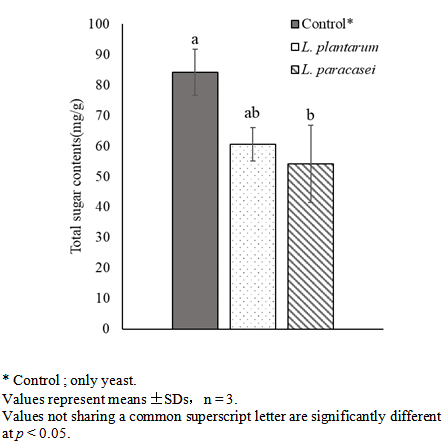
3.2. Characteristics of the Sourdough BreadThe weight, height, specific volume and moisture content of the two sourdough breads are shown in Table 1, with non-sourdough bread as a control. No significant differences were found in weight, height and moisture content of the three samples, but the specific volume of L. plantarum sourdough bread tended to be higher than that of the other two samples The total sugar content of each bread was 85±7.5 mg/g for control, 60±5.5 mg/g for L. plantarum, and 55±12.7 mg/g for L. paracasei, with both sourdough breads showing significantly less sugar (p<0.05) (Figure 2). In the organic acid measurement, the three samples mostly contained citric acid, succinic acid, and lactic acid (Table 2). The sourdough breads had far more lactic acid than the controls (p<0.01). Malic acid, which the control contained, was not detected in the sourdough bread (p<0.01). While there was no difference in the amount of total organic acids between L. paracasei and L. plantarum, both had far more acid content than the control (p<0.01).


As a result of storage at 28°C for 6 days, the control remained at about pH 5.5, and the sourdough bread at about pH 4.0 (Figure 3(a)). The pH of all samples did not change significantly during the storage period, but the sourdough bread was significantly lower than the control after 48 h of storage (p<0.01). At the start of the storage test, the general bacterial count of all samples was 102–103 cfu/g, but the control rapidly increased and reached 1010 cfu/g on the 6th day (Figure 3(b)). On the other hand, the two sourdough breads, L. paracasei and L. plantarum, which did not significantly differ, could significantly suppress the growth in bacteria compared to the control (p<0.01).
As a result of storing the control and sourdough bread at 28°C, white damage was visually confirmed on the control on day 2 (Figure 4(a). No visible accumulation of mold was found in either sourdough bread on day 2 or day 4. Both the control and sourdough breads were found to be moldy on day 6. In the mold-proof examination, control and sourdough bread inoculated with two types of mold were stored at 28°C, and the growth of mold was investigated. Figure 4(b) presents a photograph of Mold 1 and Mold 2 on the control and sourdough breads after 3 days and 2 days of storage. Mold 1 grew in all samples. As for Mold 2, it was confirmed in all three inoculated areas of the control and L. paracasei bread, but only two areas of L. plantarum were confirmed to have mold (Figure 4(b)).
Sourdough bread is a naturally fermented product, normally comprising 108–109 cfu/g of LAB 14. Both L. paracasei and L. plantarum sourdoughs in this study had 108–109 cfu/g after 24 h, and the pH reached around pH 3.5, so the amount of organic acid produced by the two lactic acid bacteria was expected to also be high. Lactic acid was the most abundant organic acid in L. plantarum and L. paracasei sourdough bread in this experiment (Table 2). In addition, the sugar content of the sourdough bread was lower than that of control (Figure 2), suggesting that the LAB had fully utilized sugar through co-fermentation with yeast. In this study, L. paracasei and L. plantarum did not differ significantly in lactic acid and total organic acid content, but L. plantarum sourdough showed a faster decrease in pH and an increase in bacterial counts than L. paracasei. In a previous report, the pH in the culture medium of L. plantarum decreased significantly, and the growth of E. coli was rapidly suppressed 10, 11, suggesting that products other than lactic acid may be involved.

The organic acids produced by LAB are what produce the unique acidity and flavor of sourdough bread and have positive effects and the shelf life 2, 4. The main functional substances produced by LAB include organic acids, bacteriocins and the like. Organic acids such as lactic acid and acetic acid are produced, and by lowering the intestinal pH, they inhibit the growth of some harmful bacteria 3. “Bacteriocins” is a categorical term for any number of antibacterial polypeptides produced by bacteria; in addition to showing antibacterial effects, mainly on strains related to the producing bacteria, it also shows antibacterial effects on pathogenic bacteria 15. The LABs used in this study have previously shown inhibitory effects on S. mutans and E. coli in co-culture 10, 11. However, it remains unclear whether L. plantarum and L. paracasei are bacteriocin-producing LABs.
Mold growth is the most common cause of spoilage of bread. Microbial spoilage of bread and the resulting waste problem cause significant economic losses to both the bakery industry and consumers 7. In this storage test, sourdough bread showed relatively suppressed growth of incidental mold growth compared to the control (Figure 4(a)), but no particular antifungal effect of sourdough bread against the two types of inoculated mold was observed (Figure 4(b)). Axel et al. discovered the antifungal compounds acetic acid, 4-hydroxyphenyllactic acid, phloretic acid, and 3-phenyllactic acid from the sourdough bread using Lactobacillus amylovorus DSM19280 16. In particular, it has reported that the acetic acid had the most pronounced antifungal activity 16, 17.
The acetic acid content of the L. plantarum sourdough bread in this study was low, with approximately 75% of the total organic acids being lactic acid (Table 2). Sourdough bread made using L. paracasei and L. plantarum sourdough inhibited the growth of general bacterial counts in a storage test. In future studies, we need to clarify whether these LABs produced antimicrobial substances or simply outcompeted general bacteria.
The authors declare that they have no conflict of interests.
| [1] | Elmadfa, I., Klein, P., Meyer, A.L., Immune-stimulating effects of lactic acid bacteria in vivo and in vitro, Proc. Nutr. Soc., 69. 416-420. 2010. | ||
| In article | View Article PubMed | ||
| [2] | Enomoto, T., Shimizu, K., Shimazu, S., Suppression of allergy development by habitual intake of fermented milk foods, evidence from an epidemiological study, Arerugi, 55. 1394-1399. 2006. | ||
| In article | |||
| [3] | Ozaki, M., A new genealogy of lactic acid fermentation. Chuohoki Publishing, 206-224. 2004. | ||
| In article | |||
| [4] | Nakada, H., Hasegawa, H., Sakurai, H., Tamura, M., Distinctive flavor and strong antifungal activity in a sourdough bread made using unique lactic acid bacteria obtained from a sugar factory, Nippon Shokuhin Kagaku Kogaku Kaishi, 57(2). 85-90. 2010. (in Japanese) | ||
| In article | View Article | ||
| [5] | Reese, A.T., Madden, A.A., Joossens, M., Lacaze, G., Dunn, R.R., Influences of ingredients and bakers on the bacteria and fungi in sourdough starters and bread. American Soci. Microbiol., 5(1). e00950-19. 2020. | ||
| In article | View Article PubMed | ||
| [6] | Gobbetti, M., The sourdough microflora: interactions of lactic acid bacteria and yeasts. Trends Food Sci. Technol., 9(7). 267–274. 1998. | ||
| In article | View Article | ||
| [7] | Axel, C., Zannini, E., Arendt, E.K., Mold spoilage of bread and its biopreservation: A review of current strategies for bread shelf life extension, Crit. Rev. Food Sci. Nutr., 57(16). 3528-3542. 2017. | ||
| In article | View Article PubMed | ||
| [8] | Komatsuzaki, N., Shima, J., Kawamoto, H., Momose, H., Production of -aminobutyric acid (GABA) by Lactobacillus paracasei isolated from traditional fermented foods, Food. Microbiol., 22(6). 497-504. 2005. | ||
| In article | View Article | ||
| [9] | Komatsuzaki, N., Nakamura, T., Kimura, T., Shima, J., Characterization of glutamate decarboxylase from a high-aminobutyric acid (GABA)-producer, Lactobacillus paracasei, Biosci. Biotechnol. Biochem., 72. 278-285. 2008. | ||
| In article | View Article PubMed | ||
| [10] | Iwabuchi, K., Shima, J., Komatsuzaki, N., Antibacterial effect of lactic acid bacteria on the cariogenic bacteria Streptococcus mutans, J. Integr. Stud. Diet. Habit., 32(4). 171-176. 2022. (In Japanese) | ||
| In article | View Article | ||
| [11] | Kudou, H, Amino, C., Hoshio, N., Shima, J., Komatsuzaki, N., Simulated digestive juice tolerance and effect on cecal organic acods of mice of Lactobacillus paracasei NFRI 7415, J. Integr. Stud. Diet. Habit., 31(3). 131-138. 2020. | ||
| In article | View Article | ||
| [12] | Nishida, O., Kuwazaki, S., Suzuki, C., Shima, J., Superior molasses assimilation, stress tolerance, and trehalose accumulation of baker’s yeast isolated from dried sweet potatoes (hoshi-imo). Biosci. Biotechnol. Biochem., 68, 1442-1448. 2004. | ||
| In article | View Article PubMed | ||
| [13] | Yue, F., Zhang, J., Xu, J., Niu, T., Lu, X., Liu, M., Effects of monosaccharide composition on quantitative analysis of total sugar content by phenol-sulfuric acid method, Frontiers in Nutrition. | ||
| In article | |||
| [14] | Gul, H., Ozcelik, S., Sagdic, O., Certel, M., Sourdough bread production with lactobacilli and S. cerevisiae isolated from sourdoughs, Process Biochemistry, 40. 691-697. 2005. | ||
| In article | View Article | ||
| [15] | Sato, R., Shima, J., Suzuki, C., Momose, H., Kawamoto, S., Characteristic evaluation of lactic acid bacteria collections based on the bacteriocin productivity, Rep. Natl. Food. Res. Inst., 66. 15-20. 2002. | ||
| In article | |||
| [16] | Axel, C., Röcker, B., Brosnan, B., Zannini, E., Furey, A., Coffey, A., Arendt, E.K., Application of Lactobacillus amylovorus DSM19280 in gluten-free sourdough bread to improve the microbial shelf life. Food. Microbiol., 47. 36–44. 2015. | ||
| In article | View Article PubMed | ||
| [17] | Ryan, L.A.M., Zannini, E., Dal Bello, F., Pawlowska, A., Koehler, P., Arendt, E.K., Lactobacillus amylovorus DSM 19280 as a novel food-grade antifungal agent for bakery products, Int. J. Food. Microbiol., 146(3). 276–283. 2011 | ||
| In article | |||
Published with license by Science and Education Publishing, Copyright © 2023 Kotomi Iwabuchi, Jun Shima and Noriko Komatsuzaki
 This work is licensed under a Creative Commons Attribution 4.0 International License. To view a copy of this license, visit
http://creativecommons.org/licenses/by/4.0/
This work is licensed under a Creative Commons Attribution 4.0 International License. To view a copy of this license, visit
http://creativecommons.org/licenses/by/4.0/
| [1] | Elmadfa, I., Klein, P., Meyer, A.L., Immune-stimulating effects of lactic acid bacteria in vivo and in vitro, Proc. Nutr. Soc., 69. 416-420. 2010. | ||
| In article | View Article PubMed | ||
| [2] | Enomoto, T., Shimizu, K., Shimazu, S., Suppression of allergy development by habitual intake of fermented milk foods, evidence from an epidemiological study, Arerugi, 55. 1394-1399. 2006. | ||
| In article | |||
| [3] | Ozaki, M., A new genealogy of lactic acid fermentation. Chuohoki Publishing, 206-224. 2004. | ||
| In article | |||
| [4] | Nakada, H., Hasegawa, H., Sakurai, H., Tamura, M., Distinctive flavor and strong antifungal activity in a sourdough bread made using unique lactic acid bacteria obtained from a sugar factory, Nippon Shokuhin Kagaku Kogaku Kaishi, 57(2). 85-90. 2010. (in Japanese) | ||
| In article | View Article | ||
| [5] | Reese, A.T., Madden, A.A., Joossens, M., Lacaze, G., Dunn, R.R., Influences of ingredients and bakers on the bacteria and fungi in sourdough starters and bread. American Soci. Microbiol., 5(1). e00950-19. 2020. | ||
| In article | View Article PubMed | ||
| [6] | Gobbetti, M., The sourdough microflora: interactions of lactic acid bacteria and yeasts. Trends Food Sci. Technol., 9(7). 267–274. 1998. | ||
| In article | View Article | ||
| [7] | Axel, C., Zannini, E., Arendt, E.K., Mold spoilage of bread and its biopreservation: A review of current strategies for bread shelf life extension, Crit. Rev. Food Sci. Nutr., 57(16). 3528-3542. 2017. | ||
| In article | View Article PubMed | ||
| [8] | Komatsuzaki, N., Shima, J., Kawamoto, H., Momose, H., Production of -aminobutyric acid (GABA) by Lactobacillus paracasei isolated from traditional fermented foods, Food. Microbiol., 22(6). 497-504. 2005. | ||
| In article | View Article | ||
| [9] | Komatsuzaki, N., Nakamura, T., Kimura, T., Shima, J., Characterization of glutamate decarboxylase from a high-aminobutyric acid (GABA)-producer, Lactobacillus paracasei, Biosci. Biotechnol. Biochem., 72. 278-285. 2008. | ||
| In article | View Article PubMed | ||
| [10] | Iwabuchi, K., Shima, J., Komatsuzaki, N., Antibacterial effect of lactic acid bacteria on the cariogenic bacteria Streptococcus mutans, J. Integr. Stud. Diet. Habit., 32(4). 171-176. 2022. (In Japanese) | ||
| In article | View Article | ||
| [11] | Kudou, H, Amino, C., Hoshio, N., Shima, J., Komatsuzaki, N., Simulated digestive juice tolerance and effect on cecal organic acods of mice of Lactobacillus paracasei NFRI 7415, J. Integr. Stud. Diet. Habit., 31(3). 131-138. 2020. | ||
| In article | View Article | ||
| [12] | Nishida, O., Kuwazaki, S., Suzuki, C., Shima, J., Superior molasses assimilation, stress tolerance, and trehalose accumulation of baker’s yeast isolated from dried sweet potatoes (hoshi-imo). Biosci. Biotechnol. Biochem., 68, 1442-1448. 2004. | ||
| In article | View Article PubMed | ||
| [13] | Yue, F., Zhang, J., Xu, J., Niu, T., Lu, X., Liu, M., Effects of monosaccharide composition on quantitative analysis of total sugar content by phenol-sulfuric acid method, Frontiers in Nutrition. | ||
| In article | |||
| [14] | Gul, H., Ozcelik, S., Sagdic, O., Certel, M., Sourdough bread production with lactobacilli and S. cerevisiae isolated from sourdoughs, Process Biochemistry, 40. 691-697. 2005. | ||
| In article | View Article | ||
| [15] | Sato, R., Shima, J., Suzuki, C., Momose, H., Kawamoto, S., Characteristic evaluation of lactic acid bacteria collections based on the bacteriocin productivity, Rep. Natl. Food. Res. Inst., 66. 15-20. 2002. | ||
| In article | |||
| [16] | Axel, C., Röcker, B., Brosnan, B., Zannini, E., Furey, A., Coffey, A., Arendt, E.K., Application of Lactobacillus amylovorus DSM19280 in gluten-free sourdough bread to improve the microbial shelf life. Food. Microbiol., 47. 36–44. 2015. | ||
| In article | View Article PubMed | ||
| [17] | Ryan, L.A.M., Zannini, E., Dal Bello, F., Pawlowska, A., Koehler, P., Arendt, E.K., Lactobacillus amylovorus DSM 19280 as a novel food-grade antifungal agent for bakery products, Int. J. Food. Microbiol., 146(3). 276–283. 2011 | ||
| In article | |||