The objective of this study was to enhance the value of cashew kernel by evaluating the nutritional potential of their pastes and the quality of their oils. The physicochemical characteristics, nutritional properties, and quality indexes of cashew kernel pastes and oils were determined using standard analytical methods. All of the parameters studied showed a significant difference (p < 0.05). The results showed that cashew kernel pastes were slightly acidic (6.01 ± 0.02 to 6.33 ± 0.02) with a low moisture content (1.2 ± 0.09% to 2.28 ± 0.13%). The samples recorded different mean value macronutrient contents: fat (36.36 ± 7.86%), carbohydrates (50.05 ± 8.03%), protein (8.98 ± 0.57%), crude fiber (0.59 ± 0.18%), with an average energy value of 563.39 ± 37.57 kcal. The pastes were richest in vitamins C (8.67 ± 1.83 mg/100 g) and E (15.91 ± 2.97 mg/100 g) and the minerals Ca (116.44 mg/kg), K (176.39 mg/kg), and Mg (183.99 mg/kg). The mean values for the quality indexes of the oils obtained were 112.70 ± 1.17 g I/100 g, 1.46 ± 0.005, and 0.85 ± 0.21 meq O₂/kg for the iodine value, refractive index, and peroxide value, respectively. The pastes are rich in nutrients and constitute a good source of energy with high oil quality. They could be incorporated into certain diets.
The cashew tree (Anacardium occidentale L.), is belonging to the Anacardiaceae family. It is native to Brazil and was introduced to India in the 16th century 1. Cashew tree is growing at altitudes below 1,000 m in tropical regions in a wide variety of soils, though it prefers light, deep soils 2.
The fruit of cashew tree is composed of a false fruit called the cashew apple and a true fruit, which is the cashew nut. The cashew apple, with its tart and sweet-and-sour flesh, is very juicy and rich in vitamin C. It is used to make fruit juice, vinegar, wine, alcohol, jams, jellies, and compotes 2. Cashew nuts (kernels) are the main commercial product of this tree, which can produce an average of 200 to 300 fruits per year 3. They are composed of a shell and a kernel containing 45% fat (35% unsaturated fat), 21% protein, and numerous vitamins and minerals. Cashew nuts are used in the food industry and also in pharmaceuticals and cosmetics 2.
Introduced to Côte d’Ivoire in the 1950 s for reforestation and erosion control, the tree has now become an important source of money for producers 4, 5. The cashew tree is now a major export crop for the African continent, which accounts for more than 55% of global cashew nut production 6. In 2020, according to estimates by the Food and Agriculture Organization of the United Nations (FAO), global production of in shell cashews amounted to 4.18 million metric tons, harvested from 7.10 million hectares, with Côte d’Ivoire, India, Vietnam, the Philippines, and Tanzania being the leading producers 7. West Africa has been the world’s leading cashew-producing region since 2015, with production exceeding 1,350,000 metric tons, and Côte d’Ivoire as the world’s leading producer of raw cashews 8.
According to the World Bank 9, between 2018 and 2024, the volume of locally processed nuts rose from 68,515 to more than 345,000 metric tons, representing approximately 30 percent of the national harvest.
The consumption of cashew kernels is becoming increasingly common among the population. Cashew kernels are available in various forms in stores, including dry-roasted or oil-roasted, salted or unsalted 10. However, cashew paste generally made from roasted cashew kernels is also available in the country’s supermarkets. These pastes come from small, local artisanal processing units. Several studies have highlighted the high nutrient content of cashew nut derivatives 11, 12, 13. However, the pastes produced from these nuts and sold on supermarket shelves have not been the subject of any studies. Their production is artisanal and unstandardized. It is important to proove their quality in order to attract consumers attention. The aim of this study is to contribute to the value addition of cashew kernels and to encourage consumer interest in cashew kernels pastes. To achieve this, the study will determine the nutritional potential of the pastes as well as the quality of the oils derived from them.
The biological material used for this study consisted of roasted cashew kernel pastes purchased from convenience stores and supermarkets in the city of Abidjan. A total of five brands of cashew kernels pastes, represented by one container, were selected based on their availability in stores and their production dates. Each brand, constituting a sample, was identified by a code to avoid any advertising (PC1: cashew kernel paste 1, PC2: cashew kernel paste 2, PC3: cashew kernel paste 3, PC4: cashew kernel paste 4, PC5: cashew kernel paste 5). The ingredients list mentioned for each brand was 100% cashew kernel.
2.2. MethodsMoisture and dry matter content were determined according to the NF ISO method 14. A dry porcelain crucible of mass M0 containing a mass M1 of sample was placed in an oven at 105°±5°C for 24 hours. The crucible was then removed, allowed to cool in a desiccator, and weighed to give mass M2.
The moisture content (% H) was obtained using following expression:
%H = ((M0+M1) – M2) / M1 x 100 (1)
The dry matter (% DM) was obtained using following equation:
%DM = 100 – %H (2)
The pH was measured using a pH meter 15. A 10 g mass of cashew kernel paste was homogenized in 100 mL of distilled water. The filtrate was then collected after filtering the mixture through Whatman filter paper. The glass electrode of the pH meter (HANNA), previously calibrated with a pH 7 buffer and then a pH 4 buffer, was immersed in the filtrate while stirring. The pH value was read directly from the pH meter’s display.
The titratable acidity (Ta) was determined using the method described by 16. This acidity was determined by an acid-base titration. The principle involves measuring the titratable acidity with a 0.1 N sodium hydroxide (NaOH) solution in the presence of 2 to 3 drops of 2% phenolphthalein, which serves as a color indicator. The titratable acidity level was obtained in g.100 mL⁻¹ according to the following formula:
Ta = (NNaOH x VNaOH x 0.9/V) x 100 (3)
VNaOH = volume of sodium hydroxide required for titration in mL
NNaOH = normality of the sodium hydroxide solution in meq g/L
V = volume of the test sample in mL
0.9 = milliequivalent gram of lactic acid
The ash content was determined according to the method described by 15. The method involves incinerating organic matter in a muffle furnace at 550°C ± 2°C for 24 hours until white ash is obtained.
The ash content (%Ac) was determined as follows:
%Ac= ((M2-M0)/(M1-M0)) x100 (4)
M0: empty crucible mass
M1: crucible mass + dry sample
M2: crucible mass + calcined sample
The fat content was determined using the Soxhlet method 15 with hexane as the solvent. The protein content was determined using the Kjeldahl method 15. The nitrogen content was multiplied by 6.25 (the nitrogen to protein conversion factor) to determine the protein content of the sample. The total sugar and reducing sugar contents of the cashew kernel pastes were determined by spectrophotometric analysis at 490 nm and 540 nm, respectively by 17, 18 methods. The crude fiber content was determined using the Weende method 15. The total carbohydrate content of the cashew kernel paste samples was obtained by subtraction according to the method 19. It was calculated by subtracting the sum of the moisture, fat, protein, and ash contents of the various samples from 100. The energy value of the sample was calculated according to the method of 20 using the following formula:
Ev (kcal) = (%C× 4) + (%F× 9) + (%P× 4) (5)
Ev: Energy value
C: Carbohydrates
F: Fat
P: protein
The vitamin A, C, and E contents were determined for each of the cashew paste samples. The method used to determine the vitamin C content of the samples was that described by 21, which is based on the reduction of 2,6-DCPIP (2,6-dichlorophenol-indophenol) by vitamin C. Vitamin E concentrations were determined by HPLC analysis. To determine vitamin A concentrations, the procedure first involved measuring β-carotene using the method described by 22. After extraction and centrifugation of the mixture, the optical density of the supernatant was measured at 450 nm using a spectrophotometer. For each test, the amount of β-carotene was calculated from a calibration curve with the following regression equation: OD450 = 0.0163 Q, where R² = 0.9988. The vitamin A content of the samples was determined by dividing the β-carotene contents by 6 23.
Mineral content was determined using an Agilent 5800 air-argon flame ICP-OES instrument 15.
The quality of oil was evaluated by determining their refractive index, acid value, peroxide value, and iodine value. The refractive index (IR) was determined using a refractometer according to the method described in the French standard NF T-60-212 24. First, the refractometer was calibrated with distilled water according to the manufacturer’s instructions. Next, the oil was heated to 40°C for 30 minutes before being transferred to the refractometer’s cell. Finally, the refractive index and temperature were read directly from the refractometer’s display. The tests were performed in triplicate.
The acid value was determined according to the standardized method specified in the French standard NF EN ISO 660 25. To do this, 0.5 g of oil was dissolved in a 25 mL mixture of ethanol and ether (50/50 v/v). The resulting solution was titrated with a 0.1 N alcoholic potassium hydroxide (KOH in ethanol) solution in the presence of a few drops of phenolphthalein (color indicator) until the solution turns pink. The acidity of the solvent (ethanol/ether) was neutralized before use with a 0.1 N potassium hydroxide solution. The tests were performed in triplicate for each sample.
The acid value (Av) was given by the following formula :
Av = 56.1 x V x N/m (6)
Av is expressed in mg KOH/g
V: volume of the ethanolic KOH solution in mL used to titrate the sample
N: normality of the KOH solution
M: mass of the oil test sample in grams
The peroxide value was determined in accordance with standard 26. 2 g of oil were dissolved in 10 mL of chloroform in a flask. To this mixture, 15 mL of acetic acid and 1 mL of potassium iodide solution (10%, v/v) were added, respectively. The flask was capped and shaken for 1 minute, then left in the dark for 5 to 10 minutes. Next, 75 mL of distilled water were added. A few drops of starch paste (a color indicator) were added while shaking vigorously. Next, the mixture was titrated with a 0.02 N sodium thiosulfate solution until the solution was completely decolorized. At equivalence, the color change was observed. A blank test (with oil replaced by distilled water) was performed. The tests were performed in triplicate for each sample.
The peroxide value (Pv) was determined using the following formula :
Pv =(V-V0) x N x 1000/m (7)
Pv expressed in meq O₂/kg
N: concentration of the sodium thiosulfate solution used
V: volume of the sodium thiosulfate solution added to the test sample, in mL
V₀: volume of the sodium thiosulfate solution added to the blank, in mL
m: mass of the test sample of fat (oil), in grams
The iodine value was determined by titrimetry in accordance with the international standard NF EN ISO 3961 27. This method involves titrating a quantity of fat (oil) with an excess of iodine. The excess iodine was then titrated with Na₂S₂O₃ (aq) to determine the quantity of iodine that reacted (back titration or indirect titration). To this end, 0.5 g of oil was dissolved in 15 mL of chloroform (tetrachloromethane, CCl₄) in a flask, to which 20 mL of Wijs’s reagent was added. The flask was sealed, shaken gently, and then placed in the dark for 1 hour. A blank test was also prepared by replacing the sample (oil) with distilled water. After removing the flask from the dark, 10 mL of a 10% (m/v) potassium iodide (KI) solution and 150 mL of distilled water were added. Next, the released iodine was titrated with a 0.1 N sodium thiosulfate solution in the presence of a 1% (m/v) starch paste as a color indicator until complete decolorization occurs. The tests were performed in triplicate for each sample. Thus, the iodine index was calculated using the following formula:
Iv = ((V0-V) x N x 12.69) /m (8)
Iv expressed in g/100 g
V0: volume of sodium thiosulfate added to the blank test (control) in mL
V: volume of sodium thiosulfate added to the test in mL
N: molar concentration of the sodium thiosulfate solution
m: mass of oil weighed in grams
Each test was performed in triplicate. The means of the various parameters studied were determined using Excel (version 2016); analysis of variance (ANOVA) at a 5% significance level was performed using Tukey’s test with the XLSTAT software version 2021.
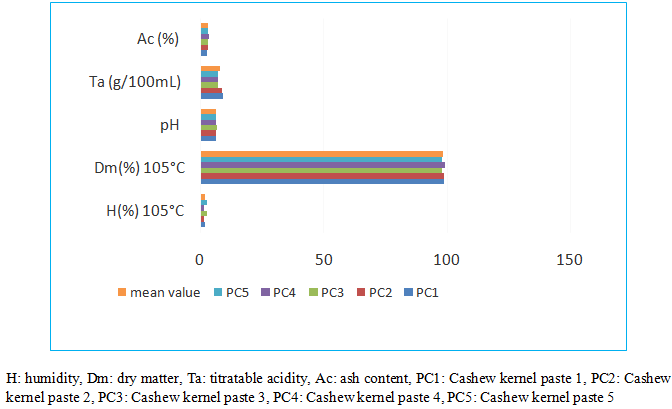
Figure 1 shows the physicochemical parameters of the various cashew kernel paste samples. All of the parameters differ significantly among the samples (p < 0.05). The samples are slightly acidic, with a mean value of 6.17 ± 0.12 and values ranging from 6.01 ± 0.02 to 6.33 ± 0.02 for PC5 and PC3, respectively. The titratable acidity, which corresponds to the presence of organic acids in the sample, ranges from 6.73 ± 0.03 (g/100 mL) to 8.73 ± 0.1 (g/100 mL), with a mean value of 7.60 ± 1.03 g/100 mL. The average moisture content of the pastes is 1.70 ± 0.52%, with relatively low values ranging from 1.2 ± 0.09% for PC4 to 2.28 ± 0.13% for PC5. The dry matter content, which is directly related to the moisture content, ranges from 97.72 ± 0.13% to 98.80 ± 0.09% for PC5 and PC4, respectively, with a mean value of 98.30 ± 0.52%. The ash content averages 2.90 ± 0.25%, with a minimum of 2.55 ± 0.10% and a maximum of 3.25 ± 0.03% for PC1 and PC4, respectively.
3.2. MacronutrientsTable 1 shows the macronutrient values in cashew kernel pastes. Analysis of variance revealed that all parameters differ significantly (p < 0.05) among all samples. Cashew pastes are significant sources of energy, with a mean value of 563.39 ± 37.57 kcal. They are higher in fat and carbohydrates, with mean values of 36.36 ±7.86% and 50.05 ± 8.03%, respectively. However, they are lower in proteins, with values ranging from 8.46 ± 0.06% to 9.77 ± 0.06% for a mean value of 8.98 ± 0.57%, and lower in fiber. The soluble sugar contents are also relatively low, with mean value of 0.63 ± 0.18 mg/L for total sugars and 0.09 ± 0.05 mg/L for reducing sugars.
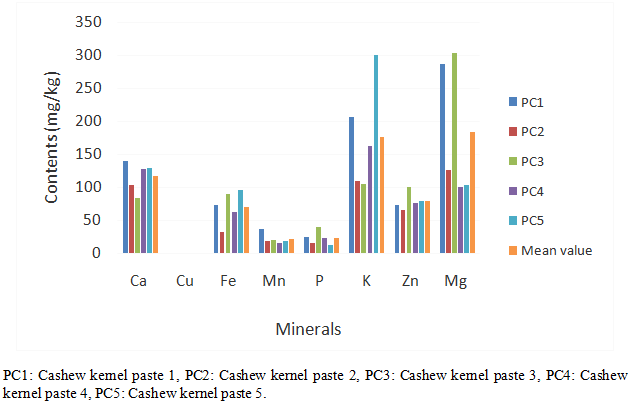
The mineral content of the cashew kernel paste samples is shown in Figure 2. The quantities of minerals present vary from one sample to another, with relatively low mean concentrations of 0.02 ± 0.01 mg/kg, 21.46 ± 8.63 mg/kg, and 22.64 ± 10.18 mg/kg for copper (Cu), manganese (Mn), and phosphorus (P). The concentrations of potassium (K), calcium (Ca), iron (Fe), magnesium (Mg), and zinc (Zn) are greater than 50 mg/kg, for most samples.
Table 2 presents the different vitamin concentrations of the analyzed pastes. Analysis of variance (ANOVA) revealed that all parameters differ significantly (p < 0.05) among all samples. They are rich in vitamins E and C, with levels ranging from 12.56 ± 0.07 mg/100 g to 20.14 ± 0.06 mg/100 g and from 5.83 ± 1.44 mg/100 g to 10.83 ± 1.44 mg/100 g, respectively. As for vitamin A, it is present in lower amounts, with a mean value of 373.01 ± 183.97 μg/100 g.
The values for the different quality indexes determined are listed in Table 3. All of the parameters differ significantly among the samples (p < 0.05). The iodine value ranges from 110.99 ± 0.15 g I₂/100 g for PC2 to 114.21 ± 0.10 g I₂/100 g for PC3, with an average of 112.70 ± 1.17 g I₂/100 g. As for the acid value, the values range from 4.68 ± 0.03 mg KOH/g to 17.77 ± 0.08 mg KOH/g for PC3 and PC4, respectively, with a mean value of 10.32 ± 6.19 mg KOH. Regarding the peroxide value, the samples exhibited low values ranging from 0.57 ± 0.03 meq O₂/kg to 1.13 ± 0.03 meq O₂/kg for PC1 and PC3, respectively, with a mean value of 0.85 ± 0.21 meq O₂/kg. Relative stability was observed for the refractive index, with an average of 1.46 ±0.005.

The analyzed cashew kernel paste samples had an average moisture content of 1.70%, corresponding to a high dry matter content of 98.30%. This value was both lower and higher than roasted cashew kernels studied in Nigeria (5.90%) 28 and in Côte d’Ivoire (1.48 ± 0.01%) 13, respectively. This low moisture content could be an advantage for extended shelf life. The cashew kernel pastes were slightly acidic, with an average pH of 6.17 and an average titratable acidity of 7.60 g/100 mL. This value was lower than cashew kernel pastes studied (3.75) by 13. Since titratable acidity is related to the organic acids in the sample, these results suggest a higher concentration in the samples studied. The average ash content found (2.90%), indicating the presence of minerals, was roughly equal to that reported for pastes made from cashew kernels in Ethiopia 29.
The determination of macronutrient contents revealed heterogeneity in the composition of the different samples. The average fat content found was lower than the kernel pastes studied by 30 and 31. According to 32, the lower fat content may be related to the roasting conditions of the kernels. The carbohydrate content was the highest in nearly all samples, with an average of 50.05 ± 8.03%, which was significantly higher than peanut pastes solded in Ouagadougou 33 and Côte d’Ivoire 13. The average protein content observed in this study was lower than that reported by 34. This would suggest that proteins were denaturated due to heat during the roasting of the kernels 12. The crude fiber content was low compared to that obtained by 30. This could be explained by the complete removal of the skins from the almonds prior to grinding. Indeed, according to 11, the skins are removed from roasted almonds to prevent their astringency and the tingling sensation they would cause in the mouth. The low soluble sugar contents could be explained by limited degradation of polysaccharides during the heat treatment of cashew kernels. The results show that cashew kernel pastes were high energy (mean energy value = 563.39 kcal). It could therefore be incorporated into certain diets.
Cashew kernel pastes contained various minerals and vitamins in varying amounts. These micronutrients play an essential role in the body’s physiological functioning. The high levels of calcium (Ca), magnesium (Mg), and potassium (K) could be a benefit of these pastes. Indeed, calcium is necessary for the strengthening of bones and teeth 35. Magnesium is important in the synthesis of carbohydrates, lipids, nucleic acids, and proteins, as well as in other functions within various organs of the cardiovascular and neuromuscular systems 36. The average magnesium content of cashew pastes (183.99 mg/kg) could meet the needs of adults, which range from 5 to 7 mg/kg/day 13. The average copper content (0.017 mg/kg) was below the toxicity threshold defined by the WHO 37. The cashew kernel paste samples contained vitamins A, C, and E in varying rates. These levels were higher than those found by 31 and 38 in their studies.
The iodine value reflects the degree of unsaturation of fats 39, which indicates the presence of unsaturated fatty acids. The average value found (112.70 ± 1.17 g I/100 g) was lower than that of sesame, soybean, and sunflower oils 40. However, it was higher than the values reported by 41 for cashew kernel oil (41.30 g I/100 g) and palm oil (20.70 g I/100 g). This would suggest that the oils studied were rich in unsaturated fatty acids. The peroxide value, on the other hand, indicates the degree of oxidation of the oils. The oils studied had an average peroxide value of 0.85 ± 0.21 meq O₂/kg, which was well below the maximum value (10 meq O₂/kg) accepted for edible oils 42. The acid value is related to the presence of free fatty acids in the sample. It also indicates the degree of lipid deterioration. The average value obtained (10.32 mg KOH/g) was lower than that reported by 28. The refractive index indicates the purity of the oil and is proportional to the molecular weight of the fatty acids as well as their degree of unsaturation 43. The average value obtained (1.46 ± 0.005) fell within the range established by 40.
The objective of this study was to contribute to the promotion of commercially available cashew kernel pastes by evaluating their nutritional potential. Analysis of the physicochemical characteristics showed that the pastes were slightly acidic (6.17 ± 0.12) with a low moisture content (1.70 ± 0.52%), which would be advantageous for a long shelf life. The pastes were good sources of macronutrients and energy (563.39 kcal). They could therefore be incorporated into certain diets. They contain various minerals (calcium, magnesium, potassium, iron, manganese, zinc) and vitamins (A, C, E) necessary for the proper functioning of the body and the prevention of certain diseases. Analysis of the oil quality would suggest that they were pure (1.46 ± 0.005), rich in unsaturated fatty acids (112.70 ± 1.17 g I/100 g) and had not undergone oxidation (0.85 ± 0.21 meq O₂/kg). Regular consumption of cashew kernel pastes would be beneficial for consumers.
The authors would like to express their sincere thanks to the laboratory's (Laboratoire des Procédés Industriels de Synthèses de l'Environnement et des Energies Nouvelles) technical staff for their support during the analyses.
| [1] | Swapan, M., Biochemical profile of Cashew nut, Int. J. Exp. Res. Rev., 20, 48-50, 2019. | ||
| In article | View Article | ||
| [2] | Gnahoua, G.M. and Louppe, D., Anacardier : [Fiche technique]. Montpellier: CIRAD-Forêt, 2003, 2 p. http://hal.cirad.fr/cirad-00429280/fr/. | ||
| In article | |||
| [3] | Tagutchou J.-P. et Naquin P., Caractérisation et traitement thermochimique des coques d’anacarde en vue de leur valorisation énergétique dans les procédés de transformation artisanale de noix de cajou, Déchets Sciences Et Techniques - Revue Francophone d’écologie Industrielle, 62, 28-35,2012. | ||
| In article | View Article | ||
| [4] | Djaha, J.B.A., Adopo, A.A.N., Koffi, E.K., Ballo, C.K. and Coulibaly, M., Croissance et aptitude au greffage de deux génotypes d’anacardier (Anacardium occidentale) élites utilisées comme porte-greffe en Côte d’Ivoire, International Journal of Biological and Chemical Sciences, 6 (4), 1453-1466, 2012. | ||
| In article | View Article | ||
| [5] | Yao, N.R., Oule, A.F., N’Goran, K.D., Evaluation de la vulnérabilité du secteur agricole face aux changements climatiques en Côte d’Ivoire, Rapport final, 2013, 105 p. | ||
| In article | |||
| [6] | N’Djolosse, K., Adoukonou-Sagbadja, H., Maliki, R., Kodjo, S., Badou, A. and Ahoyo, A.N.R., Performances agronomiques des arbres mères d’anacardiers (Anacardium occidentale L.) sélectionnés dans les plantations paysannes au Bénin, Int. J. Biol. Chem. Sci., 14 (5), 1536-1546, 2020. | ||
| In article | View Article | ||
| [7] | Chen, Y.Y., Li, N.Y., Guo, X., Huang, H.J., Garcia-Oliveira, P., Sun, J.Y., Zhang, J.D., Prieto, M.A., Guo, Z.Q., Liu, C., The nutritional and bio-active constituents, functional activities, and industrial applications of cashew (Anacardium occidentale): A review, Food Frontiers, 1–16, 2023. | ||
| In article | View Article | ||
| [8] | Sanoko, F., Koffi, K.J.-M., Coulibaly, F.L., Fondio, L., Adiko, Y.O., Djaha, A.J.B., Malezieux, E., Variabilité du rendement de l’anacardier (Anacardium occidentale L.) dans la région du Poro, nord de la Côte d’Ivoire, International Journal of Biological and Chemical Sciences, 19 (2), 640-652, 2025. | ||
| In article | View Article | ||
| [9] | World Bank, https:// www.banquemondiale.org/ fr/results/ 2025/04/15/agri-processing-adds-value-in-cote-d-ivoire-s-cashew-industry consulté le 19/08/2026. | ||
| In article | |||
| [10] | Diomandé, M., Kouamé, K.B. and Koko A.C., Comparaison des propriétés chimiques de l’huile et tourteaux d’arachide et de noix de cajou vendus sur les marchés de Daloa, Côte d’Ivoire, International Journal of Engineering and Applied Sciences (IJEAS), 4 (11), 28-32, 2017. | ||
| In article | |||
| [11] | Coulibaly, A., Kokora, P.A, Niamke, A.M., Toure, K., Dagnogo, K., Biego, G.H.M., Caractérisation physico-chimique et fonctionnelle des pellicules d’amandes de cajou (Anacardium occidentale L.) issues des usines de transformation des noix de cajou en Côte d’Ivoire, Conseil International Consultatif du Cajou, p 1-9, 2021. | ||
| In article | |||
| [12] | Ouattara, A., Fofana, D., Diomande, M., Beugre, G.A.M., Konate, I. and Bouatene, D., Production et caractérisation biochimique du tourteau de cajou (Anacardium occidentale L.), International Journal of Current Advanced Research, 12 (04-A), 1899-1908, April 2023. | ||
| In article | |||
| [13] | Ouattara, G.S., Kone, S., Ban, O.V.A., Koffi, K.E., Production, biochemical and sensory characterization of cashew almond paste compared to peanut paste produced in Ivory Coast, American Journal of Food and Nutrition, 13 (5), 179-184, 2025. | ||
| In article | View Article | ||
| [14] | Norme Française NF T90-029, 2002, Qualité de l’eau- Détermination des résidus secs à 105° et 180°. Afnor Editions. | ||
| In article | |||
| [15] | AOAC, Association of Official Analytical Chemists, Official methods of analysis, 1990, Ed., Washington DC. 684 pp. | ||
| In article | |||
| [16] | Amoa-Awua, W.K., Sampson, E. and Tano-Debrah, K., Growth of yeasts, lactic and acetic bacteria in palm wine during tapping and fermentation from felled oil palm (Elaeis guineensis) in Ghana, Journal of Applied Microbiology, 102, 599-606, 2007. | ||
| In article | View Article PubMed | ||
| [17] | Dubois, M., MC Cowen L.D., Schotcht.J., Rebersp.A. & Smithf.,. Anal. Chemen. 28, 250 p, 1956. | ||
| In article | View Article | ||
| [18] | Bernfeld P. (1955). Alpha and beta-amylases. In: Colowick S.P et Kaplan N., eds. Methods in Enzymology. Academic Press, New York (USA), 149-158. | ||
| In article | View Article | ||
| [19] | AOAC, Association of official Analytical Chemist, Official method of analysis, 2005, 5th ed., AOAC Press, Arlington,Virginia, USA. | ||
| In article | |||
| [20] | Manzi, P., Altero, A. and Pizzoferrato, L., Nutritional value of mushrooms widely consumed in Italy, Food chemistry, 73, 321-325, 2001. | ||
| In article | View Article | ||
| [21] | Pongracz, G., Neue potentiometrische Bestimmungsmethode für Ascorbinsäure und deren Verbindungen, Z. Anal. Chem., 253, 271–274, 1971. | ||
| In article | View Article | ||
| [22] | Aké, M., Poby, A.G., Malan, K.A., Tebi, A. and Monnet, D., Effet de la supplémentation en vitamine A sur les marqueurs de la nutrition dans la prise en charge de la malnutrition de l’enfant, Annual Biological Clinical, 59, 417-421, 2001. | ||
| In article | |||
| [23] | Borel, P., Drai, J., Faure, H., Fayol, V., Galabert, C., Laromiguière, M., Le Moël, G., Données récentes sur l’absorption et le catabolisme des caroténoïdes, Annales de Biologie Clinique, 63 (2), 165-77, Mars-Avril 2005. | ||
| In article | |||
| [24] | AFNOR (Association Française pour la Normalisation). 1984. Recueil des normes françaises : corps gras, graines oléagineuses et produits dérivés (3e eds.). AFNOR: Paris; 459 p. | ||
| In article | |||
| [25] | NF EN ISO 660, Norme française. Cors gras d’origines animale et végétale – Détermination de l’indice d’acide et de l’acidité, 2020,20 p. | ||
| In article | |||
| [26] | NF EN ISO 3960, Corps gras d'origines animale et végétale - Détermination de l'indice de peroxyde - Détermination avec point d'arrêt iodométrique, 2010, 16 p. | ||
| In article | |||
| [27] | NF EN ISO 3961, Norme française. Corps gras d’origines animale et végétale – Détermination de l’indice d’iode. Sixième édition 2018-08, 2018, 6 p. | ||
| In article | |||
| [28] | Ogungbenle, H.N., Afolayan, M.F., Physical and chemical characterization of roasted cashew nut (Anacardium occidentale) flour and oil, International Journal of Food Science and Nutrition Engineering, 5(1), 1-7, 2015. | ||
| In article | |||
| [29] | Misganew, A.A., Nutritional and physicochemical characteristics of cashew nut (Anacardium occidentale L.) grown in Pawe District, Northwestern Ethiopia, International Journal of Research in Agricultural Sciences, 9 (6),169-173, 2022. | ||
| In article | |||
| [30] | Ogunwalu, S.O. and Ogunjobi, M.A.K., Nutritional and sensory evaluation of cashew butter produced from Nigeria cashew, Journal of Food Technology, 8(1), 14-17, 2010. | ||
| In article | View Article | ||
| [31] | Rico, R., Bulló, M. & Salas-Salvadó, J., Nutritional composition of raw fresh cashew (Anacardium occidentale L.) kernels from different origin, Food Science & Nutrition, 4(2), 329–338, 2016. | ||
| In article | View Article PubMed | ||
| [32] | Adepoju, A.B., Coker O.J. and Adetula, O.A., Effects of processing methods on the proximate and physicochemical properties of flour and oil of cashew nut, Nigerian Journal of Nutritional Sciences, 40 (1), 87-90, 2019. | ||
| In article | |||
| [33] | Compaore, C.S., Douamba, Z., Zongo, S., Zagre, M.B., Sawadogo-Lingani, H., Technologie et caractéristiques chimiques des pâtes d’arachide vendues dans quelques marchés de la ville de Ouagadougou, Science et technique, Sciences naturelles et appliquées, 39 (1), 183-196, 2020. | ||
| In article | |||
| [34] | Gadani, B.C., Miléski, K.M.L., Peixoto, L.S., Agostini, J. da S., Physical and chemical characteristics of cashew nut flour stored and packaged with different packages, Food Sci. Technol, Campinas, 37(4), 657-662, 2017. | ||
| In article | View Article | ||
| [35] | Georges, P., Health through food, 8th printing of the 1st language edition, 2010. | ||
| In article | |||
| [36] | Chen, X. and Feng, Y., Review on nutritive value of edibles insects, Chinese for sci and technology, 12, 54-59, 2002. | ||
| In article | |||
| [37] | WHO (World Health Organization), Guidelines for food and drink water quality, Chemical fact Sheets, 3rd edition. CENEVA, Swiss, 2004, 460 p. | ||
| In article | |||
| [38] | Okonkwo, C.O. and Ozoude, U.J., The impact of processing on the nutritional, mineral and vitamin composition of cashew nut, International Journal of Engineering Sciences & Research Technology, 4(3), 596-602, 2015. | ||
| In article | |||
| [39] | Pomeranz, Y. and Meloan, E.C., Food analysis: theory and practices, 2nd ed. Van Nostrand Reinhold company, New York. Pp581-765, 1987. | ||
| In article | |||
| [40] | CODEX ALIMENTARIUS. 2009. Normes alimentaires Internationales pour les huiles végétales portant un nom spécifique CODEX STAN 210-1999. Adoptée en 1999. Amendement : 2005, 2011, 2013, 2015. Révision: 2001, 2003, 2009. CODEX ALIMENTARIUS. | ||
| In article | |||
| [41] | Evbuowman, B.O., Lawson, J.N. and Atuka, M.M., Some Physicochemical Properties of Cashew Nut (Anacardium occidentale) and Palm Kernel (Elaeis Guineensis) Oil using Straight Run Gasoline, International Journal of Science and Engineering Investigations, 2 (20), 82-84, 2013. | ||
| In article | |||
| [42] | CODEX STAN 19-1981. Norme pour les graisses et les huiles comestibles non visées par des normes individuelles, 6 p. | ||
| In article | |||
| [43] | Novidzro, K.M., Wokpor, K., Fagla, B.A., Koudouvo, K., Dotse, K., Osseyi, E.et Koumaglo, K.H., Etude de quelques paramètres physicochimiques et analyse des éléments minéraux, des pigments chlorophylliens et caroténoïdes de l’huile de graines de Griffonia simplicifolia, Int. J. Biol. Chem. Sci., 13(4), 2360-2373, 2019. | ||
| In article | View Article | ||
Published with license by Science and Education Publishing, Copyright © 2026 CAMARA Monty Abibata, KONE-SORO Haffiata, NYAMIEN Yves Bleouh Jean and KONE Kisselmina Youssouf
 This work is licensed under a Creative Commons Attribution 4.0 International License. To view a copy of this license, visit
http://creativecommons.org/licenses/by/4.0/
| [1] | Swapan, M., Biochemical profile of Cashew nut, Int. J. Exp. Res. Rev., 20, 48-50, 2019. | ||
| In article | View Article | ||
| [2] | Gnahoua, G.M. and Louppe, D., Anacardier : [Fiche technique]. Montpellier: CIRAD-Forêt, 2003, 2 p. http://hal.cirad.fr/cirad-00429280/fr/. | ||
| In article | |||
| [3] | Tagutchou J.-P. et Naquin P., Caractérisation et traitement thermochimique des coques d’anacarde en vue de leur valorisation énergétique dans les procédés de transformation artisanale de noix de cajou, Déchets Sciences Et Techniques - Revue Francophone d’écologie Industrielle, 62, 28-35,2012. | ||
| In article | View Article | ||
| [4] | Djaha, J.B.A., Adopo, A.A.N., Koffi, E.K., Ballo, C.K. and Coulibaly, M., Croissance et aptitude au greffage de deux génotypes d’anacardier (Anacardium occidentale) élites utilisées comme porte-greffe en Côte d’Ivoire, International Journal of Biological and Chemical Sciences, 6 (4), 1453-1466, 2012. | ||
| In article | View Article | ||
| [5] | Yao, N.R., Oule, A.F., N’Goran, K.D., Evaluation de la vulnérabilité du secteur agricole face aux changements climatiques en Côte d’Ivoire, Rapport final, 2013, 105 p. | ||
| In article | |||
| [6] | N’Djolosse, K., Adoukonou-Sagbadja, H., Maliki, R., Kodjo, S., Badou, A. and Ahoyo, A.N.R., Performances agronomiques des arbres mères d’anacardiers (Anacardium occidentale L.) sélectionnés dans les plantations paysannes au Bénin, Int. J. Biol. Chem. Sci., 14 (5), 1536-1546, 2020. | ||
| In article | View Article | ||
| [7] | Chen, Y.Y., Li, N.Y., Guo, X., Huang, H.J., Garcia-Oliveira, P., Sun, J.Y., Zhang, J.D., Prieto, M.A., Guo, Z.Q., Liu, C., The nutritional and bio-active constituents, functional activities, and industrial applications of cashew (Anacardium occidentale): A review, Food Frontiers, 1–16, 2023. | ||
| In article | View Article | ||
| [8] | Sanoko, F., Koffi, K.J.-M., Coulibaly, F.L., Fondio, L., Adiko, Y.O., Djaha, A.J.B., Malezieux, E., Variabilité du rendement de l’anacardier (Anacardium occidentale L.) dans la région du Poro, nord de la Côte d’Ivoire, International Journal of Biological and Chemical Sciences, 19 (2), 640-652, 2025. | ||
| In article | View Article | ||
| [9] | World Bank, https:// www.banquemondiale.org/ fr/results/ 2025/04/15/agri-processing-adds-value-in-cote-d-ivoire-s-cashew-industry consulté le 19/08/2026. | ||
| In article | |||
| [10] | Diomandé, M., Kouamé, K.B. and Koko A.C., Comparaison des propriétés chimiques de l’huile et tourteaux d’arachide et de noix de cajou vendus sur les marchés de Daloa, Côte d’Ivoire, International Journal of Engineering and Applied Sciences (IJEAS), 4 (11), 28-32, 2017. | ||
| In article | |||
| [11] | Coulibaly, A., Kokora, P.A, Niamke, A.M., Toure, K., Dagnogo, K., Biego, G.H.M., Caractérisation physico-chimique et fonctionnelle des pellicules d’amandes de cajou (Anacardium occidentale L.) issues des usines de transformation des noix de cajou en Côte d’Ivoire, Conseil International Consultatif du Cajou, p 1-9, 2021. | ||
| In article | |||
| [12] | Ouattara, A., Fofana, D., Diomande, M., Beugre, G.A.M., Konate, I. and Bouatene, D., Production et caractérisation biochimique du tourteau de cajou (Anacardium occidentale L.), International Journal of Current Advanced Research, 12 (04-A), 1899-1908, April 2023. | ||
| In article | |||
| [13] | Ouattara, G.S., Kone, S., Ban, O.V.A., Koffi, K.E., Production, biochemical and sensory characterization of cashew almond paste compared to peanut paste produced in Ivory Coast, American Journal of Food and Nutrition, 13 (5), 179-184, 2025. | ||
| In article | View Article | ||
| [14] | Norme Française NF T90-029, 2002, Qualité de l’eau- Détermination des résidus secs à 105° et 180°. Afnor Editions. | ||
| In article | |||
| [15] | AOAC, Association of Official Analytical Chemists, Official methods of analysis, 1990, Ed., Washington DC. 684 pp. | ||
| In article | |||
| [16] | Amoa-Awua, W.K., Sampson, E. and Tano-Debrah, K., Growth of yeasts, lactic and acetic bacteria in palm wine during tapping and fermentation from felled oil palm (Elaeis guineensis) in Ghana, Journal of Applied Microbiology, 102, 599-606, 2007. | ||
| In article | View Article PubMed | ||
| [17] | Dubois, M., MC Cowen L.D., Schotcht.J., Rebersp.A. & Smithf.,. Anal. Chemen. 28, 250 p, 1956. | ||
| In article | View Article | ||
| [18] | Bernfeld P. (1955). Alpha and beta-amylases. In: Colowick S.P et Kaplan N., eds. Methods in Enzymology. Academic Press, New York (USA), 149-158. | ||
| In article | View Article | ||
| [19] | AOAC, Association of official Analytical Chemist, Official method of analysis, 2005, 5th ed., AOAC Press, Arlington,Virginia, USA. | ||
| In article | |||
| [20] | Manzi, P., Altero, A. and Pizzoferrato, L., Nutritional value of mushrooms widely consumed in Italy, Food chemistry, 73, 321-325, 2001. | ||
| In article | View Article | ||
| [21] | Pongracz, G., Neue potentiometrische Bestimmungsmethode für Ascorbinsäure und deren Verbindungen, Z. Anal. Chem., 253, 271–274, 1971. | ||
| In article | View Article | ||
| [22] | Aké, M., Poby, A.G., Malan, K.A., Tebi, A. and Monnet, D., Effet de la supplémentation en vitamine A sur les marqueurs de la nutrition dans la prise en charge de la malnutrition de l’enfant, Annual Biological Clinical, 59, 417-421, 2001. | ||
| In article | |||
| [23] | Borel, P., Drai, J., Faure, H., Fayol, V., Galabert, C., Laromiguière, M., Le Moël, G., Données récentes sur l’absorption et le catabolisme des caroténoïdes, Annales de Biologie Clinique, 63 (2), 165-77, Mars-Avril 2005. | ||
| In article | |||
| [24] | AFNOR (Association Française pour la Normalisation). 1984. Recueil des normes françaises : corps gras, graines oléagineuses et produits dérivés (3e eds.). AFNOR: Paris; 459 p. | ||
| In article | |||
| [25] | NF EN ISO 660, Norme française. Cors gras d’origines animale et végétale – Détermination de l’indice d’acide et de l’acidité, 2020,20 p. | ||
| In article | |||
| [26] | NF EN ISO 3960, Corps gras d'origines animale et végétale - Détermination de l'indice de peroxyde - Détermination avec point d'arrêt iodométrique, 2010, 16 p. | ||
| In article | |||
| [27] | NF EN ISO 3961, Norme française. Corps gras d’origines animale et végétale – Détermination de l’indice d’iode. Sixième édition 2018-08, 2018, 6 p. | ||
| In article | |||
| [28] | Ogungbenle, H.N., Afolayan, M.F., Physical and chemical characterization of roasted cashew nut (Anacardium occidentale) flour and oil, International Journal of Food Science and Nutrition Engineering, 5(1), 1-7, 2015. | ||
| In article | |||
| [29] | Misganew, A.A., Nutritional and physicochemical characteristics of cashew nut (Anacardium occidentale L.) grown in Pawe District, Northwestern Ethiopia, International Journal of Research in Agricultural Sciences, 9 (6),169-173, 2022. | ||
| In article | |||
| [30] | Ogunwalu, S.O. and Ogunjobi, M.A.K., Nutritional and sensory evaluation of cashew butter produced from Nigeria cashew, Journal of Food Technology, 8(1), 14-17, 2010. | ||
| In article | View Article | ||
| [31] | Rico, R., Bulló, M. & Salas-Salvadó, J., Nutritional composition of raw fresh cashew (Anacardium occidentale L.) kernels from different origin, Food Science & Nutrition, 4(2), 329–338, 2016. | ||
| In article | View Article PubMed | ||
| [32] | Adepoju, A.B., Coker O.J. and Adetula, O.A., Effects of processing methods on the proximate and physicochemical properties of flour and oil of cashew nut, Nigerian Journal of Nutritional Sciences, 40 (1), 87-90, 2019. | ||
| In article | |||
| [33] | Compaore, C.S., Douamba, Z., Zongo, S., Zagre, M.B., Sawadogo-Lingani, H., Technologie et caractéristiques chimiques des pâtes d’arachide vendues dans quelques marchés de la ville de Ouagadougou, Science et technique, Sciences naturelles et appliquées, 39 (1), 183-196, 2020. | ||
| In article | |||
| [34] | Gadani, B.C., Miléski, K.M.L., Peixoto, L.S., Agostini, J. da S., Physical and chemical characteristics of cashew nut flour stored and packaged with different packages, Food Sci. Technol, Campinas, 37(4), 657-662, 2017. | ||
| In article | View Article | ||
| [35] | Georges, P., Health through food, 8th printing of the 1st language edition, 2010. | ||
| In article | |||
| [36] | Chen, X. and Feng, Y., Review on nutritive value of edibles insects, Chinese for sci and technology, 12, 54-59, 2002. | ||
| In article | |||
| [37] | WHO (World Health Organization), Guidelines for food and drink water quality, Chemical fact Sheets, 3rd edition. CENEVA, Swiss, 2004, 460 p. | ||
| In article | |||
| [38] | Okonkwo, C.O. and Ozoude, U.J., The impact of processing on the nutritional, mineral and vitamin composition of cashew nut, International Journal of Engineering Sciences & Research Technology, 4(3), 596-602, 2015. | ||
| In article | |||
| [39] | Pomeranz, Y. and Meloan, E.C., Food analysis: theory and practices, 2nd ed. Van Nostrand Reinhold company, New York. Pp581-765, 1987. | ||
| In article | |||
| [40] | CODEX ALIMENTARIUS. 2009. Normes alimentaires Internationales pour les huiles végétales portant un nom spécifique CODEX STAN 210-1999. Adoptée en 1999. Amendement : 2005, 2011, 2013, 2015. Révision: 2001, 2003, 2009. CODEX ALIMENTARIUS. | ||
| In article | |||
| [41] | Evbuowman, B.O., Lawson, J.N. and Atuka, M.M., Some Physicochemical Properties of Cashew Nut (Anacardium occidentale) and Palm Kernel (Elaeis Guineensis) Oil using Straight Run Gasoline, International Journal of Science and Engineering Investigations, 2 (20), 82-84, 2013. | ||
| In article | |||
| [42] | CODEX STAN 19-1981. Norme pour les graisses et les huiles comestibles non visées par des normes individuelles, 6 p. | ||
| In article | |||
| [43] | Novidzro, K.M., Wokpor, K., Fagla, B.A., Koudouvo, K., Dotse, K., Osseyi, E.et Koumaglo, K.H., Etude de quelques paramètres physicochimiques et analyse des éléments minéraux, des pigments chlorophylliens et caroténoïdes de l’huile de graines de Griffonia simplicifolia, Int. J. Biol. Chem. Sci., 13(4), 2360-2373, 2019. | ||
| In article | View Article | ||