Malnutrition remains a major public health issue worldwide, particularly in Africa. The quality of the flours used during infant weaning plays a crucial role in their nutritional development. This study aims to develop infant flour formulations using exclusively local ingredients such as corn, peanuts, cowpeas, and carrots. To optimize the roasting process for the seeds (corn, peanuts, cowpeas), a design of experiments approach was used, applying a central composite design using JMP Pro software. This method reduced the number of trials required to ten samples subjected to different combinations of roasting temperatures and times. The proportions of the ingredients were determined using a calculation system developed in Python, based on the matrix formulation method in order to comply with WHO/FAO standards : F1 (cowpea 19%, corn 69%, and peanut 12%); F2 (cowpea 20%, corn 67%, peanut 12%, and carrot 1%); F3 (cowpea 23%, corn 65%, carrot 12%); and F4 (cowpea 24%, corn 64%, peanut 11%, and carrot 1%). The results show that the formulated flours comply with WHO/FAO standards. The microbiological loads detected in these flours were below the microbiological criteria applicable to infant flours. Among the formulations tested, flours F4 and F10 obtained the highest scores in sensory evaluations. These formulations can therefore be recommended for young children, thereby contributing to the fight against child malnutrition.
Malnutrition and deficiencies in essential nutrients remain major problems in several developing countries. Among children, malnutrition is one of the leading causes of public health problems and social difficulties in these regions 1.
In 2020, 22% of children under the age of 5 worldwide were stunted, with the situation even more critical in sub-Saharan Africa. There are many causes of child undernutrition, including insufficient food intake and a lack of energy, macronutrients, and micronutrients. In addition, complementary foods are often unbalanced and low in energy and nutrients, exacerbating nutritional deficiencies in young children 2.
To improve the energy and nutritional intake of young children, several strategies can be implemented, such as the use of high-energy and nutrient-dense porridges obtained through partial starch hydrolysis and fortification during the manufacture of complementary foods 3.
In Africa, more and more research is focusing on the development of local infant flours that meet international standards 1, 4, 5, 6, 7, 8, 9. Nutritional deficiencies particularly affect children aged 6 to 24 months, a period when their nutritional needs exceed what they can obtain from breast milk or traditional family meals 10, 11, 12, 13.
During the weaning period, babies need a specific diet that provides them with sufficient energy, protein, and other nutrients such as vitamins, minerals, and trace elements 14, 15. During this period, it is essential to introduce new foods in liquid or semi-liquid form to supplement breast milk. These foods, known as complementary foods, must be of good nutritional quality and satisfactory in terms of health and organoleptic properties 16.
It is therefore appropriate to produce flours from local ingredients (cereals, vegetables) rich in macronutrients and micronutrients essential for optimal health and proper development in children. This approach aims to facilitate child nutrition and promote local products. It is in this context that interest has been focused on developing a process for formulating different cereals based on local products to help combat child malnutrition.
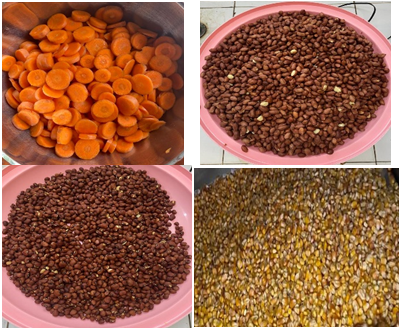
The plant material consists of corn (Zea mays), peanuts (Arachis hypogaea), carrots (Daucus carota L) purchased at the Grand Dakar market in the Dakar region of Senegal, and cowpeas (Vigna unguiculata) from the Volo-Volo market in Moroni, Comoros.
The images illustrating the ingredients used are shown in Figure 1.

The protein analysis equipment is that of the Analysis and Testing Laboratory (LEA) of the Higher Polytechnic School (ESP).
Color determination was performed using a CR-5 colorimeter. Experimental color measurement allows the corresponding physical parameters (L*, a*, b*) to be determined.
The mineral composition was determined by X-ray fluorescence spectrometry using a Niton XL3T XRF analyzer connected to a computer equipped with NDTr 6.5.2 software.
Protein analysis was performed using the NFV 18-100 method.
Microbiological analysis was performed using the NF V08-051 method.
3.2. Seed Roasting MethodIn order to reduce the number of trials required for roasting seeds (peanuts, corn, cowpeas), experimental designs are well suited. The software used for this study is JMP Pro, and the model applied is the central composite design. Two factors were considered: temperature (°C) and time (h). The limits set for these factors are: minimum values of 80°C for temperature and 1 hour for time. The maximum values are 110°C for temperature and 5 hours for time. The plan was executed to generate ten trials, the parameter combinations of which are shown in Table 1.
The flour formulation strategy is carried out using a Python-assisted formulation system, using a calculation system based on the matrix formulation method. From a list of food ingredients, this method makes it possible to find infant cereal formulas that comply with standards. The equation system used is as follows:
 |
Ten formulas were obtained taking into account the roasting pairs (Table 1). The proportions and composition of four of them (F1, F2, F3, and F4) are shown in Table 2.
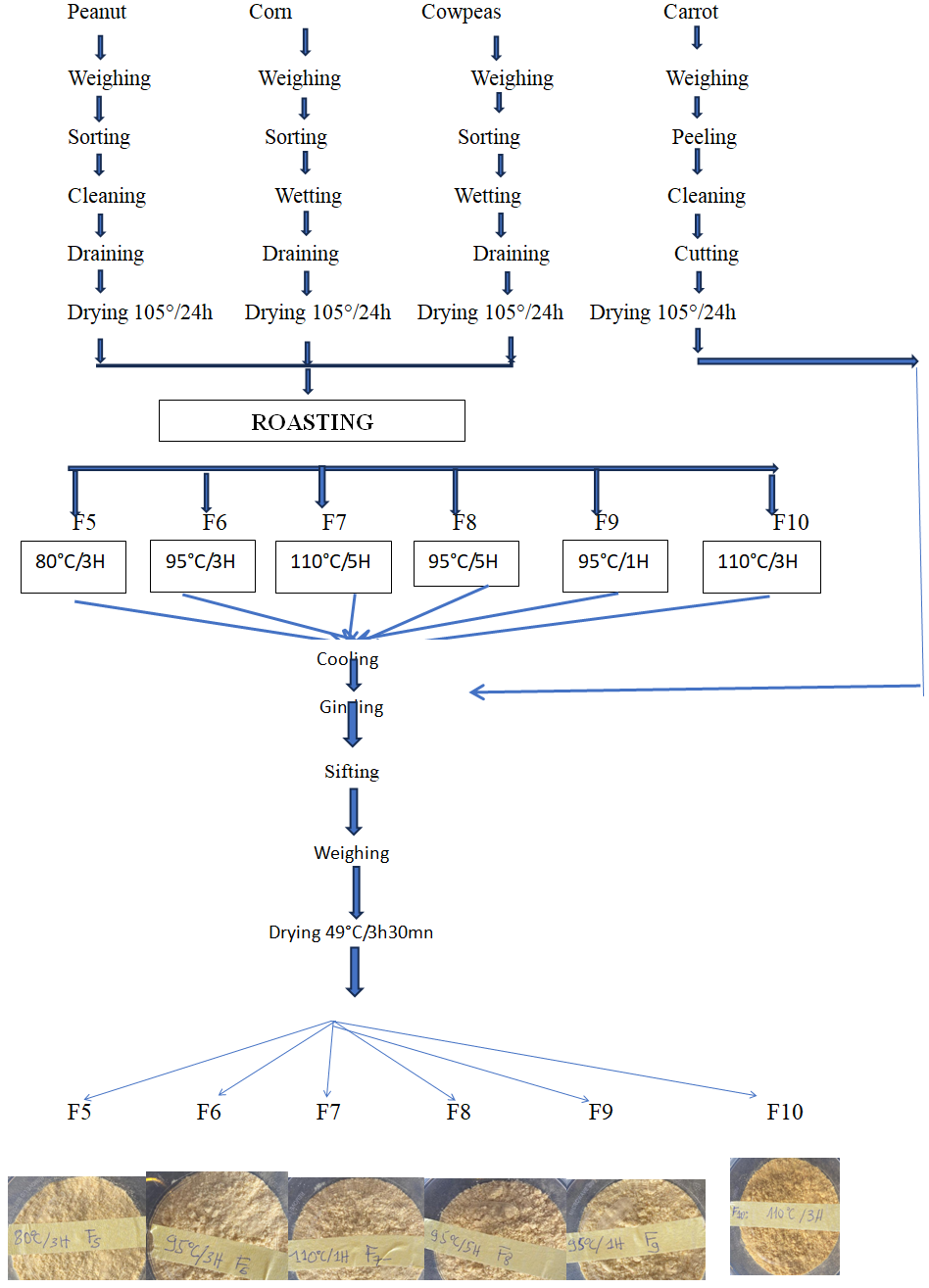
The other six formulas (F5, F6, F7, F8, F9, and F10) have the same composition and proportions (Table 3). Let F denote the other six formulas (F5, F6, F7, F8, F9, and F10).
The composition of these flours was defined based on the nutritional characteristics (WHO/FAO standard) 17 of the raw materials used.
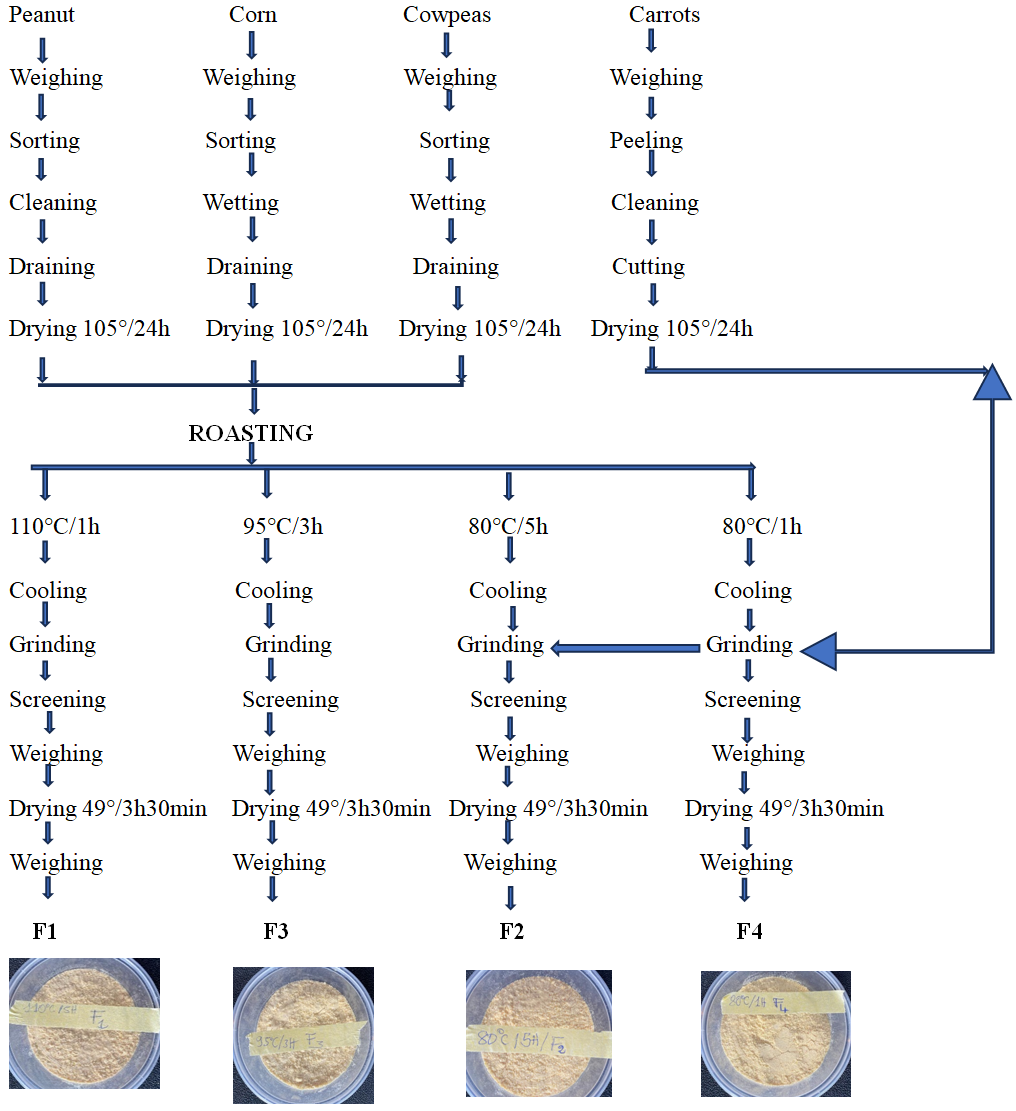
3.4. Infant Cereal Formulation ProtocolThe formulation process for flours F1, F2, F3, and F4 is shown in the diagrams below. These four formulas were chosen for protein and mineral analysis. Microbiological analysis was performed on formula F1. Figure 2 shows the formulation diagrams for flours 1 to 4, and Figure 3 shows the diagrams for formulas 5 to 10.

The protein content of the formulated flours was determined using the standard NFV 18 – 100.
The results of the analyses are presented in Table 4.
The formulated flours are rich in protein. The protein content of the flours (F1, F2, F3, and F4) varies between 11.17 and 14.36. The protein percentages obtained after analysis correlate with and confirm the program established in (Table 2) and are in line with the standards established by WHO/FAO 19, with a few differences that could be due to measurement errors. In fact, we obtained 14.36% for formula F2; 13.57% for formulas F1 and F2.
On the other hand, it is also noted that the protein content of formula F1 is 11.17% lower than that of F1, F2, and F3. This difference can be explained by the differences in proportions (Table 2).
The formulated flours are rich in protein and comply with the standards established by the Joint FAO/WHO Expert Committee on Infant Formula (13%). They are richer in protein than the “Forza” brand flours widely used in Senegal (7.5%) and have a protein content close to that of the “Rouye Lacté de Lionceau” brand (12.3%).
4.2. Characterization of MineralsMineral analyses of the four formulas (F1 to F4) were performed using X-ray fluorescence spectrometry. The results obtained are shown in Table 4.
The infant formulas listed in Table 4 are all relatively rich in iron, calcium, potassium, and sulfur. However, there are slight differences between some of the formulas. For example, there are no significant differences between formulas F2 and F4 in terms of certain minerals. This can be explained by differences in roasting temperature.
In addition, flours F2 and F4 are particularly rich in potassium, which can be attributed to the presence of carrots in their formulation, an ingredient well known for its high potassium content 20.
The flours are richer in iron and zinc than certain flours available on the Senegalese market. For example, Lionceau brand rolled milk flour has iron (3.3 mg/100 g) and zinc (2.6 mg/100 g) contents.
4.3. Microbiological CharacterizationMicrobiological analysis was performed in the laboratory using the NF V08-051 method. Table 5 shows the results of the microbiological analyses.
Table 5 shows the microbiological quality of infant flour F1. The total germ count is 5.6 x 10⁴ (CFU/g), which is below the standard (<10⁵ CFU/g). The concentrations of fecal coliforms, yeasts, and molds are also below the standard (10 CFU/g). Thus, the infant flour complies with the food safety standards established by the WHO and FAO 22.
4.4. Color CharacterizationColor plays an essential role in food processing. It attracts consumers by offering an appealing visual appearance, creating a positive impression, and arousing curiosity about the product.
Quantitative color analysis was performed using a Minolta CR-5 colorimeter with the CIELab system. The results are shown in Table 6.
Flours F1 and F3 (L = 80.32 and 80.2, respectively) have slightly higher luminance values, indicating lighter shades compared to flours F2 and F4 (L = 76.69 and 78.83), which are slightly darker.
The chromatic component b* (yellow-blue) is higher for flours F2 and F4 (b = 42.41, 41.03), which means that they have a more pronounced yellow color. In contrast, flours F1 and F3, with lower b* values (33.11 and 31.31), appear less yellow.
Regarding the a* component (red-green), all flours show a slight reddish hue, although this is not very pronounced.
The yellowness index (YI) reflects the proportion of yellow perceived in the samples. Higher values indicate a more intense yellow hue. Thus, flours F2 and F4 (YI = 60.29, 57.91) confirm a marked yellow dominance.
Overall, all samples show a light color (high L) with a strong yellow dominance (high b* and high YI). The variations between the flours mainly lie in the intensity of the yellow (b*) and the lightness (L). In summary, flours F1 and F3 appear lighter and slightly less saturated, while flours F2 and F4 have darker and more intense yellow hues.
These distinctions can be explained in part by differences in roasting time and temperature. Consequently, a qualitative assessment of the ten formulas is required.
4.5. Sensory TestsSensory analysis involves evaluating the organoleptic characteristics of a product, such as its taste, smell, texture, and appearance (color), using the human senses 23. The results of this analysis are used to identify consumer preferences, highlight the product's strengths, and identify areas for improvement.
This analysis was based on the assessments of carefully selected individuals (doctors, doctoral students, engineers, food technicians, and lay people), who judged the product according to its sensory characteristics: color, smell, taste, and texture.
The tasting test was based on a sheet presenting the ten samples obtained.
The panel consisted of six women and six men. Forty milliliters of water and five spoonfuls of flour were heated for two minutes until a homogeneous mixture was obtained, then milk was added in the same quantity as the flour.
The averages of the sensory tests are recorded in Table 6.
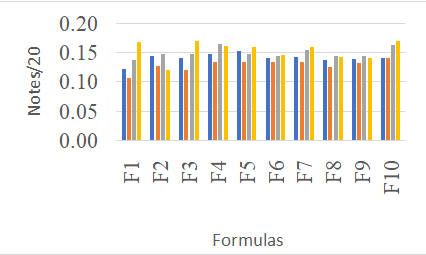
The results of the organoleptic analysis revealed that flour F5 has the best color, flour F10 has the best smell, flour F4 stands out for its texture, and flour F10 is also the highest rated for its taste. The high scores for flour F10 (110°C/3h) can be explained by the important role played by roasting. We can therefore conclude that the highest-rated flours, which were appreciated by the jury, are flours F4 and F10. Figure 4 illustrates the results of the sensory test averages.
This graph shows the ratings given to the flours during sensory testing. In terms of taste, flours F1, F3, and F10 received the highest ratings, a result attributable to roasting at temperatures ranging from 95°C to 110°C for between 3 and 5 hours. In terms of texture, formulas F4 and F10 received the highest ratings. These qualitative results (sensory tests) confirm the quantitative results obtained with colorimetric analysis. Finally, in terms of aroma, the F10 flour is the most popular, which could be explained by the roasting process (110°C/3 hours) and the presence of carrots in its composition.
The objective of this study was to develop a program for formulating infant cereals from local products without exceeding the nutrient levels established by regulatory standards. This study led to the development of infant cereal formulas based on peanuts, corn, cowpeas, and carrots with a protein content of around 13%, significant amounts of minerals such as calcium, iron, manganese, potassium, and zinc, no trace of metals, and compliance with microbiological requirements.
Formula F4 (24% cowpea, 64% corn, 11% peanut, and 1% carrot) with a roasting cycle (80°C/1 hour) and formula F10 (24% cowpea, 64% corn, 11% peanuts, and 1% carrots) with a roasting cycle (110°C/3 hours) are the most popular.
These results show that these flours can help improve the nutrition of young children while promoting local resources.
| [1] | G. A. Gbogouri, M. S. Bamba, D. Y. Digbeu, et K. Brou, «Elaboration d’une Farine infantile composée à base d’ingrédients locaux de Côte d’Ivoire: quelles stratégies d’enrichissement en acides gras polyinsaturés oméga 3?», Int. J. Biol. Chem. Sci., vol. 13, no 1, p. 6375, 2019. | ||
| In article | View Article | ||
| [2] | N. T. J. Boris, R. R. Nivohanintso, N. Nk. Laurette, D. D. Thalès, et K. S. M. Modestine, «Formulation D’un Aliment De Complément À Base De Banane Plantain, Associé Avec Du Maïs, D’arachide Et Du Haricot Mungo Pour Prévenir La Malnutrition Protéo-Énergétique Chez Les Enfants De 6 - 24 Mois À Madagascar», Int. J. Progress. Sci. Technol., vol. 37, no 1, p. 118128, févr. 2023. | ||
| In article | |||
| [3] | «GP-02_Production-artisanale-de-farines-infantiles.pdf». Consulté le: 31 octobre 2025. [En ligne]. Disponible sur: https://gret.org/wp-content/uploads/2021/11/GP-02_Production-artisanale-de-farines-infantiles.pdf. | ||
| In article | |||
| [4] | T. B. Kahiwa, T. B. Mapendo, J. K. Mubolo, et D. Z. Kivuwakihra, «Essai de formulation de la farine infantile instantanée à base de produits locaux (maïs, patates douces, soja et feuilles d’amarantes)», Ann. UNIGOM, vol. 14, no 1, 2024, Consulté le: 10 octobre 2025. [En ligne]. Disponible sur: https:// pugoma.com/index.php/UNIGOM/article/view/385. | ||
| In article | |||
| [5] | M. Nago, A. Yemoa, C. Mizehoun-Adissoda, A. Bigot, et J. Hounhouigan, « Evaluation de la qualité nutritionnelle des farines infantiles fabriquées et vendues au Bénin », J B Cl Bénin, vol. 29, p. 1218, 2018. | ||
| In article | |||
| [6] | A. Coulibaly, «Developpement d’une farine infantile a forte valeur nutritionnelle pour les enfants de 6 A 12 mois valorisant la biodiversite locale», PhD Thesis, Universite Nationale d’Agriculture, 2022. Consulté le: 10 octobre 2025. [En ligne]. Disponible sur: https://cgspace.cgiar.org/items/d323cb54-c650-41cc-b540-ac2cb0c9d576. | ||
| In article | |||
| [7] | N. F. Fogny, E. Y. Madode, F. F. Laleye, Y. Amoussou-Lokossou, et A. P. Kayode, «Formulation de farine de fonio enrichie en ressources alimentaires locales pour l’alimentation complémentaire des jeunes enfants au Bénin», Int. J. Biol. Chem. Sci., vol. 11, no 6, p. 27452755, 2017. | ||
| In article | View Article | ||
| [8] | N. T. J. Boris, R. R. Nivohanintso, N. Nk. Laurette, D. D. Thalès, et K. S. M. Modestine, «Formulation D’un Aliment De Complément À Base De Banane Plantain, Associé Avec Du Maïs, D’arachide Et Du Haricot Mungo Pour Prévenir La Malnutrition Protéo-Énergétique Chez Les Enfants De 6 - 24 Mois À Madagascar», Int. J. Progress. Sci. Technol., vol. 37, no 1, p. 118128, févr. 2023. | ||
| In article | |||
| [9] | S. BELLOUATI, B. A. BEN-MIA, I. E. H. BENOUSSAD, et M. BENHMED, «Production d’une Farine Infantile Locale avec Nouvelle Formule a Base de Quinoa et Caroube Conditionnée en Emballage Unidose», PhD Thesis, 2024. Consulté le: 10 octobre 2025. [En ligne]. Disponible sur: https://dspace.univ-temouchent.edu.dz/handle/123456789/4918. | ||
| In article | |||
| [10] | L. Harrison et al., «Dietary Strategies for Complementary Feeding between 6 and 24 Months of Age: The Evidence», Nutrients, vol. 15, no 13, p. 3041, juill. 2023. | ||
| In article | View Article PubMed | ||
| [11] | «Micronutrient gaps during the complementary feeding period in South Asia: A Comprehensive Nutrient Gap Assessment.», Nutr. Rev., vol. 79, p. 2634, mars 2021. | ||
| In article | View Article PubMed | ||
| [12] | C. K. Lutter et J. A. Rivera, « Nutritional Status of Infants and Young Children and Characteristics of Their Diets », J. Nutr., vol. 133, no 9, p. 2941S-2949S, sept. 2003. | ||
| In article | View Article PubMed | ||
| [13] | «WHO Guideline for complementary feeding of infants and young children 6-23 months of age». Consulté le: 31 octobre 2025. [En ligne]. Disponible sur: https:// www.who.int/ publications/ i/item/9789240081864. | ||
| In article | |||
| [14] | G. Camus, «Chapitre 5. Le sevrage», Bébé Petite Enfance, p. 175186, 2017. | ||
| In article | |||
| [15] | M.-A. Hays et M. Guibert, «Le rythme du sevrage », Spirale, vol. 44, no 4, p. 95103, 2007. | ||
| In article | View Article | ||
| [16] | «WHO Guideline for complementary feeding of infants and young children 6-23 months of age». Consulté le: 31 octobre 2025. [En ligne]. Disponible sur: https:// www.who.int/ publications/ i/item/9789240081864. | ||
| In article | |||
| [17] | «fao.org/ fao-who-codexalimentarius/sh proxy/ en/? lnk= 1&url=https% 253A% 252F% 252Fworkspace. fao.org% 252Fsites% 252Fcodex%252FStandards%252FCXS% 2B74 - 1981% 252FCXS_074f.pdf». Consulté le: 10 octobre 2025. [En ligne]. Disponible sur: https:// www.fao.org/ fao-who-codexalimentarius/ sh-proxy/ en/? lnk=1&url=https% 253A% 252F%252 Fworkspace.fao.org% 252Fsites% 252Fcodex% 252FStandards%252FCXS% 2B74-1981%252FCXS_074f.pdf. | ||
| In article | |||
| [18] | «ISO 5983-2:2009», ISO. Consulté le: 31 octobre 2025. [En ligne]. Disponible sur: https://www.iso.org/fr/standard/52199.html | ||
| In article | |||
| [19] | «Codex Standard for Processed CerealBased Foods for Infants and Young Children (Codex Stan 74-1981, Rév. 1-2006) : dans la section « 3.3 Protein », il est indiqué que les aliments céréaliers transformés destinés aux nourrissons et jeunes enfants doivent avoir une teneur en protéines « not less than 0.48 g/100 kJ (2 g/100 kcal) » pour les catégories spécifiées, et « not more than 1.3 g/100 kJ (5.5 g/100 kcal) » pour d’autres catégories. - Recherche Google ». Consulté le: 31 octobre 2025. | ||
| In article | |||
| [20] | E. Yusuf, K. Tkacz, I. P. Turkiewicz, A. Wojdyło, et P. Nowicka, «Analysis of chemical compounds’ content in different varieties of carrots, including qualification and quantification of sugars, organic acids, minerals, and bioactive compounds by UPLC», Eur. Food Res. Technol., vol. 247, no 12, p. 30533062, déc. 2021. | ||
| In article | View Article | ||
| [21] | «FAO/WHO (2004) – Microbiological hazards in infant formulae and powdered infant foods. FAO Food and Nutrition Paper No. 77. → Décrit les méthodes ISO utilisées pour l’analyse des farines infantiles. (FAO.org – PDF officiel ) - Recherche Google». Consulté le: 31 octobre 2025. [En ligne]. | ||
| In article | |||
| [22] | «les normes de sécurité alimentaire établies par l’OMS et la FAO - Recherche Google». Consulté le: 31 octobre 2025. | ||
| In article | |||
| [23] | «ISO 5492:1992», ISO. Consulté le: 31 octobre 2025. [En ligne]. Disponible sur: https://www.iso.org/fr/standard/11533.html. | ||
| In article | |||
Published with license by Science and Education Publishing, Copyright © 2025 Khady NDIAYE, Mamadou Moustapha DIOUF, Kalidou BA, Mamadou Faye and Adama DIOP
 This work is licensed under a Creative Commons Attribution 4.0 International License. To view a copy of this license, visit
http://creativecommons.org/licenses/by/4.0/
This work is licensed under a Creative Commons Attribution 4.0 International License. To view a copy of this license, visit
http://creativecommons.org/licenses/by/4.0/
| [1] | G. A. Gbogouri, M. S. Bamba, D. Y. Digbeu, et K. Brou, «Elaboration d’une Farine infantile composée à base d’ingrédients locaux de Côte d’Ivoire: quelles stratégies d’enrichissement en acides gras polyinsaturés oméga 3?», Int. J. Biol. Chem. Sci., vol. 13, no 1, p. 6375, 2019. | ||
| In article | View Article | ||
| [2] | N. T. J. Boris, R. R. Nivohanintso, N. Nk. Laurette, D. D. Thalès, et K. S. M. Modestine, «Formulation D’un Aliment De Complément À Base De Banane Plantain, Associé Avec Du Maïs, D’arachide Et Du Haricot Mungo Pour Prévenir La Malnutrition Protéo-Énergétique Chez Les Enfants De 6 - 24 Mois À Madagascar», Int. J. Progress. Sci. Technol., vol. 37, no 1, p. 118128, févr. 2023. | ||
| In article | |||
| [3] | «GP-02_Production-artisanale-de-farines-infantiles.pdf». Consulté le: 31 octobre 2025. [En ligne]. Disponible sur: https://gret.org/wp-content/uploads/2021/11/GP-02_Production-artisanale-de-farines-infantiles.pdf. | ||
| In article | |||
| [4] | T. B. Kahiwa, T. B. Mapendo, J. K. Mubolo, et D. Z. Kivuwakihra, «Essai de formulation de la farine infantile instantanée à base de produits locaux (maïs, patates douces, soja et feuilles d’amarantes)», Ann. UNIGOM, vol. 14, no 1, 2024, Consulté le: 10 octobre 2025. [En ligne]. Disponible sur: https:// pugoma.com/index.php/UNIGOM/article/view/385. | ||
| In article | |||
| [5] | M. Nago, A. Yemoa, C. Mizehoun-Adissoda, A. Bigot, et J. Hounhouigan, « Evaluation de la qualité nutritionnelle des farines infantiles fabriquées et vendues au Bénin », J B Cl Bénin, vol. 29, p. 1218, 2018. | ||
| In article | |||
| [6] | A. Coulibaly, «Developpement d’une farine infantile a forte valeur nutritionnelle pour les enfants de 6 A 12 mois valorisant la biodiversite locale», PhD Thesis, Universite Nationale d’Agriculture, 2022. Consulté le: 10 octobre 2025. [En ligne]. Disponible sur: https://cgspace.cgiar.org/items/d323cb54-c650-41cc-b540-ac2cb0c9d576. | ||
| In article | |||
| [7] | N. F. Fogny, E. Y. Madode, F. F. Laleye, Y. Amoussou-Lokossou, et A. P. Kayode, «Formulation de farine de fonio enrichie en ressources alimentaires locales pour l’alimentation complémentaire des jeunes enfants au Bénin», Int. J. Biol. Chem. Sci., vol. 11, no 6, p. 27452755, 2017. | ||
| In article | View Article | ||
| [8] | N. T. J. Boris, R. R. Nivohanintso, N. Nk. Laurette, D. D. Thalès, et K. S. M. Modestine, «Formulation D’un Aliment De Complément À Base De Banane Plantain, Associé Avec Du Maïs, D’arachide Et Du Haricot Mungo Pour Prévenir La Malnutrition Protéo-Énergétique Chez Les Enfants De 6 - 24 Mois À Madagascar», Int. J. Progress. Sci. Technol., vol. 37, no 1, p. 118128, févr. 2023. | ||
| In article | |||
| [9] | S. BELLOUATI, B. A. BEN-MIA, I. E. H. BENOUSSAD, et M. BENHMED, «Production d’une Farine Infantile Locale avec Nouvelle Formule a Base de Quinoa et Caroube Conditionnée en Emballage Unidose», PhD Thesis, 2024. Consulté le: 10 octobre 2025. [En ligne]. Disponible sur: https://dspace.univ-temouchent.edu.dz/handle/123456789/4918. | ||
| In article | |||
| [10] | L. Harrison et al., «Dietary Strategies for Complementary Feeding between 6 and 24 Months of Age: The Evidence», Nutrients, vol. 15, no 13, p. 3041, juill. 2023. | ||
| In article | View Article PubMed | ||
| [11] | «Micronutrient gaps during the complementary feeding period in South Asia: A Comprehensive Nutrient Gap Assessment.», Nutr. Rev., vol. 79, p. 2634, mars 2021. | ||
| In article | View Article PubMed | ||
| [12] | C. K. Lutter et J. A. Rivera, « Nutritional Status of Infants and Young Children and Characteristics of Their Diets », J. Nutr., vol. 133, no 9, p. 2941S-2949S, sept. 2003. | ||
| In article | View Article PubMed | ||
| [13] | «WHO Guideline for complementary feeding of infants and young children 6-23 months of age». Consulté le: 31 octobre 2025. [En ligne]. Disponible sur: https:// www.who.int/ publications/ i/item/9789240081864. | ||
| In article | |||
| [14] | G. Camus, «Chapitre 5. Le sevrage», Bébé Petite Enfance, p. 175186, 2017. | ||
| In article | |||
| [15] | M.-A. Hays et M. Guibert, «Le rythme du sevrage », Spirale, vol. 44, no 4, p. 95103, 2007. | ||
| In article | View Article | ||
| [16] | «WHO Guideline for complementary feeding of infants and young children 6-23 months of age». Consulté le: 31 octobre 2025. [En ligne]. Disponible sur: https:// www.who.int/ publications/ i/item/9789240081864. | ||
| In article | |||
| [17] | «fao.org/ fao-who-codexalimentarius/sh proxy/ en/? lnk= 1&url=https% 253A% 252F% 252Fworkspace. fao.org% 252Fsites% 252Fcodex%252FStandards%252FCXS% 2B74 - 1981% 252FCXS_074f.pdf». Consulté le: 10 octobre 2025. [En ligne]. Disponible sur: https:// www.fao.org/ fao-who-codexalimentarius/ sh-proxy/ en/? lnk=1&url=https% 253A% 252F%252 Fworkspace.fao.org% 252Fsites% 252Fcodex% 252FStandards%252FCXS% 2B74-1981%252FCXS_074f.pdf. | ||
| In article | |||
| [18] | «ISO 5983-2:2009», ISO. Consulté le: 31 octobre 2025. [En ligne]. Disponible sur: https://www.iso.org/fr/standard/52199.html | ||
| In article | |||
| [19] | «Codex Standard for Processed CerealBased Foods for Infants and Young Children (Codex Stan 74-1981, Rév. 1-2006) : dans la section « 3.3 Protein », il est indiqué que les aliments céréaliers transformés destinés aux nourrissons et jeunes enfants doivent avoir une teneur en protéines « not less than 0.48 g/100 kJ (2 g/100 kcal) » pour les catégories spécifiées, et « not more than 1.3 g/100 kJ (5.5 g/100 kcal) » pour d’autres catégories. - Recherche Google ». Consulté le: 31 octobre 2025. | ||
| In article | |||
| [20] | E. Yusuf, K. Tkacz, I. P. Turkiewicz, A. Wojdyło, et P. Nowicka, «Analysis of chemical compounds’ content in different varieties of carrots, including qualification and quantification of sugars, organic acids, minerals, and bioactive compounds by UPLC», Eur. Food Res. Technol., vol. 247, no 12, p. 30533062, déc. 2021. | ||
| In article | View Article | ||
| [21] | «FAO/WHO (2004) – Microbiological hazards in infant formulae and powdered infant foods. FAO Food and Nutrition Paper No. 77. → Décrit les méthodes ISO utilisées pour l’analyse des farines infantiles. (FAO.org – PDF officiel ) - Recherche Google». Consulté le: 31 octobre 2025. [En ligne]. | ||
| In article | |||
| [22] | «les normes de sécurité alimentaire établies par l’OMS et la FAO - Recherche Google». Consulté le: 31 octobre 2025. | ||
| In article | |||
| [23] | «ISO 5492:1992», ISO. Consulté le: 31 octobre 2025. [En ligne]. Disponible sur: https://www.iso.org/fr/standard/11533.html. | ||
| In article | |||