Alzheimer’s disease (AD) is the most prevalent cause of dementia worldwide more frequently manifested in postmenopausal women. It has been associated in part with genetic predisposition (Apo E polymorphism) and chronic inflammation. We tested the effects of combinations of genistein with daidzein (SERMs), inositol hexa-phosphate with choline (phospholipid precursors), and the mixture (the Mix) of these two compositions with select plant extracts, vitamins, and minerals on specific AD cellular markers. The tests were conducted on fibroblasts derived from an old female AD patient and human normal dermal fibroblasts (HNDF) cultured under normal and inflammatory conditions. Evaluations included gene and protein expression for APOE, Tau and proinflammatory genes CSF2 and PTGS2. The Mix significantly decreased APOE gene expression in the cells derived from AD donor under normal and IL1β-induced inflammatory conditions. In the presence of IL1β and TNFα, Tau gene expression was significantly lower in both HNDF and AD fibroblasts compared to control. In the presence of TNFα Tau protein was affected by SERMs, phospholipids precursors, and the Mix. Test combinations differently affected the basal and inflammation-induced CSF2 and PTGS2 genes expression in HNDF and AD fibroblast. The effects of these natural compositions were compared to 17β estradiol and inflammatory signaling pathways’ inhibitors (SAPKs) to identify nutrients affecting specific cellular targets. This study indicates that nutrient combinations containing SERMs and/or phospholipid precursors, might exert the protective role of estrogens in relation to AD. These results merit further investigations aimed at developing effective natural approaches to AD and other forms of dementia.
Alzheimer’s disease (AD) is a neurodegenerative progressive illness beginning with mild cognitive impairment (MCI), leading to loss of cognition, mobility, and eventually death. It accounts for 60-70% of all dementia cases clinically characterized by poor learning capabilities and progressive irreversible behavioral and intellectual decline which shows positive correlation with increasing age. 1, 2, 3 Clinical studies indicate that AD affects post-menopausal women more than men of the corresponding age, which would suggest that decreasing estrogen levels could play a role in the development of this disease. 2, 3 Main factors consistently associated with AD development and progression include genetic aspects such as the single nucleotide polymorphism of the APOE gene encoding the cholesterol transport protein apolipoprotein E (apoE, APOE, ApoE), hyperphosphorylation of microtubule-associated protein Tau, the presence of intracellular neurofibrillary tangles (NFTs), and the formation of extracellular amyloid-beta plaque (Aβ), accompanied by mitochondrial dysfunction and neuroinflammation related to harmful cytokines and growth factors released by microglia. 4, 5, 6, 7, 8 Collectively, these anomalies lead to synaptic and neuronal loss, which are the acknowledged hallmarks of AD. 1, 2
Since the major pathological feature of AD involves changes in APOE gene and APOE4 allele expression affecting lipid homeostasis as well as promoting formation of NFTs and Aβ, it has been hypothesized that these pathological changes might be preceded by prolonged acute innate immune inflammatory response, turning to chronic inflammation and consequently the dysfunction of the brain cells. 9, 10, 11, 12, 13 Not only AD, but many other modern-day diseases have been linked to low-grade inflammation that becomes chronic. This implies that suppressing pro-inflammatory mechanisms or improving its timely resolution might delay various age-related diseases including AD, cardiovascular disease, rheumatoid arthritis, diabetes, obesity and cancer. 14, 15
While inflammation is a part of a normal immune response against microbial infections and toxic environmental agents, when it persists it can be damaging and destructive for all cells, including neurons. 16, 17 Neuroinflammation in an early and late onset of AD is accredited to stimulation of the central nerve system (CNS) immune cells, i.e., microglia (mainly macrophages type M2 and occasionally M1) and perivascular myeloid cells by pro-inflammatory molecules such as interleukins (ILs), interferons (INFs), and tumor necrosis factors (TNFs) as well as related signaling pathways. In MCI for example the upregulation of TNFα with concurrent downregulation of TGFβ causes Aβ expression and IL1β upregulation. Stress activated protein kinases (SAPKs) such as c-JUN N-terminal kinase (JNK) and protein p38, stimulated upon exposure to cellular stresses such as genotoxic, osmotic, hypoxic, or oxidative stress and proinflammatory cytokines e.g., IL1β and TNFα, in turn activate plethora of down-stream effectors responsible for various pathologies, including AD. 18, 19 Activation of these pathways in AD is thought to contribute to disease pathogenesis such as neuronal apoptosis, β- and γ-secretase activity, and phosphorylation of the amyloid precursor protein (APP) or Tau protein. Consequently, these abnormal changes in neuronal tissue led to the accumulation of Aβ (protopathic aggregates) outside the neurons and NFTs insight the neurons, formation of Tau aggregates (tauopathies), causing damage to neuronal cells and their ultimate loss. All these facilitate neurotoxicity and eventually neurodegeneration. 4, 20, 22, 23
It has been reported that IL1β and TNFα secreted by reactive microglia are elevated in patients with higher risk of developing AD. 24, 25, 26 These pro-inflammatory cytokines affect signaling pathways of SAPKs (i.e., JNK and p38 kinase). 27, 28, 29, 30 The JNK activity and c-Jun N-terminal phosphorylation regulate stress-induced cell proliferation and apoptosis with JNKs being present in the cytoplasm and nucleus and can bind to specific sites on the DNA. 31, 32, 33 JNK inhibitors were shown to increase APOE expression in vivo and in vitro. The p38 signaling pathway that plays an important regulatory role in proliferation and differentiation of neuronal PC12 cells, was also shown to be associated with inflammation in AD, since restoring the activity of p38 kinase resulted in phosphorylation of Tau protein in vitro. 30, 34, 35 The downstream signaling effects of SAPKs converge on the promoters of pro-inflammatory genes of the rapid innate immune response such as granulocyte colony stimulating factor (GM-CSF or CSF2) and prostaglandin G/H synthase (PTGS2 /COX2) genes. 36, 37, 38 The products of PTGS2 gene are cyclooxygenases COX1 and COX2, with COX2 being the major target for non-steroidal anti- inflammatory drugs (NSAID). The promoters of these pro-inflammatory genes are strongly repressed by steroid hormones (estrogens and glucocorticoids) and NSAID. It has been demonstrated that glucocorticoids and estrogens have a regulatory crosstalk at a subset of activated pro-inflammatory genes such as CSF2, MCP-1, IL6, IL8 and more, implying that they might work through a common pathway to repress these pro-inflammatory genes. 39
Our earlier study showed that nutrients involved in lipid metabolism (choline, inositol, and phosphatidylserine) as well as soy-derived estrogenic polyphenols (genistein and daidzein), known as SERMs (selective estrogen receptor modulators) and plant extracts containing these estrogenic active compounds differently affect gene expression for APOE, its isoform APOE4, and Tau protein. 40 Since all physiological effects of natural compounds result from their cellular interactions, we investigated the effects of these natural compounds used in combinations on the basal and cytokine-activated expression of APOE, Tau, CSF2, and PTGS2 genes as well as APOE and Tau protein levels. The test combinations were: daidzein with genistein (daidzein+genistein), phospholipids precursors (IP6+choline), and a combination of these SERMs and phospholipids precursors with extracts from rosemary, red clover, chaste tree as well as vitamins C, E, B5, B6, folate and the minerals iodine and selenium (the Mix). We also included 17β estradiol (E2) to compare its effect to SERMs containing nutrient combinations. We used dermal fibroblasts derived from an old female AD donor as a recognized in vitro model for AD and human normal dermal fibroblasts (HNDF). 41 The effects of test combinations were evaluated in the cells cultured under non-inflammatory and inflammatory conditions (in the absence and presence of IL1β or TNFα,). Their efficacy was compared to specific inhibitors, some with pharmaceutical application as drugs, which included: an antagonist of estrogen receptors ERα/ERβ, and agonist of G protein-coupled receptor 30, GPER30 (i.e., ICI 182,780), a specific inhibitor of p38 kinase (i.e., SB202190), inhibitor of JNK1 and JNK2 (c-JUN N-terminal Kinase 1 and 2) (i.e., SP600125).
The AG08269 cells were purchased from Coriell Institute for Medical Research (Camden, New Jersey, USA). They are skin-derived fibroblasts from 82-year-old (at the time of sampling) female with AD (patient was a clinically unaffected member of an Alzheimer’s disease family; donor’s diseased son and granddaughter were affected; the cell morphology is fibroblast-like). 42, 43 Primary dermal normal fibroblasts from ATCC (Manassas, VA, USA). Both cell lines were grown in DMEM/F12 without phenol red (Gibco, USA) medium supplemented with 10% charcoal stripped fetal bovine serum (Sigma-Millipore, Burlington, MA, USA), and 1% penicillin-streptomycin at 37OC and 5% CO2.
Chaste tree (Vitex agnus-castus) extract and red clover extract were purchased from Monterey Bay Spice Company (Watsonville, CA, USA). Rosemary extract, inositol hexa-phosphate (IP6, food grade), and choline bitartrate (food grade) were obtained from Powder City (York, PA, USA). Phosphatidylserine (food grade) and soybean extract (food grade, containing 40% of iso-flavones) were purchased from Bulk Supplements (Henderson, NV, USA). Genistein, daidzein, vitamins C, E, B5, B6, folate, iodine, and selenium were from Sigma-Millipore (Burlington, MA, USA). Human recombinant IL1β and TNFα were acquired from R&D Systems (Minneapolis, MN, USA). The stock solutions of all test combinations of natural compounds (at 10 mg/ml concentrations) were done in DMSO. The SB202190 inhibitor, SP600125 inhibitor, ICI 182,780 inhibitor, and 17β estradiol (E2 compound) were purchased from Sigma-Millipore (Burlington, MA, USA).
2.2. Treatment of CellsBoth cell lines were treated according to previously reported methodology. 40 Briefly, the cells were seeded at 1.0x10⁶ in 35 mm cell culture dishes and left in the CO2 incubator at 37OC allowing their attachment. Next, cells were treated for 24h with either 0.1% DMSO (a non-treatment control) or with the test combinations of daidzein+genistein (1.0 µg/ml daidzein+1.0 µg/ml genistein), IP6+choline (1.0 µg/ml IP6+ 1.0 µg/ml choline), 1.0 nM E2, 1.0 µg/ml soy iso-flavones, or the Mix (1.0 µg/ml), respectively. When indicated, specific p38 MAPK inhibitor SB202190 (at a final concentration of 50 μM), JNKs inhibitor SP600125 (at a final concentration of 40 nM), or ICI 182,780 inhibitor (at a final concentration of 100 nM), were applied, respectively, as referential controls. In pro-inflammatory conditions, cells were exposed to 50 pg/ml IL1β or 67 pg/ml TNFα. Next, the cells were either lysed with RIPA buffer (Sigma-Millipore, Burlington, MA, USA) supplemented with 1mM PMSF, immediately before use were or subjected to RNA isolation and purification for RT-qPCR analysis, as described below.
2.3. Real-time Polymerase Chain Reaction (RT-PCR).Transcription analysis was performed according to previously reported methodology. 40 Briefly total RNA was isolated with RNeasy Plus kit (Qiagen, Germantown, MD, USA) according to the manufacturer’s protocol, followed by the concentration and purity assessment by recording the absorbance at 260 nm using a Nano-drop 2000c spectrophotometer (ThermoFisher, Wilmington, DE) as well as the A260/A280 ratio (>1.8) and A260/A230 ratio (>1,5). Equal amounts of 0.7 µg of RNA were reverse transcribed (total 20 µl reaction) with RT-QuantiTech kit (Qiagen, Germantown, MD, USA). Next 2.0 µl of the obtained cDNA was amplified (total 20 µl of final volume) using QuantiNova SYBR-Green master mix for qRT-PCR in the Bio-Rad CFX96 thermocycler (Bio-Rad, Hercules, USA). The PCR program was set up as follow: denaturation step at 95OC for 5 min., 40 cycles of denaturation (95OC for 10s) and combined annealing/extension (60OC for 30s) with a final melting step performed at 95OC for 10s. Relative expression of the target gene and/or reference gene obtained as quantification data (Ct) was compared to the quantification data of non-treated cells (dCt) and calculated with comparative threshold cycle (2^ddCt) LIVAK method. 44 Specific primers for target genes APOE, Tau, CSF2, and PTGS2 as well as reference (housekeeping) gene GADPH were obtained from Qiagen (Germantown, MD, USA). Each primer set was validated by the manufacturer. Their sequence is proprietary information, but they are commercially available from Qiagen (Germantown, MD, USA).
2.4. Western Blot (WB).Protein expression was assessed by Western blot analysis as previously reported. 40 Briefly, cell lysates in RIPA buffer (Cell Signaling, Danvers, MA) supplemented with 1mM PMSF and determined with DC Protein Assay (Bio-Rad, Hercules, CA) protein concentration were resolved on 4-15% gradient polyacrylamide gel electrophoresis (30 µg/ml of total protein per well), transferred to a polyvinylidene difluoride 0.2 μm membrane (PVDF membrane, Bio-Rad Laboratories, Hercules, CA), and probed with monoclonal antibody against pan APOE at 1:1000 dilution (Cell Signaling Technology (Danvers, Massachusetts. USA) monoclonal antibody against Tau at 1:1000 dilution (Novus Biologicals, Centennial, CO, USA), monoclonal antibody against ERα at 1:1000 dilution (Cell Signaling, Denver, MA, USA), and anti-GADPH antibody at 1:1500 dilution. Target proteins were detected with a polyclonal HRP-conjugated secondary antibody at 1:1500 dilution (Cell Signaling, Danver, MA). Signals were visualized by ECL detection kit (Azure Biosystems, Dublin, CA, USA) and the images were captured with Azure CSeries 600 system and auto-exposure settings.
2.5. Statistical AnalysisAll data are presented as means ± SD (n = 3). All experiments were performed at least three times each, at least in triplicates. The Student’s two-tailed t test was used to determine statistically significant differences set at 0.05 levels. Statistical analysis was performed using GraphPad software (access date: 03/15/25).
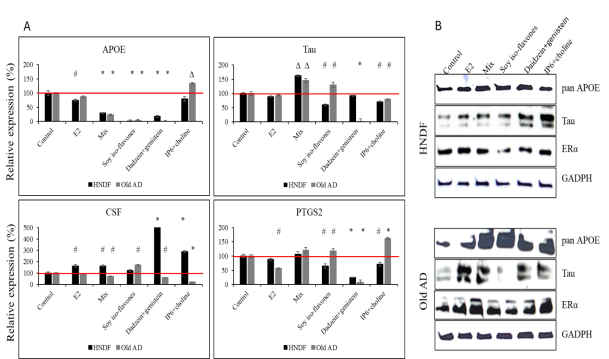
Figure 1A presents the effects of three defined combinations of natural compounds: daidzein with genistein, IP6 with choline, and the Mix containing these two combinations plus glycitein (from soy extracts), phosphatidylserine, extracts from rosemary, red clover, chaste tree and vitamins C, E, B5, B6, folate, and minerals iodine, and selenium on APOE, Tau, CSF2, and PTGS2 gene expression in HNDF and fibroblasts derived from an elder AD donor cultured in non-inflammatory conditions. The effects of E2 (as a control of female sex hormone) and soy iso-flavones extract are also presented on the same figure.
The results show that the combination of daidzein+genistein significantly inhibited APOE gene expression in HNDF by 82% and in fibroblasts derived from the AD donor by 99%. APOE gene was also inhibited by soy iso-flavones in HNDF by 99% and in AD cells by 96%. However, E2 did not affect this gene in AD cells and decreased its expression in HNDF by only 25%. The combination of IP6+choline had no significant effect on APOE gene expression in HNDF (20% downregulation) and showed a modest increase in AD cells by 34%. The Mix significantly inhibited APOE gene expression in HNDF by 70% and in AD cells by 76%.
The Tau gene expression was stimulated in the presence of the Mix in HNDF by 62% and in AD cells by 45%. Daidzein+genistein inhibited Tau by 99% but only in AD cells. Interestingly, soy iso-flavones extract mildly stimulated this gene in AD fibroblasts (by 30%) but down-regulated its expression in HNDF by 40%. Tau expression was not significantly affected by E2 in both cell types, whereas the combination of IP6+choline showed its modest decrease in HNDF by 29% and in AD cells by 21%.
The results on Figure 1A also present the changes in the expression of CSF2 and PTGS2 genes (as markers of the early innate immune response) upon the treatments with test combinations. As such, the Mix increased CSF2 gene expression by 63% in HNDF but lowered it in AD cells by 27%. In the presence of daidzein+genistein the expression of this gene dramatically increased in HNDF by 453% but it was lower by 39% in AD cells. A similar response was observed with the combination of IP6+choline, which resulted in upregulation of CS2F gene in HNDF by 189% and its downregulation by 77% in AD cells. In the presence of soy iso-flavones the CSF2 expression increased by 25% in HNDF and by 72% in AD cells, while E2 increased its expression in HNDF by 64% and did not show any significant effect in AD fibroblasts.
Expression of PTGS2 gene was inhibited by daidzein+genistein by 75% in HNDF and by 92% in AD cells. However, in the presence of iso-flavones extract its expression decreased by 35% in HNDF with no significant effect in AD cells. Cell exposure to E2 resulted in 43% inhibition of PTGS2 gene expression in AD fibroblasts without a significant effect in HNDF. In the presence of IP6+choline there was a mild 28% decrease in PTGS2 gene expression in the HNDF and was significantly higher (by 62%) in AD cells. However, in the presence of Mix this gene expression remained at the control levels in both cell lines.
Figure 1B presents the data from Western Blot analysis performed on HNDF and AD cells. In HNDF none of the test treatments affected APOE or ERα proteins expression. However, in AD cells, all three nutrient combinations and the iso-flavones extract stimulated APOE protein. In HNDF, Tau protein was visibly augmented upon treatment with IP6+choline, and it modestly increased in the presence of the Mix, iso-flavones extract, daidzein+genistein, and E2 compared to control. In AD fibroblasts, Tau protein expression increased in the presence of E2, the Mix, the combinations of daidzein+genistein and IP6+choline, while iso-flavones extract showed the inhibitory effect. Notably, we observed a double band detected with anti-Tau antibody in cell lysates in both cell lines, and a double band detected with anti-ERα antibody in the fibroblasts derived from AD donor only.

It is important to understand the effects of natural compounds under inflammatory conditions which have been associated with the development and progression of AD. The effects of three test combinations of natural compounds, on APOE, Tau, CSF2, and PTGS2 gene expression in HNDF and AD cells cultured in inflammatory conditions are presented in Figure 2 and Figure 3, respectively. The inflammatory conditions were triggered by 50 pg/ml of IL1β and 67 pg/ml TNFα, respectively.
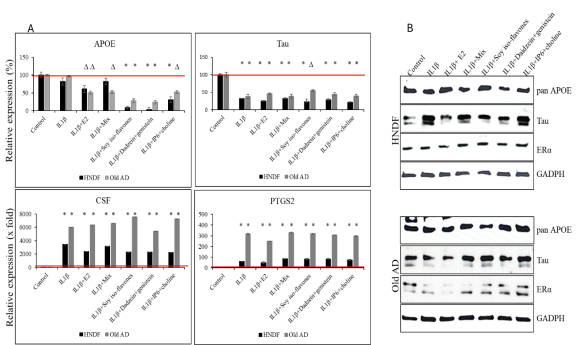
As shown in Figure 2A, the exposure of cells to IL1β alone did not affect APOE gene expression in both test cell lines, but inhibited Tau gene expression in HNDF by 68% and in AD cells by 62%. Co-treatment with IL1β and test combinations inhibited APOE gene expression in both cell lines, except for the Mix not showing any effect in HNDF. As such, in AD cells the inhibitory effects of the iso-flavones extract, daidzein+genistein, and IP6+choline, as well as E2, ranged from 21% (E2) to 78% (daidzein+genistein) in HNDF and from 44-45% (IP6+choline, the Mix and E2) to 73% (daidzein+genistein). Interestingly, the Mix and the combination of daidzein+genistein, the iso-flavones extract, and E2 did not significantly affect Tau gene expression in either of the cell lines incubated in the presence of IL1β. However, the combination of IP6+choline had a mild 11% downregulatory effect in HNDF only.
The IL1β induced inflammatory conditions strongly affected CSF relative gene expression with its increase by ~3400 x folds in HNDF and by ~6000 x folds in AD fibroblasts. Exposure of HNDF and AD derived fibroblasts to IL1β together with test combinations did not have further impact on CSF gene expression. Regarding the PTGS2 gene, we noticed that IL1β increased its expression in HNDF by ~60 x folds and in AD fibroblasts by ~320 x folds. In both cell types PTGS2 gene expression was not affected by test combinations applied jointly with IL1β.
Western blot analysis (Figure 2B) revealed that neither IL1β nor the test compositions significantly affected APOE protein expression in HNDF and AD cells. Tau protein level was augmented by IP6+choline in HNDF exposed to IL1β however, none of the test combinations applied together with IL1β affected Tau protein in AD cells. ERα protein expression displayed a similar pattern across all IL1β co-treatments in HNDF. In AD cells, but not in HNDF, ERα protein appeared as two bands (with the lower band representing the expected 66 kD molecular weight). Moreover, with IL1β or IL1β+E2 treatments ERα protein expression was similar with its mild increase in the presence of all other test compounds.
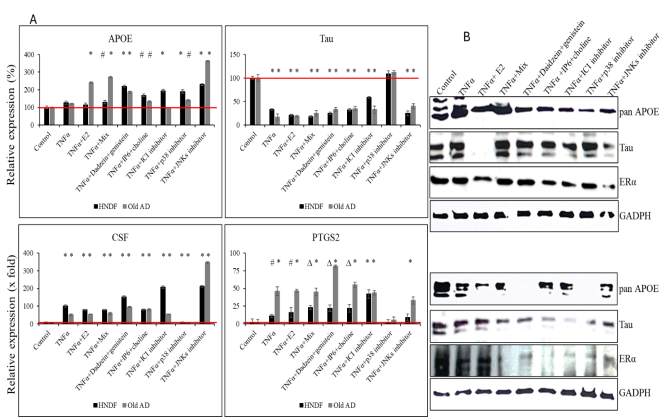
Figure 3 presents the effects of TNFα as a stimulator of inflammatory responses in the test cells. In the presence of TNFα, APOE gene expression increased in HNDF by 26% and in the AD fibroblasts by 21% (Figure 3A). In HNDF neither E2 nor the Mix revealed any significant effect, however APOE gene was upregulated by a co-treatment of TNFα and daidzein+genistein (by 94%) or IP6+choline (by 42%). In AD cells, APOE gene expression was significantly upregulated by daidzein+genistein (65%), E2 (120%), and Mix (149%), but only mildly by IP6+choline.
The Tau gene expression revealed a distinct pattern. Here, the treatment with TNFα inhibited Tau expression in both cell lines (by 67% in HNDF and by 83% in AD cells). However, application of TNFα with E2 or the Mix had rather mild inhibitory effect in HNDF by 12% and 25%, respectively, when compared to TNFα as a control. Co-administration of TNFα with daidzein+genistein or IP6+choline did not show significant effects in HNDF, while a mild Tau increase was noted in AD cells (16% for daidzein+genistein and 18% for IP6+choline).
Expression of CSF2 gene substantially increased in the presence of TNFα in both cell lines, i.e., 101 x folds in HNDF and 50 x folds in AD cells. Interestingly, HNDF exposure to TNFα together with daidzein+genistein further augmented CSF2 gene expression from 101 x folds to 152 x folds. The treatments with E2, Mix, and IP6+choline, decreased this gene expression by 23-21 x folds. In AD cells, co-administration of TNFα with daidzein+genistein and IP6+choline evidently stimulated CSF2 expression by 45 x folds and 31 x folds, respectively. The pattern of PTGS2 gene expression was different. Here, the exposure to TNFα alone, noticeably increased its expression in both cell lines, by 11 x folds in HNDF and 46 x folds in AD cells. In HNDF, TNFα co-applied with Mix, daidzein+genistein, or IP6+choline augmented PTGS2 expression by 11-12 x folds, whereas in AD cells only daidzein+genistein and IP6+choline increased this gene expression by ~35 x folds and ~9 x folds, respectively.
Western blot analysis presented in Figure 3B shows higher APOE protein expression in HNDF exposed to TNFα compared to control, whereas co-treatments of these cells with TNFα and daidzein+genistein or IP6+choline, mildly decreased APOE protein. Co-administration of TNFα with the Mix or E2 did not reveal significant differences. In AD cells, TNFα itself slightly diminished APOE protein expression, but both TNFα+E2 and TNFα+daidzein+genistein did not further inhibit it, while the Mix or IP6+choline had insignificant effects. Tau protein expression in HNDF did not change significantly by TNFα alone or TNFα co-administered with the Mix, daidzein+genistein, or IP6+choline. In HNDF co-treated with TNFα and E2, the Tau protein band was not detected. In AD cells, TNFα alone and together with E2 had no effect on Tau protein expression, however the Mix, combination of daidzein+genistein, and especially IP6+choline decreased it. The ERα expression was inhibited by the combinations containing SERMs and by IP6+choline but, interestingly, E2 did not show any effect in AD cells.

To get a glimpse on signaling pathways that may be affected by TNFα in HNDF and AD cells, we compared the effects of the test compounds to specific anti-inflammatory drugs/chemical inhibitors. These inhibitors included: ICI182,780 (ICI, antagonist of ERα and ERβ transcriptional activation but agonist of the G protein-coupled receptor 30, GPER30), p38 kinase (inhibitor SB202190), and JUN kinase (i.e., JNK1 and JNK2, inhibitor SB600125). Their effects on APOE, Tau, CSF2, and PTGST2 gene expression in HNDF and AD cells cultured in inflammatory conditions triggered by TNFα are presented in Figure 3A.
As shown, all test inhibitors stimulated APOE gene expression in HNDF in the range of 64-103%, with the highest increase observed in the presence of JNKs inhibitor. In AD cells, co-administration of TNFα with ICI inhibitor decreased APOE gene expression by 22% compared to TNFα alone. In the presence of TNFα with p38 inhibitor or JNKs inhibitor, APOE transcription increased by 19% and 241%, respectively. Moreover, TNFα co-administered with ICI inhibitor or p38 inhibitor, reversed Tau gene repression by 27% and 72%, respectively. In contrast, JNKs inhibitor did not show the effect. In AD cells exposed to TNFα together with these inhibitors we observed an increase in Tau gene ranging from 26% to 95%.
The effects of inhibitors on TNFα-triggered induction of CSF2 and PTGS2 gene expressions showed that in HNDF both ICI and JNKs inhibitors increased CSF2 gene transcription ranging from 101 x folds to 111 x folds, but p38 inhibitor decreased it from 101 x folds to 7 x folds. However, in TNFα treated AD cells, ICI inhibitor did not affect CSF2 gene expression, whereas p38 inhibitor decreased its transcription from 50 x folds to 2 x folds, and JNKs inhibitor augmented it from 50 x folds to 346 x folds. With respect to PTGS2 gene expression in HNDF, a co-treatment with TNFα and ICI inhibitor stimulated its expression from 11 x folds to 42 x folds, whereas p38 inhibitor decreased it from 11 x folds to 2 x folds, and JNKs inhibitor did not show a significant effect. In AD cells cultured in the same condition PTGS2 gene expression was not affected by the ICI inhibitor, whereas p38 inhibitor downregulated it (from 46 x folds to 5 x folds) and JNKs inhibitor downregulated it from 46 x folds to 33 x folds.
The results of Western blots analysis presented in Figure 3B show that in HNDF exposed to TNFα all test inhibitors mildly decreased APOE protein expression, while Tau protein was mildly inhibited by JNKs inhibitor only. In AD cells, in presence of TNFα+p38 inhibitor, the APOE protein band was not observed, while all three inhibitors reduced Tau protein levels. All pharmaceutical inhibitors tested in this study diminished the ERα protein level in AD cells but not in HNDF.
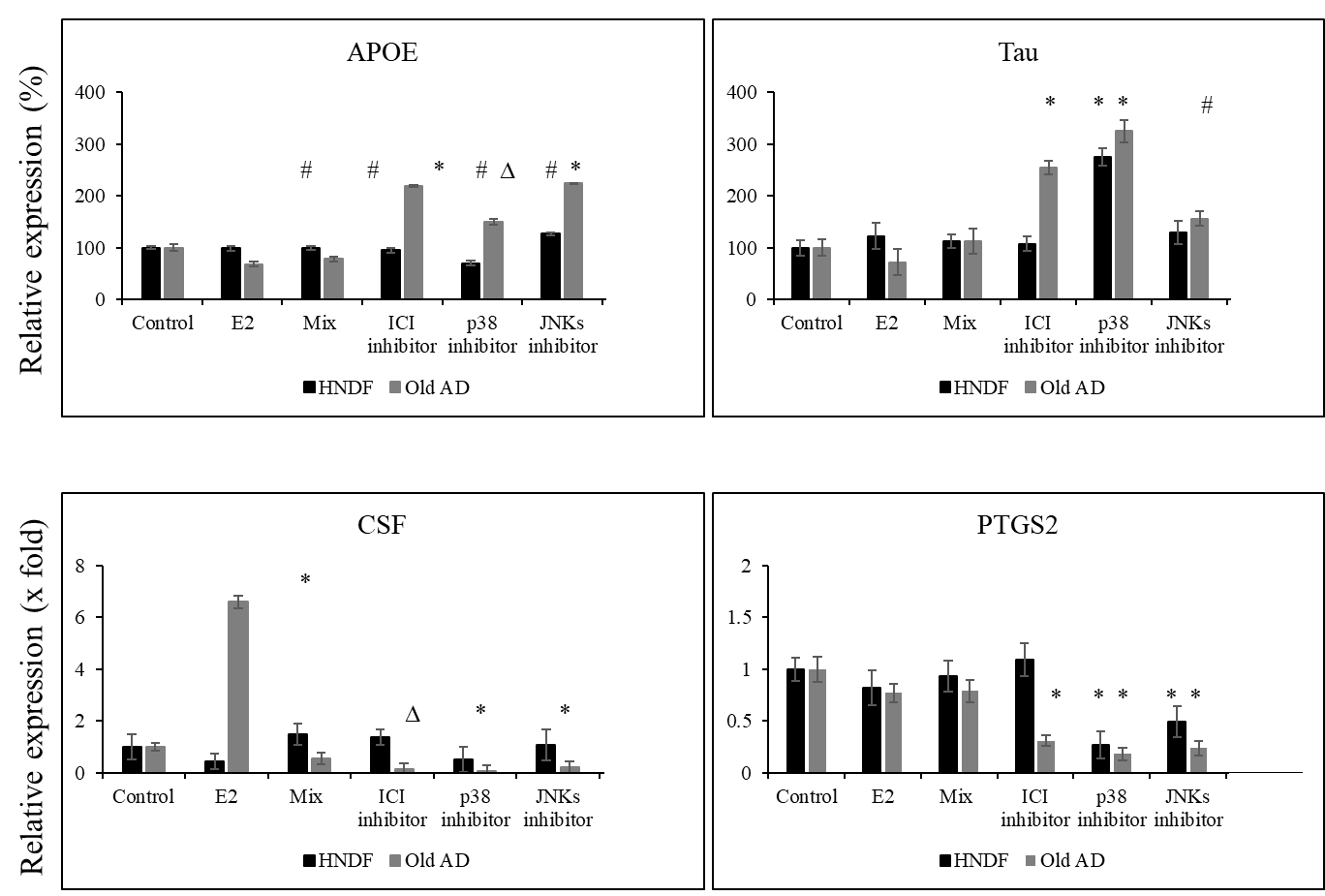
Figure 4 presents the effects of JNKs, p38, and ICI inhibitors in comparison to the Mix and E2 in the cells cultured in non-inflammatory conditions. As such, APOE gene expression in HNDF exposed to p38 inhibitor decreased by 29.8%, while JNKs inhibitor slightly increased this gene by 26.6%. The E2, Mix and ICI inhibitor showed no effect on this gene expression. However, in AD cells all inhibitors significantly increased APOE gene expression in the range of 50-124% with Mix and E2 having no significant effect. Tau gene expression in HNDF was significantly upregulated in the presence of a p38 inhibitor by 175.1% and in AD cells all inhibitors (especially p38 and ICI inhibitors) increased its expression by 56-225%. CSF2 gene expression in HNDF increased in the presence of ICI inhibitor by 0.37 x fold, whereas p38 inhibitor decreased it by 0.49 x fold, with JNKs inhibitor having no significant effect. In AD cells, all inhibitors strongly inhibited this gene expression (0.78-0.95 x fold) with E2 having a significant (5.6 x folds) stimulatory effect. In respect to PTGS2 gene, only p38 inhibitor and JNKs inhibitors decreased its expression in HNDF by 0.73 x fold and 0.51 x fold, respectively. However, in AD cells all test inhibitors strongly decreased PTGS2 gene expression by 0.69 x folds to 0.88 x folds. Both E2 and Mix did not show significant effects in both tested cell lines.


Alzheimer’s disease presents a significant therapeutic challenge. Genetic factors, such as the APOE gene single nucleotide polymorphism (i.e., APOE4 isoform) play a key role in AD’s etiology. In addition, inflammation status, diet and lifestyle factors have been shown to be major contributors to AD in both preventive and therapeutic aspects. Many years of research have opened the field of nutrigenomics showing among others that natural ER modulators (i.e. genistein and daidzein) can bind to ERα or ERβ and to steroid receptor coactivators with different affinities depending on the protein content in the cell type. 45, 46 Our previous study demonstrated that selective ER modulators applied individually can differently affect APOE transcription which was cell type specific. 40 Since all nutrients interact with each other in cellular metabolism, it was important to evaluate the effects of natural compounds applied in defined combinations (SERMs, phospholipids precursors, and the Mix) on important biological markers of AD, such as APOE and Tau, and pro-inflammatory CSF2 and PTGS2 genes expression and APOE, Tau, and ERα expression at protein levels.
4.1. Integrative Analysis of Genes and Proteins Expression in HNDF and AD Cells Exposed to E2 and Nutrient CombinationsIn non-inflammatory conditions the nutrient combinations containing SERMs, such as daidzein+genistein, soy iso-flavones extract, and the Mix significantly downregulated APOE gene in both cell lines. However, E2 itself had only a mild decreasing effect. The IP6+choline had an opposite effect by stimulating APOE gene, but only in AD cells. Transcription of Tau gene was almost totally inhibited in the AD cells by the combination of daidzein+genistein, but not E2. However, the Mix containing these SERMs compounds together with soy iso-flavones, IP6+choline and several other nutrients had stimulatory effects. Interestingly, the expression of ERα protein was neither affected by SERMs nor by the composition of phospholipid precursors. In AD cells, but not in HNDF, we detected a double band with anti-ERα specific antibody, possibly due to partial post-translational modification such as phosphorylation or palmitoylation of the total pool of ERα expressed in the cells. 47
The involvement of ERs in transcriptional regulation of APOE gene (genomic effect of estrogens and phytoestrogens) as well as protein translation in fibroblasts (non-genomic regulation by estrogen and phytoestrogens) has been suggested in our earlier study. 40 Also, it has been reported that E2 up-regulates APOE gene expression via the estrogen receptor α-mediated pathway. 48 Our present study shows that estrogenic compounds used in combinations have distinct cellular effects when compared to their actions as individual compounds. As such, daidzein+genistein administered together (ratio 1:1) can induce or repress APOE gene transcription depending on the cell type and inflammatory conditions, which differs from their individual effects as reported earlier, or when these compounds are combined with other nutrients, such as in the Mix. 40
Our previous results showed no direct correlation between the relative expression of APOE gene and APOE protein in response to individual compounds. 40 Here, we observed the inverse correlation between APOE gene and APOE protein expression in the presence of daidzein+genistein, with APOE protein being evidently elevated in AD cells compared to HNDF. Taking into consideration that in various conditions higher APOE protein availability such as in macrophages has been considered a “healthy” anti-inflammatory response, our results might be specific for fibroblasts. Could these effects be an indication of a difference between genomic and non-genomic responses to SERMs would warrant further examination. It is important to emphasize that our study evaluated total APOE expression at the genetic and protein levels, but not APOE4 allele which has been specifically associated with AD risk. Therefore, increased APOE gene expression observed with some nutrient combinations may not necessarily be negatively linked to AD but may relate to positive cardiovascular effects mediated by higher HDL levels and the APOE involvement in reducing inflammation.
The Tau protein plays an essential role in the assembly and stability of microtubules, cell outgrowth, shape and polarity and intracellular cargo. Cumulative evidence has demonstrated that dysregulated stress signaling pathways and PTMs specifically increased phosphorylation of Tau exacerbating its pathological effect and further aggravating neuroinflammatory responses. 49 Our results show that Tau gene expression in HNDF and AD cells treated with daidzein+genistein in non-inflammatory conditions was strikingly different. In HNDF the Tau gene expression was equal to control, but in AD cells it was completely inhibited. These results suggest that Tau gene might be sensitive to nutrients deprivation, with AD cells being more than HNDF sensitized to such conditions. We could see that Tau inhibition could be overturned by E2, Mix, soy iso-flavones, IP6+choline, and cytokine exposure which we will address later. It is worth mentioning that the prolonged culture (i.e., 48h) of HNDF and AD cells in non-inflammatory conditions resulted in a different expression pattern at the protein levels, likely due to their post transcriptional and/or post-translational modifications.
We also observed that in non-inflammatory conditions, the CSF2 and PTGS2 genes responded differently depending on the cell type. In HNDF, but not in AD cells, E2 augmented CSF2 gene expression. However, E2 did not affect PTGS2 gene expression in HNDF, but it significantly decreased this gene in AD cells. The effects of daidzein+genistein on the endogenous CSF2 gene transcription differed depending on the cell type as well. The daidzein+genistein strongly up-regulated CSF2 in HNDF but inhibited it in AD cells. IP6+choline also showed cell specific effects by increasing endogenous CSF2 gene expression in HNDF and repressing it in AD cells. Assuming that CSF2 gene response in HNDF cells is what is expected to be seen as a “healthy” outcome, different regulatory mechanisms of CSF2 gene transcription by daidzein+genistein or IP6+choline appear to be operating in AD cells. This would also indicate that both test nutrient combinations could modulate inflammatory status in AD cells. Upregulation of CSF2 gene expression by E2 or by daidzein+genistein in the AD cells was impaired. Decreased plasma levels of CSF2 have been reported in patients with early Alzheimer’s disease. 50 Interestingly, the results obtained with daidzein+genistein in repressing PTGS2 gene basal level expression in HNDF and AD cells suggest that anti-inflammatory actions of this combination might occur by downregulating or silencing the endogenous level of PTGS2 gene. It is worth noticing that selective silencing the PTGS2 gene expression has been reported by others. 51 As our results indicate this repression became less effective at higher concentrations of IL1β or TNFα.
4.2. Inflammatory Conditions Triggered by IL1β and TNFα Affect Genes and Proteins Expression in HNDF and AD Cells Exposed to Nutrient CombinationsInflammation is an important aspect in AD and positive effects of estrogen and SERMs have been implied in neuroprotection as well as anti-inflammatory effects. 52 Among others it has been suggested that blocking inflammatory signaling could increase APOE protein expression in microglia, indicating that APOE might be involved in or associated with inflammatory responses before and after the onset of AD pathogenesis. 28, 29 Our evaluation of the effects of E2 and nutrient combinations on the expression of AD-related genes in inflammatory conditions induced by cytokines IL1β and TNFα showed varied response. In the presence of IL1β there was no direct correlations between APOE gene and APOE protein expression similarly to what we observed under non-inflammatory cell culture conditions. IL1β did not affect APOE gene but significantly downregulated Tau gene expression in both cell lines, however, a different response was observed at the Tau protein level. IL1β increased PTGS2 gene in HNDF, but even more in AD cells. Transcription levels of these IL1β induced genes were not significantly affected in cells co-treated with any test combinations.
The cells exposed to TNFα showed a different and more complex response to test combinations, than with IL1β. TNFα did not affect APOE gene expression but strongly inhibited Tau gene in both cell lines. Co-administration of TNFα with daidzein+genistein, E2, or Mix significantly increased APOE gene transcription in AD cells, but in HNDF only daidzein+genistein more than doubled relative expression of this gene. TNFα stimulation itself significantly increased CSF2 and PTGS2 genes expression in both cell lines, particularly the PTGS2 gene in AD cells compared to controls. It is important to emphasize the differences in the orders of magnitude (i.e., folds of relative gene expression) between IL1β and TNFα effects on the pro-inflammatory genes CSF2 and PTGS2. The endogenous absolute number of transcripts of PTGS2 appear significantly higher than CSF2 in non-treated HNDF and AD cells. Thus, basal gene transcription levels differed by orders of magnitude being in the thousand folds for CSF2 and less than a hundred folds for PTGS2 in HNDF. These observations might indicate more rapid and sensitive expression of CSF2 than PTGS2 gene in response to growth factors, pro-inflammatory stimuli or infections which may occur at lower IL1β concentrations.
On the protein level, the patterns of APOE and Tau proteins expression in the presence of TNFα differed in AD cells and HNDF. As such, all test nutrient combinations decreased APOE protein in AD cells with its complete inhibition upon treatment with daidzein+genistein. On the other hand, Tau protein was inhibited by E2 in HNDF but not in AD cells, especially in the presence of TNFα. These results would suggest that anti-inflammatory effects of the combination of daidzein+genistein might involve downregulation or silencing the endogenous basal level of PTGS2 gene expression, what becomes irrelevant when this pro-inflammatory gene is under IL1β or TNFα induction. The most relevant aspect was the coordinated response of AD and HNDF to Mix and E2 on the APOE, Tau, CSF2, and PTGS2 genes expression in pro-inflammatory conditions (IL1β or TNFα). This would suggest that the entire combination of nutrients in the Mix can mimic the cellular effects of E2 in both HNDF and AD cells. Interestingly this was not the case with the subsets of the Mix ingredients (genistein+daidzein, IP-Choline and iso-flavonoids) which differently affected these genes in HNDF and AD cells.
4.3. Analysis of Genes and Proteins Expression in HNDF and AD Cells Exposed to TNFα and Specific Synthetic Inhibitors vs Natural CompoundsSPAKs (i.e., p38 kinase and c-Jun N-Terminal kinases) play critical regulatory roles in cellular response to E2, growth factors, and stress related cytokines such as IL1β and TNFα. In this aspect it was important to evaluate how the expression of AD related markers and pro-inflammatory genes tested in our study is affected by our test combinations when compared to synthetic inhibitors of ERα and ERβ (ICI inhibitor), p38 MAP kinase (p38 inhibitor) and JNK1 and JNK2 (JNKs inhibitor) upon stimulation with TNFα. We observed that transcription of CSF2 and PTGS2 genes was dramatically inhibited by p38 kinase inhibitor in both cell lines, indicating that TNFα induction of pro-inflammatory CSF2 and PTGS2 genes depends on the stress activated protein kinase p38, possibly through nuclear substrates, such as transcription factors or coactivators on gene promoters. 53 The JNKs inhibitors had opposite effects showing TNFα-driven induction of CSF2 gene in HNDF and even more strikingly in AD cells. This would imply that TNFα activated JNK1 or JNK2 are involved in the modulation of CSF2 gene promoter, possibly by targeting nuclear substrates (such as the best-known c-Jun from AP1 (JUN/FOS), ATF2 transcription factors). In contrast, the TNFα-driven PTGS2 gene expression in AD cells was not affected by the JNKs specific inhibitor in either cell line. When comparing the effects of ICI inhibitor (targeting ERα and ERβ activity) with the treatments by TNFα, TNFα+E2 and TNFα+ICI inhibitor, we observed a different pattern that could suggest that when E2 is bound to ERα or Erβ, then ERs might not be fully functional in the nucleus in repressing PTGS2 gene in AD cells because PTGS2 level was not affected by TNFα+ICI inhibitor compared to TNFα and TNFα+E2
APOE gene transcription was not significantly affected by TNFα or TNFα+E2 in HNDF, but it increased in the presence of TNFα+ICI inhibitor. This might suggest the participation of ERs in APOE gene transcriptional regulation, but we did not pursue this aspect further. Surprisingly, the p38 inhibitor did not have a great impact on APOE gene expression in AD fibroblasts, whereas JNKs inhibitor significantly increased its transcription in HNDF and even more in AD cells, corroborating other in vivo and in vitro results. 28, 29
Notably, when both cell types were exposed to TNFα+p38 inhibitor, the transcriptional repression of Tau gene by TNFα was completely reverted to the control levels. This would suggest that the TNFα transcriptional repression of the Tau gene promoter might be occurring through the TNFα induction of p38 MAPK signaling cascade that converges on a nuclear substrate acting on Tau promoter. The TNFα+E2 induced repression of Tau gene was mildly reversed by TNFα+ICI inhibitor treatment in both cell lines. It has been demonstrated that ERα and ERβ are the targets of p38 phosphorylation, and the membrane bound GPER activates p38 signaling cascade. These results may imply that when Tau gene promoter is under TNFα stress, ERs may be modulating the JNK1 or JNK2 nuclear targets activity.54 In AD cells, E2, daidzein+genistein, and the Mix showed similar effects to JNKs inhibitor’s on APOE, Tau, and PTSG2 gene expression which would suggest that these natural compounds’ effects can be mediated through c-JUN N-terminal kinase. Also, E2 can increase APOE gene expression through both direct and indirect mechanisms, including JNK pathway. 30, 31
When analyzing APOE, Tau and ERα at the protein levels we noticed a striking variability of the protein gel resolution pattern in TNFα treated HNDF vs AD cells. The TNFα-treated HNDF presented a more uniform response to all compounds tested, with the only exception of TNFα+E2, where the two expected (~ 50 kD) bands corresponding to Tau protein were not present. AD cells exposed to TNFα treatment for 48h showed a dramatic and variable response compared to HNDF. The most striking was the suppression of ERα protein expression in AD cells treated with TNFα alone and TNFα+E2 in comparison to HNDF. Also, when comparing control AD cells and AD cells treated with TNFα alone and TNFα+E2, the compounds containing SERMs, IP6+choline, the Mix and pharmaceutical inhibitors resulted in abolished ERα protein expression. Interestingly the APOE band appeared in TNFα treated cells in the presence of JNKs inhibitor. Again, if normal cells grown in minimum essential nutritional media for 48h and further stressed by TNFα are displaying the “normal” response of APOE, Tau and ERα protein, we could conclude that AD cells subjected to the same metabolic conditions respond differently to E2, the Mix, and daidzein+genistein.
4.4. Effects of ERs and SERMs on Specific AD AspectsThe results of our study point to the significant role of SERMs in modulating AD-associated metabolic aspects. It has been known that polyphenols such as genistein, daidzein or other phytoestrogens can bind to ERα and Erβ, ERs coactivator complexes, and can ameliorate inflammatory responses. 46, 55, 56 Genistein and daidzein are plant-derived phytoestrogens, abundant in soybeans. They are selective estrogen receptor modulators, and compete with estrogens for binding to ERα, ERβ, and GPER as well as work as agonists or antagonists of ERs and coactivator complexes on transcriptional activation/repression of target genes. 57, 58 Considering the results of our previous and current study, we could conclude that AD cells cultured in minimum essential media for 48h and stressed with TNFα might have non-functional nuclear ERs and even more dysfunctional ERα activity in the cytoplasm. 40 It is also important to emphasize that AD cells, but not HNDF subjected to the same TNFα induced inflammatory conditions showed a small pattern of pan APOE recovery in the presence of E2, the Mix, and with IP6+choline. Also, AD cells cultured in non-inflammatory conditions displayed noticeable downregulation of APOE, Tau, CSF2, and PTGS2 genes expression in the presence of daidzein+genistein when compared to HNDF undergoing the same treatment. This would confirm either direct or indirect involvement of SERMs and ERs in basal regulation of these genes. Towards this it has been demonstrated that lipid modified (palmitoylated) ERα resides at the plasma membrane and E2-ERα signaling occurs though non-genomic effects and the ratio of ERα/ERβ in the cells can alter the E2-like properties of estrogen receptor modulators. 59, 60 We would like to emphasize that both HNDF and AD cells exposed to IL1β or TNFα uniformly downregulated Tau gene expression. At the protein level the major difference in HNDF and AD cells occurred under co-treatment with TNFα and test combinations. It has been suggested that reduced estrogen receptor signaling has a potential role in the AD pathogenesis and it has been shown that ERα can co-localize with neurofibrillary tangles in AD disease and ERα interacts with Tau protein in vivo. 57, 61, 62 Thus, these natural compounds are of a great interest as potential “natural” therapeutics. It is important to point out that nuclear receptors such as ERs can regulate transcription of genes that lack DNA binding response elements, and in these cases, gene regulation is mediated by ligands dependent or independent protein-protein interactions with coactivators or corepressors forming complexes and binding to other transcription factors. Moreover, estrogens are also involved in regulating physiological processes such as associated with learning and memory. 63, 64
In summary, our results show cell specific and inflammation-dependent effects of nutrient combinations on the AD-related metabolic markers. In particular, the regulatory functions of estrogen bound ER on the transcription of pro-inflammatory genes CSF2 and PTGS2 supports the hypothesis that nuclear ER signaling might be impaired in AD patients. This would correlate with differing APOE, and Tau gene promoter responses to genistein and daidzein individually and in the combination. Our study shows that protective role of estrogens in AD metabolism could be mimicked by the mixture of natural compounds containing natural SERMs, phospholipid precursors, and other agents such as vitamins and minerals (the Mix). Additional compounds present in this mixture can further enhance AD-related positive effects through complementary cellular mechanisms (i.e. antioxidant effects, mitochondrial protection, bioenergy). Our findings provide scientific foundation for further investigations of nutrients interactions in searching for natural approaches to AD and other forms of dementia.
The authors thank Waldemar Sumera for his valuable suggestions in the preparation of this manuscript.
Funds were provided by the non-profit Dr. Rath Health Foundation, a separate entity from the Dr. Rath Research Institute BV. The authors are not employed by the Dr. Rath Health Foundation which had no role in the study design, performance, data collection and analysis, decision to publish, or preparation of the manuscript.
No conflict of interest declared.
Alzheimer’s disease (AD); apolipoprotein E (APOE); ); amyloid-β (Aβ); c-JUN N-terminal Kinase 1 and 2 (JNK1 and JNK2); cyclooxygenase-2 (COX2); granulocyte-macrophage colony stimulating factor-2 (GM-CSF, CSF2); estrogen receptor (ER); G protein-coupled estrogen receptor 30, (GPER30); human normal dermal fibroblasts (HNDF); mild cognitive impairment (MCI), neurofibrillary tangles (NTF); nuclear localization signals (NLS); mitochondria localization signals (MLS); microtubule associated protein Tau (MAPT), paired helical filaments (PHF); prostaglandin G/H synthase (PTGS2); stress activated protein kinases (SAPK); polyvinylidene difluoride 0.2 μm membrane (PVDF membrane); selective estrogen receptor modulators (SERM); steroid receptor coactivator 2 (SRC2).
| [1] | Alzheimer A, Forstl H, Levy R. “On certain peculiar diseases of old age.” History of psychiatry” vol. 2(5 Pt 1). 71-101. 1991. | ||
| In article | View Article PubMed | ||
| [2] | https://www.alz.org/media/images/2017-facts-and-figures.pdf (Accessed May 2025) | ||
| In article | |||
| [3] | Lupien SJ, Lord C, Sindi S, Wilkinson CW, Fiocco AJ. “Aging and Alzheimer's disease. In R. T. Rubin & D. W. Pfaff (Eds.), Hormone/behavior relations of clinical importance: Endocrine systems interacting with brain and behavior.” Elsevier Academic Press, Cambridge, 2009, 683-714). | ||
| In article | View Article | ||
| [4] | Selkoe DJ. “Alzheimer's disease: genes, proteins, and therapy.” Physiological reviews vol. 81(2). 741-766. 2001. | ||
| In article | View Article PubMed | ||
| [5] | Ogunmokun G, Dewanjee S, Chakraborty P, Valupadas C, Chaudhary A, Kolli V, et al. “The potential role of cytokines and growth factors in the pathogenesis of Alzheimer’s disease.” Cells vol.10(10). 2790. 2021. | ||
| In article | View Article PubMed | ||
| [6] | Reitz C, Mayeux R. “Alzheimer disease: epidemiology, diagnostic criteria, risk factors and biomarkers.” Biochemical pharmacology vol. 88(4). 640-651. 2014. | ||
| In article | View Article PubMed | ||
| [7] | Hardy J, Selkoe DJ. “The amyloid hypothesis of Alzheimer's disease: progress and problems on the road to therapeutics.” Science vol. 297(5580). 353-356. 2002. | ||
| In article | View Article PubMed | ||
| [8] | Takahashi RH, Capetillo-Zarate E, Lin MT, et al. “Co-occurrence of Alzheimer's disease β-amyloid and pathologies at synapses.” Neurobiology of aging vol. 31(7). 1145-1152. 2010. | ||
| In article | View Article PubMed | ||
| [9] | Kinney JW; Bemiller SM; Murtishaw AS; Leisgang AM.; Salazar AM; Lamb BT. “Inflammation as a central mechanism in Alzheimer’s disease.” Alzheimer’s & dementia vol. 4. 575–590. 2018. | ||
| In article | View Article PubMed | ||
| [10] | Rea MI, DS, V, SE, HD, OA. “Age and age-related diseases: role of inflammation triggers and cytokines.” Frontiers in immunology vol. 9(9). 586. 2018. | ||
| In article | View Article PubMed | ||
| [11] | Bertram L, Lange C, Mullin K, Parkinson M, Hsiao M, Hogan MF, et al. “Genome-wide association analysis reveals putative Alzheimer's disease susceptibility loci in addition to APOE.” American journal of human genetics vol. 83(5). 623-632. 2008. | ||
| In article | View Article PubMed | ||
| [12] | Agostinho P, Cunha RA, Oliveira C. “Neuroinflammation, oxidative stress and the pathogenesis of Alzheimer's disease.” Currant pharmaceutical design vol. 16(25). 2766-2778. 2010. | ||
| In article | View Article PubMed | ||
| [13] | Alasmari F; Alshammari MA; Alasmari AF; Alanazi WA; Alhazzani K. “Neuroinflammatory cytokines induce amyloid beta neurotoxicity through modulating amyloid precursor protein levels/metabolism.” BioMed research international vol. 2018, 3087475. 2018. | ||
| In article | View Article PubMed | ||
| [14] | Streit WJ, Mrak RE, Griffin WS. “Microglia and neuroinflammation: a pathological perspective.” Journal of neuroinflammation vol. 1(1). 14. 2004. | ||
| In article | View Article PubMed | ||
| [15] | Cameron B, Landreth GE. “Inflammation, microglia, and Alzheimer's disease.” Neurobiological disorders vol. 37(3). 503-509. 2010. | ||
| In article | View Article PubMed | ||
| [16] | Taipa R, das Neves SP, Sousa AL, Fernandes J, Pinto C, Correia AP, et al. “Proinflammatory and anti-inflammatory cytokines in the CSF of patients with Alzheimer’s disease and their correlation with cognitive decline.” Neurobiology and aging vol. 76. 125-132. 2019. | ||
| In article | View Article PubMed | ||
| [17] | Perry VH, Nicoll JA, Holmes C. “Microglia in neurodegenerative disease.” Nature reviews neurology vol. 6(4). 193-201. 2010. | ||
| In article | View Article PubMed | ||
| [18] | Tsai S.J. “Effects of interleukin-1beta polymorphisms on brain function and behavior in healthy and psychiatric disease conditions.” Cytokine & growth factor reviews vol. 37. 89-97. 2017. | ||
| In article | View Article PubMed | ||
| [19] | Liu J, Zhao ML, Brosnan CF, Lee SC. “Expression of type II nitric oxide synthase in primary human astrocytes and microglia: Role of IL-1beta and IL-1 receptor antagonist.” Journal of Immunology vol. 157(8). 3569-3576. 1996. | ||
| In article | View Article PubMed | ||
| [20] | Niikura T, Tajima H, Kita Y. “Neuronal cell death in Alzheimer’s disease and a neuroprotective factor, humanin.” Current neuropharmacology vol. 4(2). 139-147. 2006. | ||
| In article | View Article PubMed | ||
| [21] | Menon PK, Koistinen NA, Iverfeldt K, Ström AL. “Phosphorylation of the amyloid precursor protein (APP) at Ser-675 promotes APP processing involving meprin.” Journal of biological chemistry vol. 294(47). 17768-17776. 2019. | ||
| In article | View Article PubMed | ||
| [22] | Medala VK, Gollapelli B, Dewanjee S, Ogunmokun G, Kandimalla R, Vallamkondu J. “Mitochondrial dysfunction, mitophagy, and role of dynamin-related protein 1 in Alzheimer’s disease.” Journal of neuroscience research vol. 99(4). 1120-1135. 2021. | ||
| In article | View Article PubMed | ||
| [23] | Tönnies E, Trushina,E. “Oxidative stress, synaptic dysfunction, and Alzheimer’s disease.” Journal of Alzheimer’s disease vol. 57(4). 1105-1121. 2017. | ||
| In article | View Article PubMed | ||
| [24] | Tan ZS, Beiser AS, Vasan RS, Roubenoff R, Dinarello CA, Harris TB, et al. “Inflammatory markers and the risk of Alzheimer disease: the Framingham study.” Neurology vol. 68(22). 1902-1908. 2007. | ||
| In article | View Article PubMed | ||
| [25] | Gupta A, Pansari K. “Inflammation and Alzheimer's disease.” International journal of clinical practice vol. 57(1). 36-39. 2003. | ||
| In article | View Article PubMed | ||
| [26] | Laskowitz DT, Thekdi AD, Thekdi SD, Han SK, Myers JK, Pizzo SV, et al. “Downregulation of microglial activation by apolipoprotein E and apoE-mimetic peptides.” Experimental neurology vol.167(1). 74-85. 2001. | ||
| In article | View Article PubMed | ||
| [27] | Mohit AA, Martin JH, Miller CA. “p493F12 kinase: a novel MAP kinase expressed in a subset of neurons in the human nervous system.” Neuron vol. 14. 67-78. 1995. | ||
| In article | View Article PubMed | ||
| [28] | Pocivavseka A, Mikhailenko I, Strickland DK, Rebeck GW. “Microglial low-density lipoprotein receptor-related protein 1 modulates c-Jun N-terminal kinase activation.” Journal of neurology vol. 214(1-2). 25-32. 2009. | ||
| In article | View Article PubMed | ||
| [29] | Pocivavsek A, Rebeck GW. “Inhibition of c-Jun N-terminal kinase increases apoE expression in vitro and in vivo.” Biochemical and biophysical research communications vol. 387(3), 516-520. 2009. | ||
| In article | View Article PubMed | ||
| [30] | Reynolds CH, Nebreda AR, Gibb GM, Sutton MA, Anderton BH. “Reactivating kinase/p38 phosphorylates protein in vitro.” Journal of neurochemistry vol. 69(1).191-198. 1997. | ||
| In article | View Article PubMed | ||
| [31] | Behrens A, Sibilia M, Wagner EF, “Amino-terminal phosphorylation of c-Jun regulates stress-induced apoptosis and cellular proliferation.” Nature genetics vol. 21(3). 326-329. 1999. | ||
| In article | View Article PubMed | ||
| [32] | Zeke A, Misheva M, Reményi A, Bogoyevitch MA, “JNK Signaling: regulation and functions based on complex protein-protein partnerships.” Microbiology and molecular biology reviews vol. 80(3). 793-835. 2016. | ||
| In article | View Article PubMed | ||
| [33] | Tiwari VK, Stadler MB, Wirbelauer C, Paro R, Schübeler D, Beisel C. “A chromatin-modifying function of JNK during stem cell differentiation.” Nature genetics vol. 44(1). 94-100. 2011. | ||
| In article | View Article PubMed | ||
| [34] | Zarubin T, Han J. “Activation and signaling of the p38 MAP kinase pathway.” Cell research vol. 15(1). 11-18. 2005. | ||
| In article | View Article PubMed | ||
| [35] | Morooka T, Nishida E. “Requirement of p38 mitogen-activated protein kinase for neuronal differentiation in PC12 cells.” Journal of biological chemistry vol. 273(38). 24285-2488. 1998. | ||
| In article | View Article PubMed | ||
| [36] | Chun KS, Surh YJ. “Signal transduction pathways regulating cyclooxygenase-2 expression: potential molecular targets for chemoprevention.” Biochemical pharmacology vol. 68(6). 1089-100. 2004. | ||
| In article | View Article PubMed | ||
| [37] | Fernandez MC, Walters J, Marucha P. “Transcriptional and post-transcriptional regulation of GM-CSF-induced IL-1 beta gene expression in PMN.” Journal of leukocyte biology vol. 59(4). 598-603. 1996. | ||
| In article | View Article PubMed | ||
| [38] | Dixon DA, Balch GC, Kedersha N, Anderson P, Zimmerman GA, Beauchamp DR, et al. “Regulation of cyclooxygenase-2 expression by the translational silencer TIA-1.” Journal of exp extramental medicine vol.198(3). 475-81. 2003. | ||
| In article | View Article PubMed | ||
| [39] | Cvoro A, Yuan C, Paruthiyil S, Miller OH, Yamamoto KR, Leitman DC. “Cross talk between glucocorticoid and estrogen receptors occurs at a subset of proinflammatory genes.” Journal of immunology vol. 186(7). 4354-4360. 2011. | ||
| In article | View Article PubMed | ||
| [40] | Lopez G, Goc A, Rath M, Niedzwiecki A. “Natural compounds modulate apolipoprotein E gene and protein expression in fibroblasts derived from young and old female Alzheimer’s patients.” American journal of food and nutrition vol. 12(2). 49-58. 2024. | ||
| In article | View Article | ||
| [41] | Olesen, M.A., Villavicencio-Tejo, F. & Quintanilla, R.A. The use of fibroblasts as a valuable strategy for studying mitochondrial impairment in neurological disorders. Transl Neurodegener 11, 36 (2022). https://doi.org/10.1186/s40035-022-00308-y | ||
| In article | |||
| [42] | Rossi A, Rigotto G, Valente G, Giorgio V, Basso E, Filadi R, et al. “Defective mitochondrial pyruvate flux affects cell bioenergetics in Alzheimer's disease-related models.” Cell reports vol. 30(7). 2332-2348. 2020. | ||
| In article | View Article PubMed | ||
| [43] | Mendonsa G, Dobrowolska J, Lin A, Vijairania P, Jong YJ, Baenziger NL. “Molecular profiling reveals diversity of stress signal transduction cascades in highly penetrant Alzheimer's disease human skin fibroblasts.” PloS one vol. 4(2). e4655. 2009. | ||
| In article | View Article PubMed | ||
| [44] | Livak KJ, Schmittgen TD. “Analysis of relative gene expression data using real-time quantitative PCR and the 2(-Delta Delta C(T)) Method.” Methods (San Diego, Calif.) vol. 25(4). 402-408. 2001. | ||
| In article | View Article PubMed | ||
| [45] | Carlberg C, Raczyk M, Zawrotna N. “Vitamin D: a master example of nutrigenomics.” Redox biology vol. 62. 102695. 2023. | ||
| In article | View Article PubMed | ||
| [46] | Jiang Y, Gong P, Madak-Erdogan Z, Martin T, Jeyakumar M, Carlson K, et al. “Mechanisms enforcing the estrogen receptor β selectivity of botanical estrogens.” FASEB vol. 27(11). 4406-18. 2013. | ||
| In article | View Article PubMed | ||
| [47] | Saito K, Cui H. “Estrogen receptor alpha splice variants, post-translational modifications, and their physiological functions. Cells vol. 12(6). 895. 2023. | ||
| In article | View Article PubMed | ||
| [48] | Ajit R, Srivastava K, Srivastava N, Averna M, Lin RC, Korach KS, et. Al. “Estrogen up-regulates Aapolipoprotein E (ApoE) gene expression by increasing ApoE mRNA in the translating pool via the estrogen receptor α-mediated pathway.” Journal of biological chemistry vol. 272(52). 33360-33366. 1997. | ||
| In article | View Article PubMed | ||
| [49] | Chen Y, Yu Y. “Tau and neuroinflammation in Alzheimer's disease: interplay mechanisms and clinical translation.” Journal of neuroinflammation vol. 20(1). 165. 2023. | ||
| In article | View Article PubMed | ||
| [50] | Laske C, Stellos K, Stransky E, Leyhe T, Gawaz M. “Decreased plasma levels of granulocyte-colony stimulating factor (G-CSF) in patients with early Alzheimer's disease.” Journal of Alzheimer’s disease vol. 17(1). 115-123. 2009. | ||
| In article | View Article PubMed | ||
| [51] | Coward WR, Feghali-Bostwick CA, Jenkins G, Knox AJ, Pang L. “A central role for G9a and EZH2 in the epigenetic silencing of cyclooxygenase-2 in idiopathic pulmonary fibrosis.” FASEB vol. 28(7). 3183-3196. 2014. | ||
| In article | View Article PubMed | ||
| [52] | Gorzkiewicz J, Bartosz G, Sadowska-Bartosz I. “The potential effects of phytoestrogens: the role in neuroprotection.” Molecules vol. 26(10). 2954-2966. 2021. | ||
| In article | View Article PubMed | ||
| [53] | Antoon JW, Meacham WD, Bratton MR, Slaughter EM, Rhodes LV, Ashe HB, et al. “Pharmacological inhibition of sphingosine kinase isoforms alters estrogen receptor signaling in human breast cancer.” Journal of molecular endocrinology vol. 46(3). 205-216. 2011. | ||
| In article | View Article PubMed | ||
| [54] | Qi X, Tang J, Pramanik R, Schultz RM, Shirasawa S, Sasazuki T, et al. “p38 MAPK activation selectively induces cell death in K-ras-mutated human colon cancer cells through regulation of vitamin D receptor.” Journal of biological chemistry vol. 279(21). 22138-22144. 2004. | ||
| In article | View Article PubMed | ||
| [55] | Bekic S, Petri E, Krstić S, Ćelić A, Jovanović-Šanta S. “Detection of isoflavones and phytoestrogen-rich plant extracts binding to estrogen receptor β using a yeast-based fluorescent assay.” Analytical biochemistry vol. 690. 115529. 2024. | ||
| In article | View Article PubMed | ||
| [56] | Danciu C, Avram S, Pavel IZ, Ghiulai R, Dehelean CA, Ersilia A, et al. “Main isoflavones found in dietary sources as natural anti-inflammatory agents.” Current drug targets vol. 19(7). 841-853. 2018. | ||
| In article | View Article PubMed | ||
| [57] | Kuiper GG, Lemmen JG, Carlsson B, Corton JC, Safe SH, van der Saag PT, et al. “Interaction of estrogenic chemicals and phytoestrogens with estrogen receptor beta.” Endocrinology vol. 139(10). 4252-63. 1998. | ||
| In article | View Article PubMed | ||
| [58] | Arterburn JB, Prossnitz ER. “G Protein-Coupled Estrogen Receptor GPER: Molecular pharmacology and therapeutic applications.” Annual review of pharmacology and toxicology vol. 63. 295-320. 2023. | ||
| In article | View Article PubMed | ||
| [59] | Marino M, Ascenzi P, Acconcia F. “S-palmitoylation modulates estrogen receptor alpha localization and functions.” Steroids vol. 71(4). 298-303. 2006. | ||
| In article | View Article PubMed | ||
| [60] | Chen B, Gajdos C, Dardes R, Kidwai N, Johnston SRD, Dowsett M, et al. “Potential of endogenous estrogen receptor beta to influence the selective ER modulator ERbeta complex.” International journal of oncology vol. 27(2). 327-235. 2005. | ||
| In article | View Article | ||
| [61] | Kurzer MS, Xu X. “Dietary phytoestrogens.” Annuals review of nutrition vol. 17. 353-381. 1997. | ||
| In article | View Article PubMed | ||
| [62] | Maharjan CK, Mo J, Wang L, Kim M, Wang S, Borcherding N, et al. “Natural and synthetic estrogens in chronic inflammation and breast cancer.” Cancers vol. 14(1). 206. 2022. | ||
| In article | View Article PubMed | ||
| [63] | Sato K, Takayama KI, Inoue S. “Expression and function of estrogen receptors and estrogen-related receptors in the brain and their association with Alzheimer's disease.” Frontiers of endocrinology (Lausanne) vol. 14. 1220150. 2023. | ||
| In article | View Article PubMed | ||
| [64] | Yore MA, Im D, Webb LK, Zhao Y, Chadwick Jr JG, Molenda-Figueira HA, Haidacher SJ, et al. “Steroid receptor coactivator-2 expression in brain and physical associations with steroid receptors.” Neuroscience vol. 169(3). 1017-1028. 2010. | ||
| In article | View Article PubMed | ||
Published with license by Science and Education Publishing, Copyright © 2025 Gabriela N. Lopez, Anna Goc, Matthias Rath and Aleksandra Niedzwiecki
 This work is licensed under a Creative Commons Attribution 4.0 International License. To view a copy of this license, visit
http://creativecommons.org/licenses/by/4.0/
This work is licensed under a Creative Commons Attribution 4.0 International License. To view a copy of this license, visit
http://creativecommons.org/licenses/by/4.0/
| [1] | Alzheimer A, Forstl H, Levy R. “On certain peculiar diseases of old age.” History of psychiatry” vol. 2(5 Pt 1). 71-101. 1991. | ||
| In article | View Article PubMed | ||
| [2] | https://www.alz.org/media/images/2017-facts-and-figures.pdf (Accessed May 2025) | ||
| In article | |||
| [3] | Lupien SJ, Lord C, Sindi S, Wilkinson CW, Fiocco AJ. “Aging and Alzheimer's disease. In R. T. Rubin & D. W. Pfaff (Eds.), Hormone/behavior relations of clinical importance: Endocrine systems interacting with brain and behavior.” Elsevier Academic Press, Cambridge, 2009, 683-714). | ||
| In article | View Article | ||
| [4] | Selkoe DJ. “Alzheimer's disease: genes, proteins, and therapy.” Physiological reviews vol. 81(2). 741-766. 2001. | ||
| In article | View Article PubMed | ||
| [5] | Ogunmokun G, Dewanjee S, Chakraborty P, Valupadas C, Chaudhary A, Kolli V, et al. “The potential role of cytokines and growth factors in the pathogenesis of Alzheimer’s disease.” Cells vol.10(10). 2790. 2021. | ||
| In article | View Article PubMed | ||
| [6] | Reitz C, Mayeux R. “Alzheimer disease: epidemiology, diagnostic criteria, risk factors and biomarkers.” Biochemical pharmacology vol. 88(4). 640-651. 2014. | ||
| In article | View Article PubMed | ||
| [7] | Hardy J, Selkoe DJ. “The amyloid hypothesis of Alzheimer's disease: progress and problems on the road to therapeutics.” Science vol. 297(5580). 353-356. 2002. | ||
| In article | View Article PubMed | ||
| [8] | Takahashi RH, Capetillo-Zarate E, Lin MT, et al. “Co-occurrence of Alzheimer's disease β-amyloid and pathologies at synapses.” Neurobiology of aging vol. 31(7). 1145-1152. 2010. | ||
| In article | View Article PubMed | ||
| [9] | Kinney JW; Bemiller SM; Murtishaw AS; Leisgang AM.; Salazar AM; Lamb BT. “Inflammation as a central mechanism in Alzheimer’s disease.” Alzheimer’s & dementia vol. 4. 575–590. 2018. | ||
| In article | View Article PubMed | ||
| [10] | Rea MI, DS, V, SE, HD, OA. “Age and age-related diseases: role of inflammation triggers and cytokines.” Frontiers in immunology vol. 9(9). 586. 2018. | ||
| In article | View Article PubMed | ||
| [11] | Bertram L, Lange C, Mullin K, Parkinson M, Hsiao M, Hogan MF, et al. “Genome-wide association analysis reveals putative Alzheimer's disease susceptibility loci in addition to APOE.” American journal of human genetics vol. 83(5). 623-632. 2008. | ||
| In article | View Article PubMed | ||
| [12] | Agostinho P, Cunha RA, Oliveira C. “Neuroinflammation, oxidative stress and the pathogenesis of Alzheimer's disease.” Currant pharmaceutical design vol. 16(25). 2766-2778. 2010. | ||
| In article | View Article PubMed | ||
| [13] | Alasmari F; Alshammari MA; Alasmari AF; Alanazi WA; Alhazzani K. “Neuroinflammatory cytokines induce amyloid beta neurotoxicity through modulating amyloid precursor protein levels/metabolism.” BioMed research international vol. 2018, 3087475. 2018. | ||
| In article | View Article PubMed | ||
| [14] | Streit WJ, Mrak RE, Griffin WS. “Microglia and neuroinflammation: a pathological perspective.” Journal of neuroinflammation vol. 1(1). 14. 2004. | ||
| In article | View Article PubMed | ||
| [15] | Cameron B, Landreth GE. “Inflammation, microglia, and Alzheimer's disease.” Neurobiological disorders vol. 37(3). 503-509. 2010. | ||
| In article | View Article PubMed | ||
| [16] | Taipa R, das Neves SP, Sousa AL, Fernandes J, Pinto C, Correia AP, et al. “Proinflammatory and anti-inflammatory cytokines in the CSF of patients with Alzheimer’s disease and their correlation with cognitive decline.” Neurobiology and aging vol. 76. 125-132. 2019. | ||
| In article | View Article PubMed | ||
| [17] | Perry VH, Nicoll JA, Holmes C. “Microglia in neurodegenerative disease.” Nature reviews neurology vol. 6(4). 193-201. 2010. | ||
| In article | View Article PubMed | ||
| [18] | Tsai S.J. “Effects of interleukin-1beta polymorphisms on brain function and behavior in healthy and psychiatric disease conditions.” Cytokine & growth factor reviews vol. 37. 89-97. 2017. | ||
| In article | View Article PubMed | ||
| [19] | Liu J, Zhao ML, Brosnan CF, Lee SC. “Expression of type II nitric oxide synthase in primary human astrocytes and microglia: Role of IL-1beta and IL-1 receptor antagonist.” Journal of Immunology vol. 157(8). 3569-3576. 1996. | ||
| In article | View Article PubMed | ||
| [20] | Niikura T, Tajima H, Kita Y. “Neuronal cell death in Alzheimer’s disease and a neuroprotective factor, humanin.” Current neuropharmacology vol. 4(2). 139-147. 2006. | ||
| In article | View Article PubMed | ||
| [21] | Menon PK, Koistinen NA, Iverfeldt K, Ström AL. “Phosphorylation of the amyloid precursor protein (APP) at Ser-675 promotes APP processing involving meprin.” Journal of biological chemistry vol. 294(47). 17768-17776. 2019. | ||
| In article | View Article PubMed | ||
| [22] | Medala VK, Gollapelli B, Dewanjee S, Ogunmokun G, Kandimalla R, Vallamkondu J. “Mitochondrial dysfunction, mitophagy, and role of dynamin-related protein 1 in Alzheimer’s disease.” Journal of neuroscience research vol. 99(4). 1120-1135. 2021. | ||
| In article | View Article PubMed | ||
| [23] | Tönnies E, Trushina,E. “Oxidative stress, synaptic dysfunction, and Alzheimer’s disease.” Journal of Alzheimer’s disease vol. 57(4). 1105-1121. 2017. | ||
| In article | View Article PubMed | ||
| [24] | Tan ZS, Beiser AS, Vasan RS, Roubenoff R, Dinarello CA, Harris TB, et al. “Inflammatory markers and the risk of Alzheimer disease: the Framingham study.” Neurology vol. 68(22). 1902-1908. 2007. | ||
| In article | View Article PubMed | ||
| [25] | Gupta A, Pansari K. “Inflammation and Alzheimer's disease.” International journal of clinical practice vol. 57(1). 36-39. 2003. | ||
| In article | View Article PubMed | ||
| [26] | Laskowitz DT, Thekdi AD, Thekdi SD, Han SK, Myers JK, Pizzo SV, et al. “Downregulation of microglial activation by apolipoprotein E and apoE-mimetic peptides.” Experimental neurology vol.167(1). 74-85. 2001. | ||
| In article | View Article PubMed | ||
| [27] | Mohit AA, Martin JH, Miller CA. “p493F12 kinase: a novel MAP kinase expressed in a subset of neurons in the human nervous system.” Neuron vol. 14. 67-78. 1995. | ||
| In article | View Article PubMed | ||
| [28] | Pocivavseka A, Mikhailenko I, Strickland DK, Rebeck GW. “Microglial low-density lipoprotein receptor-related protein 1 modulates c-Jun N-terminal kinase activation.” Journal of neurology vol. 214(1-2). 25-32. 2009. | ||
| In article | View Article PubMed | ||
| [29] | Pocivavsek A, Rebeck GW. “Inhibition of c-Jun N-terminal kinase increases apoE expression in vitro and in vivo.” Biochemical and biophysical research communications vol. 387(3), 516-520. 2009. | ||
| In article | View Article PubMed | ||
| [30] | Reynolds CH, Nebreda AR, Gibb GM, Sutton MA, Anderton BH. “Reactivating kinase/p38 phosphorylates protein in vitro.” Journal of neurochemistry vol. 69(1).191-198. 1997. | ||
| In article | View Article PubMed | ||
| [31] | Behrens A, Sibilia M, Wagner EF, “Amino-terminal phosphorylation of c-Jun regulates stress-induced apoptosis and cellular proliferation.” Nature genetics vol. 21(3). 326-329. 1999. | ||
| In article | View Article PubMed | ||
| [32] | Zeke A, Misheva M, Reményi A, Bogoyevitch MA, “JNK Signaling: regulation and functions based on complex protein-protein partnerships.” Microbiology and molecular biology reviews vol. 80(3). 793-835. 2016. | ||
| In article | View Article PubMed | ||
| [33] | Tiwari VK, Stadler MB, Wirbelauer C, Paro R, Schübeler D, Beisel C. “A chromatin-modifying function of JNK during stem cell differentiation.” Nature genetics vol. 44(1). 94-100. 2011. | ||
| In article | View Article PubMed | ||
| [34] | Zarubin T, Han J. “Activation and signaling of the p38 MAP kinase pathway.” Cell research vol. 15(1). 11-18. 2005. | ||
| In article | View Article PubMed | ||
| [35] | Morooka T, Nishida E. “Requirement of p38 mitogen-activated protein kinase for neuronal differentiation in PC12 cells.” Journal of biological chemistry vol. 273(38). 24285-2488. 1998. | ||
| In article | View Article PubMed | ||
| [36] | Chun KS, Surh YJ. “Signal transduction pathways regulating cyclooxygenase-2 expression: potential molecular targets for chemoprevention.” Biochemical pharmacology vol. 68(6). 1089-100. 2004. | ||
| In article | View Article PubMed | ||
| [37] | Fernandez MC, Walters J, Marucha P. “Transcriptional and post-transcriptional regulation of GM-CSF-induced IL-1 beta gene expression in PMN.” Journal of leukocyte biology vol. 59(4). 598-603. 1996. | ||
| In article | View Article PubMed | ||
| [38] | Dixon DA, Balch GC, Kedersha N, Anderson P, Zimmerman GA, Beauchamp DR, et al. “Regulation of cyclooxygenase-2 expression by the translational silencer TIA-1.” Journal of exp extramental medicine vol.198(3). 475-81. 2003. | ||
| In article | View Article PubMed | ||
| [39] | Cvoro A, Yuan C, Paruthiyil S, Miller OH, Yamamoto KR, Leitman DC. “Cross talk between glucocorticoid and estrogen receptors occurs at a subset of proinflammatory genes.” Journal of immunology vol. 186(7). 4354-4360. 2011. | ||
| In article | View Article PubMed | ||
| [40] | Lopez G, Goc A, Rath M, Niedzwiecki A. “Natural compounds modulate apolipoprotein E gene and protein expression in fibroblasts derived from young and old female Alzheimer’s patients.” American journal of food and nutrition vol. 12(2). 49-58. 2024. | ||
| In article | View Article | ||
| [41] | Olesen, M.A., Villavicencio-Tejo, F. & Quintanilla, R.A. The use of fibroblasts as a valuable strategy for studying mitochondrial impairment in neurological disorders. Transl Neurodegener 11, 36 (2022). https://doi.org/10.1186/s40035-022-00308-y | ||
| In article | |||
| [42] | Rossi A, Rigotto G, Valente G, Giorgio V, Basso E, Filadi R, et al. “Defective mitochondrial pyruvate flux affects cell bioenergetics in Alzheimer's disease-related models.” Cell reports vol. 30(7). 2332-2348. 2020. | ||
| In article | View Article PubMed | ||
| [43] | Mendonsa G, Dobrowolska J, Lin A, Vijairania P, Jong YJ, Baenziger NL. “Molecular profiling reveals diversity of stress signal transduction cascades in highly penetrant Alzheimer's disease human skin fibroblasts.” PloS one vol. 4(2). e4655. 2009. | ||
| In article | View Article PubMed | ||
| [44] | Livak KJ, Schmittgen TD. “Analysis of relative gene expression data using real-time quantitative PCR and the 2(-Delta Delta C(T)) Method.” Methods (San Diego, Calif.) vol. 25(4). 402-408. 2001. | ||
| In article | View Article PubMed | ||
| [45] | Carlberg C, Raczyk M, Zawrotna N. “Vitamin D: a master example of nutrigenomics.” Redox biology vol. 62. 102695. 2023. | ||
| In article | View Article PubMed | ||
| [46] | Jiang Y, Gong P, Madak-Erdogan Z, Martin T, Jeyakumar M, Carlson K, et al. “Mechanisms enforcing the estrogen receptor β selectivity of botanical estrogens.” FASEB vol. 27(11). 4406-18. 2013. | ||
| In article | View Article PubMed | ||
| [47] | Saito K, Cui H. “Estrogen receptor alpha splice variants, post-translational modifications, and their physiological functions. Cells vol. 12(6). 895. 2023. | ||
| In article | View Article PubMed | ||
| [48] | Ajit R, Srivastava K, Srivastava N, Averna M, Lin RC, Korach KS, et. Al. “Estrogen up-regulates Aapolipoprotein E (ApoE) gene expression by increasing ApoE mRNA in the translating pool via the estrogen receptor α-mediated pathway.” Journal of biological chemistry vol. 272(52). 33360-33366. 1997. | ||
| In article | View Article PubMed | ||
| [49] | Chen Y, Yu Y. “Tau and neuroinflammation in Alzheimer's disease: interplay mechanisms and clinical translation.” Journal of neuroinflammation vol. 20(1). 165. 2023. | ||
| In article | View Article PubMed | ||
| [50] | Laske C, Stellos K, Stransky E, Leyhe T, Gawaz M. “Decreased plasma levels of granulocyte-colony stimulating factor (G-CSF) in patients with early Alzheimer's disease.” Journal of Alzheimer’s disease vol. 17(1). 115-123. 2009. | ||
| In article | View Article PubMed | ||
| [51] | Coward WR, Feghali-Bostwick CA, Jenkins G, Knox AJ, Pang L. “A central role for G9a and EZH2 in the epigenetic silencing of cyclooxygenase-2 in idiopathic pulmonary fibrosis.” FASEB vol. 28(7). 3183-3196. 2014. | ||
| In article | View Article PubMed | ||
| [52] | Gorzkiewicz J, Bartosz G, Sadowska-Bartosz I. “The potential effects of phytoestrogens: the role in neuroprotection.” Molecules vol. 26(10). 2954-2966. 2021. | ||
| In article | View Article PubMed | ||
| [53] | Antoon JW, Meacham WD, Bratton MR, Slaughter EM, Rhodes LV, Ashe HB, et al. “Pharmacological inhibition of sphingosine kinase isoforms alters estrogen receptor signaling in human breast cancer.” Journal of molecular endocrinology vol. 46(3). 205-216. 2011. | ||
| In article | View Article PubMed | ||
| [54] | Qi X, Tang J, Pramanik R, Schultz RM, Shirasawa S, Sasazuki T, et al. “p38 MAPK activation selectively induces cell death in K-ras-mutated human colon cancer cells through regulation of vitamin D receptor.” Journal of biological chemistry vol. 279(21). 22138-22144. 2004. | ||
| In article | View Article PubMed | ||
| [55] | Bekic S, Petri E, Krstić S, Ćelić A, Jovanović-Šanta S. “Detection of isoflavones and phytoestrogen-rich plant extracts binding to estrogen receptor β using a yeast-based fluorescent assay.” Analytical biochemistry vol. 690. 115529. 2024. | ||
| In article | View Article PubMed | ||
| [56] | Danciu C, Avram S, Pavel IZ, Ghiulai R, Dehelean CA, Ersilia A, et al. “Main isoflavones found in dietary sources as natural anti-inflammatory agents.” Current drug targets vol. 19(7). 841-853. 2018. | ||
| In article | View Article PubMed | ||
| [57] | Kuiper GG, Lemmen JG, Carlsson B, Corton JC, Safe SH, van der Saag PT, et al. “Interaction of estrogenic chemicals and phytoestrogens with estrogen receptor beta.” Endocrinology vol. 139(10). 4252-63. 1998. | ||
| In article | View Article PubMed | ||
| [58] | Arterburn JB, Prossnitz ER. “G Protein-Coupled Estrogen Receptor GPER: Molecular pharmacology and therapeutic applications.” Annual review of pharmacology and toxicology vol. 63. 295-320. 2023. | ||
| In article | View Article PubMed | ||
| [59] | Marino M, Ascenzi P, Acconcia F. “S-palmitoylation modulates estrogen receptor alpha localization and functions.” Steroids vol. 71(4). 298-303. 2006. | ||
| In article | View Article PubMed | ||
| [60] | Chen B, Gajdos C, Dardes R, Kidwai N, Johnston SRD, Dowsett M, et al. “Potential of endogenous estrogen receptor beta to influence the selective ER modulator ERbeta complex.” International journal of oncology vol. 27(2). 327-235. 2005. | ||
| In article | View Article | ||
| [61] | Kurzer MS, Xu X. “Dietary phytoestrogens.” Annuals review of nutrition vol. 17. 353-381. 1997. | ||
| In article | View Article PubMed | ||
| [62] | Maharjan CK, Mo J, Wang L, Kim M, Wang S, Borcherding N, et al. “Natural and synthetic estrogens in chronic inflammation and breast cancer.” Cancers vol. 14(1). 206. 2022. | ||
| In article | View Article PubMed | ||
| [63] | Sato K, Takayama KI, Inoue S. “Expression and function of estrogen receptors and estrogen-related receptors in the brain and their association with Alzheimer's disease.” Frontiers of endocrinology (Lausanne) vol. 14. 1220150. 2023. | ||
| In article | View Article PubMed | ||
| [64] | Yore MA, Im D, Webb LK, Zhao Y, Chadwick Jr JG, Molenda-Figueira HA, Haidacher SJ, et al. “Steroid receptor coactivator-2 expression in brain and physical associations with steroid receptors.” Neuroscience vol. 169(3). 1017-1028. 2010. | ||
| In article | View Article PubMed | ||