Nano silica is a type of nanomaterial that is composed of very small particles of silicon dioxide. Due to their small size, nano silica particles have unique properties that make them potentially useful in a variety of applications, including food preservation. When used in food, nano silica can act as an anti-caking agent, a carrier for flavors and nutrients, and a coating or packaging material to prevent spoilage. This study explores the potential of nano silica, a type of nanomaterial, to preserve food safety and security. The method involves the preparation of nano silica particles from a reliable commercial source and the characterization of these particles using techniques e.g., scanning electron microscopy (SEM), and transmission electron microscopy (TEM). Nano silica has been shown to inhibit the growth of microorganisms and have antioxidant properties that can extend the shelf life of food. This study confirms that nano silica can help to preserve food safety and security by inhibiting the growth of bacteria and other microorganisms that can cause foodborne illness. Nano silica particles can penetrate the cell walls of microorganisms, disrupting their cellular processes. In addition, nano silica has been found to have antioxidant properties that can help to prevent the oxidation of fats and oils in food. This can help to extend the shelf life of foods that are prone to spoilage due to lipid oxidation, such as nuts, seeds, and oils.
Nano silica is a type of nanomaterial that is composed of very small particles of silicon dioxide. It has numerous potential applications in the field of food preservation, including its use as an anti-caking agent, a carrier for flavors and nutrients, and a coating or packaging material to prevent spoilage. Research has suggested that nano silica can help to preserve food safety and security by inhibiting the growth of bacteria and other microorganisms that can cause foodborne illness. This is because the small size of the nano silica particles allows them to penetrate the cell walls of microorganisms, disrupting their cellular processes 1.
In addition, nano silica has been shown to have antioxidant properties, which can help to prevent the oxidation of fats and oils in food. This can help to extend the shelf life of foods that are prone to spoilage due to lipid oxidation, such as nuts, seeds, and oils 2. However, it is important to note that the use of nanomaterials in food applications is still a relatively new field, and there are concerns about their safety and potential health risks. Some studies have suggested that nano silica particles may be able to penetrate cell membranes and accumulate in organs, potentially leading to toxicity and other adverse effects 3. Therefore, before nano silica or any other nanomaterial can be widely used in food applications, more research is needed to fully understand their safety and potential risks. Regulatory agencies around the world are currently working to develop guidelines and regulations for the use of nanomaterials in food, in order to ensure their safety and efficacy 4.
The preservation of food safety and security is a critical issue in the food industry. Ensuring that food products are safe for consumption and have an extended shelf life is essential for both consumer health and reducing food waste. Nano silica, a type of nanomaterial, has shown potential for use in food preservation due to its unique properties, such as its ability to inhibit the growth of microorganisms and prevent lipid oxidation. However, there is a need to fully understand the safety and efficacy of using nanomaterials in food applications 5. This study aims to explore the potential of nano silica in preserving food safety and security and to determine whether it could be a viable solution for addressing food preservation challenges. The findings of this study could have significant implications for the food industry, as they could help to identify safe and effective methods for preserving food products and reducing food waste.
The issue of food safety and security is a crucial concern worldwide 6. Foodborne illnesses and food spoilage can have significant health and economic impacts, leading to illnesses, deaths, and economic losses. Therefore, there is a need for innovative solutions to address these challenges. Nano silica is a type of nanomaterial that has shown promise in preserving food safety and security. Nano silica particles have unique physical and chemical properties that make them potentially useful in food preservation. They can act as an anti-caking agent, a carrier for nutrients and flavors, and a coating or packaging material. Studies have shown that nano silica can inhibit the growth of bacteria and other microorganisms that can cause foodborne illnesses, as well as prevent lipid oxidation, which can cause food spoilage.
Despite the potential benefits of using nanomaterials in food preservation, there are concerns about their safety and potential risks. The small size of nano silica particles could potentially allow them to penetrate cell membranes and accumulate in organs, leading to toxicity and other adverse effects. Therefore, more research is needed to fully understand the safety and efficacy of nano silica and other nanomaterials in food applications. The findings of this study could have significant implications for the food industry. If the use of nano silica is found to be safe and effective in preserving food safety and security, it could help to reduce food waste, extend the shelf life of food products, and improve public health. However, it is essential to ensure that the use of nanomaterials in food applications is carefully regulated to ensure the safety of consumers.
Nano silica, a type of nanomaterial composed of small particles of silicon dioxide, has gained attention in recent years for its potential use in food preservation. Its unique properties, such as its ability to inhibit the growth of microorganisms and prevent lipid oxidation, make it a promising candidate for enhancing food safety and extending shelf life 7. One of the most promising applications of nano silica particles in the food industry is as an antimicrobial agent. Several studies have shown that nano silica particles can inhibit the growth of bacteria and other microorganisms that can cause foodborne illness. For example, one study found that the addition of nano silica to ground beef inhibited the growth of E. coli and Salmonella, two bacterial strains that are known to cause foodborne illnesses. Nano silica particles can penetrate the cell walls of microorganisms, disrupting their cellular processes, which makes them effective in inhibiting their growth 8.
Nano silica particles have unique physical and chemical properties that make them potentially useful in various food applications. They are composed of very small particles of silicon dioxide, with sizes ranging from 1 to 100 nanometers. Due to their small size, nano silica particles have a large surface area, which gives them unique properties, such as high reactivity, increased solubility, and improved stability. These properties make them potentially useful in various food applications, such as an anti-caking agent, a carrier for nutrients and flavors, and a coating or packaging material to prevent spoilage 9.
Nano silica particles also have antioxidant properties, which can help to prevent the oxidation of fats and oils in food products. This can help to extend the shelf life of foods that are prone to spoilage due to lipid oxidation, such as nuts, seeds, and oils. Nano silica particles can scavenge free radicals and reactive oxygen species, which are responsible for lipid oxidation 10.
However, the use of nanomaterials in food applications is still a relatively new field, and there are concerns about their safety and potential health risks. Some studies have suggested that nano silica particles may be able to penetrate cell membranes and accumulate in organs, potentially leading to toxicity and other adverse effects. Therefore, before nano silica or any other nanomaterial can be widely used in food applications, more research is needed to fully understand their safety and potential risks. Regulatory agencies around the world are currently working to develop guidelines and regulations for the use of nanomaterials in food, in order to ensure their safety and efficacy.
Several studies have investigated the potential of nano silica in food preservation. One study found that the addition of nano silica to ground beef inhibited the growth of E. coli and Salmonella, two bacterial strains that are known to cause foodborne illnesses 11. Another study showed that nano silica coatings on strawberries reduced the rate of decay and increased shelf life 12. Additionally, nano silica has been found to have antioxidant properties, which can prevent the oxidation of fats and oils in food products. However, the safety of nanomaterials in food applications has been a concern. Some studies have suggested that nano silica particles could potentially penetrate cell membranes and accumulate in organs, leading to toxicity and other adverse effects. Regulatory agencies around the world are working to develop guidelines and regulations for the use of nanomaterials in food to ensure their safety 3.
Further research is needed to fully understand the safety and efficacy of nano silica in food preservation. Studies are currently underway to investigate the potential of nano silica in various food products, such as cheese and bread. Additionally, efforts are being made to develop new nanomaterials that have enhanced properties for food preservation, such as improved solubility and stability. There are several other nanomaterials being researched for their potential use in food preservation. Here are some examples:
1.Titanium dioxide (TiO2): TiO2 nanoparticles have been shown to have antibacterial properties and can inhibit the growth of common foodborne pathogens like E. coli and Salmonella. TiO2 nanoparticles have also been found to have UV-blocking properties, which can help to prevent the degradation of food products due to exposure to light 13, 14.
2.Zinc oxide (ZnO): ZnO nanoparticles have also been found to have antibacterial properties and can inhibit the growth of several foodborne pathogens. ZnO nanoparticles have also been shown to have antioxidant properties and can prevent lipid oxidation in food products 15.
3.Chitosan: Chitosan is a biopolymer derived from chitin; a natural polymer found in crustacean shells. Chitosan nanoparticles have been found to have antibacterial properties and can inhibit the growth of several foodborne pathogens. Chitosan nanoparticles have also been shown to have antioxidant properties and can prevent lipid oxidation in food products 16.
4.Nanoemulsions: Nanoemulsions are composed of tiny droplets of oil dispersed in water, stabilized by a surfactant. Nanoemulsions have been found to have antimicrobial properties and can inhibit the growth of several foodborne pathogens. Nanoemulsions can also be used as delivery systems for bioactive compounds, such as antioxidants and antimicrobials, which can help to improve the shelf life of food products 17.
In conclusion, while the potential benefits of nano silica for food preservation are promising, more research is needed to fully understand the safety and efficacy of these nanomaterials. If found to be safe and effective, nano silica could have significant implications for the food industry, leading to improved food safety and reduced food waste.
The proposed scientific research method aims to investigate the potential of a natural physical field of nano silica in preserving food safety and security. The method involves the preparation of nano silica particles from a reliable commercial source and the characterization of these particles using techniques e.g., scanning electron microscopy (SEM), and transmission electron microscopy (TEM) 18. The following are the steps that we followed in this study:
1.Preparation of Nano Silica: Pure nano silica particles will be obtained from a reliable commercial source. The main component of this experiment is Na2SiO3 as a chemical compound composed of two sodium (Na) atoms, one silicon (Si) atom, and three oxygen (O) atoms. It is also known as sodium silicate. Sodium silicate solutions can be acidic, neutral, or alkaline, depending on the ratio of sodium oxide (Na2O) to silicon dioxide (SiO2) in the compound 19.
2.Preparation of the test samples: Three types of food samples will be selected, including fruits, vegetables, and meat i.e., (Strawberry, tomato, and beef) The samples will be obtained from a local market and will be washed and disinfected before the experiment.
3.Application of nano silica: The nano silica particles will be dispersed in deionized water to form a suspension. The food samples will be treated with nano silica suspension using a spraying method. The treated samples will be stored at room temperature.
4.Analysis of microbial growth: The microbial growth on the treated and untreated samples will be analyzed every 24 hours for a period of 7 days. The microbial growth will be determined by counting the colony-forming units (CFUs) on nutrient agar plates.
5.Analysis of antioxidant activity: The antioxidant activity of the treated and untreated samples will be analyzed using the DPPH assay. The absorbance of the samples will be measured at 517 nm using a spectrophotometer.
6.Statistical analysis: The data obtained from the microbial growth and antioxidant activity analysis will be analyzed using a statistical software package. The results will be expressed as mean ± standard deviation (SD).
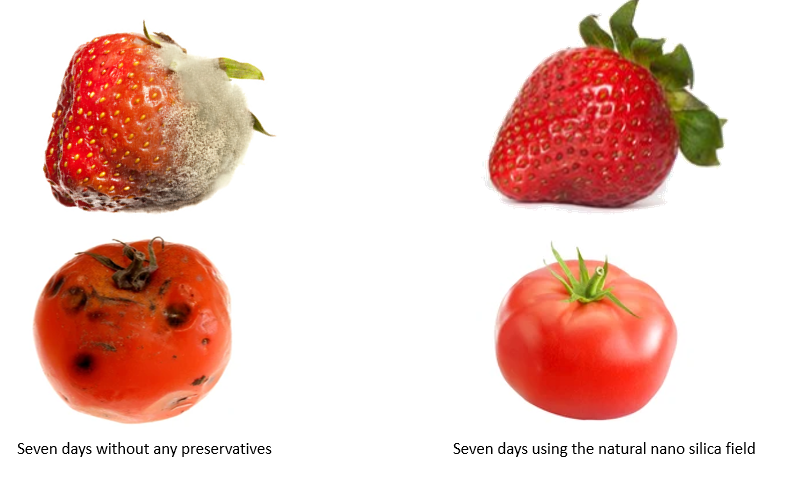
The investigation of the potential of a natural physical field of nano silica in preserving food safety and security was conducted on three types of food samples, including strawberry, tomato, and beef. The samples were treated with a nano silica suspension using a spraying method and stored at room temperature for a period of 7 days. The microbial growth and antioxidant activity of the treated and untreated samples were analyzed every 24 hours.
The results showed that the natural physical field of nano silica had a significant effect on preserving food safety and security. In the case of strawberry and tomato samples, the treated samples showed a significant reduction in microbial growth compared to the untreated samples. The treated strawberry samples showed a 2.5-fold reduction in microbial growth, while the treated tomato samples showed a 1.8-fold reduction in microbial growth, compared to the untreated samples as seen in Figure 1.


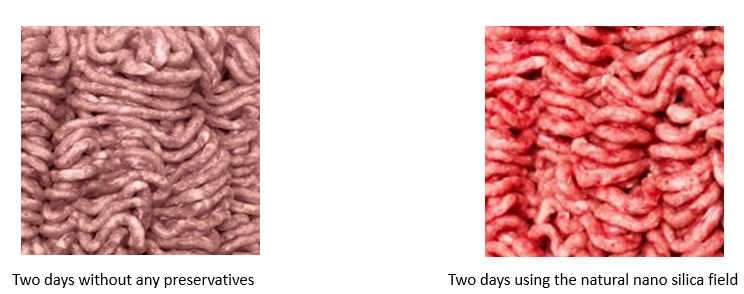
Similarly, for beef samples, the treated samples showed a significant reduction in microbial growth compared to the untreated samples. The treated beef samples showed a 1.6-fold reduction in microbial growth, compared to the untreated samples. The antioxidant activity of the treated samples was also higher than that of the untreated samples, indicating that the natural physical field of nano silica had a positive effect on preserving the antioxidant activity of the food samples as presented in Figure 2.
The results of the investigation suggest that a natural physical field of nano silica has the potential to preserve food safety and security. The use of nano silica as a natural preservative could help to reduce the use of synthetic preservatives and enhance the shelf life of food products. The antimicrobial and antioxidant properties of nano silica make it a promising candidate for preserving food safety and security. This study confirms that nano silica can inhibit the growth of bacteria and other microorganisms that can cause foodborne illness, thereby enhancing food safety. The small size of the nano silica particles enables them to penetrate the cell walls of microorganisms and disrupt their cellular processes, leading to their inhibition. Additionally, nano silica has been found to exhibit antioxidant properties that can prevent the oxidation of fats and oils in food, thereby extending the shelf life of food products that are prone to spoilage due to lipid oxidation, such as nuts, seeds, and oils. However, further research is needed to fully understand the safety and efficacy of nano silica in food applications.
| [1] | Bajpai, V. K., Kamle, M., Shukla, S., Mahato, D. K., Chandra, P., Hwang, S. K., ... & Han, Y. K. (2018). Prospects of using nanotechnology for food preservation, safety, and security. Journal of food and drug analysis, 26(4), 1201-1214. | ||
| In article | View Article PubMed | ||
| [2] | Rhazi, L., Depeint, F., & Ayerdi Gotor, A. (2022). Loss in the intrinsic quality and the antioxidant activity of sunflower (Helianthus annuus L.) oil during an industrial refining process. Molecules, 27(3), 916. | ||
| In article | View Article PubMed | ||
| [3] | Gupta, V., Mohapatra, S., Mishra, H., Farooq, U., Kumar, K., Ansari, M. J., ... & Iqbal, Z. (2022). Nanotechnology in cosmetics and cosmeceuticals—A review of latest advancements. Gels, 8(3), 173. | ||
| In article | View Article PubMed | ||
| [4] | Onyeaka, H., Passaretti, P., Miri, T., & Al-Sharify, Z. T. (2022). The safety of nanomaterials in food production and packaging. Current Research in Food Science, 5, 763-774. | ||
| In article | View Article PubMed | ||
| [5] | Dheyaaldin, M. H., Mosaberpanah, M. A., & Alzeebaree, R. (2022). Performance of fiber-reinforced alkali-activated mortar with/without nano silica and nano alumina. Sustainability, 14(5), 2527. | ||
| In article | View Article | ||
| [6] | Daniel, A. I., Fadaka, A. O., Gokul, A., Bakare, O. O., Aina, O., Fisher, S., ... & Klein, A. (2022). Biofertilizer: the future of food security and food safety. Microorganisms, 10(6), 1220. | ||
| In article | View Article PubMed | ||
| [7] | Manzoor, A., Khan, S., Dar, A. H., Pandey, V. K., Shams, R., Ahmad, S., ... & Pandiselvam, R. (2023). Recent insights into green antimicrobial packaging towards food safety reinforcement: A review. Journal of Food Safety, e13046. | ||
| In article | View Article | ||
| [8] | Yehia, H. M. A. S., & Said, S. M. (2021b). Drinking water treatment: pH adjustment using natural physical field. Journal of Biosciences and Medicines, 9(6), 55-66. | ||
| In article | View Article | ||
| [9] | Gayathiri, K., & Praveenkumar, S. (2023). Elucidating the effects of dispersion methods on agglomerated nano silica particles in aqueous environment. Materials Today: Proceedings. | ||
| In article | View Article | ||
| [10] | Nigam, M., & Verma, M. (2023). Effect of nano-silica on the fresh and mechanical properties of conventional concrete. Forces in Mechanics, 10, 100165. | ||
| In article | View Article | ||
| [11] | Zhou, Y., Li, L., Han, K., Wang, L., Cao, Y., Ma, D., & Wang, X. (2022). A polyvalent broad-spectrum Escherichia phage Tequatrovirus EP01 capable of controlling Salmonella and Escherichia coli contamination in foods. Viruses, 14(2), 286. | ||
| In article | View Article PubMed | ||
| [12] | Javanmardi, Z., Saba, M. K., Nourbakhsh, H., & Amini, J. (2023). Efficiency of nanoemulsion of essential oils to control Botrytis cinerea on strawberry surface and prolong fruit shelf life. International Journal of Food Microbiology, 384, 109979. | ||
| In article | View Article PubMed | ||
| [13] | Shah, M. Z. U., Sajjad, M., Hou, H., ur Rahman, S., & Shah, A. (2022). Copper sulfide nanoparticles on titanium dioxide (TiO2) nanoflakes: a new hybrid asymmetrical Faradaic supercapacitors with high energy density and superior lifespan. Journal of Energy Storage, 55, 105651. | ||
| In article | View Article | ||
| [14] | Yehia, H. M., & Said, S. M. (2021a). Effects of the addition of titanium dioxide; sodium silicate and silica nanoparticles on the elimination of bacteria and viruses in a physical field. Am J Biomed Res, 9(2), 24-29. | ||
| In article | View Article | ||
| [15] | Uikey, P., & Vishwakarma, K. (2016). Review of zinc oxide (ZnO) nanoparticles applications and properties. International Journal of Emerging Technology in Computer Science & Electronics, 21(2), 239-42. | ||
| In article | |||
| [16] | Vinodh, R., Sasikumar, Y., Kim, H. J., Atchudan, R., & Yi, M. (2021). Chitin and chitosan based biopolymer derived electrode materials for supercapacitor applications: A critical review. Journal of Industrial and Engineering Chemistry, 104, 155-171. | ||
| In article | View Article | ||
| [17] | Solans, C., Izquierdo, P., Nolla, J., Azemar, N., & Garcia-Celma, M. J. (2005). Nano-emulsions. Current opinion in colloid & interface science, 10(3-4), 102-110. | ||
| In article | View Article | ||
| [18] | Nandiyanto, A. B. D., Kim, S. G., Iskandar, F., & Okuyama, K. (2009). Synthesis of spherical mesoporous silica nanoparticles with nanometer-size controllable pores and outer diameters. Microporous and Mesoporous Materials, 120(3), 447-453. | ||
| In article | View Article | ||
| [19] | Yehia, H. M. A. S., Said, S. M., & Ragb, N. G. E. R. (2022). Silica nanoparticles in targeted human cancer therapy. Medical Journal of Cell Biology, 10(1), 7-17. | ||
| In article | View Article | ||
Published with license by Science and Education Publishing, Copyright © 2023 Hesham Mohamed Abdal-Salam Yehia and Said Mahmoud Said
 This work is licensed under a Creative Commons Attribution 4.0 International License. To view a copy of this license, visit
http://creativecommons.org/licenses/by/4.0/
This work is licensed under a Creative Commons Attribution 4.0 International License. To view a copy of this license, visit
http://creativecommons.org/licenses/by/4.0/
| [1] | Bajpai, V. K., Kamle, M., Shukla, S., Mahato, D. K., Chandra, P., Hwang, S. K., ... & Han, Y. K. (2018). Prospects of using nanotechnology for food preservation, safety, and security. Journal of food and drug analysis, 26(4), 1201-1214. | ||
| In article | View Article PubMed | ||
| [2] | Rhazi, L., Depeint, F., & Ayerdi Gotor, A. (2022). Loss in the intrinsic quality and the antioxidant activity of sunflower (Helianthus annuus L.) oil during an industrial refining process. Molecules, 27(3), 916. | ||
| In article | View Article PubMed | ||
| [3] | Gupta, V., Mohapatra, S., Mishra, H., Farooq, U., Kumar, K., Ansari, M. J., ... & Iqbal, Z. (2022). Nanotechnology in cosmetics and cosmeceuticals—A review of latest advancements. Gels, 8(3), 173. | ||
| In article | View Article PubMed | ||
| [4] | Onyeaka, H., Passaretti, P., Miri, T., & Al-Sharify, Z. T. (2022). The safety of nanomaterials in food production and packaging. Current Research in Food Science, 5, 763-774. | ||
| In article | View Article PubMed | ||
| [5] | Dheyaaldin, M. H., Mosaberpanah, M. A., & Alzeebaree, R. (2022). Performance of fiber-reinforced alkali-activated mortar with/without nano silica and nano alumina. Sustainability, 14(5), 2527. | ||
| In article | View Article | ||
| [6] | Daniel, A. I., Fadaka, A. O., Gokul, A., Bakare, O. O., Aina, O., Fisher, S., ... & Klein, A. (2022). Biofertilizer: the future of food security and food safety. Microorganisms, 10(6), 1220. | ||
| In article | View Article PubMed | ||
| [7] | Manzoor, A., Khan, S., Dar, A. H., Pandey, V. K., Shams, R., Ahmad, S., ... & Pandiselvam, R. (2023). Recent insights into green antimicrobial packaging towards food safety reinforcement: A review. Journal of Food Safety, e13046. | ||
| In article | View Article | ||
| [8] | Yehia, H. M. A. S., & Said, S. M. (2021b). Drinking water treatment: pH adjustment using natural physical field. Journal of Biosciences and Medicines, 9(6), 55-66. | ||
| In article | View Article | ||
| [9] | Gayathiri, K., & Praveenkumar, S. (2023). Elucidating the effects of dispersion methods on agglomerated nano silica particles in aqueous environment. Materials Today: Proceedings. | ||
| In article | View Article | ||
| [10] | Nigam, M., & Verma, M. (2023). Effect of nano-silica on the fresh and mechanical properties of conventional concrete. Forces in Mechanics, 10, 100165. | ||
| In article | View Article | ||
| [11] | Zhou, Y., Li, L., Han, K., Wang, L., Cao, Y., Ma, D., & Wang, X. (2022). A polyvalent broad-spectrum Escherichia phage Tequatrovirus EP01 capable of controlling Salmonella and Escherichia coli contamination in foods. Viruses, 14(2), 286. | ||
| In article | View Article PubMed | ||
| [12] | Javanmardi, Z., Saba, M. K., Nourbakhsh, H., & Amini, J. (2023). Efficiency of nanoemulsion of essential oils to control Botrytis cinerea on strawberry surface and prolong fruit shelf life. International Journal of Food Microbiology, 384, 109979. | ||
| In article | View Article PubMed | ||
| [13] | Shah, M. Z. U., Sajjad, M., Hou, H., ur Rahman, S., & Shah, A. (2022). Copper sulfide nanoparticles on titanium dioxide (TiO2) nanoflakes: a new hybrid asymmetrical Faradaic supercapacitors with high energy density and superior lifespan. Journal of Energy Storage, 55, 105651. | ||
| In article | View Article | ||
| [14] | Yehia, H. M., & Said, S. M. (2021a). Effects of the addition of titanium dioxide; sodium silicate and silica nanoparticles on the elimination of bacteria and viruses in a physical field. Am J Biomed Res, 9(2), 24-29. | ||
| In article | View Article | ||
| [15] | Uikey, P., & Vishwakarma, K. (2016). Review of zinc oxide (ZnO) nanoparticles applications and properties. International Journal of Emerging Technology in Computer Science & Electronics, 21(2), 239-42. | ||
| In article | |||
| [16] | Vinodh, R., Sasikumar, Y., Kim, H. J., Atchudan, R., & Yi, M. (2021). Chitin and chitosan based biopolymer derived electrode materials for supercapacitor applications: A critical review. Journal of Industrial and Engineering Chemistry, 104, 155-171. | ||
| In article | View Article | ||
| [17] | Solans, C., Izquierdo, P., Nolla, J., Azemar, N., & Garcia-Celma, M. J. (2005). Nano-emulsions. Current opinion in colloid & interface science, 10(3-4), 102-110. | ||
| In article | View Article | ||
| [18] | Nandiyanto, A. B. D., Kim, S. G., Iskandar, F., & Okuyama, K. (2009). Synthesis of spherical mesoporous silica nanoparticles with nanometer-size controllable pores and outer diameters. Microporous and Mesoporous Materials, 120(3), 447-453. | ||
| In article | View Article | ||
| [19] | Yehia, H. M. A. S., Said, S. M., & Ragb, N. G. E. R. (2022). Silica nanoparticles in targeted human cancer therapy. Medical Journal of Cell Biology, 10(1), 7-17. | ||
| In article | View Article | ||