sciepub.com
 Quick Submission

Dynamics of Digital System of Two-Motor Electrical Drive with Elastic Transmissions
Jumber Dochviri1, , Oleg Khachapuridze1, Nana Beradze1
1Department of Electrical Engineering, Faculty of Power Engineering and Telecommunications, Georgian Technical University, 77, M. Kostava str., 0175 Tbilisi, Georgia
Abstract
The appearance in recent years of the two-motor electric drives on the presses of high speed paper machines ensures increasing of the life of expensive press felts and improvement of production quality. The easiest and accurately acting from the different existing control systems of drives are two-motor drives with a total speed controller and individual thyristor converters for each motor separately. In this paper we study the dynamic characteristics of the system with a digital controller and correctors. The mathematical model of two-motor thyristor electric drive, taking into account the elastic properties of mechanical transmissions, is given. Applying the logarithmic frequency characteristics for tuning of digital controllers, correctors and current sensors of the drive system are given. The results of investigations of transient processes using the MATLAB sources are presented. This system guarantees maximum performance and proportional distribution of load between the motors without any additional controllers.
Keywords: digital control, two-motor electrical drive, dynamics, automatic distribution of loading
Copyright © 2016 Science and Education Publishing. All Rights Reserved.Cite this article:
- Jumber Dochviri, Oleg Khachapuridze, Nana Beradze. Dynamics of Digital System of Two-Motor Electrical Drive with Elastic Transmissions. American Journal of Electrical and Electronic Engineering. Vol. 4, No. 1, 2016, pp 16-22. http://pubs.sciepub.com/ajeee/4/1/3
- Dochviri, Jumber, Oleg Khachapuridze, and Nana Beradze. "Dynamics of Digital System of Two-Motor Electrical Drive with Elastic Transmissions." American Journal of Electrical and Electronic Engineering 4.1 (2016): 16-22.
- Dochviri, J. , Khachapuridze, O. , & Beradze, N. (2016). Dynamics of Digital System of Two-Motor Electrical Drive with Elastic Transmissions. American Journal of Electrical and Electronic Engineering, 4(1), 16-22.
- Dochviri, Jumber, Oleg Khachapuridze, and Nana Beradze. "Dynamics of Digital System of Two-Motor Electrical Drive with Elastic Transmissions." American Journal of Electrical and Electronic Engineering 4, no. 1 (2016): 16-22.
| Import into BibTeX | Import into EndNote | Import into RefMan | Import into RefWorks |
At a glance: Figures
1. Introduction
In the modern paper machine presses widely applied DC two-motor thyristor electric drives with digital controls. Usually on large-sized paper machine sections are joined to the motors through long mechanical shafts. Since the paper machine drive systems are usually required to maximize the effect of fast transients, so elasticities of long mechanical shafts are mandatory factor [1, 2, 5]. To obtain the best results from the point of view of transients in the system under consideration we use digital controllers of P-I type.
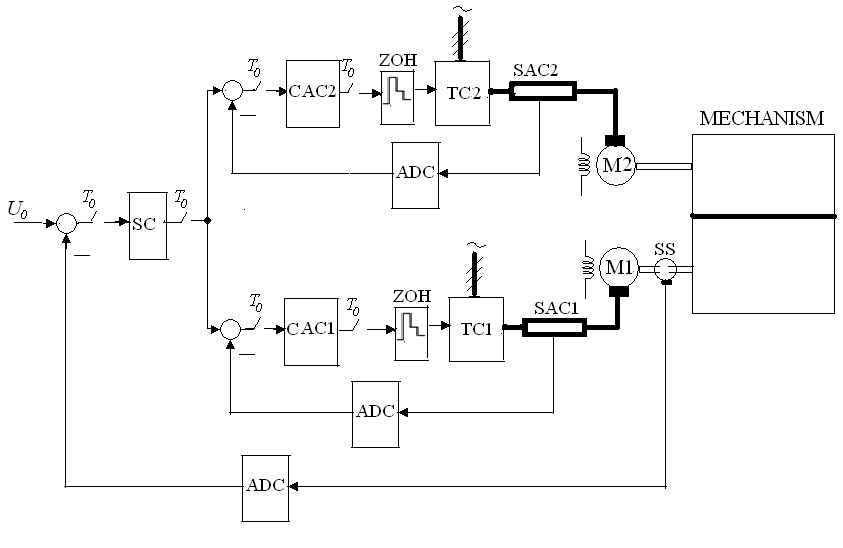
Below on Figure 1 a functional diagram of a two-motor electric drive with digital controllers of the presses of paper machines.

 Download as

On the diagram (Figure 1) we have the following notations:  governing signal; SC-digital speed controller of the drive; CAC1 and CAC2 -Digital controllers of motor current armature; SS, SAC1 and SAC2- sensors of the speed and current ofanchor; ZOH-zero-order hold; ADC-analog-to-discrete converter.
2. Mathematical Model of the Drive
Assuming no sliding between the working shafts of press of the paper machine and with elasticities of mechanical transmissions the equations of motion of the two-motor electric drive due to the principle of D'Alembert can be write as follows:
 | (1) |
where,  and
and  are moment of rotation of the DC-motor, elastic moment of mechanical transmission shaft and resistance moment of the mechanism reduced on the shaft of the main motor, respectively;
  and
and  are moments of inertia of the motors and mechanism;
 and
and  are angular speeds of the motors and mechanism;
  are rotation angles of inertial masses of the electrical motors and mechanism;
  and
and  is coefficients of elasticity of long mechanical shaft;
  and
and  are the coefficients of attenuation of torsional vibrations from the internal viscous friction of a long shaft.
If we write the variables in the relative increments and use simple transformations in the (1), we get:
 | (2) |
Where: 


 and
and  are relative increments of the angular speed of the motors and mechanism, moment of rotation of the motors, elastic moment of mechanical transmission shaft and resistance moment of the mechanism reduced on the shaft of the motor, respectively;
 ,
,  and
and
 are mechanical time constant of the motors and mechanism, respectively;
 ,
,  ,
,  and
and  are time constants of long (elastic) shaft;
  denotes total static moment from the mechanism;
  are static loadings on the motors;
  and
and  coefficients of distribution of loading of the motors;
  is base (static) values of angular speed of the drive.
To obtain transfer functions of mechanical part of the system under consideration from thesignal  to signal
  , also from
  to the
  let us rewrite equations (2) in the Cauchy form as follows:
 | (3) |
where: 
 ,
, ,
, ,
, and
and denote states of angular speeds of the motors (
 ,
, ), of the mechanism (
 ), of elastic moments of connecting long shafts (
 ,
, ); u- input signal of the object (
 ,
,  );
);  -output signal of the object (
 );
);
 |
 | (4) |
From the system of equations (3) we can write a general formula for the transfer functions:
 | (5) |
where -Laplace operator of differentiation;
 is identity matrix with the dimension 5.
Substituting the matrices  and
and  from (4) into the expression (5), we define the transfer functions of the mechanical part of the drive with respect to the angular speed of the main (first) motor as follows [6]:
 | (6) |
 | (7) |
where:
 |
 |
 |
 |
 |
 |
 |
 |
 |
 is total mechanical time constant of the drive.
3. Optimization and Modeling of the System
Optimization of the electromechanical system will be done with the following parameters of the drive:
 |
The transfer function of the object for the open loop system (without main feedback), i.e. transfer function from the output voltage of the SC to the angular speed of first (main) motor could be write as:
 | (8) |
where:  is relative increment of the output voltage of the SC;
  -static value of governing signal;
  -gain of the sensor of current armature (
 );
);  -non-compensating time-constant of the current loop.
Inserting values of parameters in the expressions (6) and (7) we get view of (8) as follows:
 | (9) |
To express transfer function of (10) in the discrete z-transform form we use well known [3] approximation: 
 , where sample time
  sec. and then we get:
 | (10) |
 Download as
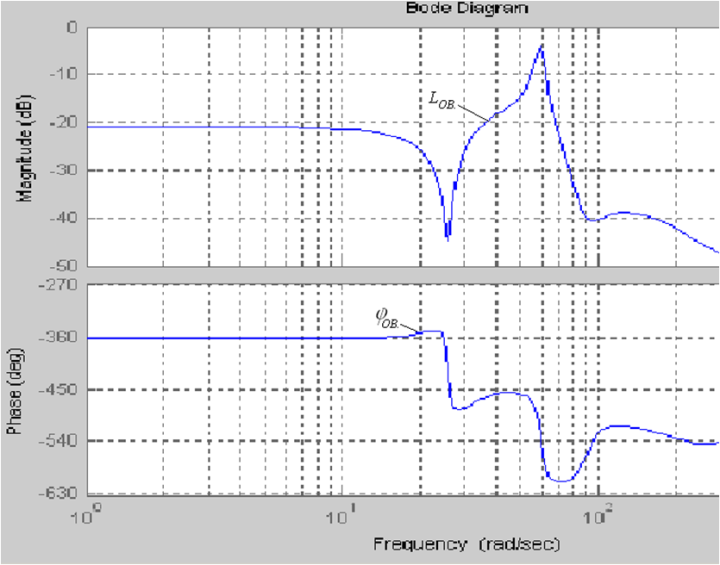
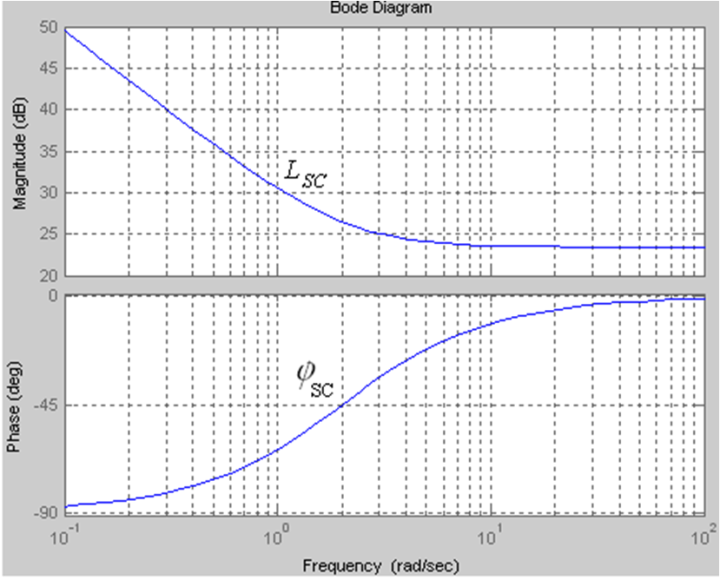
On Figure 2 are given Bode diagrams built via (10), where  is an amplitude and
  is a phase characteristic of the object of current loop of armature relative to the first motor.
To synthesis of the optimal parameters of the speed controller (SC) of the drive we apply the method of frequency characteristics (i.e., via Bode diagrams). The resulting amplitude frequency characteristic has one resonance peaks at a frequency  due to
  , i.e.
  (when
(when  is commensurate with
 then usually
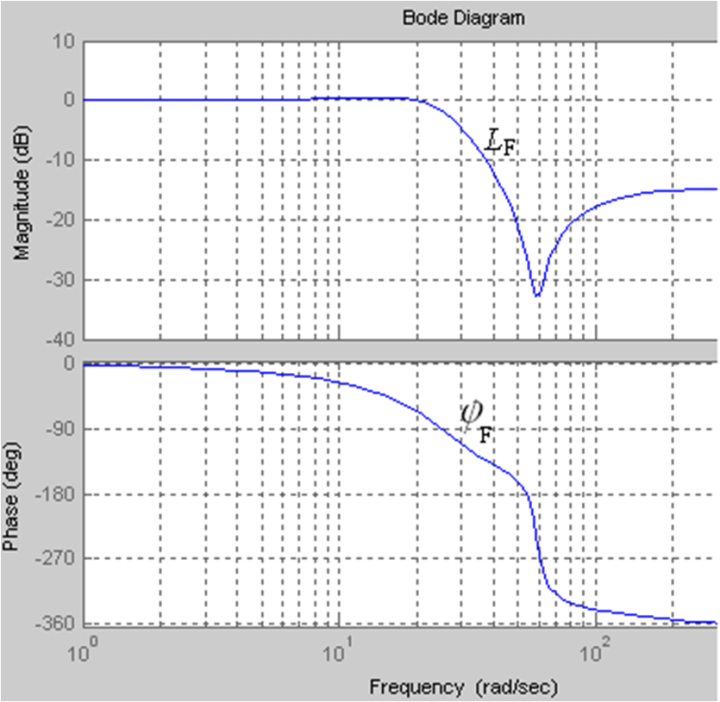
  has two resonance peaks, see e.g. [2]). Based on analysis of the obtained characteristics to suppress its resonance peak (in order to reach the maximum performance of the system) by the method pointed out in [7, 8][7, 8] we choose the optimum correction filter as follows:
 | (11) |
On Figure 3 Bode diagrams corresponding to (11) are presented, where as we estimate resonant peak is suppressed.
 Download as
Applying frequency characteristics given on Fig.2 and Figure 3 in a first approximation, tuning of the speed controller SC can be done similarly to the electrical drive with rigid shaft according to the well-known , "symmetric optimum " [4]:
a) continuous form
 | (12) |
b) discrete form
 | (13) |
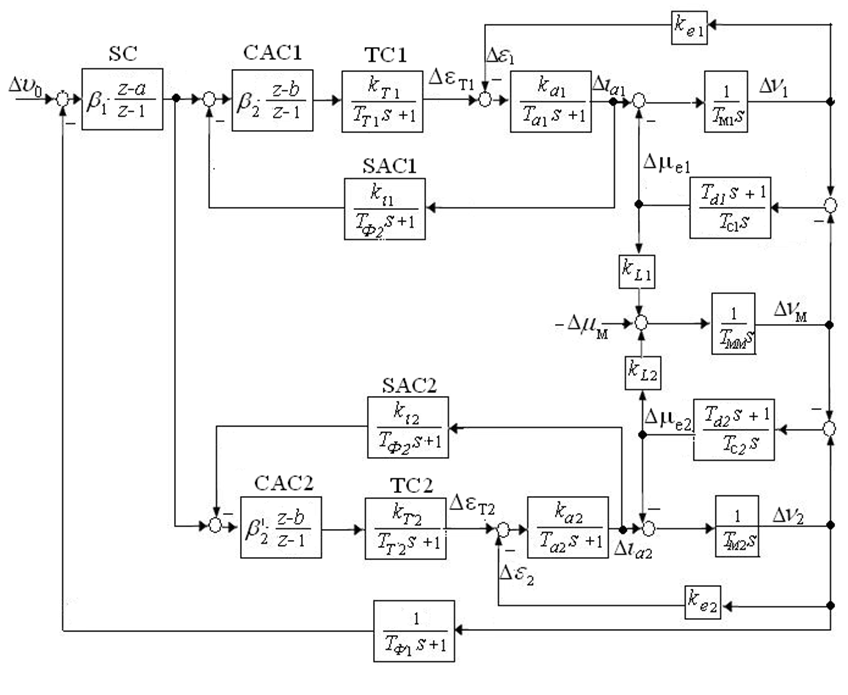
On Figure 5 detailed block scheme of a digital system of the two-motor thyristor electric drive is given, taking into account elasticities of mechanical transmissions. On this scheme, in addition to the above used notations are following ones: and
and  – gains and time constants TC1 and TC2;
  and
and  – gain and the time constants of sensors SAC1 and SAC2;
  and
and  – and the coefficients of transmission and the time constants of the circuits of anchors of the electric motors M1 and M2;
  – time constant of the filter after the sensor of speed;
  and
and  – relative increments of output voltages TC1 and TC2;
  and
and  - relative increments EMF motors;
  and
and  - relative increments of the currents of armatures. In the form of relative increments currents of electrical motors are equal to their torques:
 .
.
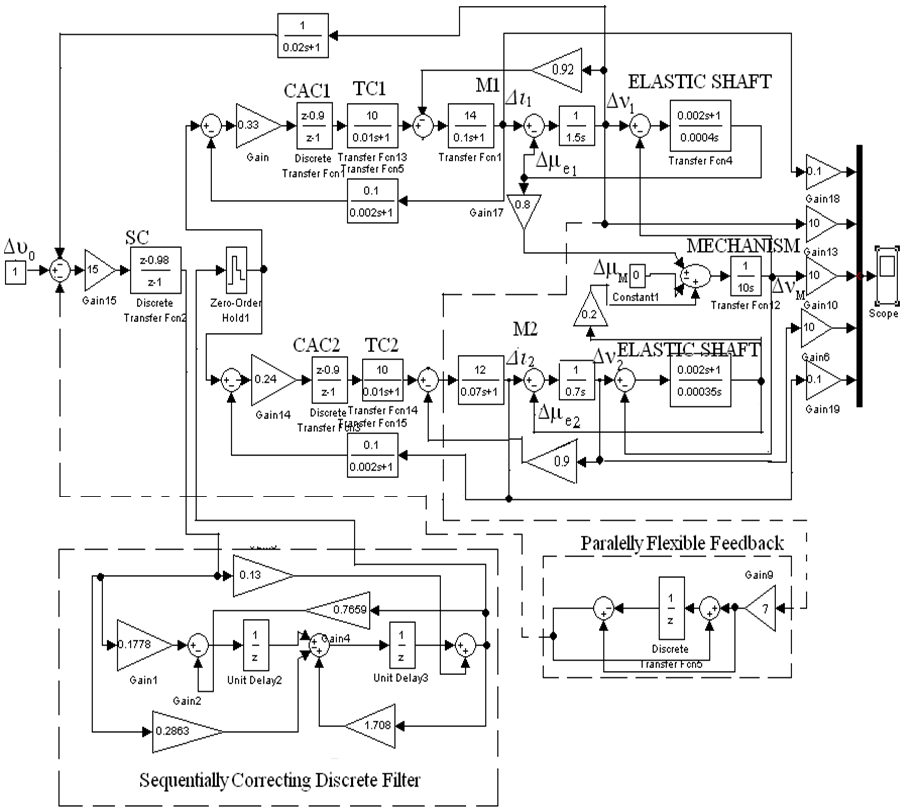
MATLAB/SIMULINK based simulations of the drive system controllers of the current of motor armature CAC1 and CAC2 were tuned due to the principle of "modular optimum" [1, 2]. On Fig.6 a block diagram of the drive with numerical values of the parameters is given.
 Download as
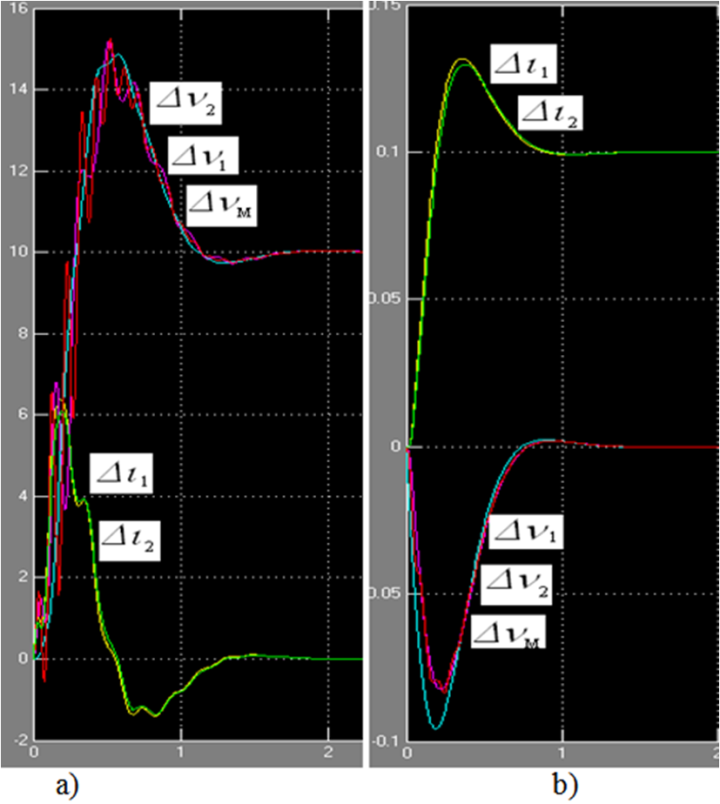
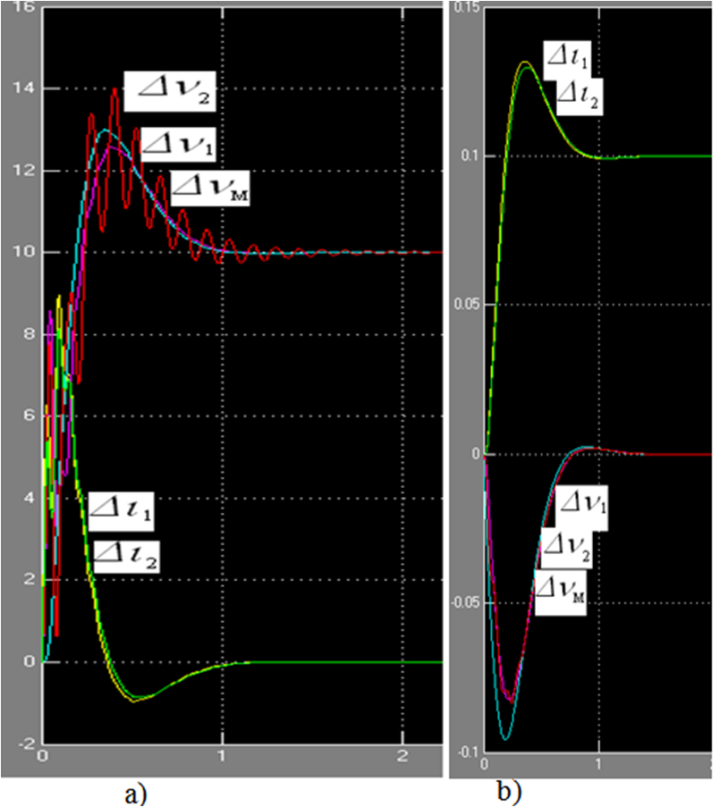
On Figure 6 is represented computer structural diagram where to suppress the elastic vibrations of the inertial masses of the motors is used a digital filter of sequential and parallel type. The sequential filter is included in the output of the SC and is built due to the formula (11), that is done similar to [8]. Corresponding transient curves are shown on the Figure 7.
 Download as
 Download as
If we use for the drive so-called parallel flexible feedback to suppress elastic vibrations from the first motor speed (see dashed filter on Figure 6) which has following transfer function:
a) in the continuous form
 | (14) |
b) in the discrete form
 | (15) |
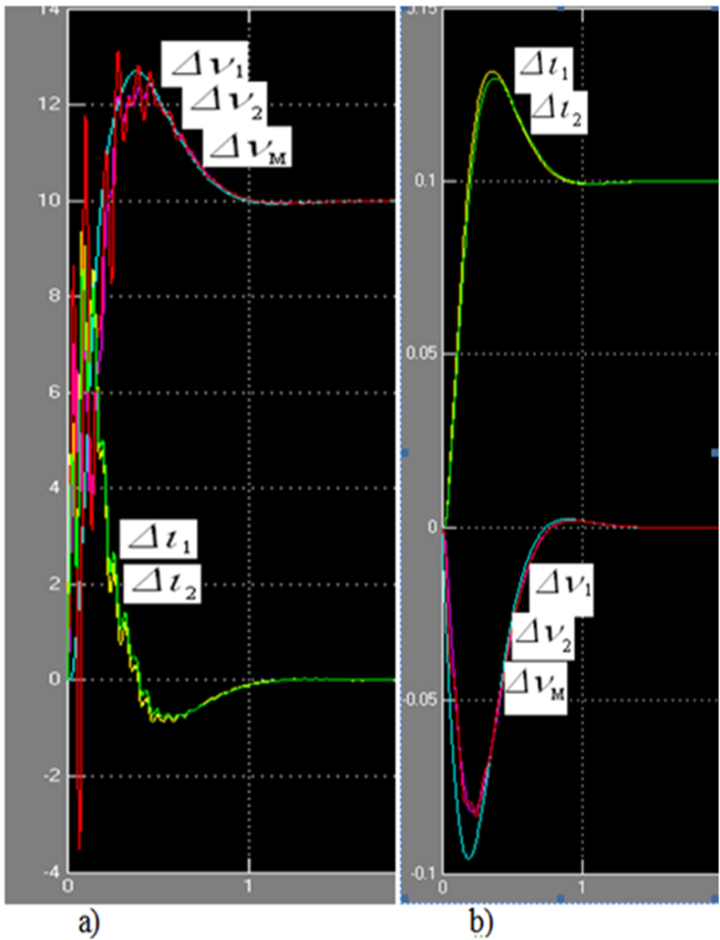
then dynamic characteristics (from the view point of high-frequency oscillations of the second motor, Figure 8, a, b) are not the best with respect to the system with sequentially correction (Figure 7,a,b).
 Download as
However, in the drive system with a flexible feedback by closing the system via the speed of second motor of the drive we obtain significantly improved characteristics (Figure 9, a, b). In this case speed controller should have following transfer function:
 | (16) |
In all modes the equal changes of the currents of armatures of the motors confirm us that the suggested system provides high-precision proportional distribution of the load between the drive motors.
 Download as
 Download as
4. Conclusions
1) The mathematical model of the two-motor thyristor electric drive with digital controls for paper machine of presses by taking into account elastic mechanical transmission are given. The system is equipped with a speed controller and individual thyristor converters for each motor separately. The scheme provides in a simple manner proportional distribution of the load between the motors.
2) Applying the method of state space of variables there are obtained generalized transfer functions of the object of control system of electrical drive with respect to the angular speed of the main (the first) electric motor.
3) On the basis of the frequency analysis expressions for tuning digital controllers of speed, currents of the motors and correctors of the system are given. Validity of the obtained parameters are confirmed via the MATLAB simulations.
Acknowledgement
The authors are grateful to the anonymous referee for his/her comments and suggestions.
The first author has been supported by the grant FR/7/3-160/14 from Shota Rustaveli National Science Foundation of Georgia.
References
| [1] | V. D. Baryshnikov, Y. A. Bortsov, et al.-Dynamics of Thyristor Electrical Drives of the Sections of Paper Machines // J. Russian Electrical Technology, 1973, v. 1, pp. 43-48. | ||
 In article In article | |||
| [2] | J. N. Dochviri-The Optimization of Transients in Multi-Motor Thyristor Electric Drives with Elastic Links for the Press Mechanisms of Continuous Technological Machines // J. Russian Electrical Technology. 2006, v. 2, pp. 34-42. | ||
| In article | |||
| [3] | K. Ogata-Discrete-Time Control Systems. Upper Saddle River, N.J.: Prentice hall, 1994. | ||
| In article | |||
| [4] | C. Kessler-Das Symmetrische Optimum // J. Regelungstechnik, 1958, v.6, pp. 395-400. | ||
| In article | |||
| [5] | E. Raatz-Regelung von Antrieben mit Elastischer Verbindung zur Arbeitsmaschinen // ENZ, 1981, A92, №4б pp. 211-216. | ||
| In article | |||
| [6] | J.N. Dochviri, O.G. Kervalishvili-The Dynamics of Two-Motor Electrical Drives with one Speed Regulator and Individual Thyristor Converters // Bull. Georgian Acad. Sci., 1978, v.91(2), pp. 421-424. | ||
| In article | |||
| [7] | A. Antoniou-Digital Filters: Analysis, Design and Applications// McGraw-Hill, New York, 1993. | ||
| In article | |||
| [8] | J. Dochviri, O. Khachapuridze, N. Beradze-A Digital Filter for Electrical Drive with Elastic Shaft // American Journal of Electrical and Electronic Engineering, 2015, v.3, №5, pp. 112-116. | ||
| In article | |||
 CiteULike
 Mendeley
 StumbleUpon
 Delicious
 Facebook
 Twitter
 LinkedIn


)



 under stepwise change of control signal; b) under stepwise change of loading)
 under stepwise change of control signal; b) under stepwise change of loading)
 under stepwise chang of control signal; b) under stepwise change of loading)