The research examined how the governments satisfy social responsibility efforts towards restorative adaptive social acceptance (ASA) as reflected in citizen satisfaction. This study examined how responsible governance in developing countries channels public goods delivery by promoting and supporting responsible innovation (RI) projects in institutions. The study adopted integrated attributed stakeholder theory (AST), by recruiting major policy stakeholders in the areas of academics, politics, and selected government institutions who are managers in a broad spectrum through an online survey. Data of the recruited 450 participants that reflects Ghanaian government stakeholders, represented 89% rate. Findings showed public goods delivery was statistically significant with government responsibility and RI but not stakeholder responsibility. Also, government responsibility and RI indicated strong effects on citizen satisfaction. However, stakeholder responsibility did not make a difference in this research findings. We recommend that, political leaders and central government adhere to acts of social responsibility, GR, AST, and RI, for their attention towards selfless delivery of social amenities, projects, and proactively improved stakeholder satisfaction through acts of social responsibility, specifically responsible innovation.
By systematically evaluating social structures, institutions, administrations, and communities 1 social ethics can be applied to the delivery of public goods. In social ethics 2 3, ethical reasoning is applied to social responsibilities in society as a subset of 'applied ethics.' As part of providing for human needs and societal needs within a societal context, in decision-making of institutions, governments and their moral agents must understand what is right. Ethics are a fundamental part of social responsibility. This study builds on social-ethical issues for government stakeholders relating to decision-making in society and public settings. As a result of social ethics, we emphasize the importance of social responsibility and the principle that knowledge and values reflect justice in the world. A concise examination of social ethics has been conducted through the morality of humans, their role in society, and healthcare issues as a whole. Institutions and governments, however, lack social responsibility, particularly in resource-dense countries where public goods are still in severe shortages.
For a connection between public goods delivery and citizen satisfaction to be established, it is proposed to reconcile the tension between individuals, communities, and government stakeholders with the perspectives of social responsibility, government responsibility, and stakeholder theories. Therefore, social responsibility is a moral obligation of governments and institutions to make decisions that are in the best interests of their societies. Furthermore, governments and institutions have a responsibility to maximize stakeholder value, but not only on a profit-making basis, but also in order to contribute to society's welfare and the environment. In order to promote social responsibilities and ethical standards, rational thinking, moral obligations, egalitarianism, multiplicity, and a democratic society of fairness and firmness are necessary to provide public goods that promote citizen satisfaction 4.
Based on the attributed stakeholder theory, this research conceptualizes real-life experiences of the government's lack of social responsibilities within the context of an increasing demand for knowledge-value and responsible innovation. As a result, any substantial distinction between social responsibility and its extent can be regarded as a policy that provides citizens with public goods and satisfaction. Considering that social responsibility implies a beneficial focus on how societal needs shape human morality and how stakeholders act on those morals to satisfy society's needs. It is essential to develop and apply expertise and knowledge in a responsible manner and develop ethical guiding principles in order to build stakeholder attributes 5.
However, responsible innovations must also have societal value and be applied with socially applied ethics in order to significantly improve how public goods are delivered. A combination of responsible innovation and social ethics related to government, institutions, and individual responsibilities can have a significant impact on social improvement. The pursuit of responsible innovation may not be worthwhile if governments lack social responsibility to meet economic and societal needs 6. The study therefore examines the inherent challenges associated with responsible innovation and social responsibility, among heterogeneous stakeholders who provide public goods required for citizen satisfaction.
Public policy concerns have increasingly been the focus of social responsibility, where local, regional, and national governments are examined. Using stakeholder theory (those who hold power, proximity, and urgency), this study examines social ethics, morals, and values in all institutions 7. The concept of a 'public sphere' has been developed to describe a realm of civic action distinct from political activity, in which a range of social responsibility plays a crucial role as agents of social policy 4.
As a result of effective public relations with stakeholders, responsible citizenship will result in increased efficiency. Despite being requested to act appropriately in a distinguishing component of those discussions: responsible government, innovation, social responsibilities, strategic decisions with social ethical principles have failed 2. As part of social ethics and responsible governance across entities, a number of issues are addressed, including the equitable distribution of socioeconomic goods and resources as well as the recognition of human knowledge and innovation. Responsible government requires social ethics and a highly qualified decision-maker due to its complexity. The sensitive aspect of this concept is that so-called democratic leaders are directed by political ethical norms, which require hard fairness and firmness in distributing national cakes without compromise, such as in the domain of quality of life for all citizens 14.
The concept of "stakeholders" has been ingrained in management academia and management thinking for all leadership roles. The term was popularized by 8 and referred to as "the principle of who and what counts" to describe the people who are at the center of firms, or in this case governance systems. Defining stakeholders as “any group or individual who can influence or be affected by the achievement of the organization's objectives,” the behavior of government and government institutions has a detrimental effect on the quality of life of all members of society 9. In addition, stakeholder management is designed to develop a framework for strategically managing the many groups that affect, directly and indirectly, the government's ability to achieve its objectives [10, p. 12]. For the restoration of citizen satisfaction, how can the government contribute more to public good delivery efforts? Addressing this central responsibility requires a greater understanding of the role of innovative responsibility in promoting and supporting public goods initiatives and campaigns.
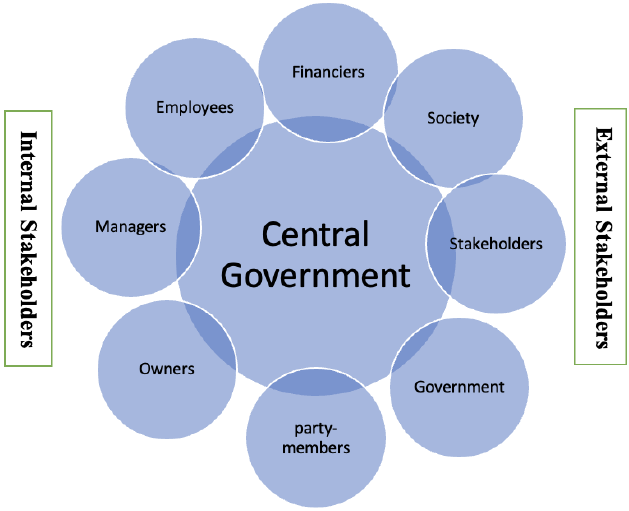
While government and stakeholders can motivate social responsibility to provide values and practices to institutions, they are also inclined to adhere to moral social behavior 3 11. According to 12, ethical decision-making that is coherent, rigorous, and consistent increases the trust of individuals and organizations. Using responsible innovation as a management paradigm that combines social growth, quality of life, and public goods achievements. Similarly, 13 and 14 reflected that stakeholder interdependence with government responsibility is integral to ethical decision-making for any institution driven by stakeholder theories applied from top-down practices and values, and the dominant paradigms of decision-making require the application of multiple social ethics simultaneously. According to 6, value-based strategy, coupled with stakeholder theory, constitutes a system of interconnected concepts and laws which guide moral behavior and provide a novel mechanism for government operations. As far as we are aware, this is the first study to employ quantitative approaches to investigate these relationships in a single model combining stakeholder theory's three characteristics. Additionally, public good delivery through government responsibility, responsible innovation, and adaptive social acceptance (citizen satisfaction) were incorporated (see Figure 1).

Attributed Stakeholder Theory (AST)
The typology of stakeholder is based on the attributes of power (the extent to which a party has the influence to impose its will in a relationship), legitimacy (socially accepted structures or behaviors), and urgency (time sensitivity or criticality of the stakeholder’s expectations) 7. In Figure 1, we attribute a company to the central government. Additionally, behavioral, institutional, and resource dependence has evolved between internal stakeholders (employees, managers, owners, and financiers) and external stakeholders (society, stakeholders, government, and party members) with regard to social ethics. Figure 1 presents the stakeholders' perspective on resources, strategic integration, and sociopolitical activities. It is observed in the Central Governments (CG) system that a high priority is given to financiers and party members, as well as how managers of political parties treat other interests under the operating conditions. In our analysis, we identified literature which illustrates that distinct classes of stakeholders can only be distinguished by a few criteria within any given working environment. Based on the various literatures, we develop a stakeholder identification theory based on Freeman's definition of a stakeholder—"any group or individual who may affect or be affected by the achievement of the organization's objectives" 55, [8, p. 46].
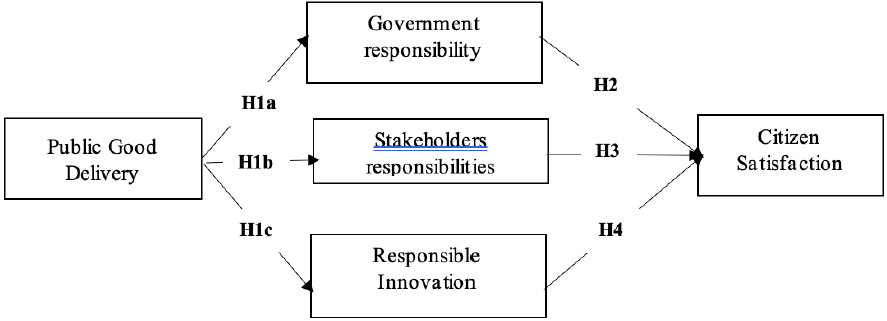
We propose that CG entirely is similar to a company whose stakeholders' identification can be drawn in the following categories of attributes: (1) the power of stakeholders (financiers) in influencing the CG, (2) the legitimacy of the stakeholders' relationship with society and party members, (3) the urgency of stakeholders prioritizing ownership, management, or activities, and (4) the balance of national interest over other stakeholders' interests. Therefore, the typology we propose is the model in Figure 2, integrated with the following variables: public goods delivery (independent variable). In addition, government responsibility, stakeholder responsibility (power, legitimacy, urgency), and responsible innovation were captured as pathways (mediations) to citizen satisfaction (i.e., adaptive social acceptance - ASA) as outcome 14. The study framework is shown in Figure 2.
We proposed the following hypotheses:
H1a: Central Government (CG) commitment to Public Goods Delivery (PDG) is positively related to government responsibility.
H2b: Public Good Delivery is positively associated with Attributed Stakeholders’ theory.
H3c: Public Good Delivery is positive related to responsible innovation in society.

The concept of social responsibility refers to a framework within which a group or individual engages with others and citizens for the benefit of the community or society as a whole. A company can provide opportunities for public goods throughout society by implementing social responsibility programs, such as corporate ethics 15. Rather than simply thinking about profits, political managers should take into consideration employees, citizens, and society as a whole as well as social responsibility. The development of policies that emphasize the importance of social benefits over individual benefits. Social responsibility must include an organization's commitment to society in addition to its economic, legal, ethical, and discretionary (charitable) responsibilities. Therefore, social responsibility may be considered above and beyond conventional commercial standards 4.
According to 4, we construct our argument by analyzing the history of government-controlled discourse in Russia. Our research of social responsibility within Central Government management is based on Laclau and Mouffe's (Hegemony and Socialist Strategy: Towards a Radical Democratic Politics, Verso Books, London, 1985) social theory of hegemony.
According to our analysis, "CG" in the Russian government's discourse legitimized the government's power. Besides generating shareholder value, social responsibility requires corporate behaviorism that serves society selflessly. Socially responsible organizations should implement policies which enhance the well-being of society and the environment while minimizing adverse effects on the socio-economic and political environment. It is possible for organizations to assume responsibilities in a variety of ways, including the responsibility of the states, the implementation of local government reforms, the adoption of ethical practices (patriotism), and the participation of citizens in all aspects of society 16.
From social ethics to embracing public roles in strengthening initiatives for human welfare, consumers and citizens are actively seeking products (leaders) with joint services (leaders). Corporate social responsibility is one of the most common practices. It is a concept of management that aims to improve an organization's economic, environmental, and social responsibilities 15. The realization that all stakeholders engage in some way with an organization in the hope or expectation that the corporation will deliver the type of value desired or expected. In addition to dividends, salaries, bonuses, additional orders, upcoming jobs, and tax revenue, expectations include dividends, salaries, bonuses, and additional orders. While maintaining prosperity, several companies, including those that follow "green" practices, have incorporated social responsibility into their corporate models. Thus, adopting social responsibility helps companies maximize shareholder value. Social responsibility also has a moral imperative 16. Future generations will be adversely affected by your actions or inaction. Being socially responsible is a smart good practice, and failing to do so may have a negative impact on the CG balance sheet.
Scholars have unanimously agreed that individuals, groups, neighborhoods, organizations, and the environment are all stakeholders. This qualification constitutes governments and institutions as potential stakeholders and the existence of their actions and inactions 13. The nature of the importance of CG activities and all the internal and externalities required social responsibilities. In order to achieve responsible governance, what are the interests of these groups, and how can these efforts be balanced? Through stakeholder theory 8 proposes that stakeholders constitute descriptive, instrumental, and normative attributes of political managers. While social responsibility commitments are associated with descriptive attributes, reports on social ethics and responsibility—which reflect the government agenda—are associated with instrumental attributes 7.
In addition, social responsibility theory was developed as a result of the need for the press to balance independence with societal duties. As a result of this concept, media practitioners must ensure that they provide the public with a comprehensive, accurate, and complete picture of events and happenings so that they are fully informed and free from interference by forces outside of ethical precepts 17. Mismanagement, hoarding, or a lack of trustworthy information result in society's suffering. As a result of a lack of social responsibility on the part of the media, inadequate accurate information leads to rumor networking that has a negative impact on society. Several research studies have demonstrated that national governments throughout the world are promoting CSR via a variety of strategies, including social responsibility and innovative responsibility 18. However, little or no research has been conducted on governments' participation in and involvement in social responsibility 1 19.
H2: Government responsibility is related to citizen satisfaction (adaptive social acceptance)
H3: Stakeholder responsibility is positively related to citizen satisfaction (adaptive social acceptance)
H4: Innovative responsibility is related to citizen satisfaction (adaptive social acceptance).
However, reporting on social responsibility requires all descriptive, instrument, and normative behaviors are exposed to society and likely to respond to social innovation 17. It is believed that government responsible innovations 22 are closely related to responsibility innovation, which consists of imagination, invention, and development that actively seeks novelty and creates value as its primary objective. Social responsibility, according to 20, entails notions of change, a means of addressing societal needs, in addition to knowledge, value, and socioeconomics. Additionally, 17 emphasizes that the evolution of social responsibility theory is strongly influenced by the societal dimensions of information service, which relate to improving quality of life. The sole responsibility of organizations and institutions around the world is to encourage media practitioners to take a social responsibility and report accurate and truthful stories about social problems. Globally, social responsibility has gained prominence in governance, administration, public and private sectors, society, media, and non-governmental organizations. The role of alliance learning in enabling developing market small and medium-sized businesses (SMEs) to generate responsible innovation using social media cognizance of this literature has been assessed by 21.
SMEs in emerging economies face substantial challenges as a result of a lack of resources and limited assistance from institutions and organizations. In accordance with the findings, absorptive capacity is an important mechanism that facilitates alliance learning and responsible innovation. Furthermore, sense-making competency emerges as a critical dynamic capability under which alliance learning impacts on responsible innovation are amplified via absorptive capacity mediating processes. In addition to providing valuable insight into the processes and boundary conditions of responsible innovation in rapidly growing Asian economies, these moderating-mediating findings contribute to the literature on dynamic capacities and responsible innovation. Additionally, the RI is proposed as a sustainable innovation for collaborative social intervention, economics and social solutions; “taking care of the future through collective stewardship of science and innovation” [20, p. 1570] for sustainable development of citizens ASA.
The concept of RI is relatively new and emerging, but is becoming increasingly important in research and infrastructure projects in science and technology in Europe as well as in developing regions 23; this concept is also applicable in other parts of the world, especially for GR and stakeholder involvement 12. In order to encourage improvements in corporate social responsibility practices, governments employ a variety of techniques. For the purpose of ensuring social responsibility, discrete fair measures are most applicable. It is most important to note that the government has the ability to create awareness and buildability for RI among organizations and stakeholders as a result of political management and the largely controlled nature of institutions 6. When individuals are aware of the social responsibility associated with responsible governance, they are more likely to direct their attention toward finding solutions to societal problems 1. Even though social responsibility is often associated with corporate business, it is essential for GR and RI to include essential stakeholder functions such as CG, state institutions, and municipalities. Governments have played a significant role in driving social responsibility and embracing public responsibilities in developing programs for the Sustainable Development Goals over the last several decades 20. Due to the inherent international nature of the modern world's economy and political difficulties, social responsibility projects provide society with a framework by which to understand what an effective partnership between firms, governments, and society entails for ASA.
In order to address a lack of RI, GR, and stakeholder responsibility for social acceptance, the government places a high priority on social responsibility. Furthermore, the central government implements policy frameworks that standardize all institutions, encouraging RI and GR to surpass the minimum legal requirements. Policy-making by the government is essential for promoting RI between different sectors of the economy at the national level, as well as encouraging a tightening of standards across the board 14.
The research adapted (Figure 2 model) integrated attributed stakeholder theory (AST), the participants were selected on the bases of affiliation to government institutions, such as public works department. This was tested from accrued data from recruited local government personnel, and education managers of public institutions with an online and email survey 4. Only public sector were targeted, for the purposes of this difference relationship between social responsibility against all the mediated (government responsibility, stakeholder responsibility, and innovation responsibility), to ascertain performance perception on adapted social acceptance in society 20. These institutions were drawn from the obstacles of weak, or poor public administrative structures for effective policy implementations. Inured on the guideline offered by 24, the distributed population was 750 with target sample size, at least responses obtained 450, represented 75% rate. Significantly this was enough for logical research involving responsibilities in public institutions 25 26.
The purpose sampling techniques was employed due to difficulty in getting swift feedback from top managers due to apathy from the population in response to questionnaires.
At least five participants were targeted from the local government institutions, education, public work department, social welfare, and so on. Participants were assured of academic research only without any third party. Also, they were assured of anonymity and confidentiality of this research data. All consented and participated, with weekly follow-up, until all the responses were received. Some phone call reminders were made, to those respondents who had not fulfilled the survey 4. A total of 450 responses, representing about 75% rate, which is considered rational for this study 27.
For avoidance of common method bias (CMB), the acquired data was done at a single point, a procedures on CMB from the study of 51 were implemented in the survey. The literature of each constructive item measures were adopted and coined according to designed related research questions. Some of the items were measured from a score card of 1-5 with at least 8-items (see Appendix).
The questionnaires survey in this study adopted almost all the measurements from previous literature. For the measurements of social responsibility, the CRS was considered along this measures according to 4 28 29, government responsibility, also look through responsible government 2 14, with specifics such as transparency, accountability, and democracy in decision making, while stakeholder responsibility considered engagement in sustainability 7 13, innovation responsibility 4 6, and adaptive social acceptance 4. Further, the stakeholder responsibility included (power, legitimacy, urgency) based on the three dimensions of the attributed stakeholder theory by 13 necessary of reciprocal impact. Likewise, the adaptive social responsibility was coined according customer acceptance 4. IBM-SPSS was used for validation and Cronbach Alpha decision to determine the statistical reliability and validity of the study.
More so, the Smart-PLS version 3, was used to explore Confirmatory Factor Analysis (CFA) to test the model executed in Figure 2. The non-parametric measurements showed good fit with Cronbach Alpha of SR (0.780), GR (0.813), AST (0.836), IR (0.826), and ASA (0.789) respectively as well as the variable loadings above 0.7 31 30.
Table 2 showed all the detailed statistical of the Composite reliability, Cronbach Alpha, variable loadings, and the R-square of the construct measures. This also employ the reflective measurement model to appropriately deal with composite reliability and validity to achieve consistent results 32. 33 explain reliability is the extent to how internal constructs are consistent in measurement models. Likewise, the Cronbach alpha has been proposed by 34 offer a value greater than 0.70 indicates the measurement model is reliable. Composite reliability values of 0.60 to 0.70 in exploratory research and values from 0.70 to 0.90 are regarded statistically satisfactory 35 36. Table 2 evaluation of outer loadings to ensure or determine items under discourse satisfy hypothesized construct measurements. This gives unidirectional predictive relationships between each constructs associated with the observed variables 52.
The following reflective model evaluation: reliability of each latent variables, internal consistency (Cronbach alpha and composite reliability), construct validity (loading and cross-loading), convergent validity (average variance extracted, (AVE)) and discriminant validity (Fornell-Lacker criterion, cross-loading, HTMT criterion) 53 (see Table 2 and Table 3). Table 3, in this study discovered a positive effect of pairwise correlation as integral part of the Fornell-Lacker index of discriminant validity. The variance values that can explain variance in the concept are highlighted. The discriminant validity value is calculated by taking the square root of the AVE value. The bolded diagonal numbers represent the square root of AVE, whereas the other values are the correlation between the corresponding SPSS components 37 38.

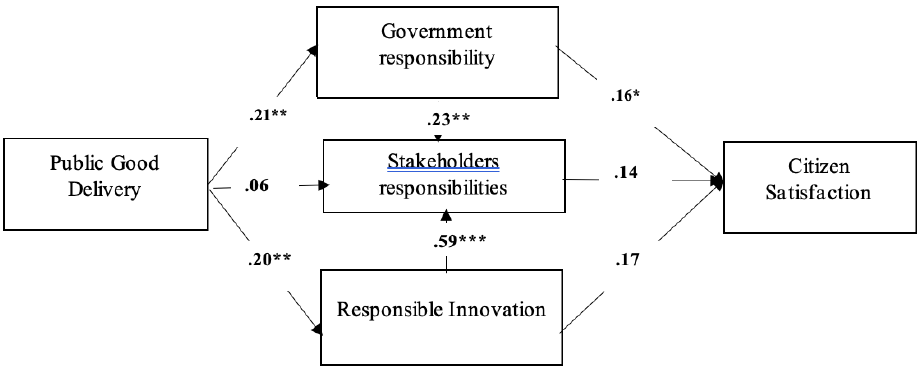
As shown in the path estimates, apart from H1b, H3, and H4 all other hypotheses were significant. Hypothesis 1b test the effect of public good delivery on related government responsibility H1a and H1c (βPGD→GR = .211**, t= 2.238, βPGD→IR = .20**, t= 1.930, p < 0.03, and p < 0.05) respectively. The results indicated that GR and IR practices have a positive and significant effect on citizen satisfaction. Except for H1b which is not significant (βPGD→AST = 0.066, t=1.132 p = 0.258), indicated lack of perceived benefit and public knowledge of stakeholder’s responsibilities. Further, H2: (βGR→CS = .157*, t= 1.687, p < .09; while H5: βGR→AST = .277***, t= 4.502, p < .005), indicating statistical significance. Therefore, the impacts of responsible government are good, for new knowledge on public acceptance of public good delivery acceptance in all government institutions, to ensure balance social impact. Finally, it was shown in the results that there exists no difference in H3 and 4 (βAST→CS = 0.136, p < 0.240) and (βIR→AST = 0.171, p < .0.144).
Although different ideas exist about how social responsibility across institutions and organizations believe to propel performance under the influence of social ethics 1 39. Significance levels were set at p < .05---p < .010. Strategically, responsible innovation relies on stakeholder responsibility to make significant strive as well as government responsibility (see Figure 3). This is consistent with business level ethical strategies such as R&D, and motivated factors 6. We identified three attributes of stakeholder relationships that serve as a basis for stakeholder salience: power, urgency, and legitimacy can enhance government responsibilities for citizen satisfaction. We also revisited the salience model from the new-knowledge value creation perspective and present a stakeholder responsibility provide complementary insight with a focus on stakeholder relationships with adaptive social acceptance in political management. We argue that a special attention from central government to the analysis of relationships is needed in order to understand how public goods are created with and for citizen satisfaction.
Stakeholder theory, developed by R. Edward Freeman and others in 1984, has evolved into a promising approach to comprehending government and society's interests as joint rather than conflicting 13. In this discussion, we examine how governments of today's strategic management contribute more to social responsibility efforts in redeeming moral ethics in providing public goods to enhance citizens' satisfaction through their role in providing public goods. As a stakeholder-driven business, what are the stakes of Central Government business? Stakeholder theory research has shifted to examine interactions with diverse functionalities credited with citizen satisfaction (i.e., adaptive social acceptance), such as public goods delivery, government responsibility, and responsible innovation. The results of this study are mixed and contribute to filling a gap in the application of stakeholder theory to analyze the relationship between government performance and citizen satisfaction. The inconsistencies have been attributed to incomplete AST 11. By examining adaptive social acceptance as a dependent variable, this study examines the impact of perceived public goods delivery on government responsibility, stakeholder responsibility, responsible innovation.
This study examines the application of AST by government stakeholders, as well as taking into account the general social responsibility of government institutions. By emphasizing the importance of government institution choices as an appropriate approach to morality, collective social ethics and responsibilities include administrative and environmental responsibility. The government, corporations, municipalities, and nations should ensure that their decisions and actions are based on social responsibility 2 29 40. In spite of the need for public goods and government responsibility in the media, academia, and public discourse, AST (power, legitimacy, urgency) has not been applied responsibly (see Figure 3). As a matter of ethics, there is a concern, however the topic under discussion is how to become more involved in society and how public resources are used explicitly. It is, however, not yet over; social ethics and/or social responsibility must still be discussed. The government must take concrete measures in accordance with information and knowledge, and decision-makers should answer to society, for power belongs to the people, as well as society as a whole.
According to the principle of responsible administration, social responsibility is an ethical concept encompassing principles regarding change and the meeting of human needs. Moreover, we emphasize the importance of social responsibility in the provision of government information services to enhance quality of life and social well-being. Except for the central government systems in sub-Saharan Africa, organizations have been socially responsible for decades. Since the 1990s, social responsibility has gained popularity globally due to increased societal influence in the media and non-governmental organizations 39. As a result of its promotion of social responsibility and positive contribution to society, CRS is also of interest to the government. In addition to contributing to the general well-being of the general public, government involvement contributes to its well-being 15 41. In this regard, the distinct debate is whether or not government agencies act in the interests of institutions, or whether individuals are responsible for institutional policies and behavior.
We explored the relationship between public good delivery and responsible innovation using AST-mediated concepts. While public good delivery was not statistically significant compared with AST, it was significantly more significant than responsible innovation. In addition to enhancing society's effectiveness, responsible innovation also leads to citizen satisfaction, which is the definition of social responsibility. Due to responsible innovation for industrial breakthroughs, globalization, and rapid technological advancements, this evolution has led to a higher quality of life, more efficient organizations, and more socially accepted working conditions 6. This resulted in public good delivery developing attitudes toward problem-solving, and the upper strata started adhering to social responsibility, especially under the General Report on Citizenship Code of Conduct.
However, the mixed findings earlier mentioned, namely that stakeholder responsibility and public good delivery and citizen satisfaction are unimportant. The lack of descriptive, normative, and instrumental attributes of the theory may be the cause. In contrast to governance, each of these characteristics pertains to the firm's management. However, political managers are instrumental to achieving performance with authority, legitimacy, and urgency, leading to public good delivery and responsible innovation for society 4. Economists say political managers are dependent on a wide variety of stakeholders throughout the economy 15. There is a strong tendency for stakeholder instrumentality and normativity to undermine public good delivery of management, decision-making, and efficiency of services. Therefore, only H1b, H3 and H4 were found to have no significance (see Table 4 and Figure 3).
A significant difference was found between GR and RI due to the citizen satisfaction (adaptive social acceptance) of public or private institutions is directed toward acting ethically and transparently, with attitudes that return to improving the quality of life for communities and societies, as well as advances for Central Government Management (CGM) in which they are entrusted, and even mitigating responsible administration. Acting for public good delivery entails more than just promoting the business, but it also promotes social ethics, moralities, and quality of life. It must go beyond profit-oriented interests because any organization or institution considered responsible must be able to meet the interests of all parties - shareholders, employees, service providers, citizens, international bodies, the community, government, institutions, and the environment. For citizen satisfaction, 14 argue that forward-looking strategies and innovative approaches influence the role of government responsibility.
A pattern of research on responsible innovation of enterprises and SMEs, for example the pursuit of active driven innovation and the application of prospect theory to responsible innovation based on wage models 49 50. According to our findings, public good delivery and responsible innovation have a marginal impact on citizen satisfaction, but at a marginal level. This is part of contribution to the sustainable development goals SDGs, promoted by 23, argues further that research builds a tripartite evolutionary game model that includes the government, focused firms, and the general public to simulate and evaluate their behavioral strategies and sensitivity to significant influencing factors at various stages of infrastructure projects.
In general, it was expected that RI would be associated with citizen satisfaction, but the low level indicates that various governments and policymakers need to put more effort into this area. As part of previous studies on IR, “responsible innovation of nano-agrifoods: Insights and views from US stakeholders” 42; roadblocks to responsible innovation: exploring technology assessment and adoption in the US 43; socio-technical integration research in Hungary and the Netherlands: responsible research and innovation in contrasting innovation environments 44. GR and RI have been shown to have an interactive relationship on stakeholder responsibility, since stakeholder responsibility is mediated in this context, resulting in significant impacts on governance and responsible innovation 45 46 47. As a result, the AST was coupled in order to provide a fresh perspective on the interaction of factors associated with these characteristics of AST in public settings. According to Sigurdsson and Candi 4, stakeholder theory's instrumental, descriptive, and normative aspects all contribute to the overall relationship between social responsibility and ASA approval. However, normative AST was expected to improve GR and RI in ASA. As a result of enhanced social responsibility to government responsibility to address societal well-being and the improvement of people's lives through social innovation, the central government should anticipate increased citizens' ASA.
Moreover, what stands out is new knowledge on AST for "the purpose of stakeholder management constitutes devising a framework for strategically managing the multitude of groups that affect, directly and indirectly, the government's ability to achieve its objectives" [10, p. 12]. With regard to the mediated relationship between GR and RI, which contributes to adaptive social acceptance in society, the importance of social responsibility associated with GR and RI has been highlighted. Also, we found an association between GR and RI on adaptive social acceptance, but not a direct correlation between stakeholder social responsibility and GR. Nevertheless, other literature has found a significant relationship between GR and RI based on stakeholder pressures as well as their impact on social and environmental responsibilities 48. African governments and political managers must integrate social responsibility as a correlated concept with government accountability, stakeholder theory, and government accountability in order to improve the quality of society and trustworthiness. By delivering public goods for sustainable development goals, society and citizens can build responsible innovation and ensure citizen satisfaction.
3.1. Implication for PracticeAs a practical application of these findings, Sub-Saharan African politicians should demonstrate commitment, dedication, patriotism in order to meet their social responsibilities through responsible governance. The act of government responsibilities for issues that are socially acceptable and problems must be delivered with the ethics of of providing publics goods. The CG must be guided by social responsibility to effectively and collaboratively adhere to the governance of strategic responsible innovation and stakeholder responsibility. We found AST was not fully adopted by governments across the world, our study recommends the integration of Attributed Stakeholder Theory within government sectors, public institutions, not only for corporate social responsibility, but private sector to ensure societal well-being and quality of life.
Through the provision of public goods, responsible innovation, and stakeholder responsibility, GR will consistently succeed through ethical calculations, adaptive governance. Therefore, political leaders can deliver public goods through responsible innovation. The findings suggest that political leaders, and CG must adhere to acts of social responsibility, GR, AST, and RI, for their attention towards the selfless delivery of social amenities, projects, and proactively improving stakeholder satisfaction through responsible innovation.
3.2. Limitations and Future ResearchThese results need to be interpreted with caution, because public good delivery is related to all the mediation of GR, stakeholder responsibility, and RI without recourse to mediation rather than relationships to ascertain impact on political-management and leadership styles among Ghana central government and for that matter Sub-Saharan Africa. This methodological decision may have led to/affected the interpretation of Attributed Stakeholder Theory, because, we did not single out (power, legitimacy, urgency) for further explanation, future studies can explore such a path on GR. Again, the research relied on government institutions but individual views. Future research can consider citizen’s information and attitudes towards government GR, RI, and ASA. Further, we used quantitative data analysis rather than qualitative methods. The application of qualitative methods will allow citizens to express extreme responses to lagging CG social responsibility, as well as RI.
We again, included government institutions without considering NGOs and private sector organizations, future research can include profit making entities, and individual participation in the survey. The sample could be increased with cross-sectional data to avoid CBM and accuracy of data analysis at a single block. Future research can as well include mediation and moderation of expanded variables such social innovation, morality, social ethics, and responsible governance. We did not distinguish between instrumental, interpreted descriptive, normative among the attributed AST for purposes of this study. We mentioned each of these as key players in the overall social responsibility and ASA.
Ethical Approval: Researchers adhered strictly to the Helsinki Declaration on Human Research and participants’ information was handled according to global standards of ethics. The participants of this survey consented to participate in this study.
Competing Interests: All authors have declare no conflict of interest nor financial interest.
|
| [1] | A. Zueva and J. Fairbrass, "Politicising government engagement with corporate social responsibility: ‘CSR’ as an empty signifier," J. Bus. Ethics, vol. 170, no. 4, pp. 635–655, 2021. | ||
| In article | View Article | ||
| [2] | D. D. Welch, "Social ethics, overview," in Encyclopedia of Applied Ethics, 2nd ed., vol. 1–4. Elsevier Inc., 2012. | ||
| In article | View Article PubMed | ||
| [3] | Y. I. Ulman, "Social ethics," in Encyclopedia of Global Bioethics, H. ten Have, Ed. Cham: Springer International Publishing, 2016, pp. 2632–2641. | ||
| In article | View Article | ||
| [4] | K. Sigurdsson and M. Candi, "Saying and doing: Social responsibility declared and applied," Creativity Innovation Manage., vol. 29, no. 1, pp. 128–140, 2020. | ||
| In article | View Article | ||
| [5] | N. M. Dahan, J. P. Doh, and J. D. Raelin, "Pivoting the role of government in the business and society interface: A stakeholder perspective," J. Bus. Ethics, vol. 131, no. 3, pp. 665–680, 2015. | ||
| In article | View Article | ||
| [6] | S. Bacq and R. V. Aguilera, "Stakeholder governance for responsible innovation: A theory of value creation, appropriation, and distribution," J. Manage. Studies, vol. 59, no. 1, pp. 29–60, 2022. | ||
| In article | View Article | ||
| [7] | K. Shafique and C. A. Gabriel, "Vulnerable stakeholders’ engagement: Advancing stakeholder theory with new attribute and salience framework," Sustainability, vol. 14, no. 18, pp. 1–19, 2022. | ||
| In article | View Article | ||
| [8] | R. E. Freeman, Strategic Management: A Stakeholder Approach. Boston, MA: Pitman, 1984. | ||
| In article | |||
| [9] | J. E. Post, A. T. Lawrence, and J. Weber, Business and Society: Corporate Strategy, Public Policy, Ethics, 8th ed. New York: McGraw-Hill, 1996. [Online]. Available: https:// www.worldcat.org/ title/ business-and-society - corporate-strategy-public-policy-ethics/oclc/32590894? page=citation. | ||
| In article | |||
| [10] | R. E. Freeman and S. Ramakrishna Velamuri, "A new approach to CSR: Company stakeholder responsibility," in Corporate Social Responsibility: Reconciling Aspiration with Application, pp. 9–23, 2006. | ||
| In article | View Article PubMed | ||
| [11] | K. Wakunuma and T. Jiya, "Stakeholder engagement and responsible research & innovation in promoting sustainable development and empowerment through ICT," Eur. J. Sustain. Develop., vol. 8, no. 3, p. 275, 2019. | ||
| In article | View Article | ||
| [12] | H. Tian and J. Tian, "The mediating role of responsible innovation in the relationship between stakeholder pressure and corporate sustainability performance in times of crisis: Evidence from selected regions in China," Int. J. Environ. Res. Public Health, vol. 18, no. 14, 2021. | ||
| In article | View Article PubMed | ||
| [13] | R. K. Mitchell, B. R. Agle, and D. J. Wood, "Toward a theory of stakeholder identification and salience: Defining the principle of who and what really counts," Acad. Manage. Rev., vol. 22, no. 4, pp. 853–886, 1997. | ||
| In article | View Article | ||
| [14] | X. Cao, D. Lv, L. Zhang, and Z. Xing, "Adaptive governance, loose coupling, forward-looking strategies and responsible innovation," IEEE Access, pp. 228163–228177, Sep. 2020. | ||
| In article | View Article | ||
| [15] | A. V. Wirba, "Corporate social responsibility (CSR): The role of government in promoting CSR," J. Knowledge Econ., 2023. | ||
| In article | View Article PubMed | ||
| [16] | A. Ganti, "Social responsibility in business: Meaning, types, examples, and criticism," Investopedia, 2023. [Online]. Available: https://www.investopedia.com/terms/s/socialresponsibility.asp. | ||
| In article | |||
| [17] | U. Obagwu, P. Paul, and M. Idris Kabiru, "Social responsibility theory of the press: A critique of its application and constraints," Int. J. Innovative Res. Develop., vol. 8, no. 12, pp. 26–35, 2019. | ||
| In article | View Article | ||
| [18] | M. Pirson, "A humanistic narrative for responsible management learning: An ontological perspective," J. Bus. Ethics, vol. 162, no. 4, pp. 775–793, 2020. | ||
| In article | View Article | ||
| [19] | J. Yu, Q. Wang, and L. Yingda, "Research on the pattern of the responsible innovation of Dalian high-tech enterprises," IOP Conf. Ser.: Earth Environ. Sci., vol. 495, no. 1, pp. 1–7, 2020. | ||
| In article | View Article | ||
| [20] | R. Owen, J. Stilgoe, P. Macnaghten, M. Gorman, E. Fisher, and D. Guston, "A framework for responsible innovation," in Responsible Innovation: Managing the Responsible Emergence of Science and Innovation in Society, pp. 27–50, Apr. 2013. | ||
| In article | View Article | ||
| [21] | N. Zahoor, H. Khan, Z. Khan, and P. Akhtar, "Responsible innovation in emerging markets’ SMEs: The role of alliance learning and absorptive capacity," Asia Pacific J. Manage., 2022. | ||
| In article | View Article | ||
| [22] | W. Li, T. Yigitcanlar, W. Browne, and A. Nili, "The making of responsible innovation and technology: An overview and framework," Smart Cities, vol. 6, no. 4, pp. 1996–2034, 2023. | ||
| In article | View Article | ||
| [23] | K. Yang, W. Wang, and W. Xiong, "Promoting the sustainable development of infrastructure projects through responsible innovation: An evolutionary game analysis," Utilities Policy, vol. 70, p. 101196, Jul. 2020. | ||
| In article | View Article | ||
| [24] | J. L. Klein, D. G. Tremblay, and D. R. Bussiéres, "Social economy-based local initiatives and social innovation: A Montreal case study," Int. J. Technol. Manage., vol. 51, no. 1, pp. 121–138, 2010. | ||
| In article | View Article | ||
| [25] | M. S. D. P. Nayak and K. A. Narayan, "Strengths and weakness of online surveys," IOSR J. Humanities Social Sci., vol. 24, no. 5, pp. 31–38, 2019. | ||
| In article | |||
| [26] | MZ Aslam, S. Omar, M. Nazri, H. A. Bustaman, and M. Yousif, "Interpersonal leadership and job engagement: Testing the mediating role of deep acting, initiative climate and learning goal orientation," J. Organizational Effectiveness-People Perform., vol. 9, no. 1, pp. 130–148, 2022. | ||
| In article | View Article | ||
| [27] | N. Altman and M. Krzywinski, "Interpreting P values," Nature Methods, 2017. | ||
| In article | View Article | ||
| [28] | M. Hopkins, "Measurement of corporate social responsibility," Int. J. Manage. Decision Making, vol. 6, no. 3–4, pp. 213–231, 2005. | ||
| In article | View Article | ||
| [29] | A. Shukla, Geetika, and N. Shukla, "Corporate social responsibility measures: A brief review," Bus. Perspectives Res., vol. 10, no. 1, pp. 101–120, 2022. | ||
| In article | View Article | ||
| [30] | J. Hair, C. L. Hollingsworth, A. B. Randolph, and A. Y. L. Chong, "An updated and expanded assessment of PLS-SEM in information systems research," Ind. Manage. Data Syst., vol. 117, no. 3, pp. 442–458, 2017. | ||
| In article | View Article | ||
| [31] | M. Sarstedt, C. M. Ringle, D. Smith, R. Reams, and J. F. Hair, "Partial least squares structural equation modeling (PLS-SEM): A useful tool for family business researchers," J. Family Bus. Strategy, vol. 5, no. 1, pp. 105–115, 2014. | ||
| In article | View Article | ||
| [32] | V. Kuleto, M. Ilić, M. Dumangiu, M. Ranković, O. M. D. Martins, D. Păun, and L. Mihoreanu, "Exploring opportunities and challenges of artificial intelligence and machine learning in higher education institutions," Sustainability, vol. 13, no. 18, pp. 1–16, 2021. | ||
| In article | View Article | ||
| [33] | Z. Awang, W. M. A. Wan Afthanorhan, and M. A. M. Asri, "Parametric and non-parametric approach in structural equation modeling (SEM): The application of bootstrapping," Modern Appl. Sci., vol. 9, no. 9, pp. 58–67, 2015. | ||
| In article | View Article | ||
| [34] | C. C. Hoang and B. H. Ngoc, "The relationship between innovation capability and firm’s performance in electronic companies, Vietnam," J. Asian Finance, Econ. Bus., vol. 6, no. 3, pp. 295–304, 2019. | ||
| In article | View Article | ||
| [35] | S. Mohammad-Alizadeh-Charandabi, M. Mirghafourvand, M. Asghari Jafarabadi, A. Mohammadi, and S. Soltanpour, "Psychometric properties of the Iranian version of the Inventory of Functional Status after Childbirth (IFSAC)," Iranian Red Crescent Med. J., vol. 19, no. 5, 2016. | ||
| In article | View Article | ||
| [36] | M. R. Ab Hamid, W. Sami, and M. H. Mohmad Sidek, "Discriminant validity assessment: Use of Fornell & Larcker criterion versus HTMT criterion," J. Phys.: Conf. Ser., vol. 890, no. 1, p. 012163, 2017. | ||
| In article | View Article | ||
| [37] | P. K. Sharma and R. K. Misra, "Core self evaluations scale: An empirical attestation among software professionals," Procedia Comput. Sci., vol. 122, pp. 79–85, 2017. | ||
| In article | View Article | ||
| [38] | K. Shao, M. Elahi Shirvan, and A. Alamer, "How accurate is your correlation? Different methods derive different results and different interpretations," Frontiers Psychol., vol. 13, pp. 1–8, May 2022. | ||
| In article | View Article PubMed | ||
| [39] | M. O’Reilly, D. Levine, and E. Law, "Applying a ‘digital ethics of care’ philosophy to understand adolescents’ sense of responsibility on social media," Pastoral Care Educ., vol. 39, no. 2, pp. 91–107, 2021. | ||
| In article | View Article | ||
| [40] | A. Yadlapalli, S. Rahman, and A. Gunasekaran, "Socially responsible governance mechanisms for manufacturing firms in apparel supply chains," Int. J. Prod. Econ., vol. 196, pp. 135–149, Apr. 2017. | ||
| In article | View Article | ||
| [41] | T. Fatima and S. Elbanna, "Corporate social responsibility (CSR) implementation: A review and a research agenda towards an integrative framework," J. Bus. Ethics, vol. 183, no. 1, pp. 105–121, 2023. | ||
| In article | View Article PubMed | ||
| [42] | K. D. Grieger, A. W. Merck, M. Cuchiara, A. R. Binder, A. Kokotovich, C. L. Cummings, and J. Kuzma, "Responsible innovation of nano-agrifoods: Insights and views from U.S. stakeholders," NanoImpact, vol. 24, p. 100365, 2021. | ||
| In article | View Article PubMed | ||
| [43] | S. C. Kimmel, N. M. Toohey, and J. A. Delborne, "Roadblocks to responsible innovation: Exploring technology assessment and adoption in U.S. public highway construction," Technol. Soc., vol. 44, pp. 66–77, 2016. | ||
| In article | View Article | ||
| [44] | M. Lukovics, S. M. Flipse, B. Udvari, and E. Fisher, "Responsible research and innovation in contrasting innovation environments: Socio-technical integration research in Hungary and the Netherlands," Technol. Soc., vol. 51, pp. 172–182, 2017. | ||
| In article | View Article | ||
| [45] | M. E. Arentshorst, T. de Cock Buning, and J. E. W. Broerse, "Exploring responsible innovation: Dutch public perceptions of the future of medical neuroimaging technology," Technol. Soc., vol. 45, pp. 8–18, 2016. | ||
| In article | View Article | ||
| [46] | K. Liu, Y. Liu, H. Zhou, Y. Kou, Q. Ji, and D. Li, "Evolutionary game and numerical simulation of participants’ collaborative behavior in integrated project delivery project," Alexandria Eng. J., vol. 60, no. 1, pp. 373–385, 2021. | ||
| In article | View Article | ||
| [47] | H. Paredes-Frigolett, "Modeling the effect of responsible research and innovation in quadruple helix innovation systems," Technol. Forecasting Social Change, vol. 110, pp. 126–133, 2016. | ||
| In article | View Article | ||
| [48] | C. D’Souza, T. Ahmed, M. A. Khashru, R. Ahmed, V. Ratten, and M. Jayaratne, "The complexity of stakeholder pressures and their influence on social and environmental responsibilities," J. Cleaner Prod., vol. 358, p. 132038, Apr. 2022. | ||
| In article | View Article | ||
| [49] | T. L. Waldron, C. Navis, E. P. Karam, and G. D. Markman, "Toward a theory of activist-driven responsible innovation: How activists pressure firms to adopt more responsible practices," J. Manage. Studies, vol. 59, no. 1, pp. 163–193, 2022. | ||
| In article | View Article | ||
| [50] | X. Qu, X. Wang, and X. Qin, "Research on responsible innovation mechanism based on prospect theory," Sustainability, vol. 15, no. 2, p. 1358, 2023. | ||
| In article | View Article | ||
| [51] | J. B. E. M. Steenkamp and A. Maydeu-Olivares, "An updated paradigm for evaluating measurement invariance incorporating common method variance and its assessment," J. Acad. Marketing Sci., vol. 49, no. 1, pp. 5–29, 2021. | ||
| In article | View Article | ||
| [52] | M. C. S. Wong et al., "Acceptance of the COVID-19 vaccine based on the health belief model: A population-based survey in Hong Kong," Vaccine, vol. 39, no. 7, pp. 1148–1156, 2021. | ||
| In article | View Article PubMed | ||
| [53] | M. Sarstedt, C. M. Ringle, and J. F. Hair, "Handbook of market research," in Handbook of Market Research, Sep. 2020. | ||
| In article | |||
| [54] | D. Turker, "Measuring corporate social responsibility: A scale development study," J. Bus. Ethics, vol. 85, no. 4, pp. 411–427, 2009. | ||
| In article | View Article | ||
| [55] | M. Snyder, Public Appearances, Private Realities: The Psychology of Self-Monitoring. New York: WH Freeman/Times Books/Henry Holt & Co., 1987. | ||
| In article | |||
Published with license by Science and Education Publishing, Copyright © 2025 Charmaine Priscilla Kwade, Franchesca Norma Imbrah and Dora Tawia Twumasi
 This work is licensed under a Creative Commons Attribution 4.0 International License. To view a copy of this license, visit
http://creativecommons.org/licenses/by/4.0/
This work is licensed under a Creative Commons Attribution 4.0 International License. To view a copy of this license, visit
http://creativecommons.org/licenses/by/4.0/
| [1] | A. Zueva and J. Fairbrass, "Politicising government engagement with corporate social responsibility: ‘CSR’ as an empty signifier," J. Bus. Ethics, vol. 170, no. 4, pp. 635–655, 2021. | ||
| In article | View Article | ||
| [2] | D. D. Welch, "Social ethics, overview," in Encyclopedia of Applied Ethics, 2nd ed., vol. 1–4. Elsevier Inc., 2012. | ||
| In article | View Article PubMed | ||
| [3] | Y. I. Ulman, "Social ethics," in Encyclopedia of Global Bioethics, H. ten Have, Ed. Cham: Springer International Publishing, 2016, pp. 2632–2641. | ||
| In article | View Article | ||
| [4] | K. Sigurdsson and M. Candi, "Saying and doing: Social responsibility declared and applied," Creativity Innovation Manage., vol. 29, no. 1, pp. 128–140, 2020. | ||
| In article | View Article | ||
| [5] | N. M. Dahan, J. P. Doh, and J. D. Raelin, "Pivoting the role of government in the business and society interface: A stakeholder perspective," J. Bus. Ethics, vol. 131, no. 3, pp. 665–680, 2015. | ||
| In article | View Article | ||
| [6] | S. Bacq and R. V. Aguilera, "Stakeholder governance for responsible innovation: A theory of value creation, appropriation, and distribution," J. Manage. Studies, vol. 59, no. 1, pp. 29–60, 2022. | ||
| In article | View Article | ||
| [7] | K. Shafique and C. A. Gabriel, "Vulnerable stakeholders’ engagement: Advancing stakeholder theory with new attribute and salience framework," Sustainability, vol. 14, no. 18, pp. 1–19, 2022. | ||
| In article | View Article | ||
| [8] | R. E. Freeman, Strategic Management: A Stakeholder Approach. Boston, MA: Pitman, 1984. | ||
| In article | |||
| [9] | J. E. Post, A. T. Lawrence, and J. Weber, Business and Society: Corporate Strategy, Public Policy, Ethics, 8th ed. New York: McGraw-Hill, 1996. [Online]. Available: https:// www.worldcat.org/ title/ business-and-society - corporate-strategy-public-policy-ethics/oclc/32590894? page=citation. | ||
| In article | |||
| [10] | R. E. Freeman and S. Ramakrishna Velamuri, "A new approach to CSR: Company stakeholder responsibility," in Corporate Social Responsibility: Reconciling Aspiration with Application, pp. 9–23, 2006. | ||
| In article | View Article PubMed | ||
| [11] | K. Wakunuma and T. Jiya, "Stakeholder engagement and responsible research & innovation in promoting sustainable development and empowerment through ICT," Eur. J. Sustain. Develop., vol. 8, no. 3, p. 275, 2019. | ||
| In article | View Article | ||
| [12] | H. Tian and J. Tian, "The mediating role of responsible innovation in the relationship between stakeholder pressure and corporate sustainability performance in times of crisis: Evidence from selected regions in China," Int. J. Environ. Res. Public Health, vol. 18, no. 14, 2021. | ||
| In article | View Article PubMed | ||
| [13] | R. K. Mitchell, B. R. Agle, and D. J. Wood, "Toward a theory of stakeholder identification and salience: Defining the principle of who and what really counts," Acad. Manage. Rev., vol. 22, no. 4, pp. 853–886, 1997. | ||
| In article | View Article | ||
| [14] | X. Cao, D. Lv, L. Zhang, and Z. Xing, "Adaptive governance, loose coupling, forward-looking strategies and responsible innovation," IEEE Access, pp. 228163–228177, Sep. 2020. | ||
| In article | View Article | ||
| [15] | A. V. Wirba, "Corporate social responsibility (CSR): The role of government in promoting CSR," J. Knowledge Econ., 2023. | ||
| In article | View Article PubMed | ||
| [16] | A. Ganti, "Social responsibility in business: Meaning, types, examples, and criticism," Investopedia, 2023. [Online]. Available: https://www.investopedia.com/terms/s/socialresponsibility.asp. | ||
| In article | |||
| [17] | U. Obagwu, P. Paul, and M. Idris Kabiru, "Social responsibility theory of the press: A critique of its application and constraints," Int. J. Innovative Res. Develop., vol. 8, no. 12, pp. 26–35, 2019. | ||
| In article | View Article | ||
| [18] | M. Pirson, "A humanistic narrative for responsible management learning: An ontological perspective," J. Bus. Ethics, vol. 162, no. 4, pp. 775–793, 2020. | ||
| In article | View Article | ||
| [19] | J. Yu, Q. Wang, and L. Yingda, "Research on the pattern of the responsible innovation of Dalian high-tech enterprises," IOP Conf. Ser.: Earth Environ. Sci., vol. 495, no. 1, pp. 1–7, 2020. | ||
| In article | View Article | ||
| [20] | R. Owen, J. Stilgoe, P. Macnaghten, M. Gorman, E. Fisher, and D. Guston, "A framework for responsible innovation," in Responsible Innovation: Managing the Responsible Emergence of Science and Innovation in Society, pp. 27–50, Apr. 2013. | ||
| In article | View Article | ||
| [21] | N. Zahoor, H. Khan, Z. Khan, and P. Akhtar, "Responsible innovation in emerging markets’ SMEs: The role of alliance learning and absorptive capacity," Asia Pacific J. Manage., 2022. | ||
| In article | View Article | ||
| [22] | W. Li, T. Yigitcanlar, W. Browne, and A. Nili, "The making of responsible innovation and technology: An overview and framework," Smart Cities, vol. 6, no. 4, pp. 1996–2034, 2023. | ||
| In article | View Article | ||
| [23] | K. Yang, W. Wang, and W. Xiong, "Promoting the sustainable development of infrastructure projects through responsible innovation: An evolutionary game analysis," Utilities Policy, vol. 70, p. 101196, Jul. 2020. | ||
| In article | View Article | ||
| [24] | J. L. Klein, D. G. Tremblay, and D. R. Bussiéres, "Social economy-based local initiatives and social innovation: A Montreal case study," Int. J. Technol. Manage., vol. 51, no. 1, pp. 121–138, 2010. | ||
| In article | View Article | ||
| [25] | M. S. D. P. Nayak and K. A. Narayan, "Strengths and weakness of online surveys," IOSR J. Humanities Social Sci., vol. 24, no. 5, pp. 31–38, 2019. | ||
| In article | |||
| [26] | MZ Aslam, S. Omar, M. Nazri, H. A. Bustaman, and M. Yousif, "Interpersonal leadership and job engagement: Testing the mediating role of deep acting, initiative climate and learning goal orientation," J. Organizational Effectiveness-People Perform., vol. 9, no. 1, pp. 130–148, 2022. | ||
| In article | View Article | ||
| [27] | N. Altman and M. Krzywinski, "Interpreting P values," Nature Methods, 2017. | ||
| In article | View Article | ||
| [28] | M. Hopkins, "Measurement of corporate social responsibility," Int. J. Manage. Decision Making, vol. 6, no. 3–4, pp. 213–231, 2005. | ||
| In article | View Article | ||
| [29] | A. Shukla, Geetika, and N. Shukla, "Corporate social responsibility measures: A brief review," Bus. Perspectives Res., vol. 10, no. 1, pp. 101–120, 2022. | ||
| In article | View Article | ||
| [30] | J. Hair, C. L. Hollingsworth, A. B. Randolph, and A. Y. L. Chong, "An updated and expanded assessment of PLS-SEM in information systems research," Ind. Manage. Data Syst., vol. 117, no. 3, pp. 442–458, 2017. | ||
| In article | View Article | ||
| [31] | M. Sarstedt, C. M. Ringle, D. Smith, R. Reams, and J. F. Hair, "Partial least squares structural equation modeling (PLS-SEM): A useful tool for family business researchers," J. Family Bus. Strategy, vol. 5, no. 1, pp. 105–115, 2014. | ||
| In article | View Article | ||
| [32] | V. Kuleto, M. Ilić, M. Dumangiu, M. Ranković, O. M. D. Martins, D. Păun, and L. Mihoreanu, "Exploring opportunities and challenges of artificial intelligence and machine learning in higher education institutions," Sustainability, vol. 13, no. 18, pp. 1–16, 2021. | ||
| In article | View Article | ||
| [33] | Z. Awang, W. M. A. Wan Afthanorhan, and M. A. M. Asri, "Parametric and non-parametric approach in structural equation modeling (SEM): The application of bootstrapping," Modern Appl. Sci., vol. 9, no. 9, pp. 58–67, 2015. | ||
| In article | View Article | ||
| [34] | C. C. Hoang and B. H. Ngoc, "The relationship between innovation capability and firm’s performance in electronic companies, Vietnam," J. Asian Finance, Econ. Bus., vol. 6, no. 3, pp. 295–304, 2019. | ||
| In article | View Article | ||
| [35] | S. Mohammad-Alizadeh-Charandabi, M. Mirghafourvand, M. Asghari Jafarabadi, A. Mohammadi, and S. Soltanpour, "Psychometric properties of the Iranian version of the Inventory of Functional Status after Childbirth (IFSAC)," Iranian Red Crescent Med. J., vol. 19, no. 5, 2016. | ||
| In article | View Article | ||
| [36] | M. R. Ab Hamid, W. Sami, and M. H. Mohmad Sidek, "Discriminant validity assessment: Use of Fornell & Larcker criterion versus HTMT criterion," J. Phys.: Conf. Ser., vol. 890, no. 1, p. 012163, 2017. | ||
| In article | View Article | ||
| [37] | P. K. Sharma and R. K. Misra, "Core self evaluations scale: An empirical attestation among software professionals," Procedia Comput. Sci., vol. 122, pp. 79–85, 2017. | ||
| In article | View Article | ||
| [38] | K. Shao, M. Elahi Shirvan, and A. Alamer, "How accurate is your correlation? Different methods derive different results and different interpretations," Frontiers Psychol., vol. 13, pp. 1–8, May 2022. | ||
| In article | View Article PubMed | ||
| [39] | M. O’Reilly, D. Levine, and E. Law, "Applying a ‘digital ethics of care’ philosophy to understand adolescents’ sense of responsibility on social media," Pastoral Care Educ., vol. 39, no. 2, pp. 91–107, 2021. | ||
| In article | View Article | ||
| [40] | A. Yadlapalli, S. Rahman, and A. Gunasekaran, "Socially responsible governance mechanisms for manufacturing firms in apparel supply chains," Int. J. Prod. Econ., vol. 196, pp. 135–149, Apr. 2017. | ||
| In article | View Article | ||
| [41] | T. Fatima and S. Elbanna, "Corporate social responsibility (CSR) implementation: A review and a research agenda towards an integrative framework," J. Bus. Ethics, vol. 183, no. 1, pp. 105–121, 2023. | ||
| In article | View Article PubMed | ||
| [42] | K. D. Grieger, A. W. Merck, M. Cuchiara, A. R. Binder, A. Kokotovich, C. L. Cummings, and J. Kuzma, "Responsible innovation of nano-agrifoods: Insights and views from U.S. stakeholders," NanoImpact, vol. 24, p. 100365, 2021. | ||
| In article | View Article PubMed | ||
| [43] | S. C. Kimmel, N. M. Toohey, and J. A. Delborne, "Roadblocks to responsible innovation: Exploring technology assessment and adoption in U.S. public highway construction," Technol. Soc., vol. 44, pp. 66–77, 2016. | ||
| In article | View Article | ||
| [44] | M. Lukovics, S. M. Flipse, B. Udvari, and E. Fisher, "Responsible research and innovation in contrasting innovation environments: Socio-technical integration research in Hungary and the Netherlands," Technol. Soc., vol. 51, pp. 172–182, 2017. | ||
| In article | View Article | ||
| [45] | M. E. Arentshorst, T. de Cock Buning, and J. E. W. Broerse, "Exploring responsible innovation: Dutch public perceptions of the future of medical neuroimaging technology," Technol. Soc., vol. 45, pp. 8–18, 2016. | ||
| In article | View Article | ||
| [46] | K. Liu, Y. Liu, H. Zhou, Y. Kou, Q. Ji, and D. Li, "Evolutionary game and numerical simulation of participants’ collaborative behavior in integrated project delivery project," Alexandria Eng. J., vol. 60, no. 1, pp. 373–385, 2021. | ||
| In article | View Article | ||
| [47] | H. Paredes-Frigolett, "Modeling the effect of responsible research and innovation in quadruple helix innovation systems," Technol. Forecasting Social Change, vol. 110, pp. 126–133, 2016. | ||
| In article | View Article | ||
| [48] | C. D’Souza, T. Ahmed, M. A. Khashru, R. Ahmed, V. Ratten, and M. Jayaratne, "The complexity of stakeholder pressures and their influence on social and environmental responsibilities," J. Cleaner Prod., vol. 358, p. 132038, Apr. 2022. | ||
| In article | View Article | ||
| [49] | T. L. Waldron, C. Navis, E. P. Karam, and G. D. Markman, "Toward a theory of activist-driven responsible innovation: How activists pressure firms to adopt more responsible practices," J. Manage. Studies, vol. 59, no. 1, pp. 163–193, 2022. | ||
| In article | View Article | ||
| [50] | X. Qu, X. Wang, and X. Qin, "Research on responsible innovation mechanism based on prospect theory," Sustainability, vol. 15, no. 2, p. 1358, 2023. | ||
| In article | View Article | ||
| [51] | J. B. E. M. Steenkamp and A. Maydeu-Olivares, "An updated paradigm for evaluating measurement invariance incorporating common method variance and its assessment," J. Acad. Marketing Sci., vol. 49, no. 1, pp. 5–29, 2021. | ||
| In article | View Article | ||
| [52] | M. C. S. Wong et al., "Acceptance of the COVID-19 vaccine based on the health belief model: A population-based survey in Hong Kong," Vaccine, vol. 39, no. 7, pp. 1148–1156, 2021. | ||
| In article | View Article PubMed | ||
| [53] | M. Sarstedt, C. M. Ringle, and J. F. Hair, "Handbook of market research," in Handbook of Market Research, Sep. 2020. | ||
| In article | |||
| [54] | D. Turker, "Measuring corporate social responsibility: A scale development study," J. Bus. Ethics, vol. 85, no. 4, pp. 411–427, 2009. | ||
| In article | View Article | ||
| [55] | M. Snyder, Public Appearances, Private Realities: The Psychology of Self-Monitoring. New York: WH Freeman/Times Books/Henry Holt & Co., 1987. | ||
| In article | |||