It is a general tendency of the students and some of the teachers of chemistry that they conceive the stoichiometric coefficients of a balanced equation of a chemical reaction are the individual kinetic orders of those reactants involved in the rate equation of that reaction. But this is not true. The stoichiometric coefficients have nothing to do with individual kinetic orders of the reactants involved in the reaction or in the rate equation. A detailed explanation with a suitable example for this misconception is provided in the present article.
A chemical equation represents a chemical reaction. It shows the reactants that start a reaction, and products formed by the reaction. A balanced equation obeys the law of conservation of mass. Similarly, a rate equation represents in chemistry, also known as the rate law or differential rate equation is an empirical differential mathematical expression for the reaction rate of a given reaction in terms of concentrations of chemical species and constant parameters normally rate coefficients and individual kinetic orders of the reaction 1. For many reactions, the initial rate is given by an equation comprising of powers of the reactants such as
(Rate)o = k [A]x [B]yv0=k[A]x[B]y
where [A][A] and [B] [B] are the molar concentrations of the species A and B, usually in moles per liter and k is the specific reaction rate or rate constant. And ‘x’ and ‘y’ are the individual kinetic orders of the reactants, and they are experimentally determinable. The kinetic orders x and y may be integers, or fractional or zero. The total kinetic order of the reaction is therefore (x + y).
Chemical structures are drawn using “ChemDraw” software. The individual orders of persulfate and iodide ions are determined from initial rate measurements. All the plots are constructed using KaleidaGraph software version 4.1 supplied by Synergy Software, Reading, PA USA.
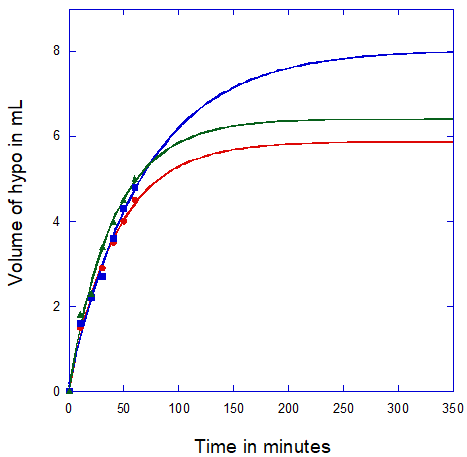
Reactions are followed by mixing solutions of required concentrations of KI and K2S2O8 and titrating 5 mL of the reaction mixture at regular intervals of time with standard thiosulfate solution. Figure 1 is the exponential rise plot of volume of hypo versus time keeping [KI] constant at 0.04 M and varying [K2S2O8] from 0.0125 M to 0.020 M at a total ionic strength of 0.13 M maintained by using required amounts of K2SO4 solution and at 25 C. Initial rates are calculated using the exponential equation y = m1 + m2*(1 − e−m3*x), where m1 and m2 are some arbitrary constants and m3 is the coefficient of ‘x’ that is time axis which gives the rate of the reaction. Data is presented in Table 1.
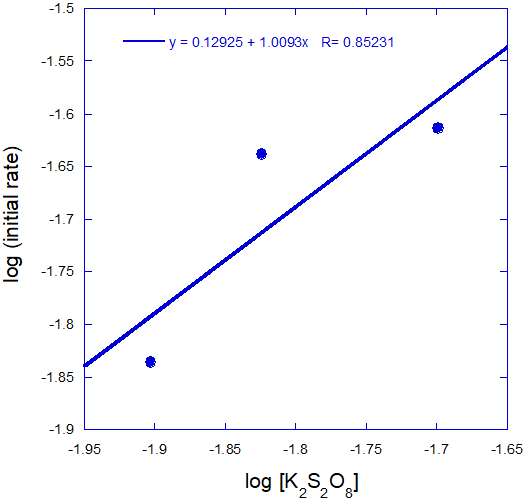
Figure 2 is the plot of log (initial rate) versus log [K2S2O8], slope of which gives the order with respect to [K2S2O8]. And the order with respect to [K2S2O8] is coming out to be 1.01. The data is given in Table 1.
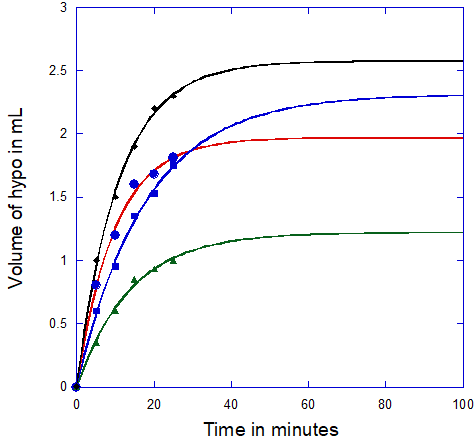
Similarly, figure 3 is the exponential rise plot of volume of hypo versus time keeping [K2S2O8] constant at 0.025 M and varying [KI] from 0.03 M to 0.045 M at a total ionic strength of 0.106 M and at 25C.
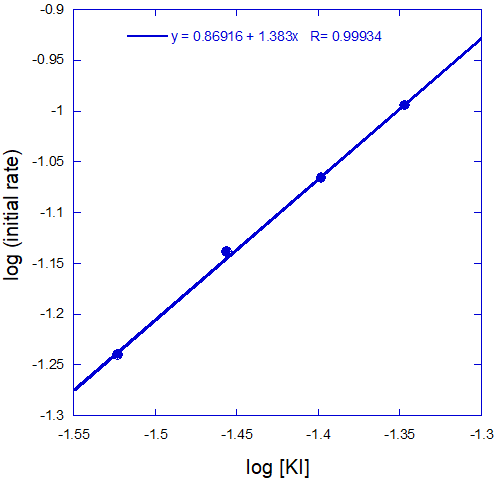
Figure 4 is the plot of log (initial rate) versus log [KI], slope of which gives the order with respect to [KI]. And the order with respect to [KI] is coming out to be 1.38. Data is given in Table 2.


We have taken the order in [KI] as 1.00 though the graph gave 1.38 which we have considered as some experimental limitations. Therefore, from orders in [K2S2O8] and [KI] the rate equation would be:
(Rate)o = k [K2S2O8]1 [KI]1v0=k[A]x[B]y
As mentioned in the abstract, to explain the problem in detail, let us take the balanced reaction between persulphate ion and iodide ion (equation 1).
 | (1) |
As argued in the abstract if the stoichiometric coefficients are taken as individual kinetic orders of the reactants, and if the reaction step in equation 1 is the rate determining step, the rate equation for this reaction would be:
 | (2) |
Which indicates that the individual kinetic orders of persulphate ion is 1 and that of iodide ion is 2. Thus, the total order of the reaction is 1 + 2 = 3. This means that the rate determining step should involve one mole of persulphate ion and two moles of iodide ion, gives the rate determining step as:
 | (3) |
And this lone reaction step should represent the total mechanism of the reaction. In fact, this was reported in iodine clock reaction where the order with respect to persulfate is one and that of iodide is two 2. But literature survey reveals that the total kinetic order of this reaction is not 3 and the individual kinetic order of iodide ion is not 2. The experimentally observed individual kinetic orders of persulphate and iodide ions are 1 each leading to the total kinetic order of the reaction is 2 3, 4. Therefore, the mechanism of the reaction is not the sole mechanism as mentioned in equation 3. And the rate equation would then be as mentioned in equation 4:
 | (4) |
The total kinetic order would then be 1 + 1 = 2. The kinetic orders of the reactants participating in the rate determining step as shown in equation 5 below are not equal or need not be equal to the stoichiometric coefficients of equation 1. Therefore, the mechanism of this reaction should involve one mole of each persulphate and iodide ions in the rate determining step to satisfy the rate equation 4 will be:
|
Taking the rate determining step 5, the rate equation would be as mentioned in equation 4. If one adds all the four steps 5, 6, 7 and 8 one will get the stoichiometric equation 1. And at the same time the mechanism satisfies the total kinetic order of the reaction is 1 + 1 = 2 and its stoichiometry. The equations 5, 6, 7 and 8 represent the final mechanism of the reaction (Scheme 1).
Persulphate is structurally similar to hydrogen peroxide.
|
In hydrogen peroxide the two hydrogens are replaced by two  groups. Therefore, it is believed that redox process that occurs persulphate oxidations resembles that of hydrogen peroxide 5. The lucid mechanism shows simultaneous homolytic cleavage of peroxide bond forming sulphate radical ion (
 ) and sulphate radical ion–iodide ion adduct
  5 (equation 5). The occurrence of
  has been well-documented by time resolved UV-VIS spectroscopy identifying its transient absorbance at 450 nm with a molar extinction coefficient of 460 M-1cm-1 6. The sulphate radical ion–iodide ion adduct
  then by intramolecular electron transfer from sulphate radical ion moiety to iodide ion gives sulphate ion and iodine atom as shown in equation 6 (scheme 1). The sulphate radical ion thus formed in equation 5 reacts with another mole of iodide ion as shown in equation 7 to give sulphate ion and iodine atom. The two iodine atoms thus formed in equations 6 and 7 finally give molecular iodine (step 8). Hence the mechanism represents that it is the oxidation of iodide ion by sulphate radical ion
  within the adduct (step 6). The first step of this process of scheme 1 is termed as energy transfer through thermolysis 5. The reaction between H2O2 and iodide ion under neutral conditions is in fact shown to follow the rate equation 9 7 similar to the present work (equation 4):
Rate = k [I−]1 [H2O2]1(9)
For the benefit of the students, one can read the paper published elsewhere by one of the authors (VJ) 8 on the detailed kinetics of hydrolysis of methyl acetate and for conceptual comprehension of the terms negative order and fractional order in the field of chemical kinetics 9.
The authors don’t have any conflict of interest.
We did not receive any funding from any source.
| [1] | Gold, Victor, ed. (2019). The IUPAC Compendium of Chemical Terminology: The Gold Book (4th ed.). Research Triangle Park, NC: International Union of Pure and Applied Chemistry (IUPAC). | ||
| In article | View Article | ||
| [2] | Chrome-extension:// efaidnbmnnnibpcajpcglclefindmkaj/ http:// www.kentchemistry.com/. Labs/ iodineclock.pdf. | ||
| In article | |||
| [3] | A. Indelli and J. E. Prue, J. Chem. Soc., 1959, 107-111. | ||
| In article | View Article | ||
| [4] | P. C. Moews, Jr. and R. H. Petrucci, Journal of Chemical Education, Volume 41, 1964, page 548. | ||
| In article | View Article | ||
| [5] | Jaesang Lee, Urs von Gunten, and Jae-Hong Kim, Environ. Sci. Technol., 2020. | ||
| In article | |||
| [6] | P. Neta, V. Madhavan, H. Zemel, and R. W. Fessenden, J. Amer. Chem. Soc. 1977, 99, 163-164. | ||
| In article | View Article | ||
| [7] | George T. F. Wong, Ling-Su Zhang, Marine Chemistry, 111 (2008) 22–29. | ||
| In article | View Article | ||
| [8] | V. Jagannadham, Khimiya/Chemistry (The Bulgarian Journal of Chemical Education), (2010) vol. 19, page 114. | ||
| In article | |||
| [9] | R. Sanjeev, V. Jagannadham, Adam A Skelton, R. Veda Vrath, World Journal of Chemical Education 2.1 (2014): 4-7. | ||
| In article | |||
Published with license by Science and Education Publishing, Copyright © 2025 Y. Sharanya, N. Keerthana, V. Rajeswari, Sanjeev Rachuru, D. A. Padmavathi, V. Jagannadham and G. Ramya Sree
 This work is licensed under a Creative Commons Attribution 4.0 International License. To view a copy of this license, visit
http://creativecommons.org/licenses/by/4.0/
This work is licensed under a Creative Commons Attribution 4.0 International License. To view a copy of this license, visit
http://creativecommons.org/licenses/by/4.0/
| [1] | Gold, Victor, ed. (2019). The IUPAC Compendium of Chemical Terminology: The Gold Book (4th ed.). Research Triangle Park, NC: International Union of Pure and Applied Chemistry (IUPAC). | ||
| In article | View Article | ||
| [2] | Chrome-extension:// efaidnbmnnnibpcajpcglclefindmkaj/ http:// www.kentchemistry.com/. Labs/ iodineclock.pdf. | ||
| In article | |||
| [3] | A. Indelli and J. E. Prue, J. Chem. Soc., 1959, 107-111. | ||
| In article | View Article | ||
| [4] | P. C. Moews, Jr. and R. H. Petrucci, Journal of Chemical Education, Volume 41, 1964, page 548. | ||
| In article | View Article | ||
| [5] | Jaesang Lee, Urs von Gunten, and Jae-Hong Kim, Environ. Sci. Technol., 2020. | ||
| In article | |||
| [6] | P. Neta, V. Madhavan, H. Zemel, and R. W. Fessenden, J. Amer. Chem. Soc. 1977, 99, 163-164. | ||
| In article | View Article | ||
| [7] | George T. F. Wong, Ling-Su Zhang, Marine Chemistry, 111 (2008) 22–29. | ||
| In article | View Article | ||
| [8] | V. Jagannadham, Khimiya/Chemistry (The Bulgarian Journal of Chemical Education), (2010) vol. 19, page 114. | ||
| In article | |||
| [9] | R. Sanjeev, V. Jagannadham, Adam A Skelton, R. Veda Vrath, World Journal of Chemical Education 2.1 (2014): 4-7. | ||
| In article | |||