There were numerous reports on the kinetic study of acid catalyzed hydrolysis of methyl acetate. In all these studies emphasis was on the calculation of pseudo-first order rate constant. There were very few reports on the calculation of second order rate constant of uncatalyzed hydrolysis of methyl acetate; a small note regarding the second order rate constant is mentioned in the 12th class Central Board of Secondary Education (CBSE) Indian textbook. It is known that the hydrolysis of methyl acetate can proceed via two pathways: the un-catalyzed and the acid catalyzed. The un-catalyzed path of the reaction is too slow to be followed. It will take several days to follow the reaction. In the present article an attempt was made to calculate the second order rate constant of the un-catalyzed path. This rate constant was obtained by plotting kobs (pseudo-first order acid catalyzed rate constants at different acid concentrations) versus [H+]. The extrapolation to zero concentration that is the y-intercept divided by the water concentration yields the second order un-catalyzed rate constant. This second order rate constant was also determined theoretically. To the best of our knowledge, no one has determined the second order rate constant of this uncatalyzed reaction. This can be given as project-based activity to Graduate students.
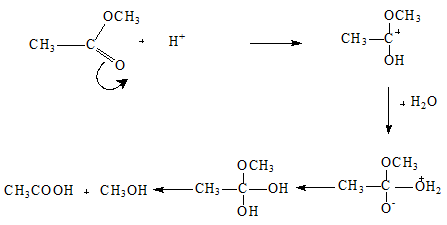
It would be interesting if the classroom teaching (both theory and laboratory sessions) commenced with the historical background of that topic. The first kinetics experiment was pioneered on the study of acid catalyzed inversion of sucrose by Ludwig Wilhelmy in 1850 using polarimetry technique 1. The first ever report on hydrolysis kinetics of methyl acetate was by Wilhelm Ostwald in 1883 2: CH3COOCH3 + H2O ⇌ CH3COOH + CH3OH. Based on mole-to-mole ratio of methyl acetate to water, we anticipate this reaction to proceed via second order; but due to negligible change in concentration of H2O during the course of the reaction it follows a (pseudo) first order path. Hence nobody ever thought of calculating its second order rate constant; though, the reaction is known for more than a century 2. Ostwald did not even consider the course of the reverse reaction (since it was negligible). This was followed by several studies on hydrolysis of kinetics of various esters in different mediums 3, 4, 5, 6, 7, 8, 9, 10 including a study on the effect of structure of ester on hydrolysis kinetics by Hinshelwood 6 that is just a year after Hammett equation 11 was developed (and was getting popularized). One of the authors (VJ) has published a detailed study on the kinetics experiment, taking the acid catalyzed hydrolysis of methyl acetate in water, an undergraduate chemistry laboratory experiment 12. In this study nothing was mentioned about the calculation of second order rate constant. However, commonly committed mistakes were highlighted, and measures were suggested. Besides this, many reports on the kinetic study of hydrolysis of methyl acetate appeared in literature 13, 14, 15, 16, 17, 18, 19. In all these studies there was not a single instance where they had mentioned about the calculation of the second order rate constant of water assisted hydrolysis of methyl acetate; we could only find small note mentioned in an Indian textbook used by Central Board of Secondary Education, New Delhi (CBSE, New Delhi) 20 where second order rate constant was determined. In the present article we have endeavored to calculate the second order rate constant of the un-catalyzed path with the help of Figure 1 (see Scheme 1) and the same was determined theoretically. In fact, determination of pseudo first order rate constant of acid catalyzed hydrolysis of methyl acetate is part of MSc first year chemistry syllabus of our college and many other colleges in our State. Hence this experiment can be given as Project-based activity for different groups of students. By carrying out this project-based activity, students learn basic aspects of chemical kinetic experiments, such as following the reaction titremetrically at different time intervals, quenching of reaction at a particular time, maintaining ionic strength, using first order integrated equation for the determination of first order rate constant, plotting of appropriate graphs. While carrying out the theoretical aspect of this experiment, students would learn how to isolate a Transition state and calculate Gibbs energy computationally. It will also enable the students to use the Eyring equation for calculation of rate constant.
Methyl acetate was purchased from Aldrich and other chemicals were of AR grade bought from the local market. All the other experimental methods adopted were similar to that reported in reference 12. KaleidaGraph software, (Reading, PA, USA) was used for the linear correlations. Effect of [H+] on rates of reactions was carried out at constant ionic strength of 2.0 M with the help of KCl. Experiments were initiated by keeping the HCl and KCl solutions of required concentration and methyl acetate in separate containers (which were thermostated at 25oC for about 15-20 minutes); the required volume of methyl acetate was extracted using a pipette and added to HCl solution. The reaction mixture was analyzed for acetic acid at regular intervals of time by titrating with standard sodium hydroxide solution taken in the burette using phenolphthalein indicator. The reactions were followed up to 2 half-life completions. Let Vo be the volume of sodium hydroxide at time “0” and the volumes of sodium hydroxide are Vt at different time intervals. Further let V∞ be the volume of sodium hydroxide after completion of the reaction. Slopes of the plots of  versus time would yield the pseudo first order rate constants.
Gaussian 09 21 program was utilized to for all the DFT calculations. B3LYP functional with 6-31G(d) was utilized. The transition State (TS) was isolated by performing Berny optimization. To convey in simple parlance Berny optimization is an algorithm which helps to find the minimum-energy geometry or a saddle point if one is hunting for a transition state (which we are). The plausible Transition State is depicted in Scheme 1. Frequency calculations were performed to find the free energy of the TS and the reactants. The reactants did not have any imaginary frequency and only one imaginary frequency was observed in the Transition state. We had used opt plus frequency simultaneously during calculations. The implicit polarizable continuum model (PCM) with water as solvent was utilized in the calculations. This model factors in dielectric screening, polarization effects and bulk solvation energies, hence can be used for determination of rate constants of a reaction. Further, since the value of theoretical rate constant is almost same as that determined by experiment, the usage of implicit PCM model is apt. The free energy of activation was substituted in the well-known Eyring equation to determine the rate constant of the reaction 22. Here transmission coefficient κ in the Eyring equation is assumed to be one. If you envisage the transition state on the the top of a mountain and the molecules ascending the mountain top, transmission coefficient κ is the index of how many actually slide down into products rather than roll back to reactants. We have made an approximation of ‘κ’ to be one as it is very unlikely that Transition State would roll back to reactants. This approximation appears to be correct as the theoretical rate constant determined by use of this equation has almost the same value as that determined by experiment (as already conveyed).
k = (κkbT/ hcϴ)e −∆‡G/RT
where kb is Boltzmann constant; T =Temperature; h is Planck’s constant; ∆‡G is the free energy of activation; R is gas constant; cϴ = 1 mol dm-3; κ = (kappa) transmission coefficient is assumed to be 1. Table 2 gives the theoretically determined free energies and the resulting rate constant of the reaction.
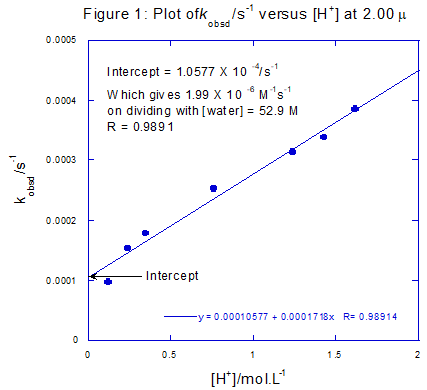
The present work is the detailed study of calculation of the second order rate constant of the un-catalyzed (Scheme 1) path with the help of Figure 1. Pseudo-first order rate constant of the un-catalyzed hydrolysis of methyl acetate at 25oC and second order rate constant of acid catalyzed reaction was reported by Yih-Huang Hsieh et al 13. Yih-Huang Hsieh et al determined the rate constant by carrying out the experiments at 90-100oC and then extrapolating to 25oC; whereas we carried out the acid (HCl) hydrolysis (Scheme 2) at different concentration of [H+] at 25oC and with the help of Figure 1 we got the second order rate constant of un catalyzed path (Scheme 1). The hydrolysis of methyl acetate can proceed via two path-ways: un-catalyzed (scheme 1) and the catalyzed (scheme 2). The data of the acid catalyzed paths is summarized in Table 1. The un-catalyzed path of the reaction would be too slow to be followed (Scheme 1). It will take several days for the reaction to go for completion.

The kinetic model of scheme 1 and 2 put together is shown as in scheme 3.

Therefore
 | (1) |
 | (2) |
 | (3) |
At constant [H2O] a plot of kobsd versus [H+] should yield a straight line (figure 1) with a slope of  [H2O] and an intercept of
 (equation 3). The y-intercept (from equation 3) is equal to
  . Thus, the y-intercept (in s-1) divided by water concentration (52.9M) yields kuncat (in M-1s-1) the second order rate constant of water assisted neutral hydrolysis of methyl acetate.
y-intercept = 0.000106 s-1 (Figure 1). This value is divided by water concentration that is = 0.00010577 /52.9 = 1.99 x 10⁻⁶ M-1s-1 is the required second order rate constant of reaction between methyl acetate and water. The reported first order kuncat value 13 is 0.17 x 10⁻⁸ s-1. This rate constant was determined under entirely different conditions in the temperature range 90-110oC and the data at 25oC was drawn by extrapolation. At those high temperatures though the reaction is carried out in sealed tube, the reaction medium would be partly in vapor phase. So, we cannot compare our data with the reported data. The reported 13 kuncat value is of first order; and what we have reported is the second order rate constant.
Theoretical rate constant was determined by finding the free energy of the TS and the reactants. The difference in free energy of the TS and the sum of the free energies of the reactants yielded ∆‡G i.e., the free energy of activation. This value was substituted in the Eyring equation (this is already explained in the methods section). The theoretical rate constant turned out to be 6.44 x 10⁻⁶ M-1 s-1.

∆‡G = (Transition state) - {(Methyl acetate) + (Water)}
∆‡G = -344.707345 - {(-268.333604 + (-76.412841)}
∆‡G = -344.707345 - (-344.746445)
∆‡G = 0.0391Hartree units
∆‡G = 0.0391 x 627.5095 kcal/mol
∆‡G = 24.535621 kcal/mol
or ∆‡G = 102633.52 J/mol
Substituting the above ∆‡G in Eyring equation 22
k = (κkbT/ hcϴ)e −∆‡G /RT 22 (here κ is 1 and cϴ = 1 mol dm-3 as already mentioned in methods section)
= [1.380662 x 10⁻²³ (298.15)/6.626176 x 10-34] exp (-102633.52/8.314 x 298.15)
= 6.2125 x 10¹² exp (-41.41)
= 6.2125 x 1012 x 1.0372 x 10-18
= 6.44 x 10⁻⁶ M-1 s-1
In the present article an attempt was made to calculate the second order rate constant of the un-catalyzed path that is water assisted hydrolysis of methyl acetate, by finding the acid catalyzed pseudo-first order rate constants at various [H+] and then by extrapolation to zero concentration of the acid to the locus of the plot of kobsd versus [H+]; this value was finally divided by the concentration of water. The second order rate constant turned out to be 1.99 x 10⁻⁶ M-1s-1. The theoretical determined rate constant turned out to be 6.44 x 10⁻⁶ M-1s-1. The fact that we are getting similar rate constant by theoretical and experimental methods, it does reflect that the obtained second order rate constant of water assisted hydrolysis of methyl acetate is reasonably correct. This project-based activity will help the students learn both experimental and theoretical determination of rate constants.
The authors are grateful to the Centre for High Performance Computing (CHPC), Cape Town, South Africa, for their generous allocation of supercomputer time.
The research did not receive any specific funding.
The authors declare no conflicts of interest.
The supplementary files contain all the input and output files of the Gaussian calculations.
| [1] | Wilhelmy Ludwig F. Ueber das Gesetz, nach welchem die Einwirkung der Säuren auf den Rohrzucker stattfindet. Annalen der Physik und Chemie 1850, 81, 413-433. | ||
| In article | View Article | ||
| [2] | Ostwald W. Studien zur chemischen D ynamik; Die Einwirknng der Sauren auf Hethylacetat. J. prakt. Chem. 1883, 28, 449-495. | ||
| In article | View Article | ||
| [3] | Griffith, R. O., McCullagh Lewis, W. C. Studies in catalysis. Part IV. Stoichiometric and catalytic effects due to the progressive displacement of one reactant by another in the “acid” hydrolysis of methyl acetate. J. Chem. Soc. 1916, 109, 67-83. | ||
| In article | View Article | ||
| [4] | Harned, H. S.; Pfansteil, R. A study of the velocity of hydrolysis of ethyl acetate. J. Am. Chem. Soc 1922, 44, 2193-2205. | ||
| In article | View Article | ||
| [5] | Harned, H. S.; Samaras Nicholas, N. T. The effect of change of medium upon the velocity of hydrolysis of ethyl orthoformate. J. Am. Chem. Soc 1932, 54, 1-8. | ||
| In article | View Article | ||
| [6] | Tommila E.; Hinshelwood C. N. The activation energy of organic reactions. Part IV. Transmission of substituent influences in ester hydrolysis. J. Chem. Soc 1938, 1801-1810. | ||
| In article | View Article | ||
| [7] | Poethke W.Ber Über die Ester-Hydrolyse in reinem Wasser. 1935, 68.6,1031-1037. | ||
| In article | View Article | ||
| [8] | Friedman, H. B.; Elmore, G. V. The hydrolysis of Methyl acetate in a Non-Aqueous solvents. J. Am. Chem. Soc 1941, 63, 864-867. | ||
| In article | View Article | ||
| [9] | Skrabal A, Zahorka A. Die Wasserverseifung des Äthylazetats. Monatsh. Chem., 1929, 53-54, 562-567. | ||
| In article | View Article | ||
| [10] | Mata Segreda, J. F. Spontaneous hydrolysis of ethyl formate: Isobaric Activation Parameters. Int. J. Chem. Kinet., 2000, 32, 67-71. | ||
| In article | View Article | ||
| [11] | Hammett Louis, P. Some Relations between Reactions Rates and Equilibrium Constants.Chem. Rev. 1935, 17, 1, 125-136. | ||
| In article | View Article | ||
| [12] | Jagannadham V. Kinetics experiments in the undergraduate chemistry laboratory. Mistakes and measures: Kinetics of acid catalyzed hydrolysis of methyl acetate as an example Khimiya/Chemistry 2010, 19, 114. | ||
| In article | |||
| [13] | Hsieh Yih Huang.; Noham Weinberg.; Wolfe Saul. The Neutral Hydrolysis of Methyl Acetate -Part 1. Kinetic Experiments. Canadian Journal of Chemistry 2009, 87, 539-543. | ||
| In article | View Article | ||
| [14] | Ikhazuangbe.; Ohien, P. M.; Babalola,O. Reaction rate and rate constant of the hydrolysis of ethyl acetate with sodium hydroxide. American Journal of Scientific and Industrial Research 2015, 6, 1-4. | ||
| In article | |||
| [15] | BeezerA. E.; Steenson,T. I; Tyrell, H.J.V. Kinetic studies in a flow microcalorimeter the acid-catalysed hydrolysis of methyl acetate at 25oC. Tyrrell H. J. V. Thermochimica Acta 1974, 9, 4, 447-449. | ||
| In article | View Article | ||
| [16] | Ehteshami, M.; Rahimi, N.; Eftekhari, A. A.; NasrM. J. Kinetic study of catalytic hydrolysis reaction of methyl acetate to acetic acid and methanol. Journal of Science & Technology, Transaction B, Engineering 2006, 30, 595-606. | ||
| In article | |||
| [17] | https:// www.brainkart.com/article/ Determination-of-rate-constant-of -acid-catalysed -hydrolysis-of-an-ester_2882/. | ||
| In article | |||
| [18] | http:// www.satyensaha.com/ pdf%20files/ B.Sc.%201st% 20year-Ester-hydrolysis -Practical S Saha.pdf. | ||
| In article | |||
| [19] | Nair P. Madhavan.; Anantakrishnan, S. V. Proc. Indian Acad. Sci. (Math. Sci.). 1950, 32. | ||
| In article | View Article | ||
| [20] | Khandrewal, B. L. Chemistry Part I, An Indian text book meant for the curriculum of Central Board of Secondary Education, New Delhi, India, Class XII, Part I, 2018 Edition, pp 110-111; ISBN 81-7450-648-9. | ||
| In article | |||
| [21] | M. J. Frisch, G. W. Trucks, H. B. Schlegel, G. E. Scuseria, M. A. Robb, J. R. Cheeseman, G. Scalmani, V. Barone, B. Mennucci, G. A. Petersson, H. Nakatsuji, M. Caricato, X. Li, H. P. Hratchian, A. F. Izmaylov, J. Bloino, G. Zheng, J. L. Sonnenberg, M. Hada, M. Ehara, K. Toyota, R. Fukuda, J. Hasegawa, M. Ishida, T. Nakajima, Y. Honda, O. Kitao, H. Nakai, T. Vreven, J. A. Montgomery, Jr, J. E. Peralta, F. Ogliaro, M. Bearpark, J. J. Heyd, E. Brothers, K. N. Kudin, V. N. Staroverov, R. Kobayashi, J. Normand, K. Raghavachari, A. Rendell, J. C. Burant, S. S. Iyengar, J. Tomasi, M. Cossi, N. Rega, J. M. Millam, M. Klene, J. E. Knox, J. B. Cross, V. Bakken, C. Adamo, J. Jaramillo, R. Gomperts, R. E. Stratmann, O. Yazyev, A. J. Austin, R. Cammi, C. Pomelli, J. W. Ochterski, R. L. Martin, K. Morokuma, V. G. Zakrzewski, G. A. Voth, P.Salvador, J. J. Dannenberg, S. Dapprich, A. D. Daniels, O¨ . Farkas, J. B. Foresman, J. V. Ortiz, J. Cioslowski, D. J. Fox, Gaussian 09, Revision E.01 2009 (Gaussian, Inc., Wallingford, C | ||
| In article | |||
| [22] | Peter Atkins & Julio De Paula. Elements of Physical Chemistry. International Edition, Oxford University Press 2017, pp 262-263. | ||
| In article | |||
Published with license by Science and Education Publishing, Copyright © 2025 Mallelli Murali, Sanjeev Rachuru, Jagannadham Vandanapu, M. Sujatha, K B Shanti Sudha, Devarkonda A. Padmavathi and Adam A Skelton
 This work is licensed under a Creative Commons Attribution 4.0 International License. To view a copy of this license, visit
http://creativecommons.org/licenses/by/4.0/
This work is licensed under a Creative Commons Attribution 4.0 International License. To view a copy of this license, visit
http://creativecommons.org/licenses/by/4.0/
| [1] | Wilhelmy Ludwig F. Ueber das Gesetz, nach welchem die Einwirkung der Säuren auf den Rohrzucker stattfindet. Annalen der Physik und Chemie 1850, 81, 413-433. | ||
| In article | View Article | ||
| [2] | Ostwald W. Studien zur chemischen D ynamik; Die Einwirknng der Sauren auf Hethylacetat. J. prakt. Chem. 1883, 28, 449-495. | ||
| In article | View Article | ||
| [3] | Griffith, R. O., McCullagh Lewis, W. C. Studies in catalysis. Part IV. Stoichiometric and catalytic effects due to the progressive displacement of one reactant by another in the “acid” hydrolysis of methyl acetate. J. Chem. Soc. 1916, 109, 67-83. | ||
| In article | View Article | ||
| [4] | Harned, H. S.; Pfansteil, R. A study of the velocity of hydrolysis of ethyl acetate. J. Am. Chem. Soc 1922, 44, 2193-2205. | ||
| In article | View Article | ||
| [5] | Harned, H. S.; Samaras Nicholas, N. T. The effect of change of medium upon the velocity of hydrolysis of ethyl orthoformate. J. Am. Chem. Soc 1932, 54, 1-8. | ||
| In article | View Article | ||
| [6] | Tommila E.; Hinshelwood C. N. The activation energy of organic reactions. Part IV. Transmission of substituent influences in ester hydrolysis. J. Chem. Soc 1938, 1801-1810. | ||
| In article | View Article | ||
| [7] | Poethke W.Ber Über die Ester-Hydrolyse in reinem Wasser. 1935, 68.6,1031-1037. | ||
| In article | View Article | ||
| [8] | Friedman, H. B.; Elmore, G. V. The hydrolysis of Methyl acetate in a Non-Aqueous solvents. J. Am. Chem. Soc 1941, 63, 864-867. | ||
| In article | View Article | ||
| [9] | Skrabal A, Zahorka A. Die Wasserverseifung des Äthylazetats. Monatsh. Chem., 1929, 53-54, 562-567. | ||
| In article | View Article | ||
| [10] | Mata Segreda, J. F. Spontaneous hydrolysis of ethyl formate: Isobaric Activation Parameters. Int. J. Chem. Kinet., 2000, 32, 67-71. | ||
| In article | View Article | ||
| [11] | Hammett Louis, P. Some Relations between Reactions Rates and Equilibrium Constants.Chem. Rev. 1935, 17, 1, 125-136. | ||
| In article | View Article | ||
| [12] | Jagannadham V. Kinetics experiments in the undergraduate chemistry laboratory. Mistakes and measures: Kinetics of acid catalyzed hydrolysis of methyl acetate as an example Khimiya/Chemistry 2010, 19, 114. | ||
| In article | |||
| [13] | Hsieh Yih Huang.; Noham Weinberg.; Wolfe Saul. The Neutral Hydrolysis of Methyl Acetate -Part 1. Kinetic Experiments. Canadian Journal of Chemistry 2009, 87, 539-543. | ||
| In article | View Article | ||
| [14] | Ikhazuangbe.; Ohien, P. M.; Babalola,O. Reaction rate and rate constant of the hydrolysis of ethyl acetate with sodium hydroxide. American Journal of Scientific and Industrial Research 2015, 6, 1-4. | ||
| In article | |||
| [15] | BeezerA. E.; Steenson,T. I; Tyrell, H.J.V. Kinetic studies in a flow microcalorimeter the acid-catalysed hydrolysis of methyl acetate at 25oC. Tyrrell H. J. V. Thermochimica Acta 1974, 9, 4, 447-449. | ||
| In article | View Article | ||
| [16] | Ehteshami, M.; Rahimi, N.; Eftekhari, A. A.; NasrM. J. Kinetic study of catalytic hydrolysis reaction of methyl acetate to acetic acid and methanol. Journal of Science & Technology, Transaction B, Engineering 2006, 30, 595-606. | ||
| In article | |||
| [17] | https:// www.brainkart.com/article/ Determination-of-rate-constant-of -acid-catalysed -hydrolysis-of-an-ester_2882/. | ||
| In article | |||
| [18] | http:// www.satyensaha.com/ pdf%20files/ B.Sc.%201st% 20year-Ester-hydrolysis -Practical S Saha.pdf. | ||
| In article | |||
| [19] | Nair P. Madhavan.; Anantakrishnan, S. V. Proc. Indian Acad. Sci. (Math. Sci.). 1950, 32. | ||
| In article | View Article | ||
| [20] | Khandrewal, B. L. Chemistry Part I, An Indian text book meant for the curriculum of Central Board of Secondary Education, New Delhi, India, Class XII, Part I, 2018 Edition, pp 110-111; ISBN 81-7450-648-9. | ||
| In article | |||
| [21] | M. J. Frisch, G. W. Trucks, H. B. Schlegel, G. E. Scuseria, M. A. Robb, J. R. Cheeseman, G. Scalmani, V. Barone, B. Mennucci, G. A. Petersson, H. Nakatsuji, M. Caricato, X. Li, H. P. Hratchian, A. F. Izmaylov, J. Bloino, G. Zheng, J. L. Sonnenberg, M. Hada, M. Ehara, K. Toyota, R. Fukuda, J. Hasegawa, M. Ishida, T. Nakajima, Y. Honda, O. Kitao, H. Nakai, T. Vreven, J. A. Montgomery, Jr, J. E. Peralta, F. Ogliaro, M. Bearpark, J. J. Heyd, E. Brothers, K. N. Kudin, V. N. Staroverov, R. Kobayashi, J. Normand, K. Raghavachari, A. Rendell, J. C. Burant, S. S. Iyengar, J. Tomasi, M. Cossi, N. Rega, J. M. Millam, M. Klene, J. E. Knox, J. B. Cross, V. Bakken, C. Adamo, J. Jaramillo, R. Gomperts, R. E. Stratmann, O. Yazyev, A. J. Austin, R. Cammi, C. Pomelli, J. W. Ochterski, R. L. Martin, K. Morokuma, V. G. Zakrzewski, G. A. Voth, P.Salvador, J. J. Dannenberg, S. Dapprich, A. D. Daniels, O¨ . Farkas, J. B. Foresman, J. V. Ortiz, J. Cioslowski, D. J. Fox, Gaussian 09, Revision E.01 2009 (Gaussian, Inc., Wallingford, C | ||
| In article | |||
| [22] | Peter Atkins & Julio De Paula. Elements of Physical Chemistry. International Edition, Oxford University Press 2017, pp 262-263. | ||
| In article | |||