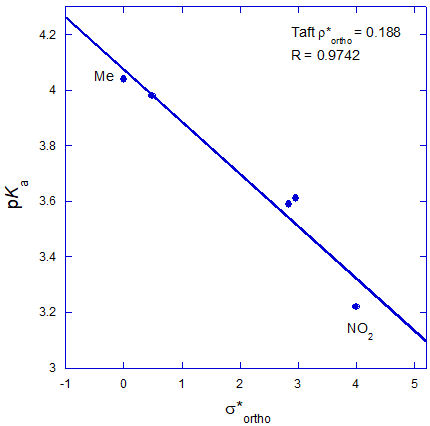
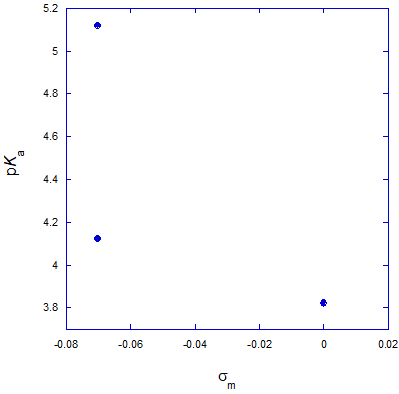
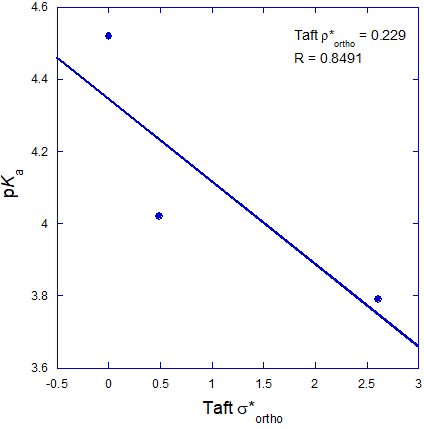
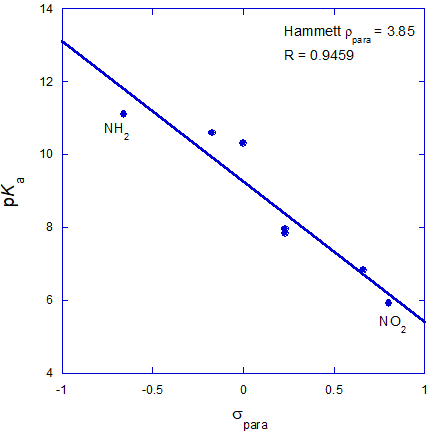
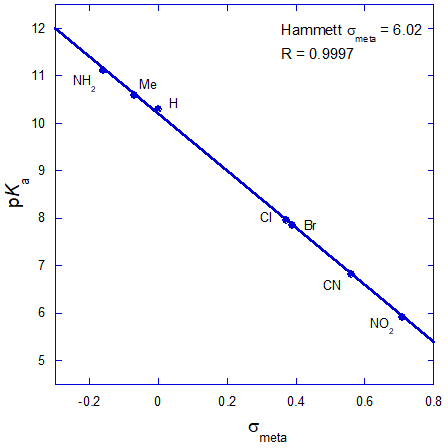
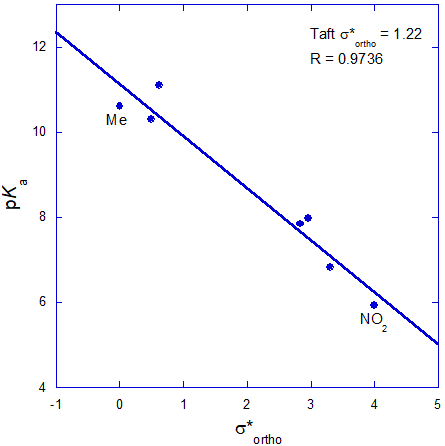
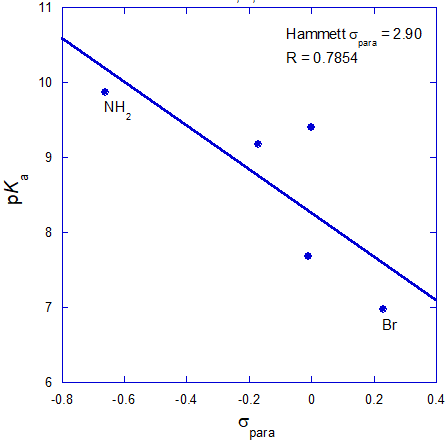
Hammett and Taft equations are applied to the acid dissociation equilibriums of 4 and 5-substituted furan, pyrrole, thiophene, tellurophene, isoxazole, pyrazole carboxylic acids, to solvolysis data of 4 and 5-substituted-2-furylmethylcarbinyl p-nitrobenzoates and to the permanganate ion oxidation of 5-substituted-2-furfurals. Excellent correlations were observed in these studies except in the case of 1-Me-4/5-X-3-pyrazole-COOH. In the case of 5-X-2-furoic, pyrrole, thiophene carboxylic acids only the substituent -COOH deviated from these correlations for which possible explanation is given in terms of intramolecular hydrogen bonding between the -COOH and the ring heteroatom and two types of intramolecular hydrogen bonding between -COOH and ring nitrogen atom and -COOH and H of NH of pyrrole. In the case of 3,5-X-4-isoxazole carboxylic acids the -NH2 group at 5 position deviated for which the explanation in terms of H-bonding between -NH2 and -COOH is given. Even the possibility of the formation of zwitterion is not ruled out. 5-X-1,2,3-triazole-4-carboxylic acids did not follow any LFER. The solvolysis rate constants of both 4 and 5-substituted-2-furylmethylcarbinyl p-nitrobenzoates correlated well with para substituent constants. Further the correlation with Brown’s σ+ values is still better. It is noteworthy that MnO4- oxidation of 5-X-2-furfural correlated well with all the para, meta and ortho substituent constants. An attempt is made for the first time by our laboratory to apply the LFER to 5 membered ring systems with one heteroatom viz. pyrroles, two heteroatoms viz. pyrazoles, imidazoles, isoxazoles, three heteroatoms viz. the triazoles and four heteroatoms viz. tetrazoles. For the first time we have shown that the pKa values of N(1)H-acidities of 3-X-pyrroles, 3-X-pyrazoles, 4-X-pyrazoles, 4-X-imidazoles, 3-X-1,2,4-triazole, 4-X-1,2,3-triazole and 5-X-1,2,3,4-tetrazoles correlated well with Hammett σ values.
Use of Hammett equation 1, 2, 3, 4 dealing with meta and para-substituted benzene derivatives and Taft equation 5, 6 dealing with ortho-substituted benzene derivatives in elucidating the reaction mechanisms in organic chemistry is indubitable. Since their introduction 1, 2, 3, 4, 5, 6 numerous publications have appeared in literature 3, 4 and are still being published to date. Application of Hammett equation and Taft equation to five membered aromatic heterocyclic ring systems was less commonly studied. The first application of Hammett law (not as an equation) 7 to furan ring was with 5-X-2-furoic acids 8. But this was quoted in reference 9 as it was published in 1935 10 even before the Hammett equation came into existence. In reference 9 by Freeman, it is surprising to see even a Hammett ρ value was reported for the dissociation of 5-X-2-furoic acids without knowing Hammett σ values because evaluation of Hammett σ values took place only in 1937 1. In spite of numerous works on the application of Hammett and Taft equations in organic chemistry, their application to five membered ring systems did not find much place in chemistry research 8, 11 except a one-page small publication appeared 55 years ago 9 and references cited there in. In this publication 9, the information of substituents in furan and thiophene derivatives used did not find a place. In the present work we have tried a deep insight with a total of 22 heterocyclic systems.
All the linear correlations were done using the KaleidaGraph software, Version 4.1, Reading, PA, USA. The chemical structures are drawn using ChemDraw software.
Visual observation of benzene and five membered heterocycles to look for the similarity of para, meta and ortho-carbons of benzene and 5th, 4th and 3rd carbons of five membered 5 or 4- or 3-(X)-2-(Y)-heterocycles:
As shown in scheme 1, it is known that all the six carbon atoms in the benzene ring are sp2 hybridized and benzene is a planar hexagon molecule.
|
This explains an equal possibility for the formation of C1 - C2, C3 - C4, C5 - C6 π bonds or C2 - C3, C4 - C5, C6 - C1 π bonds. The hybrid structure is represented by inserting a circle in the ring as shown above in scheme 1. Hence, it explains the formation of two resonance structures proposed by Kekulé 12 and they will always be in dynamic equilibrium.
|
At any given point of time during the dynamic equilibrium process of benzene, the statistical percentage of existence of either A and B in scheme 2 is 50:50. Now comparing the structure B and the structure of the 5-X-2-Y-heterocycle C of scheme 2, the functional group Y and the substituent X are separated by one single bond and two double bonds or simply by two pairs of π-electrons in benzene ring B and the heterocycle C. Therefore, it can be assumed that the substituent electronic effects can be transmitted from carbon 4 bearing the substituent X to the functional group Y at carbon 1 of the benzene. This kind of situation of structure C where in the substituent electronic effects can be transmitted from carbon 5 bearing the substituent X to the functional group Y at carbon 2 of the heterocycle would be just like that of structure B. Therefore carbon 5 of the structure C of scheme 2 could best be assumed as a para-carbon.
Similarly, now comparing structure E and the structure of the 4-X-2-Y-heterocycle F of scheme 3, the functional group Y and the substituent X are separated by one single bond and one double bond or simply by a pair of π-electrons. It can be assumed that the substituent electronic effects can be transmitted from carbon 3 bearing the substituent X to the functional group Y at carbon 1 of the benzene. This kind of situation of structure F where in the substituent electronic effects can be transmitted from carbon 4 bearing the substituent X to the functional group Y at carbon 2 of the heterocycle would be just like that of structure E. Therefore, the carbon 4 of the structure F could best be assumed as a meta-carbon.
|
Again, similar to the carbon 3 of the structure I could best be assumed as an ortho-carbon as shown in scheme 4.
|
In fact, molecular orbital calculations and dipole moment data of 2-X-thiophene carboxylic acids suggested that the para, meta and ortho carbons of benzene correspond to 5, 4 and 3 carbons of the 5 membered heterocycle 13, 14. From the correlation of carbon-13 chemical shifts versus 1H-proton chemical shifts, in which the striking parallelism of the resonance shifts of the benzene and five membered heterocycle nuclei, implies that the resonances of both nuclei respond in a parallel way to the local π-electron density on the carbon atom 15. And as such five membered heterocycles with one or two heteroatoms are planar pentagons. They have sp2 hybridized carbon atoms. They possess significant aromatic character resulting from the lone pair of electrons of the hetero atom/s and the two pairs of carbon π electrons.
Examples:
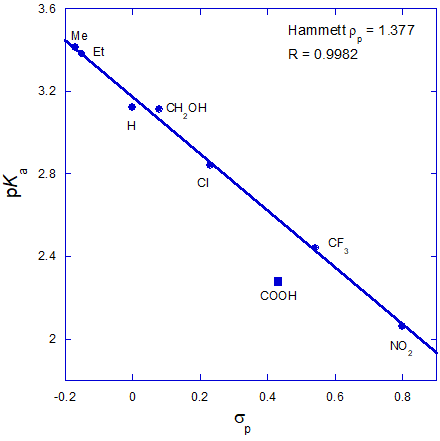
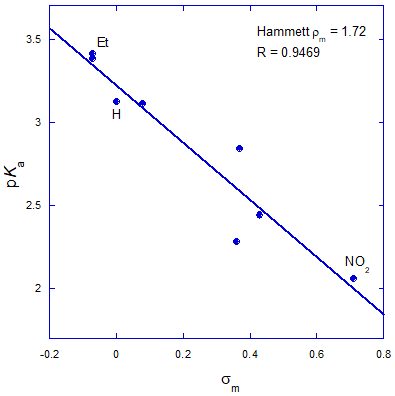
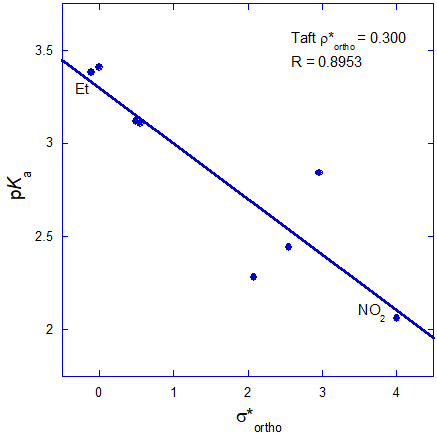
To start with, tables 1-4 show the pKa and Hammett substituent constants data of 5-X-2-furoicacids, 5-X-2-pyrrole carboxylic acids, 5-X-2-thiophene carboxylic acids and 5-X-2-tellurophene carboxylic acids respectively and figures 1-12 show the corresponding Hammett and Taft plots.
5-X-2-furoic acids:
Below is table 1 with the data of 5-X-2-furoic acids.


In figures 1-3, it is clear from the correlation coefficients, the pKa data of 5-X-2-furoic acids correlated well (Hammett ρp = 1.377, R = 0.9982) with Hammett σp values with a deviation of the lone -COOH substituent. This could be due to the weak hydrogen bonding interaction as shown below in scheme 5 in one of the 2-furoic acid (trans) conformers between H of -COOH and O of the ring 16. Therefore, good correlation of pKa data with para-substituent constants, the 5 position of the 2-furoic acid is best assumed as para-position.
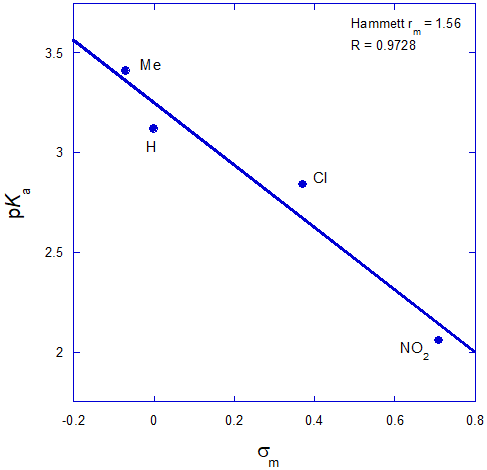
Freeman reported the Hammett ρm is for 5-X-2-furoic acids as 1.49 with a correlation coefficient of 0.943 taking the data from Catlin reference 10 9. There is no explanation in Freeman’s paper how he has achieved these values. But we replotted here in this work (starred data from table 1, figure 2A), taking the data from the journal Iowa State Coll. J. Sci., 10. The Hammett ρm is coming out to be 1.56 with a correlation coefficient of 0.9728 assuming 5-position as meta.
|
5-X-2-pyrrole carboxylic acids:
Below is the table 2 with the data of 5-X-2-pyrrole carboxylic acids.


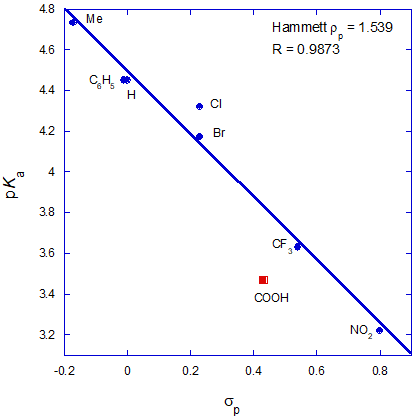
In the figures 4-6, it is clear from the correlation coefficients, the pKa data of 5-X-2-pyrrole carboxylic acids correlated well (Hammett ρp = -1.539, R = 0.9873) with Hammett σp values with a deviation of again the lone -COOH substituent. This could be due to two types of intramolecular hydrogen bonding interaction as shown below in scheme 6 17. Therefore the 5 position of the 2-pyrrole carboxylic acid is best assumed as para-position.
|
5-X-2-thiophene carboxylic acids:
Below is table 3 with the data of 5-X-2-thiophene carboxylic acids.


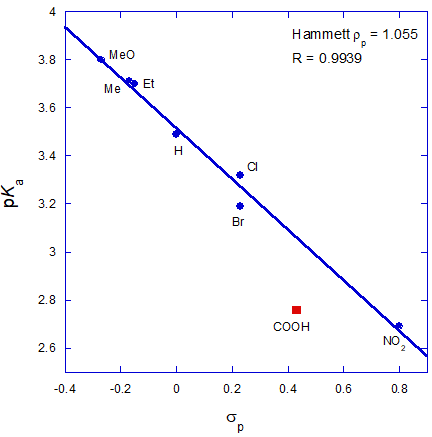
In the figures 7-9, it is clear from the correlation coefficients, the pKa data of 5-X-2-thiophene carboxylic acids correlated well (Hammett ρp = -1.055, R = 0.9939) with Hammett σp values with a deviation of again the lone -COOH substituent. This could be due to the week intramolecular hydrogen bonding interaction of H of COOH with S of thiophene ring as shown below in scheme 7. It is revealed in some protein interactions that though sulfur is a moderately good H-bond donor but also a week H-bond acceptor 18. Therefore, again the 5 position of the 2-thiophene carboxylic acid is best assumed as para-position.
|
5-X-2-tellurophen carboxylic acids:
Below is table 4 with the data of 5-X-2-tellurophene carboxylic acids.


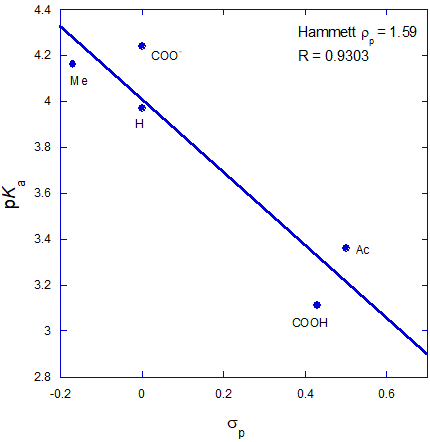
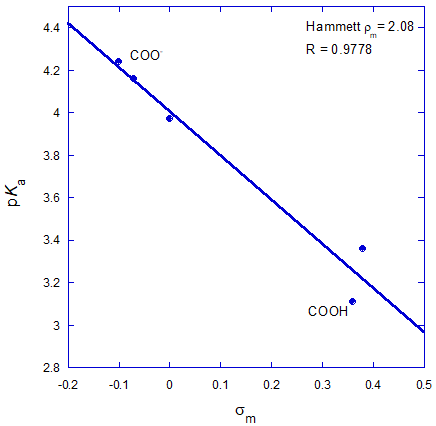
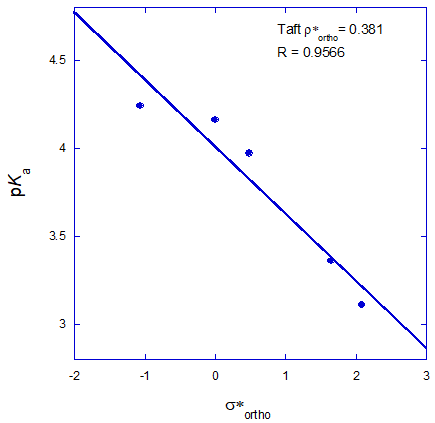
In the figures 10-12, it is clear from the correlation coefficients 0.9303, 0.9778 and 0.9566 the pKa data of 5-X-2-tellurophene carboxylic acids did not correlate well with any of the σ values. And certainly, the correlation with σp values is very poor (R = 0.9303). However, though the correlation coefficient of pKa values versus σ*ortho is less than that of with σm the points in figure 12 are evenly distributed on either side of the line of fit. Taking this argument into confidence the correlation of pKa values with σ*ortho needs a different explanation which is as follows: In benzene if we observe the substituent ortho to the functional group is in principle separated by a double bond again keeping in view of the statistical weight of the dynamic equilibrium of benzene or it simply needs a pair of π electrons (Scheme 4, H). In five membered ring system of 5-X-2-tellurophene carboxylic acid that lone π electron pair can be seen with tellurium. As tellurium has a maximum polarizability and bigger in size than either sulfur or oxygen 19 the substituent effect more easily be transmitted from the substituent to the functional group via tellurium rather than π electron pair of the five membered ring as shown below in scheme 8. And this could be the reason that the correlation with higher σm is better than σp and σ*ortho.
|
4-X-2-pyrrole carboxylic acids:
Below is theTable 5 with pKa, Hammett σp, σm and Taft  values of 4-X-2-pyrrole carboxylic acids


In figures 13-15 it is noteworthy to see that pKa values of 4-X-2-pyrrole carboxylic acids correlate well with both σp and σm substituent constants. This is best visualized in scheme 9. The transmission of substituent effect from X to COOH can take place in two directions one via carbon 5 and ring nitrogen and the other via carbon 3 as shown in scheme 9. If X behaves as a para-substituent, what it needs is a pair of two double bonds (see structure B of scheme 2) or a double bond and a pair of π electrons or a pair of non-bonded electrons. A pair of non-bonded electrons is from nitrogen. Therefore, the correlation with both σm and σp are good (figures 13 and 14).
|
4,5-X-3-isoxazole carboxylic acids

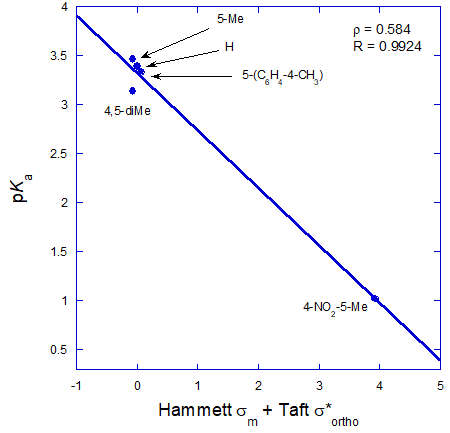
pKa values of 4,5-substituted-3-isoxazole carboxylic acids correlated well with (Hammett σm + Taft σ*ortho) (Table 6, figure 16) which indicates that the carbon 4 and carbon 5 of 3-isoxazole carboxylic acid just resemble as ortho and meta substituents respectively to COOH.
3,5-X-4-isoxazole carboxylic acids:

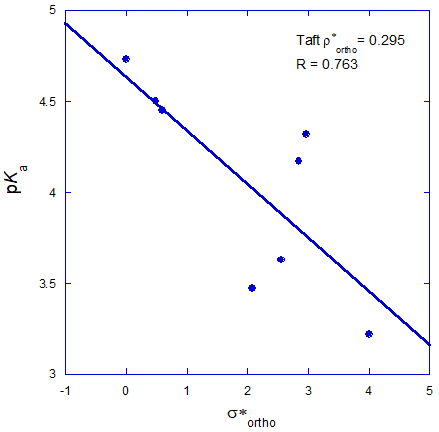
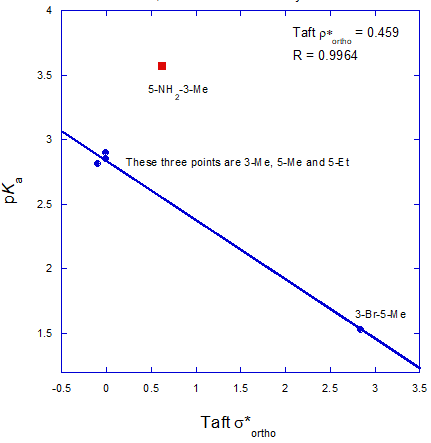
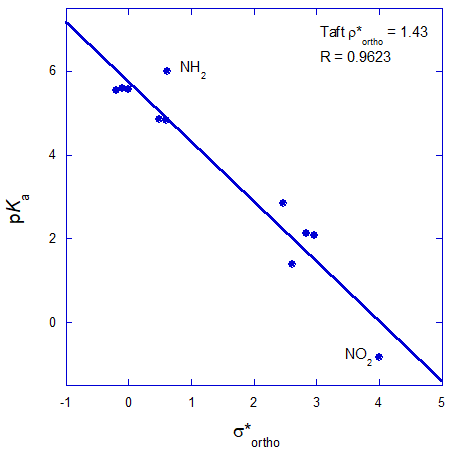
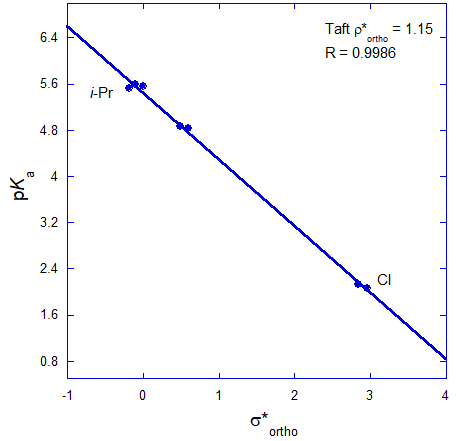
In 3,5-X-4-isoxazole carboxylic acids, the substituent X on either side of the functional group –COOH may just act as it is on ortho position. The deviation of the point of 5-NH2-3-Me in the correlation of pKa values with Taft σ*ortho of 3,5-X-4-isoxazole carboxylic acid may be due to the formation of a zwitterion or two types of intramolecular H-bonding as shown in scheme 10 below.
|
5-X-3-pyrazole carboxylic acids


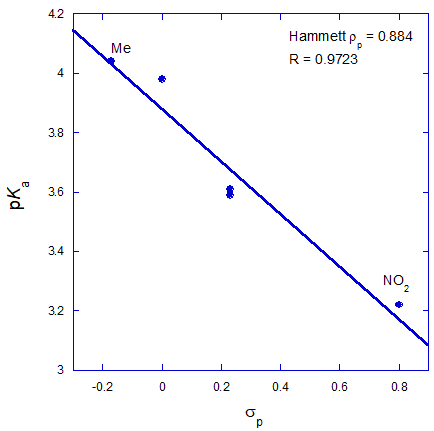
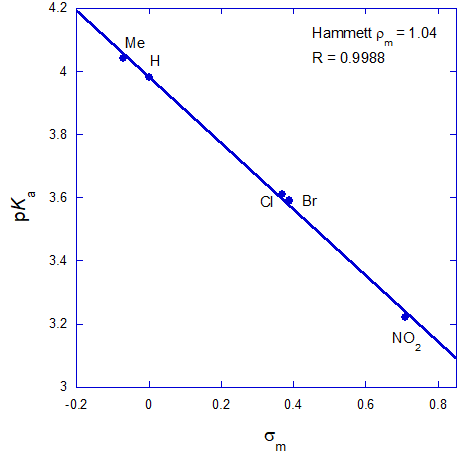
In figures 18-20, it is clear from the correlation coefficients, the pKa data of 5-X-3-pyrazole carboxylic acids correlated well (Hammett ρm = -1.04, R = 0.9988) with Hammett σm values. Therefore the 5 position of the 3-pyrazole carboxylic acid is best assumed as meta-position.
1-Me-4/5-X-3-pyrazole carboxylic acids:

1-Me-3-X-4-pyrazole carboxylic acids:

From the figures 21 and 22 with limited data it is hard to draw any conclusion.
Solvolysis data for 5-X-2-furylmethylcarbinyl p-nitrobenzoates:


4-X-2-furylmethylcarbinyl p-nitrobenzoates:


Brown’s σ+ values are from Y. Okamoto and H. C. Brown
J. Am. Chem. Soc.,80, 4979 (1958)
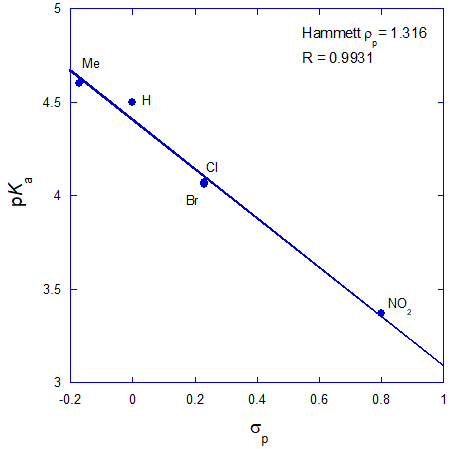
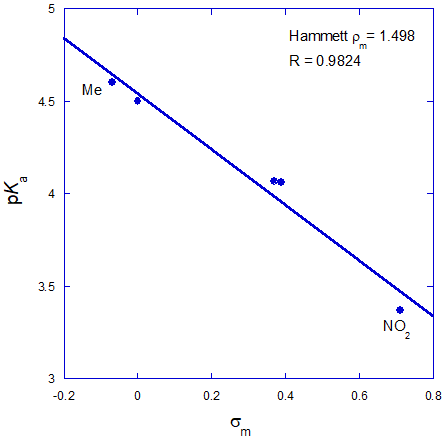
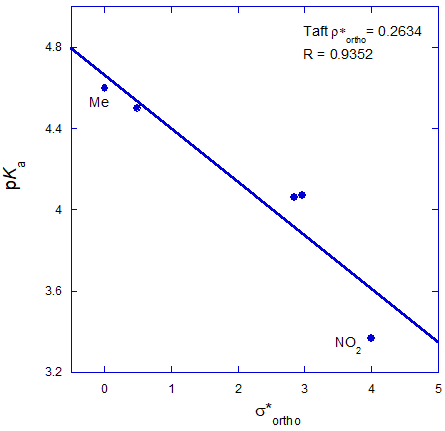
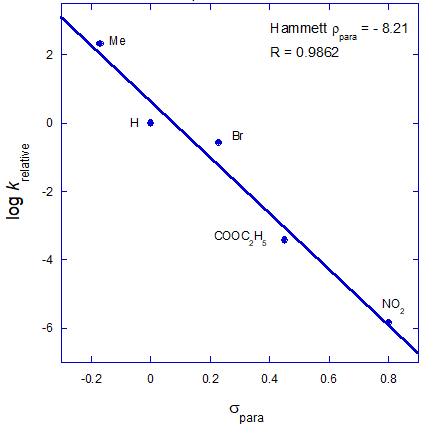
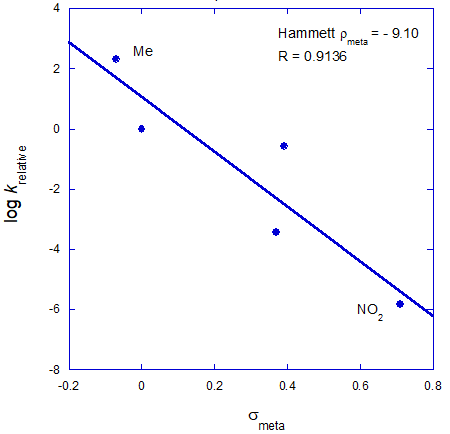
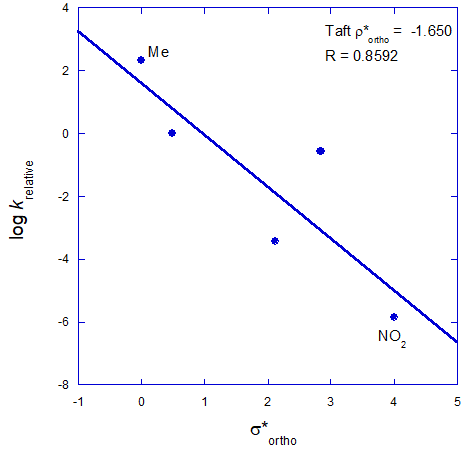
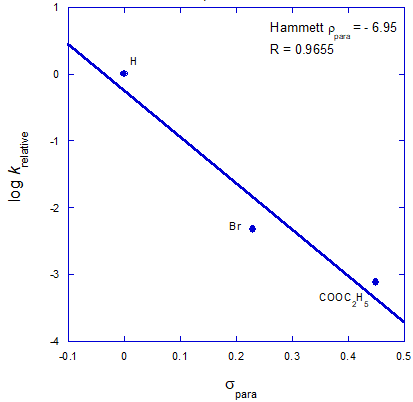
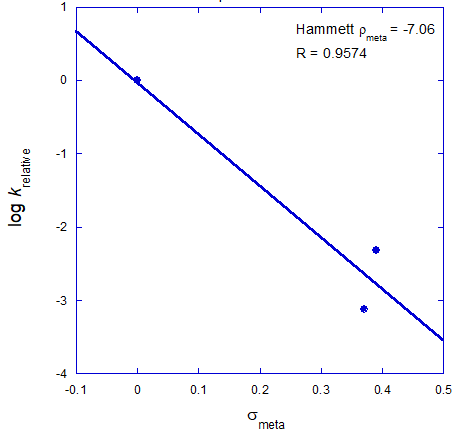
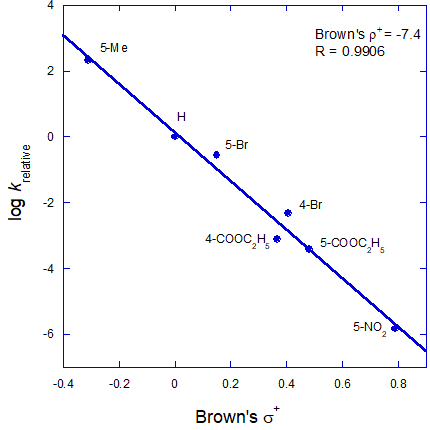
The rate constants krelative of the solvolysis of 5-X-2-furylmethylcarbinyl p-nitrobenzoates and 4-X-2-furylmethylcarbinyl p-nitrobenzoates were originally treated with Brown’s σ+ values 20. As the σ+ values are free from the mesomeric effects, the correlation was good irrespective of the position of the substituent 20. In the insight of the present work, we have tried the correlation of the rate data of the solvolysis of 5-X-2-furylmethylcarbinyl p-nitrobenzoates and 4-X-2-furylmethylcarbinyl p-nitrobenzoates separately assuming 5-X substituted derivatives as para-substituents and 4-X substituted derivatives as meta-substituents because it was shown that the 5 and 4 positions of 5-membered heterocycles just correspond to the para and meta positions of benzene ring 13, 14. Consequently, the rates of solvolysis of 5-X-2-furylmethylcarbinyl p-nitrobenzoates correlated well with σpara (figure 23) with a correlation coefficient of 0.9862 and the rates of solvolysis of 4-X-2-furylmethylcarbinyl p-nitrobenzoates correlated well with σmeta (figure 27) with a correlation coefficient of 0.9574.


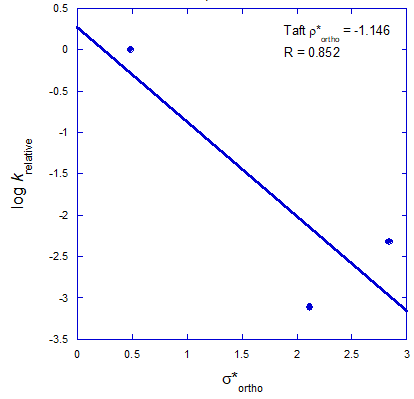
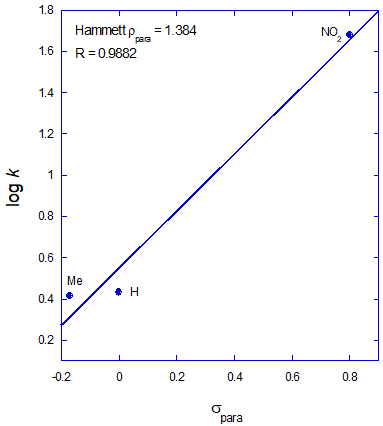
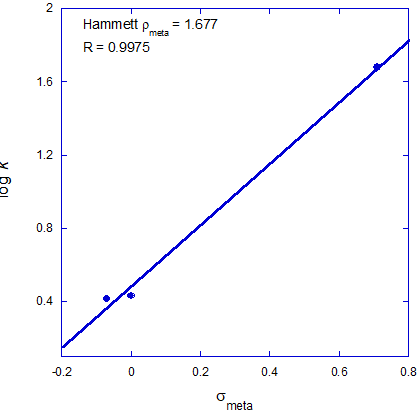
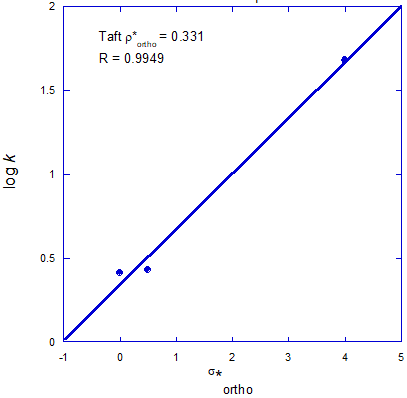
Rate data of MnO4- oxidation of 5-X-furfurals in aqueous neutral medium 21 correlated well with all the Hammett and Taft substituent constants for which we could not give any explanation. Yet the correlation with Hammett σmeta is slightly better (R = 0.9975) than the other two. This could be possible as the substituent and the functional group are separated by a pair of non-bonded electrons which come from oxygen (see scheme 3 structure E and F).However, Freeman reported 21 the Hammett plot log k2 versus σfor MnO4- oxidation of 5-X-furfurals in aqueous neutral and basic medium with substituents X = H, Me, n-Bu, Et, Cl and Br. Though MnO4- oxidation of 5-X-furfurals with X = NO2 studied but not shown in the Hammett plot. But the data is not available in this publication except the Hammett plot. Therefore, it was not possible to analyze the data in detail in the present study.
5-X-1, 2, 3-triazole-4-carboxylic acids:


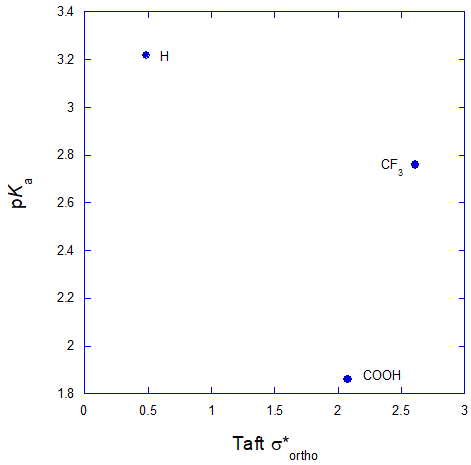
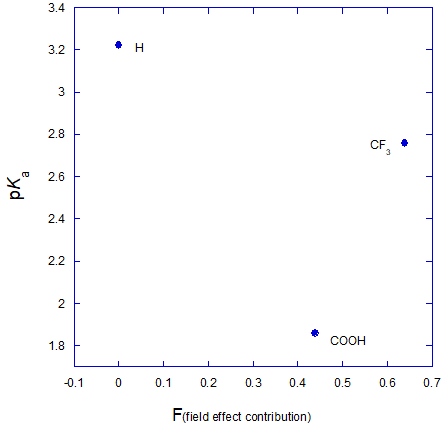
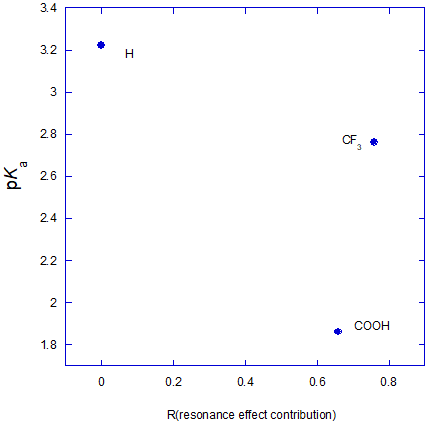
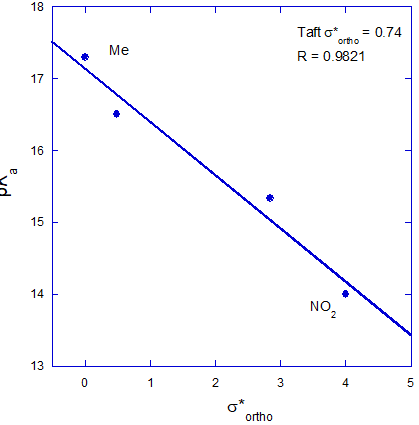
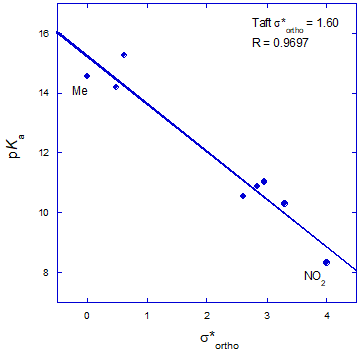
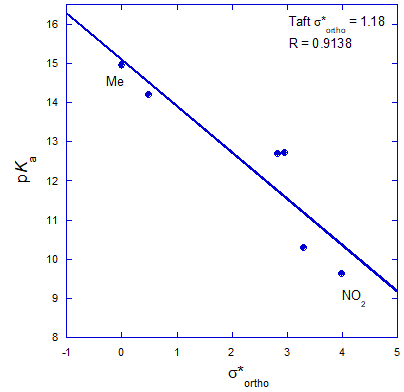
The plot of pKa versus Taft σ*ortho (figure 33) is not linear. Then we thought that using Swain and Lupton type equation (σ = fF + rR) 22 and plotting pKa versus F (field effect contribution) (figure 34) and pKa versus R (resonance effect contribution) (figure 35) to see the individual field and resonance effects on the acid dissociation. But none of them are linear. The non-linearity of any of the three plots could possibly be due to the involvement of various types of intramolecular hydrogen bonding in 5-X-1,2,3-triazole-4-carboxylic acids as shown below in scheme 11.

|
Due to the presence of these hydrogen bonding any of the substituent does not behave as if it is a pure isolated substituent, hence the non-linearity in the pKa versus Taft σ*ortho, pKa versus F and pKa versus R plots.
3-X-Pyrroles:


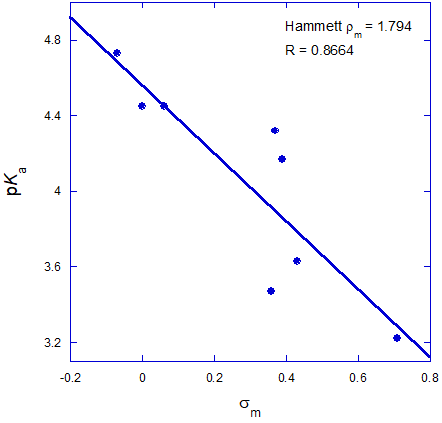
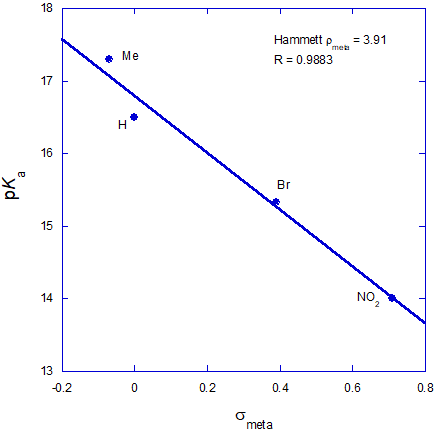
In the figures 36-38 it is clear from the correlation coefficients, the pKa data of 3-X-pyrroles correlated well (Hammett ρm = -3.91, R = 0.9883) with Hammett σm values. Therefore the 3 position of the 3-X-pyrroles is best assumed as meta-position.
3-X-pyrazoles:


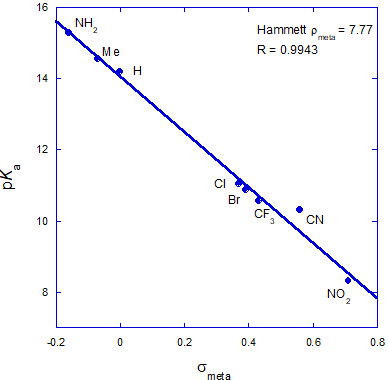
In the figures 39-41 it is clear from the correlation coefficients, the pKa data of 3-X-pyrazoles correlated well (Hammett ρmeta = - 7.77, R = 0.9943) with Hammett σm values. Therefore the 3 position of the 3-X-pyrazoles is best assumed as meta-position.
4-X-pyrazoles:


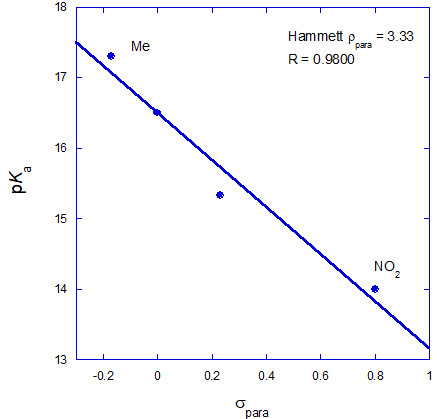
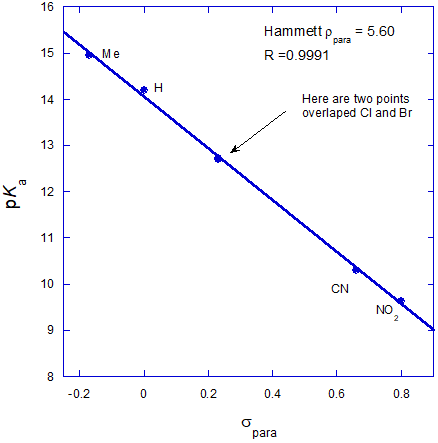
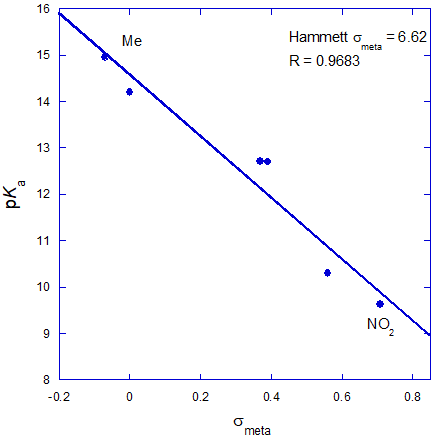
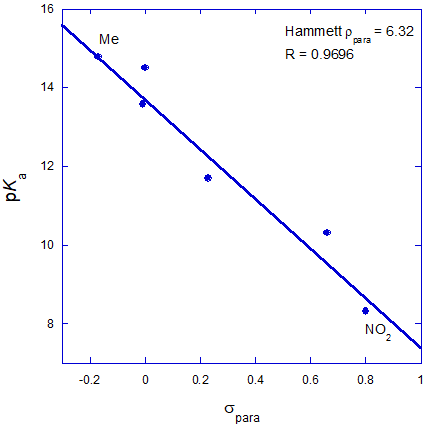
In the case of 4-X-pyrazoles the Hammett equation would have satisfied with σmeta values as the functional group (N1H) is only separated by a sp2 carbon as shown in the scheme 12A. But in the figures 42-44 it is clear from the correlation coefficients, the pKa data of 4-X-pyrazoles correlated well (Hammett ρpara = - 5.60, R = 0.9991) with Hammett σpara values. Therefore the 4 position of the 4-X-pyrazoles is best assumed as para-position. And the substituent effect may best be transmitted via sp2 carbon and sp2 nitrogen as shown in scheme 12 B.
|
4-X-imidazoles:


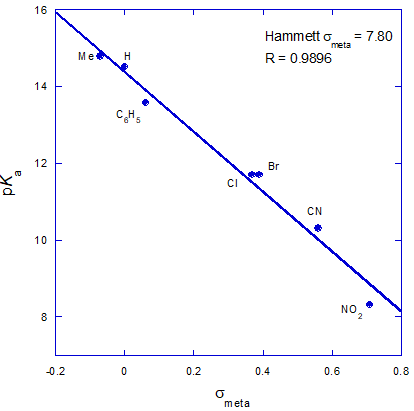
In the figures 45-47 it is clear from the correlation coefficients, the pKa data of 4-X-imidazoles correlated well (Hammett ρmeta = - 7.80, R = 0.9896) with Hammett σm values. Therefore the 4 position of the 4-X-imidazoles is best assumed as meta-position. The substituent effect may be better transmitted through the 5 positioned sp2 carbon.
3-X-1, 2, 4-triazole


In the figures 48-50 it is clear from the correlation coefficients, the pKa data of 3-X-1,2,4-triazole correlated well (Hammett ρm = -6.02, R = 0.9997) with Hammett σm values. Therefore the 3 position of the 1-substituted (N1H) 3-X-1,2,4-triazole is best assumed as meta-position. The situation here is analogous to structure F of scheme 3 as shown below in scheme 13.
|
It is to be understood that when the substituent is at 2 position like Y in structure F of scheme 3, 4 position becomes meta. Similarly, when the substituent (N1H) is at 1 position like in 3-X-1,2,4-triazole, 3 position becomes meta.
4-X-1, 2, 3-triazole:


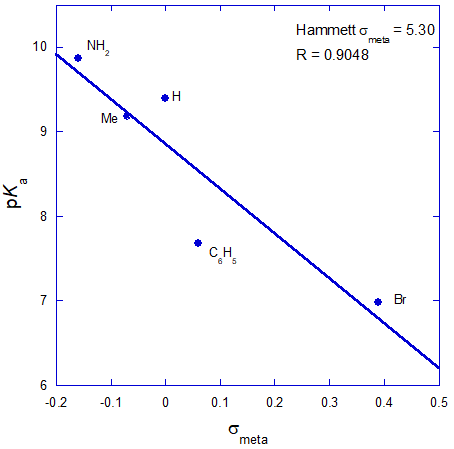
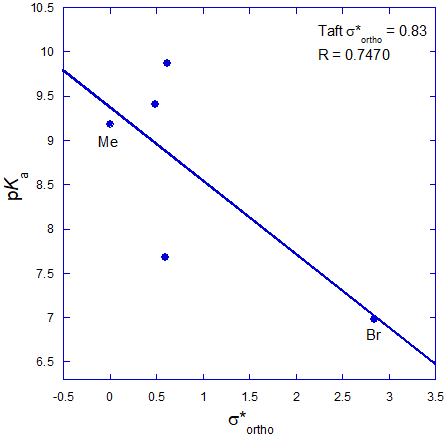
In the figures 51-53 it is clear from the correlation coefficients, the pKa data of 4-X-1,2,3-triazole correlated well (Hammett ρm = -5.30, R = 0.9048) with Hammett σm values. Therefore the 4 position of the 1-substituted (N1H) 4-X-1,2,3-triazole is best assumed as meta-position. The situation again here is analogous to structure F of scheme 3 as shown below in scheme 14 but in the opposite direction via carbon 5.
5-X-1, 2, 3, 4-tetrazoles


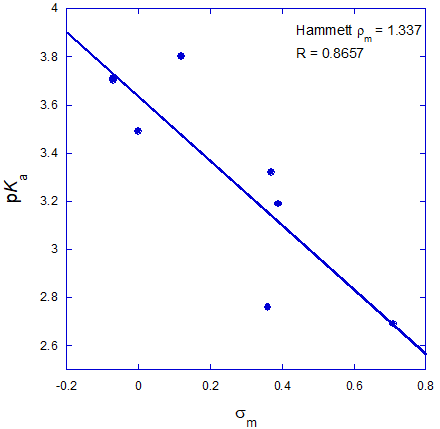
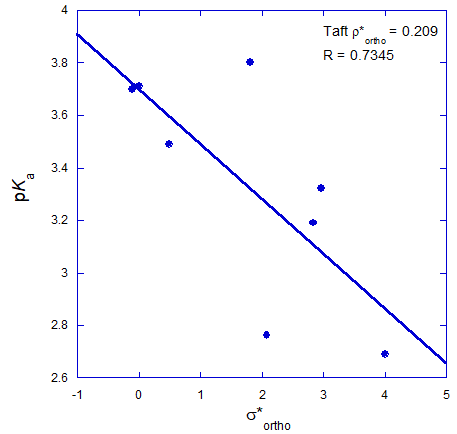
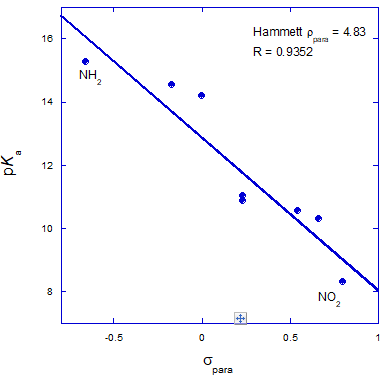
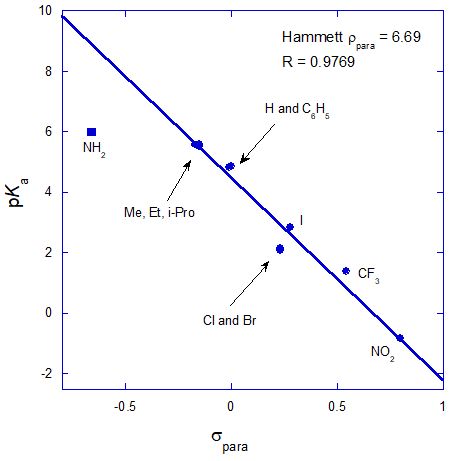
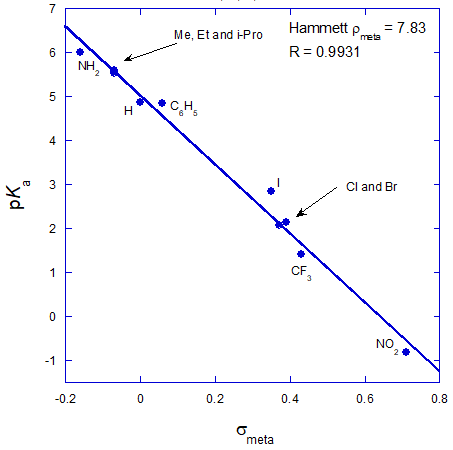
The effect of substituents (X) on the pKa values of 5-X-1, 2, 3, 4-tetrazoles is rather complex 23.Tetrazole itself is a strange molecule with 80% nitrogen of the total weight of the molecule. It is known that the tetrazole molecule exists in two tautomeric forms as shown in scheme 15 24. In a nonpolar medium, both the 1Hand 2Htautomers are predicted to exist in comparable amounts. In the solvents like water with high dielectric constant the existence of more polar 1H-tautomer is appreciable 24. From figures 54-57, the correlation of pKa values with para and meta substituents is good (R = 0.9769 and 0.9931) with a deviation of NH2 group with the para-substituents correlation.
|
Though the content of 2H-tautomer is less than the 1H-tautomer in more polar solvents (since the pKa values are from water as the solvent 23), yet the para and meta substituent effects originate from less abundant 2H-tautomer. If one looks at the 2H-tautomer (scheme 15), the functional group (N2-H) is at meta to X at position 5 via nitrogen 1 and it will be para to X at position 5 via nitrogen 3 and 4. This is just like the visual observation for defining the para and meta positions of 5 membered heterocycles as given in scheme 2 and scheme 3. This is the reason that the pKa values are well correlated with both Hammett σpara and σmeta substituent constants. The deviation of NH2 in the correlation with para substituents may be due to the intramolecular hydrogen bonding as shown in scheme 16.
|
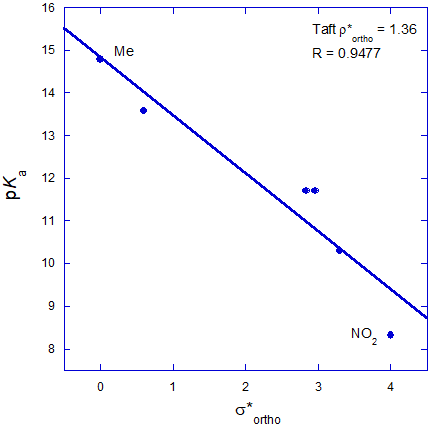
From Taft plots given in figures 56 and 57 it may be assumed that the ortho-substituent effects originate from 1H-tautomer. If one looks at the 1H-tautomer (scheme 15), the functional group (N1-H) is at ortho to X adjacent to nitrogen 1. This is just similar to the visual observation for defining the ortho position of 5 membered heterocycles as given in scheme 4. Also, it is noteworthy to see the correlation is improved without the bulky groups like CF3, I and NO2 (figure 57).
Table 22 gives a quick glance of the whole work. The readers should note that the Hammett and Taft reaction constants (ρ and ρ*) are given as positive numbers though as they were obtained as negative numbers in the plots because the plots were done using pKa (= - log Ka) values.
Hammett and Taft equations are applied to a total of 22 five-membered heterocyclic ring systems.
The authors declare that they don’t have any kind of competing interest.
The authors did not receive any kind funding from any financial resources.
| [1] | Hammett. L. P., J. Am. Chem. Soc., vol. 59, page 96 (1937). | ||
| In article | View Article | ||
| [2] | Hammett. L. P., "Physical Organic Chemistry." McGraw Hill Book Co., Inc., New York, 1940, P. 184. | ||
| In article | |||
| [3] | Jaffé, H. H, Chem. Rev., 53, 191 (1953). | ||
| In article | View Article | ||
| [4] | Wells, P. R., Chem. Rev., 63, 171 (1963). | ||
| In article | View Article | ||
| [5] | Taft, R. W.J. Am. Chem. Soc.1952, 74, 2729 and 3120. | ||
| In article | View Article | ||
| [6] | Taft, R. W.J. Am. Chem. Soc.1953, 75, 4538. | ||
| In article | View Article | ||
| [7] | L. P. Hammett, Chem. Revs., vol. 17, page 125, 1935. | ||
| In article | View Article | ||
| [8] | Imoto, E. and Motoyama, R., Bull. Naniwa Univ., Series A. 2. 127 (1954). | ||
| In article | |||
| [9] | F. Freeman, J. Chem. Edn., vol. 47, page 140, 1970. | ||
| In article | View Article | ||
| [10] | Catlin, W.E., Iowa State Coll. J. Sci., 10, 65 (1935). | ||
| In article | |||
| [11] | Salo Gronowitz, Thiophene and its derivatives part 2 in The Chemistry of Heterocyclic Compounds, an Interscience publication, 1986 by John Wiley &Sons, Inc. | ||
| In article | View Article | ||
| [12] | A. Kekulé, Justus Liebigs Ann. Der Chemie, Vol. 162, page 77-124, 1872, . | ||
| In article | View Article | ||
| [13] | Melander L. Ark. Kemi, 11, 397 (1957). | ||
| In article | View Article | ||
| [14] | Ram Keswani and Henry Freis, J. Am. Chem. Soc.,71, I789 (1949) | ||
| In article | View Article | ||
| [15] | (a) H. Spiesecke and W. G. Schneider, J. Chem. Phys., 35,731 (1961), (b) Tetrahedron Letters, 468, 1961. | ||
| In article | View Article | ||
| [16] | A.Halasa, L. Lapinski, I. Reva, H. Rostkowska, R. Fausto, and M. J. Nowak, J. Phys. Chem. A 2015, 119, 1037-1047. | ||
| In article | View Article PubMed | ||
| [17] | Advances in heterocyclic chemistry, Ed. A. R. Katritzky and A. J. Boulton, Vol. 20, page 37, Academic Press, New York, 1976. | ||
| In article | |||
| [18] | Zhou P, Tian F, Lv F, Shang Z., Proteins, 2009, 76, page 151-63. | ||
| In article | View Article PubMed | ||
| [19] | The bacterial response to the chalcogen metalloids Se and Te by D. Zannoni, F. Borsetti, J. J. Harrison and R. J. Turner in Advances in microbial physiology, Ed. By Robert K. Poole, Academic Press, First Edition 2008, page 4. | ||
| In article | |||
| [20] | Donald S. Noyce and Gary V. Kaiser, J. Org. Chem., vol. 34, page 1008, 1969. | ||
| In article | View Article | ||
| [21] | F. Freeman, J. B. Brant, N. B. Hester, A. A. Kamego, M. Kasner, T. G. Mclaughlin, and E. W. Paull, The Journal of Organic Chemistry, vol. 35, page 985, 1970. | ||
| In article | View Article | ||
| [22] | C. G. Swain and E. C. Lupton, Jr., Journal of the American Chemical Society, 90,4328, 1968. | ||
| In article | View Article | ||
| [23] | R. E. Trifonov and V. A. Ostrovskii, Russian Journal of Organic Chemistry, 2006, Vol. 42, No. 11, pp. 1585-1605. | ||
| In article | View Article | ||
| [24] | Ming Wah Wong, Regis Leung Toung and Curt Wentrup, J . Am. Chem. Soc. 1993, 115, 2465-2472. | ||
| In article | View Article | ||
Published with license by Science and Education Publishing, Copyright © 2025 Sanjeev Rachuru and V. Jagannadham
 This work is licensed under a Creative Commons Attribution 4.0 International License. To view a copy of this license, visit
http://creativecommons.org/licenses/by/4.0/
This work is licensed under a Creative Commons Attribution 4.0 International License. To view a copy of this license, visit
http://creativecommons.org/licenses/by/4.0/
| [1] | Hammett. L. P., J. Am. Chem. Soc., vol. 59, page 96 (1937). | ||
| In article | View Article | ||
| [2] | Hammett. L. P., "Physical Organic Chemistry." McGraw Hill Book Co., Inc., New York, 1940, P. 184. | ||
| In article | |||
| [3] | Jaffé, H. H, Chem. Rev., 53, 191 (1953). | ||
| In article | View Article | ||
| [4] | Wells, P. R., Chem. Rev., 63, 171 (1963). | ||
| In article | View Article | ||
| [5] | Taft, R. W.J. Am. Chem. Soc.1952, 74, 2729 and 3120. | ||
| In article | View Article | ||
| [6] | Taft, R. W.J. Am. Chem. Soc.1953, 75, 4538. | ||
| In article | View Article | ||
| [7] | L. P. Hammett, Chem. Revs., vol. 17, page 125, 1935. | ||
| In article | View Article | ||
| [8] | Imoto, E. and Motoyama, R., Bull. Naniwa Univ., Series A. 2. 127 (1954). | ||
| In article | |||
| [9] | F. Freeman, J. Chem. Edn., vol. 47, page 140, 1970. | ||
| In article | View Article | ||
| [10] | Catlin, W.E., Iowa State Coll. J. Sci., 10, 65 (1935). | ||
| In article | |||
| [11] | Salo Gronowitz, Thiophene and its derivatives part 2 in The Chemistry of Heterocyclic Compounds, an Interscience publication, 1986 by John Wiley &Sons, Inc. | ||
| In article | View Article | ||
| [12] | A. Kekulé, Justus Liebigs Ann. Der Chemie, Vol. 162, page 77-124, 1872, . | ||
| In article | View Article | ||
| [13] | Melander L. Ark. Kemi, 11, 397 (1957). | ||
| In article | View Article | ||
| [14] | Ram Keswani and Henry Freis, J. Am. Chem. Soc.,71, I789 (1949) | ||
| In article | View Article | ||
| [15] | (a) H. Spiesecke and W. G. Schneider, J. Chem. Phys., 35,731 (1961), (b) Tetrahedron Letters, 468, 1961. | ||
| In article | View Article | ||
| [16] | A.Halasa, L. Lapinski, I. Reva, H. Rostkowska, R. Fausto, and M. J. Nowak, J. Phys. Chem. A 2015, 119, 1037-1047. | ||
| In article | View Article PubMed | ||
| [17] | Advances in heterocyclic chemistry, Ed. A. R. Katritzky and A. J. Boulton, Vol. 20, page 37, Academic Press, New York, 1976. | ||
| In article | |||
| [18] | Zhou P, Tian F, Lv F, Shang Z., Proteins, 2009, 76, page 151-63. | ||
| In article | View Article PubMed | ||
| [19] | The bacterial response to the chalcogen metalloids Se and Te by D. Zannoni, F. Borsetti, J. J. Harrison and R. J. Turner in Advances in microbial physiology, Ed. By Robert K. Poole, Academic Press, First Edition 2008, page 4. | ||
| In article | |||
| [20] | Donald S. Noyce and Gary V. Kaiser, J. Org. Chem., vol. 34, page 1008, 1969. | ||
| In article | View Article | ||
| [21] | F. Freeman, J. B. Brant, N. B. Hester, A. A. Kamego, M. Kasner, T. G. Mclaughlin, and E. W. Paull, The Journal of Organic Chemistry, vol. 35, page 985, 1970. | ||
| In article | View Article | ||
| [22] | C. G. Swain and E. C. Lupton, Jr., Journal of the American Chemical Society, 90,4328, 1968. | ||
| In article | View Article | ||
| [23] | R. E. Trifonov and V. A. Ostrovskii, Russian Journal of Organic Chemistry, 2006, Vol. 42, No. 11, pp. 1585-1605. | ||
| In article | View Article | ||
| [24] | Ming Wah Wong, Regis Leung Toung and Curt Wentrup, J . Am. Chem. Soc. 1993, 115, 2465-2472. | ||
| In article | View Article | ||