In the dairy industry, the resazurin (RZ) test is used as a measure of microbial reduction capability, and thus to determine the quality and shelf life of milk. Milk is mixed with RZ solution and the fluorescence of the resulting resorufin (RS), or colour change from blue (RZ) to magenta (RS), is measured. The more bacteria present in the milk, the more the conversion of RZ to RS. The RZ test is therefore used to check the hygiene of milk production and the freshness and quality of the milk. The following groups of bacteria are primarily responsible for the reduction of resazurin in milk: 1. Lactic acid bacteria (LAB): Lactococcus, Lactobacillus and Streptococcus (e.g. S. thermophilus). These bacteria are often found in raw milk and starter cultures. They are facultative anaerobes with an active redox system (e.g. NADH/H⁺), which can transfer electrons to resazurin. 2. Enterobacteria Genera: Escherichia, Enterobacter and Klebsiella. These bacteria occur in poor hygiene conditions or in the presence of faecal contamination. They have high reduction activity and can decolorise resazurin very quickly. 3. Pseudomonads genus: Pseudomonas (e.g. P. fluorescens): common psychrotrophs in refrigerated milk. They exhibit high activity in redox metabolism and can rapidly reduce resazurin, particularly during prolonged storage. 4. Clostridia: Strictly anaerobic spore formers (e.g. Clostridium butyricum). They can reduce resazurin under anaerobic conditions, particularly in silage-contaminated milk. 5. Bacillus species: Aerobic spore formers that can also contribute to reduction through their metabolic activity. In the present work, the RZ/RS system has been studied by fluorescence and electrogenerated surface-enhanced Raman-Spectroelectrochemistry (EC-SERS) to determine the quality of milk. In addition to the analytical background of the RZ/RS system, fluorovoltammograms demonstrate how fluorescence intensity changes during electrochemical transitions between RZ and RS, providing an indication of which bacteria can reduce RZ. The electrochemistry and fluorescence of RZ and RS are influenced by physically dissolved O2 in water which occurs at a similar potential as the reduction of RZ to RS. In addition, oxygen partially quenches the fluorescence. When using the RZ method, the oxygen content of the milk must first be measured. Correction factors are used to calculate the quenching effect. In the EC-SERS Raman voltammograms, the Raman intensities change during the electrochemical formation of the nanostructured Ag electrode surface. During the corresponding chemical reactions between RZ and RS, the Raman transitions shift, which has been explained in detail for the Raman transitions between 500 and 600 cm-1. We show that the change in SERS Raman spectrum from RZ to RS can also be used to investigate the increasing bacterial contamination of milk. As we cannot determine the quantitative bacterial contamination, we are not able to compare the sensitivity of the two methods: Fluorescence and SERS Raman.
Dyes play an important role in analytical chemistry as pH and redox indicators, for staining specimens and for measuring absorbance and fluorescence.
Resazurin (RZ), also known as Alamar Blue, is a weakly fluorescent dye, but its reduced species, resorufin (RS), is strongly fluorescent. This fact is exploited in cell biology: to test cell viability and cytotoxicity of substances, the viability of cells is tested with RZ: if the cells are functioning normally, cell enzymes reduce RZ to the fluorescent RS.
In the dairy industry, the resazurin test is used as a measure of microbial reduction capacity and thus to determine the quality and shelf life of milk 1. Milk is mixed with RZ solution and the fluorescence of the resulting RS or the colour change from blue (RZ) to mauve (RS) is measured. The more bacteria present in the milk, the more the conversion of RZ to RS takes place. The resazurin test is therefore used to check the hygiene of milk production and the freshness and quality of the milk. Davis et al. explore the enzymatic pathways leading to the colorimetric change of resazurin due to bacterial metabolism. 2
The use of the RZ/RS system in the chemistry university lessons can be highly beneficial for a number of reasons, particularly in illustrating key chemical and biochemical concepts:
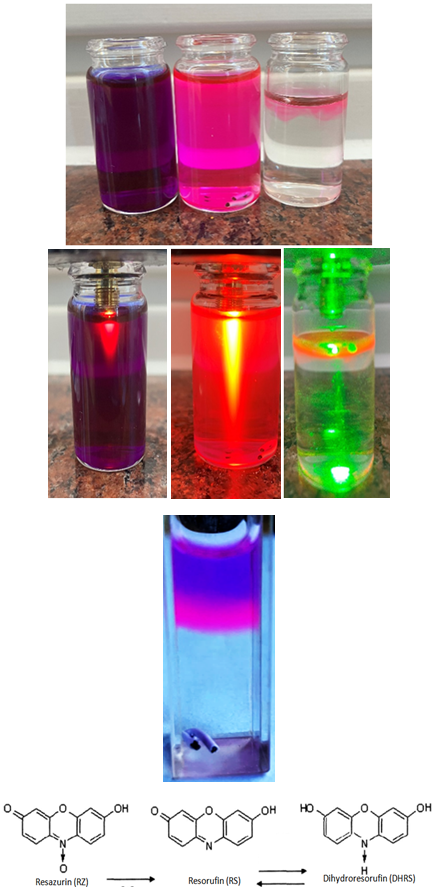
The system involves a visually striking colour change (e.g. from blue to pink for RZ to RS and finally to colourless for DHRS), making it an engaging way to capture students' attention. The colour changes correspond to redox reactions, all owing students to observe these abstract processes in real time. The RZ/RS/DHRS system is a redox indicator that highlights the transfer of electrons, a fundamental concept in chemistry. This makes it an excellent tool for teaching the principles of oxidation and reduction. Redox reactions are essential in metabolism and cellular respiration, so this system also links chemistry concepts to biology. The system is often used in biotechnology and microbiology (e.g. as an indicator of metabolic activity in cell cultures, see above). Discussing these applications can demonstrate the relevance of chemistry to real-world problems, such as assessing cell viability or testing for bacterial contamination. It can be used in discussions about pollution monitoring or water quality testing. The RZ/RS/DHRS system is generally safe and easy to use, making it suitable for demonstrations and hands-on experiments. The materials required are relatively inexpensive and widely available, making it accessible to a variety of educational settings. The RZ/RS/DHRS system provides a straightforward system for exploring reaction mechanisms, such as the stepwise reduction from RZ (blue) to RS (pink) and finally to DHRS (colourless). The system allows quantitative experiments using fluorescence, fluorovoltammetry, as the intensity of the fluorescence change is species dependent and proportional to the concentration of the reduced or oxidised species. SERS Raman voltammetry is easy to perform and the change in Raman transitions can be an unambiguous indicator of the presence of the species. Therefore, there are two different analytical methods for determining milk quality: fluorescence and SERS Raman spectroscopy.
RZ is a blue coloured and low fluorescent substance and can be electrochemically reduced or by another substance (e.g. glucose) to the pink and highly fluorescent RS. RS can be further reduced to dehydroresorufin (DHRS) at a higher (negative) reduction potential or with strong reducing agents such as sodium dithionite. Its aqueous solution of DHRS is colourless and does not fluoresce (Figure 1).

The reaction of RZ to RS is irreversible, the reaction between RS and DHRS is reversible, see reaction diagram, Figure 1 bottom. This is shown by the fact that DHRS is oxidised to RS in air, whereas RS is not oxidised to RZ (Figure 1, top). The reduction of RZ to RS and of RS to DHRS can take place wet-chemically under alkaline conditions with glucose or much more rapidly with sodium dithionite.
In school chemistry, the blue bottle experiment is often carried out, in which the colour change caused by the oxidation of glucose by methylene blue to leucomethylene blue and the reaction back to methylene blue by atmospheric oxygen is optically observed.
A similar experiment is the reaction of RZ with glucose, the so-called 'Vanishing Valentine' experiment 3. Here, colour changes between mauve and colourless are observed. When shaken, DHRS reacts with atmospheric oxygen and RZ is formed again.
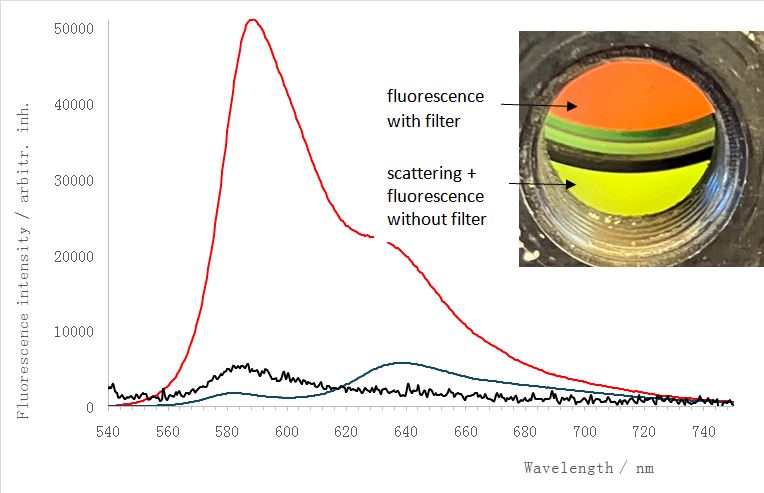
The fluorescence of RZ, RS and DHRS (concentration 10-4 mol/L, each) is shown in Figure 2. Excitation is by laser (= 532 nm).

The strong fluorescence of RS is clearly visible (maximum emission around 585 nm with a shoulder around 638 nm from RZ still present). The fluorescence of RZ is less pronounced and has a maximum at around 638 nm. The low fluorescence of RZ around 585 nm is due to the fact that RZ contains small traces of RS (purity 95%). DHRS does not fluoresce (black curve in figure 2).
If a (low-cost) photomultiplier (that does not spectrally resolve fluorescence) is used instead of a spectrometer, a notch filter (530 nm) must be used to suppress laser light scattering (see inset of Figure 2).
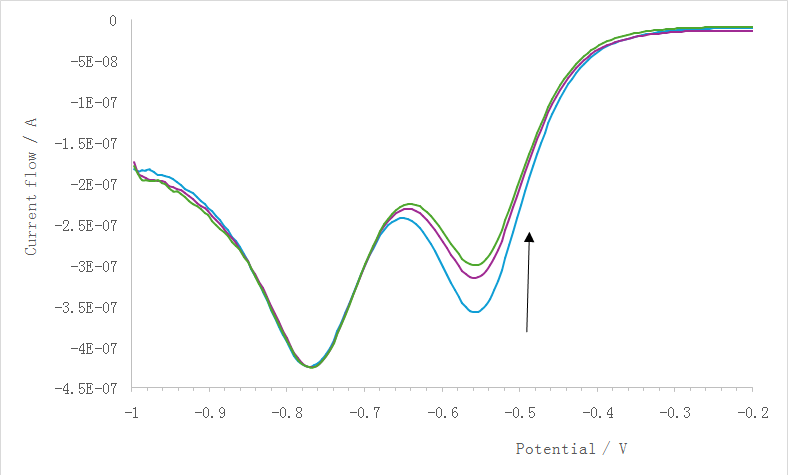
Figure 3 shows the differential pulse voltammogram (DPV) of RZ on a carbon working electrode, three times in succession. The decrease of the current peak at -0.55 V can be seen, while the current peak at -0.77 V remains constant. Ibanez et al 3 attribute the current peak to the reductions RZ -> RS (-0.55 V) and RS -> DHRS (-0.77 V). The reduction of dissolved oxygen to OH- is also around -0.55 V. As the oxygen at the electrode decreases with each DPV cycle, this current peak also decreases.

Using the RZ system as an indicator of bacterial contamination, these bacteria must have a reduction potential of less than -0.6 V.
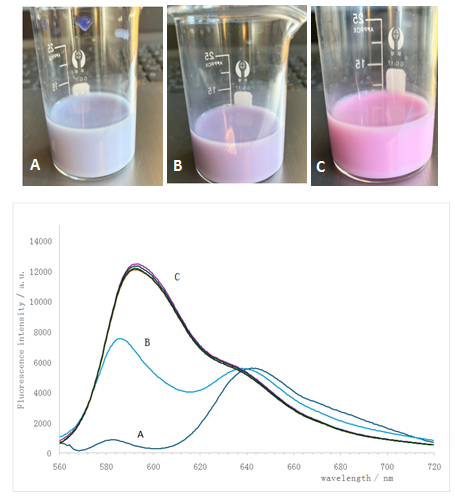
2.2. Fluorescence of RZ/RS in Milk at Different Levels of ContaminationA concentration of 0.01% w/v (0.01 g RZ in 100 mL distilled water) was used to determine the freshness of milk. This solution can be stored in the dark in the refrigerator and is stable for about 1-2 weeks. Add 100 L of the RZ solution to 1 ml of milk in a cuvette. This solution is diluted with 2 mL of distilled water. The fluorescence is immediately analysed. Figure 4 shows the results for A) fresh milk, B) milk after 6 h in the sun and C) 10 h in the sun outdoors. The beaker was sealed with parafilm. For each measurement, the temperature was 35-37°C.

The colour and fluorescence changes are clearly visible: The colour changes from light blue to light pink to deep pink. In the fluorescence spectra, curve A shows the fluorescence of RZ (max = 640 nm) and a slight fluorescence at about 585 nm due to the contamination of the RZ solution used with RS (purity level 95%). After bacterial contamination of the milk, RS has formed and the fluorescence of RS increases (B and C).
2.3. FluorovoltammogramsTo extend the knowledge of fluorescence, it seems useful to measure the change in fluorescence as a function of the applied potential, as this complements the change in fluorescence due to the chemical reduction of RZ to RS. 4 The students will thus discover the analogy between reduction by chemical and electrochemical reactions.
Fluorovoltammograms were measured using a bifurcated fibre consisting of one excitation and six readout fibres. The excitation fibre is connected to the excitation laser (532 nm), the readout fibre is connected to either a fibre spectrometer or a photomultiplier to measure the spectral resolved or the total fluorescence through a notch filter (absorption of 106 of the primary laser radiation). The fibre is attached a few millimetres above the gold or silver screen-printing electrode (SPE).
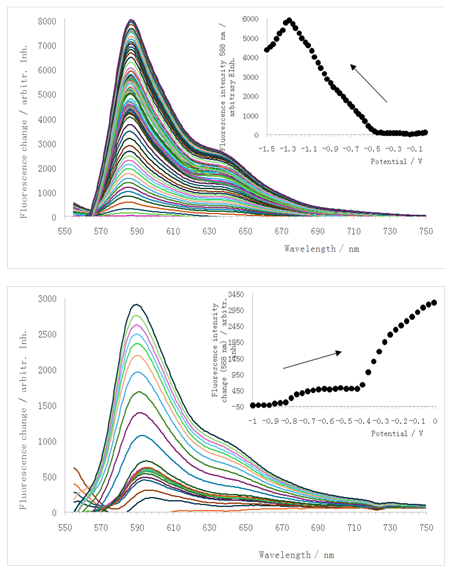
Figure 5 shows the fluorescence spectra of RZ (top) and DHRS (bottom) and, as an insert, the potential-dependent fluorescence intensity at max = 588 nm, once from 0 V to -1.5 V and once from -1 V to 0 V. To produce DHRS, RZ was titrated with sodium dithionite solution to colourless.

The fluorovoltammogram figure 5, above shows the onset of fluorescence at about -0.55 V, the reaction from RZ to RS. However, the fluorescence does not decrease at -0.7 V, the reduction of RS to DHRS, but only at about -1.3 V. This could be due to the cathode chamber becoming increasingly alkaline as a result of water decomposition, which is associated with an increase in fluorescence typical of organic dyes. This may be due to the suppression of non-radiative transitions at higher pH values. The fluorescence spectra also show the spectral shift into the hypsochromic region (associated with the increase in fluorescence) and vice versa when the potential is reduced. This phenomenon is known from fluorescein and rhodamine 7, 8, 9.
When DHRS is used (Figure 5, bottom), it can be seen that the fluorescence increases at about -0.4 V because RS is formed from DHRS.
This means that the RZ method, i.e. measuring the increase in fluorescence of the reduction product RS, can only be used for bacteria with a reduction potential of not less than -1.2 V.
2.4. Surface Enhanced Raman SpectroscopyRaman voltammetry (Raman spectrum as a function of potential) provides a versatile method to measure the change in Raman transitions as a function of applied potential. We use the surface-enhanced Raman (SERS) effect on a gold and silver electrode 5, 6, 7.
In order to demonstrate the suitability of the SERS method for determining the purity of milk, the first step was to prepare a suitable nanostructured Au or Ag electrode.
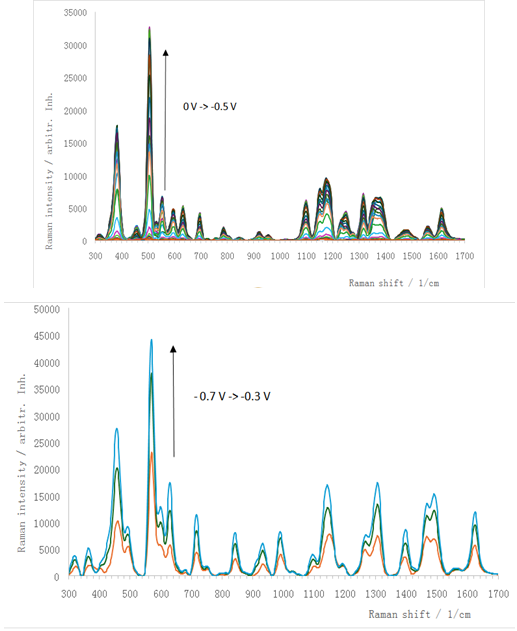
Since the Raman intensities of solutions are usually low, the surface-enhanced Raman effect (SERS) on silver or gold nanosurfaces is often used 9, 10. These can be easily generated electrochemically by coating Au or Ag electrodes with a KCl solution and applying a cyclic potential (for Au from -0.5 V to +1.5 V and back, for Ag from -0.5 V to +0.5 V): electrochemically generated SERS: EC-SERS 11. At the positive potential, oxidic surfaces are formed which are reconstructed into metal nanostructures in the cathodic return 12 (Figure 6).
The following figures show the EC-SERS spectra on an Ag screen-printed electrode of RZ between 0 V and -0.5 V (Figure 6, top), of RS between -0.7 V and -0.3 V (Figure 6, bottom). The increase in Raman intensities during the formation of the nanosurfaces at RZ and RS can be clearly seen. At -1 V, the nanosurface degrades again, which is why the Raman spectrum of DHRS is of significantly lower intensity.


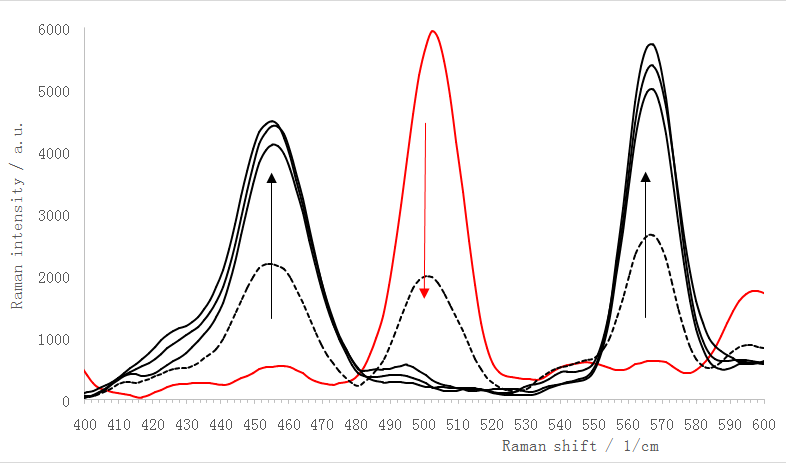
An Ag electrode prepared in this way can be used to determine the change in Raman spectrum of RZ in fresh milk and RZ/RS in gradually bacterially contaminated milk, as shown in Figure 7 for the different Raman peaks between 400 and 600 cm-1. No potential has been applied to prevent the chemical system from electrochemical reaction. The Raman transitions in this region are the most intense in the respective Raman spectrum and are easily distinguishable in terms of wave numbers, as the resolution of Raman spectrometers is typically below 4 cm-1. As shown in Figure 7, the Raman peaks of RZ (500 cm-1) decrease and the peaks of RS (460 and 570 cm-1) increase depending on the contamination.
RZ, a blue non-fluorescent dye, can be reduced to the highly fluorescent pink RS. Reduction can be achieved electrochemically or by using reducing agents. Bacteria, e.g. in sour milk, can also reduce RZ. The change from RZ to RS can therefore be used as a measure of bacterial contamination in milk: The change in colour, fluorescence and Raman spectra can be used to determine the purity of the milk. Due to the very low intensities of the Raman spectra, a nanostructured electrode (or the use of Ag or Au nanoparticles) was first prepared to increase the sensitivity of this method.
• Resazurin (Sigma R7017), Hazard statements: H315, H319, H335, Precautionary statements
• P261, P264, P271, P280, P302 + P352 P305 + P351 + P338
• Glucose (Biolaboratory: https:// www. biolaboratorium.com / products/ kristalline-glukose-1000g-biomus? variant= 44252226388263 ¤cy= EUR& utm_source=google& utm_medium=organic& utm_campaign=German&utm_content=Glucose% 20Crystalline% 20Glucose%201000g% 20BIOMUS& gad_source=1& gclid=EAIaIQobChMIpeH0-pCGiwMVj5WDBx3z5Czq EAQYAyABEgKD4fD_BwE)
• Sodium dithionite (Sigma 71699) Hazard statement(s): H251, H302, H319. Precautionary statements: P235, P264, P270, P280, P301 + P312, P305 + P351 + P338. Supplemental hazard statements (EU): EUH031.
• Potentiostat: Autolab PGSTAT 204, Metrohm with Nova 2.1.17 software
• SPE for Raman measurements: DRP-220Bt (Au as working electrode, Au as counter electrode, Ag as reference electrode) and DRP 010 (Ag as working electrode, Ag as counter electrode, Ag as reference electrode), both from Metrohm/DropSens
• Quartz cell with Pt grid electrode, Ag/AgCl reference electrode and Pt counter electrode: PTGRID-TRANSCELL (Metrohm/DropSens)
• Raman spectrometer: AvaRaman (785 nm laser, 500 mW with Raman probe RPB 785 from Inphotonics), Avantes with the software Avasoft 8.16 and Spectragryph 1.2 from Dr. Menges
• Raman cell for SPE: Metrohm/DropSens
• Bifurcated fiber (Thorlabs)
• Fiber spectrometer: AvaSpec 2048-EVO (Avantes)
• Photomultiplier: R4632 with resistor cascade socket C6270 (Hamamatsu). With voltage supplies +15 V and 0-5 V variable.
• MobileCassy2 (Leybold Didactic)
• Absorption / fluorescence cell holder (Avantes)
• Reflection flow cell for screen printing electrodes (TLFCL-REFLECCELL: Au as WE, C as counter electrode and Ag as reference electrode)
• Notch filter (NF 533-17, Thorlabs)
• Laserpointer 532 nm (laserpointerpro: https:// www.laserpointerpro.com/de/attribute/wavelength_532nm-laser_27)
• Eppendorf pipette: 100 µL
• Analysis software: QtiPlot Data Analysis and Scientific Visualization (https://www.qtiplot.com/), Avasoft 8.11.0.0 (Avantes), Nova 2.1.17, CassyLab
| [1] | N. Choudhury, S. Biswas, J. Food Sci. and Tech., 2012, 49(2), 263-268. | ||
| In article | |||
| [2] | R.H. Moyer, J.J.R. Campbell, 1963, 46, 897-906. | ||
| In article | View Article | ||
| [3] | J.J. MacFarlane, Dairy Sci. Abstracts, 1953, 15 (2), 45–47. | ||
| In article | |||
| [4] | S. Ibanez, D. Izquierdo-Bote, A. Perez-Junquera, M.B. Gonzalez-Garcia, D. Hernandez-Santos, P. Fanjul-Bolado, Dyes and Pigments, 2020, 172,107848. | ||
| In article | View Article | ||
| [5] | M. Fleischmann, P.J. Hendra, A.J. McQuillan, Chem. Phys. Lett. 1974, 26, 163-166. | ||
| In article | View Article | ||
| [6] | E. Smith, G. Dent, Modern Raman Spectroscopy. A practical approach. 2 ed; Wiley: Hoboken NJ, 2019, 119-151. | ||
| In article | View Article | ||
| [7] | H. Zhu,1 R. C. Derksen,1 C. R. Krause,2 R. D. Fox,1 R. D. Brazee,1 and H. E. Ozkan, J. ASTM International, 2005, 2, 6. | ||
| In article | View Article | ||
| [8] | I. Moreno-Villoslada, , , , , , , , 2006, . | ||
| In article | View Article PubMed | ||
| [9] | F. Le Guern, , , , , Int. J. Mol. Sci. 2020, 3, 21(23), 9 217. | ||
| In article | View Article PubMed | ||
| [10] | S. Schlücker, Surface Enhanced Raman Spectrocopy, 2011, Wiley-VCH, Weinheim, Germany. | ||
| In article | View Article | ||
| [11] | P. Vandenabeele, Practical Raman Spectroscopy, An Introduction, 2013, Wiley, Susex, UK. | ||
| In article | View Article | ||
| [12] | D. Martin-Yerga, A. Perez-Junquera, M.B. Gonzalez-Garcia, J.V. Perales-Rondon, A. Heras, A. Colina, D. Hernandez-Santos, P. Fanjul-Bolado, Electrochim. Act. 2018, 264,183. | ||
| In article | View Article | ||
Published with license by Science and Education Publishing, Copyright © 2025 Achim Habekost
 This work is licensed under a Creative Commons Attribution 4.0 International License. To view a copy of this license, visit
http://creativecommons.org/licenses/by/4.0/
This work is licensed under a Creative Commons Attribution 4.0 International License. To view a copy of this license, visit
http://creativecommons.org/licenses/by/4.0/
| [1] | N. Choudhury, S. Biswas, J. Food Sci. and Tech., 2012, 49(2), 263-268. | ||
| In article | |||
| [2] | R.H. Moyer, J.J.R. Campbell, 1963, 46, 897-906. | ||
| In article | View Article | ||
| [3] | J.J. MacFarlane, Dairy Sci. Abstracts, 1953, 15 (2), 45–47. | ||
| In article | |||
| [4] | S. Ibanez, D. Izquierdo-Bote, A. Perez-Junquera, M.B. Gonzalez-Garcia, D. Hernandez-Santos, P. Fanjul-Bolado, Dyes and Pigments, 2020, 172,107848. | ||
| In article | View Article | ||
| [5] | M. Fleischmann, P.J. Hendra, A.J. McQuillan, Chem. Phys. Lett. 1974, 26, 163-166. | ||
| In article | View Article | ||
| [6] | E. Smith, G. Dent, Modern Raman Spectroscopy. A practical approach. 2 ed; Wiley: Hoboken NJ, 2019, 119-151. | ||
| In article | View Article | ||
| [7] | H. Zhu,1 R. C. Derksen,1 C. R. Krause,2 R. D. Fox,1 R. D. Brazee,1 and H. E. Ozkan, J. ASTM International, 2005, 2, 6. | ||
| In article | View Article | ||
| [8] | I. Moreno-Villoslada, , , , , , , , 2006, . | ||
| In article | View Article PubMed | ||
| [9] | F. Le Guern, , , , , Int. J. Mol. Sci. 2020, 3, 21(23), 9 217. | ||
| In article | View Article PubMed | ||
| [10] | S. Schlücker, Surface Enhanced Raman Spectrocopy, 2011, Wiley-VCH, Weinheim, Germany. | ||
| In article | View Article | ||
| [11] | P. Vandenabeele, Practical Raman Spectroscopy, An Introduction, 2013, Wiley, Susex, UK. | ||
| In article | View Article | ||
| [12] | D. Martin-Yerga, A. Perez-Junquera, M.B. Gonzalez-Garcia, J.V. Perales-Rondon, A. Heras, A. Colina, D. Hernandez-Santos, P. Fanjul-Bolado, Electrochim. Act. 2018, 264,183. | ||
| In article | View Article | ||