Three lime requirement algorithms were calibrated against the standard lime incubation in the acid coffee soils of Tanzania using three topsoil samples from Masama Sawe (Hai District), Mfiriga (Njombe Rural District) and Msia (Mbozi District), all of pH<5.0. A total of 54 dishes (500g) were arranged in split plot RCD with three replications in the screenhouse. Main factors were locations, while sub-factors were different dosages (0, 0.023, 0.045, 0.091, 0.227 and 0.454 g) of pure CaCO3 equivalent to 0, 0.5, 1.0, 2.0, 5.0 and 10.0 tons CaCO3 per ha. These were mixed with 100g of soil per dish and incubated for six weeks at room temperature and near field capacity. At the end of week 1, 2, 4 and 6, 10g of each was mixed with 25ml of distilled water, shaken for 30 minutes in an end-to-end shaker and the pH of the soil (1:2.5) was read. The amount of CaCO3 added was then plotted against pH, and a LR determined graphically. Three liming algorithms were suggested for sandy loam, loam and clay soils that use ΔpH (target pH – initial pH; the former set at 5.5) and percent organic matter. They were validated using a separate database and compared against similar algorithms developed in Brazil, Nigeria and China. The results suggest the Brazilian algorithm LR = 0.0699*(ΔpH*OM)0.9225, being closest to the incubation algorithms, to be tentatively adopted in Tanzania, pending further validation. The discussion touches the concerns about acidity and liming in Tanzania, alternatives available, and a potentially lucrative lime industry based on locally available lime deposits.
Soil pH is a measure of acidity or alkalinity of the soil solution 1. It is the negative logarithm of the concentration of hydrogen ions [H+] in the water contained in the soil. It is negative because it is the reciprocal of hydrogen concentration, and logarithmic because it varies by the i-th power of 10 2. It features in a scale of 0-14. A balanced situation of [H+] and its counterpart [OH-] is termed neutral (pH = 7). Lower pH (<7) signifies acidity, which is associated with Fe, Al and Mn toxicities; and on the other hand, Ca, P, Mg and Mo deficiencies. For coffee this is also said to be linked with prevalence of fusarium bark disease 3. Higher pH (>7) signifies alkalinity (not common in Tanzanian coffee soils), associated with a deficiency of many micronutrients, structural deterioration and a tendency towards salinity/sodicity. In the soil biosphere, soil pH affects the growth and reproduction of microorganisms, which in turn can affect plants 4. Most coffee soils in Tanzania have pH ranging from 4 to 8. They are mainly acidic (in line with the physiographic requirements of Arabica – 5, 6).
To correct soil acidity, liming has been a popular undertaking in many countries 7. Reference 8 recommended liming in the southern and western coffee zones of Tanzania, at the blanket rate of 200 g tree-1 calcitic lime alternated with 100 g tree-1 dolomitic lime. But liming tropical and ash-based soils is quite challenging, as elaborated by 9. He notes that in tropical soils, Al and Fe are present in mineral clays that are stable at pH values as low as 5.0. In this case, Al is buried in the clay particle. It is not a threat to plant growth until soil pH reaches a value where the oxides and kaolinite dissolve, bringing Al (sometimes in toxic quantities) into the soil solution. When this situation arises, it is advisable to raise soil pH to about 5.5. This will allow Al precipitation and appreciable increase in CEC (soils of variable charge). Following this concept, he suggested a prediction of lime requirements for most tropical soils by applying the following equation: LR (t/ha) = Factor x cmol Al kg-1 soil. The factor used can vary from 1.5 to 3.0 depending on the crop characteristics and the soil type and can be tailored to local conditions. An alternative is to take into account a targeted soil base saturation (BS) which is attained by lime application. Reference 9 shared a Brazilian experience where the best coffee yields are obtained at 60 percent base saturation. In other words, coffee can grow satisfactorily in a soil with up to 40 percent Al saturation.
Several other authors have developed different formulas working under their conditions. Reference 10 suggested two formulas for sandy soil (sandy to sandy loam) and clay (clay to sandy clay loam) respectively, in Nigeria. Working with acid soils of Brazil, 11 put more weight on ΔpH, organic matter and total exchangeable acidity, coming up with two equations relating ΔpH to the other two parameters. Again, working with acid soils of China, 12 came up with a rather complicated exponential equation involving ΔpH, neutralization value (NV) of the lime, initial pH, % Clay, bulk density (BD) and soil depth. Furthermore, working with acid soils of the US, Colombia, Sri Lanka and Kenya, 13 tried to compare different models for estimating LR of tropical soils. They concluded that an important first step in formulating LR is to clearly identify the soil property of interest and target value that needs to be reached. They introduced a model of their own, called LiTAS, which they claim to fit a variety of acid tropical soils.
The topic of liming appears to have attracted scanty attention in Tanzania, evidenced by the very few published articles available. It was lightly mentioned by 14, 15 in Mbozi; and 16 in Mbulu, Northern Zone. More detailed insights were given by 2, 8 and 17. LR estimation was only attempted in 17, who used the University of Wisconsin version of the SMP algorithm, truncating the SMP factor and adjusting the target pH to 6.5 (not sure what these adjustments implied on the results). The objective of this undertaking was to calibrate available models against the standard lime incubation in different acid coffee soils of Tanzania, (Northern and Southern Highlands), thereby coming up with the best bets.
Three farms in Northern and Southern Highlands, known to have the problem of acidity, were used in this work. Mr. Amini Kimaro’s farm (Masama Sawe, Hai District) is located within latitude -3.2629 and longitude 37.19623 in decimal degrees, with an average altitude of 1636 metres above mean sea level (masl). Soils belong to the reference group of Nitisols 18. Mr. Sadiq Kangero’s farm (Mfiriga, Njombe Rural District) is located within latitude -9.13575 and longitude 35.24120 with an average altitude of 1304 masl. Soils belong to the reference group of Acrisols 19. Shimilangwada Estate (Msia, Mbozi District) is located within latitude -8. 9683 and longitude 32.8228 with an average altitude of 1400 masl. Soils belong to the reference group of Alisols 3, all according to the SOTER database.
2.2. Sample Acquisition and Physico-chemical AnalysisThe samples were selected from a pool of samples either taken by TaCRI staff or brought by the farm owners. They were pre-checked and found to be sufficiently acidic for the experiment (pH<5.0). They were analyzed for their physico-chemical properties as suggested by 20. Particles size distribution (texture) was analyzed by using the Bouyoucos hydrometer method. Soil textural classes were assigned based on percent sand, silt and clay separates using the USDA soil textural triangle. The pH of the soil was measured potentiometrically using a pH meter with combined glass electrode in soil water ratio of 1:2.5 as described by 1. Exchangeable acidity (here meaning exchangeable Al) was determined using the Peech titration method 21. Organic carbon was determined using the wet oxidation method 22. The total N content of the soil was determined using the semi-micro Kjeldahl method. Available phosphorus was determined using Bray I method 23. Cation exchange capacity and exchangeable bases (potassium, calcium, magnesium and sodium) were determined by ammonium acetate extraction, followed by distillation-titration and atomic absorption spectroscopy respectively. Effective cation exchange capacity (ECEC) was determined by the summation of total exchangeable bases and total exchangeable acidity. Base saturation was calculated by dividing the sum of exchangeable bases by ECEC, then multiplying by 100. The data were exposed to the Pearson’s correlation analysis under STATISTICA (V12) software.
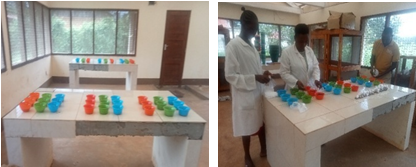
2.3. Estimation of Lime RequirementWe used 500g dishes arranged in split plot RCD with three replications in the screenhouse (Figure 1). Main factors were locations (S1: Sawe, orange; S2: Mfiriga, green; S3: Msia, blue), while sub-factors were different dosages. 100g of soil was measured per dish, making a total of 54 dishes. In each soil type and replication, incremental amounts (0, 0.023, 0.045, 0.091, 0.227 and 0.454 g) of pure CaCO3 (99.5% purity) were added. This is equivalent to 0, 0.5, 1.0, 2.0, 5.0 and 10.0 tons CaCO3 per ha. After completely mixing with the CaCO3, the soils were left to incubate for six weeks at room temperature. Distilled water was added weekly, to keep the soil moisture content near field capacity. At the end of week 1, 2, 4 and 6, 10g of each treatment was mixed with 25ml of distilled water, shaken for 30 minutes in an end-to-end shaker and the pH of the soil (1:2.5) was read. The amount of CaCO3 added was then plotted against pH, and a LR determined graphically.

The difference between final and baseline soil pH under each of the five lime rates plus the control, for the three soil types, were computed per replication and means worked out. The means were inversely plotted against the lime rates and trend lines established, that would enable the estimation of LR for changing any initial pH to a desired pH under the respective soil type. Subtracting the baseline pH for each soil type from a target pH of 5.5, which is the threshold suggested by 8, and multiplying the difference by the organic matter content, we developed LR scatterplots with three quadratic trendline equations for Sawe (Sandy loam), Mfiriga (Loam) and Msia (Clay). The incubation algorithms (denoted as LR1), were validated using a wider dataset of 11, 11 and 10 samples respectively from the west (Uvinza, Tanganyika and Bukoba) and east (Lushoto), extracted from the TaCRI database 24 by merit of having pH < 5.0 and falling into the three textural categories. This validation exercise also involved the test algorithms from Brazil 11; Nigeria 10 and China 12. Then the incubation results were subtracted from model results, whereby the closest algorithm to the incubation results was picked as the best bet.
The test algorithms were as follows:
Brazil (LR2): 
Nigeria (LR3): 
China (LR4): 
The baseline physico-chemical attributes of the test soils are summarized in Table 1 below. Soil pH is significantly lower in Sawe than the rest of the soils which are not significant. The trend was reversed with total N and CEC. In terms of organic matter, Sawe and Mfiriga had about 4 and 3 times that of Msia, respectively. This is expected because the first two are from recently established fields out of virgin land, while the third is a long-exploited estate. Bray-1 P is significantly lower in Mfiriga than the rest, which are not significant. Exchangeable acidity decreased in the order Sawe > Msia > Mfiriga. Exchangeable bases are all not significantly different.
From the Pearson’s correlation analysis, we note strong correlation among most of the parameters (r >0.5), but those deemed significant (p <0.05; r ≥ 0.9) are pH against OM and Total N, both strongly negative. However, OM and Total N are related strongly and positively (an expected situation since most of the N in the topsoil is from the decomposition of organic matter). The strongly positive correlations included Ca and K. Negative correlation was noted with pH and both OM and total N, percent silt with both Ca and K; percent clay with sand.
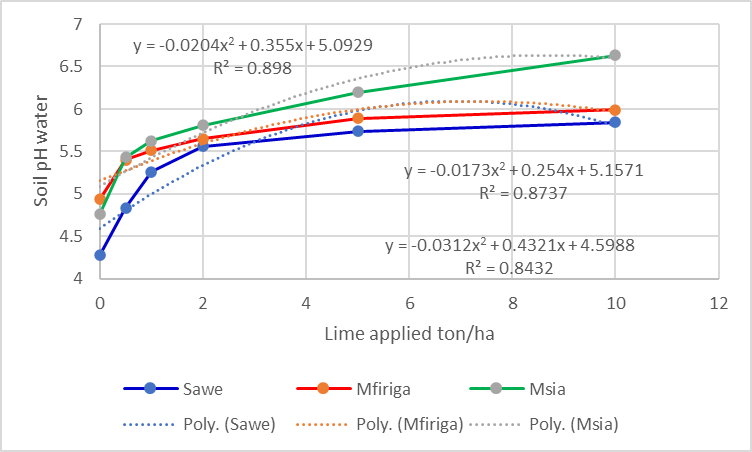
3.2. Response of Final pH to Different Lime DosagesThe graphs in Figure 2 show a similar trend of a sharp increase in pH from zero to 2 tons ha-1, whereby linear trendlines would be perfect fits. Increasing the rates brings in a flattening effect to almost no change between 5 and 10 tons per ha. Means of the three replications gave quadratic trendline equations for Sawe, Mfiriga and Msia respectively.

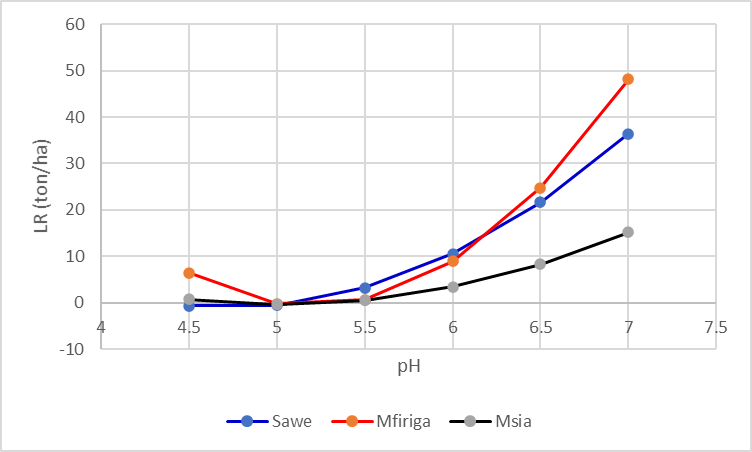
As noted in the above figure, pH is the subject, but we need LR as the subject, so we inverted the scatter plots (Figure 3), and the following respective equations were derived (Equations 1-3) representing the final pH for each level of lime applied:

LR = 7.3549pH2 – 69.764pH + 164.38 R2 = 0.8388 (1)
LR = 14.988pH2 – 155.69pH + 403.52 R2 = 0.9363 (2)
LR = 3.9817pH2 – 40.003pH + 100.09 R2 = 0.999 (3)
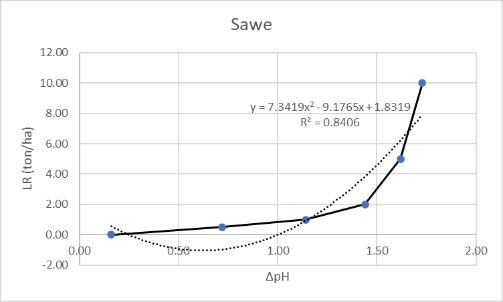
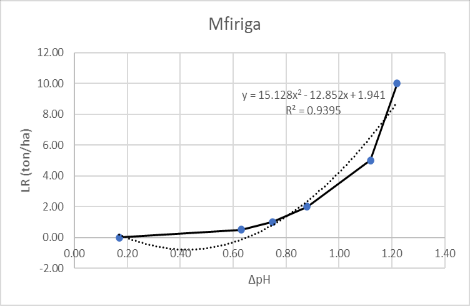
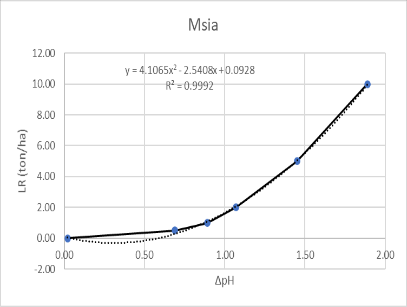
3.3. Response of pH Change to the Rates of Lime UsedWe introduced the concept of ΔpH and made the final pH to serve as target pH and the baseline pH to serve as initial pH. These were subtracted and subjected to the scatter plots, producing the following trendline equations (4-6), where pHt = target pH and pHo = initial pH (Figures 4-6).
LR = 7.3419 (pHt - pHo)2 – 9.1765 (pHt - pHo) + 1.8319 R2 = 0.8406 (4)
LR = 15.128 (pHt - pHo)2 – 12.852 (pHt - pHo) + 1.941 R2 = 0.9395 (5)
LR = 4.1065 (pHt - pHo)2 – 2.5408 (pHt - pHo) + 0.0928 R2 = 0.9992 (6)


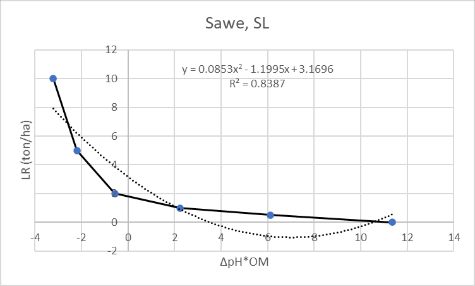
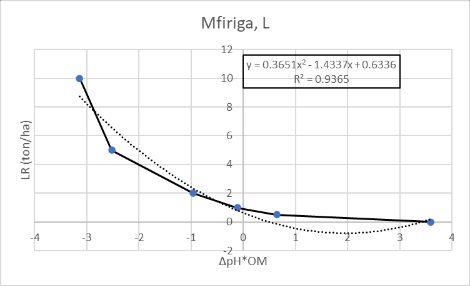
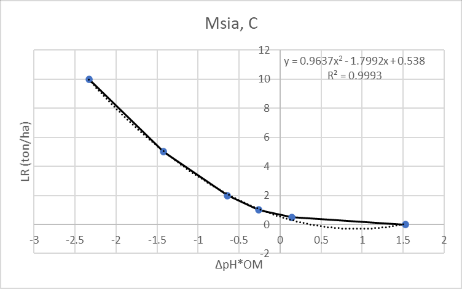
Re-calculating the LR with pHt set at 5.5 and pHo maintained as the baseline pH of various soils and multiplying the difference by OM (as in 11) we get the best fit regression models for sandy loam (Sawe, Equation 7), loam (Mfiriga, Equation 8) and clay (Msia, Equation 9) (Figures 7-9).
LR = 0.0853 (ΔpH*OM)2 – 1.1995 (ΔpH*OM) + 3.1696 R2 = 0.8387 (7)
LR = 0.3651 (ΔpH*OM)2 – 1.4337 (ΔpH*OM) + 0.6336 R2 = 0.9365 (8)
LR = 0.9637 (ΔpH*OM)2 – 1.7992 (ΔpH*OM) + 0.5380 R2 = 0.9993 (9)


Results of validation and comparison are shown in Table 2, whereby LR1 represents results from incubation; LR2, LR3 and LR4 represent the results from Brazilian 11, Nigerian 10 and Chinese 12 algorithms respectively. Looking at the table, it is clear that algorithm LR2 slightly underestimated the true lime requirement, though their difference is still small compared with the others (LR3 and LR4) which clearly overestimated it by 2-6 tons per ha. The estimation of these two appears to be heavily influenced by clay content, which is not part of the algorithms LR1 or LR2. It seems, from the study areas, clay content is not so important in LR determination. Tentatively, LR2 is hereby picked as the best bet algorithm for the coffee soils of Tanzania. In the meantime, we are collecting more acid soil samples to widen the database and further validate the findings.
Soil acidity as a global problem, its causes (natural and anthropogenic), effects on plant growth and management strategies, are well described by 28. Reference 29 attempted to describe the extent of the problem in Sub-Saharan Africa. They noted that moderate acidity (pH 5.2-6.0) covers two-thirds of Tanzania, about four-fifth of Uganda (whole country except its north-eastern end), a third of Ethiopia (the western part) and a small pocket of land in South-Western Kenya. Reference 30 stated that around 32.7 million hectares in Tanzania are covered by acid soils, of which 4.7 million hectares are cropland and 1.1 million hectares are dedicated to cultivating maize, the staple crop. Areas most affected include the Southern Highland Zone, such as Mbeya, Njombe, Songwe, and Iringa; the Western regions of Kigoma and Tabora; and the Lake Zones of Kagera, Mara, Mwanza, Geita, and Shinyanga. Less affected areas include the northern, eastern, and southern zones. These remarks reflect the degree of seriousness that soil acidity is accorded in Tanzania and why a lot of people, including smallholder coffee farmers 8 are encouraged to lime their farms.
4.2. Choice of MethodologyCaCO3 incubation method is said to be the best and most direct way of determining lime requirement of a soil, and, for most studies, has been used as a standard 31, as also used in this work. The number of sites used (n=3) is much smaller than 12 (n=17), 11 (n=22), 13 (n=31) and 10 (n=40), because we are dealing with coffee, a slightly acid-loving plant (optimum pH 5.8 – 8); so, the threshold was set at 5.0 which limited the number of sites to be included. We think the number of samples may have a bearing on the accuracy of the results. Rates of lime used and incubation time differ greatly among researchers depending on objectives. Whereas here we used 0, 0.5, 1, 2, 5 and 10 ton ha-1 and six weeks period, 27 used 0, 4, 8, 12 and 16 ton ha-1 and four weeks. Reference 26 determined the LR values first from the test algorithms, and incubated the soil with 0%, 50%, 100%, 150% and 200% of the LR values. Their incubation period was three months. In our case, limiting the maximum rate to 10 tons ha-1 was logically meant to avoid the problems of overliming 32, while starting with lower rates was meant to assess the level of soil sensitivity. The choice of incubation period following 33 was for convenience, as literatures vary from 4 to 12 weeks.
Other methods, usually calibrated on basis of the incubation method, are the SMP buffer method 34 and the Adams-Evans buffer method 35. The two are referred to in almost every literature on lime requirement, likely because liming started in the temperate areas where the buffer methods fit most. Other, slightly less common methods are the Mehlich buffer, the Sikora buffer, etc. South Africans, also temperate, have adopted their own local methods Eksteen, Cedara and RC-SG1 31. With the tropical soils more complicated than the temperate counterparts 9, many algorithms have been developed, but no one has been universally accepted. That justifies comparisons such as those of 13 as a useful way to customize LR estimation; and the objectives of this work was along the same lines.
Modeling is where you perform some analysis (such as exchangeable acidity or base saturation) and apply the data into an algorithm that estimates the LR. Some of such algorithms have been used in this work. There were limited choices of algorithms to compare. We had two separate databases built for different purposes other than LR determination. The one we built internally 25 did not consider acidity (exchangeable Al) because it is well known that, where pH is less than 5.2 (for Arabica), CAN is used both as a fertilizer and ameliorant 36, 37. To lime or not to lime would therefore depend on the economics of the farmer 38. In its part, the validation database 8 lacked soil texture, and it is not clear why this was lacking, because his intention was to entice smallholders to apply lime in their farms. It was probably a rush job due to limitations of time and resources. We will henceforth insist on including texture in any set of analyses likely to involve LR determination.
4.3. Implication of the ResultsLiming appears to have attracted insufficient research in Tanzania, evidenced by the very few published articles available, especially with coffee. Some slight work was done on soybeans by 39, 40, and maize by 17. As for coffee, 8 recommended liming rates, but did not explain the way they were derived. It is no wonder that there is no universally adopted LR estimation technique or algorithm. This paper therefore suggests the first algorithm to be used for the Tanzanian coffee areas. The algorithm is more applicable to estates and large farms with agronomists and other experts who can run the algorithm, than smallholders who do not even know about soil acidity. Many estates appear to lack such an algorithm, as they apply the lime haphazardly by broadcasting along rows regardless of terrain structure and the possibility of shifting to lower levels by rain or irrigation.
4.4. Adoption of Liming as a National StrategyThe way soil acidity in Tanzania was elaborated by 30, it sounded as a national crisis, calling for an immediate national liming programme which, for coffee, was also suggested by 8 among smallholders. However, the opinion of this paper is that Tanzania as a nation still has some way to go before adopting a full-scale liming programme, including intensive research. Two neighbourhood examples are elaborated here. In Western Kenya, 41 studied the economic and environmental response of maize to liming, noting a consistent increase in yields on soils with an initial soil pH between 4.0 and 5.7, with or without fertilizer use. For a soil pH of 5, applying 2 t ha-1 lime resulted in a significant increase in maize yields of 57% (from 2.3 to 3.6 t ha-1) in the first year after application. Associated profits – when including costs of labour - were only positive when liming was combined with fertilizer (N, P) application. Liming showed potential benefits for food security in tropical acid soils, though authors were a bit skeptical on uptake by farmers without external incentives.
Similarly, 42 investigated the effects on welfare that the introduction of liming would have in the Zambian smallholder maize market. For this purpose, he developed a dynamic, deterministic, open market, spatial partial equilibrium model, whose results indicate that liming in this market would reduce prices by 22.8% and increase welfare by 3.4% without international trade. With exports at 350 USD t-1, the local price would drop by 16.1% and welfare would increase by 5.6% due to liming. He also notes that liming is an extra cost, composed of remedial liming (to bring the pH to the desired level) and maintenance liming (to prevent the pH from dropping again to unfavourable levels). Most of smallholders are resource-poor, thus unable to afford the initial expenses for liming their acidic soils. Being at a competitive disadvantage, they will be difficult to convince into its adoption, unless the government intervenes by financial facilitation or shifting some of the subsidies from fertilizers to lime. The two studies came up with the same conclusion which also applies in Tanzania.
4.5. Alternative Pathways for Handling AcidityIt is noted that, the two studies above, and many others, tackle acidity with reference to a single crop (in the two cases, maize). And it is well known that various crops behave differently when it comes to sensitivity to pH. Reference 43 listed a total of 36 commonly grown crops in Tanzania with their optimal growing conditions including pH ranges. Minimum tolerable pH values are given in Table 3. From the table it is clear that the problem of soil acidity should be approached by crops (as 8 did for coffee) and target pH for optimal production of the selected crops determined. Once these are known, we can facilitate the farmers to “know their farms” by providing the analytical and advisory services, which will include the LR values estimated using simple algorithms as evaluated in this work. It is also good to inform the farmers on possible alternatives such as CAN and Minjingu rock phosphate (MRP). Farmers should also be educated on alternative crops which they could adopt rather than having to lime to satisfy a single (staple) crop.
One important hurdle unveiled by 2 for smallholders to adopt liming is its availability and quality. Lime is not a common commodity in the Tanzanian agro-input market and therefore, not readily available to smallholder farmers. As such, coffee estates with the liming tradition import their liming requirements from overseas. On the other hand, according to 27, the country is rich in limestone deposits that may be harnessed to meet the demand for lime in agricultural and other sectors. They mentioned 33 limestone deposits, of which 21 have been analyzed for quality, such as neutralizing value, extent of impurities, and quantity. Many of the deposits are located along the Eastern Coast of Tanzania, from Tanga through Mtwara regions, with one in Dodoma, and smaller deposits in Mbeya, Ruvuma, Kigoma, Kasulu and Songwe. The latter deposit 44 seems to be an extension of a well-researched lime deposit in Zambia 45. We need to do thorough studies on these deposits to fulfill the local lime needs. As the standard TBS/AFDC10 (5441) P3 for agricultural lime is in place, we can encourage potential investors to process, brand and avail quality agricultural lime into the agro-input market. We could then build a lucrative limestone industry that would not only supply the much-needed lime for our agricultural activities but also extend this service to neighboring countries that face similar problems. Market availability should precede any effort to pursue an intensive liming programme.
In this work, three promising lime requirement algorithms were calibrated against the standard lime incubation method for coffee soils of Tanzania. Lime incubation was done in the screenhouse for six weeks with change in pH plotted against the used lime. Three quadratic liming algorithms were suggested for different textural classes (sandy loam, loam and clay) that take into consideration ΔpH (target pH – initial pH; the former set at 5.5) and percent organic matter. The algorithms were validated and descriptively compared against similar algorithms developed elsewhere. The results suggest that the Brazilian algorithm LR = 0.0699*(ΔpH*OM)0.9225 can be adopted in Tanzania for a start, since it is likely that the inadequate number of samples (3 as compared to over 15 in the other algorithms) may have affected the results. We plan to re-do the work with a minimum of 20 samples to verify the robustness of the findings.
The discussion puts to light the interest accorded of recent to soil acidity and liming in the Sub-Saharan Africa, and Tanzania in particular. However, intensive liming programme for Tanzania should be preceded by intensive researches. Then, an appropriate incentive scheme for smallholders to adopt the liming programme should be worked out. Various tropical crops are introduced with their relative acid tolerance, a tool that extensionists could use in advising farmers on choices of crops rather than having to lime to satisfy a single (staple) crop. At the supply side, we note about 33 lime deposits in Tanzania, and a standard for its specifications. We need to study them thoroughly, and encourage potential investors to process, brand and avail quality agricultural lime into the agro-input market. We could then build a lucrative limestone industry that would supply the much-needed agricultural lime for Tanzania and elsewhere.
BD: Bulk density of a soil; BS: Base saturation in the soil in percentage; CAN: Calcium ammonium nitrate fertilizer; CEC: Cation exchange capacity of a soil; EA: Exchangeable acidity (in this context, equated with exchangeable aluminium); ECEC: Effective CEC (=Ca+Mg+K+Na+H+Al); [H+]: Concentration of hydrogen ions; LR: Lime requirement; MRP: Minjingu rock phosphate; NV: Neutralizing value (of a liming material); OC: Organic carbon %; [OH-]: Concentration of hydroxyl ion; OM: Organic matter content % (=OC*1.724); pH: Measure of acidity or alkalinity; ΔpH: Difference between the existing and the target pH; RCD: Randomized complete design (used for screenhouse experiments); SMP: Shoemaker-McLean-Pratt buffer technique; SOTER: Soil and terrain database; TaCRI: Tanzania Coffee Research Institute; USD: United States Dollar; USDA: United States Department of Agriculture.
This paper was contributed equally by all authors. Author GM conceptualized the study. Authors GM and SM managed literature searches. Authors SM and EM handled the incubation test and soil analysis. Authors GM and SM handled statistical analysis. All authors read and approved the final manuscript.
The authors declare that they have no known competing financial interests or personal relationships that could have appeared to influence the work reported in this paper.
The authors wish to acknowledge the TaCRI management for authorizing this work, and the staff of TaCRI Soil Fertility Laboratory for assistance in experimental set-up, monitoring and data collection.
| [1] | Brady, N. C. and Weil, R. R. (2008). The Nature and Properties of Soils. 13th Edn. Pearson Education, Inc. 965pp. | ||
| In article | |||
| [2] | Maro, G.P., Mbwambo, S.G., Monyo, H.E., Mfaume, D.P. and Urassa, A. (2022). Coffee response to liming in acid soils of Tanzania: Pilot study in three agro-ecological zones. World Journal of Agricultural Research Vol 10 (3), November 2022: 94-101. | ||
| In article | |||
| [3] | Mfaume, D.P., Msanya, B.M. and Msaky, J.J.T. (2019). Pedological characterization and fertility assessment of Mbimba Substation soils under coffee production in Mbozi District, Tanzania. International Journal of Advances in Science, Research and Engineering Vol 5 (10), October 2019: 177-192. | ||
| In article | View Article | ||
| [4] | Uchida R. and Hue, N.V. (2000). Soil acidity and liming. In: Silva, J.A. and Uchida, R. (eds): Plant nutrient management in Hawaiian soils: Approaches for tropical and subtropical agriculture. CTAHR, University of Hawaii at Manoa. Pp. 101-112. | ||
| In article | |||
| [5] | Wintgens, J. N. (2012). Coffee: Growing, processing, sustainable production: A guidebook for growers, processors, traders and researchers. Wiley VCH, Weinheim, Germany. 1022pp. | ||
| In article | |||
| [6] | Oberthur, T., Pohlan, J. and Soto, G. (2012). Plant Nutrition Sustainable Nutrient Management. In: Oberthur, T. et al. (Eds.), Specialty coffee managing quality. International Plant Nutrition Institute, South Eastern Asia Programme, Penang, Malaysia.149pp. | ||
| In article | |||
| [7] | Godsey, C.B., Pierzynski, G.M., Mengel, D.B. and Lamond, R.E. (2007). Evaluation of common lime requirement methods. SSSAJ Vol. 71 No. 3: 844-851. | ||
| In article | View Article | ||
| [8] | Cordingley, J. (2010). Soil Fertility Survey of Tanzania’s Smallholder Coffee Sector for Developing Lime and Fertilizer Recommendations. Report to Tanzania Coffee Board. Crop Nutrition Laboratory Services, Nairobi, Kenya. 60pp. | ||
| In article | |||
| [9] | Espinosa, J. (1996). Liming tropical soils: A management challenge. Better Crops Vol. 80 (1): 28-31. | ||
| In article | |||
| [10] | Iren, O.B., Udoh, D.T., Ediene, V.F. and Aki, E.E. (2021). Assessment of soil properties and the development of lime requirement equations for some soils in South Eastern Nigeria. International Journal of Soil Science Vol. 16 (1): 1-12. | ||
| In article | View Article | ||
| [11] | Teixeira,W.G.; Alvarez, V.; Neves, J.; Paulucio, R.B. Evaluation of traditional methods for estimating lime requirement in Brazilian soils. Rev. Bras. Cien. Solo 2020, 44, e0200078. | ||
| In article | View Article | ||
| [12] | Han, D., Zeng, S., Zhang, X., Li, J. and Ma, Y. (2023). Integrating soil pH, clay and neutralizing value of lime into a new lime requirement model for acidic soils in China. MDPI Agronomy, July 2023: 1-12. | ||
| In article | View Article | ||
| [13] | Merlos, F.A., Silva, J.V., Baudron, F. and Hijmans, R.J. (2023). Estimating lime requirements for tropical soils: Model comparison and development. Geoderma 432, March 2023: 1-12. | ||
| In article | View Article PubMed | ||
| [14] | Mfaume, D.P. (2019). Effect of liming acid soils on physico-chemical characteristics of the soil and coffee seedling vigour in Mbozi District, Tanzania. M.Sc. thesis, Department of Soil and Geological Sciences, SUA, Morogoro, Tanzania: 91pp. | ||
| In article | |||
| [15] | Otieno, H.M.O., Alwenge, B.A., and Okumu, O.O. (2019). Coffee Production Challenges and Opportunities in Tanzania: The Case Study of Coffee Farmers in Iwindi, Msia and Lwati Villages in Mbeya Region. Asian Journal of Agricultural and Horticultural Research, 3(2): 1-14. | ||
| In article | View Article | ||
| [16] | Kiriba, D.S., Mtei, K.M., Widern, F. and Ndakidemi, P.A. (2019). Reducing crops yield gap in acidic soils of Northern Tanzania. Proc. Tropentag, September 18-20, 2019, Kassel, Germany. | ||
| In article | |||
| [17] | Wickama, J. (2019). Impact of lime application on soil properties: The case of smallholder maize fields in Iringa and Ruvuma Regions. Report to SAGCOT, November 2019: 24pp. | ||
| In article | |||
| [18] | Maro, G.P., Msanya, B.M. and Mrema, J.P. (2014). Soil fertility evaluation for coffee (Coffea arabica) in Hai and Lushoto Districts, Northern Tanzania. International Journal of Plant and Soil Science (IJPSS) Vol 3 Issue 8 May 2014: 934-947. | ||
| In article | View Article PubMed | ||
| [19] | Mlingano Agricultural Research Institute (MARI) (2006a). Soils of Tanzania and their Potential for Agriculture Development. Ministry of Agriculture Food Security and Cooperative, Dar es Salaam, Tanzania. 72pp. | ||
| In article | |||
| [20] | Machacha, S. (2004). Comparison of laboratory pH buffer methods for predicting lime requirement for acidic soils of Eastern Botswana. Communications in Soil Science and Plant Analysis Vol. 35 (17-18): 2675-2687. | ||
| In article | View Article | ||
| [21] | Peech, M. (1965). Lime requirement. In: Black, C.A. et al (eds). Methods of soil analysis Part 2. Agronomy Monograph 9, ASA, Madison, WI, USA: 927-932. | ||
| In article | View Article | ||
| [22] | Walkley A. and Black C.A (1934). An examination of the Degtjareff method for determining soil organic matter, and a proposed modification of the chromic acid titration method. Soil Science 37:29–38. | ||
| In article | View Article | ||
| [23] | Bray, R.A. and Kurtz, L.T. (1945). Determination of total and available forms of phosphorus in soils. Soil Sci., 59: 39-46. | ||
| In article | View Article | ||
| [24] | Bhowmick, R., Mandal, J. and Mandal, N. (2016). Factors affecting the lime requirement in an acid Inceptisol of Jhakhand. International Journal of Bio-resource and stress management Vol. 7 {5): 1140-1145. | ||
| In article | View Article | ||
| [25] | Maro, G. P., Mbwambo, S.G., Monyo, H.E., Nkya, E.O. and Mosi, E.J. (2018). Generating soil fertility database for coffee growing areas in Tanzania. Proc. COSTECH National STI Conference and Exhibitions, 4-6 July 2018, Mlimani City Hall, Dar es Salaam. | ||
| In article | |||
| [26] | Gurmu, G., Beyene, S., Selassie, Y.G. and Kidanu, S. (2024). Lime requirement determination methods on acid neutralization efficiency under selected acidic soils of the Ethiopian Highlands. Tropical Agriculture Vol. 101 (1): 68-89. | ||
| In article | |||
| [27] | McKessy, F., McCarthy, E., Broderick, E., O’Donnell, B., and Quille, P. (2024). Investigating the accuracy and comparability of various lime prediction methods for Irish grassland mineral soils. Soil Use and Management, 40, e13034. | ||
| In article | View Article | ||
| [28] | Hue, N. (2022). Soil acidity: Development, impacts and management. Chapter 5 in: Giri, B. et al (Eds.): Structure and functions of pedosphere. Springer. 103-128. | ||
| In article | View Article | ||
| [29] | Agegnehu, G., Amede, T., Erkosso, T., Yirga, C., Henry, C., Tyler, R., Nosworthy, M.G., Beyene, S. and Sileshi, G.W. (2021). Extent and management of acid soils for sustainable crop production in the tropical agroecosystems: A review. Acta Agriculturae Scandinavica Section B: Soil and Plant Science Vol. 71 (9): 852-869. | ||
| In article | View Article | ||
| [30] | Muchoki, A. and Msimbe, B. (2023). The fight against soil acidity in Tanzania: The bitter truth and charting a sustainable food system future. Kilimo Kwanza African Agricultural and Food Systems Summit, September, 2023, Dar es Salaam, Tanzania. | ||
| In article | |||
| [31] | Van der Berg, V. (2017). An evaluation of lime requirement methods for selected South African soils. M.Sc. Thesis, Stellenbosch University, March 2017: 133pp. | ||
| In article | |||
| [32] | Harter, R.D. (2007). Acid soil of the tropics. ECHO Technical Note, 17391 Durrance Road, North Feist Myers, Florida, USA: 1-11. | ||
| In article | |||
| [33] | Mosissa, F., Balemi, T. and Keneni, G. (2019). Effect of Lime rates and incubation periods on the amelioration of acidic nitisols of Bedi area in Ethiopia. Merit Research Journal of Agricultural Science and Soil Sciences Vol. 7 (7): 087‒093. | ||
| In article | |||
| [34] | Shoemaker, H.E., McLean, E.O., Pratt, P.F., (1961). Buffer methods for determining lime requirement of soils with appreciable amounts of extractable aluminum. Soil Sci. Soc. Am. J. 25, 274–277. | ||
| In article | View Article | ||
| [35] | Adams, F. and Evans, C. E. (1962). A rapid method for measuring lime requirement of red-yellow podzolic soils. Soil Sci. Soc. Amer. Proc. 26:355-357. | ||
| In article | View Article | ||
| [36] | Robinson, J.B.D. (1964). A handbook of Arabica coffee production in Tanganyika. Tanganyika Coffee Board, Moshi. 182pp. | ||
| In article | |||
| [37] | Wrigley, G. 1988. Coffee: Tropical Agriculture Series. Longman Scientific and Technical, John Wiley and Sons Inc., New York. 1 -60. | ||
| In article | |||
| [38] | Goulding, K.W.T. (2016). Soil acidification and the importance of liming agricultural soils with particular reference to the United Kingdom. Soil Use and Management Vol. 32:390-399. | ||
| In article | View Article PubMed | ||
| [39] | Tindwa, H.J., Kachiguna, A. and Mrema, J.P. (2019). Incubation of soil with agricultural lime and phosphorus enhances biological nitrogen fixation and yield of soybeans in an Ultisol. Journal of Central European Agriculture Vol. 20 (3): 938-952. | ||
| In article | View Article | ||
| [40] | Kollie, W. S., & Semu, E. (2022). Effects of Liming on Acid Soil to Improve Growth and Yield in Soybean (Glycine max L. Merill). East African Journal of Agriculture and Biotechnology, 5(1), 244-252. | ||
| In article | View Article | ||
| [41] | Hijbeek, R., Van Loon, M.P., Ouaret, W., Boekelo, B. and Van Ittersum, M.K. (2021). Liming agricultural soils in Western Kenya. Can long term economic and environmental benefits pay off short term investments? Elsevier, Agricultural Systems Vol. 190: 10pp. | ||
| In article | View Article | ||
| [42] | Hinkel, N. (2019). Agricultural liming in Zambia: Potential effects on welfare. Institute of Energy Economics, University of Cologne, Germany: 25pp. | ||
| In article | |||
| [43] | Mlingano Agricultural Research Institute (MARI) (2006b). Rainfed agriculture crop suitability for Tanzania. Ministry of Agriculture Food Security and Cooperative, Dar es Salaam, Tanzania: 29pp. | ||
| In article | |||
| [44] | Kalvig, P., Fold, N., Jonsson, J.B. and Mshiu, E.E. (2012). Rock phosphate and lime for small scale farming in Tanzania, East Africa. Geological Survey of Denmark and Greenland, July 2012: 85-88. | ||
| In article | View Article | ||
| [45] | Mitchell, C.J. (2005). FarmLime: Low-cost lime for small scale farming. British Geological Survey Commission, Report CR/03/066N: 124pp. | ||
| In article | |||
Published with license by Science and Education Publishing, Copyright © 2025 Godsteven Maro, Suzana Mbwambo and Epafra Mosi
 This work is licensed under a Creative Commons Attribution 4.0 International License. To view a copy of this license, visit
http://creativecommons.org/licenses/by/4.0/
This work is licensed under a Creative Commons Attribution 4.0 International License. To view a copy of this license, visit
http://creativecommons.org/licenses/by/4.0/
| [1] | Brady, N. C. and Weil, R. R. (2008). The Nature and Properties of Soils. 13th Edn. Pearson Education, Inc. 965pp. | ||
| In article | |||
| [2] | Maro, G.P., Mbwambo, S.G., Monyo, H.E., Mfaume, D.P. and Urassa, A. (2022). Coffee response to liming in acid soils of Tanzania: Pilot study in three agro-ecological zones. World Journal of Agricultural Research Vol 10 (3), November 2022: 94-101. | ||
| In article | |||
| [3] | Mfaume, D.P., Msanya, B.M. and Msaky, J.J.T. (2019). Pedological characterization and fertility assessment of Mbimba Substation soils under coffee production in Mbozi District, Tanzania. International Journal of Advances in Science, Research and Engineering Vol 5 (10), October 2019: 177-192. | ||
| In article | View Article | ||
| [4] | Uchida R. and Hue, N.V. (2000). Soil acidity and liming. In: Silva, J.A. and Uchida, R. (eds): Plant nutrient management in Hawaiian soils: Approaches for tropical and subtropical agriculture. CTAHR, University of Hawaii at Manoa. Pp. 101-112. | ||
| In article | |||
| [5] | Wintgens, J. N. (2012). Coffee: Growing, processing, sustainable production: A guidebook for growers, processors, traders and researchers. Wiley VCH, Weinheim, Germany. 1022pp. | ||
| In article | |||
| [6] | Oberthur, T., Pohlan, J. and Soto, G. (2012). Plant Nutrition Sustainable Nutrient Management. In: Oberthur, T. et al. (Eds.), Specialty coffee managing quality. International Plant Nutrition Institute, South Eastern Asia Programme, Penang, Malaysia.149pp. | ||
| In article | |||
| [7] | Godsey, C.B., Pierzynski, G.M., Mengel, D.B. and Lamond, R.E. (2007). Evaluation of common lime requirement methods. SSSAJ Vol. 71 No. 3: 844-851. | ||
| In article | View Article | ||
| [8] | Cordingley, J. (2010). Soil Fertility Survey of Tanzania’s Smallholder Coffee Sector for Developing Lime and Fertilizer Recommendations. Report to Tanzania Coffee Board. Crop Nutrition Laboratory Services, Nairobi, Kenya. 60pp. | ||
| In article | |||
| [9] | Espinosa, J. (1996). Liming tropical soils: A management challenge. Better Crops Vol. 80 (1): 28-31. | ||
| In article | |||
| [10] | Iren, O.B., Udoh, D.T., Ediene, V.F. and Aki, E.E. (2021). Assessment of soil properties and the development of lime requirement equations for some soils in South Eastern Nigeria. International Journal of Soil Science Vol. 16 (1): 1-12. | ||
| In article | View Article | ||
| [11] | Teixeira,W.G.; Alvarez, V.; Neves, J.; Paulucio, R.B. Evaluation of traditional methods for estimating lime requirement in Brazilian soils. Rev. Bras. Cien. Solo 2020, 44, e0200078. | ||
| In article | View Article | ||
| [12] | Han, D., Zeng, S., Zhang, X., Li, J. and Ma, Y. (2023). Integrating soil pH, clay and neutralizing value of lime into a new lime requirement model for acidic soils in China. MDPI Agronomy, July 2023: 1-12. | ||
| In article | View Article | ||
| [13] | Merlos, F.A., Silva, J.V., Baudron, F. and Hijmans, R.J. (2023). Estimating lime requirements for tropical soils: Model comparison and development. Geoderma 432, March 2023: 1-12. | ||
| In article | View Article PubMed | ||
| [14] | Mfaume, D.P. (2019). Effect of liming acid soils on physico-chemical characteristics of the soil and coffee seedling vigour in Mbozi District, Tanzania. M.Sc. thesis, Department of Soil and Geological Sciences, SUA, Morogoro, Tanzania: 91pp. | ||
| In article | |||
| [15] | Otieno, H.M.O., Alwenge, B.A., and Okumu, O.O. (2019). Coffee Production Challenges and Opportunities in Tanzania: The Case Study of Coffee Farmers in Iwindi, Msia and Lwati Villages in Mbeya Region. Asian Journal of Agricultural and Horticultural Research, 3(2): 1-14. | ||
| In article | View Article | ||
| [16] | Kiriba, D.S., Mtei, K.M., Widern, F. and Ndakidemi, P.A. (2019). Reducing crops yield gap in acidic soils of Northern Tanzania. Proc. Tropentag, September 18-20, 2019, Kassel, Germany. | ||
| In article | |||
| [17] | Wickama, J. (2019). Impact of lime application on soil properties: The case of smallholder maize fields in Iringa and Ruvuma Regions. Report to SAGCOT, November 2019: 24pp. | ||
| In article | |||
| [18] | Maro, G.P., Msanya, B.M. and Mrema, J.P. (2014). Soil fertility evaluation for coffee (Coffea arabica) in Hai and Lushoto Districts, Northern Tanzania. International Journal of Plant and Soil Science (IJPSS) Vol 3 Issue 8 May 2014: 934-947. | ||
| In article | View Article PubMed | ||
| [19] | Mlingano Agricultural Research Institute (MARI) (2006a). Soils of Tanzania and their Potential for Agriculture Development. Ministry of Agriculture Food Security and Cooperative, Dar es Salaam, Tanzania. 72pp. | ||
| In article | |||
| [20] | Machacha, S. (2004). Comparison of laboratory pH buffer methods for predicting lime requirement for acidic soils of Eastern Botswana. Communications in Soil Science and Plant Analysis Vol. 35 (17-18): 2675-2687. | ||
| In article | View Article | ||
| [21] | Peech, M. (1965). Lime requirement. In: Black, C.A. et al (eds). Methods of soil analysis Part 2. Agronomy Monograph 9, ASA, Madison, WI, USA: 927-932. | ||
| In article | View Article | ||
| [22] | Walkley A. and Black C.A (1934). An examination of the Degtjareff method for determining soil organic matter, and a proposed modification of the chromic acid titration method. Soil Science 37:29–38. | ||
| In article | View Article | ||
| [23] | Bray, R.A. and Kurtz, L.T. (1945). Determination of total and available forms of phosphorus in soils. Soil Sci., 59: 39-46. | ||
| In article | View Article | ||
| [24] | Bhowmick, R., Mandal, J. and Mandal, N. (2016). Factors affecting the lime requirement in an acid Inceptisol of Jhakhand. International Journal of Bio-resource and stress management Vol. 7 {5): 1140-1145. | ||
| In article | View Article | ||
| [25] | Maro, G. P., Mbwambo, S.G., Monyo, H.E., Nkya, E.O. and Mosi, E.J. (2018). Generating soil fertility database for coffee growing areas in Tanzania. Proc. COSTECH National STI Conference and Exhibitions, 4-6 July 2018, Mlimani City Hall, Dar es Salaam. | ||
| In article | |||
| [26] | Gurmu, G., Beyene, S., Selassie, Y.G. and Kidanu, S. (2024). Lime requirement determination methods on acid neutralization efficiency under selected acidic soils of the Ethiopian Highlands. Tropical Agriculture Vol. 101 (1): 68-89. | ||
| In article | |||
| [27] | McKessy, F., McCarthy, E., Broderick, E., O’Donnell, B., and Quille, P. (2024). Investigating the accuracy and comparability of various lime prediction methods for Irish grassland mineral soils. Soil Use and Management, 40, e13034. | ||
| In article | View Article | ||
| [28] | Hue, N. (2022). Soil acidity: Development, impacts and management. Chapter 5 in: Giri, B. et al (Eds.): Structure and functions of pedosphere. Springer. 103-128. | ||
| In article | View Article | ||
| [29] | Agegnehu, G., Amede, T., Erkosso, T., Yirga, C., Henry, C., Tyler, R., Nosworthy, M.G., Beyene, S. and Sileshi, G.W. (2021). Extent and management of acid soils for sustainable crop production in the tropical agroecosystems: A review. Acta Agriculturae Scandinavica Section B: Soil and Plant Science Vol. 71 (9): 852-869. | ||
| In article | View Article | ||
| [30] | Muchoki, A. and Msimbe, B. (2023). The fight against soil acidity in Tanzania: The bitter truth and charting a sustainable food system future. Kilimo Kwanza African Agricultural and Food Systems Summit, September, 2023, Dar es Salaam, Tanzania. | ||
| In article | |||
| [31] | Van der Berg, V. (2017). An evaluation of lime requirement methods for selected South African soils. M.Sc. Thesis, Stellenbosch University, March 2017: 133pp. | ||
| In article | |||
| [32] | Harter, R.D. (2007). Acid soil of the tropics. ECHO Technical Note, 17391 Durrance Road, North Feist Myers, Florida, USA: 1-11. | ||
| In article | |||
| [33] | Mosissa, F., Balemi, T. and Keneni, G. (2019). Effect of Lime rates and incubation periods on the amelioration of acidic nitisols of Bedi area in Ethiopia. Merit Research Journal of Agricultural Science and Soil Sciences Vol. 7 (7): 087‒093. | ||
| In article | |||
| [34] | Shoemaker, H.E., McLean, E.O., Pratt, P.F., (1961). Buffer methods for determining lime requirement of soils with appreciable amounts of extractable aluminum. Soil Sci. Soc. Am. J. 25, 274–277. | ||
| In article | View Article | ||
| [35] | Adams, F. and Evans, C. E. (1962). A rapid method for measuring lime requirement of red-yellow podzolic soils. Soil Sci. Soc. Amer. Proc. 26:355-357. | ||
| In article | View Article | ||
| [36] | Robinson, J.B.D. (1964). A handbook of Arabica coffee production in Tanganyika. Tanganyika Coffee Board, Moshi. 182pp. | ||
| In article | |||
| [37] | Wrigley, G. 1988. Coffee: Tropical Agriculture Series. Longman Scientific and Technical, John Wiley and Sons Inc., New York. 1 -60. | ||
| In article | |||
| [38] | Goulding, K.W.T. (2016). Soil acidification and the importance of liming agricultural soils with particular reference to the United Kingdom. Soil Use and Management Vol. 32:390-399. | ||
| In article | View Article PubMed | ||
| [39] | Tindwa, H.J., Kachiguna, A. and Mrema, J.P. (2019). Incubation of soil with agricultural lime and phosphorus enhances biological nitrogen fixation and yield of soybeans in an Ultisol. Journal of Central European Agriculture Vol. 20 (3): 938-952. | ||
| In article | View Article | ||
| [40] | Kollie, W. S., & Semu, E. (2022). Effects of Liming on Acid Soil to Improve Growth and Yield in Soybean (Glycine max L. Merill). East African Journal of Agriculture and Biotechnology, 5(1), 244-252. | ||
| In article | View Article | ||
| [41] | Hijbeek, R., Van Loon, M.P., Ouaret, W., Boekelo, B. and Van Ittersum, M.K. (2021). Liming agricultural soils in Western Kenya. Can long term economic and environmental benefits pay off short term investments? Elsevier, Agricultural Systems Vol. 190: 10pp. | ||
| In article | View Article | ||
| [42] | Hinkel, N. (2019). Agricultural liming in Zambia: Potential effects on welfare. Institute of Energy Economics, University of Cologne, Germany: 25pp. | ||
| In article | |||
| [43] | Mlingano Agricultural Research Institute (MARI) (2006b). Rainfed agriculture crop suitability for Tanzania. Ministry of Agriculture Food Security and Cooperative, Dar es Salaam, Tanzania: 29pp. | ||
| In article | |||
| [44] | Kalvig, P., Fold, N., Jonsson, J.B. and Mshiu, E.E. (2012). Rock phosphate and lime for small scale farming in Tanzania, East Africa. Geological Survey of Denmark and Greenland, July 2012: 85-88. | ||
| In article | View Article | ||
| [45] | Mitchell, C.J. (2005). FarmLime: Low-cost lime for small scale farming. British Geological Survey Commission, Report CR/03/066N: 124pp. | ||
| In article | |||