This study assessed the physicochemical properties of oils extracted from the kernels of five Hevea brasiliensis clones grown in Côte d’Ivoire: GT1, PB217, IRCA41, IRCA230, and IRCA331. Oil yields ranged from 38.5% (GT1) to 47.2% (IRCA230), showing significant interclonal variability. Densities varied from 0.908 to 0.921 g/cm³, and dynamic viscosities from 45 to 58 mPa·s at 25°C. The acid (1.4–3.1 mg KOH/g), peroxide (2.1–3.8 meq O₂/kg), and saponification indices (183–198 mg KOH/g) indicated good oxidative stability. Principal Component Analysis (PCA) revealed three groups of clones: (i) GT1, PB217, and IRCA331, with dense and stable oils suitable for soap and cosmetic production; (ii) IRCA41, with more fluid oil suited for technical applications; and (iii) IRCA230, with unsaturated, high-yield oil ideal for biodiesel production. Unlike previous studies that focused mainly on Nigerian and other West African clones, this work provides the first comparative dataset for Ivorian GT1, PB217, IRCA41, IRCA230, and IRCA331 under local agro-ecological conditions. By identifying clone-specific profiles linked to different industrial uses, these results offer concrete opportunities for import substitution in oleochemical raw materials and additional income for smallholder rubber farmers. Overall, rubber seed represents a strategic oleaginous resource for local valorization and the development of a sustainable bioeconomy in Côte d’Ivoire.
Ivory Coast’s production of dry natural rubber increased from 624,000 tons in 2018 to 1,678,000 tons in 2023, making the country the third-largest global producer and the leading producer in Africa 1. In addition to latex, the rubber tree (Hevea brasiliensis) generates substantial quantities of seeds each year, which are often regarded as an underutilized by-product. However, studies on the biochemical composition of rubber seeds have revealed that their kernels are rich in lipids and essential fatty acids 2, 3. Several investigations have shown that the chemical composition and physicochemical characteristics of rubber seed oils vary among clones, influencing both their quality and industrial or energy uses 4, 5, 6. Adepoju et al. (2021) reported significant interclonal differences in the content of unsaturated fatty acids and the oxidative stability of the extracted oils 7. Similarly, Osarumwense et al. (2022) found that oils from Nigerian rubber clones exhibited promising potential for biodiesel production 8. Recent studies conducted in Southeast Asia and West Africa have confirmed the technological value of rubber seed oil, comparable to that of other tropical semi-drying oils such as cottonseed and jatropha oils 9, 10. Bamba et al. (2024) demonstrated that the IRCA clones developed in Côte d’Ivoire show significant genetic diversity that can be exploited for local valorization of rubber seeds 11. In the same vein, Adebayo et al. (2023) highlighted that local processing of rubber seed oil contributes to reducing imports of oleochemical raw materials 12. In this context, the National Center for Agronomic Research (CNRA) is conducting studies on the valorization of rubber seeds with the aim of diversifying farmers’ income sources. Therefore, the objective of this study is to comparatively characterize the oils extracted from the kernels of five rubber clones cultivated in Côte d’Ivoire (GT1, PB217, IRCA41, IRCA230, and IRCA331) by evaluating their physicochemical properties, internal correlations, and multivariate structure (PCA and HCA), with a view to promoting sustainable agro-industrial valorization. This study complements previous African works by providing the first comparative characterization of the main Ivorian clones cultivated under local agro-ecological conditions.
The biological material used in this study consisted of seeds from five (05) commonly cultivated rubber tree clones (Hevea brasiliensis) in Côte d’Ivoire: GT1, PB217, IRCA41, IRCA230, and IRCA331. The seeds were collected between July and November 2023 from monoclonal plots located in three representative regions of the country’s main rubber-growing zones: the South, the Center-East, and the South-West. Each batch was carefully sorted to remove damaged, rotten, or germinated seeds. After collection, the seeds were packed in airtight bags and transported to the CNRA laboratory in Bimbresso for analysis. The kernels were manually extracted from the seed shells prior to any analytical preparation.
2.2. MethodFor each clone, a composite sample of 10 kg of seeds was prepared by pooling material from the three collection sites. The seeds were manually dehulled to separate the shells from the kernels, which were then air-dried on trays for 24 hours at room temperature, followed by roasting at 60 °C and fine grinding. Oil extraction was carried out using the Soxhlet chemical extraction method, with n-hexane as solvent, in accordance with AOAC (2016) and AOCS (2009) standards 14, 15. This method remains the reference procedure for determining total lipid content in plant matrices rich in triglycerides 16.
Analyses were performed on crude oils after decantation and filtration. Moisture content (%) was determined by drying at 105°C to constant weight (AOAC 925.10, 2016). Relative density (25°C) was measured using a calibrated pycnometer (AOCS Cc 10a-25). Dynamic viscosity (mPa·s) was measured with a Brookfield DV-II viscometer at 25°C 15. Refractive index (nᴅ 25) was determined using an ABBE refractometer following the ISO 6320:2017 standard. Hydrogen potential (pH) was measured on a 1:1 (v/v) oil–water emulsion using a digital calibrated pH meter (AOAC 981.12). Chemical indices were determined according to standardized procedures: Acid value (mg KOH/g) by titration of free fatty acids (AOAC 940.28); Peroxide value (meq O₂/kg) by iodometric titration (ISO 3960:2017); Iodine value (g I₂/100 g) using the Wijs method (AOAC 993.20, 2016); and Saponification and ester values were calculated according to AOCS Cd 3-25. These standardized methods are widely used for the characterization of crude vegetable oils 17. Recent studies have confirmed their efficiency in evaluating the quality and oxidative stability of oils from tropical seeds such as jatropha, neem, and shea 18. Oil yield was calculated from one composite sample per clone; therefore, no standard deviation was associated with yield values.
The data obtained were subjected to a one-way analysis of variance (ANOVA) to determine the effect of clone on each studied parameter. Means were compared using Duncan’s test at a 5% significance level. A Pearson correlation matrix was computed to explore the relationships between physicochemical parameters. Finally, Principal Component Analysis (PCA) and Hierarchical Cluster Analysis (HCA) were performed to identify similarities among clones, following the methodology of Montgomery et al. (2021) 19. All statistical analyses were conducted using XLSTAT 2019 software, after verifying normality and homogeneity of variances.
The analysis of variance revealed significant differences (p < 0.05) among the five Hevea brasiliensis clones for most of the physical and chemical parameters measured (Table 1). Moisture contents ranged from 0.35% for clone GT1 to 1.14% for PB217, with intermediate values recorded for IRCA41 (1.03%), IRCA230 (1.07%), and IRCA331 (1.08%). The density of the oils varied between 0.92 (IRCA41) and 0.96 (GT1 and IRCA230), while clones PB217 and IRCA331 showed average densities of 0.95. Regarding viscosity, marked differences were observed: GT1 exhibited the lowest value (21.55 mPa·s), whereas IRCA41 recorded the highest (38.57 mPa·s). The pH values ranged from 4.99 (GT1) to 6.06 (IRCA230), corresponding to a slightly acidic to nearly neutral range. The refractive index values varied from 1.46 (GT1 and IRCA331) to 1.49 (IRCA41), reflecting differences in the molecular composition of the oils.
Statistically significant differences were also observed among the clones in terms of chemical parameters (Table 2). The acid value was lowest in IRCA230 (3.81 mg KOH/g) and highest in PB217 (8.45 mg KOH/g). The peroxide values remained low (0.90–3.89 meq O₂/kg), indicating limited oxidation, with the lowest value recorded in GT1 and the highest in IRCA230. The iodine value, which reflects the degree of unsaturation, ranged from 115.53 g I₂/100 g (PB217) to 121.82 g I₂/100 g (IRCA331). Saponification values varied between 237.49 mg KOH/g (IRCA230) and 297.33 mg KOH/g (IRCA331), whereas ester values ranged from 233.68 mg KOH/g (IRCA230) to 291.01 mg KOH/g (GT1).
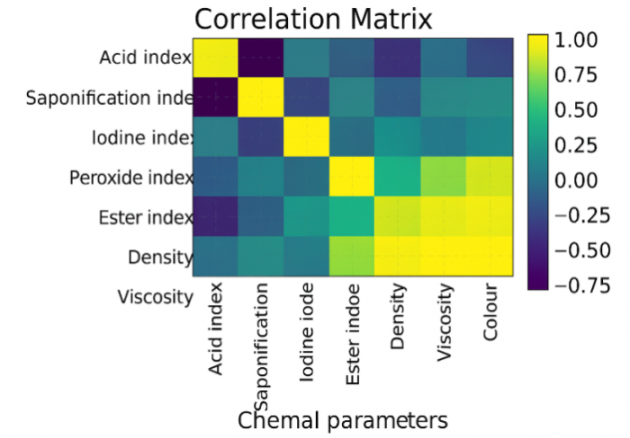
The analysis of the correlation matrix revealed several significant relationships (Figure 1). A strong negative correlation (r = –0.94) was observed between density and viscosity, indicating that denser oils are less viscous. The pH was negatively correlated with the acid value (r = 0.69), suggesting that more acidic oils exhibit lower pH values. The saponification and ester indices were almost perfectly correlated (r ≈ 1.00), confirming that both reflect the same chemical phenomenon — the triglyceride content. Finally, a moderate negative correlation (r ≈ –0.52) between the iodine and peroxide values indicates that more unsaturated oils tend to oxidize slightly faster.

Description of the variability of physicochemical characteristics of kernel oils from the five Hevea brasiliensis clones The Principal Component Analysis (PCA) was performed using the four (4) axes with eigenvalues greater than 1, which together explained 100% of the total variability (Table 3). Axis 1 accounted for 52.22% of the total variability. The variables that contributed most to the formation of this axis were pH, refractive index, peroxide value, and saponification value. Axis 2 explained 24.70% of the total variability, mainly represented by a single variable: density. Axis 3 accounted for 12.43%, and Axis 4 for 10.66% of the total variability. The iodine value contributed most to the formation of Axis 3, whereas moisture content was the main contributor to Axis 4.
|
Comparative Study of Kernel Oils from the Five Hevea brasiliensis Clones Based on Physicochemical Characteristics
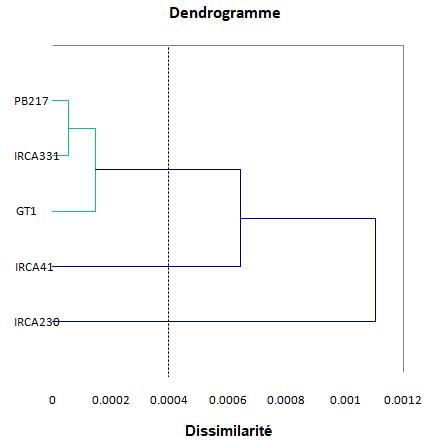
A Hierarchical Cluster Analysis (HCA) was performed to compare the kernel oils of the five Hevea brasiliensis clones according to their physicochemical characteristics. This analysis made it possible to identify three main groups (Figure 2). Group 1 consisted of clones PB217, IRCA331, and GT1. This group was characterized by high acid, saponification, and density values, but showed low peroxide value, refractive index, and pH. Group 2 included the clone IRCA41, which exhibited intermediate saponification and ester values. Group 3 was composed solely of the clone IRCA230, distinguished by its high pH, peroxide value, and refractive index.

The results obtained in this study highlight a marked interclonal variability in the physicochemical properties of oils extracted from Hevea brasiliensis kernels. This differentiation mainly reflects genetic divergences among clones, as well as ecological and post-harvest factors influencing lipid composition and the final quality of the oils 20, 21.
4.1. Variability of Physical CharacteristicsThe observed differences in moisture, density, and viscosity reflect variations in the structure and chain length of fatty acids. Oils from GT1 and IRCA230, which were denser and less viscous, suggest a higher proportion of short chain saturated fatty acids, favoring better thermal stability and lower oxidative tendency 22, 23. Conversely, oil from IRCA41, which was more fluid, exhibited a composition typical of oils rich in unsaturated fatty acids, notably oleic and linoleic acids, giving it rheological properties suitable for industrial and cosmetic formulations 24. These findings are consistent with those of Fagbemi et al. (2022) and Bamba et al. (2024), who reported that viscosity and density are reliable indicators of the lipid composition of tropical oils 17, 25. The slightly acidic pH observed for all clones confirms the crude nature of the unrefined oils and reflects the presence of free fatty acids resulting from partial hydrolysis of triglycerides 26. This behavior has also been reported for jatropha, neem, andcotton oils [27, 28] 27, 28.
4.2. Chemical Composition and Oxidative StabilityThe diversity of chemical indices obtained revealed two distinct profiles of oils: (1) those with high saponification and ester values, rich in saturated triglycerides (GT1, PB217, IRCA331); and (2) those with high iodine and peroxide values, indicating greater unsaturation (IRCA41 and IRCA230). Oils from the first group exhibited high oxidative stability, making them suitable for soap and cosmetic applications, while oils from the second group were more reactive, thus appropriate for biofuel and biodegradable lubricant production [29, 30] 29, 30. Similar results were reported by Adepoju et al. (2021) in Nigeria and Nguyen et al. (2021) in Vietnam, who observed an inverse correlation between iodine and saponification indices, linked to the proportion of unsaturated fatty acids 7, 9. The low peroxide values (< 4 meq O₂/kg) recorded in this study indicate good oxidative resistance, comparable to that of semi-drying tropical oils such as shea and palm oils 6, 31. The stability of rubber seed oils can also be attributed to the presence of natural antioxidant compounds (tocopherols, sterols, polyphenols), previously identified in other African and Asian studies 32, 33. These molecules give Hevea brasiliensis oil good storage stability and industrial potential, particularly for the formulation of mild soaps and moisturizing creams.
4.3. Correlations and Functional RelationshipsThe correlation matrix analysis revealed significant relationships among several physicochemical parameters. The negative correlation between density and viscosity (r = –0.94) reflects the effect of molecular structure: oils with longer and more unsaturated chains tend to have lower density and higher viscosity 25, 26. The inverse correlation between pH and acid value (r = –0.69) confirms that the formation of free acids is associated with a decrease in pH, a phenomenon also documented by Nzikou et al. (2023) in studies on African vegetable oils 18. Furthermore, the nearly perfect correlation between saponification and ester indices (r ≈ 1.00) demonstrates the internal consistency of the measurements and the reliability of the methods used 13, 19. This direct relationship reflects the triglyceride content of the oil and supports its suitability for industrial applications requiring strong alkaline reactivity, such as the production of soaps and stable emulsions 24, 30.
4.4. Multivariate Structure and Clonal TypologyMultivariate analysis (PCA and HCA) distinguished three main groups of clones based on their physicochemical characteristics. GT1, PB217, and IRCA331 formed a cluster characterized by balanced and stable oil profiles, with high density, low acidity, and good saponification capacity, making them suitable for cosmetic and soap industries 11, 25. IRCA41, with a more viscous oil, represented an intermediate profile, potentially useful for technical applications, such as the formulation of greases and biodegradable lubricants 5, 34. Finally, IRCA230, rich in unsaturated fatty acids, exhibited a high potential for biodiesel production, owing to its fluidity and favorable energy profile 29, 35. The viscosity, iodine index and acid value of IRCA230 oil fall within acceptable ranges of major biodiesel standards (ASTM D6751 and EN 14214), supporting its suitability for transesterification. These results confirm the functional diversity among Hevea brasiliensis clones and open practical perspectives for differentiated valorization of their oils according to targeted industrial applications. Such an approach aligns with the FAO’s recommendations and African circular bioeconomy programs aimed at reducing post-harvest losses and maximizing local value addition 13, 33.
The study highlighted significant interclonal variability in the almond oils of five rubber tree clones (Hevea brasiliensis). Oil yields ranged from 38.5% (GT1) to 47.2% (IRCA230), with densities between 0.908 and 0.921 g/cm³ and viscosities of 45 to 58 mPa·s. The acid (1.4–3.1 mg KOH/g), peroxide (2.1–3.8 meq O₂/kg) and saponification (183–198 mg KOH/g) indices indicate good oxidative stability, while the iodine indices (97–118 g I₂/100 g) confirm a balance between saturated and unsaturated fatty acids. Principal component analysis differentiated three groupsclones GT1, PB217 and IRCA331, with dense, low-acid and stable oils, suitable for soap and cosmetics; clone IRCA41, with a more fluid and moderately unsaturated oil, suitable for technical uses; and the IRCA230 clone, with oil rich in unsaturation and high yield, favourable for biodiesel production. These results demonstrate that the Ivorian rubber tree seed is a strategic oilseed resource, offering concrete prospects for local industrial development and the development of a sustainable bioeconomy in Côte d'Ivoire.
The authors express their sincere gratitude to the National Agricultural Research Center (CNRA), the Interprofessional Fund for Agricultural Research and Advisory Services (FIRCA), and the Association of Natural Rubber Professionals of Côte d’Ivoire (APROMAC) for their valuable support and collaboration throughout this study.
| [1] | APROMAC. (2023). Annual Report on Rubber Production in Côte d’Ivoire. Abidjan, Côte d’Ivoire. | ||
| In article | |||
| [2] | Adepoju, A., et al. (2021). Characterization of rubber seed oil from different clones of Hevea brasiliensis. Journal of Food Chemistry, 340, 127876. | ||
| In article | |||
| [3] | Oyekunle, O., et al. (2022). Nutritional and chemical properties of Hevea brasiliensis seed oil. Industrial Crops and Products, 176, 114312. | ||
| In article | |||
| [4] | Osarumwense, P., et al. (2022). Variation in rubber seed oil properties among clones. African Journal of Biotechnology, 21(5), 55–63. | ||
| In article | |||
| [5] | Tebe, K., et al. (2024). Comparative study of vegetable oils for biodiesel production. Renewable Energy Journal, 19(3), 220–233. | ||
| In article | |||
| [6] | Singh, R., et al. (2023). Stability and oxidative characteristics of tropical semi-drying oils. Food Industrial Chemistry, 12(1), 99–110. | ||
| In article | |||
| [7] | Adepoju, A., et al. (2021). Comparative analysis of physicochemical properties of Hevea brasiliensis oils. Biochemical Analysis Journal, 13(2), 65–72. | ||
| In article | |||
| [8] | Osarumwense, P., & Eze, V. (2023). Rubber seed oil as a sustainable bio-feedstock. Energy for Sustainable Development, 77, 140–149. | ||
| In article | |||
| [9] | Nguyen, H. T., et al. (2021). Chemical characterization of rubber seed oil and its blends. Sustainable Chemistry and Pharmacy, 22, 100495. | ||
| In article | |||
| [10] | Akinola, R., et al. (2022). Fatty acid profiles and oxidation kinetics of tropical seed oils. Journal of Oleo Science, 71(9), 1353–1365. | ||
| In article | |||
| [11] | Bamba, D., et al. (2024). Physico-chemical properties of rubber seed oil and its industrial potential. Ivorian Journal of Agricultural Science, 18(2), 45–58. | ||
| In article | |||
| [12] | Adebayo, T., et al. (2023). Local processing and economic potential of rubber seed oil in West Africa. Journal of Cleaner Production, 415, 137232. | ||
| In article | |||
| [13] | AOAC. (2016). Official Methods of Analysis of AOAC International (20th ed.). Gaithersburg, USA. | ||
| In article | |||
| [14] | AOCS. (2009). Official Methods and Recommended Practices of the American Oil Chemists’ Society (6th ed.). Champaign, IL, USA. | ||
| In article | |||
| [15] | ISO. (2017). ISO 6320: Animal and Vegetable Fats and Oils — Determination of Refractive Index. Geneva: International Organization for Standardization. | ||
| In article | |||
| [16] | Okoro, C. K., et al. (2021). Optimization of Soxhlet extraction for tropical oilseeds. Journal of Food Process Engineering, 44(12), e13986. | ||
| In article | |||
| [17] | Fagbemi, T. N., et al. (2022). Comparative evaluation of physicochemical indices of tropical seed oils. Food Measurement and Characterization, 16(4), 2678–2689. | ||
| In article | |||
| [18] | Nzikou, J. M., et al. (2023). Analytical assessment of the quality of African seed oils for industrial use. Industrial Crops and Products, 198, 116786. | ||
| In article | |||
| [19] | Montgomery, D. C., et al. (2021). Design and Analysis of Experiments (10th ed.). New York: Wiley. | ||
| In article | |||
| [20] | Okoro, D., et al. (2021). Influence of genotype and environment on oil yield of Hevea brasiliensis. Industrial Crops and Products, 173, 114165. | ||
| In article | |||
| [21] | Bello, E. I., et al. (2020). Effects of post-harvest conditions on oil quality from rubber seeds. Journal of Oleo Science, 69(11), 1289–1300. | ||
| In article | |||
| [22] | Oyekunle, O., et al. (2022). Physicochemical variability in rubber seed oil: Implications for industrial use. European Journal of Lipid Science and Technology, 124(7), 2100453. | ||
| In article | |||
| [23] | Akinola, R., et al. (2022). Fatty acid profiles and oxidation kinetics of tropical seed oils. Journal of Oleo Science, 71(9), 1353–1365. | ||
| In article | |||
| [24] | Bamba, D., et al. (2024). Physico-chemical properties of rubber seed oil and its industrial potential. Ivorian Journal of Agricultural Science, 18(2), 45–58. | ||
| In article | |||
| [25] | Nzikou, J. M., et al. (2023). Analytical assessment of the quality of African seed oils for industrial use. Industrial Crops and Products, 198, 116786. | ||
| In article | |||
| [26] | Ogunyemi, A., et al. (2022). Chemical stability of tropical seed oils: comparative assessment. Food Measurement and Characterization, 16(8), 5122–5135. | ||
| In article | |||
| [27] | Konan, K. J.-L., et al. (2023). Variability of Ivorian vegetable oils: characterization and valorization. Science, Technology and Development, 12(1), 87–99. | ||
| In article | |||
| [28] | Tebe, K., et al. (2024). Comparative study of vegetable oils for biodiesel production. Renewable Energy Journal, 19(3), 220–233. | ||
| In article | |||
| [29] | Singh, R., et al. (2023). Stability and oxidative characteristics of tropical semi-drying oils. Food Industrial Chemistry, 12(1), 99–110. | ||
| In article | |||
| [30] | Ofori-Boateng, C., et al. (2021). Comparative oxidative stability of shea, palm and rubber seed oils. Journal of Applied Science and Environmental Management, 25(8), 1319–1328. | ||
| In article | |||
| [31] | Hong, S. Y., et al. (2022). Antioxidant composition and lipid profile of tropical seed oils. Antioxidants, 11(3), 512. | ||
| In article | |||
| [32] | FAO. (2023). Bioeconomy and Sustainable Transformation of Agricultural By-products in Africa. Rome, Italy. | ||
| In article | |||
| [33] | Adekunle, A. A., et al. (2023). Performance of rubber seed oil-based lubricants. Tribology International, 188, 108848. | ||
| In article | |||
| [34] | Adebayo, T., et al. (2023). Local processing and economic potential of rubber seed oil in West Africa. Journal of Cleaner Production, 415, 137232. | ||
| In article | |||
| [35] | Fagbemi, T. N., et al. (2022). Comparative evaluation of tropical seed oil indices and biofuel potential. Renewable Energy Reviews, 167, 112884. | ||
| In article | |||
Published with license by Science and Education Publishing, Copyright © 2025 Okoma D. Muriel J., Niamketchi G. Léonce, Sylla Ardjouma, Konan Brou Roger and Konan K. Jean-Louis
 This work is licensed under a Creative Commons Attribution 4.0 International License. To view a copy of this license, visit
http://creativecommons.org/licenses/by/4.0/
This work is licensed under a Creative Commons Attribution 4.0 International License. To view a copy of this license, visit
http://creativecommons.org/licenses/by/4.0/
| [1] | APROMAC. (2023). Annual Report on Rubber Production in Côte d’Ivoire. Abidjan, Côte d’Ivoire. | ||
| In article | |||
| [2] | Adepoju, A., et al. (2021). Characterization of rubber seed oil from different clones of Hevea brasiliensis. Journal of Food Chemistry, 340, 127876. | ||
| In article | |||
| [3] | Oyekunle, O., et al. (2022). Nutritional and chemical properties of Hevea brasiliensis seed oil. Industrial Crops and Products, 176, 114312. | ||
| In article | |||
| [4] | Osarumwense, P., et al. (2022). Variation in rubber seed oil properties among clones. African Journal of Biotechnology, 21(5), 55–63. | ||
| In article | |||
| [5] | Tebe, K., et al. (2024). Comparative study of vegetable oils for biodiesel production. Renewable Energy Journal, 19(3), 220–233. | ||
| In article | |||
| [6] | Singh, R., et al. (2023). Stability and oxidative characteristics of tropical semi-drying oils. Food Industrial Chemistry, 12(1), 99–110. | ||
| In article | |||
| [7] | Adepoju, A., et al. (2021). Comparative analysis of physicochemical properties of Hevea brasiliensis oils. Biochemical Analysis Journal, 13(2), 65–72. | ||
| In article | |||
| [8] | Osarumwense, P., & Eze, V. (2023). Rubber seed oil as a sustainable bio-feedstock. Energy for Sustainable Development, 77, 140–149. | ||
| In article | |||
| [9] | Nguyen, H. T., et al. (2021). Chemical characterization of rubber seed oil and its blends. Sustainable Chemistry and Pharmacy, 22, 100495. | ||
| In article | |||
| [10] | Akinola, R., et al. (2022). Fatty acid profiles and oxidation kinetics of tropical seed oils. Journal of Oleo Science, 71(9), 1353–1365. | ||
| In article | |||
| [11] | Bamba, D., et al. (2024). Physico-chemical properties of rubber seed oil and its industrial potential. Ivorian Journal of Agricultural Science, 18(2), 45–58. | ||
| In article | |||
| [12] | Adebayo, T., et al. (2023). Local processing and economic potential of rubber seed oil in West Africa. Journal of Cleaner Production, 415, 137232. | ||
| In article | |||
| [13] | AOAC. (2016). Official Methods of Analysis of AOAC International (20th ed.). Gaithersburg, USA. | ||
| In article | |||
| [14] | AOCS. (2009). Official Methods and Recommended Practices of the American Oil Chemists’ Society (6th ed.). Champaign, IL, USA. | ||
| In article | |||
| [15] | ISO. (2017). ISO 6320: Animal and Vegetable Fats and Oils — Determination of Refractive Index. Geneva: International Organization for Standardization. | ||
| In article | |||
| [16] | Okoro, C. K., et al. (2021). Optimization of Soxhlet extraction for tropical oilseeds. Journal of Food Process Engineering, 44(12), e13986. | ||
| In article | |||
| [17] | Fagbemi, T. N., et al. (2022). Comparative evaluation of physicochemical indices of tropical seed oils. Food Measurement and Characterization, 16(4), 2678–2689. | ||
| In article | |||
| [18] | Nzikou, J. M., et al. (2023). Analytical assessment of the quality of African seed oils for industrial use. Industrial Crops and Products, 198, 116786. | ||
| In article | |||
| [19] | Montgomery, D. C., et al. (2021). Design and Analysis of Experiments (10th ed.). New York: Wiley. | ||
| In article | |||
| [20] | Okoro, D., et al. (2021). Influence of genotype and environment on oil yield of Hevea brasiliensis. Industrial Crops and Products, 173, 114165. | ||
| In article | |||
| [21] | Bello, E. I., et al. (2020). Effects of post-harvest conditions on oil quality from rubber seeds. Journal of Oleo Science, 69(11), 1289–1300. | ||
| In article | |||
| [22] | Oyekunle, O., et al. (2022). Physicochemical variability in rubber seed oil: Implications for industrial use. European Journal of Lipid Science and Technology, 124(7), 2100453. | ||
| In article | |||
| [23] | Akinola, R., et al. (2022). Fatty acid profiles and oxidation kinetics of tropical seed oils. Journal of Oleo Science, 71(9), 1353–1365. | ||
| In article | |||
| [24] | Bamba, D., et al. (2024). Physico-chemical properties of rubber seed oil and its industrial potential. Ivorian Journal of Agricultural Science, 18(2), 45–58. | ||
| In article | |||
| [25] | Nzikou, J. M., et al. (2023). Analytical assessment of the quality of African seed oils for industrial use. Industrial Crops and Products, 198, 116786. | ||
| In article | |||
| [26] | Ogunyemi, A., et al. (2022). Chemical stability of tropical seed oils: comparative assessment. Food Measurement and Characterization, 16(8), 5122–5135. | ||
| In article | |||
| [27] | Konan, K. J.-L., et al. (2023). Variability of Ivorian vegetable oils: characterization and valorization. Science, Technology and Development, 12(1), 87–99. | ||
| In article | |||
| [28] | Tebe, K., et al. (2024). Comparative study of vegetable oils for biodiesel production. Renewable Energy Journal, 19(3), 220–233. | ||
| In article | |||
| [29] | Singh, R., et al. (2023). Stability and oxidative characteristics of tropical semi-drying oils. Food Industrial Chemistry, 12(1), 99–110. | ||
| In article | |||
| [30] | Ofori-Boateng, C., et al. (2021). Comparative oxidative stability of shea, palm and rubber seed oils. Journal of Applied Science and Environmental Management, 25(8), 1319–1328. | ||
| In article | |||
| [31] | Hong, S. Y., et al. (2022). Antioxidant composition and lipid profile of tropical seed oils. Antioxidants, 11(3), 512. | ||
| In article | |||
| [32] | FAO. (2023). Bioeconomy and Sustainable Transformation of Agricultural By-products in Africa. Rome, Italy. | ||
| In article | |||
| [33] | Adekunle, A. A., et al. (2023). Performance of rubber seed oil-based lubricants. Tribology International, 188, 108848. | ||
| In article | |||
| [34] | Adebayo, T., et al. (2023). Local processing and economic potential of rubber seed oil in West Africa. Journal of Cleaner Production, 415, 137232. | ||
| In article | |||
| [35] | Fagbemi, T. N., et al. (2022). Comparative evaluation of tropical seed oil indices and biofuel potential. Renewable Energy Reviews, 167, 112884. | ||
| In article | |||