Glass transition temperature (Tg), termed the “softening point of amorphous materials” is the temperature at which an amorphous material changes from a hard, glassy state to a soft, rubbery one. As the number-average molecular weight (Mn) of the amorphous material increases, its glass transition temperature also increases, but ultimately levels off asymptotically at a maximum value labeled Tg∞. Differential scanning calorimetry (DSC) was utilized to evaluate Tg for eight samples of poly t-butyl methacrylate (PtBMA) whose Mn values ranged from approximately 1K to 500K. These values were then plotted against reciprocal Mn, producing a Flory-Fox equation of Tg = 114.7°C – .55 x 10 5 C.g.mol-1/Mn, with a correlation coefficient of 0.98. These experiments demonstrate the quantitative applications of DSC in evaluating the Flory-Fox equation for Poly (t-Butyl Methacrylate (PtBMA) as well as its suitability within the undergraduate chemistry laboratory.
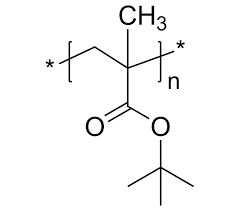
Poly(Alkyl Methacrylate) is a family of synthetic polymers made from alkyl methacrylate monomers. The most common example is polymethyl methacrylate (PMMA), which is widely known by its trade names of Lucite or Plexiglass. PMMA is a synthetic thermoplastic polymer with transparent, rigid, lightweight, and shatterproof properties, belonging to a class of materials known as engineering plastics 1, 2, 3. By varying the size of the alkyl group in the methacrylate monomer, different poly(alkyl methacrylates) can be produced with tailored properties. For example, poly(tert-butyl methacrylate) (PtBMA)lowers Tg, in comparison to PMMA, due to its large, bulky, and nonpolar side chain group. PtBMA’s side chain increases steric hindrance, which reduces the ability of the polymer chains to pack closely or interact strongly with one another. The tightly packed side chains lead to reduced crystallinity, which results in a more amorphous structure. The characteristics ofPtBMA increase its elastomeric properties and decrease its thermoplastic properties, compared to PMMA making PtBMA valuable in various industries and research applications. 4. PtBMA can be synthesized by emulsion, solution, or bulk polymerization from tert-butyl methacrylate monomers. Generally, radical initiation is used, however controlled living polymerization methods such as anionic polymerization can also be performed 5, 6. The structure of PtBMA contains a methyl group, a tertiary butyl group and an ester functional group on alternating repeat units. Figure 1 displays an individual PtBMA monomer, where n represents the number of monomers, or repeating units, in the polymer macromolecule 7.

Glass transition temperature (Tg), termed the “softening point of amorphous materials” is the temperature at which an amorphous polymer changes from a hard, glassy state to a soft, rubbery one. The Tg appears as a sharp change of temperature, and is dependent on many factors including thermal properties, volume (density), entropy, elasticity and mechanical properties. The Tg is also dependent on the rate of cooling or heating. Therefore, it is an ill-defined quantity and is usually interpreted as a kinetic phenomenon which is described as a freezing of segmental relaxation of the polymeric backbone and side chain structure. As the number-average molecular weight (Mn) of the amorphous polymer increases, its Tg also increases but ultimately levels off at a maximum value labeled Tg. The Flory-Fox empirical equation relates these parameters for linear amorphous polymers and is given by the equation below:
 | (1) |
Differential Scanning Calorimetry (DSC) can be used to evaluate when the glass transition temperatures occur, by measuring changes in heat capacity and thermal expansion 8, 9, 10.
A solid polymer can be differentiated into the amorphous and semi-crystalline categories. Amorphous solid polymers are either in a glassy state, a soft rubbery state, or a fluid state. The glassy state of a polymer can be described as a state in which cooperative chain motion of the macromolecules are frozen. This would make it so only limited local motion can take place, such as side-group rotational/vibrational motion. These motions exist due to bond angle deformation and bond stretching within the molecules. The typical model of a macromolecule in the amorphous state is the “random coil”, however, the amorphous state is better depicted by an irregularly folded chain molecule, rather than a completely idealized random coil.
2.1. Glass Transition and Glass Transition Temperature (Tg)One of the most important properties of both amorphous and semi-crystalline polymers is their thermal behavior. Understanding this behavior is not only critical for the selection of proper processing and manufacturing conditions, but also for the full understanding of the polymeric physical and mechanical properties.
The most prevalent transition in amorphous polymers, is usually labelled the glass or vitreous transition, in which the linear or volume coefficient of thermal expansion (CTE) increases. In contrast, in semi-crystalline polymers, the glass transition usually occurs below the melting temperature. The exact description of the molecular motion responsible for the glass transition is undefined, however, it is generally thought to involve macromolecular random chain bond movement. These movements can be described as groups or segments of the polymer macromolecular relaxing, vibrating or reptating (crawling). Above the Tg, the chain segments can undergo cooperative rotational, vibrational, translational, and diffusional motion. The importance of the glass transition in polymer science was stated by Eisenberg: “The glass transition is perhaps the most important single parameter that determines the application of many non-crystalline polymers now available” 17.
The temperature-dependent properties of amorphous polymers undergo major changes at the glass transition temperature (Tg). The simplest of many definitions for the glass transition temperature (Tg) is the temperature below which the amorphous polymer is glassy, and above which is soft and rubbery. The molecular interpretation of Tg is the temperature of the onset of large-scale motion of molecular chain segments. Below the Tg, the polymer chains’ atoms undergo little rotational-vibrational motions or are in a frozen bulk solid state.
The glass transition temperature can be measured in a variety of ways, not all of which yield the same value. The results from the kinetic and thermodynamic nature of the glass transition differ, and the Tg is dependent upon the thermal history of the polymer and the rate ofheating/cooling for the experiment.
2.2. Theories for Glass Transition (Glassy -to- Rubbery [18]Many theories regarding the glass transition have been developed, including: the iso-free volume theory by Flory-Fox 19, 20, 21, a modified mechanical-free volume phenomenological theory that wasexplored by the Williams-Landel-Ferry (WLF) equation 22, a modified Free volume Relaxation-Kinetic theory that includes Lattice-Hole/Voids developed by Hirai-Eyring 23, and finally, the Gibbs-DiMarzio thermodynamic theory 24, 25 which suggests that the transition is a true second order thermodynamic transition representing an equilibrium between the glass and rubbery state in which theconformational/configurational entropy at equilibrium is zero.
2.3. Free Volume Theory of Glass Transition and the Flory- Fox EquationThe Flory-Fox iso-free volume theory postulates that the glass transition occurs when the free or unoccupied volume in the macromolecule reaches a constant value and does not decrease further as the polymer is cooled below or at the Tg. The fractional value of the total volume is often taken as 0.025, which is so small that segmental jumps become impossible below the Tg 19, 20, 21.
The free volume (Vf) of the fluid is defined by Vf = VT – Vo, where VT is the total volume of the fluid at temperature T and Vo is the theoretical molar volume or occupied volume. The total volume is the sum of the free volume (Vf) and of the occupied volume (Vo). The occupied volume (Vo) includes the van der Waals radii plus the fluctuation volume which is related to the thermal vibrational and rotational motion of the molecule. Thus, the Tg can be viewed as accessing by segmental jumps of the macromolecular chain segments into vacant spaces not occupied by the polymer. The higher the free volume, the more easily segmental jumps can occur, causing either a lowering of the viscosity or increasing of the fluidity.
The glass transition temperature Tg, as explained by the free volume theory, is the temperature at which the free volume Vf reaches a constant value 19, 20, 21.
For linear amorphous polymers, the Tg value is an increasing function of the molar mass, such that Tg varies linearly with the reciprocal of the number average molecular weight (Mn). This dependance is a result of the contribution of chain-end segments in molecular motion. As the number of chain-ends increases, the free volume increases due to increasing molecular motion, and therefore the Tg temperature decreases. This relationship is expressed in the following Flory-Fox empirical equation 19, 20, 21:
 | (2) |
where
Tg∞ = Tg for a given polymer at infinite molecular weight
Mn = number-average molecular weight with units of g/mol. By reorienting and rearranging the Flory-Fox equation (2) in a straight-line format one gets the Flory equation in the form shown in equations (3)&(4) below
 | (3) |
 | (4) |
 |
If one assumes that the chain end has a free volume of Vf . then the free volume per unit volume is 2VfρNA/ Mn. Also assuming that the fractional free volume is independent of Mn, the excess free volume introduced by chain ends will be compensated by the thermal contraction shown in equation (5) below:
 | (5) |
Therefore, up rearrangement according to the Flory-Fox equationabove andsubstitution, one finds that:
K = a constant with units of °Cg/mol, is equal to equation (6) below:
 | (6) |
where
Vf = the free volume contributed by chain ends, expressed in units of cm3
ρ = the density of the polymer in g/cm3
NA = Avogadro’s number (6.023 x 10²³ molecules/mole)
α = coefficient of thermal expansion, with units of°C-1
We have previously studied and established the Flory- Fox Equations for Polystyrene (PS) 10, Poly (methyl methacrylate (PMMA) 26 and Poly (2-vinyl pyridine (P2VP) 27
2.4. Summary of the Chemical Factors affecting Tg [26]Molecular weight for linear homopolymers: an increase in molar mass (molecular weight) leads to a decrease in chain end concentrations resulting in a decrease of free volume at the end group region and thus an increase in the glass transition temperature, but ultimately levels off at a maximum value, Tg. Addition of diluents or plasticizers increase free volume thus decreasing Tg.
Molecular structure: an insertion ofrigid inflexible side groups, such as a phenyl group, will increase the glass transition temperature Tg due to the decrease in mobility/flexibility. Whereas introducing flexible side chains like acetate groups or n- or tertiary-butyl groups decrease Tg.
Chemical cross-linking: an increase in cross linking density decreases mobility, leading to a decrease in free volume and thus an increase in the glass transition temperature Tg. Increasing branching or the size of the side groups increase free volume thus decrease Tg.
Cohesive Energy Density: as a measure of polarity, the presence of polar groups increases the dipole-dipole intermolecular forces which increase interchain attraction and cohesion, making it more difficult for molecular permeation, thus leading to a decrease in freevolume resulting in an increase in Tg.
Tacticity: an increase in isotacticity decreases Tg, whereas an increase in syndiotacticity increases Tg. Generally, syndiotactic polymers have greater Tg values than isotactic polymers of the same polymer type. Atactic polymers have Tg somewhere in the middle range.
2.5. The Determination of TgExperimental methods of measuring the glass transition (Tg) are based on the physical properties of the polymers converted from the glassy state to the soft rubbery state. Three overall methods have been used:
1. Experiments defined by equilibrium thermodynamics or the Steady-State method, in which the physicalproperties are measured under static isothermalequilibrium conditions over atemperature range including Tg. Examples include dilatometry, penetrometry, refractometry, calorimetry-specific heat such as DSC or thermal analysis.
2. Experiments defined by dynamic or transport properties or the Dynamic Method, in which the physical polymer properties are measured during the heating of the polymer above Tg, in these methods Tg is measured by extrapolation to obtain isothermal conditions. Examples include:Infrared spectroscopy, NMR, stress birefringence, dielectric loss, stress relaxation, dynamic mechanical properties.
3. Tests related to end-use properties examples include: impact resistance, softening point, and hardness measurement.
2.6. General Description of the Glass Transition of Poly(t-butyl Methacrylate) (PtBMA)PtBMA has not been extensively studied with respect to glass transition temperatures and physical and chemical properties. PtBMA is a solid white thermoplastic substance (material) existing as a non-crystalline linear homopolymer that is in a glass-like state at room temperature. The glass formation is due to the lack of structural regularity in the PtBMA molecules. Below its glass transition temperature, PtBMA exists as a hard and stiff, yet brittle state and has frozen glass-like properties at room temperature. It has low to moderate dipole-dipole intermolecular forces and is a vitreous low mechanical strength material.
Eight samples of predominantly syndiotactic, monodispersed PtBMA with peak molecular weights (Mp) ranging from 1K to 500K g/mol were each individually prepared in standard aluminum pans. The individual PtBMA samples were loaded into the DSC to evaluate glass transition temperature data. The onset glass transition temperatures of the individual PtBMA samples were plotted against reciprocal peak molecular weight (mol/g) to achieve the K and Tg parameters of the Flory-Fox relationship.
3.2. Experimental Materials: Poly(t-Butyl Methacrylate)The eight samples of various peak molecular weight PtBMA used to establish the Flory-Fox equation were obtained from Polymer Standards Service (PSS) a division of Agilent technologies and were made in Germany. The samples were synthesized by anionic polymerization and are characterized mostly in the syndiotactic form.The molecular weight distribution data and polydispersity indices (PDI) for these eight samples are shown in Table 1 and were characterized by PSS using Gel Permeation and Size Exclusion Chromatography (GPC/SEC).
The Tg results were obtained using a Perkin-Elmer power compensated Differential Scanning Calorimeter (DSC) model Pyris 1. The DSC was used in its high temperature mode. Calibration of the thermal outputs of the DSC were obtained using an empty reference aluminum pan. Prior to beginning the experiment, the DSC was calibrated for Temperature, heat flow and baseline linearity. This was done by first running empty cells in both the sample and reference compartments to produce a thermal baseline. Highly pure standards of tin, lead and indium were run thru 4 thermal cycles/ramps of two heating and two cooling at a constant rate of 10.0C/min. The onset melting and recrystallization temperatures for the standards were used for temperature calibration. The onset melting /recrystallization temperatures are defined as the temperature at the initial endothermic/exothermic change from the thermal baseline. The change in enthalpy (ΔH) was used to calibrate heat flow. The ΔH is found by the peak area under the curve. The endothermic and exothermic transition temperatures as well as the enthalpies of fusion and crystallization were recorded by the Pyris 1 for Windows software. All PtBMA samples underwent two heating cycles and one cooling cycle between 40.0-160.0C at a rate of 10C/min for heating and cooling. The glass transition temperatures and enthalpies of transition were determined using the Perkin-Elmer thermal analysis software Pyris for Windows. The first heating cycle was used to measure the glass transition temperature data which included the onset, mid-point-1/2 Cp and endpoint temperatures of Tg, as well as endothermic enthalpy of transition. All experiments were run under dry nitrogen flowing at 20 cm3/min. The flowing nitrogen was used to prevent any moisture pickup or oxidative degradation. The experimental analysis is not limited to this specific DSC hardware or software.
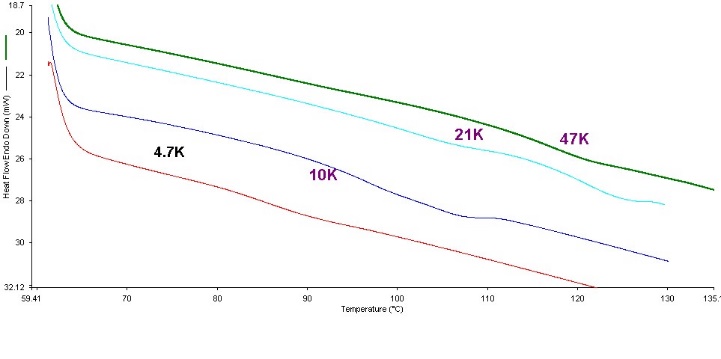
PtBMA sample was packed into a standard aluminum pan and the lid was left laying on top of the sample, unpressed. Each thermogram was obtained at a rate of 10C per minute and each glass transition temperature was calculated using the “Tg” option found in the Pyris DSC software package. Selected thermograms for various PtBMA samples are shown in Figure 2.
3.4. HazardsPoly(tert-Butyl Methacrylate) (PtBMA) (CAS# 25189-00-9) is regularly used as a versatile engineering plastic for many commercial applications. Because of its biocompatibility and low toxicity, the FDA has approved its uses in many different medical specialties. The FDA has approved PtBMA for use in contact with food, as it does not pose any significant health risks unless consumed at high levels. Goggles and gloves are nevertheless required to avoid exposure to the eyes and skin. Waste material should be disposed of according to EPA and local guidelines.

The DSC thermograms for PtBMA samples of selected peak molecular weights are shown in Figure 2. Figure 2 is an overlay of the DSC thermograms for the 4.7K,10K, 21K, and $7K g/mol poly (t-Butyl methacrylate) samples. As shown in the Figure 2, the samples with a lower molecular weight had a lower Tg Furthermore, the higher molecular weight PtBMA samples generally had greater endothermic heat flows than the lower Mp for the PtBMA samples.
Table 2 summarizes the onset, half-Cp, and end Tg data as well as the endothermic enthalpy of transition (ΔCp) for the eight individual PtBMA samples.
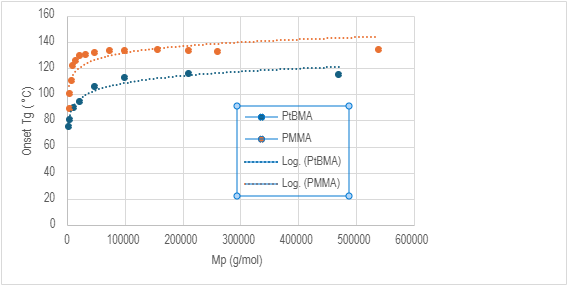
Figure 3 is the graphical representation for the onset glass transition temperature data for the poly(t-butyl methacrylate) (PtBMA) samples as shown in blue plotted against peak molecular weight,. It represents the typical Flory-Fox plot in which Tg steadily increases, but ultimately levels off at a maximum value labeled Tg.
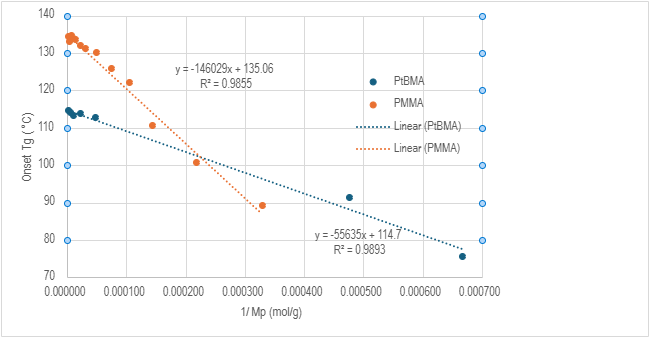
Figure 4 illustrates glass transition temperature as a function of reciprocal peak molecular weight. Given the general Flory-Fox equation of Tg = Tg - K/Mn or eq #4.it is established that the value of the slope of the graph of onset Tg versus reciprocal molecular weight, represents K for the amorphous polymer, while the y-intercept of the same plot denotes Tg. Therefore, the value of K was experimentally evaluated to be 0.55 x 10⁵Cgmol-1 for the predominantly syndiotactic PtBMA used, while the value of Tg was determined to be 114.7°C. Reported values forTgand K for PMMA are 135°C and a K value of 1.4 x 10⁻⁵Cgmol-1 respectively 26.


The glass transition temperature is a pivotal property of polymers as stated previously. Comparison of the molecular,thermal and physical properties of PMMA and PtBMA are summarized in Table 3. For two polymers such as PMMA and PtBMA, the difference in Tg∞ can often be attributed to the variations in their molecular structures. PMMA is known as stated in Table 3 to have a higher Tg due to its shorter side chain compared to PtBMA. The structure of PMMA features a methyl group whereas PtBMA has a bulky non polar tertiary butyl group which increases steric hindrance in the bulk polymer, reducing the ability of polymer chains to pack closely or interact strongly with one another chain thus leads to reduced crystallinity resulting in a more amorphous structure. The t-Butyl group is larger and grants the polymer more flexibility at lower temperatures. This increased flexibility means that PtBMA will have a lower Tgthan PMMA because it allowsfor greater mobility and less resistance to movement and less entanglement at lower temperature.
The values of K and Tg∞ in the Flory-Fox equation vary depending on the polymeric chemical structure, particularly, the flexibility of the backbone and the nature of the side group. A higher Tg∞ indicates a stiffer polymer backbone with side chains which restrict chain mobility. Also, K as based on equation 6 not only depends on the free volume effect of the end groups but also on the density of the polymer and the coefficient of thermal expansion. A higher K value suggests a steeper/stronger dependence on Tg∞ on molecular weight often due to significant chain-ends effects on the free volume contribution. Smaller K values result in a more gradual increase in Tg∞ with an increase in Mn which suggests that the polymer Tg is less sensitive to molecular weight changes. K controls the rate at which Tg approaches its asymptotic value with increasing molecular weight.
The experiment establishes the Flory-Fox equation for Poly tert Butyl Methacrylate which relates molecular weight to glass transition temperature. As molecular weight increased, glass transition temperature increased until a certain molecular weight after which the glass transition temperature leveled off. Tg∞ of 114C and the constant K of 0.55 x 10⁵C g mol-1 were determined for mostly syndiotactic PtBMA.The comparison of the molecular, thermal and physical properties explain the significance of the values comparing PtBMA versus PMMA The experiment serves as an excellent tool for the undergraduate polymer chemistry laboratory as the methodology can be readily adopted for similar experiments with different polymers.
We acknowledge the support from a Hofstra University HCLAS Research and Development Grant.
DSC = Differential Scanning Calorimetry
Tg = glass transition temperature
PtBMA = poly (tert- butyl methacrylate
PMMA = poly (methyl methacrylate)
CTE = coefficient of thermal expansion
PDI = polydispersity index
PSS = Polymer Standards Service
GPC/SEC = Gel Permeation & Size Exclusion Chromatography
Tg∞ = Tg at infinite molecular weight
K = Flory-Fox constant (°Cg/mol)
Mn =number average molecular weight
Mw = weight average molecular weight
Mp = Peak average molecular weight
Vf = free volume
ρ = density
Na = Avogadro’s number
α = coefficient of thermal expansion
mW = milliwatts
| [1] | Wikipedia, “Polymethyl Methacrylate,” June 20, 2023. [Online]. https://en.wikipedia.org/wiki/Poly(methyl_methacrylate) [Accessed June 26, 2023]. | ||
| In article | |||
| [2] | Team Xometry, “Everything You Need To Know About Acrylic (PMMA)” May 4, 2022. [Online]. https://www.xometry.com/resources/materials/acrylic-pmma/ [Accessed June 26, 2023]. | ||
| In article | |||
| [3] | Shawn Wasserman. “What is PMMA and How is It Used in the Medical World?” September 25, 2019. [Online]. https://www.ansys.com/blog/what-is-pmma-how-it-is-used-healthcare [Accessed June 26, 2023]. | ||
| In article | |||
| [4] | The Editors of Encyclopedia Britannica, “Polymethyl methacrylate” May 25, 2023 [Online]. https://www.britannica.com/science/polymethyl-methacrylate [Accessed June 26, 2023]. | ||
| In article | |||
| [5] | Ali, U., Juhanni Bt., K., Karim, A., Buang, N.A. “A Review of the Properties and Applications of Poly(Methyl Methacrylates) (PMMA)” Polymer Review, 55:4, 678 – 705 (2015). | ||
| In article | View Article | ||
| [6] | Forte, M.A., Silva, R.M., Tavares, C. J., Silva, R.F.“Is Poly( Methyl Methacrylate) (PMMA) a Suitable Substrate for ADL?: A Review” Polymers, 13, 1346 – 1374, (2021). | ||
| In article | View Article PubMed | ||
| [7] | Duval-Terrie, C., Lebrun, L. “Polymerization and Characterization of PMMA” J. Chemical Ed. 83, #3, 443-446 (2006). | ||
| In article | View Article | ||
| [8] | Wikipedia, “Differential scanning calorimetry,” May 19, 2023. [Online]. https:// en.wikipedia.org/ wiki/ Differential_scanning_calorimetry [Accessed June 26, 2023]. | ||
| In article | |||
| [9] | Blanchard, L.P. Hesse, J. Malhotra, S.L. “Effect of Molecular Weight on Glass Transition by Differential Scanning Calorimetry” Can. J. Chem, 52, 3170-3175 (1974). | ||
| In article | View Article | ||
| [10] | D’Amelia, R. P., Khanyan, B., “An Experimental Review: Evaluation of the Flory-Fox Equation for the Relationship of Glass Transition Temperature (Tg) vs Molar Mass of Polystyrene Using Differential Scanning Calorimetry (DSC),” Journal of Polymer and Biopolymer Physics Chemistry, 10(1), 10-17, August 2022. | ||
| In article | View Article | ||
| [11] | Collins, E.A., Bares, J., Billmeyer, F.W., Experiments in Polymer Science, Wiley-Interscience, New York 1973. | ||
| In article | |||
| [12] | Sperling, L. H., Introduction to Physical polymer Science, 4th edition Wiley-Interscience, Hoboken, New Jersey, 2006. | ||
| In article | |||
| [13] | Alger, M., S. M.Polymer Science Dictionary, Elsevier Applied Science, New York, New York, 1989. | ||
| In article | |||
| [14] | Rabek, J. F., Experimental Methods in Polymer Chemistry – Principles and Applications, Wiley-Interscience, New York, New York, 1980. | ||
| In article | |||
| [15] | Elias, H-G., Macromolecules Vol 1, Structure and Properties, Volume 2, _ Synthesis and Materials, Plenum, New York, New York, 1977. | ||
| In article | |||
| [16] | Flory, P.J. Principles of Polymer Chemistry” Cornell Press Ithaca, New York, 1953. | ||
| In article | |||
| [17] | Mark, J. E., Eisenberg, A., Graessley,W.W , Mandelkern, L., Samulski, E.T., Koenig, J.L. and Wignall, G.D., Physical Properties of Polymers, 2nd ed. American Chemical Society, Washington, DC, 1993. | ||
| In article | |||
| [18] | Abiad, M.G., Carvajal, M.T., Campanella, O.H. “ A Review on Methods & Theories to Describe the Glass Transition Phenomenon: Applications in Food & Pharmaceutical Products,” Food Eng. Res. 1, 105-132, (2009). | ||
| In article | View Article | ||
| [19] | Fox, T.G., & Flory, P.J.” Second Order Transition Temperatures and Related Properties of Polystyrene I Influence of Molecular Weight” J. Applied Phys. 21 (6), 581-591 (1950). | ||
| In article | View Article | ||
| [20] | Fox, T.G., & Flory, P.J. “The Glass Temperature and Related Properties of Polystyrenes Influence of Molecular Weight” J. Polymer Sci, 14, 315-319, (1954). | ||
| In article | View Article | ||
| [21] | Fox, T.G. &Loshaek, S. “Influence of Molecular Weight and Degree of Crosslinking on the Specific Volume and Glass Temperature of Polymers” J. Polym. Sci., 15, 371- 390 (1955). | ||
| In article | View Article | ||
| [22] | Williams, M.L., Landel, R.F., & Ferry, J.D.: “The Temperature Dependence of Relaxation Mechanism in Amorphous Polymers and Other Glass Forming Liquids”, J. Am. Chem. Soc. 77, 3701-3707 (1955). | ||
| In article | View Article | ||
| [23] | Hirai, N. Eyring, H. “Bulk Viscosity of Polymer Systems” J. Polymer Sci. 37, 51-70, (1959). | ||
| In article | View Article | ||
| [24] | Gibbs, J.H. & DiMarzio, E.A. “Nature of the Glass Transition and The Glass State” J. Chem Phys, 28, 373-383 (1958). | ||
| In article | View Article | ||
| [25] | Gibbs, J.H.” Nature of the Glass Transition in Polymers” J. Chem. Phys. 25, 185-185 (1956). | ||
| In article | View Article | ||
| [26] | D’Amelia, R. P., Kreth, E. H., “Establishment of the Flory-Fox Equation for Polymethyl Methacrylate (PMMA) Using Differential Scanning Calorimetry (DSC) and Determination of Relative Tacticity Using Quantitative Nuclear Magnetic Resonance Spectroscopy (qHNMR)”, Journal of Polymer and Biopolymer Physics Chemistry, 11 (1). 1-10. July 2023. | ||
| In article | View Article | ||
| [27] | D’Amelia, R. P., Kreth, E. H., “Establishment of the Flory-Fox Equation and Corroboration of the Fox Equation for Poly (2-vinylpyridine (P2VP) Using Differential Scanning Calorimetry (DSC) ”Journal of Polymer and Biopolymer Physics Chemistry, 12 (1). 1-7. March 2024. | ||
| In article | View Article | ||
Published with license by Science and Education Publishing, Copyright © 2025 Ronald P. D’Amelia and Julia Nastasi
 This work is licensed under a Creative Commons Attribution 4.0 International License. To view a copy of this license, visit
http://creativecommons.org/licenses/by/4.0/
This work is licensed under a Creative Commons Attribution 4.0 International License. To view a copy of this license, visit
http://creativecommons.org/licenses/by/4.0/
| [1] | Wikipedia, “Polymethyl Methacrylate,” June 20, 2023. [Online]. https://en.wikipedia.org/wiki/Poly(methyl_methacrylate) [Accessed June 26, 2023]. | ||
| In article | |||
| [2] | Team Xometry, “Everything You Need To Know About Acrylic (PMMA)” May 4, 2022. [Online]. https://www.xometry.com/resources/materials/acrylic-pmma/ [Accessed June 26, 2023]. | ||
| In article | |||
| [3] | Shawn Wasserman. “What is PMMA and How is It Used in the Medical World?” September 25, 2019. [Online]. https://www.ansys.com/blog/what-is-pmma-how-it-is-used-healthcare [Accessed June 26, 2023]. | ||
| In article | |||
| [4] | The Editors of Encyclopedia Britannica, “Polymethyl methacrylate” May 25, 2023 [Online]. https://www.britannica.com/science/polymethyl-methacrylate [Accessed June 26, 2023]. | ||
| In article | |||
| [5] | Ali, U., Juhanni Bt., K., Karim, A., Buang, N.A. “A Review of the Properties and Applications of Poly(Methyl Methacrylates) (PMMA)” Polymer Review, 55:4, 678 – 705 (2015). | ||
| In article | View Article | ||
| [6] | Forte, M.A., Silva, R.M., Tavares, C. J., Silva, R.F.“Is Poly( Methyl Methacrylate) (PMMA) a Suitable Substrate for ADL?: A Review” Polymers, 13, 1346 – 1374, (2021). | ||
| In article | View Article PubMed | ||
| [7] | Duval-Terrie, C., Lebrun, L. “Polymerization and Characterization of PMMA” J. Chemical Ed. 83, #3, 443-446 (2006). | ||
| In article | View Article | ||
| [8] | Wikipedia, “Differential scanning calorimetry,” May 19, 2023. [Online]. https:// en.wikipedia.org/ wiki/ Differential_scanning_calorimetry [Accessed June 26, 2023]. | ||
| In article | |||
| [9] | Blanchard, L.P. Hesse, J. Malhotra, S.L. “Effect of Molecular Weight on Glass Transition by Differential Scanning Calorimetry” Can. J. Chem, 52, 3170-3175 (1974). | ||
| In article | View Article | ||
| [10] | D’Amelia, R. P., Khanyan, B., “An Experimental Review: Evaluation of the Flory-Fox Equation for the Relationship of Glass Transition Temperature (Tg) vs Molar Mass of Polystyrene Using Differential Scanning Calorimetry (DSC),” Journal of Polymer and Biopolymer Physics Chemistry, 10(1), 10-17, August 2022. | ||
| In article | View Article | ||
| [11] | Collins, E.A., Bares, J., Billmeyer, F.W., Experiments in Polymer Science, Wiley-Interscience, New York 1973. | ||
| In article | |||
| [12] | Sperling, L. H., Introduction to Physical polymer Science, 4th edition Wiley-Interscience, Hoboken, New Jersey, 2006. | ||
| In article | |||
| [13] | Alger, M., S. M.Polymer Science Dictionary, Elsevier Applied Science, New York, New York, 1989. | ||
| In article | |||
| [14] | Rabek, J. F., Experimental Methods in Polymer Chemistry – Principles and Applications, Wiley-Interscience, New York, New York, 1980. | ||
| In article | |||
| [15] | Elias, H-G., Macromolecules Vol 1, Structure and Properties, Volume 2, _ Synthesis and Materials, Plenum, New York, New York, 1977. | ||
| In article | |||
| [16] | Flory, P.J. Principles of Polymer Chemistry” Cornell Press Ithaca, New York, 1953. | ||
| In article | |||
| [17] | Mark, J. E., Eisenberg, A., Graessley,W.W , Mandelkern, L., Samulski, E.T., Koenig, J.L. and Wignall, G.D., Physical Properties of Polymers, 2nd ed. American Chemical Society, Washington, DC, 1993. | ||
| In article | |||
| [18] | Abiad, M.G., Carvajal, M.T., Campanella, O.H. “ A Review on Methods & Theories to Describe the Glass Transition Phenomenon: Applications in Food & Pharmaceutical Products,” Food Eng. Res. 1, 105-132, (2009). | ||
| In article | View Article | ||
| [19] | Fox, T.G., & Flory, P.J.” Second Order Transition Temperatures and Related Properties of Polystyrene I Influence of Molecular Weight” J. Applied Phys. 21 (6), 581-591 (1950). | ||
| In article | View Article | ||
| [20] | Fox, T.G., & Flory, P.J. “The Glass Temperature and Related Properties of Polystyrenes Influence of Molecular Weight” J. Polymer Sci, 14, 315-319, (1954). | ||
| In article | View Article | ||
| [21] | Fox, T.G. &Loshaek, S. “Influence of Molecular Weight and Degree of Crosslinking on the Specific Volume and Glass Temperature of Polymers” J. Polym. Sci., 15, 371- 390 (1955). | ||
| In article | View Article | ||
| [22] | Williams, M.L., Landel, R.F., & Ferry, J.D.: “The Temperature Dependence of Relaxation Mechanism in Amorphous Polymers and Other Glass Forming Liquids”, J. Am. Chem. Soc. 77, 3701-3707 (1955). | ||
| In article | View Article | ||
| [23] | Hirai, N. Eyring, H. “Bulk Viscosity of Polymer Systems” J. Polymer Sci. 37, 51-70, (1959). | ||
| In article | View Article | ||
| [24] | Gibbs, J.H. & DiMarzio, E.A. “Nature of the Glass Transition and The Glass State” J. Chem Phys, 28, 373-383 (1958). | ||
| In article | View Article | ||
| [25] | Gibbs, J.H.” Nature of the Glass Transition in Polymers” J. Chem. Phys. 25, 185-185 (1956). | ||
| In article | View Article | ||
| [26] | D’Amelia, R. P., Kreth, E. H., “Establishment of the Flory-Fox Equation for Polymethyl Methacrylate (PMMA) Using Differential Scanning Calorimetry (DSC) and Determination of Relative Tacticity Using Quantitative Nuclear Magnetic Resonance Spectroscopy (qHNMR)”, Journal of Polymer and Biopolymer Physics Chemistry, 11 (1). 1-10. July 2023. | ||
| In article | View Article | ||
| [27] | D’Amelia, R. P., Kreth, E. H., “Establishment of the Flory-Fox Equation and Corroboration of the Fox Equation for Poly (2-vinylpyridine (P2VP) Using Differential Scanning Calorimetry (DSC) ”Journal of Polymer and Biopolymer Physics Chemistry, 12 (1). 1-7. March 2024. | ||
| In article | View Article | ||