Many physical activity (PA) for health interventions are small-scale and not designed to be reproducible or scalable. ‘Ireland Lights Up’ (ILU) is a large-scale, multi-level walking initiative delivered through approximately 1,000 Gaelic Athletic Association (GAA) clubs across Ireland, with an estimated 40,000 weekly participants. ILU encompasses individual, community, and environmental levels, offering strong potential for scale-up, adaptation, and sustainability. This protocol outlines a detailed methodology for evaluating both the effectiveness and implementation of ILU using implementation science frameworks. A hybrid type-two effectiveness-implementation design will be employed, guided by the RE-AIM (Reach, Effectiveness, Adoption, Implementation, Maintenance) and PRISM (Practical, Robust Implementation and Sustainability Model) frameworks, alongside the Implementation Science Assessment Tool (ISAT). The study will assess outcomes across multiple levels (participant, club, organisational, and systems). Primary outcomes include PA participation levels, subjective wellbeing (e.g., life satisfaction), social capital, reach, adoption, cost-effectiveness, and maintenance. Data collection methods include cross-sectional surveys with participants and club leaders, semi-structured interviews with key stakeholders, and a one-year longitudinal study with participants. This protocol provides a replicable approach to evaluating real-world, community-based PA interventions at scale. Grounded in implementation science, the study aims to identify key determinants of effective, sustainable health promotion within sports clubs, with particular attention to ‘not yet reached’ groups. Findings may inform future integration of scalable, context-sensitive initiatives into sports clubs for health and other community-based settings. Trial registration: ISRCTN14693503
Increasing population physical activity (PA) levels continues to remain a global public health priority 1, 2, 3. Traditional approaches to health promotion have focused on individual behaviour change; however, current thinking highlights broader social, environmental and policy contexts influencing health behaviours 4. Global PA action plans now recommend population focused programmes and public education campaigns at community level to reach wider audiences and improve outcomes 5, 6. These approaches align strongly with the Sustainable Development Goals (SDGs) 7, particularly SDG 10 and 11 around inclusivity and equity. Strengthening community-level initiatives supports increased PA participation and social cohesion. Health promotion strategies are encouraged to integrate the wider social benefits of PA, such as connectedness and belonging, to enhance community engagement 8. PA community-based programmes thus offer a promising route not only for improving health and wellbeing (SDG 3) but also for building inclusive and sustainable communities (SDG 11) 9, 10.
A settings-based approach to health promotion acknowledges the role of environments, such as communities, schools and workplaces, in supporting sustainable health outcomes 11, 12. Sports clubs have gained attention as viable health-promoting settings 13, 14. As such, sports clubs can positively influence not only PA but also increase social connectedness by providing opportunities for health enhancing initiatives 14, 15, 16. These settings can transcend traditional sport affiliated populations 17, reaching a wider audience within local communities that cross socioeconomic divides and life stages. Although their core purpose is competitive sport, their role in fostering community health has become increasingly recognised 16, with government funding for these clubs often contingent on fulfilling a broader social responsibility that meaningfully impacts their communities 16, 18, 19. Leveraging the embedded networks and infrastructure of sports clubs to deliver PA initiatives presents a strategic opportunity to reach those ‘not yet reached’ by traditional health promotion 17, 20. In line with this shift, many sports clubs look for opportunities to incorporate health promotion at a community level 21.
Walking, as a low-cost, low barrier and accessible form of PA represents an “easy win” for sports clubs wishing to expand their community health role 22. The physical and mental benefits of walking are significant and well documented 23, 24, 25 and evidence shows that community-based group walking interventions can effectively increase PA levels and improve participant health 26, 27, 28. Despite this, there is limited evidence of successful community-based walking interventions at scale or otherwise. Many studies include only short-term follow-up and focus primarily on walking behaviours 29, 30 with no studies focused specifically on walking initiatives in a sports club setting.
An increasing number of sporting governing bodies have adopted a ‘health promoting sports club’ model (HPSC) 31. A powerful example is the Gaelic Athletic Association (GAA) in Ireland. Founded in 1884 as a way of preserving Irish tradition and culture, it is now the largest amateur community sporting organisation in the world, with a grassroots network of over 2000 volunteer-led clubs across all 32 counties. GAA clubs have long been embedded as an integral part of community life, with events drawing crowds of over 80,000 spectators 32. The GAA club network transcends age and social class and operates as a focal point for people in fostering community belonging 32. Additionally, GAA clubs are a lifeline for Irish rural areas, where due to low population density and an aging population, many people experience loneliness and social isolation 33, 34. Government statistics report that a significantly higher proportion of the population in Ireland lives in rural areas than the EU average (31.4% v 27.3%) and these areas also report the highest proportion of medical card holders (means-tested free medical care scheme) 33. Building on the GAA ethos of community volunteerism and recognising the desire and need for more structured health promotion activity at a grassroots level, in 2015, the Healthy Club Project in Ireland was established to embed mainstream health promotion within GAA clubs.
1.1. Ireland Lights Up: a Unique Sports-club Based Community InitiativeThis partnership led to the development of Ireland Lights Up (ILU) in 2018, a sports club-based community walking initiative hosted by GAA clubs and designed to engage both members and non-members of the club. Seasonality is a recognised determinant of PA 35, and Ireland’s unpredictable and often inclement winter weather can create significant barriers to outdoor activity. Capitalising on their extensive nationwide club network and strong volunteer base, the GAA launched ILU to address this seasonal challenge. The initiative is built on a simple but effective concept: GAA clubs switch on their floodlights and open their grounds to the local community for weekly evening walking sessions during the winter months of January and February, providing a safe, accessible, and welcoming space for people to be active. There has been widespread adoption of this initiative and ILU is now operating across circa 1000 GAA clubs annually 36. Previous formative evaluation work highlighted the positive outcomes of the initiative, such as increased social connection and sense of belonging 37. However, due to the varied nature of participating clubs, located in both urban and rural locations, the delivery and implementation of the initiative is heterogeneous across Ireland. This inconsistency poses challenges for impact assessment, implementation, and the sustainability of these initiatives.
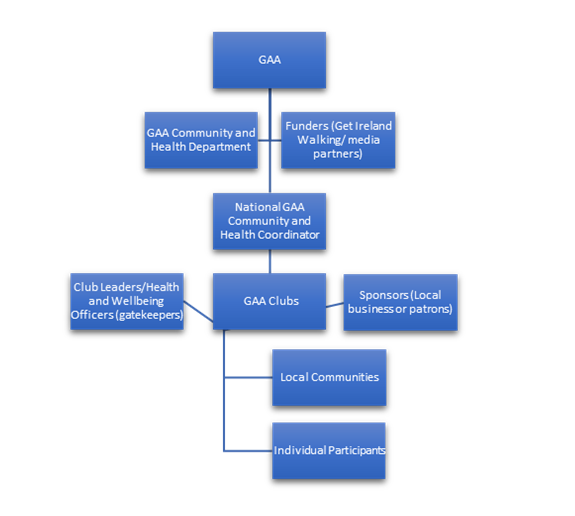
ILU is a novel example of a scalable walking initiative in a sports club setting offering an opportunity to address gaps in the literature regarding scalable interventions 38, 39. It represents a promising model for engaging diverse cohorts of the population with PA by exploring strategies to improve reach. Achieving sustained impact, however, requires a settings-based, whole systems approach to identify and understand the range of factors that influence both reach and implementation 21, 40, 41. In this approach, relationships are reciprocal; the GAA club shapes and affects the activities that take place, while club participants, the local community and governing bodies also influence how the club functions, as outlined in Figure 1 below 11, 21. This interdependent dynamic means that, beneath the surface of the ILU approach, multiple determinants exist across an ecological model of implementation. These include the capacity of a small volunteer-led team to manage delivery at scale, attitudes about ILU at club level, and sustainable leadership and partnership support 42, 43. Understanding these determinants is essential to inform and evaluate implementation strategies at scale.
To date, these mechanisms remain largely understudied and unknown as there has been limited evaluation of ILU, beyond ad-hoc feedback volunteered by clubs. Little is known therefore about what the exact determinants of successful implementation are or the benefits in terms of health and wellbeing outcomes. Successful implementation is defined as consistent and sustained delivery of ILU as intended, to effectively engage and enhance health and wellbeing outcomes in participants 44. The proposed evaluation seeks to address this gap by shedding light on how sports club-based community PA interventions can be successfully implemented, thereby supporting health promotion practitioners to better understand the determinants for successful scaleup and maintenance of such initiatives.
1.2. The Value of Utilising Implementation Science Frameworks in the Health Promoting Sports Club SettingPublic health interventions are often poorly adopted due to contextual factors hindering their success in real-world settings 45. Implementation science research has been developed to amplify the adoption of evidence-based practice and thereby increase public health impacts by identifying factors that affect the initiative’s uptake into sustained use 46. The ILU initiative presents enormous potential to identify and harness implementation strategies that can act as a blueprint for other community-based and HPSC settings to implement similar approaches. However, it is also envisioned that the task of maximising the impact and reach of ILU within community settings across Ireland is likely to be met with multiple challenges, underpinned by a host of contextual factors that can limit successful translation into regular practice 47. As ILU is implemented across diverse geographical locations and club contexts, it is important to consider the facilitators and barriers across all levels of implementation (e.g. participant, club, organisation and systems levels) 48.
Evaluating ILU at scale also requires strong approaches to demonstrate evidence of effectiveness for participants in terms of health outcomes 49. The issue of effectiveness or impact at an individual level is important. If an intervention has no effect on individual health outcomes, at least at a minimal level, there is little point in evaluating it as a whole 50. This protocol proposes a 12-month long effectiveness study with the inclusion of novel impact measures. In the event of even a modest intervention effect being detected, the study will be of greater significance considering the intervention is already operating at scale. It is also salient to document the possible unintended consequences of the intervention on wellbeing and related outcomes 51. Implementation science highlights the dual focus of capturing the core determinants of successful delivery while also measuring effectiveness at an individual level 43, 52. Despite already operating at scale, the benefits, or unintended consequences of ILU have not been captured.
There is also a gap in our understanding of scalability; in terms of maximising its own implementation or evaluating the scalability of the approach across other sporting governing bodies and community organisations. These factors are critical moderating factors to implementation and scale-up success 53. Similarly, merely determining if an intervention is successful is not enough; it is crucial to capture the ingredients that contribute to that success 54, 55. Hybrid effectiveness-implementation trials have been developed to respond to this and are vital to the successful translation of settings-based interventions 56, 57. This proposed research design will guide the development of a blueprint to capture the core ingredients of what determines the success of ILU, to guide replication while identifying barriers to implementation, and strategies to address these barriers within the real-world context 48.
1.3. Study Aim and Research QuestionsThe overall aim of the study is to measure the effectiveness of the ILU initiative in terms of its reach, implementation and sustainability across GAA clubs, measure its impact on health and wellbeing outcomes and examine how it could be implemented in other National Governing Bodies (NGBs) of Sport. This paper will detail the methods used in the evaluation of ILU to allow reproducibility for HPSCs internationally and ensure that this research can be translated for real world benefit. The methods outlined will attempt to answer the following research questions:
1. What is the reach of ILU in terms of participants and clubs across the GAA?
2. What are the facilitators and barriers that impact adoption, implementation, maintenance and sustainability of ILU across the participant, club, organisation and systems level?
3. Does participation in ILU improve physical, mental, and social health and wellbeing among participants?
4. What are the core determinants of ILU for successful scale-out to other organisations?
5. What is the wellbeing cost-benefit of the ILU implementation approach?
Ireland Lights Up is a sports club-based community walking initiative coordinated by the GAA and in partnership with Get Ireland Walking (GIW) and various Irish television, radio and digital media outlets. The initiative is endorsed by a variety of stakeholders: Sport Ireland, Healthy Ireland and Irish Life GAA Healthy Clubs. The ILU initiative, launched in 2018, operates under a straightforward model where registered clubs commit to opening their facilities to the local community on one or more designated evenings each week. These sessions are facilitated by local club leaders and volunteers who undertake responsibilities such as lighting the walking track, managing registration of participants and providing guidance and support to walkers. To assess the possibility of a national evaluation, a formative study conducted in early 2023 37 involving 181 survey participants and 12 semi-structured interviews from 12 GAA clubs, highlighted the significant impact of the ILU initiative on PA and social connection. Key findings included increased PA levels, improved social interactions, and enhanced general health and wellbeing. These findings provided the basis to inform the design of a more comprehensive evaluation framework.
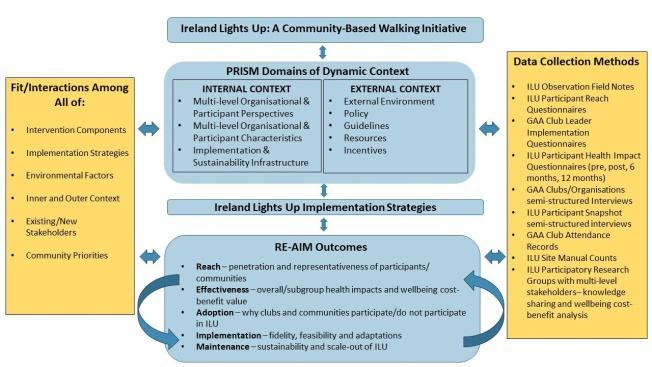
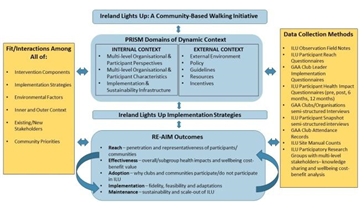
The ILU study design utilises a mixed methods approach guided by implementation science 55. The decision on which framework to use depends on the research problem, the context and the fit among the intervention 58. Thus, a hybrid type-two effectiveness-implementation study design will be applied which allows for parallel testing of impact and implementation outcomes to maximise translation to a real-world context while also providing accurate assessments of effectiveness regarding health outcomes 56. To achieve this, outcomes such as reach, adoption, acceptability, adaptability and costs must be assessed 44, 59, 60, 61. This study will utilise a combination of two implementation science frameworks; the widely known Reach, Effectiveness, Adoption, Implementation and Maintenance (RE-AIM) framework 59 and, in tandem, the Practical, Robust Implementation and Sustainability Model (PRISM) 62. These frameworks facilitate the evaluation of contextual factors, processes and outcomes of efforts to translate knowledge into real-life practice (63). The ILU theoretical framework is outlined in Figure 2 below.
Focusing on contextual factors is particularly important here as ILU is delivered over a variety of club settings. Identifying the core determinants of effective implementation across clubs in Ireland is critical to the continuation of initiatives within the community setting helping to identify the most feasible delivery processes to maximise maintenance and sustainability 59. In this context, sustainability refers to the continued adoption and integration of programme principles and behaviours at the participant, club and organisational levels to maintain impact over time 65, 66. In addition, the Intervention Scalability Assessment Tool (ISAT), a critical decision support tool for use at policy, practitioner and researcher level will assess ILU’s scalability 49. This will help determine how well ILU operates at scale across the club network. The ISAT, divided into three sections, will guide the researchers through the established factors impacting the success of scaling up PA interventions. The ISAT encourages evidence-based decision making and reflection on required resources and possible risks to long term sustainability. Informed by RE-AIM and PRISM and through a multi-stakeholder engagement approach (participant, club, organisation and systems level), the study will identify barriers and facilitators to ILU implementation, successful scale up, and strategies to overcome barriers affecting the impact and sustainability of the initiative. Successful implementation will be evaluated based on a variety of factors including intervention effectiveness alongside implementation outcomes 67.
In order to appeal to policy makers and funders, an important consideration in these types of settings, where resource allocation is limited, is the cost-benefit analysis of ILU and public health 44, 45, 68. Implementation costs are also likely to influence the acceptability of an initiative and therefore are important to measure in a study where acceptability is a key priority 44, 60. Cost-benefit is a key consideration regarding the justification of scale-up to other GAA clubs and the scale-out of ILU to other community settings 49. Furthermore, community-based initiatives need to consider broader concepts of value, focusing on incorporating social, environmental and economic cost benefits to reduce inequalities 69. To evaluate the wellbeing cost-benefit of the ILU initiative, the study will focus on measuring impacts within the effectiveness arm of the trial. The following section is presented in two parts; the first outlines detailed research methods for examining the effectiveness of ILU, while the second focuses on the proposed methods to assess its implementation. Data collection for the evaluation will take place over two years due to the initiative’s short 6-week duration.
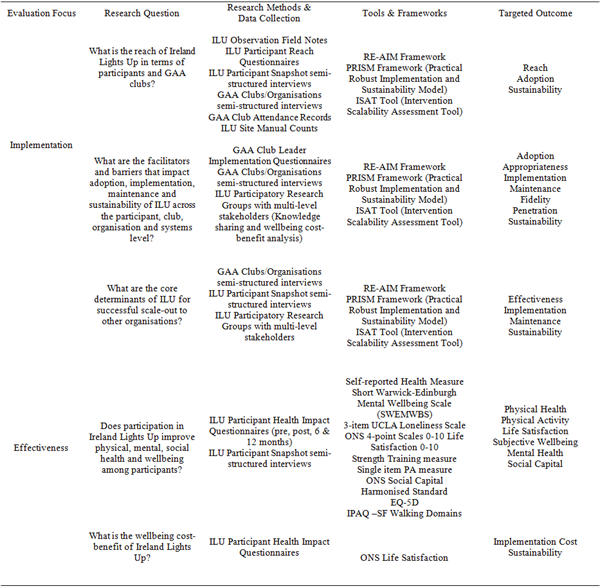
Evaluating the effectiveness of the initiative is critical to the value of a scaled-up intervention 52. This will involve an assessment of health outcomes at participant level at baseline, post-initiative, six months and 12 months via questionnaires using validated measurement tools to measure physical and mental health outcomes as well as levels of social connection. Measurement tools are described in detail in Table 1 below. Snapshot semi-structured interviews with participants will be conducted face to face during walking sessions over the six weeks of the initiative. Alongside this, wellbeing cost benefit analysis (WCBA) methodology will be adopted 70, 71, 72. Data indicators measuring life satisfaction, mental health, physical health and social relationships will be collected as part of the effectiveness evaluation questionnaires. Monetary values will be assigned to these outcomes, and a discount rate will be applied to future wellbeing outcomes to bring them to present value terms 73. This approach is suitable for longer term, sustained initiatives such as ILU. Each identified outcome will be assigned a corresponding social value, capturing the true value of the initiative. Outcomes will be informed by formative work carried out in 2023 37 as part of a rationale for proposing this protocol.
All adults in participating GAA clubs will be eligible to take part in the study providing they can give informed consent. Purposive sampling will be used to recruit participants. To address representativeness, efforts will be made to ensure diversity in participant recruitment across variables such as geographical location (e.g., urban and rural clubs), age groups, and socioeconomic status. Questionnaires will be administered online through Qualtrics software. Recruitment information will be disseminated to registered clubs by the GAA Community and Health Department who will act as gatekeeper for recruitment. The GAA will identify lead organisers in each club for questionnaire distribution. The study will apply a clustered design which is in keeping with the GAA club ethos and to ensure a wide geographical spread. Clubs will act as clusters and participants will be recruited within each cluster. A design with approximately 20 adults in each cluster was estimated. Previous sample size estimation where physical activity was the primary outcome measure 74 suggests a design effect of ~ 2.4 which indicates a sample size of n=255 is required. Allowing for a dropout of 20%, the final participant total is estimated at n=306 with circa 15 clubs/clusters.
Longitudinal participant health impact (effectiveness) questionnaires will be administered via an online Qualtrics form with links also displayed at walk starting points during the first week of the programme. Participant demographics will be recorded at baseline and include gender, age, relationship status, educational attainment, employment status, and ethnicity. Participants will also be asked about club membership, participation in ILU and sense of belonging in the club. Core health and wellbeing outcomes will be measured at baseline, post-intervention, 6 months and 12 months, and will include PA, life satisfaction, self-rated health, subjective wellbeing, mental wellbeing and social capital. The survey will use the same validated health measures at all four timepoints over 12 months, with additional ILU-specific questions included post-programme and at follow-ups to capture participant experience, programme exposure, and behavioural outcomes. This data will inform dose-response relationships, track health changes over time, and explore long-term engagement with ILU to support sustainability. The single item PA measure will be used to record PA levels 75 and strength will be measured using a validated tool from the Sport England Active Lives Adult Survey 76. Life satisfaction and value will be recorded using the Office of National Statistics (ONS) subjective personal wellbeing 4-point scales 77. Self-rated health will be measured using a single question Likert scale which has high validity and reliability among the general population 78. Loneliness will be measured using the 3-item UCLA Loneliness Scale which measures three aspects of loneliness 79; relational connectedness, social connectedness and self-perceived isolation. The Short Warwick-Edinburgh Mental Wellbeing Scale (SWEMWBS) will be used to measure mental wellbeing 80. Social Capital will be measured using adapted items from the ONS Social Capital harmonised standard 81, measuring belonging and trust.
Snapshot interviews are brief, focused interviews that usually take place at public events to gather impressions quickly. The interviews consist of three to four questions and take 2-5 minutes to complete 82. Snapshot interviews with ILU participants (n=30) will be conducted face to face onsite using semi-structured interview guides to give a voice to participant perspectives and values 83. Sample sizes are determined based on pragmatic sampling and grounded in the methodological theory of saturation principles 84. Saturation will be incorporated in a way that aligns with the study’s research questions and its theoretical and analytical approach, specifically, the RE-AIM and PRISM frameworks. A hybrid deductive-inductive approach will be used to design these by applying these implementation frameworks to assess outcomes but also to create room to explore possible changes in physical activity, health, and wellbeing outcomes, and attitudes towards ILU. A constant comparison process will be used to streamline and modify interview schedules to reflect new themes to be explored as ILU evolves across implementation settings.
Statistical Package for the Social Sciences (SPSS V25) will be used to analyse questionnaire data. Descriptive statistics will be applied to summarise participant characteristics. To assess intervention effects on health and wellbeing outcomes, change scores from baseline to post-intervention at 6 and 12 months will be compared. Depending on the type and distribution of the data, appropriate statistical tests will be selected (e.g., paired t-tests, repeated-measures ANOVA). For longitudinal data, mixed-effects models will be employed to account for repeated measures within individuals over time and to handle missing data due to attrition. These models allow adjustment for potential confounders (e.g., age, gender, baseline health status) and clustering at the club level. Significance will be set at p = 0.05. To address potential attrition bias, intention-to-treat (ITT) analysis will be applied where possible, alongside sensitivity analyses. Methods such as multiple imputation will be used to handle missing data under the assumption that data are missing at random.
Analysis of a framework-driven approach (RE-AIM, PRISM) will be applied to qualitative data analyses. Interviews will be transcribed verbatim and in accordance with recommendations by the National Cancer Institute's White Paper 85 on qualitative research in implementation science, qualitative data will be analysed using NVivo software following a hybrid deductive-inductive approach. Initially, line-by-line coding will be conducted based on the study’s research questions and relevant frameworks (RE-AIM and PRISM). Subsequently, new themes will be generated inductively from the data to capture emergent insights. Multiple researchers will independently code transcripts to enhance consistency and accuracy. Regular meetings will be held to discuss coding discrepancies and achieve consensus, thereby ensuring inter-rater reliability throughout the analysis process.
To assess the wellbeing cost-benefit, the ONS Life Satisfaction measure 81, the total number of participants, and the cost of the intervention will be employed 73, 86. The cost of the intervention will be assessed by capturing both direct financial inputs (such as cash donations and funding contributions) and non-monetary resources, including volunteer hours and running costs incurred by clubs. Volunteer time will be valued using appropriate shadow pricing methods, for example, by assigning a monetary value based on average local wage rates or opportunity costs. Club resources, including facilities and staff time, will be similarly quantified through a combination of accounting records and self-reports from participating clubs. This valuation will be guided by recent advances in wellbeing economics and social value measurement, drawing on frameworks such as the WELLBY measure of social value 70 and the HM Treasury Green Book guidance on wellbeing appraisal 71, 72. This approach allows for a comprehensive and holistic appraisal of the resources invested in the programme, beyond traditional financial metrics alone. Life Satisfaction Years (LSYs) are calculated by multiplying a participant’s life satisfaction score by how long they experienced that level of satisfaction. Validated scales with established reliability and validity will be utilised to measure constructs related to satisfaction. This ensures that the data collected is as accurate and consistent as possible.
This approach is similar to how healthcare interventions are evaluated based on Quality-Adjusted Life Years (QALYs), which measure the value of an extra year of perfect health. In the UK, an intervention is considered cost-effective if it costs less than £25,000 per extra QALY. Since life satisfaction is measured on a 0-10 scale, this translates to £2,500 for a one-point improvement in life satisfaction over a year 86. Therefore, any intervention that increases life satisfaction by one point for less than £2,500 is considered cost-effective 71.
The RE-AIM and PRISM frameworks 61, 62 will guide the evaluation of the process and determinants of implementation across multiple levels including participant, club, organisation and systems. This hybrid framework seeks to monitor the implementation of ILU across multiple delivery sites to identify strategies for successful implementation that can be translated across settings to maximise impact and scalability (see Table 1). To assess the scalability of ILU, the Intervention Scalability Assessment Tool (ISAT) will be applied which consists of ten domains: (1) the problem; (2) the intervention; (3) strategic/political context; (4) evidence of effectiveness; (5) intervention costs and benefits; (6) fidelity and adaptation; (7) reach and acceptability; (8) delivery setting and workforce; (9) implementation infrastructure; and (10) sustainability 49. The implementation arm of the study utilises observational site visits, participant and club leader cross-sectional questionnaires, stakeholder semi-structured interviews and participatory research groups with multi-level stakeholders.
For the implementation arm of the study, purposive sampling will be used to recruit a diverse sample of stakeholders across multiple levels of implementation (participant, club, organisation). Stakeholders will be invited to participate via the GAA National Community and Health Coordinator and a diverse sample of clubs will be sought in terms of club size and geographical spread. For the observational site visits, qualitative interviews, and participatory research groups, non-random convenience sampling will be employed. Email contact will be made with the lead organisers in clubs and specific GAA members will act as gatekeepers for their own networks. Individual club leaders will act as gatekeepers for accessing individual participants to ILU. The participant reach survey will also be disseminated to all GAA clubs by email through the club leaders. Qualitative interviews will use non-random convenience sampling with support from GAA gatekeepers and will involve interviews with club leaders and organisational representatives, specifically leaders and volunteers from GAA clubs and also GAA Healthy Clubs who are responsible for organising the ILU initiative within their respective clubs. Similarly, the participatory research groups will include leaders and volunteers, ensuring that the perspectives of those directly involved in programme delivery and coordination are central to the research process.
Qualitative data will be collected via observations across implementing clubs (n=10-15), one-to-one semi structured interviews (n=15), short club telephone interviews (n=40) and participatory research groups (n=2) with stakeholders. Additionally, participation rates will be gathered via attendance records and manual counts. Quantitative data will be collected by means of online surveys which will be disseminated to registered club leaders and participants to ascertain how Ireland Lights Up is organised at club level. Where feasible, self-reported data will be supplemented with additional sources, such as behavioural observations or physiological measures, to support participant responses and provide a more comprehensive understanding of their experience.
Each GAA club selected (n=15) will be visited on at least one occasion by the research team. The research team will undertake manual counts, snapshot interviews, and notetaking elements. Consent will have been obtained from the lead organiser in the club in advance. The constructs under observation will be based on the PRISM framework template of relevance to the external environment, organisational characteristics and implementation or sustainability infrastructure 62. These are structural characteristics (e.g. parking, toilet facilities, terrain, refreshments, cost etc.), networks (e.g. organised groups v informal arrangements), communication (e.g. atmosphere, welcome and introductions, no. of volunteers). A checklist of these items will be rated by the observer on a 5-point scale from “not evident/visible” to “highly visible”. Where possible, data such as the number of participating clubs each year (including cumulative vs. active figures), club attrition over time, and reasons for non-continuation will be gathered through desk-based research. All clubs that register and offer at least one session during the 6-week period are considered as having participated. Variability in delivery (e.g., frequency per week, adherence to the full programme) will be examined during the evaluation phase to better understand fidelity and implementation quality.
The participant reach survey will be administered using the electronic data collection software, Qualtrics. In this context, reach is defined as the absolute number, proportion, and representativeness of individuals who participate in the ILU initiative 59. The QR code will be disseminated to club leaders and links to the survey will be printed and displayed at the start point for each walk during the six-week ILU campaign. The lead organiser in each club will direct adult participants (>18 years of age) to scan the code on their smartphone and complete the questionnaire before walking. The aim is to understand the characteristics of those who participate (or not) in ILU. It is a one-time, cross-sectional survey.
Similarly, the GAA club leader implementation questionnaire will be administered using Qualtrics and disseminated by email through GAA gatekeepers. This is also a one-time cross-sectional survey. Both surveys include questions designed to gather comprehensive data relevant to the study objectives, including: demographic data (age, gender, occupation); GAA club membership (length of membership, roles within the club); ILU participation (frequency, type, and level of involvement); validated measures to assess general well-being, life satisfaction, and self-reported health status (see Table 1 above); logistics and challenges of organising ILU; and suggested changes for future ILU activities. To assess engagement patterns, both the Reach Participant Survey and the pre-and-post Health Impact Participant surveys will include a question on regularity of attendance across the 6-week period.
Interviews will be conducted and recorded using the Zoom digital platform with a range of key stakeholders, including GAA club leaders, organisers and representatives of stakeholder bodies responsible for ILU development. The interview schedule, informed by the RE-AIM framework, will include questions about reach (engagement, promotion, reasons for participation; effectiveness (positive or unintended negative impacts); adoption (perceptions of ILU, delivery of ILU, barriers); implementation (key success factors, adaptations to delivery); and maintenance (continuation of ILU, resources required to continue, influence on other interventions). To strengthen evaluation of implantation at scale, 10-minute phone interviews will be conducted with a broader sample of approximately 40 clubs, selected to represent four categories: (1) clubs that have discontinued ILU involvement, (2) clubs delivering the programme on a recurring basis, (3) newly participating clubs in their first year of implementation, and (4) clubs yet to implement ILU, in order to explore perceived barriers and facilitators. This component will complement data from the 15 site visits and support a broader understanding of ILU implementation.
Based on findings from the GAA participant and club leader questionnaires and semi structured interviews, participatory research groups (n=2) will be established to gather perspectives from organisational stakeholders and lead club organisers. Each participatory action group will comprise of approximately 15 to 20 participants, primarily recruited through the GAA Healthy Club Conference registration process. Conference attendees from clubs nationwide will be invited to join these groups during workshop sessions. Using the PRISM framework, these groups will explore contextual factors influencing reach and adoption. This approach aims to identify barriers and facilitators for reaching underserved populations, sharing of best practice 61 and support the adaptation of implementation strategies to local needs.
Statistical Packages for the Social Sciences (SPSS V25) will be utilised to analyse questionnaire data. Each variable will be analysed using descriptive statistics to describe participant characteristics. Risk of selection bias when recruiting clubs and participants in the implementation data collection will be minimised by stratifying and selecting clubs based on variables such as urban/rural, size of club and Healthy Clubs versus non-Healthy Clubs. The RE-AIM and PRISM framework-driven approach will be used to analyse qualitative data. Interviews and participatory research groups will be transcribed verbatim, and a hybrid approach of thematic deductive and inductive analysis will be applied to inform implementation outcomes with a constant comparison process also applied. As participation in the reach component is voluntary, data will be analysed from participating clubs, with extrapolation of broader trends based on club characteristics (e.g., location, size, type). Desk-based research and secondary data sources will be used to enhance context and assess representativeness, with limitations related to sampling and generalisability clearly acknowledged. Using the ISAT, scalability will be assessed by integrating key dimensions from the RE-AIM and PRISM frameworks. Quantitative metrics and qualitative stakeholder insights will be combined to generate a comprehensive scalability profile, with outcomes reported through concise metrics and narrative summaries highlighting facilitators, barriers, and recommendations for scale-up.
ILU is a rare example internationally of a community sports-club based walking intervention operating at scale nationwide. It is estimated that over 120,000 participants have taken part since 2018, yet the initiative has never been evaluated. To the best of the research teams’ knowledge, this is the first evaluation of a real-world community walking initiative in the sports club setting, operating nationally. ILU is uniquely placed to not only improve PA levels but also health and wellbeing in urban and rural communities across Ireland 87, 88. Thus, findings have the potential to impact public health at a societal level by enhancing the reach, effectiveness, adoption, implementation and sustainability of ILU.
Evaluating a project already at scale provides a novel opportunity to tell the real story of a national community PA initiative, explore the complex interacting factors underpinning ILU and develop shared contextual learnings 89. The pragmatic use of RE-AIM and PRISM frameworks ensures external validity, enabling application across diverse settings and populations and allowing for adaptations in other community contexts 90. The research design also addresses equity by exploring strategies to engage ‘not yet reached’ groups, informed by implementation data on reach and adoption. The hybrid RE-AIM and PRISM approach sheds light on multilevel influences affecting PA, mental, and social wellbeing, while guiding tailored recruitment and culturally appropriate adaptations 89, 91.
Nevertheless, challenges remain. The heterogeneity of GAA clubs, both in size and location, may influence implementation fidelity and outcomes, complicating comparisons. Variations in community context, including socioeconomic status, cultural norms, and local infrastructure, further influence participant engagement and the relevance of the programme’s content. This diversity complicates direct comparisons across clubs and may introduce variability in outcomes that is difficult to fully adjust for analytically. Sustaining ILU long-term raises questions about ongoing resource allocation, volunteer capacity, and maintaining participant motivation beyond initial engagement. The programme relies heavily on volunteer time and local club resources, both of which may fluctuate due to competing demands, volunteer burnout, or changes in club leadership. Ensuring consistent promotional and funding streams and organisational support will be crucial to maintaining ILU.
The non-randomised design and absence of a control group may be seen as limitations. Previous interventions have used RCTs focusing on individual or group approaches 92, but an RCT would have been more useful during early development. Since ILU is already operating at scale, a real-world evaluation is more appropriate. Widespread adoption and media coverage made control group inclusion unfeasible, as random allocation or withholding the intervention was not practical or ethical. The study will attempt to mitigate potential biases, such as selection bias and confounding, through comparative analyses of clubs delivering ILU at high versus low intensity and by adjusting for relevant covariates in the analysis. The evaluation takes place within multifaceted, evolving real-world contexts, necessitating a pragmatic approach to assess external validity 93, 94.
Another limitation of this study is the absence of participants and underserved populations in the participatory research groups, despite the stated objective of improving reach and equity. This reflects a deliberate first step to identify who these groups are and understand their specific barriers, with the intention that this foundational work will inform a follow-up study involving meaningful co-design and participatory research. The research design also runs the risk of inherent bias due to the inclusion of subjective self-reporting measures 95. Nevertheless, since health and wellbeing are subjective experiences by nature, the evaluation design will still capture observations from participants in the real-world context of a sports club setting.
3.1. ConclusionsThis study protocol outlines how a scaled-up intervention can be evaluated using an implementation science approach. The unique nature of ILU and the diverse variables measured present an excellent opportunity to document an initiative already operating at scale. This research holds potential societal impact by expanding ILU’s reach to underserved groups through strengthened local partnerships, while the maintenance phase is expected to offer a replicable template for engaging sedentary individuals and connecting them with sustainable community programmes. Findings will inform other NGBs in implementing similar sports club-based walking programmes, reinforcing the potential of clubs as settings for PA promotion. Rooted firmly in implementation science, the ILU evaluation will actively share findings with organisers and stakeholders throughout the study. There are no publication restrictions, and results will be widely disseminated to Sport Ireland, Healthy Ireland, and the Health Service Executive. Multiple publications and conference presentations are planned. Interim analyses will assess ILU’s reach and impact on participant health and wellbeing, with accessible reports provided to participants, the GAA, GIW, and relevant partners. Additionally, a blueprint detailing the implementation process and resources needed to replicate the programme in other organisations will be developed.
Beyond ILU, these findings have wider relevance and should be framed within national and global policy, including the Global Action Plan on Physical Activity (GAPPA), which highlights the need to build research and evaluation capacity. By linking findings to policy and practice, this study aims to shape scalable, effective initiatives that align with national goals and global efforts. The research also carries policy implications by demonstrating how health promotion through sports clubs aligns with forthcoming government initiatives, potentially accelerating policymaking and contributing to knowledge on expanding health-promoting sports environments for diverse communities.
The authors wish to thank the GAA and GIW for supporting the project and the individual GAA clubs, club leaders and ILU participants for agreeing to participate in and support the Ireland Lights Up evaluation.
| [1] | Gilchrist P, Osborn G. Risk and benefits in lifestyle sports: parkour, law and social value. Int J Sport Policy Polit [Internet]. 2017 Jan 2 [cited 2025 May 6]. | ||
| In article | |||
| [2] | Rebar AL, Taylor A. Physical activity and mental health; it is more than just a prescription. Ment Health Phys Act. 2017 Oct 1; 13: 77–82. | ||
| In article | View Article | ||
| [3] | Strain T, Flaxman S, Guthold R, Semenova E, Cowan M, Riley LM, et al. National, regional, and global trends in insufficient physical activity among adults from 2000 to 2022: a pooled analysis of 507 population-based surveys with 5·7 million participants. Lancet Glob Health. 2024 Aug 1; 12(8): e1232–43. | ||
| In article | |||
| [4] | Ding D, Varela AR, Bauman AE, Ekelund U, Lee IM, Heath G, et al. Towards better evidence-informed global action: lessons learnt from the Lancet series and recent developments in physical activity and public health. Br J Sports Med. 2020 Apr 1; 54(8): 462–8. | ||
| In article | View Article PubMed | ||
| [5] | Milton K, Cavill N, Chalkley A, Foster C, Gomersall S, Hagstromer M, et al. Eight Investments That Work for Physical Activity. J Phys Act Health. 2021 May 14; 18(6): 625–30. | ||
| In article | View Article PubMed | ||
| [6] | World Health Organization. Global Action Plan on Physical Activity 2018-2030: More Active People for a Healthier World. 2018. | ||
| In article | |||
| [7] | Salvo D, Garcia L, Reis RS, Stankov I, Goel R, Schipperijn J, et al. Physical Activity Promotion and the United Nations Sustainable Development Goals: Building Synergies to Maximize Impact. 2021 Jul 13 [cited 2025 May 14]; Available from: https:// journals.humankinetics.com/view/journals/jpah/18/10/article-p1163.xml | ||
| In article | View Article PubMed | ||
| [8] | Whiting S, Mendes R, Morais ST, Gelius P, Abu-Omar K, Nash L, et al. Promoting health-enhancing physical activity in Europe: Surveillance, policy development and implementation 2015–2018. Health Policy. 2021 Aug 1; 125(8): 1023–30. | ||
| In article | View Article PubMed | ||
| [9] | Ball K, Abbott G, Wilson M, Chisholm M, Sahlqvist S. How to get a nation walking: reach, retention, participant characteristics and program implications of Heart Foundation Walking, a nationwide Australian community-based walking program. Int J Behav Nutr Phys Act. 2017 Nov 21; 14(1): 161. | ||
| In article | View Article PubMed | ||
| [10] | Kahn EB, Ramsey LT, Brownson RC, Heath GW, Howze EH, Powell KE, et al. The effectiveness of interventions to increase physical activity. A systematic review. Am J Prev Med. 2002 May; 22(4 Suppl): 73–107. | ||
| In article | View Article PubMed | ||
| [11] | Dooris M. Holistic and sustainable health improvement: the contribution of the settings-based approach to health promotion. Perspect Public Health. 2009 Jan; 129(1): 29–36. | ||
| In article | View Article PubMed | ||
| [12] | World Health Organization. Ottawa Charter for Health Promotion. In World Health Organization; 1986. | ||
| In article | |||
| [13] | Geidne S, Kokko S, Lane A, Ooms L, Vuillemin A, Seghers J, et al. Health Promotion Interventions in Sports Clubs: Can We Talk About a Setting-Based Approach? A Systematic Mapping Review. Health Educ Behav. 2019 Aug 1; 46(4): 592–601. | ||
| In article | View Article PubMed | ||
| [14] | Kokko S. Sports clubs as settings for health promotion: Fundamentals and an overview to research. Scand J Public Health. 2014 Nov 1; 42(15_suppl):60–5. | ||
| In article | View Article PubMed | ||
| [15] | Lane A, Murphy N, Regan C, Callaghan D. Health Promoting Sports Club in Practice: A Controlled Evaluation of the GAA Healthy Club Project. Int J Environ Res Public Health. 2021 Jan; 18(9): 4786. | ||
| In article | View Article PubMed | ||
| [16] | Robertson, Eime R, Westerbeek H. Community sports clubs: are they only about playing sport, or do they have broader health promotion and social responsibilities? Ann Leis Res. 2019 Mar 15; 22(2): 215–32. | ||
| In article | View Article | ||
| [17] | Eime RM, Payne WR, Harvey JT. Making sporting clubs healthy and welcoming environments: A strategy to increase participation. J Sci Med Sport. 2008 Apr 1; 11(2): 146–54. | ||
| In article | View Article PubMed | ||
| [18] | Johnson S, Van Hoye A, Donaldson A, Lemonnier F, Rostan F, Vuillemin A. Building health-promoting sports clubs: a participative concept mapping approach. Public Health. 2020 Nov 1; 188: 8–17. | ||
| In article | View Article PubMed | ||
| [19] | Sport Ireland. Sport Ireland Statement of Strategy 2023-2027 [Internet]. 2023 [cited 2024 Dec 10]. Available from: https://www.sportireland.ie/about-us/sport-ireland-strategy | ||
| In article | |||
| [20] | Van der Veken K, Lauwerier E, Willems SJ. How community sport programs may improve the health of vulnerable population groups: a program theory. Int J Equity Health. 2020 May 24; 19(1): 74. | ||
| In article | View Article PubMed | ||
| [21] | Kokko S, Donaldson A, Geidne S, Seghers J, Scheerder J, Meganck J, et al. Piecing the puzzle together: case studies of international research in health-promoting sports clubs. Glob Health Promot. 2016 Mar 1; 23(1_suppl):75–84. | ||
| In article | View Article PubMed | ||
| [22] | Morris JN, Hardman AE. Walking to Health. Sports Med. 1997 May 1; 23(5): 306–32. | ||
| In article | View Article PubMed | ||
| [23] | Kelly P, Murphy M, Mutrie N. The Health Benefits of Walking. In: Walking [Internet]. Emerald Publishing Limited; 2017 [cited 2025 Feb 11]. p. 61–79. | ||
| In article | View Article | ||
| [24] | Murphy MH, Nevill AM, Murtagh EM, Holder RL. The effect of walking on fitness, fatness and resting blood pressure: A meta-analysis of randomised, controlled trials. Prev Med. 2007 May 1; 44(5): 377–85. | ||
| In article | View Article PubMed | ||
| [25] | Robertson R, Robertson A, Jepson R, Maxwell M. Walking for depression or depressive symptoms: A systematic review and meta-analysis. Ment Health Phys Act. 2012 Jun 1; 5(1): 66–75. | ||
| In article | View Article | ||
| [26] | Hanson S, Jones A. Is there evidence that walking groups have health benefits? A systematic review and meta-analysis. 2015 Jun 1 [cited 2025 May 14]; Available from: https:// bjsm.bmj.com/ content/49/11/710?trk=public_post_comment-text. | ||
| In article | View Article PubMed | ||
| [27] | Kassavou A, Turner A, French D. Do interventions to promote walking in groups increase physical activity? A meta-analysis. Int J Behav Nutr Phys Act. 2013; 10: 18–18. | ||
| In article | View Article PubMed | ||
| [28] | Ogilvie D, Foster CE, Rothnie H, Cavill N, Hamilton V, Fitzsimons CF, et al. Interventions to promote walking: systematic review. 2007 Jun 7 [cited 2025 May 14]; Available from: https://www.bmj.com/content/334/7605/1204?dm_i=145213264 | ||
| In article | View Article PubMed | ||
| [29] | Brown, Mummery K, Eakin E, Schofield G. 10,000 Steps Rockhampton: Evaluation of a Whole Community Approach to Improving Population Levels of Physical Activity. 2006 Jan 1. Available from: http:// journals.humankinetics.com/ view/ journals/jpah/3/1/article-p1.xml. | ||
| In article | View Article | ||
| [30] | De Cocker KA, De Bourdeaudhuij IM, Brown WJ, Cardon GM. Effects of “10,000 Steps Ghent”: A Whole-Community Intervention. Am J Prev Med. 2007 Dec 1; 33(6): 455–63. | ||
| In article | View Article PubMed | ||
| [31] | Hoye A van, Johnson S, Geidne S, Vuillemin A. Relationship between coaches’ health promotion activities, sports experience and health among adults. Health Educ J. 2020; 79: 763–74. | ||
| In article | View Article | ||
| [32] | Crampsie A. Playing identity politics: the Gaelic Athletic Association in modern Ireland. In: Koch N, editor. Critical Geographies of Sport. Routledge; 2016. | ||
| In article | |||
| [33] | Central Statistics Office. Urban and Rural Life in Ireland, 2019 - Central Statistics Office [Internet]. CSO; 2019 [cited 2024 Apr 4]. Availablefrom: http://www.cso.ie/en/releasesandpublications/ep/p-urli/urbanandrurallifeinireland2019/. | ||
| In article | |||
| [34] | Hartnett A, Gorman C. Active Leisure and Ageing in Rural Ireland: Exploring Perceptions and Motivations to Facilitate and Promote Meaningful Physical Activity. Articles [Internet]. 2022 Apr 1; Available from: https://arrow.tudublin.ie/tfschhmtart/105. | ||
| In article | View Article | ||
| [35] | Faubel R, Garriga A, Sempere-Rubio N, Molina-Prados M. Impact of seasonality on physical activity: a systematic review. Eur J Public Health. 2022 Oct 1; 32(Supplement_3): ckac131.159. | ||
| In article | View Article | ||
| [36] | Gaa.ie. ‘Ireland Lights Up’ returns in 2025 [Internet]. 2024 [cited 2024 Dec 16]. Available from: https://www.gaa.ie/article/ireland-lights-up-returns-in-2025. | ||
| In article | |||
| [37] | Lambe B, McGrath A, Murphy N, Briggs N. O.2.2-1 Shining a light on success: the impact of the ‘Ireland Lights Up’ walking initiative on health and wellbeing. Eur J Public Health. 2023 Sep 1; 33(Supplement_1):ckad133.116. | ||
| In article | View Article PubMed | ||
| [38] | Lee K, Ding D, Grunseit A, Wolfenden L, Milat A, Bauman A. Many Papers but Limited Policy Impact? A Bibliometric Review of Physical Activity Research. Transl J Am Coll Sports Med. 2021 Fall; 6(4): e000167. | ||
| In article | View Article | ||
| [39] | Reis RS, Salvo D, Ogilvie D, Lambert EV, Goenka S, Brownson RC. Scaling up physical activity interventions worldwide: stepping up to larger and smarter approaches to get people moving. The Lancet. 2016 Sep 24; 388(10051): 1337–48. | ||
| In article | View Article PubMed | ||
| [40] | Fried EI, Robinaugh DJ. Systems all the way down: embracing complexity in mental health research. BMC Med. 2020 Jul 14; 18(1): 205. | ||
| In article | View Article PubMed | ||
| [41] | Johnson S, Vuillemin A, Geidne S, Kokko S, Epstein J, Van Hoye A. Measuring Health Promotion in Sports Club Settings: A Modified Delphi Study. Health Educ Behav. 2020 Feb 1; 47(1): 78–90. | ||
| In article | View Article PubMed | ||
| [42] | McGrath A, Richardson N, Murphy N. Strategies for effective implementation and scale-up of a multi-level co-designed men’s health initiative ‘Sheds for Life’ in Irish Men’s Sheds. Front Health Serv. 2022; 2: 940031. | ||
| In article | View Article PubMed | ||
| [43] | Stone AB, Yuan CT, Rosen MA, Grant MC, Benishek LE, Hanahan E, et al. Barriers to and Facilitators of Implementing Enhanced Recovery Pathways Using an Implementation Framework: A Systematic Review. JAMA Surg. 2018 Mar 1; 153(3): 270–9. | ||
| In article | View Article PubMed | ||
| [44] | Proctor E, Silmere H, Raghavan R, Hovmand P, Aarons G, Bunger A, et al. Outcomes for Implementation Research: Conceptual Distinctions, Measurement Challenges, and Research Agenda. Adm Policy Ment Health Ment Health Serv Res. 2011 Mar 1; 38(2): 65–76. | ||
| In article | View Article PubMed | ||
| [45] | Powell BJ, Fernandez ME, Williams NJ, Aarons GA, Beidas RS, Lewis CC, et al. Enhancing the Impact of Implementation Strategies in Healthcare: A Research Agenda. Front Public Health [Internet]. 2019 [cited 2024 Jan 10]; 7. Available from: https://www.frontiersin.org/articles/10.3389/fpubh.2019.00003 | ||
| In article | View Article PubMed | ||
| [46] | Bauer MS, Kirchner J. Implementation science: What is it and why should I care? Psychiatry Res. 2020 Jan 1; 283: 112376. | ||
| In article | View Article PubMed | ||
| [47] | Hawe P. Lessons from Complex Interventions to Improve Health. Annu Rev Public Health. 2015; 36(1): 307–23. | ||
| In article | View Article PubMed | ||
| [48] | Koorts H, Eakin E, Estabrooks P, Timperio A, Salmon J, Bauman A. Implementation and scale up of population physical activity interventions for clinical and community settings: the PRACTIS guide. Int J Behav Nutr Phys Act. 2018 Jun 8; 15(1): 51. | ||
| In article | View Article PubMed | ||
| [49] | Milat, Lee K, Conte K, Grunseit A, Wolfenden L, van Nassau F, et al. Intervention Scalability Assessment Tool: A decision support tool for health policy makers and implementers. Health Res Policy Syst. 2020 Jan 3; 18(1): 1. | ||
| In article | View Article PubMed | ||
| [50] | Curran GM, Landes SJ, McBain SA, Pyne JM, Smith JD, Fernandez ME, et al. Reflections on 10 years of effectiveness-implementation hybrid studies. Front Health Serv [Internet]. 2022 Dec 8 [cited 2024 May 23]; 2. Available from: https://www.frontiersin.org/articles/10.3389/frhs.2022.1053496 | ||
| In article | View Article PubMed | ||
| [51] | Glasgow RE, Vogt TM, Boles SM. Evaluating the public health impact of health promotion interventions: the RE-AIM framework. Am J Public Health. 1999 Sep; 89(9): 1322–7. | ||
| In article | View Article PubMed | ||
| [52] | Milat, Newson R, King L, Rissel C, Wolfenden L, Bauman A, et al. A guide to scaling up population health interventions. Public Health Res Pract. 2016 Jan 28; 26(1): e2611604. | ||
| In article | View Article PubMed | ||
| [53] | Damschroder LJ, Aron DC, Keith RE, Kirsh SR, Alexander JA, Lowery JC. Fostering implementation of health services research findings into practice: a consolidated framework for advancing implementation science. Implement Sci. 2009 Aug 7; 4(1): 50. | ||
| In article | View Article PubMed | ||
| [54] | Moullin JC, Dickson KS, Stadnick NA, Albers B, Nilsen P, Broder-Fingert S, et al. Ten recommendations for using implementation frameworks in research and practice. Implement Sci Commun. 2020 Apr 30; 1(1): 42. | ||
| In article | View Article PubMed | ||
| [55] | Rapport F, Clay-Williams R, Churruca K, Shih P, Hogden A, Braithwaite J. The struggle of translating science into action: Foundational concepts of implementation science. J Eval Clin Pract. 2018; 24(1): 117–26. | ||
| In article | View Article PubMed | ||
| [56] | Curran GM, Bauer M, Mittman B, Pyne JM, Stetler C. Effectiveness-implementation Hybrid Designs. Med Care. 2012 Mar; 50(3): 217–26. | ||
| In article | View Article PubMed | ||
| [57] | Landes SJ, McBain SA, Curran GM. An Introduction to Effectiveness-Implementation Hybrid Designs. Psychiatry Res. 2019 Oct; 280: 112513. | ||
| In article | View Article PubMed | ||
| [58] | Matlock DD, Fukunaga MI, Tan A, Knoepke C, McNeal DM, Mazor KM, et al. Enhancing Success of Medicare’s Shared Decision Making Mandates Using Implementation Science: Examples Applying the Pragmatic Robust Implementation and Sustainability Model (PRISM). MDM Policy Pract. 2020 Jul 1; 5(2): 2381468320963070. | ||
| In article | View Article PubMed | ||
| [59] | Glasgow RE, Harden SM, Gaglio B, Rabin B, Smith ML, Porter GC, et al. RE-AIM Planning and Evaluation Framework: Adapting to New Science and Practice With a 20-Year Review. Front Public Health. 2019; 7: 64. | ||
| In article | View Article PubMed | ||
| [60] | Lewis CC, Fischer S, Weiner BJ, Stanick C, Kim M, Martinez RG. Outcomes for implementation science: an enhanced systematic review of instruments using evidence-based rating criteria. Implement Sci. 2015 Nov 4; 10(1): 155. | ||
| In article | View Article PubMed | ||
| [61] | McCreight MS, Rabin BA, Glasgow RE, Ayele RA, Leonard CA, Gilmartin HM, et al. Using the Practical, Robust Implementation and Sustainability Model (PRISM) to qualitatively assess multilevel contextual factors to help plan, implement, evaluate, and disseminate health services programs. Transl Behav Med. 2019 Nov 25; 9(6): 1002–11. | ||
| In article | View Article PubMed | ||
| [62] | Feldstein AC, Glasgow RE. A Practical, Robust Implementation and Sustainability Model (PRISM) for Integrating Research Findings into Practice. Jt Comm J Qual Patient Saf. 2008 Apr; 34(4): 228–43. | ||
| In article | View Article PubMed | ||
| [63] | Glasgow RE, Trinkley KE, Ford B, Rabin BA. The Application and Evolution of the Practical, Robust Implementation and Sustainability Model (PRISM): History and Innovations. Glob Implement Res Appl. 2024 Aug 31; 4(4): 404. | ||
| In article | View Article PubMed | ||
| [64] | Fort MP, Manson SM, Glasgow RE. Applying an equity lens to assess context and implementation in public health and health services research and practice using the PRISM framework. Front Health Serv. 2023; 3: 1139788. | ||
| In article | View Article PubMed | ||
| [65] | Hall A, Shoesmith A, Doherty E, McEvoy B, Mettert K, Lewis CC, et al. Evaluation of measures of sustainability and sustainability determinants for use in community, public health, and clinical settings: a systematic review. Implement Sci. 2022 Dec 13; 17(1): 81. | ||
| In article | View Article PubMed | ||
| [66] | Proctor E, Luke D, Calhoun A, McMillen C, Brownson R, McCrary S, et al. Sustainability of evidence-based healthcare: research agenda, methodological advances, and infrastructure support. Implement Sci. 2015 Jun 11; 10(1): 88. | ||
| In article | View Article PubMed | ||
| [67] | Proctor E, Powell BJ, McMillen JC. Implementation strategies: recommendations for specifying and reporting. Implement Sci. 2013 Dec 1; 8(1): 139. | ||
| In article | View Article PubMed | ||
| [68] | Guillon M, Rochaix L, Dupont JCK. COST-EFFECTIVENESS OF INTERVENTIONS BASED ON PHYSICAL ACTIVITY IN THE TREATMENT OF CHRONIC CONDITIONS: A SYSTEMATIC LITERATURE REVIEW. Int J Technol Assess Health Care. 2018 Jan; 34(5): 481–97. | ||
| In article | View Article PubMed | ||
| [69] | Banke-Thomas AO, Madaj B, Charles A, van den Broek N. Social Return on Investment (SROI) methodology to account for value for money of public health interventions: a systematic review. BMC Public Health. 2015 Jun 24; 15(1): 582. | ||
| In article | View Article PubMed | ||
| [70] | Frijters P, Krekel C, Sanchis R, Santini ZI. The WELLBY: a new measure of social value and progress. Humanit Soc Sci Commun. 2024 Jun 8; 11(1): 736. | ||
| In article | View Article | ||
| [71] | HM Treasury. Green Book supplementary guidance: Wellbeing. [Internet]. Wellbeing Guidance for Appraisal; 2021. Available from: https://www.gov.uk/government/publications/green-book-supplementary-guidance-wellbeing. | ||
| In article | |||
| [72] | HM Treasury. The Green Book and accompanying guidance [Internet]. HM Treasury; 2022. Available from: https://www.gov.uk/government/collections/the-green-book-and-accompanying-guidance-and-documents. | ||
| In article | |||
| [73] | Frijters P, Krekel C. A handbook for wellbeing policy-making: History, theory, measurement, implementation, and examples [Internet]. Oxford University Press; 2021 [cited 2024 Sep 24]. Available from: https:// library.oapen.org/ handle/ 20.500.12657/60760. | ||
| In article | |||
| [74] | McGrath A, Murphy N, Richardson N. Study protocol: evaluation of sheds for life (SFL): a community-based men’s health initiative designed “for shedders by shedders” in Irish Men’s sheds using a hybrid effectiveness-implementation design. BMC Public Health. 2021 Apr 26; 21(1): 801. | ||
| In article | View Article PubMed | ||
| [75] | Milton K, Bull FC, Bauman A. Reliability and validity testing of a single-item physical activity measure. Br J Sports Med. 2011 Mar; 45(3): 203–8. | ||
| In article | View Article PubMed | ||
| [76] | Sport England. Active Lives and Active People Survey [data series]. UK Data Set; 2023. | ||
| In article | |||
| [77] | Zajacova A, Dowd JB. Reliability of self-rated health in US adults. Am J Epidemiol. 2011 Oct 15; 174(8): 977–83. | ||
| In article | View Article PubMed | ||
| [78] | Lundberg O, Manderbacka K. Assessing reliability of a measure of self-rated health. Scand J Soc Med. 1996 Sep 1; 24(3): 218–24. | ||
| In article | View Article PubMed | ||
| [79] | Russell DW. UCLA Loneliness Scale (Version 3): reliability, validity, and factor structure. J Pers Assess. 1996 Feb; 66(1): 20–40. | ||
| In article | View Article PubMed | ||
| [80] | Tennant R, Hiller L, Fishwick R, Platt S, Joseph S, Weich S, et al. The Warwick-Edinburgh Mental Well-being Scale (WEMWBS): development and UK validation. Health Qual Life Outcomes. 2007 Nov 27; 5(1): 63. | ||
| In article | View Article PubMed | ||
| [81] | Office of National Statistics. Social capital in the UK - Office for National Statistics [Internet]. 2021 [cited 2024 Apr 4]. Available from: https:// www.ons.gov.uk/ peoplepopulati onandcom munity/ wellbeing/bulletins/socialcapitalintheuk/2020. | ||
| In article | |||
| [82] | Bultitude, DeWitt J. Evaluation tool 6 – Snapshot interviews – Europlanet [Internet]. 2018 [cited 2025 Jun 24]. Available from: https://www.europlanet.org/outreach/europlanet-evaluation-toolkit/evaluation-tool-snapshot-interviews/. | ||
| In article | |||
| [83] | Palinkas LA, Aarons GA, Horwitz S, Chamberlain P, Hurlburt M, Landsverk J. Mixed Method Designs in Implementation Research. Adm Policy Ment Health. 2010 Oct 22; 38(1): 44. | ||
| In article | View Article PubMed | ||
| [84] | Saunders B, Sim J, Kingstone T, Baker S, Waterfield J, Bartlam B, et al. Saturation in qualitative research: exploring its conceptualization and operationalization. Qual Quant. 2018; 52(4): 1893–907. | ||
| In article | View Article PubMed | ||
| [85] | NIH. Qualitative Methods in Implementation Science. USA: National Cancer Institute; 2015. | ||
| In article | |||
| [86] | What Works Wellbeing.» Comparing benefits and costs of wellbeing activities at work: updated business calculator [Internet]. 2020 [cited 2025 Feb 11]. Available from: https://whatworkswellbeing.org/blog/comparing-benefits-and-costs-of-wellbeing-activities-at-work-updated-business-calculator/. | ||
| In article | |||
| [87] | Casey MM, Eime RM, Harvey JT, Sawyer NA, Craike MJ, Symons CM, et al. The influence of a Healthy Welcoming Environment on participation in club sport by adolescent girls: a longitudinal study. BMC Sports Sci Med Rehabil. 2017 May 19; 9(1): 12. | ||
| In article | View Article PubMed | ||
| [88] | Lane A, Murphy N, Donohoe A, Regan C. A healthy sports club initiative in action in Ireland. Health Educ J. 2020; 79: 645–57. | ||
| In article | View Article | ||
| [89] | Stange KC. Commentary: RE-AIM Planning and Evaluation Framework: Adapting to New Science and Practice With a 20-Year Review. Front Public Health [Internet]. 2020 Jul 3 [cited 2024 Apr 4]; 8. Available from: https:// www.frontiersin.org /journals/public-health/articles/10.3389/fpubh.2020.00245/full. | ||
| In article | View Article PubMed | ||
| [90] | Balis LE, Strayer TE, Ramalingam N, Harden SM. Beginning With the End in Mind: Contextual Considerations for Scaling-Out a Community-Based Intervention. Front Public Health [Internet]. 2018 Dec 10 [cited 2025 Feb 19]; 6. Available from: https://www.frontiersin.org/journals/public-health/ articles/ 10.3389/ fpubh.2018.00357/full. | ||
| In article | View Article PubMed | ||
| [91] | Mendoza-Vasconez AS, Linke S, Muñoz M, Pekmezi D, Ainsworth C, Cano M, et al. Promoting Physical Activity among Underserved Populations. Transl J Am Coll Sports Med. 2016 Oct 15; 1(14): 125. | ||
| In article | View Article | ||
| [92] | Foster C, Kelly P, Reid HAB, Roberts N, Murtagh EM, Humphreys DK, et al. What works to promote walking at the population level? A systematic review. Br J Sports Med. 2018 Jun 1; 52(12): 807–12. | ||
| In article | View Article PubMed | ||
| [93] | Glasgow RE. What Does It Mean to Be Pragmatic? Pragmatic Methods, Measures, and Models to Facilitate Research Translation. Health Educ Behav. 2013 Jun 1; 40(3): 257–65. | ||
| In article | View Article PubMed | ||
| [94] | Huebschmann AG, Leavitt IM, Glasgow RE. Making Health Research Matter: A Call to Increase Attention to External Validity. Annu Rev Public Health. 2019 Apr 1; 40(Volume 40, 2019):45–63. | ||
| In article | View Article PubMed | ||
| [95] | Gorber SC, Tremblay MS. Self-Report and Direct Measures of Health: Bias and Implications. In: Shephard RJ, Tudor-Locke C, editors. The Objective Monitoring of Physical Activity: Contributions of Accelerometry to Epidemiology, Exercise Science and Rehabilitation [Internet]. Cham: Springer International Publishing; 2016 [cited 2025 Mar 26]. p. 369–76. | ||
| In article | View Article | ||
Published with license by Science and Education Publishing, Copyright © 2025 Nicola Briggs, Aisling McGrath, Barry Lambe, Niamh Murphy and Noel Richardson
 This work is licensed under a Creative Commons Attribution 4.0 International License. To view a copy of this license, visit
http://creativecommons.org/licenses/by/4.0/
This work is licensed under a Creative Commons Attribution 4.0 International License. To view a copy of this license, visit
http://creativecommons.org/licenses/by/4.0/
| [1] | Gilchrist P, Osborn G. Risk and benefits in lifestyle sports: parkour, law and social value. Int J Sport Policy Polit [Internet]. 2017 Jan 2 [cited 2025 May 6]. | ||
| In article | |||
| [2] | Rebar AL, Taylor A. Physical activity and mental health; it is more than just a prescription. Ment Health Phys Act. 2017 Oct 1; 13: 77–82. | ||
| In article | View Article | ||
| [3] | Strain T, Flaxman S, Guthold R, Semenova E, Cowan M, Riley LM, et al. National, regional, and global trends in insufficient physical activity among adults from 2000 to 2022: a pooled analysis of 507 population-based surveys with 5·7 million participants. Lancet Glob Health. 2024 Aug 1; 12(8): e1232–43. | ||
| In article | |||
| [4] | Ding D, Varela AR, Bauman AE, Ekelund U, Lee IM, Heath G, et al. Towards better evidence-informed global action: lessons learnt from the Lancet series and recent developments in physical activity and public health. Br J Sports Med. 2020 Apr 1; 54(8): 462–8. | ||
| In article | View Article PubMed | ||
| [5] | Milton K, Cavill N, Chalkley A, Foster C, Gomersall S, Hagstromer M, et al. Eight Investments That Work for Physical Activity. J Phys Act Health. 2021 May 14; 18(6): 625–30. | ||
| In article | View Article PubMed | ||
| [6] | World Health Organization. Global Action Plan on Physical Activity 2018-2030: More Active People for a Healthier World. 2018. | ||
| In article | |||
| [7] | Salvo D, Garcia L, Reis RS, Stankov I, Goel R, Schipperijn J, et al. Physical Activity Promotion and the United Nations Sustainable Development Goals: Building Synergies to Maximize Impact. 2021 Jul 13 [cited 2025 May 14]; Available from: https:// journals.humankinetics.com/view/journals/jpah/18/10/article-p1163.xml | ||
| In article | View Article PubMed | ||
| [8] | Whiting S, Mendes R, Morais ST, Gelius P, Abu-Omar K, Nash L, et al. Promoting health-enhancing physical activity in Europe: Surveillance, policy development and implementation 2015–2018. Health Policy. 2021 Aug 1; 125(8): 1023–30. | ||
| In article | View Article PubMed | ||
| [9] | Ball K, Abbott G, Wilson M, Chisholm M, Sahlqvist S. How to get a nation walking: reach, retention, participant characteristics and program implications of Heart Foundation Walking, a nationwide Australian community-based walking program. Int J Behav Nutr Phys Act. 2017 Nov 21; 14(1): 161. | ||
| In article | View Article PubMed | ||
| [10] | Kahn EB, Ramsey LT, Brownson RC, Heath GW, Howze EH, Powell KE, et al. The effectiveness of interventions to increase physical activity. A systematic review. Am J Prev Med. 2002 May; 22(4 Suppl): 73–107. | ||
| In article | View Article PubMed | ||
| [11] | Dooris M. Holistic and sustainable health improvement: the contribution of the settings-based approach to health promotion. Perspect Public Health. 2009 Jan; 129(1): 29–36. | ||
| In article | View Article PubMed | ||
| [12] | World Health Organization. Ottawa Charter for Health Promotion. In World Health Organization; 1986. | ||
| In article | |||
| [13] | Geidne S, Kokko S, Lane A, Ooms L, Vuillemin A, Seghers J, et al. Health Promotion Interventions in Sports Clubs: Can We Talk About a Setting-Based Approach? A Systematic Mapping Review. Health Educ Behav. 2019 Aug 1; 46(4): 592–601. | ||
| In article | View Article PubMed | ||
| [14] | Kokko S. Sports clubs as settings for health promotion: Fundamentals and an overview to research. Scand J Public Health. 2014 Nov 1; 42(15_suppl):60–5. | ||
| In article | View Article PubMed | ||
| [15] | Lane A, Murphy N, Regan C, Callaghan D. Health Promoting Sports Club in Practice: A Controlled Evaluation of the GAA Healthy Club Project. Int J Environ Res Public Health. 2021 Jan; 18(9): 4786. | ||
| In article | View Article PubMed | ||
| [16] | Robertson, Eime R, Westerbeek H. Community sports clubs: are they only about playing sport, or do they have broader health promotion and social responsibilities? Ann Leis Res. 2019 Mar 15; 22(2): 215–32. | ||
| In article | View Article | ||
| [17] | Eime RM, Payne WR, Harvey JT. Making sporting clubs healthy and welcoming environments: A strategy to increase participation. J Sci Med Sport. 2008 Apr 1; 11(2): 146–54. | ||
| In article | View Article PubMed | ||
| [18] | Johnson S, Van Hoye A, Donaldson A, Lemonnier F, Rostan F, Vuillemin A. Building health-promoting sports clubs: a participative concept mapping approach. Public Health. 2020 Nov 1; 188: 8–17. | ||
| In article | View Article PubMed | ||
| [19] | Sport Ireland. Sport Ireland Statement of Strategy 2023-2027 [Internet]. 2023 [cited 2024 Dec 10]. Available from: https://www.sportireland.ie/about-us/sport-ireland-strategy | ||
| In article | |||
| [20] | Van der Veken K, Lauwerier E, Willems SJ. How community sport programs may improve the health of vulnerable population groups: a program theory. Int J Equity Health. 2020 May 24; 19(1): 74. | ||
| In article | View Article PubMed | ||
| [21] | Kokko S, Donaldson A, Geidne S, Seghers J, Scheerder J, Meganck J, et al. Piecing the puzzle together: case studies of international research in health-promoting sports clubs. Glob Health Promot. 2016 Mar 1; 23(1_suppl):75–84. | ||
| In article | View Article PubMed | ||
| [22] | Morris JN, Hardman AE. Walking to Health. Sports Med. 1997 May 1; 23(5): 306–32. | ||
| In article | View Article PubMed | ||
| [23] | Kelly P, Murphy M, Mutrie N. The Health Benefits of Walking. In: Walking [Internet]. Emerald Publishing Limited; 2017 [cited 2025 Feb 11]. p. 61–79. | ||
| In article | View Article | ||
| [24] | Murphy MH, Nevill AM, Murtagh EM, Holder RL. The effect of walking on fitness, fatness and resting blood pressure: A meta-analysis of randomised, controlled trials. Prev Med. 2007 May 1; 44(5): 377–85. | ||
| In article | View Article PubMed | ||
| [25] | Robertson R, Robertson A, Jepson R, Maxwell M. Walking for depression or depressive symptoms: A systematic review and meta-analysis. Ment Health Phys Act. 2012 Jun 1; 5(1): 66–75. | ||
| In article | View Article | ||
| [26] | Hanson S, Jones A. Is there evidence that walking groups have health benefits? A systematic review and meta-analysis. 2015 Jun 1 [cited 2025 May 14]; Available from: https:// bjsm.bmj.com/ content/49/11/710?trk=public_post_comment-text. | ||
| In article | View Article PubMed | ||
| [27] | Kassavou A, Turner A, French D. Do interventions to promote walking in groups increase physical activity? A meta-analysis. Int J Behav Nutr Phys Act. 2013; 10: 18–18. | ||
| In article | View Article PubMed | ||
| [28] | Ogilvie D, Foster CE, Rothnie H, Cavill N, Hamilton V, Fitzsimons CF, et al. Interventions to promote walking: systematic review. 2007 Jun 7 [cited 2025 May 14]; Available from: https://www.bmj.com/content/334/7605/1204?dm_i=145213264 | ||
| In article | View Article PubMed | ||
| [29] | Brown, Mummery K, Eakin E, Schofield G. 10,000 Steps Rockhampton: Evaluation of a Whole Community Approach to Improving Population Levels of Physical Activity. 2006 Jan 1. Available from: http:// journals.humankinetics.com/ view/ journals/jpah/3/1/article-p1.xml. | ||
| In article | View Article | ||
| [30] | De Cocker KA, De Bourdeaudhuij IM, Brown WJ, Cardon GM. Effects of “10,000 Steps Ghent”: A Whole-Community Intervention. Am J Prev Med. 2007 Dec 1; 33(6): 455–63. | ||
| In article | View Article PubMed | ||
| [31] | Hoye A van, Johnson S, Geidne S, Vuillemin A. Relationship between coaches’ health promotion activities, sports experience and health among adults. Health Educ J. 2020; 79: 763–74. | ||
| In article | View Article | ||
| [32] | Crampsie A. Playing identity politics: the Gaelic Athletic Association in modern Ireland. In: Koch N, editor. Critical Geographies of Sport. Routledge; 2016. | ||
| In article | |||
| [33] | Central Statistics Office. Urban and Rural Life in Ireland, 2019 - Central Statistics Office [Internet]. CSO; 2019 [cited 2024 Apr 4]. Availablefrom: http://www.cso.ie/en/releasesandpublications/ep/p-urli/urbanandrurallifeinireland2019/. | ||
| In article | |||
| [34] | Hartnett A, Gorman C. Active Leisure and Ageing in Rural Ireland: Exploring Perceptions and Motivations to Facilitate and Promote Meaningful Physical Activity. Articles [Internet]. 2022 Apr 1; Available from: https://arrow.tudublin.ie/tfschhmtart/105. | ||
| In article | View Article | ||
| [35] | Faubel R, Garriga A, Sempere-Rubio N, Molina-Prados M. Impact of seasonality on physical activity: a systematic review. Eur J Public Health. 2022 Oct 1; 32(Supplement_3): ckac131.159. | ||
| In article | View Article | ||
| [36] | Gaa.ie. ‘Ireland Lights Up’ returns in 2025 [Internet]. 2024 [cited 2024 Dec 16]. Available from: https://www.gaa.ie/article/ireland-lights-up-returns-in-2025. | ||
| In article | |||
| [37] | Lambe B, McGrath A, Murphy N, Briggs N. O.2.2-1 Shining a light on success: the impact of the ‘Ireland Lights Up’ walking initiative on health and wellbeing. Eur J Public Health. 2023 Sep 1; 33(Supplement_1):ckad133.116. | ||
| In article | View Article PubMed | ||
| [38] | Lee K, Ding D, Grunseit A, Wolfenden L, Milat A, Bauman A. Many Papers but Limited Policy Impact? A Bibliometric Review of Physical Activity Research. Transl J Am Coll Sports Med. 2021 Fall; 6(4): e000167. | ||
| In article | View Article | ||
| [39] | Reis RS, Salvo D, Ogilvie D, Lambert EV, Goenka S, Brownson RC. Scaling up physical activity interventions worldwide: stepping up to larger and smarter approaches to get people moving. The Lancet. 2016 Sep 24; 388(10051): 1337–48. | ||
| In article | View Article PubMed | ||
| [40] | Fried EI, Robinaugh DJ. Systems all the way down: embracing complexity in mental health research. BMC Med. 2020 Jul 14; 18(1): 205. | ||
| In article | View Article PubMed | ||
| [41] | Johnson S, Vuillemin A, Geidne S, Kokko S, Epstein J, Van Hoye A. Measuring Health Promotion in Sports Club Settings: A Modified Delphi Study. Health Educ Behav. 2020 Feb 1; 47(1): 78–90. | ||
| In article | View Article PubMed | ||
| [42] | McGrath A, Richardson N, Murphy N. Strategies for effective implementation and scale-up of a multi-level co-designed men’s health initiative ‘Sheds for Life’ in Irish Men’s Sheds. Front Health Serv. 2022; 2: 940031. | ||
| In article | View Article PubMed | ||
| [43] | Stone AB, Yuan CT, Rosen MA, Grant MC, Benishek LE, Hanahan E, et al. Barriers to and Facilitators of Implementing Enhanced Recovery Pathways Using an Implementation Framework: A Systematic Review. JAMA Surg. 2018 Mar 1; 153(3): 270–9. | ||
| In article | View Article PubMed | ||
| [44] | Proctor E, Silmere H, Raghavan R, Hovmand P, Aarons G, Bunger A, et al. Outcomes for Implementation Research: Conceptual Distinctions, Measurement Challenges, and Research Agenda. Adm Policy Ment Health Ment Health Serv Res. 2011 Mar 1; 38(2): 65–76. | ||
| In article | View Article PubMed | ||
| [45] | Powell BJ, Fernandez ME, Williams NJ, Aarons GA, Beidas RS, Lewis CC, et al. Enhancing the Impact of Implementation Strategies in Healthcare: A Research Agenda. Front Public Health [Internet]. 2019 [cited 2024 Jan 10]; 7. Available from: https://www.frontiersin.org/articles/10.3389/fpubh.2019.00003 | ||
| In article | View Article PubMed | ||
| [46] | Bauer MS, Kirchner J. Implementation science: What is it and why should I care? Psychiatry Res. 2020 Jan 1; 283: 112376. | ||
| In article | View Article PubMed | ||
| [47] | Hawe P. Lessons from Complex Interventions to Improve Health. Annu Rev Public Health. 2015; 36(1): 307–23. | ||
| In article | View Article PubMed | ||
| [48] | Koorts H, Eakin E, Estabrooks P, Timperio A, Salmon J, Bauman A. Implementation and scale up of population physical activity interventions for clinical and community settings: the PRACTIS guide. Int J Behav Nutr Phys Act. 2018 Jun 8; 15(1): 51. | ||
| In article | View Article PubMed | ||
| [49] | Milat, Lee K, Conte K, Grunseit A, Wolfenden L, van Nassau F, et al. Intervention Scalability Assessment Tool: A decision support tool for health policy makers and implementers. Health Res Policy Syst. 2020 Jan 3; 18(1): 1. | ||
| In article | View Article PubMed | ||
| [50] | Curran GM, Landes SJ, McBain SA, Pyne JM, Smith JD, Fernandez ME, et al. Reflections on 10 years of effectiveness-implementation hybrid studies. Front Health Serv [Internet]. 2022 Dec 8 [cited 2024 May 23]; 2. Available from: https://www.frontiersin.org/articles/10.3389/frhs.2022.1053496 | ||
| In article | View Article PubMed | ||
| [51] | Glasgow RE, Vogt TM, Boles SM. Evaluating the public health impact of health promotion interventions: the RE-AIM framework. Am J Public Health. 1999 Sep; 89(9): 1322–7. | ||
| In article | View Article PubMed | ||
| [52] | Milat, Newson R, King L, Rissel C, Wolfenden L, Bauman A, et al. A guide to scaling up population health interventions. Public Health Res Pract. 2016 Jan 28; 26(1): e2611604. | ||
| In article | View Article PubMed | ||
| [53] | Damschroder LJ, Aron DC, Keith RE, Kirsh SR, Alexander JA, Lowery JC. Fostering implementation of health services research findings into practice: a consolidated framework for advancing implementation science. Implement Sci. 2009 Aug 7; 4(1): 50. | ||
| In article | View Article PubMed | ||
| [54] | Moullin JC, Dickson KS, Stadnick NA, Albers B, Nilsen P, Broder-Fingert S, et al. Ten recommendations for using implementation frameworks in research and practice. Implement Sci Commun. 2020 Apr 30; 1(1): 42. | ||
| In article | View Article PubMed | ||
| [55] | Rapport F, Clay-Williams R, Churruca K, Shih P, Hogden A, Braithwaite J. The struggle of translating science into action: Foundational concepts of implementation science. J Eval Clin Pract. 2018; 24(1): 117–26. | ||
| In article | View Article PubMed | ||
| [56] | Curran GM, Bauer M, Mittman B, Pyne JM, Stetler C. Effectiveness-implementation Hybrid Designs. Med Care. 2012 Mar; 50(3): 217–26. | ||
| In article | View Article PubMed | ||
| [57] | Landes SJ, McBain SA, Curran GM. An Introduction to Effectiveness-Implementation Hybrid Designs. Psychiatry Res. 2019 Oct; 280: 112513. | ||
| In article | View Article PubMed | ||
| [58] | Matlock DD, Fukunaga MI, Tan A, Knoepke C, McNeal DM, Mazor KM, et al. Enhancing Success of Medicare’s Shared Decision Making Mandates Using Implementation Science: Examples Applying the Pragmatic Robust Implementation and Sustainability Model (PRISM). MDM Policy Pract. 2020 Jul 1; 5(2): 2381468320963070. | ||
| In article | View Article PubMed | ||
| [59] | Glasgow RE, Harden SM, Gaglio B, Rabin B, Smith ML, Porter GC, et al. RE-AIM Planning and Evaluation Framework: Adapting to New Science and Practice With a 20-Year Review. Front Public Health. 2019; 7: 64. | ||
| In article | View Article PubMed | ||
| [60] | Lewis CC, Fischer S, Weiner BJ, Stanick C, Kim M, Martinez RG. Outcomes for implementation science: an enhanced systematic review of instruments using evidence-based rating criteria. Implement Sci. 2015 Nov 4; 10(1): 155. | ||
| In article | View Article PubMed | ||
| [61] | McCreight MS, Rabin BA, Glasgow RE, Ayele RA, Leonard CA, Gilmartin HM, et al. Using the Practical, Robust Implementation and Sustainability Model (PRISM) to qualitatively assess multilevel contextual factors to help plan, implement, evaluate, and disseminate health services programs. Transl Behav Med. 2019 Nov 25; 9(6): 1002–11. | ||
| In article | View Article PubMed | ||
| [62] | Feldstein AC, Glasgow RE. A Practical, Robust Implementation and Sustainability Model (PRISM) for Integrating Research Findings into Practice. Jt Comm J Qual Patient Saf. 2008 Apr; 34(4): 228–43. | ||
| In article | View Article PubMed | ||
| [63] | Glasgow RE, Trinkley KE, Ford B, Rabin BA. The Application and Evolution of the Practical, Robust Implementation and Sustainability Model (PRISM): History and Innovations. Glob Implement Res Appl. 2024 Aug 31; 4(4): 404. | ||
| In article | View Article PubMed | ||
| [64] | Fort MP, Manson SM, Glasgow RE. Applying an equity lens to assess context and implementation in public health and health services research and practice using the PRISM framework. Front Health Serv. 2023; 3: 1139788. | ||
| In article | View Article PubMed | ||
| [65] | Hall A, Shoesmith A, Doherty E, McEvoy B, Mettert K, Lewis CC, et al. Evaluation of measures of sustainability and sustainability determinants for use in community, public health, and clinical settings: a systematic review. Implement Sci. 2022 Dec 13; 17(1): 81. | ||
| In article | View Article PubMed | ||
| [66] | Proctor E, Luke D, Calhoun A, McMillen C, Brownson R, McCrary S, et al. Sustainability of evidence-based healthcare: research agenda, methodological advances, and infrastructure support. Implement Sci. 2015 Jun 11; 10(1): 88. | ||
| In article | View Article PubMed | ||
| [67] | Proctor E, Powell BJ, McMillen JC. Implementation strategies: recommendations for specifying and reporting. Implement Sci. 2013 Dec 1; 8(1): 139. | ||
| In article | View Article PubMed | ||
| [68] | Guillon M, Rochaix L, Dupont JCK. COST-EFFECTIVENESS OF INTERVENTIONS BASED ON PHYSICAL ACTIVITY IN THE TREATMENT OF CHRONIC CONDITIONS: A SYSTEMATIC LITERATURE REVIEW. Int J Technol Assess Health Care. 2018 Jan; 34(5): 481–97. | ||
| In article | View Article PubMed | ||
| [69] | Banke-Thomas AO, Madaj B, Charles A, van den Broek N. Social Return on Investment (SROI) methodology to account for value for money of public health interventions: a systematic review. BMC Public Health. 2015 Jun 24; 15(1): 582. | ||
| In article | View Article PubMed | ||
| [70] | Frijters P, Krekel C, Sanchis R, Santini ZI. The WELLBY: a new measure of social value and progress. Humanit Soc Sci Commun. 2024 Jun 8; 11(1): 736. | ||
| In article | View Article | ||
| [71] | HM Treasury. Green Book supplementary guidance: Wellbeing. [Internet]. Wellbeing Guidance for Appraisal; 2021. Available from: https://www.gov.uk/government/publications/green-book-supplementary-guidance-wellbeing. | ||
| In article | |||
| [72] | HM Treasury. The Green Book and accompanying guidance [Internet]. HM Treasury; 2022. Available from: https://www.gov.uk/government/collections/the-green-book-and-accompanying-guidance-and-documents. | ||
| In article | |||
| [73] | Frijters P, Krekel C. A handbook for wellbeing policy-making: History, theory, measurement, implementation, and examples [Internet]. Oxford University Press; 2021 [cited 2024 Sep 24]. Available from: https:// library.oapen.org/ handle/ 20.500.12657/60760. | ||
| In article | |||
| [74] | McGrath A, Murphy N, Richardson N. Study protocol: evaluation of sheds for life (SFL): a community-based men’s health initiative designed “for shedders by shedders” in Irish Men’s sheds using a hybrid effectiveness-implementation design. BMC Public Health. 2021 Apr 26; 21(1): 801. | ||
| In article | View Article PubMed | ||
| [75] | Milton K, Bull FC, Bauman A. Reliability and validity testing of a single-item physical activity measure. Br J Sports Med. 2011 Mar; 45(3): 203–8. | ||
| In article | View Article PubMed | ||
| [76] | Sport England. Active Lives and Active People Survey [data series]. UK Data Set; 2023. | ||
| In article | |||
| [77] | Zajacova A, Dowd JB. Reliability of self-rated health in US adults. Am J Epidemiol. 2011 Oct 15; 174(8): 977–83. | ||
| In article | View Article PubMed | ||
| [78] | Lundberg O, Manderbacka K. Assessing reliability of a measure of self-rated health. Scand J Soc Med. 1996 Sep 1; 24(3): 218–24. | ||
| In article | View Article PubMed | ||
| [79] | Russell DW. UCLA Loneliness Scale (Version 3): reliability, validity, and factor structure. J Pers Assess. 1996 Feb; 66(1): 20–40. | ||
| In article | View Article PubMed | ||
| [80] | Tennant R, Hiller L, Fishwick R, Platt S, Joseph S, Weich S, et al. The Warwick-Edinburgh Mental Well-being Scale (WEMWBS): development and UK validation. Health Qual Life Outcomes. 2007 Nov 27; 5(1): 63. | ||
| In article | View Article PubMed | ||
| [81] | Office of National Statistics. Social capital in the UK - Office for National Statistics [Internet]. 2021 [cited 2024 Apr 4]. Available from: https:// www.ons.gov.uk/ peoplepopulati onandcom munity/ wellbeing/bulletins/socialcapitalintheuk/2020. | ||
| In article | |||
| [82] | Bultitude, DeWitt J. Evaluation tool 6 – Snapshot interviews – Europlanet [Internet]. 2018 [cited 2025 Jun 24]. Available from: https://www.europlanet.org/outreach/europlanet-evaluation-toolkit/evaluation-tool-snapshot-interviews/. | ||
| In article | |||
| [83] | Palinkas LA, Aarons GA, Horwitz S, Chamberlain P, Hurlburt M, Landsverk J. Mixed Method Designs in Implementation Research. Adm Policy Ment Health. 2010 Oct 22; 38(1): 44. | ||
| In article | View Article PubMed | ||
| [84] | Saunders B, Sim J, Kingstone T, Baker S, Waterfield J, Bartlam B, et al. Saturation in qualitative research: exploring its conceptualization and operationalization. Qual Quant. 2018; 52(4): 1893–907. | ||
| In article | View Article PubMed | ||
| [85] | NIH. Qualitative Methods in Implementation Science. USA: National Cancer Institute; 2015. | ||
| In article | |||
| [86] | What Works Wellbeing.» Comparing benefits and costs of wellbeing activities at work: updated business calculator [Internet]. 2020 [cited 2025 Feb 11]. Available from: https://whatworkswellbeing.org/blog/comparing-benefits-and-costs-of-wellbeing-activities-at-work-updated-business-calculator/. | ||
| In article | |||
| [87] | Casey MM, Eime RM, Harvey JT, Sawyer NA, Craike MJ, Symons CM, et al. The influence of a Healthy Welcoming Environment on participation in club sport by adolescent girls: a longitudinal study. BMC Sports Sci Med Rehabil. 2017 May 19; 9(1): 12. | ||
| In article | View Article PubMed | ||
| [88] | Lane A, Murphy N, Donohoe A, Regan C. A healthy sports club initiative in action in Ireland. Health Educ J. 2020; 79: 645–57. | ||
| In article | View Article | ||
| [89] | Stange KC. Commentary: RE-AIM Planning and Evaluation Framework: Adapting to New Science and Practice With a 20-Year Review. Front Public Health [Internet]. 2020 Jul 3 [cited 2024 Apr 4]; 8. Available from: https:// www.frontiersin.org /journals/public-health/articles/10.3389/fpubh.2020.00245/full. | ||
| In article | View Article PubMed | ||
| [90] | Balis LE, Strayer TE, Ramalingam N, Harden SM. Beginning With the End in Mind: Contextual Considerations for Scaling-Out a Community-Based Intervention. Front Public Health [Internet]. 2018 Dec 10 [cited 2025 Feb 19]; 6. Available from: https://www.frontiersin.org/journals/public-health/ articles/ 10.3389/ fpubh.2018.00357/full. | ||
| In article | View Article PubMed | ||
| [91] | Mendoza-Vasconez AS, Linke S, Muñoz M, Pekmezi D, Ainsworth C, Cano M, et al. Promoting Physical Activity among Underserved Populations. Transl J Am Coll Sports Med. 2016 Oct 15; 1(14): 125. | ||
| In article | View Article | ||
| [92] | Foster C, Kelly P, Reid HAB, Roberts N, Murtagh EM, Humphreys DK, et al. What works to promote walking at the population level? A systematic review. Br J Sports Med. 2018 Jun 1; 52(12): 807–12. | ||
| In article | View Article PubMed | ||
| [93] | Glasgow RE. What Does It Mean to Be Pragmatic? Pragmatic Methods, Measures, and Models to Facilitate Research Translation. Health Educ Behav. 2013 Jun 1; 40(3): 257–65. | ||
| In article | View Article PubMed | ||
| [94] | Huebschmann AG, Leavitt IM, Glasgow RE. Making Health Research Matter: A Call to Increase Attention to External Validity. Annu Rev Public Health. 2019 Apr 1; 40(Volume 40, 2019):45–63. | ||
| In article | View Article PubMed | ||
| [95] | Gorber SC, Tremblay MS. Self-Report and Direct Measures of Health: Bias and Implications. In: Shephard RJ, Tudor-Locke C, editors. The Objective Monitoring of Physical Activity: Contributions of Accelerometry to Epidemiology, Exercise Science and Rehabilitation [Internet]. Cham: Springer International Publishing; 2016 [cited 2025 Mar 26]. p. 369–76. | ||
| In article | View Article | ||