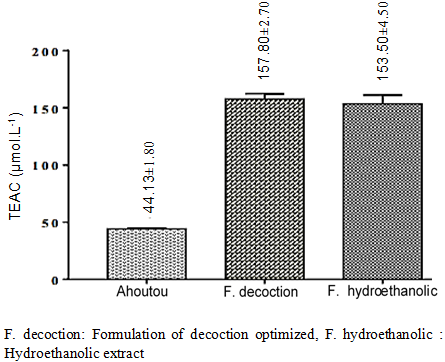
Malaria is a public health problem in Africa, more precisely in Côte d’Ivoire. In addition to the formal treatments known in hospitals, a segment of the population uses treatments based on medicinal plants. Ahoutou (preparation of three (03) medicinal plants), like other preparations, is one of these treatments. The effectiveness of this preparation is the subject of debate. It is therefore imperative to apply characterization methods in order to scientifically evaluate the properties of ahoutou. This work aims to carry out a physicochemical characterization and evaluate the therapeutic properties of ahoutou. After extraction and physicochemical characterizations of the ahoutou, the flavonoid and polyphenol contents were measured. The results show that the magnesium contents of the extracts are between 530 ± 5.8 and 369 ± 4.6 µg/g of extract. The amounts of calcium in the different extracts vary from 3343 ± 1.7 to 487 ± 3.5µg/g of extract. Potassium contents vary from 3908± 3.5 to 1987± 4.1 µg/g of extract. The presence of certain minerals in our extracts (Iron, calcium, magnesium, sodium, potassium) would be a supplement to the diet in the prevention of certain complications due to malaria such as anemia, oxidative stress, hydro-electrolyte disorders and dehydration. Ahoutou has a moderate effect on Plasmodium falciparum and has anti-radical and antioxidant activity. It also has antiplasmodial activity with moderate effect on Plasmodium falciparum. As for the leaves that make up the ahoutou recipe, they also have antiplasmodial activity. Aqueous extracts (decoction) have a proven effect on Plasmodium falciparum. Ahoutou could therefore be used as a treatment for malaria in addition to formal treatment.
Malaria is caused by parasites of the plasmoid family 1. It is female Anopheles mosquitoes that transmit these parasites by biting to feed on blood. The signs of malaria may differ depending on the severity of the infection, but the most common symptoms generally include chills and sweating, headache: intense and constant, muscle and joint pain. Symptoms are nausea and vomiting which can cause dehydration, general fatigue and anemia, caused by the destruction of red blood cells by the parasite 2. Malaria is a tropical disease found mainly in Africa, Asia and Latin America. According to WHO data in 2023, the number of malaria cases across the world reached approximately 249 million in 2022, resulting in 608,000 lives lost 3. Most cases and deaths have occurred in Africa, with 94% of cases and 95% of deaths recorded. In Côte d’Ivoire, malaria is a scourge that affects the entire population. It is transmitted throughout the year, with peak incidence from April to July. The country is ranked among the ten countries with the highest rates of malaria cases and deaths in 2020, with 3.1% of global cases and deaths, 2.5% of global deaths, and 6.5% of cases malaria in West Africa 3, 4. To remedy this, an ambitious national policy was implemented in Côte d'Ivoire to combat malaria, with the aim of reducing the incidence and mortality of this disease and eradicating it by 2030 5. In view of this, in addition to contemporary medical treatments, there are traditional methods to manage malaria. These approaches are frequently based on the use of medicinal plants and natural remedies. A medicinal plant, a plant substance or a herbal preparation can be used as a raw material for the manufacture of a herbal medicine. Like other preparations, such as Artemisia annua, which is renowned for its antimalarial properties, this plant is frequently used as an infusion 6. Additionally, neem (Azadirachta indica) is used to prepare decoctions which are consumed to treat malaria. In addition, moringa oleifera is sometimes used for its nutritional and medicinal properties 7. Ahoutou, a preparation for the treatment of malaria, also exists. It is known that this preparation is made up of various local medicinal plants, each with particular properties to relieve the symptoms of malaria 8. It has shown limitations in many cases in the treatment of malaria. However, those who use the Ahoutou recipe find it effective against malaria, while others say the opposite. Which leaves room for reflection. This reflection leads us to question the procedure for manufacturing the products, in particular the preparation time, the extraction process and the different proportions of the leaves during mixing (ratio). All of these factors could impact product quality. Indeed, Koffi 9, Bitwell et al. 10 showed in their work that several factors such as the extraction process, the extraction time, the nature of the solvent and the ratio can impact the extraction yield of certain compounds such as flavonoids and polyphenols. Faced with these recurring problems that traditional practitioners face in preparing the recipes that they offer to the population, we undertook this study to make our contribution to help them. It would be necessary to use scientific tools commonly used in experiments such as experimental plans to optimize optimal extraction conditions and control the physicochemical and therapeutic properties of this preparation. This work therefore aims to carry out a physicochemical characterization and evaluate the therapeutic properties of ahoutou.
Extracts studied (aqueous ahoutou, decoction and hydroéthanolique optimized) were dried during 24 hours in a étuve Memmert-Germany in 60°C minimum. They were then kept in glassy vials. With the aid of scales of type Sartorius analytic (Engleterre), 0.3 g of powder of the plant equipment dried in the étuve in 46°C in a porcelain crucible of 30 mL. This trial catch was put in the oven with mitten (Naberthem-Germany) regulated in 600°C during 5 hours. After cooling, 2 mL of hydrochloric acid 0.5 N were added to acquired cinder then carried in complete vaporizing on a sand bath. Recovered final residue, was filtered in a vial sounded by 100 mL and they supplemented with the water distilled up to the trait of gauge. For these analyses, one of five (05) mL of this resolution took a sample for the proportion of the mineral: Fe, Na, Mg, Zn, M and K by Spectrophotomètre of Nuclear Absorption (SAA). One of five (05) mL of the sample took a sample in a vial of 50 mL; two (02) mL of Lanthane in 5 % were added to it before supplementing with some water distilled up to the trait of gauge.
2.2. Preparation of the Reactive of LanthaneA mass of 58.65 g of Lanthanum (La2O3) is moistened with 50 mL of distilled water. Under the hood, it was added to 250 mL of 25% hydrochloric acid concentrated and stirred gently until dilution complete the Lanthanum to 5 %. The solution was then completed to one litre with distilled water. Before any reading, the atomic absorption spectrophotometer must be calibrated. To do this, we prepare a standard solution of 100 ppm from a commercial solution called multi element 1000 ppm. This preparation is carried out as follows: 2.5 mL of the stock solution (1000 ppm) are introduced in a flask of 25 mL and supplemented with concentrated nitric acid until the gauge line. This solution was used to prepare the ranges of the standard.
2.3. Preparation of the StandardDilutions were made from standard solutions of each mineral (100 mg/L) in the completion of the different initial volumes of 50 mL with distilled water, so as to obtain a concentration range specific for each mineral. These calibration solutions were then used for the calibration of the spectrophotometer atomic absorption flame. The results of the optical densities (D. O.) read at the wavelength corresponding to each mineral were used to determine the amounts of minerals in the samples. The results were expressed according to the following formula of Clement and Françoise 11.
 |
With, Cess: Concentration of the test (mg/mL), Cbl: Concentration of the elements contained in the extraction solution (blank) in mg/mL, Pess: Weight of the test (Kg), V: Volume of test recovery (mL), T: Content (µg/g or mg/Kg)
The atomic absorption spectrophotometer readings are taken at 248.3 nm (Fe) ; 279.5 nm (Mn) ; 589 nm (Na) ; 258 nm (Zn) ; 285.2 nm (Mg) ; 766.5 nm (K) and 422.7 nm (Ca).
2.4. Statistical AnalysisStatistical analysis of the results was performed using analysis of variance (ANOVA). When a significant difference was observed, Tukey and Dunnett's multiple comparison tests were performed.
The result of the trace element content of Ahoutou and the formulations (optimized decoction extract and hydroethanolic extract) is shown in Table 1. The extracts contain significant quantities of trace elements. Magnesium, calcium, potassium and phosphorus are the most abundant minerals in the different extracts. The magnesium contents of the extracts are between 530 ± 5.8 and 369 ± 4.6 µg/g of extract. The amounts of calcium in the different extracts vary from 3343 ± 1.7 to 487 ± 3.5µg/g of extract. Potassium contents vary from 3908± 3.5 to 1987± 4.1 µg/g of extract. As for the phosphorus content, it oscillates between 200 ±1.2 and 130 ±2.3 µg/g of extract. As for the sodium, zinc, manganese and iron contents, they are 16.64 ± 0.01 and 7.75 ± 0.01 µg/g of extract, 6.1 ± 0.01 and 5.9 ± 0.05 µg/g of extract, 4.7 ± 0.05 and 4.54 ± 0.01 µg/g of extract respectively and finally 0.022± 0.001 and 0.009 ± 0.001 µg/g of extract.
The mineral are essential substances in the good functioning of organism 12. The most part are in limitless quantities in the water of river, lakes as well as in nature (plants). Mineral containing in plants participate actively in their therapeutic activity. Trace elements are nutritious mineral elements necessary to our organism in quantity very weak coach in well brought up doses, these same mineral could be toxic for organism. In this study, the mineral elements such as manganese, iron, magnesium, zinc, calcium, sodium and potassium were determined. The choice of these mineral is justified by their essential biological role in organism. In effect, these mineral were identified as necessary for human life by the WHO 13. Therefore, certain minerals, particularly manganese, zinc and iron, appear to play a role in malaria prevention. Manganese is an essential trace mineral that plays an essential role in several metabolic processes because many enzymes depend on manganese for their functions. As the cofactor of superoxide dismutase, it is a critical element for antioxidant defense 14. It participates in the production of cellular energy and is a co-activator of RNA polymerase by participating in the synthesis of hemoglobin 15. Manganese intake could contribute to the production of red blood cells and increase their presence during treatment. Zinc is also an essential trace mineral that promotes cell growth and differentiation 16. Due to zinc's crucial role in cell differentiation, zinc deficiency leads to impaired immune function and reduced resistance to infection. Zinc deficiency is thought to exacerbate malaria 17. In addition, there is growing evidence that zinc supplementation may help prevent this parasitosis 18. In regions affected by malaria, this parasitosis and iron deficiencies coexist and interact, leading to a great interest in iron in public health. An acute malarial attack induces anaemia, mainly through a decrease in erythrocyte production by the bone marrow following suppression of erythropoiesis and increased hemolysis 19. Also, malaria also contributes to iron loss by inducing iron immobilization in the form of hemozoin and an increase in urinary excretion 20 as well as a decrease in the ingestion and absorption of iron from food sources 21. As malaria is a hemolytic disease due to the destruction of red blood cells by the parasite, it is often responsible for severe anemia. The iron intake through these extracts could be valuable in the replenishment of hemoglobin during treatment. Ndako et al., 22 have proven that Plasmodium falciparum infection leads to a reduction in serum Na+ and K+. Sodium acts with potassium particularly in the intracellular space to regulate osmotic pressure and maintain the proper balance of water in the body. The presence of certain minerals in our extracts (Iron, calcium, magnesium, sodium, potassium) would be a complement to the diet in the prevention of certain complications due to malaria such as anemia, oxidative stress, hydroelectrolyte disorders and dehydration.
3.2. Physico-chemical Properties of the Leaves of Azadirachta indica, Cymbopogon citratus and Psidium guajavaThe physico-chemical properties of the leaves of Azadirachta indica, Cymbopogon citratus and Psidium guajava are summarized in Table 2. According to the obtained results, the moisture content of the leaves of Azadirachta indica, Cymbopogon citratus and Psidium guajava are 8.63 ± 0.96%; and 7.3 ± 1.27 per cent and 8.56±0.83%, respectively. The ash content of the three leaves is between 8% and 11%, with a value of 10.32± 0.79% for the leaves of Azadirachta indica, of 9.22±0.94% for the leaves of Cymbopogon citratus and 8.20 ± 1.79% of the leaves of Psidium guajava.
The characterization of the phytochemical constituents, chemical, carried out on the aqueous extracts of the leaves of the three plants, has given the results recorded in the Table 3. The results obtained indicate that the majority of the plant extracts contain polyphenols, flavonoids, saponins and tannins. However, some of these extracts do not contain all of the alkaloids, sterols, and terpenes.
The powder of the leaves of each plant were the subject of the extractions of aqueous. A total of nine (9) aqueous extracts were obtained using three conventional extraction methods: maceration, infusion, and decoction. The results of the extraction are reported in Table 4.
The extraction of the extracts varies depending on the plant species and the content of each species in metabolic secondary used in the extraction. The yields are given in general for the aqueous extracts, to an average return of 13.50% (± 0.24) resulting from the average of decoction 14.83 (±0.26%), infusion 12.67 (±0.24%) and maceration to 13.0 (±0.23%).
3.3. Total Flavonoid and Total Polyphenol ContentsThese extracts are nine (9) aqueous extracts obtained by maceration, by infusion and by decoction. The results of the determination of the flavonoid content of the extracts are indicated in Table 4. For Azadirachta indica, the results show that the total flavonoid contents of the aqueous extracts of the leaves obtained by two of the three extraction methods, namely decoction and maceration does not present a significant difference (P>0.05). However, the decoction seems to be the best method for extracting total flavonoids with an average of 6.73 ± 0.02 mg EQ/mL compared to 6.67 ± 0.04 mg EQ/mL for maceration followed by infusion with a mean of 6.67 ± 0.04 mg EQ/mL. Regarding Cymbopogon citratus, the results of the total flavonoid content of the aqueous extracts of the leaves obtained by two of the three extraction methods, namely decoction and infusion, do not show a significant difference (P>0.05). However, infusion seems to be the best method for extracting total flavonoids with an average of 7.2 ± 0.38 mg EQ/mL compared to 6.9 ± 0.12 mg EQ/mL on average for decoction followed by maceration. with an average of 5.8± 0.12 mg EQ/mL. As for Psidium guajava, the results of the total flavonoid content of the aqueous extracts of the leaves obtained by the three extraction methods show that the decoction is preferable for extracting the flavonoids with an average of 8.10 ± 0.02 mg EQ /mL versus 7.80 mg EQ/mL on average for infusion followed by maceration with an average of 7.62 ± 0.02 mg EQ/mL. Statistically the difference in total flavonoid contents depending on the different extraction methods is highly significant (P<0.01).
The total polyphenol content of the aqueous extracts of the plants of Azadirachta Indica, Cymbopogon Citratus and Psidium Guajava is indicated Table 5. With regard to aqueous extracts, the results show that the decoction records the highest contents in polyphenols whatever Plants with values of 16.74 ± 0.08 mg EAG/ML, 16.82 ± 0.18 mg EAG/ML and 30.76 ± 0.82 mg EAG/ML for Azadirachta Indica, Cymbopogon Citratus and Psidium Guajava respectively. However, Psidium Guajava contains many more polyphenols (p <0.001) than the other two plants.
Infusion comes in second place in Azadirachta indica and Psidium guajava respectively with averages of 13.21±0.11 mg EAG/mL and 21.53±0.18 mg EAG/mL, followed by maceration which records respectively significant total polyphenol contents with averages of 9.9±0.79 mg EAG/mL and 18.90±0.12 mg EAG/mL. In Cymbopogon citratus, the two extraction methods, namely infusion and maceration, do not show a significant difference (P>0.05). However, maceration seems to be the best method to extract total polyphenols with an average of 13.05 ±0.13 mg. EAG/mL versus 12.95±0.05 mg. EAG/mL on average for infusion. The flavonoid and polyphenol contents it contains are low. The data also showed that Ahoutou has less antioxidant power. This anti-free radical power observed could be due to the low levels of flavonoids and total polyphenols. Indeed, N’gessan et al., 23 showed the existence of a correlation between total phenol concentrations and anti-free radical activity. In addition, several studies have shown that flavonoids and polyphenols are compounds with pronounced antioxidant activity 24.
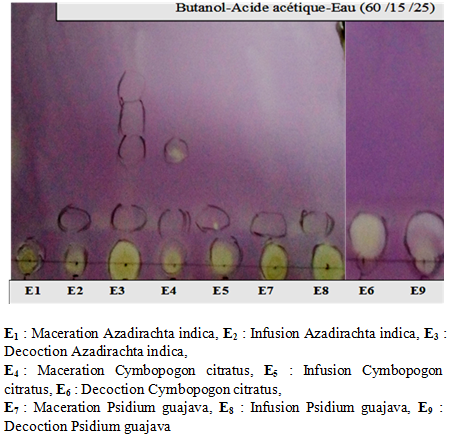
3.4. Therapeutic ActivitiesThe raw extracts studied further to migration on a plate of silicagel with a mixture of acetous butanol-sour solvent - water (60/15/25) were revealed in DPPH (Figure 1).

The antioxidizing activity of the aqueous extracts of the plants of Azadirachta indica, Cymbopogon citratus and Psidium guajava acquired by decoction, infusion and soaking was assessed by the method of discount of the free radical DPPH and by the method of piégeage of radical ABTS. The results of the value of CI50 of DPPH determined from the Figure 2 and from the value of the test of ABTS are pointed out in the Table 6. The results of this activity were expressed by parameter CI50 and extract having the value of lowest CI50, exercise antiradicalaire most well brought up activity. So, according to acquired results, all extracts are gifted with an antioxidizing activity. Activities vary from an extract to other one and from a plant to other one. Difference between extracts and reference molecule (ascorbic Acid) is statistically significant (P <0.05) except for the extract of decoction of Psidium guajava. Psidium guajava apparait as the most active plant on Radical DPPH with CI50 of 0.29±0.01 mg / mL extracts of decoction. As for the reference molecule (Vitamin C) it shows CI50 of 0.25±00 mg / mL. According to the ABTS assay results, the aqueous decoction extracts exhibited the highest antioxidant activity among the plant extracts.

Extracts that showed good antioxidant activity, better flavonoid and polyphenol content were selected for antiplasmodial activity tests. Thus, the decoction extracts were tested on 4 clinical isolates, which are the clinical isolates ANK137, ANK138, ANK139 and ANK140 and on the reference strain Dd2 of Plasmodium falciparum. The results obtained are reported in Table 7. The content data show that the leaves of the three plants studied are rich in mineral substances and the powders of the drugs obtained would lend themselves to good conservation because the moisture content of the three leaves of the plants is all less than 10%. This is because the moisture content of plants gives an indication of their shelf life. Thus, a low water content is a requirement for a long shelf life. The results obtained are different from those of Mitra and Mitra and Misra, 25 for the leaves of Azadirachta indica. These authors found a moisture content of 59.4% and an ash content of 3.4%. For Psidium guajava leaves, the moisture content result is similar to those of Tensaout and Gaoua, 26. Indeed, these authors found a humidity level of 8.08% after drying at 105°C. The anti-free radical effect of the extracts could be related to the hydrogen-donating capacity of polyphenols 27. These natural antioxidant substances, found in plant extracts, are part of the therapeutic arsenal in the fight against many pathologies such as asthma and cancer. The in vitro antioxidant activity of the extracts would be an important contribution to the success of antiplasmodial treatment. This is because parasite-activated neutrophils trigger endothelial cell destruction that can be prevented by antioxidants and proteolytic enzyme inhibitors in vitro 28.
The screening tube and reveals to us the different chemical groups present in the drug. As we note in general, the presence of polyphenols, flavonoids, saponins and tannins in the extracts of the three plants. These results are consistent with those obtained by Abalaka et al. 29, Figueirinha et al. 30 and Biswas et al. 31 in the aqueous extracts of the leaves of Azadirachta indica, Cymbopogon citratus and Psidium guajava, respectively. These results show that these plants contain active principles responsible for the various pharmacological properties of which they were the object. The yield of extraction by decoction, by maceration and infusion showed that the best yields were obtained with the extracts of decoction of some of the plants studied. The determination of the yields allows you to appreciate quantitatively extracts that can be drawn from each species. These returns can also consider the quantity of organs to take in the event of a need for a possible similar study, which would make the use of medicinal plants more rational 38. The choice of the leaves is justified by the fact that the leaves are the seat by excellence of the biosynthesis and even the storage of the secondary metabolites responsible for the biological properties of the plant 32. The results obtained in this study are better than those obtained by Tarkang et al., 33. Indeed, these authors found yields of 5.84% and 5.80% respectively when aqueous extraction of the leaves of Psidium guajava and Cymbopogon citratus. This difference could be due to the time when the leaves are harvested and the origin of these leaves. The screening of antioxidant activity by TLC that we carried out using DPPH as a developer, shows that all extracts, including the Ahoutou recipe, are able to reduce the DPPH radical. These results are consistent with those of 34. Indeed, to screen the antioxidant activity of its extracts, these authors had used this method and had obtained yellow bands on a purple background to select extracts with antioxidant activity. The quantitative test confirms the antioxidant activity of the extracts observed. According to the results, all the extracts showed antioxidant activities. However, decoction extracts showed high antioxidant activity regardless of the plant. This good antioxidant activity is based on the content of phenolic compounds contained in these extracts. Indeed, polyphenols are compounds with antioxidant power due to their redox properties 35. In addition, these extracts have high accumulations of polyphenols and total flavonoids at the same time; which is in agreement with the results of antioxidant activity by DPPH and ABTS tests. These results obtained are better compared to the result of the Ahoutou recipe. The results of the tests showed that all the crude extracts studied possess antiplasmodial activity according to the classification scale proposed by Bero et al., 36 and reported by Beourou et al., 37. According to these authors, a plant extract is said to have a promoting effect if the IC50 is between 5μg/mL and 15μg/mL (5<IC50<15 μg/mL) and has a moderate effect if its IC50 is between 15μg/mL and 50μg/mL (15<IC50<50 μg/mL). Thus, the IC50 obtained ranged from 7.10 μg/ml (Psidium guajava extract) to 29.46 μg/ml (Azadirachta indica extract). In view of these results, we can say that the three plant extracts studied have promising antiplasmodial properties on isolates ANK137, ANK138, ANK139 and ANK140, with the exception of Azadirachta indica extracts which showed a moderate effect on three of the four isolates, namely ANK138, ANK139 and ANK140 and Cymbopogon citratus extract on ANK140 isolates. However, these activities differed from one extract to another for the same plant and from one plant to another. This could be explained by the difference in the content of active compounds and the antigenic polymorphism of clinical isolates. Thus the extracts of the leaves of the three plants obtained antiplasmodial activity. The use of solvents of different polarity was therefore of great use. Also, the choice of extracts to be tested on the basis of their flavonoid and polyphenol composition and antioxidant activity is of paramount importance since almost all the extracts selected were active against Plasmodium falciparum. With regard to the validation of the antiplasmodial activity of these extracts, the results of the three decoction extracts of Azadirachta indica, Cymbopogon citratus and Psidium guajava yielded IC50 values of 14.81 μg/mL, 26.87 μg/mL and 15.36 μg/mL respectively for the chloroquinoresistant Plasmodium falciparum reference strain Dd2. Our results differ from those obtained by Tarkang et al., 33. Indeed, these authors obtained on the Plasmodium falciparum Dd2 strain the IC50 values of 141 μg/mL and 23.79 μg/mL for the aqueous extracts of Cymbopogon citratus and Psidium guajava leaves respectively collected between july and august in Yaoundé, Cameroon. This difference could be due to the geographical location and the harvest season.
In this work, the objective was to provide scientific evidence of the therapeutic activity of an herbal preparation used in the treatment of malaria. This preparation, called Ahoutou by its designer, is used in humans but has not previously been the subject of preclinical studies on patients with malaria to evaluate its therapeutic properties. It appears from this study that Ahoutou contains secondary metabolites, in particular phenolic compounds, according to the qualitative analysis. Physicochemical and phytochemical analyses have also shown that the Ahoutou recipe has all the chemical compounds that are likely to treat malaria. However, the recipe has a moderate effect on Plasmodium falciparum. Ahoutou also has a significant anti-free radical and antioxidant activity due to the presence of these compounds. It will need to be used over a long period of time before healing. It also has moderate-effect antiplasmodial activity on Plasmodium falciparum. As for the leaves that make up the Ahoutou recipe, they also have antiplasmodial activity. Aqueous extracts (decoction) have a proven effect on Plasmodium falciparum. This effect is thought to be due to the high concentration of secondary metabolites (polyphenols and flavonoids) in the extracts of these leaves. However, the combination of these three extracts that constitutes Ahoutou showed a moderate effect less than the effects obtained by the plants taken individually. However, this activity could be improved by modern tools or extraction techniques (processes) to make it more effective against malaria.
Declaration of Interests
The authors state that they have no known competing financial interests or personal relationships that could have appeared to influence the work reported in this article.
CRediT authorship contribution statement
Gouegoui Serge-Pacôme Bohui, Conceptualization, Data curation, Formal analysis Methodology, Validation, Writing–original draft, Writing–review & editing; Namory Méité, Formal analysis, Validation, Visualization, Writing – original draft, Writing – review & editing; Elogne Guessan Zoro, Writing – original draft, Writing – review & editing; Alfred Niamien Kouamé, Methodology, Supervision, Validation, Visualization, Writing – review & editing, Ali Sanou, Writing – original draft, Writing – review & editing; Lébé Prisca Marie-Sandrine Kouakou, Methodology, Supervision, Validation, Visualization, Writing – review & editing, Wagner Luiz Ramos Barbosa, Conceptualization, Supervision, Validation, Visualization, Writing – review & editing.
| [1] | Loy, D.E., Liu, W., Li, Y., Learn, G.H., Plenderleith, L.J., Sundararaman, S.A., Sharp, P.M., Hahn, B.H., 2017. Out of Africa: origins and evolution of the human malaria parasites Plasmodium falciparum and Plasmodium vivax. Int. J. Parasitol., Molecular Approaches to Malaria 2016 (MAM2016) 47, 87–97. | ||
| In article | View Article PubMed | ||
| [2] | Bria, Y.P., Yeh, C.-H., Bedingfield, S., 2021. Significant symptoms and nonsymptom-related factors for malaria diagnosis in endemic regions of Indonesia. Int. J. Infect. Dis. 103, 194–200. | ||
| In article | View Article PubMed | ||
| [3] | OMS, 2023. Rapport 2023 sur le paludisme dans le monde [WWW Document]. URL https://www.who.int/fr/teams/global-malaria-programme/reports/world-malaria-report-2023 (accessed 10.9.24). | ||
| In article | |||
| [4] | PNLP, 2020. le Paludisme en Côte d’Ivoire [WWW Document]. URL https://www.pnlpcotedivoire.org/paludisme-en-cote-d-ivoire/ (accessed 10.9.24). | ||
| In article | |||
| [5] | MSHP, C., 2016. Politique nationale d’amélioration de la qualité des soins et des services de santé en Côte d’Ivoire [WWW Document]. Sev. Malar. Obs. URL https:// www. severemalaria.org/ fr/pays/la-cote-divoire (accessed 10.9.24). | ||
| In article | |||
| [6] | Pouka, M.K., Ngene, J.P., Ngoule, C.C., Ottou, P.M., Ndjib, R.C., Dibong, S.D., Mpondo, E.M., 2015. Caractérisation des plantes médicinales à flavonoïdes des marchés de Douala (Cameroun). Int. J. Biol. Chem. Sci. 9, 1494–1516. | ||
| In article | View Article | ||
| [7] | Sylla, Y., Silue, D.K., Ouattara, K., Kone, M.W., 2018. Etude ethnobotanique des plantes utilisées contre le paludisme par les tradithérapeutes et herboristes dans le district d’Abidjan (Côte d’Ivoire). Int. J. Biol. Chem. Sci. 12, 1380–1400. | ||
| In article | View Article | ||
| [8] | Bohui, G.S.-P., Beourou, S., Sanogo, D., N’guessan, J.D., Attioua, K.B., Adima, A.A., 2024. Phytochemical Screening and Evaluation of the Antioxidant and Antiplasmodial Activities of “Ahoutou”, a Recipe Used in the Treatment of Malaria in Côte d’Ivoire. Sci. J. Chem. 6, 109–116. | ||
| In article | View Article | ||
| [9] | Koffi, N.E., 2014. Contribution à l’optimisation et à l’étude chimique des polyphénols de deux plantes de la Côte d’Ivoire Tectona grandis Linn (Verbenaceae) et Justicia secunda Vahl (Acanthaceae). | ||
| In article | |||
| [10] | Bitwell, C., Indra, S.S., Luke, C., Kakoma, M.K., 2023. A review of modern and conventional extraction techniques and their applications for extracting phytochemicals from plants. Sci. Afr. 19, e01585. | ||
| In article | View Article | ||
| [11] | Clement, M., Françoise, P., 2003. Analyse chimique des sols, Tec et Doc. ed. | ||
| In article | |||
| [12] | OMS, 2011. Rapport sur le paludisme dans le monde ; résumé et points essentiels. | ||
| In article | |||
| [13] | Picard, H., 1975. Utilisation thérapeutique des oligo-éléments, Maloine. ed. Paris, France. | ||
| In article | |||
| [14] | Culotta, V.C., Yang, M., O’Halloran, T.V., 2006. Activation of superoxide dismutases: Putting the metal to the pedal. Biochim Biophys Acta 747-758. | ||
| In article | View Article PubMed | ||
| [15] | Aschner, M., Lukey, B., Tremblay, A., 2006. The Manganese Health Research Program (MHRP): status report and future research needs and directions. Neurotoxicology 733–736. | ||
| In article | View Article PubMed | ||
| [16] | Prasad, A.S., 2003. Zinc deficiency. Br. Med. J. 409–410. | ||
| In article | View Article PubMed | ||
| [17] | Shankar, A.H., Prasad, A.S., 1998. Zinc and immune function: the biological basis of altered resistance to infection. Am. J. Clin. Nutr. 447S-463S. | ||
| In article | View Article PubMed | ||
| [18] | Bates, C.J., Evans, P.H., Dardenne, M., 1993. A trial of zinc supplementation in young rural Gambian children. Br. J. Nutr. 243–255. | ||
| In article | View Article PubMed | ||
| [19] | Phillips, R.E., Looareesuwan, S., White, N.J., Silamut, K., Kietinun, S., Warrell, D.A., 1986. Quinine pharmacokinetics and toxicity in pregnant and lactating women with falciparum malaria. Br. J. Clin. Pharmacol. 677–683. | ||
| In article | View Article PubMed | ||
| [20] | Brabin, B.J., 1992. The role of malaria in nutritional anemias; in Fomon SJ, Slotkin S (eds): Nutritional Anemias, Raven Press. ed. New York. | ||
| In article | |||
| [21] | Molyneux, M.E., Looareesuwan, S., Menzies, I.S., 1989. Reduced hepatic blood flow and nintestinal malabsorption in severe falciparum malaria. Am. J. Trop. Med. Hyg. 470–476. | ||
| In article | View Article PubMed | ||
| [22] | Ndako, J.A., Olisa, J.A., Ozoadibe, O.Y., Dojumo, V.T., Fajobi, V.O., Akinwumi, J.A., 2020. Evaluation of the association between malaria infection and electrolyte variation in patients: Use of Pearson correlation analytical technique. Inform. Med. Unlocked 21, 100437. | ||
| In article | View Article | ||
| [23] | N’gessan, J.D., Zirihi, G.N., Kra, A.K.M., Kouakou, A.J., Djaman, K., Guede Guina, F., 2007. Free radical scavenging activity, flavonoid and phenolic contents of selected Ivoirian plants. Int. J. Nat. Appl. Sci. 425–429. | ||
| In article | |||
| [24] | Yéo, S.O., 2015. Evaluation In Vitro des activites antibacterienne et antioxydante des extraits de racines de Cochlospermum planchonii Hook f. ex. Planch (Cochlospermaceae), une plante utilisee contre les diarrhees en Côte d’Ivoire. Doctorat d’Université Thèse Unique, Université Félix Houphouët Boigny. | ||
| In article | |||
| [25] | Mitra, C.R., Misra, P.S., 1967. Amino acids of processed seed meal proteins. J. Agric. Food Chem. 697–700. | ||
| In article | View Article | ||
| [26] | Tensaout, F., Gaoua, A., 2018. Caractéristiques chimiques et propriétés antioxydantes de la goyave «Psidium guajava ». Memoire de fin d’etude, 94p. Universite Abderrahmane Mira – Bejaia. | ||
| In article | |||
| [27] | Kossah, R., Nsabimana, C., Zhang, H., Chen, W., 2013. Evaluation of antimicrobial and antioxidant activities of Syrian sumac fruit extract. J. Nat. Prod. 102. | ||
| In article | |||
| [28] | Hemmer, C.J., Lehr, H.A., Westphal, K., Unverricht, M., Kratzius, M., Reisinger, E.C., 2005. Plasmodium falciparum Malaria: reduction of endothelial cell apoptosis in vitro. Infecioust Immunol. 1764–1770. | ||
| In article | View Article PubMed | ||
| [29] | Abalaka, M., Oyewole, O.A., Kolawole, A.R., 2012. Antibacterial Activities of Azadirachta Indica against Some Bacterial Pathogens. Adv. Life Sci. 5–8. | ||
| In article | |||
| [30] | Figueirinha, A., Paranhos, A., Pérez-Alonso, J.J., Santos-Buelga, C., Batista, M.T., Kolawole, A.R., 2008. Cymbopogon citratus leaves : characterisation of flavonoids by HPLC–PDA–ESI/MS/MS and an approach to their potential as a source of bioactive polyphenols. Food Chem. 718–728. | ||
| In article | View Article | ||
| [31] | Biswas, B., Rogers, K., McLaughlin, F., Daniels, D., 2013. Antimicrobial Activities of Leaf Extracts of Guava (Psidium guajava L.) on Two Gram-Negative and Gram Positive Bacteria. Int. J. Microbiol. 7. | ||
| In article | View Article PubMed | ||
| [32] | Bitsindou, M., 1997. Enquêtes sur la phytothérapie traditionnelle à Kindamba et Odzala (Congo) et analyse des convergences d’usage des plantes médicinales en Afrique Centrale. (Thèse de doctorat). Université libre de Bruxelles, Belgique. | ||
| In article | |||
| [33] | Tarkang, P.A., Franzoi, K.D., Lee, S., Lee, E., Vivarelli, D., Freitas-Junior, L., Liuzzi, M., Nolé, T., Ayong, L.S., Agbor, G.A., Okalebo, F.A., Guantai, A.N., 2014. Activités antiplasmodiques in vitro et combinaisons synergiques d’extraits de solvants différentiels du produit polyherbal. | ||
| In article | |||
| [34] | Tuo, K., 2015. Criblage phytochimique, activité antioxydante et antiplasmodiale in vitro de cinq plantes utilisées traditionnellement en Côte d’Ivoire contre le paludisme. Université Félix Houphouët Boigny, Côte d’Ivoire. | ||
| In article | |||
| [35] | Zeng, W., Wang, S.Y., 2001. Antioxidant activity and phenolic compounds in selected herbs. J. Agric. Food Chem. 5165–5170. | ||
| In article | View Article PubMed | ||
| [36] | Bero, J., Frédérich, M., Quetin-Leclercq, J., 2009. Antimalarial compounds isolated from plants used in traditional medicine. J. Pharm. Pharmacol. 1401–1433. | ||
| In article | View Article PubMed | ||
| [37] | Beourou, S., Okou, O.C., Tuo, K., Kamenan, K.C.D., Gnondjui, A.A., Kouakou, L., Atteméné, D.S.D., Penali, L., Jambou, R., Djaman, A.J., 2017. Propagation in culture of Plasmodium falciparum gametocytes clinical isolates and antiplasmodial activity of two medicinal plant extracts on parasitic growth. Afr. J. Parasitol. Res. 249–256. | ||
| In article | |||
| [38] | Yéo, S.O., Guessennd, K.N., Meité, S., Ouattara, K., Bahi, G.A., N’Guessan, J.D., Coulibaly, A., 2014. In vitro Cochlospermum planchonii (Cochlospermaceae) antioxidant activity of extracts hook. of ex. the Planch root. J. Pharmacogn. Phytother. 164–170. | ||
| In article | |||
Published with license by Science and Education Publishing, Copyright © 2025 Gouegoui Serge-Pacôme Bohui, Namory Méité, Elogne Guessan Zoro, Alfred Niamien Kouamé, Ali Sanou, Lébé Prisca Marie-Sandrine Kouakou and Wagner Luiz Ramos Barbosa
 This work is licensed under a Creative Commons Attribution 4.0 International License. To view a copy of this license, visit
http://creativecommons.org/licenses/by/4.0/
This work is licensed under a Creative Commons Attribution 4.0 International License. To view a copy of this license, visit
http://creativecommons.org/licenses/by/4.0/
| [1] | Loy, D.E., Liu, W., Li, Y., Learn, G.H., Plenderleith, L.J., Sundararaman, S.A., Sharp, P.M., Hahn, B.H., 2017. Out of Africa: origins and evolution of the human malaria parasites Plasmodium falciparum and Plasmodium vivax. Int. J. Parasitol., Molecular Approaches to Malaria 2016 (MAM2016) 47, 87–97. | ||
| In article | View Article PubMed | ||
| [2] | Bria, Y.P., Yeh, C.-H., Bedingfield, S., 2021. Significant symptoms and nonsymptom-related factors for malaria diagnosis in endemic regions of Indonesia. Int. J. Infect. Dis. 103, 194–200. | ||
| In article | View Article PubMed | ||
| [3] | OMS, 2023. Rapport 2023 sur le paludisme dans le monde [WWW Document]. URL https://www.who.int/fr/teams/global-malaria-programme/reports/world-malaria-report-2023 (accessed 10.9.24). | ||
| In article | |||
| [4] | PNLP, 2020. le Paludisme en Côte d’Ivoire [WWW Document]. URL https://www.pnlpcotedivoire.org/paludisme-en-cote-d-ivoire/ (accessed 10.9.24). | ||
| In article | |||
| [5] | MSHP, C., 2016. Politique nationale d’amélioration de la qualité des soins et des services de santé en Côte d’Ivoire [WWW Document]. Sev. Malar. Obs. URL https:// www. severemalaria.org/ fr/pays/la-cote-divoire (accessed 10.9.24). | ||
| In article | |||
| [6] | Pouka, M.K., Ngene, J.P., Ngoule, C.C., Ottou, P.M., Ndjib, R.C., Dibong, S.D., Mpondo, E.M., 2015. Caractérisation des plantes médicinales à flavonoïdes des marchés de Douala (Cameroun). Int. J. Biol. Chem. Sci. 9, 1494–1516. | ||
| In article | View Article | ||
| [7] | Sylla, Y., Silue, D.K., Ouattara, K., Kone, M.W., 2018. Etude ethnobotanique des plantes utilisées contre le paludisme par les tradithérapeutes et herboristes dans le district d’Abidjan (Côte d’Ivoire). Int. J. Biol. Chem. Sci. 12, 1380–1400. | ||
| In article | View Article | ||
| [8] | Bohui, G.S.-P., Beourou, S., Sanogo, D., N’guessan, J.D., Attioua, K.B., Adima, A.A., 2024. Phytochemical Screening and Evaluation of the Antioxidant and Antiplasmodial Activities of “Ahoutou”, a Recipe Used in the Treatment of Malaria in Côte d’Ivoire. Sci. J. Chem. 6, 109–116. | ||
| In article | View Article | ||
| [9] | Koffi, N.E., 2014. Contribution à l’optimisation et à l’étude chimique des polyphénols de deux plantes de la Côte d’Ivoire Tectona grandis Linn (Verbenaceae) et Justicia secunda Vahl (Acanthaceae). | ||
| In article | |||
| [10] | Bitwell, C., Indra, S.S., Luke, C., Kakoma, M.K., 2023. A review of modern and conventional extraction techniques and their applications for extracting phytochemicals from plants. Sci. Afr. 19, e01585. | ||
| In article | View Article | ||
| [11] | Clement, M., Françoise, P., 2003. Analyse chimique des sols, Tec et Doc. ed. | ||
| In article | |||
| [12] | OMS, 2011. Rapport sur le paludisme dans le monde ; résumé et points essentiels. | ||
| In article | |||
| [13] | Picard, H., 1975. Utilisation thérapeutique des oligo-éléments, Maloine. ed. Paris, France. | ||
| In article | |||
| [14] | Culotta, V.C., Yang, M., O’Halloran, T.V., 2006. Activation of superoxide dismutases: Putting the metal to the pedal. Biochim Biophys Acta 747-758. | ||
| In article | View Article PubMed | ||
| [15] | Aschner, M., Lukey, B., Tremblay, A., 2006. The Manganese Health Research Program (MHRP): status report and future research needs and directions. Neurotoxicology 733–736. | ||
| In article | View Article PubMed | ||
| [16] | Prasad, A.S., 2003. Zinc deficiency. Br. Med. J. 409–410. | ||
| In article | View Article PubMed | ||
| [17] | Shankar, A.H., Prasad, A.S., 1998. Zinc and immune function: the biological basis of altered resistance to infection. Am. J. Clin. Nutr. 447S-463S. | ||
| In article | View Article PubMed | ||
| [18] | Bates, C.J., Evans, P.H., Dardenne, M., 1993. A trial of zinc supplementation in young rural Gambian children. Br. J. Nutr. 243–255. | ||
| In article | View Article PubMed | ||
| [19] | Phillips, R.E., Looareesuwan, S., White, N.J., Silamut, K., Kietinun, S., Warrell, D.A., 1986. Quinine pharmacokinetics and toxicity in pregnant and lactating women with falciparum malaria. Br. J. Clin. Pharmacol. 677–683. | ||
| In article | View Article PubMed | ||
| [20] | Brabin, B.J., 1992. The role of malaria in nutritional anemias; in Fomon SJ, Slotkin S (eds): Nutritional Anemias, Raven Press. ed. New York. | ||
| In article | |||
| [21] | Molyneux, M.E., Looareesuwan, S., Menzies, I.S., 1989. Reduced hepatic blood flow and nintestinal malabsorption in severe falciparum malaria. Am. J. Trop. Med. Hyg. 470–476. | ||
| In article | View Article PubMed | ||
| [22] | Ndako, J.A., Olisa, J.A., Ozoadibe, O.Y., Dojumo, V.T., Fajobi, V.O., Akinwumi, J.A., 2020. Evaluation of the association between malaria infection and electrolyte variation in patients: Use of Pearson correlation analytical technique. Inform. Med. Unlocked 21, 100437. | ||
| In article | View Article | ||
| [23] | N’gessan, J.D., Zirihi, G.N., Kra, A.K.M., Kouakou, A.J., Djaman, K., Guede Guina, F., 2007. Free radical scavenging activity, flavonoid and phenolic contents of selected Ivoirian plants. Int. J. Nat. Appl. Sci. 425–429. | ||
| In article | |||
| [24] | Yéo, S.O., 2015. Evaluation In Vitro des activites antibacterienne et antioxydante des extraits de racines de Cochlospermum planchonii Hook f. ex. Planch (Cochlospermaceae), une plante utilisee contre les diarrhees en Côte d’Ivoire. Doctorat d’Université Thèse Unique, Université Félix Houphouët Boigny. | ||
| In article | |||
| [25] | Mitra, C.R., Misra, P.S., 1967. Amino acids of processed seed meal proteins. J. Agric. Food Chem. 697–700. | ||
| In article | View Article | ||
| [26] | Tensaout, F., Gaoua, A., 2018. Caractéristiques chimiques et propriétés antioxydantes de la goyave «Psidium guajava ». Memoire de fin d’etude, 94p. Universite Abderrahmane Mira – Bejaia. | ||
| In article | |||
| [27] | Kossah, R., Nsabimana, C., Zhang, H., Chen, W., 2013. Evaluation of antimicrobial and antioxidant activities of Syrian sumac fruit extract. J. Nat. Prod. 102. | ||
| In article | |||
| [28] | Hemmer, C.J., Lehr, H.A., Westphal, K., Unverricht, M., Kratzius, M., Reisinger, E.C., 2005. Plasmodium falciparum Malaria: reduction of endothelial cell apoptosis in vitro. Infecioust Immunol. 1764–1770. | ||
| In article | View Article PubMed | ||
| [29] | Abalaka, M., Oyewole, O.A., Kolawole, A.R., 2012. Antibacterial Activities of Azadirachta Indica against Some Bacterial Pathogens. Adv. Life Sci. 5–8. | ||
| In article | |||
| [30] | Figueirinha, A., Paranhos, A., Pérez-Alonso, J.J., Santos-Buelga, C., Batista, M.T., Kolawole, A.R., 2008. Cymbopogon citratus leaves : characterisation of flavonoids by HPLC–PDA–ESI/MS/MS and an approach to their potential as a source of bioactive polyphenols. Food Chem. 718–728. | ||
| In article | View Article | ||
| [31] | Biswas, B., Rogers, K., McLaughlin, F., Daniels, D., 2013. Antimicrobial Activities of Leaf Extracts of Guava (Psidium guajava L.) on Two Gram-Negative and Gram Positive Bacteria. Int. J. Microbiol. 7. | ||
| In article | View Article PubMed | ||
| [32] | Bitsindou, M., 1997. Enquêtes sur la phytothérapie traditionnelle à Kindamba et Odzala (Congo) et analyse des convergences d’usage des plantes médicinales en Afrique Centrale. (Thèse de doctorat). Université libre de Bruxelles, Belgique. | ||
| In article | |||
| [33] | Tarkang, P.A., Franzoi, K.D., Lee, S., Lee, E., Vivarelli, D., Freitas-Junior, L., Liuzzi, M., Nolé, T., Ayong, L.S., Agbor, G.A., Okalebo, F.A., Guantai, A.N., 2014. Activités antiplasmodiques in vitro et combinaisons synergiques d’extraits de solvants différentiels du produit polyherbal. | ||
| In article | |||
| [34] | Tuo, K., 2015. Criblage phytochimique, activité antioxydante et antiplasmodiale in vitro de cinq plantes utilisées traditionnellement en Côte d’Ivoire contre le paludisme. Université Félix Houphouët Boigny, Côte d’Ivoire. | ||
| In article | |||
| [35] | Zeng, W., Wang, S.Y., 2001. Antioxidant activity and phenolic compounds in selected herbs. J. Agric. Food Chem. 5165–5170. | ||
| In article | View Article PubMed | ||
| [36] | Bero, J., Frédérich, M., Quetin-Leclercq, J., 2009. Antimalarial compounds isolated from plants used in traditional medicine. J. Pharm. Pharmacol. 1401–1433. | ||
| In article | View Article PubMed | ||
| [37] | Beourou, S., Okou, O.C., Tuo, K., Kamenan, K.C.D., Gnondjui, A.A., Kouakou, L., Atteméné, D.S.D., Penali, L., Jambou, R., Djaman, A.J., 2017. Propagation in culture of Plasmodium falciparum gametocytes clinical isolates and antiplasmodial activity of two medicinal plant extracts on parasitic growth. Afr. J. Parasitol. Res. 249–256. | ||
| In article | |||
| [38] | Yéo, S.O., Guessennd, K.N., Meité, S., Ouattara, K., Bahi, G.A., N’Guessan, J.D., Coulibaly, A., 2014. In vitro Cochlospermum planchonii (Cochlospermaceae) antioxidant activity of extracts hook. of ex. the Planch root. J. Pharmacogn. Phytother. 164–170. | ||
| In article | |||