The aim of the current study was to perform Density Functional Theory calculations in order to investigate the corrosion inhibition capabilities of selected molecules on metal surfaces. The study focused on five 2-[(benzimidazolyl)methylthio]imidazole derivatives as potential corrosion inhibitors. Geometric optimization studies of the molecules was performed using the B3LYP/6-31+G(d,p) level of theory. Subsequently, several electronic properties, such as Frontier Molecular Orbital (FMO) energies (HUMO, LUMO), energy band gap (ΔE), dipole moment (μD), electronegativity (χ), softness (S), chemical hardness (η) and fraction of electrons transferred to the metal surface (ΔN) were analyzed. The FMO analysis provides information on the electron donation and backdonation processes occurring between the inhibitors and the metal surfaces. Based on Gibbs free energy (ΔG) calculation, all studied molecules exhibited thermodynamic stability (ΔG < 0). Among them, 1-BZ-H and 2-BZ-CH₃ showed the highest EHOMO energies and ∆N values, indicating strong electron-donating abilities and efficient adsorption on the metal. In contrast, 3-BZ-NO₂ showed the smallest band gap and largest dipole moment, reflecting its high reactivity due to electron backdonation and polarization effects. The molecules 4-BZ-Cl and 5-BZ-CF₃ showed moderate inhibitory activity, which is in accordance with their intermediate electronic properties.
Metal corrosion is a universal problem that affects both industrial infrastructures and domestic equipment. It results from a natural and spontaneous process of degradation of metals and metal alloys under the influence of their environment, leading to considerable economic losses and environmental risks. Corrosion represents a specific problem in the manufacturing, transportation and energy production sectors. Metallic equipment (pipes, cables, electrical installations, tanks, buildings, marine structures…) are extremely sensitive to corrosion. The use of inhibitors becomes essential to extend their service life. Therefore, it is crucial to design effective and sustainable strategies for the prevention and control of the corrosion phenomenon. Several methods are used to mitigate corrosion, including the use of chemical inhibitors 1, 2, 3 on the surface of materials, which remains one of the most widespread and cost-effective approaches. These processes are based on the formation of a protective film on the metal surface, thus limiting the access of corrosive agents such as dissolved oxygen, chloride ions or industrial acids 4. Among chemical corrosion inhibitors, inorganic one, such as chromates and phosphates, can have significant adverse effects on human health and environment (water, soil and air) 5, 6. Organic compounds containing heteroatoms such as nitrogen, oxygen and sulfur, as well as conjugated systems (aromatic rings, π double bonds), have a high adsorption capacity on metal surfaces via chemisorption or physisorption interactions 7, 8. Nitrogen and sulfur heterocyclic compounds are valuable due to the high electron density associated to Nitrogen and Sulfur atoms, which favors their interaction with the vacant orbitals of transition metals. Among these compounds, benzimidazole and imidazole derivatives are considered as nontoxic compounds and have been studied and recognized as corrosion inhibitors. This family of compounds is distinguished by their effectiveness, as they can act as electron donors while ensuring stability of the adsorbed film thanks to the electronic delocalization of their aromatic nuclei 9, 10, 11, 12, 13.
Quantum-chemical calculations have established themselves as an essential tool for the study of reaction mechanisms and, in particular, corrosion inhibition. Functional Theory (DFT) allows to calculate molecular properties such as the highest occupied molecular orbital energy (EHOMO), the lowest unoccupied molecular orbital (ELUMO), dipole moment (µD), electronegativity (χ), and hardness (η) and analyze their correlation with the corrosion inhibition efficiency. DFT help to provide accurate fundamental parameters at low cost, even for complex molecules. It therefore constitutes a bridge between certain classical empirical concepts and quantum mechanics, and represents a powerful technique for probing the adsorption of inhibitors on metals and analyzing experimental data 14, 15, 16, 17.
The aim of the study was to perform Density Functional Theory calculations in order to investigate the corrosion inhibition capabilities of five molecules of the 2-[(benzimidazolyl)methylthio] imidazole family molecules on metal surfaces. These hybrid molecules belong simultaneously to the benzimidazole and imidazole families. Their structure results from the fusion of these two heterocyclic rings, linked by a methylthio bridge
(–CH₂–S–). This architecture gives them electronic richness and functional diversity likely to enhance their adsorption capacity on metal surfaces, making them promising candidates as corrosion inhibitors.
In this study, molecular properties such as reactivity and stability were established through the calculation of descriptors such as energy gap (ΔE), chemical hardness (η), dipole moment (µD), the fraction of electrons transferred from the inhibitor molecule to the metallic atom (ΔN), and chemical softness (S).
The chemicals structures studied are presented in Table 1. They were synthesized on a laboratory scale. The details of the chemicals and the synthesis steps are presented in a previous paper 18.
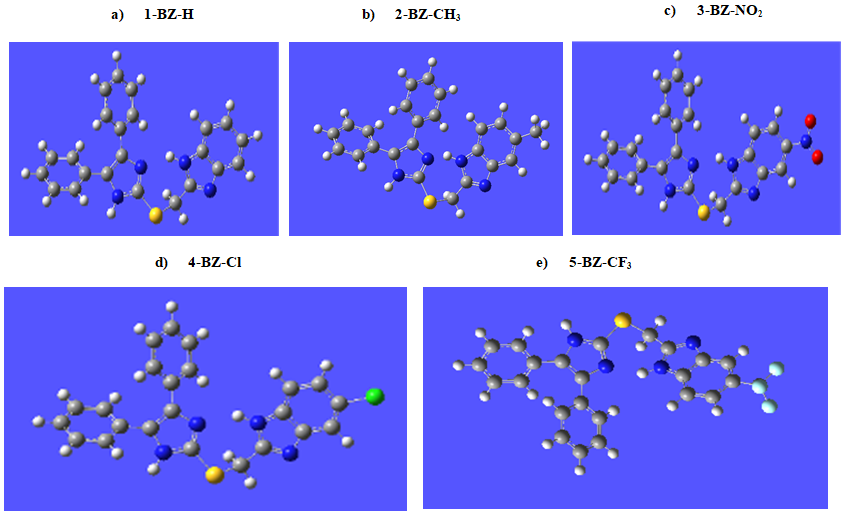
All the quantum chemical calculations have been performed at the B3LYP/6-31+G (d,p) level of theory, using Gaussian 09 19. This method of calculation has been extensively used to study the effectiveness of corrosion inhibitors and their electronic properties 20. Before the study of properties of inhibitors, the molecules were optimized (geometrical) by the Density Functional Theory 16 using functional (B3LYP) 21. The chemical and optimized structures of the compounds studied are given in Figure 1.
From Frontier Molecular Orbital (FMO) calculation, the energy of the highest occupied molecular orbital (EHOMO), lowest unoccupied molecular orbital (ELUMO), and the energy gap ( ) were obtained to elucidate inhibition mechanisms. Additional descriptors were calculated, such as ionization potential
(I = – ), electron affinity (A =
 ), chemical potential (μ, Eq. 1), global hardness (η, Eq. 2), softness (S, Eq. 3), electronegativity (χ = – μ) and dipole moment (μD). The fraction of electrons transferred from inhibitors molecules to the copper surface for example was calculated (ΔN, Eq. 4).
 | (Eq.1) |
where χCu and χinb are the absolute electronegativity of copper and the inhibitor molecule, respectively; ηCu and ηinh are the absolute hardness of copper and the inhibitor molecule, respectively.
In order to calculate (∆N), the theoretical value for the electronegativity of bulk copper was χCu = 4.48 eV/mol and the absolute hardness is ηCu = 0 eV/mol (for a metallic bulk I = A), because they are softer than neutral metallic atoms 22. These parameters remain essential to determine the properties and effectiveness of corrosion inhibiting molecules 23, 24.
Calculations of chemical descriptors (Table 2) by the quantum method on benzimidazole derivatives in the gas phase were carried out on the optimized structures of the studied molecules represented in Figure 1 as previously reported in one of our recent publications 25. The calculated values of Gibbs free energy (ΔG) correspond to the thermodynamic stability of isolated molecules in the gas phase. Thus, negative ΔG values indicate that the optimized molecular structures are stable and their formation from constituent atoms is spontaneous under (B3LYP/6-31+G(d,p) theoretical level). Here, ΔG reflects the intrinsic energy stability of each inhibitor molecule, providing a useful descriptor of its relative reactivity and stability prior to adsorption process.
From Table 2, the thermodynamic results show that NO₂ and CF₃ give the most stable systems with ΔG = -29.08 Kcal/mol and ΔG = -28.70 Kcal/mol, resp. These compounds are followed by the 5-BZ-CF3 (ΔG= -27.99 Kcal/mol), 2-BZ-CH3 (ΔG= -27.79 Kcal/mol) and 1-BZ-H (ΔG= -27.51 Kcal/mol). It should be noted that the observed thermodynamic stability is not directly or exclusively correlated with the electron-donating character of the substituent. Other factors, such as mesomeric or resonance effects on the conjugated NO₂ system, may also contribute to their stabilization 26 27.
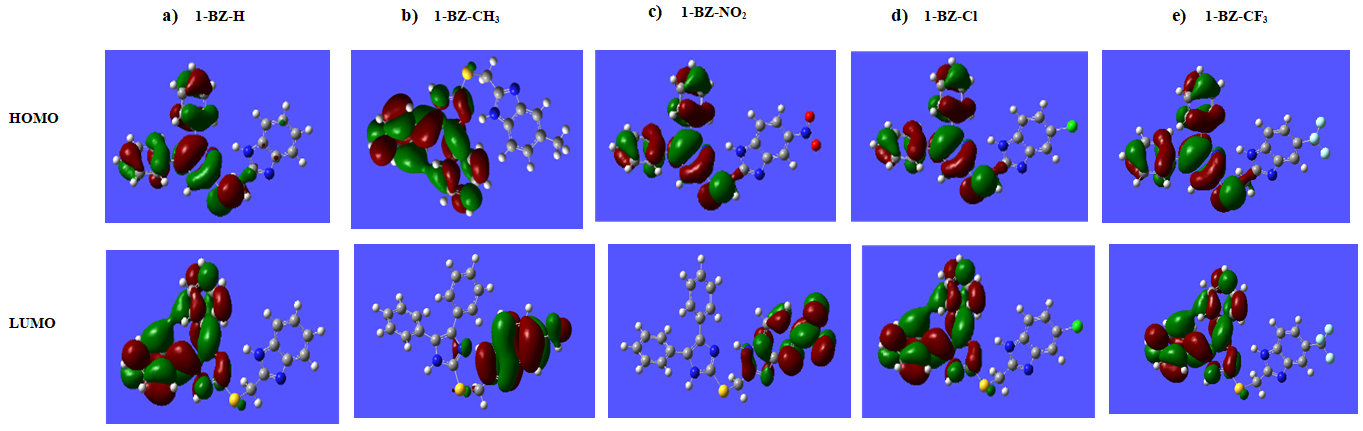
Figure 2 shows the HOMO and LUMO plots of the optimized molecules. Table 2 also presents the values of the electronic parameters obtained (EHOMO, ELUMO and ΔE). EHOMO (Highest Occupied Molecular Orbital) reflects the ability of a compound to donate electrons to the metallic surface, thereby favoring the formation of chemical bonds with the vacant orbitals of the metal. The higher the energy (less negative), the easier the electron donation. Conversely, ELUMO (Lowest Unoccupied Molecular Orbital) indicates the ability of the molecule to accept electrons from the metallic surface (back-donation), thus enhancing the stability of the adsorption process.
The results show that the compounds 2-BZ-CH₃ has the highest EHOMO (-5.84 eV), indicating a high electronic donation capacity of this compound and therefore a good adsorption ability on the metal surface. A classification taking into account the capacity to donate electrons, we note 2-BZ-CH3 ˃ 1-BZ-H ˃ 4-BZ-Cl ˃ 5-BZ-CF3 ˃ 3-BZ-NO₂. According to ELUMO values, 3-BZ-NO₂ has the lowest ability to accept electrons from the metallic surface (ELUMO = −2.37 eV), therefore an important retro-donation favoring a more stable bond. A classification taking into account the capacity to receive electrons, we note that 2-BZ-CH3 ˃ 1-BZ-H ˃ 4-BZ-Cl ˃ 5-BZ-CF3 ˃ 3-BZ-NO₂. The energy gap (the difference between these two energy levels) provides information on the overall reactivity: a lower gap corresponds to a more polarizable molecule, and therefore one more prone to interact with the metal 28, 29. Table 2 show that the compounds can be classified in the following order of reactivity and polarization: 3-BZ-NO₂ ˃ 2-BZ-CH3 ˃ 1-BZ-H ˃ 4-BZ-Cl ˃ 5-BZ-CF3. 3-BZ-NO₂ presents the smallest energy gap (ΔE= 3.77 eV). It is the most reactive and the most polarizable molecule, and therefore the most likely to interact with the metal and thus, the best potential inhibitor. The compounds 4-BZ-Cl and 5-BZ-CF₃ have the highest gap energies, resulting in low reactivity and therefore lower inhibitory efficacy. In contrast, the donating compounds 2-BZ-CH₃ and 1-BZ-H have a moderately reduced ΔE (4.35 eV and 4.37 eV resp.), indicating an intermediate stabilizing effect.


From the dipole moment analysis, 3-BZ-NO₂ exhibits the highest dipole moment (21.90 D), indicating the high possibility of adsorption on the metal surface. The inhibitor interacts strongly with the metal surface by donating electron pairs of nitrogen and sulfur atoms to metal’s vacant d-orbitals. That lead to the formation of a stable protective film to prevents corrosion 28, 30. However, the dipole moment alone is not sufficient to predict the inhibition efficiency of a molecule. A comparative analysis shows that 3-BZ-NO₂ has a high potential for surface interaction due to its low energy gap, which favors polarization and possible back-donation effects. Compounds 1-BZ-H (6.45 D) and 2-BZ-CH₃ (6.08 D), with intermediate dipole moments, are expected to adsorb mainly through electron donation because of their relatively high EHOMO values. The compounds 4-BZ-Cl (8.90 D) and 5-BZ-CF₃ (10.39 D), with intermediate polarity, are less favorable candidates for adsorption due to their large band gap energies 4.40 eV and 4.42 eV, respectively. This suggests less reactivity and weaker electron exchange with the metal surface.
The fraction of transferred electrons (ΔN) is an important parameter in the study of the interaction between the inhibitor and the metal surface. Positive value of ΔN indicates net electron transfer from the inhibitor molecule to the metal. This transfer promotes the formation of coordination bonds and therefore stable adsorption on the metal surface. The higher the ΔN value, the greater the electron donation capacity and therefore the inhibitory potential. ΔN values < 3.6 indicate a tendency for molecules to donate electrons to the metal surface. In this case, inhibition efficiency increases with the inhibitors' ability to donate electrons to the metal 31, 32, 33, 34. In this context, DFT calculation using metallic slabs such as Cu (111), or Fe (110) have been widely used to describe adsorption mechanisms, adsorption energies, and charge transfer phenomena between inhibitors and metal surfaces 35, 36, 37. These computational approaches provide detailed insights into inhibitor–surface interactions at the atomic scale, clarifying adsorption process. Several studies have shown that benzimidazole derivatives exhibit strong bond (chemisorption) on Fe (110) and Cu (111) surfaces, in agreement with high inhibition activities 36, 37. The DFT results confirm that electron donation from heteroatoms (N, S) to vacant metal orbitals enhances charge transfer and surface protection 37. From Table 2, ΔN values obtained are positive and smaller than 3.6. This places this family of compounds in the category of inhibitors that act by net electron transfer to the metal surface. Several studies on corrosion inhibitors show a correlation between experimental inhibition efficiencies and the fraction of electrons transferred 31, 38. However, it has also has been demonstrated that no strict or linear relationship exists between increasing ΔN values and inhibition efficiency 38. The positive ΔN values of 1-BZ-H and 2-BZ-CH₃, as well as the high EHOMO values, indicate strong electron donor properties supporting a chemisorption mechanism (coordination with the d orbitals of copper). In contrast, 3-BZ-NO₂, with its low ΔE and high dipole moment, exhibits significant polarization favoring physisorption and back-donation interactions. These results show importance of the key electronic parameters (EHOMO, ΔE, ΔN, μD) governing inhibitor–metal interactions. The use of explicit surface models in future work will help validate and refine these theoretical predictions.
Future work will focus on Adsorption Locator simulations using COSMO-RS solvation method to provide solvent-corrected under realistic corrosion conditions of quantum descriptors (EHOMO, ΔE, ΔN, μD), PDOS and adsorption energies (Eads) of inhibitor on Cu (111) and Fe(110) surfaces. studies will clarify the roles of N and S atoms in adsorption process. The adsorption Gibbs free energy (ΔGads) will quantify the spontaneity and the bond strength between the molecule and the metal surface and refine understanding of inhibitor–metal interactions. Overall, these approaches to enhance prediction of adsorption stability and inhibition performance of benzimidazole derivatives.
From DFT quantum chemical calculations at B3LYP/6-31+G(d,p) theory level, a correlation between key parameters from the electronic structure of functionalized 2-[(benzimidazolyl)methylthio]imidazole derivatives and their potential as metal corrosion inhibitor could be established. According to theoretical data, 2-[(benzimidazolyl)methylthio]imidazole derivatives are stable in the gas phase with negative Gibbs free energy. The two most stable thermodynamically are 3-BZ-NO₂ (ΔG = -29.08 Kcal/mol) and 5-BZ-CF₃ (ΔG = -28.70 Kcal/mol). From FMO calculations, the compound 3-BZ-NO₂ has the lowest ELUMO and the smallest gap energy, showing reactivity and backdonation capacity. Furthermore, the compounds 1-BZ-H and 2-BZ-CH₃ exhibit the highest EHOMO, suggesting electron donation from the inhibitor molecule to the metal. From the dipole moment calculation, the compound 3-BZ-NO₂ has the highest value (21.90 D), that ascribe a strong molecular polarity, responsible of adsorption on the metal surface. 4-BZ-Cl and 5-BZ-CF₃ suggest moderate inhibition efficiency due to their relatively large band gap. Although the present study focused on the gas phase electronic properties of the inhibitors, it is well recognized that the adsorption of inhibitor molecules onto a metallic surface is the key step governing corrosion protection. Therefore, understanding and modeling the inhibitor–metal interface represents an essential complement to quantum chemical analysis in the gas.
| [1] | A. Kadhim, A. A. Al-Amiery, R. Alazawi, M. K. S. Al-Ghezi, and R. H. Abass, “Corrosion inhibitors. A review,” International Journal of Corrosion and Scale Inhibition, vol. 10, no. 1, pp. 54–67, 2021. | ||
| In article | View Article | ||
| [2] | N. R. Dhongde, N. K. Das, J. Hazarika, J.-G. Park, T. Banerjee, and P. V. Rajaraman, “Azoles as corrosion inhibitors in alkaline medium for ruthenium chemical mechanical planarization applications: Electrochemical and theoretical analysis,” J Mol Struct, vol. 1320, p. 139651, 2025. | ||
| In article | View Article | ||
| [3] | C. Verma et al., “Principles and theories of green chemistry for corrosion science and engineering: design and application,” Green Chemistry, vol. 26, no. 8, pp. 4270–4357, 2024. | ||
| In article | View Article | ||
| [4] | V. Singh et al., “A sustainable and green method for controlling acidic corrosion on mild steel using leaves of Araucaria heterophylla,” Sci Rep, vol. 15, no. 1, p. 2225, 2025. | ||
| In article | View Article PubMed | ||
| [5] | A. A. Mohamed, A. T. Mubarak, Z. M. H. Marstani, and K. F. Fawy, “A novel kinetic determination of dissolved chromium species in natural and industrial waste water,” Talanta, vol. 70, no. 2, pp. 460–467, 2006. | ||
| In article | View Article PubMed | ||
| [6] | M. A. Ahmed, S. Amin, and A. A. Mohamed, “Current and emerging trends of inorganic, organic and eco-friendly corrosion inhibitors,” RSC Adv, vol. 14, no. 43, pp. 31877–31920, 2024. | ||
| In article | View Article PubMed | ||
| [7] | D. Kobbekaduwa, O. Nanayakkara, T. Krevaikas, and L. Di Sarno, “Effect of organic corrosion inhibitors on the behaviour of repair mortars and reinforcement corrosion,” Constr Build Mater, vol. 451, p. 138787, 2024. | ||
| In article | View Article | ||
| [8] | K. A. Othman, W. M. Hamad, and R. A. Omer, “Theoretical and experimental exploration of organic molecules adsorption on iron surfaces for corrosion inhibition: a review,” Corrosion Reviews, vol. 43, no. 3, pp. 335–359, 2025. | ||
| In article | View Article | ||
| [9] | S. Benabid and L. Toukal, “Inhibition Effect of Benzimidazole Derivatives on the Corrosion of Mild Steel in Acidic Medium: Experimental and Theoretical Studies.,” Acta Chim Slov, vol. 71, no. 4, 2024. | ||
| In article | View Article PubMed | ||
| [10] | X. Guo et al., “Understanding the adsorption of imidazole corrosion inhibitor at the copper/water interface by ab initio molecular dynamics,” Corros Sci, vol. 236, p. 112237, 2024. | ||
| In article | View Article | ||
| [11] | Y. Song et al., “Corrosion inhibition of two imidazole–pyridine derivatives on Q235 steel in HCl: Experimental and theoretical studies,” Corrosion Engineering, Science and Technology, p. 1478422X251350823, 2025. | ||
| In article | View Article | ||
| [12] | X. Wang, J. Yang, and X. Chen, “2-Benzylsulfanyl-1H-benzimidazole and its mixture as highly efficient corrosion inhibitors for carbon steel under dynamic supercritical CO2 flow conditions,” Corros Sci, vol. 235, p. 112170, 2024. | ||
| In article | View Article | ||
| [13] | S. Malinowski, M. Wróbel, and A. Woszuk, “Quantum chemical analysis of the corrosion inhibition potential by aliphatic amines,” Materials, vol. 14, no. 20, p. 6197, 2021. | ||
| In article | View Article PubMed | ||
| [14] | G. Gece, “The use of quantum chemical methods in corrosion inhibitor studies,” Corros Sci, vol. 50, no. 11, pp. 2981–2992, 2008. | ||
| In article | View Article | ||
| [15] | L. Ahmed, N. Bulut, O. Kaygılı, and R. Omer, “Quantum chemical study of some basic organic compounds as the corrosion inhibitors,” Journal of Physical Chemistry and Functional Materials, vol. 6, no. 1, pp. 34–42, 2023. | ||
| In article | View Article | ||
| [16] | N. Khalil, “Quantum chemical approach of corrosion inhibition,” Electrochim Acta, vol. 48, no. 18, pp. 2635–2640, 2003. | ||
| In article | View Article | ||
| [17] | M. J. Frisch et al., “Gaussian 09, version D. 01, Gaussian,” Inc., Wallingford, CT, 2009. | ||
| In article | |||
| [18] | B. Coulibaly, B. Fante, S.-E. Koffi Téki Dindet, A. V. Able, V. Chagnault, “Design, synthesis and antibacterial activity evaluation of 4, 5-Diphenyl-1H-Imidazoles derivatives,” Open Journal of Medicinal Chemistry, vol. 11, no. 2, pp. 17–26, 2021. | ||
| In article | View Article | ||
| [19] | E. Vernack, D. Costa, P. Tingaut, and P. Marcus, “DFT studies of 2-mercaptobenzothiazole and 2-mercaptobenzimidazole as corrosion inhibitors for copper,” Corros Sci, vol. 174, p. 108840, 2020. | ||
| In article | View Article | ||
| [20] | A. D. Becke, “Structure and optical properties of 2, 3, 7, 9-polysubstituted carbazole derivatives. Experimental and theoretical studies new mixing of Hartree-Fock and local density-functional theories,” J Chem Phys, vol. 98, pp. 1372–1377, 1993. | ||
| In article | View Article | ||
| [21] | M. N. El-Haddad, “Spectroscopic, electrochemical and quantum chemical studies for adsorption action of polyethylene oxide on copper surface in NaCl solution,” Zeitschrift für Physikalische Chemie, vol. 234, no. 11–12, pp. 1835–1851, 2020. | ||
| In article | View Article | ||
| [22] | N. Jain and R. Di Felice, “A Quantum Computational Method for Corrosion Inhibition,” J Chem Theory Comput, 2025. | ||
| In article | View Article PubMed | ||
| [23] | G. Gece, “The use of quantum chemical methods in corrosion inhibitor studies,” Corros Sci, vol. 50, no. 11, pp. 2981–2992, 2008. | ||
| In article | View Article | ||
| [24] | B. Coulibaly, K. Sangare, A. V. Able, V. Aurélie, and B. Fante, “Synthesis and theoretical study of the stability and reactivity of some 2-[(benzimidazolyl) methylthio]-4, 5-diphenylimidazole derivatives using the Density Functional Theories (DFT) method.,” Journal of Drug Delivery & Therapeutics, vol. 14, no. 10, 2024. | ||
| In article | View Article | ||
| [25] | L. Beverina and G. A. Pagani, “π-Conjugated zwitterions as paradigm of donor–acceptor building blocks in organic-based materials,” Acc Chem Res, vol. 47, no. 2, pp. 319–329, 2014. | ||
| In article | View Article PubMed | ||
| [26] | R. W. Taft Jr, S. Ehrenson, I. C. Lewis, and R. E. Glick, “Evaluation of resonance effects on reactivity by application of the linear inductive energy relationship. 1, 2 VI. Concerning the effects of polarization and conjugation on the mesomeric order,” J Am Chem Soc, vol. 81, no. 20, pp. 5352–5361, 1959. | ||
| In article | View Article | ||
| [27] | E. Gutiérrez, J. A. Rodríguez, J. Cruz-Borbolla, J. G. Alvarado-Rodríguez, and P. Thangarasu, “Development of a predictive model for corrosion inhibition of carbon steel by imidazole and benzimidazole derivatives,” Corros Sci, vol. 108, pp. 23–35, 2016. | ||
| In article | View Article | ||
| [28] | E. E. Oguzie, C. B. Adindu, C. K. Enenebeaku, C. E. Ogukwe, M. A. Chidiebere, and K. L. Oguzie, “Natural products for materials protection: mechanism of corrosion inhibition of mild steel by acid extracts of Piper guineense,” The Journal of Physical Chemistry C, vol. 116, no. 25, pp. 13603–13615, 2012. | ||
| In article | View Article | ||
| [29] | A. Popova, M. Christov, and T. Deligeorgiev, “Influence of the molecular structure on the inhibitor properties of benzimidazole derivatives on mild steel corrosion in 1 M hydrochloric acid,” Corrosion, vol. 59, no. 9, pp. 756–764, 2003. | ||
| In article | View Article | ||
| [30] | N. A. Wazzan and F. M. Mahgoub, “DFT calculations for corrosion inhibition of ferrous alloys by pyrazolopyrimidine derivatives,” Open J Phys Chem, vol. 4, no. 1, pp. 6–14, 2014. | ||
| In article | View Article | ||
| [31] | E. A. Mohamed, H. E. Hashem, E. M. Azmy, N. A. Negm, and A. A. Farag, “Synthesis, structural analysis, and inhibition approach of novel eco-friendly chalcone derivatives on API X65 steel corrosion in acidic media assessment with DFT & MD studies,” Environ Technol Innov, vol. 24, p. 101966, 2021. | ||
| In article | View Article | ||
| [32] | H. M. Gebremeskel, M. A. Welearegay, and T. T. Nadew, “Computational investigation of corrosion inhibition properties of hydrazine and its derived molecules for mild steel,” Quantum Engineering, vol. 2024, no. 1, p. 5343086, 2024. | ||
| In article | View Article | ||
| [33] | S. Satpati, S. K. Saha, A. Suhasaria, P. Banerjee, and D. Sukul, “Adsorption and anti-corrosion characteristics of vanillin Schiff bases on mild steel in 1 M HCl: experimental and theoretical study,” RSC Adv, vol. 10, no. 16, pp. 9258–9273, 2020. | ||
| In article | View Article PubMed | ||
| [34] | K. F. Khaled, “Studies of iron corrosion inhibition using chemical, electrochemical and computer simulation techniques,” Electrochim Acta, vol. 55, no. 22, pp. 6523–6532, 2010. | ||
| In article | View Article | ||
| [35] | J. Zhu et al., “Understanding the inhibition performance of novel dibenzimidazole derivatives on Fe (110) surface: DFT and MD simulation insights,” Journal of Materials Research and Technology, vol. 17, pp. 211–222, 2022. | ||
| In article | View Article | ||
| [36] | E. Vernack, D. Costa, P. Tingaut, and P. Marcus, “DFT studies of 2-mercaptobenzothiazole and 2-mercaptobenzimidazole as corrosion inhibitors for copper,” Corros Sci, vol. 174, p. 108840, 2020. | ||
| In article | View Article | ||
| [37] | X. Wang et al., “Corrosion inhibition effect of benzimidazole and two derivatives on copper in alkaline environments: Experimental and theoretical analyses,” J Mol Liq, vol. 390, p. 122985, 2023. | ||
| In article | View Article | ||
| [38] | I. Ahamad, R. Prasad, and M. A. Quraishi, “Thermodynamic, electrochemical and quantum chemical investigation of some Schiff bases as corrosion inhibitors for mild steel in hydrochloric acid solutions,” Corros Sci, vol. 52, no. 3, pp. 933–942, 2010. | ||
| In article | View Article | ||
Published with license by Science and Education Publishing, Copyright © 2025 Sangaré Kassoum, Coulibaly Bamoro, Seyhi Brahima, Diomandé Sekou and Yao-Kouassi Akoua Philomène
 This work is licensed under a Creative Commons Attribution 4.0 International License. To view a copy of this license, visit
http://creativecommons.org/licenses/by/4.0/
This work is licensed under a Creative Commons Attribution 4.0 International License. To view a copy of this license, visit
http://creativecommons.org/licenses/by/4.0/
| [1] | A. Kadhim, A. A. Al-Amiery, R. Alazawi, M. K. S. Al-Ghezi, and R. H. Abass, “Corrosion inhibitors. A review,” International Journal of Corrosion and Scale Inhibition, vol. 10, no. 1, pp. 54–67, 2021. | ||
| In article | View Article | ||
| [2] | N. R. Dhongde, N. K. Das, J. Hazarika, J.-G. Park, T. Banerjee, and P. V. Rajaraman, “Azoles as corrosion inhibitors in alkaline medium for ruthenium chemical mechanical planarization applications: Electrochemical and theoretical analysis,” J Mol Struct, vol. 1320, p. 139651, 2025. | ||
| In article | View Article | ||
| [3] | C. Verma et al., “Principles and theories of green chemistry for corrosion science and engineering: design and application,” Green Chemistry, vol. 26, no. 8, pp. 4270–4357, 2024. | ||
| In article | View Article | ||
| [4] | V. Singh et al., “A sustainable and green method for controlling acidic corrosion on mild steel using leaves of Araucaria heterophylla,” Sci Rep, vol. 15, no. 1, p. 2225, 2025. | ||
| In article | View Article PubMed | ||
| [5] | A. A. Mohamed, A. T. Mubarak, Z. M. H. Marstani, and K. F. Fawy, “A novel kinetic determination of dissolved chromium species in natural and industrial waste water,” Talanta, vol. 70, no. 2, pp. 460–467, 2006. | ||
| In article | View Article PubMed | ||
| [6] | M. A. Ahmed, S. Amin, and A. A. Mohamed, “Current and emerging trends of inorganic, organic and eco-friendly corrosion inhibitors,” RSC Adv, vol. 14, no. 43, pp. 31877–31920, 2024. | ||
| In article | View Article PubMed | ||
| [7] | D. Kobbekaduwa, O. Nanayakkara, T. Krevaikas, and L. Di Sarno, “Effect of organic corrosion inhibitors on the behaviour of repair mortars and reinforcement corrosion,” Constr Build Mater, vol. 451, p. 138787, 2024. | ||
| In article | View Article | ||
| [8] | K. A. Othman, W. M. Hamad, and R. A. Omer, “Theoretical and experimental exploration of organic molecules adsorption on iron surfaces for corrosion inhibition: a review,” Corrosion Reviews, vol. 43, no. 3, pp. 335–359, 2025. | ||
| In article | View Article | ||
| [9] | S. Benabid and L. Toukal, “Inhibition Effect of Benzimidazole Derivatives on the Corrosion of Mild Steel in Acidic Medium: Experimental and Theoretical Studies.,” Acta Chim Slov, vol. 71, no. 4, 2024. | ||
| In article | View Article PubMed | ||
| [10] | X. Guo et al., “Understanding the adsorption of imidazole corrosion inhibitor at the copper/water interface by ab initio molecular dynamics,” Corros Sci, vol. 236, p. 112237, 2024. | ||
| In article | View Article | ||
| [11] | Y. Song et al., “Corrosion inhibition of two imidazole–pyridine derivatives on Q235 steel in HCl: Experimental and theoretical studies,” Corrosion Engineering, Science and Technology, p. 1478422X251350823, 2025. | ||
| In article | View Article | ||
| [12] | X. Wang, J. Yang, and X. Chen, “2-Benzylsulfanyl-1H-benzimidazole and its mixture as highly efficient corrosion inhibitors for carbon steel under dynamic supercritical CO2 flow conditions,” Corros Sci, vol. 235, p. 112170, 2024. | ||
| In article | View Article | ||
| [13] | S. Malinowski, M. Wróbel, and A. Woszuk, “Quantum chemical analysis of the corrosion inhibition potential by aliphatic amines,” Materials, vol. 14, no. 20, p. 6197, 2021. | ||
| In article | View Article PubMed | ||
| [14] | G. Gece, “The use of quantum chemical methods in corrosion inhibitor studies,” Corros Sci, vol. 50, no. 11, pp. 2981–2992, 2008. | ||
| In article | View Article | ||
| [15] | L. Ahmed, N. Bulut, O. Kaygılı, and R. Omer, “Quantum chemical study of some basic organic compounds as the corrosion inhibitors,” Journal of Physical Chemistry and Functional Materials, vol. 6, no. 1, pp. 34–42, 2023. | ||
| In article | View Article | ||
| [16] | N. Khalil, “Quantum chemical approach of corrosion inhibition,” Electrochim Acta, vol. 48, no. 18, pp. 2635–2640, 2003. | ||
| In article | View Article | ||
| [17] | M. J. Frisch et al., “Gaussian 09, version D. 01, Gaussian,” Inc., Wallingford, CT, 2009. | ||
| In article | |||
| [18] | B. Coulibaly, B. Fante, S.-E. Koffi Téki Dindet, A. V. Able, V. Chagnault, “Design, synthesis and antibacterial activity evaluation of 4, 5-Diphenyl-1H-Imidazoles derivatives,” Open Journal of Medicinal Chemistry, vol. 11, no. 2, pp. 17–26, 2021. | ||
| In article | View Article | ||
| [19] | E. Vernack, D. Costa, P. Tingaut, and P. Marcus, “DFT studies of 2-mercaptobenzothiazole and 2-mercaptobenzimidazole as corrosion inhibitors for copper,” Corros Sci, vol. 174, p. 108840, 2020. | ||
| In article | View Article | ||
| [20] | A. D. Becke, “Structure and optical properties of 2, 3, 7, 9-polysubstituted carbazole derivatives. Experimental and theoretical studies new mixing of Hartree-Fock and local density-functional theories,” J Chem Phys, vol. 98, pp. 1372–1377, 1993. | ||
| In article | View Article | ||
| [21] | M. N. El-Haddad, “Spectroscopic, electrochemical and quantum chemical studies for adsorption action of polyethylene oxide on copper surface in NaCl solution,” Zeitschrift für Physikalische Chemie, vol. 234, no. 11–12, pp. 1835–1851, 2020. | ||
| In article | View Article | ||
| [22] | N. Jain and R. Di Felice, “A Quantum Computational Method for Corrosion Inhibition,” J Chem Theory Comput, 2025. | ||
| In article | View Article PubMed | ||
| [23] | G. Gece, “The use of quantum chemical methods in corrosion inhibitor studies,” Corros Sci, vol. 50, no. 11, pp. 2981–2992, 2008. | ||
| In article | View Article | ||
| [24] | B. Coulibaly, K. Sangare, A. V. Able, V. Aurélie, and B. Fante, “Synthesis and theoretical study of the stability and reactivity of some 2-[(benzimidazolyl) methylthio]-4, 5-diphenylimidazole derivatives using the Density Functional Theories (DFT) method.,” Journal of Drug Delivery & Therapeutics, vol. 14, no. 10, 2024. | ||
| In article | View Article | ||
| [25] | L. Beverina and G. A. Pagani, “π-Conjugated zwitterions as paradigm of donor–acceptor building blocks in organic-based materials,” Acc Chem Res, vol. 47, no. 2, pp. 319–329, 2014. | ||
| In article | View Article PubMed | ||
| [26] | R. W. Taft Jr, S. Ehrenson, I. C. Lewis, and R. E. Glick, “Evaluation of resonance effects on reactivity by application of the linear inductive energy relationship. 1, 2 VI. Concerning the effects of polarization and conjugation on the mesomeric order,” J Am Chem Soc, vol. 81, no. 20, pp. 5352–5361, 1959. | ||
| In article | View Article | ||
| [27] | E. Gutiérrez, J. A. Rodríguez, J. Cruz-Borbolla, J. G. Alvarado-Rodríguez, and P. Thangarasu, “Development of a predictive model for corrosion inhibition of carbon steel by imidazole and benzimidazole derivatives,” Corros Sci, vol. 108, pp. 23–35, 2016. | ||
| In article | View Article | ||
| [28] | E. E. Oguzie, C. B. Adindu, C. K. Enenebeaku, C. E. Ogukwe, M. A. Chidiebere, and K. L. Oguzie, “Natural products for materials protection: mechanism of corrosion inhibition of mild steel by acid extracts of Piper guineense,” The Journal of Physical Chemistry C, vol. 116, no. 25, pp. 13603–13615, 2012. | ||
| In article | View Article | ||
| [29] | A. Popova, M. Christov, and T. Deligeorgiev, “Influence of the molecular structure on the inhibitor properties of benzimidazole derivatives on mild steel corrosion in 1 M hydrochloric acid,” Corrosion, vol. 59, no. 9, pp. 756–764, 2003. | ||
| In article | View Article | ||
| [30] | N. A. Wazzan and F. M. Mahgoub, “DFT calculations for corrosion inhibition of ferrous alloys by pyrazolopyrimidine derivatives,” Open J Phys Chem, vol. 4, no. 1, pp. 6–14, 2014. | ||
| In article | View Article | ||
| [31] | E. A. Mohamed, H. E. Hashem, E. M. Azmy, N. A. Negm, and A. A. Farag, “Synthesis, structural analysis, and inhibition approach of novel eco-friendly chalcone derivatives on API X65 steel corrosion in acidic media assessment with DFT & MD studies,” Environ Technol Innov, vol. 24, p. 101966, 2021. | ||
| In article | View Article | ||
| [32] | H. M. Gebremeskel, M. A. Welearegay, and T. T. Nadew, “Computational investigation of corrosion inhibition properties of hydrazine and its derived molecules for mild steel,” Quantum Engineering, vol. 2024, no. 1, p. 5343086, 2024. | ||
| In article | View Article | ||
| [33] | S. Satpati, S. K. Saha, A. Suhasaria, P. Banerjee, and D. Sukul, “Adsorption and anti-corrosion characteristics of vanillin Schiff bases on mild steel in 1 M HCl: experimental and theoretical study,” RSC Adv, vol. 10, no. 16, pp. 9258–9273, 2020. | ||
| In article | View Article PubMed | ||
| [34] | K. F. Khaled, “Studies of iron corrosion inhibition using chemical, electrochemical and computer simulation techniques,” Electrochim Acta, vol. 55, no. 22, pp. 6523–6532, 2010. | ||
| In article | View Article | ||
| [35] | J. Zhu et al., “Understanding the inhibition performance of novel dibenzimidazole derivatives on Fe (110) surface: DFT and MD simulation insights,” Journal of Materials Research and Technology, vol. 17, pp. 211–222, 2022. | ||
| In article | View Article | ||
| [36] | E. Vernack, D. Costa, P. Tingaut, and P. Marcus, “DFT studies of 2-mercaptobenzothiazole and 2-mercaptobenzimidazole as corrosion inhibitors for copper,” Corros Sci, vol. 174, p. 108840, 2020. | ||
| In article | View Article | ||
| [37] | X. Wang et al., “Corrosion inhibition effect of benzimidazole and two derivatives on copper in alkaline environments: Experimental and theoretical analyses,” J Mol Liq, vol. 390, p. 122985, 2023. | ||
| In article | View Article | ||
| [38] | I. Ahamad, R. Prasad, and M. A. Quraishi, “Thermodynamic, electrochemical and quantum chemical investigation of some Schiff bases as corrosion inhibitors for mild steel in hydrochloric acid solutions,” Corros Sci, vol. 52, no. 3, pp. 933–942, 2010. | ||
| In article | View Article | ||